SHANGHAI: The global trading system is under stress from protectionism and unilateralism, which will continue to grow unless countries can manage their domestic situations, said Singapore’s Trade and Industry Minister Chan Chun Sing during the Singapore-China Trade and Investment Forum in Shanghai on Tuesday (Nov 6).
Countries must be able to “make adjustments” and distribute gains from economic integration, in order to avoid “a global backlash” that could disrupt global supply chains and undermine growth, he said.
In light of the challenges facing the international trading system, Mr Chan said Singapore and China have “every reason” to work together to uphold an open, fair trading system.
He added that World Trade Organization (WTO) rules must also evolve to address new market trends.
BELT AND ROAD RISK CAN BE MINIMISED: CHAN CHUN SING
Mr Chan was in Shanghai to attend the first China International Import Expo.
During his three-day visit, he also met the Singapore business community in Shanghai and visited Singapore companies at the expo.
He noted that Singapore has continuously supported China’s integration with the rest of the world.
Trade and Industry Minister Chan Chun Sing said that countries must make adjustments in light of the stress on the global trading and economic system.
As China reaches a new stage of development, with its outward investment outstripping foreign direct investment, Mr Wong said there are new opportunities for Singapore companies.
One such opportunity is in providing financial and legal advisory services to support Belt and Road projects.
“One third of China’s Belt and Road outward investment goes through Singapore. Why does it go through Singapore? Because of a few very simple reasons. We combine the financial prowess and resources of China with the niche capabilities of Singapore,” he said.
“The niche capabilities of Singapore include our ability to syndicate loans, syndicate complex infrastructure projects for the long term, to use a legal system where it’s trusted by all parties.”
When asked about potential financial or reputational risk to Singapore, given that some Belt and Road projects have run into problems, Mr Chan said this risk can be minimised by evaluating projects according to market principles, maintaining market discipline, and through careful implementation.
OPPORTUNITIES FOR SINGAPORE COMPANIES IN CHINA
Speaking to reporters at the end of his visit to Shanghai, Mr Chan urged Singapore companies to explore opportunities in China beyond the developed coastal provinces.
He said both countries hope to promote more collaboration among businesses, including attracting Chinese companies to use the Singapore as a base in Southeast Asia, and working together to explore third-party markets.
“We encourage the Singapore companies to come to China, to explore the opportunities not just at the coastal provinces, but also some of the non-coastal provinces like in the western region or in the central region,” said Mr Chan, adding that China is a big market, with “a lot of opportunities for Singapore companies at different tiers of the market and different tiers of development”.
During his visit, Singapore and China also concluded talks to upgrade a free trade agreement between the two countries.
Elaborating on areas of further cooperation between Singapore and China, he said both sides can look into how to use the China-Singapore Free Trade Agreement, and tariff barriers and non-tariff barriers can be lowered.
He added: “Then there are also other issues like the mutual recognition of each other’s standards. For example, in the field of professional services, it’s very useful for both countries to have this mutual recognition of each other’s standards, and how we can better integrate our system of customs clearance.”
LARGER TREND IS IN GREATER GLOBAL INTEGRATION
Mr Chan also noted that Chinese President Xi Jinping made a significant speech at the opening of the Expo on Monday, where he pledged to continue to open up the Chinese market to the rest of the world.
“In my conversation with the Chinese leaders, I think they are very clear, that going forward the world can only get more integrated and not less. And the larger mega trend is that in any production of any complex product, it will be a global production chain, global supply chain and it is in our common interest for every one of us to work together to better integrate that global production chain,” he said.
“If we can do that, actually it will bring more benefits to all of us. Not just the Chinese companies, but also the Singapore and international companies. I think they are very clear that this is what they need to do. So not withstanding any temporal hiccups here and there, I think the larger trend is in the correct direction.”
While in Shanghai, Mr Chan also officiated opening ceremonies for Singapore companies Mapletree and UOB, and witnessed several Memorandum of Understanding signings between Singaporean and Chinese entities.
SINGAPORE: The Singapore Police Force (SPF) will be conducting road blocks and security checks in the area around Suntec during the 33rd ASEAN Summit.
This was announced in a joint news release on Tuesday (Nov 6) by the SPF, the Civil Aviation Authority of Singapore (CAAS) and the Land Transport Authority (LTA).
The area around Suntec has been designated as an Enhanced Security Special Event Area.
As part of the security measures in place, the news release provided details of prohibited items in the vicinity, a temporary restricted area and road closures and traffic arrangements during the period.
Unmanned aerial vehicles (UAVs) or drones are among a range of items prohibited within the special event area.
“Offenders may be arrested and, upon conviction, will be liable to a fine not exceeding S$20,000, to imprisonment for a term not exceeding 12 months, or both. The UAV will also be seized,” the joint release said.
Some of the other items prohibited include:
Any noxious or offensive substance.
A marine flare and signal, landing flare, highway fuse, smoke generator, distress signal or other pyrotechnic device intended for signalling, warning, rescue or similar purposes.
Any petroleum or flammable material within the meaning of the Fire Safety (Petroleum and Flammable Materials) Regulations.
An explosive within the meaning of the Arms and Explosives Act.
Any arms within the meaning of the Arms and Explosives Act.
ROAD BLOCKS
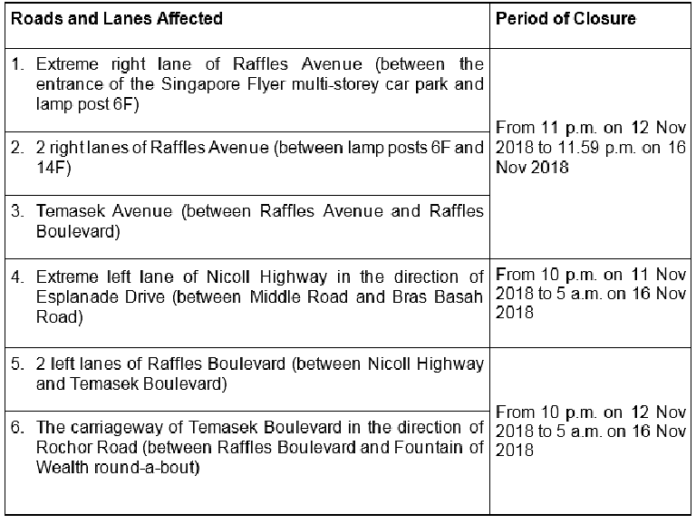
To facilitate security arrangements for the event, the following roads and lanes will be closed to traffic from Nov 11 to Nov 16:
CAAS will also establish a temporary Restricted Area over central areas in Singapore from Nov 12 (0000hrs) to Nov 16 (2359hrs), under the Air Navigation Order (ANO), the release said.
The central areas include: Fullerton Road, Connaught Drive, St Andrew’s Road, Stamford Road, Victoria Street, Bras Basah Road, Bencoolen Street, Rochor River, Syed Alwi Road, Beach Road, Java Road, Nicoll Highway and Shoreline of the Marina Promenade.
“During the stated dates and timings, the flying of UAVs and conduct of other aerial activities (such as kite-flying and hoisting of captive balloons) are prohibited within and into the temporary Restricted Area, unless authorised by the CAAS. Unauthorised conduct of aerial activities within and into the temporary Restricted Area is an offence under the ANO,” the release added.
SINGAPORE: It was a quiet Tuesday morning (Nov 6) at Woodlands estate, as the late Singapore Armed Forces (SAF) full-time national serviceman Liu Kai, surrounded by grieving family and friends, lay in a casket hours before a military funeral was scheduled to take place at Mandai Crematorium.
Corporal First Class (CFC) Liu, 22, died on Saturday after a training accident involving a Bionix vehicle.
He was operating a Land Rover during an exercise at the Jalan Murai training area when a Bionix vehicle reversed into his vehicle.
CFC Liu’s wake spanned across a block and a multi-purpose hall, where at least 50 chairs had been set up for a memorial service.
CFC Liu Kai’s mother being supported by her daughter as his hearse makes its way to Mandai Crematorium. (Photo: Marcus Mark Ramos)
Before the service started, CFC Liu’s family had gathered around his casket. His mother, now helped out of her wheelchair, looked at her son and cried uncontrollably.
By now a small crowd had gathered at the neighbouring block. One of them was crane operator William Mah, who said he lived there and came to pay his respects.
“Of course, it’s very sad,” the 58-year-old said. “This kind of thing should not happen.”
Family, friends and camp mates gathered to send CFC Liu Kai off. (Photo: Marcus Mark Ramos)
Soon dozens of SAF servicemen in uniform and black armbands, some with hands clasped in front of them, stood solemnly outside the hall. Inside, there were barely any seats left.
After attendees sang a soothing Chinese gospel song, a man holding a bible raised his hand and prayed before closing the casket.
Then SAF pallbearers carried out the Singapore flag-draped casket into a white hearse and saluted, as family members watched and sobbed under a throng of black umbrellas.
As the hearse inched out of the car park the family members held on to its rear, and the cries from CFC Liu’s mother grew louder.
The hearse carrying CFC Liu Kai being escorted as it arrives at Mandai Crematorium on Nov 6, 2018. (Photo: Howard Law)
At the crematorium, the hearse pulled in slowly behind a military band, flanked by hundreds of servicemen who lined the driveway and saluted.
The casket was carried into a service hall, where a ceremony took place in private.
On Monday, family members had described CFC Liu as a kind and warm-hearted boy who wanted to travel on a mission trip to Thailand to help those in need.
SHANGHAI: When Han Siyuan first decided to apply for a job as a pilot cadet in 2008, she was up against 400 female classmates in China on tests measuring everything from their command of English to the length of their legs.
Eventually, she became the only woman from her university that Shanghai-based Spring Airlines picked for training that year. She is now a captain for the Chinese budget carrier, but it has not become much easier for the women who have come after her.
Han is one of just 713 women in China who, at the end of 2017, held a licence to fly civilian aircraft, compared with 55,052 men. Of Spring Airlines’ 800 pilots, only six are women.
“I’ve gotten used to living in a man’s world,” she said.
China’s proportion of female pilots – at 1.3 per cent – is one of the world’s lowest, which analysts and pilots attribute to social perceptions and male-centric hiring practices by Chinese airlines.
But Chinese airlines are struggling with an acute pilot shortage amid surging travel demand, and female pilots are drawing attention to the gender imbalance.
Chinese carriers will need 128,000 new pilots over the next two decades, according to forecasts by planemaker Boeing Co , and the shortfall has so far prompted airlines to aggressively hire foreign captains and Chinese regulators to relax physical entry requirements for cadets.
“The mission is to start cutting down the thorns that cover this road, to make it easier for those who come after us,” said Chen Jingxian, a Shanghai-based lawyer who learned to fly in the United States and is among those urging change.
‘TOKEN EFFORTS’
Such issues are not confined to China; the proportion of female pilots in South Korea and Japan, where such jobs do not conform to widespread gender stereotypes, is also less than 3 per cent.
But it is a sharp contrast to the situation in India, which, like China, has a fast-growing aviation market. But thanks to aggressive recruiting and support such as day care, India has the world’s highest proportion of female commercial pilots, at 12 per cent.
Captain Han Siyuan, 30, poses in the cockpit of Spring Airlines Airbus A320 before taking off at Hongqiao International Airport in Shanghai, China Oct 8, 2018. (Photo: REUTERS/Aly Song)
China’s airlines only hire cadets directly from universities or the military. They often limit recruitment drives to male applicants and very rarely take in female cohorts.
In addition, unlike in other markets, such as the United States, China does not allow people to convert private flying licenses to commercial certificates for flying airliners.
Li Haipeng, deputy director of the Civil Aviation Management Institute of China’s general aviation department, said many airlines were also dissuaded to hire women by generous maternity leave policies. That has been further aggravated by Beijing’s move in 2015 to change the one-child policy, he added.
“Male pilots do not have the issue of not being able to fly for two years after giving birth, and after the introduction of the second-child policy, airlines are not willing to recruit and train a pilot only to have her not being able to fly for about five years,” he said.
Captain Han Siyuan, 30, poses with her dogs at her house in Shanghai, China Oct 18, 2018. (Photo: REUTERS/Aly Song)
He said Air China, China Eastern Airlines and China Southern Airlines had all made some effort to recruit female pilots, adding “nearly all other companies do not.”
China Eastern and China Southern declined to comment while Air China did not respond to Reuters’ requests for comment.
Pilots said that hiring decisions were usually left to individual airlines and did not appear to be driven by the country’s regulator, the Civil Aviation Administration of China, whose recruitment requirements do not mention gender.
Xiamen Airlines, a China Southern subsidiary, told Reuters it offers up to 540 days of maternity leave. It started recruiting female pilots in 2008, and paused for a few years in between before resuming last year. Out of its 2,700 pilots, 18 are women while another 18 are in training.
“Allowing more women to become pilots is undoubtedly a good way to supplement (an airline’s) flying capability,” a spokesman for the carrier said.
PERSUASION AND PUBLICITY
The strongest calls for change are coming mostly from Chinese female pilots, thanks to a slew of returnees who learned how to fly while living abroad in countries like the United States.
In March, the China Airline Pilots Association (ChALPA) established a female branch at an event attended by pilots from the People’s Liberation Army Air Force and local airlines, according to media reports.
Captain Han Siyuan, 30, gets ready before her plane takes off at an office of Spring Airlines in SHanghai, China Oct 18, 2018. (Photo: REUTERS/Aly Song)
Chen, the lawyer who also serves as a vice-president of the ChALPA’s women’s branch, said she and others have been trying to spread the word by speaking about the issue at air shows in China.
Eventually, she said, the organisation hopes to persuade Chinese airlines to adjust their recruitment and maternity policies.
Another key obstacle to tackle, she added, was the inability of general aviation pilots to shift to the commercial sector.
“It’s a systemic issue,” she said. “We hope that change can happen in three to five years, but this is not something that is up to us.”
Others like Han, who in recent months has appeared in Spring Airlines promotional videos, said she hoped the growing publicity would help to raise awareness.
“I can’t personally give people opportunities,” she said. “But I hope that (the publicity) can slowly help open the door for companies or for girls with dreams to fly.”
SINGAPORE: A high-level gathering of trade experts in Singapore last month emphasised how US-China trade tensions are already affecting the Asia-Pacific region.
As leaders gather for the upcoming ASEAN and APEC Summits, they face a deepening trade crisis that shows no signs of easing.
The first Singapore Trade Policy Forum, organised by the Centre for Multilateralism Studies of the S Rajaratnam School of International Studies at Nanyang Technological University, brought together 40 experts from governments, business and universities across the region for an in-depth discussion of current threats to the trading system and what to do about them.
DEEPENING AND WIDENING THREATS
Business leaders in Singapore and beyond are increasingly concerned over the fall-out from the trans-Pacific confrontation. The weakening of the World Trade Organisation (WTO), the only global trade safety net, is also a growing worry.
Businesses fear the uncertainty arising from unilateral trade measures. This is having an effect on investment decisions and may lead to the relocation of investment away from China.
Some regional players could benefit from this, but overall the costs, in terms of disrupted supply chains and trade distortion, will be high.
The latest forecasts from the IMF highlight the global scale of the effects. There are no signs of these negative effects on growth and confidence abating. On the contrary, they are expected to intensify in 2019.
The US-China situation is hard to resolve because trade policy is only one aspect of a growing geopolitical rivalry. Some have talked of a new Cold War, and Vice-President Mike Pence’s recent speech accusing China of interference in the US’s mid-term elections gives weight to this.
However China’s economic power, still greater than the Soviet Union’s ever was, should restrain any thoughts of an easy trade war win for the US.
With trade growth set to slow sharply amid a trade war between the US and China, the IMF cut its outlook for global GDP by two-tenths to 3.7 percent for 2018 and 2019. (Photo: AFP/Mark RALSTON)
The expectation that China’s WTO accession would lead it to converge with western norms has proven false. Instead we have competing models of capitalism, state and market, both deeply rooted in their political systems.
At the Singapore Trade Policy Forum, it seems participants understood the concerns that the US and other traders have about China’s policies, for example on state-owned enterprises, digital trade and intellectual property. These predate the Trump administration and are widely shared in governments and business.
However, they were also worried about the US administration’s preference for unilateral action over strengthening the multilateral system, its apparent lack of a coherent strategy or an inclusive view of business interests and its relations with regional countries.
In particular, pressure to take sides in the dispute – to “choose a lane” as a US official put it recently – was seen as something to be resisted.
If anything, it is likely that current US tactics will reinforce hardliners in China and make reforms in areas where there are legitimate concerns less likely. It was also suggested that they might accelerate China’s move towards less reliance on trade as its economic driver.
No one expects that either side will change course soon. There is no quick fix in prospect.
Instead, the Forum focused on what businesses and governments in the region can do to limit the fallout. In the short term, the key word is containment. This means, in particular, pushing ahead with regional trade agreements.
Signs with the US and Chinese flags hang outside a store selling foreign goods in Qingdao, in China’s eastern Shandong province, a day after Beijing announced an additional US$60 billion in retaliatory tariffs on US good as part of a trade war. (Photo: AFP
The entry into force of the Comprehensive and Progressive Agreement for Trans-Pacific Partnership (CPTPP) will send a strong signal of commitment to open and cooperative trade policy. So would conclusion of the negotiations over the Regional Comprehensive Economic Partnership (RCEP).
While as a trade agreement like the RCEP is not as ambitious as the CPTPP, its country coverage gives it great political importance. Negotiators aim to get at least a long way towards finalising it by the end of the year.
Bilateral and other new regional free trade agreements (FTAs) are also increasingly important between Asia-Pacific economies and others, particularly the EU.
Completion of the Japan-EU FTA last year was spurred on by concerns about the deteriorating trade environment and the need to reinforce the benefits of integration. It is likely to serve as a template for the agreements that the EU will negotiate next, with Australia, New Zealand and possibly Mercosur (the Common Market of the South comprising Argentina, Brazil, Uruguay and Paraguay).
And looking beyond Brexit, the UK’s interest in joining CPTPP has generally been well received.
The importance of other platforms for regional cooperation was also endorsed. APEC in particular can provide, through its inclusive membership and its non-binding, consultative nature, a venue for quiet diplomacy where smaller economies can work to influence China and the US.
The possibility of using the good offices of the WTO Director-General to mediate between the US and China was also raised at the Forum. This is possible under WTO rules, but both sides would have to be in the market for it, which is clearly not the case now.
Perhaps some such mediation could become relevant as part of finalising and working out an eventual deal if the two are able to find common ground.
ESSENTIAL TO REINFORCE WTO
Over the longer term, reinforcing the WTO system is vital. The rules need updating and clarifying, but this can’t mean just targeting China.
Leaders of 11 nations sign a slimmed-down version of the TPP trade agreement, now known as the Comprehensive and Progressive Agreement for Trans-Pacific Partnership (CPTPP) in Santiago, Chile, on Mar 8, 2018. (Photo: AFP/CLAUDIO REYES)
All the major trading powers are on the spectrum of subsidisation, for example. And systemic changes alone are not a cure-all. It’s how its members use the WTO that matters.
It is also important not to push the system beyond its limits. The WTO dispute settlement system, already under severe pressure, cannot resolve the fundamental US-China conflict. The way forward has to be through negotiation.
Mobilising more active business support for the multilateral system is also essential. This has to go beyond just making statements – effective political lobbying is needed. National and regional business groups have an important part to play here. Recent surveys show their members now see this as a higher priority than in previous years.
Some hope that the US will eventually move away from unilateralism if it becomes concerned about FTAs hampering its access to the 95 per cent of the world’s consumers who live outside its borders.
The epicentre of growth is still Asia, with its expanding middle class demand. This puts the region’s governments and businesses in a key strategic position.
With growing economic clout and close links to both China and the US, the other countries of the Asia-Pacific region are uniquely well placed to weigh in on the side of cooperation and managing competition.
They can and should lead the movement back to a new and more stable trade consensus.
Evan Rogerson is adjunct senior fellow in the Centre for Multilateralism Studies at S Rajaratnam School of International Studies, and the convener of the Singapore Trade Policy Forum. He was formerly a Director at the WTO and has more than 40 years’ experience in trade policy.
SINGAPORE: He longs to see his 5-year-old son and wishes he could be back in India with his wife for Deepavali.
“I’m so happy whenever I see them,” Kotisuntaram said. He breaks into a smile whenever he speaks about his family.
But for Deepavali this year, the 31-year-old construction worker will only be making a video call with his family from his dormitory room.
“This year I’m just staying in Singapore for Deepavali. I’m in Singapore to find money and I want to take my salary and give it to my family instead of using it on plane tickets to fly back home,” he said.
Deepavali, the festival of lights, is one of the most important Hindu festivals in India. The festival is also celebrated in several other Asian countries like Malaysia and Singapore, which will be commemorating it on Tuesday (Nov 6).
Those celebrating the occasion put on lavish outfits, erect spectacular light displays to mark the triumph of light over darkness and indulge in feasts fit for a king. And just like Chinese New Year and Christmas, there is a heavy emphasis on spending the occasion, which can last several days, with family.
But those occasions are rare for Kotisuntaram, who has been working in Singapore for 13 years.
Kotisuntaram, 31, is eagerly anticipating spending Deepavali with his family once he saves up enough money. (Photo: Ainslee Asokan)
He was able to return to Tamil Nadu last year to celebrate the festival with his family, an occasion he cherished.
“Last year’s Deepavali celebrations were so good when the family came together,” Kotisuntaram said.
The day had started with him picking out festive clothes for his wife and son, before settling in to watch the fireworks that were put together specially for the day.
“I was so happy to be with my family.
“So happy.”
As of 2017, there are about 1.4 million foreign workers in Singapore, with 1.1 million of them being S Pass and work permit holders, according to the Ministry of Manpower.
For many, financial constraints and not being able to take time off work, stand in the way of them going home on festive occasions.
“I miss spending Deepavali back home,” said Sebaria, 29, a technician who has been working here for two years.
“What is Deepavali here without my family?
“I’m feeling sad, but what can I do?” he said with a despondent shrug before he grew quiet.
When asked if he would go back to India if given the chance, he said: “They are my family so I’m happy if I’m with them for Deepavali, but economically it is not good for me.”
Sebaria, 29, is one of the few foreign workers who will be spending Deepavali in Singapore this year. (Photo: Ainslee Asokan)
A return plane ticket which can cost up to S$300 during the festive period has stopped Sebaria from visiting his family back in India.
It is a big sum for foreign workers like him who are paid low wages and have debts to clear.
“(Workers) who come to Singapore from Bangladesh and India, they actually pay very high agent fees,” said Isabel Phua, programme head for Migrant X Me a social enterprise that aims to bridge the gap between the migrant worker community and youths in Singapore.
Agent fees can sometimes go up to S$20,000, she said of work permit holders.
“When they come to Singapore, their contracts are only one to two years long and they are being paid S$400 to S$500 dollars a month.
“Even if you send back the full amount every month, it is still not enough to cover the debts that they are in and so that is why they choose to work overtime,” she said as she explained why many of these workers make the painful decision to spend Deepavali away from their families.
TIME TO MAKAN
Many of the foreign workers who are not able to be with their families make the best of their time in Singapore by preparing a feast of their own – like Arulmania, 27, a maintenance worker.
“I’m cooking mutton and chicken curry in my dorm!” he said excitedly as he laid out his plans for Tuesday.
“This year, I will be cooking, makan, and going to the movies,” he said.
For these foreign workers, “makan” – meaning to eat in Malay – is a highlight of the Deepavali celebrations.
And initiatives like Oh Wow! by It’s Raining Raincoats are using food to reach out to those who are away from their families on Deepavali.
Oh Wow! which was rolled out on Saturday, encourages Singaporeans to invite foreign workers for a home-cooked meal, restaurant outing or even for a quick lunch together at various work sites, said founder of It’s Raining Raincoats, Dipa Swaminathan.
One of Oh Wow!’s initiatives is to distribute food to work sites, and to join the workers for a meal. (Photo: Dipa Swaminathan)
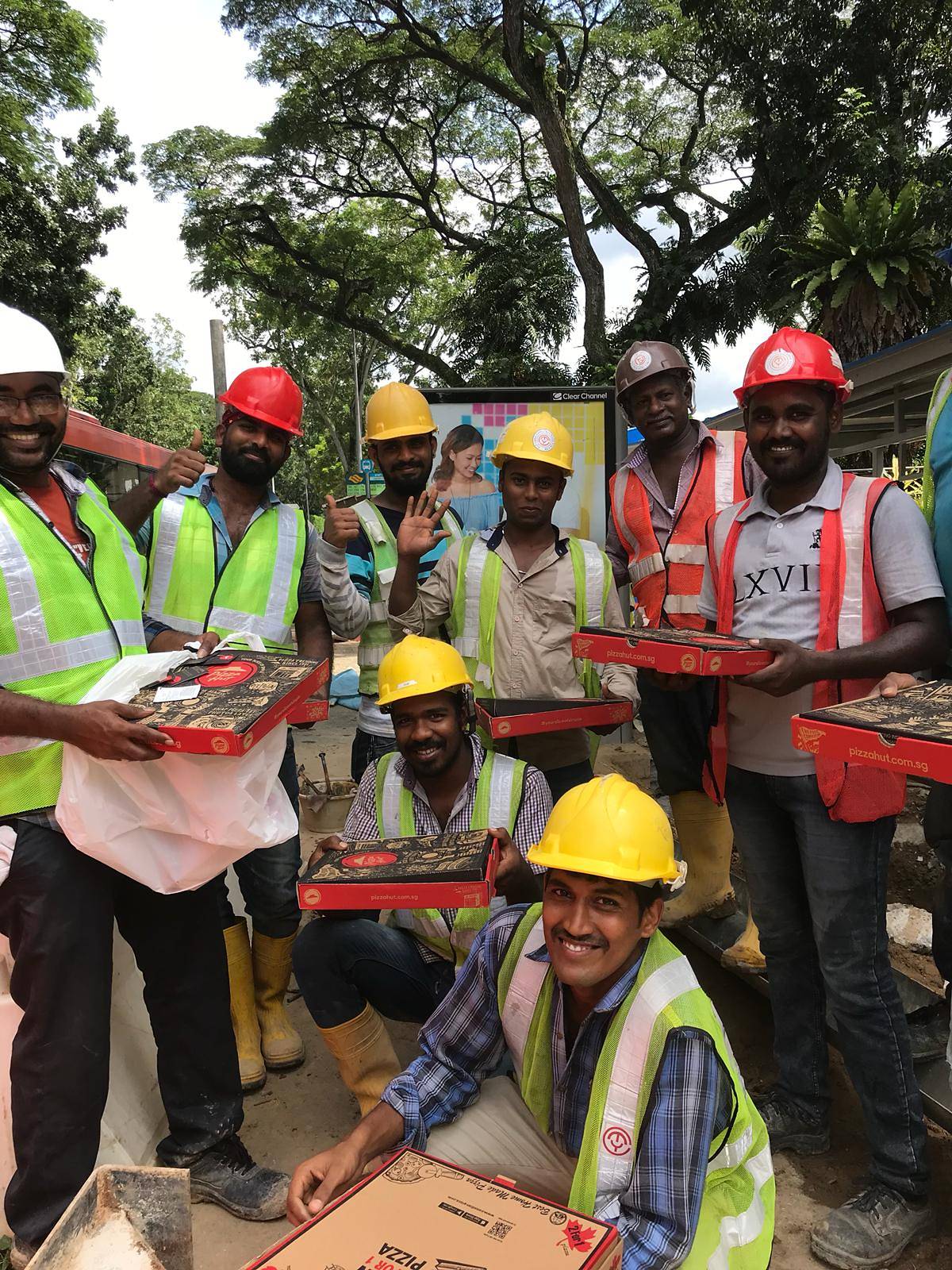
Oh Wow! volunteers have been visiting work sites around Singapore to hand out pizza and doughnuts to the workers and to join them for a meal as part of their Deepavali outreach.
“The workers are just delighted when someone comes up to them with a meal at their work sites because it is so unprecedented,” said Ms Dipa.
“Actions like these show them that there are Singaporeans out there who care about their welfare. These workers helped build this city and this shows that people are genuinely aware of them.”
IT STARTS WITH A “HAPPY DEEPAVALI”
Aside from food-related initiatives, there are also performances and events being organised for these foreign workers.
The Migrant Workers’ Centre (MWC) is organising a night of song and dance at a dormitory in Seletar to usher in the Deepavali spirit.
Mr Yeo Guat Kwang, chairman of the Migrants Workers’ Centre speaks to other members of the organisation at its headquarters located along Serangoon Road. (Photo: Ainslee Asokan)
“The festive (season) is really one good opportunity to engage with them and really make them feel warm,” said MWC’s chairman Mr Yeo Guat Kwang.
“With all these events happening, migrant workers get to move away from the mindset of just working,” said one of MWC’s ambassadors, Subramaniyan Varatharajan, 51, who has been working in Singapore as a driver.
“These events give workers the opportunity to de-stress, and at least for those few hours they get to be themselves,” he said.
But Mr Yeo also said it is not enough just to hold such events.
“If you are talking about helping these workers during Deepavali, it is quite one-off,” agreed Ms Phua, adding that befriending the workers would be a better long-term alternative.
And sometimes, befriending them could even start with just a simple festive greeting – “Happy Deepavali!”
Waren, GERMANY: Dr Dieter Hotzelmann gets frustrated when he talks about the default approach in healthcare to treating the elderly – that is, with surgery, drugs, and more surgery, and sometimes after it’s too late to do much else.
“It’s complete nonsense to place two new hips on a 90-year-old. Such idiocy,” he laments to CNA Insider.
“Health insurance would pay up to 30,000 euros for broken hips – only after the bone is fractured, then they pay for rehabilitation. But what if I can prevent this from happening?”
Take, for example, one of the general practitioner’s latest clients. Mrs Ingeborg Meier, 86, listened to doctors’ advice to operate on her hip which had suddenly started hurting.
The joint replacement procedure earlier this year didn’t make the pain go away – in fact, for months she had to resort to crutches, a blow for the independent senior who loves pottering about in her garden with her husband.
Said Dr Hotzelmann: “Her internal and external joint rotation is still good. If I had seen her before the surgery, I would have said we can still do something.”
Dr Dieter Hotzelmann of Pro Mobil
By ‘something’, he’s referring to the exercises and rehabilitative therapies that his clinic, a pioneer in its field in Germany, uses to stave off and even reverse frailty in the elderly.
The idea for Pro Mobil came about 11 years ago when Dr Hotzelmann, a GP trained in geriatrics and osteopathy, noticed a fundamental flaw in the way the healthcare system worked – which was to treat problems after they had escalated.
His logic is quite simple.
If I put a senior off long-term care, delay the degree of care for a few years, this could save billions for the government and health insurers.
His team of therapists and doctors work to keep their clients – many referred by family doctors at the first sign of frailty – independent and mobile for as long as possible, with customised exercises that employ playdough, bouncing balls and strength-training machines.
So intriguing is the clinic’s preventive approach that the country’s largest statutory health insurer, AOK, has included its treatments in its coverage. Something not all insurance companies in Germany are prepared to do yet, as this is still not considered part of regular health care.
Mrs Ingeborg Meier, 86, working with a therapist on strength training after her operation.
But it’s not just about saving dollars on averted hospital care.
“If one four-week course of treatment here (at the clinic) enables a senior to stay independently at home for three to four years, that’s a big difference when you’re 85,” said Dr Hotzelmann.
Imagine lying in bed for four years, versus running around for four years.
THE DEMOGRAPHIC SHIFT
This is a crucial point because in just over decade, seniors will make up a third of Germany’s population. Policymakers have realised that for the current universal welfare system to hold up, a new model is needed to care for the ageing population.
Germans contribute about 21 per cent of their income to social security, out of which 7.3 and 1.275 per cent respectively go into compulsory health and long-term care insurance. Among European countries, Germany is expected to have one of the biggest increases in public expenditure on long term care by 2060.
Which is why in 2015, the Preventive Health Care Act came into force, highlighting certain responsibilities that must be carried out by health insurance providers with the aim of keeping Germans as healthy as possible for as long as possible – and out of institutional care.
AOK, for instance, incentivises its 24 million members to stay healthy from a young age. It does so with a range of courses on issues from nutrition and stress management, offered for free or at highly subsidised rates; and a recently-launched fitness app that gives members rebates for exercising.
“When there are less care services needed, fewer nursing homes, there are huge savings in the economy,” said Dr Hotzelmann. In all, about 4 per cent of all spending in the German health system flows into health promotion and prevention measures like vaccinations.
Meanwhile in Singapore, another country facing an ageing population crisis, insurance systems are still largely geared towards providing care for members only after an illness occurs.
And for most long term care insurance policies, including the new government-run CareShield Life scheme, members qualify for payouts if they are unable to fulfill three activities of daily living – that is, only if a person is severely disabled.
“If you get help (earlier), you may even be able to reverse your condition and stop needing that kind of care,” said Associate Professor Shirlena Huang from the National University of Singapore, who has co-authored a study on enabling Singaporeans to age well in the community.
On the one hand, the good news is that Singaporeans are among not just the longest-lived but also the healthiest people in the world. On the other hand, one local study has found that nearly half of those aged 60 and above who were surveyed were frail or pre-frail.
An old man walks on an overhead bridge in Singapore. (File photo: Francine Lim)
Studies have linked physical frailty to higher chances of falls, fractures, hospitalisation, disability and death – and thus higher healthcare costs. Yet the condition remains largely overlooked in Singapore.
Mr Lee Poh Wah, chief executive of the Lien Foundation, said there was an urgent need to revamp Singapore’s rehabiliation financing model, incentivise prevention and ensure that seniors remain physically and cognitively agile as long as they can.
“Once seniors become frail and begin depending on others for care, they may get caught in a spiral of irreversible decline,” he said.
RETHINKING ELDERCARE
Retaining their independence, Dr Hotzelmann believes, starts with changing the way seniors are cared for at home by loved ones.
Many people tell their older relatives ‘please sit down, I am scared you will fall. I will do everything for you’. That’s wrong.
Instead, seniors should be encouraged to do things on their own for as long as possible, even if it takes more time and effort, he said. “If they remain seated, their muscles weaken, their sense of balance worsens, and they stop getting up altogether. Little by little, they will lose their independence.”
This belief is what underpins the work of Pro Mobil in the town of Waren, Germany.
On a visit there, CNA Insider observed as octogenarian Gertrude Fiege rolled out a ball of pink dough with her hand, pinching and pressing it into shape as directed by her ergotherapist, Ms Ulrike Baumotte.
That was the easy part. When Ms Baumotte wrapped the dough around her fingers and told her to wriggle out of the knots, her fingers start to tremble and tire.
Gertrude Fiege and her ergotherapist work on returning strength to her hand.
The loss of grip strength and finger dexterity is common in old age, but something that simple that most people take for granted can mean a devastating loss of independence for the elderly.
“When you can’t open the lid of a jar, or drain the water from a pot of boiled potatoes, when you can’t turn the key to unlock your door anymore, it becomes a problem for daily life,” said Ms Baumotte.
“Now is a good time for Mrs Fiege to start therapy, before her hands get too weak.”
It was a little late off the mark for Mrs Meier, the woman who underwent hip surgery in April before she was referred to Dr Hotzelmann.
When she hobbled into his office on crutches, like any patient her needs were assessed (could she get out of bed and shower on her own? Did she get out of the house? etc), before a four-week course of daily strength-training and balancing exercises was prescribed.
And after just two weeks, the results were heartening indeed.
Where it used to take her 31 seconds to walk six meters, she now took 24 seconds without her walking aid. Her sense of balance was so improved, she tossed aside the crutches she’d had to rely on since the surgery.
“When I go up and down the stairs, I feel the difference. I am happy like this,” said Mrs Meier.
Two weeks into treatment, Mrs Meier could hold her balance for a few seconds.
Sometimes, the results surprise even Dr Hotzelmann.
One stroke patient who was paralysed on one side of her body came to see him in the hopes of being able to move around on her own again. Every morning, her daughter would give her a call at home to check on her.
But one morning, she didn’t pick up the phone. Her panicked daughter thought she’d had another fall. But it turned out the old woman had gone to the hairdresser’s by herself, for the first time in 10 years.
“They want to be able to step out of their home without fear. Grandma should be able to go about the village, do her own groceries, meet her friends. This is what I would want for myself,” said Dr Hotzelmann.
WATCH: How they beat frailty and old age (10:10)
COSTS AND PAYOFF
The concept of preventive care through exercise is not entirely new to Singapore. Gym Tonic, a strength-training programme for seniors initiated by the Lien Foundation, is offered at over 20 venues in Singapore where trainers help the elderly fight frailty and extend their functional years.
Members of the public who sign up for the 12-week programme at community gyms and senior centres pay nominal fees out-of-pocket, as it is not covered by any insurance schemes. The costs of the Gym Tonic machines the seniors use are borne by the foundation.
Wellness coach Looi Yuan Hui at Gym Tonic with 70-year-old retired bus driver Quek Kai Choo.
But at Pro Mobil, Dr Hotzelmann says that his clients don’t pay him anything. That’s because the cost of the programme – 2,500 euros (S$3,900) for 20 days over four weeks, including meals and transport – is claimable under some statutory health insurance providers, like AOK.
The company, like other health insurance providers, is required by guidelines to spend 7 euros a year per insured person on primary prevention and health promotion, under the 2015 Preventive Health Care Act.
That’s a mere drop – less than 1 per cent – compared to the estimated 3,000 euros spent on each AOK member per year for hospital and medical care.
Dr Hotzelmann hopes that one day, preventive programmes like his will be covered by all insurers and made accessible to everyone. Indeed, he sees it as a duty, “politically, ethically and socially”, to keep the elderly fit so that they stay valuable members of society and “not just be a medical burden”.
What could prove persuasive is a study is being done on some 700 AOK clients who have undergone ambulatory geriatric rehabilitation (including at Pro Mobil).
It aims to establish if such care does indeed reduce falls and fractures, and hence, nursing home and hospital admissions – as well as health care costs for insurers.
Then there’s the social aspect. At Pro Mobil, even after they have completed their four-week programme. patients still return twice a week for group exercises where they look forward to meeting others.
The problem is that a lot of old people sit alone in their apartments. They are lonely, and slowly they become weaker and weaker.
“So we don’t just train them for four weeks and say ‘okay, you’re fine, bye bye’. The social component is very important too,” said Dr Hotzelmann.
PREVENTIVE CARE – THE WAY FORWARD
Ultimately, however, preventive care doesn’t start in old age.
Said 20-year-old Hanes Kolbe, a Berlin resident: “You hear stories of people who start falling really sick (when they’re old). I’m starting to think about what I can do to avoid the possible health problems, even though this is all still very far away.”
“It makes sense to invest in primary prevention for the young,” said Mr Werner Mall, head of prevention at AOK.
It’s like investing in the next generation – we believe it will lower our costs in the long run.
Our CNA Insider producer and AOK staff exercising.
While statutory insurers have been legally obliged since 1995 to include vaccinations and disease screenings in their coverage, these days, the focus has expanded to keeping modern-day chronic diseases at bay through a healthy lifestyle.
“If you want to deal with diabetes, then you have to deal with nutrition. If we want to gain more healthy life in years, we have to change people’s’ behaviour,” said Mr Mall.
Which is why insurers like AOK are offering online health and well-being courses, app-powered cash incentives to exercise, as well as tie-ups with gyms or sports clubs which policy-holders can join for free.
“In our modern lifestyle, eight hours of sitting at a desk, we have to use use all kinds of means like apps and programmes to motivate people to move more,” said Sandra Rocha, a physiotherapist at AOK’s preventive department.
Mr Mall added: “I would be content if one day, we can spend more on prevention than on therapy.”
It may take a while, though, to get people on board the idea of planning ahead for healthy old age. But as long-term care expert Thomas Meisner said, summing up: “The demographics have changed, such that people’s lives still go on for 30 years even after they retire. Whether this person spends these 30 years as someone in need of care, or as a healthy person, depends on preventive care,”
CNA Insider’s trip to Germany, to study its approach to long-term care for the elderly, was supported by the Lien Foundation.
SINGAPORE: The Singapore Civil Defence Force (SCDF) will deploy 150 officers and a range of emergency vehicles for the 33rd ASEAN Summit, when hundreds of ministers and delegates from 10 Southeast Asian nations will descend on Singapore’s Suntec International Convention and Exhibition Centre from Nov 11 to 15.
Besides fire engines and ambulances to deal with the more common emergencies, the SCDF is also looking out for a far more sinister threat: Chemical, biological and radioactive (CBR) attacks.
To deal with such unconventional threats, some of SCDF’s specialised personnel and vehicles will be standing by.
“We do not wish for these capabilities to be used, but if we do have any incidents related to CBR, we will be able to mount a swift response,” director operations department Assistant Commissioner (AC) Daniel Seet told reporters on Monday (Nov 5).
From left: The hazmat mitigation vehicle, hazmat control vehicle and mass decontamination vehicle. (Photo: Marcus Ramos)
After months of preparation, including tabletop and night exercises, SCDF will hold technical exercises at Suntec on Tuesday to familiarise its personnel with the area.
It helps that the SCDF has been deployed for several high-key events this year, not least the Trump-Kim summit in June, AC Seet said.
While AC Seet said the Trump-Kim summit was more complex due to its dynamic and multi-venue nature, the ASEAN Summit has its own challenges.
Because it will be held near a shopping mall, the SCDF has to work with tenants and in-house emergency teams to ensure everyone is well-drilled in contingency plans while business goes on as usual.
In the case of a chemical attack, people are likely to panic, fall ill and start vomiting.
That’s when SCDF’s specialised emergency vehicles will be rolled out: The hazmat control vehicle is the “brain” of the operation; the hazmat mitigation vehicle provides the boots on the ground; while the mass decontamination vehicle cleans up casualties before they get medical attention.
HAZMAT CONTROL VEHICLE
The hazmat control vehicle will be tasked to identify hazards, assess the extent of contamination and determine the mitigation approach.
The vehicle is essentially a “nerve centre” which distributes information ranging from what suit to wear to how large the contamination area is, said hazmat department assistant director, Lieutenant-Colonel Kwok Shun Yung.
“The priority is to determine whether the threat is credible,” he added.
The drone in the hazmat control vehicle can be used to monitor the incident area. (Photo: Marcus Ramos)
The vehicle is equipped with a device that can detect chemicals in the air from as far as 5km away, and a surveillance drone which can access hard-to-reach areas and potentially detect the source of hazardous substances.
The hazmat control vehicle has various equipment to identify hazardous substances. (Photo: Marcus Ramos)
Its interior looks like a cross between a high-tech command centre and a chemistry lab, with cameras to monitor incident areas and devices to identify different chemicals.
HAZMAT MITIGATION VEHICLE
At the same time, the SCDF’s other assets, like the hazmat mitigation vehicle, move in like clockwork.
The specialists would have a rough idea of what they are up against, as first responders stationed near an incident area would have provided them with information like the number of casualties and symptoms displayed.
“The first wave of information is critical,” said Captain Ang Hwee Ting, a Hazmat specialist who is also commander of Jurong Island Fire Station.
The hazmat specialists will enter contaminated areas, isolate and mitigate the contaminants and collect samples of unknown sources so they can be identified.
The high performance suit offers enough protection for SCDF personnel to handle hazardous agents. (Photo: Marcus Ramos)
The hazmat mitigation vehicle, designed to evacuate people and detect and mitigate hazards, also carries a buggy that can transport equipment and casualties.
The Hazmat buggy, as it’s called, can carry two stretchers to transport casualties. (Photo: Marcus Ramos)
SECRET ROOM
In situations where a building needs to be evacuated, there might be people who could not escape in time. That is when personnel from the Special Rescue Unit (SRU) come in; they will usher these people into a secret and protected room within the building.
This room has minimal ventilation, with its openings and gaps sealed off to protect those inside from hazardous substances that might be in the air.
Outside the building, SRU personnel will operate the mass decontamination vehicle, which can “clean” up to 80 walking casualties and 18 incapacitated casualties per hour.
Personnel from the Special Rescue Unit, wearing stuffy, non-permeable suits, demonstrating how they decontaminate a casualty. (Photo: Marcus Ramos)
Incapacitated casualties will have their clothes removed and bodies thoroughly washed with disinfectant. The target is to complete the process in six minutes.
Walking casualties can use eight shower cubicles in the vehicle, with interactive panels to guide them along.
The interactive panel guides casualties on how to decontaminate themselves. (Photo: Marcus Ramos)
“The moment we set up, we must decontaminate everyone within an hour,” SRU commander Major Jason Chua said.
“THIS IS WHAT I WAS TRAINED FOR”
For some full-time national servicemen (NSF), this will be their first real-life deployment.
SRU section commander Sergeant (SGT) Nazeem Fazil and Second Lieutenant (2LT) Ken Lee will be stationed together at the secret room in Suntec.
“I feel proud going through something like this in National Service and being part of such a high-profile event,” SGT Nazeem, 19, said. “Hopefully nothing happens, but if something were to happen, I would play my part.”
2LT Ken Lee (left) and Sergeant Nazeem Fazil are from the Special Rescue Unit, which is almost fully made up of full-time national servicemen. (Photo: Marcus Ramos)
2LT Lee said being exposed to tear gas during his training days helped him prepare for this.
“Our training really prepares us for this chaotic scenario because working under pressure is something that our instructors try to impose on us,” the 21-year-old said.
SHANGHAI: Singapore and China have concluded talks to upgrade the China-Singapore Free Trade Agreement (CSFTA), Singapore’s Ministry of Trade and Industry (MTI) said in a statement on Monday (Nov 5).
This was announced following a meeting between Singapore’s Trade and Industry Minister Chan Chun Sing and Fu Ziying, who is China’s Vice Minister of Commerce and the China International Trade Representative, on Monday. The meeting took place on the sidelines of the China International Import Expo.
Under the current CSFTA, there are no tariffs on 95 per cent of Singapore’s exports to China, while there are no tariffs on all Chinese exports to Singapore.
The upgraded CSFTA is expected to provide Singapore businesses with greater trade facilitation and investment protection in China.
It is also expected to provide Singapore businesses with improved market access and will cover cooperation in new areas, including legal and financial services, e-commerce and the environment.
Mr Chan said this development marks “an important step forward” for bilateral economic relations between Singapore and China.
“The upgrade signals our joint commitment towards greater economic collaboration and trade liberalisation. Singapore businesses can expect to enjoy greater access to the vast Chinese market and greater certainty in their investments when the upgraded CSFTA takes effect,” he said.
Minister for Trade and Industry Chan Chun Sing (right) and Chinese Vice Minister of Commerce and China International Trade Representative Fu Ziying meeting at the inaugural China International Import Exposition in Shanghai. (Photo: MTI)
The CSFTA was the Chinese government’s first such agreement with an Asian country.
Talks to upgrade the FTA, which entered into force in January 2009, have been three years in the making. They began after Chinese President Xi Jinping visited Singapore in November 2015.
In September, Singapore Deputy Prime Minister Teo Chee Hean had said that the signing of the upgraded pact is expected when Chinese Premier Li Keqiang visits Singapore for the ASEAN Summit next week.