SINGAPORE: A self-driving shuttle bus service will be on trial at the National University of Singapore’s (NUS) Kent Ridge campus from March 2019, said transport company ComfortDelGro, which will be operating the service.
This will be the first time a transport operator is trialling an autonomous shuttle bus service, ComfortDelGro said in a news release on Monday (Nov 12).
During the year-long trial, ComfortDelGro’s wholly-owned subsidiary, ComfortDelGro Bus will be operating an EasyMile EZ10 autonomous shuttle, which will be funded by Inchcape Singapore.
A shuttle that can carry 15 passengers will travel along a 1.6km route in NUS between Heng Mui Keng Terrace and Business Link.
But during the initial stage of the trial, the shuttle will not take any passengers. It will focus on collecting data for its mapping and navigation systems.
An EasyMile autonomous shuttle bus that will be on trial in NUS in 2019. (Photo: ComfortDelGro)
A safety engineer will be on board the shuttle to ensure safe operation of the vehicle, as well as to provide engineering expertise.
“Once the trial management team is satisfied that the shuttle is ready for commuter trials, passengers will be able to start boarding the vehicle,” ComfortDelGro said.
The shuttle bus will be operating in “real mixed traffic conditions”, meaning that it will be driving alongside other vehicles on the road.
The EZ10 autonomous shuttle, according to the news release, runs entirely on electricity and has autonomous vehicle (AV) technology that combines robotics and artificial intelligence.
It will only rely on its internal software and hardware, with no reliance on external infrastructure, ComfortDelGro said.
It has been deployed successfully in similar traffic conditions in countries like France, Germany, Norway, Australia, and Japan.
“We believe the experiences gained from these trials will help us gain greater insight into how to become an AV fleet operator in the years to come,” said ComfortDelGro’s managing director and group CEO Yang Ban Seng.
If the trial is successful, it could be commercially rolled out, said the news release.
“In this era of digitalisation and smart technologies, the use of autonomous vehicles as a mode of transport is not a question of ‘if’ but ‘when’,” added Professor Chen Tsuhan, NUS deputy president (Research and Technology).
This will be ComfortDelgro’s third foray into the autonomous vehicle sphere in Singapore – with two other ongoing trials in Sentosa and Jurong Island by its subsidiary SBS Transit.
SINGAPORE: Economic ministers from the Association of Southeast Asian Nations (ASEAN) on Monday (Nov 12) signed an agreement to facilitate cross-border e-commerce transactions within the region.
The agreement, finalised after nine rounds of negotiations which started last June, is the grouping’s first agreement on e-commerce.
Apart from aiming to facilitate cross-border e-commerce transactions, the newly signed pact will look to foster an environment of trust and confidence in the use of e-commerce, said Singapore Trade and Industry Minister Chan Chun Sing at the signing ceremony held on the sidelines of the 17th ASEAN Economic Community (AEC) Council Meeting.
It also aims to deepen cooperation among ASEAN member states so as to spur the use of e-commerce as a way of driving regional economic growth.
Mr Chan said the agreement will encourage paperless trading between businesses and governments, which can generate more rapid and efficient transactions in ASEAN.
Businesses can access and move data across borders more easily, subject to appropriate safeguards, he added.
On that, ASEAN has taken steps to promote better consumer and personal data protection through the use of online dispute resolution mechanisms to facilitate the resolution of e-commerce claims, said Mr Chan.
Trade and Industry Minister Chan Chun Sing at the signing ceremony of an e-commerce agreement held on the sidelines of the 17th ASEAN Economic Community (AEC) Council Meeting. (Photo: Jeremy Long)
Sustained economic growth and a young, digitally-savvy population are among factors driving ASEAN’s Internet economy, which is expected to hit US$200 billion by 2025. Of which, e-commerce is set to grow to US$88 billion.
Mr Chan said the region’s potential has attracted many foreign players, such as Amazon and Alibaba.
On top of that, Southeast Asia has seen the rise of ASEAN-based unicorns, like Singapore-based Lazada and Indonesia’s Tokopedia, that now have a sizable presence in the region’s e-commerce market.
However, adoption remains in its infancy compared to China and the United States, said Mr Chan.
He referred to non-tariff barriers, including logistics and cross-border digital regulations, that remain as challenges for small- and medium-sized enterprises looking.
“This agreement will help bolster the trust and confidence of ASEAN consumers in e-commerce and drive adoption. In doing so, we will enable ASEAN businesses to grow domestically, regionally and globally,” he said.
SINGAPORE, Seoul and Hong Kong are the three Asian countries to top the list of most sustainable cities, according to a new index released on Thursday.
The 2018 Sustainable Cities Index (SCI), done by Arcadis NV, an Amsterdam-headquartered global design, engineering and management consulting company, found that the three cities have ranked high overall in terms of ‘people’, ‘planet’, and ‘profit’, the three main factors of sustainability.
The report, which assessed 100 of the world’s most prominent cities, also identified ‘evolutionary cities’ and thirteen ‘fast-growing megacities’ of which 10 ‘megacities’ were found to be at the bottom of the people index.
The megacities included those situated in rapidly growing economies including China and India, which were subject to high levels of inward-migration, investment in infrastructure and change.
“Cities like Mumbai, Shanghai and Shenzhen exhibit significant inequality in terms of income and access to resources and opportunity,” the report said.
“Citizen experiences include high levels of informal economic activity as well as the powerful influence of enterprise – often directed by the state to deliver development and services.”
The report added that citizens have little control over the way in which the city evolves but “paradoxically the models suggest that many citizens retain a sense of stability through kinship and community links highlighted by the Balanced city archetype.”
“In Asia, we find a clear distinction between the well-established Seoul and Tokyo and a large group of cities in China and emerging markets.”
Of 23 cities in the sample, 14 are in the bottom quartile, facing significant challenges across all pillars, the report noted.
Acadis said the performance gap affecting cities in the bottom quarter of the ranking is “particularly daunting”
“Delivering sustainable growth from such a baseline will require huge progress against the agenda set out by the UN SDGs (United Nations Sustainable Development Goals).
Bearing that in mind, here are the three best and worst sustainable cities in Asia:
Best
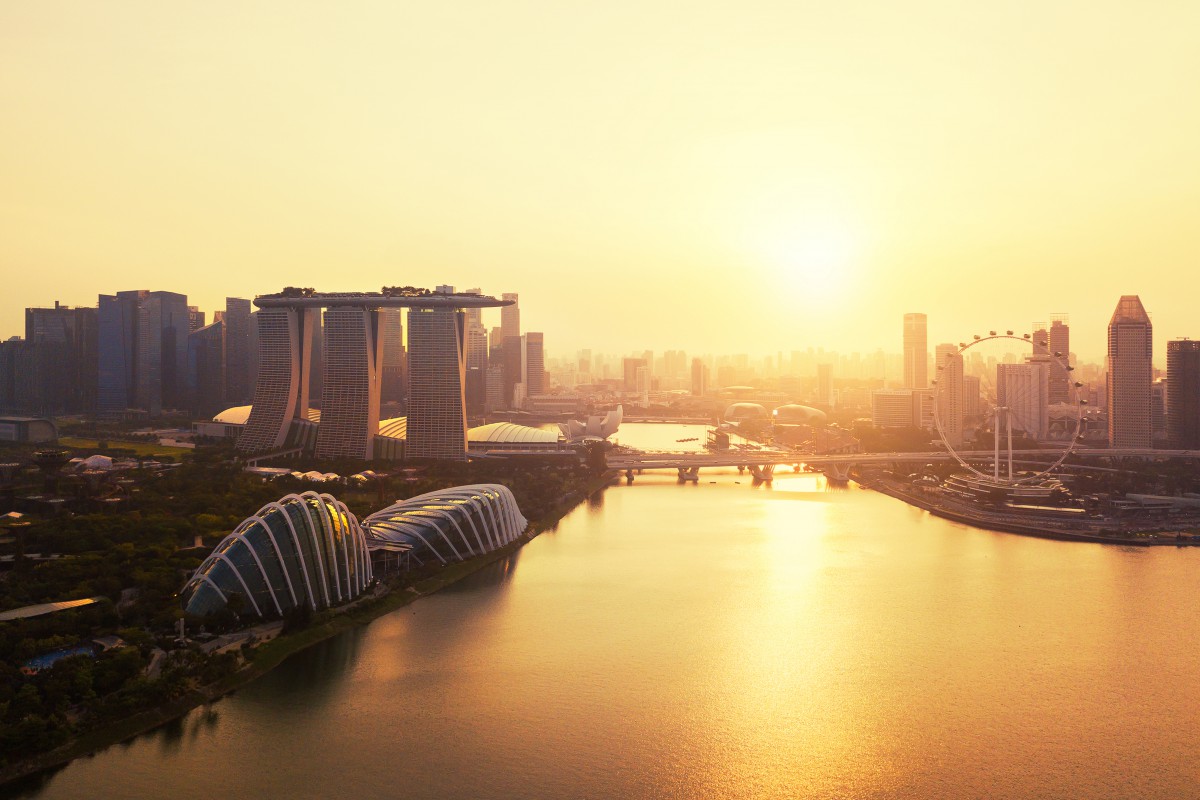
Singapore has rolled out several core projects for its Smart Nation agenda. Source: Shutterstock
Singapore
At fourth place in the overall index, Singapore is just behind European cities London, Stockholm, and Edinburgh. The city state is highly ranked due to its high score in one or two pillars of the index. Like Hong Kong, Singapore are in the top 10 driven by very high ‘profit’ rankings and middle of the road ‘people’ and ‘planet’ rankings.
The index report noted that most of the top 10 cities had high ‘Planet’ scores – these are Northern European cities like Stockholm and, Frankfurt which have been highly successful in combining economic prosperity and environmental stewardship.
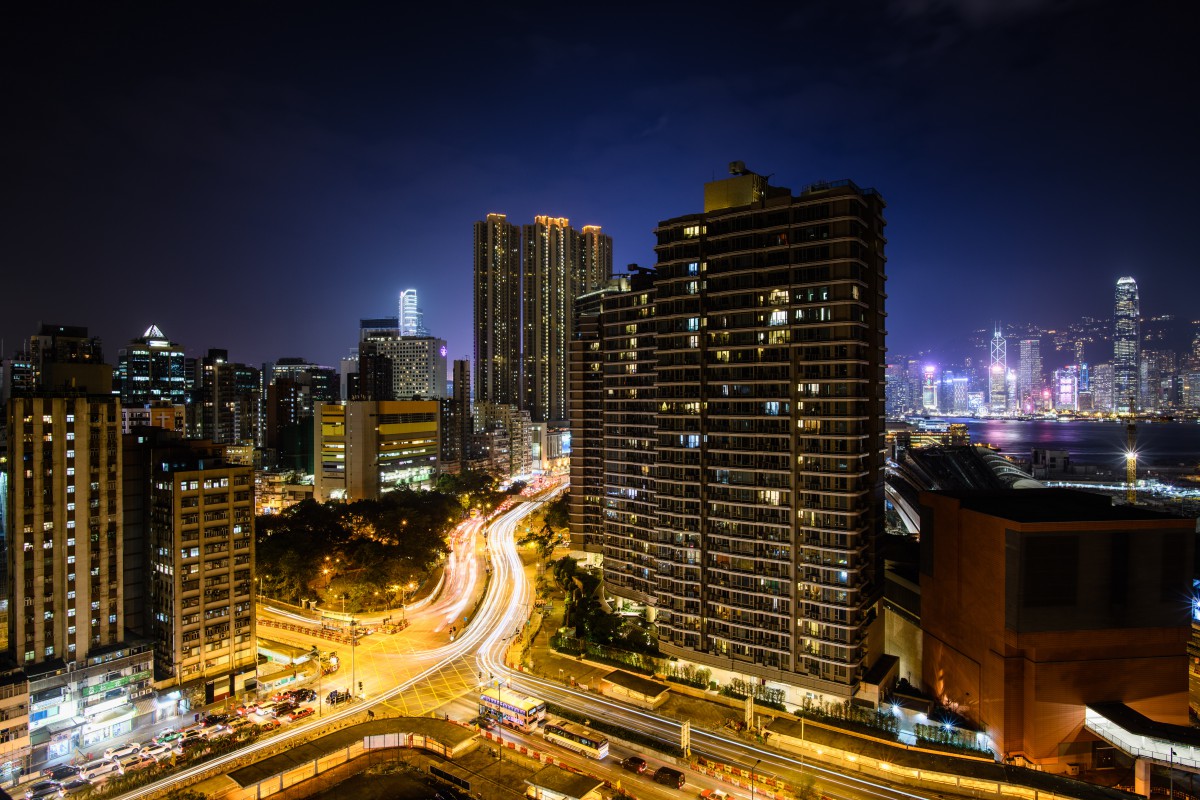
A long exposure general view shows commuters driving on a main road near the construction site (R) of the West Kowloon terminus of the high-speed rail link which will connect the city to the southern Chinese city of Guangzhou as Hong Kong’s skyline looms in the background on December 27, 2017. Source: Antony Wallace / AFP
Hong Kong
Hong Kong was among the three cities to come out comfortably on top in ‘profit pillar’, the index report found that the city was breaking away from other top-performing cities on transportation, ease of doing business and connectivity.
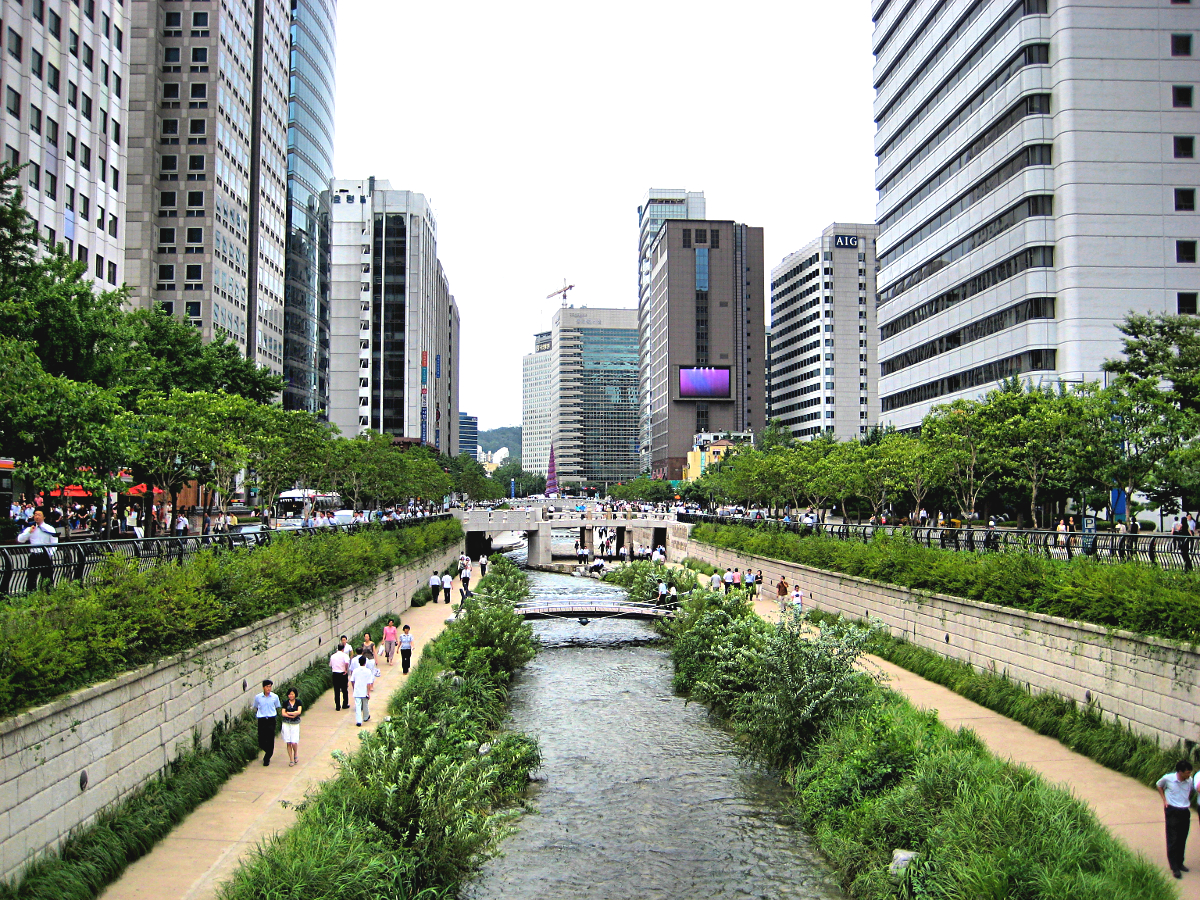
Seoul’s Cheonggyecheon stream, which underwent a massive urban restoration project. Pic: Wikimedia Commons.
Seoul
Seoul and three European cities including Zurich all score well on ease of doing business and output, but the performance of the transport system is much more mixed, the index report said
Worst
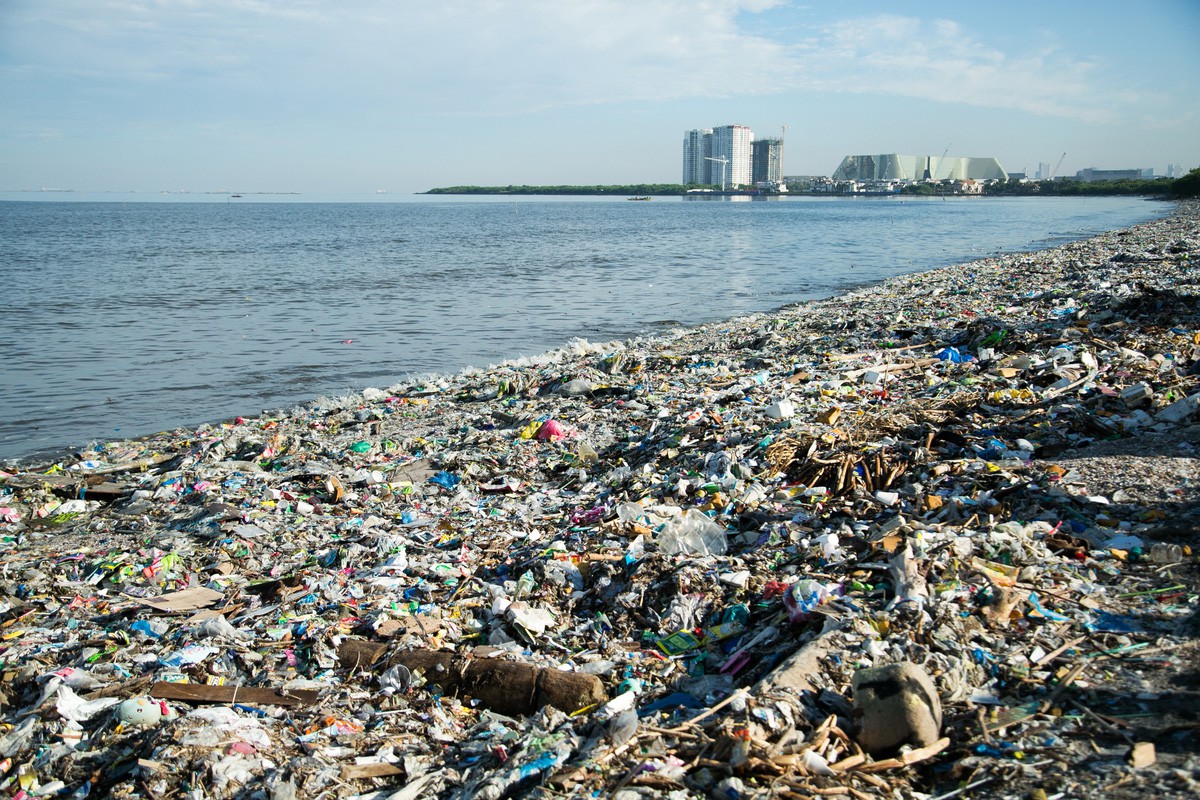
The coast of Freedom Island in Metro Manila teems with trash in this photo taken in 2017. Source: Greenpeace/Mongabay
Manila
At 93rd place, Manila faired poorly for the ‘People’ factor which refers to the cities’ social mobility and quality of opportunity and life.
On the city’s management of energy use, pollution and emissions, the Philippines capital was also lowly-ranked at 91st place.
In terms of ‘profit’, which is assessed for business environment and economic performance, Manila ranked 98.
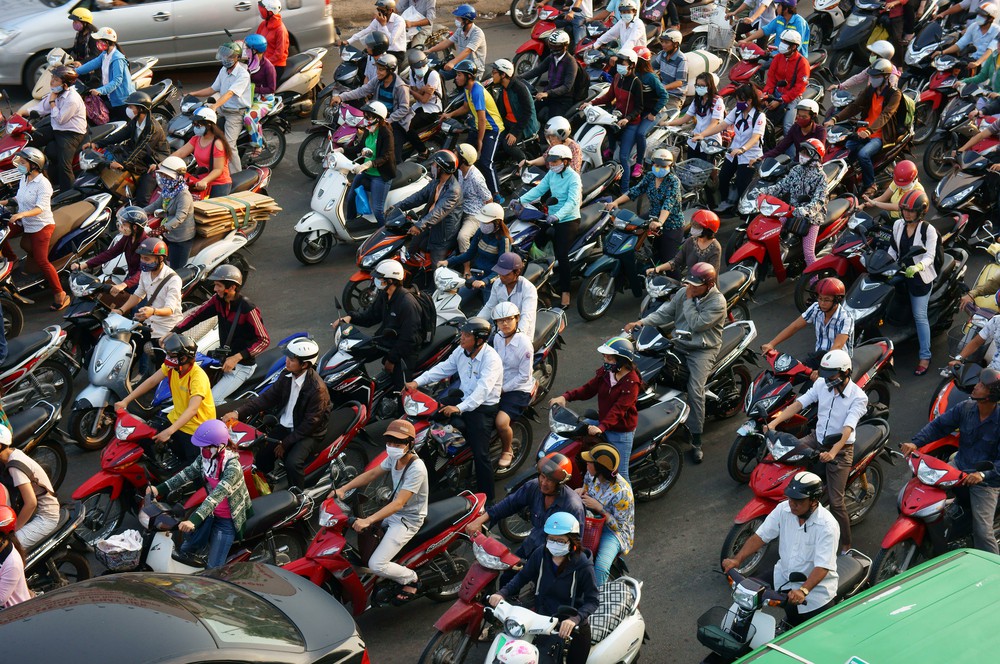
Heavy motorcycle traffic in Hanoi, Vietnam. Source: Xuanhuongho/ Shutterstock
Hanoi
Cities in the lowest quartile come mostly from Asia and Africa, but Hanoi comes at the bottom of the ‘Planet’ rankings, over legacy challenges associated limited green space, high levels of air pollution and poor waste management provision.
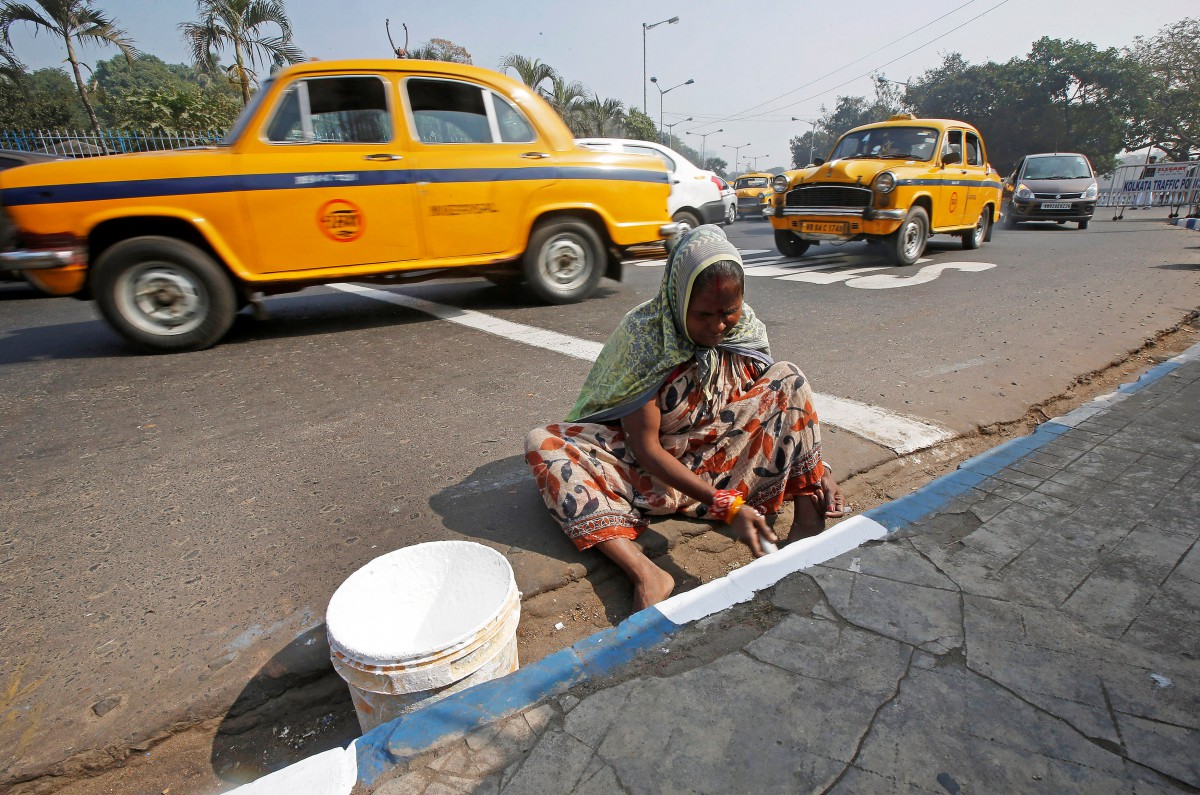
A woman paints a pavement on a busy road in Kolkata, India January 5, 2018. Source: Reuters/Rupak De Chowdhuri
Kolkata
Like Manila, Kolkata is at the bottom 10 on the ‘Planet’ sub-index owing to the Indian city’s lacklustre environmental-friendly practices.
“However, investment in low carbon technologies will inevitably be a lower priority when basic citizen needs like water and waste management still need to be fixed,” the index report noted.
SINGAPORE: Madam Chua Oi Lin, 64, tries to make herself inconspicuous when she is working.
At 7am every work day, she begins cleaning the toilets and common corridors on five floors of the 15-storey Tan Boon Liat Building, before making her exit by 10am when the office workers and shoppers start streaming in.
At 1pm, when most of the occupants are out for lunch, the cleaner would re-emerge for another round of cleaning to freshen up the same areas before calling it a day at 4pm.
Madam Chua said she thinks that being “invisible” has its merits, even though it makes her day for someone to simply greet her or acknowledge her presence, never mind not thanking her for her efforts.
More often than not, however, crossing the paths of fellow human beings bring about unwelcomed consequences: People might complain to her superiors when they see her resting in between her cleaning shifts. Then, there are the nasty encounters, said Mdm Chua, who is married to a 78-year-old retiree.
Once, she accidentally sprayed some tap water on a man in one of the toilets, and he cursed her mother in Hokkien in retaliation.
While she has resigned herself to the fact that many people look down on her for doing a “dirty job”, the man’s remarks angered her so much that she gave him a piece of her mind.
“I told him not to scold me bad words as I am here to work, not to have my mother insulted by him,” said the cleaner who is paid S$1,200 a month and still cares for her mother who is in her 80s.
The issue of low-wage workers like Madam Chua, who often end up as “invisible” in their workplaces — people simply walk past them without greeting or talking to them, and they are not shown the respect they deserve or treated with dignity — was highlighted recently amid the ongoing national conversations on social mobility and inequality in Singapore.
At a dialogue session with Deputy Prime Minister Tharman Shanmugaratnam late last month, Ambassador-at-large Tommy Koh said the issue is not about these people doing their jobs with dignity, but about the way “the elite” treats them.
Deputy Prime Minister Tharman Shanmugaratnam and Special Adviser of IPS Tommy Koh at a dialogue during an event held by the Institute of Policy Studies as part of its 30th anniversary.
Prof Koh said:
I would say in Singapore, the elite does not show respect for people who work as cleaners, gardeners, petrol station attendants, security personnel. One of the problems in Singapore is that these low-wage workers are treated as invisible people.
He was responding to Mr Tharman’s suggestion that there should be more focus in helping Singaporeans in their mid-50s and 60s to “work for as long as they wish, to work with dignity, to earn a decent pay”.
Mr Tharman had noted that 60 per cent of working Singaporeans aged 55 and above, with no more than secondary school education, had ended up at the lower end of the “escalator” of social mobility.
As for Prof Koh’s “elite” comment, Mr Tharman said that it is not only the elite who shows little respect for the ordinary blue-collar workers, describing such an attitude as “part of our social culture”.
“We inherited a combination of British institutions and an East Asian culture, both of which are quite hierarchical, both of which tended to look down on ordinary manual labour,” said Mr Tharman in the session held ahead of a conference to mark the 30th anniversary of policy research think-tank Institute of Policy Studies (IPS).
In an email interview, Prof Koh continued to view the issue as one involving members of the elite, which were once part of “a classless society” and now live in “a class-conscious society”.
The elitist attitude rears its ugly head when they “do not greet (those who do low-paying jobs) or acknowledge their presence”, he said, relating an encounter on Tuesday (Nov 6) where one of three men who washed his car at a petrol service station thanked Prof Koh’s wife for speaking to him.
“The poor people of Singapore need better pay and respect from the elite,” Prof Koh stressed.
LIFTING THE CLOAK OF INVISIBILITY
Long used to being given the cold shoulder, it did not take much coaxing for these “invisible” people to lay bare their suppressed frustrations and unaddressed hurt.
A 59-year-old toilet attendant at Marina Bay Sands (MBS) shared that she often greets guests with a friendly “good morning” or “good evening”, but most would just ignore her and carry on with their business.
The woman, who wanted to be known only as Madam Lim, said: “If you work this kind of job, people don’t look up to you. They see that you are illiterate and uneducated, they don’t really see much value in engaging with you.”
Toilet janitor Madam Goh – a 76-year-old who made the news in August due to a spat over five-cent coins – lamented that people seldom consider the point of view of workers like her.
In the incident, the janitor at Block 79 Circuit Road hawker centre chided a woman who had paid the toilet’s 10-cent entrance fee in two five-cent coins.
News of Mdm Goh’s disgruntlement quickly spread after the woman’s niece posted the janitor’s photo on Facebook. But Mdm Goh pointed out that few would have known that she had only started refusing the coins after years of getting her own five-cent coins rejected by members of the public when she returned them as change.
A cleaner pushes his trolley in a shopping centre in Singapore. (File photo: AFP/Roslan RAHMAN)
“Look, I still got so many,” said the janitor of more than 30 years who declined to give her full name due to the “negative press” she had received, flashing her quarter-full canister of five-cent coins.
On a daily basis, Mdm Goh would also encounter two to three fee evaders, directly affecting her earnings since she only takes home the amount she collects, sharing the money – S$20 on average – with her 61-year-old nephew who takes the night shift.
Still, Mdm Goh considers herself fortunate, noting that tray and plate collectors at food courts have it worse, since they need to move about a lot more and often face customers, which raises the chances of conflict.
Freelancer Euphemia Lee — who witnessed a woman scolding a food court cleaner who had prematurely cleared her plate at Jem mall in 2016 — said she had become more aware of how cleaners were treated around her since.
“I have seen this happen almost on a day-to-day basis, be it (customer’s rebuke) verbal or non-verbal. Looks of disgust towards staff are not uncommon,” said the 32-year-old.
The 2016 incident made the headlines after a video of the customer’s tirade against the deaf and mute cleaner went viral on Facebook. The customer later apologised for her actions.
Although it has been more than two years since the incident, Ms Lee said she remained disturbed by the customer’s initial behaviour and remarks. “(They) showed a lack of empathy towards another human being,” she said.
Ms Nur Shakylla Nadhra, a sub-editor at a research company, notices that some of her colleagues do not acknowledge the cleaners when they clear the trash cans under their office desks. “I understand that you are busy, but there is not even a glance. It only takes a few seconds (to say thank you),” said the 27-year-old.
Another group of “invisible people” are security guards who have to grapple with rude behaviour and have unkind remarks thrown at them.
Mr Surjeet Singh, a security supervisor with Ademco Security Group, poses for a photo. (Photo: Nuria Ling/TODAY)
Mr Surjeet Singh, a security guard of 20 years, said he had been called names such as “dog”, “idiot” and “bloody fool”, when trying to get people to comply with the rules of the premises they are in.
“It really lowered my morale … I feel very disturbed and it can affect you emotionally, where you go home still thinking why the man said that to you,” said Mr Singh, 58, who earns S$1,500 a month.
Mr Singh’s boss, Ademco Security Group managing director Toby Koh, cited the case of a security officer at a condominium who was told to clean up the mess after a resident’s child had vomited.
There have also been occasions when parents would tell their children to “study hard, if not, you may become a security guard” even while an officer is standing nearby, he said.
For office cleaner Loke Yoke Chee, his most unforgettable day was the time when a high-ranking American employee at Royal Bank of Scotland at One Raffles Quay took him and his fellow workers out to lunch at a Vietnamese restaurant to celebrate Christmas in 2010.
“That was the first time in my life somebody (of a higher status) invited me for lunch,” said the 60-year-old who depleted his savings while fighting lymphoma, a cancer of the blood.
Except for that Christmas lunch, Mr Loke has spent most of his 20 years as a cleaner trying to keep out of other people’s way — and sight — as far as possible to avoid being an “ear sore” while he is vacuuming the floor, or a “distraction” while wiping office and meeting room tables when bank employees start filing in from 9am.
He would then proceed to clear the rubbish bins and tidy up the pantry areas before lunchtime.
Mr Loke Yoke Chee, a cleaner at OUE Downtown, tries not to be bothered by those who look down on his work. (Photo: Koh Mui Fong/TODAY)
Mr Loke, who now mainly tends to the mall area of OUE Downtown, has learnt to take it in his stride and not get “too bothered” when he meets “some people with higher education who look down on us”.
He would often tell himself that
I come here just to earn a living.
WHAT CONSTITUTES A LIVING WAGE?
Despite the cold-shoulder treatment that they often get from members of the public, those interviewed said such dismissive attitudes are the least of their concerns. Instead, they are more concerned about keeping their jobs.
For MBS cleaner Madam Lim, her monthly pay of S$1,500 goes towards her immediate living expenses.
While her daughter, who is in her 20s, had just graduated with an accounting degree from a private university, Mdm Lim said: “I can’t rely on her because I didn’t support her university education. We had no money. She put herself in university through her own means, by taking on a part-time job.”
Mdm Lim’s son, in his 30s, is a watch salesman while her husband holds an unstable job slaughtering ducks in Jurong.
At the IPS dialogue, Prof Koh had asked what can be done to ensure that low-wage workers are “able to live in dignity and material sufficiency”, adding that his own research had shown that there are between 100,000 and 140,000 households living in absolute poverty.
As for the portion of households living in relative poverty, he noted that his estimate is closer to 20 to 35 per cent, not 15 per cent as previously cited by Education Minister Ong Ye Kung.
In a subsequent Facebook post on Oct 27, Prof Koh described the income distribution of Singapore as a “moral disgrace”, in that it currently resembles the shape of a pear, whereas founding Prime Minister Lee Kuan Yew had envisaged one that resembles the shape of an olive.
“Many of our working people do not earn a living wage and live in poverty”, he said, adding that the progressive wage model in force in three sectors – starting with the cleaning sector in September 2015, followed by the landscape and security sectors in 2016 – did not change the situation.
His comments fuelled a spirited debate on whether Singapore should have a minimum wage, which has been adopted in Japan (average of 848 yen or S$10.25 per hour), South Korea (7,530 won or S$9.20 per hour), Taiwan (NTS$140 or S$6.25 per hour) and Hong Kong (HK$34.50 or S$6.07 per hour).
Singapore’s chosen progressive wage model is meant to address wages in sectors that had stagnated due to widespread cheap sourcing and a limited scope for collective bargaining, as prices are locked in once contracts are signed, resulting in high turnover and labour shortages.
Currently, among cleaners engaged in the office and commercial areas, the minimum monthly wage for a general or indoor cleaner is S$1,120. Outdoor or healthcare cleaners should at least get S$1,320, and cleaners who are “multi-skilled” or able to operate machines should at least command S$1,520, while supervisors get S$1,720.
For those working in food courts, coffee shops, hawker centres or restaurants, table-top cleaners should be getting at least S$1,220, while dishwashers or refuse collectors should get a minimum of S$1,320.
As a basic requirement, all cleaners will have to go for an eight-hour course called “Demonstrate understanding of the local cleaning industry environment”.
To move up the ranks, they can undergo training under the Singapore Workforce Skills Qualifications – a national credential system that trains, develops, assesses and certifies skill and competencies for the workforce.
A food court cleaner in Singapore. (Photo: Gaya Chandramohan)
National University of Singapore sociologist Tan Ern Ser sees the training courses as a possible solution for the “invisible people”, who largely come from the generation who grew up in the 50s or 60s with only primary, lower, or no education.
As an alternative to skills development, Asst Prof Namrata Chindarkar of Lee Kuan Yew School of Public Policy suggested that corporates may consider “senior internships”.
“(The approach that creates and identifies jobs where older generations can add value and which they also find meaningful and fulfilling) may potentially unlock ground-breaking ideas on how services and technology can truly benefit the elderly,” she said.
Assoc Prof Tan also pointed out that society could redesign jobs to cater to seniors, promote health lifestyle and active ageing, provide income supplements and subsidised healthcare and housing, and enable their children to play their part in supporting the elderly.
For example, there are schemes for low-wage earners, such as the Workfare Income Supplement (WIS) which helps workers earning a gross monthly income of not more than S$2,000 by giving them additional cash payouts and Central Provident Fund (CPF) contributions.
The WIS hands out a maximum of S$3,600 to a worker aged 60 and above, of which 40 per cent would be paid in cash and the rest going into his or her CPF account.
Younger workers get less, with those aged between 35 and 44 getting up to S$1,500, those between 45 and 54 getting up to S$2,200 and those between 55 to 59 getting up to S$2,900.
Last year, 366,000 workers came under the scheme, with a quarter of them estimated to be working in the cleaning, security and landscape sectors, said National Trades Union Congress (NTUC) Assistant Secretary-General and Member of Parliament Zainal Sapari.
While helpful, the maximum cash payout of S$1,440 a year, which translates to S$120 a month, does not get the workers out of their vicious circle, said older low-wage workers who were interviewed.
A few were also sceptical about upgrading their skills at their age, especially when their trainer in the basic course could only speak English while they are native Hokkien speakers.
A cleaner with Marvel Clean, 53-year-old Daud Yusof, who started working in the sector eight years ago with a monthly salary of S$950 at another company, and now earns S$1,600, is yearning for a bonus structure to reward the hardworking workers.
“I work even when I am sick. I have never gone to see a doctor (and taken MC) … because money is very important (to survive in Singapore),” added the bachelor.
Apart from the workers themselves, other Singaporeans interviewed also felt that more should be done – by society as a whole – to take better care of this group.
A food court employee in Singapore. (Photo: Gaya Chandramohan)
The issue for lawyer Walter Silvester, 42, is not that there is something wrong about the low-wage workers, but “something is wrong about the society” that does not feel it has an obligation to uplift the people who have been disadvantaged throughout their working lives.
“A lot of them shouldn’t be doing what they are doing at this age. We have to pay the price, so if we are willing to pay higher prices for the services they provided, it will go some way to solving their problems,” he said, noting that the progressive wage model is not effective.
“These people are earning S$1,000, S$1,000-odd per month. You can’t do anything (with that) in Singapore,” he added.
Mr Silvester felt that the workers should be getting at least S$1,600 or S$1,800 a month to keep up with the “standard of living” here.
He said: “Over the last 10 to 15 years, there have been a lot of changes, a lot of progress in certain sectors of society, there has been a lot less in others. We can’t just move on, and then a bunch of us are having a good salary, making money, and these people left behind aren’t given the same opportunities.
“The increased standard of living? They (low-wage workers) have nothing to do with it. They are not gaining from it. We should look after them because as a society, we decided to go on this path, but we are not bringing them along with us.”
To restore the balance between the disparate groups, Mr Silvester added:
I don’t mind being taxed more if it is going towards things that we need to do, things that we need to take responsibility for.
IMPROVING WORKING CONDITIONS
The contentious issue of wages aside, the rest quarters for members of this “invisible tribe” have also attracted the attention of some Singaporeans. They noted that the quarters are often set up in a bad location, such as beside a rubbish dump.
Employers said that they are at the mercy of service buyers or customers – building operators and tenants – who will not hesitate to switch to another contractor if they raise the issue about the area allocated as rest quarters.
Mr Sapari, who created a stir earlier this year after pointing out that some vulnerable low-income earners were working like “slaves”, could empathise with the employers in this instance.
Last month, while he was trying to help a group of cleaners get a proper rest area by raising the matter with the authorities, the managing agent terminated its contract with the cleaners’ firm, citing the company’s non-performance.
“In the cleaning industry, it is very easy for service buyers to find reasons for non-performance, whether valid or not,” Mr Sapari said.
“I personally feel that the managing agent terminated the contract because they were unhappy for being told off and instructed by the ministry officers to provide a rest and storage area for the cleaners.”
Such a proper resting area does not even have to be a room, he added, pointing out that it could be carved out of a small area with proper furniture and ventilation for the workers.
Chief executive officer of Bizlink Centre, Mr Alvin Lim, suggested that a proper resting area could be made a requirement in the building code, similar to how it was written into law for every building to incorporate a fire command centre.
A former teaching staff at a private school, who declined to be named, said that at one of its campuses, he noticed that the cleaners’ quarters are beside the rubbish chute, where the low-wage workers would have their meals.
“These are obviously not ideal conditions to work in,” he said. Some of these allocated quarters are also said to be too small.
A cleaner in Singapore. (Photo: Gaya Chandramohan)
Madam Lin Yi Zhu, 72, who works as a cleaner at Botanic Gardens MRT station, said she wears two layers of clothes on the job – her uniform with her own blouse underneath – as she does not have a cabinet where she can store her belongings properly. There is only a storeroom where the broom and dustpan are kept.
Mdm Chua, the cleaner at Tan Boon Liat Building which hires eight cleaners, had over the five years she worked there “built” her own resting area at the staircase landing.
It is located just above the cleaners’ designated office located in a tiny room under the stairwell, which could not accommodate all eight workers at the same time.
Her makeshift quarters was set up using scraps she had picked up while cleaning, including a wooden plank as a bed and a cardboard box as a dining table.
Mdm Chua’s employer, Benchmark Cleaning Services director Jason Tan Tze Li, said he was not even given a big enough space to keep the vacuum cleaning machine at one office his firm cleans after it was renovated, much less a dedicated corner for his cleaners.
Mdm Chua Oi Lin, who works for Benchmark Cleaning Services, cleans toilets and common corridors at Tan Boon Liat Building. (Photo: Nuria Ling/TODAY)
As an employer, Mr Tan, 37, also finds it important to educate service buyers who are asking for younger cleaners who can speak English, since they are not necessarily his best workers.
“Younger folks might decide to show up one day and not show up another day. Older folks (in their 50s and 60s) are good. They are more serious, have a greater sense of responsibility, and put their heart and soul into doing a good job,” he said.
As for speaking English, he said it is not hard for the older folks to pick up terms like “coffee” or “tea”, which are almost all that they need to know to do a good job.
Mr Tan also called for others to show more empathy for cleaners who cannot be expected to work for eight hours non-stop.
“All of us need to give and take. If the morning is busy, afternoon, they should rest a bit more, it is okay,” he said. “If everyone goes by the book, there will be no end to nit-picking.”
Agreeing, Cyber Security Agency of Singapore consultant Matthew Loong, 34, said: “If employees are entitled to their break time at the pantry, the cleaner should also be entitled to his or her break time at the pantry.”
Treating low-wage cleaners with dignity could also come in the form of taking their feedback seriously, said a former full-time National Serviceman who regretted not pursuing a complaint by a cleaner auntie at his camp.
The soldiers are expected to clean up after themselves, but the cleaner in her 60s had to clean up after the men when they returned from field training with their muddy boots, said the man, now in his 30s, who declined to be named.
“She confided in me, expecting me to forward the feedback, which I did, but no one did anything about it,” he said, adding that he let the matter slide even though she continued to complain over having to clean up after the men.
Looking back, he felt that he had been irresponsible by being indifferent towards the elderly cleaner. “I was not nasty to her, but I also did not regard her as well as my colleagues in the office,” he said.
SINGAPORE: Singapore’s fourth generation (4G) leaders have taken a stronger hold of the People’s Action Party (PAP) Central Executive Committee (CEC) following the party’s internal elections held on Sunday morning (Nov 11), with several senior leaders stepping down.
The three 4G leaders identified as potential successors to Prime Minister Lee Hsien Loong when he steps down – Minister for Trade and Industry Chan Chun Sing, Minister for Education Ong Ye Kung and Minister for Finance Heng Swee Keat – were all among 12 members who were voted in by PAP cadres.
Prime Minister Lee Hsien Loong, Home Affairs and Law Minister K Shanmugam as well as Health Minister Gan Kim Yong were among the more senior members remaining in the CEC.
Other 4G leaders elected by cadres to the CEC, the party’s highest decision-making body were:
Culture, Community and Youth Minister Grace Fu;
Environment and Water Resources Minister Masagos Zulkifli;
Foreign Affairs Minister Vivian Balakrishnan;
Minister in the Prime Minister’s Office Ng Chee Meng;
Minister in the Prime Minister’s Office Indranee Rajah and,
Speaker of Parliament Tan Chuan-Jin
Defence Minister Ng Eng Hen and Manpower Minister Josephine Teo were co-opted into the CEC.
Minister K Shanmugam, Prime Minister Lee Hsien Loong, and Ministers Chan Chun Sing and Gan Kim Yong at the PAP Conference and Awards Ceremony at Singapore Expo on Nov 11, 2018. (Photo: Jeremy Long)
PM Lee is likely to remain secretary-general and lead the party through the next General Election, which must be called by April 2021.
He has been the PAP’s secretary-general since 2004, a position held by Emeritus Senior Minister Goh Chok Tong and Mr Lee Kuan Yew when they were Prime Ministers.
Coordinating Minister for Infrastructure and Minister for Transport Khaw Boon Wan stepped down from the CEC, as did assistant secretaries-general Deputy Prime Minister Teo Chee Hean and Deputy Prime Minister Tharman Shanmugaratnam. The three will continue to serve in Prime Minister Lee’s Cabinet.
Former Cabinet ministers Lim Swee Say and Yaacob Ibrahim also stepped down from the CEC.
President Halimah Yacob, who was a member of the previously-elected CEC, had in August 2017 resigned from the party to stand as a candidate for the Elected Presidency.
The election for the party’s highest decision-making body was conducted at the Singapore Expo by around 2,000 of the party’s cadres.
With the CEC election on Sunday, Mr Lee said in his speech to the party conference that the PAP was taking a “major step in political renewal”. He said following the elections, the new CEC would meet within “a couple of weeks” to elect a new slate of office holders.
“A HANDING OVER OF THE BATON”
Speaking to reporters after the announcement of the CEC, Ms Indranee said being part of the CEC is a “heavy responsibility” and is something that has to be done for Singaporeans.
“The first thing I should say is that we’re very grateful to the five who have served for so long and chose selflessly to step down, because they still have so much more to contribute.
“But in the spirit of self renewal they voluntarily agreed to step down and to allow younger ones to take on the responsibility. So it’s basically a handing over of the baton and understanding that we want the transition to be smooth, to be seamless,” she added.
Dr Yaacob, one of the five who has stepped down from the CEC, expressed confidence in the ability of the new leaders to “come together as a team” and lead the party into the next election.
“I think whatever it is we have to get prepared for the next election. I think this transition is a very important part of that plan to make sure that the 4G ministers are not only in charge of the CEC but ready to plan for the next GE. This is their GE, as mentioned by PM, and this is something in which they have to come together.
“I have confidence in the 4G ministers. I’ve worked with them in Cabinet, I know who they are and what they’re capable of doing,” he added.
Senior member of the CEC Mr Shanmugam added that the 4G leaders in the new committee have worked together, both before and after they joined politics.
“Many of them are holding key positions. So I think they hold a lot of promise. That process has got to be quickened and they’ve just got to take on and shoulder the responsibilities,” he added.
In response to a question on the positions of the members of the new CEC, Mr Shanmugam said it will be decided when the elected members meet.
“My personal view is the lineup, particularly the assistant secretary-general (posts), should reflect the future,” he said.
SINGAPORE: The People’s Action Party (PAP) has only two years left to prepare for the next General Election (GE), Prime Minister Lee Hsien Loong said on Sunday (Nov 11), in a possible hint about when the next GE would be.
In his Mandarin speech at the party’s awards and conference, Mr Lee said the PAP did exceptionally well in the last GE, but it can neither rest on its laurels nor take people’s support for granted.
“Compared to the last GE, the next GE will be completely different,” he said. “It will be a new test for the PAP,” he said.
At a dialogue session on Tuesday (Nov 6) at the Bloomberg New Economy Forum, Mr Lee had suggested that it was “always possible” that the next GE could be brought forward.
He also reiterated the point in his English speech, saying that Sunday’s party conference may be the last one before the next GE. The next General Election must be held by April 2021.
Mr Lee, who is the PAP’s secretary-general, was speaking prior to the announcement of election results for the party’s Central Executive Committee (CEC), its highest decision-making body.
He also announced the stepping down of five senior members of the CEC – Khaw Boon Wan, Teo Chee Hean, Tharman Shanmugaratnam, Yaacob Ibrahim and Lim Swee Say.
Meanwhile, three leaders from the fourth-generation (4G) leadership team – Chan Chun Sing, Ong Ye Kung and Heng Swee Keat – who are widely tipped to be potential successors to Mr Lee when he steps down, were among 12 members voted into the CEC by PAP cadres.
In his speech, Mr Lee stressed the importance of maintaining good politics in Singapore, pointing out that there are four things the PAP must do.
For one, he said, there must be capable and good leadership, both for the party and Singapore.
The skyline of Singapore’s financial district. (Photo: AFP/File/Roslan Rahman)
“To understand people’s concerns, give people hope for the future, and unite people towards common purposes, the PAP must have good leaders,” he said. “And Singaporeans must have confidence that the party has good men and women who can take the country forward.”
“They must know that the PAP comprises men and women who are here not for themselves, but to serve Singapore,” he added. “That includes every party member, from branch activists to CEC members, to the Secretary-General and Chairman of the party.”
NEED FOR PAP TO BRING DIFFERENT GROUPS AND OPINIONS TOGETHER
Mr Lee also said the PAP aims to be a “broad tent” where members should always try to find common ground and maintain common space where different views can be aired constructively, and in a way that does not erode trust and social cohesion.
He noted that while the PAP’s supporters have to accept the party’s core values, he said its members can and do hold different views “across the whole spectrum”.
“Some are conservative, others are liberal, some want to keep the PSLE examination, others favour scrapping it, some want to retain Section 377A, others want to repeal it,” he said. “Regardless of these differences, all can be good, loyal members of the PAP.”
Hence, Mr Lee said it is important that the PAP is able to bring these different groups and opinions together.
“Only then can Singaporeans unite to create happiness, prosperity and progress for our nation,” he said.
GOOD POLICIES MUST BE COMPLEMENTED WITH A HUMAN TOUCH
Mr Lee also noted that the PAP must understand the concerns of Singaporeans, and show them that they are doing their best to address them.
“If we understand people’s concerns well, then we can respond, work with them to address their specific worries, and give them the confidence that together, we can make things better,” he said.
He added that many Government policies, such as increasing the supply of HDB flats and enhancing quality and expanding access to preschool education, are aimed at solving people’s concerns. But he said that beyond these individual policies, it is necessary to “connect the dots” and “paint an overall picture for Singaporeans”, so that people get the broader message: that the Government understands the people’s concerns.
That is where, he said, good policies must be complemented with a human touch, the party’s organisation and networks are crucial, and every party activist plays a part.
Children at NTUC My First Skool in Edgefield Plains. (Photo: MCI)
“By showing voters that you personally care, you convince them that the PAP cares, and the Government cares,” he said.
“I know your work is not easy,” he told party members at the conference. “It will be tiring, and sometimes even discouraging, but we are all here today because we count it a privilege to serve.”
“Every person we succeed in helping, and whose life we make better, makes it all worthwhile.”
Mr Lee also spoke of the need to plan ahead for the long term so that Singaporeans know they can look forward to a better future.
“Not only must the country as a whole prosper, but people must believe that they themselves have every chance to improve their own lives, and especially their children’s lives,” he said, adding that this is why the Government has put “so much emphasis” on education and learning, to bring every child to a good starting point.
But beyond education and meritocracy, he said, it is also important to maintain the egalitarian spirit in society.
“Without such a social ethos, social prejudice and barriers will gradually harden, and make it tougher for someone from poorer families to rise up, do well, and be accepted for his worth,” he said.
“This ethos will also help us feel that we are all Singaporeans together, and make for a more cohesive and much happier society.”
SINGAPORE: Twelve women and two men, aged between 20 and 51, were arrested during a two-day enforcement operation against vice activities, massage establishments and public entertainment outlets, the police said on Saturday (Nov 10).
The enforcement operation, from Friday to Saturday, was conducted along Kitchener Road, Jalan Besar, Rangoon Road, Petain Road and Sam Leong Road.
Officers from the Central Police Division arrested 12 women for offences under the Women’s Charter, Immigration Act and Employment of Foreign Manpower Act.
Three of these women allegedly carried out vice activities at a hotel and private apartments while four other women were arrested in two unlicensed massage establishments.
These women are believed to have advertised their sexual services online.
Another five women were arrested at a public entertainment outlet along Sam Leong Road. The outlet was also found to have contravened licensing conditions under the Public Entertainment Act.
Cash amounting to S$1,210 and 14 computers were seized. (Photo: Singapore Police Force)
Two men were arrested for gambling in a common gambling house along Petain Road. Cash amounting to S$1,210 and 14 computers were also seized.
Police investigations are ongoing.
Those found guilty of being the owner/occupier and using a place as a common gaming house will face a maximum fine of S$50,000 and imprisonment not exceeding three years.
Any person caught gaming in a common gaming house faces a maximum fine of S$5,000 and/or a maximum of six months in jail.
Landlords and hotel owners are advised to ensure that tenants do not carry out vice activities in their premises.
Any person who knowingly lives wholly or in part on the earnings of the prostitution of another person can be jailed up to five years and fined up to S$10,000.
SINGAPORE: The rising tensions between research and teaching in universities, particularly those in the US, provide lessons for Singapore.
One reason for rising tensions is the increasing complexity of the real world. We no longer live in a world in which mechanical engineers design cars and electrical engineers design computers; we live in a world of digital systems in which everything is becoming connected.
Thousands of suppliers often collaborate informally on the design and manufacture of these systems, often across different continents, and often for markets with different needs and regulations.
Whether we talk about the Internet of Things, cloud computing, machine learning, or artificial intelligence, the design of everything now requires broad, technical and business knowledge that go far beyond existing academic disciplines and the narrow silos of academic journals.
NEW JOBS REQUIRE REAL WORLD UNDERSTANDING
Technology is also changing the definition of jobs, requiring universities to adjust their curricula and even the boundaries between different disciplines.
The Internet of Things, cloud computing, machine learning, and artificial intelligence are changing the work of doctors, lawyers, accountants, architects, journalists, engineers and scientists, from low-level to high-level work, even as curricula remain focused on low-level knowledge such as mathematics.
Changing the curricula and boundaries between disciplines requires professors who understand the real world more than the academic world of esoteric knowledge.
A second factor fuelling rising tension between research and teaching is research has become narrower and more impractical, thus contributing less to innovation and enterprise than it once did.
For example, start-ups have been the leading drivers of innovation in the US for the last 40 years. However, preliminary results from my research with Martin Kenney and Donald Patton on IPOs (initial public offerings) filed in the US shows that the proportion of top managers and directors who hold PhDs in these successful start-ups dropped by about half between 1990 and 2010.
If the life sciences are excluded, which represent about half the PhDs, the drop is even larger. Less than 9 per cent of top managers and directors hold PhDs, and more than half only hold a bachelor’s or MBA by the late 2000s.
My evaluation of the Wall Street Journal’s billion-dollar start-up club finds similar results, but this time by looking at the impact of scientific papers on the patents held by these global start-ups.
Only eight (6 per cent) of 143 startups cited more than 10 different scientific papers in their patents and six of them are biotech and bio-electronic startups.
The importance of advances in science to biotech start-ups is not surprising. 90 per cent of royalty income for the top 10 universities comes from biotechnology, and universities obtain a larger percentage of the patents awarded in biotech (about 9 per cent) than for all other high-tech sectors (about 2 per cent).
Again, other than biotech and related fields, PhDs and university professors have a small impact on innovation and enterprise.
A university student graduation. (Photo: Reuters/Brian Snyder)
IMPACTING THE JOBS GRADUATES GET
The falling relevance of research, along with the increasing complexity in the real world, make most university rankings meaningless.
Who cares if your university scores high in research rankings if your graduates don’t receive high salaries or create successful start-ups? Adding value requires universities to make contributions to productivity growth, jobs, and other aspects of local and national economies.
Viewed from this angle, graduates of Singapore’s top universities have much lower pre-tax starting salaries (about S$3,500 each month) than do graduates of America’s top 10 (S$6,700) or even top 300 or so universities around the world where graduates have a starting pay of S$5,500.
Viewed also from this angle, Singapore’s graduates of Singapore’s top universities have been involved in few successful start-ups in Singapore over the last 30 years.
They are also not top managers or directors among US IPOs, ranking far below graduates of universities in the UK, Canada, Israel, Taiwan, Germany, France, Finland, Sweden, Switzerland, Russia, and South Africa, according to my research.
Singapore can learn from the US because its universities have been feeling the impact of the changes discussed above for many years.
For instance, trust in universities, experts, and institutions in general have plummeted in the US as students realise that university educations are not as practical and thus not as valuable as they once were.
These problems became well known after the 2008 Global Financial Crisis when many university graduates could not find jobs, even low-paying ones. Many students realised they have been in school for many years and yet had few marketable skills.
In the US, high school students are also becoming aware of this problem and it is one reason they have trouble choosing a career or even a major. They realise that in their 10 years of school, they have learned little about work, what it involves for many professions, and thus the advantages and disadvantages of various career choices.
File photo of a man looking over employment opportunities at a jobs centre in San Francisco, California. (Photo: REUTERS/Robert Galbraith)
Bryan Caplan, a professor of economics at George Mason University, illuminates some of the problems with education in his book The Case Against Education.
Through an assessment of statistical research on employment and salaries, he shows that most of the high salaries achieved by high school and university graduates come from “signalling” and not from better skills.
Employers pay higher salaries to high school and university graduates because these graduates have “signalled” in their degrees and in their high grades the attributes of intelligence, diligence, and conformity, attributes that are favoured by companies.
But as the percentage of people graduating from universities increases, the bar rises thus making it harder for university graduates to obtain the jobs that university graduates obtained 30 years ago.
Caplan documents how recent university graduates in the US can increasingly be found employed in bars, restaurants and other jobs previously filled by less educated workers, simply because companies value the signalling from education.
Singapore does the same thing, for example, hiring Filipino college graduates to work in bars and restaurants, even though skills covered in university courses aren’t used in these jobs.
PUSH BACK AGAINST RESEARCH
What should Singapore’s universities do to avoid the downward spiral that many parts of America’s education system have entered?
One option is to increase the number of practitioners among faculty to increase the practicality of courses, something that many top universities do.
The advantage of practitioners is that they have deep practical knowledge, but this can also be a disadvantage. Different products, services, companies, and institutions require different types of solutions and thus the deep, narrow knowledge of practitioners can push students away from unique solutions and towards one-size-fits-all solutions.
Students attend a lecture in the auditorium of a university in Munich, Germany, May 25, 2016. (Photo: REUTERS/Michaela Rehle/File Photo)
For example, auto companies operate differently from semiconductor companies. Thus, practitioners with broad knowledge are needed, knowledge that was once held by PhD holding faculty before academic journals became their sole obsession.
Some argue that universities should even consider hiring practitioners as department heads, something that has been tried by business schools but met with mixed success.
This mixed success came from pushback from PhD-holding academics who were not interested in the practical teaching and research advocated by practitioners.
Deans could not fire poor teachers, reassign them, or even hire better teachers because tenured faculty have large amounts of power. This provides another reason why the pendulum must swing back towards teaching among PhD-holding faculty.
For the pendulum to swing back, leadership is required; leadership from university deans, provosts, and presidents and in Singapore, ultimately from the Ministry of Education to hire professors with more knowledge about the real world of work, even if they don’t have as many publications in top journals as others do.
In the end, the Singapore Government can decide the type of universities they want, ones that score high in research results, or ones that provide Singaporeans with the skills that will lead to higher salaries, successful enterprise, and faster growth in productivity.
Jeffrey Funk is a retired associate professor of management at the National University of Singapore.
SINGAPORE: The alert came in at 9pm on a Sunday. Dr Teo Li Tserng had been in hospital since he was called in for an emergency operation at noon. A busy day was about to get busier.
A patient with around 20 stab wounds – on her chest, abdomen, back and arms – had just been wheeled in, and time was running out.
Amid the whirlwind of activity and hubbub in the operating theatre, Dr Teo made the first crucial call: Put in a chest tube. If blood were to gush out, that would mean excess bleeding inside the area and having to open her up, an intrusive procedure he was hoping to avoid.
A hush fell momentarily as the tube was inserted. There was no spurt of blood.
But something else soon caught his attention. Her blood pressure was falling – perhaps an issue with the anaesthetic, ventured another doctor.
Troubled, Dr Teo had taken a step back to watch the rest of the operation on Patient A’s wounds – something he often does during trauma operations, as CNA Insider would learn. “No, no,” he said half-impatiently. “I want to know if it’s due to blood loss. Are we missing something?”
Speeding up their search for an answer, his team found it in her abdomen. So we’ve got a breach there,” he said, referring to her intestines. “Bo bian (no choice), we need to open her up.”
‘ADRENALINIE JUNKIES’
In Dr Teo’s area of speciality, time is always running out. The chief of trauma and acute care surgery at Tan Tock Seng Hospital is part of an exclusive breed – one of around 10 trauma surgeons in all of Singapore.
Dr Teo Li Tserng.
They are the “adrenaline junkies” of the medical profession – as he admits – plunging headfirst into life-threatening cases once they get the call.
Any form of injury caused by an external force can be considered a trauma. Many of their patients, however, have multiple injuries or trauma in multiple regions, whether from traffic accidents, bad falls or penetrating wounds.
Given unprecedented access to TTSH’s trauma unit, CNA Insider found a team of four surgeons always starting every case “on the back foot” as he described it.
While their emergency physician colleagues are the first to resuscitate and stabilise trauma patients brought to hospital, what comes next – to save the patients – is the trauma surgeon’s call.
In the resuscitation room with a patient.
And they have less than an hour to get it right – the “golden hour”, starting the moment a trauma patient is injured, and not upon arrival in hospital. No period is more crucial to the patient’s survival and recovery than this.
“That’s where, if you’d like to put it, the thrill of doing trauma is,” said Dr Teo, who was appointed to his position in 2014. “You have to play catch up – if you don’t, and you don’t know what you’re doing, the patient tends to not do well, and that’s the challenge we have.”
The 43-year-old has a way of distilling thoughts about his highly specialised field from popular culture and through analogies, and there is one famous line from the film Forrest Gump that he correlates with trauma surgery.
“It’s like a box of chocolates. You really don’t know whether you’ll like everything in the box,” he said, contrasting it with planned surgery, which is “relatively predictable” and where even the curve balls are those “you sort of expect”.
It takes more than a dislike of monotony, however, to do what he does. The ability to “change direction in the management of a patient midstream” is a must.
That could have happened in the case of the stabbing victim, for example. “If the patient had bled into the chest after we put the chest tube in, I’d have had to change tack and quickly open the chest,” he explained.
When he gets the chance – when his patients are still conscious – he sees it as his job to share with them his “plan A and B” for treating them.
But what you wouldn’t know is I actually have up to plan F, which you don’t need to know because that’s when things happen really badly.
That is the nature of trauma surgery. And it was something he was warned about when he was a young trainee hoping to specialise in the field.
He related what his mentor told him: “If you do trauma, when shit hits the fan, you must be able to mop it up properly. And not everybody can do it.”
48 HOURS IN HOSPITAL
The working hours are also a challenge. Over the one month that CNA Insider had to catch TTSH’s trauma team in action, it was rare to find Dr Teo without his caffeine fix – a cup of coffee – in his hands.
When he is not practising his other clinical interests in colorectal and other general surgery, he is on call for trauma cases, usually every alternate week. He is then activated about three times a day, even on weekends.
Dr Teo receiving word of a trauma case.
He may be at work by 7.30am, but could still be called back after 5pm, which happened more than once during one of the weeks.
“Essentially, you barely get much rest because after you come back (home) from a trauma, you’re in bed, they call you again to update you on the results. Then after that, you get another (case),” he said.
“That’s the life for that week. You really just have to sleep when you can … Cut down on other activities if you can.”
The longest shift he has worked was 48 hours, operating on four cases over that stretch. It was “just an unfortunate series of events” as he was about to go home, he said, shrugging it off.
“You’re changing, you’re in your car, they call you, and then you’re stuck – you’re back up again. It just rolled over, and by the time you know, 48 hours are up. You’re still in hospital.”
In such cases, he said, the adrenaline surge “makes you really alert and really quick”.
When there’s a lull, we’re really tired, but then that surge wakes us up … and you’re constantly doing something – you’re addressing a problem.
“You’re going in and out,” he added. “And the patients are very sick, so you don’t really have time to think of whether you’ve had dinner or used the bathroom or not. So that’s just that.”
Patient A’s case was one of those that stretched into the early hours. It was around midnight, as his team was about to wrap up, when he said: “I just realised I’ve been here (in hospital) for 12 hours.”
Under these circumstances, he has found that humour is as good a tool as any to employ in the operating theatre. So he told his staff: “You’ve got two more hours before my caffeine runs out.”
Waiting for his team to wrap up the operation on Patient A.
And it was back at work at 7.30am again. Despite such demands, Dr Teo avers that there has not been a case he has missed, which goes to explain why he carries two phones.
“I sleep with my phones. I shower with my phones near me. I go for dinners with my phones on the table,” he said. “Everything else is secondary to a call.”
That calls for a certain lifestyle revolving around his on-duty period: No parties or inviting people to his home or football games with his friends.
“It sort of becomes part of your life. Everybody like my friends would, after a while, just ignore it … If you show up, you show up – that sort of thing,” he added.
“And relationship-wise, people who are around you would also have to accept that.”
Chinese New Year is no exception. If a case calls, “then my mum would pack dinner”, he said matter-of-factly.
Leaving hospital after a long, busy day.
CONDUCTING THE ORCHESTRA
There is a reason that trauma consultants are so important when patients arrive with severe injuries. They are the ones who coordinate the care of those patients, the main part of the job scope.
This involves up to seven departments of the hospital, from the accident and emergency department to radiology to the intensive care unit. And they take their cue from Dr Teo’s team.
“If there’s no trauma surgeon, then there’s essentially no leader in the group,” he said. And that means patients with multiple injuries would not have anyone prioritising the sequence of treatments they should receive.
In Patient A’s case, for example, the orthopaedic surgeon wanted to do a full exploration of the wounds of her left wrist that same night. But Dr Teo decided that it would have to wait until the next day.
The wrist wounds of the stabbing victim.
“At that moment in time, what was important was resuscitating the patient in terms of stopping the bleeding, making sure the lung didn’t have an air leak and making sure the heart didn’t have a leak of blood,” he said.
It is in those moments when he can be found standing aside and observing the medical practitioners in action, in order to give his input.
“If the trauma team leader is actively involved in doing something, he loses sight of everything else,” he explained.
I’m the only person who doesn’t seem to be doing anything, yet those in the know would know that the most stress is on the trauma team leader.
There was an analogy he found apt here to explain why “someone needs to know a bit about everything”, enough to tell everybody what to do first.
“We’re like the conductor of an orchestra. We may not have all the sub-speciality knowledge that bassoon players have, for example, but we know what their roles are – we know when they’re supposed to come in,” he said.
“That’s where we coordinate them, to come in to play a nice tune … in this case, to make sure that the patients get timely care.”
Observing the resuscitation of a patient.
This “power of coordination”, he added, is “conferred” on trauma consultants by their hospital colleagues because with patients in the state they are in and the clock ticking, “the last thing we need to do is have a consensus”.
That power is only one part of the equation, however, as illustrated by another of his movie references. “Like what we watch in Spiderman, with great power comes great responsibility,” he cited. “So if something goes wrong, it’s our fault.”
It is not a simple responsibility to bear, for one thing because trauma surgeons usually know little about what exactly has happened to their patients.
“Most of the time, we only have collaborative history from maybe a passerby or whatever the paramedics saw,” explained Dr Teo. “We’d just have to go on our clinical experience and our hunches on what we’re going to do next.”
Paramedics have a part to play in TTSH’s overall trauma service.
Patient B, a motorcyclist hit and dragged by a vehicle, was a case in point. How exactly the accident transpired or even what vehicle it was, which would offer more clues as to how the doctors should proceed, was unclear.
Dr Teo had to order a head-to-pelvis scan, which showed no obvious fracture of the skull. In the end, beyond leg and arm fractures, which he had asked his orthopaedic colleagues to fix, the patient was in the clear.
SLASHING MORTALITY RATES
It seemed like a well-oiled machine at work as Patient B was wheeled out of the emergency department to the main hospital, from the resuscitation room to the CT (computed tomography) scan room to the high dependency ward.
But it was not always like this at TTSH or any other hospital.
In the CT scan room.
“Before a trauma system was ever invented, the surgeon or doctor with the loudest voice or greatest power in the hospital would do whatever he needed to do first,” said Dr Teo.
“The knowledge in Singapore on how to manage trauma was at best driven by personalities within a hospital.”
The care of trauma patients was poorly coordinated and even held up at times by, for example, delays in getting radiologists to do a scan.
This time, Dr Teo found a football analogy for the situation.
“Imagine a soccer team like Real Madrid. You can have every single defender knowing what he needs to do, but if you don’t have a manager who knows how to gel everybody together, you’re never going to get a Champions League-winning team,” he said.
But (for) every trauma patient that comes in, you need to win. Because if you lose, the patient dies. The equation is that simple.
That state of affairs showed up in the mortality rates, compared with a mature healthcare system like the United States’.
Then in 2003, TTSH set up the Republic’s first trauma unit with two surgeons, Associate Professor Appasamy Vijayan and Assoc Prof Chiu Ming Terk.
In four years, the hospital halved its mortality rates. And over the period 2005 to 2012, the crude trauma mortality rate fell from 13.6 per cent to 5.9 per cent.
Within a decade of the unit’s founding, the rates were “comparable if not better” than in major centres in the US, said Dr Teo, citing Maryland’s shock trauma centre’s benchmark of 4.78 per cent.
And in 2016, TTSH reduced it to 2.7 per cent.
TTSH up there among the best in slashing mortality rates.
He was just a trainee “gravitating towards the more emergency-based specialities” when the TTSH trauma service was being set up, and has not looked back ever since the two pioneer doctors brought him on board.
“I realised that I liked to follow up on my patients,” he said. “I like talking to patients, I like understanding their difficulties and being, in the local colloquial context, kaypoh about how to now help them manage their lives.
“The A&E people, if you psychoanalyse them, may like just to deal with the acute problem and then after that, they may not necessarily like to follow through.”
As CNA Insider discovered, the trauma service is not only about being in the operating theatre. After bringing mortality rates down to the US’ levels, the team began to focus more on returning patients to society – their “psychosocial reintegration”.
Dr Teo working on a patient.
One way it is doing that is by partnering the Manpower Ministry to identify patients who can return to their workplaces “or at least a modification of their work, such that they can carry on being a part of society”.
“Our occupational therapists reassess the patients, go down to their areas of work, look at their scope of work and speak to their employers, and then re-scope the work such that the patient doesn’t necessarily jump back into his initial role,” explained Dr Teo.
Patient B is now at the beginning of that journey. Physiotherapist Debra Ow has been working daily with him to increase his strength and balance, to speed up his recovery process.
It started with something as simple as using a walker to get about on his feet again, with specific exercises scheduled in due course – and a lot of motivation provided by Ms Ow along the way.
“Words of encouragement do help these patients go a long way, especially if they’re in hospital for a period of time,” said the 25-year-old.
REHAB, EMOTIONAL TRAUMA, AND DEATH
The return-to-work programme was a natural progression for a trauma team who noticed that the majority of their patients were relatively young.
“If we don’t return them to the socio-economic state they started with, or at least something resembling that, then they’d be a burden on their own families and, at a bigger level, would be a burden on society because we’d have to support them,” said Dr Teo.
Once a week, the trauma surgeons do their rounds with physiotherapists and occupational therapists, among other rehabilitation practitioners, discussing cases and seeing patients together to understand the complexity of care.
The earlier a rehabilitation specialist gets involved in a case, the sooner he can identify what trauma doctors must do to facilitate a patient’s rehabilitation later, for example where to put the splint in the case of a spinal injury.
Dr Teo doing his ward rounds with his TTSH colleagues.
It is not only the physiological aspect of care that is starting early in the treatment process at TTSH. There is also collaboration with psychologists who have an interest in post-trauma anxiety.
This is where senior psychologist Lanurse Chen comes in, like she did to help Patient C, a motorcyclist who collided with an elderly pedestrian. He suffered significant bruising, while the latter subsequently died from her injuries.
It was Dr Teo who called in Ms Chen, 38, after sensing that the patient “probably needed some support emotionally”. And there she was the next day, by his bedside to assuage his feelings of guilt.
He told her: “I saw that they (paramedics) were doing CPR on her. (I was like), ‘I don’t want this to happen, man. Come on.’” Trying to reassure him, she replied: “Of course, nobody wants that to happen.”
As the session went on, she suggested some logical reasoning tools to help prevent his feelings from overwhelming him.
Senior psychologist Lanurse Chen reassuring Patient C while also looking out for his non-verbal cues to assess his emotional state.
Dr Teo has seen how important it can be to fix such psychological trauma, including in young patients. He cited a six-year-old boy who was injured and then could not pass his Primary One for three years.
“Everybody attributed it to a head injury … but the scans were all normal,” related the doctor. After his team brought in a child psychiatrist and psychologist, the boy “started getting back to advancing” at school.
The case that has had the most impact on him, however, is not one of success, but rather of a patient he could not save – a motorcyclist around the age of 30 who was run over by three vehicles.
“When I went to see the wife of the patient, that’s where it changed my life … She was extremely calm, which made me even more uncomfortable,” said Dr Teo, who was then roughly the same age as the deceased.
“She said, ‘Thank you for trying your best.’ … Then she asked me, ‘Can I go and look after my four-year-old kid now?’
That left an indelible impression on me because whatever we do to a patient, the downstream effect on the family – the four-year-old kid – is really large.
Generally, his team members are left to their own devices to cope with a death. Dr Teo does so by running, playing computer games, travelling abroad sometimes and by “not being the friendliest person after a death”.
“But like I share with my team, we do need to bounce back because you never know when the next case is coming … If you continue to not focus on your task, you may lose your next patient,” he added.
The trauma team have catch-up sessions at least once a week, for collegiality and to share their experiences.
THE FUTURE OF TRAUMA
While mortality rates are no longer the sole markers of success for the trauma unit, there has been no let-up in the efforts to prevent deaths. But that now extends beyond the hospital, to outreach programmes in the community.
Some 90 per cent of TTSH’s trauma cases are caused by blunt injuries, the majority of which are motor vehicle accidents. So the trauma team has started giving talks on road safety, in partnership with the Traffic Police.
The topics include defensive driving techniques as well as the type of injuries that can be sustained and how to treat them at an accident scene.
“Part of this public awareness … is basically, for want of a better term, a scare tactic,” said Dr Teo, who would rather have fewer people coming in as trauma patients in the first place.
A traffic accident victim.
With self-drive holidays growing in popularity among Singaporeans, the talks are also done at travel fairs to educate the public on “what medication to avoid, how to time their drives, how to avoid fatigue and how to recognise fatigue”.
As of late, another pattern of injury has also emerged – from crashes caused by personal mobility devices (PMDs), he disclosed. And they usually involve the young, who are not quick enough to avoid such collisions.
While he lauded the recent move to decrease the speed limit of these devices to 10 kmh on footpaths, he noted that there were still dangers.
“A lot of these PMDs, if you look at it, can be used on a park connector, for which access to immediate medical care may be far away, and therefore the first responders would be important,” he said.
To reduce the incidence of severe injuries, the first project his team is planning is to engage educational institutions such as primary schools. The trauma unit will also be publishing a research paper on the issue next year.
As education, research and prevention become part of the mature trauma system alongside emergency and rehabilitative care, Dr Teo’s team has expanded.
He now has 10 junior doctors, which has also allowed him to look into collaborating with other hospitals whose facilities or trauma service are not at the level of TTSH, to help them manage trauma patients.
Most of all, however, he is pinning his hopes for the future of trauma care on the next generation.
“We hope that we can attract more people to be interested in trauma care, not only the surgical part of it, but also the overall trauma care of the patient and the holistic care,” he said.
Despite the long hours and emotions running high sometimes, Dr Teo still manages to personify calm on the job – one of the key attributes he said a trauma surgeon must bring to a “very chaotic situation”.
Then there is his sense of humour, sometimes morbid – especially in the operating theatre – but also meant to produce a calming effect on colleagues and patients alike; for example, when he checked on despatch rider Rafidah Eunos during his rounds.
Despatch rider Rafidah Eunos in the resuscitation room.
The 30-year-old had been in an accident and needed stitches on her lip, among other treatments, but did not think it was necessary. “Can just leave it, lah,” she told him.
“You want to leave it, ah? No lah, you want to keep it pretty, right?” he replied in mock surprise. “Then next time you can still go for Miss Universe.”
Press him about what he has given up for the job, and he is emphatic that the word “sacrifice” should not come into something that one does willingly. And he looks no further than his patients to find the rewards.
“Some of my friends say, ‘You abuse yourself, you abuse your body, just to do this. Is it worth it?’” he said. “It’s worth it, because otherwise a young life would be lost.”
Dr Teo and his trauma registrar operating on Patient A.
ROCKHAMPTON, Australia: Men dressed in varying shades of green file out solemnly onto the heaving deck of the RSS Resolution – the Republic of Singapore Navy’s (RSN) landing ship tank – and head for the thundering Chinook sitting on the flight deck.
The Singapore Armed Forces (SAF) and Australian Defence Force (ADF) troops embarking the helicopter in unison are part of the advance party being transported to an inland landing site to eliminate enemy forces ahead of the main fighting force.
The soldiers are in the thick of action, executing the ship-to-shore element of Exercise Trident – a bilateral exercise featuring battalion-level amphibious operations.
The exercise was rehearsed in the lead-up to Saturday’s (Nov 10) finale, with the main forces arriving on shore by Fast Craft Utility (FCU) and Fast Craft Equipment and Personnel (FCEP) vessels.
However, the final showdown saw most of the troops being transported by CH-47D Chinook and AS332 Super Puma helicopters instead, due to rough seas at the Shoalwater Bay Training Area in Queensland, Australia, resulting in the mission not being able to witness the storming of the beach until sea conditions later improved.
Visiting SAF and ADF soldiers participating in the exercise on Saturday, Senior Minister of State for Defence Heng Chee How and Australia Assistant Minister for Defence David Fawcett were not fazed by the change of plans in the mission.
Speaking to reporters on board the RSS Resolution, Mr Heng commended both armies for being able to operate together when faced with the elements.
“I think in the nature of military operations, you have to adapt to the environment, including the weather and the sea state as well,” he said. “What it means is that we will find different ways and means to attain our operational objectives.”
During their visit, Mr Heng and Mr Fawcett witnessed the heli-borne insertion of the advance party from RSS Resolution to an inland landing site and also flew on board the Super Puma helicopters.
“The fact that we are not able to do this particular tactical manoeuvre today is not a showstopper because really … it’s an all-weather partnership that has gone on for years,” said Mr Heng.
“We have been at Shoalwater Bay for 28 years and we will continue to be here to expand our collaboration, so when you look at today’s activity, we will make adjustments – instead of going in by ship or craft, we will go in by helicopter and the exercise will go on.”
This year’s Exercise Trident involved more than 1,300 personnel from the SAF and the ADF, featuring the largest number of participating ADF troops since the inaugural exercise in 2013.
A signature military exercise birthed by the Comprehensive Strategic Partnership between both nations, it highlights the interoperability between SAF and ADF, demonstrating the “closeness of our defence relations” according to Mr Heng.
Echoing his sentiments, Mr Fawcett said: “The Comprehensive Strategic Partnership that we have and are developing is a good bedrock for bilateral training … in this exercise, we bring the two forces together and we improve our ability to operate.”
Other than the gainful military partnership borne out of the Comprehensive Strategic Partnership, Mr Fawcett added that investment in the area by Singapore is not only building collaborative capability, but also “investing in infrastructure and industrial capability here in Australia”.
CARD GAMES, SINGLISH LESSONS
Some SAF soldiers spent five days with their ADF counterparts and conducted joint planning and rehearsals in the lead-up to Exercise Trident.
The interactions between both sides were valuable experiences, according to officers from both armies who spoke to reporters on Friday.
“The troops from Australia are very professional and forthcoming. They are very willing to share their experiences and deployment experiences,” said Captain Brian Chua, officer commanding of Bravo company in 1st Guards Battalion.
“On the more personal level, our soldiers attempted to teach them a bit of Singlish as well.”
Procedures between the two are very similar, said Major Pat D’arcy, an officer commanding of the Alpha Company of the 8th/9th Battalion of the Royal Australian Regiment.
“Integration between troops has been fantastic,” he said while speaking to reporters on Friday. “At the moment the troops are playing cards with each other at the tent.”
“They’ve been doing PT (physical training) together in the mornings and evenings in their own time and they’ve also been going to dinner together and talking and smiling, so it’s been fantastic.”
The Republic of Singapore Air Force commemorated 20 years of helicopter training in Oakley, Australia on Nov 10. (Photo: Gaya Chandramohan)
RSAF CELEBRATES 20 YEARS OF TRAINING IN OAKEY
Meanwhile, the Republic of Singapore Air Force (RSAF) on Saturday also celebrated 20 years of helicopter training in Oakey, Australia with a commemorative event held at Warriors’ Camp, Rockhampton.
As part of the celebrations, Mr Heng and Mr Fawcett unveiled a symbolic mural of the Super Puma and Chinook helicopters depicting the RSAF’s training in Oakey.
Speaking at the event, Mr Heng thanked the Australian Department of Defence and the ADF for their long-standing support in hosting the RSAF’s training in Oakey.
“This anniversary celebration is yet another reflection of the deep and longstanding friendship between our two defence establishments, and between Australia and Singapore,” he said.
Senior Minister of State for Defence Heng Chee How and Australia Assistant Minister for Defence David Fawcett visiting the training ground in Oakley, Australia. (Photo: Gaya Chandramohan)
In 1996, then-Deputy Prime Minister and Minister for Defence Tony Tan and Australia’s then-Minister for Defence Ian Mclachlan signed the Oakey agreement, which allowed the RSAF to deploy up to 16 helicopters to train its pilots in the area.
In 2012, an agreement between Singapore and Australia was signed for the continued conduct of the RSAF’s helicopter training in Oakey for another 15 years until 2027.