Home Blog Page 907

Commentary: The Marina Barrage, a dream 20 years in the making

0

SINGAPORE: The Marina Barrage has become an iconic landmark and a popular social space for many Singaporeans.

Clean, green, open, free and accessible to all Singaporeans and visitors, built at a cost of S$226 million, this impressive infrastructure, with a breath-taking view of the sea, was completed only in four years in 2008.

This year marks the 10th anniversary of the Barrage. Its objectives range from the functional, like flood control, to the strategic, of ensuring water security, and the symbolic, in providing a landmark waterfront attraction. It has received 16 million visitors since it was built, almost three times Singapore’s entire population.

It is the result of visionary planning at the highest political level, and painstaking planning and implementation by scores of officers at PUB, Singapore’s national water agency.

20 YEARS IN THE MAKING

The city-state has made consistent global mark in terms of long-term water resource policy, planning, management, development, governance and technology.

This has not been easy. It has required generations of very competent engineers regularly developing innovative alternatives to address numerous challenges Singapore has faced since independence.

These includes the need to provide clean water for all uses amidst rapid economic development, population growth, high urbanisation and growing expectations and aspirations. This has been achieved in spite of the lack of space to store rainfall, erratic weather patterns and impacts of climate change.

Marina Bay, as a source of water was first considered by the government during the 1980s. Only after 1987 when Singapore River was cleaned up, did founding Prime Minister Lee Kuan Yew challenge PUB to construct a freshwater lake in the Bay.

Cecilia Tortajada and Asit Biswas with PUB during construction of Marina barrage

The authors, Cecilia Tortajada and Asit K Biswas, being briefed by PUB officials at the construction site of Marina Barrage in January 2007 (Photo: PUB)

The Barrage is across the Marina Channel at the confluence of Kallang, Geylang and Singapore rivers, and Rochor and Stamford canals. The objective is to collect and store water from the most densely populated areas of the island, a task made trickier by pollution then.

Water flowing into the reservoir had to be clean, meaning policies, legislation and stringent monitoring processes must be in place to protect water quality, lest Singapore end up with a stinking septic water body instead of a reservoir with clean water, enjoyed by everyone.

MINIMISING FLOODING, KEEPING WATERS CLEAN

The Barrage has managed the risk of flooding, in discharging excess storm water into the sea. Many forget that the Marina Channel used to be directly connected to the sea. 

During heavy rains and high tides, low-lying areas in the vicinity including Chinatown, Boat Quay, Jalan Besar and Geylang, were prone to flooding, some of which flooded after extreme high tides even in the absence of rain.

To keep the Marina Reservoir waters clean today, online monitoring systems track real-time water quality data, complementing the manual collection of water samples for testing. 

Technology has been an enabler in safeguarding water quality. In recent years, PUB has also advanced technological solutions like robotic SWANs (Smart Water Assessment Network) for monitoring quality. 

A modelling software predicts water quality changes for several what-if scenarios to plan appropriate and prompt interventions.

The Barrage’s role in providing more drinkable water has gotten a recent boost. In 2020, a new desalination plant will be built at Marina East, which will treat freshwater from Marina Reservoir and salty water from the sea.

desalination plant

Artist impression of an aerial view of the Keppel Marina East desalination plant. (Image: Keppel)

HOLISTIC PLANNING

We visited Marina Barrage in January 2007, when it was under construction. What was most impressive was its holistic planning and strong execution.

The project did not look to traditional flood control or water supply systems alone. Instead, it planned at the catchment level, to maximise the collection of water, covering 10,000 ha, and treat it so that Marina reservoir would have clean water.

In Gujarat, India, Kalpasar project has been under planning for some two decades. 

The objective is to build a dam across the Gulf of Khambat and create a reservoir for domestic, industrial and irrigation purposes. 

Some S$50 million have been spent but construction will take at least another 10 years, putting the project at severe risk of cost escalation and potentially jeopardising its completion.

FUTURE CHALLENGES

Some have asked how the Marina Barrage can contribute to water security in the future in the face of climate variability and change.

Our view is that PUB is a remarkable institution that experiments continuously, contributing to numerous innovations. Its holistic approach to water management looking at Singapore’s reservoir system in totality, exemplified by the barrage, puts Singapore in a good position to tackle future water challenges. 

Marina Barrage, being part of a reservoir integration scheme, is able to deal with heavy rains, because it can transfer extra water to the much larger Upper Pierce Reservoir.

newater singapore

A NEWater plant in Singapore. (File photo: TODAY)

READ: Singapore’s water story underscores the value of preparedness, a commentary

This holistic management, which includes NEWater and desalination, contributes to Singapore’s water security.

Indeed, apart from ensuring unimpeded supply to clean, drinkable water, it is absolutely critical that Singapore manages water demand, and enhances the efficiencies of commercial and industrial sectors in their water usage. 

Singapore’s Four National Taps strategy, traditionally focused on safeguarding water from local catchments, importing water, and using NEWater and desalinated water, needs a fifth tap – to manage water demand, and ingrain a culture of water conservation in the national psyche. There will never be enough water if it is not used prudently.

Per capita daily water use in Singapore is 143 litres, somewhat similar to England and Wales at 142 litres. The independent water regulator for England and Wales has suggested this demand be reduced to 60 to 70 litres per day. Citizens of Charleroi, Belgium, used only 71 litres each day in 2016.

In our view, Singapore should consider reducing per capita daily use to 70 to 90 litres by at least 2050 – a target made eminently through the employment of economic, technological and behavioural change instruments.

READ: Think outside of the box to tackle water scarcity, a commentary

Water fountain at Marina Bay file

A youth cools himself off at a water fountain near Marina Bay in Singapore. (File photo: Reuters)

Joan Ho, in her book Tidal Fortunes: A Story of Change, refers to a TV interview by late Prime Minister Lee Kuan Yew, where he talked about the Marina Barrage, still an idea at that time:

In twenty years, it is possible that there could be breakthroughs in technologies, both anti-pollution and filtration, and then we dam up or put a barrage at the mouth of the Marina – the neck that joins the sea – and we will have a huge freshwater lake.

“The advantages are obvious. One: A large strategic reserve of water – fresh water – for use in emergency: a drought, or some such period. Second, it will help flood control because at high tides – exceptional high tides – which happen about two periods a year, if they coincide with heavy rain, the three rivers and canals will flood parts of the city.”

“Now with the barrage, we can control the flooding. And with the barrage, the water level can be held steady. We need never [sic] have low tides. So the recreational use and scenic effect would be greatly improved. And it is possible in another twenty years, and therefore, we should keep on improving the quality of water.”

This year marks the 10th anniversary of that which was once a dream.

Cecilia Tortajada is Senior Research Fellow at the Institute of Water Policy, Lee Kuan Yew School of Public Policy, National University of Singapore. Asit K Biswas is Distinguished Visiting Professor at the same school.
Source link

MMA: Singapore’s Tiffany Teo notches tough win at ONE Championship event

0

SINGAPORE: Local MMA fighter Tiffany Teo scored an impressive win over her Brazilian opponent at ONE Championship’s Heart of the Lion event on Friday night (Nov 9). 

Teo beat Michelle Nicolini after the pair went toe to toe for 15 minutes across three rounds at the Singapore Indoor Stadium. 

While Nicolini showcased her grappling prowess, it was Teo who kept her opponent at bay with some powerful striking combinations.

The 28-year-old Singaporean held firm in the face of Nicolini’s doggedness and ultimately won by unanimous decision. 

CHRISTIAN LEE WINS DESPITE SHORT NOTICE

Christian Lee ONE

Christian Lee is delighted after beating Japan’s Kazuki Tokudome. (Photo: ONE Championship) 

Canadian-born Christian Lee, who was fighting Japan’s Kazuki Tokudome, won via technical knockout in the first round. 

The bout was scheduled with only five days’ notice, after Lee’s sister Angela pulled out of her fight with China’s Xiong Jing Nan after suffering an injury.

Lee seemed unfazed by the late notice as he weathered Tokudome’s takedown efforts in the opening moments of the bout before landing a solid right straight that dropped his Japanese opponent to the canvas.

Lee finished off Tokudome by raining down piston-like ground shots, forcing the referee to step in and end the fight.

BELINGON TAKES MAIN EVENT

ONE main card

Belingon was crowned the ONE Bantamweight champion after beating Brazil’s Bibiano Fernandes. (Photo: ONE Championship) 

In the main event of the evening, Philippines’ Kevin Belingon was crowned the ONE Bantamweight champion after ending the five-year reign of Brazil’s Bibiano Fernandes.

Belingon’s game plan was to attack Fernandes’ body with thudding spinning back kicks while connecting on fiery boxing combinations.

Fernandes did his best to take the action to the ground, but Belingon showcased impressive grappling to keep the defending champion at bay. 

After five rounds of action, Belingon took home the victory via split decision.

Official results for ONE: Heart of the Lion

ONE Bantamweight World Championship bout: Kevin Belingon defeats Bibiano Fernandes by Split Decision (SD) after 5 rounds

Catch Weight bout (72kg): Christian Lee defeats Kazuki Tokudome by TKO (Strikes) at 3:07 minutes of round 1

ONE Super Series Kickboxing Catch Weight bout (71kg): Giorgio Petrosyan defeats Sorgraw Petchyindee Academy by Unanimous Decision (UD) after 3 rounds

Women’s Strawweight bout: Tiffany Teo defeats Michelle Nicolini by Unanimous Decision (UD) after 3 rounds

Lightweight bout: Adrian Pang defeats Kota Shimoishi by TKO (Doctor’s Stoppage) at 5:00 minutes of round 1

ONE Super Series Muay Thai Featherweight bout: Jo Nattawut defeats George Mann by Unanimous Decision (UD) after 3 rounds.

ONE Super Series Muay Thai Bantamweight bout: Alaverdi Ramazanov defeats Andrew Miller by Knockout (KO) at 0:57 minutes of round 1

Featherweight bout: Garry Tonon defeats Sung Jong Lee by Submission (Guillotine) at 2:04 minutes of round 2

Strawweight bout: Dejdamrong Sor Amnuaysirichoke defeats Himanshu Kaushik by Submission (Rear Naked Choke) at 4:45 minutes of round 2

ONE Super Series Muay Thai Bantamweight bout: Muangthai P.K.Saenchaimuaythaigym defeats Panicos Yusuf by Unanimous Decision (UD) after 3 rounds

Bantamweight bout: Shuya Kamikubo defeats Muhammad Aiman by Unanimous Decision (UD) after 3 rounds

Bantamweight bout: Xie Bin defeats Hisyam Samsudin by Submission (D’arce Choke) at 3:19 minutes of round 1

Featherweight bout: Anthony Engelen defeats Meas Meul by Knockout (KO) at 0:39 minutes of round 1

Strawweight bout: Miao Li Tao defeats Sim Bunsrun by TKO (strikes) at 1:49 minutes of round 1

Source link

The harsh realities behind the rising sugar cane prices in Singapore

0

SINGAPORE and MALAYSIA: They are too young to have beer. But the many youngsters who go to Chomp Chomp Food Centre at Serangoon Gardens can still drink to their heart’s content from the popular tower dispensers at the hawker centre.

The quenchers on their tables are sugar cane towers, however, and not beer – drink stall owner Brendon Tan’s solution for his thirsty customers.

“We used to sell smaller cups,” he said. “(Gradually) we upsized from 700 millilitres to 1 litre, then 1.5 litres. People were looking for (a bigger) jug, so I thought maybe we can try a (sugar cane) tower.”

In the past year though, he had to raise the prices of the juice – for the first time in the two decades he has been selling the drink. A tower now costs S18, up from S$15.

Drink stall owner Brendon Tan getting ready to serve a sugar cane tower at Chomp Chomp Food Centre.

Mr Brendon Tan getting ready to serve a sugar cane tower.

In fact, the cost of sugar cane in Singapore has risen by much more. Between last November and this July, the price per box rose from around S$16.50 to S$29 – a 75 per cent increase.

With food prices rising by more than 10 per cent over the past five years, the series For Food’s Sake finds out what is behind the hikes in the prices of various foods and beverages.

In the case of sugar cane, it is a shortage like never before, said Mr Ray Sng, one of the co-founders of Daily Fresh Sugarcane Supplier.

“Some of my customers in other hawker centers (told me) they’re selling (sugar cane) three days in a week,” he said.

“On the other four days, they’ve no supply to sell. Or even when they have, they sell it until lunchtime because they have one or two boxes only.”

And the factors coming into play are not only short-term, but also long-term.

Mr Ray Sng and For Food's Sake presenter Lennard Yeong eating at the Chomp Chomp Food Centre.

Mr Ray Sng (left) and For Food’s Sake presenter Lennard Yeong eating at the Chomp Chomp Food Centre.

WHAT THE RAINS AND FLOODS DID

Singapore imports more than 99 per cent of its sugar cane from Malaysia, where the best areas for growing the plant are in the western states, such as Negeri Sembilan, Perlis, Kedah and Perak as well as in Muar, Johor.

Sugar cane’s water requirements are higher than other arable crops, yet too much water can also create problems, as presenter Lennard Yeong discovered when he travelled to Negeri Sembilan.

In the Jelebu district, being next to a river has helped farmer Mohammed Farid, whose family has been growing sugar cane since his father started in the 1970s.

But when it rained continuously for five days last December, the downpour flooded his farm, leaving his crop vulnerable.

“(Too much rain) damages the sugar cane. Some rotted and turned sour,” he said. “I wanted to cry and scream out loud. It was very frustrating and disappointing.”

In February, his farm flooded again, along with other farms in the low-lying area – an unprecedented recurrence.

“The flood was almost three to four feet high. So we had to cut the sugar cane in half (to save some),” he said. “I deployed all 20 of my employees from one area to the next.”

On both occasions, he was able to save only about 30 per cent of his sugar cane – a crop with a minimum growing period, ideally, of around nine months.

“The most difficult thing I’ve ever faced has been to recover (my losses) from the flood,” he added.

HEADING FOR CLOSURE

Even if the weather takes a turn for the better, Singaporeans might still have to pay more to get their sugar cane fix in the near future.

Many of Malaysia’s sugar cane farms are small family holdings, and that model of business may well become a thing of the past.

Take, for example, Mr Mohd Arif Majid, who runs his two-hectare farm in Negeri Sembilan with the help of only one person: His 50-year-old wife Simisah.

He takes pride in that fact, but also struggles to send freshly cut stems to his buyers. While sugar cane is best processed within 24 hours of harvest, he sometimes has to start earlier.

“If the request is for a lot of sugar cane to be available on Wednesday, maybe we’d have to start cutting on Monday. If the amount is less, then perhaps we’d start cutting on Tuesday afternoon,” he said.

Age is also catching up on the 55-year-old, who might not have much time left to run the farm. He has four sons, but none of them plans to take over from him.

“In the sugar cane business, you get your returns only after seven months (when you harvest),” he said. “My four sons prefer to be salaried workers and are working for the government. They feel more comfortable in office clothes.”

LARGER FARMS SCALING BACK

The time-consuming job of planting and cutting sugar cane means owners of bigger farms must rely on foreign labour. And that is also posing a challenge.

A shortage of workers is farmer Tan Wee Teck’s greatest problem, as the work “is too hot and too tough”. “You have to go row by row to look for the longest (stems),” he said by way of explanation.

The shortage extends to the labour-intensive task of processing the crop.

This includes removing the skin so the stems look cleaner, which is done manually because “not all sugar cane grows straight”, not to mention that “you have to leave some (skin) on or else the sugar cane would dry out”.

“It would be very difficult to use a machine,” he said.

In 2006, he had around 30 workers – many of whom were Indonesians – in his 40-hectare farm in Muar. Now he has a workforce of 14, which has forced him to halve the size of his farm to 20 hectares.

“Even if I raise the salary, the younger folks aren’t interested in farming. I can’t attract young locals. There would still be very few interviewees,” he added. “We aren’t able to produce more sugar cane.”

After spending three days meeting farmers, Mr Yeong also found that some of them have started to downsize because the Malaysian authorities have been cracking down on undocumented migrants in the past few years.

MIDDLEMEN GIVING UP TOO

As it turns out, even some middlemen are throwing in the towel.

For example, Mr Yap Siong Shee, who used to supply Singapore with sugar cane from farms in southern Malaysia, had to close his shop barely a year into operations because of the decreasing stock.

“We (had to) go to places farther afield to buy (sugar cane), like Pahang and Perak,” said the former supplier in Malaysia. “(Petrol costs and salaries) became more expensive.

“(For every) box, we were losing S$3 to S$4. So you can (calculate) that for 200 boxes … we were losing around $600 per day. So how much per month could I lose? So we couldn’t sustain this.”

In Singapore, two suppliers also called it quits and were absorbed by Daily Fresh, which delivers enough sugar cane stems daily to make 50,000 litres of juice.

There are six other companies delivering sugar cane to Singapore daily, and it was initially not easy for Daily Fresh, incorporated in April last year, to gain the trust of the licensing companies across the Causeway.

Mr Sng said his company had to pay farms in advance to secure their share of sugar cane. And now its efforts to keep supply coming include a plan to start its own farm, if the land can be acquired.

“It wouldn’t cover everything, but it would counter part of the problem,” he said. “I don’t think there’ll be a day in Singapore when we … have no sugar cane juice at all.

“Farms have closed down (but) there’ll always be somebody who’s going to come into the market.”

However, with consumers footing only a fifth of the current price hike driven by the bad weather – according to the supplier – Mr Yeong could not help wondering whether prices may rise further.

“With an eye on the bottom line, whether (the big players) can keep the supply going may well depend on how much we’re willing to pay,” he said.

Watch the series For Food’s Sake here. And read about why cockles are becoming costlier and harder to find.

Source link

Mobile phone repair shops in Singapore have a fix to stay relevant as technology develops

0

SINGAPORE: Their loud, garish neon lights make them easy to spot in heartland town centres. Their unique selling proposition – “cheaper than what the authorised service centre will charge” – calls out like a siren when our mobile devices “die” an untimely death.

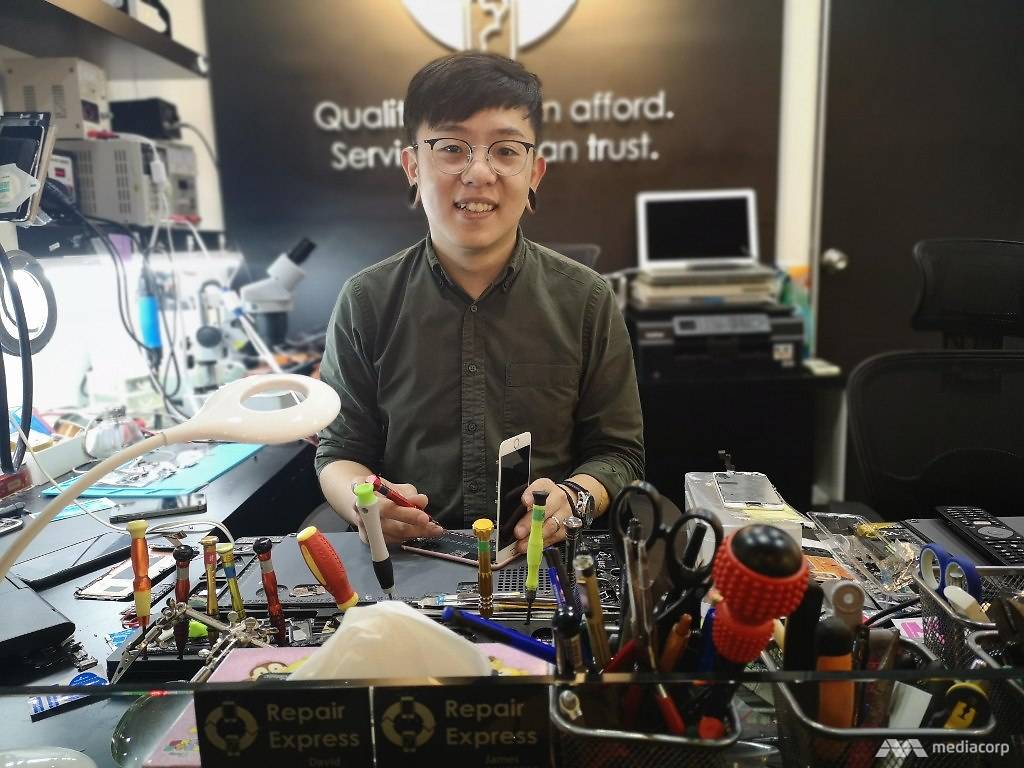
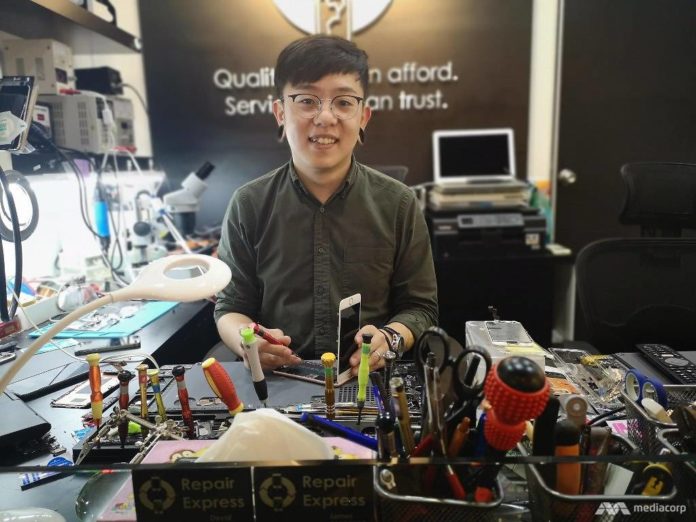
One such mobile phone repair business is Repair Express, whose co-founder, 28-year-old David started off as an apprentice at Sim Lim Square – one of Singapore’s well-known IT enclaves.

His workspace is a nondescript office in the middle of Crawford Lane. Flickering near the entrance was a big, flat-screen TV hooked up to YouTube and showing videos of mobile devices being fixed or taken apart. David was sat bent over fiddling with a dissembled smartphone when Channel NewsAsia walked in on him one afternoon.

It has been his bread-and-butter for the past four years, supported by what he described as a steady stream of customers.

On average, he gets 15 to 20 customers a day, or 500 to 600 customers each month. Setting up shop away from the retail hotspots means avoiding the costly overheads and these savings are passed on to his customers, he said.

Another key selling point: Repair Express is open at all hours of the day. 

This allows it to capture an underserved demographic: “You’ll be surprised, I get about three to four customers a week during the 4am-to-7am time slot,” David shared.

But are businesses like his up to the task of fixing that Apple or Samsung phone packed with the latest technology?

ON THE JOB TRAINING 

The budding entrepreneur shared that everything he knows about fixing phones is self-taught. This means seeking out support groups and forums whose members share their expert insights and techniques. And as a last resort – trial and error, he said. 

“We rely on the combined wisdom of the mobile repair industry,” David said, and this means watching fix-it videos and tutelage from others in closed forums and Facebook groups.

Those looking to join these closed groups in the tight-knit community will have to answer a series of technical questions and provide links to their repair businesses before moderators allow them entry. 

“One of the questions I was asked is: ‘If there’s a vertical green line on the screen, what’s the reason for it?’” David recounted.

Once in, he said “it’s a positive environment” where people are generally open to sharing their knowledge and helpful when answering queries from others.

Mobile repairman 1

David says Repair Express gets about 500 to 600 customers a month, but this number has been dropping in recent times. 

Knowledge sharing seems to be the main way skills of the trade are picked up. 

Aaron Goh, operations manager at uBreakiFix, shared that his company provides a structured in-house training programme where new employees are paired up with senior technicians to learn skills such as diagnostics and repair work ranging from simple battery and screen replacements to more complicated issues like water damage. 

Newer ones are usually given theoretical briefings on the types of faults and the likely causes and allowed to practice on dummy sets before moving on to customers’ devices only when confident – but with supervision.

His main challenge today? Newer curved screen models like Samsung Galaxy Note 8 and 9.

Aaron told Channel NewsAsia: “This is because the parts are more delicate and expensive … There are also more steps to disassemble then reassemble such phones.

“Other phones which are more difficult to repair are the less commonly used phones mainly because we have less exposure to such phones and less opportunity to practice (on them).” 

GETTING HELP FROM AFAR

Beyond online support, Repair Express’ David said technicians would make trips to places like China where the refurbishment of mobile phones is a “very big market”, he said.

For example, David said there aren’t many in Singapore who knows how to fix a faulty curved display screen – a component that is increasingly common in the latest phones such as Samsung’s Galaxy 9 and Huawei’s Mate 20.

Repairing these screens can be a highly technical affair involving heating pads, glue, thin wires, chemicals and a vacuum chamber. But delicate parts could be damaged in the process.

Another method available now promises less harm to the device. This involves freezing the phone in a cooling machine to -190 degrees, which makes the screen easy to remove, David said.

“Heat causes damage to screens and underlying wires; freezing doesn’t,” he explained. But at about S$8,000 to S$10,000 each, the machine is certainly not a small investment. 

Yet, he sees value in knowing how to fix such screens. Together with an unnamed partner company, he has coughed up the funds to allow two technicians to learn the technique in China. The two have been there since February, and will only be back at the end of the year, he revealed. 

It costs about S$3,000 a month just for their living expenses and “tuition fees”. Buying the screens for them to practice on is an additional expense, he added. 

Such commitment to improving one’s tradecraft is aligned with David’s business philosophy of focusing on branding and quality of the service to stay relevant and in demand. 

“All my customers know I’m not the cheapest around,” he said, “But they know what they are getting: Yi fen qian, yi fen huo (Chinese saying for paying more for quality).”

While uBreakiFix does not send people overseas for training, Aaron said technicians and suppliers from markets like China will demonstrate to its senior technicians how to repair the more delicate parts on the latest Samsung phones or remove the cameras on phones ranging from OnePlus and Apple to Xiaomi and Oppo.

Camera removal is a service “regularly requested” by customers who work in sensitive or secure work environments or National Servicemen, he shared. 

Broken phone screens

Repairing broken phones are getting more challenging as manufacturers move towards more complex and delicate components like curved screens. (Photo: uBreakiFix/Facebook)

“Only China technicians possess such unique skill sets,” Aaron said. “They are willing to show our technicians the ropes because we procure repair parts from them. 

“Usually these Chinese technicians learn from their own contacts who work with the brand owners or phone manufacturers,” he added.

CHALLENGING CLIMATE

However, even as mobile phone repairmen here look to upgrade their skillsets, external factors are posing a threat to their livelihoods.

One of these is the introduction of the latest and more technologically advanced phones within a short span of time by the smartphone makers. This is being done with greater regularity.

Indeed, a report by Euromonitor International released in August this year stated that while there is already an “extremely high” household penetration rate in terms of mobile phone sales, sales figures for the devices will continue to remain strong in Singapore. 

READ: When should children be allowed to have their own mobile phones? A commentary

It forecasts mobile phone sales to hit about 2.78 million this year, comparable with 2017’s 2.79 million sold.

smartphones

File photo of people showing their smartphones. (AFP PHOTO / PHILIPPE HUGUEN)

“High disposable incomes and consumer interest in keeping abreast of the latest technological innovations are some of the factors contributing both to a stable rate of replacement sales and to value growth,” the research firm said in the report.

“Furthermore, through short-term mobile contracts, telecommunication operators offer consumers attractive incentives and subsidies to regularly upgrade their existing phones approximately every two years.”

This is currently being played out. 

Already, industry leaders like Apple and Samsung have unveiled their latest models, as have rivals Google, Huawei, Xiaomi and even Razer. 

Repair Express’ David acknowledged these market developments, but these short launch cycles are not what keeps him up at night. 

What has most affected his customer base, he said, is the inexpensive insurance plans being offered by the telcos as a value-add service when a new mobile phone is purchased.

He said sales volume has “gone down quite a bit” and, when pressed, said in July, he saw about 300 customers – half of the usual figure cited above. 

There is also increased competition from other mobile repair service providers – “nowadays, it is quite easy to learn how to repair phones like Apple’s iPhones from YouTube” – and lower charges levied by the official service centres, David pointed out. 

It appears there are no quick fixes for mobile repair businesses but to collaborate and play catch-up with technology to stay relevant. 

Source link

Will lower prices in open market make consumers use more electricity? Experts weigh in

0

SINGAPORE: As electricity retailers in the Open Electricity Market (OEM) dangle discounted tariffs at cost-savvy consumers, experts are divided over whether this could lead to higher consumption.

Some said this could lead to a “rebound effect”, which refers to consumers using more electricity because it is cheaper. Others said the OEM would make users more aware of their consumption habits, leading to a decrease in consumption.

On Nov 1, the OEM was expanded to households with postal codes beginning with 58 to 78, such as those in Choa Chu Kang, Bukit Batok and Yishun. This means they can switch to a different retailer that offers a cheaper electricity plan.

After the market was first opened on Apr 1 to households in Jurong, the Energy Market Authority said that roughly a third of consumers there have chosen to switch retailers, enjoying savings of about 20 per cent.

With the market opening to all households in Singapore by May next year, energy experts have warned of a potential rise in electricity consumption.

READ: Phased nationwide roll-out of Open Electricity Market begins: 5 things to know

Professor Subodh Mhaisalkar, executive director of Nanyang Technological University’s (NTU) Energy Research Institute, acknowledged the “possibility of a rebound effect”.

“The risk is that with cheaper electricity, people may tend to use more,” said Ms Melissa Low, a research fellow at the National University of Singapore’s (NUS) Energy Studies Institute.

For example, she said studies have found that those who use energy-efficient appliances actually end up consuming more electricity. A 2011 report by American think-tank Breakthrough Institute estimated that 10 to 30 per cent of energy savings from efficient cars and homes are lost.

However, Ms Low said it’s hard to tell for sure if the rebound effect will happen in Singapore, especially as retailers might tweak their prices as the OEM expands and consumption habits vary across estates.

“Studies need to be done on the Jurong residents who switched to get a better sense,” she added.

MORE AWARENESS ON USAGE

The National Environment Agency said in May that households are consuming 17 per cent more electricity than a decade ago. Last year, households used about 7,295 GWh of electricity, equivalent to each of them spending an average of about S$1,000 a year on electricity bills.

When asked how the Government might ensure electricity usage does not increase with lower prices, Minister for Trade and Industry Chan Chun Sing said it’s also about helping households be more aware of their consumption patterns. 

“The Open Electricity Market is just the first part of our restructuring of the energy markets,” he said in an interview on the sidelines of the Singapore International Energy Week on Oct 30. “The other thing that we are doing is progressively implementing the smart meters.”

File photo of electricity meter

File photo of an electricity meter. (Photo: Aqil Haziq Mahmud)

When switching retailers, consumers can choose to install an advanced meter that measures electricity consumption at half-hour intervals, as opposed to current cumulative meters which are manually read once every two months.

The new meters are expected to give more accurate readings and help households better manage electricity consumption.

“Once we have the combination of the advanced meters and the Open Electricity Market, it will allow consumers to have more choices to be better able to match their demand and supply and save money,” Mr Chan added.

READ: Singapore to open up retail electricity market from November: What it means for consumers

Mr Gilles Pascual, ASEAN power and utilities transaction leader at Ernst and Young, said the open market will make consumers more aware of electricity prices, leading to a “slight decrease” in consumption.

“Once people are empowered, they know they can influence their bill,” he added. “With a few easy adjustments to their consumption behavior, they can further reduce their bill.”

Mr Sharad Somani, KPMG Singapore’s Asia-Pacific head for power and utilities, said he does not foresee “significant changes in consumption in the near term”.

“Currently, a lot of electricity is used to power essential products like household appliances and consumption from these items is therefore unlikely to change,” he explained.

Mr Somani said consumers will also become more informed on how much electricity they use as retailers offer choices like peak and off-peak plans that are more energy-efficient.

“Retailers may look to offer packages that tap into new technologies such as smart meters and the Internet of Things to offer consumers plans that reduce their electricity bill,” he added.

NTU’s Prof Mhaisalkar said he hopes such measures by retailers “nudge the consumers in making the right choices and contributing overall towards energy conservation and saving”.

RETAILERS CHIP IN

For Senoko Energy, one of 13 alternative retailers on the market, “the idea is not to say here’s a lower price but use more, but here’s a lower price but I want you to be more sustainable”.

“Retailers are doing a very good job at educating customers on energy efficiency,” said its senior vice president of SME and consumer sales Stefano Boscaglia. “I know throughout social media we do a lot of work to say here’s some energy-saving tips.”

READ: Full opening of electricity market in Singapore to fire up competition: What will retailers do?

Mr Boscaglia said he has not seen Jurong households that have recently switched to Senoko’s plans use more electricity.

“It’s probably too early tell because Jurong is a small portion of the market and the data we’re getting is still very young,” he said. “That will play out over time as the market opens up to the various zones.”

Nevertheless, Mr Boscaglia said he does not expect consumption to increase as consumers have shown to be “quite savvy”. “I think customers want that anyway because they’re looking at being more energy-efficient in how they go about their consumption,” he added.

NUS’ Ms Low said households might still choose to maintain their consumption despite the lower prices. “To some people, the money that they save can be used to buy groceries,” she added.

Source link

Commentary: A wake-up call, when a disadvantaged child gets 8 out of 100 for an exam

0

SINGAPORE: Income inequality creates divisions in our society.

From birth, children from the bottom 20 per cent receive less access to financial and social resources than their peers from other socio-economic status.

This gap widens with each year and its effects become evident by the time these children turn seven, when formal education begins.

A number of years ago, I visited an eight-year-old boy who lived with his grandmother. His parents were incarcerated for drug offences. His grandmother and the eight-year-old boy survived on ComCare for a number of years.

During my home visit, I noticed that he was unwilling to engage me in a conversation. Because his school bag was wide open when I visited, I asked for permission to look at a test paper he had received that day.

The child had scored 8 out of 100 for his English examination. He was unwilling to talk to me not because he was shy, but because he couldn’t speak much English.

This also meant that he was unable to enjoy his time in school. His grandmother explained that it was becoming increasingly difficult for her to persuade him to attend school. On an average week, he would skip two days.

I had then a three-year-old daughter who had begun stringing sentences in English, and was conversing with practically anyone who would lend her their ears. I rarely had any difficulties sending her to kindergarten since she was always looking forward to varied experiences in school.

His lived experience and my daughter’s lived experience were completely different. I was horrified to see the gap between this eight-year-old boy and my then three-year-old daughter.

A WIDENING GAP WITH AGE

After the home visit, I made arrangements for the child to receive psychological support for his learning difficulties. While that helped him enjoy school a little more, he was by then, too far behind his peers and could no longer keep up with academic requirements.

The gap continues to widen between him and his peers with each year.

students in school uniform walking

(Photo: Unsplash/Fancycrave)

I often think about this boy and wonder what we, as a society, could have done to help him. 

His disadvantaged background (including inter-generational poverty and drug abuse) should have been red flags for schools, community organisations, relatives, neighbours and family friends.

His inability to string sentences in English by the age of five should have raised red flags for all who interacted with the child. Why were this child’s needs not identified by anyone?

READ: This is what the face of poverty looks like, a commentary

NO SUPPORT

It became evident with time that the eight-year-old child did not have an ecosystem of support around him. He was not attending school regularly. He was also not actively engaged in any social groups outside of his home.

His grandmother lamented that even if these support systems were readily available in their community, she would not have been able to facilitate the boy’s access to them.

This grandmother, who is equally disadvantaged, was struggling to understand the boy’s needs. Because of her poor health and her own poor command of English, she struggled to facilitate his access to resources.

One could hardly blame her for struggling to pull herself together, think clearly about what her grandson needed and take her unwilling grandson to access these resources.

READ: The trouble with helping disadvantaged kids is you don’t know where to start, a commentary

Elderly girl Singapore

An elderly woman and a child in Singapore. (Photo: Gaya Chandramohan)

WE CAN EACH DO SOMETHING

While helping children from disadvantaged backgrounds overcome obstacles to progress in their path seems like an enormous task, it isn’t a mammoth undertaking that requires an immediate overhaul of our education system.

However, it also isn’t going to simply be resolved by us showing more care and concern for one another. It requires commitment at different levels.

The duo’s community – the kindergarten, the school, relatives, neighbours, volunteers and community agencies – must step up to facilitate the child’s access to these resources.

This has to be done in the absence of a strong adult figure who would create the ecosystem of support.

The school and community agencies must consider different ways of engaging the child during school hours, such as providing one-to-one supervision, providing an allied educator to support his learning needs and mobilising social welfare officers or social service practitioners to actively reach out and create the necessary ecosystem of support.

The good news is that there are existing programmes available in the community that aim to do this very needful thing. Programmes such as KidSTART and KIDS 0-3 are great examples. Both aim to coordinate and strengthen support across agencies, extend new forms of support, and monitor the progress of children from birth onwards.

READ: Trade-offs unavoidable in social policy: MSF

Generic preschool image. Photo: TODAY (1)

Teacher and children at a pre-school in Singapore. (File photo: TODAY)

We need to find a way to scale up such programmes in all neighbourhoods, actively reach out to these families and tailor the ecosystem of support to meet the needs of these children. We need to provide schools with these same resources to do this outreach work.

IT TAKES A VILLAGE TO RAISE A CHILD

Beyond the schools and the community agencies who do this needful work of offering professional services to these families, informal social support systems such as volunteers, neighbours and family friends play a big part in ensuring that these children utilise the resources they need from an early age.

A neighbour could have provided some support to the child by offering to ferry the child to school. Another neighbour could have offered to read to the child regularly or offered support to the grandmother when she feels disempowered to take the child to school.

A relative could have helped with homework supervision.

A grassroots volunteer could have befriended the child and offered to take the child for weekly language or reading classes. 

A grassroots leader could work with community agencies to bring outreach programmes to the neighbourhood, and mobilise volunteers to commit to forming long-term relationships with these families.

Everyone has a moral obligation to alleviate this hardship. It is definitely within our power to extend help and support to a child, even if it is an inconvenience to us.

Imagine the impact we would make as a society if we would all learn to commit to the welfare of one such child.

READ: MOE-led task force to strengthen support for students from disadvantaged families

Children play physical education PE class

(Photo: Unsplash/MI PHAM)

It takes a village to raise a child, and when we, as participants of this village also scale up our efforts to support these children, we would start seeing these children having a better shot at achieving positive life outcomes.

WHAT DOES THAT MEAN FOR YOU AND I?

If you are a social service practitioner in a community agency or a teacher in a school, it means designing outreach programmes aimed at tailoring ecosystems of support to meet the needs of the child.

It would mean actively reaching out to these children and their families, and focusing not just on creating the support systems, but finding various ways to facilitate the child’s access to these systems. It would mean mobilising the community to help support this child.

READ: Three stories on why tackling poverty requires active listening, a commentary

Michelle Yeo, the co-founder of ReadAble, a literacy programme for children from low-income families, describes the work needed to help uplift children from disadvantaged families well:

When children are in an unstable environment, they are subject to intense, chronic stress … and this affects their development greatly … If we are really committed to lifting up these children, then we must be prepared to offer help on many fronts.

In order to give these children a good shot at positive life outcomes, we, the community, have to reach out and offer help, on a long-term basis. There is no short cut to doing this needful work.

Cindy Ng is a social worker with extensive experience working with low-income families and persons experiencing violence and abuse.

Source link

‘Together in the same arena’: RSAF, army rehearse for Exercise Trident finale

0

ROCKHAMPTON, Australia: Sand and walls of hot exhaust slammed into us as a helicopter deftly lowered itself into a grassy clearing some distance away.

The helicopter’s ramp lowered and men in green filed out with their weapons and gear, promptly dropping to the ground prone in anticipation of an enemy ambush.

Exercise Trident (1)

A Chinook engaged in helicopter operations. (Photo: Gaya Chandramohan)

Exercise Trident (2)

Soldiers disembarking from a Chinook. (Photo: Gaya Chandramohan)

The men were part of an advance party, rehearsing a scenario in which they were airlifted from a landing ship tank (LST) out at sea to eliminate enemy forces inland before the main troops arrive at the scene.

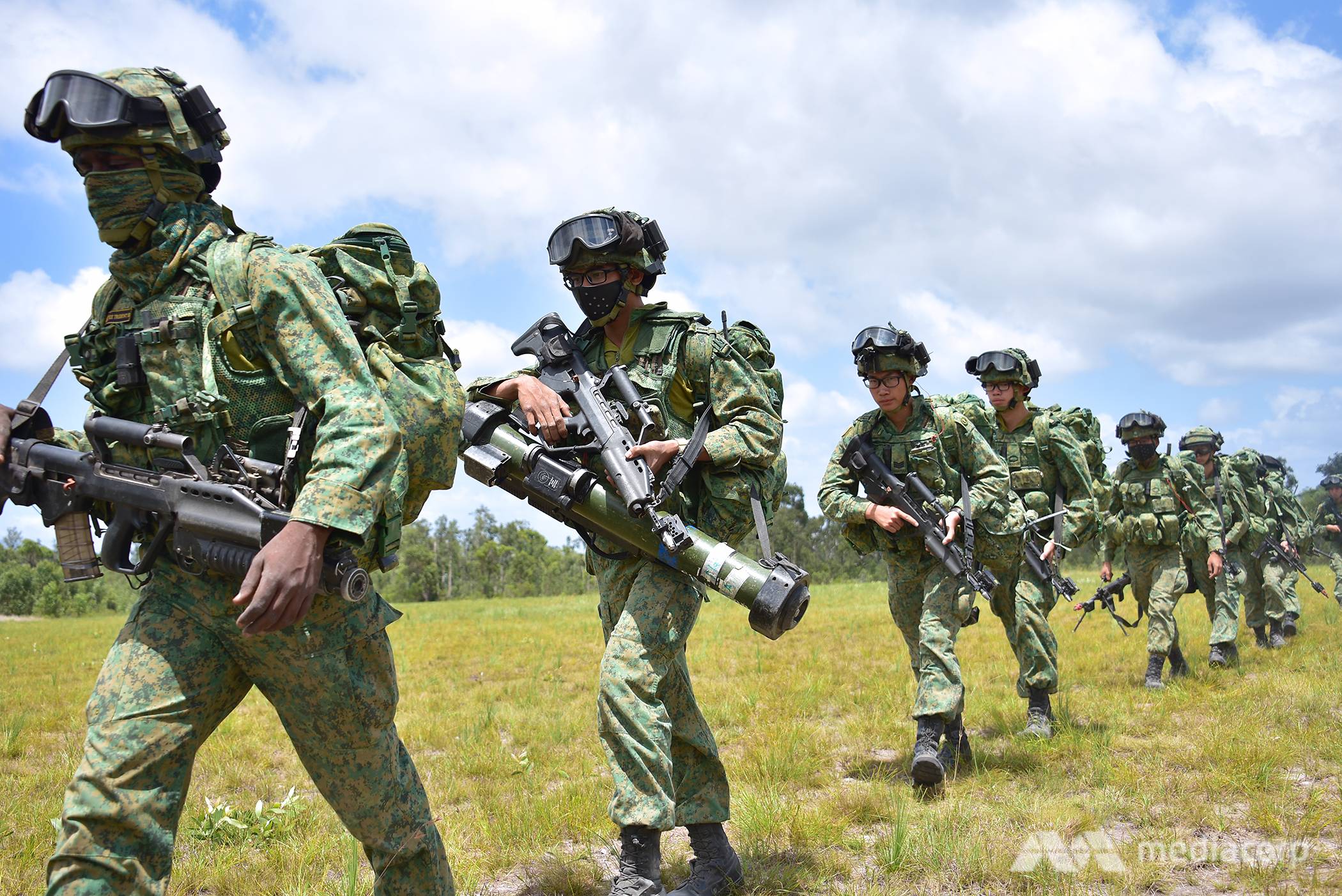
On Saturday (Nov 10), these Republic of Singapore Air Force (RSAF) troops and assets will see action in the grand finale of Exercise Trident.

The 10 RSAF aircraft – six Super Pumas and four Chinooks – will be flying troops inland as part of a helicopter and ship-to-shore operation that also involves the Singapore navy and army, as well as the Australian Defence Force (ADF).

Exercise Trident (9)

Soldiers getting into formation upon disembarking from a helicopter. (Photo: Gaya Chandramohan)

To the air force personnel involved in the Trident’s helicopter operations, it is a rare opportunity that allows them to work with their army and navy counterparts.

“This is the part where we see the real value of Exercise Trident,” said Exercise Air Director Senior Lieutenant-Colonel (SLTC) Maxmillion Goh.

Exercise Trident (7)

Soldiers rehearsing for Exercise Trident. (Photo: Gaya Chandramohan)

Exercise Trident (8)

(Photo: Gaya Chandramohan)

“By having all our airmen, sailors as well as our soldiers all together within the same arena, we go through a very deliberate planning and coordination process to make sure we develop with close understanding in terms of each other’s platforms and capabilities and each other’s operational considerations and requirements.”

READ: SAF troops rehearse for Exercise Trident finale amid challenging conditions

For air-land tactical controller (CPT) Eileen Yeo, coordination with navy and army personnel is crucial in helping her team maintain a safe airspace for pilots over land and sea.

“We don’t get to practice on a tri-service level in Singapore,” CPT Yeo said. “In Singapore, we focus on our own skills to make sure we are very good at it, so that when it comes to exercises like these, we can work together and make sure it is synced and integrated.”

She added that the area under her charge back in Singapore is “much smaller” compared to the Shoalwater Bay Training Area (SWBTA) – an area four times the size of Singapore – where they train in Australia.

“Here, you get the experience of coordinating with all three services, something I don’t often get to do back home.” 

Exercise Trident

A Chinook helicopter at Exercise Trident. (Photo: Gaya Chandramohan)

This year’s Exercise Trident involves more than 1,300 personnel from the SAF and the ADF and features the largest number of participating troops from the ADF since Trident kicked off in 2013. Trident is the signature bilateral exercise featuring battalion-level amphibious operations executed by the SAF and the ADF.

Even for Trident veterans like Second Warrant Officer Vijaikumar Rangabashayam, each year’s mission holds something new.

“The dynamics of the whole exercise with more assets being involved also changes and that provides us with a different challenge for every Trident, and we see how we work around it,” said the Chinook Aircrew Specialist Leader, who has taken part in Exercise Trident three times.

“The scenarios are always evolving and changing so that we always stay relevant to current situations everywhere.”

READ: ‘You won’t find us walking on eggshells’: Pressing on with Exercise Trident during a safety timeout

READ: New safety measures for armoured training implemented at Exercise Wallaby

Source link

More tourists visiting Singapore, but spending less: STB

0

SINGAPORE: More tourists visited Singapore in the second quarter of this year compared to last year, but they spent less, according to a Singapore Tourism Board report released on Friday (Nov 9).

International visitor arrivals grew by 8 per cent year-on-year to reach 4.6 million. However, tourism receipts for the same period fell 1.7 per cent to S$6.6 billion.

This was due to tourists spending less on sectors such as shopping and food and beverage during the second quarter, the report said.

STB Q2 2018

Major segments of Singapore’s tourism receipts in Q2 2018. (Infographic: STB)

Tourists spent a total of S$1.26 billion on shopping, a 22 per cent decline compared to the previous year, and S$601 million on food and beverage, a 15 per cent decrease from the previous year.

Gazetted hotel room revenue increased by 9.4 per cent year-on-year to reach S$1 billion, with average occupancy rate at 85 per cent – a 0.9 percentage point increase from last year.

STB Report Q2 2018 Top Spenders

Top spenders amongst tourists visiting Singapore in Q2 2018. (Infographic: STB)

Visitors from China, Indonesia and India spent the most, contributing to 45 per cent of tourism receipts, excluding the sightseeing, entertainment and gaming segment.

Source link

SAF to launch joint operation to secure 33rd ASEAN Summit

0

SINGAPORE: Security forces will be on high alert next week as about 19 heads of state are due to arrive in Singapore for the 33rd ASEAN Summit.

Various tasks forces from the Singapore Armed Forces (SAF) will mount a joint operation involving more than 40 assets and 1,600 troops for the Summit, which runs from Monday to Thursday (Nov 11 to 15).

These are the Air Defence Task Force, the Maritime Security Task Force, the Island Defence Task Force and the Special Operations Task Force. They will work alongside Ministry of Home Affairs (MHA) agencies to ensure safety in the Summit venue, Suntec International Convention and Exhibition Centre.

saf joint ops

Security forces will be on high alert ahead of the 33rd ASEAN Summit. (Photo: Ariel Lim)

The upcoming event’s security demands are as complex as those during the historic summit between US President Donald Trump and North Korean leader Kim Jong Un in June, according to Colonel Lim Kok Hong, head of the current operations group of the SAF.

“We have a lot more heads of state coming here, about 19 other heads of state depending, so the movements will be very different and there will be more complexities on the ground,” said Colonel Lim.

READ: SCDF to deploy hazmat vehicles, 150 officers at ASEAN Summit

Speaking aboard RSS Sovereignty at Tuas Naval Base on Friday, Colonel Lim said that the different agencies have been working closely with each other to develop and execute plans for the summit.

The RSS Sovereignty is one of Singapore’s five commissioned Littoral Mission Vessels (LMVs) which patrols crowded and busy waters. At all times, up to two LMVs or Patrol Vessels secure Singapore’s territorial seas, along with the Police Coast Guard.

Singaporeans should expect different security operations from that of the Trump-Kim Summit. 

“Every summit location will provide different challenges. The previous one was a lot closer to the sea hence our security posture is different. This one is closer inland but there are a lot more heads of state, a lot more hotels, so the challenges are different,” noted Colonel Lim.

As part of SAF’s joint operation, an additional two such vessels will be stationed at the waters around Marina Barrage. They will be accompanied by an unmanned aerial vehicle and an Apache Helicopter.

Up in the skies, the Air Defence Task Force will activate the Gulfstream 550, to provide airborne surveillance of the Island. During critical periods, the Air Force will have fighter jets, helicopters, or surveillance aircraft in the air to enhance its defence.

On land, MHA agencies take charge of security. They are supported by the Island Defence Task Force, which includes chemical, biological, radiological and explosives sections that will do preventive sweeps in key areas. 

The Special Operations teams will also be on standby for any contingencies or counter-terrorism measures when the heads of states are around.

Source link

LTA to introduce caps on parking spaces at new private developments from February 2019

0

SINGAPORE: Caps on car parking spaces at new private developments will be introduced next year, under new parking standards announced by the Land Transport Authority (LTA) on Friday (Nov 9).

LTA also announced that five areas will be gazetted as car-lite precincts. These are Marina South, Kampong Bugis, Woodlands North, Bayshore and Jurong Lake District.

The new Range-based Parking Provision Standards – which will be introduced from February next year – will replace the existing Car Parking Standards and Range-based Car Parking Standards, and are meant to give developers “greater flexibility” in managing parking provisions, said the authority.

The new standards will specify both the minimum and maximum number of car parking places a development must have – unlike the current Car Parking Standards, which only sets a minimum number.

In addition, there will be fewer car parking places under the new standards for certain types of new developments that fall under specific zones.

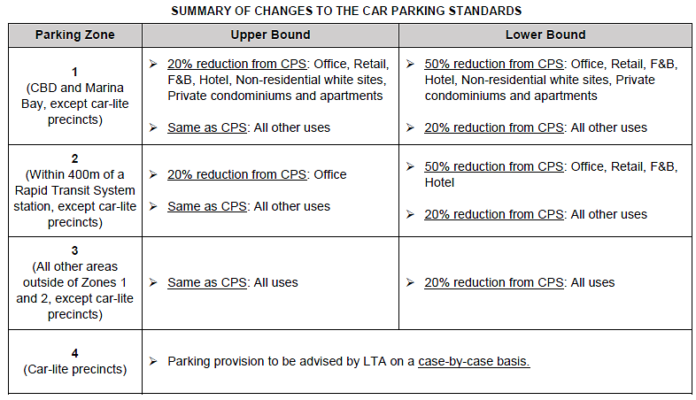
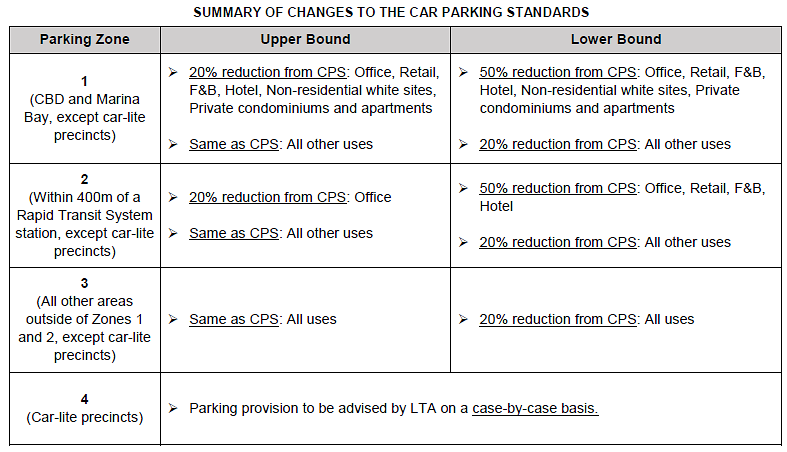
Depending on development type, new private developments in the Central Business District and Marina Bay, as well as those within 400m of a Rapid Transit System station, could have the maximum number of car lots they can have set at a 20 per cent reduction from current minimum standards (unless they are in a car-lite precinct).

Graphic showing changes to car parking standards - LTA

(Image: LTA)

NEW CAR-LITE PRECINCTS 

The five areas gazetted for development as car-lite precincts – Marina South, Kampong Bugis, Woodlands North, Bayshore and Jurong Lake District – will be planned with added support for public transport and alternative travel options. 

Parking provisions for development applications here will be determined on a case-by-case basis, said LTA.

The changes to car parking provisions were introduced as part of changes to the Parking Places Act.

The Parking Places (Amendment) Act 2018 was passed in March this year to give LTA the power to better adjust parking provision for private developments and support a “car-lite Singapore”.

At the time, LTA said this would allow Singapore to maximise the use of its limited land and free up car park space for other uses.

CATERING for MOTORCYCLISTS 

To ensure new developments cater for motorcycles, LTA will also introduce requirements for motorcycle lots in all non-residential developments.

Five per cent of the total car and motorcycle parking lot provision for each development will be allocated to motorcycles.

Developments that have obtained the necessary approvals from the Urban Redevelopment Authority on or after Feb 1, 2019 will be allowed to provide any level of parking provision within the specified range, said LTA. 

The changes will apply to new developments, redevelopment, selected additions and alteration and change of use applications received on or after Feb 1 next year, and will not be applied retrospectively.

Source link