SINGAPORE: “Breathless speculation” about his future appointment in the People’s Action Party’s (PAP) Central Executive Committee (CEC) may be “off the mark”, Law and Home Affairs Minister K Shanmugam has said, in response to media reports that suggested he would be appointed a PAP assistant secretary-general and deputy prime minister.
Replying to questions from Channel NewsAsia, Mr Shanmugam said: “I can understand the speculation based on the photograph at the party conference and my relative seniority.
“But these assessments are based on a snapshot, of a point in time, rather than a deep understanding of how the PAP operates and how transition works.”
Minister K Shanmugam, Prime Minister Lee Hsien Loong, and ministers Chan Chun Sing and Gan Kim Yong at the PAP Conference and Awards Ceremony at Singapore Expo on Nov 11, 2018. (Photo: Jeremy Long)
“I have said on Sunday, in response to a question as to whether I will be one of the assistant secretaries-general, that these matters have to be decided by the CEC, but that my own view is that the appointments must reflect the future and not the transition,” Mr Shanmugam said.
“So quite a bit of the breathless speculation may be off the mark.”
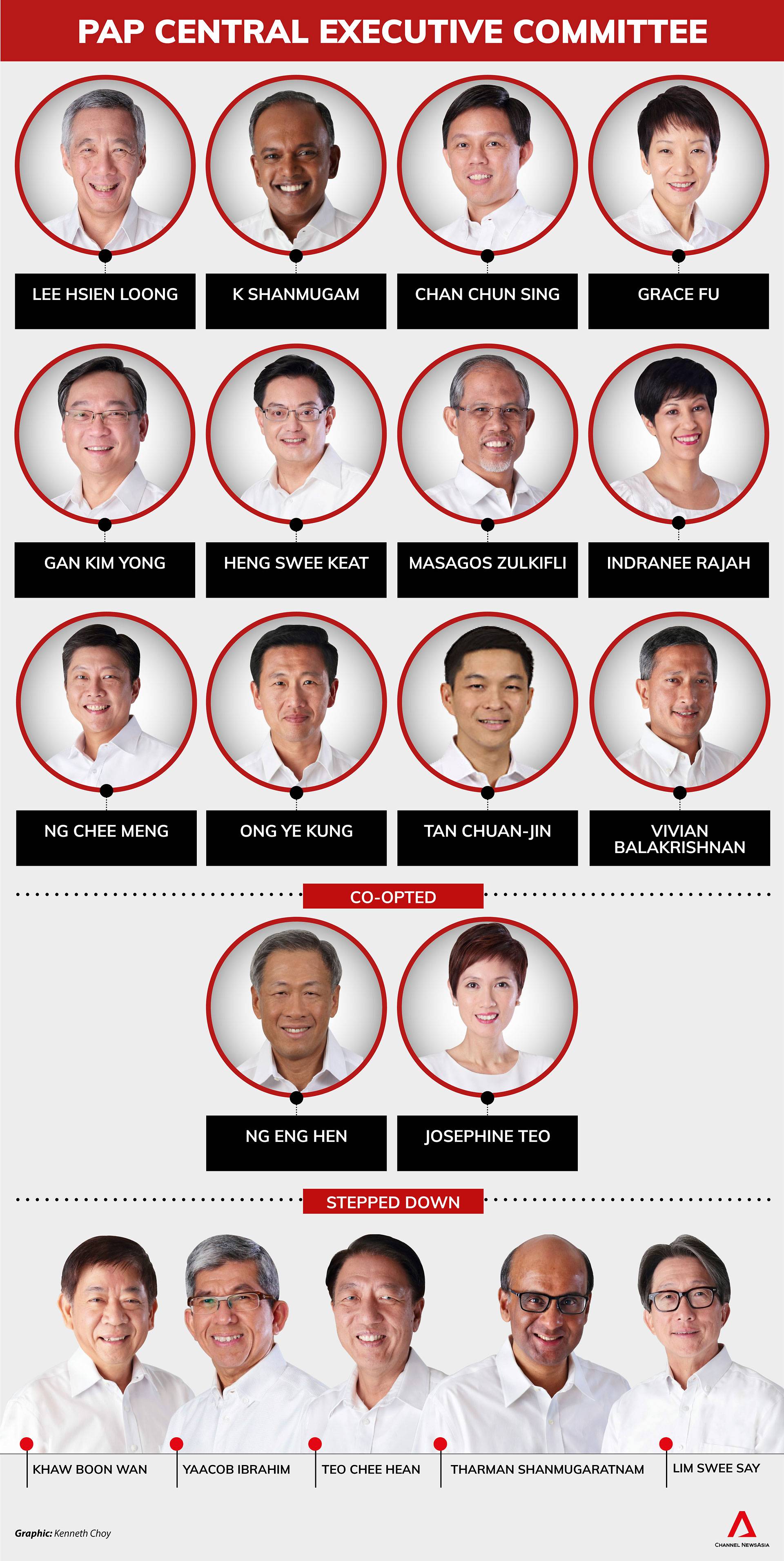
On Sunday (Nov 11), 12 PAP members were elected into the CEC – Prime Minister Lee Hsien Loong, Mr Shanmugam, Health Minister Gan Kim Yong, Foreign Affairs Minister Vivian Balakrishnan, Finance Minister Heng Swee Keat, Trade and Industry Minister Chan Chun Sing, Education Minister Ong Ye Kung, Minister for the Environment and Water Resources Masagos Zulkifli, Minister for Culture, Community and Youth Grace Fu, Ms Indranee Rajah and Mr Ng Chee Meng, both Ministers in the Prime Minister’s Office and Speaker of Parliament Tan Chuan-Jin.
Defence Minister Ng Eng Hen and Manpower Minister Josephine Teo were co-opted into the committee.
Graphic showing PAP’s newest Central Executive Committee. (Graphic: Kenneth Choy)
This PAP conference was closely watched for clues regarding Singapore’s political leadership succession. Deputy Prime Ministers and PAP assistant secretaries-general Teo Chee Hean and Tharman Shanmugaratnam have relinquished their party posts, leading to some speculation about who will fill their shoes.
Analysts have said that the assistant secretary-general spots are likely to go to one or two of three ministers in the running for the position of prime minister – Mr Ong, Mr Heng and Mr Chan. There was also a suggestion that one spot could go to Mr Shanmugam.
Other ministers who have stepped aside in the party central committee include Co-ordinating Minister for Infrastructure Khaw Boon Wan, who was the party chairman; and former Cabinet ministers Lim Swee Say and Yaacob Ibrahim.
Mr Lee said during the party conference that the PAP is taking a “major step in political renewal”.
He added that following the elections, the new CEC would meet within “a couple of weeks” to elect a new slate of office holders, and that he would follow up with changes in the Cabinet lineup.
THE ACCUMULATION of private wealth has rocketed in China in the decade following the global financial crisis, thanks to a strengthening economy and successful stimulus programmes.
Between 2016 and 2017, China added 106 billionaires to its ultra-high net worth population to hit a total 373 billionaires – a growth rate of two billionaires per week. In 2006, the country only had 16 billionaires.
Flush with cash, this group of nouveau riche are not only travelling more (nearly 80 million Chinese nationals made outbound trips in the first half of 2018 – 16.4 percent more than last year) and choosing to send their children to schools abroad, they are also constantly on the lookout for investment opportunities outside of China.
And because culturally, home ownership is a key marriage criterion among the Chinese (over 70 percent of Chinese millennials are already proud homeowners), buying up overseas real estate is a naturally attractive prospect.
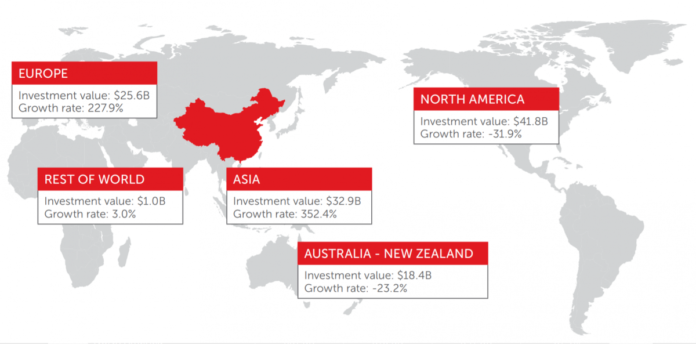
Chinese outbound real estate investment in 2017. Source: Juwai.com
Reports say the answer lies in Asia.
Compared to traditional favourites like the US, Canada, Australia and New Zealand, it is in Asia where Chinese interest has been picking up the most steam. And fuelled by an increasingly tough domestic investment climate, the Chinese are keener than ever on investment opportunities in Asia’s developing markets.
Last year, Chinese investment in Asia increased by a staggering 352.4 percent to hit a total value of US$32.9 billion in both commercial and residential properties, according to online Chinese real estate data platform Juwai.com in its October 2018 report.
Europe emerged the second most popular region for Chinese investors, with investments growing 227.9 percent to reach US$25.6 billion in total value, whilst investments in Australia, New Zealand and the US declined.
Within Asia, Juwai CEO and director Carrier Law says countries in Southeast Asia have been gaining Chinese buyer market share at unprecedented rates.
In Thailand, for example, the number of inquiries from Chinese buyers looking to buy homes increased by 91 percent between January 2017 and January 2018. When compared to the same period in 2016, that increase goes up even further – to a staggering 313 percent.
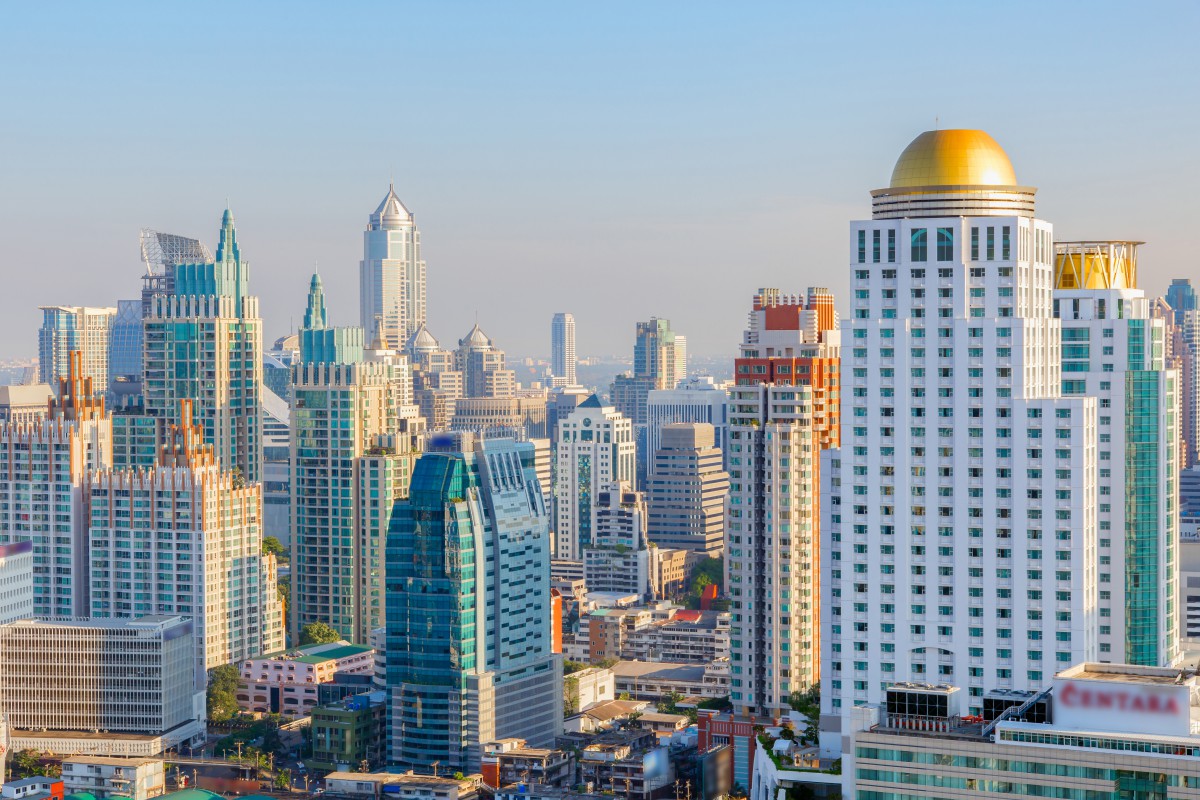
Aerial view of Bangkok’s skyline. Source: Shutterstock
An Asia Times article quoting China Real Estate News said one likely contributing factor is that although foreigners are only allowed to buy high-rise properties in Thailand, they enjoy permanent property rights without property tax and inheritance tax.
Data from Bangkok-based developer Risland shows that since 2015, Chinese buyers pumped in US$10 billion into condo purchases in Thailand, which is the equivalent of the combined investment from Japanese and Singaporean investors. In fact, the developer estimates that one out of every five condos built in Thailand is owned by mainlanders or buyers from Hong Kong.
Other Southeast Asian economies drawing Chinese investors include Malaysia, Vietnam, Singapore and the Philippines.
Speaking to NST Property, Law added in a recent report: “Even smaller countries like Cambodia are seeing rapid growth in Chinese buying, although from a much smaller base.”
These investments are largely due to low prices and cultural commonalities between the Chinese mainlanders and these Southeast Asian markets but one other key factor, Law said, is their involvement in China’s “One Belt One Road” initiative.
Source: Responses compiled for UBS Evidence Lab survey. Chart from Juwai.com report.
In total, Chinese mainlanders spent US$119.7 billion to buy properties abroad in 2017.
This is an 18.1 percent increase from the US$101.4 billion they spent in 2016, an impressive growth figure, given it comes at a time of capital controls and growing political resistance to the spread of Chinese money abroad.
At home, Chinese citizens are bound by an annual purchase limit of US$50,000 worth of foreign currency per person whilst abroad, their overseas withdrawals using Chinese bank cards are limited to RMB100,000 (US$14,400) per person.
Additionally, according to South China Morning Post, the State Administration of Foreign Exchange (SAFE) has also “dramatically increased its policing” of illegal outflows, even resorting to naming and shaming those who dared to challenge Beijing’s capital control regime. The report said SAFE disclosed 23 such cases in August, five of which involved Chinese citizens trying to buy properties abroad.
But interestingly, despite Beijing’s best efforts to tighten controls over domestic capital outflows, Chinese interest and demand for properties abroad remain robust, reports say.
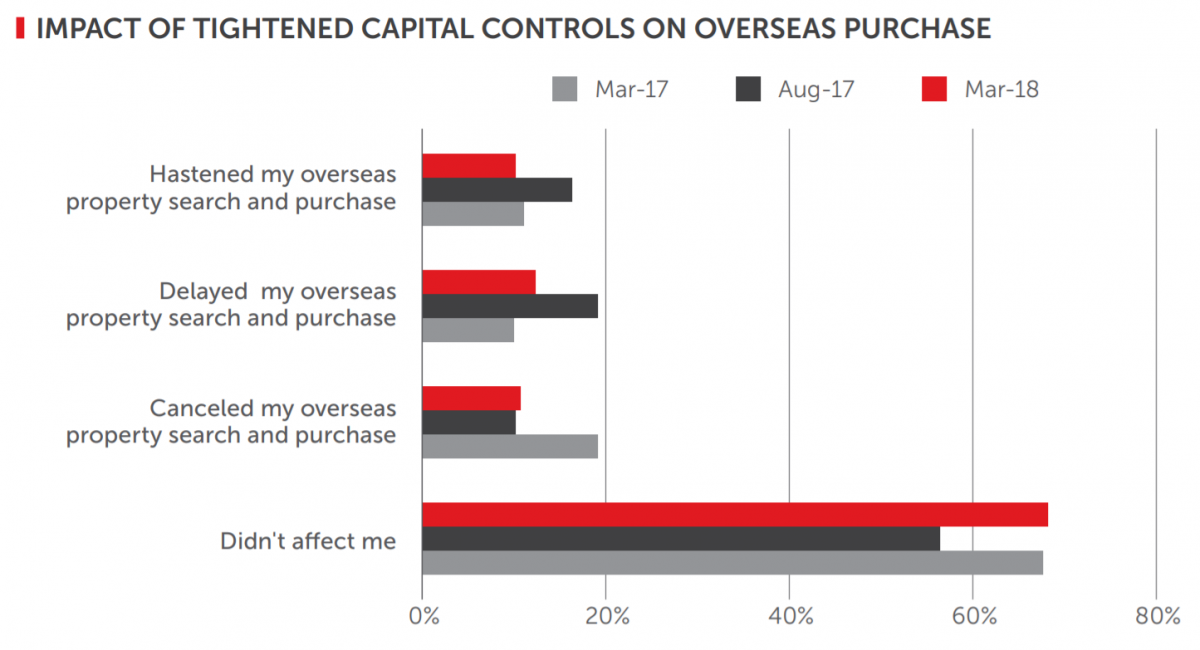
Juwai’s study says the impact of capital controls may have been blown out of proportion or “overstated”. Two-thirds of Chinese investors even told a survey by the UBS Evidence Lab (see image) that the capital controls, “didn’t affect me”.
As it stands, Juwai expects Chinese overseas real estate investments to continue unabated, with a projected growth of 3 to 8 percent this year. This would bring the total investment value up to between US$123.3 billion and US$129.3 billion.
SINGAPORE: In the world of online multiplayer video game Defence of the Ancients (DOTA), Gondar is the infamous bounty hunter who infiltrates rebel terrain to bring criminals to justice – all while being invisible.
The tales of Gondar’s prowess stretch on with each feat more impressive than the last, and for the right price, even the most devious assassin may find fear in the shadows.
Drawing parallels to today’s world, could the most effective cybersecurity allies come in the form of hackers themselves?
FRIEND OR FOE?
Going back a chapter, the rapidly growing number of hackers fall into two main camps working on opposing ends of the law: White hats and black hats.
The former are more commonly known as ethical hackers while the latter serve to wreak havoc for personal gain, and in some cases to fuel a wider hacktivist agenda – using tech know-how to protest against perceived political, legal, or societal injustices.
Think of the vulnerability market as a worldwide ecosystem of buyers and sellers, motivated by the forces of supply and demand.
Security researchers and hackers now have a multitude of options, unlike in the early days, when hackers traded and sold exploits amongst themselves for fame, disruption of traditional IT and software development pipelines, and once in a while for unscrupulous profit.
In a nutshell: The abundance of bad actors with ill intent are not going anywhere. The more technology individuals and enterprises alike use and become connected with, the more avenues there are for intruders to exploit system vulnerabilities.
In fact, as long as you’re connected to the web, a perpetrator can use a phishing website to launch a ransomware attack and lock down your device via the WiFi access points around you.
But imagine if businesses could use this intel for good?
Case in point. In 2017, the Zero Day Initiative – the world’s largest bug bounty programme – published 1,009 vulnerabilities in total.
Threat intelligence gained through exhuming these vulnerabilities from different software programmes, IT systems, or connected devices enabled the protection of customers, on average, 72 days before an official patch was released from the vendor.
Vulnerability research is a modern-day arms race between the black hats, cybercriminals looking for a quick buck and the white hats, researchers working with vendors to produce a patch that tightens the reins around vulnerable systems.
Globally, such bounty programmes uncovered a total of 1,522 vulnerabilities last year, out of which, 61 per cent were marked “critical-severity” and “high-severity”. Imagine the kind of damage that could have been inflicted should these vulnerabilities be uncovered by cybercriminals first.
Perhaps more than anything, the critical missing link for organisations is not just in the form of building layered network defences, having round-the-clock threat visibility, or adopting newfangled solutions. Instead, organisations should focus on exploring how hackers themselves can become the solution for a safer Internet.
Through the lens of ethical hacking, it is riveting to witness how there exists a global community committed to identifying security flaws in IT systems or software programmes for the purpose of strengthening the cyber world instead of exploiting it.
So much so that the work of these individuals has earned a nod from government bodies such as the US Department of Defence, enlisting their help to put national cybersecurity defences to the test.
A man types into a keyboard during the Def Con hacker convention in Las Vegas, Nevada, US on July 29, 2017. (Photo: REUTERS/Steve Marcus/File Photo)
We’re seeing this play out around the world as well. Take Pwn2Own, an annual computer hacking contest for instance. The winning white hat team in 2018 exploited a series of codes to gain control of a vendor’s web browser and revealed four new points of entry that could potentially facilitate the complete removal of a device’s operating system.
Not only do initiatives like this reveal the vulnerability of devices and software in widespread use, they also serve as a checkpoint on the progress made in security from the year before.
ENLISTING HACKERS
What businesses and government bodies alike need is to adopt a total change in paradigm to expose cybersecurity systems to the outside, enlist hackers to exploit vulnerabilities, and then reward them for responsibly disclosing vulnerabilities.
Singapore is already making strides in this direction with the inception of the Government Bug Bounty Programme slated to roll out later this year in a bid to identify blind spots in our connected infrastructures, and build a more innovative and inclusive cyber ecosystem.
To that end, Deputy Prime Minister Teo Chee Hean added that through this process, the government could “bring together a community of cyber defenders, who share the common goal of making cyberspace safer and more resilient”.
Only then can a sense of shared ownership be fostered to protect our critical information infrastructure – a vital element that will underpin Singapore’s Smart Nation vision.
File photo of Deputy Prime Minister Teo Chee Hean.
Some businesses may view this concept with eyebrows raised, fearing the worst repercussions for their digital assets and a beating to customer confidence levels. Would they be inadvertently handing over the keys to a group of masked intruders?
Not at all. Security experts have reached an inflection point: To protect data, they needed support beyond their existing in-house coders and security teams can offer.
An outside perspective is required to help win this raging war on the inside against cybercrime – in the form of perpetrators themselves. A change in mindset to create an open cybersecurity ecosystem needs to be set in stone for this to come to fruition.
Just like how DOTA heroes manoeuvre effortlessly between lawlessness and justice, white hat hackers and security researchers tasked with infiltrating systems and profiting in the form of new defence intelligence for good can bring promise of greater infrastructure security.
As the market evolves with the introduction of more programmes to incentivise research, a well-rounded defence agenda will need to work in tandem with global independent researchers to disclose security bugs and safeguard intellectual property.
Only then can Singapore truly benefit from a hacker’s books – or networks – to turn the tide against the real intruders.
Nilesh Jain is Trend Micro vice-president for Southeast Asia and India.
JOHOR BAHRU: The Johor state government has identified several mega projects to be implemented next year, including the construction of an airport in Mersing and part of a bridge linking Johor Bahru and Singapore.
“The bridge could be crooked or straight, but it would be a reality,” said Johor Chief Minister Osman Sapian on Monday (Nov 12).
The “crooked” bridge refers to a project first mooted by Prime Minister Mahathir Mohamad during his previous term in office. In 2003, Dr Mahathir had announced that Malaysia would go ahead and build its own half of the bridge if Singapore refused to demolish its half of the Causeway.
The Malaysian half would involve a six-lane highway that would curve in a way that would allow vessels to pass under it.
Osman said on Monday that the design of the bridge has not been finalised.
Construction will probably start after all quarters have reached an agreement over how to address congestion at the Johor Causeway and the Malaysia-Singapore Second Link, he added.
Singapore’s Ministry of Foreign Affairs had said in October that it has not received “any official proposal or communications” from Malaysia on the construction of a so-called “crooked bridge”.
According to The Star, Osman said that so far, there have not been any negative comments about the revival of the crooked bridge following the state government’s explanation on the matter.
“This is to solve the congestion at both entry points … and it only gets worse during holidays,” he was quoted saying in the report.
Johor state Chief Minister Osman Sapian. (File photo: Howard Law)
On the new airport in Mersing, the Johor Chief Minister said it will be located in the East Coast Economic Region. and can serve tourists from Batam in Indonesia and Phuket in Thailand.
It could also be a light aircraft repair hub.
“The Prime Minister has agreed that ECER will play a role. The airport is not for aircraft like Boeing, but for light planes like the Fokker.
“There are two locations, but the cost is still unknown, the consultant will make an evaluation,” Osman told reporters after opening a convention of local Johor authorities.
Osman also said that the development of Segamat district would be a priority for the state government next year, with projects including the upgrading of the Segamat Inland Port and a large-scale dairy and beef farm.
He added that housing and comprehensive development are two of the main issues that would be addressed when the state’s 2019 Budget is tabled on Nov 29.
“Many people have asked us to fulfil our promise of providing affordable housing,” he said, noting that the state government has already made good on 10 of its manifesto promises.
“Some have asked us for comprehensive development, and this is part of our plans. Some have also asked for higher salaries, allowances and bonuses. Insha Allah (God willing), we will give a year-end bonus to civil servants and staff of local authorities and statutory bodies in the state,” he added.
SINGAPORE: Immigration and Checkpoints Authority (ICA) officers foiled attempts to smuggle in more than 2,000 cartons of duty-unpaid cigarettes through Woodlands Checkpoint last week, the authority said on Monday (Nov 12).
In a Facebook post, ICA said its officers discovered duty-unpaid cigarettes in a Singapore-registered car on Saturday.
A total of 192 cartons and 40 packets of duty-unpaid cigarettes were found hidden in four ice boxes of seafood and the car’s spare tyre compartment.
A 64-year-old Singaporean man was referred to Singapore Customs for investigation.
A total of 192 cartons and 40 packets of duty-unpaid cigarettes were found in the Singapore-registered car. (Photo: ICA)
On Friday, ICA officers noticed anomalies in the scanned images of an arriving Singapore-registered bus and found 1,846 cartons and 40 packets of duty-unpaid cigarettes in the vehicle’s luggage compartment.
The 47-year-old Singaporean driver was also referred to Singapore Customs for investigation.
“Our borders are our first line of defence in safeguarding Singapore’s security. In view of the Asean summit, ICA has stepped up checks at our air, land and sea checkpoints.
“Motorists using the land checkpoints can expect enhanced checks on their vehicles. We seek the public’s understanding and cooperation as we keep our borders safe during this period,” the authority added.
More than 1,800 cartons of duty-unpaid cigarettes were found in the Singapore-registered bus. (Photo: ICA)
SINGAPORE: Travellers with faded fingerprints will soon not have to worry about getting stuck during immigration clearance.
From April 2019, the Immigration and Checkpoints Authority (ICA) will progressively deploy a new screening system which uses three biometric identifiers – fingerprints, facial and iris – to complement fingerprint matching for immigration clearance. ICA said this is more accurate and is useful for travellers with deteriorated fingerprints due to ageing, scarring or genetics.
The new system will be available at all checkpoints.
“With the BioScreen-Multi Modal Biometric Screening System, travellers can be authenticated using any of the three biometric identifiers,” the agency said in a statement on Monday (Nov 12).
“This will enable more efficient immigration clearance for travellers who may face difficulties using their fingerprints.”
The process is expected to take the same amount of time as current immigration procedures. (Photo: Marcus Ramos)
After handing over their passports, travellers put two thumbs on a fingerprint scanner and concurrently look at a camera which scans their faces and eyes. A green tick on a screen indicates the process is completed.
This process is expected to take the same amount of time as current procedures, with ICA saying it will be further fine-tuned during trials. The system is being trialled at manual and automated counters at Woodlands, Tuas and Tanah Merah Ferry Terminal checkpoints.
“A robust biometrics database of travellers, comprising facial images, fingerprint and iris, will be useful for post-incident investigation and data analytics purposes in the event of a security incident,” ICA added.
FACIAL RECOGNITION
Meanwhile, the ICA has also been beefing up security at Singapore’s borders with the use of facial recognition cameras, which have been deployed at Woodlands Checkpoint since 2012.
The cameras, found at strategic locations like entrances, queue lines and immigration counters, are used to identify wanted persons, including during post-incident investigations.
The facial recognition cameras are located at entrances, queue lines and immigration counters. (Photo: Marcus Ramos)
Since 2012, the system has identified persons wanted for offences like possessing multiple identities and previously overstaying in Singapore, although ICA declined to reveal exact figures due to operational security.
“More than 280,000 travellers pass through Woodlands Checkpoint every day,” Deputy Assistant Commissioner (DAC) Lian Lee Siong from ICA told reporters on Monday.
“With this facial recognition technology, we will be able to process large volumes of passengers more efficiently and securely.”
The cameras have also been used during stepped-up checks in the lead-up to the ongoing ASEAN Summit, and other major events like the Trump-Kim summit. ICA is also in the midst of deploying the cameras at other checkpoints like Changi Airport.
HOW IT WORKS
ICA works with other security agencies like the police to upload pictures of wanted persons into its database, which currently contains a few hundred thousand images.
The system can simultaneously compare faces of multiple travellers to those in the database and automatically flag wanted persons to officers in the command centre. These officers make a final identification before alerting their colleagues on the ground.
ICA officers in a command centre look out for wanted persons flagged by the system. (Photo: Marcus Ramos)
Officials said this process takes three to five seconds, which means suspects trying to flee the country will be nabbed even before reaching the immigration counter.
“If someone commits a crime inland and attempts to depart Singapore through our checkpoints, all we need is just a photograph of him and our system will be able to sieve him out from the crowd,” DAC Lian said.
The system is smart enough to identify suspects using old photos, or if their features were altered or obstructed. For example, officials showed a real-life example of a wanted person being identified despite dying her hair a different colour.
It can also detect objects based on physical features like colour, size and dimension, meaning officers can identify suspects based on the colour of his T-shirt, or other security risks like unattended baggage.
“This provides you ways of identifying and verifying a person-of-interest even without an image,” said Dr Naresh Kumar, a director at the Office of the Chief Science and Technology Officer, which helped produce the system.
“With the attributes and descriptors, we are able to nail down the person. This keeps our checkpoints safe and secure.”
The system can sieve out a suspect from a sea of travellers at Woodlands Checkpoint. (Photo: Marcus Ramos)
If officers need to look back in time, the system can trawl up to a year of old footage and automatically show instances of the suspect passing through.
As far as privacy is concerned, ICA said in a statement that only authorised officers are allowed to enter the command centre and operate the cameras.
“In addition, the user access rights are restricted such that users only have access to perform their assigned duties,” it added. “Any officer found to have abused the system will be investigated and dealt with in accordance with the law.”
MOBILE AND BODY-WORN CAMERAS
Besides the fixed cameras, ICA has also deployed mobile and body-worn cameras equipped with facial recognition technology.
The mobile cameras, which have been used for several Home Team operations since July 2017, are usually for large-scale events like festive celebrations, when prior intelligence has indicated the possible appearance of a wanted person.
These cameras can be set up within 10 minutes and is useful when it is not practical for officers to patrol the ground for long hours. They can send alerts to officers’ mobile phones through a secure wireless network.
ICA officers equipped with the body-worn cameras near the start of an immigration queue. (Photo: Marcus Ramos)
Another option is the body-worn cameras, which officers can use in low-light conditions or when faced with infrastructural challenges, like on board a cruise or inside a vehicle.
These cameras are also connected to officers’ mobile phones and can automatically match faces to a remote database.
The body-worn camera is tethered to the officer’s mobile phone. (Photo: Marcus Ramos)
“The body-worn cameras allow roving officers on patrol within the checkpoints to accurately and swiftly detect persons-of-interest before they reach the immigration counters,” ICA said.
SINGAPORE: As commuters filed into Little India MRT station at around 10am on Monday (Nov 12), some were selected to place their bags through an X-ray scanner and walk through a metal detector.
They were randomly picked to undergo checks on the first day of the Land Transport Authority’s enhanced security screening trial, and some did not hesitate to express their dissatisfaction at the process.
“This is ridiculous,” a male commuter said loudly, as security officers scanned his body after the metal detector beeped as he walked through. “To do this at the airport is okay, but to do it here? It’s unacceptable.”
When Channel NewsAsia asked him about his experience, the man, who declined to be named, said: “The whole process is very tedious. It slows down my journey. Of course it does.”
On average, four people were screened every 10 minutes at Little India station when Channel NewsAsia was there.
Security staff signalled to selected commuters to place their belongings through X-ray scanners before they walked through the metal detectors.
After the screenings, most of which were done within 90 seconds, they entered the fare gates. Channel NewsAsia observed that there were no queues.
However, another man who was screened frowned as he placed his two plastic bags and a haversack into the X-ray machine.
He told Channel NewsAsia: “This is a waste of my time. The selection does not seem random at all, they are picking people carrying bags like me. I’m already in a rush for work and now they make me do this.”
A lady, who was carrying a small handbag, was also selected for the screening and she took less than 30 seconds to complete the checks.
She expressed concern at how long the process could take during the morning and evening peak hours.
“Especially the morning crowds, that will be a bit hard if they are going to screen everyone,” she said.
But some commuters, like 45-year-old Subramaniam Balasubramaniam, said he accepted that the checks are part of efforts by authorities to make Singapore more secure.
“We feel safer with these random checks. It’s our duty, as people living in this country to support (measures like these),” added the manager, who has been a permanent resident in Singapore since 2005.
The security equipment placed at Ang Mo Kio station were not in use on Monday morning. (Photo: Amir Yusof)
Deputy director of LTA’s public transport security division Joseph Goh assured commuters that they will not be stuck in long queues during the screenings as officers select the commuters randomly and the checks are done one at a time to ensure that there is no congestion.
Speaking to reporters at Little India MRT station on Monday, Mr Goh said: “This is similar to how bag checks are currently being conducted. As these checks are random, it will not cause delay to the majority of the commuters.”
He stressed that the trial was conducted as part of the agency’s efforts to review its security measures.
“We know from incidents elsewhere that public transport systems are particularly vulnerable, perhaps because of the large number of people passing through. Therefore we learn from this and are planning to implement enhanced security screenings at MRT stations,” said Mr Goh.
The LTA security screening trial, which is set to run for six months, will be conducted at different MRT stations across the country.
LTA confirmed that commuters travelling through Little India, Bedok, Ang Mo Kio, Bukit Panjang and Yishun MRT stations could be selected to undergo screening, but the location and timing of the checks could change in subsequent days.
LTA said that the security officers have undergone training on how to randomly select passengers to be screened. (Photo: Amir Yusof)
In response to how officers would randomly select commuters to be screened, Mr Goh said that they have undergone training to look out for commuters who are carrying bulky items, for instance.
“The officers are trained to conduct their own assessment to pick passengers to check … there’s no fixed formula of who we pick,” said Mr Goh.
He added that LTA will use data collected from the trial, such as the time taken for an individual to be screened, to improve the “effectiveness and efficiency of the process”.
“We seek commuters understanding and support as we work towards keeping our public transport system safe,” he added.
SINGAPORE: Prime Minister Lee Hsien Loong and Malaysian Prime Minister Mahathir Mohamad on Monday (Nov 12) reiterated the strong relationship between Singapore and Malaysia, during an official lunch hosted in honour of Dr Mahathir and his wife Dr Siti Hasmah Mohd Ali at the Istana.
The Malaysian prime minister is in Singapore on an official visit from Monday to Tuesday, his first official visit since he was elected prime minister in May.
The two leaders had a “wide-ranging discussion” on bilateral and regional issues of mutual concern, the Ministry of Foreign Affairs (MFA) said in a statement.
Speaking at the lunch, Mr Lee affirmed the “close friendship” between Singapore and Malaysia, pointing out that this occasion was far from the first time Dr Mahathir had visited Singapore. The 93-year-old previously led Malaysia for 22 years prior to his re-election.
An official welcome for Malaysian Prime Minister Mahathir Mohamad at the Istana in Singapore. Dr Mahathir was received by Prime Minister Lee Hsien Loong. (Photo: TODAY/Koh Mui Fong)
“I welcome the opportunity today to reaffirm the close friendship between our countries and also to continue our discussion when I called upon Dr Mahathir in Putrajaya in May, soon after the elections in Malaysia,” said Prime Minister Lee.
The two men had a good meeting on Monday and “discussed ways to deepen our bilateral cooperation”, said Mr Lee.
He also stressed the close ties between the two countries.
“Malaysia is Singapore’s closest neighbour and vice-versa,” he said. “We are bound by geography and history, our economies are extensively intertwined because we are each other’s second largest trading partners, and Singapore is Malaysia’s second largest foreign investor.”
“Our relationship is further strengthened by bonds of kinship, friendship and memories,” added Mr Lee. “We all have friends and relatives who live, study or work across the Causeway, and we feel at home when we visit each other.”
He said Singapore and Malaysia would “always have a unique place for each other in our hearts”, and added that he looked forward to working with Dr Mahathir and his government to strengthen the “special bond” between the two countries.
Malaysia Prime Minister Mahathir Mohamad (left) and Singapore Prime Minister Lee Hsien Loong at an official lunch. (Photo: TODAY / Koh Mui Fong)
Dr Mahathir similarly highlighted the close relationship between Malaysia and Singapore.
Speaking during the lunch, Dr Mahathir said that Singapore and Malaysia are “like twins” who are able to live together in harmony.
“Malaysia and Singapore are like twins in a way, excepting that perhaps the elder twin is a little bit bigger than the younger twin, and a little bit older,” said Dr Mahathir. “But we have been able to live together in reasonably harmonious terms.”
The two countries work together and help each other out, added Dr Mahathir.
“It is not often that you see countries which come together and then separated and still be able to work together and help each other,” he said.
“With regard to the help extended by Singapore, I wish to record here our appreciation for the help extended by Singapore during the present currency crisis we had recently,” he added. “If there is any way we can return the hospitality, we will try do so.”
There will always be competition between two countries, said Dr Mahathir, but the most important thing is to continue the good relations. “As between two countries there will be some differences, there will also be competition, as between two countries, but the competition is always healthy.
“It helps us to really make every effort to win in any competition, and this really helps us to grow even faster.”
Mr Lee emphasised Singapore’s intention to continue “constructive, forward-looking relations” with Malaysia, said MFA in its statement.
He reiterated Singapore’s commitment to build on strong existing cooperation and find new areas where both sides “can collaborate for the benefit of the people of Singapore and Malaysia”, it added.
Mr Lee also expressed appreciation to Dr Mahathir for Malaysia’s support for Singapore’s ASEAN chairmanship, and both leaders agreed to work together to continue strengthening ASEAN, said MFA.
During his visit, Dr Mahathir was welcomed with an honour guard at the Istana. He also met President Halimah Yacob and had an orchid – the Dendrobium Mahathir Siti Hasmah – named after him and Dr Siti Hasmah.
Prime Ministers Mahathir Mohamad and Lee Hsien Loong and their wives at the naming ceremony for an orchid – the Dendrobium Mahathir Siti Hasmah. (Photo: TODAY/Koh Mui Fong)
Dr Mahathir and Mdm Halimah affirmed the “deep historical historical and people-to-people ties” which form the foundation of Singapore-Malaysia bilateral relations, said MFA.
On Tuesday, Emeritus Senior Minister Goh Chok Tong will host a lunch for Dr Mahathir.
In addition, Dr Mahathir’s alma mater the National University of Singapore will confer on him an Honorary Doctorate of Laws.
The Malaysian prime minister will also attend the 33rd ASEAN Summit and Related Meetings from Tuesday to Thursday.
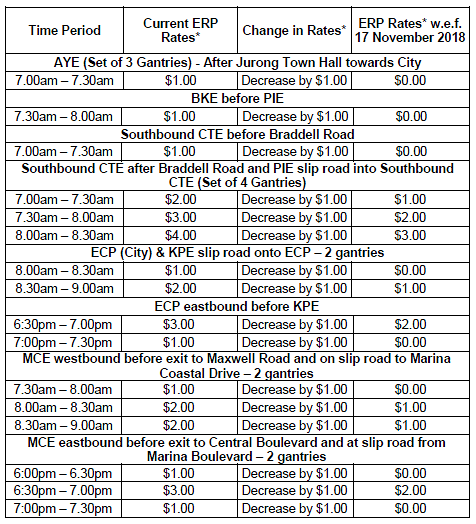
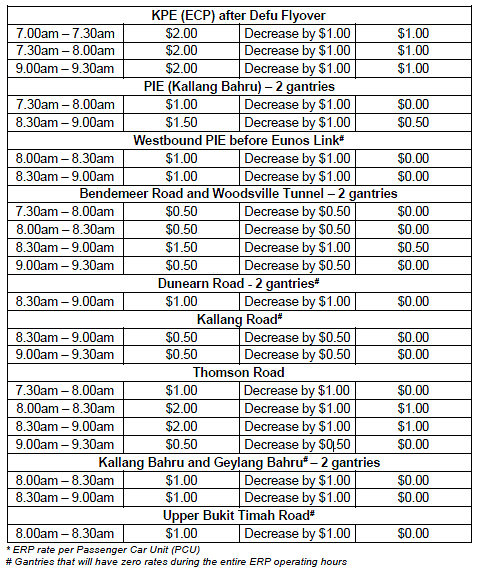
SINGAPORE: Electronic Road Pricing (ERP) rates at selected gantries will be reduced during the school holidays, the Land Transport Authority (LTA) announced on Monday (Nov 12).
The revised rates will apply from this Saturday (Nov 17) to Dec 31, said LTA in a media release.
The affected gantries and the new rates are shown below:
(Table: LTA)
(Table: LTA)
The rates will revert to the pre-school holiday rates from Jan 2 onwards, said LTA.
The rates for other gantries will remain unchanged.
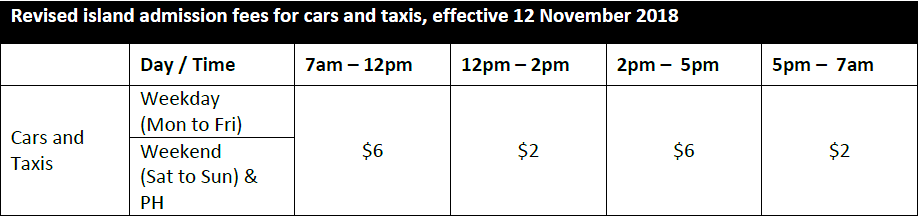
SINGAPORE: Visitors driving to Sentosa or taking a taxi to the island can now pay lower admission fees during lunchtime and in the evenings on weekends and public holidays.
Sentosa Development Corporation (SDC) announced on Monday (Nov 12) that the fees during those periods have been reduced to S$2.
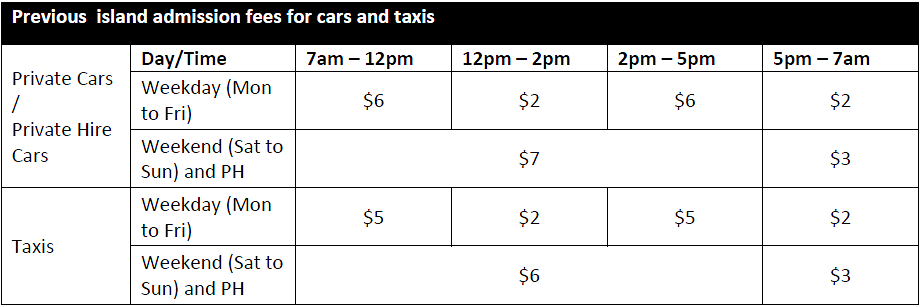
Previously, cars entering the island on weekends and public holidays were charged S$3 from 5pm to 7am and S$7 for the rest of the day, including at lunchtime.
For taxis, the old charges were S$3 from 5pm to 7am, and S$6 for the rest of the day.
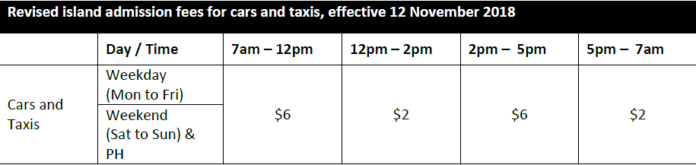
Revised Sentosa island admission fees for cars and taxis. (Image: Sentosa Development Corporation)
Previous Sentosa island admission fees for cars and taxis. (Table: Sentosa Development Corporation)
The fee structure is now the same for cars and taxis on both weekdays and weekends – S$2 at lunchtime and from 5pm to 7am, and S$6 at all other times.
Before the changes, taxi rates were S$5 on weekdays before 5pm and outside of lunchtime.
The changes, which took effect on Monday, is part of efforts to simplify island admission fees for guests entering by cars and taxis, SDC said in a media release.
The changes will be implemented for an initial period of two years, it added.
According to the SDC, the revised fees complement the simplified car park charges that were rolled out at Beach Station, Imbiah, Tanjong Beach, Palawan Beach and Sentosa Cove Village in August last year. The car park charges have been set to S$1.20 per hour from 7am to 5pm daily or S$2.40 per entry from 5.01pm to 6.59am.
“With the year-end school holidays upon us soon, we look forward to welcoming more guests and their loved ones, who will be able to take advantage of changes in island admission fees to visit and enjoy Sentosa’s unique leisure activities,” said Mr Chin Sak Hin, assistant chief executive of the SDC.
Entry to Sentosa is free for cyclists, personal mobility device riders, child concession card holders entering the island via Sentosa Express, guests walking in via the Sentosa Boardwalk and those taking SBS Transit’s bus 123.