SINGAPORE: Students with disabilities can now borrow assistive technologies at a library at Temasek Polytechnic and identify which devices suit them best before deciding what to buy.
The library at Temasek Polytechnic, which opened last Tuesday (Nov 13), is among three “satellite loan libraries” that will be set up at polytechnics.
Singapore Polytechnic and Ngee Ann Polytechnic will launch the facilities early next year.
The initiative is part of efforts by the Infocomm Media Development Authority (IMDA) and SPD, formally known as the Society for the Physically Disabled, to help these students get greater access to infocomm and assistive technologies.
For second-year Temasek Polytechnic student Sebrina Ng, who was diagnosed with hearing impairment as a child, it has been quite difficult for her to understand what others are saying even with a hearing aid.
At the new library, she can try out tools such as a Roger Pen. It is a wireless microphone that can help transmit the speaker’s voice to her hearing aid.
The Roger Pen is a wireless microphone that transmits a speaker’s voice to a hearing aid. (Photo: IMDA)
“I can see more options and explore with different devices,” said the 22-year-old.
President of SPD Chia Yong Yong said: “The libraries will enable students when they are prescribed to try out a different range of devices and technology to find one that is most suited.”
Such infocomm and assistive technology tools can cost between S$50 and S$5,000.
Under the Ministry of Education’s Special Education Needs fund, students with severe hearing, physical and visual disabilities can receive up to S$70,000 in support.
Students with less severe physical impairments can get up to S$5,000 to purchase the necessary assistive technology devices, and eligible students with less severe hearing or visual impairment will receive up to S$25,000 in subsidies.
Speaking at the biennial E2Connect Forum on Monday, Communications and Information Minister S Iswaran said that everyone has a collective responsibility to ensure that every Singaporean has access to technologies.
“To do this, we will need the combined effort of the Government, industry and community groups, who are well-placed to address the needs of persons with disabilities and enable them to participate meaningfully in a digital society and digital economy,” he said.
SINGAPORE: The new passenger terminal building at Seletar Airport has commenced operations, Transport Minister Khaw Boon Wan said on Monday (Nov 19).
The two-storey, 10,000 sq m terminal opened its doors to its first business passengers, with scheduled turboprop flights operating from December.
Passengers will enjoy enhanced facilities and an easier transition from air to land, Mr Khaw said in a Facebook post.
Mr Khaw added that 34 trials involving more than 2,000 volunteers were carried out to test the check-in, baggage handling and immigration and security clearance facilities and processes.
Immigration lanes at the new passenger terminal at Seletar Airport. (Photo: Facebook/Khaw Boon Wan)
The number of check-in counters has increased from one to four, with six immigration lanes, two security screening stations and a gate holdroom that can accommodate 200 passengers.
Other new amenities are a garden courtyard and a hall for those waiting to receive flights.
A meeters-and-greeters hall for those waiting to receive flights. (Photo: Facebook/Khaw Boon Wan)
28,000 maids borrowed from licensed moneylenders in first half of 2018.
File picture of Singapore currency. (Photo: AFP/Roslan Rahman)
(Updated: )
Bookmark
SINGAPORE: Making it mandatory for maids to seek their employers’ consent before borrowing from licensed moneylenders could drive them to borrow from unlicensed ones, Senior Parliamentary Secretary for Manpower Low Yen Ling said in Parliament on Monday (Nov 19).
This was the reason why the ministry has not made it mandatory for maids to seek the employers’ consent or disclose the borrowing, she said.
“We are concerned that if and when we do so, it may well trigger the foreign domestic worker towards taking more drastic actions such as gravitating towards borrowing from unlicensed moneylenders to avoid telling their employers,” she said.
It is a “delicate balance”, she added in response to Member of Parliament (MP) for Ang Mo Kio GRC Darryl David. He had asked if the ministry would consider getting maids to seek their employers’ consent to borrow from licensed moneylenders.
Mr David and Potong Pasir MP Sitoh Yih Pin had earlier asked for statistics on maids who have taken loans from licensed moneylenders. They also asked if the authorities intend to place any restrictions on maids taking such loans, and what the consequences are for employers.
28,000 MAIDS BORROWED FROM LICENSED MONEYLENDERS IN FIRST HALF OF 2018
Senior Minister of State for Law Edwin Tong said that 28,000 maids had borrowed from licensed moneylenders in the first half of this year.
The number is more than double last year’s and almost 20 times the 1,500 in 2016.
Despite the large number, however, Mr Tong said that Moneylenders Credit Bureau data from 2016 to the first half of 2018 showed that the large majority of maids had repaid their loans.
The Ministry of Law announced two measures in October to strengthen protections for maids and other foreigners residing in Singapore from the effects of over-borrowing, Mr Tong noted.
The measures include imposing aggregate loan caps to limit the total amount that any foreigner residing in Singapore can borrow from licensed moneylenders and the introduction of a self-exclusion framework for all individuals, including foreigners, who borrow from licensed moneylenders.
As for those who borrow from unlicensed moneylenders, the numbers are smaller. Ms Low said based on numbers provided by the police, there were about 460 reports of harassment by unlicensed moneylenders arising from maids borrowing or acting as guarantors from 2008 to September 2018.
“We do not condone any borrowing from unlicensed moneylenders by foreign workers,” Ms Low added.
To send a clear signal of its strong stand, the Ministry of Manpower (MOM) had earlier announced that work pass holders would be repatriated and debarred from working in Singapore if they are found to have borrowed from unlicensed moneylenders.
SINGAPORE: Singapore recognises the uncertainty and volatility in the world today, but looking at what it has achieved this year, it does not need to be pessimistic about its outcome, Foreign Affairs Minister Vivian Balakrishnan said on Monday (Nov 19).
Reviewing Singapore’s foreign affairs policy in a ministerial statement in Parliament, Dr Balakrishnan said that Singapore has built up the “very precious asset of trust” with its neighbours and the international community, based on its adherence to international law and a rules-based order. This is so, even in times of “significant geopolitical turbulence”.
“They trust us because they know we are straight, honest brokers, we are sticklers for international law and a rules-based world order and free trade, and we believe in the sanctity of agreements and contracts,” he said. “And they also trust our competence, to be able to deliver when times are short and the outcomes are urgent and important.”
“We will continue to be nimble to adapt, seize opportunities and to do our best,” he said, adding that his ministry will continue to work closely with other ministries and agencies to keep Singapore’s foreign policy balance sheet in good order.
But he also stressed that foreign policy begins at home and thus getting Singaporeans’ support is crucial. “An effective foreign policy rests on this domestic consensus, a consensus built both within this House, and outside with fellow Singaporeans,” he said.
Prime Minister Lee Hsien Loong handing over to Thailand’s Prayut Chan-O-Cha during the Closing Ceremony of the 33rd ASEAN Summit and Related Summits in Singapore on Thursday (Nov 15). (Photo: Jeremy Long)
SINGAPORE’S ASEAN CHAIRMANSHIP A “WHOLE-OF-NATION EFFORT”
Dr Balakrishnan noted that Singapore has had a very busy year on the foreign policy front, looking at the various events and initiatives the country was involved in over the course of the year.
“We witnessed a global order in rapid transition, marked by heightened big power rivalry, rising protectionist sentiment, xenophobia and technological disruption,” he said.
“As a small country, we have responded nimbly to this volatile global environment, making ourselves relevant to powers big and small, and enlarging the political and economic space for all Singaporeans.”
Over the course of Singapore’s chairmanship of the Association of Southeast Asian Nations (ASEAN), the 10-member regional grouping has made several achievements and launched various key projects, Dr Balakrishnan pointed out.
These include the establishment of the ASEAN Smart Cities Network, which creates a common framework for smart city development and mutual exchange of action plans, and finalising of the Model ASEAN Extradition Treaty.
Prime Minister Lee Hsien Loong speaking at a press conference at the 33rd ASEAN Summit and Related Summits in Singapore on Thursday (Nov 15). (Photo: Hanidah Amin)
“Our chairmanship has been a whole-of-nation effort involving all our government agencies, our media, universities and think tanks, as well as the private sector,” said Dr Balakrishnan.
“Post-2019, Singapore will continue the role of ‘shepherd’ for the ASEAN Smart Cities Network, and bring new ideas to the table,” he added. “There is much more that ASEAN can achieve, and we will work with our counterparts to build a more united, resilient and innovative ASEAN in the years to come.”
Dr Balakrishnan highlighted two events held this year that he said reaffirmed Singapore’s reputation as an impartial and reliable country that can make useful contributions to the international community.
The first was the Trump-Kim Summit in June, and the other was the Bloomberg New Economy Forum earlier this month, which saw international business and political leaders gathering in Singapore to discuss the challenges confronting the global economy and possible solutions.
“Overall, both these events allowed us to raise our standing in the world, and fly our flag high.”
File photo of US President Donald Trump shaking hands with North Korean leader Kim Jong Un at the Capella Hotel on Sentosa island in Singapore on Jun 12, 2018. (Photo: Reuters/Jonathan Ernst)
NEED FOR SINGAPORE TO “DOUBLE DOWN” ON MULTILATERAL DIPLOMACY
Dr Balakrishnan also reiterated the need for Singapore to “double down” on its support for multilateralism and the rules-based global world order.
“We have no choice but to subscribe to that, because we will always be small, a tiny red dot, and our trade volume is more than twice our GDP,” he said, adding that keeping the trading framework free and open, and having recourse to third-party dispute resolution mechanisms are “essential for a tiny city-state like Singapore.”
Dr Balakrishnan also gave an update on Singapore’s relations with its neighbours as well as major powers such as China and the United States.
With Malaysia, he said Singapore has had a positive momentum of high-level exchanges with the new Pakatan Harapan government.
“Malaysia has a new, diverse and lively Cabinet – their ages range from 25 to 93 – but we share many aspirations and challenges, and I can speak certainly for the younger ministers, both in Singapore and Malaysia, that there is good rapport and communication,” he said.
Malaysian Prime Minister Mahathir Mohamad shakes hands with Singapore Prime Minister Lee Hsien Loong during a meeting at the Presidential Palace on the sidelines of the 33rd Association of Southeast Asian Nations (ASEAN) summit in Singapore, Nov 12, 2018. (Photo: AFP/Feline Lim)
As for Indonesia, Dr Balakrishnan said both countries’ relations are in good shape, underpinned by the “robust and expanding economic cooperation” through projects such as the Kendal Industrial Park in Central Java and the Nongsa Digital Park in Batam.
Singapore has also had a number of high-level exchanges with China, Dr Balakrishnan noted, with the Belt and Road Initiative a new highlight in both countries’ bilateral cooperation.
He described Singapore’s relationship with the United States as “robust”, spanning defence, economic and security, as well as people-to-people spheres.
“The US remains committed to the region, and we will continue to do more with the US administration in the years to come,” he said.
ROHINGYA ISSUE: BANGLADESH GOVERNMENT DONE AN “ADMIRABLE JOB”
In his statement, Dr Balakrishnan also spoke about the Rohingya refugees and the situation in Myanmar’s Rakhine State, giving the House an update on his visit to the refugee camps in Bangladesh earlier in November. Hundreds of thousands of Rohingya refugees have fled the Rakhine State since 2017, following an army crackdown.
He said based on his observations on the ground, the Bangladesh government has done an “admirable job” of providing humanitarian support to the refugees. But he added that the current situation is unsustainable.
“As long as the refugees remain in the camps and have no jobs and means of livelihood, they will have no future prospects,” he said. “We have to welcome the fact that both Myanmar and Bangladesh are engaged in direct, detailed discussions on the preparations for the repatriation.”
Myanmar’s State Counsellor Aung San Suu Kyi attends the ASEAN Plus Three (APT) Summit in Singapore, Nov 15, 2018. (Photo: Reuters/Athit Perawongmetha)
He added that while this is a critical first step, it is not a complete solution, and there are still many details to be worked out.
This was an issue that some Members of Parliament sought clarification on, with MP Christopher de Souza asking for Dr Balakrishnan’s view on the repatriation of Rohingya that was meant to commence in mid-November, and if enough has been done to ensure that those who return will not face the same threats to their safety as when they first left.
To that, Dr Balakrishnan stressed that there is “sincere goodwill” on the part of both Myanmar and Bangladesh, and that he can state “with a fair amount of confidence” that both sides sincerely want a return of the refugees.
He noted that Myanmar’s State Counsellor Aung San Suu Kyi has acknowledged that the refugees are residents of Myanmar, and they are entitled to go back. “This is a brave position for her to take,” he said.
But he said that the refugees themselves have to want to return, pointing out that their key concern is security.
“Having risked life and limb to get across into the refugee camp, their question is, will it be safe for me to return?” he said, emphasising that there are still a lot more details that need to be sorted out.
“It is ultimately about confidence and trust,” he said. “The domestic lesson for us here is … you understand why we are so focused on making sure inter-ethnic, inter-religious relations are looked after assiduously.
“Because once the fabric is torn, it’s very difficult to put together again.”
SINGAPORE: Despite some challenges with implementation, the socially-conscious enterprise hawker centre (SEHC) model is “generally sound” and the Government should let market mechanisms work instead of mandating low rents, Environment and Water Resources Minister Masagos Zulkifli told Parliament on Monday (Nov 19).
“Food prices are kept affordable with a good variety of high-quality options, and the majority of hawkers are doing well at the SEHCs,” he said. “We should not undo these achievements.”
Mr Masagos was responding to a barrage of 19 questions tabled by several Members of Parliament on the SEHCs, including the challenges hawkers under this model face and how the ministry is addressing them.
SEHCs have been in the spotlight after it emerged that hawkers there faced issues with additional operating costs like dishwashing, tray-return and consultancy fees.
Mr Masagos said the SEHCs need time to establish themselves, as he asked for patience for the model to “adapt, adjust and optimise” the outcomes it seeks to achieve.
These include ensuring there are affordable food options, providing a decent living for hawkers and preserving hawker centres as vibrant social spaces.
He highlighted how SEHCs, first established in 2015, have attracted new entrants to sustain the hawker trade.
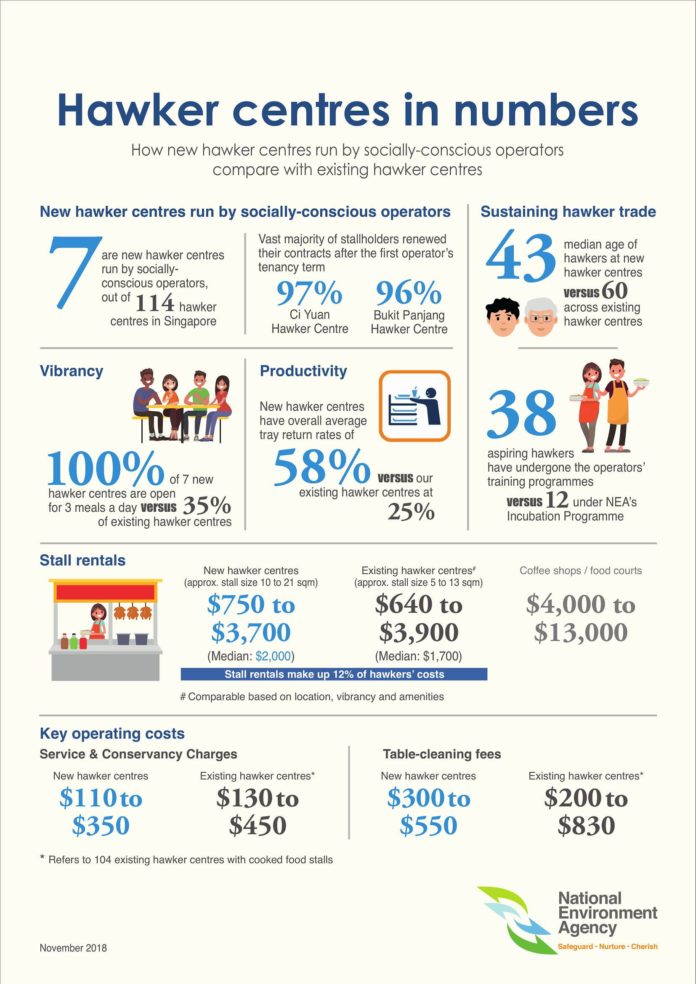
The median age of hawkers at the seven SEHCs is 43 years old, “significantly lower” than the median age of 60 in the other 107 NEA-run hawker centres, he said.
He added that they are leading a new model of “clean and productive hawker centres” by implementing measures like centralised dishwashing to reduce the amount of menial work for the hawkers.
“Taken together, these initiatives reduce the physical burden of being a hawker, and can go a long way to help sustain our hawker trade,” he said.
In addition, food prices at SEHCs are comparable to existing hawker centres and are generally lower than prices at surrounding coffee shops and food courts.
MARKET MECHANISMS WORKING
“The market mechanism is working, and Government should not intervene unnecessarily in mandating low or no rental, which could otherwise affect fair competition,” Mr Masagos said.
“It is natural to have some level of churn as better hawkers replace those who are less suited for the trade. Market forces would lead to a fair distribution of hawker stalls, which ultimately benefits residents.”
Mr Masagos said it is inappropriate for the Government to subsidise a hawker on the basis that business is poor, as this would be unfair to a better performing hawker who thrives on healthy competition and other private sector food shop operators located nearby.
“The model must, therefore, ensure that rentals and costs are transparent and fair to hawkers, but cannot subsidise hawkers to the extent that it distorts the workings of the market,” he added.
“We have heard the feedback, and will adjust the model to better serve Singaporeans. As with any trials and experiments, we cannot always get it right the first time.”
MORE OVERSIGHT BY NEA TO SAFEGUARD HAWKERS’ WELL-BEING: SMS AMY KHOR
Likewise, Senior Minister of State for the Environment and Water Resources Amy Khor said that it is “difficult” to get the SEHC model right from the start, and that the National Environment Agency (NEA) will continue its stock-take of the model.
She added that amid the stock-take, NEA will rebalance its soft-touch regulatory approach and exercise greater oversight to safeguard hawkers’ well-being.
“So we set some key parameters, let the market work, and when we get feedback or issues are raised, we will move to address them swiftly and decisively, as we have done in the past month or so,” Dr Khor said.
The regulatory body will also look at the selection criteria for operators, what to leave to market forces and whether any safeguards should be prescribed, such as those announced in November to standardise four key terms in contracts between operators and hawkers.
Dr Khor also provided figures on the rents and operational costs faced by hawkers at SEHCs.
She clarified that the median rental of stalls in SEHCs is about S$2,000 per month and not S$4,000 as some media reports have said.
The median rent for stalls in existing hawker centres is S$1,700 per month, which is “comparable to those of the new centres after accounting for the larger stall size, better-designed stalls and amenities at the new centres”, she said.
“They are nowhere near the rentals at these private F&B outlets, which can range from S$4,000 to S$13,000 a month, before other operating costs,” she said, adding that NEA has put in place measures to ensure that rentals are “fair and not speculative”.
How new hawker centres run by socially-conscious operators compare with existing hawker centres. (Infographic: NEA)
On operating costs, hawkers at SEHCs pay between S$100 and S$350 a month, similar to the S$130 to S$450 paid at existing centres. Similarly, table-cleaning services at SEHCs are between S$300 and S$550 a month, within the range of S$200 to S$830 a month at existing hawker centres.
Dr Khor added that NEA will continue to support stallholders at SEHCs in managing costs, such as through the extension of the Productive Hawker Centre grant to these hawkers.
“We will continue to make adjustments and recalibrate the SEHC model to ensure that it continues to achieve the key social outcomes of our hawker centres, which are to provide affordable food in a clean environment, allow hawkers to make a decent living, and build communities,” Dr Khor said.
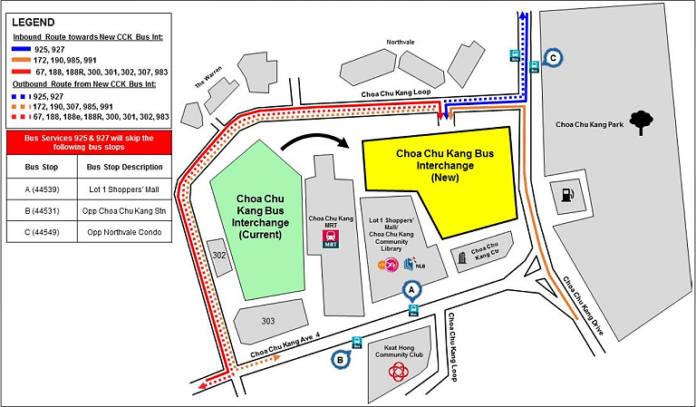
SINGAPORE: The existing Choa Chu Kang bus interchange will move to a new location at the junction of Choa Chu Kang Loop and Choa Chu Kang Drive from Dec 16.
The relocation is meant to facilitate the construction of the Jurong Region MRT Line, the Land Transport Authority (LTA) said in a press release on Monday (Nov 19).
All 13 bus services currently operating from the existing Choa Chu Kang bus interchange will operate from the new Choa Chu Kang bus interchange, with the current bus interchange ceasing operations on the same day.
Services 925 and 927 will be adjusted to enter and exit the new bus interchange through the junction of Choa Chu Kang Loop and Choa Chu Kang Drive. With this change, the two bus services will skip Choa Chu Kang Avenue 4.
The new bus interchange will feature barrier-free sheltered boarding and alighting areas, and linkways connecting to Choa Chu Kang MRT and LRT stations.
Close to 100 bicycle lots will be made available “to facilitate active mobility and first-and-last-mile connectivity”, the LTA release said.
It will also feature “commuter-centric facilities like priority queue zones, nursing room and barrier-free toilets to better cater to the needs of the elderly, less mobile and families with young children”, added LTA.
Instead of a conventional ticket office, an e-lobby and a seated waiting area for face-to-face commuter engagement with TransitLink service advisers will be set up as part of a One Stop Service Centre, a first for a bus interchange.
The interchange will also come with upgraded facilities for bus captains and other staff, such as an air-conditioned staff canteen, dedicated toilets and a staff lounge.
“High-volume low-speed fans” will also be installed at the concourse area to provide a comfortable environment for commuters, LTA said.
Information on the bus routes will be available at the affected bus stops, bus terminal, and on buses, LTA said. Commuters can also look out for more information on LTA’s online and social media platforms.
SINGAPORE: A Singapore Airlines flight bound for Paris was forced to turn back to Changi Airport on Monday (Nov 19) due to a loss of cabin pressure.
Flight SQ336 departed from Singapore and was originally meant to arrive in the French capital at 7.15am, Paris time (2.15pm, Singapore time).
The plane had to turn back “shortly after departure” and landed back at Changi Airport around 2.30am, according to a Singapore Airlines spokesperson.
Screengrab of SQ336’s route from flight tracking website Flightradar24.
After a change of aircraft, the flight took off again at 6am and is expected to land in Paris at 12.17pm (Paris time) – about five hours later than it was originally scheduled to arrive.
None of the passengers or crew members were injured, said the spokesperson.
A photo circulating on social media appeared to show that oxygen masks had been deployed on the flight.
According to Twitter user @jcgrenoble, who tweeted the image, the flight had to make an emergency landing following a “decompression incident”.
@airfrance@SingaporeAir what is going on with SIN-CDG AF0257 cancelled for technical problems. then SQ336 has to do emergency landing following decompression incident! Both Boeing 777!!! will i make it at the third trial in 2h??? Not reassuring! Would prefer flying airbus! pic.twitter.com/0MRfdqbIB3
According to his tweets, he was transferred to the Singapore Airlines flight after an Air France flight from Singapore to Paris was cancelled “for technical problems”.
The twitter user also posted a picture of a letter directed at customers on board SQ336.
“We apologise for the delay to this flight. This is due to a technical issue,” read the letter.
SINGAPORE: One of my first office job was temping for NTUC Income’s human resources (HR) department. The bulk of my time was spent on mail merge, printing out hundreds of rejection letters to mail out to unselected job applicants.
Despite how environmentally-unfriendly that might seem (think of the trees!), it is a noble gesture since it brings closure to all the interested jobseekers who didn’t get a job despite applying.
You would think such replies would probably be more prevalent and swift today given that we have conduits like emails, instant messaging and SMS.
But that isn’t the case. In fact, the situation has worsened.
HR IS OVERWHELMED
Not getting any updates about a job application (or in today’s terms – getting ghosted by the company you applied to) is very common. And you shouldn’t find it surprising.
In 2000, when I was printing out hundreds of rejection letters a day, more than half the applications came in via mail.
That’s right folks. In a not-so-distant past, people printed out their resume, put them into a manila envelope and mailed these out to potential employers.
With all that effort required, one would tend to be more selective in applying for jobs – and so in the past, there were less job applications to process.
But now you can literally “easy apply” or “quick apply” via online job portals like LinkedIn. With a click of a button you can spam hundreds of employers.
Now multiply that with the number of jobseekers in the market. It is overwhelming for any recruiting company, even if you are not as hotly contested for like Google is.
Applications have grown ten times from the days of snail mail but HR departments have not grown by the same multiplier. It is humanely impossible to sort through all those applications and provide a response to each.
Moreover, the HR department’s key performance indicator (KPI) is to fill roles, not to create nice parting shots.
Now you can literally “easy apply” or “quick apply” via online job portals like LinkedIn.(Photo: Unsplash/John Schnobrich)
I personally tried to close the loop by calling up candidates – until one experience stopped me. A 1-minute call to provide closure turned into a 30-minute debate-and-counselling session.
SORRY, THERE’S SOMEONE BETTER
Another major reason why companies might ghost you is because they already have someone else in mind for the role, or at least the mould of it, and you are just not it.
I have seen numerous hiring managers who have requirements only Superman could fit.
Beyond that, you also have cases such as the managing partner of one large audit firm who turns away anyone from Anglo-Chinese School (he says it’s because he comes from Hwa Chong).
Or the Chinese HR director that won’t entertain anybody born in the year of tiger, dragon and rooster (because their horoscope conflicts with the owner’s).
To the boss who only accepts graduates from local universities.
With so many different factors at play, it can be difficult for jobseekers not to be ghosted. But if you play your cards right, there are ways to minimise them.
1. MAKE SURE YOU GET PAST THE ROBOT APPLICATION TRACKING SYSTEM
According to a study by software company Capterra in 2015, 75 per cent of recruiters and talent managers use some form of recruiting or applicant tracking software (ATS).
They help force rank applicants so that recruiters only need to go through the top 10 per cent.
So how do you make sure you rank high?
Like why certain pages rank on page one of google and others on page 10, keyword optimisation in your CV is crucial.
You can do a manual count of hard skills and soft skills keywords within the target job description. Which can be very time-consuming since every single job you are applying for probably carry a different set and mix of keywords.
You could use a quicker hack – a CV keywords optimisation platform such as Career Hero.
Attendees at a job fair line up for an interview carrying their resumes in leather bags. (Photo: REUTERS/Jason Reed)
The keywords from the job description will be matched against what you have in your CV. You will be alerted to missing ones and you enter them into your CV, ensuring that your CV could rank high when it lands onto the ATS.
2. GET REFERRED
According to Bersin by Deloitte, their study in 2017 of 11 common sourcing channels found that employee referrals are the number one source of high-quality candidates.
Because no one will ever refer their crazy neighbour to their company. Even if the neighbour is your BFF.
Moreover, many companies have incentive programmes that only pays if your referee hits their one-year mark. That also mean if you are referred, you might naturally be associated with a “high-quality” label.
Of course, this would be easy if you already know someone in your target company. If not, you can start today with LinkedIn and connect with people you don’t know.
Besides ensuring that you have a complete LinkedIn profile, your approach to current employees must be strategic. Don’t go guns-blazing and connect with everyone you can find to ask for referrals.
Instead, do some research to find out who the hiring manager might be. If that isn’t available, look for peers. And then you want to reach out to them and ask for …. career advice.
Everybody likes to be regarded as an expert. If you stroke their ego enough, they might be more than happy to grant you 20 minutes of their time for coffee (that you offer to buy) or at least a phone call.
Based on the experience of my previous career coaching clients, the success rate is about 60 per cent. At least half would entertain a coffee.
(Photo: Unsplash/rawpixel)
Just make sure you follow through with what you pitched – that you are only getting career advice and not begging for a referral once you hand them their coffee.
If you are good enough, they may naturally refer.
If not, given what they know of you, they could at least point you in the right direction to gain more XP before you try again.
3. BYPASS THE HR DEPARTMENT
It is common for hiring managers to override recommendations made.
They just need to give fair warning, hiring managers get their way and everyone moves on.
Even if they are not, a single recruiter of a huge company would probably be managing 40 to 50 job requisitions at any one time.
Going straight to the hiring manager might be akin to an express ticket for your favourite ride at Universal Studios.
But how do you even begin?
It isn’t hard to find someone’s business email address. The tough part is to find them at scale. There are plenty of email finding tools in the market.
And once I have an email address, I would feed them into an automated email marketing tool such as reply.io.
It allows me to create an email drip that would continue to check in if no replies are detected. This is massive because most recipients do not have email OCD like I do. Chances are they have 5,000+ emails – numbers that would make me break into a cold sweat.
So the best way to ensure your email gets read is to send multiple check-ins.
My personal favourite is the final email (usually the fourth) to tell them I am going to stop as I don’t want to clog up their inbox. This usually gets a 40 per cent response rate because it makes the recipient feels bad.
As a single job seeker, there are many things you can do to avoid ghosting. If you think you are indeed a good fit, what’s the harm in pursuing that opportunity?
And why not try unconventional approaches to circumvent the problem?
Like what Einstein said before, doing the same thing over and over again but expecting different results is insanity.
Adrian Tan is co-founder of The Resource Group, a boutique HR consulting agency that specialises in HR and grant consultancy for SMEs. He is the recipient of the SHRI HR Entrepreneur of the Year in 2013 and writes regularly about HR at adriantan.com.sg.
SINGAPORE: Travelling from Sengkang to Punggol should take 20 minutes by bus, but for Ms Denise Wong’s husband, the journey home typically lasts an hour.
“My husband is already exhausted after work, and the traffic jam tires him out even more,” the 33-year-old homemaker lamented.
In the five years since they bought a new Housing and Development Board (HDB) flat at Punggol Way, the Light Rail Transit (LRT) and North East Line serving the town have also gotten more crowded, Ms Wong said.
In fact, she is already thinking about moving out of the new town, which has become too “hot and crowded” due to the urban sprawl:
“The transportation, facilities and malls are not growing as fast as the population. That has caused a lot of inconvenience,” she said.
A man looking at a model of new flats at the HDB Hub. (File photo: TODAY/Ooi Boon Keong)
The traffic congestion also serves as a real headache for Ms Alia Mohamed, who has lived at Edgedale Plains for over a year and drives to Suntec City for work.
“It will take me 15 to 20 minutes if I travel to work on the weekends. During the weekdays, it can take an hour,” the 33-year-old facilities manager said.
The traffic congestion in Punggol has been a long-standing problem, having first surfaced at least five years ago. In 2013, Punggol residents griped about the pace of transport infrastructure improvements, which they felt were lagging behind the population boom.
As Punggol morphs into one of the largest housing estates in Singapore with a slew of new developments — it is projected to be twice the size of Ang Mo Kio — its transport woes continue to persist unabated. The ongoing road works to help the transport infrastructure play catch-up further adds to the congestion and inconvenience, much to the chagrin of residents.
It was not too long ago when the mere mention of “Punggol” brought to mind the boondocks. Back in 1970s and 80s, pig farms were a common sight in Punggol, recalled 44-year-old Lee Ngee Chong.
“My relatives and grandparents used to live in attap houses in Punggol. Every Sunday, (my family and I) will drive up to the ‘countryside’ and Upper Serangoon Road was the only way to Punggol, so this place has many memories for me,” Mr Lee said with a chuckle.
Life has come a full circle for the self-employed Mr Lee, who has been living in a four-room HDB flat at Punggol Way with his family for the past five years. They had moved from Toa Payoh, where they had stayed for over 20 years.
While he finds the environment in Punggol to be relaxing, the traffic congestion is a major annoyance for him — enough for him to also consider moving out.
If the traffic worsens, I may want to get out of (Punggol). In the five years that I have lived here, the traffic has worsened.
Last week, the Land Transport Authority (LTA) announced that a new link road connecting Punggol Central to Kallang-Paya Lebar Expressway (KPE) and Tampines Expressway (TPE) will open on Nov 25, almost a year ahead of schedule.
In June last year, the LTA also brought forward the opening date of Punggol Coast MRT Station from 2030 to 2023 — a good seven years — to beef up transport infrastructure in the area.
A new link road connects Punggol Central to the Kallang-Paya Lebar Expressway and Tampines Expressway. (Photo: Land Transport Authority)
The station will serve residential estates in the Northshore District and Punggol Point District, in time for the first batch of 5,300 Build-to-Order units across seven projects due to be completed in 2020.
Long-time resident Dominic Cheong, who has lived in Punggol for over 20 years, said that while he is looking forward to the new link road, he expects it to be insufficient in just a few years.
The 56-year-old businessman said:
The new roads may alleviate the situation temporarily, but when the population starts growing again, it will be status quo in two to three years.
Punggol’s journey from a sleepy district to a spanking new waterfront town began way back in 1996, when then-Prime Minister Goh Chok Tong first announced the idea to develop Punggol. But the project — known as “Punggol 21” — got off to a rocky start due to the Asian financial crisis in 1997 and 1998.
The vision for Punggol was rebooted in 2007 with the “Punggol 21-plus” project unveiled by Prime Minister Lee Hsien Loong. The goal is to transform the area into a waterfront town of the 21st century.
Of the 11 districts in Punggol, seven feature waterfront living. Of the seven waterfront housing districts, five have been launched, while the remaining two will be located at an inland stretch bordering Coney Island and in the area of the current prawn-fishing spot at Tebing Lane.
The Waterway View housing project in Punggol (Photo: ADDP)
Since then, the Government has sought to ensure that the amenities in Punggol have kept pace with the rapidly growing resident population.
To date, there are two shopping centres in Punggol: Waterway Point and Punggol Plaza, while a third commercial neighbourhood centre — Oasis Terraces — also houses one of Singapore’s largest polyclinics.
By 2021, the upcoming Punggol Town Hub — which includes a hawker centre, regional library, childcare centre and healthcare facilities — and the Punggol Regional Sports Centre will also be ready.
Punggol currently has nearly 50,000 HDB flats, and the number is set to rise rapidly over the next few years. HDB’s latest annual report showed that the number of dwelling units in Punggol is projected to ultimately double to 96,000.
Over the past decade, the residential population in Punggol has almost tripled from 54,560 in 2008 to 161,570 as of June this year, based on data from the Singapore Department of Statistics. This is close to the population size in Ang Mo Kio (165,710).
Until the new link road opens, Punggol has only three major arterial roads leading to the TPE and KPE — Punggol Way, Punggol Road, Punggol East — for its residents.
In comparison, Ang Mo Kio is served by the Central Expressway, Yio Chu Kang Road, and Upper Thomson Road. These are, in turn, connected to five arterial roads (Ang Mo Kio Avenues 1, 3, 4, 5 and 6).
In 2013, the LTA said that road improvement works would be implemented when necessary to “enhance the public transport services as necessary in accordance with the pace of developments in the area”.
Peak hour traffic jams on the expressways into Punggol are common. (Photo: Gaya Chandramohan)
Such road improvement works, however, offer little comfort for Mr Lee who said:
If the Government knows that Punggol is going to grow bigger in the future, they should have done the road widening in the first place and not react to (the growing population).
Mr Lee added: “The road widening creates a lot of hindrances and inconveniences for the road users, as well as for the residents because of the dust and noise. They should have planned ahead and do (the road works) once and for all.”
Ms Wong reiterated that the infrastructure in Punggol has not been growing in tandem with the residential population, while Mr Kok Chee Mun — who has lived in the area for nearly 20 years — noted that the Asian Financial Crisis had slowed Punggol’s growth, and the town was making up for lost time.
“The development of Punggol is similar to the growth of other towns such as Yishun when it was a new estate, so these teething problems are expected,” said the 62-year old watchmaker in Mandarin.
STRIDES MADE IN IMPROVING AMENITIES
The traffic congestion aside, most residents said that strides have been made to improve amenities in the estate, such as childcare centres, schools, healthcare facilities and food outlets.
As of June 2018, Punggol had the highest proportion of children aged below five years in Singapore, at 10.3 per cent, or 16,700 children.
Children at NTUC My First Skool in Edgefield Plains. (Photo: MCI)
According to data from the Early Childhood Development Agency, there are 57 childcare centres in Punggol at the end of the first half of this year, compared to 53 at the end of 2017. The 57 centres have a capacity for 9,743 children, which is one of the highest in Singapore.
In comparison, only 3.4 per cent of Ang Mo Kio residents, or 5,660, were below five years old. The 68 childcare centres in the estate have a capacity for 7,825 children.
In September this year, the Ministry of Education announced that Yusof Ishak Secondary School will be permanently relocated from its existing Bukit Batok site to Punggol in 2021 to meet the demand for secondary school places in the newer housing estate.
The Singapore Institute of Technology will also move to its Punggol North campus come 2023, which will sit alongside a business park in the district.
The SingHealth polyclinic at Oasis Terraces, which officially opened on May 23 this year, is focused on women’s and children’s health, given the relatively high number of young families in the estate. Besides medical and dental care, the polyclinic also offers physiotherapy and podiatry services.
Ms Shoba Dayalan, a Punggol resident since 2007, said that her family used to travel to Sengkang to visit the polyclinic there.
“It was very troublesome (before the Punggol polyclinic opened). Previously, there were also very few general practitioners in Punggol. The number of clinics has now increased,” the 39-year-old homemaker said.
Registration counters at Punggol Polyclinic. (Photo: Gwyneth Teo)
And while some residents cited the lack of competition for the high prices of groceries at the only wet market at Punggol Plaza, the prevalence of online grocers and supermarkets sprouting around Punggol have alleviated the problem somewhat.
“It’s not fashionable to have wet markets now,” said Mr Kok, the 20-year resident of Punggol. “It is a good-to-have, but not a must-have.”
Halal food options in coffee shops are also sorely lacking, some Muslim residents said.
At the end of the day, many residents said that the growth of the town has to be moderated, and a balance has to be struck between the new developments and preserving the tranquillity of Punggol.
“I hope the Government preserves the greenery at Punggol,” said Ms Alia. She added: “However, it can also be scary if the estate is too quiet.”
In 2013, Member of Parliament (MP) for Pasir Ris-Punggol GRC Teo Ser Luck said that the transport infrastructure in Punggol “must be aligned with the town development itself”.
“If not, there will always be one catching up with the other,” he said.
Apart from the new link road connecting Punggol Central to the TPE and KPE, there are existing works for an additional exit point from the TPE into Punggol, MP Sun Xueling, who looks after the Punggol West area, said.
(From left to right) Senior Parliamentary Secretary Ms Sun Xueling, Deputy Prime Minister Teo Chee Hean, Minister for Trade and Industry Chan Chun Sing, Senior Minister of State Janil Puthucheary, Minister Ng Chee Meng and Mr Teo Ser Luck.
“In the longer term, with more developments in the northern and in the western parts of Punggol, we are looking into new road infrastructure works to cater to increased activity in these areas,” she added.
Punggol resident Ms Wong suggested increasing the frequency of the town’s LRT service.
“There are only two cabins for the Punggol LRT. Besides the residents, many foreign workers working on the new developments in Punggol also use the LRT, which makes it very crowded,” she said.
Ms Wong added: “The queues can get quite ridiculous. Besides increasing the frequency of the trains, the authorities should consider increasing (the two-cabin trains) to four cabins.”
While the lagging transport infrastructure was a main bugbear for many residents, Mr Cheong felt that it was not only the hardware that needs improvement.
THE PRICE AND REWARDS OF DEVELOPMENT
Amid its rapid growth, Punggol’s “kampung spirit” has been lost, Mr Cheong said. He believes that the hawker centre at the upcoming Punggol Town Hub is one place to foster such a community spirit.
“It will also be good to have (another) wet market. The current one at Punggol Plaza isn’t really a wet market, and I think some people miss having the ‘kampung spirit’ at these places,” he said.
Waterway Cascadia in Punggol. (Photo: Aqil Haziq Mahmud)
As Punggol develops at a breakneck speed, some long-time residents are witnessing — before their very eyes — the tension between development and preserving the things they used to love about the area.
Mr Cheong reminisced that he used to be able to see the Straits of Johor from his unit at Punggol Field, which is near the TPE. The town’s skyline had also changed dramatically in his 20 years in Punggol, he said.
“When I first moved in, Punggol was like a ghost town. You could even hear the wild dogs barking at night. Punggol felt more laid-back then,” he added:
I am disappointed that the sea view has gone, but it has been made up with more amenities.
Ms Isabelle Lim, 22, who has lived in the estate for the past 11 years with her parents, described Punggol’s growth as “a little painful”.
Still, the student at Singapore Management University acknowledged that “with more people also comes more amenities, and the amenities are nice”.
“My family and I used to like Punggol because it was quiet, but now that Punggol is quite self-sufficient, living here is relatively convenient,” she added.