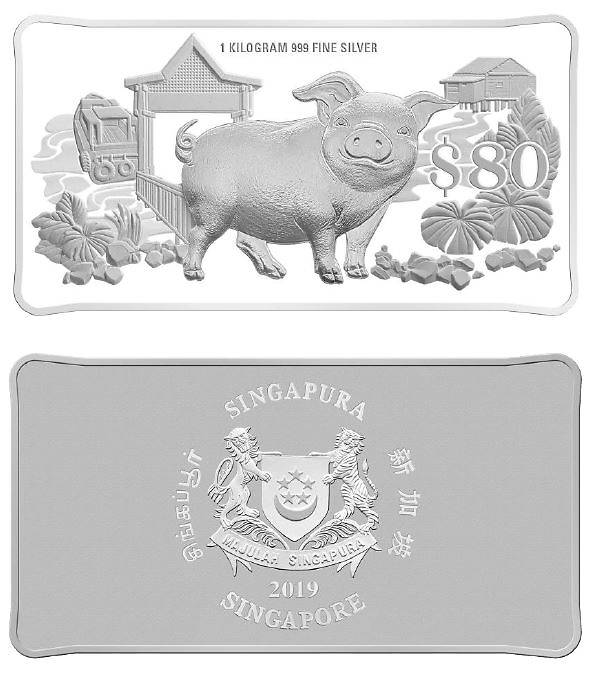
SINGAPORE: The 2019 Year of the Boar coins will feature an image of a pig and the island of Pulau Ubin in the background, the Monetary Authority of Singapore (MAS) revealed on Wednesday (Nov 21).
The limited edition coins, which are part of the third issue in the Singapore Fourth Chinese Almanac Coin Series, will be issued on Jan 1 next year, MAS said in a media release.
They will come in 10 different versions with varying metallic compositions, minting relief effects and shapes, as well as in special premium sets with different coin combinations.
An illustration of the gold and silver three-coin set. (Image: MAS)
An illustration of a 1 kilogram rectangular coin made from 999 fine silver with a face value of S$80. (Image: MAS)
They include a 1kg rectangular coin made from 999 fine silver with a face value of S$80 and a premium gold and silver three-coin set.
The obverse side of the coins will bear the Singapore Coat of Arms with the year 2019.
The coins will be sold by the Singapore Mint and orders must be sent by Dec 16, according to MAS. Balloting may take place if the coins are oversubscribed.
NEW YORK: The world’s central bankers have begun to discuss the idea of central bank digital currencies (CBDCs), and now even the International Monetary Fund and its managing director, Christine Lagarde, are talking openly about the pros and cons of the idea.
This conversation is past due. Cash is being used less and less, and has nearly disappeared in countries such as Sweden and China.
At the same time, digital payment systems – PayPal, Venmo, and others in the West; Alipay and WeChat in China; M-Pesa in Kenya; Paytm in India – offer attractive alternatives to services once provided by traditional commercial banks.
Most of these fintech innovations are still connected to traditional banks, and none of them rely on cryptocurrencies or blockchain. Likewise, if CBDCs are ever issued, they will have nothing to do with these over-hyped blockchain technologies.
Nonetheless, starry-eyed crypto-fanatics have seized on policymakers’ consideration of CBDCs as proof that even central banks need blockchain or crypto to enter the digital-currency game.
This is nonsense. If anything, CBDCs would likely replace all private digital payment systems, regardless of whether they are connected to traditional bank accounts or cryptocurrencies.
As matters currently stand, only commercial banks have access to central banks’ balance sheets; and central banks’ reserves are already held as digital currencies.
IMF Managing Director Christine Lagarde attends a news conference during International Monetary Fund – World Bank Annual Meeting 2018 in Nusa Dua, Bali, Indonesia, October 11, 2018. (Photo: REUTERS/Johannes P. Christo)
That is why central banks are so efficient and cost-effective at mediating interbank payments and lending transactions. Because individuals, corporations, and non-bank financial institutions do not enjoy the same access, they must rely on licensed commercial banks to process their transactions.
Bank deposits, then, are a form of private money that is used for transactions among non-bank private agents. As a result, not even fully digital systems such as Alipay or Venmo can operate apart from the banking system.
LET’S WELCOME CENTRAL BANK DIGITAL CURRENCIES
By allowing any individual to make transactions through the central bank, CBDCs would upend this arrangement, alleviating the need for cash, traditional bank accounts, and even digital payment services.
Better yet, CBDCs would not have to rely on public “permission-less,” “trustless” distributed ledgers like those underpinning cryptocurrencies.
After all, central banks already have a centralised permissioned private non-distributed ledger that allows for payments and transactions to be facilitated safely and seamlessly. No central banker in his or her right mind would ever swap out that sound system for one based on blockchain.
If a CBDC were to be issued, it would immediately displace cryptocurrencies, which are not scalable, cheap, secure, or actually decentralised. Enthusiasts will argue that cryptocurrencies would remain attractive to those who wish to remain anonymous.
But, like private bank deposits today, CBDC transactions could also be made anonymous, with access to account-holder information available, when necessary, only to law-enforcement authorities or regulators, as already happens with private banks.
A worker checks the fans on miners, at the cryptocurrency farming operation, Bitfarms, in Farnham, Quebec, Canada, February 2, 2018. (Photo: REUTERS/Christinne Muschi/File Photo)
Besides, cryptocurrencies like Bitcoin are not actually anonymous, given that individuals and organisations using crypto-wallets still leave a digital footprint. And authorities that legitimately want to track criminals and terrorists will soon crack down on attempts to create crypto-currencies with complete privacy.
Insofar as CBDCs would crowd out worthless cryptocurrencies, they should be welcomed. Moreover, by transferring payments from private to central banks, a CBDC-based system would be a boon for financial inclusion.
Millions of unbanked people would have access to a near-free, efficient payment system through their cell phones.
A FINANCIAL REVOLUTION
The main problem with CBDCs is that they would disrupt the current fractional-reserve system through which commercial banks create money by lending out more than they hold in liquid deposits.
Banks need deposits in order to make loans and investment decisions. If all private bank deposits were to be moved into CBDCs, then traditional banks would need to become “loanable funds intermediaries,” borrowing long-term funds to finance long-term loans such as mortgages.
In other words, the fractional-reserve banking system would be replaced by a narrow-banking system administered mostly by the central bank.
That would amount to a financial revolution – and one that would yield many benefits. Central banks would be in a much better position to control credit bubbles, stop bank runs, prevent maturity mismatches, and regulate risky credit/lending decisions by private banks.
So far, no country has decided to go this route, perhaps because it would entail a radical disintermediation of the private banking sector.
One alternative would be for central banks to lend back to private banks the deposits that moved into CBDCs. But if the government was effectively banks’ only depositor and provider of funds, the risk of state interference in their lending decisions would be obvious.
Bitcoin is the first decentralised digital currency, as the system works based on the blockchain technology without a central bank or single administrator (Photo: AFP/Lars Hagberg)
A THIRD SOLUTION
Lagarde, for her part, has advocated a third solution: Private-public partnerships between central banks and private banks.
“Individuals could hold regular deposits with financial firms, but transactions would ultimately get settled in digital currency between firms,” she explained recently at the Singapore Fintech Festival:
Similar to what happens today, but in a split second.
The advantage of this arrangement is that payments “would be immediate, safe, cheap, and potentially semi-anonymous.” Moreover, “central banks would retain a sure footing in payments.”
This is a clever compromise, but some purists will argue that it would not solve the problems of the current fractional-reserve banking system. There would still be a risk of bank runs, maturity mismatches, and credit bubbles fueled by private-bank-created money.
And there would still be a need for deposit insurance and lender-of-last-resort support, which itself creates a moral hazard. Such issues would need to be managed through regulation and bank supervision, and that wouldn’t necessarily be enough to prevent future banking crises.
In due time, CBDC-based narrow banking and loanable-funds intermediaries could ensure a better and more stable financial system. If the alternatives are a crisis-prone fractional-reserve system and a crypto-dystopia, then we should remain open to the idea.
Nouriel Roubini is professor of economics at the Stern School of Business, New York University, and CEO of Roubini Macro Associates.
SINGAPORE: Social media users across the world were unable to gain access to their Facebook and Instagram feeds for a short period on Tuesday (Nov 20) night.
The Down Detector website showed Facebook outage spots on the east coast of the United States as well the United Kingdom, France, Portugal, Germany and Switzerland. Similar outage spots were seen in India, the Philippines and Singapore. Reports of the outage first came in at about 8pm.
Facebook was down in Europe and eastern United States. (Map: downdetector.com)
Like Facebook, Instagram was also down in Europe and eastern United States. (Map: downdetector.com)
The hashtags #FacebookDown and #InstagramDown erupted on Twitter as users took their complaints to the rival social media platform, while others injected humour in the breakdown with gifs and memes.
SINGAPORE: New Nominated Member of Parliament (NMP) Irene Quay on Tuesday (Nov 20) called on the Government to encourage employers to allow their employees to take up to three days of sick leave each year without submitting medical certificates (MCs), saying that the move could help build trust and boost morale.
Speaking in Parliament, Ms Quay – who is also president of the Pharmaceutical Society of Singapore – said that individuals who queue at clinics to get an MC for common ailments such as the flu might inadvertently end up infecting others.
“Apart from being unproductive and potentially spreading your contagion, being out and about would actually exacerbate your illness when you should be getting much-needed rest at home,” she said.
“One may even conveniently ask for unwarranted antibiotics since they are already at the clinic, contributing to global antimicrobial resistance problems.”
Ms Quay was speaking on the Employment (Amendment) Bill, which will require employers to recognise MCs from all doctors. Currently, employers are required to accord paid sick leave only if the MC is issued by Government and company-appointed doctors.
“Today, doctors are registered under the Medical Registration Act and are subject to the Singapore Medical Council Ethical Code and Ethical Guidelines,” Manpower Minister Josephine Teo said. “Therefore, there is no longer a need to distinguish between MCs issued by different groups of doctors where paid sick leave is concerned.”
Taking it a step further to allow sick leave without an MC, said Ms Quay, will reflect “a strong signal of trust” between employers and employees, and in turn increase accountability and morale.
Ms Irene Quay speaking in Parliament on Nov 20, 2018.
While Ms Quay admitted that there will always be a “small percentage” of individuals who will abuse the system, the benefits would outweigh the “small number of abuse cases”.
Ms Quay proposed audits and provisions as methods to prevent abuse, and a surveillance system to look out for cluster infections.
“In fact, even with our current situation, it is not difficult to get a day off from work by faking an illness to get an MC,” said Ms Quay, citing a 2012 Jobs Central survey that showed almost one-fifth of 3,300 Singapore employees admitting to having faked an illness to get away from work.
Ms Quay also noted how several healthcare clusters and civil service organisations have already been allowing their employees to take sick leave without MC “for many years”, and that the Employment Act also does not prohibit employers from doing so.
“But there is a need for MOM to mandate it in the Act so that these benefits can be accelerated across the nation, rather than to let nature take its course,” she said.
In response, Mrs Teo said that creating controls and audit systems to prevent the system from being abused would add to business costs.
“As the Employment Act does not prohibit employers from (according sick leave without MCs), progressive companies are free to go ahead to offer this as part of their talent attraction and retention strategies,” she added.
CAN NON-DOCTORS ISSUE MCs?
As for the amendment requiring employers to recognise MCs from all doctors, Ms Quay asked the MOM and Ministry of Health (MOH) to consider allowing Collaborative Practice Prescribers (CPP) who run clinics in hospitals and polyclinics to issue MCs.
CPPs are highly qualified pharmacists and nurses who can review and prescribe medication independently within the scope of their Collaborative Practice Agreement.
The move will help reduce inefficiencies in Singapore’s healthcare system amid an ageing population, Ms Quay said. “We need to focus on a team-based model of care where various healthcare professionals come together to provide cost-effective care outcomes,” she added.
Furthermore, Ms Quay said, CPPs undergo rigorous training and audits to uphold high standards of care, and are equipped with necessary industry certifications.
“Currently, these practitioners can only provide excuse chits to patients. If patients require MCs, they have to be directed to medical doctors where they have to wait again for the doctors to furnish their MCs,” Ms Quay added.
“It causes unnecessary delays to patients and can be disruptive to both the CPP and the doctor.”
Dr Intan Azura Mokhtar speaking in Parliament on Nov 20, 2018.
Member of Parliament for Ang Mo Kio GRC Intan Azura Mokhtar asked if the amendment could include recognising MCs from traditional Chinese medicine (TCM) practitioners who are registered with the Traditional Chinese Medicine Practitioners Board.
“There are increasingly more who prefer to get help from TCM practitioners for their ailments such as frozen shoulders, plantar fasciitis or even back pains, which can significantly affect work performance,” Dr Intan said.
“These ailments may not have immediate cure from medications, but with consistent TCM treatments, much relief can be achieved.”
In response, Mrs Teo said that a small number of doctors have dual registration under the Traditional Chinese Medicine Practitioners Act and Medical Registration Act (MRA).
“For the purposes of granting paid sick leave, employers are required to recognise the MCs issued by such practitioners in their capacity as doctors under the MRA,” she added.
As for CPPs, Mrs Teo said that they are not registered under the MRA, and therefore the MOH has not allowed them to issue MCs.
“MOH will need time to assess them and other models of care,” she added. “MOM will therefore continue to monitor and adjust the Employment Act if necessary.”
SINGAPORE: A Bill to extend Singapore’s main employment law to more workers, especially those in managerial and executive positions, was passed in Parliament on Tuesday (Nov 20).
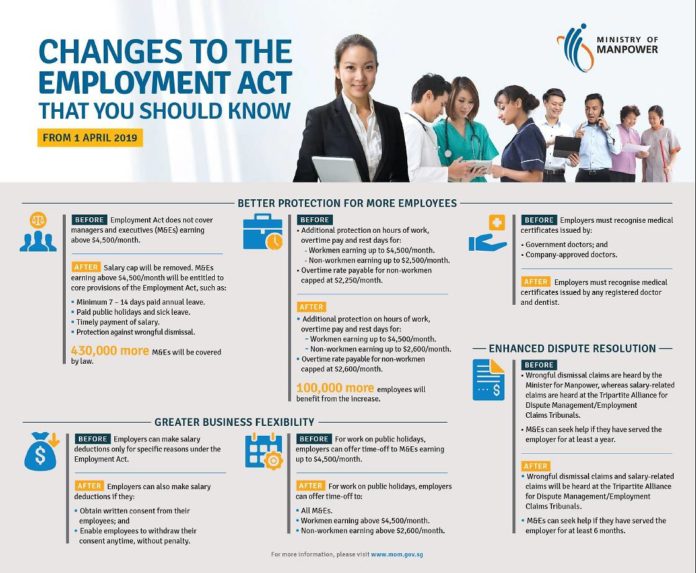
One of the four key changes will result in core entitlements and protection being extended to 430,000 more managers and executives. Previously, managers and executives earning more than S$4,500 a month were excluded from the coverage of the Employment Act (EA).
The inclusion will see their entitlement to and protection of minimum days of annual leave, paid public holidays and sick leave, timely payment of salary as well as statutory protection against wrongful dismissal, among other core provisions.
Manpower Minister Josephine Teo said that the review of the Employment Act is “timely” as the proportion of Professionals, Managers, Executives and Technicians (PMETs) in the local workforce is expected to rise from 56 per cent today to about two-thirds by 2030.
“Since it was last reviewed in 2012, the profile of our labour force and local employment practices have continued to evolve,” Mrs Teo said.
With the change, almost all of the working population will come under the protection of the EA. It, however, excludes public servants, domestic workers and seafarers as they are covered separately under other laws due to the nature of their work.
Changes to the Employment Act (Infographic: MOM)
Member of Parliament (MP) Patrick Tay and Nominated MP Walter Theseira were among the 17 MPs who spoke on the amendment.
Both MPs welcomed the expansion and lauded it as a “radical” change that will help address cases faced by aggrieved professionals, managers and executives (PMEs) earning more than S$4,500.
“Having a salary cap meant that there was a deliberate delineation of workers covered under the Act and those who were not. Some rogue employers tried to ‘game’ the Act by making use of the salary cap to exclude workers from the Act,” Mr Tay said.
Dr Theseira said that the vast majority of managers and executives today are in a similar position to the rank-and-file in the past.
“They cannot afford to use contract law to settle employment disputes and do not have power to bargain over employment contract terms. They should be protected by the Employment Act, just as the rank-and-file already are, Dr Theseira said.
PROTECTION OF HOURS OF WORK, OVERTIME PAY, REST DAYS
Among other EA amendments, rank-and-file workers such as clerks and receptionists and those performing labour work will be given additional protection on hours of work, overtime pay and rest days.
This provision, called Part IV, has been revised upwards to cover rank-and-file workers earning up to S$2,600 a month from S$2,500 a month.This will cover 100,000 more workers.
The overtime rate payable for rank-and-file workers will be revised upwards from S$2,250 a month to S$2,600 a month.
DISPUTE RESOLUTION AVAILABLE AT ‘ONE-STOP’ TRIBUNAL
Another key amendment includes simplifying the dispute resolution process.
Wrongful dismissal claims will be heard at the Employment Claims Tribunals (ECT) instead of at the Ministry of Manpower (MOM). The change was made to appoint the ECT as a one-stop service as it already hears salary-related disputes.
On this, MPs Louis Ng and Intan Azura Mokhtar said that there is a need to make clear the interpretation of dismissals.
Both MPs cited examples of employers who took issue with pregnant workers and mothers and dismissed them on murky and unfair grounds.
“I recall an incident where a resident was aggrieved that her former employer managed to persuade her to tender her resignation through veiled threats and manipulation,” Dr Intan said.
“Without clear definition, the protection against unfair dismissal may be ineffective because instances of unfair dismissals are often not clear-cut and can be easily disguised,” Mr Ng said.
With the transfer, Mrs Teo said that the MOM will publish a set of guidelines to guide the process of adjudicating wrongful dismissal claims
Mrs Teo added it “would not be possible” to define all scenarios of wrongful dismissals. The guidelines will take a “more feasible approach” to use illustrations and set out principles and parameters that the ECT must refer to when adjudicating cases.
Additionally, the service qualifying period for managers and executives for wrongful dismissal protection will be reduced from 12 months to 6 months.
Non-constituency MP Dennis Tan asked how the six months was decided.
Mrs Teo said that the duration was derived after tripartite discussions. She added that employers have agreed on the six-month criteria on the basis that it would be sufficient for them to assess a manager and executive’s suitability for the job.
SALARY DEDUCTIONS, PROTECTION FOR OTHERS
The last of the key changes to the EA is directed at enhancing flexibility for employers. The option to give time-off for employees who work on public holidays will be extended to workmen doing manual labour earning more than S$4,500 a month and rank-and-file workers earning more than S$2,600 a month.
They will continue to retain the current options of compensation in the form of an extra day’s salary or a full day off.
The EA has also been amended to make salary deductions more flexible while still protecting workers’ interests.
Previously, the EA limited the types of salary deductions that employers can make such as absence from work or damaging or losing goods entrusted to the employee.
“Such controls protect the employee’s interests, but can also inconvenience them. For example, some companies provide voluntary group hospital and surgical insurance for their employees if the employees agree to co-pay the premiums,” Mrs Teo said.
“The EA does not allow such deductions even when the employee agrees. So employees have to separately reimburse the employer,” she added.
After the amendment, salary deductions will be allowed if they fulfil two conditions. Firstly, the employee must provide written consent and secondly, the employer must enable the employee to withdraw his consent at any time, without penalty.
For example, employers may negotiate group insurance plans for voluntary purchase by their employees. Employees who choose to purchase such plans may authorise their employers to deduct the premiums from their salaries.
MPs Denise Phua and Zainal Sapari called attention to the lack of coverage for those who are self-employed as well as vulnerable and at-risk workers such as low-skilled elderly and those with mild to severe disabilities.
In response, Mrs Teo said that self-employed persons do not have the same relationship with service buyers as that between employees and employers hence the Employment Act would not apply.
However, she added that MOM has put forth recommendations to address challenges faced by self-employed persons earlier this year.
The amendments to the EA will commence on Apr 1 next year.
50 YEARS OF EMPLOYMENT ACT
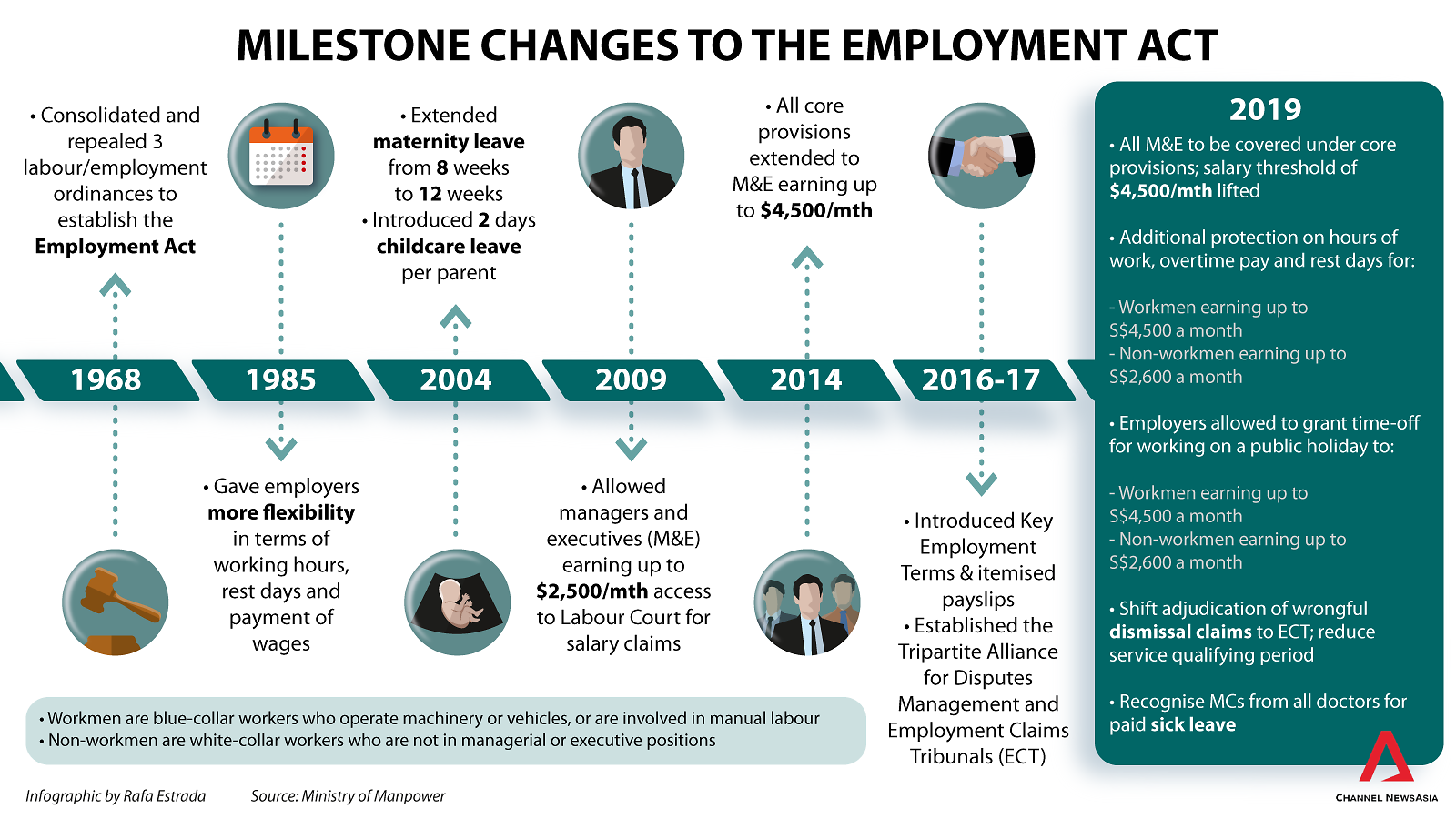
With all the changes, Mrs Teo said the EA has “come a long way” since it was enacted in 1968 by then-Minister for Foreign Affairs and Labour S. Rajaratnam.
“Back then, managers and executives (M&Es) were a very small part of our workforce. There was little need to cover them under the EA,” she said, noting that it was more than 40 years later in 2009 that coverage extended to some M&Es.
Over the years, Mrs Teo said the Government has also improved employment protection and benefits over the years.
For example, childcare leave and enhanced maternity leave was introduced in 2004, before provisions on compensation for work on public holidays and paid sick leave were extended to all employees under the EA five years later.
And in 2016, the Government introduced itemised pay slips and written key employment terms.
“Each amendment of the EA is a result of careful consideration by the tripartite partners to meet the interests of both employers and employees,” Mrs Teo said. “As we mark the 50th anniversary of the EA this year, we should acknowledge the tripartite collaboration that has kept our EA relevant and well-calibrated.”
Mr Tay called the act “an embodiment of the delicate balancing of tripartite concerns” to maximise labour force participation while protecting workers’ rights and balancing them against employers’ need to stay competitive and create good jobs.
“To ensure its relevance, this balancing act also has to take into account the changing demographics of our workforce and the disruptive forces impacting work and our economy,” he said.
SINGAPORE: The Government has put in place new anti-money laundering and terrorism financing requirements for property developers that will require them to perform due diligence checks on their buyers and flag suspicious activity.
The new rules come after Parliament passed the Developers (Anti-Money Laundering and Terrorism Financing) Bill on Tuesday (Nov 20).
The Bill amends both the Housing Developers (Control and Licensing) Act and the Sale of Commercial Properties Act, which regulate the sale of residential and commercial properties before they are completed by developers.
In his opening statement on Tuesday, Minister of National Development Lawrence Wong said that developers will now be required to carry out customer due diligence checks on buyers, keep proper records relating to these checks, and report any suspicious transactions to the Suspicious Transaction Reporting Officers.
Mr Wong, who is also Second Minister for Finance, added that developers will also have to implement programmes to train their employees, and develop internal policies as well as controls to manage and mitigate money laundering and terrorism financing risks.
“The Bill adopts a risk-based approach to anti-money laundering and terrorism financing compliance,” he added. “Principal obligations are set out, but businesses will have the flexibility to develop procedures according to the different risks they identify using their own programmes.”
Additionally, individuals who have been convicted of money laundering and terrorism financing offences will be barred from being developers.
Developers will also be required – in the event of investigations and any subsequent criminal proceedings – to comply by producing relevant information, retaining documents and making copies, and disclosing information.
These changes will bring Singapore’s anti-money laundering and terrorism financing regime in line with the international standards set out by the Financial Action Task Force (FATF), said Mr Wong.
An inter-government body, the FATF was established in 1989 to set national and international standards, and promote the effective implementation of measures to combat money laundering and terrorism financing.
“This Bill is important as it allows Singapore to more effectively combat money laundering and terrorism financing,” said Mr Wong.
“It ensures our compliance with the FATF Recommendations and signals our commitment to be a responsible member of the international community.
“Failure of businesses to meet international standards puts at risk our international business relationships, as well as the reputation of individual companies and the Singapore financial market in general,” he added.
Those convicted of not complying with the new provisions may be fined up to S$100,000.
NOT A ‘TICK IN THE BOX EXERCISE’
Speaking in support of the Bill, Member of Parliament (MP) for Nee Soon GRC Louis Ng lauded the intent of the amendments but also pointed out that the new requirements for developers needed to be more specific.
“It seems to me that this Bill leaves quite a big room for housing developers to make their own judgment calls,” he said, citing how words with broad interpretations such as “appropriate” and “adequate” appeared multiple times in the Bill.
He added that some other parts of the Bill were written with “some ambiguity”.
“At one point, developers are told not to deal with purchasers that have ‘an obviously fictitious name’. ‘What is an obviously fictitious name?’” asked Mr Ng.
In response, Mr Wong said that the phrasing was “deliberately done” to give businesses the flexibility to develop procedures according their own considerations, including business size and customer profile.
Mr Ng also expressed hope that this was not just another “tick in the box exercise”.
“We must remember that we are asking developers who are there to make a profit to do their due diligence which might end up with them making less profits. We are asking them to check on their own clients who are paying them and at times paying them a lot of money,” said Mr Ng.
MP Lee Bee Wah speaks in Parliament on 20 Nov 2018.
Nee Soon GRC MP Dr Lee Bee Wah also stressed that the government needs to engage the “right people with the relevant know-how” and work closely with them to ensure the new legislation will not end up “just another paper exercise and form signing”.
In response, Mr Wong stressed that the Urban Redevelopment Authority (URA) will help developers “level up” through their industry outreach and provide all the necessary guidance in the initial implementation stage.
“Subsequently, URA will provide ongoing support to improve the industry’s understanding of what constitutes risky transactions, as well as their risk mitigation capabilities that are needed, in order to foster a good understanding of the new requirements,” Mr Wong added.
“We would like to strike a balance between complying with the requirements recommended by the FATF and ensuring that the burden on developers is not excessive,” he added.
BEING TOO “HEAVY-HANDED”?
Answering a question from MP Gan Thiam Poh, who had asked when the duty and responsibility of the developer ends, Mr Wong stressed that developers would not be required to monitor their buyers “perpetually”.
“The rules will make clear that the requirements on developers will only apply until the project is completed, which is also the point at which the developer is no longer regulated under the two Acts,” he added.
Meanwhile, Dr Lee also warned against “overreacting and being too heavy-handed” in the proposed regulations and duties for developers.
“If we look at the existing policies, the risk of transactions being abused for money-laundering and terrorism funding activities is frankly not very high,’ she said. “Hence, I do not see the point of burdening the developers with additional requirements, that may or may not serve the purpose of mitigating (money laundering or terrorism financing).”
She added that the sales transactions already including documents and payments that have to be handled by financial institutions.
“Developers are secondary recipients of funds and the (money laundering/financing terrorism) risks faced by developers are lower,” she added.
While Mr Wong agreed that most money laundering and terrorism financing activities are generally concentrated in the financial sectors, he added that real estate is also an “established method of money-laundering worldwide”.
“For the real estate sector in particular, beside your bankers and lawyers, developers are a key party that deal with property buyers,” he added.
“So they do play an important role in the detection and prevention of such activities and that’s why we are introducing these requirements by amending the two acts that regulate developers to better facilitate our anti-money laundering and counter-terrorism financing activities.”
SINGAPORE: New industrial parks could soon be built in Southeast Asia after Sembcorp Development and China-Singapore Suzhou Industrial Park Development signed a Memorandum of Understanding (MOU) on Tuesday (Nov 20) to develop such parks in the region.
This was one of the 13 MOUs signed during the 12th Singapore-Jiangsu Cooperation Council meeting in Singapore, aimed at deepening economic partnership and advancing the Belt and Road Initiative (BRI).
Focusing on areas including trade and logistics as well as financial services, the MOUs involve Singapore entities such as SP Chemicals, Sembcorp and Enterprise Singapore.
The agreements signed include a partnership between Enterprise Singapore and Suzhou Industrial Park Administrative Committee (SIPAC) to develop third-party market collaboration along the Belt and Road.
SIPAC also signed four MOUs with the Singapore Exchange and three banks – DBS, OCBC and UOB – to promote collaborations in fintech and facilitate investments into Singapore and Jiangsu.
Meanwhile, SP Chemicals will establish a new petrochemical plant with the Taixing government, promoting international trade in chemicals. This will be the single largest foreign investment of US$800 million in Taixing.
Sembcorp Development, Temasek Polytechnic, Duralite Power and Nanjing University of Aeronautics and Astronautics also signed an MOU over a collaborative innovation centre for smart drone surveying technology for environment protection.
Thirteen Memoranda of Understanding were signed. (Photo: Tan Si Hui)
“VERY STRONG COMPLEMENTARITIES” BETWEEN SG, CHINA: HENG
Singapore Finance Minister Heng Swee Keat, who co-chaired Tuesday’s meeting with Jiangsu Governor Wu Zhenglong, said the MOUs showed there was a recognition that there are “very strong complementarities” between Singapore and China.
He added that Singapore could position itself as a global Asia node of technology, innovation and enterprise, with a flow of investors between both countries.
“Singapore can serve as a very good base for Chinese companies that are going out into the region,” he said. “In turn, Singapore can also be a very good base for global companies that are seeking to enter China in Asia.”
“In the future, there will be more scope for collaboration on technology and innovation, whether it’s in the area of healthcare, environmental protection, and many other areas of manufacturing, which will be increasingly reshaped by the march of technology.”
During his speech at the meeting, Mr Heng added that Singapore was committed to partnering Jiangsu in supporting China’s economic priorities – the BRI being one of them.
Mr Heng said the BRI would be “a major area of cooperation in the coming years” and noted that Singapore was an “early supporter” of the initiative.
The BRI was unveiled in late 2013 by China President Xi Jinping to build infrastructure in Asia, Africa and Europe to strengthen trade links.
The initiative has drawn controversy, most recently when US Vice President Mike Pence earlier this week warned smaller countries not to be seduced by the massive infrastructure programme.
In response to US-China tensions over the initiative, Mr Heng said the BRI was a complex project and there would “inevitably be misunderstandings on what it seeks to achieve”.
He added: “We need to promote a deeper understanding of the Belt and Road initiative, as well as other initiatives … on what it can and cannot do, and what it should or should not do.”
Singapore’s Senior Minister of State for Trade and Industry Koh Poh Koon and Jiangsu Vice Governor Guo Yuanqiang also attended the event as the vice co-chairmen of the council.
Last year, Singapore was Jiangsu’s third-largest investor with bilateral trade that grew at 15.7 per cent year-on-year, reaching US$11.3 billion (S$15.1 billion).
Singapore’s cumulative investments in the province were worth more than US$26.3 billion with 3,706 projects, as of end-December 2017.
SINGAPORE: When young hawker Douglas Ng was operating a fish ball noodle stall at the Golden Mile Food Centre, he found himself struggling to turn a profit.
At S$3 for a bowl of handmade fish ball noodles, he had a stream of customers – and has since won a Michelin Bib Gourmand award – but his margins were worn thin by his costs.
He raised his price by 50 cents, but to his dismay, his business dropped by 40 to 50 per cent.
“If I say that food pricing should be more expensive, I tell you, the consumer would go and hammer me,” said the 27-year-old.
“But look at … the utility costs, the rental and the salary that we’re paying. It’s no longer S$1,200, S$1,300. These hawkers, to find an assistant, are easily paying S$1,800 to S$2,400.”
Good-quality hawker food can only come from increasing the prices of the fare, he still reasons. But some consumers are also still unwilling to fork out that bit more for their hawker food, as the programme Talking Point discovers.
With hawkers pressured into keeping prices low but finding business unsustainable over the long run, while the younger ones are largely unwilling to join the trade, what might it take for change to happen? (Watch the episode here.)
CONSUMERS UNAWARE
A hawker’s life has always entailed long hours, but Mr Tan Kim Leng, who sells prawn noodles at Tiong Bahru Market and Food Centre, agrees that it is much harder today, compared to about 20 years ago when he started.
“At that time, everything wasn’t so expensive,” said the 49-year-old. “The food cost, salaries for the workers – all these have gradually increased … so there’s stress on us.”
Fresh prawns, for example, used to cost him about S$10 per kilogramme six years ago but that price has increased by 50 per cent.
File photo of Tiong Bahru Market. (Photo: Sherlyn Goh)
Mr Ng, who started The Fishball Story in 2013, disclosed that his net profit from selling a bowl of noodles at S$3 was 20 to 30 cents.
“That’s the margin … and it’s pathetic,” he lamented. “It’s very difficult for (hawkers) to continue selling cheap food any more.”
But does the public know the profit margins for common hawker fare? Those interviewed by Talking Point grossly overstated the amount.
One man thought the profit margin for a plate of nasi lemak was S$1 to S$1.50. When told it was 30 cents, he exclaimed: “I don’t believe it. How to survive with that!”
Another man was also surprised at the profit margin for a S$3.50 bowl of ban mian (flat noodle soup), thinking it was S$1.50.
But despite saying that 30 cents was a low profit margin, he would not pay for the same bowl if the price were S$4. “I’d change my food,” he said. “Because hawker food is mostly catered for the low-income group.”
IT’S ABOUT IMPRESSIONS
Given how price sensitive consumers can be, hawkers like Mr Tan are loath to increase prices. “That’s the last thing I’d consider,” he said, agreeing that hawker centres are supposed to be economical eating places.
“So we have to extend our working hours by one to two hours. Last time, I opened my shop at about 9am, but right now I open my shop at 7.30am or 7.45am … to balance the food cost.”
As for hiring a stall assistant, there is no guarantee the person would even stay.
“Some of the workers … work for one day only. On the second day, they (stop) coming,” he complained. “They give the reason that (it’s) too hot – ‘I can’t take it.’ Seriously, it’s that bad.”
The trouble with hawker food is that it suffers from a poor impression, Mr Ng believes, comparing it with a bowl of ramen, which can command prices of S$10 to S$12 but is essentially a street food in Japan.
While Japanese food is perceived as more expensive because they use quality ingredients, “many hawkers are also using quality ingredients”, he said.
“(Consumers) can pay more for trendy food, Instagrammable stuff, restaurants, but when they come back to a hawker, for a 10-cent increment only, (they) make noise.”
This perception that “hawker food has to be cheap, has to be good” must be changed, he stressed, suggesting that an across-the-board price increase of 50 cents to S$1 would be fair.
That would, ideally, lead to hawkers buying better ingredients, hiring more hard-working assistants and churning out quality food for consumers. “It’s a win-win for everybody,” he added.
If nothing is done, the danger is that in the next five to 10 years, “maybe 40 to 50 per cent of the hawkers will be gone, and then this heritage will die off”, he warned.
‘HAWKERS NEED TO BE BRAVE’
While there is a group of consumers who would “never” pay more for hawker food, there are others who do not mind doing so, said local food advocate and consultant K.F. Seetoh.
What it would take, he believes, is for hawkers to sell better food and “be emboldened to know where they’re selling (and) what”.
“The demographics are very important. Your food is very important,” he said. “The hawkers need to be brave … and not feel as if the customers are always threatening to walk away.”
The successful hawkers out there, he described, “know what they’re doing, they’re very consistent and they know where to upsell – they’re just (providing) very good service”.
If the average hawker is pricing each portion at S$3 or S$4 each, and does not make at least 200 sales a day, there is little point in them continuing the trade, he advised.
“You’re struggling. You might as well ask for handouts from the government,” he added.
To partly address the plight of hawkers leaving the trade and to meet Singaporeans’ need for affordable food services, the Socially-conscious Enterprise Hawker Centres were introduced in 2015.
But in recent months, there have been a flurry of complaints about the model, a topic that drew more than 20 questions filed in Parliament for yesterday’s sitting.
In this Talking Point segment, Senior Minister of State (Environment and Water Resources) Amy Khor noted that one of the social objectives of the new hawker centres was to ensure that hawkers make a decent living.
Some of the terms of the contracts between the operators and hawkers are being changed in that regard, and a dishwashing subsidy will be extended to stallholders at the seven new hawker centres.
Beyond what the government can do, she called on Singaporeans to “rally behind the hawkers”.
“If we patronise them, we support them, they can do a viable business. Then we’ll be able to attract new hawkers, younger hawkers into the trade,” she said.
Watch this episode of Talking Point here. New episodes on Channel 5 every Thursday night.
SINGAPORE: Imagine this. A customer walks up to a food court in a neighbourhood mall.
Upon ordering, he is directed to a confusing array of payment schemes and systems available at the cashier. Without batting an eye, he whips out his wallet, fishes for a note and hands it over.
In Singapore, digital payment services are fast becoming king. With three in five merchants accepting e-payments, and with plans to see the country cheque-free by 2025, why are some Singaporeans still reluctant to adopt cashless payments?
It is widely acknowledged that the number of payment options available in Singapore may serve as an impediment. Instead of helping individuals choose the way they want to transact, it confuses them.
LOOKING TO DIGITALLY-READY NATIONS AS EXAMPLE
In comparison, Sweden is leading the movement towards a digital future, being the most cashless society in the world. With barely 1 per cent of the value of all payments made physically last year, the idea of being cashless is widely accepted in its society.
Future-readiness measures how well an economy is prepared to digitise based on how its society responds to and incorporates new technologies daily, as well as the adaptiveness of its enterprises to integrate these technologies into their operations.
Despite its smart nation efforts to create a digital-friendly environment, Singapore came in at 15th place for future-readiness.
One aspect where Singapore could improve in comparison to its global counterparts is in its attitude towards adopting e-commerce. While the nation’s e-commerce market continues to grow, it still lags behind other markets such as US or China.
As a well-connected and small city-state, it is very easy for consumers to travel to physical shopping destinations.
With ATMs readily available to withdraw cash in Singapore, consumers have little reason to shop online – unlike in China, where consumers rely heavily on digital payments and deliveries, especially if they don’t live in a city.
Elsewhere, Singapore’s fintech adoption levels are also lower than the global average. Consumers wouldn’t switch from traditional banks to fintech providers “unless it is a brand new innovation or value proposition,” Mr Liew Nam Soon, EY ASEAN Financial Services Managing Partner at Ernst & Young Advisory, said.
Only when Singaporeans have the mindset to look beyond the status quo and be open to experimentation in their personal lives, can they implement the same mentality into business practices and processes. This is important, as the IMD business school report also called out the low agility of Singapore businesses to transform as another barrier towards future-readiness.
For example, cloud adoption can help organisations reduce cost, mitigate risks and have greater options to scale nationally and regionally. By not adopting cloud or digitally transforming, businesses risk being disrupted, or worse, losing out altogether.
Just look at our region. The Government has done a tremendous job in building Singapore as the Asian hub in various fields, such as finance, healthcare and technology. This has attracted top talent and investment from all around the world, which ensures that we have a thriving economy.
However, without being future-ready, Singapore’s ability to stay ahead of the pack may be at risk.
A view of the Singapore skyline. (File photo: Reuters)
Other countries are catching up fast. Indonesia has more than twice as many organisations adopting artificial intelligence (AI) than Singapore.
And if other economies can adapt to new technologies better and faster, it may not be long before they bring this agile mindset to other top industry sectors – and potentially claim ownership in those in the region.
But changing a nation’s mindset to be more receptive of constant changes in technologies, systems and practices is easier said than done.
BUILDING A TRULY DIGITAL-SAVVY NATION
Minister-in-charge of the Smart Nation Initiative Vivian Balakrishnan once said:
We want to make sure no segment of society will be left behind and there must not be a digital divide.
Besides changing mindsets, greater emphasis needs to be placed on integrating new technologies into citizen’s everyday lives to prevent a digital divide.
NETS, an electronic payment service provider, has been deployed to centralise the disparate e-payment systems, bringing cashless payments to some 12,000 stalls within hawker centres, canteens and coffee shops nationwide.
Standardised payment options at every customer touchpoint will hopefully encourage citizens to embrace them. Then, citizens should be incentivised to go digital.
Early adopters of PayNow, a cross-bank mobile payment system, are being rewarded. By registering their National Registration Identity Card (NRIC) with the PayNow app by a certain date, citizens can receive their SG Bonus from the Government earlier compared to those waiting for a cheque to be issued.
More than a million people in Singapore are using PayNow since it was first launched in 2017, said The Association of Banks in Singapore.
More also needs to be done to dispel people’s fear towards change of digital developments at work. For instance, a study by data analytics company Qlik found that nine out of 10 employees in Singapore struggle to deal with data at the workplace.
We can increase data literacy levels – and instil confidence in embracing new technologies which run on data – by introducing digital learning programmes across individual levels, and public and private sectors.
As stated by Mr Parminder Singh, Chief Commercial and Digital Officer of MediaCorp, at the Future Ready Forum 2018, only when concerns about new technologies have been addressed, will people be more open to upskill and relearn their ways of working.
Ultimately, while Singapore’s citizens can be guided towards the right direction, the onus still lies with the public, society and communities to foster a forward-thinking mindset in order to stay relevant in a fast-paced technological landscape.
“Digital is not something you do, but what you are,” said Mr. Singh.
Ronen Naishtein is General Manager, Asia, Hong Kong and Taiwan at Oracle NetSuite.