Home Blog Page 897

Several MRT stations along North-South and East-West lines to close earlier

0

SINGAPORE: Several MRT stations along the East-West Line (EWL) and North-South Line (NSL) will close earlier at about 11pm every Friday and Saturday between Nov 30 and Dec 15. 

The stations are Dover, Clementi, Jurong East, Chinese Garden and Lakeside along the EWL, as well as Marsiling, Kranji, Yew Tee, Choa Chu Kang, Bukit Gombak and Bukit Batok on the NSL. 

The early closures are to conduct renewal of the power supply system and other maintenance work, said transport operator SMRT in a media release on Thursday (Nov 22). 

SMRT early closure Nov to Jan

(Table: SMRT)

“During the planned closures from Nov 30 to Dec 15, train services on the EWL between Queenstown and Buona Vista MRT stations will operate as a bi-directional shuttle with longer service intervals of up to 12 minutes,” said SMRT.

“This arrangement allows train services to continue between these stations using a single track, while facilitating the turn-around of trains for the rest of the EWL.”

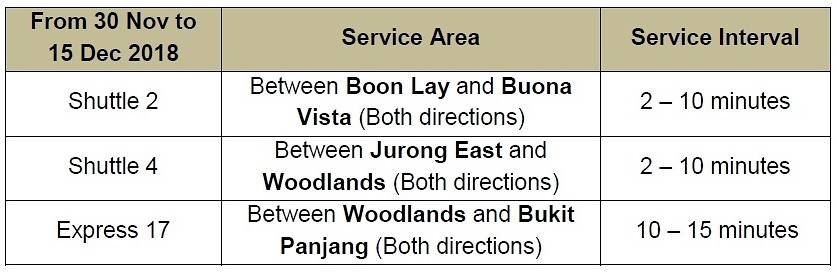
SMRT added that there will be shuttle bus services for affected commuters which will stop at designated bus stops near the MRT stations. 

SMRT early closure shuttle bus 2

(Table: SMRT)

SMRT has been closing sections of the lines earlier over the past few months, to facilitate renewal of the power supply system. 

It had said that the project is expected to be completed by the early 2020s. 

EWL SERVICES AT CITY HALL STATION TO END EARLIER IN JAN

In January, train services on the EWL at City Hall MRT station will end earlier at 11.30pm on the first two Fridays and Saturdays of the month. 

This is due to maintenance work in the EWL tunnels near the station. 

“During this time, train services on the EWL between Outram Park and Raffles Place MRT stations will operate as a bi-directional shuttle with longer service intervals of up to 12 minutes,” said SMRT. 

It added that NSL services at City Hall MRT will operate as usual. 

SMRT early closure shuttle bus 3

(Table: SMRT)

As there will be no train service on the EWL between Raffles Place and Bugis MRT stations from 11.30pm on the affected dates, a shuttle bus will be available for commuters to travel between the two stations.

“As the timing of the last trains departing each station during the planned closures will vary, commuters are advised to check for station-specific timings at affected MRT stations, or on SMRT Trains’ website and social media platforms for commuters to plan their journeys ahead,” SMRT said.

Source link

Singaporeans will likely know their next PM on Friday

0

SINGAPORE’S ruling People’s Action Party (PAP) is expected to unveil is next line of leaders on Friday in an announcement that will see the candidate who will most likely succeed Prime Minister Lee Hsien Loong to become the city-state’s fourth premier.

Sources told the Straits Times that the country’s top decision-making body held a meeting Wednesday night to determine who would fill the crucial post of first assistant secretary-general and the rest of the new office-holders.

After making the announcement, the party’s central executive committee (CEC) will meet with MPs and branch secretaries to explain their decision.

SEE ALSO: Which Singapore graduates are most employable in the world? 

According to the Straits Times, choice for first assistant secretary-general – the post that most likely leads to becoming Lee’s successor – appears to have narrowed down to two contenders: Finance Minister Heng Swee Keat, 57, and Trade and Industry Minister Chan Chun Sing, 49.

The candidate who takes on Lee’s post will also likely become one of the higest-paid political leaders in the world. According to various estimates, Lee earns an average annual salary of SGD2 million (US$1.45 million) a year.

The sources said Lee is unlikely to attend the media conference on Friday as he intends to focus on the fourth-generation (4G) leadership.

2018-08-09T112928Z_212962729_RC1FA0AAED80_RTRMADP_3_SINGAPORE-NATIONALDAY-1024x713

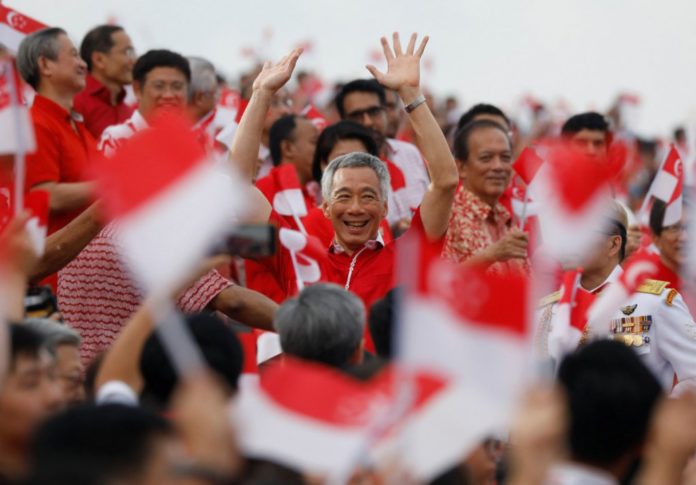
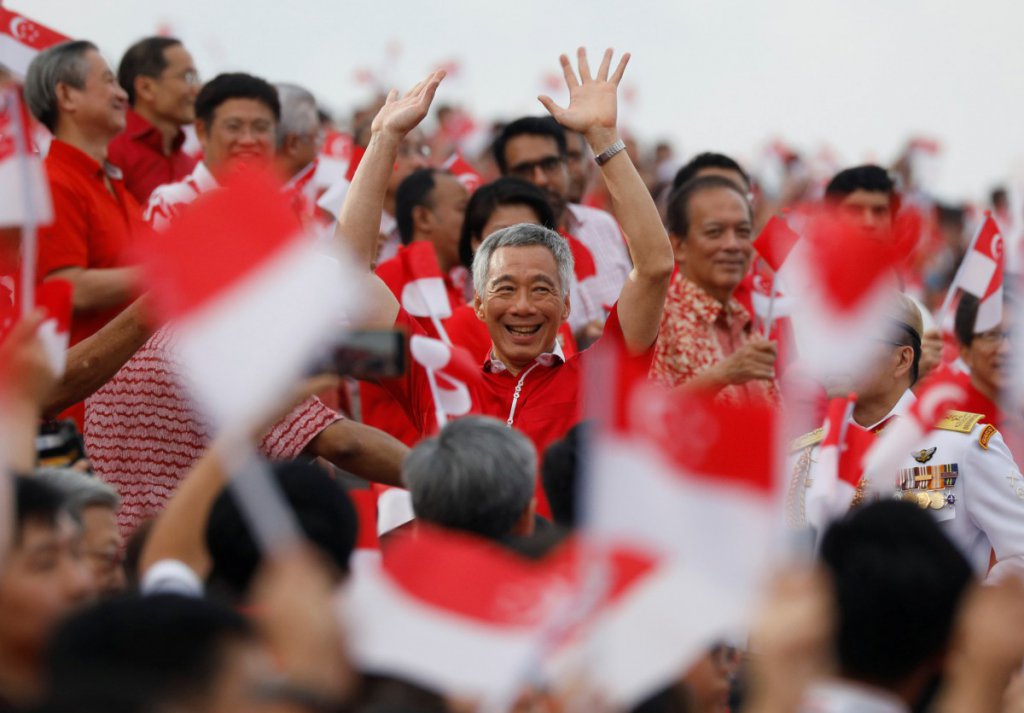
Singapore’s Prime Minister Lee Hsien Loong arrives for the National Day parade along Marina Bay in Singapore August 9, 2018. Source: Reuters

Lee had earlier said his successor must play a key role in ushering the PAP to victory in the next election, which could be held as early as next year but is not due until 2021.

However, the 66-year-old Lee, who is the son of Singapore’s first Prime Minister Lee Kuan Yew, had also mentioned that he intended to step down when he turns 70, which is in 2022.

SEE ALSO: Singapore’s PM reminds party of no ‘monopoly of power’ after Malaysian polls 

Since the city-state’s independence, the PAP has dominated Singapore’s politics over the five decades and has won all the elections with significant majorities.

Despite having an opposition, the party faces no real challenge to its power.

“Singaporeans will get a good indication of who is most likely to succeed Prime Minister Lee Hsien Loong as People’s Action Party (PAP) leader and the country’s fourth prime minister tomorrow,” the Straits Times said.

Source link

Southeast Asia digital economy smashes expectation with $240 billion valuation

0

IN any discussion about the growth of Asia’s digital economy, China usually becomes the main focus.

However, the recent exponential growth of Southeast Asia in the internet economy is giving analysts and observers something else to ponder.

The region’s digital economy is expected to grow up to US$240 billion in value, by 2025, effectively tripling in size.

A new study conducted by Google and Singapore’s Temasek, predicts the region’s 350 million mobile internet users spanning across six countries have boosted its internet economy to the value of US$72 billion, up from US$50 billion in 2017.

SEE ALSO: Where in Asia are my digital skills most in demand?

This new “inflection point,” as the study calls it, has made Google and Temasek raise their initial estimation of growth which was US$200 billion in the next seven years to US$240 billion.
Capture2-1024x423

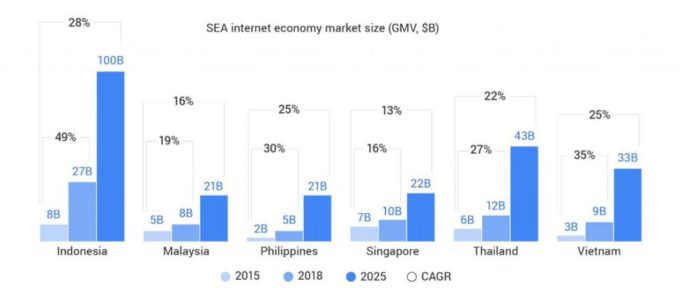
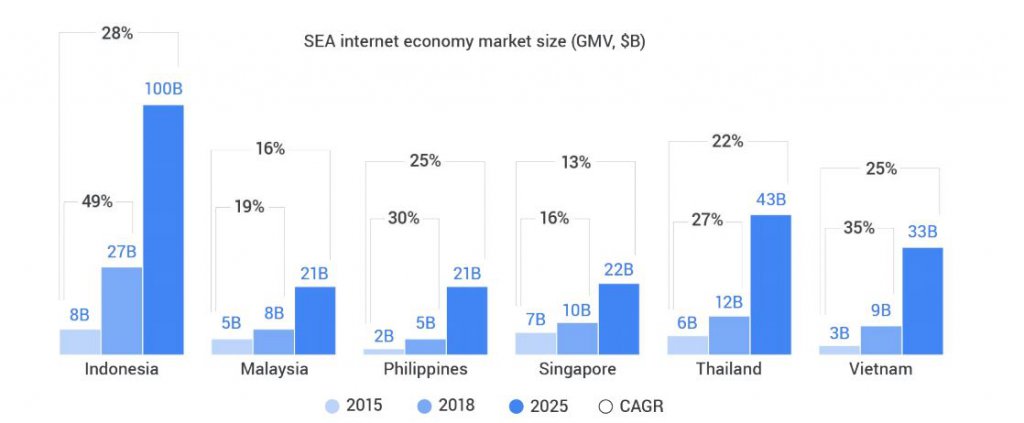
Indonesia largest ($27B) and fastest growing (49% CAGR),
will be a $100B internet economy by 2025. Source: Google-Temasek

At the moment, the region’s most populous country, Indonesia is leading the charge as the most prominent player at US$27 billion and is estimated to reach the US$100 billion mark by 2025.

In that same timeframe, Thailand’s digital economy is projected to triple from current US$12 billion to US$43 billion and Vietnam from US$9 billion to US$33 billion.

SEE ALSO: ASEAN business is not keeping up with digital transformation

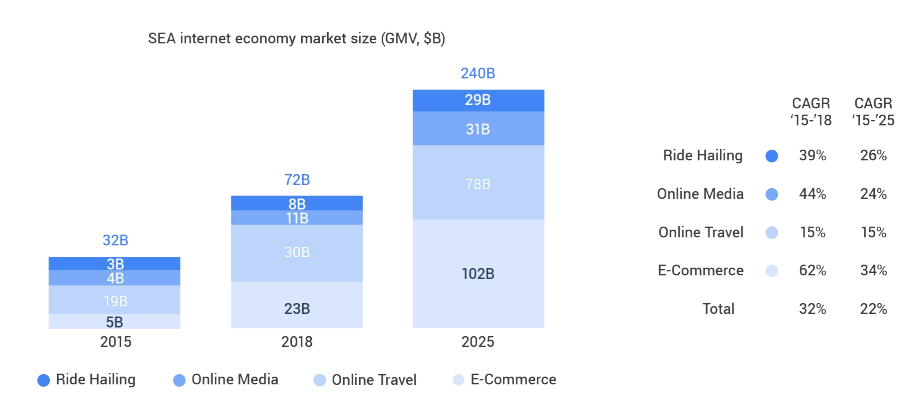
The study focused on four sectors within the digital economy and found the online travel industry will be responsible for the most significant chunk of the estimated US$72 billion in revenue.

E-commerce will account for US$23  billion, followed by online media, and ride-hailing services with US$11 billion and US$8 billion respectively.
Capture

Booming e-Commerce sector, Online Media accelerating. Source: Google-Temasek

However, by 2025, e-commerce is expected to be the biggest revenue generator. The industry is projected to bring in US$102 billion, propelled mainly by the three biggest players in the region — Lazada, Shopee, and Tokopedia.

Fueled by online advertising, gaming, and the emergence of on-demand music and video subscription, online media is tipped to become a US$31 billion industry while ride-hailing is will be worth US$29 billion.

Ride-hailing was given particular focus by the study due to the unique situation in the region where, earlier this year, leading vendor Grab acquired its competitor, Uber’s business.

Grab, and its other rival that emerged out of Indonesia Go-Jek have seen their market expand monumentally, according to the report.

SEE ALSO: Which Singapore graduates are most employable in the world?

Over eight million rides are taken by users in 2018, compared to only 1.5 million per day in 2015. The active users utilising the hailing services itself ballooned from eight million in 2015 to a whopping 35 million in 2018.

Food delivery services, which is a part of e-hailing services see faster growth in revenue as both Grab, and Go-Jek sought to expand into this untapped market.

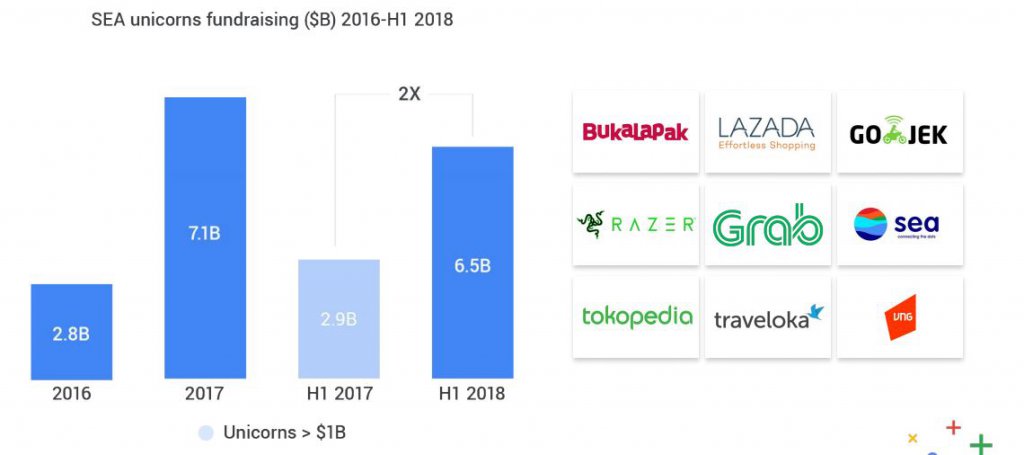
With regards to funding, 2018 is a record year fundraising in the region for the digital economy.

US$9.1 billion was raised in the first half of 2018 alone. To put it in perspective, all of 2017 saw a total investment of US$9.4 billion.

Since 2015, a total of US$24 billion investment flowed to the region.

Most of the funding (US$ 16 billion since 2016) went to the regions nine unicorn companies – Bukalapak, Go-Jek, Grab, Lazada, Razer, Sea Group, Traveloka, Tokopedia, and VNG.

It is also worth noting that Grab is the region’s first decacorn (company with US$10 billion-plus valuation), and took the lion’s share of the investments (US$6 billion).
Capture3-1024x455

Most funding went to SEA’s nine unicorns ($16B since 2016);
Grab 1st decacorn ($10B+ valuation), less than 20 globally. Source: Google-Temasek

The rest of the players in the digital economy did not do all that badly and had certainly benefited from the investors’ confidence in the region.

More than 2,000 tech companies in the region secured funds, with companies valued less than US$1 billion collectively raising almost US$7 billion in the last three years.

Singapore and Indonesia emerged as investors’ favourite destination as companies headquartered in these countries attracted the vast majority of the funding in the tune of US$16  billion and US$6 billion since 2015.

The other countries raised a combined total of US$2 billion.

SEE ALSO: Why are tech titans like Google and Apple talking about digital wellness?

In the previous iteration of the study, Google-Temasek identified six distinct areas that will pose a challenge to sustain growth in the digital economy.

These areas were: internet infrastructure, ability to secure funding, building consumer trust, developing logistics to handle e-commerce, ability to attain talent, and viable digital payment solutions.

This year’s report, however, declared that the availability of venture capital investments has turned from being a challenge for the Southeast Asian internet economy ecosystem to being one of its core strengths.

Considerable progress has also been made in the other five areas of challenge, the reports said, and one such development is the creation of 100,000 new professional jobs, which is expected to double by 2025.

This article originally appeared on our sister site Tech Wire Asia

Source link

Man dies after being hit by private bus outside Forestville EC

0

SINGAPORE: A 25-year-old man died after being hit by a private bus outside the Forestville executive condominium at Woodlands Drive 16 on Wednesday (Nov 21) evening. 

The man died at the scene, the police said in response to queries from Channel NewsAsia, adding that they were notified about the accident at about 7pm.

Investigations are ongoing, the police added.

The body of the victim, an Indian, was pinned under the right rear wheel of the bus, SCDF said.

Man dies in accident involving bus outside executive condominium in Woodlands

Photos circulating on WhatsApp showed the scene of the accident, with a police tent by the side of a cordoned-off road. Police and SCDF vehicles and officers were also seen.

Photos circulating on WhatsApp showed the Forestville bus and a body covered in white cloth at the scene of the accident.

A police tent can be seen at the side of the road, which is cordoned off. Police and SCDF vehicles and officers were also seen.

A Channel NewsAsia reader, who lives in the area, said that he saw a crowd at the scene and a passerby helping to direct traffic.

He also saw the body being shifted into the tent.

“A couple of Indian people were being interviewed by the authorities,” he said. “I think the deceased is someone they knew.”

forestville accident scene 2

Photos circulating on WhatsApp show the scene of an accident where a pedestrian died after being hit by a private bus outside the Forestville executive condominium on Wednesday (Nov 21) evening. 

forestville accident scene

Photos circulating on WhatsApp show the scene of an accident where a pedestrian died after being hit by a private bus outside the Forestville executive condominium on Wednesday (Nov 21) evening. 

This story came from a reader tip-off. If you would like to send in photos or videos of something newsworthy, WhatsApp our Mediacorp news hotline at +65 8218 8281 or message us on Facebook.

Source link

Singapore, Netherlands ink environment and water management agreement

0

AMSTERDAM: Singapore and the Netherlands on Wednesday (Nov 21) signed an agreement to enhance cooperation on environmental and water management.

This is the first time the two countries are signing a memorandum of understanding in the area of both environment and water.

Apart from aiming to facilitate knowledge exchange and expertise in the area of water management, the deal will look to support industry efforts to develop technologies and capabilities in water production, including through joint implementation of demonstration projects between the private and public sectors.

It also focuses on enhancing capabilities in four areas: Integrated water resource management, circular economy, climate change, and pollution prevention and control.

The Netherlands is the forerunner in the area of resource recovery and waste management, and the agreement can facilitate Singapore in exploring circular economy concepts.

“We need to transition to a circular economy because the current linear model of ‘make, use and dispose’ is inherently unsustainable in the long-term,” said Environment and Water Resources Minister Masagos Zulkifli at the signing ceremony held at Prodock Amsterdam.

Masagos Zulkifli and Sigrid Kaag

Singapore’s Environment and Water Resources Minister Masagos Zulkifli and the Netherlands’ Foreign Trade and Development Cooperation Minister Sigrid Kaag sign an agreement to enhance cooperation on environmental and water management, at the Prodock Amsterdam on Nov 21, 2018. (Photo: Junn Loh)

He added that if done correctly, Singapore would be able to address climate change through maximising resource efficiency and minimising waste across product life cycles and the economy as a whole.

Citing the upcoming multi-billion-dollar Tuas Nexus project, which comprises an integrated waste management facility and a water reclamation plant, Mr Masagos said the transition towards a circular economy can present an opportunity for collaboration between Singapore and Dutch companies.

“We are keen to partner with international businesses to share solutions and technologies in Singapore’s transition towards a circular economy,” he said. “There is immense untapped potential in the sharing of best practices, and cross-border transfer of knowledge and technologies.”

More than S$5 billion in tenders will be called for the Tuas Nexus development over the next five years, and the facility is expected to be completed in phases from 2023 onwards.

The signing of the agreement was witnessed by King Willem-Alexandar of the Netherlands and President Halimah Yacob as part of her five-day State Visit to the country.

Earlier on Wednesday, Madam Halimah received a ceremonial welcome by the king and queen of the Netherlands at the historic Dam Square in the capital city.  She later laid a wreath on a nearby national monument to commemorate those who died during the World War I and II.

The President will also be visiting The Hague, Rotterdam and Eindhoven over the next few days.

Source link

Singapore thrash Timor Leste 6-1 to keep Suzuki Cup semi-final hopes alive

0

SINGAPORE: Fandi Ahmad’s Singapore hammered Timor Leste 6-1 at the National Stadium on Wednesday (Nov 21) to keep their hopes of progressing to the semi-finals of the AFF Suzuki Cup alive. 

A hat-trick from Safuwan Baharudin, a brace from Ikhsan Fandi and a goal from Faris Ramli gave Singapore a comfortable win as the Lions stayed third in Group B on six points, one behind Thailand and Philippines who drew 1-1 in Bacolod City.

The Lions entered the game knowing that anything less than a victory would kill off their chances of moving to the next round, and it took them just 12 minutes as Safuwan headed past Aderito Raul Fernandes.

But the Lions were barely done with their celebrations when Timor Leste got their equaliser as a lightning quick counterattack saw Rufino Walter Gama tap home.

But the home side recovered quickly and Safuwan got his second of the night in the 19th minute as he smashed home a loose ball after Zulfahmi Arifin’s freekick was smothered. 

Singapore then made it 3-1 11 minutes later when Ikhsan prodded home after another set-piece was half-cleared.

Ikhsan Fandi Timor Leste

Ikhsan Fandi gives his marker the slip at the AFF Suzuki Cup match against Timor Leste on Wednesday (Nov 21). (Photo: Matthew Mohan)

Fandi’s men were turning on the style at this point and Ikhsan made it 4-1 in the 42nd minute, smashing in a superb bicycle-kick after a header across by Safuwan.

The second half was a much more subdued affair compared to the first, as the away side seemed to regain their composure. The closest the Lions could come to scoring was a fierce shot from substitute Nazrul Nazari which rebounded off the crossbar.

But the Lions found their second wind in the dying embers of the game as substitute Faris found the net in the 90th minute and Safuwan rounded off his virtuoso performance with a neat header.

Shakir Hamzah Timor Leste

Shakir Hamzah goes in for the tackle as Singapore faces Timor Leste in the AFF Suzuki Cup match on Wednesday (Nov 21). (Photo: Matthew Mohan)

Singapore’s final group game will be against Thailand at the Rajamangala Stadium in Bangkok on Sunday (Nov 25) while Philippines will travel to Indonesia.

Source link

CNB seizes S$300,000 worth of drugs, 3 suspects arrested

0

SINGAPORE: An assortment of drugs worth S$305,000 – including cannabis, Ice, ecstasy and heroin – was seized by the Central Narcotics Bureau (CNB) on Tuesday (Nov 20). 

Three suspected drug offenders – two Singaporeans and a Malaysian – were also arrested. 

In a media release on Wednesday, CNB said its officers were deployed on Tuesday evening to observe two suspected drug traffickers near Marsiling Lane. 

There, they witnessed the first suspect, a 27-year-old man, leave his 11th-floor apartment with a white plastic bag. He went down to the sixth floor and returned to his unit empty-handed. 

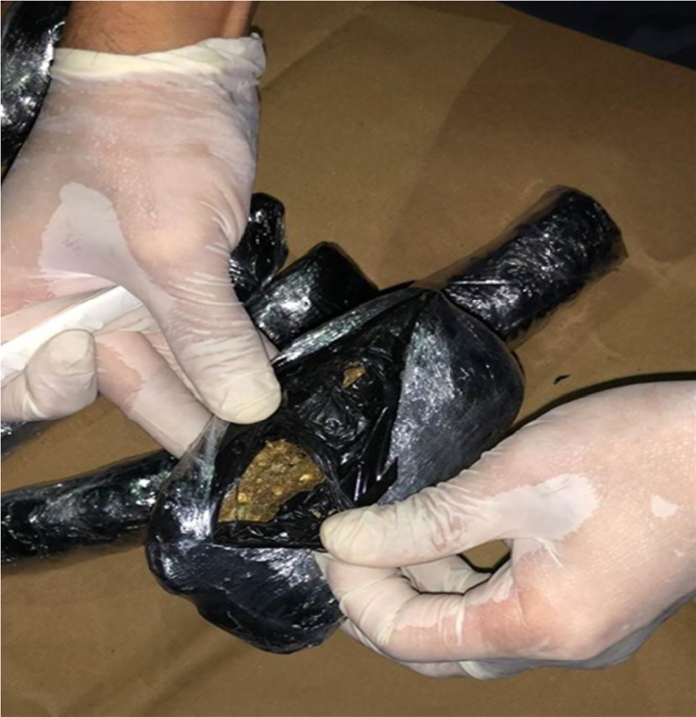
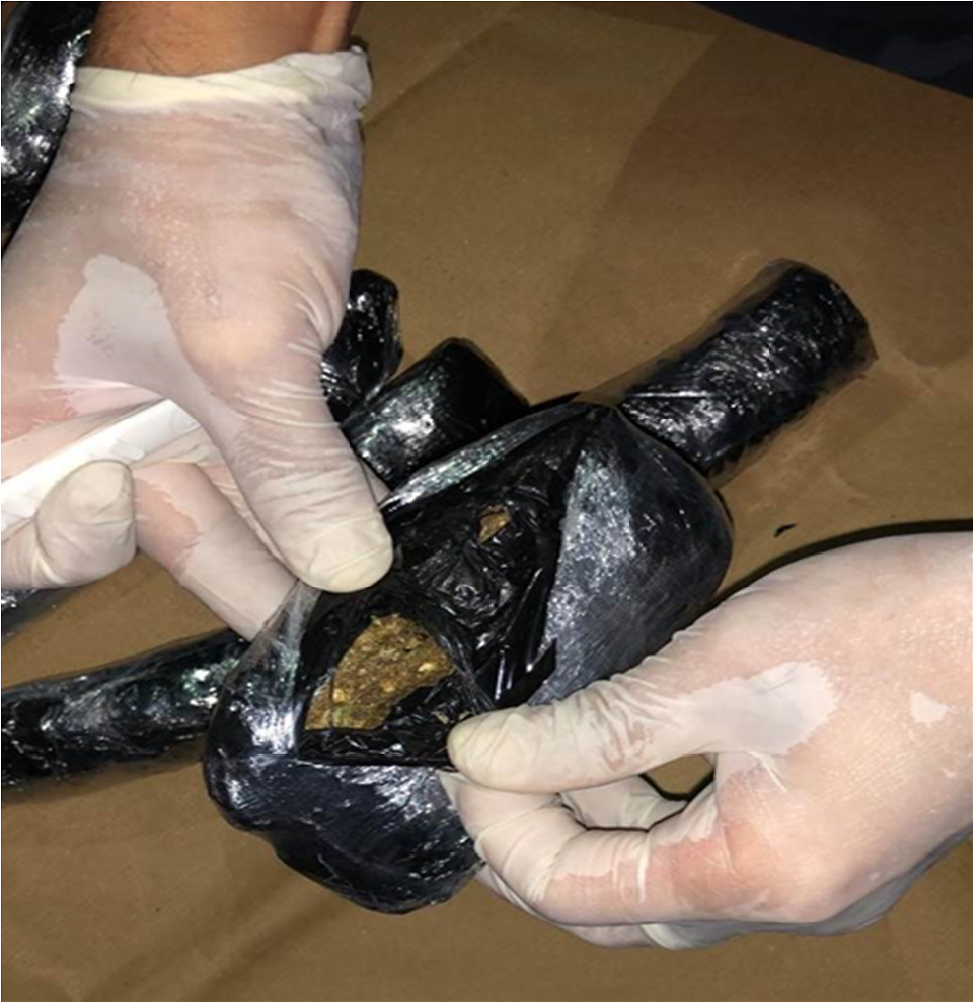
A short while later, officers saw the second suspect, a 30-year-old man, loitering on the 6th floor of the same block. When the man, who had a white plastic bag on him, proceeded to the ground floor, he was arrested. Officers found 1.31kg of cannabis packed in 12 black bundles in the bag.

CNB seizes assortment of drugs worth S$305,000, arrests 3 suspects

Cannabis, packed in different bundles, recovered by officers in a CNB operation on Nov 20. (Photo: Central Narcotics Bureau)

Another party of officers proceeded to raid the unit of the 27-year-old man, where they found 2.94kg of heroin, 520g of Ice, 142 Erimin-5 tablets, 87 Ecstasy tablets and 17g of cannabis, said the CNB.

The man also led officers to a stash of drugs hidden at the lift landing area on the seventh floor, where they found a red plastic bag containing 500 Erimin-5 tablets. 

CNB seizes assortment of drugs worth S$305,000, arrests 3 suspects (2)

Erimin-5 tablets hidden at a 7th floor lift landing area. (Photo: Central Narcotics Bureau)

The third suspect, a 41-year-old Malaysian man suspected to be involved in the drug activities of the first suspect, was arrested at Woodlands Checkpoint on Tuesday evening.

Officers who searched the motorcycle he was riding found 1.97kg of cannabis, wrapped in various black bundles. 

He also led officers to a stash of drugs hidden in a pipe at a multi-storey car park near Marsiling Drive, where 234g of cannabis was recovered.

CNB seizes assortment of drugs worth S$305,000, arrests 3 suspects (1)

Drugs hidden behind a pipe, at a multi-storey carpark in the vicinity of Marsiling Drive. (Photo: Central Narcotics Bureau)

Investigations into the drug activities of all the suspects are ongoing. 

According to CNB, 3.53kg of cannabis is enough to feed the addiction of more than 500 abusers for a week, while 2.94kg of heroin can feed the addiction of about 1,400 abusers for a week.

Source link

Tall Order: The Goh Chok Tong Story raises S$2 million for charity

0

SINGAPORE: More than S$2 million was raised at a charity launch of Emeritus Senior Minister Goh Chok Tong’s biography – A Tall Order: The Goh Chok Tong Story on Wednesday (Nov 21).

The charity event sold more than 250 copies of the book autographed by Mr Goh. The books were priced at S$2,000, S$10,000 and S$50,000.

The proceeds from the event, as well as all royalties from the sales of the books, will go towards two charities Mr Goh is patron of – the MediaCorp Enable Fund and EduGrow for Brighter Tomorrows. 

Tall Order: The Goh Chok Tong Story charity launch (1)

Emeritus Senior Minister Goh Chok Tong (centre) at a charity launch of his biographical book – “A Tall Order : The Goh Chock Tong Story”. (Photo: Vanessa Lim)

The book, which documents Mr Goh’s life and career, was officially launched on Nov 8 by Prime Minister Lee Hsien Loong. It is written by former Straits Times journalist Peh Shing Huei.

READ: Culture of leadership self-renewal needs to be entrenched: PM Lee

Speaking at the event, Mr Goh said his generation enjoyed meritocracy and social mobility put in place by the Government and nurtured by society. He stressed that it’s important to continue efforts to keep Singapore a meritocratic society. 

“A government bursary paid my way through university, my life turned out well, not just because of my own effort but also because of our practice of meritocracy, ” said Mr Goh. 

“I did not have to rely on ‘guanxi’ (Chinese for networks or connections), I had equal opportunities to study, compete, get a job and do well on my own steam,” he said.

“Meritocracy cannot be left to its own devices. We must constantly adjust to maintain an open system with opportunities for all Singaporeans to advance themselves,” he added. 

READ: Excerpts from Tall Order: The Goh Chok Tong Story

The MediaCorp Enable Fund, formerly known as the Today Enable Fund, seeks to help people with disabilities realise their aspirations, improve their skills and work prospects.

EduGrow for Brighter Tomorrows is an initiative that supports the growth of children from disadvantaged families in areas including education and character building.

Source link

Stretch of Canning Rise to be pedestrianised from Jan 3

0

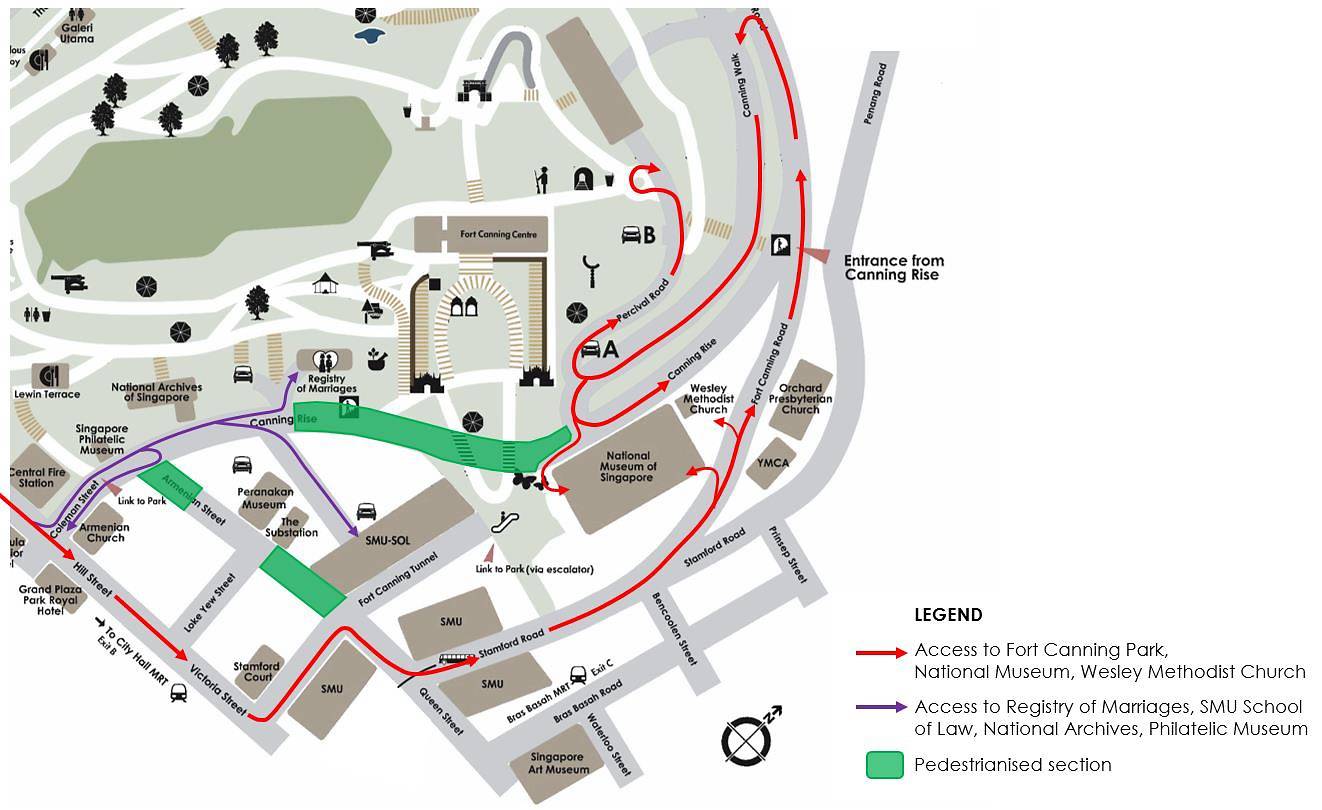
SINGAPORE: Canning Rise will no longer connect Hill Street to Fort Canning Road from Jan 3, 2019, the National Parks Board (NParks) said in a news release on Wednesday (Nov 21).

A portion of the one-way street – after the Registry of Marriages and before the National Museum of Singapore’s coach drop-off bay – will close to vehicular traffic for good from that date. 

With this change, motorists from Hill Street and Coleman Street heading towards Fort Canning Road will have to get there via Victoria Street and Stamford Road.

A walkway connecting Fort Canning Park’s Farquhar Garden to Fort Canning Green will replace the expunged portion of Canning Rise to create “a pedestrian friendly environment within the park,” NParks said.

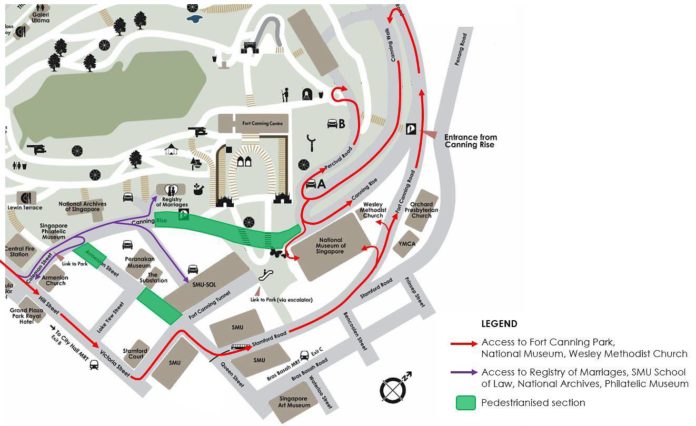
Canning Rise road closure Fort Canning Armenian Street map

READ: New Central Area cycling network in the pipeline
READ: 3 historical gardens at Fort Canning Park to be restored

In addition, parts of Armenian Street are also set to be pedestrianised, leaving a stretch open for vehicles access to the Peranakan Museum and the Substation via Loke Yew Street when pedestrianisation works are complete.

With the road closures, motorists will have to use Canning Walk to access National Museum of Singapore’s coach drop-off and Fort Canning Park Carparks A & B.

Motorists will still be able to drive through Canning Rise to access the National Archives Singapore, Singapore Philatelic Museum, Singapore Management University School of Law and the Registry of Marriages, added NParks.

The authorities will provide directional and information signs to guide motorists prior to the road closure and during construction works. 

Source link

HDB terrace near Whampoa sold for record price of nearly S$1.2 million

0

SINGAPORE: A Housing and Development Board (HDB) terrace was sold at nearly S$1.2 million in the third quarter of this year, smashing a previous record for the priciest HDB unit ever sold, according to a real estate trends report published by OrangeTee on Wednesday (Nov 21).

The 237 sq m HDB terrace located along Jalan Bahagia near Whampoa was sold in September at S$1.185 million. 

This is slightly higher than the S$1.18 million record set by a 5-room Design, Build and Sell Scheme (DBSS) flat in Bishan that changed hands in February last year.

The third priciest HDB unit sold on record was a 5-room DBSS flat at Lorong 1A Toa Payoh, sold for S$1.16 million.

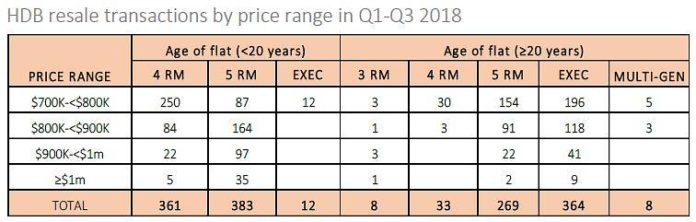
A total of 52 million-dollar HDB units were sold in the first three quarters of this year, the report said. Most of them – 40 units – were less than 20 years old.

HDB transactions table

Source: Data.gov.sg, OrangeTee & Tie Research & Consultancy

BUMP IN RESALE TRANSACTIONS

The report also said that resale transactions grew amid weakening HDB property prices.

According to HDB data, 17,462 resale applications were received in the first three quarters of this year, hitting a five-year high, the report said.

In the same period, the number of HDB flats resold for at least S$700,000 reached a six-year high, with a total of 1,438 transactions.

Prices slipped marginally by 0.1 per cent in Q3 as compared to the previous quarter. 

Punggol saw the biggest increase in the number of resale applications, rising 334.4 per cent for the first three quarters of this year as compared to five years ago. Sengkang saw the next highest increase with 58.3 per cent over the same period.

The report attributed this to growth in the number of Build-To-Order (BTO) flats in those areas that have reached their five-year minimum occupation (MOP) period.

It also said that the many condominiums built in Punggol and Sengkang might have spurred HDB owners to upgrade. 

Data compiled also showed that the prices of premium HDB flats are “holding up better in the current market” compared to smaller, standard flats, the report said.

OrangeTee projected the total number of HDB resale transactions this year to reach around 23,000 units and to increase further to about 24,000 next year.

“The possible increase could be attributed to more BTO flats reaching MOP next year and subsequently ready for resale. The demand may continue to be supported by the healthy job market and robust economy,” it said.

Source link