Home Blog Page 896

Female martial artists in Singapore fight hard to make progress against stereotypes

0

SINGAPORE: “Oh I’m giving you a chance just because you’re female.”

These were the words Brazilian jiu-jitsu exponent Geraldine Lam once heard from a male sparring partner during training.

“Sometimes when you train with guys, and if they are new to the sport, they may feel like they can’t lose to you,” said Ms Lam.

“They might go all out and try to use their utmost strength to win, which can lead to more injuries. If they lose, they might say: ‘Ah I can’t go hard on you anyway because it will seem like I’m bullying you.’

“But this makes me want to improve my technique even more.”

Vanessa Lee, founder and head trainer at Van Lee Fitness – an all-women Muay Thai gym – gave me a knowing look when I asked her about the gender stereotypes women may face in the male-dominated field of martial arts. 
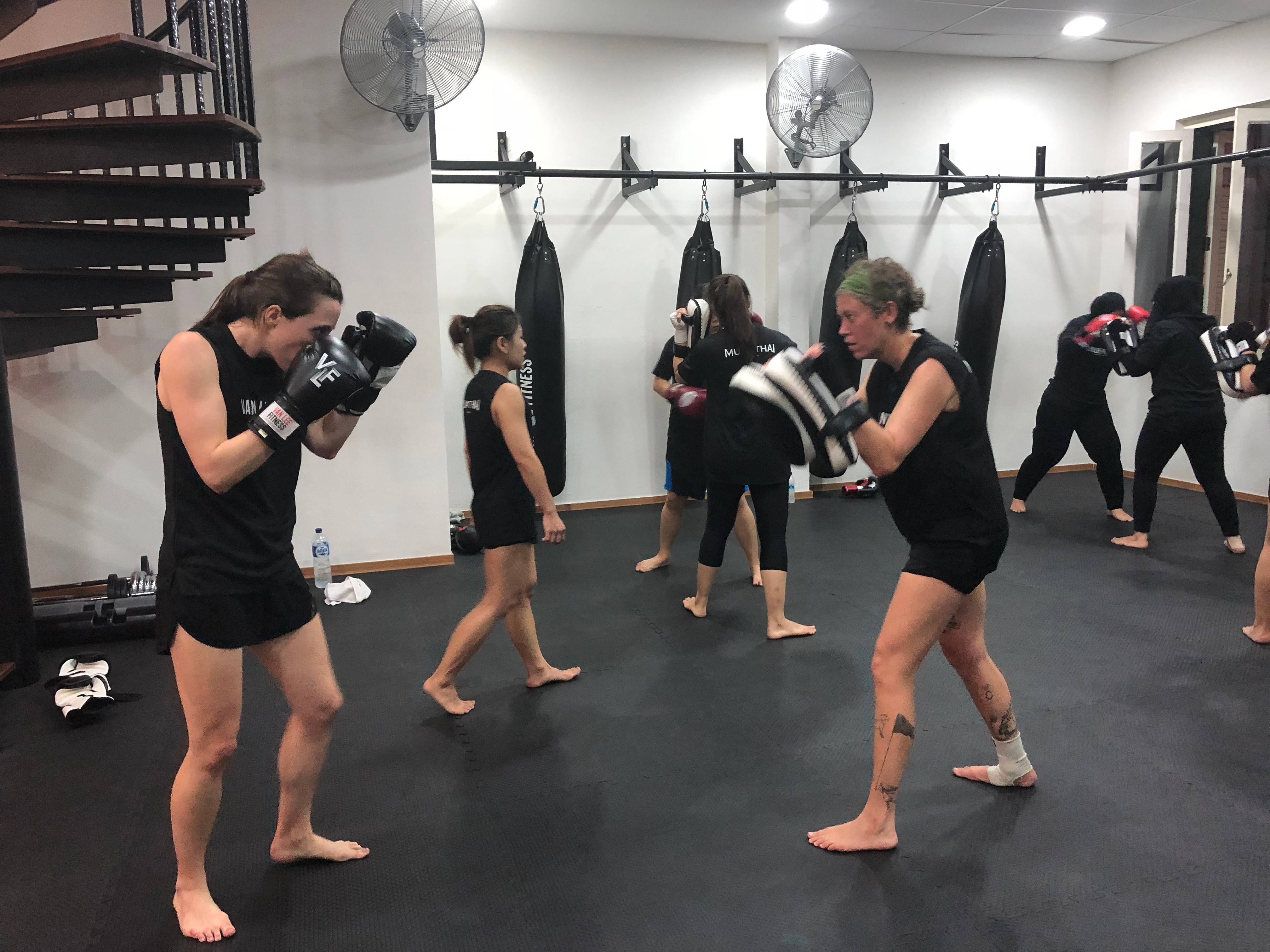
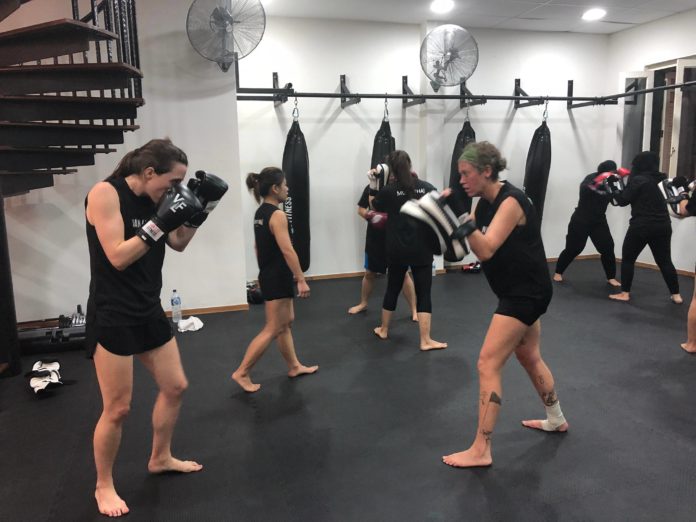
van lee fitness training

Women training at Van Lee Fitness, an all-women Muay Thai gym in Chinatown. (Photo: Ainslee Asokan)

“I think gender stereotypes are still pretty prevalent even in our modern world. Women are still seen as the weaker sex and we’re often not taken seriously,” she said.

Despite the gender hurdles some women in martial arts have to face, I wanted to find out more about what motivated women to break into this field.

HOW MUCH WILL YOU SACRIFICE?

On top of the remarks she received from her male counterparts, Ms Lam also had to deal with other obstacles – like an injury that left her unable to fully use her hands for a prolonged period of time.

geraldine lam bjj

Geraldine Lam during a BJJ match. (Photo: Geraldine Lam)

The injury left her with trigger finger, a condition where fingers and thumbs may get stuck in a bent position due to overuse of the finger tendons from gripping objects too hard.

“It was a very frustrating period of time for me because you could not grip anything. At work, I could not even type properly. It went on for at least a year or two,” she said.

“I was very jealous of other people because I couldn’t train … I felt like I kind of lost my identity for a while.”

Others have gone as far as to switch jobs to cater to their martial arts training.

“I used to work for Toys ‘R’ Us and I left after 10 years because I wanted to have more training time,” said a professional Muay Thai fighter who wanted to be known only as Chocolate. 

“Call it a mid-life crisis but at 30, I decided that maybe I should switch to a fitness-related (job) so that I can train more seriously.”

chocolate training

Chocolate is seen training with her coach, Jack. (Photo: Chocolate)

chocolate during a match

Chocolate during a Muay Thai match. (Photo: Chocolate)

Another martial artist spoke about how she had to juggle her studies.

“In 2014, while I was at university, I had my first fight for Muay Thai. I had to train three to four times a week in the day time. (After that) I had to go back for university tutorials some days,” said Audrey Cheong, 27.

“I always fell asleep during the tutorials,” she recalled.

But Ms Cheong was determined to push ahead to achieve her goal of competing in Muay Thai.

audrey during a boxing match

Audrey Cheong after winning a boxing match. (Photo: Audrey Cheong)

In 2017, she added another feather in her cap when she made her boxing debut. During this period, it was no longer university commitments but her job as a human resource manager that she had to balance with training to become a competitive fighter.

“It was terrible … horrible. Very tiring. There is no social life when you are training for a fight,” she recounted with a slight laugh.

“When it comes down to everyday training, I just have to break it down into hours and minutes to get through it.

“The hardest part is the mental aspect. There was a lot of self-doubt and there is never a final goal you can reach.”

However, despite having to break the glass ceiling and juggling hectic routines, the take-up rate among women in martial arts seems to be on an uphill trajectory. 

RISE OF MARTIAL ARTS AMONG WOMEN IN SINGAPORE: FAD OR NOT?

“There is really a very significant increase of women in martial arts, regardless of whether it is in Muay Thai or boxing or Brazilian jiu-jitsu,” said Chocolate, who is also currently part of the management team at Onyx MMA where she trains.

“The turning point for Muay Thai could be Contender Asia. It made the Muay Thai industry in Singapore boom around 2008 and 2009,” she said in reference to the Muay-Thai-focused reality show released in 2008.

However, she noted, a little somberly, that it could also be because martial arts has become more mainstream.

“Another way of putting it is that it has become more commercialised,” Chocolate said. 

“You get a lot of gyms that are not doing martial arts starting to incorporate some form of martial arts. You get box-aerobics, boxercise …

“Once we have service providers like that who don’t cater to the apex of the food chain – which is to groom fighters who go out and fight – inevitably, the market will start to be attuned to this concept.”
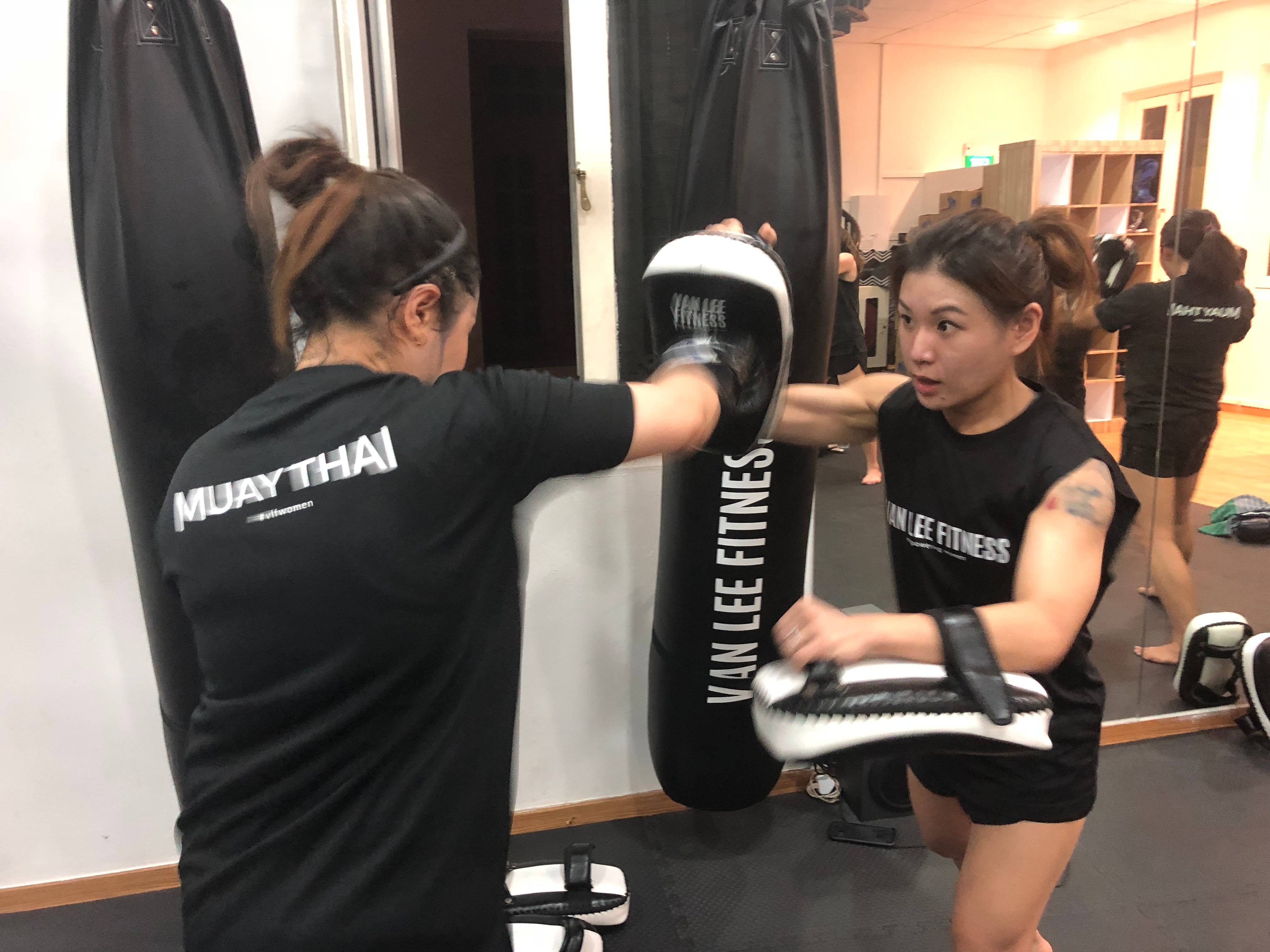
n lee

Vanessa Lee is the head trainer and business owner at Van Lee Fitness. (Photo: Ainslee Asokan)

Ms Lee echoed similar sentiments, adding that she wanted to cater to the fitness market – namely women who don’t want to compete – while still including Muay Thai.

Another driving force was former UFC women’s bantamweight champion Ronda Rousey.

“Ronda Rousey is nowhere near the first female to compete professionally, but in terms of the industry as a whole, she made it possible for a lot of women to think about martial arts,” said Chocolate.

The Ultimate Fighting Championship has made cage fighters like Ronda Rousey into household names

On a larger scale, Ms Lee believes that martial arts could have an empowering effect on women – one that can only be felt while executing fearless high kicks or landing a clean punch square on the target.  

“I find that women all over the world are starting to realise their power,” she said. “Martial arts has become a platform for them to get stronger, inside out. To some, it might be intimidating at first, but it’s so empowering.”

But can it be sustained? Chocolate believes it can, simply because women, in her view, have a more patient and structured approach towards martial arts compared to men who may seek quicker routes to obtain gratification from doing the sport.

Ms Lee also reckons that women these days are more open towards trying out martial arts.

“Most of us in Singapore, it’s just a busy country and you need that outlet to release that stress,” she said.

“I envision more women taking up martial arts in the future.”

Source link

Commentary: The dead need a place too in land-scarce Singapore

0

LIVERPOOL: Who liked “doing” Qing Ming when they were children? Anyone?

I remember little about visiting my grandfather’s ashes many years ago – it was, I found out later, at Khong Meng San in Bright Hill – and only two images remain in my mind’s eye. 

An endless row of urns stacked on shelves, and a pool full of tortoises.

It was 6am, I was a grouchy five-year-old, and all I could think about was why there were so many tortoises looking like they were trying to make a getaway. I had little time to think about Ah Kong.

Now, spending much of my academic career musing about death and post-death, thoughts of the dead poke me like errant friends on Facebook.

WHERE TO PUT THE DEAD?

What to do with the dead? 

That’s a question that pops up in society’s consciousness every year or two, especially around periods where we remember our loved ones and visit their resting places – Qing Ming, All Souls Day, Shab-e-Barat, Pithru Paksha and more.

A recent video documentary on Channel NewsAsia, showing the dire circumstances for Hong Kong’s dead, some of whom were housed in shelves of plastic boxes in cramped apartments, generated the usual colloquial lamentations in Singapore.

Aiyoh! Die already! Singapore’s going this way, we’re going to end up in plastic boxes too! Eh, you think it’s a good time to buy shares in Toyogo?

Earlier this year I penned a commentary about spaces associated with death in Singapore, and how we need to de-programme ourselves from linking death, and the burial of the dead with physical and spiritual pollution.

The less we think of a space as unclean, the more likely we are to find a solution that acknowledges both the need for such spaces and the limitations of our island.

Similarly, there are and are going to be many more dead. Cultural and religious norms are in direct confrontation with geographical constraints and social taboos, particularly NIMBY-ism (or the attitude of “not in my backyard”). 

There needs to be other methods of releasing the dead.

BECOMING ETHEREAL

But is releasing the right word? Maybe that’s the problem. 

In choosing between burial, ash storage and any other option – whether sea burial, memorial gardens, or blasting off into space – we are faced with two extremes – an either or situation.

In the former, there is a static place where at least a physical portion of you remains. Even if you are squeezed into a bag, and left in a drawer with strangers, at the very least you retain a physical presence in this world.

In the latter, you become ethereal, there is no particular spot, tomb, or marker that one can point to and say, “When I’m dead, I’ll be remembered here”.

Authors own - Terence Heng - Ritually placing ashes into an urn before interment

“When I’m dead, I’ll be remembered here” – Ritually placing ashes into an urn before interment. (Photo: Terence Heng)

Dispersal, recycling, scattering – these are all well-intentioned, eco-friendly methods that would make any millennial proud. 

But these words carry with them a deep symbolic violence – a final destruction to one’s body, a kind of annihilation of one’s social identity.

My research often leads me to think about the ways individuals want to express their identities, and many sociologists have pointed to the myriad approaches we take – dress, behaviour, language, place-making, and more. 

Of these, I have always found the use of material objects to reveal the most of one’s desires, fears and aspirations.

These objects are sometimes called aesthetic markers – items that perform our identity for those to see. Tombstones, urns, memorial plaques, obituaries, ancestral tablets and other death paraphernalia can potentially come under this umbrella.

New methods of dealing with the dead too often ignore the need for these markers. To remove all physical trace of an individual is not just to simply forget them, the act seems to also somehow marginalise their value when they were alive.

AESTHETIC MARKERS STILL NEEDED

The physical nature of a marker is thus deeply important – which is possibly why online memorial pages and zombie Facebook profiles can only go so far as replacements for a memorial plaque. 

Even though we spend an increasing amount of time negotiating the world through a smartphone, there are still things we want to feel, touch and sense.

READ: Keeping the deceased alive online has changed how we grieve, a commentary

That tactility is also why we are often concerned about the aesthetics of death – consider the outrage recently when it was found out that some individuals’ columbarium plaques were made of quartz and not marble.

Think of the intricate designs and minimalist lines of graves of different religions and ethnicities. Whichever the taste or style, individuals demand beauty, even if they are not there to see it.

Authors own - Terence Heng - Tactile and tangible, Small mementos mean much to both Living and Dead

Tactile and tangible, small mementos mean much to both living and dead. (Photo: Terence Heng) 

There are many of course that do not mind disappearing off the face of the earth. After all, we were non-existent before we were born, why should we continue to “exist” when we are gone?

But I think the need reflects our very human desire to be social, and to continue to be part of something bigger.

Many well-meaning design students try to engage with these problems. Oftentimes you will see at graduation shows a design for the dead – memorial halls or other spaces meant to provide that physical and aesthetic solution.

READ: Contemplating the future of dying, a commentary

Other more visible options, like turning yourself into a tree, is also gaining traction in some parts of the world.

What we need to do more urgently, is to think and research about how we can find more ways for the living to be satisfied with how they will exist when dead. 

What is there that enough of us can point to and say, “When I’m dead, I’m fine with being remembered like this”?

The problem of available space will continue to remain, and unless we find ways to harness technology and policy in sensitive ways to appease that social need to belong and be present, we will always struggle with plastic boxes and wayward ashes.

Terence Heng is a lecturer in Sociology at the University of Liverpool, UK, where he is also an associate at the Centre for Architecture and the Visual Arts. He studies the changing identities of Chinese Singaporeans through ritual, religion and place-making.

Source link

Six-month trial for ‘floating donut’ dining experience in Marina Bay

0

SINGAPORE: One company is stepping up the waterfront dining experience – by taking mealtime onto the waters in donut-shaped boats.

This comes as a new regulatory sandbox by the Pro-Enterprise Panel (PEP) was announced on Friday (Nov 23), allowing The Floating Donut Company to operate its three-boat fleet in Marina Bay.

The firm, which also operates in Phuket, said it is the first to offer such a private outdoor dining experience in Singapore.

However, the project was initially stalled for three years, after its German founder, Ms Miriam Becker, hit roadblocks with several local regulatory agencies.

“It was really hard for me in the beginning because I didn’t know which agencies to approach. I had some who said from the beginning: ‘Sorry, no, that’s not going to work’,” she said.

According to Ms Becker, the agencies, including the Maritime and Port Authority of Singapore, the Urban Redevelopment Authority and the PUB, had various concerns ranging from passenger safety to potential water pollution.

“That was a big challenge to get them all to the table, to ask what the problems are and what we can do to make this work.

“That’s where the Pro-Enterprise Panel came in and said: ‘Let’s sit together and try to find a solution’,” said Ms Becker, who moved to Singapore nine years ago.

That solution took the form of a six-month trial in a regulatory sandbox.

Floating donut 3

The “floating donut” boats must adhere to speed limits and other safety measures. Photo: Ministry of Trade and Industry)

The company also made compromises by tweaking its proposal – including replacing its boats’ barbecue grills with prepared meals, to avoid potentially polluting the water.

The boats must also adhere to speed limits and other safety measures.

Pointing to this instance, Senior Minister of State for Trade and Industry Mr Chee Hong Tat said: “Whenever there’s a new idea, it’s likely it will push against regulatory boundaries.”

He added that regulators’ concerns are often valid, so the challenge is to address these concerns while allowing innovative ideas to take flight.

But according to Mr Chee, Singapore can do well in this area, as it is small and compact.

“One of our key strengths is good coordination between government agencies … We differentiate ourselves from our competitors through the use of smart regulations to be able to have the best of both worlds – safety, quality and supporting innovative ideas,” he said.

The Floating Donut Company launches operations on Nov 30.

Floating donut 2

The Floating Donut Company will operate its three-boat fleet in Marina Bay. (Photo: Ministry of Trade and Industry)

Source link

270m artwork to be centrepiece of Chingay 2019 to commemorate Bicentennial

0

SINGAPORE: It took local artists Ng Yak Whee, Rosihan Dahim and Vijaya Mohan two months, working on a field under a tent, to come up with a collaborative painting that will be the centrepiece of next year’s annual street parade Chingay. 

Collaborating on the art piece titled “Past, Present and Future of Singapore” posed significant challenges to all three artists, who had different styles and medium, they said on Friday (Nov 23) at a media conference. 

The painting is a commemorative piece for the 200th anniversary of Sir Stamford Raffles’ arrival in Singapore. 

But apart from stylistic differences, there were also technical difficulties.

They had to work in an open field under the sun because of the material used in painting the canvas and it required sunlight to dry the paints. 

Mr Ng, an urban artist known for his abstract art style, was in charge of creating the artwork’s backdrop.

“With such a big painting, we had to paint it outdoors. We had to paint it under sunlight and on the ground. In this time of the year, the weather is quite unpredictable. It could be sunny in the morning and rainy in the afternoon,” he said. 

Sometimes he would have to re-do parts of the artwork because of the rain washing out the paints. 

“We had to race against time and weather,” Mr Ng added. 

Mr Dahim, a pioneer in Singapore’s surrealism art, had to take care of making sketches across the canvas. It was split into three themes – past, present and future. 

He had to incorporate images of a future Singapore conjured up by Singaporeans who submitted their illustrations to Chingay. 

“Me being a surrealist artist, I go into imaginative works and into their dreams. Like for housing, now it’s all concrete walls. I see glass buildings and you can look out into the greenery,” Mr Dahim said. 

He also included “stingray airline”, a futuristic aircraft that takes the shape of the marine creature after dwelling on the suggestions from the public. 

After his sketches, Rangoli artist Ms Vijaya was tasked with filling in the Rangoli motifs and designs on the artwork with acrylic paints and markers. 

The artwork will travel through the heartlands where the public’s thumbprints will be collected to fill the artwork. The organising committee expects to collect at least 200,000 thumbprints and have since gathered half of it.

All three artists will be among the performers in the Chingay parade, putting their finishing touches on the canvas.

Chingay

Chingay 2019 (Photo: Fann Sim)

Jeanie Tan, chairman of Chingay 2019, said the committee also reached out to long-standing groups that have witnessed the changes in Singapore over the years for their participation in commemorating the nation’s Bicentennial anniversary. 

Among them are the 176-year-old St Margaret’s Primary and Secondary schools, the 157-year-old law firm Dentons Rodyk & Davidson as well as the 162-year-old German Association. 

Among 21 volunteer performers from the German Association is Annika Harloff who moved to Singapore in 2011. 

“For me personally, it was a long-term wish to participate in Chingay,” she said. 

“I was watching it several times with my friends and then I became an F&B volunteer. So it started with behind-the-scenes voluntary work and I enjoyed the feeling, the atmosphere. We got to mingle with other performers from different cultures, take pictures all the time. It’s a very special cultural event,” Ms Harloff said. 

Chingay will take place on Feb 15 and 16 next year at the F1 Pit Building. It will run from 8pm to 9.30pm on both days.

Tickets, priced between S$28.50 and S$60, are already on sale.

Source link

1 injured in chain collision involving car, 4 heavy vehicles

0

SINGAPORE: A 35-year-old man suffered minor injuries after a chain collision involving three trailers, a tipper truck and a car on Jalan Buroh on Friday (Nov 23) morning.

The police and SCDF told Channel NewsAsia they were alerted at about 9.15am to the accident, which occurred near the junction of Jalan Buroh and Jurong Pier Road.

chain accident jurong pier jalan buroh map

A map of the location of a chain accident at the junction of Jalan Buroh and Jurong Pier Road on Nov 23, 2018. (Image: Google)

The man, who was driving one of the trailers, was conscious when taken to Ng Teng Fong General Hospital, the police said.

Investigations are ongoing.

Source link

Heng Swee Keat and Chan Chun Sing ‘make a strong pairing’: PM Lee

0

SINGAPORE: Prime Minister Lee Hsien Loong has said that he supports the decision of younger ministers in the Cabinet who have come to a consensus that Finance Minister Heng Swee Keat will be their leader.

Mr Lee also said that Mr Heng has asked Minister for Trade and Industry Chan Chun Sing to be his deputy.

“I support the decision of the younger team, and am happy with this outcome,” he said in a Facebook post on Friday (Nov 23). 

“I have known and worked with Swee Keat and Chun Sing for some years now, and watched them grow in their different responsibilities. They have complementary strengths, and make a strong pairing.”

The ruling People’s Action Party (PAP) newly elected Central Executive Committee (CEC) held its first meeting on Friday and elected a new slate of officeholders, he said in the post on the party’s Facebook page.

READ: PAP appoints Heng Swee Keat first assistant secretary-general

Mr Heng is the new first assistant secretary-general and Mr Chan is now the second assistant secretary-general, the party announced earlier on Friday.

Health Minister Gan Kim Yong is the new party chairman, and Minister for the Environment and Water Resources Masagos Zulkifli the vice-chairman. PM Lee remains the PAP secretary-general.

“This new CEC will lead the party into the next General Election, which must be held at the latest by April 2021,” Mr Lee wrote.

He said that the younger ministers and political office holders have been meeting in recent months to discuss who should lead them. 

PAP central executive committee office-bearers infographic

PAP Members of Parliament have also endorsed the choice of Mr Heng as their next leader and Mr Chan as his deputy, Mr Lee said.

“I am confident that they will continue to grow in experience and touch, and steadily win the confidence and trust of Singaporeans,” he wrote.

He added that he will announce Cabinet changes in due course.

The younger political officeholders issued a statement on Friday saying that they have chosen Mr Heng to lead the team after carefully considering the issue.

“We endorse and support Swee Keat and Chun Sing as our leaders,” they said.

“We will continue to work cohesively as a team, and forge a strong partnership with all Singaporeans. We are united in our purpose of serving Singaporeans to the best of our abilities.”

Source link

Man arrested after CNB seizes nearly 4.3kg of heroin worth S$300,000

0

SINGAPORE: A 59-year-old man was arrested on Thursday for the suspected trafficking of 4.26kg of heroin, the Central Narcotics Bureau (CNB) said on Friday (Nov 23). 

Heroin worth nearly S$300,000 and cash worth more than S$64,300 were seized in an operation conducted in the vicinity of Haig Road. 

During the operation, officers seized a bundle containing 455g of heroin from his e-scooter and cash worth more than S$6,800 from the suspect as he exited a lift on the ground floor of a building. 

The suspect was then escorted to his hideout, where officers conducted a search and found 14 bundles containing about 3.81kg of heroin that were hidden in the wooden headboard of a bed frame. 

Wooden headboard where heroin was found on Nov 22

Central Narcotics Bureau officers found heroin hidden in the wooden headboard of a bed frame. (Photo: CNB)

Cash worth more than S$57,500 was also recovered from his hideout. Investigation into the suspect’s drug activities are ongoing.

The CNB said that 4.26kg of heroin was enough to “feed the addiction of about 2,030 abusers for a week”.

Cash found by CNB on Nov 22

Cash found by the Central Narcotics Bureau during an operation on Nov 22. (Photo: CNB)

Source link

Commentary: Someone needs to do something about Facebook — but what?

0

SINGAPORE: “Facebook cannot be trusted to regulate itself”, a Democratic US lawmaker, Representative David Cicilline, said last week

A recent New York Times report “makes clear that Facebook executives will always put their massive profits ahead of the interests of their customers”, he said.

In Singapore, Senior Minister of State for Law Edwin Tong echoed similar sentiments when he said Singapore “cannot rely on the goodwill” of social media platforms to protect the nation from disinformation campaigns.

As calls to regulate social media grow worldwide, legislative options include censorship and changes to how the networks operate, while education offers perhaps the best inoculation against fake news.

Select Committee (3)

Mr Edwin Tong, member of the Select Committee on deliberate online falsehoods. (Photo: Hanidah Amin)

CALLS FOR REGULATION

In September, the Singapore Parliament’s Select Committee on Deliberate Online Falsehoods recommended combating those falsehoods with both education and legislation.

This month, the will to regulate social media may have gotten a boost in Singapore. Completely unfounded claims linking Prime Minister Lee Hsien Loong to Malaysia’s 1MDB scandal circulated on the States Times Review’s website and its Facebook page.

The Info-communications Media Development Authority ordered the site to take down the article. When it refused, IMDA ordered local Internet service providers to block access to the site. 

IMDA asked Facebook to take down a post on States Times Review’s page that repeated the allegations and shared the article. Facebook refused, saying it does not take down allegedly false material unless it contributes to imminent violence or physical harm, a policy announced in July.  

Global calls to regulate Facebook first got loud in 2016, with allegations that Russians used ads and fake news to attempt to sway the US presidential election to Trump and to sway the Brexit vote to the exit side. 

READ: An era of fake news, how the seeds of doubt are sown, a commentary

Calls to regulate were renewed last week when the New York Times reported that CEO Mark Zuckerberg and his number two, Sheryl Sandberg, were slow to respond to evidence of Russian election interference.

Facebook number two executive Sheryl Sandberg repeated that the social network was too slow to

Facebook number two executive Sheryl Sandberg repeated that the social network was too slow to respond to foreign influence campaigns (Photo: AFP/Jim WATSON)

The report suggested that Sandberg saw it as a personal betrayal that the company’s security chief revealed to the board that in 2017, Facebook had not yet contained Russian interference.

Then, rather than simply focusing on fixing vulnerabilities, the report says Facebook hired a public relations firm to lash out against its critics and other tech giants.

Zuckerberg has acknowledged the company “stumbled”. Its reported foot-dragging and deflection are hardly surprising. Large corporations rarely err on the side of too much transparency or taking too much responsibility too soon for oversights.

It’s difficult to argue with the premise that incentives of a social media company are not perfectly aligned with the public interest. The company profits from selling advertising, not from circulating truth or building communities.

One could counter that any private company has a strong incentive to maintain trust and keep customers.

But users are locked into social networks. It takes effort to build up your network on a platform. Even if you exit, you’re on your own unless you convince your friends to go with you. And if you leave Facebook, where do you go? Instagram? Maybe you’ll just send messages on WhatsApp? Facebook owns both.

READ: Don’t delete Facebook, just get smarter, a commentary

To prod social media companies to focus beyond their need to grow profits, regulation seems reasonable.

Most calls to regulate social media stop at “someone has to do something”. There are two categories of legislative proposals: Those targeting certain kinds of content and those that would change how services operate.

FILE PHOTO: The Facebook application icon on a phone screen

The Facebook application icon on a phone screen, August 3, 2017. (Photo: REUTERS/Thomas White/File Photo)

CONTENT-BASED REGULATION

America is paralysed when it comes to content-based regulations. You won’t see a government commission deciding what’s fake or real news. That would be seen as usurping the public’s job to make such decisions.

READ: Deepfakes, the future of video manipulation and election hacking, a commentary

Singapore — less squeamish about regulating content — can reach local lawbreakers, but in cases where authorities needs a foreign social media company’s cooperation to enforce its law, things get complex.

Nations other than the US and Ireland, where Facebook has headquarters, face obstacles when trying to control what happens on its platforms.

If authorities of a nation allege that content violates local laws, Facebook says it sometimes makes the content inaccessible in that country, even if it does not violate Facebook’s own community standards.

Facebook’s transparency report shows that it sometimes takes down content without a court order, but doesn’t detail how it decides whether to act.   

Even when social media cooperate with law enforcement, Singapore’s Select Committee highlighted concerns from around the world about how speedily they act.

OPERATIONAL CHANGE TO PLATFORMS

More dramatic legislative proposals would change how social networks function. In July, Senator Mark Warner, Democrat of Virginia, released a white paper with around twenty such proposals.

Changes to how a service operates may be applied globally because of the difficulty of applying different rules to a global network. To comply with the European Union’s General Data Protection Regulation, many tech firms, including Facebook, made worldwide changes to their services.

New EU data protection rules are likely to radically change how websites use and share personal

New EU data protection rules are likely to radically change how websites use and share personal information and track users. (Photo: AFP/Pau Barrena)

READ: What those ‘updates to our privacy policy’ mean for Singapore, a commentary

One of Warner’s less controversial proposals is to force social media to flag accounts operated by bots, which have been used to spread disinformation. Singapore’s Select Committee similarly recommended empowering the authorities to take action against bots.

Another set of Warner’s proposals aims to authenticate online identities and locations. This would help combat anonymous and pseudonymous posts and impersonation.

It could also be part of a strategy to stop foreigners from creating political ads. If Americans had known that posts and ads were created by agents in Saint Petersburg, Russia — rather than voters in St. Petersburg, Florida — fake news would have fizzled in 2016. Singapore’s Select Committee also recommended curbs on anonymity.

Laws against anonymity raise potential objections, though. Dissidents around the world sometimes publish anonymously. Even a law that does not require users to post with their real names — but requires a social network to confirm their real names or locations — could chill public debate. 

People may not post unless they trust social media companies not to reveal their identities to authorities.    

A promising set of proposals in Warner’s paper is designed to promote competition by minimising the extent to which we are locked into a network. Competition would pressure existing networks to maintain trust in order to keep their users.

If a social network were legally required to allow us to download our data, in a machine-readable format, so we could transfer it to another network, this could help competitors emerge. 

Alternatively, a social media platform like Facebook could be required to make its network inter-operable with a rival like Twitter.

The Twitter logo is displayed on a screen on the floor of the NYSE

The Twitter logo is displayed on a screen on the floor of the New York Stock Exchange (NYSE) in New York City, US, September 28, 2016. (Photo: REUTERS/Brendan McDermid)

Granted, proposals to enable competitors to arise are long-term solutions, of little value to the victim of fake news spreading virally today.

MEDIA LITERACY EDUCATION

Fake news is a moving target that will, to some extent, elude law enforcement and technological fixes. Artificial intelligence is making it possible to make videos of people appearing to say things they didn’t say. “Legislation cannot be a silver bullet in itself”, Singapore’s Select Committee concluded in its report.

Minister for Communications and Information S Iswaran said: 

You and I remain Singapore’s first and most important line of defence against deliberate online falsehoods.

It’s difficult to find opponents of media literacy education. But at a recent talk I gave to junior college students, they were quick to point out that media literacy education must be done well.

When compared to law, a media literacy programme doesn’t diminish the need for messy conversations about definitions of truth and how to identify it. It just changes who is participating in the conversations—not just legislators and judges, but students, parents, teachers, and concerned citizens.

READ: Beware the culture warriors of social media, a commentary

In the US, some parents echo Donald Trump and teach their children that CNN is fake news. Others teach that Fox News is fake. Devising media literacy programmes to satisfy both remains elusive.

U.S. President Donald Trump speaks at a Make America Great Again Rally in Washington, Michigan

A sign showing major news organisations along with the words “fake news” is held up as US President Donald Trump speaks at a Make America Great Again Rally in Washington, Michigan April 28, 2018. (Photo: REUTERS/Joshua Roberts/Files)

Singapore may be less ideologically divided, but agreeing how to distinguish truth from falsehood requires answering questions about who gets the last word.

Try this: List a few mainstream news sources and a few alternative ones, local and foreign. Think about what you’d tell a student about how to evaluate their credibility. Imagine how you’d teach students to evaluate messages of political candidates. Consider which cases you’d select to illustrate your approach. Would your choices get universal agreement?  

Media literacy education can backfire, warns Microsoft researcher danah boyd (who spells her name in lowercase). If we question everything, and trust nothing, we may stop trusting the best available sources of facts.

Donald Trump’s refrain that respected media outlets are fake news and “enemies of the people” appears to be an attempt to undermine trust in sources of authority that conflict with him.

Media literacy training must not only undermine trust but build it, helping us detect not only what’s fake but what’s not.

The authorities can punish purveyors of falsehoods, and legislators may be able to change how the platforms operate, but building media literacy is every nation’s best hope for building a discerning citizenry with high resistance to disinformation.

It takes practice to evaluate information. Schools and community programmes everywhere can provide it. In the process, families, communities, and nations must engage in difficult conversations about truth, falsity, and trust.

Dr Mark Cenite teaches communication law at the Wee Kim Wee School of Communication & Information at Nanyang Technological University, where he is Associate Chair (Academic). 

Source link

New initiatives launched to help companies adopt emerging technologies

0

SINGAPORE: Call centres of the future may be able to predict the reason for a customer’s call, and banks could prompt clients to raise their credit limit ahead of a weekend sale.

This is Singapore’s vision for the services sector – termed Services 4.0 – as the country pushes for further of adoption of cutting-edge technologies and new methods of designing software solutions in the industry.

At the Infocomm Media Development Authority’s second SG:Digital Industry Day on Thursday (Nov 22), Communications and Information Minister S Iswaran offered a glimpse of how the “next generation” of Singapore’s services sector – which contributes nearly 70 per cent of the Republic’s gross domestic product (GDP) and up to 75 per cent of its workforce – could look like.

“Much has been said about Industry 4.0 and its transformative impact on the manufacturing sector. But the services sector too is undergoing a similar transformation,” he said.

Using the banking sector as example, Mr Iswaran pointed out that not too long ago, customers had to physically go to a bank branch for simple transactions like withdrawals. 

But with ATMs and other technologies, that process has been automated and banks are going further to anticipate the services that clients need through artificial intelligence.

Mr Iswaran pointed to DBS Bank as an example of how services can be “more anticipatory and emphatic”. DBS has started to analyse the pattern of incidents encountered by their customers to predict the nature of their calls.

“This has helped customer service officers offer quicker solutions and reduce call handling time,” said Mr Iswaran.

GOING CLOUD NATIVE

To amplify these benefits, the Government is encouraging companies to build and run their applications on the cloud with flexible modular components – a method also known as cloud native architecture.

Conventionally, software applications are developed as a block – which makes it hard for changes to be made and companies could take weeks or months to make amendments. 

But using cloud native architecture, developers have more flexibility to pick and choose the technical components they want. 

They can also do so quickly because these components could already be commercially-available online and have open standards.

“Cloud native architecture allows solution providers to be more nimble and responsive to customer’s needs and at a lower cost … (It) may sound like an advanced technology, but no company is too small or young to go cloud native,” said Mr Iswaran.

cloud native 2

Tessaract.io. offers case management software to companies such as law and accounting firms. 

One company that has adopted such a method is Tessaract.io. The company offers case management software to companies such as law and accounting firms – which may ask for additional features like the ability to extract text from PDFs, or transcribe calls. 

Being cloud native means that solutions can be easily interfaced and integrated with other technology service providers to offer compatible, centralised solutions for its clients.

“(We) are not in the business of making solutions to transcribe calls, but there are service providers who provide that and what we just need to do is to integrate their system into our (solution),” said the company’s head of client success, Sharon Tan.

To help more adopt this practice, IMDA will roll out an initiative called GoCloud by early 2019. SMEs that qualify will receive help from expert coaches on a short-term project with up to 50 per cent funding.

DIGITAL SERVICES LAB

Separately, a Digital Services Laboratory (DSL) has been set up to bring together researchers, industry players and government agencies, with the goal of creating solutions to solve sector-wide digitalisation challenges.

The two-year programme will first look at addressing issues in the built environment, lifestyle, modern services, as well as trade and connectivity sectors.

One project it is working on is the National Speech Corpus – a database of audio files with locally-accented words. It can be used to train voice recognition software to better understand how Singaporeans speak. 

This will allow global technology providers to deliver better speech-related applications in Singapore.

The first version of the corpus contains more than 2,000 hours of audio and 40,000 words including phrases such as “Tanjong Pagar”, “ice kacang” and “nasi lemak”.

The corpus has been used to refine an automated transcription software that Mediacorp and IMDA are co-developing, which is currently being used to create subtitles for English drama episodes. 

It usually takes eight hours for staff to transcribe subtitles for a one-hour episode, but the process can be shaved to two hours with the software. It has up to 90 per cent accuracy rate now.

“Once we develop the (software) further, we expect to extend it to other content genres and other languages,” said Anil Nihalani, Mediacorp’s head of digital products and technology. 

“We also want to (have) additional features like automatic content indexing and that allows us to do various types of time-stamping and automatic recognition of scenes in programmes. 

“This will significantly help us to improve our overall offerings to our viewers.”

Source link

Singapore, Netherlands share ‘common commitment’ to multilateralism: President Halimah Yacob

0

AMSTERDAM: Singapore and the Netherlands share a “common commitment” to multilateralism, free trade and the rule of law, said President Halimah Yacob during a state banquet hosted by King Willem-Alexander and his wife Queen Maxima on Wednesday (Nov 21) in Amsterdam. 

As pioneers of ASEAN and the European Union respectively, both countries are firm advocates of regional integration, said Mdm Halimah. 

“We are both outward looking countries with open economies and world-class ports and airports. Trade is our lifeblood and our two countries are the gateways to our respective regions,” she said. 

King Willem-Alexander, meanwhile, lauded Singapore for its commitment to continued success.

“It’s characteristic of your country that you always think a few steps ahead. In that respect, we are honoured that you have come to us for inspiration,” he said. 

“Conversely, your visit – and that of the delegation travelling with you – inspires us. There is so much that we can learn from you, especially in the field of technological innovation,” he added.

Singapore-Netherlands President Halimah Yacob

Singapore President Halimah Yacob speaking at a state banquet hosted by King Willem-Alexandar of the Netherlands and his wife Queen Maxima. (Photo: Ministry of Communications and Information)

Mdm Halimah also highlighted how Singapore’s ties with the Dutch go back in time, citing the examples of mining expert Karl Willem Benjamin van Kleef and economist Dr Albert Winsemius – all of whom played a role in Singapore’s growth.

Dr Winsemius had helped shaped Singapore’s economic development during its early years of independence. It was because of his vision that Singapore was able to transform the swampy delta of the Jurong River into an industrial hub.

Van Kleef, who had lived in Singapore for a good part of his life, bequeathed his entire estate to the municipal government when he died in 1930. The Van Kleef Centre, a modern aquatic science facility in the country, was later named in his honour. 

Today, Singapore is home to more than 1,600 Dutch companies. The Netherlands is also Singapore’s largest EU investor, with total investments amounting to more than S$100 billion (€60 billion). Similarly, Singapore has more than S$18 billion worth of investments in the Netherlands. 

Mdm Halimah said she was confident that economic relations between the two countries will further deepen, on the back of the EU-Singapore Free Trade Agreement signed last month. 

READ: Singapore, Netherlands ink environment and water management agreement

For a start, an agreement to establish a practical framework to develop stronger business relations and reciprocal cooperation between the Singapore Business Federation and the Confederation of Netherlands Industry was inked on Thursday (Nov 22) at Rotterdam.

A two-year Memorandum of Understanding was also signed on the same day between Enterprise Singapore and the Netherlands Enterprise Agency to bolster collaboration in areas of innovation and market access for sectors such as healthcare.

Source link
