SINGAPORE: After scraping and mincing the flesh of the yellow-tail fish, hawker Tan Chee Meng grabs a fistful of it, massaging gently.
As he squeezes the mixture between his thumb and index finger, he uses a spoon to form it into a ball, which is then dropped into a simmering pot of water. This process is tedious, time-consuming, and some say inefficient.
But it pays off. By 1pm, his Hup Kee fish ball noodles would be sold out.
Despite the roaring business, and the prospect of more sales by using pre-mixed fish paste or embracing automation, he insists on sticking to the traditional methods.
“We’ve persisted for so long already. If we aren’t able to scrape the fish meat, we’d find other ways till we’re no longer able to do so,” he said.
“We won’t consider fish paste … We’d (rather) give up on the business.”
This hawker from Malaysia, who operates a fish ball noodle stall in an Ang Mo Kio coffee shop, is one of very few hawkers in Singapore who still make their unevenly-shaped fish balls from scratch. And he’s proud of it.
The 38-year-old owes his skills to his father Tan Ah Chong, who started making fish balls in Pahang in the 1980s with his wife.
Business was good, but his wife fell sick and subsequently died, leaving him devastated and unmotivated to continue with the trade.
So the younger Mr Tan stepped in, after completing his studies, to help his father. And he has been doing this for 20 years now.
Mr Tan Ah Chong with his son.
He started off doing the “dirty” work: Descaling the yellow-tail fish (commonly used for making fish balls), removing the head and filleting the flesh. He also had to observe closely how his father made the fish balls.
“This isn’t a skill that you can easily catch on to,” he said. “It takes time to accumulate experience. After some time, you’d understand the process.”
Scraping the fish requires a good measure of experience; the bones are located along the middle, so one must be careful and not apply too much pressure there.
And one must scrape from the tail towards the head, to avoid getting fish bones into the flesh.
There is no big secret to their recipe, quipped the younger Mr Tan – just some salt, pepper and water, as far as they would let on. And mixing the yellow-tail fish with flour or other fish is a no-no.
“It’s purely fish meat inside the fish balls,” affirmed his father. On the choice of yellow-tail fish, the 68-year-old said its flesh has plenty of texture and that “fish balls made of this are tenderer”.
“The quality is very good. It’s good for the body too, and satisfying,” he added. “Every day, we have to finish selling the fish balls, to keep them fresh … But we often don’t have enough to sell.”
By scraping the fish themselves, they can control the texture and the taste, they said, insisting that their loyal customers would be able to tell the difference between a handmade fish ball and a factory-made one.
MACHINERY A MISTAKE, COMING TO S’PORE WASN’T
At one point, the family did invest in machinery to churn out more fish balls. But that turned out to be a mistake, said the elder Mr Tan.
“We didn’t sell the machine-made fish balls because even after many attempts, they were horribly made,” he said, adding that the look and texture of the fish balls ended up like tofu.
Or as his son put it, “They weren’t fit for consumption.”
The father had visited a fish ball factory before, and knew how fast automation could be. But the machine he bought was left unused ever since they found it ineffective.
“It’s very fast … but we aren’t taking up the challenge. No way,” he said. “For our production, it has to be done this way … Business would be good (but) it’s whether the taste is acceptable or not?”
About two years ago, the younger Mr Tan and his brother decided to venture into Singapore to try their luck. Business was slow in the first year, and they had to put in long hours.
But over time, they built up a customer base with their handmade fish ball noodles. His day now starts at 6.30am, when he leaves home to prepare the food and open the stall at 7.30am.
Their work is not done when they are sold out, however: They would make fish balls until about 9pm for the next day.
“Every fish needs to be personally scraped by me. It can’t be rushed,” he said. “Thus, making fish balls takes very long hours.”
Customers who turn up at his stall often ask, “Hai you ma (Still have any to sell)?”
Those who are turned away may complain that he makes too few fish balls, but he would explain that since it is labour-intensive, production is limited. He would then point them to another fish ball noodle stall nearby.
“When there are many customers, and we end up being sold out early, there’s no choice. We can’t produce our stuff on the spot,” he told CNA Insider, estimating that he makes up to 500 fish balls and 70 fish cakes on weekdays – and more at the weekend.
He has engaged a helper to ease his load by, for example, slicing shallots, chilli and dried bean curd. But she does not touch the fish balls.
DISAPPEARING CRAFT
Many yong tau foo or fish ball noodle stalls may claim that their products are handmade but are referring only to the shaping process.
In many cases, they buy ready-made paste from the factories and shape it at their stalls, hence fish balls from different stalls end up tasting the same.
But with people today focused on fast production output for “high returns”, the older Mr Tan understands why more are using fish paste – and rendering the art of handmade fish balls a disappearing one.
“Youngsters aren’t learning this manual work because it’s too slow and low in production,” he said. “All are not learning. And the older ones have no energy to continue. This will disappear.”
While several individuals have approached his family, looking for a partnership, he said production quantity was still a handicap.
“But it (the quantity) is really limited. We can’t cope already with one stall, why bother opening a second? Hence we didn’t proceed to think about it,” he explained.
Both father and son acknowledged that without technology to increase production, they will not make it big. And they seemed content with that.
“In a way, we aren’t able to make a lot of money. It seems good business … but you can’t have both,” said the older Mr Tan.
“You need to ensure quality standards and … produce large quantities. I’m not sure how to handle this. Thus, it’s about having a clear conscience, doing one’s best in what one does.”
SINGAPORE: As a General Practioner (GP) with 20 years’ experience, Dr Lye Tong Fong has met all types of patients. Among them are those who demand antibiotics even when they are not needed or effective.
Sometimes they come in with “very minor symptoms” like a fever or a slight runny nose, Dr Lye told Channel NewsAsia at his clinic in Pasir Ris.
“When they come in, the first thing they say is ‘Doctor, I need antibiotics’. There is no grounds for you to explain and use logic with them,” he said.
If they demand them, he may give the patients the antibiotics.
“But I will tell them the situation in which they should start on the course. I think that’s the best you can do, next to fighting with them and having a drama in the clinic,” he said.
For example, if the illness persists beyond one week with fever and discharge containing mucus and pus, they could need to start on the antibiotics, he said.
There are many symptoms, such as a sore throat, cough or runny nose, which are often caused by viruses and therefore not treatable with antibiotics. The drugs only act on illnesses caused by bacteria.
But more often than not, Dr Lye tells patients when they do not need antibiotics, and they are convinced. This has become more important than ever, with the World Health Organization (WHO) flagging antibiotic resistance, which is caused by misuse and overuse of the drugs.
Bacteria carried by people build resistance against antibiotics when repeatedly exposed to them. Eventually, people grow immune to these antibiotics, and may not respond to them.
File photo of antibiotics.
But still, a 2016 study conducted by the National University of Singapore found that four in five patients with upper respiratory tract infections, which causes symptoms such as runny nose and sore throats, do not know that antibiotics cannot help alleviate their condition. Many expected their doctors to include antibiotics as part of their treatment.
ANTIBIOTIC RESISTANCE RISING TO DANGEROUSLY HIGH LEVELS
The WHO said earlier this year that antibiotic resistance is “rising to dangerously high levels in all parts of the world” and is one of the biggest threats to global health, food security, and development today.
“Without urgent action, we are heading for a post-antibiotic era, in which common infections and minor injuries can once again kill,” the global health authority warned.
Closer to home, the Pharmaceutical Society of Singapore has sounded the same warning.
Speaking to Channel NewsAsia, members of the society Dr Andrea Kwa, a clinician scientist and specialist pharmacist (infectious diseases) at the Singapore General Hospital, and Dr Jonathan Seah, senior principal clinical pharmacist at Changi General Hospital, painted a bleak picture of the future should the situation not change.
“Aggressive treatments that we have been employing we can’t do anymore, because the treatments will knock out your immune system. Whatever infections you are exposed to may kill you,” Dr Seah said.
Having resistant bacteria means health professionals will have to use stronger antibiotics, broader spectrum antibiotics, combination antibiotics or more toxic versions in order for them to work, Dr Seah cautioned.
CAN NEW ANTIBIOTICS BE DEVELOPED?
The urgency of the problem comes against a backdrop of slowing antibiotic production by pharmaceutical companies and bacteria that have become resistant to many types of the drugs.
In July this year, Novartis, one of the world’s largest drug makers, announced the end of its antibacterial and antiviral research, joining others pharmaceutical companies like AstraZeneca, Sanofi and Allergan. Another industry giant GlaxoSmithKline has put some antibiotics assets under review.
“In terms of money-making, it’s harder to make money from antibiotics. Business-wise, it’s hard for them to justify (making antibiotics),” Dr Seah said.
A superbug resistant to all known antibiotics that can cause “severe” infections or even death is spreading undetected through hospitals across the world, scientists have warned AFP/JORGE DIRKX
Given that it can take 15 years to come up with a new compound, go through all the steps in research and clinical trials, and then have it registered for use, it is possible that by the time the drug comes out, it could be ineffective, he added.
Dr Kwa also said the reality is that producing drugs for longer-term and chronic illnesses is more profitable for these pharmaceutical companies, as antibiotic usage is limited to a few days each time.
She added that new antibiotics are being produced, but they not be able enough to cover all the resistant bugs.
“They are all just a little bit better or little bit different from what we have. And even if you have a very good antibiotic, once you come on board, you use it, you misuse it, resistance will happen,” she said.
DIAGNOSTIC KITS, EDUCATION PART OF SOLUTIONS
The pharmacists suggested that GPs use diagnostic kits that rule out bacterial infection so that antibiotics are not prescribed unnecessarily. While they cost about S$10 each, investing in these kits is “better than paying for the cost of taking antibiotics”, Dr Kwa said.
There is also a need to change the mindset of the public, as the expectation that they need antibiotics could be influencing GPs, Dr Kwa said.
The Health Promotion Board, which introduced a public education campaign titled Use Antibiotics Right in October 2018, said there is a need to educate people on the correct use of antibiotics, which should not be seen as cure-all medicines.
“The campaign serves to remind the public that antibiotics do not help with upper respiratory tract infections, which one may be prone to during the flu season, and to heed their doctor’s advice before taking antibiotics,” a spokesperson said.
In response to queries from Channel NewsAsia, the Ministry of Health (MOH) said education of both doctors and patients is important to generate awareness of and action against antimicrobial resistance, particularly in the prevention of unnecessary use.
WOULD DELINKING DISPENSING OF ANTIBIOTICS FROM PRESCRIBING HELP?
An additional factor to consider is that some GPs may prescribe antiobiotics for financial reasons, Dr Kwa said. She suggested that the desire to keep patients happy so that they keep returning could influence some GPs.
Dr Lye Tong Fong at the Central 24-hr Clinic in Pasir Ris. (Photo: Jalelah Abu Baker)
Dr Lye acknowledged that some doctors prescribe antibiotics “rampantly” because of business concerns but this is not prevalent, he said.
The Pharmaceutical Society thinks that if GPs prescribe antibiotics, but not dispense them, the situation could improve. This is because patients would have to go to a different location to pick up their treatment rather than collect it from their clinic’s pharmacy.
Such delinking of the prescription and dispensing processes is already the practice in countries like the United States, South Korea and Australia.
Dr Lye, however, said that delinking has not led to a drop in multi-resistant bacteria.
“In fact, they have more multi-resistant bacteria. So that practice does not guarantee a better prescription of antibiotics,” he said.
In fact, profits will shift from the doctors side to pharmacies instead, he countered.
“The only thing that delinking will do is cause the patient some inconvenience,” he said.
MOH also said that delinking prescription from dispensing may not necessarily decrease the use of antimicrobials like antibiotics.
While antibiotics can only be prescribed by qualified and licensed doctors and are not available for over-the-counter purchase, MOH will “continue to work with stakeholders to enhance the surveillance of antimicrobial resistance and improve stewardship of antimicrobial use,” a spokesperson said.
HAND HYGIENE, VACCINATIONS IMPORTANT
While they suggested solutions to improve the situation, the pharmacists stressed that prevention is better than treatment. To this end, Dr Seah urged the public to maintain hand hygiene by washing their hands, using masks when needed, and avoiding public areas if unwell to prevent the spread of illnesses like colds and coughs.
Woman getting her flu vaccine. (Photo: Unsplash/Hyttalo Souza)
They also encouraged more people to go for vaccinations. Primary care providers can also take a more proactive role in promoting vaccinations, Dr Kwa said.
The common vaccinations are those that guard against pneumonia and influenza, the pharmacists said.
Still, there is a need to curb the current antibiotic overuse and misuse. Dr Kwa stressed the possible dire consequences. There is “a lot of cost if you take an antibiotic in an inappropriate manner”, she said.
“This cost may not be obvious to you now, but it will come back to haunt you one day. Humans are very myopic. When it doesn’t haunt you immediately, it is out of the mind,” she said.
SINGAPORE: The Singapore Zoo was jam-packed during the recent Deepavali public holiday as happy families roamed around the exhibits. Visitors snapped photographs of the proboscis monkeys and the hornbills relaxing in the afternoon sun.
But mere metres away at the zoo’s hospital, there was palpable tension as around a dozen vets crowded around a sedated clouded leopard. One vet kept a close eye on the anaesthesia level, ensuring that the 15kg carnivorous cat remained sedated, while another examined its razor-sharp jaws.
Dr Abraham Mathew, a senior vet with Wildlife Reserves Singapore (WRS), wiped his sweaty eyebrows as he placed a catheter into the leopard’s urethra – a tube that carries urine and semen through the penis.
Besides using a catheter, Dr Abraham Mathew (right) and his team also used electroejaculation to extract sperm from Tripod the clouded leopard. The clouded leopard is known affectionately by Dr Mathew and his team as Tripod, as it has only three legs after an accident during its childhood. (Photo: Jeremy Long)
Then, it flowed. The leopard’s semen filled the vial; barely three drops but it was enough for the team’s senior endocrine technician Josephine Kawi.
She would take the vial to the adjacent laboratory and examine the sperm through a microscope. The semen was then stored in tanks of liquid nitrogen, to be used for subsequent research or even artificial insemination if the need arises.
The whole procedure took about 40 minutes, but it could make a significant difference to the survival of the species.
Besides the clouded leopard, other animals to have undergone the same “reproductive assessment” procedure include the red panda, tapir and siamang – all three are listed as endangered on the International Union for Conservation of Nature (IUCN) red list. So, too, has the giant panda which along with the clouded leopard are listed as vulnerable.
Cute but endangered: The red panda population is decreasing rapidly and there has been various conservation programmes to help the species breed. (Photo: Marcus Mark Ramos)
The importance of the work of Dr Mathew and his team cannot be understated. “If we don’t make the effort to do programmes like these in zoos, sometimes we will just lose our animals,” he said.
ARTIFICIAL INSEMINATION ONLY AS LAST RESORT
Dr Mathew, who has worked with WRS for nine years, also stressed how important it was that the team perfected the techniques of collecting sperm and artificial insemination for various animals.
“If we don’t try out these techniques, if we don’t get the techniques correct, when the time comes, it’s actually going to be too late,” he said.
“So we cannot wait for the species to be on the brink of extinction before we try to do something,” added the assistant director for WRS’ veterinary services.
Karma the red panda is placed under general anesthesia for this procedure. (Photo: Marcus Mark Ramos)
The collected sperm cells are stored in the zoo’s cryobank and the semen could prove useful even after the animal dies.
“We still have their genetic material with us and in time, if we get a female from the same species we can attempt to (insert) his semen into her,” he added.
But Dr Mathew maintains that artificial insemination – the process of depositing sperm cells from a male into a female’s reproductive tract – is only done as a last resort if natural breeding fails.
For the animals that underwent reproductive assessment, he pointed out that all the species, except the red panda and the giant panda, have successfully reproduced in captivity at WRS.
Kai Kai, the female giant panda, is fertile for only 24-36 hours each year. (Photo: Marcus Mark Ramos)
Where natural breeding has failed, such as with the giant panda and the African lion, artificial insemination has been attempted. Although this has not been successful, Dr Mathew said the team will keep trying until it gets some results.
‘FRUSTRATING’ TO BREED GIANT PANDA BECAUSE OF SHORT TIME FRAME
Ms Kawi, who was hired by WRS to lead the team efforts in monitoring the giant pandas, acknowledged that there has been a lot of interest from the Singapore public in the efforts to help the pair – Jia Jia and Kai Kai – conceive.
“I think it’s nice because you have the public cheering them on but (people) also don’t understand how frustrating it is to breed giant pandas because of this once-a-year window that we have,” said Ms Kawi, who has worked with WRS for five years.
“So when I can I would try to explain how hard it is. But it’s really nice and every time they see me they will ask if there’s a baby panda on the way,” she added.
MS Josephine Kawi stores the semen samples in a liquid nitrogen tank to preserve them. (Photo: Jeremy Long)
The team only gets a small window of opportunity – 24 to 36 hours every year – in which the female giant panda Kai Kai is fertile during the breeding season. During this period, which is typically from March until May, the team will collect a semen sample from Jia Jia and inseminate Kai Kai.
The team has attempted the process unsuccessfully four times, but Ms Kawi said that the team will continue doing so for as long as the pandas remain under the care of WRS.
Jia Jia the male giant panda munching on bamboo at his enclosure in the River Safari. (Photo: Marcus Mark Ramos)
“My fingers are crossed every year. We found out yesterday from our giant panda check that (Kai Kai’s) reproductive tract is in very good condition. Her ovaries look good, her tract looks good, and all the sperm that we have collected from the male also looks very good,” she added.
“They still have some more years here so I’m very hopeful that we will get a baby from them before they leave.”
Dr Mathew has a bigger wish – and that is for people to see zoos as more than just a visitor attraction. Zoos, he said, also try “to sustain species in captivity using science and the art form of keeping animals and breeding them”.
Since Chuckie the binturong is under anasthesia, vets use the opportunity to conduct a dental examination. (Photo: Marcus Mark Ramos)
He also expressed hope that the public would participate and contribute to conservation programmes by the WRS and other organisations.
“Because I think there’s so much going on, not just at our zoo, but in our region and globally. There’s so much effort to try to preserve these animals for our future.”
SINGAPORE: The name Bukit Batok means “coughing hill” in Malay, a moniker given because of the blasts of quarrying activity commonly heard in the area in the post-war years.
In the decades since quarrying ceased, nature has taken over the old mining sites, flourishing alongside the developments that have transformed the area into a self-sufficient residential town.
Bukit Batok boasts one of Singapore’s most unique landscapes: the distinctive formations of Little Guilin and Bukit Batok Nature Park have been backdrop to many local period dramas and selfies alike.
(Photo: West Mall)
LIVE, DINE AND PLAY AT BUKIT BATOK
West Mall, located beside Bukit Batok MRT, is a comprehensive heartland mall with anchor tenants such as Bukit Batok Public Library, Cathay Cineplex and Cold Storage. Residents in the area favour the community vibe of the mall, without having to experience the high human traffic that occurs in other suburban malls.
If one wishes to purchase items from high street brands or department stores, JEM and Westgate are just one MRT stop away at Jurong East, touted to be second Orchard Road of Singapore.
Every neighbourhood has a beloved eatery that has served generations of family meals. For Bukit Batok, it is Alif Restaurant, an Indian-Muslim eatery serving roti prata fluffy and tasty enough to rival its famous counterparts over at Jalan Kayu. The faithful patrons of Bukit Batok have kept Alif Restaurant in business for a few decades.
(Photo: 99.co)
For more upmarket dining options, Joyden Canton Kitchen and iO Italian Osteria at HillV2 serve up fare comparable to what you would find in well-known restaurants in town.
Michelin Bib Gourmand recipient New Ubin Seafood has now made its home in the West. Don’t be surprised to find corporate bigwigs tucking into their signature dish of USDA Black Angus Ribeye Steak alongside heartlanders decked out in T-shirts and shorts.
(Photo: New Ubin Seafood)
Here’s a tip: save some room for a decadent serving of rice fried with lashings of beef lard. We know of people who order the steak just to savour the fried rice, replete with wok hei and flavour.
Get your adrenaline pumping by gathering a group of friends for a spot of laser tag at The HomeTeamNS clubhouse at Bukit Batok. For less heart-racing activities, check out the bowling alley and karaoke lounge for some after-hours or weekend fun.
Bukit Batok Nature Park. (Photo: National Parks)
GREEN SPACES APLENTY IN BUKIT BATOK
Take in lungfuls of the fresh, crisp air at the Bukit Batok Nature Park, where residents go for scenic runs, morning tai qi sessions, and leisurely hikes along its gentle terrain.
The many trails lead you to look-out points that are over 10-storeys high, offering unspoiled views of the nature park and the disused quarry – its jagged cliff face juxtaposing the deep, still waters of the pond.
For a literally breathtaking hike, climb a flight of more then 100 steps to visit a World War II memorial site, as well as where the first TV transmission tower was built in Singapore.
Nature lovers can look forward to the completion of the 4.8ha Bukit Gombak Park in 2019, which will be linked to Little Guilin and Bukit Batok Nature Park by the Choa Chu Kang Park Connector, effectively creating a continuous green belt, further boosting the greenery of the region.
To the west of Bukit Batok, a new HDB town the size of Bishan is in the making. The new 700ha Tengah estate will feature a predominant back-to-nature theme that will be employed throughout the new town. These include community gardens, farming features and a plantation district. In line with the theme, Tengah will also have a car-free town centre, the first of such in Singapore.
An estimated 42,000 new homes are expected upon Tengah’s completion. With its influx of new homes and homeowners, Tengah is likely to breathe new life to the mature estate of Bukit Batok.
ONCE UPON A DATA STORY IN BUKIT BATOK
(Image: 99.co)
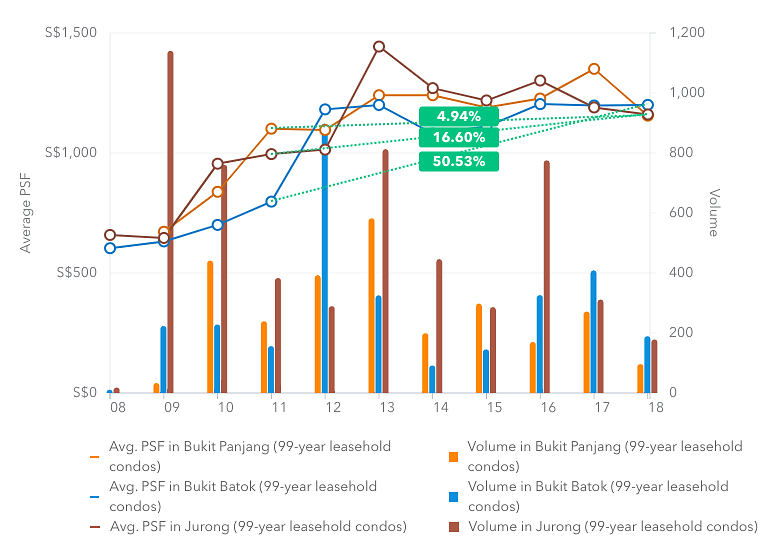
With a few different districts in the West, how did private property in Bukit Batok fare in comparison with its neighbours?
To answer this question, we did a comparative study examining data patterns of 99-year leasehold condominiums in three different neighbourhoods – namely Bukit Batok (in blue), Bukit Panjang (in orange) and Jurong (in brown – inclusive of both Jurong West and Jurong East).
To further refine our search, we only looked at the per square foot pricing of 99-year leasehold condominiums that had received their temporary occupation permit after year 2000. In addition, we zoomed in on psf data from 2011 to the third quarter of 2018.
We found that 99-year leasehold condominiums in Bukit Batok performed remarkably well – appreciating by 50.53 per cent across an eight-year period. The same property segment in Jurong registered gains of 16.6 per cent while its Bukit Panjang counterparts increased only slightly by 4.94 per cent.
If one is looking at buy a home or investment property in the West, private homes in Bukit Batok certainly warrant a closer look. Robust gains have been made by 99-year leasehold condominiums in just under a decade.
Artist’s impression of Jurong Lake District. (Image: Facebook/Lawrence Wong)
THE STRATEGIC POSITIONING OF BUKIT BATOK When the 360-ha Jurong Lake District is complete, it is expected to be home to about 20,000 residential properties and support 175,000 jobs, according to projections shared by the Urban Redevelopment Agency.
In the long run, areas in the Jurong Lake District are expected to register an increase in both property and population buildup. While a boost in infrastructure is in the works, it will not be surprising for congestion issues to crop up.
For homebuyers and investors looking to be part of the Jurong Lake District action but do not fancy being in the thick of things, Bukit Batok is a good alternative to consider. Being a 10-minute drive away from the Jurong Lake District, residents in Bukit Batok have the twin benefit of quick access to the second CBD, while coming home to a green and tranquil neighbourhood.
For families that call Bukit Batok home, there is no shortage of schools in the area. Primary and Secondary schools in the area include Princess Elizabeth Primary School, Bukit View Primary School, Swiss Cottage Secondary School, and Bukit Batok Secondary School. Located in close proximity to Le Quest, Dulwich College – a British international school – adds diversity to the educational options and the demographics of residents in Bukit Batok.
A well-rounded lifestyle, potential for capital appreciation and proximity to the upcoming Jurong Lake District are just some of the reasons why property buyers choose to make Bukit Batok their home.
SINGAPORE: It was in a shed behind their kampung house in Changi where the Lim family first made fish balls by hand – scraping, seasoning, mixing and moulding yellow-tail fishinto balls well into the night.
Patriarch Lim Boon Chay got into this trade out of necessity; as a provision shop owner in the 1970s, fish balls were among his best-selling items, but the quality and supply provided to him were inconsistent.
One of his customers recommended that he make his own fish balls, generously shared a recipe and taught him how to do it.
Mr Lim’s eldest daughter Novelle, who was a toddler then, recalled spending many hours playing at the shed, watching her parents and grandparents at work, and then helping out during the holidays when she was in primary school.
They even operated stalls at a wet market during the peak Chinese New Year period, when she would pitch in overnight.
That was how the DoDo brand of fish balls started, growing to a 150,000-square-foot factory in Senoko Way – and another in Malaysia.
The factory in Senoko Way.
Today, with a workforce of 500, the two factories process over 15 tonnes of fish meat daily and more than 60 varieties of fish-based foods, such as yong tau foo products, for Singapore and some 20 overseas markets.
But all this would not have happened if Mr Lim did not have the foresight to venture into automation early on.
“If we’d continued to make fish balls by hand, we wouldn’t have been able to grow the business because there’d be a limitation on the production volume,” said Ms Lim, the deputy CEO of Thong Siek Global, which also distributes the DoDo fish balls and other products.
The family’s big break came in the 1980s, when they had to move from their kampung house to a public flat, forcing them to upgrade their fish-ball-making shed to a proper factory. But operations were still labour-intensive.
It was during this time that Mr Lim travelled to Osaka, Japan on a study trip, and learned that fish balls could be frozen and were found in many forms and flavours there.
“When he came back, he said, ‘Oh, this business can grow very big. It can grow beyond Singapore.’ And that’s when he started to look at exporting our products,” recalled his 42-year-old daughter.
Ms Novelle Lim.
He decided to automate processes to increase the output, and introduced the concept of vacuum-packed fish balls, which gave the product a four-week shelf life.
“I think, in the 1990s, we were the first company to sell fish balls in the supermarket,” Ms Lim said proudly.
After adopting the Japanese way of production, they were able to increase their output from three tonnes a year in the 1970s to more than six tonnes in 1984 to nearly 5,500 tonnes of all products today.
Their fully automated lines now include grinding, processing and auto-packaging facilities.
When they first ventured into mass production, however, their challenge was to maintain the taste and quality of their fish balls. They had to design processes to suit their recipes.
To start off, they decided to use raw materials from Japan. “We knew there was already processed fish meat that we could use. It was consistent in quality and there was no fish odour, as compared to handmade,” she said.
The fish paste, or surimi, from Japan is composed mainly of fish. Now, they import surimi from many countries, such as Vietnam, Thailand and Indonesia.
“They wash away all the blood of the fish … the water-soluble protein, and what’s left are the proteins that are good for making fish balls,” Ms Lim said, adding that the taste is no different from their handmade fish balls.
HAND-SHAPED MACHINERY
The family also invested in equipment from Japan to blend the seasoned paste (it contains yellow-tail fish fillet) based on their recipe.
The paste goes along an automated line, where a machine moulds it in the shape of a fish ball, which then passes through a metal detector, is cooked, vacuum-packed and frozen before it is distributed locally or overseas.
For the fresh fish balls, there is a “hand-shaped” machine to mimic the irregular texture of real handmade fish balls.
Mr Lim is so particular about their quality of the products that there is even a machine called a texture analyser. It mimics the human biting action, testing the hardness and flexibility of the fish ball from the production line.
One of the staff also samples and grades the fish ball. “It should be springy and firm,” said one of the quality control supervisors.
The paste is regularly sent to the research and development team to test its quality before it is made into fish balls.
Although automation has taken over the operations, some processes are still too delicate to be done by machinery and are largely done by hand, such as the cutting of yong tau foo and inserting the fish paste.
Apart from supermarket chains, some of the company’s clients include stall owners, who find it difficult to hire manpower to make the yong tau foo items from scratch.
“It’s really tiring. They’d have to get up very early in the morning, like 3am or 4am,” said Ms Lim.
“(Many) stall owners don’t do the fish balls from scratch any more. Some of them buy the yellow-tail fillet from us (or) the ready-made paste … They’d just need to form them into shapes – into the fish balls – at their stalls.”
She has become so familiar with the products, especially the yong tau foo, that when she patronises a stall, she can recognise the taste of the paste if it is from DoDo.
IS HANDMADE BETTER THAN FACTORY-MADE?
When asked if there is value in still making fish balls by hand, Ms Lim said it does “touch people’s hearts”.
“People think it’s different, although the taste and texture are the same as what we produce in the factory. It’s the sentimental value, I think,” she added.
She disagreed that traditional fish balls are necessarily better than factory-made ones. Her factory, she maintained, produces good fish balls, similar to what some hawkers make on their own.
To produce its fresh local fish balls, the factory uses yellow-tail fish from Indonesia, which the supplier fillets and freezes before exporting.
“The process is the same with the hand-scraped ones. We’d blend them, form them into shapes, and the difference is we won’t cook it, so that our consumers would buy the fresh fish balls to cook back home,” she said.
“The key to the taste is the raw materials we use.”
To her, making fish balls is not only a business, but also a passion, having grown up with the product. “I’ve seen it evolving from a backyard business to automation, from the Singapore market to the overseas market,” she said.
“So I’ve this mission to grow this business and bring this product to the world.”
SINGAPORE: Joseph Schooling broke two national records as Singapore won two medals at the FINA Swimming World Cup on Saturday (Nov 17).
Schooling set a new national record after clinching the bronze medal in the Men’s 50m Butterfly with a time of 22.40s, losing out only to Russia’s Vladimir Morozov and US’ Michael Andrew, who came in first and second respectively with a time 22.17s and 22.32s.
Singapore’s Joseph Schooling swims during the Men’s 50m Butterfly at at the FINA Swimming World Cup on Nov 17, 2018. (Photo: Singapore Swimming Association/Simone Castrovillari)
However the 23-year-old was not done yet and later on Saturday, Team Singapore – consisting of Schooling, Roanne Ho, Teong Tzen Wei and Amanda Lim – won the silver medal in the 4x50m Mixed Medley Relay with a time of 1:42.21s.
During the his leg, Schooling broke yet another record, this time in the 50m backstroke – a stroke he is not commonly known for – with a time of 24.08s.
“I’m very happy. And a new national record in backstroke, I don’t know what to say. I mean, it’s a new position. So I’m enjoying it,” said Schooling.
Australia came in first with a time of 1:39.79s while Hong Kong took the third sport at 1:43.30s.
SINGAPORE: A new mobile app designed for residents in the MacPherson estate was launched on Saturday (Nov 17), with functions that connect users to digital doctors and volunteers.
Called MacPherson Cares, the app was unveiled at the constituency’s 50th anniversary celebration.
The app is available in four languages and a big font size – useful features for the mature estate, where one in three residents are above the age of 60. The app also features icons, illustrations and pictorial guides.
Among the functions include a telemedicine service that enables residents to have video conferencing consults with doctors, and medication to be delivered to their homes.
The MacPherson Cares app features icons, illustrations and pictorial guides.
The app also allows users to request for volunteers to carry out tasks such as buying of meals.
“What we hope to achieve is that our residents, especially our seniors, are comfortable with this digital solutions,” said Ms Tin Pei Ling, Member of Parliament for MacPherson SMC.
“At the end of the day, we don’t want the digital solutions or the apps to become the reason that separates them from the community or separate them from the most important thing that will be in their interest,” she added.
THAILAND and SINGAPORE: Because of its taste and texture, it is the key ingredient in the old favourite among Singaporeans, chicken rice. Hom Mali – or fragrant Thai jasmine rice – is also preferred by local Chinese restaurants.
It is one of Thailand’s premium exports, and the World Rice Conference has named it the world’s best rice five times since 2009. But that quality, for the most important staple in Asia, has come at an increasingly higher price.
For hawker Wong Teck Tham, the cost of the rice had increased by more than 10 per cent over the past five years, to about S$100 for every 50 kilogrammes.
He was shocked, however, when it then increased to S$108 around the middle of this year. “I’ve never used rice that’s so expensive,” he said.
Premium quality, at an increasingly higher price.
But the hike has been far steeper for local rice importers: Up by 58 per cent since last year, according to the Singapore General Rice Importers Association.
And with the price of Thai jasmine rice now at its highest in a decade owing to a supply shortage, they will have to remain on the alert for more hikes, as the series For Food’s Sake discovers. (Watch the episode here.)
HARVESTED ONCE A YEAR
Singapore imports more rice from Thailand than from any other country. And the kingdom’s north-eastern province of Ubon Ratchathani is one of the main areas for growing Thai jasmine rice, which can thrive because of the soil and climate there.
Ubon Ratchathani.
But unlike other types of rice that farmers elsewhere can produce up to five times a year, Thai jasmine rice is harvested only once a year. And a delicate balance is involved.
“We need water to run into the fields to a depth of 15 centimetres,” said farmer Vichai Pimpam.
“If it rises any higher than that, it isn’t good because the rice stalks won’t grow straight, and the wind would blow it over easily.
Herein lies a major issue. Owing to insufficient public funding, the irrigation system is lacking in the province. So a successful harvest depends on the whims of the weather.
Mr Vichai Pimpam now gets about 17 baht (S$0.71) per kilogramme of rice – just enough for his family’s survival.
And extreme weather has not been uncommon in recent years. In 2016, Thailand experienced its worst drought in decades, and Ubon Ratchathani was one of the provinces that suffered the most.
The supply of Hom Mali rice from the harvest at the end of last year was also quite low, said Thai rice exporter Khajornkiat Sa-Nguankulchai.
Factors such as the dry weather as well as floods caused the shortage, which in turn caused the price to increase, added Mr Chokchai Lorattanakul, the managing director of Ubonsangcharoen Rungruang Rice Mill.
He does not expect rice production this season to be better. And there has already been good demand this year, domestically and internationally, for the stocks that Thailand has, noted Mr Khajornkiat.
Rice being loaded for export.
RICE SCHEME GONE SOUR
But the weather has not been the only notable factor. A rice-pledging scheme from 2011 to 2013 under the previous government – headed by former Prime Minister Yingluck Shinawatra – has also been costly.
The programme encouraged farmers to grow as much rice as possible and bought the crop from them at 50 per cent higher than the market price. The supply was then stockpiled to create an artificial shortage to jack up prices.
While the policy proved popular in the rural areas, the government could not sell the rice at prices covering the purchase cost, administration and storage. And a political scandal erupted.
Thailand’s ex-PM Yingluck Shinawatra was sentenced to five years in prison last year for failing to stop graft in a rice programme AFP/LILLIAN SUWANRUMPHA
Eventually the funds dried up, leaving hundreds of thousands of farmers unpaid and millions of tonnes of rice rotting in warehouses.
The cost to the country? An estimated 640 billion baht (S$26.7 billion), said Thailand Development Research Institute distinguished fellow Nipon Poapongsakorn, an expert on the Thai rice industry.
After the military government came into power in 2014, it changed tack and encouraged farmers to diversify by growing other crops or stop farming altogether. This has contributed to the shortage of Hom Mali rice.
Farmers have been asked to diversify rather than grow as much rice as they can.
AGEING FARMERS, POVERTY AND DRUGS
Going forward, prices may also continue to rise because young people do not want to become farmers. The income is too low and the risks too high for them, so they are moving to the cities.
This is becoming a serious issue, as the average age of Thai rice farmers is now 51. “In north-eastern Thailand, the agricultural land and labour are declining,” highlighted Knowledge Network Institute of Thailand senior fellow Somporn Isvilanonda.
“At the same time, the remaining workforce is ageing. These factors are affecting the price.”
Dr Somporn Isvilanonda.
Take, for example, 35-year-old Charuwan Chanthop, a daughter of rice farmers from Ubon Ratchathani. She moved to Bangkok when she was 16 and owns an art gallery now.
“My family was poor. We knew nothing but farming. I asked myself, ‘Did I really want to be a farmer?’ Then I decided to leave and move to Bangkok to find a job that can support my family,” she said.
The drugs infesting her province, along one of the trafficking routes in the Mekong region, played a part in that decision.
“My home town has a drugs problem. There are a lot of drug dealers in my village, so (families) want to send the kids away … (to help them) escape from the problem,” she said.
Ms Charuwan Chanthop (facing camera) in her art gallery in Bangkok.
TACKLING THE PROBLEMS
One of the ways to overcome the labour shortage is to use technology. “More farmers are reducing costs by, for example, using machinery to harvest crops, as labour cost is higher during harvest season,” cited Dr Somporn.
In the long run, seed treatment using a coating process can help to prevent shortages caused by diseases, insects and drought or heat.
“This protects the rice in its first 30 days after planting. So just like a little baby … you need to protect it early on,” explained Syngenta head of seed-care (Asia-Pacific) Saad Haroon.
The agrotechnology company’s treated seeds may cost 10 to 30 per cent more than regular seeds, but such technology can pave the way to a brighter future for farmers.
“This leads to approximately 6 to 7 per cent yield improvement,” said Mr Saad. “(The grower) has more rice that’s produced, and he can sell more and get more profit.”
Meanwhile, consumers in Singapore must depend on rice importers to mitigate the impact of the price hikes and sudden shortages. Keeping stockpiles is one way of doing this, as shown by Singapore General Rice Importers Association chairman Michael Hiu.
Even though he is forced to buy rice at a higher price, his stockpile means he is not at the mercy of Thai exporters.
And he has raised his selling price for supermarkets, restaurants and hawkers by only one to two per cent each time, taking a cut in his profit margin.
“They’re still our customers – their survival is equal to our survival,” he explained. “If we raise the price too high, we might lose the customers.”
When asked about the cost of Thai rice going forward, however, he was not optimistic. “Based on current trends and the current (market) situation, we don’t foresee there’ll be a drop in the price,” he said.