SINGAPORE: Fifty diesel hybrid buses will serve commuters from December, said the Land Transport Authority (LTA) on Monday (Nov 26).
They will offer smoother and quieter rides, said LTA, as the electric motor – powered by batteries – reduces exhaust emission and noise generated by the diesel engine.
According to LTA, the batteries are automatically charged by the diesel engine, and when the brakes are applied, the vehicle’s momentum is converted into electricity, making the fleet more environmentally friendly.
The buses will also be fitted with new passenger information display systems.
The display on the outside will show the bus service number, destination and the next three MRT or LRT stations to help commuters plan their bus to train transfers.
The passenger information display system on a diesel hybrid bus. (Photo: LTA)
Inside the bus, commuters will be able to see information on the next four bus stops, MRT and LRT transfer information, as well as current time and indication if the bus has arrived at the stop.
The passenger information display system on a diesel hybrid bus. (Photo: LTA)
There will also be audio announcements of the next bus stop. LTA intends to introduce this on all new buses going forward, starting with these diesel hybrid buses.
Other features of the new buses include a collision warning system as well as an anti-fatigue system which monitors the eye and head movement of drivers, and alerts them through a vibration on their seat if they are tired.
Wheelchair space has also been increased from one to two to cater to parents with prams.
Following consultations with the Singapore Association of the Visually Handicapped, grab poles have been made a brighter, tiffany blue to help the visually challenged.
They will be rolled out progressively from December starting with 10. Bus services which will get the new diesel hybrid vehicles are still being finalised, although one of them is feeder service 272 which operates from Bukit Merah interchange.
“For a start, the diesel hybrid buses will be deployed on both feeder and trunk services to test their operational feasibility, taking into consideration the extent of use of these buses and impact to commuters,” said an LTA spokesperson in response to media queries.
“We will be trialing them as we learn how efficient they are as well as getting feedback from bus operators and commuters as well,” said Senior Parliamentary Secretary for transport Baey Yam Keng on the sidelines of the unveiling by LTA.
“We will also be trialing other technologies because at the end of it, we want to be open to all new things that may come our way in terms of fleet choices because not only do we want it to be cleaner for the environment, we also want commuters as well as operators to have better experiences,” he added.
SINGAPORE: Fifty-one Indian star tortoises, who were rescued from the illegal wildlife trade in Singapore, embarked on a journey back home to India on Monday (Nov 26).
The repatriation exercise was carried out by animal welfare group, Animal Concerns Research and Education Society (ACRES), with support from the Agri-food and Veterinary Authority (AVA), the Indian government and Wildlife SOS in India.
It is ACRES’ largest mass repatriation of rescued animals to date.
“I couldn’t wait for this day to come. It’s been years of efforts that we’ve been putting in – not just to repatriate the tortoises, but also to ensure that they were in good health before we sent them over,” said the group’s deputy chief executive Anbarasi Boopal.
ACRES founder and chief executive Louis Ng and deputy chief executive Kalai Vanan load tortoises for repatriation. (Photo: ACRES)
ACRES had been caring for the animals for eight years, while repatriation plans had been in the pipeline for more than two years.
The group added that the repatriation was a landmark event for India and Singapore and demonstrates their “strong commitment” to ending the illegal wildlife trade.
The tortoises will take a four-and-a-half-hour flight to Bangalore, India, after which, they will be quarantined for a month in a protected area in Karnataka state.
“Ben” the Indian star tortoise has a snack before the repatriation. (Photo: ACRES)
They will then be released into the wild, but have been microchipped to allow experts to continue monitoring them.
However, executing the project was no mean feat. Apart from logistical issues, the group said financing the project was a huge hurdle, as it required up to S$60,000.
In fact, the groups’ fundraising target was only achieved on Sunday, one night before the exercise was set to happen, according to Ms Boopal.
Indian star tortoise “Pappadum”. (Photo: ACRES)
The bulk of this sum came from donations – such as the S$15,000 it raised on a crowdfunding platform.
“Even though the number of tortoises we are sending back is just the tip of the iceberg of illegal wildlife trade, we are thrilled that this has been made possible, thanks to support from the agencies and from individuals who have donated,” she said.
Indian star tortoises being loaded before the repatriation. (Photo: ACRES)
Ms Boopal added that the public can also do its part to root out illegal wildlife trade in Singapore by being the group’s “eyes and ears on the ground”.
She encouraged people to report any illegal wildlife trading activities that they may encounter online or offline.
The star tortoise is among the five most common types of illegal wildlife seized by AVA, along with hedgehogs, ball pythons, sugar gliders and leopard geckos.
Indian star tortoises “Bingo” (left) and “Rattle” in their respective compartments before the repatriation. (Photo: ACRES)
SINGAPORE: Water treatment firm Hyflux has been granted a four-and-a-half month extension to its debt moratorium until Apr 30, 2019.
The embattled company’s six-month moratorium, which grants it a reprieve from creditors, was originally set to expire on Dec 18.
In a court hearing on Monday (Nov 26), Hyflux’s legal advisors from WongPartnership said the firm will spend the next one to two months discussing terms of the scheme of arrangement with different groups of creditors.
The discussions will allow Hyflux to gather enough input to formulate the terms of the scheme and then, apply to the court for leave to convene a meeting.
Hyflux said it will make an announcement on the Singapore Exchange (SGX) once the formal proposal for the scheme of arrangement is finalised. It will also prepare an application to be submitted to the court for leave to convene creditor meetings for considering, and potentially adopting the scheme of arrangement.
This comes as Hyflux secured a white knight in the form of a consortium made up by Indonesia’s Salim Group and Medco Group (SM Investments), which has offered a S$400 million equity injection for a 60 per cent stake in the firm once it has paid off all its debts.
The consortium is also granting Hyflux loans to help finance it through the restructuring.
During the two hour long hearing on Monday, WongPartnership lawyers said Hyflux has until Apr 30 to get creditors on board with its restructuring proposal, failing which, SM Investments can walk away from the restructuring agreement that was signed.
NUS Business School associate professor Lawrence Loh said the latest developments make it crystal clear what Hyflux needs to direct all of its focus on.
“The main concern for Hyflux is to get the understanding and accommodation of the creditors. Obviously, a scheme is still a scheme, the creditors will still have to be agreeable before the scheme can go on. It’s the main hurdle for them to clear, even before they can actually get the investors to be involved.”
“At this point in time, Hyflux is not in a situation where it is spoilt for choices. They actually have to make do with what is best and available on the table, day by day, month by month.”
He also said it is understandable should the creditors continue to raise any concerns or objections during this process.
“Obviously if you look at it from the creditors point of view, they have to protect their interests and uphold the objective of getting their money back. Given the situation now, the waters will be very stormy and it’s expected that the creditors will push to the maximum limit for what they can actually squeeze out of these circumstances.”
NOT YET READY FOR FINALISED RESTRUCTURING PROPOSAL
In a filing to the SGX on Friday, Hyflux said it is still working towards putting together the terms of a scheme of arrangement involving creditors.
According to the statement, Hyflux also dismissed recent media articles claiming the purported details of a restructuring plan shared with its senior unsecured financial creditors as “mere speculation”.
(Photo: Jeremy Long)
“The company and its advisers will engage with various stakeholder groups to obtain their views on the intended scheme of arrangement to be proposed to creditors, and this process is currently underway and expected to continue over at least the next one to two months and will progressively extend to the various stakeholder groups.” Hyflux said.
The firm said that it will need to from time to time, sound out the various stakeholders involved to try and understand which options and permutations may be viable.
But for now, the company is not in a position to put forward a “finalised and definitive restructuring proposal”.
Meanwhile, Hyflux had received on Nov 8 a second deadline extension till Nov 29, from its largest secured lender Maybank to find a buyer and sign a binding agreement for its Tuaspring Integrated Water and Power Plant.
Hyflux was first originally given until Oct 15 to find a buyer for the Tuaspring plant. It later asked for a two-week extension until Oct 29 and received an in-principle approval from Maybank.
SINGAPORE: A total of 7,500 cartons of duty-unpaid cigarettes were seized by officers from the Immigration and Checkpoint Authority (ICA) at Tuas checkpoint on Friday (Nov 23).
A Malaysia-registered lorry which was entering Singapore at about 5am was directed for further checks by an ICA officer, the authority said in a news release on Monday.
The officer had noticed anomalies in the scanned images of the lorry which was conveying a consignment declared to be oatmeal, the release added.
“During the course of checks, ICA officers uncovered 7,500 cartons of duty-unpaid cigarettes concealed among the consignment,” ICA said.
The driver of the lorry was a 38-year-old Malaysian man.
A total of 7,500 cartons of duty-unpaid cigarettes were seized. (Photo: ICA)
The total duty and Goods and Services Tax evaded amounted to about S$640,500 and S$46,950 respectively.
The case has been referred to Singapore Customs for further investigation. The vehicle used in the commission of such offences is liable to be forfeited, the authority added.
SINGAPORE: Back when I was an undergraduate student in the United States, I interned at the University’s Career Placement Centre by assisting students in their job search.
Once, I caught the flu bug, but being the ever-industrious Singaporean, I took some medicine and turned up at work.
Unfortunately, the sight of me blowing my nose twice in the space of three minutes convinced the manager to send me home. My appeals to remain at work were but to no avail.
The manager then donned a face mask and sprayed down the entire office meticulously with anti-virus spray, as if I was patient zero for a viral epidemic. She then chided me for coming to work, risking the spread of the flu in the office. I left feeling rather amused at the whole incident.
These days, I am less amused.
Most of us are aware of the practice of absenteeism, where one is intentionally absent from work. However, what happens when someone turns up at work despite being ill? Professor Cary Cooper at Lancaster University identified this type of behaviour as “presenteeism”.
PRESENTEEISM IS EXPENSIVE
Presenteeism is more damaging to the economy than absenteeism and can cost billions annually in productivity loss.
A widely cited 2004 American Productivity Audit-Stewart survey found that the United States sees productivity loss attributed to presenteeism of US$150 billion (S$206 billion) each year.
In the United Kingdom, the Centre for Mental Health calculated that presenteeism from mental ill health alone costs the UK economy £15.1 billion (S$27 billion) each year. Most recently, a 2016 report by Pathology Awareness Australia found presenteeism cost the Australian economy more than A$34 billion per year (S$33.5 billion).
The organisational cost aside, presenteeism may actually lead to poorer personal health.
A British medical study on civil servants compared those who took no medical leave despite their illness with those who took some medical leave when they were ill.
Ill civil servants who did not take any medical leave were two times more likely to suffer a serious coronary event. It seems working while ill may cause psychological burden and stress to accumulate, which can lead to a heart attack. Other studies show individuals take longer to recover and may affect future physical and mental health.
Why does presenteeism cost so much? The high cost of presenteeism may be attributed to surprisingly minor ailments such as throat conditions, fever, headaches, flu and cough, according to researcher Hesan Quazi.
However, the impact of working in spite of these ailments lead to poorer work quality, teamwork and lower concentration. These contribute to a reduced output per hour worked and ultimately add up to billions of dollars in lost productivity.
Strange as it might sound, by turning up sick at work to display how hardworking you are, you actually cause your company to lose more money than if you had stayed home.
Those who do may lose concentration more easily, take longer to process instructions or waste precious time undoing errors.
For jobs that require precision and attention to detail, such lapses may result in monetary losses or even risk to human lives.
Some illnesses may also be contagious – whether because of the easy transmission of airborne diseases or the spread of viruses and bacteria through commonly used items such as door handles or the buttons on an elevator and the photocopier machine. This in turn causes other colleagues to be sick.
IRON MAN MENTALITY
The underlying assumption to presenteeism is that people treat their work seriously and are insecure about losing their job. Quazi proposed a host of reasons as to why presenteeism persists.
For those paid on a per-project or per-hour basis, some turn up to work sick for the extra salary.
Sometimes, employees face deadlines closing on them. They might feel they have little choice but to put up with the illness and work towards the deadline.
Others believe in the need to be visible to their superiors and display commitment to work despite being ill. These employees seek to project the image that they are hard workers and team players. There is also the fear that absence from work for even a day would present a rival colleague with the opportunity to shine.
On a more egotistical note, individuals may exhibit the “Iron Man Mentality” – where one believes missing work is not acceptable and is a sign of weakness – or subscribe to the “Indispensible Man Theory”, where the highly committed believe the organisation cannot function without their presence.
From Ironman the movie.
MINDSET CHANGE IS NEEDED
Changing mindsets in presenteeism is an uphill battle. The employer might feel that the absent employee is a liability to the business. The employee in turn responds to such concerns by practising presenteeism.
Some Singaporean businesses are taking steps to tackle this issue. For example, local company, Concorde Security, a provider of Security Officers, has to ensure that all staff turn up for work in a timely manner at their respective locations.
Failure to provide the stipulated number of guards would result in stiff penalties. Yet, guards who turn up for work ill may not be in an ideal position to do their job well, compromising on the safety and security of people and facilities.
So Executive Director Alan Chua taps on technology to assist his staff. He utilises multiple devices, sensors and visual recognition software, empowering security specialists in a mobile command post to respond to incidents.
If the security specialist is taken ill and is not able to carry out their duties, colleagues can use these technologies to seamlessly cover their duties without compromise to operational security.
Employers must acknowledge that presenteeism is a problem that affects their bottom line. To reverse this culture, it must first start from the top.
The enlightened leader should focus on the delivery of results and re-designing jobs rather than value face time. Promoting healthy eating and an active lifestyle among employees will not hurt either.
File photo of fruits and vegetables. (Photo: AFP/Tobias Schwarz)
Once leaders set the tone for a mindset change, they pave the way for the exploration of viable alternatives to support employees.
Organisations might, for instance, explore the use of video conferencing to allow sick employees to be present at an important meeting. The employee joins in for the duration of the meeting remotely and then subsequently recuperates at home.
Other organisations have also encouraged the use of Statement of Medical Fitness or Fit Notes. Rather than getting doctors to write Medical Certificates, some doctors state what work the ill individual is suitable for or what work they should be exempt.
Those who have been through National Service would be familiar with the medical officer’s prescription of “Attend B” or “Attend C” to respectively denote a person’s fitness for light duties and complete rest.
For presenteeism, the buck must stop with organisational leaders. Seeing everyone present at work might give false confidence when an ill employee cannot contribute effectively.
Ultimately, we all become poorer financially and physically if we miss the forest for the trees.
Dr Paul Lim is a Lecturer of Organisational Behaviour and Human Resources with the Lee Kong Chian School of Business at the Singapore Management University. His research focuses on the areas of Millennials, Mentoring and Resilience.
SINGAPORE: A 29-year-old young working professional visited our clinic complaining of difficulty with urinating.
She had trouble starting and often felt that she could not complete voiding. She also had a slow flow.
After some questions, we found out she also had a habit of holding back peeing due to work commitments. She went to the toilet only twice a day and drank very little fluids.
After a series of tests, we found she had what is known as voiding dysfunction, where there is poor coordination between the bladder muscle and the urethra because of a weakening of bladder muscles. This weakening is generally irreversible.
Even with medication, she had to re-learn relaxing her pelvic floor muscles with pelvic floor exercises taught by physiotherapists or specialist nurses.
The only silver lining is her condition thankfully had not affected her kidneys though she needed to be monitored closely for the long term.
HOLDING IN YOUR PEE IS ALRIGHT?
You may have read some news reports suggesting that it is alright to hold your urine. Unless medically advised by urologists, doing so is not suitable for everyone and other urological conditions have to be ruled out first.
The National University Hospital (NUH) Urology Centre sees a good number of patients with overactive bladders and bladder retraining is actually one conservative, non-invasive treatments. This involves holding back urinating for slightly longer intervals after the urge to begin until one’s bladder capacity improves and the patient develops a better controlled urination schedule.
(Photo: Unsplash)
In fact, holding in your pee is a form of treatment for overactive bladders. For stress incontinence which is more common in females, pelvic floor exercise is usually the prescribed treatment. When prescribed by urologists, these forms of holding urine are safe for healthy people.
NOT FOR THOSE WITH DIABETES, SPINAL CORD ISSUES OR PELVIC SURGERY
However, holding back urination might come with risks for some groups of people – including those with primary neurological conditions, spinal cord injuries, spinal cord congenital conditions, or stroke, as well as those who have had pelvic surgeries or diabetes.
They may drink normal amounts of fluids but have a poor sense of how much water is in their bladder and use the toilet infrequently. Holding back urine can increase their risk of urinary tract infections, developing dysfunctional voiding or kidney disorders.
They have to be monitored carefully for urological complications. In a worst case scenario, they may require a catheter.
NOT FOR THOSE WITH PROBLEMS WITH PEEING
Sometimes people also experience problems with peeing – nothing comes out despite feeling an urge to use the bathroom. This usually happens to young, otherwise healthy, females. Many of these patients we have seen have the habit of holding back urination because of work or because they fear public washrooms may be dirty.
They may also have poor fluid intake and constipation. Some experience a very slow stream. Many only seek medical attention when they have urinary tract infections. Contrary to intuition, we would advise patients like these to drink more water and urinate more frequently.
File picture of tap water. (Photo: AFP/VOISHMEL)
Physiotherapy may also be recommended so that they learn to relax their pelvic floor.
Lastly, patients who have recurrent urinary tract infections should not hold back urination if they experience a strong urge to go to the bathroom after drinking fluids because this may cause another infection if there is stagnant urine in their bladder.
During an acute urinary infection, they should consume more water and urinate when they have a strong urge to, after seeing a doctor and being treated with antibiotics. After recovery, they should keep up with the good work of consuming more water (ranging from 1.5 to 3 litres, depending on body weight) and practise urinating regularly.
A normal, healthy person can hold their pee for about two to three hours, depending on fluid consumption, but anything longer might be problematic.
Anyone with these symptoms and those with difficulties peeing should seek help from their family doctors or see a urologist. We often advise patients to be wary about applying widely dispensed medical advice as diagnoses can vary from patient to patient.
Sticking to one without fully appreciating how their medical history might affect them in a unique way might not be the best idea.
All patients have their own conditions and stories and we cannot have a one-advice-fits all model to healthcare. It is best to consult a specialist and get a tailored plan if you have problems in the bathroom.
Dr Fiona Wu is an associate consultant from the Department of Urology at National University Hospital.
SINGAPORE: It was not too long ago that Facebook was a politician’s best friend.
As the social media platform started taking off in Singapore about a decade ago, politicians — from across the political spectrum — rushed to get onboard, setting up their Facebook accounts, posting comments and pictures, and engaging fellow users.
At that time, it seemed as though Facebook could do no wrong, and politicians saw it as a godsend — an ideal platform not only to communicate their messages, but also to gather feedback and gauge public sentiments.
Of late, however, Facebook has come under scrutiny around the world, as news emerge of how the social media giant inflated its metrics, tried to cover up data breaches, as well as allowed itself to be used as a conduit for spreading mis- and disinformation.
Earlier this week, Facebook also admitted to hiring a Washington-based lobbying company that pushed negative stories about Facebook’s critics, including philanthropist George Soros.
Singapore’s leaders, in particular, have repeatedly stressed the need for new laws to make the company accountable, pointing out that Facebook cannot be relied upon to protect users from online falsehoods.
It was recently reported that parliaments in eight countries — including Singapore, Australia, the United Kingdom, Brazil and Latvia — had issued separate requests for Facebook founder Mark Zuckerberg to respond to them on the platform’s negative impact.
Speaker of Parliament Tan Chuan-Jin, who is active on Facebook, stressed that MPs do not rely solely on the social media platform as part of their outreach. (Photo: AFP/Kirill Kudryavtsev)
Against this backdrop, some observers here are calling on the Government and Members of Parliament (MPs) to reduce their reliance on Facebook, especially as a platform for garnering feedback and assessing how the public feels about certain initiatives and policies.
After all, how much of the feedback or sentiment is genuine? Or could it be part of a nefarious campaign designed to sway public opinion?
Speaker of Parliament Tan Chuan-Jin, who is active on Facebook, stressed that MPs do not rely solely on the social media platform as part of their outreach. “If you’re using one platform to gauge support, you are seriously misguided,” said Mr Tan, who is an MP in Marine Parade GRC.
Other People’s Action Party (PAP) MPs interviewed by TODAY agreed that there are limits to the efficacy of Facebook, and they are tapping the platform with their eyes wide open. Workers’ Party MPs could not be reached for comments on this report.
Still, given that Facebook is susceptible to manipulation, media industry veteran Viswa Sadasivan said it is important for the Singapore Government to “maintain a healthy distance” from the company.
“It would be awkward, if not unwieldy, if the Government sees the need to take action against Facebook when the Prime Minister and leading political leaders appear beholden to it as their key online communication platform,” said Mr Viswa, a former Nominated MP who is the chief executive of strategic and crisis communications consultancy Strategic Moves.
He had previously served as the Chairman of the Political Development Feedback Group of Singapore’s Feedback Unit, which is now known as Reach.
FACEBOOK AND POLITICS: A LOVE-HATE RELATIONSHIP
Back in 2008, there was a rush among ministers and MPs alike to boost their online presence. Mr Teo Ser Luck, who was a senior parliamentary secretary at the then-Ministry of Community Development, Youth and Sports, said that he used Facebook to gauge public support for Singapore’s bid to host the Youth Olympics Games in 2010.
“If translated into a political strategy, Facebook could be a powerful tool,” Mr Teo said at the time. Mr Teo stepped down from political office last year and is now a Pasir Ris-Punggol GRC MP.
Several other ministers and MPs had also spoken on the need to engage the online community to get a feel of the public’s views and opinions on issues and policies. If not, they would be seen as being out of touch.
The Singapore politician seen as the most adept at using Facebook is Prime Minister Lee Hsien Loong himself.
Since joining Facebook in 2012, Mr Lee has amassed 1.2 million followers.
When he first launched his Facebook page, Mr Lee said in a welcome note that using the social networking site allowed him to share what he was doing and thinking about.
He also wanted netizens to “help shape ideas and understanding of what we can do together to improve our lives”. And in one status update, he had said that he took netizens’ views “very seriously”.
When Mr Tan set up his Facebook page in 2007, he had used it to connect with family, friends and colleagues, especially “when you’re separated by distance, time and space”.
After he joined politics in 2011, he noted that Facebook was useful — but not vital — for politicians to gather feedback.
Mr Tan, who was formerly Minister for Social and Family Development, said:
“Saying that Facebook is vital is overstating it. One, not everyone is on and active on Facebook. You also have watering holes, where people of similar interests gather in certain groups. There are also echo chambers.”
Expressing a similar sentiment, Bishan-Toa Payoh GRC MP Saktiandi Supaat added: “I always find it hard to gauge sentiments through Facebook because is the sample size sufficient? Are the views skewed towards one side and is this representative of the views of the entire population?”
Ms Sun Xueling, Senior Parliamentary Secretary for the Home Affairs and National Development ministries, said she uses Facebook to send out updates on her grassroots activities.
As an MP of Pasir Ris-Punggol GRC, she also uses the platform to gauge sentiments on proposed initiatives in her ward, such as setting up a study corner or a community garden.
As with all online platforms, Ms Sun said there are vocal individuals who want their feedback to be heard. Though they are important, “it can sometimes take on a disproportionate scale as ‘online echo chambers’ can be formed where like-minded individuals congregate, shutting out other individuals who might not be as proactive online in making their views heard”.
MPs who spoke to TODAY stressed that sentiments online do not, at times, tally with views on the ground, such as during the 2015 General Election (GE).
Following the 2011 polls, which saw the ruling PAP losing a GRC for the first time and garnering its lowest vote share since independence (60.1 per cent), the sentiments on Facebook and other Internet platforms indicated that the party would fare “a lot worse” in the 2015 GE, Mr Tan recalled. “You get that sense online,” he said.
In the end, the PAP won with a vastly improved national vote share of 69.9 per cent — the highest vote share since 2001. The results showed that the “response on the ground was quite different”, Mr Tan noted. “So then you ask yourself whether the sentiments online are truly representative?” he said.
Facebook’s CEO Mark Zuckerberg is seen at the VivaTech (Viva Technology) trade fair in Paris on May 24. (Photo: AFP/GERARD JULIEN)
MULTIPLE SOURCES OF ENGAGEMENT
While Facebook is useful depending on how it is used, the platform is not the “be all or end all” when it comes to engaging the populace, said the MPs. As Mr Tan noted, it is just one reference or contact point among many other platforms that politicians use in combination to get a better sense of the ground.
“To dismiss it would be to lose a platform not just to gather feedback but for politicians to put across our thoughts and perspectives because we cannot go to every event and engage the people,” he said.
Still, “face-to-face interactions of course trump everything else”, he added.
Ms Sun similarly combines the online feedback with house visits and walkabouts around her ward to get a fuller picture.
“So I see for myself the situation on the ground and cross-reference it to what I read online,” she added.
“I also ask the local agencies to stake out at local hotspots where there is a lot of feedback to get real data on the ground to fact-check the feedback we receive online.”
Given that it is evidently easy to manipulate information – including views – on Facebook, how do the MPs decide which comments they should look at?
A useful guide is to look at comments that are thoughtful, said the MPs. Of course, there are instances where there are a few monikers or fake profiles of individuals or groups that seem to appear regularly, said Mr Tan.
They do try to distort information or paint an inaccurate picture of public sentiments. Genuine comments, however, still exist, he noted.
Mr Saktiandi said that even if there are criticisms, they are put across in a “fairly constructive” manner. “If there are useful perspectives – whether positive or criticisms – shared, you take them onboard and you channel them to the different agencies,” he added.
With Facebook embroiled in one scandal after another, are the MPs more cautious of the platform? Not really, they said.
Mr Tan said that Facebook is still an important platform, but relying on it solely “wouldn’t be a wise move” as it does have its shortcomings.
Views on Facebook should be complemented with evidence-based data such as surveys on perspectives about issues or policies, coupled with traditional on-the-ground engagement, he added.
Having evidence-based data “is not being unfeeling or unsympathetic”, noted Mr Tan. It is just one of the touch points to inform policymakers.
“Facebook does not give you an absolute picture of what Singaporeans are thinking or feeling. No single platform can give you that,” he added. “What you need is a collection of tools – house visits, walkabouts, dialogues and social media platforms.”
While these activities may still not offer a full picture of people’s sentiments, “they give you a much better sense of it”.
Responding to TODAY’s queries, a Ministry of Communications and Information (MCI) spokesperson said that it leverages “a myriad of platforms” to engage and gather feedback from different segments of the population on national policies and issues.
“We encourage agencies to embrace digital communications and tap on social media platforms such as Facebook, Twitter and Instagram to augment their public education and outreach efforts,” said the MCI spokesperson.
“On their end, social media platforms are also working with governments and other stakeholders to promote and ensure the responsible use of their services.”
Even as online channels grow in popularity, the MCI spokesperson noted that face to-face engagement will remain a “key component of government communications as they enable a deeper and robust level of interaction that cannot be achieved through online platforms”.
For instance, the Government feedback unit Reach co-organises dialogues with citizen representative groups as well as conduct ground surveys, among others, to gather public feedback and views on various issues, said the spokesperson.
Members of the Select Committee on deliberate online falsehoods: (From left) Mr K Shanmugam, Mr Charles Chong, Dr Janil Puthucheary and Mr Pritam Singh. (Photo: Hanidah Amin)
RISE OF THE “DARK ARTS”
In recent years, state actors have exploited the Facebook platform to undermine both the political process and integrity in countries such as the United States and France.
As far as the Singapore public is concerned, such state-backed activities on Facebook have yet to make their presence felt — at least not on a similar scale — in the Republic’s political sphere.
However, the use of fake accounts to promote certain views on Facebook is prevalent within the commercial sector here.
Ms Cho Pei Lin, managing director of public relations, communications and marketing firm Asia PR Werkz, noted that there had been a growth in social media agencies in the last five years.
In addition, PR and advertising firms have established their own social media departments to cope with rising demand.
Most of the time, both government organisations and private companies engage these agencies to create their social media content.
When clients, often private firms, face criticisms about issues relating to their products or services, these agencies would engage an “army of social media influencers” to “drown out the noise”, said Ms Cho, who has 15 years of experience in her field.
These “micro-influencers”, who typically have under 10,000 or 5,000 followers, would be paid a “token fee” of between S$20 and S$50 per post to portray a company in a positive light or distract the public from the criticisms against it.
“They are not your ‘big influencers’ with hundreds of thousands of followers. They are genuine, ordinary people. Nothing spectacular about them,” said Ms Cho.
Then, there are large companies which activate their own employees, or organisations who use their members, to go out and “right the wrong” or spread the word on their key messages.
Ms Cho said that her company does not execute such plans for clients, but “if the situation requires it, I would not hesitate to recommend it”.
Ms Rachel Ooi, a digital and content marketer, similarly said that she has had clients who request for such tactics to be used. In her previous role at a digital marketing agency, which she declined to name, Ms Ooi was working on promoting an app that allows consumers to buy products and services.
One of the campaign requirements was to create fake personas and start a comment thread with positive comments as well as giving the app high ratings. “That was in the contract with the client,” said Ms Ooi, who added that her agency rejected that requirement in the contract.
Such tactics are not unique to Singapore — they tend to be used by China and Hong Kong-based companies, which she has worked with. Thus far, her work here has been “more commercial and not political in nature”, said Ms Ooi, who has nearly a decade of experience in the field and blogs about digital marketing.
Asked whether such tactics present an ethical dilemma, Ms Ooi responded: “As every marketer would do, you have to present your clients in the best light.”
Mr Daniel Yap, who previously managed a PR and communications firm, said that PR, advertising and social media agencies use the “dark arts” on Facebook, where they create fake accounts and stories as well as buying likes to promote their clients.
“When I did consulting work, it was my job to advise and inform my clients of all the options on the table and to analyse the effectiveness and implications of each option,” said Mr Yap, who has been in the field for over a decade.
“My clients over the last decade have both been targets of fake account attacks as well as users of that tactic.”
A PR professional, who wanted to remain anonymous as she had signed a non-disclosure contract, said that PR firms “generally avoid using fake identities and do not circulate fake news”.
The backlash can be horrendous, she said, as seen from the rapid demise of the United Kingdom-based PR firm Bell Pottinger after it was found to have run a racially charged PR campaign in South Africa that included creating fake Twitter accounts to spread falsehoods.
Increasingly, PR, advertising and social media agencies are also employing “dark social” tactics, where content is shared through private channels such as WhatsApp, WeChat or Lime, where it is “untraceable”, compared to public platforms like Facebook, said Ms Cho.
The aim in sharing the content on these platforms is to change mindsets or counter narratives that may be floating around.
Asked whether government organisations, too, have asked to employ “dark social” tactics, she said:
“Whether they are government agencies or private firms or other organisations, they do not openly declare they do it – to have people drown out the noise. These are practices people want to keep under wraps.”
TOUGH TIMES FOR FACEBOOK
The technology behemoth is today a beleaguered company, fending off one controversy after another.
Its founder and CEO Mark Zuckerberg has been trying to salvage the company’s reputation, including testifying at the US’ Senate commerce and judiciary committees in April this year to explain how Facebook is leveraging artificial intelligence to sort out hate speech, among others.
He also apologised for the mistakes that Facebook had made.
Facebook first came under fire after it was found that Russian agents had used the platform to spread misinformation to influence the United States’ presidential election in 2016.
Next came the revelation that Facebook knew British political consulting firm Cambridge Analytica was illegally accessing the private information of millions of people in 2015, but did not disclose the data breach.
Facebook’s reputation took yet another beating in 2016 after it admitted that it had inflated its metrics showing the amount of time people spent watching videos on the platform. Advertisers who sued the company said they had uncovered evidence that Facebook had been aware of the miscalculated metrics since January 2015.
In a New York Times expose earlier this month, it reported that a year after Facebook discovered dodgy Russia-linked activities on its platform in 2016, the company had yet to contain what the newspaper said was “Russian infestation”.
Last week, Facebook’s ability to spread misinformation — and its inability to stop misinformation from spreading — hit home after the Singapore authorities slammed socio-political website States Times Review for posting an article on Facebook linking PM Lee to the 1Malaysia Development Bhd (1MDB) scandal.
(Image: Facebook/States Times Review)
Describing the article as defamatory, the authorities filed police reports against the website and directed Internet service providers in Singapore to restrict access to the website.
Facebook, however, refused to take down the offending States Times Review post, saying that it will remove inaccurate information circulating on its platform only if it leads to voter suppression, or poses a threat of imminent violence.
The Facebook episode came not long after a 10-member Select Committee here, tasked to study deliberate online falsehoods, recommended that new laws be introduced to hold technology companies accountable for what is being published on their platforms, among other things.
Pointing to the need for such laws, Senior Minister of State for Law Edwin Tong told Parliament this week that Facebook’s lack of action illustrates why the country “cannot rely on the goodwill of such service provider platforms” to protect it from disinformation campaigns.
In its report released in September, the Select Committee also made known its concerns about the armies of bots flooding Facebook. The aim is to distort information and amplify falsehoods in an attempt to create disruption within society, noted the committee which started its work earlier this year.
When asked about the number of fake accounts that it had detected in Singapore, and whether it had taken any action, a Facebook spokesperson told TODAY that it did not have the breakdown of fake accounts removed per country. Only global data was available, added the spokesperson.
Based on its latest Community Standards Enforcement Report, Facebook said it had disabled 800 million fake accounts in the second quarter of this year, an increase from 583 million in the first quarter. It disabled 754 million fake accounts in the third quarter.
The company said that in both the second and third quarters, it had found and flagged 99.6 per cent of those accounts removed even before users reported them.
Saying that “we work hard” to keep fake accounts off the platform, Facebook said it blocks millions of such accounts at the registration stage every day. It has “made recent improvements to recognise these inauthentic accounts more easily by identifying patterns of activity, without assessing account contents themselves”, added the social media giant.
“For example, our systems may detect repeated posting of the same content, or aberrations in the volume of content creation.”
MAINTAINING A “HEALTHY DISTANCE”
For the Government, Facebook is but just one of its engagement tools, several communications and political analysts reiterated.
Associate Professor Alton Chua, from the Wee Kim Wee School of Communication and Information at Nanyang Technological University (NTU), said that even if the Government uses Facebook to pick up any “online buzz, they’ll treat the platform only as the first port of call”.
Dismissing online feedback as “noise” can lead to the accusation that the authorities are out of touch. “To strike a balance, both online and offline approaches need to be used,” said Assoc Prof Chua.
“While remaining plugged in to the social media, they cannot avoid walking the ground, talking to people face-to-face, and experiencing first-hand of what is happening for themselves.”
Assoc Prof Edson Tandoc, from the same school in NTU, noted that social media platforms provide efficient channels for groups to scan the social landscape to have an idea of the range of opinions and sentiments on an issue.
But he cautioned that “it would be a mistake to think that the distribution of such opinions and sentiments online match the actual distribution in the population”.
Professor Lim Sun Sun, who heads Singapore University of Technology and Design’s Humanities, Arts and Social Sciences cluster, said that the online space is not directly representative of the broader population.
That is because online platforms tend to attract those who are younger, educated and more digitally connected. As such, Prof Lim – currently a Nominated Member of Parliament – believes the Government has never used online platforms as the main or the “only yardstick” to gauge sentiments.
“Few governments would be so naïve as to rely on only one source,” said Prof Lim. “I don’t think it (the Government) ignores it but it takes the online feedback as one data point against a broader constellation of views that are gathered through other means.”
Mr Viswa said that for political leaders not to view or use Facebook as a “key source of intelligence on ground sentiment would amount to denying that there is this elephant in the room”.
However, he observed that it has become “almost standard practice for ministers and MPs to post about their engagements on Facebook”, leading him to conclude that there is “excessive reliance” on the platform.
This has had the unintended effect of boosting the platform’s legitimacy and endorsement of its content, Mr Viswa said.
If the Government does not recalibrate its approach on Facebook, it will not only further legitimise online chatter, but could also result in “false positive or negative reading of ground sentiments”.
He felt that the Government needs to invest more in the traditional means of engagement. These include engaging mainstream media and through face-to-face interactions.
“Let us not forget that most Singaporeans still rely on these (channels) for information. Expediency needs to be balanced with accuracy,” he cautioned.
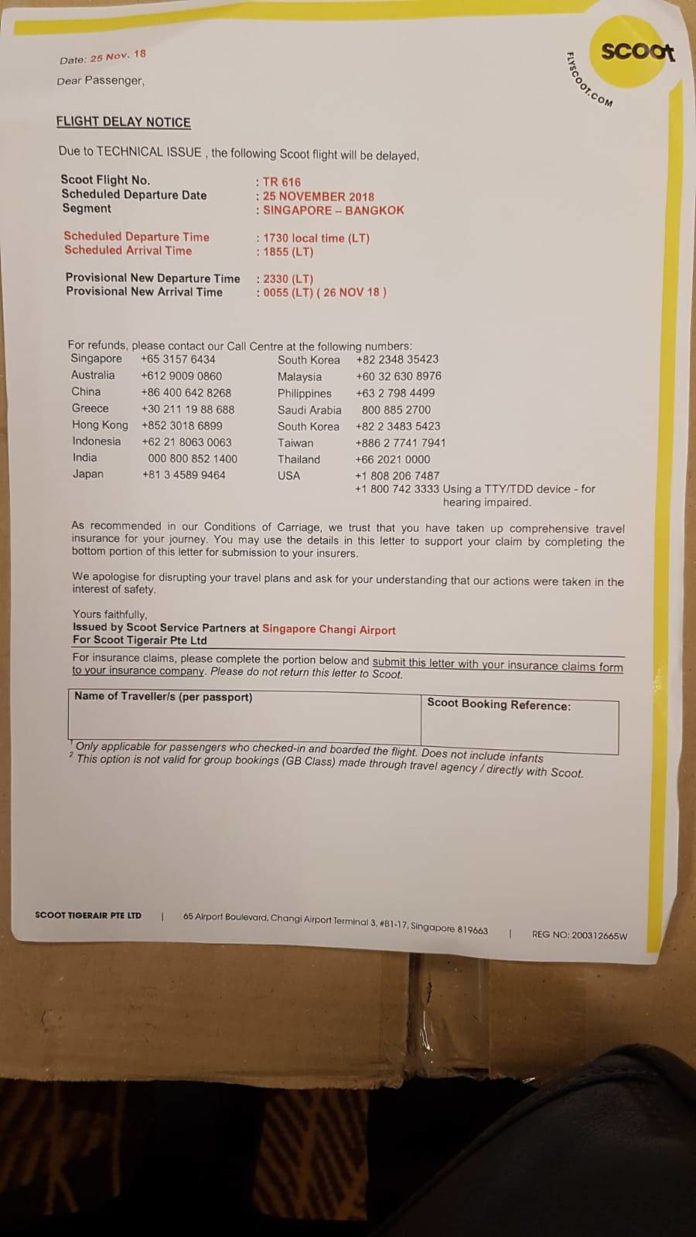
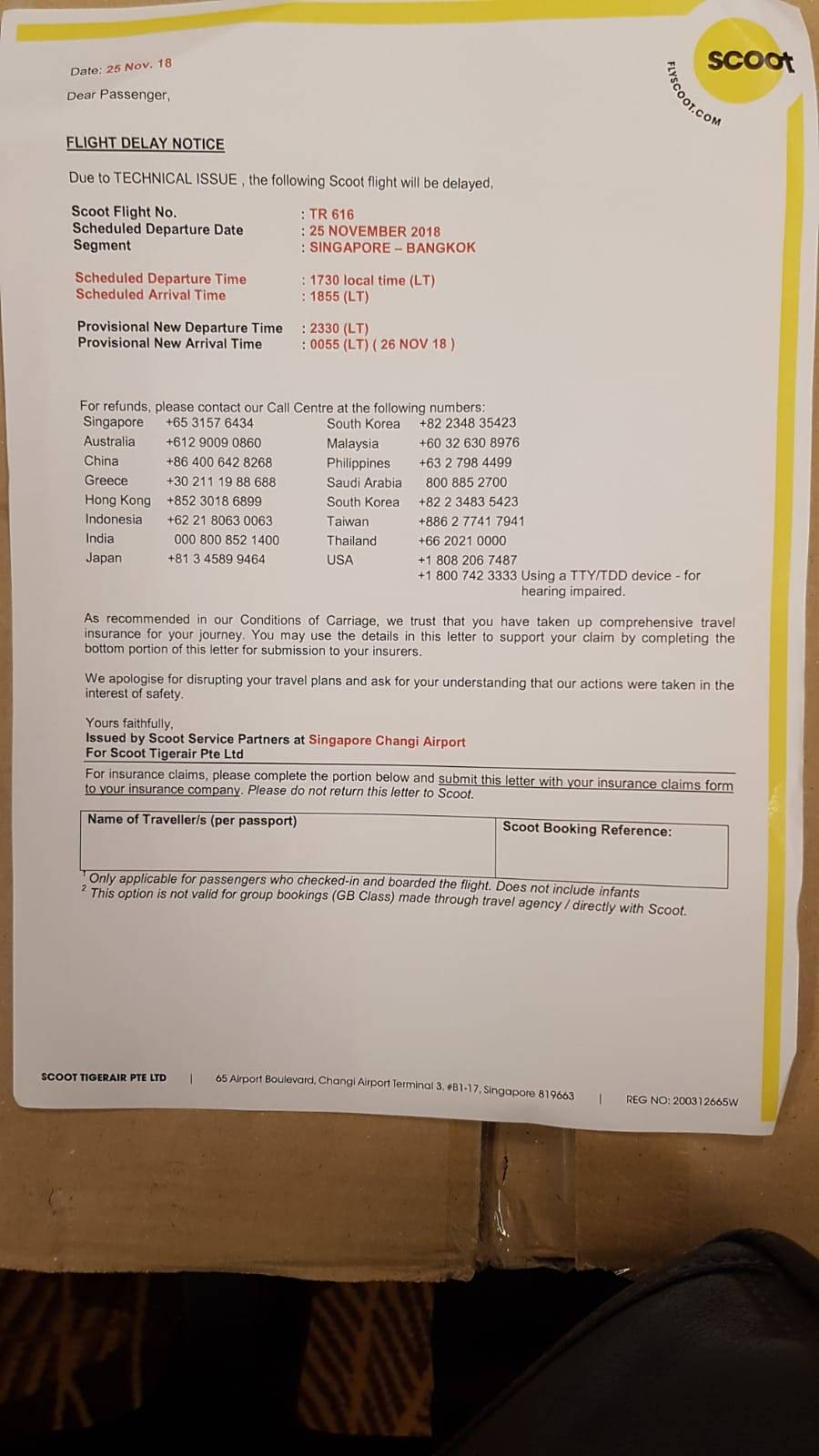
SINGAPORE: Travellers bound for Bangkok on Scoot airlines flight TR616 were stranded for almost seven hours at Changi Airport Terminal 2 on Sunday (Nov 25) after their flight was delayed.
The aircraft was scheduled to depart Singapore at 5.30pm, but eventually left at 12.28am.
In response to Channel NewsAsia’s queries, Scoot said the delay was due to a technical issue with the “aircraft nose gear door”.
“As rectification works took longer than expected, Scoot decided to deploy a replacement aircraft to minimise further disruption to customers’ travel plans,” Scoot said.
The airline said customers were provided with refreshments during the delay. It also apologised for the inconvenience caused to the customers and the disruption to their travel plans.
Mr Kenneth Loo, 51, who was travelling to Bangkok for business, showed Channel NewsAsia video clips of disgruntled passengers at the departure gate, including the elderly, who were demanding explanations from Scoot staff about the delay.
“The flight was supposed to depart at 5.30pm. It’s now 9.56pm and we are still waiting. The situation is chaotic,” said Mr Loo.
Flight notice issued to passengers by Scoot. (Photo: Kenneth Loo)
A man could also be heard in one of the videos sent by Mr Loo, saying: “Give us an option for a different flight! … Put us on a different airline, we don’t need Scoot.”
Another affected passenger, a 56-year-old engineer who did not wish to be named, could be heard in a video sent to Channel NewsAsia, saying: “Look at all the people here. Old people, children, no toilets, no hot water to be able to prepare food for the children.
Snacks and bottled water handed out to passengers of Scoot flight TR616. (Photo: Kenneth Loo)
Snacks and meals were later handed out to passengers, he added.
According to Mr Loo, Scoot issued a notice to passengers at around 11.30pm, explaining that the delay was caused by a “technical issue” and that the new departure time was 11.30pm.
“We apologise for disrupting your travel plans and ask for your understanding that our actions were taken in the interest of safety,” the notice said.
BANGKOK: Singapore crashed out of the AFF Suzuki Cup on Sunday (Nov 25) after losing 3-0 to reigning champions Thailand at the Rajamangala Stadium.
An own goal from Irfan Fandi, a poacher’s finish from Supachai Jaided and a late Adisak Kraisorn strike meant the Thais top Group B on 10 points while the Lions finished third with six.
Heading into the match, Fandi Ahmad’s Singapore side needed a victory to guarantee their place in the semi-finals of the tournament.
The Lions gave the home side an early scare as Ikhsan Fandi’s low shot was pushed away by Thai custodian Chatchai Budprom.
But it was the Thais who broke the deadlock in the 12th minute, as an inswinging cross was scuffed into his own net by Irfan.
Singapore against Thailand in the AFF Suzuki Cup on Sunday (Nov 25). (Photo: Matthew Mohan)
The hosts doubled their lead 11 minutes later as an attempted clearance from Zulqarnaen Suzliman fell kindly to Jaided’s feet and he finished low past Singapore goalkeeper Hassan Sunny.
Singapore came out firing after the break, with the introduction of Faris Ramli providing some added impetus.
Ikhsan almost pulled one back in the 55th minute for the Lions but his curling freekick from just outside the area failed to hit the target.
Fandi threw defender Safuwan Baharudin into attack and his side started to punt the ball long as the Lions tried to find their way back into the match.
But this meant the home side had extra space to exploit and striker Kraisorn duly sealed the Thais’ victory with one minute left.
The loss means it has been six years since the Lions last progressed past the group stages of the tournament.
In the group’s other game, Philippines were held to a goalless draw by already-eliminated Indonesia. Sven Goran Eriksson’s Azkals finished in second behind the Thais.