Home Blog Page 888

YouTube Rewind: CNA Insider’s video makes it into top 10 local videos

0

CNA Insider’s exclusive look into the Singapore women’s prison earned it a spot in the top 10 YouTube videos watched by Singaporeans.

inside women's prison insider thumbnail

Inside the Women’s Prison by CNA Insider made it into the top 10 trending YouTube videos in Singapore. 

SINGAPORE: An exclusive look inside Singapore’s only women’s prison by CNA Insider has made it to the list of top 10 trending YouTube videos of 2018 for Singapore.

The video, titled Inside the Women’s Prison, made it to eighth spot on the list. Channel NewsAsia’s digital features team was given unprecedented access to film life behind bars for inmates at Institution A4, formerly known as Changi Women’s Prison.

The video has 817,000 views as of Thursday (Dec 6) and it marks CNA Insider’s first entry into the annual top ten trending videos list. 

“We are extremely grateful that audiences continue to seek out Channel NewsAsia’s content across digital platforms,” said Channel NewsAsia’s chief editor of Digital News Jaime Ho. “We are particularly encouraged by the growth in viewership across YouTube, as seen in the numbers who enjoyed CNA Insider’s exclusive look inside Singapore’s women’s prison.

“In months to come, we will roll out more original news and current affairs content on YouTube, and look forward to providing even more compelling content to all our subscribers.”

READ: Inside the women’s prison – Empathy, rigour and help to turn inmates’ lives around

Singer-songwriter Charlie Lim’s remake of the 1987 National Day classic We Are Singapore topped the list. The video has chalked up more than 2 million views.

READ: NDP 2018: ‘We Are Singapore’ back as theme song, but with a twist

Singaporean singer JJ Lin’s performance of Our Love on Chinese reality TV show Sound of My Dream was the second top trending video.

Meanwhile, videos from local creators Night Owl Cinematics (NOC), Jianhao Tan and Naomi Neo took third, fifth and sixth place respectively. A Chinese New Year video from Mediacorp’s Channel 8 made the ninth, while the 10th spot went to Buzzfeed’s video on different breakfast types in Singapore.

“It is great to witness home-grown content and talents do exceptionally well in the list this year, and it proves that we are more than capable of creating great videos to engage audiences at home and around the region,” said Angeline Leow, head of communications at Google Singapore.

The two non-Singapore related videos that made the list were Portugal’s match against Spain during the 2018 World Cup (4th spot) and AsapSCIENCE’s solution to the Yanny and Laurel audio illusion (7th spot).  

READ: World Cup – Ronaldo hits hat-trick as Portugal deny Spain

The announcement is part of YouTube’s yearly YouTube Rewind recap to see what hooked viewers in 2018.

YouTube’s top trending videos are as follows:

Singapore: Top Trending YouTube Videos (non-music)

  1. NDPeeps: We Are Singapore – NDP 2018 Theme Song [Official Music Video]
  2. 浙江卫视音乐频道 ZJSTV Music Channel – 欢迎订阅: [ CLIP ] 林俊杰《我们的爱》《梦想的声音2》EP.11 20180112 /浙江卫视官方HD/
  3. Ryan Sylvia (Night OwlCinematics): 12 Types of Classmates
  4. FIFATV: Portugal v Spain – 2018 FIFA World Cup Russia™ – MATCH 3
  5. Jianhao Tan: 12 TEACHERS YOU’LL NEVER WANT TO MEET
  6. Naomi Neo: Getting Married | Naomi Neo’s Wedding
  7. AsapSCIENCE: Do You Hear “Yanny” or “Laurel”? (SOLVED with SCIENCE)
  8. CNA Insider: Inside Singapore’s Only Women’s Prison | CNA Insider
  9. Mediacorp Channel 8: 2018年新传媒全体艺人齐贺岁《阿狗狗旺旺过好年》
  10. BuzzFeedVideo: We Tried Four Different Breakfasts In Singapore

Singapore: Top Trending YouTube Videos (music)

  1. 杰威爾音樂 JVR Music: 周杰倫 Jay Chou (with 楊瑞代) (等你下課 Waiting For You) 歌詞版MV
  2. Maroon 5: Maroon 5 – Girls Like You ft. Cardi B
  3. PIGFISH Music Channel: 于文文《體面》動態歌詞版 (前任3:再見前任 插曲)
  4. BLACKPINK: BLACKPINK – ‘뚜두뚜두 (DDU-DU DDU-DU)’ M/V
  5. NAGASWARA Official Video | Indonesian Music Channel: Siti Badriah – Lagi Syantik- Pretty Full (Official Music Video NAGASWARA)
  6. ibighit: BTS (방탄소년단) ‘FAKE LOVE’ Official MV
  7. 杰威爾音樂 JVR Music: 周杰倫 Jay Chou (不愛我就拉倒 If You Don’t Love Me, It’s Fine) Official MV 發燒影片華語地區蟬聯第一 美國直衝前二
  8. Ariana Grande: Ariana Grande – no tears left to cry
  9. JYP Entertainment: TWICE “What is Love?” M/V
  10. Bruno Mars: Bruno Mars – Finesse (Remix) [Feat. Cardi B] [Official Video]

Global Top Trending YouTube Videos (non-music)

  1. Kylie Jenner: To Our Daughter
  2. Dude Perfect: Real Life Trick Shots 2 | Dude Perfect
  3. David Dobrik: we broke up
  4. Sonell Official: Walmart yodeling kid
  5. AsapSCIENCE: Do You Hear “Yanny” or “Laurel”? (SOLVED with SCIENCE)
  6. FIFATV: Portugal v Spain – 2018 FIFA World Cup Russia™ – MATCH 3
  7. Primitive Survival Tool: Build Swimming Pool Around Underground House
  8. Cobra Kai: Cobra Kai Ep 1 – “Ace Degenerate” – The Karate Kid Saga Continues
  9. Amit Bhadana: Behan Bhai Ki School Life – Amit Bhadana
  10. KhangProFilm: NGƯỜI TRONG GIANG HỒ PHẦN 6 | LÂM CHẤN KHANG | FULL 4K | TRUYỀN NHÂN QUAN NHỊ CA | PHIM CA NHẠC 2018

Global: Top Trending YouTube Videos (music)

  1. Flow La Movie: Te Bote Remix – Casper, Nio García, Darell, Nicky Jam, Bad Bunny, Ozuna | Video Oficial
  2. NickyJamTV: Nicky Jam x J. Balvin – X (EQUIS) | Video Oficial | Prod. Afro Bros & Jeon
  3. Maroon 5: Maroon 5 – Girls Like You ft. Cardi B
  4. Daddy Yankee: Daddy Yankee | Dura (Video Oficial)
  5. Ozuna: Ozuna x Romeo Santos – El Farsante (Remix) (Video Oficial)
  6. Becky G: Becky G, Natti Natasha – Sin Pijama (Video Oficial)
  7. Ultra Music: El Chombo – Dame Tu Cosita feat. Cutty Ranks (Official Video) [Ultra Music]
  8. Drake: Drake – God’s Plan
  9. Reik: Reik – Me Niego ft. Ozuna, Wisin (Video Oficial)
  10. Ozuna: Vaina Loca – Ozuna x Manuel Turizo (Video Oficial)
Source link

Singapore ‘won’t hesitate to take firm actions against intrusions’ by Malaysia: Khaw Boon Wan

0

SINGAPORE: Singapore “will not hesitate to take firm actions against intrusions” in its waters if it becomes necessary, said Transport Minister Khaw Boon Wan on Thursday (Dec 6) in a media conference addressing Malaysia’s purported extension of the Johor Bahru port limits

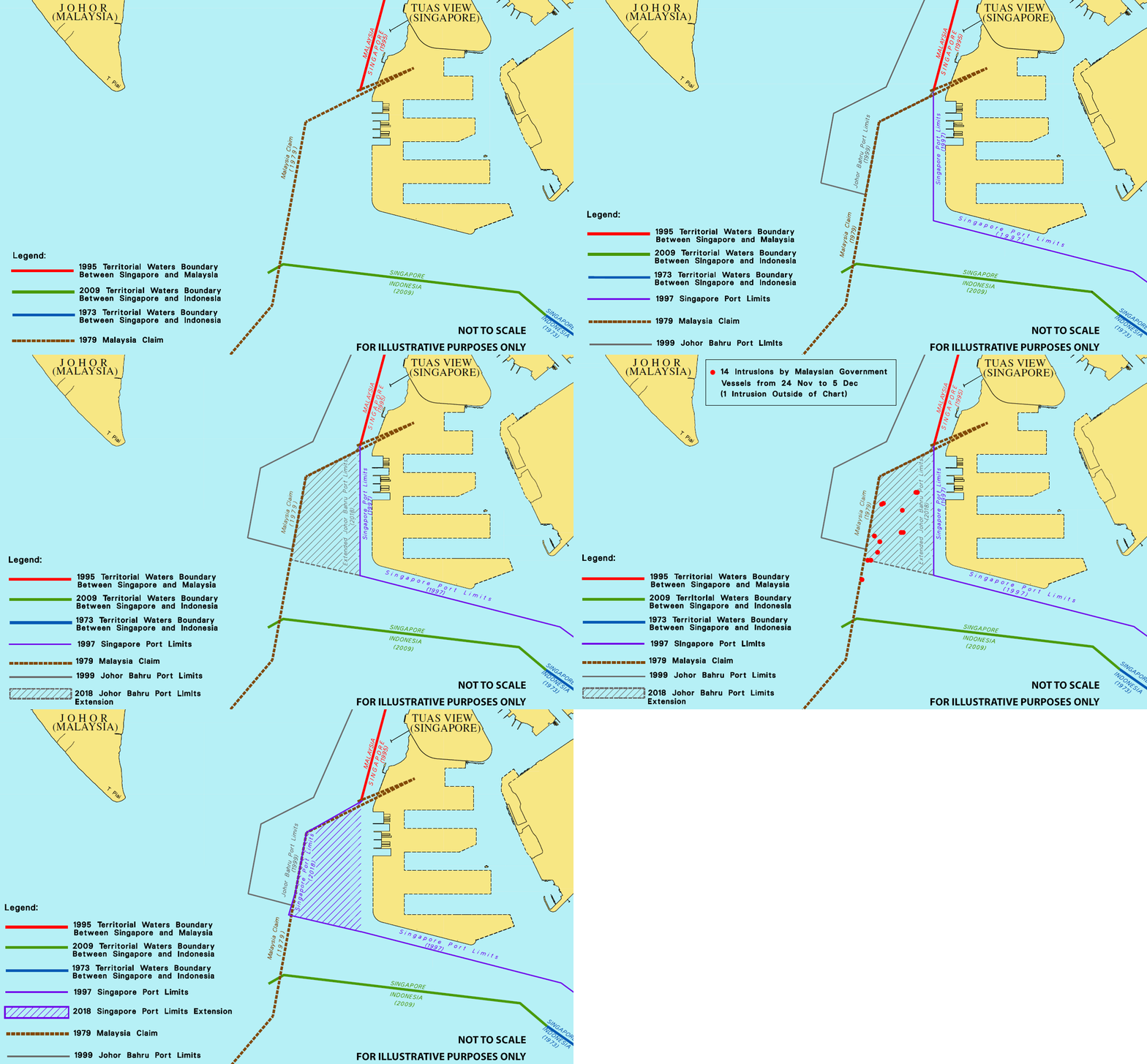
Mr Khaw said that there had been 14 intrusions into Singapore’s territorial waters off Tuas in the past two weeks, after changes to the port limits were announced through Malaysia’s Federal Government Gazette on Oct 25, 2018. 

Singapore had protested the repeated intrusions via three Third Party Notes, he added. 

Mr Khaw said Singapore’s security agencies will continue to patrol the area and respond to unauthorised activities on the ground. 

READ: In full – Khaw Boon Wan’s statement on Malaysian intrusions into Singapore territorial waters

He said the agencies have so far responded “with restraint against aggressive actions by the Malaysian government vessels”, but added that Singapore “cannot allow our sovereignty to be violated, or new facts on the ground to be created”.

“Therefore, if it becomes necessary, we will not hesitate to take firm actions against intrusions and unauthorised activities in our waters to protect our territory and sovereignty,” said Mr Khaw. 

READ: Singapore refutes PM Mahathir’s claim that Malaysia has not “touched” Singapore’s border

The minister also announced that Singapore has decided to extend its port limits off Tuas. 

“In view of these recent provocative developments, we have decided to extend the Singapore Port Limits off Tuas via Maritime and Port Authority of Singapore (Port Limits) (Amendment) Notification 2018,” said Mr Khaw. 

“This extension is well within Singapore Territorial Waters, and tracks the eastern boundary of the 1999 Johor Bahru Port Limits. 

“The Gazette takes effect from today,” he added. 

“BLATANT PROVOCATION”

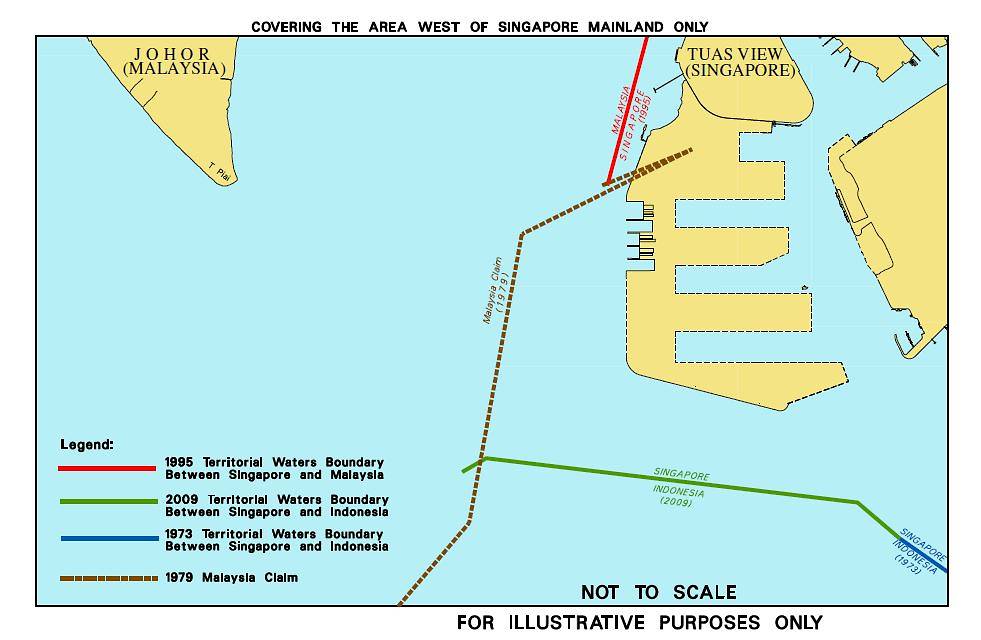
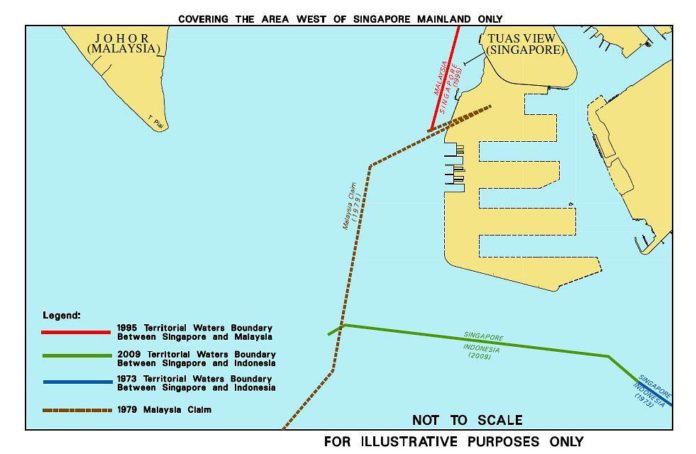
In 1979, Malaysia published a map showing the limits of the territorial waters which it claimed, which included its claim on Pedra Branca, as well as on areas at the eastern and western approaches to Singapore, Mr Khaw said at the media conference.

Singapore had protested to Malaysia to reject its claim on Pedra Branca and also “stated categorically that these new boundary lines violated Singapore’s sovereignty and were unacceptable to Singapore”, he said. 

Chart 1

A map showing the limits of the territorial waters claimed by Malaysia in 1979. (Map: Ministry of Transport)

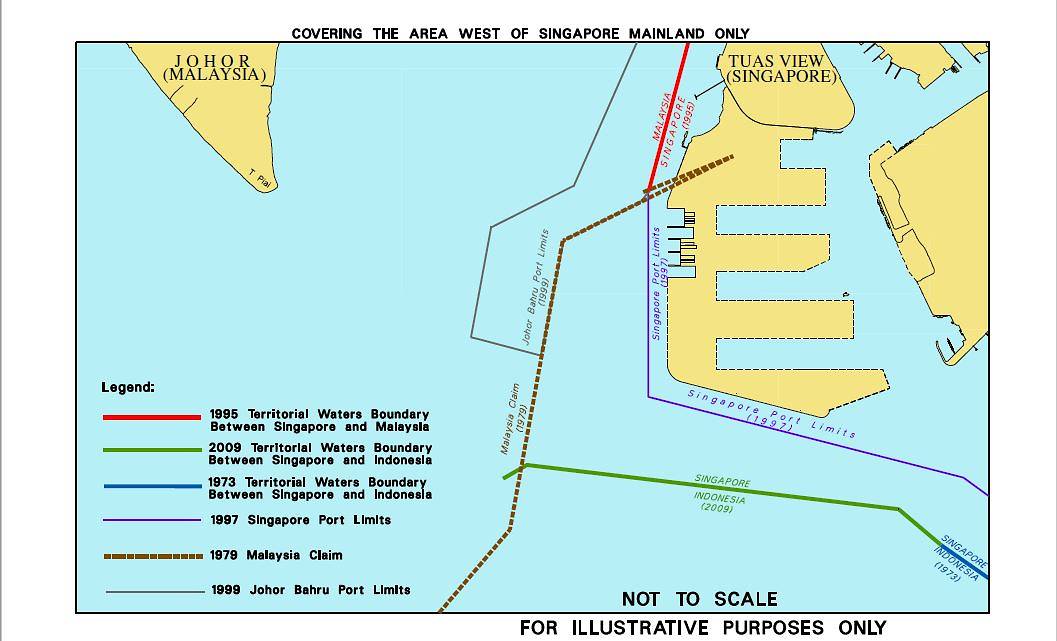
Nevertheless, in 1987, Malaysia went on to publish the Johor Bahru Port Limits that followed this claimed boundary line, and made slight amendments later in 1999. Since then, for 20 years, the 1999 Johor Bahru Port Limits have remained intact. 

However, on Oct 25, the limits were “unilaterally and arbitrarily extended”, Mr Khaw said. 

“Quite apart from the fact that Singapore has never accepted their 1979 territorial claims, the recent purported extension of the Johor Bahru port limits goes beyond what even Malaysia itself claimed as its territorial waters,” he said. 

Chart 2

The 1999 Johor Bahru Port Limits. (Map: Ministry of Transport)

According to Mr Khaw, Singapore has – since at least 1999 – been exercising its jurisdiction in the waters now covered by the recent extension of the port limits. 

“We have been patrolling the area regularly, and protested any intrusions or unauthorised activities. Malaysia has never laid claim to these waters, or protested our actions there,” he said. 

“Now, out of the blue, Malaysia is claiming these territorial waters that belong to Singapore. Without any prior consultations, Malaysia is seeking to alter unilaterally the long-standing status quo in the area. 

“This is a blatant provocation and a serious violation of our sovereignty and international law,” he added. 

The transport minister noted that “countries do amend their port limits from time to time”. 

“But they must do so in a way that does not contravene international law or infringe on the sovereignty of another country,” he said, adding that the last time Singapore amended its port limits was in 1997.  

Source link

Singapore, Malaysia maritime dispute: A timeline

0

SINGAPORE: Singapore and its northern neighbour Malaysia are embroiled in a maritime dispute after the two countries traded conflicting views over the issue.

Singapore has said Malaysia has been intruding into its waters.

Here is a timeline of key events: 

TIMELINE OF EVENTS

1979: Malaysia publishes a map depicting the territorial waters it claims. This included its claim on Pedra Branca, as well as on areas at the eastern and western approaches to Singapore. The boundary lines that Malaysia claimed at the western approach intruded into the port limits of Singapore. Singapore was not consulted in the making of this map.

1980: Singapore lodges a diplomatic protest with Malaysia over the 1979 map, asserting that the boundary lines indicated in the map violated Singapore’s sovereignty and that Pedra Branca belongs to Singapore.

1987: Malaysia publishes its Johor Bahru port limits, which tracks the territorial sea limits claimed in its 1979 map.

1995: Singapore and Malaysia conclude the 1995 Agreement between the Government of Malaysia and the Government of the Republic of Singapore to Delimit Precisely the Territorial Waters Boundary in Accordance with the Straits Settlements and Johore Territorial Waters Agreement 1927.

READ: In full: Khaw Boon Wan’s statement on Malaysian intrusions into Singapore territorial waters

1997: Singapore’s port limits to the west of Raffles Lighthouse are extended slightly for better regulation of shipping traffic in the vicinity. Until 2018, this was the last time Singapore amended its port limits.

1999: Malaysia publishes its amended Johor Bahru port limits, which still tracks the territorial sea limits claimed in its 1979 map. For the next 20 years, this limit has remained intact. Singapore continues to exercise its jurisdiction in the waters now covered by the extension of the port limits, without any protest from Malaysia. 

2018: Malaysia publishes altered Johor Bahru port limits, which encroach into Singapore’s territorial waters off Tuas. The altered port limits extend significantly eastward beyond the territorial sea claim in the area made in Malaysia’s 1979 map. Singapore protests the altered port limits, noting there have been numerous intrusions by Malaysian vessels into Singapore waters since the alteration. Singapore extends its port limits off Tuas following the recent provocations.

Illustration showing the adjustment of Singapore and Malaysia’s port limits.

Source link

Here’s why global carbon emissions will hit record highs in 2018

0

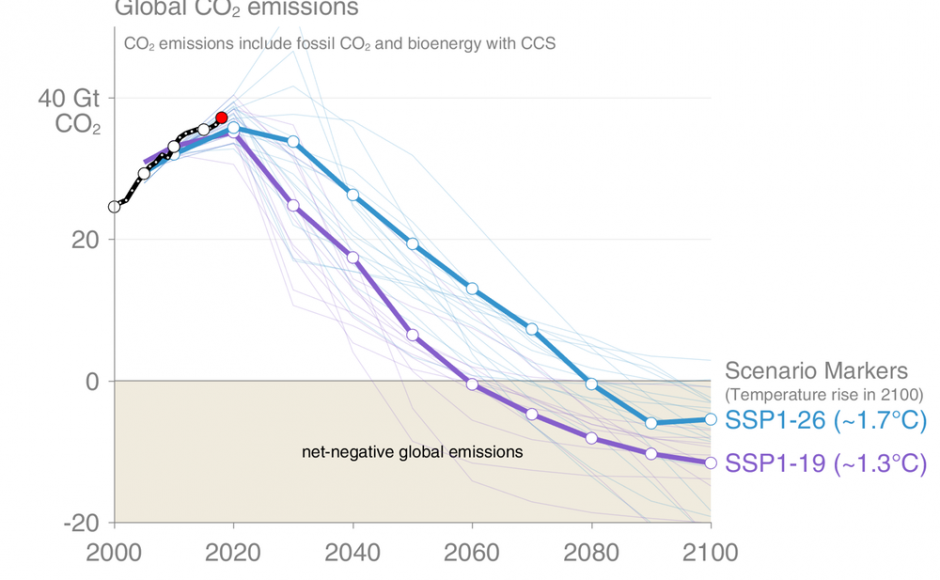
CARBON dioxide (CO₂) emissions from fossil fuels and industry are projected to rise more than 2 percent (range 1.8 percent to 3.7 percent) in 2018, taking global fossil CO₂ emissions to a new record high of 37.1 billion tonnes.

The strong growth is the second consecutive year of increasing emissions since the 2014-16 period when emissions stabilised, further slowing progress towards the goals of the Paris Agreement that require a peak in greenhouse gas emissions as soon as possible.

Strong energy demand is behind the rise in emissions growth, which is outpacing the speed at which decarbonisation of the energy system is taking place.

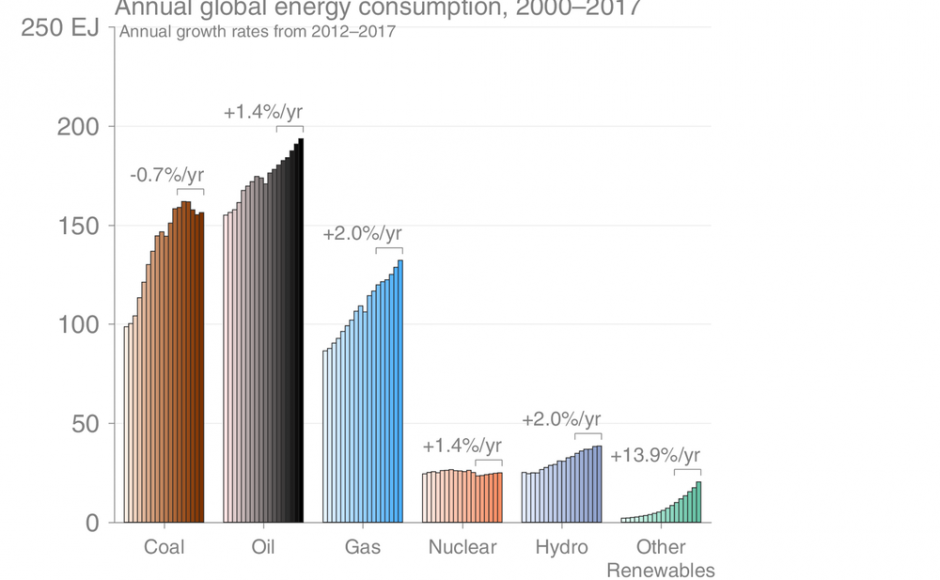
Total energy consumption around the world increased by one-sixth over the past decade, the result of a growing global middle class and the need to provide electricity to hundreds of millions of people living in poverty.

The challenge, then, is for all nations to decarbonise their economies while also satisfying the need for energy, particularly in developing countries where continued growth in energy supply is needed.

SEE ALSO: Indonesians fight back against South Korean-funded coal plants

These analyses are part of the new annual assessment of the Global Carbon Project (GCP), published today in three separate papers. The GCP brings together scientists who use climate and industrial data from around the world to develop the most comprehensive picture of the Earth’s sources and sinks of greenhouse gases.

energy-940x580

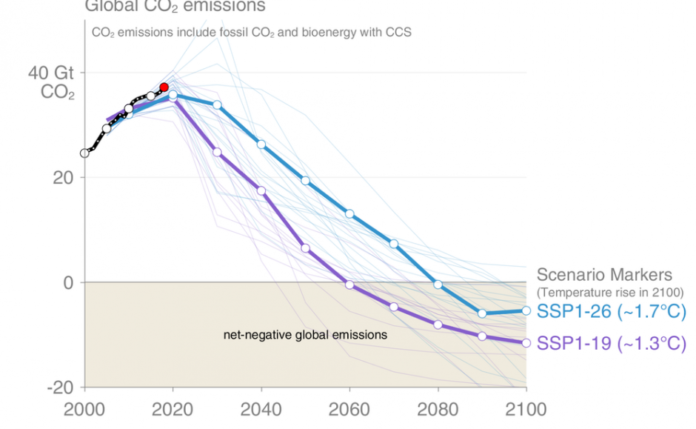
Historical CO₂ fossil fuel emissions (black, red dot is our projection for 2018) and the Shared Socioeconomic Pathways (SSPs) from the IPCC 1.5℃ special report (2018) to stabilise the climate below 1.5℃ and 2℃ warming above pre-industrial levels. Source: Global Carbon Project/The Conversation

Sources of fossil fuel emissions

A surprise in 2018 (and 2017) was the return to growth in CO₂ emissions from coal use after an apparent peak in 2013, although coal emissions in 2017 were still 3 percent below the 2013 record high.

This change was one primary reason for the higher increase in emissions growth in 2018, on top of long-term growth in oil and natural gas emissions.

The largest national contributions to the growth in coal emissions came from China and India, while the single largest decline in coal emissions was in the United States, where more than 250 coal-fired power plants have closed since 2010 and more are expected to close down over the next five years.

The growth of emissions from cement production has slowed significantly.

energy-2-940x580

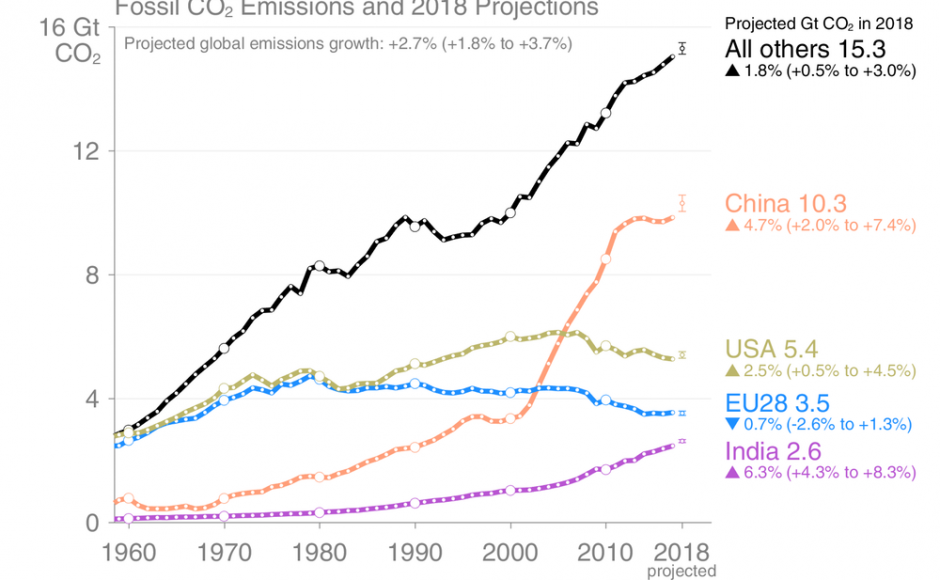
Annual global CO₂ fossil fuel emissions to 2017, with the 2018 projection suggesting coal will approach the levels seen in 2013. (Le Quere et al. 2018, ESSD; Jackson et al. 2018, ERL). Source: Global Carbon Project/The Conversation

SEE ALSO: Climate change in Asia: Why collective welfare comes before individual rights

Country trends

Most countries are contributing to the increase in global fossil CO₂ emissions.

However, 19 countries representing 20 percent of the global emissions, showed declining trends in emissions in the past decade (2008-17) while their economies continued to grow.

These countries are: Aruba, Barbados, Czech Republic, Denmark, France, Greenland, Iceland, Ireland, Malta, the Netherlands, Romania, Slovakia, Slovenia, Sweden, Switzerland, Trinidad and Tobago, the UK, the US, and Uzbekistan.

Turning to changes in CO₂ emissions in 2018, unexpectedly, China, which accounts for 27 percent of global emissions, is set to grow 4.7 percent, up from 1.7 percent growth in 2017.

Likewise, and despite the long-term trend of emissions declines, the US is set to increase its emissions by 2.5 percent this year, due to increased heating and cooling demands and oil use.

The European Union is set to reduce its emissions by 0.7 percent, compared with 1.4 percent growth in 2017, potentially the first reduction since 2014.

Indian emissions are expected to grow 6.3 percent on the back of strong growth in coal use.

SEE ALSO: Can Vietnam achieve its vision of a ‘green transformation’?

Greenhouse gas emissions in Australia have increased for the last four years to June 2018.

energy-3-940x580

Annual CO₂ fossil fuel emissions to 2017, and projected 2018 emissions based on partial data to September (dot points with error bars). Source: Global Carbon Project/Le Quere/The Conversation

energy-4-940x549

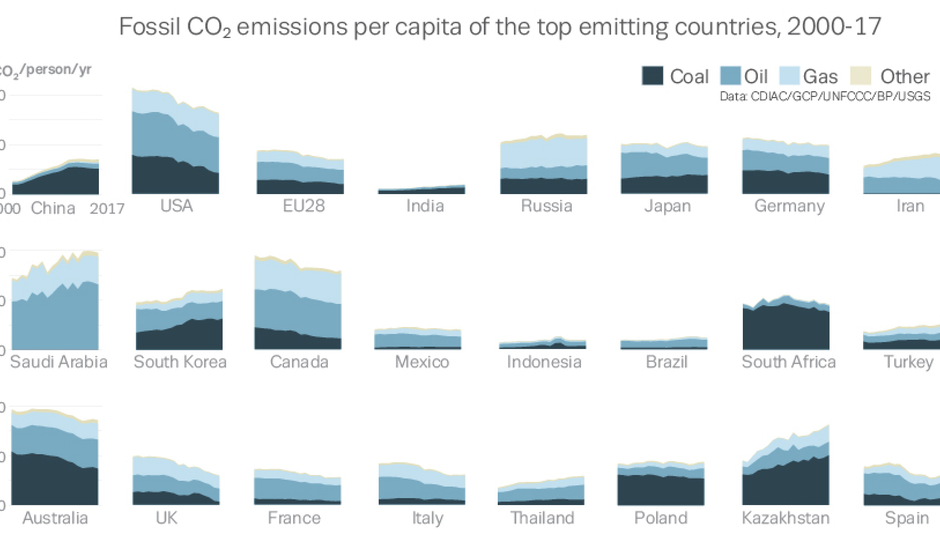
CO₂ emissions per capita to 2017. Source: Global Carbon Project 2018/The Conversation.

SEE ALSO: Air pollution can take a decade off your life expectancy

Outlook

An unprecedented energy revolution is already underway towards cleaner sources of energy.

Globally, renewable energy (solar, wind, and biofuels) is growing at an extraordinary rate, with a doubling of the global capacity every four years, albeit starting from a very low base compared with energy generated from fossil fuels.

A continuation and acceleration of this trend is consistent with the requirements of the Paris Agreement.

However, the same scenarios also call for the equally rapid decline in emissions from fossil fuels, something we do not see in our latest data presented here. The stronger growth in emissions projected for 2018, which is likely to extend into 2019, is inconsistent with agreed-upon climate targets.

energy-5-940x580

Source: Global Carbon Project/The Conversation

The recent Emissions Gap Report 2018 shows large and growing discrepancies among 1) current emissions trends; 2) national emissions reduction committed by countries; and 3) the declining trends required to meet the targets of the Paris agreement.

All countries need to increase their mitigation efforts and levels of ambition to reverse the tide of emissions growth, if decarbonisation pathways consistent with the climate targets of 1.5℃ and well-below 2℃ are to be met.

By Pep Canadell, CSIRO Scientist, and Executive Director of the Global Carbon Project, CSIRO; Corinne Le Quéré, Professor, Tyndall Centre for Climate Change Research, University of East Anglia; Glen Peters, Research Director, Center for International Climate and Environment Research – Oslo; Robbie Andrew, Senior Researcher, Center for International Climate and Environment Research – Oslo, and Rob Jackson, Chair, Department of Earth System Science, and Chair of the Global Carbon Project, globalcarbonproject.org, Stanford University

This article is republished from The Conversation under a Creative Commons license. 

Source link

Commentary: Lessons from San Jose and Stan Lee as Singapore’s Smart Nation efforts enter new phrase

0

SINGAPORE: In mid-November, Singapore was named “Smart City of 2018” at the Smart City Expo World Congress in Barcelona.

Having won the award, what is next? Two seemingly unrelated events that also happened in mid-November provide one possible answer. 

The first was the American Anthropological Association’s annual meeting in San Jose. It was no coincidence it was right smack in Silicon Valley.

According to the Financial Times, “tech companies have been using the event to recruit an unprecedented number of cultural anthropologists”. They finally understand that technology is as much about how we live, as it is about how we compute. 

The second was American comic book giant Stan Lee’s passing. He created many of the most loved superheroes many of whom are now part of trillion-dollar blockbuster movies. Why were his characters so popular? The consensus is he made them “relatable” to readers.

Spiderman costume file

A costume from the 2002 movie Spider-Man displayed at the Hollywood Costume exhibition at the Victoria and Albert museum in London. (File photo: AFP/Ben Stansall)

Spiderman, for example, frequently felt inadequate and had girl problems; the Avengers often fought amongst themselves, not unlike many management teams. Stan Lee’s characters were relatable because they were equal parts superhero and human – with real-life hopes, fears and foibles like us.

Since the launch of Smart Nation at the end of 2014, citizens have been telling us they want to know what being smart means to them. Beyond buzzwords and headlines, they want to “touch and feel” Smart Nation. 

READ: How do we know when we’ve become a Smart Nation? A commentary

Thus, one answer to what is next, is we can make Smart Nation super relatable to more citizens. And a good way to do that is to better understand how we all live in a Smart Nation. That way, we can design clearer benefits and value that citizens can “touch and feel”.

A SHIFT: FROM VISIONS AND TECHNOLOGIES TO IMPLEMENTATION AND PEOPLE

Making value and benefits clearer is in fact a shift that is underway in many smart cities movements worldwide. Before, the focus was dominated by visions and technologies.  “Citizen-“, “people-“, and “human-centric” were often included as hackneyed cliches. 

Then something happened. City and corporate leaders were increasingly challenged why their slick slides said so much about technology, but so little about people. As a result, now, there is greater emphasis on implementation, and on the value and benefits to citizens. 

A good example in Singapore is the Parking.sg app. In just over a year, using the app instead of peeling parking coupons has become the norm for many drivers. Between its October 2017 launch to March this year, 250,000 vehicles used it 2 million times. By early November, 475,000 vehicles had used it 11 million times. 

parking.sg app

The Parking.SG app. (Photo: MCI)

Drivers like it because it is convenient, cashless, paperless, saves time, and in some cases, even saves money (when parking sessions ended earlier than planned). Initial reservations have largely dissipated.

The only complaint we still hear is one told to us with an impish grin. Drivers joke they can no longer peel their coupons ten minutes ahead of the time on their watches.

Another example is the Moments of Life app launched in June this year. It is designed around the government services that citizens need at different stages of their lives – such as registering for a child’s birth and locating preschools near them. This makes it easy for busy parents to know and access what they need in one digital platform.

While it is still in pilot phase, and some might criticise the use of life stages as belated (as market segmentation by life stages has been a longstanding private sector practice), the tangible shift to be citizen-centric, instead of government department- or service-centric, is both positive and welcome.

READ: Another Government app? Complain, sure, but after trying it, a commentary

This greater emphasis on implementation, value and benefits has gone hand-in-hand with an expansion in services and projects. The vast adoption of payment services such as PayNow (where funds can be easily transferred within a minute or two), and the proliferation of trials of on-demand buses, autonomous vehicles, and sensors signal that we are one step closer to realising our Smart Nation vision.

As services expand, more and more citizens should be able to “touch and feel” their benefits and value.

TO IMPROVE ADOPTION, FIGHT DISAPPOINTMENT AND DISCONNECT

It is clear momentum has picked up. But adoption of upcoming services and technologies is not guaranteed.

As part of our research on smart cities and digital economies, we often ask citizens to tell us what they know about Smart Nation. Typical responses that cut across age groups continue to be “not sure” and “something to do with technology”. They struggle to elaborate further.

Why is this so despite all the initiatives and successes so far? Our ongoing studies and surveys on technology adoption and experience suggest two barriers have yet to be fully overcome.

The first is disappointment: The new technology neither adds value nor fits their needs. The second is disconnect: The benefits of adopting something new are perceived to accrue mostly to companies and cities, and not to them.

READ: Beneath the digital friendly facade, Singaporeans still reluctant to accept cashless payments, a commentary

Raffles Place crowd

People walk out for their lunch break at the Raffles Place financial district in Singapore. (File photo: AFP/Roslan Rahman)

Over time, this combination of disconnect and disappointment poses a risk. It will increase resistance to adoption of future services. The momentum that has been steadily building up could stall. This will hinder future Smart Nation efforts. 

What an unfortunate irony that would be. Because our research also shows that citizens, across age groups, are optimistic about technology. A recent workshop with teachers from a local secondary school illustrates this clearly.

We asked them to assess how their work tasks would be changed by new technologies. They had to categorise the tasks under four types of impact: “Improve”, “Stay the Same”, “Replaced”, or “Made Worse”.

They decided that most of the tasks would fall in the first three categories. Only a couple were put into the fourth. They were clearly optimistic.

Citizen optimism is an asset that we can use to improve adoption. A soon-to-retire Singaporean administrative executive in a global firm told us with pride that she enjoyed picking up new technologies at work.

One reason was they were so new that she found herself explaining them to her teenage relatives. Now imagine citizens – young and old – doing this for one another for Smart Nation initiatives. What a wave that would create.

It would be such a pity if instead this optimism was whittled down by disconnect and disappointment. We thus have to fight the disconnect and disappointment.

In the same way that urban designers are encouraged to think about how people would benefit from the streets, buildings, and neighbourhoods they design, we will have to sweat the details about how citizens will benefit and find value in specific Smart Nation initiatives. 

READ: Singapore’s Digital Readiness Blueprint must also address ‘invisible illiteracies’, a commentary

BACK TO SAN JOSE AND STAN LEE

How do we sweat the details? Like the tech companies hiring anthropologists, we can first develop a deep understanding of how citizens live their lives in a Smart Nation. 

That understanding will help us better design clear benefits and value. The ultimate goal will be benefits and value that are super relatable to citizen hopes, fears, and foibles. So that more and more citizens can “touch and feel” what Smart Nation means for them.

And what if we could combine all this with our citizens’ optimism too? Imagine what we could achieve.

We could become super smart.

Poon King Wang is the Director of the Lee Kuan Yew Centre for Innovative Cities at the Singapore University of Technology and Design, where he also heads the Smart Cities Lab and the Future Digital Economies and Digital Societies initiative.

Source link

Singapore guitar legend Zul Sutan dies, aged 61

0

SINGAPORE: Local music icon and guitarist Zul Sutan died on Wednesday (Dec 5) at the age of 61.

As the frontman for the rock band Tania, he grew to be a household name in Singapore’s music scene, in a career spanning more than 40 years.

Tania started as a trio in 1976, and the band shot to fame performing at Pebbles Bar located at what was then Singapura Forum Hotel in Orchard. It later became a resident band at Harry’s at Orchard Towers.

Zul was also known for the song Beat the Drums, a self-written track from his solo album recorded in the early 1990s.

harry's boat quay poster

Poster for Zul Sutan’s set at Harry’s at Boat Quay. (Poster: Harry’s)

Tributes for the veteran musician came pouring in shortly after news of Zul’s death.

Tania posted on its official Twitter page: “The lion sleeps tonight. Rest in peace, Zul Sutan. We’ll miss you, big brother. #ZulSutan.”

“Singapore just lost one of her giant talents and I just lost someone I called Pops,” said actress Pam Oei. “There will be no other like him.”

Local jazz icon Jeremy Monteiro described Zul as “one of our very best over the past almost 50 years”.

“Goodbye big brother, a light has gone out in our music scene and there is no replacement in sight. Rest in Peace,” he said in a Facebook post.

Source link

StarHub unveils new SIM-only plans with ‘extra large’ data bundles

0

SINGAPORE: Local telco StarHub on Wednesday (Dec 5) announced three new SIM-only mobile plans which it said come with “extra large data bundles”.

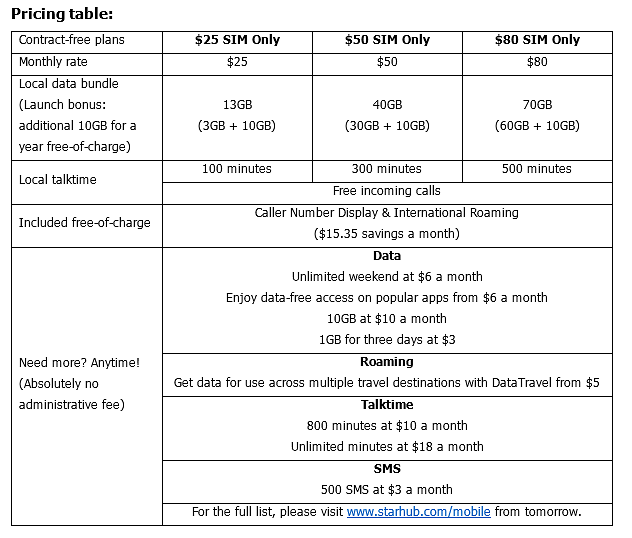
The mid-tier S$50 SIM-only plan, for instance, offers customers 30GB of data a month, with free incoming calls and 300 minutes of local talktime.

Caller number display and international roaming – previously chargeable as add-on services – are included free of charge.

The first 10,000 customers to sign up will get an additional 10GB of data every month for a year as a “launch bonus”, said StarHub.

The plans are contract-free and customers are not bound by any minimum subscription period.

“The plans are devoid of hidden charges for customers to enjoy peace-of-mind,” said the telco. “In a market-first, StarHub is scrapping all one-time administrative, activation and SIM card fees, which add up to about S$200 over 12 months for a typical customer.”

Companies have been ramping up efforts to attract customers amid fierce competition in the local telecoms markets, with the impending launch of fourth telco TPG Telecom.

READ: MyRepublic launches 3 mobile plans, talks up customer focus

READ: M1 unveils new postpaid plans as data war heats up

READ: Singtel launches unlimited data mobile plans

Several mobile virtual network operators (MVNO) have also recently entered the market – Circles.Life, Zero Mobile, Zero 1 and MyRepublic.

StarHub said customers can sign up for its new SIM-only mobile plans from Thursday. The three plans will replace its existing list of five postpaid plans, the telco added.

To be eligible to get a phone at a discounted price, postpaid customers can choose to pay an additional S$25 every month for 24 months.

StarHub mobile plans price

(Image: StarHub)

Source link

Jail for SCDF officer who obstructed justice by deleting video of NSF Kok Yuen Chin being pushed in well

0

SINGAPORE: A Singapore Civil Defence Force (SCDF) officer on Wednesday (Dec 5) received one month’s jail for obstructing justice by deleting a video that showed a full-time national serviceman (NSF) being pushed into a pump well.

Corporal Kok Yuen Chin died in May after being found unconscious at the bottom of a 12m-deep fire station pump well which was filled with water at Tuas View Fire Station.

Staff Sergeant Adighazali Suhaimi pleaded guilty to one charge of intentionally obstructing the course of justice by deleting the video, which was evidence for criminal investigations into the death of Corporal Kok.

At the time of the offence, Adighazali was an SCDF regular and a Hazardous Materials specialist. He was one of five SCDF officers who were charged over the incident.

Pump well tuas view fire station collage

Left: The pump well that Corporal (CPL) Kok Yuen Chin drowned in. Right: Tuas View Fire Station. (Photos: SCDF, Mediacorp)

READ: ‘Visible injuries’ on body of SCDF NSF sustained in pump well during rescue process: Police

The accused and his colleagues gathered at the fire station on May 13 to celebrate Corporal Kok’s NSF’s completion of National Service, a few days ahead of his Operationally Ready Date (ORD).

He was presented with a plaque and a cake, while Adighazali’s co-accused Staff Sergeant Muhammad Nur Fatwa Mahmood suggested that Corporal Kok undergo the ORD ritual of “kolam”, by entering the pump well.

This ritual is a form of ragging and is prohibited in SCDF, with anti-ragging posters displayed around the fire station.

Even though Corporal Kok said he did not want to undergo the ritual, Fatwa lifted him by his armpits while a few others, including Adighazali, helped carry him towards the pump well, according to evidence presented in court.

While the officers made their way to the pump well and opened the gate, co-accused Lieutenant Kenneth Chong Chee Boon looked out of a window and saw the officers near the well.

He knew they were going to make Corporal Kok enter it, and shouted: “No filming”. After some of the officers raised their hands to show that they were not holding a phone and repeated his instructions back to him, Chong closed the window and did not look in their direction again.

Corporal Kok sat at the edge of the pump well as instructed but appeared scared and made no attempt to enter it, the court heard. 

Fatwa suddenly pushed him forcefully and he fell into the well, submerging without surfacing for air. After trying unsuccessfully to locate him, a few of the officers used a fire engine suction pump to pump water out of the well.

Corporal Kok was taken out of the well at 9.43pm, 36 minutes after he was pushed in. He was taken to hospital and pronounced dead at 11.02pm.

SCDF NSF Kok Yuen Chin's death: A timeline

READ: Death of SCDF NSF Kok Yuen Chin: Timeline of events

“DELETE, DELETE” CO-ACCUSED SAYS WHEN SHOWN VIDEO ADIGHAZALI TOOK

Despite Chong’s “no filming” instruction, Adighazali had recorded part of the incident using his mobile phone. The footage began with Corporal Kok standing at the edge of the pump well, and ended just after Fatwa pushed him in.

Some two hours after recording the video, Adighazali was in the locker room of the fire station waiting for the police to arrive when he told Fatwa that he had taken a video of the incident.

He passed his mobile phone to Fatwa. After Fatwa watched it, he told Adighazali “delete, delete” repeatedly.

Adighazali did so, even though he knew the clip was evidence and that police officers were arriving to investigate the case.

The Technology Crime Forensic Branch of the Criminal Investigation Department examined Adighazali’s Apple iPhone 7 a day later, and recovered the deleted video.

Forensic examination showed that it was created at 9.06pm on May 13 and deleted at 11.23pm.

ACCUSED’S CULPABILITY LOWER THAN OFFICER WHO PUSHED VICTIM IN: DEFENCE

Deputy Public Prosecutor Kumaresan Gohulabalan asked for a one-month jail sentence, saying that the accused’s culpability was similar to Fatwa’s.

Fatwa was sentenced to one year and four weeks in jail in October, while the cases for the remaining three officers are pending.

READ: SCDF officer jailed over death of NSF Kok Yuen Chin

Adighazali’s defence lawyer Ashwin Ganapathy asked for a sentence of no more than 14 days, saying that his client deleted the video in the spur of the moment, after giving in to the pressure put on him by Fatwa.

Adighazali had confessed to deleting the video in the very first interview with the investigation officer, he said, and was “so overwhelmed by guilt that he felt the right thing to do was to confess and not continue with the cover-up”.

“It is also important to recognise the state our client was in at the material time,” said the lawyer. “What had supposed to be a joyous occasion quickly turned fatal for one of our client’s men.” 

He said Adighazali was “reduced to a state of panic, guilt and utter worry”, and his culpability is lower than Fatwa, who instigated Adighazali, said the defence.

In response, the prosecutor said that the pressure Adighazali felt was “self-conceived”, as he held the same rank as Fatwa.

READ: Board of Inquiry recommends decommissioning pump wells, review of anti-ragging measures

READ: ‘Committed to eradicating ragging within our ranks’: SCDF implements follow-up actions after NSF death

District Judge Chay Yuen Fatt said he could not agree that the accused’s role or culpability was less than Fatwa.

“Ultimately, he was the one who deleted the video. It was a conscious and deliberate decision to delete the video,” he said. “I also cannot accept that he was under pressure from Fatwa. If there was any pressure at all, it was internal. I cannot give any mitigating weight to that.”

Corporal Kok’s aunt Helen Kok told the media after the hearing that the family gets by a day at a time.

“This (incident), we won’t forget,” she said in Mandarin. “How can we forget.”

READ: Corporal Kok Yuen Chin’s last conversation with his father

Source link

‘Future of telco industry is not telcos’: Circles.Life’s co-founder shares how AI, data will shape its strategy

0

SINGAPORE: “The future of the telco (industry) is not telcos (as we know them)… but data-driven technology companies offering digital services that are yet imagined today,” said Circles.Life co-founder Rameez Ansar.

In a wide-ranging interview with Channel NewsAsia on Tuesday (Dec 4), Mr Rameez outlined how the industry could look like in the future, as well as how the three-year-old Mobile Virtual Network Operator (MVNO) intends to branch out into non-telco services. 

READ: Upstart Circles.Life looks to ring in changes in Singapore’s telecoms sector

These services, he added, are being developed through the start-up’s investments into technologies such as machine learning, artificial intelligence (AI) and predictive analytics. 

Mr Rameez explained that the company’s move away from telco services does not mean it will neglect its primary MVNO business. 

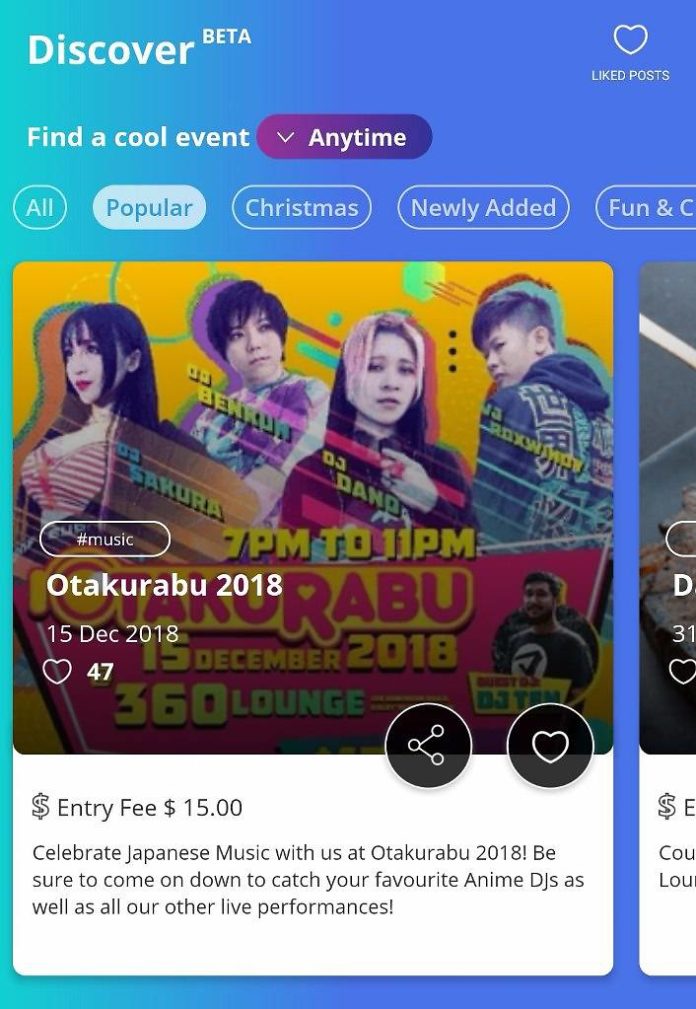
Rather, a shift towards services like events recommendation through a recently introduced feature called Discover is a natural outcome and progression from its current role, he said, adding that the company has created relationships through know-your-customer processes when people sign up with them as well as when they set up their billing methods. 

He cited how telcos – not just local incumbents Singtel, StarHub or M1 with whom Circles.Life leases mobile network capacity from, but those globally – have shown that the “backwardness of their technology” means attempts to introduce digital services have not taken off or were not well received by people.

“Execution (of new services) is challenging when your infrastructure is from 10 years ago and are not agile,” the 36-year-old said. 

He cited Google and Apple as examples of how technology companies, through for instance the introduction of e-SIM, are actually the ones innovating in the industry instead of telcos.  

E-SIMs are digital SIMs that allows users to activate their cellular plan from telcos without needing to slot in a physical SIM card. Apple included this technology with its latest slate of iPhones, while Google actually takes on the role of an MVNO with its Project Fi – now renamed Google Fi – project.

DOUBLING DOWN ON DATA

Mr Rameez did point out that the roll-out of any digital service by Circles.Life will not be done just for the sake of doing so. After all, it is not a publicly listed company or heavily backed by investors such that it needs to constantly show growth. 

The company, which has cornered nearly 5 per cent of the overall Singapore market, is mindful that any additional product will have to boost, not compromise, its profile, he added. 

Citing the Discover feature as an example, he said it is an “interesting value proposition” for its user base as “people are still going around randomly trying to find new things”. 

Circles.Life Discover feature


And it is being powered by machine learning and AI developed internally. Mr Rameez said Circles.Life had built a research and development (R&D) team in Bangalore, India, specifically looking at how to make sense of the large amounts of data being generated by its customers. The company has committed S$25 million to this team for long-term growth, which includes acquiring companies like Fratics and Klassify this year. 

The Bangalore R&D team, led by former Yahoo engineering director Amitava Ghosh, was started in August this year. Its work will be used to refine Discover and how it recommends events, services and products according to customer preferences. There are 25 employees but this is expected to double by the next quarter.

Asked why Circles.Life decided to base its R&D team in Bangalore instead of Singapore where it is headquartered, Mr Rameez explained that it wanted to go where the talent is.

He said that particularly for machine learning and deep engineering, Singapore “is not quite there yet”. 

READ: 10,000 in Singapore to be taught AI basics for free

Circles.Life considered five possible cities – Silicon Valley, Bangalore, Shenzhen, Beijing and Shanghai – but eventually settled on the Indian city where there is a “density of tech unicorns” which attracts the necessary talent. 

He added it was “not a cost decision” to base the team in Bangalore, given that talent is at a premium there with companies like Google and Amazon setting up shop and willing to pay top dollar for people with the necessary skills.

Besides introducing Discover last month, Mr Rameez disclosed that the company will be extending its partnership with EZ-Link this month and more details will be available soon.

Earlier in May, both parties signed a deal allowing the telco’s subscribers to earn 50MB of data for every 10 rides they take per week and this can be added to their monthly limits. 

Circles.Life will also move into the financial technology space next year. When asked for details, the co-founder said it is unlikely to launch a digital wallet, but possibly payment options for the events and services being recommended through Discover.

STAYING PLUCKY, LEARNING FROM MISTAKES

Yet, even as the company continues to grow and evolve from its days as plucky upstart in a seemingly stale telco space, it is not without its flaws. 

The start-up had recently been in the headlines, and for not-so-positive reasons. Its Epic Invite promotion drew flak from former Nominated Member of Parliament Eunice Olsen, who labelled the ad as “sexist, derogatory, disrespectful, distasteful” and a “cheap shot at a publicity stunt”.

She even lodged a police report against the advertisement. 

READ: Circles.Life removes ad that ex-NMP Eunice Olsen calls ‘sexist and derogatory’

The MVNO later removed the ad and said it will “learn from this experience”. 

Circles.Life said in a separate statement on Tuesday that it met with Ms Olsen and her manager on Monday.

It added: “The insightful discussion brought both parties to a common understanding that none of the parties intended to damage anyone’s reputation. We both understood and respected each other’s views and no legal action will be taken.”

A company spokesperson added that there are plans to engage Ms Olsen to promote her views on women empowerment, although details have not been finalised. 

This is not the first time the start-up’s marketing stunts have stirred controversy. Its cash vending machine promotion, with the hashtag #3DollarBaller, this February was cut short by the police due to security concerns. 

Mr Rameez said he takes full responsibility for the latest promotion and its fallout, saying these are consequences of him pushing his team to do things differently. 

“(In taking a different approach,) mistakes will be made,” the co-founder conceded, adding that this does not excuse his company from avoiding such mistakes in the first place. 

That said, he does not believe the company needs to shed its “upstart-y ways” even as it grows and become more established. If taken positively, it is a trait commonly seen in companies that are innovative, he stated. 

Source link

Commentary: On both sides of the Causeway, Grab’s grand ambition hits road bumps

0

KUALA LUMPUR: It is not every day you hear a prime minister offer to resign during a dialogue session.

But Malaysian Prime Minister Mahathir Mohamad did so when a session with taxi drivers turned rowdy last month, after discussions over what they said was preferential treatment given to ride-hailing giant Grab turned sour without a resolution in sight. Many shouted obscenities and stormed out.

CAR-FIRST MALAYSIA

Malaysian taxi drivers have faced immense challenges, not least because private car ownership has been warmly encouraged in the country for decades.

Malaysia has already seen two national car projects, Proton in 1983, and Perodua in 1992 with mixed results. Now there’s talk of a third national car project, to be potentially launched in 2020.

READ: Post-Proton, Malaysia still dreams of a national car, a commentary

This public policy orientation towards cars has resulted in a population with high levels of private car ownership and infrastructure that favours cars rather than public transportation, which makes it ideal for the entry and expansion of a ride-sharing app like Grab.

But Malaysians, particularly those in the capital, are not entirely happy with the status quo.

Political secretary to Finance Minister Lim Guan Eng, Tony Pua’s recent remarks that the government was looking into a partnership with Grab to replace feeder buses at MRT stations and solve last mile connectivity (given the capital’s underused fixed line rail options), drew questions in the capital.

Mahathir Mohamad (1)

Malaysia prime minister Mahathir Mohamad at the dialogue session with taxi drivers in Langkawi on Sunday (Oct 21). (Photo: Bernama)

In the Klang Valley, commuters gripe about last-mile RM3 (S$0.98) fares hiked up by Grab’s RM5 minimum, imposed post-merger with Uber. Students say what used to cost RM2 fares to the train station now rack up RM6. Those working part-time lament that they are back to depending on unreliable bus services.

This rising cost of getting a ride has fuelled talk of improving feeder bus service on social media where many have complained that Grab has been become too expensive for daily use.

Soon after Pua’s comment (“Why provide feeder buses if you can work with Grab?”), Transport Minister Anthony Loke, clarified that the possibility of a Grab partnership is only a “proposal”. 

UNHAPPINESS AND HICCUPS

Grab, which first entered the market as MyTeksi in 2012, received a warm welcome in Malaysia. Conventional taxis in Malaysia were notorious for not using meters, many were old and unkempt, and not considered a safe mode of transportation for women.

In contrast, Grab offered users an easier way to book taxis, get a fare estimate and provided the ability to share your ride information with loved ones.

However, Grab’s merger with Uber in March this year riled up commuters in its home turf of Malaysia and Singapore.

The Competition and Consumer Commission of Singapore (CCCS) investigated complaints by riders and drivers about increased fares and commissions paid to Grab and reported that effective fares (net of promotions) rose 10 to 15 per cent post merger.

The CCCS eventually fined both companies S$13 million for infringing the Competition Act. The commission also instructed Grab to follow its pre-merger pricing algorithm to avoid excessive price surges and commissions.

But can these one-off punitive actions shape Grab’s future behaviour? And will they translate into better fares and commission rates in Malaysia?

A GrabTaxi logo is seen on a car neck pillow in a taxi in Hanoi

An old GrabTaxi logo is seen on a car neck pillow in a taxi in Hanoi, Vietnam on Sep 9, 2015. (Photo: REUTERS)

DRIVERS AND COMMUTERS ADJUST

To be sure, Malaysian users haven’t stood by idly; many have taken action in the face of increased Grab fares. Some university students are helping themselves by finding cheaper rides through carpooling via WeChat groups. 

Rachel, a management consultant in Kuala Lumpur used Uber before on a “nearly daily basis”. Since fares increased, she says she uses Grab less: 

I’ve started driving more, and using other apps like MyCar.

Still, many alternatives have only a cash-only payment option which deters her from switching over completely, she says.

Drivers have also been affected by the merger. A recent medical graduate (waiting for a government hospital placement) I talked to said he started driving for Grab a year before the merger.

He pointed out that under Grab, fares are fixed, unlike Uber, which takes into account both time and distance, and Grab drivers feel they lose out on rides during heavy traffic. He has also seen a decrease in his income since the merger.

The expansion of Grab into food delivery services has also faced hiccups. In end-September, GrabFood drivers in Kuala Lumpur went on strike after their incentive fee for deliveries was cut from RM10 to RM5.

Initially, the company attributed the disruption in food delivery services to a technical glitch but came clean after word of the strike spread on social media. Grab eventually issued a statement clarifying that the new incentive scheme had not gone down well with drivers and pledged to be more transparent.

Commuters and drivers feel aggrieved because the drop in drivers’ incomes and dip in affordability post-merger stands in huge contrast with the billions of fund raising and cash burnt by the company, now valued in the billions. 

Commuters and drivers feel aggrieved because the drop in drivers’ incomes and dip in affordability post-merger stands in contrast to the company now valued in the billions. 
Some see Grab in the same light as Uber, a business built by former CEO Travis Kalanick worth billions and yet has drivers earning less than minimum wage.   

A POSITIVE OUTLOOK AMID A MIXED PICTURE FOR GRAB

The largest detractors of Grab’s expansion in Malaysia have been taxi drivers. There are an estimated 30,000 taxi drivers in the Klang Valley, a figure comparable to one-sixth of the total number of public transport vehicles in the country, and they have repeatedly protested the operations of e-hailing companies which have introduced a flood of part-time drivers.

Malaysia taxi driver

Taxis queue up for passengers at the Duta Bus Terminal in Kuala Lumpur. (File photo: AFP/Saeed Khan) 

As Mahathir’s townhall showed, the government’s willingness to regulate rather than ban Grab does not sit well with them.

Although the Malaysia Competition Commission did not sanction the merger with Uber, the government has heeded taxi drivers’ demands for fairer competition. In July, the Ministry of Transport introduced new regulations to level the playing field between e-hailing drivers and traditional taxis.

E-hailing drivers now have to adhere to Public Service Vehicle license rules – just like ordinary taxi drivers. They must now have insurance coverage for drivers, passengers and third parties, pass a six-hour course with the Land Transport Board, and go through car inspections – conditions which have deterred many new drivers from signing up.

The regulations are most likely to affect part-time drivers, who make up 75 per cent of the estimated of 200,000 e-hailing drivers in the country. The government is also restricting the commission e-hailing companies can make from each ride, which can be as high as 25 per cent presently.

In Singapore, competition is heating up for Grab again. Launching in Singapore last week, Go-Jek, an Indonesian ride-hailing app that also offers multiple services has sounded the battle alarms.

Apart from its ride-hailing business, it has huge war chests as an e-payments giant. Valued at roughly S$5 billion, Go-Jek might be an evenly matched competitor for Grab. While those in Singapore have embraced Go-Jek’s entry, Malaysia unfortunately does not figure as a key market expansion point in the company’s plans.

READ: When Go-Jek enters Singapore, what consumers, drivers and delivery services can expect, a commentary

That is a pity because Malaysian consumers would likely welcome Go-Jek as a countervailing force that puts downward price pressure on Grab. 

Observers point out that Malaysia’s new guidelines for ride-hailing apps do not impose limitations for the giant, especially if drivers are already compliant.

A Go-Jek rider and passenger travelling on a busy street in central Jakarta, Indonesia.

(Photo: Reuters/Darren Whiteside)

For users in Malaysia, the hope for a cheaper ride might be the proliferation of other smaller apps, the creation of an aggregator app and the promise of a level playing field. Apps, such as Bellhop in the United States, allow users to compare fares and availability of different ride sharing services.

Uber has threatened to shut down two of these apps in the United States; but, they are looking to expand internationally where smaller local companies may benefit from having their services listed on an aggregator.

Many expect Grab to retain the lion’s share of the ride-hailing market in Malaysia, even with new, albeit smaller players, and as regulatory reforms catch up – and for prices to eventually moderate.

After all, Malaysia’s car-centric policy think has favoured Grab’s expansion. And many Malaysians give credit to MyTeksi-Grab for shaking up an unreliable and moribund taxi sector, regardless of what the taxi drivers might say.

It’s now up to Grab to retain that goodwill with its stakeholders.

Khor Yu Leng is an independent economist at Segi Enam Advisors, and a specialist on the political economy of mobility.

Source link