Researchers find the introduction of DBS Bank’s PayLah! mobile wallet in April 2017 resulted in the doubling of the use of mobile payments.
Passengers just need to scan the QR code on the taxi’s cashless payment terminal and the app will automatically process the payment. (Photo: DBS)
(Updated: )
Bookmark
SINGAPORE: The introduction of mobile wallets like DBS Bank’s PayLah! has helped spur the adoption of mobile payments, with small merchants the main beneficiaries, according to a new study by the National University of Singapore (NUS) Business School.
Released on Thursday (Dec 13), the study found that the introduction of PayLah! in April 2017 doubled the use of mobile payments, particularly for smaller transactions amounting to less than S$100.
The weekly number of such transactions increased by 114 per cent, compared with larger transactions of more than S$100 which went up by 88 per cent, it showed.
Credit and debit card sales for small merchants, in particular, saw a boost from the introduction of PayLah!’s QR code technology, the study added.
This business demographic saw an average increase of 3.4 per cent per month in the value of credit and debit card sales during the 9-month period after the technology was introduced, compared with the first two months of 2017 before the launch.
New entrepreneurs also gained from the introduction of the mobile wallet, with monthly card sales amount increasing by 11 per cent, compared to the 2.1 per cent growth among more established small merchants.
The research was led by Professor Sumit Agarwal, together with dean of Finance and Strategic Management at NUS Business School Bernard Yeung, associate professor Qian Wenlan and Hong Kong Baptist University’s assistant professor Zou Xin.
They studied an anonymised dataset containing a variety of bank activities for 250,000 consumers from a leading local bank, and analysed local transactions from randomly chosen customers. These include transaction amounts and time, as well as the name of the merchant.
The data spanned a 24-month period from January 2016 to December 2017, with the consumers transacting with more than 45,000 different merchants during that time.
It was not obvious from the data that PayLah! helped merchants to grow sales though, the study pointed out.
The QR code mobile payment method promoted sales growth primarily for new businesses by enabling them to acquire more customers, it added.
“The development of mobile payments plays a critical role in Singapore’s goal of becoming a cashless society,” said Prof Agarwal.
“The findings also provide important input for discussions about financial technology (fintech) and digitisation by offering new insights on the real economic effect of improved payment convenience and efficiency.”
SINGAPORE: Singapore’s labour market showed further signs of improvement in the third quarter of 2018, with total employment growing at a faster pace and fewer retrenchments, according to Ministry of Manpower (MOM) figures released on Thursday (Dec 13).
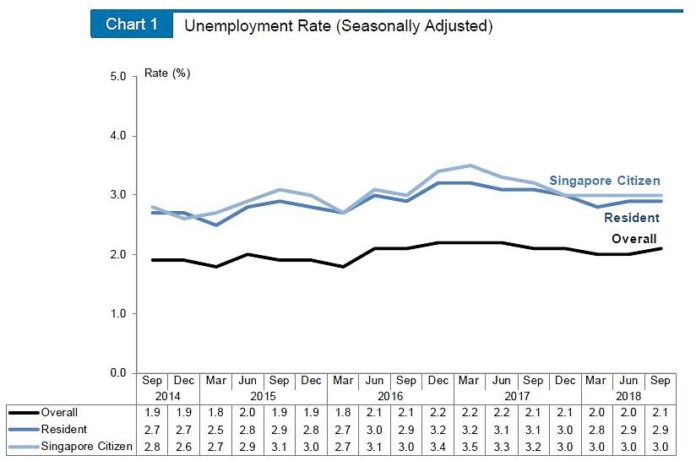
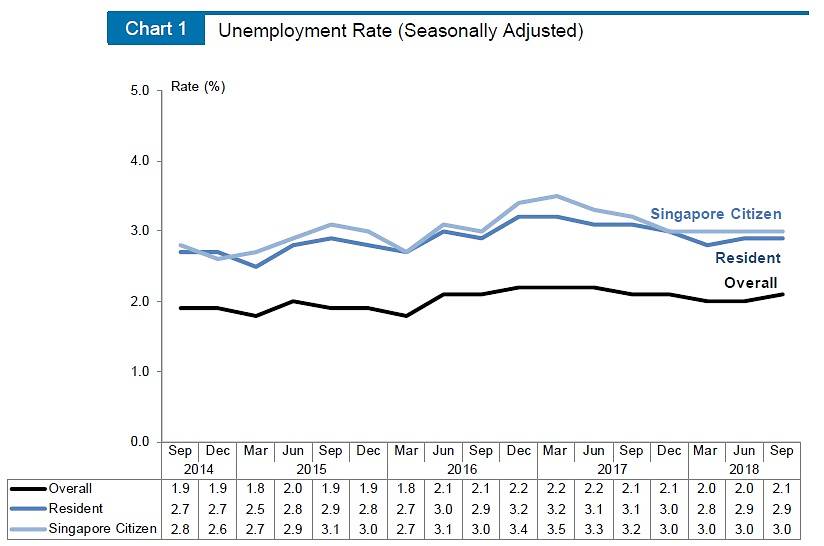
In its quarterly labour market report, the ministry reported that while the overall unemployment rate rose slightly to 2.1 per cent in September from 2 per cent in June, the seasonally adjusted unemployment rate among residents (2.9 per cent) and citizens (3 per cent) held steady from June to September.
The seasonally adjusted unemployment rate among long-term residents declined to 0.6 per cent in September from 0.7 per cent in June, “suggesting that workers are better able to secure employment as economic conditions improved”, MOM said.
As of September, there were 66,000 residents and 58,200 citizens unemployed, said MOM.
Unemployment Rate (Seasonally adjusted). (Graphic: Ministry of Manpower)
The number of retrenchments was also smaller at 2,860, compared to the previous quarter’s 3,030.
This was also lower compared to a year ago when retrenchment was at 3,400.
Business restructuring and reorganisation remained the top reason for retrenchments, MOM said.
“Among the retrenched residents, majority were professionals, managers, executives & technicians (PMETs) (70%), and they continued to be overrepresented relative to their overall workforce composition,” it added.
Total employment, excluding foreign domestic workers, grew by 16,700 in the third quarter, compared with the growth of 6,500 in the previous quarter. This was the highest quarterly growth since the fourth quarter of 2014, said MOM.
The service sector was the main driver of total employment growth, which was led by higher-skilled sectors such as professional services, information and communications, community, social and personal services, as well as financial and insurance services.
MOM said that going forward, hiring momentum “may moderate” given external trade tensions and slowing growth in Singapore’s key final demand markets.
SINGAPORE: My children relish the holiday season, not just because they get to play to their hearts’ content, but also because they are looking forward to unwrapping their presents on Christmas day.
Gift giving and receiving are key components of the Christmas season, as with gathering with family and friends over a feast.
But young children tend to skip the giving part and go straight to the receiving; sometimes this even entails demanding for things.
Parents would do well to consider this delicate balancing act.
Perhaps we feel that they have worked hard throughout the year, and it’s only right to reward them with a holiday or a much-desired gift.
But how do we refrain from spoiling our kids and contain the entitlement monster that seems to rear its ugly head especially during this season?
“Mummy, last year you got me a Frozen Lego set. Can I get the bigger set that comes with a castle this year?”
“Brother received a Playstation for his birthday, so why can’t I get a Wii?”
I don’t like the present aunty gave me. Can I exchange it?
Such questions tend to be greeted with a loud sigh on our part, as we struggle to impart the meaning of gift giving, yet keep ourselves from morphing into the Christmas scrooge.
How do we engage in festive giving and receiving with grace, and inspire children to find joy in giving, not merely in receiving?
START WITH GRATITUDE
I shudder each time the kids attempt to unwrap their gift in front of its giver.
What if they don’t like it? What if they show their disdain?
(For a person with a background in Public Relations, this carries crisis potential so I’m always on high alert.)
File photo of a boy opening his presents (AFP PHOTO / PHILIPPE HUGUEN)
When it comes to teaching gratitude, we tend to wag our fingers at our children. “Be thankful,” we nag, “children in (name a third world country) don’t even have food to eat and clothes to wear.”
Alas, this refrain doesn’t always have the desired effect. Children may find it hard to picture the sad plight of these poor children; the reality is simply too far removed from their cushy everyday lives.
Research shows that gratitude carries many psychological benefits. An article on the Wall Street Journal states: “Researchers find that people with a grateful disposition are more thankful for a wider variety of things in their lives, such as their friends, their health, nature, their jobs or a higher power – and they experience feelings of gratitude more intensely.”
How do we train up this gratitude muscle?
For starters, we can teach our children to thank their gift-givers properly. This is a basic social skill that many children struggle with.
Instead of looking at the gift-bearer in the eye and thanking them, kids get off by muttering a cursory “thanks” – often directed at the gift instead of the giver.
We can also teach them to focus on others’ feelings, for example when they present a friend a gift. Get them to observe the recipient’s feelings, words and facial expression. And then ask them, “Do you think your friend liked the gift?” and, “How does that make you feel?”
If we don’t teach our children and give them opportunities to exercise gratitude, then we may be allowing its lesser twin, entitlement, to foster instead.
LEARN TO SAY NO
Whenever presented with an extra loud or whiny “request” for the latest book series or Nerf gun, it is tempting to cave and give in to the want – cleverly disguised as a need.
But try not to commit to anything immediately. By taking the time to think, and to say no occasionally, you may find that you’re doing both your wallet and your child a favour.
How so?
Children who get their every wish granted will likely find it hard to take “no” for an answer, the rare moment it comes. They may also struggle to appreciate what they already have.
Each time their stash of toys gets enlarged, the older toys tend to be relegated to a corner, leading to opportunities lost to maximise the joy and experience that each toy can bring.
A girl reacts as she views a Luvabella Doll at the Hamleys toy store in London, Britain, October 12, 2017. (Photo: REUTERS/Toby Melville)
Take for example my kids’ Lego stash. Each time they receive a new set, the older creations get stored away. But each time I say “no”, there is a chance that they may start fiddling with their previous creations, jiggling bits around, and re-modelling them into new things.
Having less means that you are forced to be creative with what you already have.
This doesn’t mean you should say no to everything they ask for of course. Requests to have a play date with friends, an outdoor picnic, or a hug should be met with an emphatic “yes”.
We don’t need to wait till Christmas to teach our children how to give; opportunities abound in the everyday.
Is someone you know unwell? Rally the kids to brainstorm ideas about how to help this person or make her feel better.
When we regularly embark on “giving” projects – whether it’s for grandmother or a neighbour – it becomes part of the family DNA, and our children’s mindset and way of life in later years.
Instead of growing up feeling like the whole world revolves around them, they learn to see themselves as playing a meaningful and contributing role in society.
If we go deeper, they may also learn that their abilities were given for a purpose. That life isn’t solely about getting good grades, graduating from a prestigious university and making a good living.
Shel Silverstein’s classic book, The Giving Tree, talks about the unconditional love a tree gives to a little boy. The boy grows up and continues to search for his own happiness and insodoing, takes just about everything from the tree, leaving just the stump.
There are many ways to interpret this story, but one question to ask ourselves is, do we, like the tree, give everything we have just to make our young happy?
Is this really in their best interest? Does this really build up their self-esteem?
Or do we at some point say:
Look, son, this is all I have to give. The rest, you will have to figure out yourself and learn to be resourceful. You should also learn to give to others.
It is hard to see our children struggle. Every fibre of our being wants to reach out and help.
But often, these struggles build character, and life’s small disappointments are invaluable opportunities to learn resilience and to roll with the punches.
So this Christmas, think twice about lavishing gifts that our kids want just to show our love. There are many other ways to show them love.
And if we exercise self-control in our giving, they will begin to appreciate what they do have, and learn to become a keen contributor to society in future – not just a taker.
June Yong is a mother of three, an educational therapist and owner of Mama Wear Papa Shirt, a blog that discusses parenting and education in Singapore.
SINGAPORE: Being advised by family and friends that having multiple strollers for their firstborn will be ideal was what prompted young parents Kenneth Tan and Tay Shixian to start toying with the idea of renting.
“Many of them recommend getting a stroller for each stage of growth,” recalled Ms Tay. “There’s one for babies around three to four months old but as soon as they can sit upright, you will need a different stroller and again when they get a bit older.”
A colleague of Mr Tan, for instance, had 10 strollers of different sizes for her four children.
Overwhelmed by the types and prices of strollers available, the married couple began searching for alternatives.
“The prices are steep and we don’t want to end up with prams idling at home,” Mr Tan said. “That was when Shixian asked if there’s an option for us to rent as and when we want, and return when we don’t.”
That planted the seed of PramShare – a business that the couple launched two years ago to meet the needs of parents like themselves. Apart from strollers, car seats and baby cribs are also available for rent.
While the idea of sharing cars, bicycles or homes may seem more prevalent in Singapore, the so-called “sharing economy” – underpinned by the idea of sharing access to resources, rather than ownership, through digital platforms – has been increasingly embraced by local businesses beyond transportation and hospitality.
These are companies – not necessarily technology start-ups – that hope to tap on the burgeoning space and get consumers to start sharing more than just big-ticket items. They facilitate the rental of commodities ranging from clothes to watches, and even on-demand services such as doing chores around the house.
One new entrant is Timeless Fleur, a one-year-old online retailer of preserved flowers.
Tan Yining, 23, hopes to attract budget-conscious and eco-friendly couples to rent her preserved flowers for their weddings. (Photo: Tang See Kit)
Being natural flowers that have undergone a special preservation process, preserved flowers do not require daily maintenance, such as watering, and have a longer shelf-life of at least a year.
Given these merits, owner Tan Yining thought it would be apt to introduce a “flower sharing” service. As a start, the 23-year-old, who quit university to focus on the business, has set her sights on the wedding market where there’s “significant” flower wastage.
“Flowers are usually used then thrown away after the weddings. It is quite a pity so I thought given that preserved flowers don’t wilt, maybe they can be better alternatives to fresh flowers.”
Being reusable also meant the possibility of more competitive pricing.
Ms Tan says her wedding floral arches are available for rent at S$388 each, almost half the price of a similar item that uses fresh flowers.
Over at PramShare, rental rates differ according to products, brands and preferred periods.
For a stroller, daily rental fees can range from S$29 to S$49 or start from S$49 to S$69 for a week. Customers can choose to collect it from the company’s office in Pioneer, which is open 24/7, or opt for a delivery at a fee.
Thus far, its users are mostly tourists and the expatriate community here in Singapore. The entrepreneurs admit that it has been “more difficult” to attract local parents to use their service.
“The first response is usually ‘Is there such a thing in Singapore?’” said Mr Tan. “We will explain what we do but many will choose to stay status quo and proceed to buy a new stroller for their child.”
Hygiene concerns pose as one of the hurdles.
“We had many parents who asked how the strollers are cleaned but after explaining how we remove the fabric and all (detachable compartments), parents still find it hard to get over the fact that this item has been used by other children,” added Ms Tay.
“Because it’s not brand new, they still think it’s dirty.”
This changing of longstanding consumer habits is a common challenge for all businesses attempting to jump on the sharing economy bandwagon, said Associate Professor Zafar Momin from the Nanyang Technological University’s (NTU) Nanyang Business School.
“Whether people are looking at strollers or flowers, one of the biggest hesitations will be about the quality and condition of the product they might get. But it’s not impossible to convince consumers.”
Citing how the concept of ride-sharing or home-sharing was unthinkable just a few years back, Assoc Prof Zafar highlighted the building of a sense of community and customer relationships as crucial factors.
“Like how you would rate a driver, allow your customers to rate your products or write testimonials. You can try to tell them all about what you’re doing but the collaborative dynamics of the shared economy means that a sense of community is the most important thing.”
While the trend of sharing economy moving beyond ride-sharing and renting accommodation is hardly surprising, the NTU professor noted that new businesses will need to be mindful of competition and find a niche quick.
“Compared to others in the industry like bicycle-sharing, the entry cost for some of these newer players is low. But because it is low, others will find it easy to enter your space.”
He added: “Millennials are embracing the shared economy; they like to use things and don’t necessarily have to own them. But just because they are open to sharing many goods and services, it doesn’t mean that it will work out for all players. To succeed, businesses still need to find a niche or fill real demand.”
TAKING BABY STEPS, BUT OPTIMISTIC
Owners of PramShare and Timeless Fleur told Channel NewsAsia that they are hopeful of attracting more customers in the long run.
The former has plans to help parents “monetise” their idling strollers and car seats, revealed Mr Tan. PramShare will either acquire these used items or allow customers to leverage its platform to find a renter. The new initiative will start in a month’s time.
The couple is also banking on their complementary business, PramWash, to help spread the word. Despite starting a few months later, PramWash, which offers cleaning services for strollers and other baby items, has been racking in profits with growth of 250 per cent year-on-year.
Ms Tay said: “When our PramWash customers need a replacement stroller or car seat, we direct them to PramShare. We are hoping that this will help people realise that shared items are not dirty and will, in future, give them a try.”
Over at Timeless Fleur, its two-month-old flower-sharing service has confirmed five orders so far – a result that Ms Tan thinks is encouraging given that consumers here know little about preserved flowers.
Preserved flowers from Timeless Fleur in Singapore. (Photo: Tang See Kit)
“When I started in December 2016, preserved flowers were almost unheard of. Now there are more (retailers) in the industry, but the concept remains quite new to most Singaporeans.”
Ms Tan thinks couples who are environmentally-conscious or on a budget will be tempted to rent her flowers for their big day.
“As long as there’s a clear communication from us to the customers in terms of what they can expect, I don’t see why people wouldn’t want to try something that helps to save money and reduces waste.”
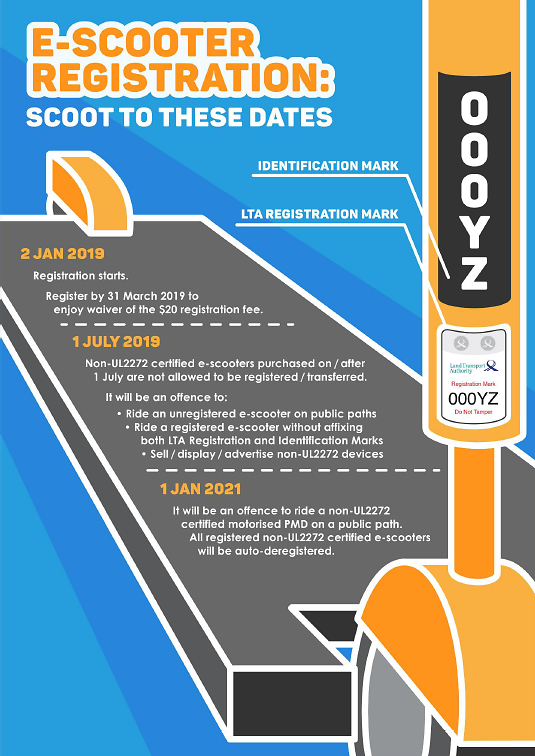
SINGAPORE: Owners of electric scooters will be able to register their devices with the authorities from Jan 2.
The registration fee of S$20 will be waived for owners who register their e-scooters by Mar 31, the Land Transport Authority (LTA) said this in a media release on Wednesday (Dec 12).
Registration can be done via LTA’s website at www.onemotoring.com.sg/escooter or at Singapore Post offices until Jun 30.
“Registrants must be at least 16 years old and will need to declare that their e-scooters are compliant with the device criteria specified under the Active Mobility Act,” LTA said.
“Those who make false declarations can be subject to a fine of up to S$5,000 and/or imprisonment of up to 12 months,” LTA added.
A unique registration number will be issued to owners at the point of registration. The e-scooter owners will then be required to fabricate an Identification Mark bearing the unique number, LTA said in the release.
A separate LTA Registration Mark will also be issued to the registrant, LTA added.
Those who register online will receive the LTA Registration Mark via registered mail while those registering at a SingPost office will receive it on-the-spot.
“Owners who register their e-scooters by Jun 30, 2019 will be given a grace period of 14 calendar days from the date of registration to affix both the Identification Mark and LTA Registration Mark prominently on the e-scooter, during which they may continue to use the e-scooter,” LTA said.
Key dates on e-scooter registration, which opens Jan 2, 2019. (Image: Land Transport Authority)
Riding an e-scooter on public paths without the Identification Mark or the LTA Registration Mark beyond the grace period is an offence, LTA said, with first-time offenders subject to a fine of up to S$1,000 or up to three months’ jail, or both.
From Jul 1, it will be an offence to “ride, or cause another person to ride” an unregistered e-scooter on public paths, LTA said. First-time offenders could be fined up to S$2,000, jailed for up to three months, or both.
“These measures are aimed at deterring reckless riding and facilitating enforcement efforts against errant riders to improve public safety for all path users,” LTA said.
According to the regulations, e-scooters must not exceed 20kg in maximum laden weight, 70cm in maximum width and 25kmh in maximum motorised device speed.
All motorised personal mobility devices must be certified to the UL2272 standard from Jan 1, 2021, LTA said.
Retailers will be banned from selling motorised PMDs that are not UL2272 standard from Jul 1 next year to improve public safety and minimise the risk of fire incidents, LTA added.
Those who currently own e-scooters without the certification can register their devices if they were purchased before Jul 1. However, they can only be used on public paths until Dec 31, 2020 and will automatically become de-registered on Jan 1, 2021.
“For the safety of device owners and those around them, LTA strongly encourages all owners to use UL2272 certified devices only,” LTA said.
SINGAPORE: Former City Harvest Church leader Chew Eng Han was on Wednesday (Dec 12) found guilty of trying to escape Singapore and defeat justice.
On the morning of Feb 21, Chew was caught by the Police Coast Guard following a tip-off while trying to leave Singapore illegally from Pulau Ubin.
This was a day before he was due to start serving a jail term of three years and four months for his role in the misappropriation of S$50 million in church funds.
At the time, Chew was allowed his request to start serving his sentence on Feb 22, after the Chinese New Year holiday.
Chew, who has served more than nine months of his original sentence, claimed trial over one charge of attempting to leave Singapore and another of attempting to defeat justice.
District Judge Victor Yeo found Chew guilty, saying he was not persuaded by the defence’s arguments that the accused was apprehended too early, and that his actions up to the point of his arrest did not amount to embarking on a crime proper.
The hearing was attended by a handful of people, while a lean Chew listened to the proceedings without expression.
PROSECUTION, DEFENCE TUSSLE OVER TECHNICAL ISSUES
The prosecution said that Chew had made arrangements to leave Singapore illegally and was on the first leg of a journey out of the country, which meant he had “embarked on the crime proper”.
Chew was caught while on a boat in Singapore waters, on his way to meet up with a second boat, which he would then board for Malaysia.
Chew’s defence lawyer Adrian Wee said that his client was “apprehended too soon” and had not embarked on the crime proper as he was not on the boat that was intending to leave for Malaysia.
He added that Chew “had not completed the act of leaving Singapore”, and so could not be said to have tried perverting the course of justice.
Furthermore, the course of justice “had ended when the Court of Appeal rendered its decision on Feb 1 2018”, said Mr Wee. This was when the Apex Court rejected the prosecution’s bid to reinstate longer jail terms for the former CHC leaders.
In response, Deputy Public Prosecutor Christopher Goh said the course of justice ends only when the sentence has been served.
NOT PERSUADED BY DEFENCE, SAYS JUDGE
In delivering his verdict, the judge said that Chew setting out to sea on the first boat was an inextricable part of his journey out of Singapore.
“By the time the accused embarked on the first boat, he was clearly on his way to leaving Singapore from an unauthorised place,” he said.
“I am not persuaded by the defence’s arguments. With due respect to the learned counsel, the arguments would require the court to adopt an overly narrow view,” said the judge.
He added that “drawing such fine distinctions would result in an illogical outcome in which an accused person who designs an elaborate escape plan with multiple legs of the journey … would evade liability”.
The judge also agreed with the prosecution that the course of justice continues even after sentences have been passed and appeals exhausted, rejecting the defence’s argument that it had ended after the final appeal.
Five other City Harvest leaders who were sentenced alongside Chew for the misuse of church funds started serving their sentences in April last year.
Two men who helped Chew in his attempt to escape Singapore by boat were sentenced to jail in July.
Tan Poh Teck, 53, the boatman piloting the motorised sampan in Chew’s escape bid, was sentenced to 27 weeks’ jail.
He had intended to take Chew to the northeastern part of Pulau Ubin, where Chew would take another boat.
Tan Kim Ho, a 42-year-old Malaysian man also known as Rayson, who made arrangements for Chew to get to Malaysia by boat, was sentenced to a jail term of six months.
Another man, Malaysian driver Khoo Kea Leng, was jailed for six months in April for his role in the escape plan. He had linked Chew up with Rayson.
BROKERS in Singapore’s real estate have forecasted the prices of residential properties in city-state to remain stagnant or even dip next year.
While the prices of homes were predicted to increase as much as 10 percent this year, estimates compiled by Bloombergshow a decline of up to three percent next year and home sales below 2017 levels this year may not appreciate any further next year.
Lee Nai Jia, Knight Frank’s head of research in Singapore, said the market has “come to a standstill.”
“The Government is unlikely to introduce additional curbs or rollbacks as the market is stabilising.”
In July, the government introduced measures to cool the market which led to the slow down in the increase of residential property price.
Singapore’s regulators saw the need to introduce the measures in wake of a seven percent hike in prices during the first half of the year owing to aggressive land bids from developers and collector or redevelopment transactions, according to Bloomberg.
Other constrictions include the government limiting the number of “shoe-box sized” apartments that developers can build, along with additional anti-money laundering safeguards.
By Trong Nguyen Royalty-free stock photo ID: 747163435 Public residential condominium building complex and downtown skylines at Kallang neighborhood in Singapore. Source: Shutterstock
The supply of residential units spiked and the demand for them lowered after the government announced plans to slow the release of land sales in the first six months of next year.
Smartkarma analyst Tan Kok Keong told Bloomberg that home builders were increasingly worried about the government’s constant tweaking of rules as costs for development could rise while interest in Singaporean properties among foreign buyers could dip.
However, the government insists that its intervention was crucial in avoiding a property bubble as home prices could jump as much as 15 percent this year.
“Let me be very clear that the Government cannot and will not take a hands-off attitude to the property cycle,” National Development Minister Lawrence Wong said in a speech last month.
“So there should not be any surprise when we intervene in the market, because that is our approach and attitude.”
Executive director at real estate asset manager ZACD Group, Nicholas Mak, said property prices would remain flat next year at best, but said declines of up to three percent could happen.
“Had the Government not introduced the additional curbs, this bull run in the residential market would have continued for three years.”
SINGAPORE: Mention “engineering” and the image of a nerdy, socially awkward character preoccupied with machines and working on mundane tasks springs to mind.
In reality, however, that perception is far from true.
Today, engineering has become more diverse compared to two decades ago. In the past, there were only four main fields of engineering – civil, chemical, electrical and mechanical – available in local universities. Now there are many sub-disciplines and specialist engineering fields such as biochemical, computing, pharmaceuticals and robotics, just to name a few.
An engineer’s work is as distinctive as it is sophisticated. A mechanical engineer could design products like toys, turbines and spacecrafts using his knowledge of materials, mechanics and energy transfer.
A biochemical engineer could use her knowledge of chemical, life and materials sciences to develop and test products in healthcare, petrochemicals, food and energy sectors.
ENGINEERS AND THE SMART CITY
Changing urban environment calls for new skills, and the role of engineers has become more sophisticated.
Smart cities projects have sprouted up throughout Asia, including Singapore. The underlying denominator to making a city “smart” is technology-led development – such as high-speed broadband and energy management systems – that lead to greater efficiencies, according to The Economist.
Smart cities are also about promoting sustainable growth, upskilling of jobs through innovation, and improving quality of people’s lives through technology advances in transportation systems, education and healthcare.
For instance, the Singapore Management University (SMU) has become a fully green campus. Johnson Controls’ engineers designed a chiller plant that met system efficiency standards, as well as right-sized the plant capacity and installed high efficiency chillers and other equipment.
The improved chiller plant system efficiency is expected to yield significant energy savings and expenditure for the university.
Artist’s impression of the new SMU Campus Green. (Image: SMU)
On the other hand, South Korea’s Songdo, an intelligent city built from the ground up, has nearly 40,000 residents and another 70,000 commute to the city daily for work.
Billed as a first-generation smart city, Songdo has a pneumatic waste disposal system that sucks trash from homes into processing centres for automatic sorting and recycling of the waste into renewable energy. Buried underneath the streets are sensors that detect traffic conditions and alter signals based on congestion.
HOW MANY ENGINEERS DOES IT TAKE TO BUILD A SMART CITY?
Singapore was built “on the backs of engineers” who spearheaded the nation’s economic growth. Now, with the push towards a Smart Nation, there is a need to develop even stronger deep engineering capabilities to solve complex engineering problems.
Some estimated 30,000 infocomm jobs, including tech engineering jobs, need to be filled by 2020.
Although engineering is a professional degree, it’s often seen as an outdoor, dirty job where an engineer would spend most of his time at a job site.
Long hours, low pay and poor job prospects are some of the myths that typically sum up people’s view of engineering.
To be fair, this can in some ways be true of the initial three to five years of an engineer’s professional life. But it is an essential phase to hone one’s technical skills and engineering knowledge, cumulating in experience that would be invaluable in the later stages of one’s engineering career.
ATTRACTING AND KEEPING ENGINEERING TALENT
So, what can we do to attract and to retain engineering talent?
Employees work at Samsung Bioepis labs in Incheon, in this handout photograph taken on May 7, 2014 and provided by Samsung Bioepis. (Photo: Samsung Bioepis/Handout via Reuters)
Firstly, there’s a need to spread the passion for engineering. As a teenager, I used to work in my father’s air-con servicing business during the school holidays.
I was intrigued by the mechanism and was eager to learn more about the trade, despite always being covered in dirt and sweat from fixing the equipment. The experience sparked my interest to pursue engineering as a field of study and subsequently, my profession of choice.
We need to keep that spark of curiosity going with current engineers. They should be encouraged to be creative and to upskill themselves in the latest technologies, especially in embracing digital and data-driven ways of solving engineering problems.
In a built environment, this means the use of app-based and unmanned platforms to resolve issues. For instance, our engineers are tapping cloud technology to remotely monitor installed chillers, as well as to analyse the data sent back by the equipment to take preventive measures against threshold breaches.
Engineers need to see beyond the mundane to find meaning in their work. What we do or don’t do has a direct impact on the larger community.
For example, creating optimised work environments for building occupants allows them to be productive at work; or helping smart building owners save money by cutting energy consumption with well-designed, energy-efficient solutions.
When you strip it down to its bare essentials, engineering is about solving problems and removing roadblocks.
Beyond technical knowledge, engineers are tasked with project management and taking on leadership roles. Complex projects like the Marina Barrage or the Zero Energy Building at BCA Academy required deep engineering capabilities and a thriving engineering ecosystem for support.
Giving proper recognition to engineers and better incentives commensurate with their advanced skill-sets could help stem the drain of our engineering talents.
To nurture future engineers, it’s important to give students a peek into what real-world, real-life engineering is about through immersive, experiential hands-on learning.
Our collaboration with ITE College East — the setting up of a fully functioning chiller plant system designed for a classroom setting — allows students to apply their knowledge to real-life smart building management systems.
Previously, they could only observe equipment outside of the classroom and did not have access to live systems to experiment and operate in real-time.
Indeed, the “nerd” label does not do justice to the engineers of tomorrow. Think Elon Musk – the multi-billionaire engineer whose work is redefining transportation – and you’ll get the picture.
Elon Musk speaks at Boring Company community meeting in Bel Air, Los Angeles, California on May 17, 2018. (Photo: Reuters)
Engineers create interesting things that impact and potentially transform people’s lives.
Going forward, they will be challenged to apply their intelligence, creativity, skillsets and experience to design and develop smart cities for the masses.
So, how many engineers does it take to build a smart city? Well, the answer: “All of us.”
Ken Lim is general manager and managing director in Building Technologies and Solutions, Singapore at Johnson Controls.
SINGAPORE: Consumers in Singapore gave the quality of mobile and broadband services high marks in general, but felt that telco hotline waiting times were too long, according to a survey released on Tuesday (Dec 11) by the Infocomm Media Development Authority of Singapore (IMDA).
The Consumer Awareness and Satisfaction Survey, which is in its sixth cycle, was last held in 2014.
Respondents were asked to rate their satisfaction with key services, including mobile data, fixed broadband, mobile telephone, international roaming and fixed-line telephone, among others.
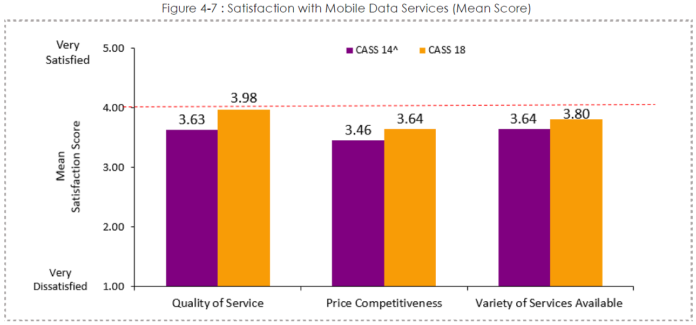
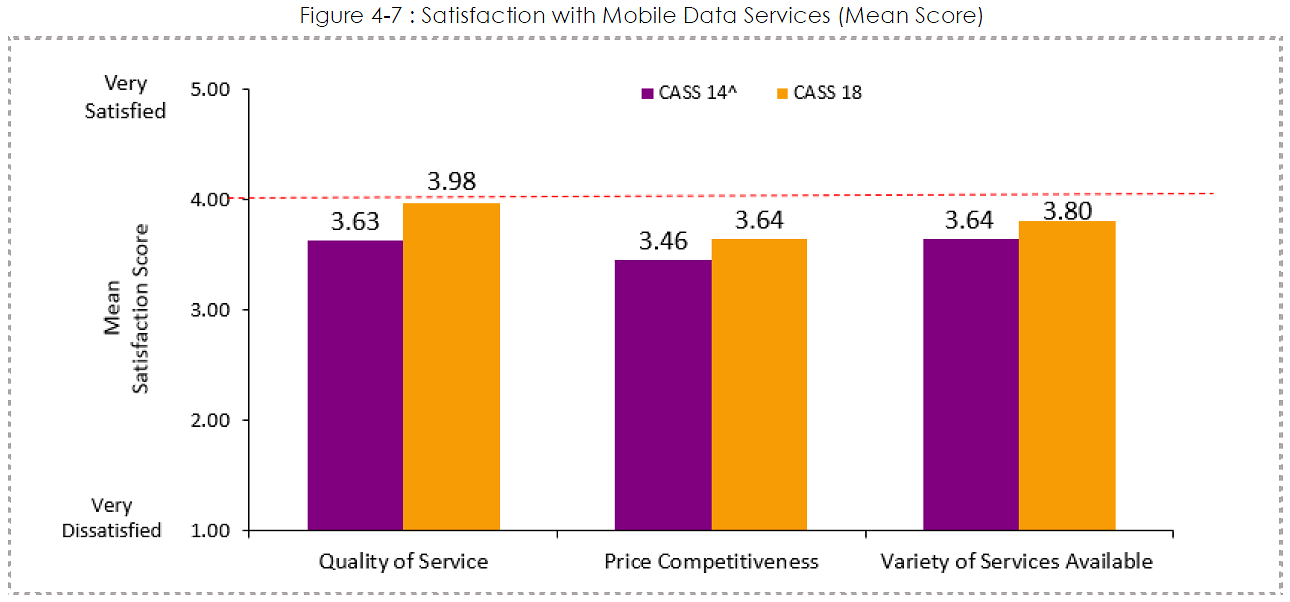
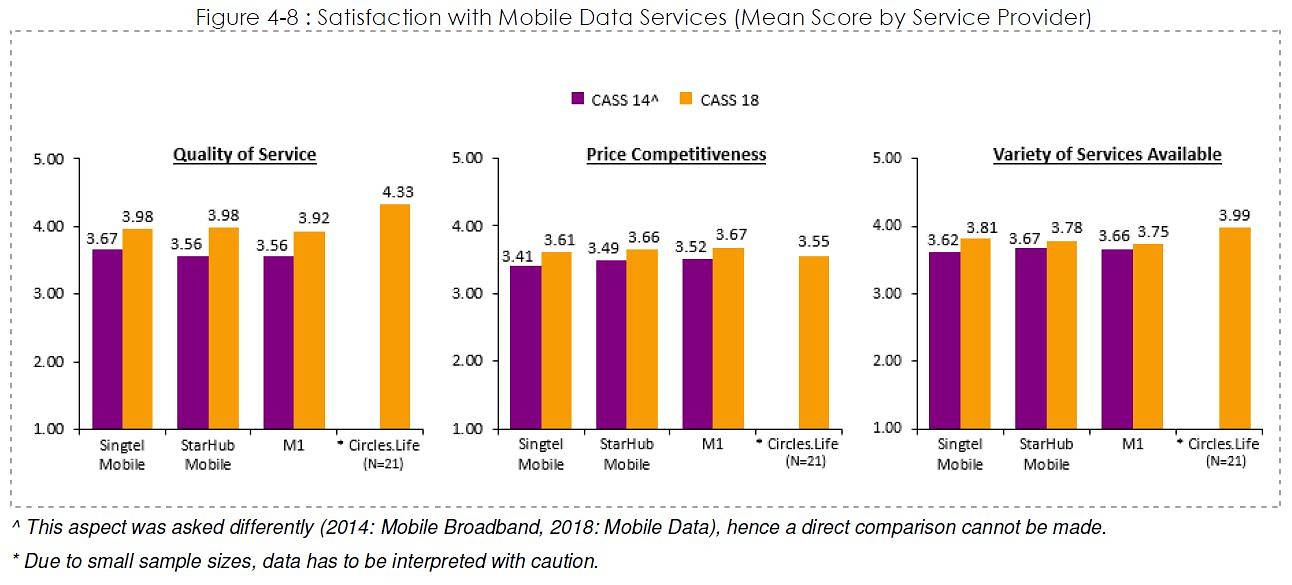
Ratings for the quality of service were positive for all, with users giving mobile call and messaging services a score of 4.04, mobile data a rating of 3.98 and fixed broadband a slightly lower 3.68.
All five services achieved similar or higher ratings for quality of service compared with 2014. Mobile data service saw the biggest jump, rising from 3.63 in 2014 to 3.98 in 2018.
Consumer satisfaction with mobile data services. (Image: IMDA)
MOBILE COVERAGE
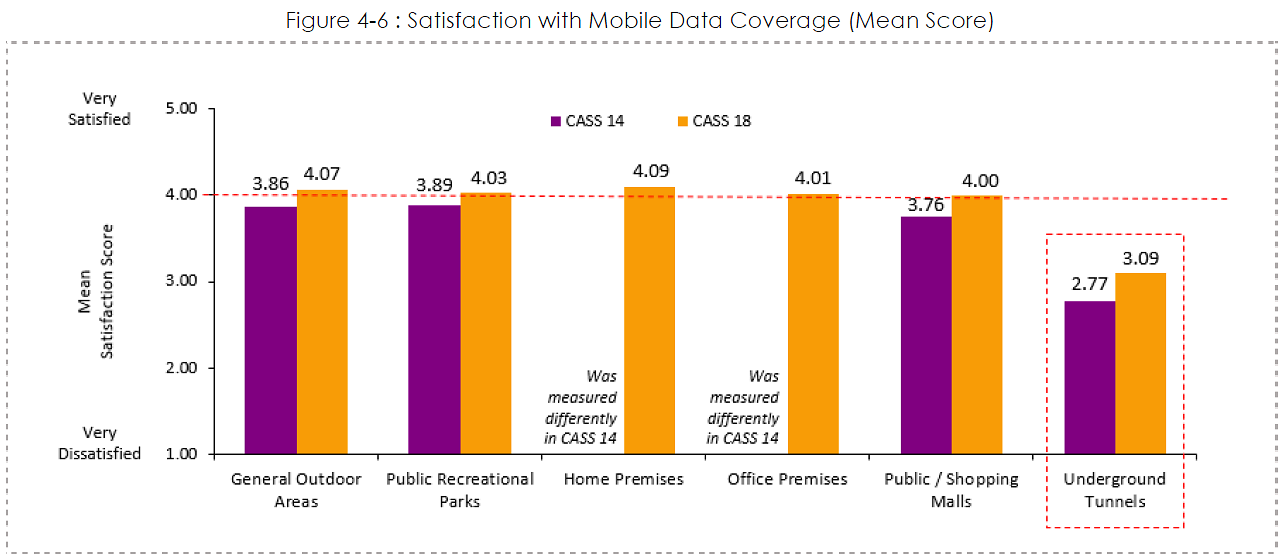
Satisfaction with the coverage of mobile data services outdoors, at home, in offices and shopping malls was at least 4 points.
Satisfaction with the coverage in underground tunnels remained the lowest but improved from 2.77 in 2014 to 3.09 this year.
Consumer satisfaction with mobile data coverage across locations. (Image: IMDA)
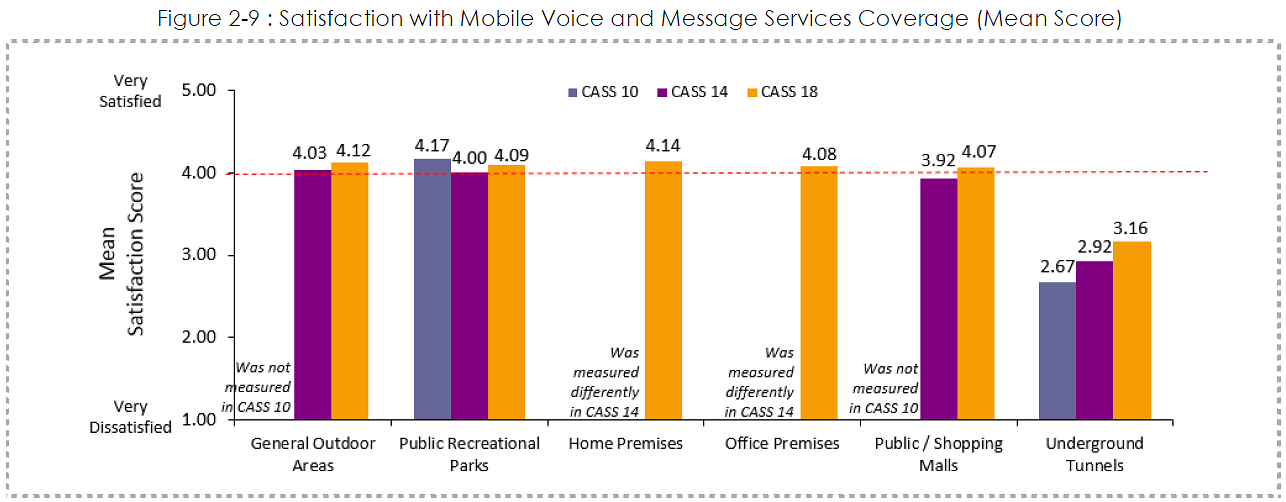
Similarly, satisfaction with the coverage of mobile voice and message services was at least 4 points in most areas, but coverage in underground tunnels got a rating of 3.16.
Consumer satisfaction with mobile voice and message services coverage across locations. (Image: IMDA)
COMPARING TELCOS
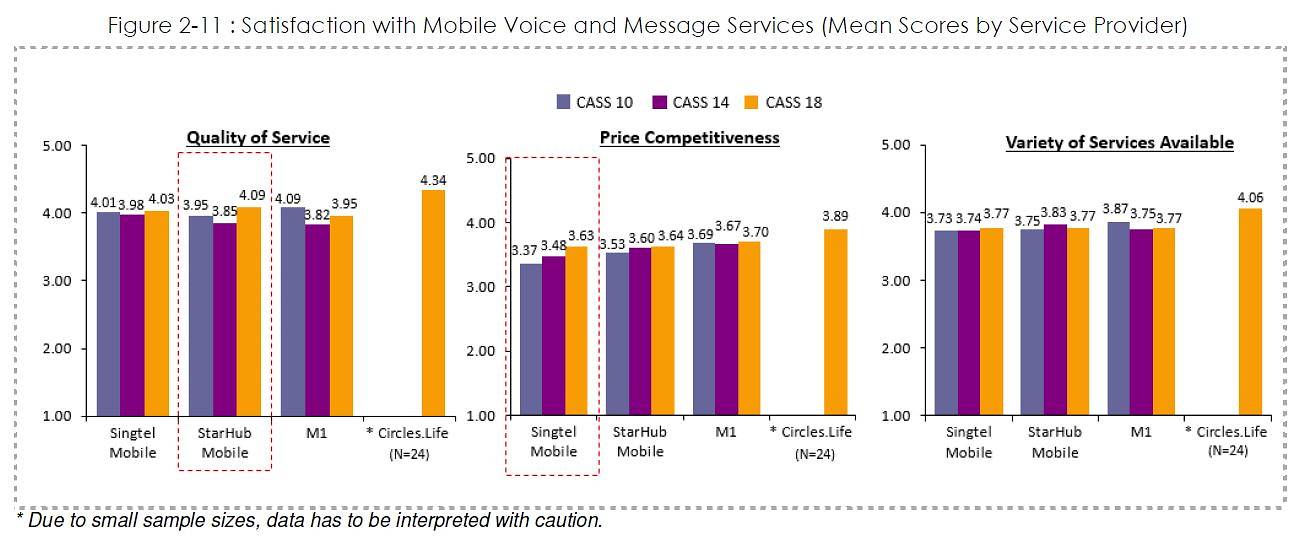
Among the three main telcos, StarHub saw a “large increase” in its satisfaction mean score for the quality of mobile voice and message services, whereas Singtel Mobile and M1 saw a smaller increase in their mean scores.
Satisfaction with mobile voice and message services by service provider. (Source: IMDA)
Satisfaction with the quality of mobile data services was fairly consistent across the main telcos with all scoring close to 4.
Satisfaction with mobile data services by service provider. (Source: IMDA)
REDUCE HOTLINE WAITING TIME: CONSUMERS
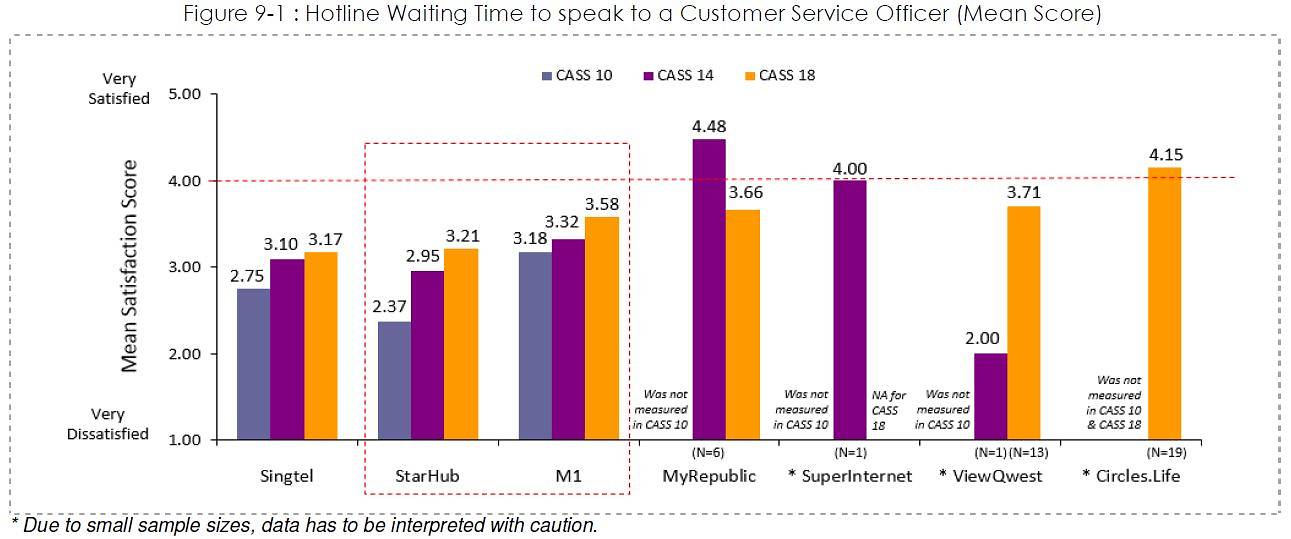
As with previous years, the improvement most respondents wanted to see was a shorter waiting time on the telcos’ hotlines.
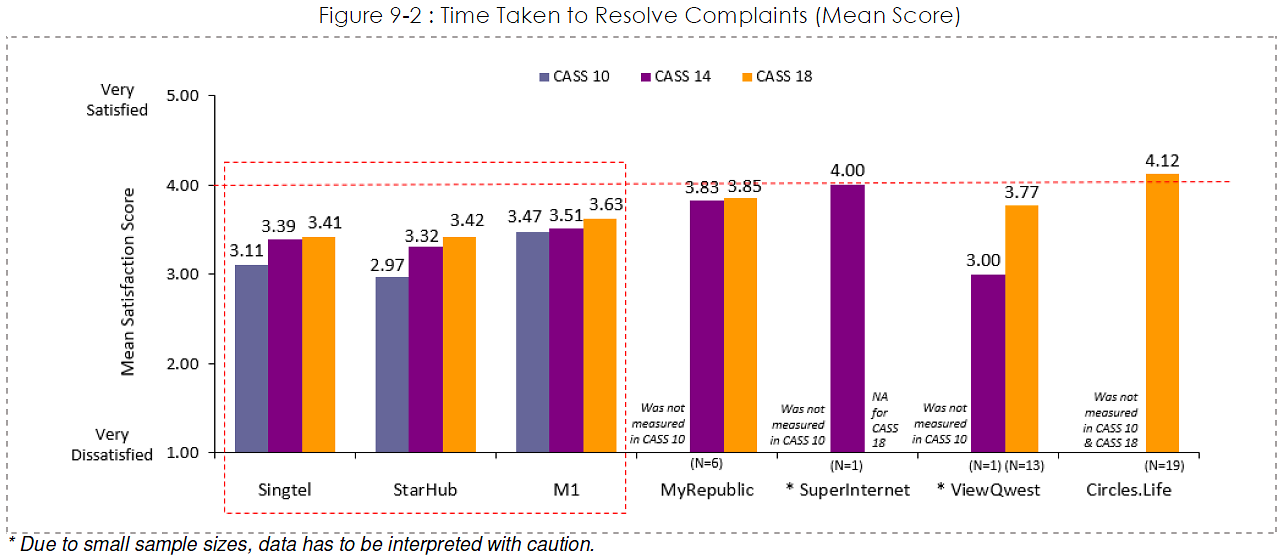
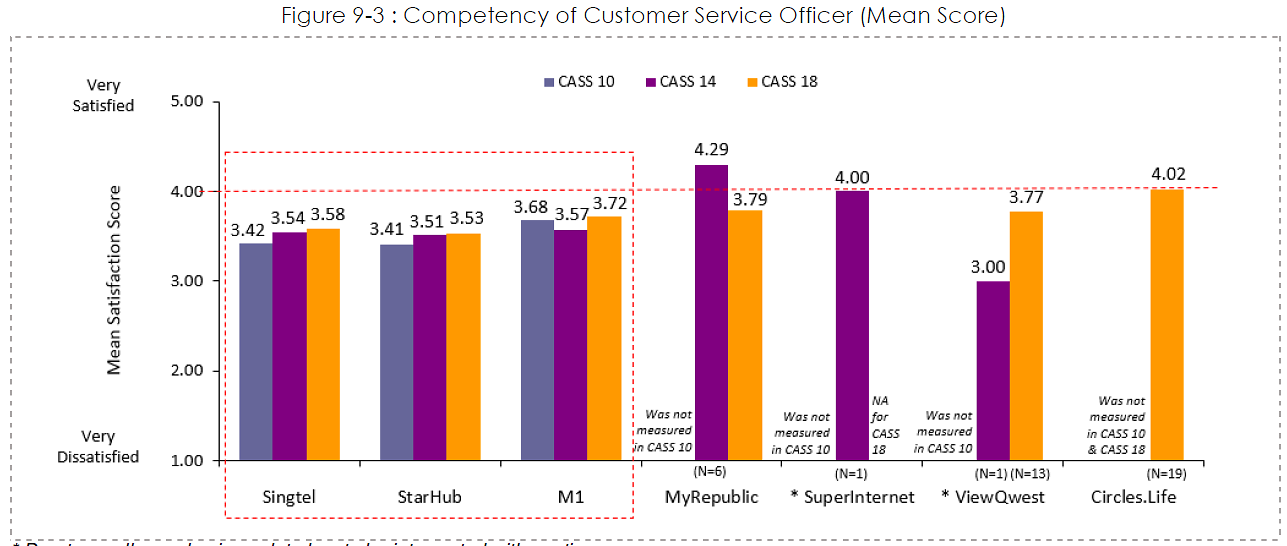
Consumers also highlighted the need to have prompt and effective follow-up to complaints, and wanted service providers to improve the competency and product knowledge of customer service officers.
Hotline waiting time by service provider. (Source: IMDA)
Among the service providers, respondents were least satisfied with the hotline waiting time and the time taken to resolve complaints by Singtel, and the competency of customer service officers from StarHub.
Consumer satisfaction on time taken by telecommunication providers to resolve complaints. (Image: IMDA)
Consumer satisfaction on competency of customer service officers across telecommunication providers. (Image: IMDA)
However, satisfaction with customer care has improved for the three main service providers – Singtel, StarHub and M1.
HIGHER USER ADOPTION RATES
The adoption rates of telecommunications services – mobile data (83.8 per cent), fixed broadband (92 per cent) and mobile telephone (96.5 per cent) continued to increase, with the exception of fixed telephone lines, which has been on the decline since 2005.
In particular, subscription to mobile data services among respondents aged 60 and above doubled to 58.1 per cent in 2018 from 25 per cent in 2014.
While mobile plans with a phone subsidy are still the most popular among consumers, SIM-only mobile plans now make up one in six (or 16.2 per cent) of mobile plan sign-ups.
The survey also found that the use of Wireless@SG doubled from 20.8 per cent in 2014 to 43.5 per cent in 2018.
Adoption of international roaming services rose after a drop in 2014 (46 per cent). while payphone usage continued to decline sharply (4.5 per cent).
The survey was conducted between March and May 2018, and involved about 1,500 households representative of Singapore’s population.
SINGAPORE: Only half of Singaporean adults get enough sleep at night, according to a survey conducted by market research firm YouGov released on Tuesday (Dec 11).
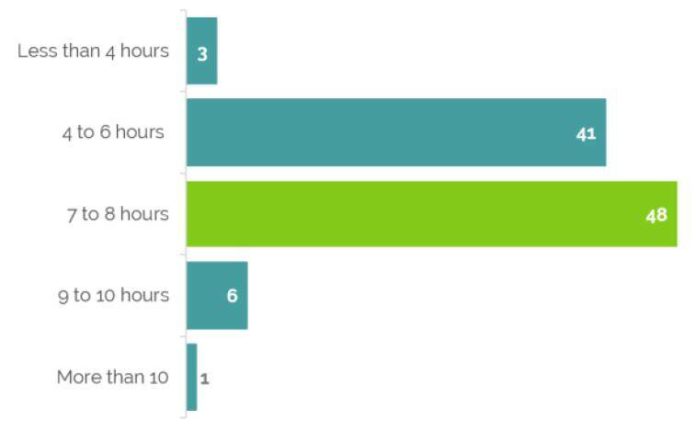
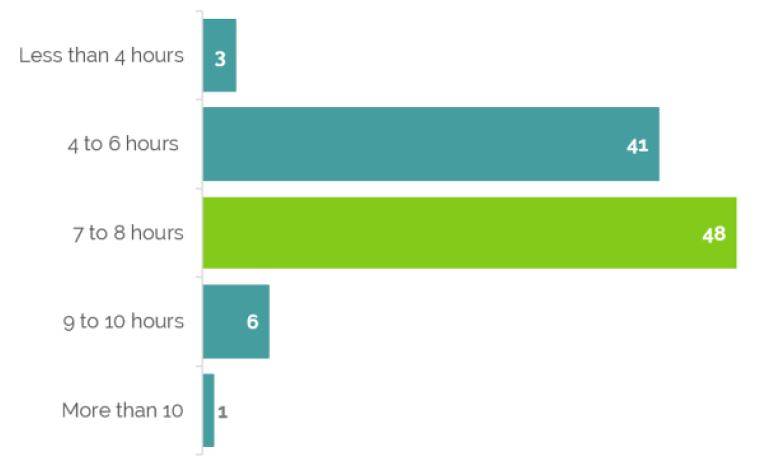
While the average adult should get between seven and eight hours of sleep daily, only 48 per cent of Singaporean adults do.
The data, based on a survey of 1,022 Singaporeans, showed that four in 10 adults get less than seven hours of sleep a night.
About 3 per cent of Singaporeans get less than four hours of sleep a night. (Source: YouGov)
“In a fast-paced metropolis like Singapore, only about half its citizens are getting enough rest. What’s particularly worrying is lower-income Singaporeans are twice as likely to get less than four hours of sleep a night,” said Mr Jake Gammon, the Asia-Pacific head of YouGov Omnibus.
The survey, which was conducted last month, found that while 3 per cent of Singaporeans get less than four hours of sleep, this proportion doubled among those with a monthly household income of less than S$4,000.
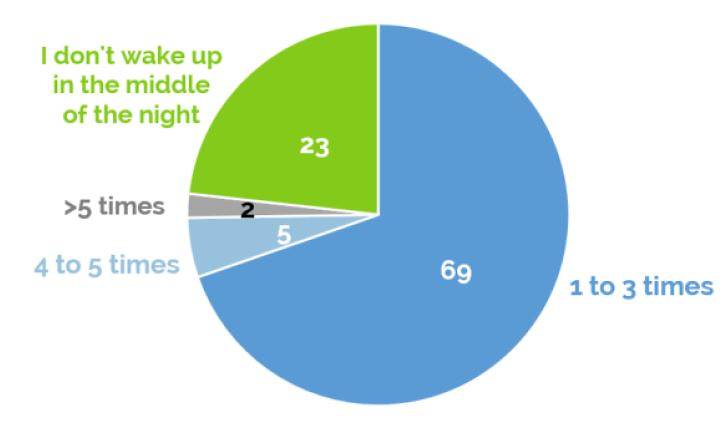
In addition, three-quarters of Singaporeans wake up at least once a night, the survey found.
On average, only a quarter of Singaporeans sleep through the night. (Source: YouGov)
“Once Singaporeans turn 55 however … their quality of sleep seems to improve, suggesting demanding work could be the cause of sleepless nights,” said Mr Gammon.
More than half of the respondents (53 per cent) also said they sleep with a “chou chou” or comfort object such as a stuffed toy or security blanket, the survey found.
Women were more likely to sleep with a comfort object at 61 per cent compared to men at 44 per cent.
Those aged between 25 and 34 were more likely to use a comfort object (61 per cent) compared to those aged 55 and above (32 per cent).
However, there was no indication that those who sleep with a comfort object have better or longer hours of sleep than those who do not, the study noted.