“We are pleased to note that, by MND’s own criteria, AHTC’s performance over the recent years in the areas of S&CC arrears management and corporate governance has progressively improved,” it said in a press release on Friday evening.
“This was achieved through the significant efforts of AHTC and its residents, despite the many challenges faced,” it added.
MND released the town councils’ financial statements and the town council management report for FY2017 on Friday.
The ministry highlighted that Workers’ Party-run AHTC was the only town council that submitted qualified financial statements for last year and that it was the seventh straight year the town council had done so.
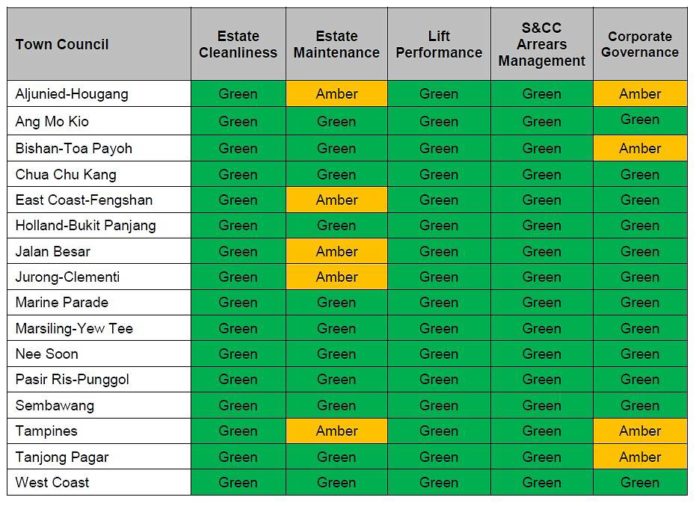
The town council management report also said that AHTC scored “amber” ratings for corporate governance and estate maintenance.
The 16 town councils are assessed annually under five indicators using three colour bands – green, amber and red – with green being the best and red the worst.
Summary of town councils’ performance for FY2017. (Table: Ministry of National Development)
The town council report said of AHTC’s amber rating for corporate governance: “Failure to maintain updated accounts and records of expenses due to an internal control weakness where the TC failed to record expenses incurred in a timely manner.
“This was also the reason why the auditor had qualified AHTC’s financial statements.”
In response, AHTC said that MND’s press release on the qualification received by the town council from its external auditor was “selective and incomplete”.
“What MND omits to say on this observation, but was included by AHTC’s external auditor, is that the expenses in question ‘are found to have been taken up into expenses and the related payables during the financial year’ and that ‘there are no material misstatements found in the expenses and related payable transactions during the financial year.’,” AHTC said.
“In contrast, when describing Tampines Town Council’s amber rating for corporate governance, MND chose an even-handed and balanced tone.”
MND’s report had said that Tampines Town Council scored an amber rating for an incorrect amount transferred from the operating fund to the sinking fund and lift replacement fund. It also added in the report that: “The TC had identified the computational error and rectified it, but it is still considered a case of non-compliance as the correct amount was not transferred within one month after the end of the quarter.”
In its response on Friday, AHTC also said that while it is factually correct that this is the seventh year the town council has received qualified statements from its external auditor, MND’s report gives the impression “that AHTC has stood still for seven years”.
“From 13 observations flagged in 2012-13, AHTC has received just one observation this financial year,” AHTC said.
“We believe MND’s specific reference to seven consecutive years is deliberately calculated to lower the esteem of AHTC in the public eye.”
AHTC town councillors and Workers’ Party leaders have been accused of breaching their fiduciary duties in the management of the town council and are currently fighting the allegations in court.
About 150 to 200 students from the new Data Science and Artificial Intelligence undergraduate programme are expected to benefit from this, says the university.
NTU’s dean for the College of Engineering Professor Louis Phee (second from left) and AMD’s corporate vice president for Asia Datacenter Group Allen Lee (second from right) at the lab’s launch event. (Photo: AMD)
(Updated: )
Bookmark
SINGAPORE: Global chipmaker AMD and Singapore varsity Nanyang Technological University (NTU) on Friday (Dec 14) jointly announced the launch of a S$4.8 million laboratory aimed at nurturing future data science and artificial intelligence (AI) talent here.
In their press release, both parties said the data science and AI lab will tap on AMD’s deep learning technologies as well as NTU’s strengths in machine learning, AI and data science.
Benefiting from these will be the first batch of undergraduates for NTU’s Data Science and Artificial Intelligence programme that will run from academic year 2019.
These students will be exposed to real-world applications such as developing software used in security fields like identification and motion detection. They will also work on projects such as developing clinical support solutions using big data analysis to aid medical diagnosis , it added.
Students will work on AMD’s open-source Radeon Open Compute platform that will allow them to simulate complex systems or scenarios in days, rather than years, it said.
The university will invest S$1.9 million in the lab, while AMD will put in another S$2.9 million, NTU told Channel NewsAsia separately on Friday. About 150 to 200 students from the new programme will stand to benefit from the facility, a spokesperson added.
The varsity will provide the lab space, cover operational costs and provide domain experts from its teaching staff, while AMD will provide the technology along with training and development support from its machine learning, AI and high-performance computing (HPC) experts.
The investment will help AMD develop local talent and “seed” AI and data science skills to future leaders and researchers at a very early stage.
“This would give them time to be familiar with the technology as well as equipping them with the knowledge that there are alternative deep learning platforms available that can run TensorFlow or Caffe applications,” a AMD spokesperson said.
TensorFlow and Caffe are deep learning or machine learning frameworks popularly used today.
The partnership will be for five years and is timed to allow undergrads taking the data science and AI programme to enjoy the full benefits of this industry collaboration, the spokesperson added.
“NTU is the premier institution for artificial intelligence, and we’re very excited to bring our technologies to empower the participating students to freely explore the diversity of deep-learning applications,” said Mr Allen Lee, corporate vice president for Asia Datacenter Group at AMD, in the press release.
SINGAPORE: Nine people have been caught with duty-unpaid cigarettes in two operations in Yishun and Sengkang, said Singapore Customs in a Facebook post on Thursday (Dec 13).
The raids, conducted together with the Housing and Development Board (HDB), took place on Dec 6 and 11.
The offenders were issued fines ranging from S$500 to S$1,900.
Another suspect is being investigated after being caught with duty-unpaid liquor.
One person was caught with duty-unpaid alcohol during the operations. (Photo: Facebook/Singapore Customs)
The Facebook post also said that some HDB units were found to be overcrowded.
Singapore Customs said they will continue working with government agencies to deal with activities involving duty-unpaid cigarettes in Singapore.
Duty-unpaid cigarettes were found during the operations. (Photo: Facebook/Singapore Customs)
The fine for a first-time offender found to have up to one packet of duty-unpaid cigarettes is S$500. Repeat offenders and those caught with more than one packet will be given heavier penalties.
Singapore Customs urged the public to report Activities involving duty-unpaid cigarettes by calling their hotline at 1800-2330000, emailing customs_intelligence@customs.gov.sg or using the Customs@SG mobile app.
SINGAPORE: Aljunied-Hougang Town Council (AHTC) was the only town council that submitted qualified financial statements for 2017 – the seventh straight year it had done so, the Ministry of National Development (MND) said on Friday (Dec 14).
A qualified financial statement indicates that the auditor may have received incomplete information, or that the entity being audited used accounting methods that did not follow generally accepted accounting principles.
AHTC’s financial statements were qualified by its external auditor “due to an internal control weakness where the town council failed to record expenses incurred in a timely manner”, MND said.
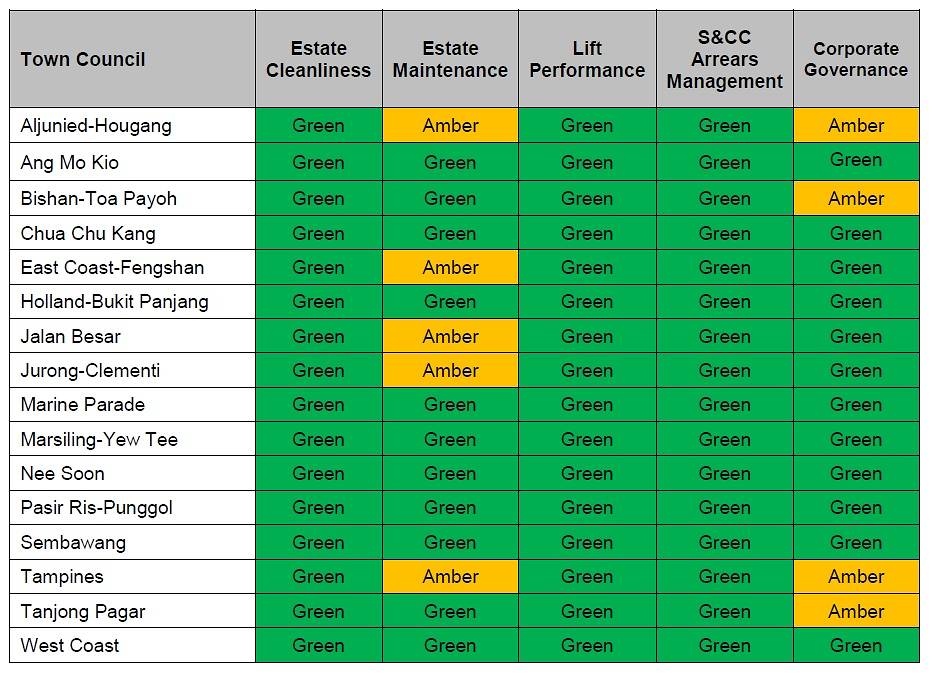
The ministry also released its town council management report for 2017, where four town councils – including AHTC – scored an “amber” rating for corporate governance.
The 16 town councils are assessed annually under five indicators using three colour bands – green, amber and red.
A “green” rating means that there was full compliance with the checklist for the indicators; “amber” means there is one item of non-compliance or one observation from the auditor; “red” is the worst rating, with at least one item of non-compliance and one observation from the auditor, or two or more items in either category.
Summary of town councils’ performance for FY2017. (Table: Ministry of National Development)
AHTC was rated “amber” in corporate governance for its failure to maintain updated accounts and records of expenses.
Bishan-Toa Payoh Town Council was rated “amber” because it accepted quotations which were not circulated to the town council as required.
Tampines Town Council also scored an “amber” rating for an incorrect amount transferred from its operating fund to the sinking fund and lift replacement fund. The town council had identified the error and rectified it, but the correct amount was not transferred within one month after the end of the quarter, MND said.
The “amber” rating for Tanjong Pagar Town Council was due to it obtaining approval for the transfer of budget from other areas to its cleaning and utilities expenses only after the expenditure was incurred.
5 TOWN COUNCILS RATED “AMBER” IN ESTATE MAINTENANCE
Five town councils – Aljunied-Hougang, East Coast-Fengshan, Jalan Besar, Jurong-Clementi and Tampines – were rated “amber” in estate maintenance.
This means that they had between four and seven counts of “maintenance observations” per block on average, MND said.
All 16 town councils scored “green” in the other categories of estate cleanliness, lift performance, and arrears management for service and conservancy charges.
The ministry said it has reviewed the current set of indicators and methodology for its annual town council management report.
“For FY2018, the areas measured under the estate cleanliness and estate maintenance indicators have been updated to sharpen the focus on issues of public health/hygiene, public safety and the living environment.
“These include increasing the severity levels for observations such as overflowing refuse in bin chutes, and adding new items such as snapped/dangling tree branches,” it said.
The remaining indicators are being reviewed progressively and details will be announced when ready, it added.
The FY2017 audited financial statements of all town councils have been presented to Parliament, and the statements will be made available on the town councils’ websites.
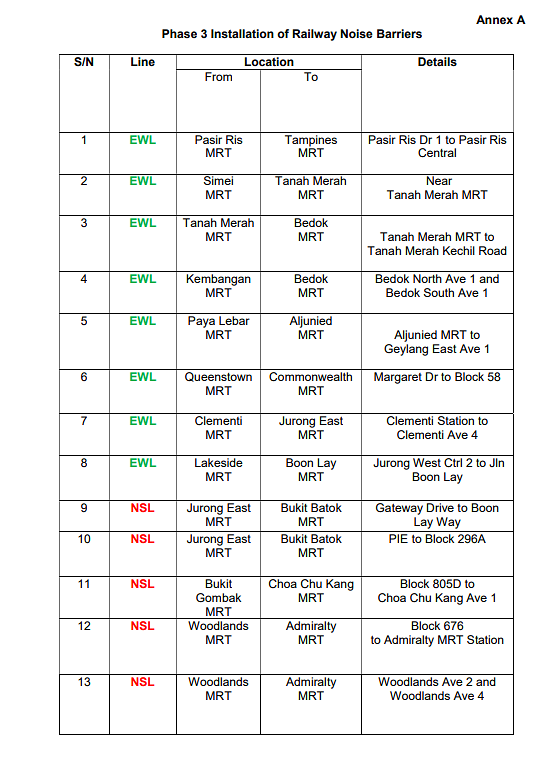
SINGAPORE: The Land Transport Authority (LTA) has called a tender to install railway noise barriers at 16 new locations along the North-South and East-West MRT lines, it announced in a statement on Friday (Dec 14).
The awarding of the tender is expected in July 2019.
This phase, the third of the railway noise barriers programme, will cover elevated railway sections in areas such as Jurong, Woodlands and Pasir Ris. About 5.5km of railway noise barriers will be installed.
On-site installation works are expected to begin in the third quarter of 2020 and completed around 2023, following design and off-site fabrication works. This will bring the total length of noise barriers installed across Singapore to 27km.
Such noise barriers are expected to reduce rail noise levels by about five to 10 decibels.
LTA has implemented early closures and late openings along the North-South and East-West lines since December 2017 to facilitate installation works. On-site works under Phase 2 of the programme is currently ongoing, slated for completion by 2020.
Priority is given to stretches along elevated railway tracks where the noise levels exceed the National Environment Agency’s standard of 67 decibels per hour.
Other measures implemented by LTA to reduce railway noise include the use of noise-dampening wheels and concrete sleeper tracks. The agency also said they would continue working with train operators and manufacturers to find alternative solutions.
SINGAPORE: For Mr Sean Saito, stepping into technology seemed like serendipity.
The 24-year-old had his first serious encounter with a tech problem in 2013, when the Internet connection at his home in Japan failed. No one in the family knew how to get it back up again. Even though he knew nothing as well, he was expected, as the oldest son, to troubleshoot the issue.
He looked up the wireless router’s manual for answers, which includes turning the device off and on again. When that failed, he flipped through the manual again and was instructed to “open command prompt” on his computer and key in some computer commands.
“After two commands, the Internet worked again!” Mr Saito recounted to Channel NewsAsia in a recent interview.
“My mum and younger brother were amazed at what I did,” he said, adding with a laugh that there was some “hero worship” at play.
That same year, he travelled to Singapore to start his undergraduate studies in computer science at Yale-NUS College, influenced in part by that incident at home.
“I never touched programming until then,” he shared.
He has flourished since. He founded a coding academy Code Gakko for students while finishing his degree, and holds the distinction of being the first Bachelor’s degree hire at German software giant SAP for the position of a machine learning (ML) developer.
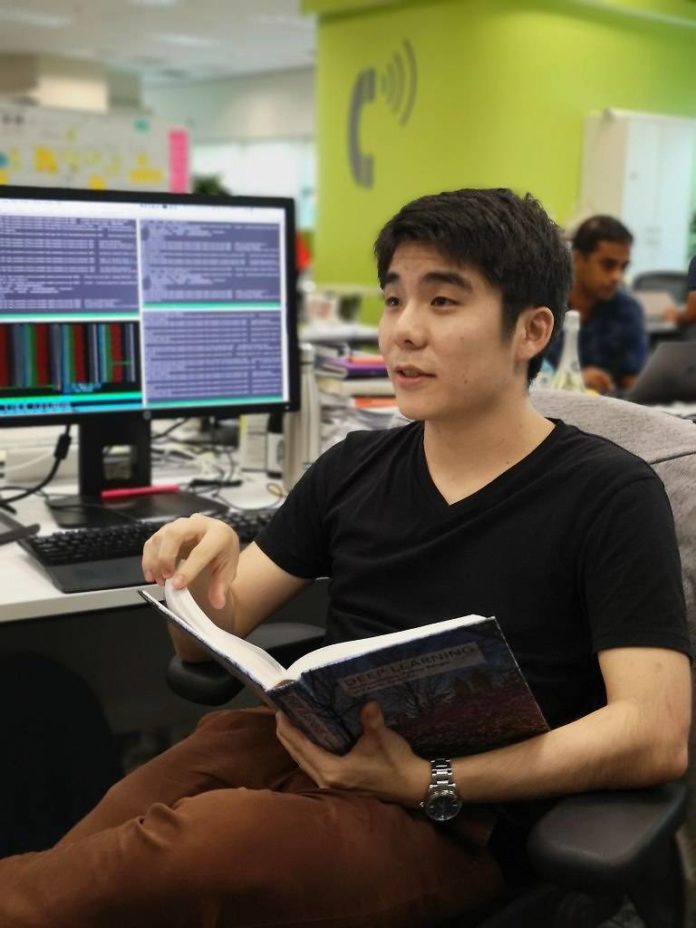
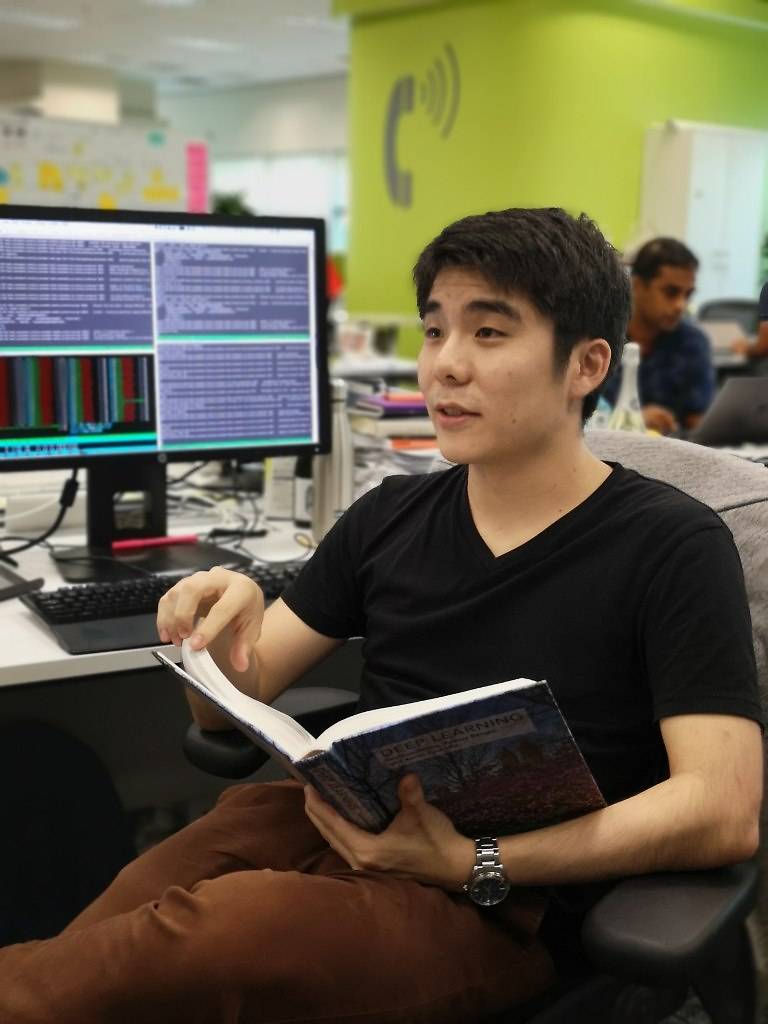
Mr Sean Saito is the first Bachelors-level hire for his role as machine learning developer at software giant SAP. (Photo: SAP)
HUMANITIES MAKE SENSE OF TECHNOLOGY
Asked what helped him hit the ground running after graduating, Mr Saito said that the liberal arts foundation at Yale-NUS gave him a different perspective of programming and artificial intelligence (AI).
One example of this was when he took philosophy and was exposed to Scottish philosopher David Hume’s theory of empiricism. He explained how he took it to mean one derives the knowledge one does through one’s experiences and this, in his view, is similar to machine learning.
“It’s kind of like machine learning and how they learn through making mistakes,” he elaborated.
It is this interdisciplinary mindset that Mr Saito said was helpful and encouraged others to adopt, and not just focus on the technical side of computer science.
Artificial intelligence and machine learning have been key themes in this year’s technology landscape, not least in Singapore where the Government has been pushing for its adoption and building up the necessary talent pool.
All ministries and related agencies are, in fact, required to have at least one project using AI for service delivery or policy making by 2023 – in key performance indicators (KPIs) spelt out in the Digital Government Blueprint released in June this year.
BASICS ARE BEST
Mr Saito’s SAP colleague, Mr Benjamin Yap, came through a more conventional route, taking up a computer engineering degree at the National University of Singapore (NUS), graduating in 2010.
For him, the basic grounding he received in areas such as writing good code and adopting good documentation habits was invaluable as he stepped into the working arena.
“These are very important … as we don’t work in silos and having good documentation allows me to better communicate my work to others,” Mr Yap explained, adding that these fundamentals don’t change even as tech trends like AI and machine learning evolve.
Mr Benjamin Yap says the right attitude, not just aptitude, needs to be applied when in an internship to get the most out of the experience. (Photo: SAP)
The 29-year-old research associate highlighted the importance of participating in internships and, more importantly, having a good, proactive attitude during these stints.
Mr Yap did his internship in his third year of undergraduate studies and was exposed to general programming and project management work. These experiences, he said, helped prepare him for the working world.
Mr Saito echoed the point, saying he had great mentors when he was interning while studying and the experience allowed him to work out what he learned in theory.
Paying it forward, the ML developer said he is currently mentoring a Nanyang Polytechnic student who is there for six months, and involving the student in real-world applications like learning the enterprise resource planning matrix using AI.
SCHOOLS CLIMB ONBOARD
Universities here, on their part, are not ignorant of the changing needs these students face as the push for AI and ML talent gathers pace.
NUS School of Computing’s vice dean Professor Sanjay Jain told Channel NewsAsia in an email that all its undergrads are required to read some General Education modules in humanities and social sciences, and those interested in literature and philosophy can also take related modules as unrestricted electives.
Another local varsity, the Singapore Management University (SMU), said separately that its new core curriculum, which will be implemented from Academic Year 2019-2020, will comprise 12 course units grouped under three learning pillars: Capabilities, Communities and Civilisations.
The Civilisations pillar, for instance, aims to immerse students in fundamental debates such as happiness and suffering and wealth and poverty “to encourage critical dialogue between multiple and competing traditions of thought and problem-solving”, the spokesperson said.
As for placing more emphasis on internships, SMU said it was the first local university to make internships compulsory and all its students complete at least one 10-week stint before graduating. Many School of Information Systems (SIS) students go for more than one internship, it added.
NUS’ Prof Sanjay pointed out that all School of Computing undergraduates are required to complete a six-month internship programme, but are also open to taking up opportunities to work with industry players.
One example is the Orbital Programme, which he said is a “self-directed, independent work course” allowing students to pick up software development skills and work with industry mentors to develop their projects.
These efforts by institutes of higher learning (IHLs) to partner industry players will be crucial going forward, as companies continue to vie for available talent spurred by the increasing use of AI across the enterprise.
Mr Steve Van Wyk, vice president and head of analytics at SAP Asia-Pacific, said it is necessary to stoke the development cycle for AI and ML professionals.
“Without these new entrants, we are going to have troubles delivering projects to our clients … and our clients will have trouble delivering their own projects,” he said.
Research firm Gartner had previously forecasted that AI will create 2.3 million jobs in 2020, while eliminating 1.8 million. It is in this state of disruption that building up a sustainable AI talent pipeline appears to be Singapore’s best bet to keep it ahead of the tech curve.
SINGAPORE: Last Sunday (2 Dec), Tampines Town Council launched a new monitoring system to track work carried out by estate cleaners.
In response to complaints from residents about estate cleanliness, a mobile app will now gather insights on cleaners’ routes, area coverage and other analytics.
Cleaners are to log into the app upon beginning their duties. Besides giving close-to-real-time updates on cleaners’ locations, the app also generates a report of their progress for supervisors.
CONCERNS ARISE
The data would help estate offices “better plan (their) resources and schedule,” said Tampines GRC MP Cheng Li Hui in a Facebook post, to ultimately improve the cleanliness of the estate over time.
Seeking cleaners views on the matter, local media reported one individual feeling his employers wanted to “control” him while netizens expressed concerns about breaches of privacy.
Absent from the discussion as of yet is an understanding of the wider implications of new digital infrastructure. Public digital initiatives like Tampines’ cleaners monitoring system must be scrutinised for their impact on worker-employer ties and whether they directly address the core concerns of residents.
Debates on the consequences of automation in the economy typically focus on the phasing out of job functions or entire occupations. An equally important trend is the automation of supervisory functions to optimise the actions of human workers.
Automation of supervisory or monitoring functions per se is not new – courier and postage services have longed track the movement of objects or vehicles, like your foodpanda deliveries and your Alibaba package.
A postman using the SmartPost app to track delivery. (Photo: Michelle Teo)
Digital monitoring of cleaning services, however, specifically tracks the movement of human beings, not just in optimising the supply chain to ensure the most efficient delivery mode, minimise number of warehouses parcels go through or reduce the time taken for a truck to arrive at a processing centre.
Instead, physical human actions or movements involved in cleaning tasks are converted into tightly controlled variables. In other words, rather than improving the tools of work, systems optimising human action effectively make man the very tool of work.
When managers use these tools, they engage with their staff less as people and more as data points and levers that are controllable, replaceable and even robotic.
The risk here is that remotely-collected data on job performance becomes a substitute for workers’ agency. The system launched in Tampines certainly bears some similarities with taxi booking and food delivery apps which remotely collect data on and optimise rider routes.
But unlike Grab drivers or Deliveroo riders who are self-employed and can choose when, where and how much they would like to work, cleaners have lower levels of autonomy in shaping their conditions of work to begin with.
Unequal power relations between such low-wage workers and their employers mean that workers are more likely to be constrained in expressing their views about work processes, even as these newfangled technology give companies more flexibility in deploying cleaning staff.
Advancements in technology and workplace automation have but one goal – the chase after efficiency, productivity and lower costs, and it is easy to forget how work should involve dealing with human beings with dignity when digital initiatives reduce them to digits on a screen.
Yet technology too has also afforded greater flexibility and independence for those in higher-paying and mostly white collared jobs who enjoy the support of their progressive employers.
An elderly worker using a mobile phone. (Photo: Jeremy Long)
In this context, given this large and likely growing potential disparity, we must preserve whatever voice low-wage cleaners still have over what they do.
DOES IT REALLY IMPROVE ESTATE CLEANLINESS?
It may seem that substituting worker voices for information on how they perform their duties can provide town councils with data points to address residents’ feedback on lapses in cleanliness.
While optimisation certainly increases the scale of operations and efficiency of resource deployment, can we be sure that it improves quality of service delivery?
Many underlying causes for estate uncleanliness cannot be addressed simply by re-arranging duty schedules or ensuring workers complete assigned routes. Factors such as employee motivation, benefits schemes and workplace culture are not captured or resolved by a position tracking system.
In identifying locations that may require more manpower or redistributing cleaners efficiently, could the use of technology lead supervisors to abdicate their responsibility of people management and shun consulting employees?
If a cleaning company makes the trade-off in favour of increased scale or efficiency at the expense of employees, there must be a clearer articulation of the benefits for cleaners.
For instance, cleaners could be given more opportunities to take charge of their work of overseeing the cleanliness of estates and provide input on how best to carry out their duties.
For rideshare and food delivery services, their platforms allow drivers to amass a greater number of job requests per day and increase their income, and work as much or as little as they would like. Would estate cleaning companies be open to giving cleaners time off once they have completed their duties, or will they strive to get more out of them?
The cleaners tracking system reinforces a hierarchy of who is deserving of privacy and autonomy, which disadvantages workers at the end of the supply chain.
In the Tampines estate cleaners’ case, anecdotally, many are male foreign workers from Bangladesh who already experience extensive surveillance in their private and public lives.
CCTVs, enhanced security systems, guard patrols and other measures are used to regulate foreign workers living in dormitories. Local NGOs like Transient Workers Count Too (TWC2) and the Humanitarian Organisation for Migration Economics (HOME) have also described the intensified policing of public spaces frequented by migrant workers such as Little India or Geylang.
File photo of a cleaner at an HDB estate.
Netizens are right to question the new system and whether it impinges upon workers’ privacy amid this backdrop of strong measures that impact migrant workers’ everyday lives. By collecting real-time data on cleaners’ footfall and even time taken to complete tasks, the actions of migrant workers are further scrutinised and analysed.
BEWARE NOT TO EXACERBATE INEQUALITIES
The estate cleaning monitoring app and system is still undergoing testing but Ms Cheng says a few town councils have expressed interest in it.
I would caution these town councils and companies instead to be attentive to the inequalities in our society and be careful not to exacerbate them.
Understanding the deleterious effects of digital initiatives on workers is perhaps a first step towards identifying and mitigating unintended outcomes of otherwise helpful digital infrastructure. In this case, an app that on the surface seems to address residents’ complaints about cleanliness can have a far more detrimental impact on labour relations.
As architect and urbanist Keller Easterling describes in her book Extrastatecraft: The Power of Infrastructure Space, there is a distinction between what infrastructure “is doing, rather than what it is saying.”
Digital initiatives like the Tampines Town Council’s cleaner monitoring system certainly contribute to the desired construction of Singapore as a Smart Nation.
They must however, be examined carefully for whether they genuinely fulfil their purported outcomes and their potentially dehumanising effects on social ties and inequalities in our community.
Natalie Chia is a researcher studying urban displacement and digital governance at the Oxford University’s Department of International Development.
SINGAPORE: A Singaporean man is under investigation after authorities at Tuas Checkpoint caught him trying to enter Singapore with puppies hidden in the spare tyre compartment of his car.
The 25-year-old was stopped for a car boot check when he arrived at Tuas Checkpoint at about 3.45am on Tuesday (Dec 11), said the Immigration and Checkpoints Authority (ICA) and Agri-Food and Veterinary Authority of Singapore (AVA) in a joint news release on Thursday.
During the inspection, an ICA officer noticed “anomalies” in the car boot and conducted further checks, said the two authorities.
“Upon removing the spare tyre and the cover of the spare tyre compartment, the officer found 12 sedated puppies cramped in the compartment,” they said.
Some of the puppies were weak, and three eventually died.
“As the driver did not possess valid health certificate and import permits, he was referred to the AVA for investigation,” they added.
The surviving puppies are currently under quarantine at AVA’s facilities.
A total of 12 puppies were retrieved from the car. (Photo: Immigration & Checkpoints Authority)
Anyone who imports animals without an AVA permit could be fined up to S$10,000 and jailed for up to a year.
“Animals that are smuggled into Singapore are of unknown health status and may introduce exotic diseases such as rabies into the country,” said the news release. “As such, AVA strictly regulates the import of animals to prevent the introduction of exotic diseases into Singapore and safeguard the health and welfare of animals.”
A NEW survey found that Indonesia, Singapore and Burma (Myanmar) are placed among the top 10 most generous countries in the world based on their likeliness to donate money or volunteer for a humane cause.
Washington-based management consulting company Gallup, which recently released it World’s Most Generous Countries Report 2018 found that Indonesia topped the list alongside the more affluent Australia with both having the Highest Civic Engagement Index Score of 59.
The Southeast Asian country was even placed higher than “better positioned” New Zealand and the United States which both scored 58 on the index with Ireland and the United Kingdom trailing behind with a score of 56 and 55 respectively.
Singapore is placed seventh in the top 10 while Burma is at ninth spot after Kenya.
The survey involves the collection of “positive” responses to three questions into a Civic Engagement Index score for each country with the highest score being 100.
Last year, the company asked adults in 146 countries whether they had donated money to a charity, volunteered time to an organisation or helped a stranger in need within the past month.
Gallup found that on average, 43 percent worldwide said they had helped a stranger or someone they didn’t know who was in need, while far fewer said they had donated money (27 percent) or had volunteered their time (18 percent).
Hong Kong action film star Jackie Chan (C) poses for a photo with children as part of his UNICEF campaign to help children in Yangon on July 7, 2012. Chan, who is a goodwill ambassador for the UN Children’s Fund (UNICEF), is in Myanmar to help combat child trafficking. Source: AFP
“Indonesia and Australia have consistently appeared in the top 10 countries with the highest civic engagement scores in the past several years, and their scores in 2017 were not much different from 2016,” the report said.
A majority in Indonesia (53 percent) said they had volunteered their time to an organization in the past month, which contributed immensely to the country’s overall score.
Billions worldwide pitch in to help
Gallup said the figures have been stable for the past decade. Last year, nearly 1.4 billion had donated money to a charity, almost 1 billion had volunteered their time to an organization and 2.2 billion had helped a stranger in need in the past month.
While there is a strong link between Civic Engagement Index and per capita GDP, Gallup said the most civically engaged populations in the world are not always the wealthiest as in the case of Indonesia, Kenya and Burma.
Gallup pointed out that Burma has been at the top of this list for years.
“The country’s strong Buddhist traditions, which stress donating to and volunteering at temples, are usually reflected in the majorities who typically respond positively to each question.”
It added that 88 percent of Burmese residents said that they had donated money to a charity, the highest percentage in the world last year but the numbers who helped strangers and volunteering their time, dropped to new lows in 2017, amid the Rohingya refugee crisis.
According to Gallup, Some of the countries such as Yemen, the Palestinian Territories and Greece which continue to suffer from economic and political upheaval were among territories where populations were the least civically engaged.
Despite its economic prowess, civic engagement levels continued to be among the lowest in the world in China which had a score of 17 for 2017.
However, the mainland’s score improved from 11 in 2015 to 17 in 2017 after new laws eased restrictions on charitable organisations in 2016.
The 14 percent of Chinese who donated money to charity in 2017 is nearly double the 8 percent who said they did the previous year, Gallup said.
SINGAPORE: The teenager who murdered a woman under the instructions of her husband Anthony Ler has been released after serving nearly 17 years in prison.
The 32-year-old male Singaporean had his sentence remitted on Nov 2 this year, the Ministry of Home Affairs (MHA) said on Thursday (Dec 13).
“The President, on the advice of the Cabinet, had exercised her powers of clemency and granted the subject a remission of the remaining part of his sentence,” MHA said.
“The factors that were considered included the subject’s good conduct and rehabilitation progress in prison, the total length of the subject’s sentence served thus far, as well as the circumstances of his case.”
MHA added: “Conditions, such as curfew hours and electronic monitoring, are imposed to monitor the subject following his release, and further rehabilitative support is provided to aid his reintegration into society.”
The ministry added that the trial judge found the teenager, who was 15 years old at the time of the offence, had been manipulated by Ler.
Anthony Ler was hanged in 2002 having failed in his appeal against his conviction for abetting the murder of his wife.
The high-profile case shocked the nation when the court heard that Ler offered the teenager S$100,000 to kill his wife, Annie Leong.
In May 2001, the teenager waited for Leong, 30, at the lift landing on the fourth floor of a Housing and Development Board (HDB) block in Hougang.
When Ms Leong emerged from the lift, the teenager approached her from behind and slashed her neck with a steak knife before stabbing her in the chest. Ms Leong died in hospital several hours later.
A psychiatrist report submitted to the court said the teenager, who had known Ler since he was 10 years old, had looked up to Ler as a role model.
In December 2001, the teenager was convicted of murder under the Penal Code and sentenced to be detained at the President’s pleasure. His identity was not reported during the High Court trial as he was only 15 years old.