SINGAPORE: Mr Ritz Jaafar consumes two cans of soft drink every day – a habit the 44-year-old started as a teenager.
The two cans he has now are a far cry from about a year ago, when he was downing seven to eight cans in a day. A wake-up call came in the form of a high blood sugar reading when he went for a medical check-up.
While aware that the sugary drinks could be paving the path to diabetes, Mr Ritz has not been able to cut them out from his daily routine.
“I am addicted to the caffeine and the sugar rush,” the bar manager told Channel NewsAsia.
The drinks that Mr Ritz prefers contain high amounts of sugar, with a 320ml can of regular Coca Cola containing 33.9g of sugar, which is equivalent to six and three-quarters teaspoons. Kickapoo does not provide information on the total amount of sugar in a can of the fruity beverage.
His daily habit means that he consumes more than 12kg of sugar in a year, equivalent to 2,400 teaspoons, just from these drinks.
He is also highly likely to be busting his recommended sugar limit. The Health Promotion Board (HPB) recommends that added sugar should contribute to no more than 10 per cent of dietary energy. For a typical male with a 2,200 kcal energy requirement, this translates to 40 to 55g, or eight to 11 teaspoons of sugar daily.
This limit includes sugar added to beverages as well as food such as cakes and candies. According to HPB, drinking an additional 250ml of sugar-sweetened beverages every day increases a person’s risk of diabetes by 18 to 26 per cent.
It is such sugar intake that the Ministry of Health (MOH) is working to reduce among Singaporeans in its continued war against diabetes. Almost half a million Singaporeans live with diabetes, higher than the global prevalence.
The authority has started consulting the public on four possible measures that include banning and taxing some pre-packaged sugar-sweetened beverages in a bid to cut overall sugar intake. On average, Singaporeans currently consume more than 1,500 teaspoons of sugar from pre-packaged sugar-sweetened beverages every year, MOH said.
WEIGHT GAIN, TOOTH DECAY AND POOR BLOOD SUGAR CONTROL POSSIBLE EFFECTS OF TOO MANY SUGARY DRINKS
Chief dietitian at Mount Elizabeth Novena Hospital Natalie Goh said that such sugary beverages are bad for health if consumed in excessive amounts as they lead to weight gain and can contribute to poor blood sugar control. Obesity is a risk factor of Type 2 diabetes, she added.
Dietitian Naras Lapsys said that there is research to show that a high intake of sugar can cause chronic inflammation in the body, and therefore is linked to health problems like heart disease.
Both the dietitians pointed out that the sugar-sweetened drinks only offer sugar calories, but contain no other beneficial nutrient.
In Singapore, according to numbers from on HealthHub, an MOH website, two in three new kidney failure cases were due to diabetes, one in two people who had a heart attack had co-existing diabetes and two in five people who had a stroke had co-existing diabetes.
Mr Lapsys added that other beverages apart from fizzy drinks would be contributing empty calories, as they typically contain added sugars. Among such drinks are those which are fruit- or yoghurt-based.
The experts urged the public to choose water over sugary drinks.
“Sugar intake whether in the form of sugar added during food preparation or in beverages, should be limited to no more than nine teaspoons per day in adults,” Ms Goh said.
SINGAPORE: “A child’s bedroom, with a turquoise rug in the centre, some toys, a hairbrush, and toilet roll strewn upon it … Polly prances around her bedroom, looking for clues. She sees something, and creeps along her shelves, turning round, and pouncing.”
The two trainee describers read animatedly from their script, their words flowing seamlessly with the characters’ dialogue on stage. The words they used were carefully chosen and spoken with energy to bring the characters’ actions and mood of the scene alive to those listening.
All this, to give blind or vision-impaired audience members the chance to fully enjoy a live performance with their friends and family without missing out on anything: Each jump and spin by a character, scene change and even what props are being used on the stage.
This commentary is known as audio description, which the Singapore Repertory Theatre (SRT) will be bringing to its performances next year. It is equipping its theatre, the KC Arts Centre, with the necessary technology. SRT says it is the first arts venue in Singapore to make use of audio description for the vision-impaired.
Learning and engagement manager Paul Adams said SRT has been making a greater commitment to making its performances accessible to those with disabilities. This includes sign language interpretation, which is available for all its performances, and sensory-friendly “relaxed performances”, where loud sounds and strobe lights are removed.
But he came to realise there were no audio described performances in Singapore. “It’s such a shame because I’ve listened to the service, worked with audio describers in the UK, and I know how wonderful it is,” he said.
Ms Seren Chen, a participant at the audio description training session, describing a performance. (Photo: Hanidah Amin)
GIVING THEM WHAT THEY NEED TO KNOW
Mr Adams explained that users will need to download an app onto their mobile phone prior to the performance to access the audio description. “So when a user comes into the theatre, they log on to the app, click for SRT’s audio description, put in their own headphones, and off they go,” he said.
“You can control the volume, treble and bass,” he added. “Everyone’s hearing is different and everyone likes a certain sound, so the user has full control.”
But technology aside, it takes no small measure of skill to be able to describe a theatre performance in a way that fits seamlessly with the on-stage dialogue and gives patrons just the right amount of information.
And that is where training comes in: Over six days in December, trainers from Australia were invited to run a course for arts practitioners across the industry. The training, equipment and audio described performances are co-funded by SRT and philanthropic organisation Temasek Foundation Nurtures.
According to Mr Adams, who took part in the training, the course involved some disability awareness training, where participants were tasked to walk around the theatre’s vicinity wearing glasses that gave them a vision impairment and understand what it was like to be guided. But it was also very much focused on picking up the audio description itself – and knowing what to describe and what not to.
“We note down the mapping of elements on the stage, bright colours, lighting, entrances and exits of the actors and times when actors are on stage but don’t say anything,” said Kari Seeley, an audio description trainer and voice professional from Adelaide.
“The thing is with a blind or vision impaired audience, they can hear all the dialogue, all of the sound effects, but they just need the explanation of the visual elements,” she added. “For instance, if you have a murder mystery, they can hear all of the dialogue, they can hear when people walk on the stage, but won’t necessarily know who it is until they speak. Or there might be a flash of a red dress at a window, but it’s not significant until you find out that the person who did the murder was a woman in a red dress.”
“So they need to know all this.”
Using the right vocabulary is also important, added audio description coordinator Jody Holdback.
“So for children’s productions, you’d probably use something a little bit more simplistic than an adult production, so that’s very important … the timing, detail of the production, putting it into words and actually delivering with the right tone, speed and pitch for the production they’re watching,” she said.
A training session in progress. (Photo: Hanidah Amin)
AN “AMAZING IMPROVEMENT”
Ms Holdback, who is also vision-impaired, added that having audio description for a theatre performance is an “amazing improvement”. She explained that without the benefit of such a service, the only way she could enjoy a live performance was if a friend or family member leaned over to whisper in her ear.
“Not everyone around you likes that, and it’s distracting for the person you’re with, and unless they’re very descriptive in what they tell you, it really doesn’t provide enough information,” she said.
“It also means that friends who have vision and those without sight can go out after a show and have a chat … and they can engage in the performance on an equal level because the person without vision has received that description,” added Ms Seeley.
Audio description also fills an accessibility gap that is present in the Singapore arts scene, explained Melissa Yeo, who is a member of the Disability Advisory Panel of the Access Arts Hub, a collective of individuals and organisations who hope to make the arts more accessible and appealing for those with disabilities.
“When people talk about arts and accessibility, we are pretty limited to making it accessible in the area of infrastructure,” said Ms Yeo, who is also vision-impaired. “But we also need to make it accessible in terms of the content.”
NO GOOD DOING IT ALONE
As an extension to the audio describing service, SRT also plans to hold touch tours for vision-impaired audience members. These tours, which are typically held prior to the start of a performance, involve audience members being guided on stage to touch and feel the costumes and props being used in the production, in order to give them a more tangible gauge of what they hear in the audio description.
Teaching participants about touch tours. (Photo: Hanidah Amin)
Moving forward, added Mr Adams, the service will be available for six SRT performances next year, and the trainees are free to use their new skills not just for SRT but for other theatre companies as well.
“It’s no good SRT doing this alone,” he said. “We hope that when people come to their first show at SRT, they’re looking at their calendar for the next show at another company.”
There is also the likelihood, he added, of audio describing taking root not just in theatre performances, but in other settings such as art exhibitions and galleries. And this is one reason the training was open to arts practitioners from varied backgrounds.
“The stuff that’s most immediately applicable from the training is the insight into the kind of considerations we need to keep in mind when we have the vision-impaired as our primary audience,” said Seren Chen, an executive in education programmes at the Singapore Art Museum. “So we’ll be doing our own research to adapt what I’ve learned from the training.”
Ultimately, Mr Adams stressed the importance of moving the agenda of accessibility forward across the entire arts community.
“We need the industry to grow together for this agenda,” he said. “And it’s been really rewarding and empowering to see the entire arts community coming together … no egos, no competitiveness, we’re all at the table trying to move this agenda.”
SINGAPORE: Despite having end-stage lung cancer, 58-year-old Pang Ming Kwong is determined to make the most of his time. He recently proposed to his girlfriend from his hospital bed, and the couple plan to marry in January.
On Saturday (Dec 15), Mount Elizabeth Hospital threw them an engagement party, which was attended by about 50 family and friends.
In a room filled with pink, red and white balloons, nurses sang A Thousand Years from the Twilight movies, as Mr Pang’s fiancée Koh Soh Kuan, 49, stood by him, dressed in white.
The couple, both Singaporeans, have been together for eight years. Mr Pang, who was diagnosed with lung cancer about three years ago, decided to propose to her on Nov 17 when she went to visit him.
Ms Koh told Channel NewsAsia that she was extremely happy and touched by the proposal, although she did not expect it.
“We really love each other, we want to be husband and wife forever, no matter where we are,” she said.
Pang Ming Kwong and Koh Soh Kuan got engaged in a ceremony at Mount Elizabeth Hospital, with about 50 friends and family members in attendance. (Photo: Mount Elizabeth Hospital)
Ward nurses helped Ms Koh with her makeup, and the hospital’s in-house chef prepared a cake and food for the celebration.
A church pastor invited by the couple officiated the ceremony, with a symbolic exchange of rings.
Pang Ming Kwong and Koh Soh Kuan got engaged in a ceremony at Mount Elizabeth Hospital, with about 50 friends and family members in attendance. (Photo: Mount Elizabeth Hospital)
“When our ward nurses heard about Mr Pang’s wishes, they gathered together, and with the blessings of management, fulfilled Mr Pang’s dreams today,” said Dr Noel Yeo, CEO of Mount Elizabeth Hospital, Orchard.
Pang Ming Kwong and Koh Soh Kuan got engaged in a ceremony at Mount Elizabeth Hospital, with about 50 friends and family members in attendance. (Photo: Mount Elizabeth Hospital)
According to Ms Koh, her fiance remains spirited while undergoing treatment.
Mr Pang, who has gone through five rounds of chemotherapy, cannot speak without a speaking valve. He told Channel NewsAsia in a note that he was “very happy”, and that his plans for the future was just to “be happy” with Ms Koh.
He said during the ceremony: “If not for the hospital organising this, I won’t have the happiness that I have now, I’m very grateful.”
SINGAPORE: About 4kg of cannabis was seized and four suspects were arrested on Friday (Dec 14) by the Central Narcotics Bureau (CNB).
The first two suspects – a 31-year-old Singaporean and 24-year-old Malaysian – were arrested after CNB officers intercepted a Malaysia-registered car along Keng Lee Road near the Newton area.
About 1.9kg of cannabis was found on the floorboard of the front passenger seat. Cash amounting to S$1,100 was also seized, said CNB in a media release on Saturday.
Officers then raided the home of the Singaporean suspect in Hougang and seized another 2.1kg of cannabis, 92g of Ice and 56g of new psychoactive substances.
About 1.9kg of cannabis was found in the car, on the floorboard of the front passenger seat. (Photo: CNB)
A 26-year-old Singaporean man was separately arrested at a shophouse unit in Geylang. The man had earlier met with the two suspects at a medical facility in the vicinity of Keng Lee Road before leaving in a taxi, said CNB.
A 29-year-old suspect was also arrested at the shophouse.
Cannabis seized in a CNB operation on Dec 14, 2018. (Photo: CNB)
Investigations into the drug activities of all the suspects are ongoing.
CNB said 4kg of cannabis is enough to feed the addiction of 571 abusers for a week.
SINGAPORE: More than 30 collective sales sites have failed to find successful bidders at the close of tender, following the latest round of cooling measures introduced in July.
In a bid to entice developers, around 15 en bloc projects have sought to lower their asking prices, according to Huttons Asia.
One of them is Park View Mansions in Jurong, which relaunched its tender for a second time on Wednesday (Dec 12) at an asking price of S$250 million – 22 per cent lower than its initial asking price earlier this year.
“After the cooling measures, developers turned very cautious and are very selective in acquiring new en bloc sites,” said Terence Lian, head of investment sales at Huttons Asia, which is the marketing agent for the project.
More than 80 per cent of owners at the 160-unit development agreed to the new price within two to three months “in view of current market conditions”, Mr Lian said. If successful, homeowners are expected to get between S$1.44 million and S$1.6 million from the collective sale.
Park View Mansions is the latest en bloc project seeking to lower its reserve price in a quieter collective sales market.
Other projects include Gilstead Mansion near the Novena area, which relaunched its tender at S$65 million – S$3 million less than its guide price in June. Windy Heights condominium in Kembagan is undergoing a resigning process to lower its price by about 7 per cent to S$750 million.
This comes on the backs of July’s cooling measures, as well as new guidelines aimed at cutting the number of shoebox units in certain districts and revised guidelines for indoor and outdoor spaces.
Other projects which maintained their asking prices following these measures saw their tenders close without finding a successful bidder. They include the Spanish Village condominium at Farrer Road, which made its second en bloc attempt in October at a price tag of S$882 million. Its tender closed on Nov 20 without securing a buyer.
Park View Mansions in Jurong.
“Developers will generally try to intensify the land use – that is the premium that they can get out of it,” said Dr Lee Nai Jia, head of research at Knight Frank. “The trick is that with all the balcony bonus and smaller unit size, it helps developers maximise the land value.”
“Now with all this measures coming in, it means the gross development value may be lower. Because the area per unit is larger, and they have to consider more things like function rooms, which eats into the efficiency of the development,” Dr Lee said.
“So in other words, what we are getting is the gross development value is likely to decline. And to maintain their margin in terms of profit, they also have to lower their asking price for this size,” he added.
“So if that particular area favours smaller units and cannot accept the supply of bigger units, (developers) will be more cautious and may lower their asking price for the sites.”
SOME PROJECTS RAISING ASKING PRICES
On the other hand, at least two en bloc projects are raising their asking prices.
Mandarin Gardens along Siglap Road, for instance, upped its asking price by close to 12.5 per cent to S$2.79 billion in November, after finding out that the land parcel it sits on was undervalued.
Pine Grove near Ulu Pandan Road also raised its price in October by S$14 million to S$1.86 billion, in a bid to secure a majority consensus needed to launch a public tender.
Analysts said raising the asking price would likely deter developers, especially for mega sites.
“Very often sellers are only interested in what they’ll be getting – that means the premium they’ll be getting – and omit the other costs developers will acquire for the plot of land,” Huttons’ Mr Lian explained.
“It’s not just the reserve price – it’s also the lease upgrading premiums, the differential premiums, the 5 per cent non-remittable ABSD (Additional Buyer’s Stamp Duty) plus the 25 per cent remissible ABSD if they cannot sell all their units within the five-year period.”
Knight Frank’s Dr Lee said that some en bloc sellers may have a “loss aversion” mindset when it comes to selling their properties.
“Some of them may have probably bought them at quite high prices and are generally only willing to sell if prices are above a certain mark,” he added.
“In the case of Pine Grove and Mandarin Gardens, they may find their product is very unique and so they want to push up prices … But it might be a bit difficult because there are other options – many options – available in the market.”
Spanish Village along Farrer Road.
DEVELOPERS SHIFTING ATTENTION TO SITES FOR HOTEL USE: ANALYSTS
With a slower residential property market, some analysts said more developers may shift their attention to buying parcels for hotel use instead. Since the cooling measures in July, two of the three sites sold en bloc have clinched planning permissions to change their land use for hospitality.
These include Golden Wall Centre near Little India, which sold for more than S$276.2 million, as well as Waterloo Apartments at Bras Basah, which was sold at S$131.1 million. The deals come on the back of strong tourist arrivals and increasing gazetted hotel room venue, according to a Singapore Tourism Board report earlier this year.
“These assets provide income. To some of the developers, that’s good for their shareholders especially when land parcels or developers’ sales are slowing, so that helps them diversify some of the risk in the market,” said Dr Lee.
“If you look at the macroeconomic outlook, Singapore visitor arrivals are still holding up very well. Singapore is getting more integrated into the Southeast Asian economies,” Dr Lee said. “I will expect there will be more MICE events and collaboration between the different countries.”
Moving forward, CBRE expects en-bloc sales volume in 2019 to drop to 10 to 20 per cent of this year’s value. According to Huttons Asia, some en bloc projects may relaunch in the first quarter whilst maintaining its initial asking price, as the market stabilises, barring potential external economic shocks.
SINGAPORE: The Singapore Civil Defence Force (SCDF) is stepping up fire safety checks at commercial properties during the festive period, it said in a news release on Saturday (Dec 15).
Two shopping malls and five public entertainment outlets were inspected on Friday and several fire safety violations were found.
These include exit lights that were not working, obstruction to common passageways and exit doors, as well as “unauthorised change of use in parts of the premises”, said SCDF.
Obstruction to common corridors can hamper smooth evacuation in a fire emergency. (Photo: SCDF)
SCDF reminded the owners and management of public buildings and places of recreation to ensure compliance with all fire safety requirements.
Entertainment outlets like discotheques and pubs should also ensure that their premises are not overcrowded.
“SCDF takes fire safety violations seriously and will not hesitate to take tough enforcement actions against the offenders,” it said. “Fire safety is a collective responsibility and together we can all help to reduce fire occurrences in Singapore.”
First time offenders may be fined up to S$5,000. Repeat offenders will be taken to court and if convicted, they face a fine of up to S$10,000 and a jail term of up to six months.
Carrying out fire safety works without plan approval constitutes a major offence, and carries a fine of up to S$200,000 and a jail term of up to 24 months.
SCDF added that members of the public who spot fire hazards are encouraged to report the cases through its fire hazard reporting line at 1800-280-0000, or via email at SCDF_Fire_Safety_Feedback@scdf.gov.sg.
During this festive period, SCDF also reminded residents to check their decorative lighting fixtures for damage and defects before use, and to keep in mind the following advice:
Do not leave decorative lighting fixtures, including lit Christmas trees switched on when leaving home or when going to bed. Lighting fixtures rated for indoor use should not be used in outdoor areas;
Use decorative lighting fixtures which carry the SAFETY Mark. Similar to electrical appliances and accessories such as fans and adaptors, decorative lighting fixture is also a Controlled Goods under the Consumer Protection (Safety Requirements) Registration Scheme, which is administered by SPRING Singapore;
Decorations made of light tissue paper or cardboard burn easily. Do not attach them to lights or other heat sources, and always keep them away from naked flames, such as lit candles;
Lit candles should be placed in stable holders on a heat-resistant surface. Lit candles should also be kept away from combustibles such as Christmas trees, paper or cardboard decorations, dry foliage, curtains and furnishings.
SINGAPORE: Meet John. He’s a Machine Risk Officer and part of his company’s leadership. His team consists mainly of intelligent machines and he works with them more often than he does with his human colleagues.
If any of the machines fail, all the potential risks are managed by John. He’s also passionate about establishing human-machine trust, championing machine ethics, and setting the rules for how to handle machine-caused wrongdoing.
John’s job doesn’t exist yet, but in the next five to ten years, his role and others such as Head of Business Behaviour or Cyber Calamity Forecaster may become a reality.
These are the jobs of the future and their skillsets will demand an entirely different set of skills. Are we adequately preparing students and workforce for these jobs that might become the norm in ten years?
PREPARING FOR THE FUTURE OF WORK – WHOSE JOB IS IT?
The Ministry of Education has made sweeping changes in recent years to reduce the emphasis on academic results for primary and secondary education in order to develop 21st century competencies in students at an early age.
But we’re behind when it comes to addressing the last-mile skilling problem within private businesses and higher education institutions.
According to Cognizant’s Relearning How We Learn From the Campus to the Workplace report, globally, most businesses and higher education institutions agree it’s extremely important to prepare workers and students to work alongside emerging digital technologies.
Yet, neither can agree on who is responsible for making that a reality, despite both acknowledging that our workforce is woefully unprepared under the status quo.
People crossing a street in Singapore’s central business district. (File photo: Reuters)
In Singapore, both parties expect to fail: Businesses and educators estimate that only 60 per cent of staff and 55 per cent of students are prepared to handle new types of work in the next five years.
Higher education institutions seem to be pointing the finger at businesses when the topic of soft business skills is broached, while businesses push back when they find themselves needing to retrain fresh graduates.
The problem arises because educators view their role as knowledge providers, while businesses see themselves as job providers, expecting educational institutes to overhaul their curriculum to align with changing work and workforce needs.
Collaboration between both is critical. Globally, 75 per cent of businesses and higher education institutes equally believe that; but in Singapore, just over half of businesses view working together as critical to successfully managing the transformative and disruptive impact of the new machine age.
The fundamental challenge is that both entities have completely different set of priorities and goals. While businesses expect to move fast to meet their business goals, the educational institutions are slower to change.
One way to encourage higher education institutions and businesses to work together is by complementing traditional degrees with certifications from employers.
For example, California’s community colleges are running employer-verified programmes that offer digital badges to students for human skills such as adaptability, problem-solving, and resilience.
A job seeker talks with a corporate recruiter as he peruses the man’s resume at a job fair in Washington, June 11, 2013. (Photo: REUTERS/Jonathan Ernst/File Photo)
TRAINING AND LEARNING APPROACHES OF THE FUTURE
While there is clearly no one-size-fits-all approach for preparing the future workforce, companies and education institutions agree they must identify skills of the future and overhaul existing curriculum and associated learning and teaching approaches.
In my view, there are four key actions that businesses and higher education institutions can take:
1. ZOOM IN ON SKILLS THAT MAKE HUMANS MORE HUMAN
In the future, what makes us human will make us employable. Companies are increasingly placing a premium on job applicants who demonstrate skills like flexibility, self-motivation, empathy, resilience, creativity and communication capabilities.
They know “humanness” will become a competitive advantage when working with intelligent systems, as human behaviours and activities are still far outside the purview of current and near-future technologies. Future jobs will require a combination of human instincts and technological capabilities.
For instance, big data and data science jobs are increasingly less focused only on statistics skills and more on the ability to make sense of data and apply insights to solve complex business cases.
Tech giant Google have detailed “solving difficult, non-routine analysis problems” and “interacting cross-functionally with a wide variety of people and teams” in their data science job listings.
Google CEO Sundar Pichai speaks on stage during the annual Google I/O developers conference in Mountain View, California, May 8, 2018. (Photo: Reuters/Stephen Lam)
To adequately prepare students, higher education institutions can take a page from the playbook of SkillsFuture and incentivise students to pick up new skills beyond what is currently core course curriculum.
Higher education institutions should create separate programmes that will help students upskill throughout their education journey by encouraging interdisciplinary studies and consider incorporating these as degree requirements.
For instance, engineering students could enhance their communication or presentation skills by joining courses conducted by humanities faculty to supplement their core course curriculum.
2. FOCUS ON SKILLS TO COLLABORATE WITH, NOT CREATE, ROBOTS AND AI
Many organisations are increasingly investing in artificial intelligence and machine learning to create intelligent robots that automate processes, for instance in automotive or manufacturing industries. The knee-jerk reaction is to hire or train talent that can develop these robots in-house.
While the necessary expertise will vary according to business needs, not every employee will need to create an AI-powered robot, but most will have to familiarise themselves with basic technical constructions and how to best interact with these robot creations to fully exploit automation’s full value.
An automated check-in kiosk at Changi Airport Terminal 4. (Photo: Kenneth Lim)
An example of this can be seen at Singapore Changi Airport Terminal 4 where airport staff now oversee and troubleshoot problems passenger might face in using the automated self-check-in machines.
Deployed as Changi Experience Agents, Changi now has roving customer service officers walking the grounds – serving passengers with high-quality, face-to-face interactions and allowing airlines to better optimise their resources through human-machine collaboration.
3. STOP CREATING, START CURATING TRAINING AND TEACHING CONTENT
Businesses and educators will need to see themselves as curators rather than creators of content. In fact, 62 per cent of business leaders agree that they will need to move from creating to curating learning materials when it comes to training or teaching programmes.
Leveraging high-quality content from other learning providers can give business trainers and educators greater agility and responsiveness to design timely these modules.
International organisations recognise this major re-skilling gap and are responding to this demand for engaging, up-to-date and industry-relevant training. A great example is the World Economic Forum’s partnership with IT industry partners, streamlining training content on one platform called SkillSET in its tech re-skilling drive.
Users have free access to materials covering general business skills to cybersecurity and big data. This database is accessible to all so any enterprise, for instance a small business in Singapore, can use the resources instead investing in costly development of training programmes.
4. MAKE TRAINING IMMERSIVE, PERSONALISED AND INTERACTIVE
While AI can bring about significant business benefits when applied in business operations, it can also be leveraged to change the way students and employees learn.
AI can personalise learning experiences, with students or employees learning faster or slower according to what machine learning algorithms observe from how quickly they pick up on a topic.
Augmented reality and virtual reality (VR) can expose learners to experiences required to do their jobs that might have taken much longer to gain.
A man trying out Virtual Reality googles at the Seniors for Smart Nation launch at Kolam Ayer Community Centre. (Photo: People’s Association)
For example, the University of Newcastle in Australia offers a VR-based delivery room training for midwifery students to learn key anatomy and birthing techniques.
Skilling and reskilling the workforce for future job will remain a perennial challenge and a hot topic of discussion among academia, industry and our society.
Where all stakeholders agree that the education and training practices need an overhaul, yet no one wants to take the lead in driving this agenda, perhaps we need a mindset shift that embraces collective responsibility in moving the needle for workers in this area.
While John’s future job as the Machine Risk Officer seems secure, it won’t be long before it too is automated. To ensure Singapore society is adequately prepared for the future of work, it’s clear that higher education institutions, businesses and the government need to work hand-in-hand.
Manish Bahl is assistant vice president at Cognizant’s Centre for the Future of Work.
SINGAPORE: Ever wondered how much of your hard-earned money you should be spending on rental? Here are some basic guidelines – be it for condominiums or HDB properties.
TYPICAL CONDO RENT PRICES
If you’re completely new to Singapore, here are some very rough, easy numbers to go by when calculating how much to spend on rent.
Core Central Region (CCR) and Sentosa – About S$5,000 to S$8,000 per month
Rest of Central Region (RCR) – About S$3,500 to S$4,200 per month
Outside of Central Region (OCR) – About S$2,100 to S$2,600 per month
Mind you, there are always exceptions. You’ll occasionally see a unit that’s twice the average rental amount. That may happen if it’s near a hub area (for example, near Toa Payoh Central), or has some kind of unique amenity; proximity to certain universities, being next to the MRT station, and so forth.
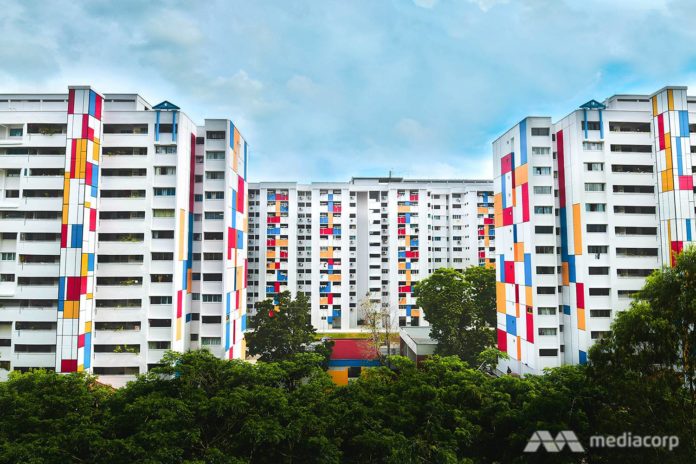
Teck Whye Avenue decked out in red, blue and yellow. (Photo: Gaya Chandramohan)
RENTING HDB FLATS
If a flat is at least a three-room, the owner can let out individual rooms. These are the most affordable options, and prices can be in the range of S$550 to S$1,200 depending on location.
As for renting out the entire flat, HDB prices are (currently) almost on par with condo prices in the OCR. This is because Singapore’s rental market has softened considerably over the past three years. In the more central and mature districts, HDB flats can rent out for around S$3,000 a month.
But again, note that this is due to unusually low rental rates for condos in the market right now; the price gap between condos and HDB flats is historically much greater.
So now that you have a baseline, here are the other considerations when you spend on rent:
Use the 40 per cent expense ratio guideline
Check the rates of neighbouring units
Get a lower price for a longer lease
Work out furnishing costs before picking a rental unit
1. Use the 40% expense ratio guideline
This is one of those financial rules of thumb, like saving 20 per cent of your pay cheque. If you’re faced with the choice of choosing between two shortlisted units, you can pay less attention to the price difference if it falls within the realm of affordability.
For example, say you have a monthly income of S$7,500. You would then budget a maximum of S$3,000 a month to spend on rent. Between a unit that costs S$2,600 a month, and a unit that costs S$3,000 a month, you’ll know you’re “safe” picking the more expensive unit. It still falls within the realm of affordability.
As to why 40 per cent, that’s because it still allows you to save and have decent discretionary income.
In the case of S$7,500, you could still save S$1,500 a month for emergencies, and have S$3,000 a month to spend on scented candles, string quartet concerts, and other fancy things.
So you’ve found a unit you like, because the condo has a nice pool. Before you sign on the dotted line, check to see if there are other available units in the same development.
It should go without saying, but plenty of over-eager first-time renters miss this step. Doing so, however, could get you a better deal.
We don’t just mean look at their listings; we mean speak to the agent or landlord, and try to negotiate with them as well.
In fact, let them know you’re talking to them because you’re interested in another unit in the same condo (some competition always helps to lower the price).
Besides potentially getting you a good deal, this ensures you’re not overpaying for your unit of choice.
If all the surrounding units are being rented for S$3,000 a month, you don’t want to be only person who ends up paying S$3,300; at least not without a fantastic reason.
If you want a two- or three-year lease, don’t let the cat out of the bag early. When asked, say you’ll be here for a while but may consider moving once you understand the island better.
And then ask if you can get a lower price if you sign a longer lease. Having a property empty for even one month can be costly to the landlord, so most are eager to minimise vacancies. You may be able to bargain the price down by 10 to 15 per cent by taking a longer lease.
File photo. (Photo: Unsplash)
4. Work out furnishing costs before picking a rental unit
Before you even go shopping for a unit, note the floor space you want. Then drop by IKEA or these furniture stores, and work out the cost of furnishings you need.
This will help you decide between a furnished and unfurnished unit. If the added cost of buying your own stuff takes you beyond the 40 per cent guideline (see point 1), then you may want to look for something else.
A common newbie mistake when you spend on rent is to make off-the-cuff decisions about whether the unit must be furnished, and then rack up a massive credit card bill when the furniture costs more than they suspected.
So remember: work out the estimated cost of furnishings first. That will help you gauge how much you should be paying for rental costs alone.