SINGAPORE: Seven cases of liver injury have been reported following the consumption of mahogany seeds, the Health Sciences Authority said on Tuesday (Dec 11).
The seeds, which come from the swietenia macrophylla or mahogany plant, are commonly known as “sky fruit” or “buah tunjuk langit” in Malay and “xiang tian guo” in Chinese.
“Mahogany seeds are used traditionally in Southeast Asian countries to help control blood sugar and high blood pressure. However, there are no clinical studies in humans supporting its effectiveness or safety,” HSA said.
Over the past three years, HSA said it has received seven local reports of liver injury suspected to be associated with the ingestion of mahogany seeds, both in raw and capsule form.
The liver injuries were of varying severity, ranging from mild liver function impairment to liver failure. A patient also sustained kidney injury while another had multiple joint aches and pain, also known as polyarthralgia.
Of the seven patients, who are in their 40s to 70s, five were hospitalised. The patients have since recovered or are recovering after they stopped taking the suspected products.
HSA said that most of the patients had underlying medical conditions, including diabetes, hypertension, hyperlipidaemia (high blood cholesterol) and fatty liver. They were also taking other medications concurrently.
The liver injuries occurred 30 to 45 days after the consumption of mahogany seeds, except in one patient where the injury occurred six months later.
CONSUMED IN RAW AND CAPSULE FORM
The patients had consumed the mahogany seeds to control their blood sugar, blood pressure or for general well-being, HSA said.
Five of them consumed mahogany seeds in its raw form, purchased from different sources in Singapore and Malaysia. Their consumption ranged from 10 seeds in a month to 18 seeds in a day.
The remaining two patients took mahogany seed capsules intermittently or two capsules twice a day. One product was labelled as “Natural Miracle Healer”, which the patient obtained from a blog shop in Singapore, while the other was an unknown brand from Malaysia.
Five of the patients consumed mahogany seeds in its raw form, purchased from different sources in Singapore and Malaysia. (Photo: Health Sciences Authority)
“Although there is no scientific data on the risk of liver injury from taking mahogany seeds, HSA advises consumers to exercise caution when considering the use of these products. HSA will continue to closely monitor the situation and update the public of any significant findings,” it said.
Those who have consumed the seeds should consult a doctor as soon as possible if they feel unwell or develop symptoms of liver injury such as nausea, loss of appetite, lethargy and dark urine, or show signs of jaundice such as their skin or whites of eyes turning yellow.
SINGAPORE: When her employers took off on a recent vacation, they left half a can of luncheon meat, some dumplings, eggs, noodles and onions for Paulene, a 28-year-old foreign domestic worker (FDW) from the Philippines.
Paulene, who is using a pseudonym, said she was also given S$20 for the week they were gone. The money, however, was also for groceries for her employers’ daughter, who did not travel with the family.
“Her daughter came home one of the evenings and she wanted me to buy food. I bought grapes, fish and vegetables. That left S$9 for three days,” said Paulene.
She said that as long she has rice she can cope, but added that sometimes she has had to use her own money to buy enough food.
She is one of the 250,000 foreign domestic workers employed in local households.
As many families leave for their year-end vacation over the December school holiday period, some FDWs have posted concerns about whether they will be able to eat well when their employers are away on over a dozen threads on Facebook groups that give FDWs advice and support.
On one of the biggest groups with more than 26,000 members, close to 300 comments were posted on threads relating to concerns about food when their employers are overseas. Paulene said that these concerns occur throughout the year and are also something experienced by some of her FDW friends.
And it’s not just when employers are away that FDWs have concerns about eating properly.
Raquel Mondarte, a 47-year-old FDW from the Philippines, had the help of her neighbours and friends when she did not receive proper, full meals.
She added that her former employer was “great” but was “very stingy with food”. That employer often would not even provide vegetables or meat for her meals.
“Some of my neighbours or friends would come and give me some food. Sometimes it’s food that’s already cooked. Sometimes it’s canned food,” Ms Mondarte said.
“But mostly I will just buy food with my own money,” she said.
Local non-governmental organisations Transient Workers Count Too (TWC2) and Humanitarian Organisation for Migration Economics (HOME) said they are seeing more complaints from workers about inadequate or poor quality food. Concerns about food and nutrition are one of the top five issues raised by FDWs.
This is despite the Ministry of Manpower’s (MOM) requirement that employers have to provide FDWs with three meals a day and these have to be enough for a female engaged in moderate activity.
This includes four slices of bread with spread for breakfast, and rice, cooked vegetables, a palm-sized amount of meat, and fruit for lunch and dinner.
However, a TWC2 spokesperson told Channel NewsAsia the organisation has seen an uptick in complaints from domestic workers having inadequate food.
“Our case numbers have come down over the last few years, but our social workers around four years ago reported that they were hearing more complaints from workers about inadequate food in general, such as having rice and some cheap green vegetables for meal after meal,” the TWC2 spokesperson said.
While the NGO is seeing fewer FDW cases after a shift to focus on supporting male construction workers, it continues to hear similar complaints about food from FDWs.
Foreign domestic workers in Singapore. (File photo: TODAY)
The Centre for Domestic Employees (CDE), which is NTUC’s advocacy group for FDWs, said about 4 per cent of over 2,400 cases it has attended to since 2016 were about complaints of not having enough food.
HOME, which provides food and shelter for FDWs in distress, said that about 40 per cent of the 800 women housed at their shelter complained about inadequate or poor quality food.
Its advocacy and communications manager Stephanie Chok said these complaints are of FDWs being given leftovers, stale or insufficient food, or food that they are unable to consume due to dietary and religious restrictions.
Ms Chok added that in many cases, these workers are afraid to voice their concerns to their employers for fear of being reprimanded or have their employment contracts terminated.
“In other cases, employers may make comments like ‘Why is the food finishing so quickly’ that may cause the FDW to eat less than what she requires to perform her chores,” Ms Chok said.
Some employers have even resorted to installing surveillance cameras in the kitchen, sometimes directed at the refrigerator, to monitor what is being eaten.
Indonesian domestic helper Suri, who has worked in Singapore for five years, said she lives in a household with such cameras. She said that she is only allowed to eat certain foods. Eggs, for example, can be eaten but “not much, maybe one a day”.
“I still remember what sir said: ‘You can’t eat fish because the fish is so expensive. That’s only for grandma and my kids’,” Suri said (not her real name).
“If I cook and the children are not eating, they will ask me ‘You cook for who? Did you take from the fridge?’ I said no, this is meat that I bought with my own money and they will be quiet,” she said.
HOW MUCH TO GIVE
While some domestic workers face issues in having enough for their meals, others have free access to the refrigerator and store cupboard when their employers are gone. Some FDWs Channel NewsAsia spoke to say they are given a sum of money and have the freedom to decide how they want to spend that money.
Indonesian domestic worker Margaretha Gole, 33, said her employer usually leaves her with between S$50 to S$70 when going away for about a week.
With the budget in mind, she plans her meals for the rest of the week. Her trick is to buy a whole chicken and divvy it up into four to six portions. She also shops for vegetables at the supermarket clearance section.
“Buying a whole chicken costs about S$7. If I make curry chicken, I will buy eggs or potato to add in, instant curry paste and coconut milk. In between, I buy canned food like sardines or luncheon meat,” she added.
Ms Gole said that this freedom to decide how she wants to spend her own food allowance makes her feel trusted.
“My boss did not tell me the limit of how much I can spend, she just made sure that I have enough to eat. Because of this trust and care from my employer, I don’t take advantage to spend it all,” she said.
“Actually if the employer gives freedom to the maid … I’m sure the maid is more confident and will know how to manage her spending. Sometimes maid just wants to spend more because an employer is stingy,” Ms Gole added.
Last year, a couple was sentenced to jail for starving their Filipino domestic helper for 15 months, causing her to lose almost 20kg.
MOM said that employers are required to provide adequate food and fulfil all obligations relating to the employment of a FDW, regardless of whether the employer is in Singapore or overseas.
Its spokesperson added that beyond legal protection, all first-time FDWs attend a mandatory programme which advises them on what to do if they face well-being issues.
Those who feel that they are not given adequate food should speak to their employers or their Employment Agencies, or contact MOM or the CDE, the spokesperson added.
TWC2 said that employers often say their domestic worker “is just like one of the family”, and this could be a gauge for how much to provide for their domestic worker.
“Maybe a good starting point would be to ask how they would provide for an unwaged family member who they have to leave behind when they went on holiday. The chances are that they’d make a rough calculation of what would be needed, stock up on the necessary goods, and then hand over cash to cover any extra purchases that are needed,” a TWC2 spokesperson said.
CDE executive director Shamsul Kamar said that when employers go on holiday, they should ensure that there is enough food consisting of bread, biscuits, rice, protein, meat, and vegetables that can last the FDW for the entire duration that the family is away.
Alternatively, provide the FDW with a sum of money that is sufficient for her to buy all her meals during this period.
“The FDW should not be paying for the food using her own money,” Mr Shamsul added.
“Our FDWs are migrant workers who came to Singapore to earn a decent wage and deserve to be treated with respect, compassion and care. Having mutual respect and understanding strengthens the employer-employee relationship. This, in turn, will motivate FDWs to do their best for the families they work for,” Mr Shamsul added.
SINGAPORE: A new speed camera system that calculates a vehicle’s average speed over a stretch of road rather than at a single point will go live along Tanah Merah Coast Road from Dec 17.
The system was installed along a 4km stretch of road in the first quarter of this year and has gone through rigorous testing to ensure accuracy and robustness, the Singapore Police Force said in a media release on Monday (Dec 10).
This is the first time such a system is being used on Singapore roads. Tanah Merah Coast Road, which has a speed limit of 70kmh, was chosen to roll out the system “because it is susceptible to speeding and illegal racing”, the police said.
“The system, comprising cameras at the entrance and exit of the enforcement zone, will detect and compute the average speed of a vehicle while it is in the zone,” the police said.
“If the average speed of the vehicle exceeds the limit for the road or for the particular vehicle (which has a specified speed limit), the motorist will be liable for the offence of speeding,” they added.
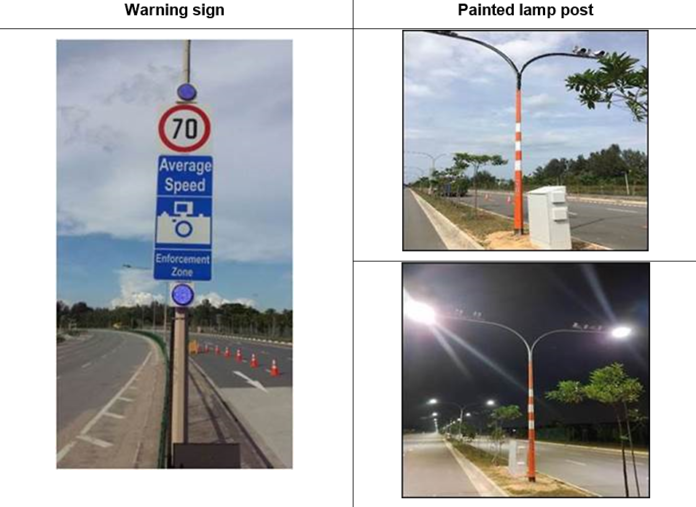
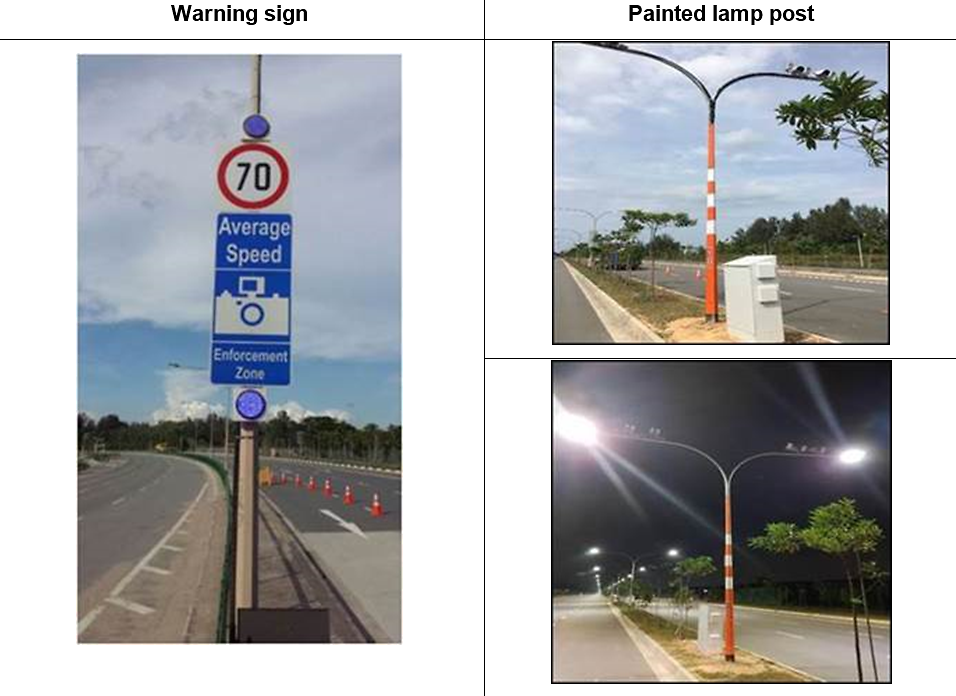
Signs will be put up ahead of and within the enforcement zone to remind motorists to comply with the speed limit.
Lamp posts on which the average speed cameras are mounted have also been painted in luminous orange to ensure that they are highly visible.
“The new ASC system will help shape the behaviour of motorists and deter speeding. Road safety is a shared responsibility. All motorists must play their part in keeping our roads safe,” the police said.
Warning sign and painted lamp posts at to notify motorists to comply with the speed limit along Tanah Merah Coast Road. (Table: Singapore Police Force)
SINGAPORE: Malaysia will negotiate with Singapore regarding the ongoing maritime dispute between the two countries, but no decision has been made about removing Malaysian vessels, Prime Minister Mahathir Mohamad said on Monday (Dec 10).
“We will negotiate with Singapore,” Malaysia’s Dr Mahathir told reporters after a visit to the Institute of Integrity in Kuala Lumpur.
“We don’t want to fight with Singapore – sometimes there are overlapping claims, we can resolve through negotiations,” he said, speaking in Malay.
These negotiations will begin as soon as possible, and will be handled by “foreign affairs”, said Dr Mahathir in English.
When asked whether there would be an attempt to withdraw the Malaysian government vessels in the disputed area, Dr Mahathir said that there was no decision.
“At the moment because there is no decision, the vessels are there,” he said. “Singapore vessels are there, Malaysian vessels are there.”
Separately, Malaysia’s foreign affairs ministry on Monday issued a statement saying it would take “all effective measures to de-escalate the situation on the ground”.
However, the Malaysian government “is unable to accede” to Singapore’s “counter-proposal” of a return to the status quo prior to Oct 25, 2018, it said.
Said the Malaysian ministry: “The ministry referred to Singapore’s diplomatic note of Dec 8, 2018, in which Singapore declined Malaysia’s proposal for both countries to mutually cease and desist sending assets into the disputed area effective 0000 hrs on Dec 8, 2018 with a view of promoting de-escalation of tensions on the ground, pending discussions on outstanding maritime boundary issues.
“Singapore also called upon Malaysia to return to the status quo prior to Oct 25, 2018 by immediately withdrawing all Malaysian government vessels in the area.”
Both countries acknowledge that any measures taken would be without prejudice to their own claims, said the statement. However, Malaysia is unable to accede to Singapore’s counter-proposal, it added.
“While the government of Malaysia is unable to accede to Singapore’s counter-proposal, Malaysia will take all effective measures to de-escalate the situation on the ground, reaffirming its position to handle the situation in a calm and peaceful manner,” it said.
In the meantime, Malaysia reiterates “the importance of strong bilateral relations” between the two countries, said the ministry, adding that the country hopes discussions will “commence expeditiously”.
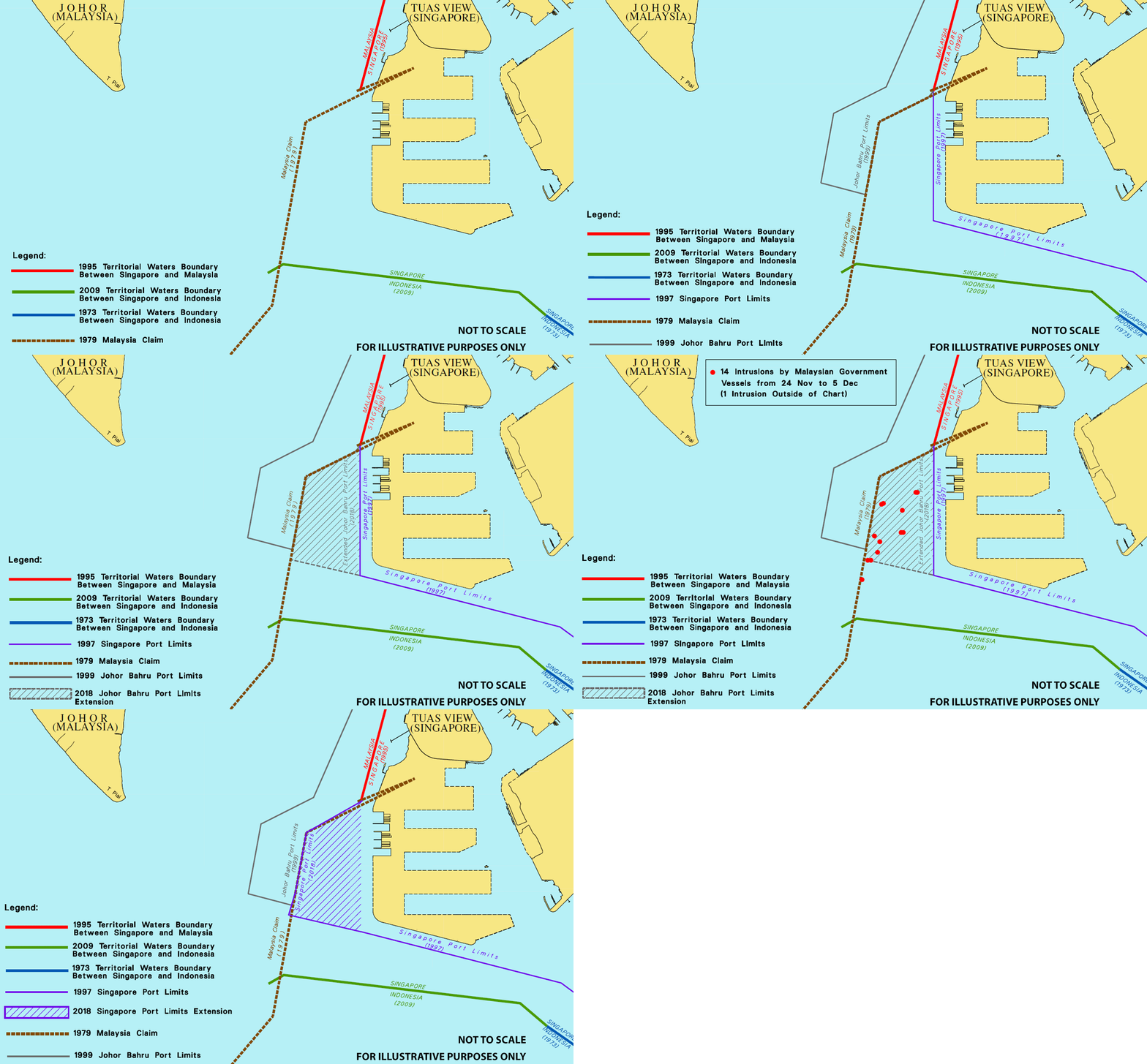
There have been 14 intrusions by Malaysian government vessels in Singapore territorial waters in the last two weeks, Transport Minister Khaw Boon Wan said at a media briefing last Thursday.
These intrusions came after Malaysia extended its Johor port limits on Oct 25, encroaching into Singapore waters off Tuas.
Malaysia has called for both countries to “cease and desist” from sending assets into a “disputed area” – a proposal Singapore’s Ministry of Foreign Affairs on Friday said it did not agree with, calling for a “return to the status quo ante before Oct 25, 2018”.
Illustration showing the adjustment of Singapore and Malaysia’s port limits.
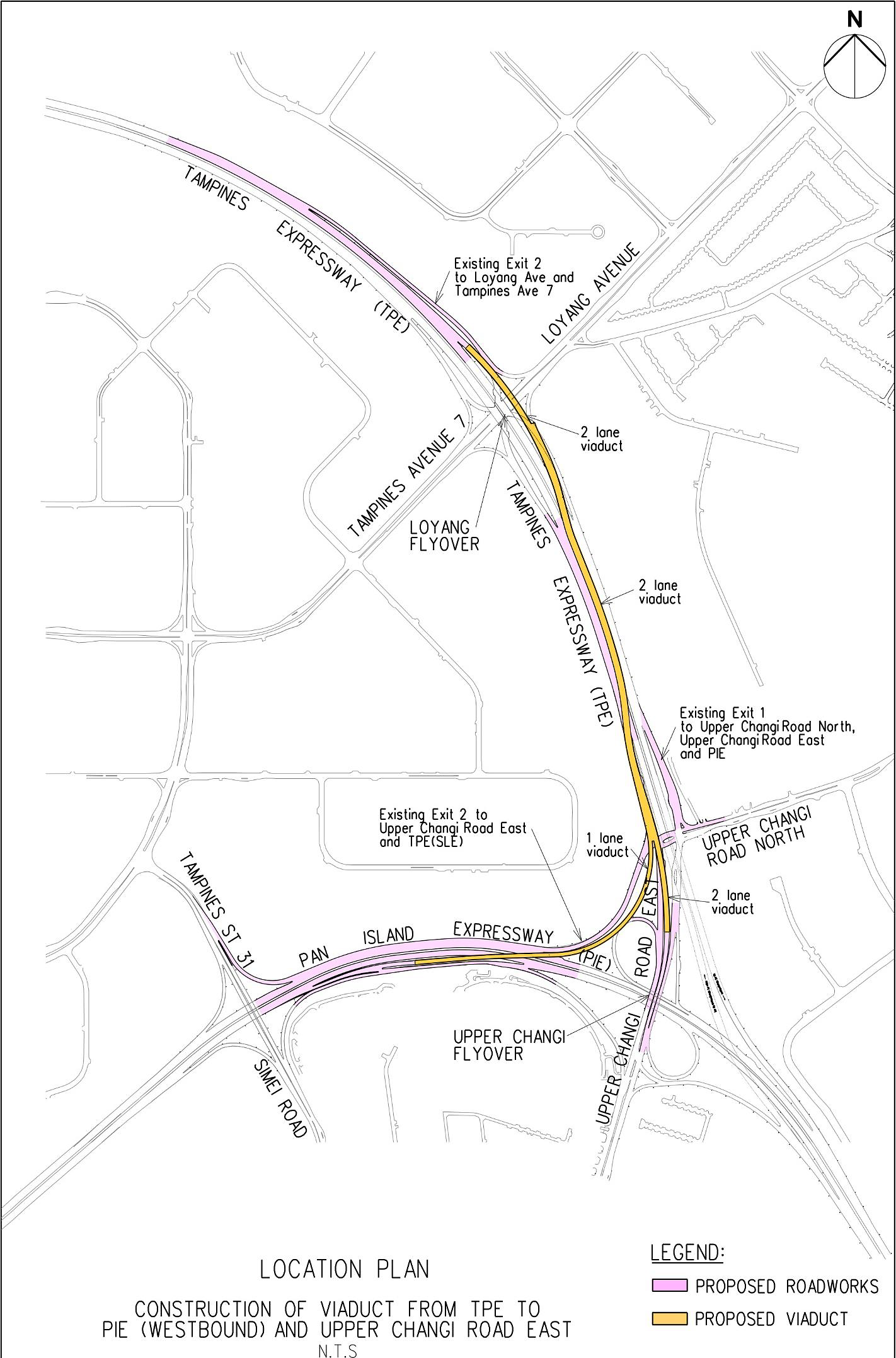
SINGAPORE: The replacement contract for the Tampines Expressway (TPE)-Pan-Island Expressway (PIE) Changi Viaduct that collapsed last year has been awarded to Hwa Seng Builder for S$95.6 million, the Land Transport Authority said in a news release on Monday (Dec 10).
Works are expected to begin in the first quarter of 2019, with completion scheduled for the first half of 2022, two years later than it was originally expected to be completed.
Hwa Seng will be responsible for completing the construction of the viaduct, including the demolition of any structures deemed unsafe.
Hwa Seng is an established contractor who has completed various road construction projects, including the new road link connecting Punggol Central to Kallang-Paya Lebar Expressway (KPE) and TPE(PIE) that opened to traffic last month, said the LTA in the release.
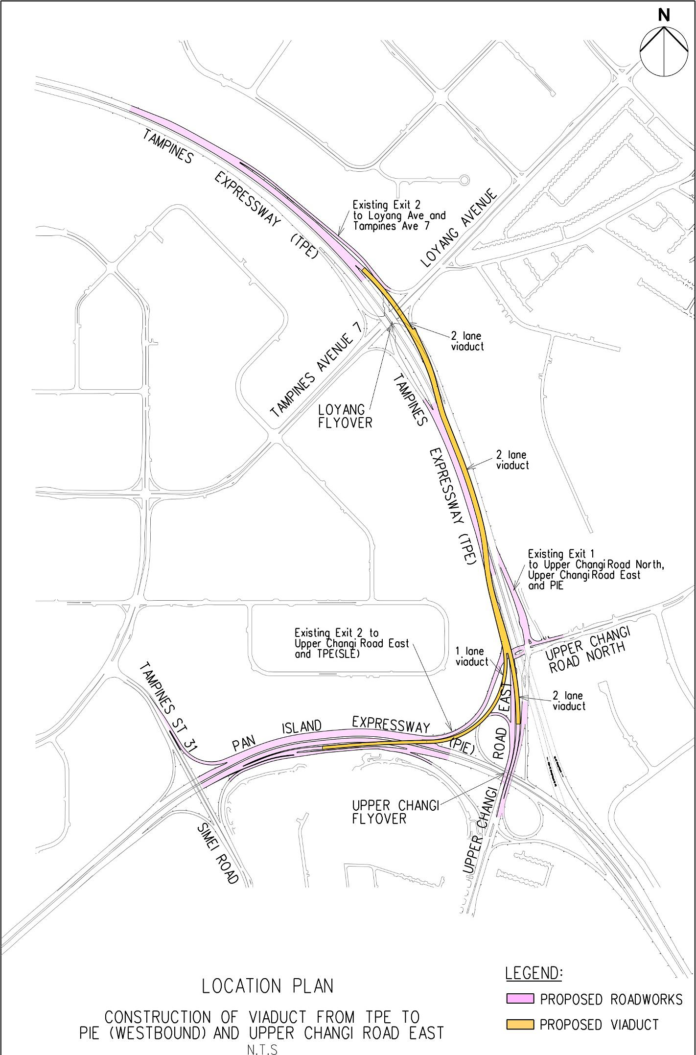
The TPE-PIE Changi viaduct location plan. (Image: LTA)
The incomplete viaduct collapsed on Jul 14 2017, causing the death of Chinese national Chen Yinchuan who was one of 11 workers on top of the structure before the incident. Another three Chinese, one Indian and six Bangladeshi workers were injured too.
A multi-agency probe into the collapse found that corbels – brackets that help support beams – had given way. Cracks were also found in the areas supporting 11 other parts of the viaduct.
Transport Minister Khaw Boon Wan said in July 2018 that LTA had reached an agreement to terminate its contract with OKP Contractors and will also recover appropriate costs.
When completed, the TPE-PIE Changi Viaduct will provide a direct connection for motorists travelling from TPE (Changi) to PIE (Westbound) and Upper Changi Road East by bypassing the stretch of TPE (Changi) between Loyang Flyover and Upper Changi Flyover and the existing signalised junctions with Loyang Ave and Upper Changi Road North.
SINGAPORE: It is 9am on a Monday morning and I have just rolled out of bed, still in my pyjamas. There is a cup of strong Italian Moka pot-brewed coffee waiting for me in the kitchen. Well, it is barely tepid by now because my partner brewed it about an hour ago, before leaving for his office.
I reply to WhatsApp messages and scroll through Instagram as I caffeinate myself. How idyllic isn’t it? It sounds like the life of a taitai, or some might say, #freelancelife.
Well, hold up on the eye-rolling for a moment.
What you don’t know (yet) is that I’ve worked for a month straight, weekends included, to complete various time-sensitive writing commissions I have taken on.
On this specific Monday, after stealing a short moment of relaxation, I switch on my laptop at 9.15am and will continue chugging away at writing and editing articles, sending out interview requests and replying to enquiries for the next 10 hours.
The next day, and every day for the foreseeable future, I will rinse and repeat this schedule as a freelance writer all over again.
LOVE, NOT HATE
The gig economy is booming. About one in three American workers are freelancers and while there are no official figures in Singapore, smaller studies, like one recently conducted by insurance company Manulife indicate there is a significant number of gig workers here too.
Among the respondents, 49 per cent of those currently in traditional employee roles indicated interest in becoming a part of the gig workforce, a sign that the allure of freelancing is strong.
There are many reasons people give for switching – or wanting to switch – to freelancing. It typically boils down to variations of these two: They hate their current job; or they want a more flexible schedule.
These are certainly good reasons to try something different, but becoming a gig worker won’t necessarily be the solution to these pain points.
Here’s the real deal. To earn a decent living as a freelance worker, whatever skill you might be selling (writing, photography, coding, graphic design, cooking, personal training, you get the idea) has to be good enough that people will pay you money for it. This means you have to have developed a certain level of proficiency at it.
(Photo: rawpixel / Unsplash)
Chances are, the thing you intend to do as a freelancer is likely to be at least somewhat related to your full-time profession, where you arguably have a competitive advantage.
I was a newspaper journalist for 4.5 years before I quit my full-time position. With no real plan in mind, I figured I would take on freelance jobs to pay the bills for a few months before finding another job.
Over the months, the writing gigs gradually increased in volume and scope and six years on, I have found myself back in the position of being pretty much a full-time, albeit freelance, journalist.
One thing is clear – I have always loved writing. I may have been bothered by some aspects of my previous jobs such as the daily stress, but very essence of the work continues to appeal to and inspire me. This is why I continue to do what I do.
But if you are experiencing a strong aversion to the nature of your current full-time work, those feelings probably will not magically disappear the moment you exchange your office cubicle for a kitchen table while still doing something similar.
In that case, you might be tempted to try your hand at a job that is entirely different. A humble suggestion: It might make sense to start this as a side hustle first so you are assured you can support yourself with it. Either way, the key here is that you actually should have a passion for what you do, not hate it.
CRUNCHING NUMBERS
According to the most recent figures by the Ministry of Manpower, in 2017, a full-time employee worked about 45.9 hours per week. By my count, I certainly clock those hours too, if not more. And I need to, or I would not be able to make a living as a gig worker – this is the case for many other full-time freelancers too.
Sometimes, I laugh when I think about how I tried to escape the hours of a full-time job, only to end up still doing it, and more, in any case.
Gig workers who are in it to earn a living, which differentiates them from those who are doing it for supplementary income, will have to put in the hours.
You are not restricted to working typical office hours, which gives your schedule a certain amount of flexibility, but it is unlikely you will gain excessive amounts of free time.
After all, to make up for that opportunity to go for, say, late morning yoga classes (guilty!) or high tea on a weekday (guilty too!), the tradeoff is foregoing nighttime cocktails at the latest hip bar or missing weekend social activities because work and deadlines beckon (ditto to both).
During those moments, you better be loving your freelance gig or the perk of a flexible schedule sure won’t seem worth it to give up the security of a steady, monthly income for ad hoc paid assignments.
Karen Tee is a freelance travel and lifestyle writer. Six years ago, people thought she was crazy to leave the security of her full-time job. Today, most want to know how she does it.
SINGAPORE: A firm believer of XRP, Mr Ken Tan continued pumping money into the cryptocurrency over the course of this year — even after the prices of cryptocurrencies have fallen from its peak between last December and January this year.
Thus far, the 36-year-old businessman has poured about S$100,000 into cryptocurrencies, including the S$15,000 that he invested in November last year when prices skyrocketed.
“When we saw it (prices) went up to the peak, (my wife and I) were like really FOMO-ing (fear of missing out),” he said.
As he entered the market during the cryptocurrency bull run, his portfolio grew by S$100,000 within eight weeks.
But he decided not to cash out as his intention was to invest for the long term.
With the value of XRP down 90 per cent since its peak of US$3.40 (S$4.67) in January, Mr Tan’s portfolio has shrunk to over S$30,000, resulting in a paper loss of about S$70,000.
“Of course I look back, I regret it, but there is no way for me to undo that,” he added.
Another investor, who only wanted to be known as Vanessa, also did not cash out her S$70,000 profit when Bitcoin prices shot up, partly due to the withdrawal limits imposed by cryptocurrency exchanges.
After intensive research, the 31-year-old banker traded her Bitcoins for another cryptocurrency, Ripple, and pumped in extra money to buy other digital coins, bringing her total investments to S$40,000.
Her portfolio has since dwindled in value, and is now worth about S$10,000.
Vanessa is “frustrated” that she will make a loss if she moves her money out to other types of investment.
“Crypto is already so cheap. It doesn’t make sense to sell something so cheap and buy something else,” she said.
A very niche investment instrument in their early years since Bitcoin was invented and released as an open-source software in 2009, cryptocurrencies — a form of virtual currency — caught the attention of mainstream investors at the end of last year when their value soared.
Bitcoin — the most well-known cryptocurrency — began its exponential climb in November last year, surging by 200 per cent over the next one-and-a-half months to hit its peak value of close to US$20,000 per coin on Dec 17, based on data from CoinMarketCap, a website that tracks the prices of cryptocurrencies.
But the dramatic ascent was short-lived.
Bitcoin’s spectacular rise was followed by an equally spectacular fall, with its price dropping drastically throughout 2018. As of Friday (Dec 7), one Bitcoin is valued at US$3,428 — an 80 per cent drop from its peak.
Besides Bitcoin, other popular cryptocurrencies such as XRP and Ethereum also saw a similar crash. Almost US$700 billion has been wiped off from global cryptocurrency markets since their peak.
Representation of the Ethereum virtual currency standing on the PC motherboard is seen in this illustration on, Feb 3, 2018. (Photo: REUTERS/Dado Ruvic/Illustration)
WHAT GOES UP MUST COME DOWN
The crash in cryptocurrency prices should not have come as a big surprise, given the earlier warnings issued by some well-known investors and financial experts.
Billionaire investor Warren Buffett famously called Bitcoin “rat poison”, while Nobel Prize-winning economist Robert Shiller called the craze last year a “fad”. Both said that Bitcoin was in a bubble, which would eventually pop at some point.
The lack of a good explanation for Bitcoin’s meteoric rise — along with the risks that come with investing in it — is not lost on some retail investors such as 26-year-old George Varghees.
The logistics operations executive, who believes in the long-term potential of cryptocurrencies, said the fall was something that he had expected.
“The spike to US$20,000 is not a conventional spike … a lot of it is from speculation. It’s normal that the price has to come down much more to a normal stabilised rate,” he said.
While Mr Varghees’ portfolio has decreased in value by 50 per cent to about S$3,000, he was one of those who decided to cash out his profits when cryptocurrency prices soared at the end of last year.
He made a profit of about S$9,000 last year from his initial investment of S$9,000, which partly explains his indifference to his paper loss. He said:
I went into it understanding that … (there is a) chance that (it) may not work. I was prepared to lose whatever I put in.
Observers have cited several factors that could have contributed to the downward pressure on cryptocurrency prices.
A Business Insider report that Goldman Sachs has scrapped plans to open a trading desk for cryptocurrencies due to unclear regulatory framework surrounding them could have caused confidence in Bitcoin and the like to have fallen.
Regulators around the world are also increasingly scrutinising crypto-related businesses.
In June, Japan’s financial regulator, the Financial Services Agency, slapped six exchange operators with business improvement orders, after it found that measures to prevent money laundering and know-your-customer processes were inadequate.
In September, a federal judge in New York allowed a United States securities law to be used to prosecute fraud cases involving cryptocurrency. The Securities Exchange Commission also issued fines to two cryptocurrency firms.
The security of cryptocurrency transactions is also questioned, after South Korea-based cryptocurrency exchange Coinrail got hacked and lost about 30 per cent of coins traded on its exchange in June. In the same month, another South Korea-based exchange Bithumb was also hacked and lost US$30 million worth of cryptocurrencies.
Singapore’s central bank joins a number of regulators who have warned about cryptocurrency investments, including the US Federal Reserve (Photo: AFP/ROSLAN RAHMAN)
Some analysts expect the downtrend in cryptocurrencies to continue.
Bloomberg intelligence analyst Mike McGlone said on Thursday (Dec 6) that Bitcoin prices are likely to fall to around US$1,500.
Santa Clara University professor of finance Atulya Sarin wrote in a column for financial news site MarketWatch that Bitcoin will be “worthless” when its price falls below the cost of mining it, leading miners to exit.
He argued that without mining, Bitcoin is “just a set of encrypted numbers with no value”.
Mining is a peer-to-peer computer process, where miners solve mathematical problems to verify the transactions or payments, from one user to another on a decentralised network, to obtain Bitcoins.
In Singapore, some miners have indeed shut down their mining rigs in light of the fall in cryptocurrency prices.
Mr Ian Chan, 52, used to make about S$270 on average a month for each rig — after taking into account electricity costs — when he started mining a digital currency called ZCash in June last year.
After some experimentation, he switched to mining for Bitcoin Gold in June this year as he realised that the latter yielded higher returns.
Even then, his returns started turning negative in July, losing about S$8 to $$10 per rig each month. He decided to power down his rigs in Singapore and Malaysia in September as he realised that the downtrend would not end anytime soon.
The IT specialist has left his rigs in Mongolia and Brunei running as he is still able to make a profit of about S$10 to S$20 per rig each month due to the lower electricity costs in these countries.
Mr Chan did not want to reveal how many rigs he has.
A man works beneath a display showing the market price of Bitcoin on the floor of the Consensus 2018 blockchain technology conference in New York City, New York, US, May 16, 2018. (Photo: REUTERS/Mike Segar)
END OF A VIRTUAL CRAZE?
It’s not just cryptocurrency investors who have been hit by the drop in prices. Cryptocurrency-related businesses are affected as well.
Cryptocurrency exchanges based in Singapore, which are one of the main platforms investors use to buy cryptocurrencies and trade in them, said that trading activity has shrunk.
Mr Liu Yusho, co-founder of an exchange called CoinHako, said trading volume has declined by five times throughout this year’s “down market”, although he claimed that the exchange “continues to experience steady growth”.
Mr Rune Evensen, the co-founder of another exchange, Coss, said that compared to the peak at the end of last year, the average number of new membership sign-ups per day has dropped by around 75 per cent in the current bear market.
“It’s completely (like) day and night,” Mr Evensen said, adding that such a drastic drop is a “logical consequence” once the market turns for the worse.
When it’s a bull market, everybody wanted to jump into Bitcoin. Now, they are not so eager to get in because they don’t know where the market is going.
The decrease in the popularity of mining cryptocurrencies can also be seen at Sim Lim Square, with the “crazy buying” of mining rigs at the end of last year to earlier this year having all but ended.
These “mining rigs” are composed of gaming computer components such as graphics processing unit (GPU) cards, a motherboard and cables.
A shopowner at one of the higher floors of the shopping mall, who only wanted to be known as Glen, declared that the “market is dead”.
Staff and shopowners said that the buying frenzy began to taper off between March and April, when Bitcoin prices dropped below US$10,000, and they have seen almost zero orders for the mining rigs since then.
File photo of Sim Lim Square. (Photo: Calvin Oh)
Mr Kenny Tan, 60, a part-timer at Video-Pro, said the shop was earning S$300,000 to S$400,000 every month in November and December last year from the sales of these rigs.
Now, some of its previous customers have dismantled the rigs and offered to sell back the parts to the shop, which it doesn’t accept, Mr Tan added.
A staff at Dynacore, Mr Ansari Abdul Pari, 34, said he used to sell five to 10 sets every day.
Both Dynacore and Video-Pro, which earlier were grappling with the shortage of GPU cards, are now selling them at a 30 to 50 per cent loss as demand had dwindled before they were able to clear their inventories.
For example, a Nvidia Geforce 1080 Ti GPU used to retail for over S$1,000. But Video-Pro is now selling it for only S$700.
Although another shop Bizgram does not have the problem of unsold GPUs, it still has 40 to 50 metal frames waiting for buyers since January, said its 36-year-old manager, Niraj Agarwal.
He has not been able to sell them even after lowering the price from S$120 to S$60, which is near the cost price. The shop also has a few mining motherboards that have not been cleared.
Mining Rig Club, whose main business “heavily depends” on revenue from hosting mining rigs for its customers, had to change its business model in the face of the decreasing popularity of cryptocurrency-mining.
Mr Leon Lim, the chief executive officer of the company, said that about 70 to 80 per cent of his customers had shut down their rigs.
His team took three months to come up with a new business strategy. Instead of mining new cryptocurrencies through the rig, users can supposedly receive digital coins as rewards by running “masternodes”. These are computer wallets within a decentralised network that enables the processing of transactions, similar to mining, except without the hardware equipment.
Mining rigs aside, the long, snaking queues at Bitcoin automated teller machines (ATM) observed during last year’s frenzy are also no longer in sight, said Ms Zann Kwan, founder of Bitcoin Exchange, which owns and operates four ATMs around Singapore.
Despite the drop in interest in Bitcoin, Ms Kwan said it hasn’t affected the company as it is still “growing”. In fact, she calls the present market a “return to normalcy”.
There were reports about the machines crashing or running out of Bitcoins during the peak period in December last year and January, as transactions could take up to three days due to a congested Bitcoin network.
Customers who buy Bitcoins from the ATMs now do it in smaller amounts of between S$50 and S$200, compared with over S$2,000 a year ago.
The profile of customers has also changed, said Ms Kwan.
“(Back then), cryptocurrency buyers were attracted to the market without knowing what it is, without knowing how to deal with the cryptocurrency wallet. Now, the baseline of customers are people who are more well-versed in cryptocurrency,” she added.
“And if you look at price, it’s a lesson for most people. People started to learn about what they’re buying, rather than (follow a) herd mentality.”
It’s a lesson for the cryptocurrency industry too, said Singapore University of Social Sciences (SUSS) Professor David Lee.
“Prices coming down is a very good thing for the industry,” he added, as stakeholders are now “re-focusing” on the technology underpinning cryptocurrencies, i.e. blockchain.
Bitcoin was the first application of blockchain technology — an open, distributed ledger that can record transactions between two parties efficiently and in a verifiable and permanent way.
The ledger itself can also be programmed to trigger transactions automatically.
“(We should not) focus on the price. It’s always a cycle … People need to refocus on how much can this technology do, and the answer is a lot,” Professor Lee added.
The chief executive officer of cryptocurrency advisory firm XSQ, Mr Lim Hong Zhuang, added: “Revenues of blockchain companies have fallen, and many once speculative investors or businesses that were started during the hype have also seen closure with people exiting the industry.
“We are seeing the real technology companies survive and building up their products at the moment.”
Mr Anson Zeall, the chairman for Singapore’s Cryptocurrency and Blockchain Industry Association, agrees.
“The new projects coming out are much more solid in this particular time compared to the ones in last November when everyone is raising ICOs for the sake of raising,” he said.
Initial coin offerings (ICOs) are used by startups to raise funds for new cryptocurrency ventures by issuing their own digital tokens.
A worker checks the fans on miners, at the cryptocurrency farming operation, Bitfarms, in Farnham, Quebec, Canada, February 2, 2018. (Photo: REUTERS/Christinne Muschi/File Photo)
AN UNCERTAIN FUTURE AWAITS
Despite the cryptocurrency crash this year, the investors interviewed— Mr Chan, Mr Tan, Vanessa and Mr Varghees — said they are not quitting the market yet.
In fact, some of them are still pouring more money into cryptocurrencies as a way of lowering their average cost of investment as prices continue to fall.
Vanessa, for example, said she has not lost confidence in cryptocurrencies even after losing 75 per cent of her investment.
Part of these investors’ bullishness stems from their belief in the blockchain technology and its increasing adoption by traditional financial institutions.
Reports and studies have concluded that the technology could eliminate back-office roles in financial services and bank businesses — such as clearing and settlement of trades, financing, as well as tax and regulatory reporting.
For example, DBS announced in November that it had set up a blockchain trade platform to supply commodities across borders.
Developed with agri-commodity company Agrocorp International, the platform is able to provide real-time updates on commodity prices and delivery information, helping all those in the supply chain save costs and increase efficiency and transparency, said the bank.
FILE PHOTO: A logo of DBS is pictured outside an office in Singapore January 5, 2016. REUTERS/Edgar Su/File Photo GLOBAL BUSINESS WEEK AHEAD
Outside of Singapore, more relevant applications of blockchain-based platforms have also started emerging, in areas of ticketing systems, retirement plans and payments.
For example, the Netherlands-based GET Protocol has come up with a blockchain-based ticketing system that aims to prevent identity fraud.
Once a consumer buys a ticket through this ticketing system, it can be linked to a verified owner through a QR code, which can’t be viewed until just before the event starts. The QR code will also disappear once it has been scanned to prevent identity fraud.
Virtual coins that are backed by regulators, such as Paxos, have also emerged.
Approved by the New York Department of Financial Services, the Paxos token is designed to function as a liquid alternative to cash that can be used for instantaneous settlement in financial transactions globally.
Despite these developments in the cryptocurrency space, Mr Zeall said retail investors still need to fully understand what the founders behind the digital coins are doing before taking the plunge.
“It’s not just about believing in the technology. Know what the token is doing, know the tech, know what they are trying to solve, then consider,” he added.
So while the token economy of the blockchain, represented by its various cryptocurrencies, has been touted to have huge potential, the chairman of the Token Economy Association, Mr Chia Hock Lai, cautioned that cryptocurrencies and their underlying blockchain technology are still in the nascent stage of development.
“The end-user usability has more room for improvement, as the failure rate of blockchain firms continues to be high,” he added.
Besides the high failure rate, Mr Zeall also warned that there is a lot of misinformation where people are unaware that they may be buying tokens issued by cryptocurrency startups that have folded.
“Especially those that ICO when Ethereum was US$600, and it is now US$89? Definitely some companies will not be around. But the coin, the token is still around, it doesn’t die. You have to know what the coin is about, is the management still there, is there a foundation still running their operations,” he added.
“There will be people that try to trick (retail investors) in moving the (prices) of (those) coins but actually there is no (business) activity. … If no one is running the coin, from that sense, it’s still worthless because no one is supporting it.”
Mr Zeall said the industry still needs to “weed out” these “bad actors”.
While investors are hoping to see growth in the sector, as well as the recovery in the prices of the cryptocurrencies they are holding in the next three to five years, Mr Evensen warned that nobody knows how much further cryptocurrency prices will fall.
According to Mr Chia, for those who are still interested in cryptocurrencies despite the uncertainties, a prudent approach would be to stick to the top five cryptocurrencies.
“Invest no more than 5 per cent of their total investment portfolio. Most importantly, never buy more than what they can afford to lose,” he added.
Mr Zeall was a lot more absolute. “The whole point is… don’t speculate.”