SINGAPORE: Electricity and gas tariffs are set to drop in the first quarter of 2019.
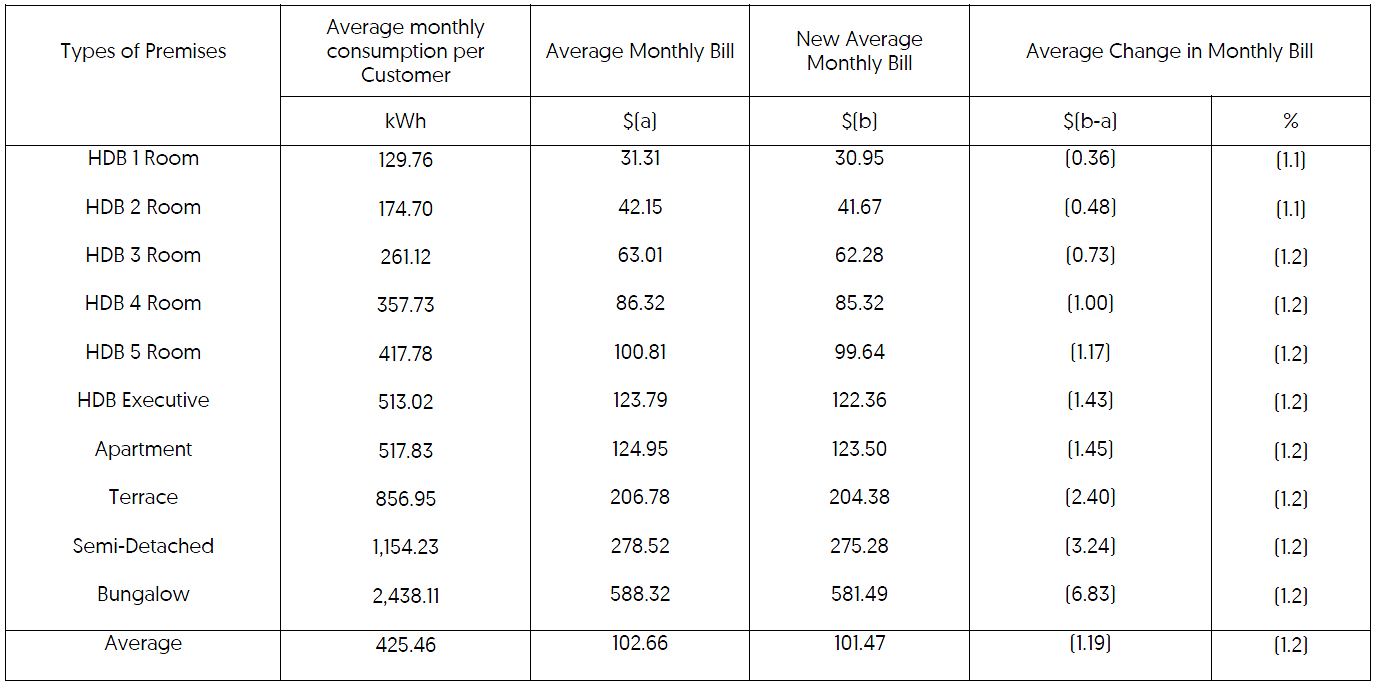
Electricity tariffs will decrease by an average of 1.2 per cent or 0.28 cent per kWh from Jan 1 to Mar 31 next year, compared to the previous quarter, SP Group announced on Sunday (Dec 30).
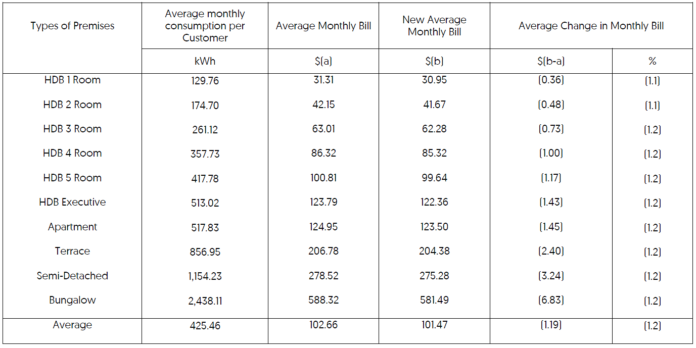
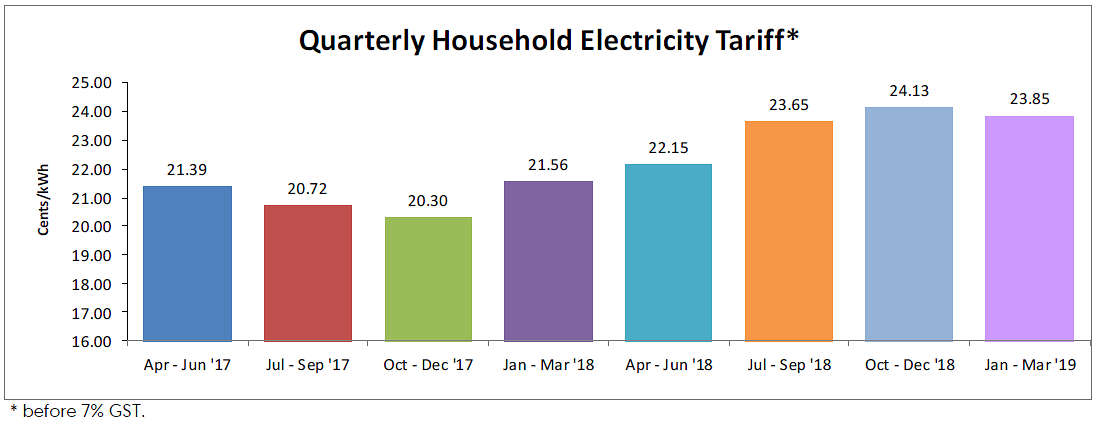
Households’ electricity tariff will fall from 24.13 cents to 23.85 cents per kWh. In effect, the average monthly electricity bill for four-room HDB flats will decrease by S$1, SP Group said.
The lower tariffs are mainly due to the lower cost of natural gas for electricity generation compared to the previous quarter.
This marks the first fall in tariffs since the last quarter of 2017, when the household tariff was 20.30 cents per kWh.
SP Group reviews electricity tariffs quarterly based on guidelines set by the Energy Market Authority, the electricity industry regulator.
GAS TARIFF TO DECREASE
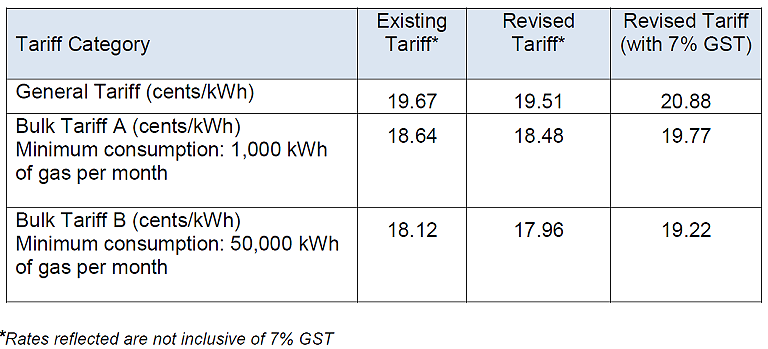
In a separate news release, City Gas also announced on Sunday that gas tariffs will decrease in the first quarter of 2019 by 0.81 per cent or 0.16 cent per kWh, from 19.67 cents per kWh to 19.51 cents per kWh.
This is due to a decrease in fuel costs compared with the previous quarter, City Gas said in its media release.
“City Gas reviews the gas tariffs based on guidelines set by the Energy Market Authority (EMA), the gas industry regulator,” the release said.
SINGAPORE: Imagine there’s a way to turn the plastic waste that ends up in oceans and landfills into a life-saving material, say, for making cheap fire-resistant jackets for all people.
It isn’t hard to do – at least, not any more – for a team of researchers in Singapore dreaming of reducing environmental waste and sharing their breakthrough with the world.
These scientists from the National University of Singapore and the Singapore Institute of Manufacturing Technology have converted polyethylene terephthalate (PET) bottles into a highly insulating and absorbent material called aerogel.
Aerogels, the lightest and most porous materials known to man, have existed since the 1930s – and were used to insulate the Mars Pathfinder rover in the 1990s.
Aerogel being folded.
But this is the first time an aerogel has been made from PET, the same plastic used for water and soft drink bottles.
And with an estimated eight million tonnes of plastic waste entering the world’s oceans each year, there is no shortage of material that could be recycled into aerogel products instead.
Their possible real-life applications include: As a lining for fire-retardant coats and carbon dioxide absorption masks that could be used during a fire; better heat and sound insulation in buildings; and cleaning oil spills.
NUS Associate Professor Hai Minh Duong, the co-leader of the research team, once used to wonder when he saw oil and plastic waste on the beach: “Can we use the rubbish on the beach to clean the oil spills?”
Fellow co-leader, Prof Nhan Phan-Thien, wanted to come up with a real product for everyone, after a lifetime of producing theories.
“We want everyone to have a (fire-resistant) jacket. For example, we all live in high-rise buildings, and the first thing is safety. And if there’s a fire … everyone can be safe,” he cites.
Now they have found a solution to these issues and more.
Assoc Prof Hai Minh Duong (left) and Prof Nhan Phan-Thien.
BETTER THAN WHAT’S OUT THERE
Over 95 per cent of an aerogel’s volume is made of air, hence the material’s high internal surface area and absorbent qualities.
Based on the team’s experiments, when their aerogel is coated with certain water-repellent chemicals, it absorbs up to seven times more oil than existing commercial sorbents can – and at a faster rate.
Owing to its insulating properties, it reduces sound more than any conventional insulation foam can, and insulates against heat many times better than fibreglass.
Oil spills threaten marine life.
When coated with flame retardants, it can withstand temperatures of up to 620 degrees Celsius – seven times more fireproof than the thermal lining in conventional fire-fighting suits, but at about 10 per cent of the weight.
To explain why aerogels are given different coatings, or surface modifications, Dr Duong uses the metaphor of a video game. “That’s like an expansion pack when you buy the game,” says the 44-year-old.
“With the surface modification, you can get the wide range of applications, like if you coat the aerogels … with an amine chemical, they can absorb the toxic gases and carbon dioxide.”
The most common type of commercially available aerogel is silica aerogel, which he says sells for about S$40 per sheet (A4 size) and is used mainly in the aviation, car, gas and petroleum industries.
But his PET aerogel would cost about 50 cents to manufacture, with one recycled bottle producing one sheet.
Besides devising a more environmentally-friendly and cost-effective aerogel, his team has also shortened the production process – which typically takes up to seven days – to about eight to 10 hours instead.
It is all about the recipe used for “cooking” the materials. And Dr Duong has another metaphor handy for a complex process that starts with rendering PET down into fibres: It is like the chemistry between two people.
“It’s very similar to fibre and fibre. If you’d like (the bonding to be) strong and to hold, they need … the chemical reaction between them,” he says.
After swelling up the fibres with water and then freeze-drying them, the result is “one of the most promising materials in the 21st century”.
A SERIES OF WORLD’S FIRSTS
This is not the first time his team has created a new aerogel. Nearly three years ago, NUS announced their “world’s first” cellulose aerogel, made of paper waste.
In January, it was reported that the researchers had, in another pioneering development, turned unwanted cotton-based fabric into an even stronger aerogel.
The three aerogels have overlapping applications, although cellulose and cotton aerogels are more skin-friendly and thus could be used for personal care products like diapers, as well as in medical and battlefield settings, such as for rapid haemorrhage control.
Aerogel offers many uses for textile waste.
Of the three, the PET version is the strongest and has the fastest absorption capacity. But Dr Duong’s team is not done yet with recycling environmental waste into “amazing” engineering applications.
In future, they hope to do the same with rubber waste, for example from tyres, food waste like coffee grounds and soya bean pulp, and even metal or electric waste.
People tend not to recycle now because they think waste cannot be more than low-value material, believes Dr Duong, who has been working at NUS for eight years.
“As long as they know the value of the waste, (that) they can convert it into a very high value, (then) they’d recycle,” he says.
From plastic bottles to a range of applications.
But for now, before his team can get the world to really sit up and take notice, they must commercialise the technology for mass production.
They recently published their PET aerogel research in the scientific journal Colloids and Surfaces A, and filed for a global patent.
They had earlier licensed the cellulose aerogel technology, through the NUS Industry Liaison Office, to materials and engineering company Bronxculture, based in Singapore.
But it may still take three to five years before any commercial product is in the market, reckon Dr Duong and Prof Phan-Thien, 65.
Eager for that to happen sooner, they are in the process of starting their own company to manage their cotton and PET aerogels.
The aim is to get it up and running by the end of next year, with some 20 companies worldwide interested in partnering them already.
It is an unusual step for university professors, but on Prof Phan-Thien’s part, he is “fascinated” by this project.
“As an engineer, you need to focus on the products,” he says. “It’s good to lay your hand on something real, and this is it.”
SINGAPORE: The latest Global Innovation Index ranked Singapore as the fifth most innovative country in the world.
We come up top in many areas including high-tech manufacturing and high-tech net exports.
Tech innovation has propelled Singapore towards realising our ambition of becoming an innovation-based economy, but large foreign multinational corporations (MNCs) have been its primary engine.
For the instincts of tech innovation to be woven into the fabric of our economy requires us to groom local innovators – local talent who can create enterprise solutions to local problems that have the potential for international scale.
Worldwide, research and development (R&D) activities in small, innovative economies are primarily driven by home-grown companies. In Sweden, local MNCs contribute almost half of total R&D expenses while Nokia contributed close to 50 per cent of R&D expenses in Finland during its prime.
People crossing a street in Singapore’s central business district. (File photo: Reuters)
As Budget 2019 draws near, the Ministry of Finance has asked for feedback from Singaporeans on how companies and workers can become more innovative to gain a long-term competitive edge.
So it is timely to examine how Singapore can develop local tech innovators and grow the next unicorn that can reap massive economic growth in an era of disruption.
Suppose a student wants to learn how to start a tech company. What can he do?
The conventional path for him is enrolment into business school. Yet this option is less than ideal where outdated programmes and case studies will lead him to learn the tepid vocabularies of entrepreneurship from dusty case studies such as Google and 3M, yet fail to develop the instincts needed for breakthrough innovation.
He might also learn business principles like minimum viable product, a risk-based approach towards business which encourages entrepreneurs to commit the least resources needed to build a functioning product.
In this, he might learn that to build a fully functioning four-wheel vehicle such as a car, he should start by thinking about building a two-wheel skateboard to gather feedback from customers before proceeding further.
Yet this paradigm is problematic because it assumes a linear, incremental model of innovation but the gestation journey of most game-changing technologies is often radical and aggressive.
Seeking feedback on a faster horse carriage will not give rise to Ford’s gasoline-powered automobile.
A university student graduation. (Photo: Reuters/Brian Snyder)
The other problem is that traditional business schools, as a microcosm of the university education system, inculcates short-term thinking. Students are subjected to continuous short-term scholastic testing, including examinations, essays and class participation.
Instead of fostering much needed imagination, creativity or a can-do attitude, business schools saddle students with academic endeavours and conditions them to prioritise their resources and attention for the short term.
Entrepreneurship, in contrast, requires the entrepreneur to be able to think long term, seize new opportunities and pivot to solve problems.
The entrepreneur will inevitably make mistakes, encounter setbacks and experience uncertainty, and little in business school teaches him how to navigate these challenging circumstances.
Being encouraged to be risk-adverse, the business school graduate instead avoids taking risks and fails to develop the killer business acumen vital for innovation.
These same instincts are needed in a student who eventually wants to work in a high-growth tech company, even if he doesn’t want to start his own company.
Some say we expect too much out of business schools, which are also tasked with grooming professionals climbing up the corporate ladder and helping people switch industries mid-career.
But most of us can agree equipping graduates with skills for the future economy must remain a basic goal or business schools risk becoming obsolete.
The alarm bells have sounded. Minister for Trade and Industry Chan Chun Sing had remarked at an Industry 4.0 panel that the conventional education system alone is too slow to meet the needs of tomorrow.
Chan Chun Sing speaking at an event.
Over the past 20 years, more business schools around the world are offering entrepreneurship modules but it is worth considering bolder changes to these programmes in Singapore.
I have five suggestions for business schools to consider in ensuring business programmes remain relevant.
First, a closer partnership with industry leaders to develop programme components. Mentorship and coaching from industry leaders can move the needle.
Many self-made billionaires around the world have committed plans to help students realise their entrepreneurial potential yet these programmes are still not part of mainstream business school education in Singapore.
Taizo Son, a self-made billionaire, founded Vivita, an early education school that provides a 21st century makers’ space to nurture a children’s curiosity for entrepreneurship. They expose students to the latest cutting-edge technology, including virtual technology, 3D printing and the like.
By empowering students to create, experiment and prototype, Son’s programme propels students to solve problems and make the future.
Peter Thiel, co-founder of Paypal and an early investor of Facebook, started the Peter Thiel Fellowship since 2011.
Peter Thiel, co-founder of PayPal, speaks at the Republican National Convention in Cleveland, Ohio, US, July 21 2016. (Photo: REUTERS/Carlo Allegri)
Each year, he gives 20 to 30 students a two-year US$100,000 fellowship to drop out of college and commit full-time to build their business. His fellowship also provides a network of investors, customers and mentors that fellows can draw on for support.
RETHINK THE DESIGN OF BUSINESS DEGREE PROGRAMMES
Second, instead of a model of teaching and passive knowledge acquisition, business schools should design their programmes to focus on practice as core curriculum in developing action-oriented graduates.
Business programmes should be experiential and provide an immersive experience that allows students to develop, launch and operate real business plans. They should aim to get students out of the classroom and into the competitive world of solving real problems.
Business schools should transform themselves into accelerators that aggregates programmes, events, initiatives and business competitions on a common platform for students – in partnership with entities such as Enterprise Singapore, incubators and the start-up ecosystem.
They could hold hackathons, business competitions or pilot studies so that students can pitch and pivot their ideas to fit the needs of enterprises.
Business schools could design their programmes to fit each stage of the business life-cycle, from ideation, prototyping, beta-testing, early-stage venture capitalisation and rapid growth.
A social impact accelerator dinner workshop held at the Singapore Management University equips social entrepreneurs with skills like value proposition design. (Photo: Facebook/Lien Centre for Social Innovation)
There are no lack of available suitable partners to business schools.
The Start-up Weekend Singapore (SWSG) Mega Hackathon, a space where diverse talent brainstorm and tackle specific challenges in 24 hours, helps entrepreneurs brainstorm ideas and meet people with different skills, and is a great module for the ideation phase.
StartupX, partly run by SWSG’s founder, recently partnered with Temasek to start The Start, a programme that supports entrepreneurs with high-potential ideas in the prototype or beta stage with funding and coaching, so that they can become a viable company that attracts follow-on investor funding or customers.
Competitions such as the DBS-NUS Social Venture Challenge or the Lee Kuan Yew Global Business Plan Competition, with its exposure to venture capitalists, can provide useful testing grounds in the post-beta or revenue generation phases.
In all these, the school should also see itself as an enabler for the student, to provide links to relevant resources, networks and opportunities that support students in building their unique business model and mobilising resources to succeed. Professors would act in advisory capacities as mentors to be consulted on students’ business strategies.
Third, business schools must keep case studies fresh and relevant. Instead of dusty old business cases, the school could draw on virtual accelerator programmes such as One Million by One Million or reality TV shows such as Shark Tank and Dragon’s Den, which do a better job in teaching students how to be entrepreneurs with stronger, more recent case studies.
(Photo: Unsplash/Hunters Race)
Fourth, in terms of performance measurement, in lieu of grades, business schools could track students’ follow-on funding or revenue generated through hackathons or business competitions, complemented by annual reviews that track students’ assessment of their own growth and 360-degree feedback from mentors, customers and team mates.
The school should also track the number of projects that become inactive, as well as those at the ideation, prototype, beta, early or growth stage. Students whose projects become inactive could be matched, based on student’s interests, to other teams whose projects are growing.
RETHINK ADMISSIONS
Fifth, let’s rethink admissions. Business schools should select hungry, ambitious candidates who want to turn ideas into reality – and jettison traditional rule-based admission methods based on past performance and grades.
Business schools should assess the potential of aspiring graduates and their proposed project through qualitative questionnaires and interviews, in the same way that many professional degree programmes select students based on their portfolio and field interests.
In this, the school could take a page from the playbook of established accelerators like Y Combinator, Tech Stars and Echoing Green, which select entrepreneurs based on their subject mastery and leadership skills, the innovativeness of their intended project and potential for huge impact.
The school could then try get students who might have common or complementary ideas to team up.
RETHINK BUSINESS SCHOOL
The Times Higher Education has plans to launch a new way of ranking universities next April. It would capture the quality of jobs landed by graduates, contributions to economic growth and global partnerships forged.
The initiative is in line with Singapore’s push to measure an institute’s worth beyond the narrow measurement of research publications and is a step in the right direction.
Where even the ranking agencies have recognised that old methods of signaling which educational institutes have a better value proposition, it is time for business schools to step up and rethink its role in an age of disruption.
Singapore must strive to grow our pool of local tech innovators and company founders, and business schools must transform themselves to aid this goal.
Oon Tian Sern is the founder of Acceset. He is also recipient of the Queen’s Young Leader Award in 2018 and associate with the Philip Yeo Initiative.
SINGAPORE: It all started with New Zealand film director Peter Jackson’s documentary They Shall Not Grow Old.
Ngoh Shian Bang, 24, was awestruck when he saw the film which had colourised footage of World War I scenes.
“It’s all in black and white and when you see old footage, they’re all very sped up. People walking very fast,” said Ngoh.
“In the documentary, it showed the transition from black-and-white footage, sped up footage, slowly to colour. I was like, ‘That’s incredible!’,” he added.
Armed with his computer and Adobe Photoshop, Ngoh decided to give colourisation a go. The first of his attempts were of national hero Lieutenant Adnan Saidi who fought to defend Pasir Panjang Ridge days before Singapore fell to the Japanese.
Ngoh, who picked up the hobby about a month back, said only a handful of photos of Lt Adnan exists today and all are in black-and-white.
“He’s always been in school textbooks … We see black-and-white figures as from ‘that era’ and we don’t feel the connection. Once I coloured them, I realised that they are just like us. We also exist in colour, right? So how are they any different from us? It’s just the time difference,” Ngoh said.
One of Mr Ngoh’s first attempts at colourisation was of Malayan soldier and national hero Lieutenant Adnan Saidi. (Montage: Ngoh Shian Bang)
He posted his “very amateur attempt” on a local discussion board Reddit and received encouraging comments despite botching the colour work on his medal, he said.
Apart from Lt Adnan, Ngoh has also coloured former president Benjamin Sheares, Tan Kay Hai and criminal lawyer Leo Fernando.
Ngoh was fascinated by flight lieutenant Tan’s story. He was a Singaporean who was with the British air force, shot down and captured by the Germans while flying on D-Day in 1944 over Normandy. Lt Tan escaped and lived to old age.
“I think people should know him. He’s a war hero,” Ngoh said.
Ngoh worked on colouring an old photo of Singaporean RAF pilot Tan Kay Hai. (Photo: Fann Sim)
The self-professed history buff said he enjoys history and feels that it is a topic that is “underappreciated” by Singaporeans his age.
“I feel a sense of pride. I’m bringing something that’s from a 100 years ago and throwing it out again. It feels like it could be something from yesterday as compared to taking a picture … This is the closest I’ll ever get to seeing something from the past,” Ngoh, who is also a freelance photographer, said.
Portraits are his main focus now because they are easier, he said. With simple backgrounds, budding colourisation artists like him can focus on the skin and facial tones. These are also the hardest to get right.
“A face has blood on the cheeks, fat over the chin area, nose and ears will also have veins and blood as well. So there could be a red layer first to represent blood, then skin colour could be a bit of yellowish darker tones,” he said.
A portrait can take him five hours to colour.
The easiest things to colour are clothes like uniforms, especially when there is information out there on what they look like, he said. Ngoh, who has been at the hobby for about a month, said there are many guides available online to help others learn the craft.
One of the main Reddit forums for colourised history has grown to more than 430,000 subscribers in six years. Among its moderators are colourists who have turned professional.
ENSURING HISTORICAL ACCURACY
National University of Singapore historian Matthias Wong said while colouring old photos is a “great way” for both colourists and viewers to engage with history, special care should be taken.
“Coloured photos are not historical documents, they are artwork that imaginatively recreate a scene from the past. We do not have records for everything, and we will never know what the past looked like exactly. These creators often invoke their imagination to fill in the blanks, making their best guesses in choosing the right shades of colours,” Wong said.
They should do their best to find evidence to support their choice of colours, he added. This could be done through reading accounts and descriptions of their subjects from that time, and paying close attention to important details like the colours of the hair, eyes and skin.
“We often unknowingly import our own biased views into the past. … Also, placing a watermark on their coloured creations will remind anyone who comes across the photo that this was a recreated image, a result of an imaginative process that may not be entirely representative of the past,” Wong said.
Ngoh, as well as fellow local colourist Cho Dee Fei agreed that they have to work towards an image that is as close as possible to the photo’s reality.
Cho Dee Fei, 29, works as an engineer but dabbles in colouring old photos in his downtime. (Photo: Hanidah Amin)
While coloured old photos evoke a sense of immediacy and relevance to viewers, 29-year-old engineer Cho agreed that they should only be seen as supplements to the actual photos and not meant to replace the original black-and-white photos.
This is a view shared by the amateur colourisation community online too.
“People try their very best to match the colours. For example, uniforms of World War II. You cannot possibly colour them in red, blue or green or whatever colours,” Cho said.
“We follow this for uniforms, buildings, car models. There are some things that are a bit ambiguous. For example, the clothes of civilians. We do not really know what are the colours worn exactly so most of the time it’s a bit of guesswork,” he said.
This, he said, is to respect history and not distort it.
Cho looks for local photos on Roots, a website curated by the National Heritage Board that draws from various repositories including the National Archives and museums.
One of Mr Cho’s colourisation work includes the photo of a woman from the 1960s found from Roots, a website by the National Heritage Board. Skin tone and facial features are the hardest to get right during colourisation, according to Mr Cho. (Montage: Cho Dee Fei)
Cho has also coloured photos of people, whose names are not known to him, donated by the public to the archives. When he started this hobby about half a year ago, Cho realised that most colourised photos originated from Western countries so he wanted to colour people from Singapore’s history – well known or not.
“There are a lot of old photos donated by the public and I find this very interesting,” he said.
“Maybe I feel like many people are doing colourisation of famous people and it becomes a bit too generic. (I) wanted to try something a little different, I suppose,” he added.
Both colourists are looking to work on old family photos in future. But Cho said he wanted to work on getting better at colourisation first.
Ngoh is waiting for his relatives to give him a photo of his maternal grandfather who was born in Thailand whom he never met. Like Peter Jackson, Ngoh is inspired by his grandfather’s life story.
“He was involved in espionage and was in charge of arresting triads in the Golden Triangle. … He fought the Japanese and when they left, he fought the communists,” he said.
Meanwhile, he has worked on requests from friends to colour their old family photos.
“It’s a good way for them to reconnect maybe not physically but emotionally. I think it’s like a service. You feel good that you have done something that makes them happy,” he said.
SINGAPORE: A 25-year-old man was arrested for suspected drink-driving after he was involved in an accident along the Central Expressway (CTE) early on Saturday morning (Dec 29).
Photos online show his car flipped over, with debris scattered on the road.
The police said they were alerted to the accident at 3.45am along the CTE towards the Seletar Expressway (SLE). Two female passengers, aged 24 and 25, were conscious when taken to Tan Tock Seng Hospital, police added.
A car that was involved in an accident along CTE. (Photo: Facebook/Shaqliz Liz)
The man’s car was believed to have flipped over after it hit the rear of another car. Photos show the second vehicle was not as badly damaged.
Prime Minister Lee Hsien Loong says the Reform and Friendship Award that the Chinese government recently conferred on the late Mr Lee is a “strong affirmation” of his long-standing support for China’s development.
Mr Lee Kuan Yew (File photo: TODAY)
(Updated: )
Bookmark
SINGAPORE: The multi-faceted cooperation between Singapore and China today was built on the foundations laid by founding Prime Minister Lee Kuan Yew and China’s late paramount leader Deng Xiaoping, said Prime Minister Lee Hsien Loong.
He said this in a written interview published by Xinhua on Saturday (Dec 29). The comments were in response to the Reform and Friendship Award Beijing conferred on the late Singapore leader earlier this month, in recognition of his long-standing support of China’s development.
The award was given as the Chinese Communist Party celebrated the 40th anniversary of China’s “reform and opening up”.
In the piece to Xinhua, written in Mandarin, PM Lee noted how Mr Lee’s involvement in China’s reform goes back to his first meeting with Mr Deng in 1978 in Singapore.
“Mr Lee Kuan Yew was a long-standing friend of China. He was a close observer of China and took a deep interest in its development. Over 37 years, Mr Lee visited China 33 times and witnessed firsthand China’s phenomenal growth and development,” said PM Lee, according to a transcript of his comments provided by the Prime Minister’s Office.
“He not only went to the major coastal cities, but also many inland provinces and historic destinations. He thus gained a better understanding of Chinese society, and of the tremendous determination of the Chinese people to transform their society and improve their lives.”
It was Mr Lee who first suggested Singapore’s first government-to-government project, the China-Singapore Suzhou Industrial Park, PM Lee wrote.
He added that this led to the Sino-Singapore Tianjin Eco-city, as well as the third government-to-government project – the Chongqing Connectivity Initiative which was launched in 2015 to promote the development of China’s western region and contribute to the Belt and Road Initiative.
“All these projects were designed to complement China’s evolving development needs,” said PM Lee.
“China has made huge strides over 40 years of its reform and opening up. Mr Lee was one of the first to foresee this dramatic success, the huge difference this would make to China’s population and the world, and how Singapore could participate in and benefit from this transformation.”
The prime minister added that the award accorded to the late Mr Lee is a “strong affirmation” of his long-standing support for China’s development and friendship between both countries.
“Singapore wishes China every success in its continuing journey of reform and opening up under President Xi Jinping, and looks forward to our relations flourishing for many more years to come,” said PM Lee.
SINGAPORE: Mention rental scams, and you could be forgiven for thinking that tenants are usually the victims, for example by giving a deposit to a fake landlord.
But did you know that landlords in Singapore are more commonly the targets of scammers posing as legit tenants?
Here is a list of rental scams that landlords of residential properties need to watch out for.
This is fairly recent in Singapore, and is a phishing attack in the guise of a rental request. With this rental scam, the tenant insists on paying you first. They will claim they want to transfer their security deposit, or the first month’s rent, but can only do so via services like PayPal.
Later, they will ask for your account details, as well as your name, NRIC number and address. This is sufficient information for them to hack your account. Not all of them are just after the funds in your wallet either; some of them will use your hijacked account to launder money.
This year, several Singaporean landlords have reported being targeted for such a scam on anti-scam site scamalert.sg, citing the name of the scammer as Tan Mui Joo.
As a rule, never trust a tenant who’s eager to pay before even viewing the property.
File photo of a person surfing the Internet in Singapore. (AFP/Jewel Samad)
This is one of the most vicious rental scams a so-called tenant can pull, because it affects an innocent third party.
This scammer starts off appearing as a good tenant who pays rent on time for the first few months. They may even put down an unusually big amount at the start, such as three months’ rent. After the first three months however, you’ll notice there’s no more money coming in.
And, when you visit your property, you’ll find it inhabited by a total stranger. This stranger has been tricked into thinking your tenant is the landlord, and has been paying the rent money to your tenant.
By the time you find out, the tenant has usually left the country.
This rental scam is especially painful if the third party is vulnerable, for example a single parent, or a foreign worker who desperately needs the funds. You will not feel good evicting them, but they are unlikely to be able to pay you after already paying your criminal “tenant” rent in advance.
To prevent this, always make appointments to check on your property every few months. If you are renting out a condo, get to know the neighbours and the security guards; they can be the first to tip you off if something is wrong. Some condos also let residents install a CCTV camera outside their units.
The Singapore Police Force has put up crime advisories to warn against these scams – but as many “subtenant” victims are foreigners, they may not get the message until it is too late.
We suggest introducing any confirmed tenants to your neighbour; this suggests to them that there’s another pair of eyes on them.
This is similar to scam #2, except in this case, the scammer “short-leases” your property illegally. This is most popularly done through sites such as Airbnb. At prices of around S$120 a night, a tenant can shave substantial amounts off their rent, by having illegal guests stay over.
Because these short stayers are only around for a few days, it is easy for them to make the excuse that they have visiting friends. Also, your tenant is still there most of the time, so even the neighbours may not notice anything strange.
As the landlord who has rented out an apartment, make it a point to visit websites like Airbnb to check whether your home is listed, or Google your address from time to time. This is how you can find out if your tenant is illegally letting out your place on short-lease basis.
File photo. (Photo: Pixabay)
4. THE ILLEGAL STASH SCAM
This is when criminals use your house as a storage space.
The tenant pays the rent on time, and does not cause any trouble. They are quiet all the time.
In fact, they may be too quiet. Neighbours may notice the lights are off all the time, or that they seldom see the tenant come in and out, except at odd hours.
There is a chance the tenant is using your property as an illegal stash house. They are not able to store their unlicensed cigarettes, pirated DVDs, narcotics, in a warehouse; so the next best option is to rent in a quiet residential area, and keep the stuff in the closets. The rental cost is low, compared to their criminal proceeds.
Again, the best defence is to visit the tenant periodically. The easiest way is to make it clear in your Tenancy Agreement that the landlord is entitled to enter the premises every three months for maintenance work, for example air-con cleaning.
Of course, the tenant might hide the stuff when you arrive, but they may decide to move, and find a less discerning landlord.
5. THE BROTHEL SCAM
This is the one we love to giggle at in the news. But it really does happen, and it is not restricted to the heartlands.
The rental scam is perpetuated by pimps, who rotate various women in and out of the house. Clients of the prostitutes are invited into the property, which is a major problem; a furnished property may be damaged by the clients, or items are sometimes stolen.
And if there is an altercation, you could face a police investigation.
Remember that, even if you are eventually cleared, the police will have to look into your details to ensure you are not in cahoots with with the pimp. This can cause undue stress and worry.
This scam mainly happens in heartland areas, but do not assume it does not happen in a condo. Prostitution rings will use any location with lax security, and a high degree of anonymity.
Again, clauses in your Tenancy Agreement that specify the need to periodically enter the premises for maintenance work could help prevent this, as with being on good, communicative terms with your neighbours who can keep a lookout for you.
6. THE HIT-AND-RUN SCAM
This is a tenant who is unable to pay you throughout the entire lease – and knows it.
They may have enough for the deposit and advance, and perhaps half a year of rent. But they will sign a year’s lease for a fancy property, knowing full well they will stop paying beyond a certain point.
These tenants have different motives – some just want to live in a luxury area for a while, and then run. The more nefarious ones are running some kind of scam, like a fake investment scheme. They will rent prestigious addresses for credibility, with no intent to stay beyond a few months.
These tenants will usually start giving you late payments after three or four months, and their excuses will pile up. By the time you take action, they will have owed you one to two months’ of back rent; but the house will be empty when you show up.
A good way to prevent this is to verify the tenant’s occupation by asking for his/her name card at the viewing. You can then Google his online presence, or give his company a call to verify that he/she is indeed working there.
To avoid being the victim of rental scams, get an agent to screen the tenant. Most of these can be prevented by having a good property agent representing you, the landlord.
Property agents registered with the Council of Estate Agencies (CEA) are obliged to perform basic background checks on prospective tenants.
They may also have experience in spotting the warning signs of a bad tenant or a potential scammer. Sure, you might need to pay a one or two month agent’s commission, but a peace of mind is surely worth more than that.
SINGAPORE: For Singaporeans seeking to diversify their portfolios, investing in a property overseas might be an enticing option.
The relative strength of the Singapore dollar compared to regional currencies means you might get more bang for your buck elsewhere.
Ismail Gafoore, co-founder, Executive Chairman and CEO of property firm PropNex, gave this example on the Asia Business First Podcast this week. “In Singapore, if we want to invest in a property, if you do not have a million dollars, you are not going to get something that is decent enough.
“Even at a million dollars, today we are only talking about something slightly bigger than a shoebox … Imagine you paying an additional stamp duty – assuming if that is your second or third property – even as a Singaporean, you may end up… having to pay a 16 per cent stamp duty on a million dollars. It is S$160,000. And that pure stamp duty can give you a free home in Cambodia.
“I think an average earning Singaporean can invest overseas. I think it is one way to grow your nest (egg) towards retirement. One of the key concepts I want to share with people is “other people’s money”… If you are able to buy a property and let’s say put down 30 per cent and you take a 70 per cent loan over a period of 10, 15 years. And if you can rent (it) out for the next 15 years and if your rental can cover and pay out the loan, you would have got a property actually (for) free.”
Still, Mr Ismail conceded that such investments are not without risks.
After all, the value of the property and the rental yield could decrease depending on currency swings.
“The concern here will be capital appreciation. People are always torn between entering a market that is cheap, and whether are you taking a risk on the currency stability and whether it will appreciate.”
He also warned against getting carried away without first finding out about rules on foreign ownership.
FILE PHOTO: The Sydney Opera House and Harbour Bridge can be seen behind real estate agent and a potential buyer from Shanghai, during an inspection of a property for sale in the Sydney suburb of Vaucluse, Australia, July 11, 2015. REUTERS/David Gray/File Photo
“In Australia, foreigners can buy only properties that are under construction. When you own the property – because it is completed, you cannot sell your property to another foreigner. You are forced to sell to a local. For example, some of us – when we see a townhouse with a big piece of land, we are so excited because in Singapore it is so expensive. And we dive in and we say, ‘This is what I want!’ But when you want to sell – and you cannot sell to another foreigner – by Australian standards, they say, ‘This land is small. I can buy acres for this!’ And you might get trapped in that situation. So you have to understand each country’s specifics and your objective.”
Dr Davin Wang, Chief Data Officer at property data company StreetSine Technology Group, advised potential buyers always to do their homework.
“Having stayed in a place doesn’t mean that you have very good property knowledge … It is very important that we have access to professionals who can really arm us with knowledge, market intelligence, understanding of where the property cycle is, what are the risk factors in that environment, specific to that country or even specific to that city that might make that investment outstanding…
“A lot of online resources and information are much more readily available now in what was traditionally seen as a very opaque industry… But that does not replace quality advice from a professional. Property is always seen as a local game. So it is very good to actually find a person that specialises in property in the locale that you’re intending to invest in to get good advice…
“When we make a property investment, it is important to choose quality over quantity. And it is better to have one key quality property that is in a very stable market, predictable and reliable regulatory reform or regulatory standards and nothing that will really surprise you in terms of investment property than to pick a market that is still in a state of flux, that you carry a lot more risk.”
To find out what the experts advise when it comes to investing in emerging markets, listen to the Asia Business First podcast here.
SINGAPORE: Singapore’s population boom in its first 40 years has seen the massive explosion of households and the mushrooming of public housing to meet residential needs.
The number of resident households has increased by almost three times from 472,700 in 1981 to 1,289,900 in 2017.
However, the rapid growth phases in the 1980s and 1990s with the number of households expanding at an average annual rate of about 4.62 per cent and 3.32 per cent are unlikely to be replicated going forward.
Instead, average household growth rates have slowed down to about 1.79 per cent in the 2010s. Resident household growth rates have stabilised at 2.08 per cent in 2017 after a sharp decline in 2011.
Resident households and average household size in Singapore. Resident household growth rates have stabilised at 2.08 per cent in 2017 after a sharp decline in 2011. (Graph: Sing Tien Foo, Source: Ministry of Trade and Industry, Department of Statistics)
In other words, it’s time for HDB to shift gears from ramping up housing supply to rethinking what sustainable, highly liveable housing that promotes social goals should look like.
SHRINKING HOUSEHOLD SIZES
A second important shift in Singapore’s demographic structure impacting housing has also been underway, where the average household size has significantly decreased from 4.87 persons in 1980 to 3.30 persons in 2017.
We have observed alarming trends in the growth of smaller 2-person and 3-person household families, which collectively make up more than 4 in 10 of total households in Singapore as of 2017.
The changing demographic structure may have implications for the demand for HDB flats, but the causal effects are not as clear. Did HDB and private developers respond to dwindling trends in household size by building smaller flats and private apartments? Or did household sizes shrink because developers built smaller apartments?
There is a trend in the growth of smaller 2-person and 3-person household families as of 2017. (Graph: Sing Tien Foo, Source: Ministry of Trade and Industry, Department of Statistics)
It’s clear that private developers had ramped up the supply of shoebox units in response to higher investment demand for smaller and more affordable apartments that can be rented out, prompting URA to revise guidelines to reduce the number of shoebox units and stem the shrinking of private homes in October.
While there is no evidence to suggest that housing supply is influenced by changing household size, what is clear is that household size across all housing types has shrunk since 1980, with possible knock-on effects for social cohesion and family bonding.
Except for landed housing that has an average household size of 4.29 persons, private condominiums and apartments house on average 3.24 persons.
Bigger 4-room and 5-room or executive HDB have an average household size of 3.42 and 3.77 persons respectively, while the smallest of the lot, the 2-room and 3-room HDB flats house 2.19 persons and 2.63 persons respectively.
The average occupancy size for each housing type has also come down but stayed constant since the early 2000s.
Household size across all housing types has shrunk since 1980 (Graph: Sing Tien Foo, Source: Ministry of Trade and Industry, Department of Statistics)
BIGGER HOUSES MIGHT ENCOURAGE FAMILIES TO HAVE CHILDREN
While we cannot establish cause, it’s undeniable that the family planning decisions of Singapore households are correlated with housing size they live in.
In an earlier op-ed I wrote, I highlighted that three groups of households tend to have more children – homeowners (relative to renters), families living with parents or siblings (usually in a bigger apartment), and families from older cohorts, based on empirical analyses done with two scholars from National Chengchi University using the Panel Study of Family Dynamics survey data from Taiwan.
Why might that be the case for those who live with other immediate family members? If childcare support from old parents were a consideration for younger couples to bring forward their childbearing decisions, housing policies that encourage extended family members to live with each other may create a conducive environment with strong family support that encourages young couples to have more kids and at a younger age.
In 1989, where there was an oversupply of flats in some housing estates, including Woodlands and Yishun, HDB took the unprecedented step to combine unsold three-room and four-room flats and convert them into jumbo flats of 147 sq m to 199 sq m.
Families living in jumbo flats enjoy the luxury of space afforded by many bedrooms, a huge living and dining area, a family room and a kitchen, even leaving space for a study room and a maid room in some cases.
File photo of HDB flats in Singapore. (Photo: Nurfarahhin)
It’s no wonder then that they are highly sought after by large multi-generation families but one almost cannot plan to own one without some deliberate and well-timed searching and waiting.
With only a few thousand jumbo flats to go around Singapore, they barely register a blip on the total population of HDB flats. Where not many are put on the resale market, they command a high price premium, ranging from S$650,000 to S$950,000.
The jumbo flats were a one-off plan by HDB to clear unsold flats in the 1980s. Such a similar large-scale conversion has not been undertaken by HDB since.
Existing flat owners can still apply to the HDB Conversion Scheme to combine two adjoining 3-room or smaller flats bought in the resale markets. But these are ad hoc and rare, considering also the implication that the two title deeds will be merged and the flats cannot be split up for separate sale subsequently.
Yet perhaps in recognition of the possibility that more young couples want to stay in bigger flats with their ageing parents, the government recently reintroduced multi-generation living and brought back a batch of 84 three-generation (3Gen) flats in the Build-to-Order exercise in November 2013.
These flats of at least 115 sq m, which have 5 sq m space more than most 5-room flats, include at least four bedrooms and three bathrooms, and can house married couples with their aged parents.
But they do not have two access doors like some private condominium dual-key units do, suggesting HDB’s intent to guard against attracting buyers intending to rent out part of their flat.
Still they remained popular, with eight in 10 of such units booked, said the HDB in February, where close to 1,500 of these flats across more than 20 projects have been put up for sale alone in 2017.
ENCOURAGE MORE TO LIVE WITH FAMILIES
In a land scarce country like Singapore, large flats brush up against competing land uses but if jumbo flats have knock-on social effects – including promoting multi-generation living, strong family support, more closely knitted families and greater encouragement among younger couples to have more children – that extra 5 sq m space in the 3Gen flats would be aligned with other population goals. It would then be worth considering increasing the supply of such flats.
Already, we know that couples are more likely to live with their parents in 5-room and executive flats.
The open kitchen concept for a 5-room flat at HDB’s My Nice Home Gallery. (Photo: HDB)
Practically speaking, bigger flats also offer more space to encourage interactive activities that build family bonding and manage friction that might otherwise arise from having to live together in a smaller space.
Living with parents in these 3Gen flats not only allow more young couples in their thirties to spend more time with their parents, it also helps them muster more support and manage the pressure of juggling between bringing up their children and building their careers.
While there is still no clear evidence to suggest that larger flats could change couples’ decisions on childbearing; at least, they would have no excuse not to take care of their ageing parents.
A move to build more 3Gen flats would also complement the Extended Proximity Housing Grant (PHG) which offers S$20,000 to encourage families to buy resale flats and live in close proximity to their parents.
But government intervention will be needed, where high per square foot housing prices will likely continue to incentive private developers to build more shoebox apartments to meet financially constrained buyers and investors.
HDB is also not likely to build more 5-room and bigger flats, unless new buyers demand for these.
Still, if housing size, and more specifically, 3Gen flats can address Singapore’s twin demographic problems, bringing young families and aged parents under one roof, and tackling the low fertility rates plaguing Singapore for many years, it’s worth relooking the supply of more 3Gen flats.
Sing Tien Foo is the Dean’s Chair Associate Professor and Director of Institute of Real Estate and Urban Studies (IRES), National University of Singapore.
SINGAPORE: A motorcyclist was injured in a chain collision along the Pan-Island Expressway (PIE) involving a motorcycle, three taxis and four cars on Friday (Dec 28).
The motorcyclist, a 29-year-old man, was conscious when he was taken to Tan Tock Seng Hospital, police said.
The accident on the PIE towards Tuas after the Paya Lebar exit happened at about 5pm.
In photos posted on social media, paramedics can be seen attending to a man lying on the ground. The rightmost lane appears to be closed amid heavy traffic.
Paramedics attend to a man after a chain collision along PIE. (Image: Facebook/Singapore road accidents)