U.S. oil prices fell on Friday after the United States showed signs of following Asia into an economic slowdown, although crude supply withdrawals by producer club OPEC prevented prices from dropping even further.
FILE PHOTO: A gas torch is seen at the Filanovskogo oil platform operated by Lukoil company in Caspian Sea, Russia October 16, 2018. REUTERS/Maxim Shemetov
Bookmark
LONDON: Oil rose toward US$57 a barrel on Friday after China said it would hold talks with the United States to look for solutions to a trade dispute, while signs of lower crude supply also supported prices.
The Organization of the Petroleum Exporting Countries cut crude output in December, a Reuters survey showed, and the American Petroleum Institute (API) reported a drop in U.S. crude inventories.
Brent crude , the global benchmark, rose 84 cents to US$56.79 a barrel by 0932 GMT. U.S. crude oil was up 81 cents at US$47.90.
“Jitters over the health of the global economy look set to endure but are being lost on the oil market, at least for the time being,” said Stephen Brennock of oil broker PVM.
“That said, whether this bout of price strength can be sustained is far from certain.”
Oil gained further support from the latest supply report from the API industry group, which said on Thursday that U.S. crude stocks fell by 4.5 million barrels last week.
Both benchmarks are on track for solid gains in the first week of 2019 trading despite rising concerns that the China-U.S. trade war will lead to a global economic slowdown.
But in comments that helped oil to rally, China’s commerce ministry said it would hold vice-ministerial trade talks with U.S. counterparts in Beijing on Jan. 7-8.
The two nations have been locked in a trade war for much of the past year, disrupting the flow of hundreds of billions of dollars worth of goods, raising concern of slowing growth and roiling financial markets.
A survey from the Institute for Supply Management on Thursday showed U.S. factory activity slowed more than expected in December, and leading economies in Asia and Europe have reported a fall in manufacturing activity.
Despite the demand-side concerns, oil has received some support as supply cuts announced by the global coalition of producers known as OPEC+ kick in.
OPEC, Russia and other non-members agreed in December to reduce supply by 1.2 million barrels per day in 2019. OPEC’s share of that cut is 800,000 bpd.
The Reuters survey on Thursday found OPEC supply fell by 460,000 bpd in December, following assessments by Bloomberg and JBC Energy also showing a sizeable decline.
The focus now will be on whether producers deliver further curbs in January to implement the deal fully.
(Additional reporting by Henning Gloystein; Editing by Dale Hudson)
SINGAPORE on Friday launched a database which allows would-be home buyers to check the track record of their property agents.
The Council for Estate Agencies (CEA) launched the Property Agents’ Transaction Records Initiative which publishes the records of residential transactions carried out by realtors in the city-state in the last two years.
According to the Straits Times, the first phase of the initiative involved CEA’s website updated with information on completed HDB transactions, including when the flat changed hands, location, and whether the agent worked for the buyer or seller.
“The additional information can provide consumers with a clearer understanding of the agent’s experience in terms of how active he or she has been in the last two years in closing HDB resale transactions, in which HDB towns, and whether he or she was acting for the buyer or the seller,” the CEA was quoted as saying.
However, the information accessible were only those that took place over the last 24 months to allow consumers to see only the most updated transactions.
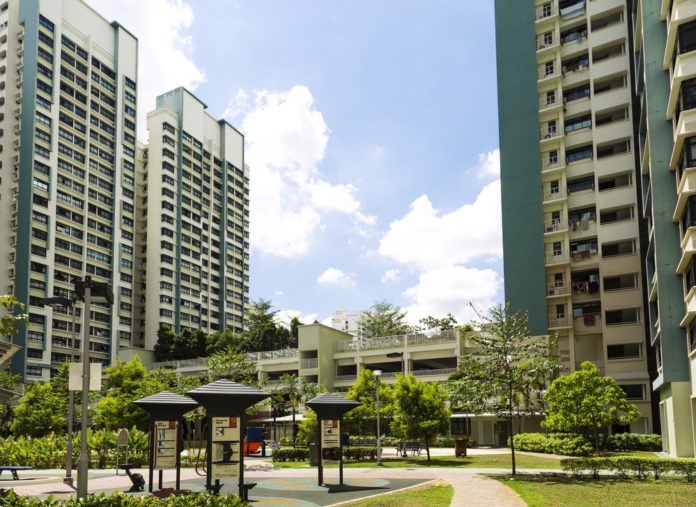
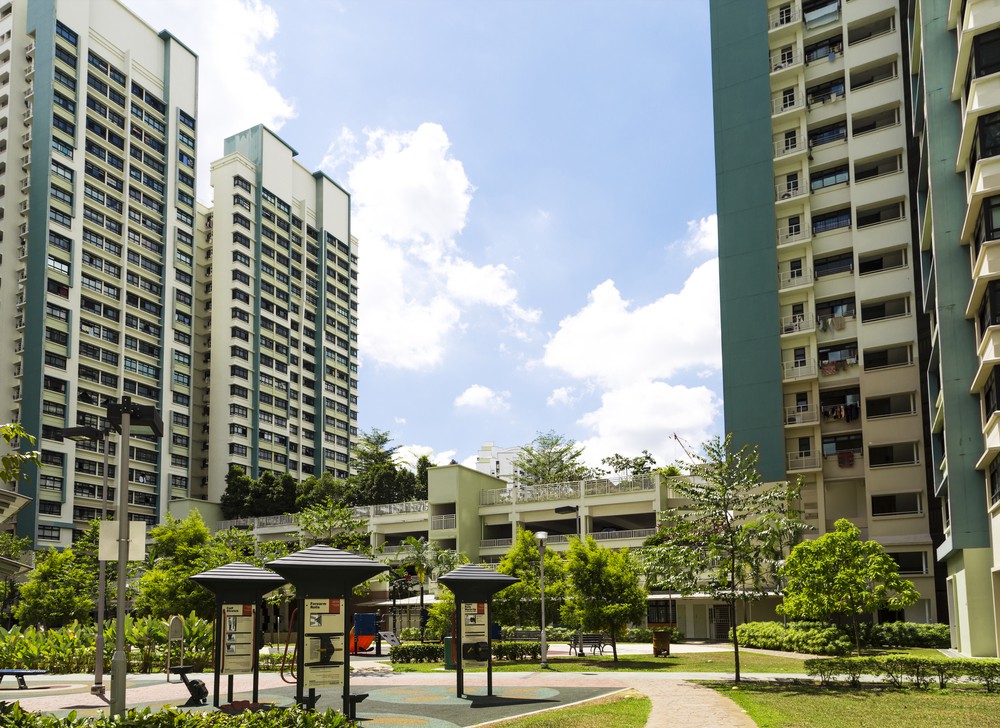
A new apartment neighborhood in with carpark and playground in Singapore. Source: Shutterstock
For more dated information, people can refer to data.gov.sg.
The effort, which eas among recommendations in the Real Estate Industry Transformation Map last February, was aimed at making the information much more transparent and to consolidate trust among buyers, sellers, and realtors.
“Property agents will be able to provide verified records of their experience in closing residential transactions, which will help them build and sustain consumer trust,” the CEA added.
By the end of the year, the council is expected to expand the initiative to homes that were put of for rent as well as residential properties that were not under the government’s HDB programme.
Last year, the CEA issued 57 new property agency licenses and 1,198 property agent registrations, while 59 property agency and 2,091 property agent registrations lapsed from Dev 31, 2018.
Chia I-Ling, the CEA’s director for policy and licensing, was quoted as saying the city state’s industry continues to face challenges with higher consumer expectations and disruptive technologies.
“In order to remain relevant, it is vital that the real estate agency industry keeps up its efforts to transform itself and enhance its professionalism,” she said.
SINGAPORE: The sharing economy has pervaded many aspects of our lives, and is probably here to stay, with goods, assets and services being shared and rented.
However, the bike-sharing sector, with an initial strong growth momentum and proliferation of players, has met with new headwinds and fresh challenges in the last two years.
Still, recent news that Ofo, one of the sector’s pioneers and most dominant player, is facing potential bankruptcy, came as a surprise to many.
Earlier this year, news report detailed how oBike wound up operations in Singapore after citing massive difficulties as it brushed up against regulatory crackdowns on the proliferation of bikes in other cities such as London, Taipei and Melbourne – but Ofo had remained exuberant about its prospects to meet new Land Transport Authority requirements for shared bikes.
BIKE-SHARING COMPANIES OWN ASSETS WHICH INCUR COSTS
On the surface, the challenges faced by these bike- haring companies are probably no different from the typical challenges faced by start-ups.
Innovative technologies or business models attract newcomers and followers, and with a larger number of players, there would inevitably be a winnowing process as the industry consolidates to a few dominant players.
Much has been made of platform businesses such as Facebook and Google where IT and mobile apps allow companies to acquire massive networks of users exponentially without a corresponding increase in cost, thereby boosting their value and profitability.
However, bike-sharing companies are also asset-based companies, which experience additional challenges in operations.
The sharing of assets on a platform, in this case, bicycles, involve the use of physical assets. Unlike sharing platforms like Uber and Airbnb, where companies earn off users renting out their assets, the bicycles are owned by a bike-sharing company.
A man with an oBike at a bicycle parking lot in Ang Mo Kio. (Photo: Kenneth Lim)
This means that the company has to deal with issues of asset ownership and management, including capital investment, inventory tracking, and maintenance and repair.
Additionally, bicycles are not always positioned in the right places, limiting how responsive supply can react relative to demand. Bikes need to be relocated and moved around manually.
COSTS CAN INCREASE EXPONENTIALLY
For bike-sharing companies, operational requirements led to additional costs. If not planned or optimised, a bike-sharing company’s cost structure can rapidly escalate without enough economies of scale to move bikes around affordably.
If the company attempts to scrimp on these, customer service will suffer, eroding their user base.
Bicycles, unlike cars, do not travel far. Their biggest use is likely to be in cities, for short transits between city locations particularly subway stops, saving users the inconvenience of driving in crowded areas, yet still enabling them to move faster than walking can.
But bicycles parked haphazardly on the pavement can become an eyesore, with some cities having introduced rules and ordinances for proper parking and storage of bicycles.
These regulations, which aim to manage the negative externalities of bike-sharing operations add to the sector’s operating costs – as bike-sharing companies then have to invest in the parking, stowage and pickup of bicycles.
(Photo: Kenneth Lim)
DAMAGE AND PILFERAGE
There is inevitably wear and tear on bikes as they get used, and are exposed to the elements. On top of that, pilferage or just plain vandalism might be a factor in some cities.
These add up again to higher operating costs for repair and replacement. If there is no proper inventory tracking system, bike-sharing companies will suffer substantial losses.
According to the Financial Times in June 2017, Wukong Bicycle, one of the first bike-sharing companies in China to close down, lost 90 per cent of its bicycles to theft over six-and-half months.
In some ways, the vast proliferation of bike-sharing makes companies victims of their success. The more the bikes are used, the more they are out there parked on the streets, and therefore the greater the social backlash they generate, with regulatory authorities more likely to step in.
Although not factored in at the start, they suffer rapidly growing costs of operations and compliance as their business volume surges.
Shared bikes have flooded the sidewalks of major Chinese cities for the past two . (Photo: AFP/Greg Baker)
LESSONS FOR E-SCOOTER COMPANIES
The next wave of last-mile mobility, which might involve the use of e-scooters, will have to consider these operational and regulatory issues in their business models, to be successful.
E-scooter batteries have to be charged regularly, so companies in this space must factor in plans to tap on a user base and the need to build infrastructure to ensure that e-scooters are and can be regularly charged.
The bike-sharing sector’s fixated on swift consumer acquisition, which might have led to their downfall. Learning from this, e-scooter companies will do well to consider an initial gradual customer acquisition approach, scaling up more rapidly as companies gain more experience and information.
But the problem is that start-ups often come under huge pressure to grow speedily when many venture capital models focus on traditional network economics measures of potential including the start-up’s user base and growth in active users.
Although investors also look at the number of cities or countries start-ups plan to enter, these are less applicable for the bike-sharing sector as each city’s operation is relatively self-contained.
While insights into usage patterns and IT systems can be transferable, there may be minimal synergies in the sharing of operational cost across cities.
A man riding an electric scooter. (File photo: TODAY)
E-scooter operators also need to remember that satisfying a user base spread over a large area (e.g. across Singapore) might be more costly than satisfying a user base concentrated in a smaller locality (e.g. like Tampines).
E-scooters should also be seen in the context of complementing and enhancing the overall transportation network, for example, in linking MRT stations and bus terminals to office areas and housing estates.
Data that illuminate consumer patterns will be key to ensuring its value proposition and the sustainability of its business.
The company should plan out and adapt its operating processes, analyse consumer information together with journeys taken and timing, and work out how best to optimise its positioning of e-scooters and electrical charging points, based on the usage patterns gleaned through operations.
With information on demand, the company is in a better position to optimise its pricing models based on different periods of the day, week and month, and according to demand for each location.
Starting with an area-by-area approach, or city-by-city approach, allows it to build up economies of scale.
The widespread proliferation of bike-sharing services and their sharp decline in Singapore offers lessons for policymakers and companies looking to solve Singapore’s last-mile transport puzzle.
If e-scooter companies and the investors backing them up avoid the temptation of rapidly scaling up for market share, and focus on consumer retention and a sustainable business model, the city-state has a shot at better last-mile transport mobility.
Goh Puay Guan is an associate professor in the Department of Analytics & Operations at the National University of Singapore (NUS) Business School.
SINGAPORE: Visitors to this year’s River Hongbao can look forward to more fireworks than in previous years.
Pyrotechnic experts from Australia, USA, Italy, and China will light the Singapore skyline with 12 minutes of fireworks over four nights, each with different themes. That’s four times the usual three-minute display.
The local fireworks team will also be charting the history of Singapore in the sky through 3-minute fireworks shows on four other days during the event.
The festivities from Feb 3 to 10, coinciding with Chinese New Year, are set to be among the grandest in recent years.
Artist’s impression of the bird’s eye view of the River Hongbao exhibition on the Floating Platform. (Image: River Hongbao 2019 Organising Committee)
Organisers said they are spending a third more than last year, although they declined give the exact cost.
They have also snared double the number of corporate sponsors, and would require five times more volunteers each night for this Singapore Bicentennial edition.
“We have pulled out all the stops to make it a stand-out celebration,” said Mr Ang Wei Neng, chairman of the River Hongbao organising committee.
EXHIBITION ON “JUNK BOAT”
A massive junk boat structure that contains an interactive bicentennial exhibition will stand beside the Singapore River.
There, visitors will learn of the changes in the Singapore River through time. It will also feature a short animation on Singapore’s history from 1820-1920 that is being produced by local company, Robot Playground Media.
The Teochew, Khek, Cantonese, and Hokkien communities will show their traditional trades, or contributions to Singapore. That’s a first for these dialect groups, whose handicraft and wares will be found along the Food Street.
As for the lanterns display, a hallmark of River Hongbao – it will return even bigger than before. The centrepiece is a 60m long lantern Our Garden, Our Home, featuring the UNESCO-listed Botanic Gardens, along with scenes from the founding of modern Singapore. It will join existing favourites such as the god of fortune and the Chinese zodiac.
Artist’s impression of the main lantern set piece: Our Garden, Our Home. (Image: River Hongbao 2019 Organising Committee)
The organising committee is also pushing hard to attract a younger crowd. Online games, a photography competition, and an Instagram challenge are all part of their bid to woo the young.
Vice-chairman of the committee Henry Kwek said that the goal is to make River Hongbao “relevant to the new generation”.
In addition to the exhibitions and competitions, the organising committee has lined up stage performances featuring both international and local talent.
“This year, we really want to focus on two things. One is to spread the Bicentennial message. Second of all, is to attract more young Singaporeans to understand this important part of Singaporean Chinese culture,” said Mr Ang.
Admission is free for the River Hongbao 2019, which will run from Feb 3 to Feb 10, 2pm to 11pm daily at the Float @ Marina Bay. It will open till 1am on Feb 4, the eve of Chinese New Year.
Held since 1987, River Hongbao has seen about 1.5 to 2 million visitors in previous years, and is expecting more than a million this year.
SINGAPORE: The Straits Times Index (STI) generated a 6.5 per cent decline in total returns in 2018, said Singapore Exchange (SGX) in a report on Thursday (Jan 3).
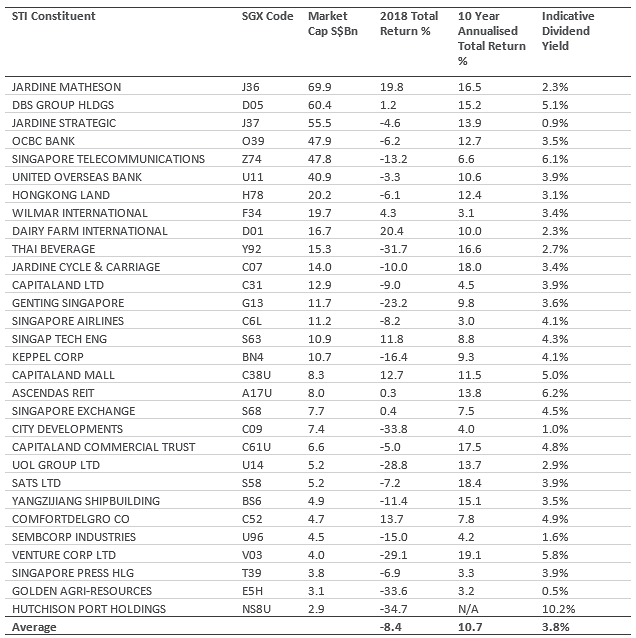
It added that the non-weighted average return of the 30 STI constituents for last year was a decline of 8.4 per cent.
The five strongest stocks in 2018 were Dairy Farm International, Jardine Matheson, ComfortDelGro Corp, CapitaLand Mall and Singapore Tech Engineering, with average total returns of 15.7 per cent, said the local bourse operator.
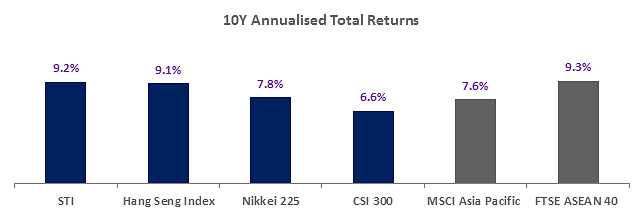
For the 10 years ending 2018, the STI generated annualised total returns of 9.2 per cent, thanks to the reinvestment of dividends.
The figure is one-fifth higher than the regional Asia Pacific benchmark, and in-line with the FTSE ASEAN 40 Index, said SGX.
The STI’s comparative total returns for the 10 years ending 2018. (Table: SGX)
“Without reinvesting dividends the STI’s annualised return over the 10 years would have been 5.7 per cent.
“Dividends have played a key role in these annualised returns, and following the 6.5 per cent decline in total return for the STI in 2018, the 30 constituents currently average an indicative dividend yield of 3.8 per cent,” said SGX.
On a non-annualised basis, the STI’s total return was 140.5 per cent over the period which spanned the end of 2008 to the end of 2018.
Over the 10-year period, the strongest of the current stocks were Venture Corp, SATS, Jardine Cycle and Carriage, CapitaLand Commercial Trust and Thai Beverage PCL.
The STI tracks the performance of top 30 stocks listed on Singapore Exchange. The full list is tabled below:
Table showing full list of STI constituents. (Table: SGX)
The STI fell 0.86 per cent on Thursday to close at 3,012.88.
SINGAPORE: Even as bike-sharing company Ofo faces cash flow problems, it must continue to ensure that it has enough bicycles for its users in Singapore, said the Consumers Association of Singapore (CASE).
In response to queries from Channel NewsAsia, the consumer watchdog’s executive director, Mr Loy York Jiun, said on Wednesday (Jan 2): “There have been reports that Ofo China is encountering cash flow problems.
“Hence, CASE has reached out to Ofo Singapore to request for more information on the situation in Singapore.
“Notwithstanding the above, Ofo Singapore still has an obligation to their existing customers to deliver a minimum level of service – there should be sufficient bikes available to meet the needs of their existing pass holders until their passes expire,” Mr Low added.
Last month, Ofo’s chief executive Dai Wei said the Chinese bike-sharing startup is battling “immense” cash flow problems and disbanding the firm has been considered as an option.
Dai has also been added to China’s social credit blacklist, which bars him from buying property or going on vacation.
Ofo, known for its yellow bicycles, has also faced issues in Singapore. The Land Transport Authority had said in November that it intended to take regulatory action against Ofo for possessing a fleet of bicycles beyond its maximum fleet size of 10,000.
Yet, customers in Singapore have expressed unhappiness over the company’s operations and some have said there are too few bikes on the streets for use.
Currently, Ofo users who opt for the pay-as-you-go service are charged S$1 for rides of less than 15 minutes, S$1.50 for a 30-minute ride and S$2.50 for an hour-long ride.
Meanwhile, the Ofo pass allows users to pay S$8.99 for unlimited use within 30 days, S$16.99 for 60 days and S$26.99 for 90 days.
Ofo user Eugene Low, who purchased a 90-day pass in October, said that he regretted doing so because he struggled to find bicycles for him to use in his daily commute.
“In August and September, Ofo bicycles were everywhere and easy to find and use. But they have disappeared recently and I’ve given up looking for them,” said the IT engineer.
Disappointed with the company’s failure to deliver, he contacted Ofo Singapore’s customer service in November to cancel his subscription but has yet to receive a response.
Many also posted comments on Ofo Singapore’s Facebook page, some complaining about how they cannot find the bicycles, while some said they have been unable to claim refunds after encountering glitches with the system.
CASE confirmed that over the last three months, it has received five complaints against Ofo Singapore, which were “generally requests for refunds”.
The consumer watchdog’s Mr Loy added that existing Ofo pass holders “should be wary” that their subscriptions may be automatically renewed through the mobile application and “may wish to take decisive action” to cancel their subscription if they no longer want to use the bike-sharing service.
“Their notice of cancellation should be documented (for example by taking screenshots) for ease of dispute resolution,” he added.
VENDORS OWED S$700,000, SET TO MAKE POLICE REPORT
According to at least two of Ofo Singapore’s former logistic vendors, the Beijing-based firm owes them around S$700,000 for their services and has not replied to their letters of demand. The two companies were employed by Ofo to handle bicycle transportation, storage and rebalancing, and are looking to make a report with the Singapore police white-collar crime unit, the Commercial Affairs Department.
Mr Kelvin Chiak, chief executive officer for one of the logistics firms that served Ofo, told Channel NewsAsia that Ofo owes his company a total of S$174,000.
“They owe vendors money, and when asked, threaten to hold back payment. We provided them services worth around S$60,000 a month, and then they offered to pay us S$10,000. They keep using the same tactic,” said Mr Chiak, who declined to name his company but would only say it has existed for around 30 years.
Mr Chiak and at least one other logistics vendor, SB Express, are jointly looking to report the matter to the police.
SB Express’ managing director Sebastian Lee told Channel NewsAsia that Ofo owes the firm around S$400,000, and his attempts to contact Ofo’s acting general manager Jack Zhou has failed.
“The last time I heard from him was in November, and he said he needed approval from Ofo’s HQ in Beijing for the payments,” said Mr Lee, who provided lorries, personnel and warehouses to fulfil his services to Ofo.
STAFF FIRED ‘OUT OF THE BLUE’
The contracts of hundreds of Ofo Singapore employees were also terminated in November, according to a former senior manager Channel NewsAsia spoke to.
The manager, who declined to be identified, said around 200 bicycle marshalls in November and dozens of its employees who worked at the firm’s registered office address at AXA Tower along Shenton Way had their contracts terminated.
“We worked at level 55 at AXA Tower but I never felt like I was on cloud nine. In fact, people were all in tears after the company retrenched a number of employees out of the blue,” he said.
According to local media reports, the office has been vacated in November, one month before its lease was up.
He added that Ofo Singapore still owes him around S$6,000 in claims, and he, along with other colleagues, have lodged their complaints with the Tripartite Alliance for Dispute Management.
Mr Hazrul Fitri Mohd Yusof, a former Ofo bicycle marshall, told Channel NewsAsia that his contract was terminated in November. His job was to ensure that Ofo bicycles parked indiscriminately in Queenstown were transported back to proper locations.
Mr Hazrul and around 200 other bicycle marshalls who worked across the island were informed by their team leaders “unexpectedly” to return their tools on Nov 7 and return all Ofo bicycles to designated yellow boxes.
“We sort of knew then that it was over, the company was letting us go and their operations in Singapore is ending soon,” he added.
“One thing I’ll say is that they expected us to use 4G data for our work to locate the bicycles but never bothered to reimburse us.”
A third former employee, who worked in operations and resigned from the company in October, said he left because there were “tell-tale signs that Ofo wasn’t going to stay afloat for long in Singapore”.
“Things started to look shaky when the country manager left the company (around mid-2018) and then followed by the regional manager, Alan Jiang. From the second quarter onwards, staff claims and some vendors which provided services for Ofo’s operations (warehouse space, vans and lorries) were not paid promptly,” he added.
He also pointed out that Ofo had left and pulled back on their launches in places like India, London and the Philippines.
Channel NewsAsia has reached out to Ofo Singapore and its acting general manager Jack Zhou for clarification on the company’s financial status, on claims that it owes vendors and former staff money, as well as on how it intends to continue to serve its customers in Singapore.
SINGAPORE: Visitors to the new library@harbourfront can relax with a book while enjoying panoramic views of Sentosa when it opens on Jan 12.
Located on the third floor of VivoCity, the 3,000 sq m library is the largest to be located in a shopping mall in Singapore.
“It is designed with two distinct zones – one for adults and teens and another for children – to provide conducive spaces and enhanced services that suit their reading and learning needs,” said the National Library Board (NLB) on Thursday (Jan 3).
It added that the 460-seat library houses a collection of about 200,000 books, magazines and audio-visual materials.
CHILDREN’S AREA TO ENABLE CREATIVE LEARNING
The children’s section is designed to help young readers learn through technology. In an area called Tinker Truck, there will be Augmented Reality books on a variety of topics to make their reading experience more interactive.
It will also feature the first “makerspace” in a library, aimed at developing creativity and children’s problem-solving skills through DIY learning materials, crafts and puzzles.
NLB said it will work with partners to run programmes related to science, technology, engineering, the arts and mathematics on a monthly basis.
To provide a more immersive storytelling experience, space has been carved out for projecting videos on all four walls of the room, using light and sound effects.
The Stories Come Alive Room allows the use of moving images, light and sound effects to create an immersive storytelling experience for children. (Photo: Cheryl Lin)
SECTION FOR ADULTS COMES WITH DIGITAL FOCUS
At the adults and teens section, physical newspapers have been replaced by 16 e-newspaper reading stations – the most in any public library in Singapore.
Regular exhibitions on emerging technologies will be held every quarter.
Library@harbourfront will organise workshops on technology-related topics. (Photo: Cheryl Lin)
“Singapore is on this journey to promote a smart nation and NLB feels we can play a part to support it. We want to make technology something very easy for people to feel and touch but not in an intimidating way,” said Ms Catherine Lau, NLB’s assistant chief executive (public library services).
The library will also offer weekly virtual reality sessions for visitors and provide interactive tools like Google Voyager.
The adults and teens section will be run by volunteers who will help to find, recommend or shelve books.
There are currently about 50 volunteers at library@harbourfront, and NLB said the number will increase. Other public libraries at Chinatown, Tampines and Bukit Panjang are also run on similar models.
Retiree Ho Hew Lee, 76, said he gets great satisfaction from having volunteered at public libraries for more than a decade. When he’s not conducting digital literacy workshops, Mr Ho teaches seniors how to use the NLB mobile app and e-newspaper stations.
“I’m very happy helping out seniors who are so blur with whatever they hold like smartphones. After they discuss with me, they’re surprised at what it can do and that gives me the satisfaction,” said Mr Ho.
SINGAPORE: People walking along the Singapore River over the weekend might have been shocked to see that the statue of Sir Stamford Raffles – a prominent feature of Boat Quay – looked very different.
Painted over on one side so that it blended into the background, the statue seemed to disappear when viewed from a certain vantage point.
This was created by strategically layering paint over the statue’s white polymarble surface, said the Singapore Bicentennial Office (SBO), which confirmed on Wednesday that it had commissioned the stunt.
The statue of Sir Stamford Raffles, before and after application of paint. (Photos: Singapore Bicentennial Office)
To commemorate the Singapore Bicentennial marking the 200th anniversary of the British arriving in Singapore, SBO decided to go for something “slightly different”.
A close-up of the “disappearing” statue of Sir Stamford Raffles, located along the Singapore River.
The curtain-raiser to the Singapore Bicentennial – to be launched on Jan 28 – is intended to spark a conversation on the arrival of the British and their contributions to the nation.
“It recognises that there were other significant milestones in the nation’s journey, which began some 500 years before the British arrived in Singapore,” an SBO spokesman said.
“There were also many who arrived in 1819 and in the years that followed, who contributed greatly to the nation.”
The “disappearing” statue of Sir Stamford Raffles aims to spark fruitful conversations on Singapore’s history.
The artwork was created in partnership with local artist Teng Kai Wei, specialises in public scultures. He is best known for the interactive light installation, titled Leap Of Faith, at last year’s Singapore Night Festival.
People crowd around taking pictures of the “disappearing” statue of Sir Stamford Raffles.
The artwork will be taken down by the end of Thursday.
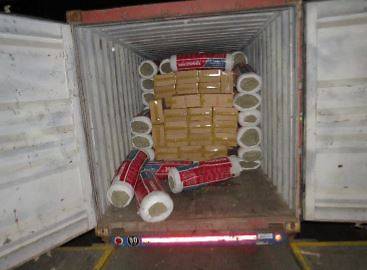
SINGAPORE: More than 7,400 cartons of duty-unpaid cigarettes were seized last Thursday (Dec 27) from a Singapore-registered truck at the Pasir Panjang Scanning Station.
The goods were discovered after Immigration and Checkpoints Authority (ICA) officers conducted checks on the truck carrying a 20-foot container.
The container where duty-unpaid cigarettes were found within the consignment declared as “rockwool insulations”. (Photo: ICA)
Officers had noticed anomalies in the scanned images of the consignment declared as “rockwool insulations”, said ICA.
During the checks, they found 7,498 cartons and 16 packets of duty-unpaid cigarettes hidden in the consignment within the container.
The case was then handed over to the Singapore Customs for further investigations.
According to ICA, the total duty evaded was about S$640,460 and the Goods and Services Tax (GST) evaded about S$46,940.
“The ICA will continue to conduct security checks on passengers, cargo and vehicles at the checkpoints to prevent attempts to smuggle undesirable persons, drugs, weapons, explosives and other contraband,” said the authority.
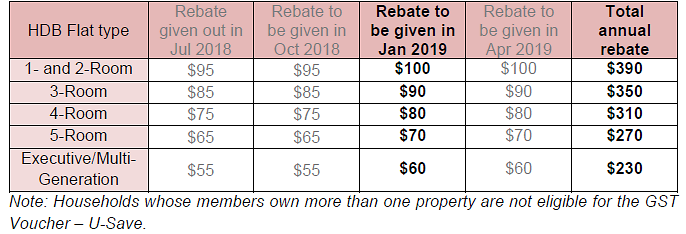
SINGAPORE: About 900,000 Singaporean HDB households will receive the next instalment of the GST Voucher – Utilities-Save (U-Save) rebate in January, the Ministry of Finance (MOF) announced on Wednesday (Jan 2).
The rebate, which is part of the permanent GST Voucher scheme, is distributed every three months. It helps HDB households offset part of their utilities bills and serves to lower overall household expenses.
The U-Save rebate is expected to amount to around S$300 million in 2019, said MOF in the press release.
In January, eligible households will each receive a GST Voucher – U-Save of up to S$100 depending on their HDB flat type.
The ministry said that the vouchers help support households in one- and two-room HDB flats. Annually, the vouchers are equivalent to about three to four months of their utilities bills on average, said MOF.
“Those living in three- and four-room HDB flats have received support equivalent to about one to two months of their utilities bills,” it added.
As announced in Budget 2018, eligible households will receive an additional S$20 per year (S$5 per quarter) for three years, from 2019 to 2021, the ministry added.