SINGAPORE: As many as five Malaysian government vessels have been seen in Singapore territorial waters, in the wake of a positive meeting between Singapore and Malaysia’s foreign affairs ministers.
In response to media queries, the Maritime and Port Authority of Singapore (MPA) confirmed that there were five Malaysian government vessels in Singapore waters off Tuas at 6pm on Wednesday.
As at 6pm on Thursday (Jan 10), two Malaysian government vessels remain in Singapore territorial waters off Tuas, MPA said.
Location of Malaysian buoy-laying vessel MV Pedoman in Singapore territorial waters in the evening of Jan 10, 2019. (Image: MarineTraffic)
One of these Malaysian ships was buoy-laying vessel MV Pedoman. Malaysian media reported that the vessel with 22 crew members replaced the MV Polaris, which left Singapore waters on Saturday.
According to a Bernama report, the Malaysian Marine Department insisted on Wednesday that both vessels had been in Malaysian waters.
“The MV Pedoman replaced the Polaris because the latter needed to restock and refuel,” a Malaysian government official said.
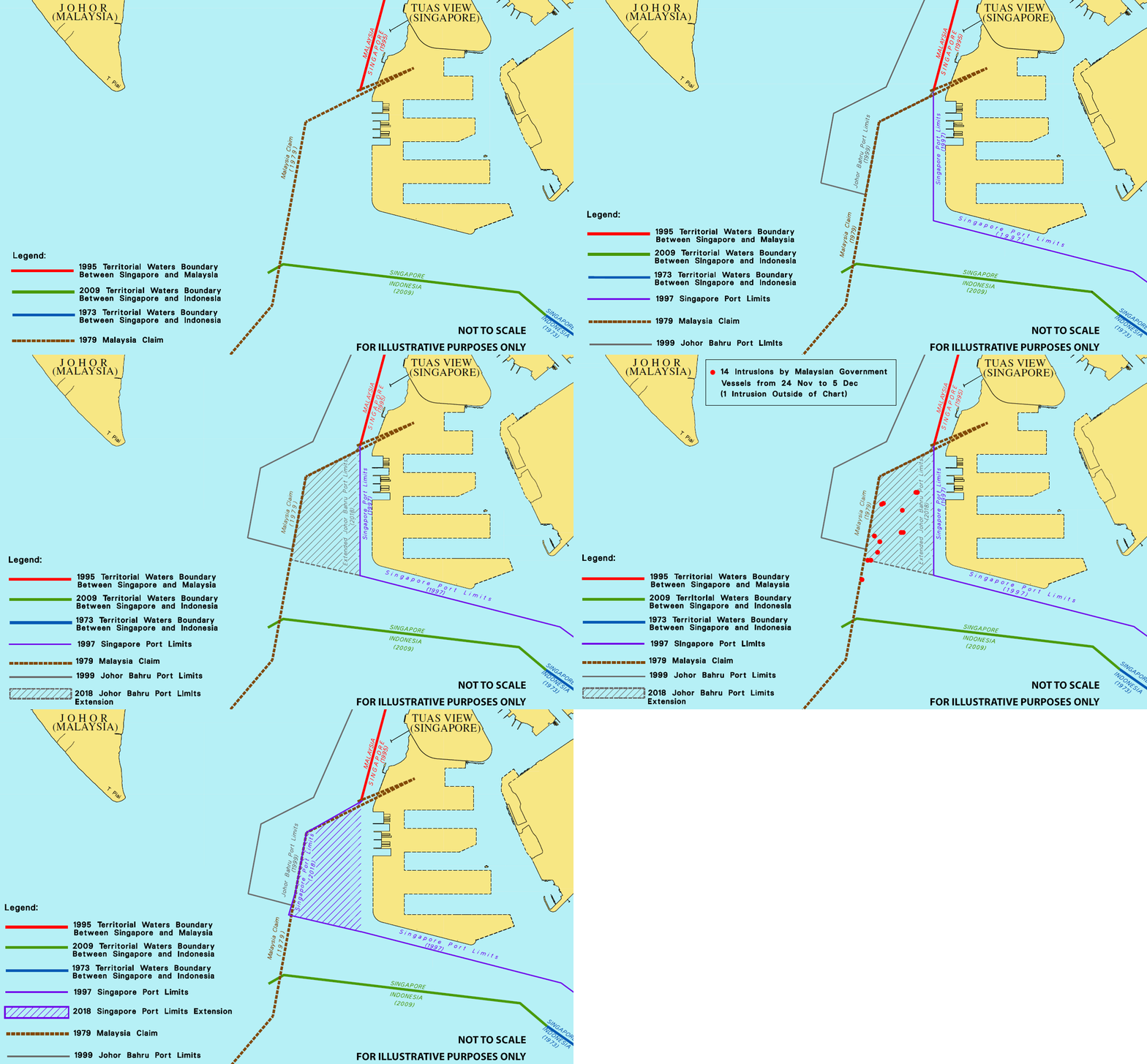
Malaysian government vessels have made repeated incursions into Singapore territorial waters in recent months, after Malaysia extended the Johor Bahru port limits in October, encroaching into Singapore territorial waters off Tuas.
Singapore has protested the port limit extension and the movements of the vessels. Singapore’s Transport Ministry also extended Singapore’s port limits off Tuas on Dec 6 in response.
Transport Minister Khaw Boon Wan also said then that there had been as many as 14 intrusions by Malaysian vessels in the two weeks before Dec 6.
At the same time, the two countries have been embroiled in a dispute on the airspace over southern Johor.
This week, tensions appeared to have eased as both countries’ foreign ministers met.
Singapore Foreign Affairs Minister Vivian Balakrishnan and his Malaysian counterpart Saifuddin Abdullah said in a joint statement on Tuesday that the countries had agreed to establish a working group to study and discuss legal and operational matters relating to the maritime dispute, in order to provide a basis for further discussions and negotiations.
They also agreed to suspend the permanent restricted area established by Malaysia in the airspace over Pasir Gudang, while Singapore similarly suspended its implementation of Instrument Landing System procedures for Seletar Airport.
Both sides’ transport ministers were to meet “soon” for discussions, the statement said.
Illustration showing the adjustment of Singapore and Malaysia’s port limits.
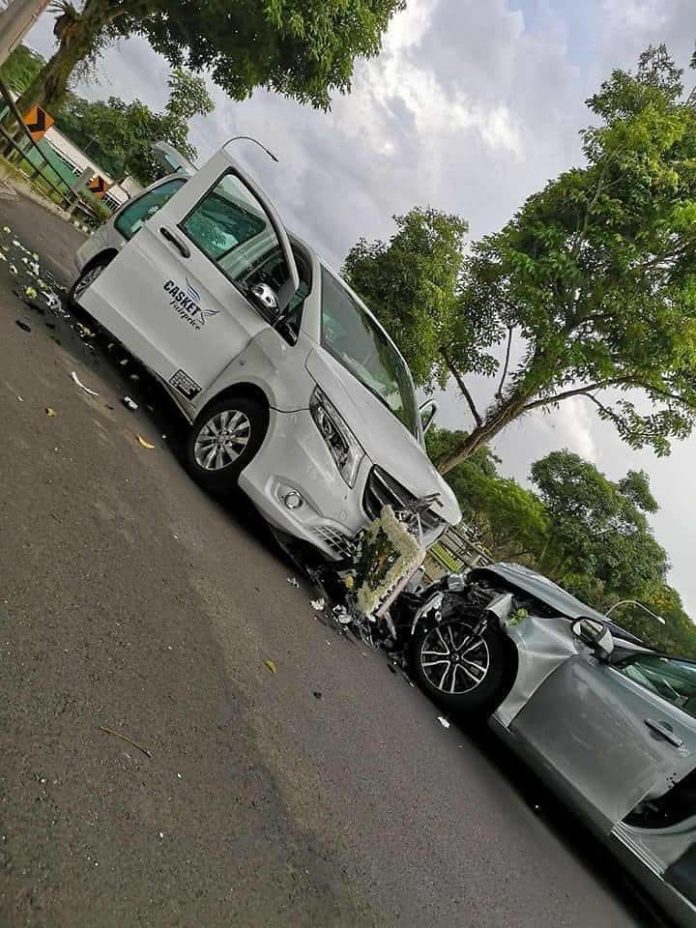
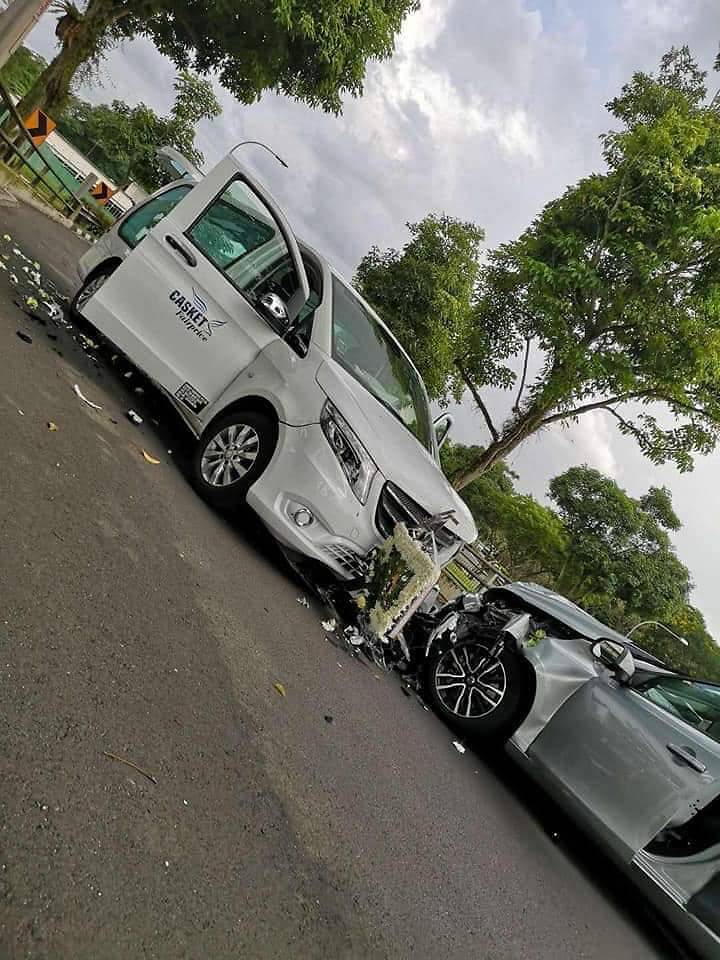
SINGAPORE: Two people were taken to hospital after a car and a hearse collided along Mandai Road on Tuesday (Jan 8).
The police said they were alerted to the accident along Mandai Road towards Mandai Avenue 1 just after 3.30pm.
The injured, aged 30 and 32, were conscious when taken to Khoo Teck Puat Hospital, the police told Channel NewsAsia on Thursday. One of them was in the car at the time of collision, while the other was in the hearse.
The hearse, which has the name of funeral service provider Casket Fairprice on the driver’s door, is said to have skidded into the oncoming lane, where it crashed into the silver car.
Police investigations are ongoing.
A car and a hearse collided along Mandai Road towards Mandai Avenue 1 on Jan 8, 2019. (Photo: Facebook/SG Road Vigilante)
It is not known if the hearse was transporting a body at the time of the accident.
Photographs circulating on social media show a floral wreath, presumably attached to the front of the hearse before the accident happened, partially smashed on the ground between the two vehicles.
Flowers lay scattered on the road.
The front of the car’s hood appears to have caved in from the impact of the crash.
LAS VEGAS: Creative Technology has bagged more awards at the CES consumer electronics trade show with its Super X-Fi (SXFI) audio products, but CEO Sim Wong Hoo is already thinking ahead about how to bring the technology to the wider market.
Mr Sim on Wednesday (Jan 9) told Channel NewsAsia that its SXFI products clinched Best of CES awards from top industry media such as AVS Forum, TechRadar, Overclock and SoundGuys – and some for products that are not yet in the market.
He shared that AVS Forum had already given its CES award to the Singapore-based company in 2018 when it previewed its prototype here, so he wasn’t expecting to repeat the feat.
“I thought I already wowed them last year, so this year, there was nothing to wow them with,” he said.
However, the folks at AVS Forum were impressed with Creative’s vision of bringing its Super X-Fi audio tech to a home theatre setting, and allowing up to four users to personalise their viewing experience independent of the others in the room, he said.
“Now, you can’t control the volume when watching your home theatre; some may want it louder and others softer,” Mr Sim explained.
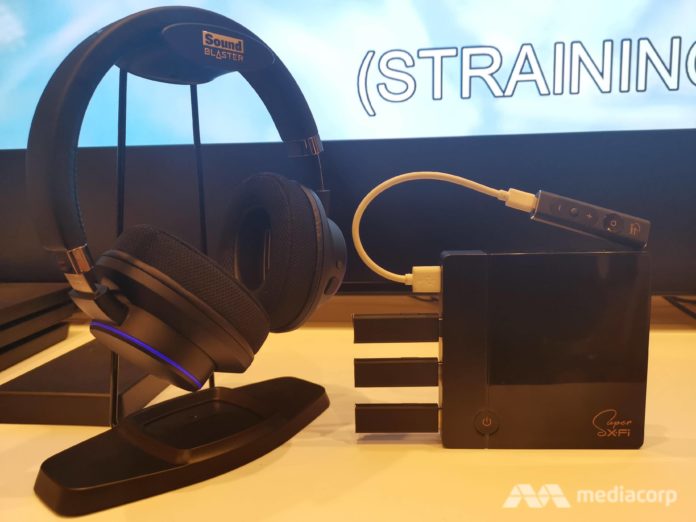
“With the SXFI TV (set-top box), users can plug in their individual sound profile and listening preferences using their respective SXFI Theater headphones.
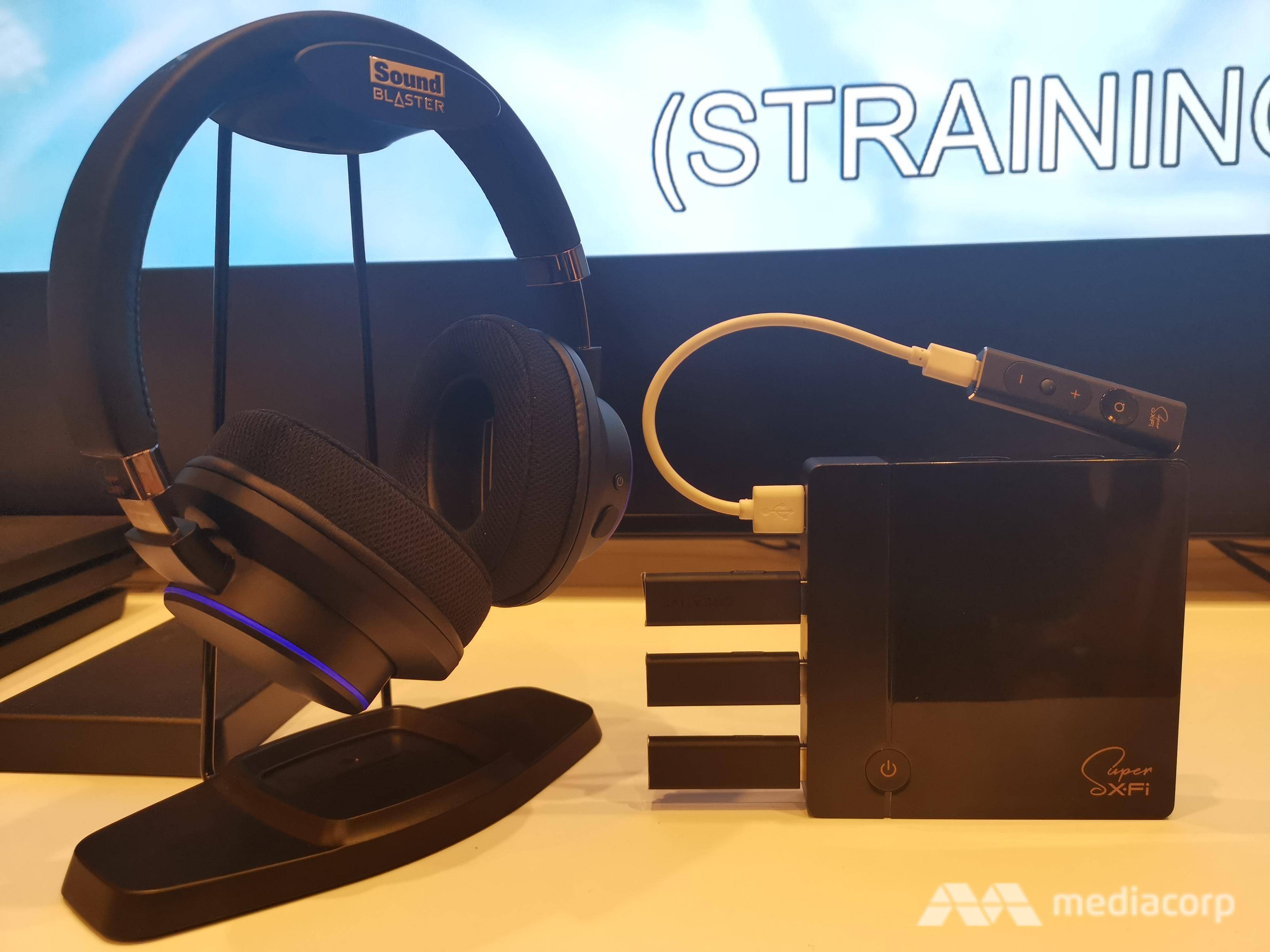
The SXFI Theater (left) and SXFI TV are market-ready products in Creative’s pipeline, but Mr Sim said the company didn’t want to introduce too many too soon as it would distract consumers from existing offerings.
The SXFI TV, in particular, uses a proprietary wireless technology that Creative claims reduces the latency significantly to about 10 milliseconds compared to, say, BlueTooth.
The latency rate for the latter comes in at 100 milliseconds to 200 milliseconds so, for example, the sound of a punch thrown will not be in sync with what’s seen on the screen, the CEO explained.
These two products are not yet in the market. Mr Sim said the company wanted only to give visitors to its demo booth a preview of how they work and the experiences a user can have with them.
It is likely to be six more months before SXFI Theater and SXFI TV hit the market, he said.
As for the products already in the market, such as the SXFI Amp dongle, Mr Sim declined to give the sales figure so far, only revealing there is pent-up demand for the product, a point he had also made last September at the product launch.
SXFI EVERYWHERE?
Looking ahead, the confident Creative CEO said it is “open for business” to partners interested in integrating the Super X-Fi technology into their audio products.
He even gave a glimpse of future plans by showing a “cut-and-paste” offering that smaller-scale manufacturers can quickly use to integrate into their product line and bring to market.
This can be done through a miniaturised SXFI Amp dongle, which a manufacturer can quickly splice into its existing headphone products, he explained.
Creative’s Sim opened up and shared the company’s vision for helping small-scale partners go quickly to market with its audio technology.
More established audio players keen on having more control over the integration of Super X-Fi tech can do so by buying its chip instead of the ready-made option, he added.
This, again, showed how the CEO was adamant not to repeat the mistakes made in the SoundBlaster days.
Creative did not open up its SoundBlaster technology to the wider industry ecosystem when it had market dominance and then failed to defend its lead when competition came knocking and ate away at its revenue base.
With a long-term product roadmap in mind, Creative Technology looks ready to “run like hell” – a term Mr Sim has used before – to cash in on its latest invention.
It is open to registered architects and design consultants in Singapore and around the world.
The design should be able to bring out the significance of the Bay East Garden site, which was chosen as it symbolically captures Singapore’s journey as a nation, said the Founders’ Memorial Committee in a media release.
Landscaping is an important component, and design proposals will need to take into account the connectivity and accessibility of the site.
“Through the indoor and outdoor spaces, the design should facilitate a visitor journey that is educational, reflective and inspiring,” said the committee.
It added that there will be permanent and temporary galleries, a visitor centre, a viewing gallery, multi-purpose rooms, a volunteers’ room and a family room that will cater to visitors with different needs. These facilities will allow for programmes such as talks, workshops and guided tours.
The committee said it expects the 3,700 sq metre Founders’ Memorial to attract one million visitors each year.
The international design competition will be organised in two stages, with the first involving the submission of proposals.
A jury panel will then shortlist up to six designs for the second stage, which will involve the further development of the designs.
In May, Singaporeans can take part in engagement workshops to offer their views of the shortlisted proposals. A winning design will be announced at the start of 2020, said the committee.
Foreign design consultants are “strongly encouraged” to team up with architects registered in Singapore for stage one of the competition, said the committee. At stage two, it is mandatory for them to team up with local architects.
Map showing the Founders’ Memorial site. (Photo: Founders’ Memorial Commitee)
Chairman of the committee Lee Tzu Yang said the winning design should be one that honours the founding values of Singapore.
“We envision that it will be a space which everyone of all ages can enjoy and relate to, and an icon that Singaporeans can be proud of and share with our future generations,” said Mr Lee.
Registration for the competition will close on Feb 15. More information on the design competition can be found at this website.
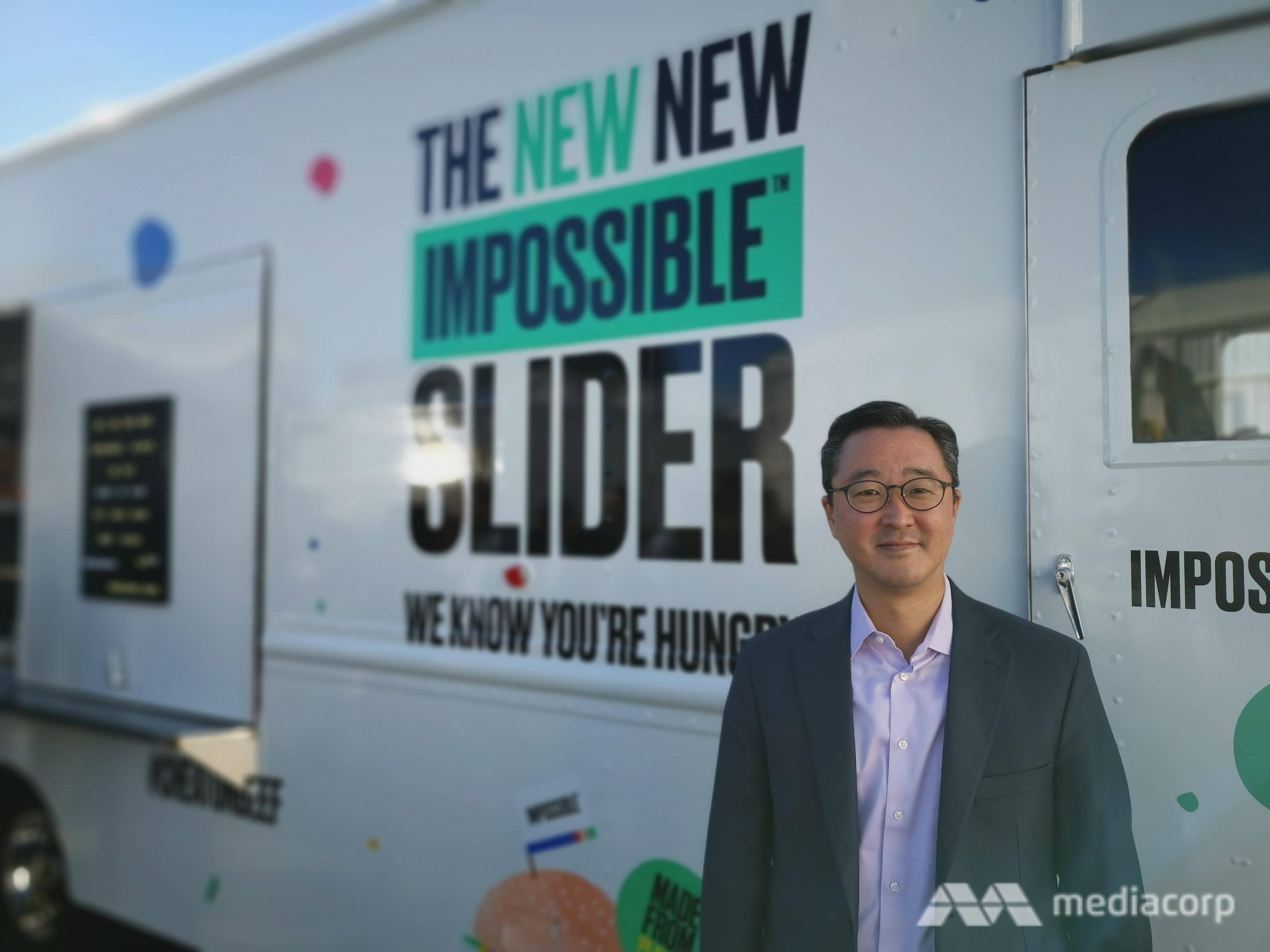
The US start-up’s chief operating officer David Lee says it is betting big on the versatility of its created meat, which he said can be used in a burger, bao or dumpling.
Impossible Foods brought a food truck to CES 2019 serving sliders using its newly launched recipe.
(Updated: )
Bookmark
LAS VEGAS: First Hong Kong, now Singapore – United States start-up Impossible Foods is preparing to launch in another cosmopolitan city, and it is confident its plant-based “meat” will win over the tastebuds of food-loving Singaporeans.
The Silicon Valley-based Impossible Foods had unveiled its Impossible Burger 2.0 at the ongoing CES 2019 consumer electronics trade show on Monday, claiming that it contains no gluten, no animal hormones and no antibiotics, and has “as much bioavailable iron and protein as a comparable serving of ground beef from cows”.
The company also said it plans to launch the new recipe in Singapore “later this year”, confirming rumours of its arrival that started after the 2017 investment made by Singapore investment company Temasek.
Channel NewsAsia tried the new recipe before speaking to chief operating officer David Lee on Wednesday (Jan 9) and found the slider Impossible Foods was distributing at CES 2019 to be flavourful, tastes and feels like actual beef and probably impossible to tell the difference in a blind test.
COO David Lee is confident its Impossible Burger 2.0 will be a hit among Singaporeans, having seen success in the similarly cosmopolitan city of Hong Kong.
An earlier blind taste test conducted by Channel NewsAsia using the original recipe saw three Singaporean foodies picking Impossible Foods’ version to be the one with the best taste.
Asked what is one feature of the new recipe that will most entice Singaporeans, Mr Lee pointed to the “versatility” of its product.
“It can be used in a stir fry, a bao or spicy dumplings … (basically) fit into different cuisines,” the COO said, adding this would play well in a diverse food scene like Singapore.
Impossible Foods had earlier garnered the endorsement of Singapore Prime Minister Lee Hsien Loong, who posted on his Facebook page last September that the burger patty “tastes like meat”.
Asked about the actual launch date, Mr Lee was tight-lipped. “Soon in 2019,” he said, after much probing.
He did say that the company will work closely with notable chefs and food establishments to bring its product to market here, rather than open a standalone food outlet.
“This will help us establish a strong, credible brand,” the COO explained.
Mr Lee also said there is already a “handful” of employees in Singapore to start its local operations, and will add to the number as it grows. He added it will start small at launch and learn as they go, but will add to its ranks as it scales.
SINGAPORE: Serviced residence Ascott Raffles Place Singapore, which is housed within a restored 1950s heritage building, is set to be sold off for S$353.3 million by Ascott Residence Trust (Ascott Reit).
The sale price is 64.3 per cent above the property’s latest valuation of S$215 million as at Dec 31, 2018, Ascott Reit said in a stock exchange filing on Wednesday (Jan 9).
It said that the buyer is an unrelated third party, but did not reveal the name.
A Collyer Suite bedroom in Ascott Raffles Place Singapore. (Photo: Ascott)
Ascott Reit acquired the serviced residence from The Ascott Limited for S$220 million in 2012. The sale will help it realise an estimated net gain of S$134 million, which will be channelled into new investment opportunities, Ascott Reit said.
“The sale will give us the financial flexibility to recycle capital and invest in higher-yielding properties. We may also use the sale proceeds to pay down debt which will then increase our debt headroom for potential acquisitions of quality assets or to develop our own properties,” said Ms Beh Siew Kim, Ascott Residence Trust Management Limited’s CEO.
Once Southeast Asia’s tallest building, the 20-storey Ascott Raffles Place houses 146 units across 15,696 sqm of gross floor area. The property, which opened in 2008, has a leasehold of 999 years.
The transaction is expected to be completed in May.
Ascott Raffles Place accounted for 3 per cent of Ascott Reit’s gross profit for the nine months ended September 2018. The sale of the property is not expected to have a material impact on Ascott Reit’s financial performance.
Ascott Reit’s other operational properties in Singapore are Ascott Orchard, Citadines Mount Sophia and Somerset Liang Court. lyf one-north is expected to open in 2021.
SINGAPORE: More needs to be done to help local businesses – particularly small- and medium-sized enterprises (SMEs) – better understand and benefit from the Government’s industry transformation maps (ITMs), said industry leaders and analysts on Wednesday (Jan 9).
The comments were made at the annual pre-Budget discussion organised by the Institute of Singapore Chartered Accountants, where panellists also discussed the need to relook the foreign worker quota and certain property regulations.
A VAGUE UNDERSTANDING
The ITMs are sector-specific roadmaps that were first announced in Budget 2016 as part of a S$4.5 billion industry transformation programme. All 23 roadmaps have been rolled out as of March last year.
Even though it has been two years since the roadmaps were progressively rolled out, SMEs only have a vague understanding of how they stand to benefit from those transformation blueprints, noted the panellists.
“More often than not, it requires quite a bit of persuasion to get SMEs to come forward to take up ITM programmes,” said Singapore Manufacturing Federation’s (SMF) secretary-general Ahmad Magad.
He attributed this to a “lack of awareness in terms of what ITMs can do for each sector”, and suggested that the roadmaps be refined to “be clearer (and) more detailed”.
While the ITMs may have had some effect on nudging businesses to prioritise innovation, Ms Joanne Guo from the Singapore Business Federation, said that SMEs still need some guidance.
“Our SMEs would like to find out more in terms of how ITMs can help them and where they really need help on is guidance on ways to improve their manpower needs and talent pipeline,” she said.
Apart from awareness, another area of concern is whether the ITMs are broad-based enough to encourage a wider transformation exercise among businesses, said KPMG Singapore’s head of tax Tay Hong Beng.
Given that the roadmaps are currently being implemented across industries, some panellists said it could be time to fine-tune certain things.
“We should look at how to evolve the plan to suit the changing environment that we have, especially with all the uncertainties in the world,” said Mr Kenneth Loo, president of the Singapore Contractors Association.
Mr Liang Eng Hua, chairman of the Government Parliamentary Committee for Finance and Trade and Industry, said the ITMs have seen encouraging results thus far, although more can be done.
He also said that a “collaborative effort” is needed for the ITMs to work well.
“The ministry and agencies can give out broad messages, but they will need to rely on partnerships with the trade associations and chambers (TACs) to finesse and bring them across to their members,” said Mr Liang, who is also Member of Parliament for Holland-Bukit Timah GRC.
“For ITMs to work well, the working mindset should not be just about ‘What can the ITMs do for me or my business’. The more appropriate question to ask is ‘What we want the ITMs to do for our businesses’.”
He added: “In other words, businesses and industries must ground up the agenda and the action to be taken. Because at the end of the day, it is the business and stakeholders who know what are needed for companies to thrive.”
Under the theme “Progressing with a Vibrant and Innovative Economy”, industry leaders and analysts discussed key issues surrounding the economy, such as the industry transformation maps and digitalisation, at the discussion. (Photo: ISCA)
RELOOK FOREIGN WORKER QUOTA, LEVY
Among the other issues raised during the discussion include recalibrating Government grants to make them more accessible and relevant for businesses.
KPMG’s Mr Tay pointed out how several grants aimed at helping companies with the digitalisation journey are focused on “ideation”, instead of the “real difficulty”, which is implementation.
“Thinking new ideas and getting it created is just one part of the journey; the other is on implementation. Even if you have good ideas, implementation costs or benefits that will take years (to materialise) will still deter businesses.”
Manpower shortage was also highlighted by several industry leaders. Mr R Dhinakaran, president of the Singapore Retailers Association, asked if there is a fairer way of determining the foreign worker quota across industries.
Some, like the retail sector, face more difficulty attracting Singaporean workers. “All these things need to be taken into account when fixing the quota,” he said.
Some solutions for this were raised during the discussion.
Mr Dhinakaran, for instance, suggested having a “seasonal quota” for foreign workers. This, he said, would help ease the sector’s manpower crunch without impacting the Government’s broader push for productivity.
Over in the emerging financial technology (fintech) space, a shortage of highly skilled tech talent has been a “critical issue” for many start-ups , said Mr Chia Hock Lai.
As such, the president of the Singapore FinTech Association asked if the manpower curb could be loosened for start-ups to hire foreign tech specialists to fill specific roles in areas such as artificial intelligence and blockchain technology.
Apart from loosening manpower curbs, Mr Ang Yuit, vice president of the Association of Small and Medium Enterprises, mentioned that the levies imposed on the hiring of foreign workers have ramped up business costs.
He hopes that the Government can review the levy to help local businesses remain competitive in the region.
LOOSEN SOME PROPERTY REGULATIONS
Meanwhile, Mr Chia Ngiang Hong, second vice president of the Real Estate Developers’ Association of Singapore, called for the Government to consider tweaking the five-year limit that developers have to sell all units at their residential projects.
Under the latest slew of cooling measures, which took effect last July, developers are subject to a non-remissible 5 per cent Additional Buyer’s Stamp Duty (ABSD) when they purchase en bloc properties for redevelopment.
They also face an increase in the remissible ABSD from 15 per cent to 25 per cent, which can only be waived if all the units in the new development are sold within five years of acquiring the site.
“Even if you are with left with five or 10 units, you are hit with the full penalty with interest,” said Mr Chia. “This penalty is no joke.”
This “frightening risk” has prompted developers to become more selective in their land acquisition strategies, particularly for big sites.
“We are not asking for a waiver or a removal of the ABSD, but if the Government can tweak a bit, like giving bigger projects a longer period, that will be very helpful.”
SINGAPORE: SP Group said on Wednesday (Jan 9) it has rolled out its first wave of 38 electric vehicle charging points, a move that comes amid a growing popularity and uptake of electric vehicles.
The 38 points comprise 19 50kW direct current (DC) chargers, which are able to fully power up a vehicle in 30 minutes, as well as 19 43kW alternating current (AC) chargers.
They are located at commercial buildings, industrial sites and educational institutions islandwide, including at Alexandra Technopark, Hyflux Innovation Centre, Techlink and Corporation Place.
“The locations are close to amenities such as food centres, offering drivers greater convenience while waiting for their vehicles to be charged,” SP Group said in a news release.
This is the first wave of 1,000 charging points SP Group plans to roll out by 2020, which the company expects to become Singapore’s largest public electric vehicle charging network.
The roll-out of the charging points come amid a growing popularity of electric vehicles.
According to data from the Land Transport Authority, there were 614,937 cars registered in Singapore as of end-November last year. Of those, 357 cars were petrol-electric plug-ins while 466 were pure electric. LTA’s data also showed there were 102 pure electric taxis.
Those numbers have grown from 206 petrol-electric plug-in cars and 314 pure electric cars at the end of 2017.
“SP’s new additions will be a game-changer in improving the charging turnaround time for EV drivers in Singapore,” the company said in the release.
“EV drivers can also enjoy at least 50 per cent cost savings compared to typical Internal Combustion Engine (ICE) vehicles for every kilometre travelled. The cost of using SP charging points will be regularly adjusted, mainly influenced by the prevailing electricity costs in Singapore.”
File photo of an electric vehicle charging point. (Image: CNA)
SP UTILITIES MOBILE APP
SP Group said that drivers can search and access the charging service through the SP Utilities mobile app. The app includes functions for payment and will send users regular updates on their charging sessions.
One of SP Group’s charging points, located at Singapore Polytechnic, will also be used to train students taking the engineering curriculum.
Over the next few years, SP Group intends to introduce more high-powered DC charging points of up to 350kW.
OTHER DC CHARGERS
Aside from SP Group, there are currently six other DC chargers in Singapore.
Electric car-sharing company BlueSG said in December that it will progressively open up its charging points to the public in the first quarter of 2019. Previously, only its own fleet of cars use its charging points.
A BlueSG electric vehicle charging point. (Image: CNA)
The company currently has 531 charging points islandwide at 135 locations islandwide, and aims to have 2,000 charging points at 500 locations by 2020. Of these charging points, 20 per cent will be available for the public to use.
SINGAPORE: The Shetland sheepdog that was reported missing after it was taken to Platinium Dogs Club had died while it was at the pet boarding centre, the Agri-Food and Veterinary Authority (AVA) said on Wednesday (Jan 9).
In a Facebook update, AVA added that the dog was later cremated by a pet cremation service provider.
“Preliminary investigations have revealed that Prince, a Shetland Sheepdog reported to be missing from PDC (Platinium Dogs Club), had died while it was boarded there and was cremated by a pet cremation service provider,” the update said.
Separately, the animals AVA had taken temporary custody following raids at the centre have been returned to their respective owners except for one dog, whose owner is not in Singapore, and a rabbit.
“We are continuing to establish ownership of the rabbit,” said AVA.
“AVA’s investigation is still ongoing. The public is advised not to speculate and let the investigation take its course,” it added.
“AVA takes animal welfare seriously and will take enforcement action against any offenders to safeguard animal welfare.”
Platinium Dogs Club has been under investigation by the authorities following complaints of alleged mistreatment of animals under its care.
One of the pet owners was Ms Elaine Mao, who was told on Dec 30 that her Shetland sheepdog named Prince had gone missing after she took her pet to the centre on Dec 16.
The exterior of Platinium Dogs Club, a pet boarding centre, which is being investigated for alleged mistreatment of animals. (Photo: Jeremy Long)
Her dog was not among the animals that AVA had taken temporary custody of following raids at the pet boarding centre on Dec 29 and 31. Eighteen dogs and a rabbit were found by AVA at the pet boarding centre, a semi-detached house at 7 Galistan Avenue.
She is assisting with investigations on alleged animal welfare-related offences, according to Senior Parliamentary Secretary for National Development Sun Xueling in a Facebook post on Monday.
He said in a Facebook post on Saturday that “there are also allegations that some people, in response, have also acted wrongly, and taken the law into their own hands”.
“Those allegations will also be investigated,” he added.
An AVA notice outside Platinium Dogs Club instructing the tenants that they are not allowed to have any animals on the premises. (Photo: Jeremy Long)
On Jan 2, a 40-year-old man who was among a group of people who gathered outside Platinium Dogs Club’s premises, was taken to hospital after a car knocked into him.
He was believed to be a volunteer helping one of the pet owners who had gone to the centre to confront the owner.
Under the Animal and Birds Act, those who fail in their duty of care towards the animals in the course of conducting an animal-related business may be fined up to S$40,000 or jailed for two years, or both.