Home Blog Page 858

8 in 10 Singaporeans satisfied with relations between different races, religions: MCCY survey

0

SINGAPORE: Eight in 10 Singaporeans were satisfied with race and religious relations in 2018, while two in three agreed that there were enough opportunities to interact with people of different backgrounds and beliefs, according to the results of a survey commissioned by the Ministry of Culture, Community and Youth (MCCY).

The topline findings of the annual survey were revealed for the first time by minister Grace Fu on Tuesday (Jan 22) in a wide-ranging interview on her ministry’s work last year.

The Social Pulse Survey, which has been carried out annually since 2016, involved 500 face-to-face interviews conducted monthly with residents aged 15 and above from randomly selected households. They were asked for their opinions on matters such as sports, arts, culture and community living, MCCY said.

READ: Class – not race nor religion – is potentially Singapore’s most divisive fault line

READ: In the search for solutions to the class divide, a call for more financial help

In elaborating on the ministry’s work in building a cohesive society, Ms Fu noted that in 2018, more than 5,700 Singaporeans had been engaged through BRIDGE or Broadening Religious/Racial Interaction through Dialogue and General Education programmes.

The series of BRIDGE initiatives were launched in 2017 by MCCY to foster better understanding and appreciation of the diverse religions and cultures in Singapore.

For example, more than 500 people participated in the Ask Me Anything series in 2018, up from 121 in 2017. Eighty per cent of the attendees were first-time participants, the ministry said.

Grace Fu

Culture, Community and Youth Minister Grace Fu at the ministry’s year-in-review on Jan 25, 2019. (Photo: MCCY)

Ms Fu, who attended a session on Catholicism organised by a non-governmental organisation, said: “It was interesting that it’s able to reach out to people who may not have attended an Inter-Racial and Religious Confidence Circle (IRCC) event but are able to ask questions that they might be interested in, that (are) personal to them in a very safe space.”

NINE IN 10 PROUD TO BE SINGAPOREAN

The survey also found that 90 per cent of those polled in 2018 were proud to be Singaporeans, while 80 per cent agreed that Singapore is a caring and cohesive society.

To illustrate, Ms Fu pointed to the increased level of giving – both in terms of people volunteering their time and resources.

READ: Singapore donates record amount via charity site in 2018, half a million on Christmas

READ: For three families who broke our viewers’ hearts, an outpouring of help

One in three Singaporeans volunteered in 2016, up from one in 10 in 2000, she said. In 2017, the amount of tax-deductible donations increased from S$866 million to S$1.05 billion.

Ms Fu also spoke about how a shared heritage as well as sports and arts programmes have brought Singaporeans from different backgrounds together.

“Our bid to have hawker culture listed in the UNESCO list of Intangible Cultural Heritage is one effort to galvanise Singaporeans to recognise a culture that is so common to our daily lives that we have sometimes taken it for granted. Hawker culture is a daily living experience for many, if not all, Singaporeans. It is actually enjoyed and participated by all races, all backgrounds,” she said.

Almost 220,000 pledges of support for the nomination had been made online between Aug 19 last year and Jan 7 this year, she added.

READ: Commentary: UNESCO listing may lift hawker culture but saving it is a different challenge

When asked if the issues raised about how social enterprises manage hawker centres would affect the listing, Ms Fu said that UNESCO is not looking for a perfect presentation of intangible cultural heritage. 

“It’s about presenting what that cultural heritage means to us, and if this hawker centre model is what we have today, this is what they will allow us to list, and it allows us the flexibility to evolve over time,” she said.

What UNESCO wants is for that particular heritage to have a resonance with many Singaporeans, and for the culture to be “alive”, she said.

The attendance for performing arts and culture activities, both ticketed and non-ticketed, also went up, Ms Fu noted.

The latest figures from 2017 showed that more than 11 million people attended non-ticketed events, an all-time high, while 1.9 million people attended ticketed events, a 5 per cent increase from the year before.

READ: For artistic millennials, making a living out of the arts is a craft in itself

When asked about what is being done to ensure that ticketed events receive the same support as non-ticketed events, Ms Fu said it is a balancing act.

“I think that when we have artists saying that we should watch out for our involvement in non-ticketed items because it seems to be having an impact on the ticketed performances, it tells me that we are probably getting the balance right.

In wrapping up her comments on MCCY’s work in 2018, she said: “Ultimately, we are in the work of building the social glue that binds all Singaporeans together.”
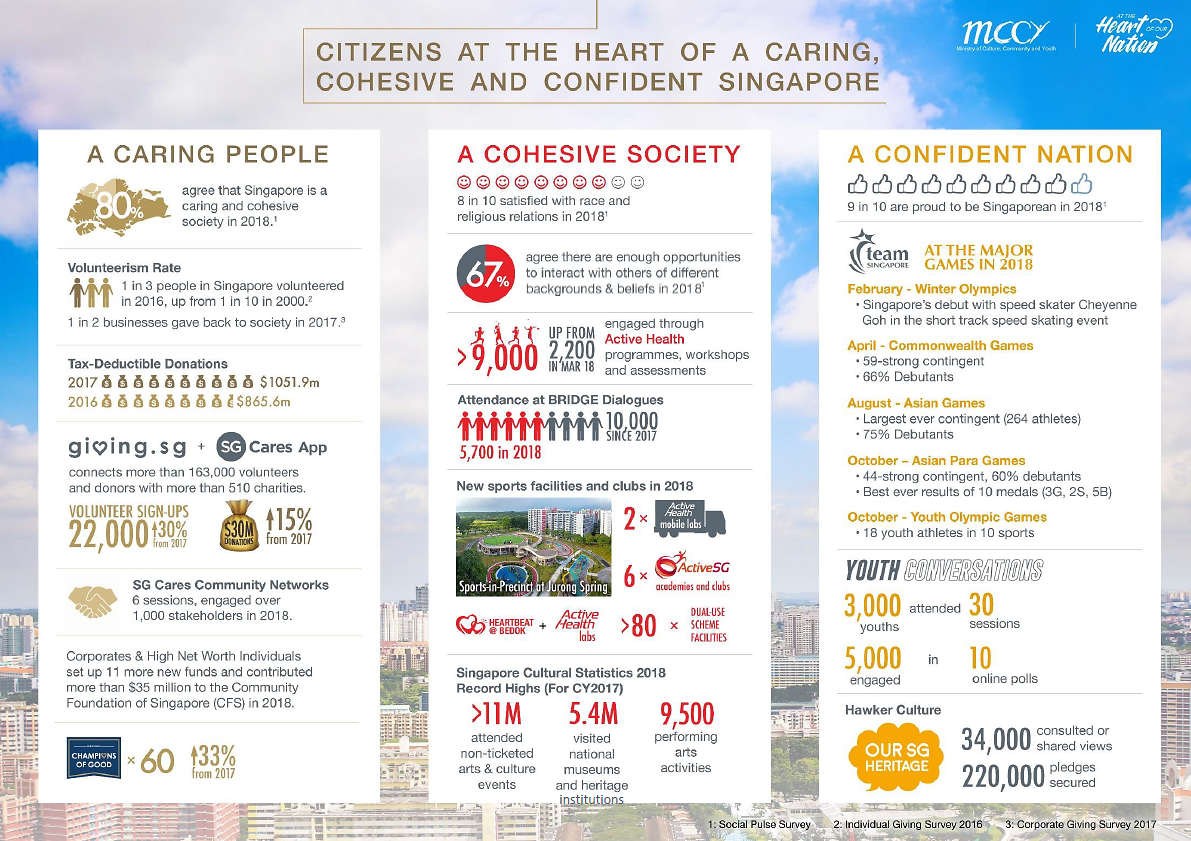
Ministry of Culture, Community and Youth's Year-in-Review infographic

Highlights from the Ministry of Culture, Community and Youth’s Year-in-Review. (Graphic: Ministry of Culture, Community and Youth)
Source link

Mortgage demand slumps in ‘unaffordable’ Singapore

0

SINGAPOREAN banks are seeing a drop in mortgage demands from the onset of the government’s cooling measures that threatened to accelerate declining property prices.

Property analysts say the property curbs have caused residential unit prices took a dip in the last quarter of last year for the first time in 18 months.

Derek Tan, an analyst at DBS Group Holdings, predicted the slowing demand for mortgages could contribute up to a three percent dip in prices, while sales of homes could plunge by 20 percent.

SEE ALSO: Singapore: 900 buyers cancelled flat bookings in 2018

Another analyst, Diksha Gera of Bloomberg Intelligence said the mortgage growth will not exceed two percent this year, while the latest data from the Monetary Authority of Singapore data showed home loan growth slowed to 1.9 percent between January and November 2018.

China’s economic downturn, coupled with Singapore’s surge in housing supply and rising mortgage rates in the city-state were factors weighing in on sentiment, according to Royston Foo, an independent property analyst.

“I expect the overall property market outlook to be weaker in 2019,” said Foo, who publishes on Smartkarma, as quoted by Bloomberg.

“Insecurity and bearish sentiment will result in potential buyers holding back purchases and adopting a wait-and-see approach.”

000_DF3X4

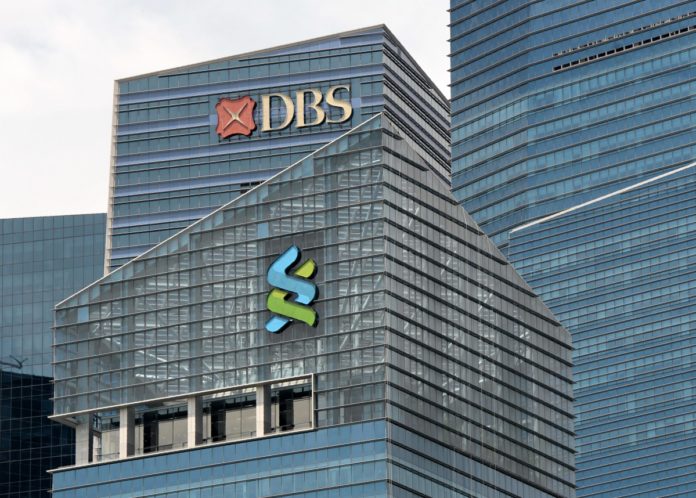
A DBS (top) and Standard Chartered bank logo (C) are seen on the building at Marina Bay financial district in Singapore on July 21, 2016. Source: AFP

The Demographia International Housing Affordability survey ranked Singapore as the ninth unaffordable location amongst the largest markets in the world next to Australia, Canada, Hong Kong, Ireland, New Zealand, the United Kingdom and United States

Earlier this month, DBS chief executive officer Piyush Gupta said the government’s new regulations introduced in July had hit the demand in mortgages, growing less than US$2.5 billion in 2018 compared to the US$4 billion predicted at the beginning of the year.

Singapore’s regulators saw the need to introduce the measures in wake of a seven percent hike in prices during the first half of the year owing to aggressive land bids from developers and collector or redevelopment transactions.

Other constrictions include the government limiting the number of “shoe-box sized” apartments that developers can build, along with additional anti-money laundering safeguards.

SEE ALSO: Records of Singapore’s property agents are now available online 

The government insists that its intervention was crucial in avoiding a property bubble as home prices could have jumped by as much as 15 percent in 2018.

However, Singapore’s three largest banks, DBS, OCBS and United Overseas Bank were not expected to see a dent in earnings as the increased mortgage rates were expected to dampen the blow.

Nomura Holdings analyst Marcus Chua said the bankes raised home loan rates by 20 basis points on average in the past 90 days to just above two percent, adding they may climb to three percent.

Source link

Can Singapore help keep the peace in China’s faltering Belt & Road?

0

CHINA’S Belt and Road Initiative (BRI) has gained huge momentum, with governments, companies and lawyers keen to maximise the many opportunities it presents. But it has also come with more than its fair share of push-backs, disputes and accusations of debt-diplomacy – landing developing nations into a pit of financial strife from which they are unable to dig themselves out.

To combat the inevitable clashes that occur on the multi-billion-dollar worldwide project, Singapore and China this week established an international panel of mediators.

Dispute resolution professionals from both countries, along with representatives from the country in question, will work together to resolve any issues before they escalate.

SEE ALSO: Belt and Nope: Southeast Asia doesn’t trust China

“BRI projects tend to be high-value, multi-party and multi-jurisdictional,” George Lim, chairman of Singapore International Mediation Centre (SIMC), said in a statement.

“These factors raise the chances of a dispute occurring during the course of project delivery and also complicate the dispute resolution process… Adversarial processes will inevitably be costly and time-consuming and cause significant delay to project delivery.”

file-20180502-153895-8e3ujj

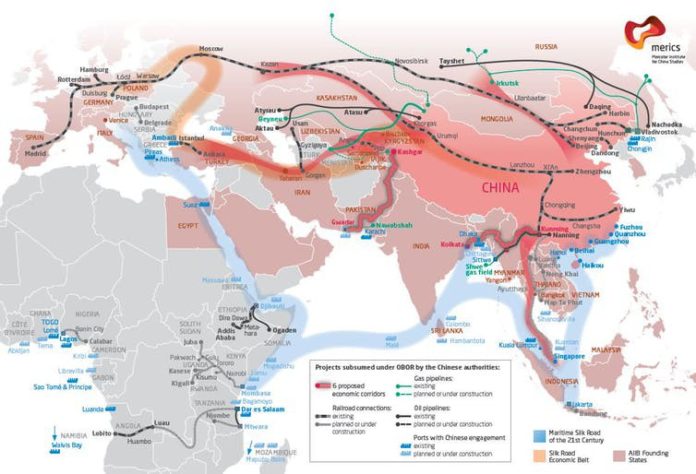
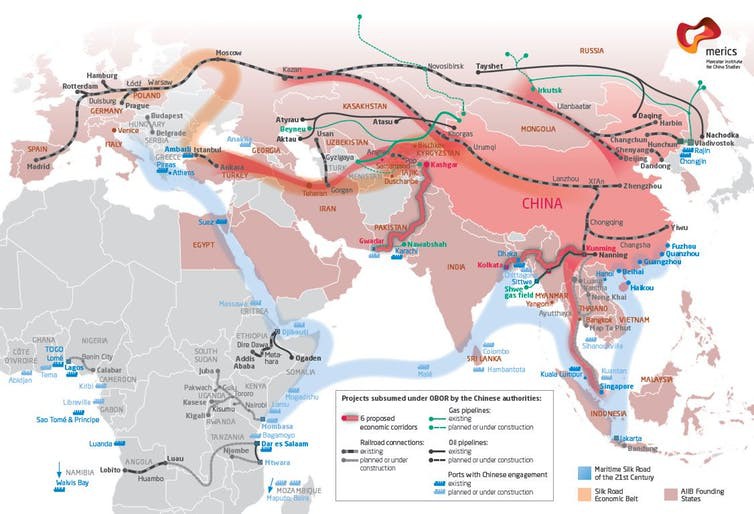
China’s Belt & Road Initiative will sweep across some 70 nations in Asia, Africa, Europe and the Pacific region. Source: Mercator Institute for China Studies

A Memorandum of Understanding to set up a BRI mediator panel was signed between the SIMC and the China Council for the Promotion of International Trade (CCPIT) in Beijing on Thursday.

The BRI is President Xi Jinping’s flagship project to boost global trade and further Chinese diplomacy. It stretches across Asia, Africa, the Middle East, and Europe, connecting regions with a serious of major infrastructure projects, including railways and major ports.

Despite, or maybe because of, Beijing’s aggressive attempts to further the initiative, they have run into a number of disagreements with other governments.

SEE ALSO: Indonesia seeks $60b in Belt and Road projects

The nature and funding of the China-led projects has raised concerns across Asia.

Malaysia’s new prime minister, Mahathir Mohamad, has scrapped US$22 billion-worth of Belt and Road projects in the country, including the 688-kilometre East Coast Rail link, and two natural gas pipelines.

The financial burden was given as the reason behind the cancellation, Mahathir said in August Malaysia could not repay the money and accused China of “a new version of colonialism.”

2017-05-15T125251Z_1504083465_RC17B33AE3F0_RTRMADP_3_CHINA-SILKROAD

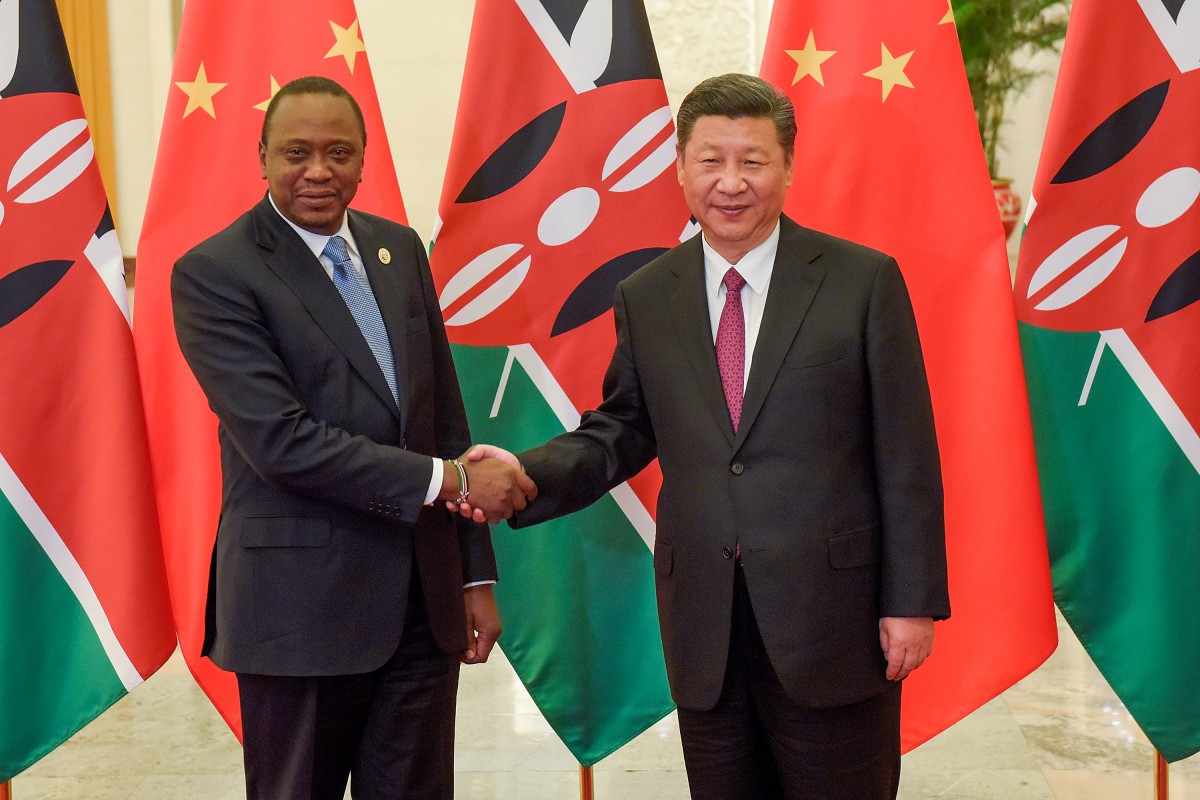
Chinese President Xi Jinping shakes hands with Kenyan President Uhuru Kenyatta prior to their bilateral meeting during the Belt and Road Forum for International Cooperation at the Great Hall of the People in Beijing, China May 15, 2017. Source: Reuters/Etienne Oliveau

Burma (Myanmar) also sought to scale back a US$7 billion port project in troubled Rakhine state, again out of fears it involves too much debt for the country to repay. Reaching a compromise, the two signed an agreement in November to go ahead with the project at a reduced cost of US$1.3 billion in the initial phase.

Sri Lanka was forced to cede control of a strategic port to Beijing because it was unable to repay massive debts to China.

It’s a similar story in Africa where Beijing has pumped in nearly US$150 billion in loans since the turn of the millennium.

SEE ALSO: The costs and benefits of China’s Belt and Road Initiative

Despite hitting several roadblocks, China is continuing to bullishly forge ahead with the initiative. The hope is that the panel will be able to weather some of the storms that arise along the way.

Under the new agreement, both parties will jointly develop the rules, case management protocol and enforcement procedures for BRI dispute cases submitted for mediation.

Those on the panel will also undergo a skills exchange programme to familiarise themselves with the business and dispute resolution culture of the BRI jurisdictions.

Source link

First phase of Cross Island Line to open by 2029: Khaw Boon Wan

0

SINGAPORE: The first phase of the Cross Island Line (CRL), Singapore’s eighth MRT line and its longest fully underground line, will open by 2029, Transport Minister Khaw Boon Wan said on Friday (Jan 25).

Speaking during a visit to the work site of Bright Hill MRT station on the Thomson-East Coast Line, Mr Khaw confirmed that the CRL’s first phase will have 12 stations, in areas such as Changi, Loyang, Pasir Ris, Hougang and Ang Mo Kio. 

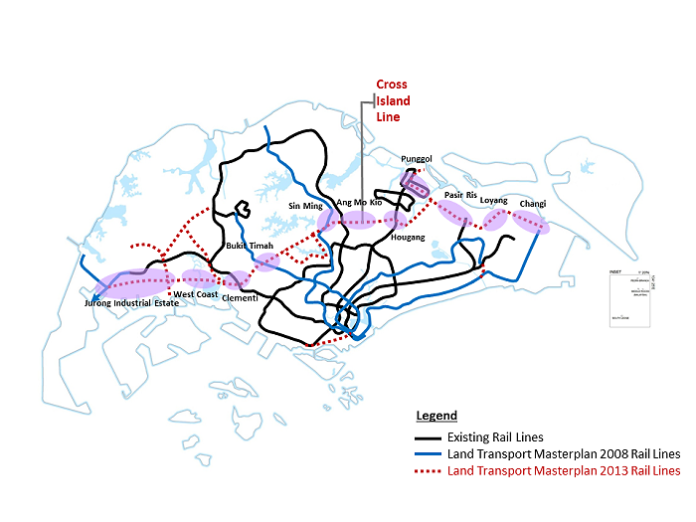
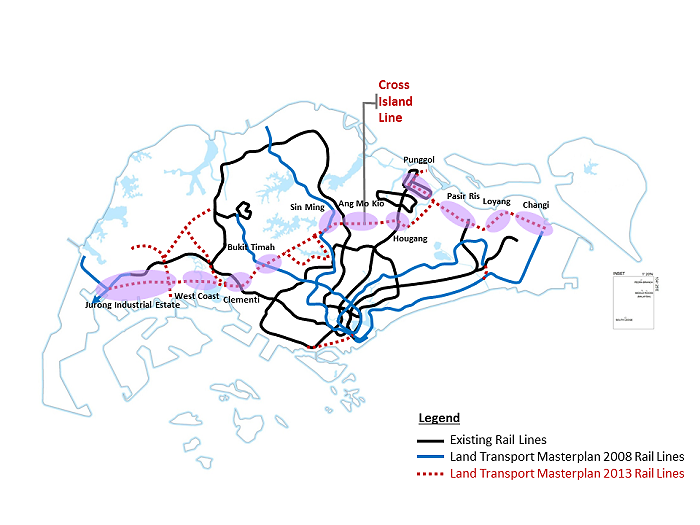
First announced as part of the Transport Master Plan 2013, the CRL will stretch across Singapore to connect the western, north-eastern and eastern parts, including “potentially Changi Airport”, Mr Khaw said. 

Bright Hill will be one of four interchange stations in phase one of the CRL. The other interchange stations will be at Ang Mo Kio with the North-South Line, Hougang with the North East Line and at Pasir Ris with the East-West Line.

cross island line map

Map showing the Cross Island Line route. (Map: LTA)

With the opening of the first phase, more than 10,000 households along the 29-km stretch will have their travelling times reduced, he said. It will also bring Singapore closer to its goal of having eight in 10 households living within a 10-minute walk of an MRT station.

“It will help realise our vision for a ‘car-lite’ Singapore,” he said. 

Mr Khaw added that the line will support new hubs of economic activity outside the central business district, such as the Jurong Lake District, Punggol Digital District and Changi region. 

“Recreational spaces such as Changi Beach Park and the nearby Bishan-Ang Mo Kio Park will also become more accessible to Singaporeans using public transport,” he said.

CRL TO RELIEVE PASSENGER LOADS ON OTHER LINES

The CRL will also help to relieve passenger loads on the North-South Line, East-West Line and the North-East Line, Mr Khaw said. 

“With the CRL stations interchanging with all existing radial lines, commuters will have more journey options to get to their destinations. Many will benefit from shorter journeys and faster travel times,” he said. 

For example, commuters travelling from Serangoon North to the Loyang industrial area using the CRL will see their journey times reduced by 50 minutes, he pointed out. 

ONE SIGNALLING SYSTEM, BETTER COMPONENTS

Recalling various local and overseas examples of train disruptions due to different signalling systems, the minister said that the CRL will only have one signalling system. 

“We have also learnt that the signalling system comes with a lot of vehicle on-board controllers and trackside equipment. If such devices or components come from less than reliable manufacturers or are not robust enough to withstand the vibrations of a moving train, then the final signalling system delivered to us will have lots of cleaning up or replacement problems during operation,” said Mr Khaw. 

The construction of the first phase of the CRL starts in 2020, and he warned that “there will be some impact to nearby residents and businesses”. 

“LTA will work closely with its contractors and the local community to minimise these inconveniences,” said Mr Khaw. 

A new MRT depot, the CRL Changi East depot, will be opened. The depot was originally planned as an underground facility, like the rest of the CRL stations and tunnels, but authorities decided to locate it and its reception tracks above ground after a “thorough cost-benefit analysis”. 

“The decision will save taxpayers more than S$3.5 billion,” said Mr Khaw. 

The Land Transport Authority has also started calling tenders for the construction of Singapore’s seventh MRT line, the Jurong Region Line. 

Source link

Body of Aloysius Pang given airport send-off, flown home

0

AUCKLAND: The body of actor and fallen soldier Aloysius Pang is on its way back to Singapore after it left Auckland Airport on Friday (Jan 25).

Pang’s body left the mortuary at Waikato Hospital on Thursday evening after authorities agreed not to proceed with a post-mortem at the family’s request, a mortuary staff member who declined to be named said.

Corporal First Class (National Service) Pang, 28, died in the early hours of Thursday (New Zealand time) after sustaining serious injuries during a Singapore Armed Forces (SAF) training exercise in New Zealand.

READ: Aloysius Pang was crushed between howitzer gun barrel and cabin

Separately, New Zealand police told Channel NewsAsia a preliminary investigation into the incident was undertaken after it was notified of Pang’s death. 

“The death is not being treated as suspicious and police offer their sympathies to the friends and family of Aloysius Pang Wei Chong,” Detective Inspector Brent Matuku said. 

READ: Aloysius Pang: 4th SAF training fatality in 18 months

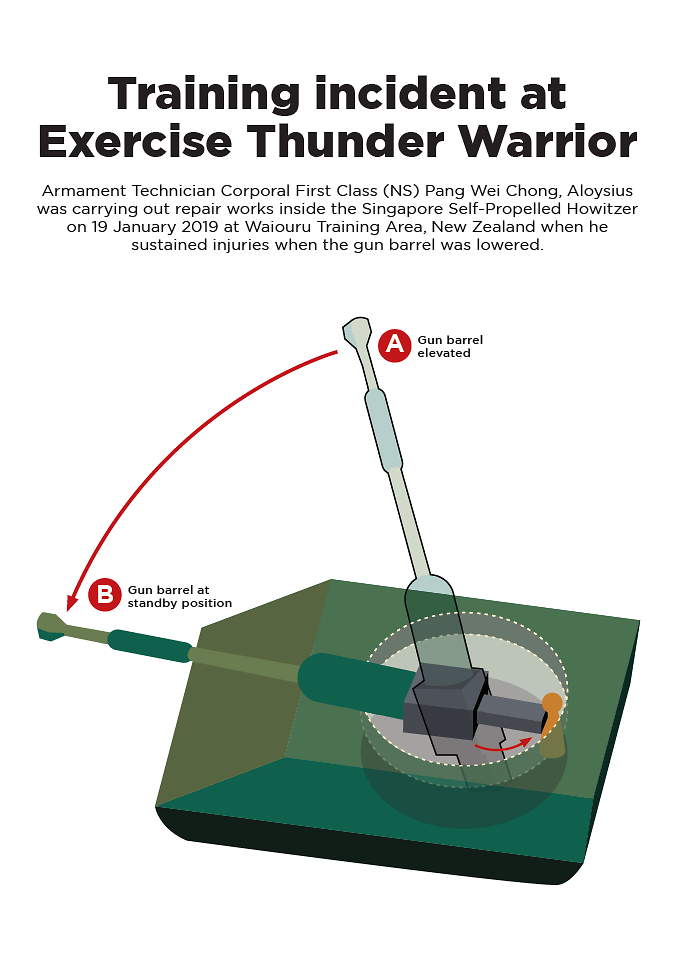
At a press conference on Thursday, SAF senior commanders said Pang was crushed between the gun barrel of a howitzer and its cabin after he was “unable to get out of the way” as the barrel was lowered.

Training incident at Exercise Thunder Warrior

(Graphic: MINDEF)

On Thursday evening, Pang’s body was transported to local funeral parlour Sincere Funeral Services, eight minutes away from the hospital.

READ: Aloysius Pang ‘precious’ to the family: Brother

READ: Aloysius Pang death: Our responsibility to ensure safety of our children, says Chief of Defence Force

A staff member at the parlour told Channel NewsAsia that Pang’s body had left for Auckland Airport at 7.30am on Friday (2.30am, Singapore time).

At Auckland Airport’s corporate terminal, a group of men – one of them wearing a Singapore Army uniform – asked if this reporter was there for the “funeral”.

At about 11.15am, a group of men and women wearing New Zealand military uniform exited the corporate terminal airside and boarded a van.

Haziq - Aloysius Pang's body repatriated 4

The corporate terminal at Auckland Airport. (Photo: Aqil Haziq Mahmud)

Haziq - Aloysius Pang's body repatriated 1

The hearse used to transport Aloysius Pang’s body. (Photo: Aqil Haziq Mahmud)

Shortly after, a Sincere Funeral Services hearse left the terminal, followed by an empty passenger van.

Finally at about noon, a Republic of Singapore Air Force KC-135 taxied to the runway and took off heading east.

Haziq - Aloysius Pang's body repatriated 2

The KC-135 aircraft carrying Aloysius Pang. (Photo: Aqil Haziq Mahmud)

Defence Minister Ng Eng Hen had said in a Facebook post that a KC-135 had been sent to New Zealand to repatriate Pang’s body.

Pang’s manager Dasmond Koh told reporters there could be plans for a memorial service so “all of his fans and loved ones can say goodbye”.

Source link

‘Precious of the family’: Priority is to bring Aloysius Pang’s body home soon, says brother

0

SINGAPORE: The youngest of three siblings, Aloysius Pang was doted on and regarded as “the precious”, said the actor’s elder brother on Thursday (Jan 24), adding that his family’s top priority was to bring the 28-year-old’s body home soon.

Aloysius Pang had been conducting repair work in a Singapore Self-Propelled Howitzer as part of his reservist training in New Zealand when he suffered serious injuries to his chest and abdomen. 

He died on Wednesday night. 

READ: Aloysius Pang was crushed between howitzer gun barrel and cabin

“He’s the precious of our family, the youngest (and) the most loved,” Kenny Pang told reporters at Changi Airport after flying in from New Zealand. He was accompanied by Dasmond Koh, the late actor’s manager at agency NoonTalk Media. 

“What you see on television… that is who he is,” said the older Pang. “He is caring and devoted to his passion – that is the true self of Aloysius.”

Kenny Pang also said that his brother was a filial and beloved son. 

Dasmond Koh Kenny Pang Changi Airport press conference

Dasmond Koh (left) and Aloysius Pang’s brother Kenny speaking to reporters at Changi Airport on Thursday (Jan 24). (Photo: Hani Amin)

“He was the one (that we) showered love on and he reciprocated (by showing) all the support and love to the family,” he said. 

Aloysius Pang, who held the rank of Corporal First Class (CFC), was an armament technician with the 268th Battalion Singapore Artillery.

READ: Our responsibility to ensure the safety of our children, says Chief of Defence Force

READ: Aloysius Pang – 4th SAF training fatality in 18 months

An independent Committee of Inquiry (COI) will be convened to investigate the incident – the fourth military training-related death in 18 months. 

When asked if the family was waiting for more answers as to how the accident happened, Pang’s manager Dasmond Koh said they did not want to comment as investigations were still ongoing.  

READ: New Zealand authorities to conduct post-mortem on Aloysius Pang before repatriation

“It’s very sensitive because it’s still going through investigation. We cannot comment further until the next report is out. We’ll take it step by step after all these reports are out,” said Koh. 

“For the time being, that is not our primary concern. Our primary concern is to get Aloysius back,” he added. 

“A LOT OF UPS AND DOWNS”

The older Pang said he did not get the chance to speak his brother, who had slipped into an unconscious state by the time he reached New Zealand.

For the family, the past few days had been an emotional roller-coaster ride.

“There were a lot of ups and down throughout this trip,” he said. “(About) his first surgery, second or third, we were all very worried, whether it would for the best or for the worst.”

Dasmond Koh Changi Airport press conference

Aloysius Pang’s manager Dasmond Koh chokes back tears during a press conference at Changi Airport on Thursday (Jan 24). (Photo: Hani Amin)

“None of us can be mentally prepared for any of this…. Now, it’s just for us to grieve,” Kenny Pang added. 

Pang began his career as a child actor at the age of nine. He took a hiatus, but returned to acting in 2012 and picked up awards along the way, including Best Newcomer at the 2015 Star Awards. 

READ: Aloysius Pang – A young life devoted to acting, despite being bullied

He was also among the group of rising stars picked by Mediacorp to form a new generation of male celebrities dubbed the Eight Dukes.

His fellow celebrities as well as fans have been flooding social media with condolences messages since news of his death broke. 

“We received a lot of fan support (and) encouragement. Aloysius would have been very grateful for the love shown to him,” said Koh, who asked, however, that the family be given privacy.   

Koh added that a memorial service may be held for fans and colleagues to pay their last respects to Pang and bid farewell.

“We will try to arrange a session for fans to say goodbye,” he said in Mandarin. “We will let everyone know if there’s something more definitive in the next day or two.”

Source link

Aloysius Pang’s death: Key quotes from top SAF officials

0

SINGAPORE: Top officials from the Singapore Armed Forces (SAF) on Thursday (Jan 24) presented preliminary findings on how actor Aloysius Pang was injured and killed during a training exercise in New Zealand, in their first news conference since the accident.

The findings come ahead of a committee of inquiry convened to look into the circumstances surrounding the incident.

READ: Aloysius Pang was crushed between howitzer gun barrel and cabin: Chief of Army

Here’s what has been established so far, in their own words: 

HOW DID THE INCIDENT HAPPEN? 

Chief of Army MG Goh Si Hou: Aloysius is an armament technician and he is trained to perform maintenance and repair for the Singapore Self-Propelled Howitzer.

At the time of the incident, Aloysius was with another technician and also a gun detachment commander. They were called in to perform diagnosis on a suspected fault in the gun. 

So, as part of the rectification process, the gun barrel has to be lowered to standby position. As you can see from the picture, it appears from the initial findings that Aloysius was unable to get out of the way as the gun barrel was lowered. He was caught between the end of the gun barrel and the interior of the Singapore Self-Propelled Howitzer, and he suffered crush injuries as a result.

Training incident at Exercise Thunder Warrior

(Graphic: MINDEF)

WHAT IS THE STANDARD OPERATING PROCEDURE WHEN THE GUN BARREL IS LOWERED?

Commander Combat Service and Support Command (CSSCOM) COL Terry Tan: First and foremost, the operator and the technician have to link up and discuss about the plan to repair. I think that is the most important. After the discussion, there will be a command that will be given to lower the barrel and then there will be a verbal warning that will be given, and the commander will check (the cabin is) clear before the button is pressed to lower the barrel. 

WHO ELSE WAS IN THE CABIN WITH PANG?

COL Tan: Usually when we deploy technicians, they usually go in buddies. This is to make sure they can look after one another. In this case, there was only one (other) technician deployed inside the cabin to troubleshoot the fault, excluding Aloysius. 

So altogether, there were two technicians and the commander of the gun inside the cabin – in total, three. There were no injuries to the other two.

WHAT REFRESHER TRAINING DO MAINTENANCE TECHNICIANS GET?

COL Tan: Before a major exercise, NSmen undergo a comprehensive training programme. Specific for the maintenance crew, NSmen go through refresher training on equipment inspection as well as maintenance tasks such as demonstration by trainers on how to perform maintenance tasks before the servicemen conduct hands-on training. All these are done with emphasis on training safety and precaution as they go about these maintenance tasks.

Additional practical session on trouble shooting and common faults are also conducted. 

Aloysius has undergone this refresher training and is qualified and competent to do his job in Exercise Thunder Warrior.

Commander CSSCOM COL Terry Tan speaking at Aloysius Pang press conference

Commander CSSCOM COL Terry Tan speaking at the press conference on the death of Aloysius Pang on Jan 24, 2019. (Photo: Jeremy Long)

WAS THIS PANG’S FIRST TIME CONDUCTING REPAIR WORK? 

COL Tan: This was not his first time – in fact this is his seventh in-camp training. He has done five high-key and two low-key (trainings). Prior to Exercise Thunder Warrior, he has attended a maintenance vocational refresher training. In fact, when he landed in New Zealand, he was given a just-in-time refresher training just before training started. So it is definitely not Aloysius’ first time maintaining the system.

HOW WAS PANG TREATED?

Chief Army Medical Officer COL Dr Edward Lo: When the accident happened, Aloysius was treated on site by the SAF doctor and his team, and after that he was evacuated by helicopter to Waikato Hospital, which is a tertiary hospital as well as a regional trauma centre. 

At that facility, he underwent surgery as well as ICU care to treat the multiple injuries that he sustained during the incident. 

Immediately after the accident, Aloysius was conscious. He was able to speak to the doctor as well as the medical team that was attending to him. 

After the first surgery that took place the same night, the next morning – the next day, when Aloysius’ mother went to visit, he was still able to speak to his mother. 

But given the extent of his injuries, his condition made a turn for the worse and it deteriorated. 

Despite the additional surgery, and putting him on artificial life support, Aloysius eventually succumbed to his injuries.

Chief Army Medical Officer COL (Dr) Edward Lo Hong Yee at Aloysius Pang press conference

Chief Army Medical Officer COL (Dr) Edward Lo Hong Yee at the press conference on the death of Aloysius Pang on Jan 24, 2019. (Photo: Jeremy Long)

READ: New Zealand authorities to conduct post-mortem on Aloysius Pang before repatriation

WHAT IS BEING DONE IN THE WAKE OF THE INCIDENT? 

MG Goh: I called for a safety call this morning with my army commanders as well as all my trainers – over 1,200 of them – I told all my commanders that this cannot be business as usual. 

We are very sorry for every training death that happens at SAF. I have told them that we must do better and we must do our utmost to restore confidence in our training safety and to ensure the safety of all our soldiers. 

Chief of Army MG Goh Si Hou speaking at Aloysius Pang press conference

Chief of Army MG Goh Si Hou speaking at the press conference on the death of Aloysius Pang on Jan 24, 2019. (Photo: Jeremy Long)

I told my commanders that we will review our training tempo and the training activities that we have because we want to put a singular focus on training safety on the ground going forward. 

If this means removing training activities, reducing training that we do in the meantime, we will do that.

Chief of Defence Force LG Melvyn Ong: Following the safety time-out, I’ve asked all the services in the SAF to come back to review their training tempo with a view to lowering their training tempo. 

For how long? After the safety time-out, perhaps a month or two. 

We will reduce our training tempo and review this across the SAF to focus on safety for all our NSFs and NSmen.

This will take the form of lowering the duration, intensity and frequency of existing training. (We may) take some things out to do training better at a more sustainable pace. 

This reduction of training tempo following the safety timeout will be enforced for as long as it takes to get this right. 

As the Chief of Army has said, it cannot be business as usual.

THERE HAVE BEEN FOUR SAF TRAINING FATALITIES IN THE PAST 18 MONTHS. WHAT DO YOU SAY TO PARENTS OF NS BOYS, SEEING ANOTHER TRAINING DEATH? 

LG Ong: Our parents – we are all parents, many of us are – come to the BMT graduation parade, and I see the pride in their eyes when they see their children serving national service. Parents are proud of their children serving national service. But on the other hand, it is our responsibility to ensure the safety of their children. And we must ensure that parents are assured.

To the parents, I will say this: As a system, the SAF has put in place a good system. For all the incidents that have occurred, for all the findings … and recommendations on how to improve the safety systems, we have fully brought them on board, be it in the areas of heat injuries or in the areas of vehicle safety. 

I think we don’t shirk away from this and we always want to be better.

READ: Aloysius Pang: 4th SAF training fatality in 18 months

And we have improved, in our system and the emphasis of the commanders especially in the army over the last couple of incidents. They’ve been going at it. And I think the safety system is in a better place. 

But going forward, what we will do is lower the tempo.

I think first, you have to have the safety time-out, which the army has correctly done. Thereafter all services will come back on how they view the tempo of operations: It’s too fast, too intense, too many things, too frequent. 

From there, we will do a dedicated review of the training tempo and we will take a look at it holistically within each service and see what we can do to maybe lower the tempo so that they can focus more on safety and do things better, do things well, do things safely. They will come back to me on this one.

Chief of Defence Force LG Melvyn Ong speaking at Aloysius Pang press conference 2

Chief of Defence Force LG Melvyn Ong speaking at the press conference on the death of Aloysius Pang on Jan 24, 2019. (Photo: Jeremy Long)

ARE THERE SYSTEMIC LAPSES THAT HAVEN’T BEEN DEALT WITH?

LG Ong: We have – ERPSS – an external review panel on SAF safety that we have. They’ve been formed to oversee the conduct of safety and systems reviews for MINDEF and the SAF. They have consistently ascertained that the systems are in place – and we listen to them. They’ve visited almost 14 SAF formations in their last cycle, and they actively go around and analyse various parts of the army and the SAF.

Interim progress reports will also be provided to MINDEF leadership from the ERPSS, so we are always in constant contact with them. But the system, I’d say, is largely in place. 

But we can do better. Which is why are going to review the training tempo. I believe that once we lower the training tempo … it’ll give us more time to ascertain the optimum level of activity, the right emphasis and the right training activity level. I think this will put us in a much better state.

READ: Fans and colleagues mourn Aloysius Pang’s death, pay tribute on social media

READ: ‘My world is no more’: Aloysius Pang’s girlfriend Jayley Woo mourns his death

Source link

Aloysius Pang was crushed between howitzer gun barrel and cabin: Chief of Army

0

SINGAPORE: Aloysius Pang, the actor who died in a military training accident, was crushed between the gun barrel of a howitzer and its cabin after he was unable to get out of the way as the barrel was lowered.

This was revealed by Chief of Army Major-General (MG) Goh Si Hou at a press conference on Thursday (Jan 24).​​​​​​​

Chief of Army MG Goh Si Hou speaking at Aloysius Pang press conference 3

Chief of Army MG Goh Si Hou speaking at the press conference on the death of Aloysius Pang on Jan 24, 2019. (Photo: Jeremy Long)

Pang, 28, an armament technician with the 268th Battalion Singapore Artillery, was on reservist at the Waiouru Training Area in New Zealand as part of an annual Singapore Armed Forces (SAF) exercise called Exercise Thunder Warrior.

On Jan 19, he was tasked to repair a suspected fault in the gun barrel of a Singapore Self-Propelled Howitzer (SSPH). As Pang, another technician and a gun detachment commander were inside the howitzer cabin, the gun barrel was lowered to its standby position.

“It appears from the initial findings that Aloysius was unable to get out of the way as the gun barrel was lowered,” said MG Goh. “He was caught between the end of the gun barrel and the interior of the SSPH and he suffered crush injuries as a result.”

READ: Actor Aloysius Pang dies after sustaining serious injuries in SAF training accident

READ: New Zealand authorities to conduct post-mortem on Aloysius Pang before repatriation

According to MG Goh, when the gun barrel is lowered, the space in the howitzer cabin is reduced. But the space is “typically sufficient” for artillery operators as well as technicians to operate, he said.

“What we found is that unfortunately, he was unable to get out of the way of the barrel as it was lowered,” MG Goh said.

The gun barrel is lowered from within the cabin, and it takes about nine to 10 seconds for it to be fully lowered from a standby position, said Colonel (COL) Terry Tan, commander of the Combat Service Support and Command (CSSCOM).

When asked who lowered the gun barrel and if there were any lapses in safety procedures, MG Goh said this will be the focus of the investigation. It was “not appropriate” to go into details until the investigation is completed, he said.

PANG WAS “QUALIFIED, COMPETENT”: CSSCOM COMMANDER

Pang was “qualified and competent” as an armament technician, said COL Tan.

Before an exercise of this scale, NSmen have to undergo a comprehensive training programme, he said. Maintenance crew members like Pang go through refresher training on equipment inspection as well as maintenance tasks such as demonstrations by trainers and hands-on training. Additional practical sessions on troubleshooting and common faults are also conducted, he said.

READ: Aloysius Pang: A young life devoted to acting, despite being bullied

READ: ‘My world is no more’ – Aloysius Pang’s girlfriend Jayley Woo mourns his death

“All these are done with emphasis on training safety and precaution as they go about these maintenance tasks,” COL Tan said.

“Aloysius has undergone this refresher training and is qualified and competent to do his job in Exercise Thunder Warrior,” he added.

WHAT HAPPENED

Pang, who held the rank of Corporal First Class (National Service), died four days after the accident happened on Saturday.

After he was injured, Pang was evacuated to Waikato Hospital, a regional trauma centre where he underwent three operations to treat his injuries. After the first operation and a follow-up operation, Tan Tock Seng Hospital’s chief of trauma and acute care surgery Dr Teo Li Tserng said on Monday that Pang’s condition had stabilised.

He was also said to be awake and breathing on his own without any mechanical ventilation.

However, Pang’s condition took a turn for the worse and required additional surgery, said MINDEF on Wednesday. Despite another operation to repair damaged organs and artificial life support for his lungs, kidneys and heart, Pang died.

An independent Committee of Inquiry will be convened to investigate the circumstances leading to the incident. 

READ: Aloysius Pang: 4th SAF training fatality in 18 months

Pang’s death is the fourth military training-related death in the last 18 months.

On Sep 15, 2017, 21-year-old full-time national serviceman (NSF) Gavin Chan died after he was ejected from a Bionix infantry fighting vehicle at the Shoalwater Bay Training Area in Queensland, Australia. 

On Apr 30 the following year, NSF Dave Lee, 19, died nearly two weeks after suffering a heatstroke following an 8km fast march.

Seven months later on Nov 3, NSF Liu Kai, 22, died after a Bionix vehicle reversed into his jeep during a field exercise at the Jalan Murai training area.

Source link

Aloysius Pang: 4th SAF training fatality in 18 months

0

SINGAPORE: An independent Committee of Inquiry (COI) will be convened to investigate a Singapore Armed Forces (SAF) training incident in New Zealand, which led to the death of actor Aloysius Pang.

More information about the circumstances of what happened is expected to be revealed at a Ministry of Defence media conference on Thursday afternoon (Jan 24).

This is the fourth time in 18 months where an SAF soldier has died while in training. 

Jan 19, 2019: Corporal First Class (National Service) Pang, 28, was carrying out repair work inside a Singapore Self-Propelled Howitzer – an artillery gun mounted on an armoured chassis – with two other SAF personnel when an accident happened, seriously injuring him. 

He had been taking part in Exercise Thunder Warrior at the Waiouru Training Area as part of his reservist commitments and was injured when the gun barrel was lowered.

Pang had to be put on artificial life support for his lungs, kidneys and heart, and died at 8.45pm (Singapore time) on Wednesday at Waikato Hospital in Hamilton.

READ: Aloysius Pang – A young life devoted to acting, despite being bullied

READ: Aloysius Pang dies in SAF training accident – What we know so far

NOV 3, 2018: CORPORAL FIRST CLASS LIU KAI

The wake of the late NSF Liu Kai

The wake of the late NSF Liu Kai, who died in a training incident on Nov 3. (Photo: Jeremy Long)

Full-time national serviceman (NSF) Liu Kai died after he was involved in an accident at Jalan Murai training area on Nov 3.

Corporal First Class (CFC) Liu Kai was operating a Land Rover as part of a field training exercise when a Bionix vehicle reversed into his vehicle, partially mounting it. The 22-year-old died from his injuries and an army-wide safety timeout was called, including overseas training exercises. 

Defence Minister Ng Eng Hen told Parliament on Nov 19: “There are obviously a number of questions that need to be answered in determining the cause of this incident.

“They include: Were safety protocols followed by the crew of the Land Rover and the Bionix vehicle during this phase of the exercise? Were the vehicle commander, driver and crew of the Bionix aware of the Land Rover behind them and did they conduct their reversal safely?”

A COI and police investigations will fully examine several questions into the death of CFC Liu, he said.

READ: Death of NSF Liu Kai – Bionix that mounted Land Rover was reversing from ‘simulated enemy fire’

APR 30, 2018: CORPORAL FIRST CLASS DAVE LEE

NSF Lee Han Xuan Dave wake (1)

A framed photo of NSF Dave Lee at his wake on May 2, 2018. (Photo: Howard Law) 

Full-time national serviceman (NSF) Dave Lee died on Apr 30, nearly two weeks after “displaying signs of heat injury” in Bedok Camp following the completion of an 8km fast march.

The COI investigating the death of the full-time national serviceman found that inadequate on-site casualty management and delayed evacuation were “likely reasons” for him succumbing to heat stroke.

Citing preliminary findings, Defence Minister Ng said in a ministerial statement in Parliament on Aug 6 that there were several calls for CFC Lee to be evacuated, but these calls were either “not heard or not heeded”.

“The delay in evacuation resulted as the persons attending to CFC Lee mistook his signs and symptoms as due to physical exhaustion,” Dr Ng said.

The COI also found breaches of training safety and discipline regulations on Apr 17, the day before the heat stroke occurred.

Dr Ng told Parliament that if no criminal charges are filed against those responsible for lapses leading to the NSF’s death, the Ministry of Defence (MINDEF) would prosecute them in a military court.

READ: Death of NSF Dave Lee – COI highlights inadequate casualty management, delayed evacuation as factors

SEP 15, 2017: 3RD SERGEANT GAVIN CHAN

3sg chan siblings

3SG Gavin Chan’s siblings paying their respects before the cortege moved off to Mandai Crematorium. (Photo: Justin Ong) 

3rd Sergeant (3SG) Gavin Chan, 21, died after he was involved in a vehicular accident at the Shoalwater Bay Training Area in Queensland, Australia in September 2017. 

According to MINDEF, 3SG Chan, a Vehicle Commander from 41st Battalion Singapore Armoured Regiment, was travelling in a Bionix Infantry Fighting Vehicle as part of an overseas training exercise.

3SG Chan had been giving instructions to the driver of the Bionix vehicle when it got stuck on a large boulder whilst reversing. The vehicle suddenly “dropped down over the rock rolling sideways before coming to rest further down the slope”, a coroner’s report said.

According to Queensland police investigations, he was “ejected from the vehicle and suffered significant injuries”.

There were some safety lapses identified by a COI, but it did not find any “negligence, foul play or misconduct”, Defence Minister Ng said. However, the COI recommended the SAF review its training safety regulations on the position of the vehicle commander for armoured fighting vehicles.

READ: Training death of 3SG Gavin Chan – no negligence or misconduct, but SAF training rules reviewed

Source link

Singapore tops mobile app use and downloads: App Annie

0

SINGAPORE: When it comes to downloading and using mobile apps, users in Singapore are top of the class.

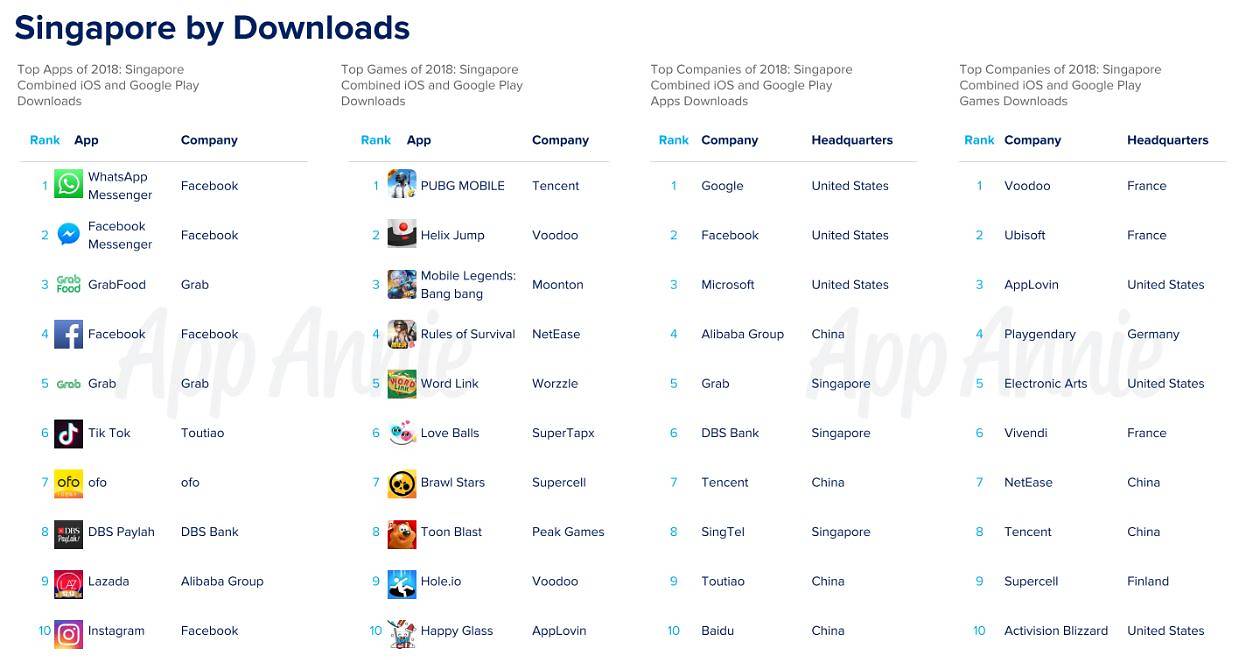
At least that’s what App Annie regional director Jaede Tan said, when he pointed out that Singapore mobile users install, on average, 115 apps and use 46 of these – the highest among the countries the mobile and data analytics company surveyed for its recently released The State of Mobile in 2019 report.  

He also told Channel NewsAsia this points to a preference here for “unbundled apps” rather than super apps being pushed by companies such as Grab and Go-Jek.

READ: With Grab’s super app ambitions, who will it eat for lunch? A commentary

He added that the findings from the report showed that Singapore is a mature market.

Mr Tan juxtaposed this with Indonesia, which is in the early stages of maturity. He said app downloads grow most rapidly in these markets as more consumers buy new devices and begin to build their app collection but are not necessarily heavy or active users. Singaporeans, on the other hand, have found their “go-to apps” over time and use them more, he said.  

“Today, Singaporeans use apps for almost every aspect of their lives, from communicating to banking and insurance, shopping, transport and even dating,” Mr Tan said.

“Part of this (high number of apps) is also because we tend to see a preference for unbundled apps in Singapore, rather than super platform-type apps that bundle many different services together.”

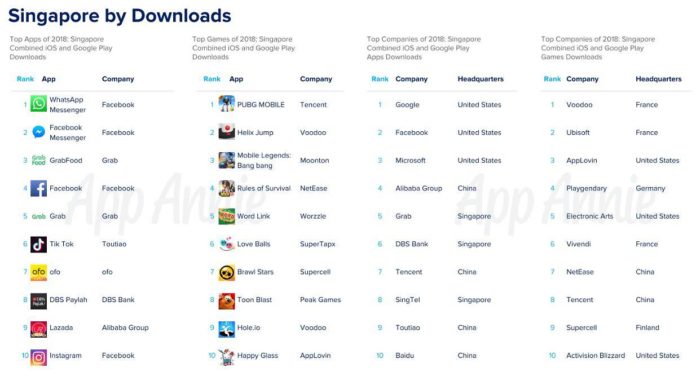
App Annie Singapore top downloads

(Chart: App Annie)

According to the report, the top three downloaded apps for both iOS and Android operating systems in Singapore last year are WhatsApp, Facebook Messenger and GrabFood while the one with the highest monthly active users (MAUs) are WhatsApp, Facebook and Instagram.

READ: Train commute taking too long? Here are some Singapore mobile games to keep you occupied

In terms of mobile games, which App Annie studies separately, online multiplayer hit PlayerUnknown’s Battlegrounds (PUBG) tops the list for most downloaded app here, followed by Helix Jump and Mobile Legends: Bang Bang. Pokemon Go continues to be the most used app last year though, followed by Mobile Legends and PUBG, the report stated.

Overall, App Annie found that there were 194 billion app downloads worldwide and US$101 billion spent on app stores in 2018.

It does not make available the breakdown by countries.

FINDING LOVE, DIGITALLY

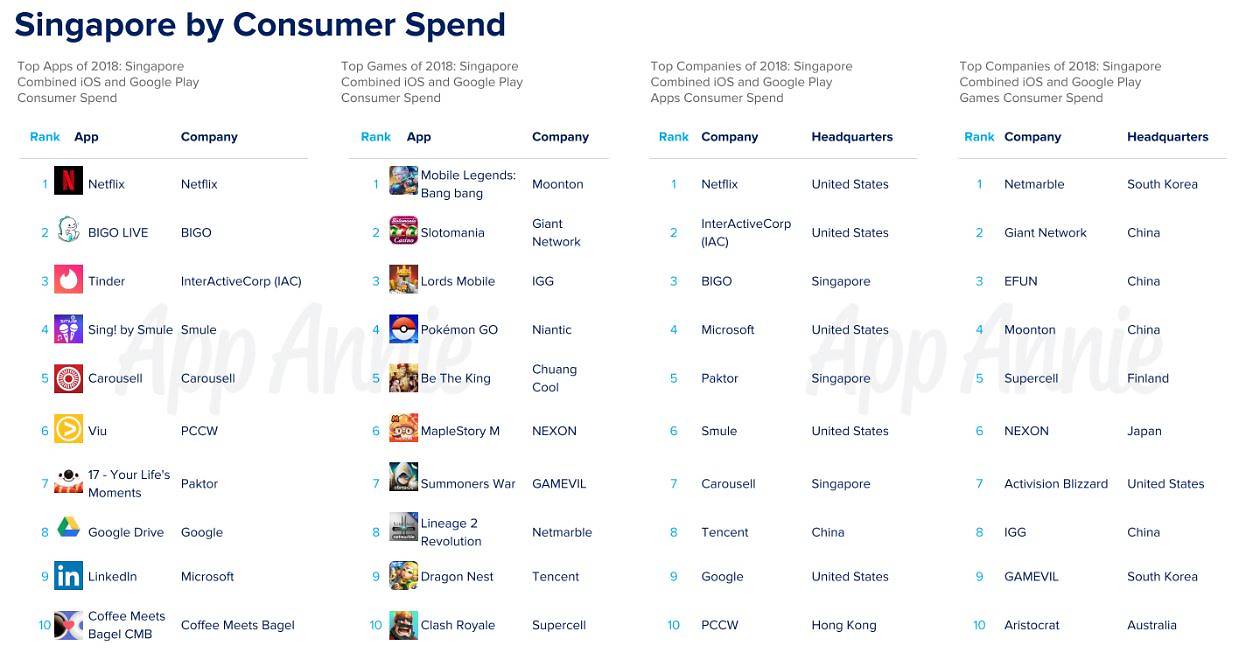
The study also threw up a somewhat surprising finding: Singaporeans are increasingly spending on dating apps like Tinder and Coffee Meets Bagel.

App Annie Singapore table on consumer spend

(Chart: App Annie)

Tinder was third on the top 10 list by consumer spend, while Paktor’s 17 – Your Life’s Moments and Coffee Meets Bagel came in at 7th and 10th, respectively.

So, does that mean that the act of finding love in Singapore is increasingly moving into the digital sphere? To this, Mr Tan said: “Definitely.”

He said Tinder, particularly, had a “phenomenal year overall” and came in 2nd globally for consumer spend too. These dating apps, in general, have “unlocked the keys to monetisation through subscription over the last few years”.

“They have become the de facto dating tool in many countries around the globe,” he added.

The regional director also pointed to video streaming as a “space to watch” in Singapore, given that apps like Netflix and Viu, a video service operated by PCCW Media, is high on the consumer spend lists last year.

He said this category has had a breakout couple of years around the world, with the top five video streaming apps globally seeing their revenue grow 285 per cent and time spent on these growing 140 per cent worldwide since 2016.

“I think this is a space to watch in Singapore as well as local broadcasters and content producers will need to engage consumers with their content via mobile or risk missing out entirely,” Mr Tan said.

Source link