SINGAPORE: As wreaths from well-wishers continued to be carried into the tentage at 82A MacPherson Lane minutes before the wake for Aloysius Pang was opened to the public on Saturday (Jan 26), a queue of at least 80 had snaked all the way out onto the pavement parallel to the main road.
“What a loss, what a loss,” a passer-by muttered to himself in Mandarin. “He’s the same age as my child.”
Pang, an actor, died on Wednesday in a military training accident during a Singapore Armed Forces (SAF) training exercise in New Zealand.
The 28-year-old was an armament technician with the 268th Battalion Singapore Artillery, and was on reservist at the Waiouru Training Area in New Zealand as part of an annual Singapore Armed Forces (SAF) exercise called Exercise Thunder Warrior.
At noon, members of the public, were allowed in to pay their respects. Some had been waiting for almost two hours.
One of the first in the queue was a 31-year-old who only wanted to be known as Alex.
“There’s been too many NS training related deaths,” he said.
“These are things which shouldn’t be happening. How many heartbroken parents are out there because of all these needless deaths?
“I was hoping that he would recover but at the back of my head I knew that he could die too. I’m three parts angry and one part sad. This doesn’t need to happen. It’s unbearable.”
Kenny Pang, the brother of Alyosius Pang, is seen at the wake on Jan 26, 2019. (Photo: Gaya Chandramohan)
Members of the public queue as they wait to pay their respects at Aloysius Pang’s wake. (Photo: Gaya Chandramohan)
Members of the public were allowed in to the wake in batches, patiently waiting their turn behind barricades before finally entering the main wake area.
“I couldn’t control my emotions after seeing his photo,” said a member of the public who only wanted to be known as Ting Ting.
“The last time I met him was at a fans gathering at Tampines Hub last July. He was kind, gentle and down-to-earth, you could see that from the way he interacted with us.
“He was a very good man, good actor, and had a long way to go in life.”
Local celebs and fellow actors seen at the wake of Aloysius Pang on Jan 26, 2019. (Photo: Gaya Chandramohan)
A condolence card and flowers at the wake of Aloysius Pang on Jan 26, 2019. (Photo: Gaya Chandramohan)
Pang will be accorded the full honours of a military funeral, said the Ministry of Defence (MINDEF) on Friday (Jan 25). He will be cremated on Sunday at Mandai Crematorium.
SINGAPORE: “A lot of trees hold stories that they can’t tell you,” said National Parks Board (NParks) arborist Robin Ong.
“For example, ‘I’ve been hit by a car 20 years ago and therefore I have this defect at my feet’,” he added.
The 33-year-old is one of 200 arborists or tree doctors employed by NParks to manage about two million trees growing in public spaces around Singapore.
“They can’t speak (so) we need to come in and speak on their behalf to ensure that they have all the care they require,” Mr Ong told Channel NewsAsia at a field along Evans Road where several towering rain trees are being checked.
Finding out the story of a tree is a two-step process. First, a basic tree assessment (BTA) followed by an advanced assessment if there are signs of damage.
A BTA is like a routine body check-up. Aside from a visual assessment at ground level, Mr Ong would record the vital statistics of the tree such as its girth and height.
“There are certain things that we look out for like dead branches because dead branches will decay and possibly fall during a high wind event,” said Mr Ong.
A tablet with a drop-down checklist helps him with the BTA. It also contains a database of the tree’s history and condition when it was previously inspected.
They also use basic tools like binoculars, cangkul, a tree probe and measuring tape to get a better understanding of the tree. (Photo: Marcus Ramos)
The inspection takes about about 15 to 20 minutes.
“If you multiply this by 500 (trees) a month, that is what our colleagues in certain divisions have to do. 15 to 20 minutes, this is a concise version,” he said.
Trees that do not require advanced-level inspections are checked every 12 to 24 months. This is more frequent than what is recommended by the International Society of Arboriculture, which is every one to five years.
A hole was discovered near the base of the tree during the inspection. Using a changkul, Mr Ong exposed the hole for a closer look to determine if action is needed.
“So it’s a 40-cm hole. The tree is about more than 2 metres in diameter. Comparing 40 centimetres to 2 metres, it really isn’t a lot,” he said.
In these instances, the arborists will use advanced assessment tools such as a resistograph to check for decay.
A needle is drilled into the tree and the amount of resistance felt is recorded. This tells him how dense the wood is. When there is decay, fungi would colonise the wood and make it less solid leading to cavities.
“They paint a fuller picture of what’s beyond the surface,” Mr Ong added.
“Speaking from my own experience, we spare no effort … if there are any defects, we assess it and give it a certain likelihood of failure. If this likelihood of failure is beyond the threshold that we are comfortable with or beyond the management of the tree, you have to mitigate it sooner,” he said.
“Like a tree in the middle of Orchard Road, obviously, you wouldn’t want a dead branch hanging over there for five weeks,” he added.
LISTENING TO THE TREE
Arborists also use sound wave tomography to check for cavities within the tree trunk. It is similar to how an ultrasound scan works.
Mr Ong sets up a detection system around the circumference of the rain tree’s trunk that will work as “ears” to listen out for soundwaves. His colleague strikes a part of the tree with a mallet to send sound waves through its trunk.
By striking the trunk with a hammer, sound waves will travel through the trunk to be picked up by devices monitoring for activity. If it travels slowly, it could be due to the presence of a cavity. (Photo: Marcus Ramos)
The sound waves travel faster if the trunk is dense and solid. Soundwaves travelling slower through parts of the trunk suggest there could be a cavity within.
Mr Ong said he is not too concerned of the tree’s condition but suggests a more frequent inspection cycle.
“Every year, this guy will probably get two inspections minimum which is by certain standards excessive,” he said.
To get to nooks and crannies that are hard to get to, NParks arborists fly small drone cameras that will allow them to look at the spot real-time. (Photos: Marcus Ramos)
“As you would imagine, data alone can only give you this much. It’s up to you to interpret it and tell the story for the tree and whether or not based on the site conditions, targets, based on many many other things whether to retain the tree or not,” he said.
Sometimes Mr Ong and his colleagues like Ms Clarice Xue scale trees to get a closer look to help them understand what is going on.
Nothing beats getting “up close and personal with the tree to understand what is going on”, said Mr Ong. In fact, he said many within the arboriculture industry in Singapore are certified tree climbers.
They undergo a tree-climbing course that teaches them to scale trees without hurting the tree or the climber.
ADAPTING TO GROWING CHALLENGES
Mr Oh Cheow Sheng, group director of streetscapes at NParks said that one of the challenges unique to Singapore is changing weather patterns.
“We are getting more severe and intense storm events. A combination of heavy rainfall and strong wind gusts can cause damage to our trees,” Mr Oh said.
Last year, there were several instances of trees falling in a storm. An 89-year-old man was killed by a falling tree branch at North Bridge Road.
Since 2016, NParks has switched its approach to help trees stand a better chance against adverse weather. It makes sure that tree canopies are pruned before the onset of monsoonal periods to make them less top-heavy.
At the same time, trees with girths exceeding 4 metres are given advanced checks on an annual basis.
According to Mr Oh, this reduced falling tree incidents by 85 per cent from 3,000 cases in 2001 to about 400 cases in 2018.
“Most trees are healthy and they do not require advanced checks. … It is a very small number of trees that require that kind of attention,” he said.
“Trees that require advanced level checks simply means that they have some kind of defect that we want to monitor. It does not mean that the tree is not safe,” he added.
With the changing weather patterns, Mr Ong said that his workload in the last few years has been “ridiculous”. Weekends are sometimes spent writing reports and visiting sites to monitor the human traffic around the tree for a better gauge of the potential impact if the tree were to fall, he said.
“If you consider the urban environment, especially in highly-populated places here there are a lot of buildings and narrow channels, wind picks up. Any tree, given the right amount of wind load is just going to be picked up and toppled,” he said.
“If a tree falls somewhere then our workload suddenly spikes up because of reactions by the public. It has really been ridiculous for the past couple of years. A lot, a lot of work (due to the changing weather conditions),” Mr Ong added.
Aside from the weather, there are other factors beyond the control of the arborists.
“When a development happens right next to the tree, the pH value of the soil becomes more and more acidic. These are changes that you are not able to mitigate because it’s soil. You can’t just remove all the soil around the tree and replace it,” he said.
“Trees and construction, it’s a very real thing in Singapore especially because of space constraints and there is construction everywhere,” he added.
Acidic soil conditions could affect tree health.
Given the “ridiculous” workload, Mr Ong wishes that more people would be interested in the vocation.
“It’s not an easy science. It’s never enough. We need more people interested in outdoor work. Right now, Singaporeans don’t seem to be very keen on working outdoors,” he said.
SINGAPORE: Would you house your dog somewhere else if you were going overseas for work?
If you were paying money for this service, would you expect him to be fed, showered and taken care of?
And if so, wouldn’t you expect your dog to be returned after, alive and well, at least no worse off than the condition you packed him off in?
We seem to take basic welfare standards of our animals for granted when we leave them in the hands of pet boarding facilities.
Yet over the past month, many Singaporeans have woken up to the fact that there’s not always the case, in the aftermath of flash raids on one pet boarding service Platinium Dogs Club by the Agri-Food & Veterinary Authority of Singapore (AVA).
18 dogs and a rabbit were fortunately found in the rented semi-detached house but one Shetland sheepdog called Prince met his untimely end. What was more shocking was news from authorities that Prince had passed away at the premises and was cremated.
The tragedy has raised many questions about the state of animal welfare regulations in Singapore, with many calling for stricter rules on pet boarding facilities.
While much progress in animal welfare has been made over the past few years, the long-drawn incident clearly reveals the gaps in our laws regarding animal welfare and their enforcement.
It has become painfully obvious that tighter regulations are required to safeguard animals entrusted to pet boarding facilities, and what they can or cannot do.
Pet boarding has always been a grey area. Under AVA’s rules, pet boarders do not require a license to operate.
Only commercial pet farms need licenses and therefore have to comply with certain standards and rules set by AVA, including the size of cages animals can be housed in, the health of the animals and their records, as well as their agreement to AVA’s regular spot checks.
Pet boarding facilities that are not pet shops, however, do not fall under this category.
People seen walking outside pet boarding centre Platinium Dogs Club at 7 Galistan Avenue. (Photo: Jeremy Long)
On the other hand, although the Urban Redevelopment Authority (URA) does not allow pet boarding in residential properties, we have not heard tales of AVA or URA intervening in residential pet boarding businesses unless there are complaints from neighbours about arising disamenities.
But the recent episode suggests we must ensure that commercial pet boarding facilities, such as Platinium Dogs Club, are subject to the same rules and regulations which govern pet shops and farms.
Boarding animals must be given proper food, shelter, water and mental stimulation. They must be given timely medical care, and be protected from neglect and abuse.
But because most pet boarding businesses are not licensed, there is no way for the authorities to ensure this. This has to change.
Some will argue that there are many freelance pet boarders who have personal relationships with pet owners and look after animals in their free time, for whom heavy intervention will impose high compliance costs.
Indeed, there may be a distinction to be made between people who help look after their friends’ pets, and pet boarding businesses who are running a business operation with the intent of profit making.
Platinium Dogs Club, for example, advertised online and ranked highly on Google, leading to many dog owners engaging their services. At the very least, there is a case to be made for consumer protection.
The exterior of Platinium Dogs Club, a pet boarding centre, which is being investigated for alleged mistreatment of animals. (Photo: Jeremy Long)
What is disturbing is the pet shop license conditions, which stipulate how pets ought to be displayed, recorded, microchipped and then sold, are not very different form how we treat goods or property.
Might that be the reason why more resources could be devoted to animal protection but are not?
BETTER ENFORCEMENT NEEDED
In that context, it is heartening to hear authorities reassure the public. Home Affairs and Law Minister K Shanmugam’s pledge of a thorough investigation and action to be taken against illegal acts was well welcomed.
Our laws have evolved in recent years to reflect society’s growing desire to protect animals, in tandem with the growth in animal welfare groups.
We have strengthened laws that support animal welfare. The Animal and Birds Act was amended in 2014 to impose harsher penalties for animal abusers. Businesses found guilty of animal cruelty for the first time can be fined a maximum of S$40,000 and/or jailed for 2 years, compared to s$10,000 and/or jail of 1 year before the Act was revised.
The next important step is to make sure that these laws are enforced, including on errant pet boarding facilities and other pet-related businesses. It is heartening to see more Singaporeans looking out for cases of animal cruelty. The SPCA receives an average of 80 to 90 reports of alleged cruelty to animals every month.
While AVA has also made improvements in enforcement, more still needs to be done. If the policy intent is to let pet businesses operate freely, only stepping in when trouble brews, do authorities simply have the bandwidth and manpower to respond decisively to look into all cases of alleged animal welfare and halt any mistreatment?
Exterior of pet boarding centre Platinium Dogs Club, which is located at 7 Galistan Avenue. (Photo: Jeremy Long)
Since July 2018, neighbours were already surfacing complaints to AVA about excessive howling of dogs at Platinium Dog Club. Yet, it continued business operations until tragedy struck five months later.
Closer follow-up, more timely investigations, and perhaps involvement of the public for other similar complaints could have brought Platinium’s practices to light earlier and forestall the sad series of events. The dogs did not have to lose their lives.
Animal welfare groups in Singapore do not have enforcement powers. This is in contrast to countries like New Zealand and Australia, where the SPCA is empowered legally to bring animal offenders to justice.
Officers have the authority to enter property, seize animals and evidence of animal cruelty offences, issue on-the-spot-fines and initiate prosecution under animal welfare legislation, just to name a few.
If the authorities consider engaging the help of animal welfare groups in enforcing cases of animal cruelty, that could dramatically change the landscape of animal welfare here.
It could help authorities enforce laws against these cases of animal abuse without straining constabulary resources. It would allow errant pet businesses to be dealt with quickly and pose a more credible deterrent against animal mistreatment.
It would also be in line with the employment of auxiliary police who are vested with powers to safeguard life and property of persons in Singapore and assist the Police in the maintenance of law and order under the Police Force Act.
WHY DOESN’T CREMATION REQUIRE A LICENSE?
The lack of regulations are not limited to pet boarding businesses, but also include other pet related industries, such as pet grooming, cremation and training.
It was only two years ago that a pet cremation facility was found to have not cremated pets properly, and returned a mixture of compounds similar to sand and cement instead of the animal’s ashes to their owners.
Niches at a pet columbarium. (Photo: Lim Jia Qi)
Despite not being registered, that particular facility was able to continue its business activities, until complaints made the news.
Pet cremation providers do not require a license from the AVA, and yet do not have a surefire way of ensuring that pets belong to those who order their cremation.
Again, it’s starting to sound like the disposal of pets, just like the disposal of goods, require little thought and therefore little action against wrongdoing, a good reason to enlist the instincts and muscle of animal welfare groups who have animal welfare at heart.
SOME WAY TO GO
We have some distance to cover before we become a nation with the highest standards of animal welfare.
The Platinium Dog Club tragedy has brought some of these issues to light, but we have others we need to deal with – such as tighter regulations for the sale of pets.
Jurisdictions, like California’s, have passed laws to prohibit the sale of dogs, cats and rabbits in pet stores unless the animals are from a rescue organisation. This will also drive pet owners to find their pets straight from a sustainably sourced and ethical pet farm.
Animal welfare groups are always ready to work with the authorities, so that we can work towards a Singapore which is better and kinder to its animal friends. It’s time to allow us to step up and do more.
SINGAPORE: A year-long series of events will officially kick off on Monday (Jan 28) to mark the 200th anniversary of the arrival of Stamford Raffles, a key turning point in Singapore’s modern history.
To start the ball rolling, the annual i Light Singapore event and Light to Night Festival will run from Jan 28 to Feb 24.
They will feature works specially curated for the bicentennial commemoration.
Six bridges spanning the Singapore River, including Cavenagh Bridge, Anderson Bridge and the Helix Bridge, will be transformed through light art installations by local artist Michael Lee and five international counterparts.
Where do stories begin / Where do stories end is a light installation on Cavenagh Bridge by Michael Lee and Perception3. (Photo: Fann Sim)
Themed Bridges of Time, they allow visitors to experience different aspects of Singapore’s long history.
The Light to Night festival will see key moments and characters in Singapore’s history projected in lights on buildings around the Civic District, including the Asian Civilisations Museum, Victoria Theatre and Victoria Concert Hall, The Arts House and National Gallery Singapore.
Among the projections is Sayang di Sayang, which depicts the life and work of Zubir Said, who composed Singapore’s national anthem. Another is The Resident, which pays tribute to William Farquhar and his novel ideas.
STEP INTO HISTORY
Those who want to “go back in time” to witness history can do so via an app which will also be launched on Monday by the National Heritage Board and National Parks Board.
Th BALIKSG app allows members of the public to revisit historical events such as the signing of the 1819 Treaty, “meet” historical characters and learn about historical places through the use of augmented reality.
Throughout the rest of the year, other initiatives and activities will be launched around the island.
The Singapore Bicentennial Office said that through these events, the public can look forward to an array of diverse and immersive events not just in the 200 years since 1819 but also 500 years before.
Its deputy director Wong Chock Fang said: “The Singapore Bicentennial is about 1819, one of the key turning points for Singapore. But it’s also about the time before and after 1819.
“It’s a commemoration of our journey from 1299 all the way to today. We want to look at all that’s happened throughout the centuries, the communities and individuals who’ve arrived and contribute to the modern Singapore we know today.”
Manpower Minister Josephine Teo, who is overseeing the bicentennial commemoration activities, said she hopes that the events, planned in collaboration with various community partners, ethnic groups and religious institutions, will “ignite a curiosity among Singaporeans for our long and rich history”.
“This is true to the spirit of openness that Singapore embodies. We should always keep an open mind about different people, cultures, religions, values and beliefs. There’s always something to understand and learn,” Mrs Teo said.
SINGAPORE: The National Parks Board (NParks) unveiled a 10-year action plan on Friday (Jan 25) that seeks to “strengthen the resilience” of Singapore’s native rainforests.
The action plan covers the Bukit Timah Nature Reserve, Central Catchment Nature Reserve and Nature Park Network.
In a press release, NParks said that the Forest Restoration Action Plan “will chart the restoration that will be undertaken over the next 10 years to regenerate the secondary forests in the nature parks buffering the two nature reserves, as well as disturbed patches within the reserves”.
“This will assist the forests to regenerate and approximate a mature forest landscape in time,” it added.
Minister for Social and Family and Development Desmond Lee (left), Adviser for Holland-Bukit Timah Dr Vivian Balakrishnan, Chairman of Garden City Fund Prof Leo Tan and Adviser for Holland-Bukit Timah Ms Sim Ann, taking part in the community tree-planting ceremony. (Photo: Farez Juraimi)
Buffer parks give the public a space to interact with nature and help lower visitorship pressure on the nature reserves. There are currently six of such parks covering more than 250 hectares, including the Rifle Range Nature Park.
As part of restoration efforts, NParks will engage the community in activities such as planting more than 250,000 trees and shrubs across the nature parks and open areas in the nature reserves.
The plants are native to Singapore and include nitrogen-fixing plants like the petai, as well as fruit-bearing trees like the kumpang and common sterculia.
Other measures carved out in the action plan include the installation of aerial rope bridges across Rifle Range Road, as well as underground culverts so that animals can move safely between the Rifle Range park and Bukit Timah Nature Reserve.
NParks spokespeople explaining the processes of planting and weed removal to students. (Photo: Farez Juraimi)
On Friday, NParks’ group director for conservation Dr Adrian Loo highlighted the importance of community stewardship.
“We always believe in community stewardship. By actually planting a plant, they will feel like they own the forest as well. We are encouraging that kind of community stewardship over the forest,” said Dr Loo.
Mr Joseph Koh, chairman of the Friends of Bukit Timah community group, also expressed hope that the action plan would become a national effort.
Minister Desmond Lee partakes in the removal of invasive weed species. (Photo: Farez Juraimi)
“What we really need to do is explain to the community, to our younger generation, the science and the broader strategic considerations behind this programme,” said Mr Koh. “They can (then) see precisely (that) what we are doing has a multiplying effect on how the forests can be further protected.”
The works in Rifle Range park are scheduled to be completed by next year.
Restoration efforts at the park began on Friday, involving Second Minister for National Development Desmond Lee, as well as advisers for the Holland-Bukit Timah GRC.
Also participating were nature group members and 80 students from Fuchun Secondary School, Nanyang Girls’ High School and ITE College East.
Adviser for Holland-Bukit Timah Ms Sim Ann interacting with students. (Photo: Farez Juraimi)
SINGAPORE: Actor Aloysius Pang will be accorded the honours of a military funeral, said the Ministry of Defence (MINDEF) on Friday (Jan 25).
He will be cremated on Sunday at Mandai Crematorium.
Pang’s body arrived in Singapore on Friday evening from New Zealand, two days after he died of injuries sustained in a military training accident.
It made the over 10-hour journey from Auckland in a Republic of Singapore Air Force KC-135R aircraft, which landed in Singapore at about 5.45pm.
His family received his body at Paya Lebar Air Base.
Chief of Army, Major-General Goh Si Hou was also at the air base to offer his condolences, said MINDEF.
Corporal First Class (National Service) Pang, 28, was seriously injured on Sunday during a Singapore Armed Forces (SAF) training exercise in New Zealand.
Pang’s brother, Kenny, told reporters on Thursday night that his brother had slipped into an unconscious state by the time his family members arrived in new Zealand.
“None of us can be mentally prepared for any of this … Now, it’s just for us to grieve,” Kenny Pang said.
Pang’s artiste agency, NoonTalk Media, said those who wish to pay their last respects to him can do so from noon on Saturday to noon on Sunday.
A private wake for the family will be held on Saturday morning.
“We respectfully appreciate the privacy given during this period,” the management agency said on its Facebook page.
Aloysius Pang began his career as a child actor at the age of nine. He took a hiatus, but returned to acting in 2012 and picked up awards along the way, including Best Newcomer at the 2015 Star Awards.
SINGAPORE: The first phase of the Cross Island Line (CRL), Singapore’s eighth MRT line and its longest fully underground line, will open by 2029.
For a start, there will be 12 stations – Bright Hill, Teck Ghee, Ang Mo Kio, Tavistock, Serangoon North, Hougang, Defu, Tampines North, Pasir Ris, Pasir Ris East, Loyang and Aviation Park.
It is one of three phases of the CRL, said the Land Transport Authority (LTA) on Friday (Jan 25), adding that engineering studies are still being conducted for the second and third phase.
These studies include the two underground alignment options in the vicinity of the Central Catchment Nature Reserve, south-west of Bright Hill station.
“LTA has consulted various stakeholders and will take all views into consideration before deciding on the final alignment. Details will be announced when ready,” the authority said in a news release.
Here’s an overview of the 12 CRL stations that will be operational from 2029:
Aviation Park
Artist impression of Aviation Park MRT station. (Image: LTA)
Aviation Park Station, the eastern-most station on the first phase of the CRL, is close to the Changi Airfreight Centre and Changi Beach Park. It will be constructed along Changi Coast Road.
Loyang
Artist impression of Loyang MRT Station. (Image: LTA)
Loyang Station will be located near Selarang Camp, along Loyang Avenue. It will be close to Loyang Valley Condominium and Loyang Industrial Park.
Pasir Ris East
Artist impression of Pasir Ris East MRT Station. (Image: LTA)
Pasir Ris East Station will be constructed along Pasir Ris Drive 1, close to the Pasir Ris East Community Building and White Sands Primary School.
Pasir Ris
The CRL will pass through the existing Pasir Ris Station, which is part of the East-West Line. The CRL line will be constructed underground. The station is close to White Sands Mall and Pasir Ris Town Park.
Tampines North
Artist impression of Tampines North MRT Station. (Image: LTA)
Tampines North Station will be built near Tampines Street 62 and the Tampines Expressway. It will be near residents at Tampines GreenView and Tampines North Town.
Defu
Artist impression of Defu MRT Station. (Image: LTA)
Defu station will be built along Tampines Road, and will serve commuters travelling to the Defu Industrial Area.
Hougang
The CRL will pass through the existing Hougang Station, which is part of the North-East Line. The station is close to Hougang Mall, Hougang Polyclinic and will serve residents living at Hougang Avenue 10.
Serangoon North
Serangoon North station will be built along Ang Mo Kio Avenue 3, serving commuters travelling to Bowen Secondary School, Al-Istiqamah Mosque and Serangoon Community Club.
Tavistock
Tavistock Station will be constructed along Ang Mo Kio Avenue 3, near Ang Mo Kio Industrial Park 2, Chen Su Lan Methodist Children’s Home and Tavistock Avenue.
Ang Mo Kio
Artist impression of the CRL Ang Mo Kio MRT Station. (Image: LTA)
The CRL will pass through the existing Ang Mo Kio Station, which is part of the North-South Line. The station is close to Ang Mo Kio Hub and will serve residents living at HDB blocks along And Mo Kio Avenue 3.
Teck Ghee
Teck Ghee Station will be located near the junction of Ang Mo Kio Avenue 6 and Ang Mo Kio Avenue 2. It will serve residents living at HDB blocks at Ang Mo Kio Avenue 1, as well as people travelling to Bishan-Ang Mo Kio Park.
Bright Hill
Artist impression of Bright Hill MRT station. (Image: LTA)
Bright Hill Station will be an interchange station between the second stage of the Thomson-East Coast Line (TEL2) and the first stage of the CRL. LTA said the TEL2 is progressing well and on track to open for passenger service in 2020.
The station is close to Ai Tong Primary School and will serve residents from developments such as Sin Ming Garden, Faber Gardens and The Gardens at Bishan.
8 PROPERTIES PARTIALLY ACQUIRED; ONLY ANCILLARY FEATURES AFFECTED
To facilitate the construction of the first phase of the CRL and associated road works, LTA said that the Government will partially acquire eight properties.
Map of the Cross Island Line.
The properties include Loyang Valley Condominium, an electrical sub-station at Loyang Avenue, Hitachi Chemical(s) at Loyang Way and Loyang Industrial Park at Loyang Lane.
On the other end of phase one of the line, properties that will be partially acquired include Daikin Airconditioning (Singapore) and Gain City Best-Electric at Ang Mo Kio Industrial Park 2, Ang Mo Kio Hub, as well as Kong Meng San Phor Kark See Monastery at Bright Hill Road.
LTA stressed that with the acquisitions, only ancillary features will be affected.
“No buildings or operations will be affected, no structures will be demolished and no relocation will be required. LTA will reinstate any affected structures,” LTA said.
It added that compensation will be based on market value of the acquired land as at the date of acquisition gazette, in accordance with the Land Acquisition Act.
Landowners can continue using the site until Jan 31, 2020.
SINGAPORE: Two Malaysians were arrested on Wednesday (Jan 23) for attempting to smuggle contraband cigarettes through Singapore’s Woodlands Checkpoint.
The Immigration and Checkpoints Authority (ICA) said the two separate cases involved the suspects concealing the cigarettes in their Malaysia-registered cars.
ICA said its officers “detected anomalies” in the undercarriage of the first car, driven by a 33-year-old woman. After conducting checks, the officers found 460 packets of cigarettes hidden in the vehicle’s modified fuel tank.
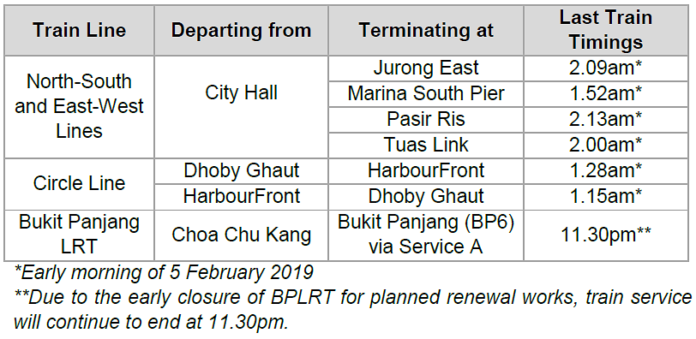
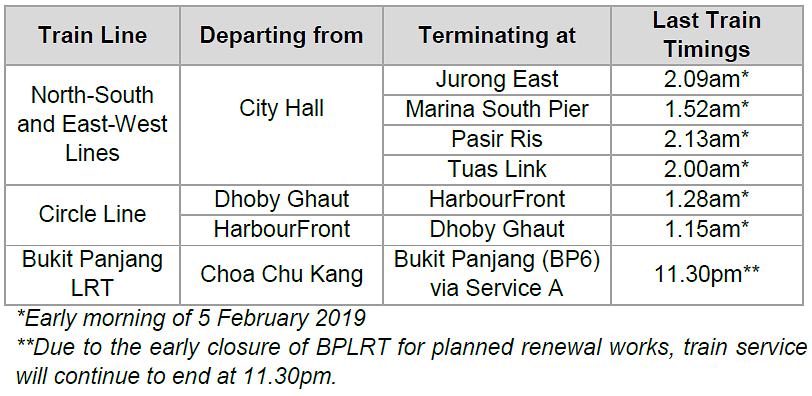
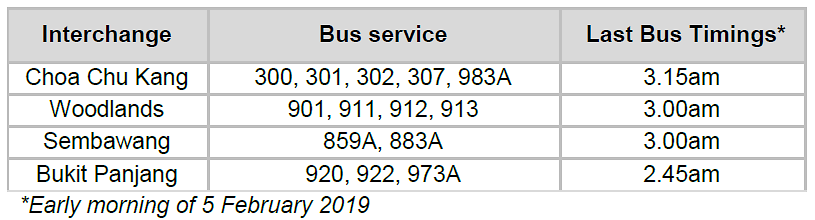
SINGAPORE: Operating hours for some train and bus services will be extended on Feb 4, the eve of Chinese New Year, until the wee hours of Feb 5.
Transport operator SMRT announced this on Friday (Jan 25), saying it is extending service hours for three of its lines – the North-South Line, East-West Line and Circle Line.
Selected bus services will also have extended operating hours, so passengers on the last trains can connect to them, SMRT said.
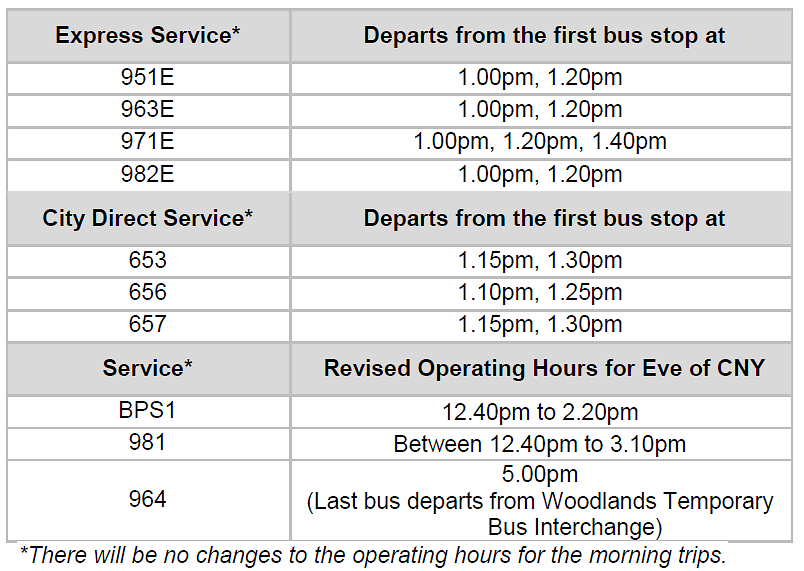
Additionally, operating hours for several bus services will be brought forward. They includes express services 951E, 963E, 971E and 982E, as well as City Direct services 653, 656 and 657.
SINGAPORE: Asia-Pacific countries need to work together on environmental issues to create a sustainable future, two Singapore ministers urged on Friday (Jan 25).
Deputy Prime Minister Teo Chee Hean and Environment and Water Resources Minister Masagos Zulkifli cited growing global population and demand on resources as key reasons for countries to take steps to tackle climate change. The ministers were speaking at the Third Forum of Ministers and Environment Authorities of Asia Pacific.
“We want to improve the lives of our increasing global population, by providing each person with better nutrition, better health care, better housing, better education, and better protection against the vagaries of nature,” Mr Teo said. “But a larger population will also consume more energy, emit more greenhouse gases, and generate more waste and pollution – if we carry on business as usual.”
The global population has grown from 6.1 billion in 2000 to 7.6 billion in 2018. This number is expected to increase and is projected to reach 9.8 billion by 2050, according to the United Nations.
“Climate change also threatens to reverse gains we have made … if we continue with business-as-usual, our societies will suffer as climate change intensifies,” Mr Masagos said, referring to a recent report by the Intergovernmental Panel on Climate Change (IPCC) which warned that global temperatures could reach 1.5 degrees Celsius above pre-industrial levels as early as 2030.
The IPCC is a leading international body of climate change researchers convened by the UN.
Minister for Environment and Water Resources Masagos Zulkifli.
In its report in October last year, experts said a massive global effort is necessary to keep warming within 1.5 degrees Celsius, or the world will face devastating consequences on its economies and ecosystems. These could mean deadlier weather extremes, falling crop yields and higher sea levels.
Mr Teo pointed to technology as “a valuable tool” for the region to achieve a better and more sustainable future. One such example was the deployment of mini-grid and standalone solar home systems in India, which helped power all its villages in 2018.
Similarly, Mr Masagos called on the region to focus on R&D and innovation, and to adopt circular economy approaches.
“By transforming waste into resource, we will generate new economic value from something that would have been thrown away. A new industry can emerge where skilled workers design innovative products and manufacturing processes for waste,” he said.
“Innovations in material recovery, remanufacturing and recycling can help close resource loops,” he added.
Both ministers agreed there is scope for the region to work together, even as individual countries pursue measures to address their own climate problems.
“The Asia-Pacific region could explore knowledge sharing and dialogue to develop a regional circular economy. This has been done elsewhere,” Mr Masagos said. He listed the 2016 North Sea Resources Roundabout, signed by the Netherlands, United Kingdom, France and Flanders to facilitate cross-border trade of recycled materials as resources, as an example.
“Sustainability is too complex and interlinked for us to resolve on our own,” Mr Teo said. “We need to strengthen multilateral cooperation and collective action, which are needed to address global environmental challenges such as deforestation, transboundary haze pollution, and maritime pollution including plastics.”
The Third Forum of Ministers and Environment Authorities of Asia Pacific serves is a key preparatory meeting for the 4th Session of the United Nations Environment Assembly that will be held in Nairobi in March.