SINGAPORE: I often ask my friends, “Do you know the value of pi?”
The answer is immediate, “3.14” as everyone has memorised this mathematical figure in school.
Then I ask, “Do you know how many calories you should eat in a day that will keep your weight constant?”
I get blank looks and shrugs.
How is it that we all know how to calculate the area of a circle using pi, but we do not know how much food we should be consuming daily to maintain a healthy lifestyle?
This ignorance of basic food nutrition is widespread across the globe. It is the root problem that needs to be addressed first in Singapore’s war on diabetes and more lately, on sugary beverages. We will waste too much time and money fighting the surface issues, and later, wonder why the tide against diabetes is not turning.
I am fully supportive of proposed regulations being mooted by the Ministry of Health. These measures that include banning and taxing some pre-packaged sweetened drinks, tightening advertising regulations, and implementing a mandatory nutrition label on such product, can increase public awareness about the dangers of excessive sugar intake.
They may also encourage food and beverage manufacturers to create more healthy options if they want continued revenue growth.
But will people be any less ignorant of their consumption habits?
Any food nutritionist will tell you that preventing weight gain is as simple as eating as many calories as you would burn in a day. Public health institutions often recommend about 2,000 kcal daily. But what type of meals should you eat in a day to keep within the limit?
Many Singaporeans do not know. Most do not realise that their daily combination of sweet drinks, pastries and hawker food easily exceeds this daily recommendation.
Regular exercise will do little to stem the weight gain as there are too many calories consumed to burn off. No matter how fast you push yourself, a 2.4km run only burns about 150 kcal, or the same calories found in a can of soft drink.
A plate of Char Kuay Teow (fried noodles) is collected by a customer at a hawker centre in Singapore. (Photo: REUTERS/Edgar Su)
Common sense will tell you it is far easier to eat below your recommended calorie limit than to run many kilometers, but this is not common knowledge. Yet when people are told that they can count their calories using free fitness apps like MyFitnessPal, the reaction is often “It’s too difficult” or “Calorie counting doesn’t work”.
Put aside the excuses and give calorie-counting a shot.
With calorie-counting, you will soon learn that your daily lunch of fried noodles and iced frappe contain nearly 1,000 kcal, and that you’re better off with healthier choices like soup noodles and plain water.
NOT SO SWEET, BUT BY HOW MUCH?
Now let us apply this lack of “calorie knowledge” to the sugar intake situation here.
Vague labels used in anti-diabetes campaigns are not very helpful when we should be educating people on actual calorie values.
Take for example if a consumer sees a packaged drink with the label “Not So Sweet” or “Healthier Choice”, will he know how much he can drink today?
Answer: The truly health-conscious will tell you to consume zero-calorie drinks, or just plain water (definitely zero calories). Any sweet drink should be an occasional treat, not a daily habit.
There are many news articles or infographics that point out the unhealthy amount of sugar in different drinks – this is nice to know but not practical in real-world use.
So, why not just stick to providing calorie information and teaching people how to add them up?
IMPOSSIBLE TO REGULATE
At a dialogue session organised by the Ministry of Health last week, some attendees pointed out that regulations to cut sugar intake in Singapore should be extended across the food and beverages industry, not just on pre-packaged sweetened drinks.
While reasonable, it is impossible to regulate the thousands of food establishments across the island.
Freshly prepared drinks such as bubble tea and coffee for example are difficult to regulate. This is concerning as both bubble tea- and coffee-drinkers face greater risks than they realise.
File photo of bubble tea. (Photo: Marcus Mark Ramos)
Coffee is great for perking you up, but a small cup of kopi-C (coffee with condensed milk and sugar) contains almost the same amount of unnecessary sugars as a full can of soft drink. It is however almost calorie-free if you remove the milk and sugar.
(Trivia: If it helps you to kick the sweet coffee habit, you can actually become wealthier if you stop buying coffee from cafes and restaurants. Shark Tank investor Kevin O’Leary told CNBC that he would never pay US$2.50 for coffee when it costs him US$0.18 to make his own. He would invest the difference.)
DO WHAT COUNTS
As you have read, we keep coming back to the same root problem – if you do not know how to read or count your calories, you will not truly understand the severity of the sugar problem.
Furthermore, calorie-counting has also proven to be effective in managing Type 2 diabetes.
According to Harvard Medical School researchers, excess body fat is the number one risk factor and losing as little as 10 per cent of your body weight can reduce your risk or even reverse Type 2 diabetes.
The most effective way to drop excess weight is to count your calorie intake and then reduce it by 250 to 500 kcal per day with healthier food options.
Losing weight is that simple. Do not pay heed to fad diets or miracle cures when all you need is basic arithmetic.
The good news is that cutting back on sugary drinks and food does not mean depriving yourself of them. It really is about moderation.
About 400 years ago, a Japanese doctor (and also a trained samurai) named Kaibara Ekiken wrote in his book Yojokun (Lessons on Nurturing Life):
Eating and drinking small amounts (of rich food) and savouring them will give you the same pleasure as eating and drinking to full satisfaction, but without any ill after-effects. In all things, if you do them to full satiety, they will surely turn to misfortune.
His key observation was that many people died young because they neglected techniques on how to take care of themselves.
Funny how little human nature changes. In the 21st century, we are surrounded by an incredible wealth of helpful information and tools: Nutritional labels, fitness apps, health trackers and endless literature on weight management, yet not many make proper use of them.
The Nutrition Facts label is seen on a box of Raisin Bran at a store in New York February 27, 2014. (Photo: REUTERS/Brendan McDermid)
All you need is to understand the concept of calories because it is the universal measure everyone can agree on.
If Singapore could legislate that every type of drink sold to consumers has to come with a calorie label – it can be on the drink package or on the menu – this would resolve the tension surrounding bubble tea and coffeeshop kopi sales.
Then there must be the political willpower to educate everyone from young children to adults on the basics of counting calories. This is easier than learning the multiplication table … or the value of pi!
But legislation takes time. To fend off diabetes and many other diseases, don’t wait for government regulations.
Just start counting your calories.
Ian Tan is a marketing professional, former journalist and author of the book Anyone Can Lose Weight. By counting his calories, Ian lost 10kg in 2013. His 63kg body weight and BMI of 21.5 have remained constant for the past six years.
SINGAPORE: Since 2016, Mr Yee Qing Xiang has been cycling from his home in Bedok to his workplace in Kent Ridge about twice a week.
Not only does it help him keep fit, the 27km journey by bicycle also gets him to his office faster: It takes him about 75 minutes, compared to 90 minutes by public transport.
“I love the feeling of freedom on a bicycle. You can go further than you would on foot, and of course there’s the fitness bit,” said the 31-year-old engineer, who sets off for his cycling trips before the crack of dawn at around 6.30am.
There are some challenges, though.
If it rains, cycling is out. Sometimes, along certain parts of his journey near the Singapore River where “the pavement gives way to cobblestones”, it gets “a little bumpy”, Mr Yee said. When his bike has a mechanical failure, he is also unable to get onto public transport. Then, there is always the issue of sharing footpaths with pedestrians, he added.
Such gripes are common among cyclists interviewed, although most of them say that the overall experience is pleasant and enjoyable — and they credit this in no small part to the improvements in Singapore’s cycling infrastructure.
WHAT’S IN PLACE
In response to queries, an LTA spokesperson said that currently, about 120km of bicycle paths has been built, including those in nine residential towns: Tampines, Sembawang, Changi-Simei, Pasir Ris, Yishun, Punggol, Jurong Lake District, Bedok and some parts of Ang Mo Kio.
Together with the more than 300km of park connectors which have been built, Singapore is past the halfway mark of the 700km target.
Apart from cycling paths demarcated in red, bicycle wheeling ramps were built along staircases, among other things.
It was previously announced that Ang Mo Kio would have a 20km cycling network by last year. Currently, there is about 4km of completed cycling path network in the estate, following the first phase of work.
An artist’s 2015 impression of the elevated cycling path to be built in Ang Mo Kio. (Image: URA)
However, the timeline was extended after the authority saw opportunities to link the cycling network in Ang Mo Kio with those in nearby towns, such as Bishan.
The spokesperson said: “The cycling network in Bishan will be linked to the network in Ang Mo Kio that had been earlier announced … This will enhance connectivity for the Bishan residents, bringing them to amenities like Chong Boon market and Ang Mo Kio food centre that will be accessible via the cycling network in Ang Mo Kio.”
The cycling paths in Ang Mo Kio will be progressively completed in phases from this year to 2022, as “more time is required for the diversions works at heavily built-up areas”. When completed, the cycling network in Ang Mo Kio and Bishan will total about 24km.
WHAT’S COMING UP
Over the next five years, LTA said it would add some 100km of cycling paths by building new ones and expanding existing networks in towns such as Taman Jurong, Bishan, Toa Payoh and Bukit Panjang.
A tender was recently issued to construct a 7km long cycling network in Bukit Panjang. Works are expected to start this year and be completed in 2021.
The LTA spokesperson said the authority is also looking at “providing more inter-town cycling routes to connect cyclists directly from their homes to the city, such as the Geylang-City and Queenstown-City links that are underway”.
To this end, a consultancy tender will be rolled out soon to “study in detail the feasibility and implementation of these inter-town connectivity as well as connectivity within the central area”, the spokesperson said.
The LTA first announced that a central area cycling network was in the works in 2017. No completion date has been set.
Nevertheless, when the new cycling paths are built, residents in Chinatown, Farrer Park, Jalan Besar, Kallang, Lavender and Little India will have “a direct cycling connection to the city-centre”.
“Connectivity for cyclists within the city centre will also be greatly enhanced,” said the spokesperson. “This will make cycling safer and more seamless for those who prefer cycling as their main mode of commuting, especially those working in the central area.”
Artist impression of cycling bridge over the Tampines Expressway connecting Tampines to Pasir Ris. (Image: LTA)
STILL A MINORITY PURSUIT
While efforts are being made to enhance the connectivity of cycling networks, riding the two-wheeler seems to remain a minority pursuit in Singapore.
LTA’s then-director of active mobility Tan Shin Gee had said in news reports in 2017 she hoped that in five to 10 years, 4 to 6 per cent of all trips would be done by bicycle. Currently, the figure is about 1 to 2 per cent.
Some common challenges faced by cyclists include the lack of bicycle-parking spaces and shower facilities at workplaces.
One cyclist, a 36-year-old fine arts lecturer who only wanted to be known as Ms Joey, used to cycle from Yishun to her workplace in Bugis about three times a week, since 2016.
However, she stopped late last year after she was informed by the management “not to park her bicycle in the office”. She said:
I was told later on that it was because it didn’t look too professional, and I couldn’t find other secure options outside of the office to park my road bicycle.
Then, there is the familiar refrain that Singapore’s “hot and humid” weather is not conducive for cycling.
Senior Minister of State for Transport Janil Puthucheary had previously spoken out against this mindset, stating that it was “a matter of expectation and conditioning”.
While novice cyclist Dave Lai concedes that it does get “too hot to cycle at times”, he is thankful that he can take a shower at his workplace, which makes sweating and the heat less of an issue for him.
The 32-year-old speech therapist began cycling to work about two months ago.
On alternate days, he would make the 10km trip from his home in Lakeside to the National University Hospital, which takes him 75 minutes.
While this would take longer than using buses and the MRT (which is about 45 minutes), he said that cycling helps him to kill two birds with one stone.
“I can save time eventually, because I don’t have to find extra time to go jogging, or do other sports. Also, it can go some way towards reducing my carbon footprint, which is good for the environment.”
Mr Lai admitted that the lifestyle change did take time to get used to. Committing to the change is also about “finding the right kind of motivation”, he added.
I gave myself extra reinforcers, for example, I began listening to podcasts while cycling, which was useful to me.
Other cyclists also said that the weather and showering facilities, while important factors, are not significant impediments for them, pointing out that riders can choose to start their trips earlier to avoid the blazing sun.
For these cyclists, the more important considerations are safety and having to share space on pavements and roads.
On designated cycling paths, the increased presence of personal mobility device (PMD) users and straying pedestrians have become a headache for many cyclists.
Ms Jenn Chen, 24, a marketing executive who cycles from her home in Tampines Street 11 to the MRT station in Tampines Central, said she observed more PMD users on bicycle paths in the last six months.
While she recognises that the paths have to be shared, she said that “e-scooter riders often go at fast speeds”, which may be dangerous for others on the path.
It has prompted the LTA to put in place new regulations to “foster greater rider responsibility” and encourage “safe sharing” of paths and roads.
From Feb 1, cyclists and PMD users will have to ride at speeds of 10kmh or below on footpaths. They will have to stop and look out for vehicles at road crossings. All cyclists will also have to wear helmets when riding on roads.
However, the new rules seem to have caused a “bikelash”, with many cyclists saying that they will discourage cycling.
It was enough to cause some people to put off cycling to work entirely, Mr Yee being one of them. He said:
Previously, when regulations were a little lighter, I’d take about one hour and 15 minutes (to get to work). I won’t cycle on the roads on a weekday during rush hour, so that adds an additional 7km to my commute going by park connectors.
“A significant enough portion of my route is on footpaths, and limiting the speed to 10kmh would mean I would take much longer, and as such, makes it untenable,” Mr Yee said, adding that he will no longer be cycling to work from Feb 1.
On the roads, the debate continues over who has the right of way. Said Ms Joey:
Cyclists are still considered as pests on the roads, and there is still this tension between cyclists and drivers.
A recent altercation between a lorry driver and a cyclist along Pasir Ris Road has sparked discussions online about who had the right of way.
A viral video of the incident, which happened about a month ago, has garnered more than 2.9 million views and close to 30,000 shares.
A lorry driver and a cyclist who were in a road accident on Saturday (Dec 22) were both arrested by the police. (Screengrab: Facebook / Roads.sg)
The driver, Teo Seng Siong, told The Straits Times that he was not aware at the time of the incident that cyclists were allowed to cycle two abreast. Both the driver and cyclist, Eric Cheung Hoyu, were arrested and subsequently charged.
Teo was accused of causing hurt to the cyclist by negligently failing to keep a proper lookout while overtaking him.
Cheung was charged with breaching traffic rules by riding his bicycle in the middle of the leftmost lane, instead of keeping to the far left edge of the road, thereby causing obstruction to faster moving vehicles. He is also accused of committing mischief by knocking off the side mirror of Teo’s lorry with his hand.
Both men will return to court later this month.
Some cyclists worry if such altercations between drivers and cyclists — accentuated on social media — would cast a shadow on cycling on roads, with cyclists fearing for their safety due to a possible backlash from drivers.
“Such cases, especially when they blow up on social media, open up situations in the future where cyclists could be scared and deterred from riding on the roads,” said Mr Chu.
TIME TO CHANGE THE RULES?
Mr Francis Chu, the co-founder of cycling enthusiast group Love Cycling SG, felt that it is time to tweak some traffic rules and make adjustments to the infrastructure, in order to accommodate the growing presence of cyclists on the roads.
“Over the last two to three decades, we’ve seen more cyclists so we would need to gradually refresh some traffic rules,” said Mr Chu, a businessman.
Taking a leaf from Taipei’s experience, he suggests that there could be a “slow lane”, where speed limits on the left lanes on multi-lane roads could be reduced to 40kmh, so as to reduce the speed difference between two wheelers and cars.
In the Taiwanese capital, advance bicycle boxes or “safety boxes” in front of cars are demarcated on roads to allow cyclists to get a few seconds’ head start before proceeding.
However, transport experts such as Dr Park Byung Joon from the Singapore University of Social Sciences (SUSS) believe that demarcating a “slower lane” could create “bottlenecks” in traffic, not only along a particular road, but subsequent ones.
With Singapore being a land-scarce city, creating safety boxes may not be a feasible option as well, he noted.
In May 2017, the LTA completed improvements along Bencoolen Street, including lane reclamation for a cycling path and a covered pedestrian walkway.
However, the area is too small to form an adequate cycling network, resulting in low utilisation of the cycling path, according to a report published by the Centre for Liveable Cities last year, which examined existing road and street designs.
Singapore also had its first on-road cycling lane installed on Tanah Merah Coast Road in 2017. The on-road cycling lane has raised profile chevron markings to demarcate it from the vehicular lane, but it is not protected from heavy vehicles that frequent the route.
A dedicated cycling lane on Tanah Merah Coast Road. (Photo: Elizabeth Neo)
The LTA has said that it does not have plans to build more on-road cycling lanes elsewhere.
In some European and American cities, bicycles are allowed on subway trains and public buses. In Singapore, foldable bicycles — not bigger than 120cm by 70cm by 40cm — can be taken on board public transport.
To make cycling a more attractive option for commuters, some cyclists have suggested fixing bike racks in public buses so that it would be more convenient for them to use a bicycle for first- and last-mile journeys.
In Los Angeles, for example, most buses are fitted with bicycle racks.
Experts, however, caution that while such improvements could be experimented, safety issues could arise. They also questioned if such racks — which mean cyclists would need time to mount and dismount their bicycles — were feasible during peak hours.
THE PROMISE OF SHARED BICYCLES
Apart from infrastructure improvements and relooking the rules, the introduction of shared bicycles could potentially persuade more people to take up cycling in Singapore — albeit that bike-sharing companies are currently going through a challenging period, particularly for those that had expanded too quickly.
In 2016, the authorities viewed dockless bicycles as a possible solution to improve first-and-last-mile connectivity and encourage cycling for short trips, and looked to dockless bicycle-sharing operators such as oBike, ofo and Mobike to fill the niche.
A recreational cyclist who only wanted to be known as Mr Tay, 29, said that he got his mother to try out shared bicycles last year. “I used it to encourage her to pick up cycling … and eventually, she went to get her own bicycle,” he said.
The administrative executive, who has his own bicycle, however noted that the concept of shared bicycles would help only “in a small way” to encourage cycling culture.
The culture or lifestyle of cycling … is way larger than just bridging the last mile or going to the market.
Experts say that it can be “difficult” to measure how integral shared bikes are to cycling as a mode of transport.
SUSS’ transport economist Walter Theseira said that while the presence of shared bicycles does increase the number of single trips taken by cyclists, it remains unclear whether this will lead to an increase in the uptake of cycling as a whole, or if more commuters are integrating cycling as part of their journeys.
Dr Park said that while bicycle-sharing companies did indeed encourage cycling because of its “low price points” and “the fact that it could be parked and picked up anywhere”, such benefits were not long lasting, due to questions over the viability of bicycle-operating companies.
The concept of bicycle sharing has taken a hit in the past year amid reports of bicycles being dumped or parked indiscriminately and bicycle-sharing companies facing financial woes.
Bikes from oBike, ofo and Mobike in Singapore. (Photo: Mubin Saadat)
NO SMOOTH RIDE IN DENSE CITY
Despite efforts to make cycling more commonplace here, one of the biggest hurdles that cannot be wished away is Singapore’s high population density, said experts.
Singapore had a population density of around 7,796 people per square km last year. This is about 1.5 times that of Amsterdam, for example, which has a population density of 4,908 people per square km.
Said Dr Park: “While all the other factors such as the hot weather come into play, at the end of the day, Singapore is an extremely dense city. If our population is already so dense, what are we going to do when we each have bikes?”
He noted that the “existing roads are already close to saturation points, especially during the morning and evening peak periods”, while buses and trains are “already crowded”, so it can be difficult to accommodate bicycles onto public transport.
Given how dense the city is, there is a certain limit for cycling.
Dr Theseira concurred: “Road carrying capacity plays an important role and there is not much you can do to make cycling safer on congested rush-hour roads unless you are willing to construct dedicated cycling lanes or paths.”
Virtual model highlighting a new cycling path in Teck Ghee. (Photo: NRF, SLA, GovTech, Dassault Systèmes)
Moreover, cycling as a mode of transport may not always be the most attractive option, when compared with other modes of transport over longer distances.
Dr Park noted that buses and MRT trains already provide “great connectivity” to a large majority of commuters here.
Said Dr Theseira: “The physical reality of cycling, however, is that it takes more time and energy to go a certain distance than motorised transport, all else equal.
“Cycling therefore has a hard time being competitive with motor transport when commuting distances are longer, or when traffic is managed well.”
SINGAPORE: What is a big adventure to pre-schoolers? Going to the supermarket on their own to buy groceries? Walking around in the neighbourhood to run an errand for their parents?
What if that errand was to a destination one kilometre away? What if it was further, and entailed taking the bus and train to the financial district – 17 MRT stations away – by themselves?
Whether children in Singapore are too pampered or sheltered has been a matter of perennial debate. Now, some parents are finding out the answers for themselves as they send their tiny tots out on their own for the first time.
In the case of Nathanael, an only child aged five years and one month, his mother Serena Ong sent him from their home in Simei to his father’s office in Marina One.
“I don’t want him to be spoilt or to overly depend on us for stuff,” she said.
Ms Serena Ong with Nathanael.
He is one of six boys and three girls aged two to five years old who were given a chance to be independent by running errands alone, with their missions captured on camera by the programme On The Red Dot.
They included children who were crossing traffic junctions by themselves for the first time, with a production crew of 12 disguised as passers-by to follow their every move and ensure each child’s safety.
And as their parents learnt, in confronting the question of whether a child is old enough to do something, there would be doubts and surprises. (Watch the episodes here.)
THE BLANKET BRAVO
Ms Ong had her reservations even before her son left home.
The set-up had been simple enough: Nathanael thought his father had left his laptop behind and needed it urgently, but mum could not leave home because someone was repairing the television. And the boy initially volunteered to help.
Then he changed his mind and started wailing, even as Ms Ong told him to bring along his favourite blanket. She said: “At this point, my heart started to (go) like, ‘Should I still carry on with this task?’”
Nathanael carrying his blanket.
Her son would have to walk about 400 metres to take a bus, alight after two stops and take the train from Upper Changi station to Downtown station. From there, it is about 200m to his father’s workplace.
He did not get far in his first attempt and ran home scared, which made his mother’s heart “ache”.
“But I know if I push him a little, he can do better,” said Ms Ong, who eventually had to take him to the bus stop before he agreed to soldier on by himself for the rest of the journey.
Once he reached the MRT station, he was back to his normal self, saying aloud as he was on the escalator: “Oh, first time. So fun.”
Listening out for the train announcements, he was able to alight at the right station – which impressed his mother – and then get to the right office building, where he asked the concierge to call his father, Mr Yong Kai Keong.
While admitting to his dad that he “took very long to cry and cry”, Nathanael let on that he felt proud of his efforts, and said: “So, in times of emergency, I can help.”
Reviewing the footage of her son made Ms Ong cry a little.
“I think he’s grown up. This brought me back to the first day when he had to go to pre-school, when … the teacher said, ‘No, you can go home. He’s fine,’” she recounted.
So that moment was like, ‘Huh? He doesn’t need me any more.’ Sometimes I think the separation anxiety is from the mother and not the child.
Lying down on a seat at Marina One, waiting for his father.
He has since become more independent, she added, “so to me, it’s like, ‘wow’; that boost of confidence really helped him a lot, and I’m glad I didn’t give up and pressed on”.
INDEPENDENCE DAY
For Ms Atiqah Halim, she wondered whether her son Dani, aged three years and 11 months, should have been given his task – to pass his father’s mobile phone to him – after it was over.
While she would not have called him an independent child, as he always wanted to do the same thing his brother did, she reckoned: “Maybe he can; it’s just that he has never had the chance to (be independent).”
Ms Atiqah Halim with Dani.
Last year, the family welcomed their third child, and Dani has been adjusting to his new role – from baby of the family for three years to elder sibling.
It is a familiar scenario for families. And that was why another parent, Mrs Uma Jacob, decided to give her four-and-a-half-year-old son Noel the task of buying some things from the supermarket while taking care of his visiting two-year-old cousin.
Noel recently became a big brother, and with Mrs Jacob having her hands full with two boys now, the working mum needed him to be more independent.
“I wanted Noel to step out of his comfort zone, where he feels as if he can accomplish this task on his own,” she said.
Noel bought the eggs his mum wanted, but not diapers and wet wipes, so that he could still hold on to his cousin.
In Noel’s case, the supermarket was 160m away. Dani, meanwhile, was asked to buy lunch first and take the food, along with his father’s mobile phone, to their new flat almost 1km away from their current Tampines home.
“It’s not just a test for Dani, but I think it’s a test for us as well,” said Ms Atiqah.
“It’s interesting because Singapore is quite a safe country, yet we’re very protective of our kids. So to let go of our kids is quite a challenge.”
Running his first errand alone was a challenge for Dani too. And it was not long before he found himself inconsolable and heading back to his mother.
Dani crying.
She persuaded him to give it another go. And he did, talking to himself to keep going. “How do I go to my house?” he asked at one point.
He figured it out and delivered the phone to his father, Mr Suhardi Suradi, but forgot to buy lunch. After he went back to his mother – by himself again – she asked him if he was scared, and he said yes.
That was what made her wonder about his task. But in the end, she thought that asking him to buy food from a specific cafeteria may have been the only unnecessary complication.
“He’s quite proud of the fact that he managed to send the phone to his father. We probably will remind him, ‘Hey, you did this … That means you’re a big boy,’” she said. “It’s a proud moment for the family.”
Dani delivering his father’s phone.
THE GRANDPARENTS REACT
Dani’s maternal grandparents were among the senior family members who watched the footage of these children in action. And grandpa Ab Halim Huzir was waiting for that moment when his grandson mustered the confidence to set off by himself.
“During our days, we were different. We were really independent. But nowadays, because children are a bit more pampered, I can say they lack confidence,” he said.
Mdm Ana Lim, who looks after twin grandsons Mingyu and Mingzheng – aged four years and four months – during the day while their mother works, did not think such young children could do such tasks.
The two boys were told to buy bread, cheese, and ham from a supermarket 50m from their block, and then go to a playground that is a two-minute walk away to prepare a picnic for their mum Serene On.
“Asking them to buy stuff is something they can’t do. They always stick close to their mother. How can they be on their own?” questioned Mdm Lim.
But that was why single mum Ms On thought it would be a good experience and hoped to see “how they respond to the challenges and how they behave because … they rely on me a lot.”
Mingyu (left) and Mingzheng didn’t buy all the picnic ingredients, nor make a sandwich for their mum until she arrived. But she lets them “run a bit” now, instead of holding them “so tightly”.
Grandpa Wan Bock Thiaw, on the other hand, felt that his grandson Ninja, aged two years and 11 months, had got a chance to do something special.
The boy’s mother Chelsea is a second-generation owner of a frog farm in Lim Chu Kang, and she thought her son could start helping out with simple things.
So she asked him to scrub a frog pen and feed the fish in two ponds while navigating around the one-hectare farm without his parents, as well as deliver frog meat to a neighbouring farm.
And when Mr Wan saw him feeding the fish, and singing to himself while doing so, he said: “I bet no one else (so young) in Singapore does this. When I was his age … I was probably sitting around, waiting to be fed.”
Ninja is “a bit afraid to get himself hurt” and is “used to having someone around to give him guidance”, said dad Deon Brand. That is, until his tasks.
His daughter added: “As parents, we let our fears kind of cloud our judgement on what we think a kid going on three years old might be able to understand or what they can do.”
YES, THE GIRLS CAN
Although most children do not grow up on a farm, they do have to adapt to different situations during their childhood as parents would know.
Charlotte, aged four years and 10 months, had to deal with that when her family returned from the United States last year. And mum Min Poh thinks she did better than expected. Still, “new situations are tough for her”.
Ms Min Poh with daughter Charlotte.
“Sometimes she’s a little bit like a deer caught in the headlights,” said Ms Poh. “I wanted her to be more comfortable with situations she doesn’t know or can’t really predict.”
Her challenge was to bring her brother’s jiu-jitsu belt to his class 470m away in Katong, and walk another 400m to retrieve a library book from her grandmother’s place.
It tested not only her resolve – she ran back home panicking at first – but also her road safety skills, as she had to cross a junction by herself for the first time.
Like Dani, she waited for others to cross before she started across. “I was impressed and happy that whatever I said a million times sunk in,” said her mother. “She’s also braver than I thought. So that was reassuring.”
Following the map her mum drew.
Charlotte proudly told her grandmother that she made the trip by herself, and said to her mother after returning: “I was scared the first time, but I was happy. It was fun at the last (part).”
That was enough for dad Peck Choon Hong to want her to continue doing errands, since “she’s definitely capable of it”.
For Ms Yoong Ying Ying, whose family has a small restaurant at The Grandstand on Turf Club Road, she was also glad she could task her five-year-old daughter Joy with delivering food within the shopping complex.
“It made me realise that if I had given her opportunities earlier, she’d have become a more confident child,” said Ms Yoong.
Joy made three deliveries within a 100-metre radius of her parents’ cafe.
Among the parents, perhaps Ms Yvonne Lian had more reasons than most for wanting her five-year-old daughter Chloe, who had never gone anywhere unaccompanied, to become self-reliant.
“She might be dyslexic, so I hope that she can learn from young to open up … and adapt to things more easily,” said Ms Lian.
“I hope she can discover more about herself. At the same time, I can discover more about her capabilities.”
If Chloe has dyslexia, it may impair her sense of direction and affect how well she remembers instructions. And her task had several steps.
Ms Yvonne Lian explaining Chloe’s task to her.
At the Aranda Country Club, she had to find the fish pond and the shop close it, buy a fish tank and decorate it, and catch 10 fishes to bring back to her mother in the lobby.
She did forget, but was so determined the second time round that she spent two hours on her task. Stretched mentally and physically at the end, she could not secure the lid of the tank or carry it further.
But the little trooper made it back eventually – sobbing from the effort – into her mother’s embrace. The experience showed Ms Lian, who had imagined Chloe would give up halfway, how far her daughter could go.
“This is like 1,000 per cent power up. My daughter has grown up,” she said. “I can see that she can run more errands by herself. That’s enough for Mummy.”
RESISTING THE URGE TO HELP
To close her fish tank’s lid, Chloe had sought the help of an “uncle” passing by, or so she thought. In actual fact it was a cameraman.
But when the tank started to weigh her down, just two minutes away from her mother, the production crew resisted the urge to help, to give her a chance of completing the task on her own terms.
And such decisions on whether to intervene by assisting a lost or crying child were challenging ones for the team to make, said series producer Mak C K.
When Chloe said she couldn’t carry her tank, a cameraman told her to gather her strength before walking back.
“Having consulted with child psychologists and the Japanese production team behind the original Old Enough! series (with 29 years of experience making the programme), we learnt not to simply give in to our natural instincts to help a child showing any signs of discomfort,” he said.
If the child wasn’t in any form of physical danger, we kept a close watch and tried to give him/her the opportunity to overcome any setbacks by himself/herself.
“In doing so, the children are given the opportunity to gain confidence … and feel proud of themselves for helping out their parents successfully,” he added.
Asked what surprised him the most, Mr Mak cited the way the children behaved when seemingly unsupervised. “Almost of all them rose to the occasion and pursued their tasks single-mindedly. Even their parents themselves were surprised,” he said.
“Sometimes we witnessed the children growing up right before the camera lens. That’s a magical moment captured for their parents (and the children) to cherish forever.”
Watch the series here, an adaptation of the Japanese hit television show Old Enough! New episodes of On The Red Dot air on Mediacorp Channel 5 every Friday at 9.30pm.
An awkward moment as Nathanael casually tells a stranger, one of the cameramen, that he’s going to his father’s office in Marina One.
SINGAPORE: As an afternoon drizzle faded and the overcast sky cleared, the hearse carrying the body of actor Aloysius Pang rolled into view at Mandai Crematorium on Sunday (Jan 27).
Sporting black armbands on their left biceps, close to 300 servicemen and women from the Singapore Armed Forces’ (SAF) Artillery formation lined both sides of the road, grim-faced, sporting smartly pressed berets. Upon command, they snapped into a salute.
Aloysius Pang is accorded a military funeral at Mandai Crematorium. (Photo: Marcus Mark Ramos )
Aloysius Pang is accorded a military funeral at Mandai Crematorium. (Photo: Matthew Mohan)
Clad in black, Pang’s older brother Kenny followed behind the hearse.
As the funeral march echoed and boots clattered, the hearse halted behind the military band.
Eight pallbearers lifted the flag-draped coffin, carrying it past Kenny and into the funeral hall.
Aloysius Pang is accorded a military funeral at Mandai Crematorium. (Photo: Matthew Mohan)
Aloysius Pang is accorded a military funeral at Mandai Crematorium. (Photo: Marcus Mark Ramos)
Three rounds of blanks fired by six servicemen punctuated the silence, and the bugle was sounded.
The servicemen bowed their heads for one minute of silence and bade Pang farewell.
Kenny Pang follows behind the hearse of his brother, Aloysius, at Mandai Crematorium. (Photo: Marcus Mark Ramos)
Pang, an actor, died on Wednesday from injuries sustained in a military training incident during a Singapore Armed Forces (SAF) training exercise in New Zealand.
A private wake was held for the family on Saturday morning; the wake at MacPherson Lane was later opened to the public from noon on Saturday to noon on Sunday.
“I don’t even know him personally but as a Singaporean, I can relate to this,” said a 26-year-old who only wanted to be known as Atikah.
“My brother is a driver in the army and he operates machineries as well. I hope there won’t be any other accidents, especially to our NS men. A mother sends her child to the army to protect Singaporeans, but if they don’t come back, that’s very sad.”
Local celebrities such as Chen Shucheng, Rayson Tan, Aileen Tan and the Sam Willows’ Benjamin and Narelle Kheng were also in attendance.
Member-of-Parliament for Marsling-Yew Tee GRC Alex Yam was also seen arriving at about 10.30am on Sunday.
Crowds of bystanders continued to grow as the morning wore on, with members of the public, many clad in the sombre tones of black and white, standing along the barricades that separated the wake area from the walkways of the housing estate.
This spilled over to two coffee shops nearby and onto the pavement parallel to the main road.
The memorial service started at about 1.30pm on Sunday, with eulogies from Pang’s friends and family.
Pang’s eldest brother Jefferson, who was the first person to speak during the service, recalled how their mother doted on his brother and would practise his scripts with him.
“How we can get through this is to remember how he was and being that special person to everyone and that is what we want everyone to remember,” the 32-year-old said.
He also recounted his brother’s last words to their mother in New Zealand.
“Mum, don’t cry. If you cry, I’ll cry too. I’ll recover in a couple of days, then I’ll take you to New Zealand casino for a walk,” he cited Pang as saying to their mother.
Local celebrities such as Shane Pow, Carrie Wong, Kym Ng, Hong Hui Fang and Felicia Chin were among others who paid tribute to Pang.
Describing him as a “sweet boy”, Ng recalled how Pang would play table tennis with her and spend time chatting with her during gatherings.
“He was very sincere, had no agenda in what he did … He was a very sensible boy, always very thoughtful and always dedicated his friends and his work.”
Actress Hong called Pang “the kid that parents would wish to have”.
“Aloy is very loved, missed and adored by many people … He always loved, gave and spoke from his heart and never put on any fronts,” added Chin, who recalled how Pang bought portable fans for her and others while they were filming.
“This kind little boy would set aside 10 per cent of his pay to thank and bless the production people,” she said. “He had a heart of gold.”
SINGAPORE: Hearing about Mr Goh Teck Koon’s first brush with nursing, it is almost a surprise that he decided to stay working in healthcare for more than half a century.
He had just started training to be a nurse in 1964, when racial riots broke out. Even before completing his training in basic nursing procedures, Mr Goh found himself in a surgical ward, needing to help people injured in violence. His first patient was a man with a wound to his abdomen and Mr Goh had to remove his dressing so that he could be stitched up.
“To my horror, I saw a lump of intestine on the patient’s body. That gave me a shock! I turned pale,” he said, the fear he felt all those years ago still showing in his eyes. His reaction at the time was so strong that he had to be escorted to another ward.
Putting that behind him, Mr Goh came to terms with the fact that he would continue to see such things as a nurse, and started to develop his career. He retired in December at the age of 75 after 54 years in the nursing profession. His final role was to teach the next generation of nursing professionals as a clinical educator.
With his straight-backed, no-nonsense demeanour, Mr Goh does not come across as someone to get emotional about the possibility of missing his work, which has been such a central part of his life.
But the dozens of farewell cards left on his table at Changi General Hospital (CGH) and the legacy he leaves behind show that his colleagues – and the profession to which he has dedicated his life – will surely miss him.
THE PRIDE IN SAVING LIVES
This nursing veteran has been instrumental in shaping and developing nursing practices and standards that will continue well beyond his retirement.
However, when asked about his proudest moment, he revealed that it boils down to a patient’s life.
As he remembered the incident imprinted in his memory, his energy picked up and he was transported back to the day it happened. He remembered numerous little details despite the years that have passed.
It was in the 1980s, when a 39-year-old bank manager was admitted to hospital after a heart attack and was told to rest. During visiting hours, many people came to see him and Mr Goh was concerned about how this could affect the man’s recovery.
“You cannot have so many visitors,” he told the patient, and suggested a note could be put outside saying no visitors were allowed. In response, the man asked Mr Goh not to be so “straight” and said that he needed to talk to his clients. Mr Goh was not able to convince him that his health was more important, and he left it, albeit reluctantly.
The next morning, when Mr Goh was attending to him, the patient had a fit and collapsed.
He checked the heart monitor and realised that the man was going to die if he did not intervene. So against all the rules, he took a debrillator and shocked him, rousing him to life.
Mr Goh Teck Koon retired from the nursing industry after 54 years, his last role as a clinical educator at Changi General Hospital. (Photo: Marcus Mark Ramos)
At the time, nurses were not allowed to administer such treatment, but his instincts to save a life overrode the need to abide by the rules. Indeed, although he could have got into trouble, the man’s doctor was grateful for the action he took. Mr Goh was also cushioned by his quick thinking to document the man’s abnormal heart function.
“I felt very useful because I could save somebody’s life just like that,” he said.
LEAVING A LEGACY
In fact, such acts have proven to be just the tip of the iceberg of his contribution to nursing. Over the years, he was in charge of developing and improving nursing standards and quality of care at CGH,while also being roped in to help it attain international accreditation.
He also played an integral role in the setting up of the Intensive Care Unit (ICU) there.
Mr Goh recalled his role in establishing the ICU with particular satisfaction. When the ICU was set up, there were electrocardiogram (ECG) monitors with alarm systems. However, there were not enough people who could interpret the ECG readings and tell why the alarm triggered. Data fromthe ECG showed if the heart is working normally.
“Every time I went on my rounds, and the alarm sounded, they would say false alarm. I’d ask them ‘how do you know its false alarm? Did you check?’ I found it very risky. Sometimes when you think it’s a false alarm, it turns out to be an actual alarm, (so if) you neglect it the patient will die,” he said.
To solve the problem, he developed a protocol on how to manage the alarm system.
He also played a part in spreading the awareness of CPR, or Cardiopulmonary Resuscitation training. In fact, he was responsible for bringing in to CGH the all-familiar mannequins that are used in such training.
Mr Goh laughed a little every time he spoke of his achievements in his decades in the nursing industry. It meant he laughed a lot over the one-hour interview.
He was also an advocate for other nurses when they were at risk of not getting enough rest. At the time, nurses might work the night shift from Monday to Sunday, then get a “sleeping day”, one more day off and then return to work the next day.
He proposed to the Ministry of Health (MOH) that a better approach would be that they should work four nights, then get three days of rest including one sleeping day. The ministry rejected the idea on the basis of a lack of manpower.
“We did our own pilot project. We took a ward roster and planned it out with the existing staff. We submitted it to them, and they approved. After that, (the norm) became four nights,” he said, sounding triumphant at the recollection.
MAKING THE MOST OF HIS HUMBLE BEGINNINGS
Perhaps his never-say-die attitude is to be expected, given Mr Goh’s humble beginnings. He lived with his parents, three brothers and a sister in a rented flat on Anson Road.
His parents did not work, and as a child, Mr Goh would help them by hawking the kueh, porridge and bee hoon made by his mother. That left him with little time to study. Still, he made it to secondary school.
However, he did not get a certificate at the end of his four years. His effortless enunciation provides no clue, but Mr Goh failed English. So, despite a lack of qualifications, he went out to work with a paper importer for two years.
All that time, he did not give up on his education. He went to night classes and eventually passed English, paving the way for him to apply for a job as a nurse.
BAD JOB MARKET LED HIM TO NURSING
The story of how he entered the industry is, however, not a romantic one. He decided to join nursing amid a bad job market.
“Nursing wasn’t my first option. In fact my first option was to be a clerical officer. Somehow or other, they offered me nursing instead and being the first job available, I grabbed it instead of letting it go,” he says.
Mr Goh was a late bloomer, by his own admission, but he may have accidentally landed in the perfect job for him.
“I told myself, I must work hard, and learn as much as I can. So I actually excelled when I went into nursing,” he said.
Mr Goh Teck Koon’s colleagues sing for him at his farewell as he exits a 54-year career. (Photo: Marcus Mark Ramos)
Even now, his love for learning burns bright. He subscribes to online journals and keeps himself abreast of the latest medical changes and advancements. Where he feels there could be improvements, he gets in touch with doctors and questions them.
“This is one area where we can’t just depend on what we do here. We must also know what’s happening internationally,” he said.
RETIRING, BUT HELPING NEVER STOPS
Even as the curtain draws on his career, Mr Goh will not be turning his back on healthcare. CPR training mannequins look set to continue to be more a part of his life than relaxing walks in the park.
He was a founding member of the then-Singapore National Resuscitation Council, now known as the Singapore Resuscitation & First Aid Council (SRFAC). His work with them will be taking centre-stage.
“I’ll continue when I retire, I will do a bit of auditing for our council, and also some of these private companies will ask me to teach because I am a chief instructor.
His weekends will also be spent on giving refresher lessons to doctors from private clinics, as that is when they have more free time.
“A lot of the time, patients collapse at home. You can do something then, but if you wait for the ambulance to come, by that time it’s too late. We teach them to do CPR … and lives can be saved if you know how to do it. And it’s not difficult. This is something we need to spread.”
Mr Goh became a nurse at a time when it was almost unheard of for men to join the profession, and when it did not have the best image, but he did not care. It did not stop him.
“People used to ask ‘Why did you go into nursing? It’s a dirty job, you have to clean up patients, clean up their mess’.”
His reply then was simple and he still holds it close to his heart: There is nothing so nice as nursing.
And while he has been matter-of-fact during the interview, in the final moments of his career, when his younger colleagues gather to sing him a farewell song and tell him they will miss him, a crack appears in his stoic veneer.
The tears spring to his eyes and one can see just what nursing means to this man who has given his life to help others.
SINGAPORE: The funeral of Aloysius Pang is due to take place on Sunday (Jan 27) afternoon, where the late actor will be accorded full military honours.
His body will be taken from MacPherson Lane, where his wake has been held, to Mandai Crematorium.
At the wake on Saturday, friends, family, fellow actors and members of the public gathered to pay tribute to Pang who died on Wednesday after succumbing to injuries sustained in an accident during a Singapore Armed Forces training exercise in New Zealand.
The wake was kept private on Saturday morning, with celebrities such as Chen Hanwei, Fann Wong and Christopher Lee in attendance. Also present was Pang’s girlfriend Jayley Woo.
Chen Hanwei at the wake of the late Aloysius Pang on Jan 26, 2019. (Photo: Gaya Chandramohan)
Actress Zoe Tay at Aloysius Pang’s wake on Saturday (Jan 26). (Photo: Gaya Chandramohan)
Singapore actor Edmund Chen at the wake of the late Aloysius Pang on Jan 26, 2019. (Photo: Gaya Chandramohan)
At noon, members of the public were allowed in so that they could pay their respects. Hundreds of people turned up, coming from all over Singapore.
The line for the public ebbed and flowed as the afternoon wore on, but even at 3pm, at least 100 people continued to wait patiently in line.
Politicians such as Senior Minister of State for Communications and Information Sim Ann also attended, as did many celebrities, including Zoe Tay and Jeanette Aw.
About 50 people from Pang’s fan club, the “Pangsters”, arrived mid-afternoon. A number of them were wearing bright orange t-shirts bearing the late actor’s face, sobbing before they entered the wake.
Fan’s at Aloysius Pang’s wake on Saturday (Jan 26). (Photo: Gaya Chandramohan)
A member of Aloysius Pang’s fan club at the actor’s wake. (Photo: Gaya Chandramohan)
At a press conference on Thursday, SAF senior commanders said Pang was crushed between the gun barrel of a howitzer and its cabin after he was “unable to get out of the way” as the barrel was lowered.
An independent Committee of Inquiry will be convened to investigate the circumstances leading to the incident, MINDEF had said.
MINDEF and SAF will continue to render assistance and support to Pang’s family, the ministry said in its press release.
Pang’s body arrived in Singapore on Friday evening from New Zealand, two days after he died of injuries sustained in the training accident.
“The late Corporal First Class (NS) Pang was accorded due honours by the Singapore Armed Forces (SAF) through a homecoming ramp ceremony with Chief of Army Major-General Goh Si Hou in attendance, a Guard of Honour and fellow soldiers of the Artillery Formation,” said MINDEF in a media release.
SINGAPORE: When she was just seven years old, a family friend in his 30s started making sexual advances on her.
Ms Devika Satheesh Panicker, now 24, did not think much of it, as she was too young to understand the gravity of what was going on.
It started out with kissing and touching over her clothes, and progressed to molestation and digital penetration. The family friend also made her touch him.
The man spent a lot of time with her in the Woodlands flat she shared with her parents and two sisters, Devika recalled, as he was in Singapore looking for a job and her parents let him stay as a tenant in the family home.
This continued for more than a year, until he turned his attention to her older sister, asking her inappropriate sexual questions. The older girl told her parents about it, and they sat Devika down. After about 20 minutes of coaxing, she revealed what had happened to her.
“I was worried that he might punish me if my parents found out,” she told Channel NewsAsia.
Looking back, she could identify the first time she realised something was wrong – when she felt pain as he was molesting her.
“I told him ‘I don’t want’,” she recalled. “That is one of the more vivid memories I still have of him making me feel unsafe. That was one of those moments when I was like, why would someone who cared for me want to hurt me?”
He bought her candy after that and asked her if she was alright, and told her not to tell anyone about it as “it’s our secret”.
SHE TESTIFIED AGAINST HIM IN A TRIAL
Devika’s parents filed a police report after she revealed what the man had done to her. He was charged with molestation and sexual abuse. The man claimed trial and she remembers testifying as a witness.
She was kept in another room as she was too young to be in the courtroom, she said, but could see the proceedings via video link. She remembered seeing him on the screen, the first time she saw him after his arrest, but felt nothing.
Less than a year after investigations began, her perpetrator was sentenced to six years’ jail and 14 strokes of the cane.
After this, her parents sat her down and told her to forget what had happened and to never talk about it again.
It was only when Devika was 10 or 11 and taking a health education class that she began to grasp what had happened. The teacher was going through “good touch, bad touch” lessons, explaining a scenario where a man touched a woman without her consent on a bus, when Devika realised it was similar to what she had experienced.
She felt confusion at first, followed by anger. This gave way to feelings of helplessness, and depression. Her grades began falling and although her parents took her for therapy sessions, she did not open up, repeatedly saying: “I’m fine, I’m fine.”
She felt ashamed and blamed herself, refusing to seek help as “I didn’t want to see myself as a victim”.
“Subconsciously I believed that I deserved it,” she said. It created a distance between her and men, and she found herself struggling with problems in relationships, holding on to toxic ones because she did not think she would find someone else who would love her.
On top of this, she kept track of the time her attacker spent in jail.
“I was counting down every year,” she said. “The last year when I knew he was going to be released, I had so much trouble sleeping, I was having nightmares that he would come and find me for putting him in jail. It was a very difficult year for me, but I’ve never seen him after that. I think he was deported.”
IT TOOK A TOLL ON THE ENTIRE FAMILY
The ordeal took a toll not just on Devika but her entire family – with her parents and older sister blaming themselves for what happened.
This is a common reaction in such cases, said Mr Kenny Liew, senior clinical psychologist at the Institute of Mental Health’s department of developmental psychiatry.
“Parents may have the misconception like – oh, I failed to protect my child, I didn’t know,” he said, pointing out that the perpetrator in sexual grooming cases may have used strategies to allow the victim to be exploited more easily.
In his talks with such young survivors of sexual abuse, he tackles the problems of guilt and blame, interspersing them at times with chats with the parents, whose reactions are equally pivotal to the child’s recovery process.
In 2017, the Ministry of Social and Family Development (MSF) investigated 181 cases of alleged sexual abuse of children, an increase from the 107 in 2016 and 82 in 2015. The 2016 figure was the first time the number of cases crossed the 100 mark in more than a decade.
The ministry attributes the steady increase of cases since 2015 to its efforts in uncovering more cases with serious child protection concerns that were flagged for intervention.
Over the years, it has introduced more rigorous screening tools, provided more training for social workers, educators and counsellors for identifying and detecting child abuse, and also increased public education on family violence so those affected by it will know how to seek help.
WHAT HAPPENS WHEN A CHILD SEX CASE IS REPORTED?
There are various levels of intervention for suspected child abuse cases, with the state stepping in for serious injuries and sexual abuse with MSF’s Child Protective Service and possibly law enforcement agencies.
Cases that are lower on the spectrum are dealt with either by community-based child protection specialist centres, family violence specialist centres, or community agencies. When suspected child abuse is reported to Child Protective Service, a social investigation is initiated. This is distinct from a criminal investigation.
In a social investigation, a child protection officer checks on the safety of the child and works with the child and family members to address the allegations. With the family, the officer draws up a care and protection plan for the child. In cases where the police are involved due to a suspected criminal offence having taken place, the child protection officer will also work closely with the police.
At all times the safety of the child is prioritised, and children can be taken out of the family and placed with other caregivers or in foster care, depending on the severity of the situation. As a last resort, they may be placed in children’s homes.
Should the case go to court, the children are given additional help such as counselling or therapy at various critical points that may affect them emotionally – such as when they have to testify in a trial.
When the perpetrator is released from jail, the child’s safety is kept in sight, and the case can be referred again for the various levels of intervention if needed.
SIGNS TO LOOK OUT FOR
Sexually abused children may exhibit symptoms such as sudden behaviour and mood changes, said IMH’s senior clinical psychologist Kenny Liew.
These include shying away from physical contact, excessive crying, a change in habits or routines, a regression to behaviour from when they were younger such as thumb-sucking or bed-wetting, and self-harm.
They may also develop inappropriate sexual behaviour such as excessive genital touching, use of sexually graphic language, or initiation of inappropriate sexual contact with other children.
Signs may also show up in school, with a change in academic performance, he said.
Indeed, people who have day-to-day contact with the child involved are usually the first to find out about the abuse, said Ms Goh Mei Fang, 30, a senior clinical psychologist at MSF’s Clinical and Forensic Psychology Service.
But everyone responds differently, and not every child who experiences sexual abuse may develop a traumatic response, said Mr Liew.
Even so, the goals of therapy for Ms Amanda Goh, 32, who leads the sexual abuse intervention team at MSF’s Clinical and Forensic Psychology Service, are to reduce distressing symptoms in victims and increase their abilities to function.
Another goal is to teach caregivers helpful parenting and communication skills and ways to cope with their own reactions as caregivers to what happened to their child.
Sexual abuse in children is particularly challenging, Mr Liew said, because they are at a stage where they are developing their social and sexual identities and learning how to be more independent.
“So when there is sexual abuse, it really disrupts these good developments that they’re going through and that can make it more particularly challenging than … say, a road traffic incident which they can see as an external event,” he said.
His number one goal in therapy is for the children to see that it was not their fault, and to see that “there’s a lot of hope”.
I STILL FIND LIFE TO BE A VERY BEAUTIFUL THING
For Devika, it was hope that she managed to find, after years of not being able to come to terms with what happened to her.
When she was 21, she returned to the stairwell where the man used to molest her. As part of a college application, she got a friend to photograph her, and the result was a candid picture with her smiling.
When she was 21, Ms Devika Satheesh Panicker returned to the stairwell where she had been molested as child. She had this photo taken of herself smiling, as she began coming to terms with what happened to her. (Photo: Courtesy of Devika Satheesh Panicker)
There have been times she wondered what her life would have been if she had not been molested, or what she would say to her perpetrator ifshe was to meethim again.
“If I was 16, and I met him, I would have been raging,” she said. “But now, where I am now in life, I think I’m able to see … that yes, it was a choice he made to violate me that way.”
“And I know he’s suffered in jail and I know he’s already served his time, he’s been punished for the choice he’s made. He’s faced the consequences of it, as much as I’ve faced the consequences of what he had done to me.”
Devika is now an events manager and a spokesperson for the Sexual Assault Care Centre run by women’s rights group Association of Women for Action and Research (AWARE).
Even though she felt like she was not good enough, always feeling “imprisoned” by what happened to her, Devika thinks she has become a kinder person as a result of what she experienced, and has forgiven the man.
“I can share my story. I have a voice. It’s the one way that I can allow myself to move forward and not let it pull me down anymore – like this did not happen in vain,” she said. “I still find life to be a very beautiful thing. Though I did have moments of suicidal thoughts here and there, I think I’m very happy with my life.”
Anyone who is aware of a child being or at risk of being abused, can help by alerting a community-based Child Protection Specialist Centre, MSF’s Child Protective Service, the ComCare Hotline 1800-222-0000 or their nearest Family Service Centre.
Where a life is in danger, the public should immediately call the police.
SINGAPORE: A one-stop service centre bringing together eight different Malay-Muslim organisations offering a gamut of services such as childcare and senior care, was launched on Saturday (Jan 26).
The Kurnia@WGS service centre will allow residents to access a variety of programmes and facilities under one roof at Wisma Geylang Serai, a social and cultural heritage hub located at 1 Engku Aman Turn.
The service centre houses Malay-Muslim organisations such as the Association of Muslim Professionals, Muhammadiyah and the Creative Malay Arts and Culture.
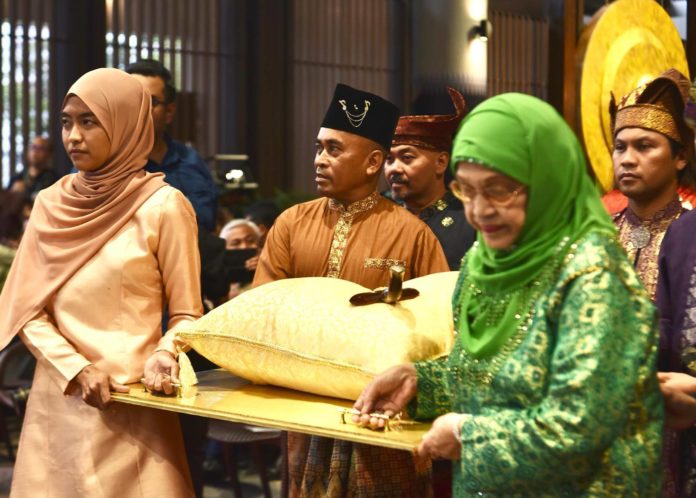
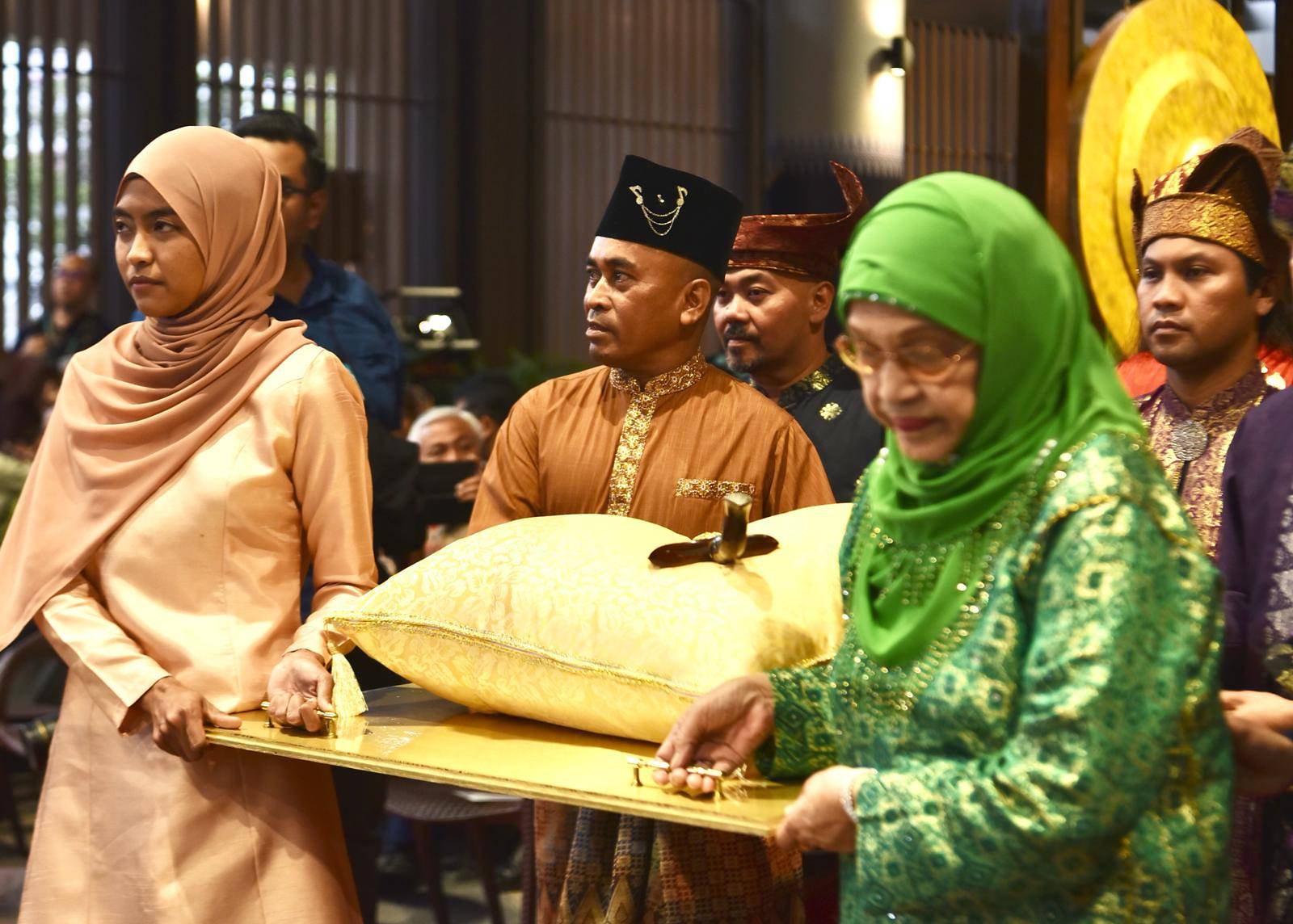
Prime Minister Lee Hsien Loong was a key witness at Saturday’s (Jan 26) Keris Mandat ceremony, a sacred ceremonial decree that symbolises the handling over of the official seal of power. (Photo: Alif Amsyar)
It was launched at Wisma Geylang Serai’s official opening by Prime Minister Lee Hsien Loong, who first mooted the idea of transforming the area in 2011.
GEYLANG SERAI NO LONGER AN ENCLAVE
Speaking at the opening of the heritage hub, Mr Lee said Geylang Serai was no longer an enclave, but had become a well-integrated community that reflects Singapore’s multi-racial and multi-religious society.
Prime Minister Lee Hsien Loong, Minister-in-charge of Muslim Affairs Masagos Zulkifli, Minister for Trade and Industry Chan Chun Sing and other prominent figures at the Kurnia@WGS on Jan 26, 2019. (Photo: Alif Amsyar)
He said that although other races had moved in, it retained its cultural uniqueness and identity.
“Wisma Geylang Serai was conceived in this spirit not just to be a symbol of heritage and nostalgia for the Malay community, but to be a vibrant centre which reflects the diverse interests and continuing progress of Singapore’s Malays,” said Mr Lee. “At the same time, (it is) a venue where all races and religions are welcome, and are interested to visit.”
Malay dancers performing at one of the function rooms at Wisma Geylang Serai. (Photo: Alif Amsyar)
Mr Lee added that with the hub completed, Senior Minister of State for Defence and Foreign Affairs Maliki Osman will engage with the community to develop Geylang Serai further.
Mr Maliki said a key factor behind the concept of the hub was to ensure relevance and sustainability while adapting to the needs of the community.
“Our goal is to develop and deliver traditional and signature programmes that will bridge and bond the Malay-Muslim community and the larger non-Malay-Muslim community,” said Mr Maliki.
Some of those programmes will come in the form of new facilities such as the PPIS Family Service Centre (East), NTUC First Campus’ My First Skool and the Geylang Serai Heritage Gallery.
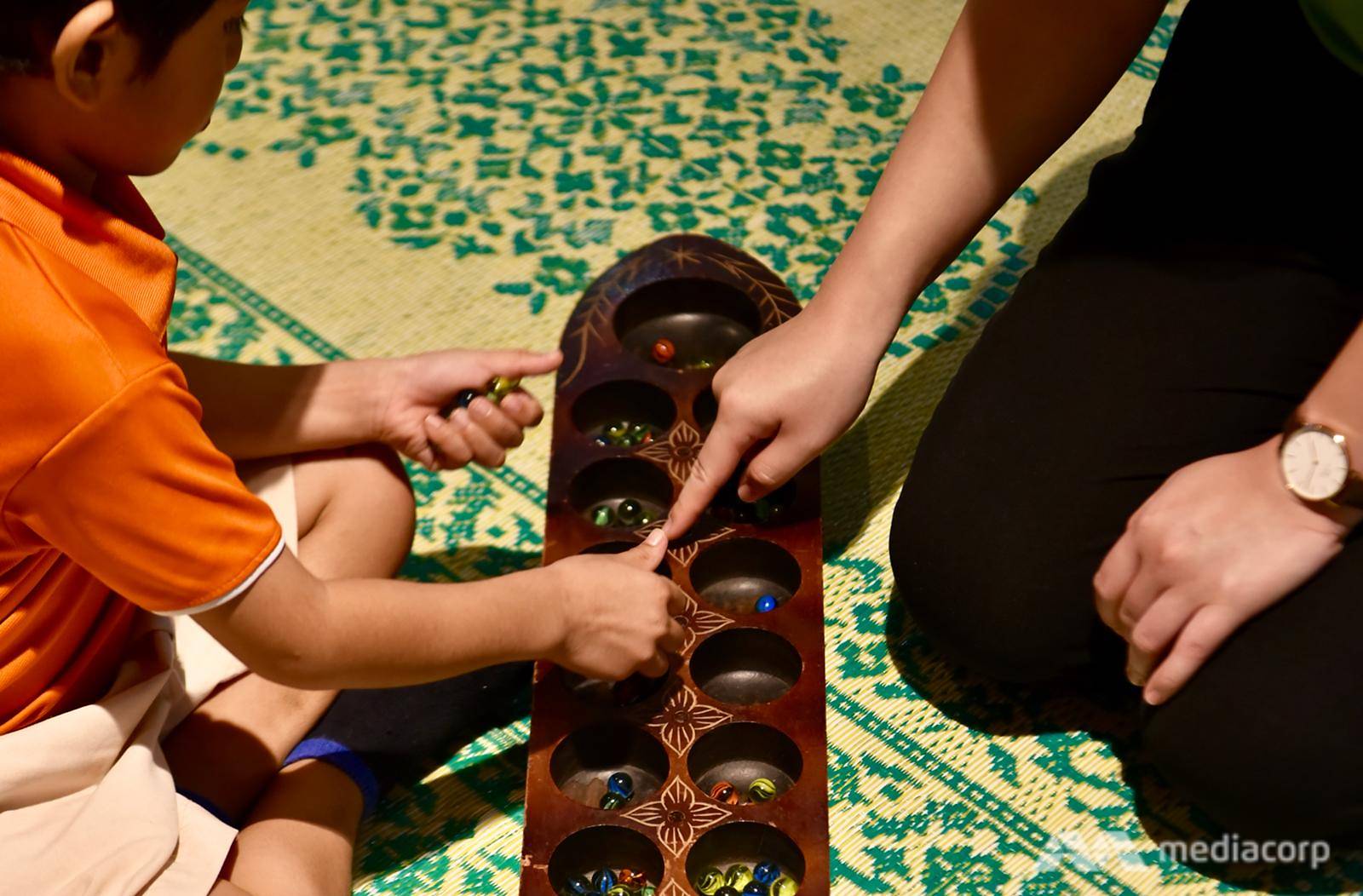
A student from the NTUC First Campus’ My First Skool at Wisma Geylang Serai playing the traditional malay game of congkak. (Photo: Alif Amsyar)
M3 ALLIANCE
On Friday, Minister-in-charge of Muslim Affairs Masagos Zulkifli launched another joint office called M3@WGS, also located at Wisma Geylang Serai.
It houses three key Malay-Muslim organisations: Islamic Religious Council of Singapore (MUIS), self-help group Mendaki and the Malay Activity Executive Committees Council.
The centre will operate seven days a week, allowing the public to engage Mendaki and MUIS on its services beyond office hours.
Geylang Serai Community Club and the South East Community Development Council have also relocated to Wisma Geylang Serai.
THREE-DAY CELEBRATIONS
A three-day festival celebrating the opening of the hub is ongoing and is made up of five different zones, featuring a variety of arts, culture and lifestyle programmes and events.
Called “Geylang Serai: Past, Present, Future”, the festival aims to feature past and upcoming Singapore Malay band groups, since Wisma Geylang Serai was a seeding ground for budding talent in the past.
Screening of old Malay classic films, cultural exhibits and family carnival games will be available to members of the public.
SINGAPORE: How prepared will you be when a terror attack strikes?
The Ministry of Home Affairs (MHA) is beefing up efforts to prepare the community amid ongoing terror threats, which it calls “the new normal”.
The plans, which were announced at the inaugural SGSecure Community Conference on Saturday (Jan 26), include more outreach in areas like suburban malls and private estates as part of SGSecure, a movement that strengthens the community’s response during an attack.
“It only takes one prepared Singaporean to administer CPR to save another’s life,” said Ms Sun Xueling, Senior Parliamentary Secretary for Home Affairs and National Development.
“When it comes to the crunch, are you that one Singaporean? So to the man on the street, the everyday Singaporean, what is SGSecure to him?”
Law and Home Affairs Minister K Shanmugam with Ms Sun Xueling, Senior Parliamentary Secretary for Home Affairs and National Development, speaking with SGSecure representatives on Jan 26, 2019. (Photo: Ahmad Khan)
A recent survey of about 2,000 Singaporeans showed that while about half were trained or were familiar with a so-called emergency preparedness skill such as first aid, less than one in three were taking part in activities aimed to preparing the community.
It was one of the reasons why the authorities wanted to get the word out more, by bringing larger scale roadshows to heartland malls and to residents in private estates.
The aim is to reach 100 condominiums over two years, as terror threats continue to mount.
Home Affairs and Law Minister K Shanmugam said: “They (terror threats) are the new normal. That is part of our life. It is not going to go away. So our preparedness and response, I think, have to be in-built and part of the new normal. This means getting people committed, not just to be aware, but committed to take action themselves.”
Supt Mohd Azman Mohd Sidek, a Police NSman and vice principal of Meridian Secondary School. (Photo: Ahmad Khan)
Some people are already heeding that call. A new Responders Network has been set up, and it comprises volunteers who are mobilised during times of crisis.
Supt (NS) Mohd Azman bin Mohd Sidek, a Police NSmen and also the Vice-Principal of Meridian Secondary School, devotes his weekends to train Singaporeans on SGSecure-related skills since 2016.
“This network is important because when you look at any crowded place, you’d wonder how many people at the crowded place are equipped with many skills that can be very useful to be called upon should there be a crisis of some kind,” he said.
Volunteers from the SGSecure Responders Network. (Photo: Ahmad Khan)
“You stand ready to commit yourself when you are activated, to do your part to whichever situation the crisis requires you to be activated for.”
Singaporeans who use the myResponder app, which alerts them to help put out small fires nearby or to those who need emergency medical assistance, will now be able to access it through the SGSecure app.
To ensure that efforts are coordinated across the community, authorities are piloting what is called a “Community Response Roundtable”, a regular platform to help religious groups, schools and businesses collaborate and share best practices in terror emergencies.
About 600 people attended the SGSecure Community Conference.