SINGAPORE: Former City Harvest Church leader Chew Eng Han was given an additional jail term of 13 months on Tuesday (Jan 28) for trying to flee Singapore and attempting to defeat justice.
Chew, 58, is currently serving his sentence for his role in the misappropriation of S$50 million of church funds and is almost a year into his sentence.
A crew commander on the Police Coast Guard vessel that intercepted Chew’s boat following a tip-off told the court during the trial that Chew looked straight ahead without acknowledging him when the commander shouted at Chew and the boatman.
Chew claimed trial to his new charges and was found guilty in December by District Judge Victor Yeo, who said he was not persuaded by the defence’s arguments that Chew was apprehended “too early” and had not yet embarked on a crime proper.
Chew could have been jailed for up to six months and fined up to S$2,000 for trying to leave Singapore illegally.
For attempting to defeat justice, he could have been jailed up to seven years and fined.
Three men who helped him in his attempt to escape Singapore by boat – including the boatman and two Malaysians with roles in the plot – were sentenced to jail last year.
SINGAPORE: A new method of using both waste water and food waste to generate biogas will be implemented at Tuas Nexus plant when it opens in 2025.
This follows a two-year trial of the method which has yielded successful results, said PUB and the National Environment Agency (NEA) on Tuesday (Jan 29).
Currently, all water reclamation plants in Singapore use water sludge – solids from household waste water – to generate biogas, which is then used as part of the electricity mix to power the plant.
By adding food waste to the treatment process, it can triple the biogas yield, said PUB and NEA in a joint media release.
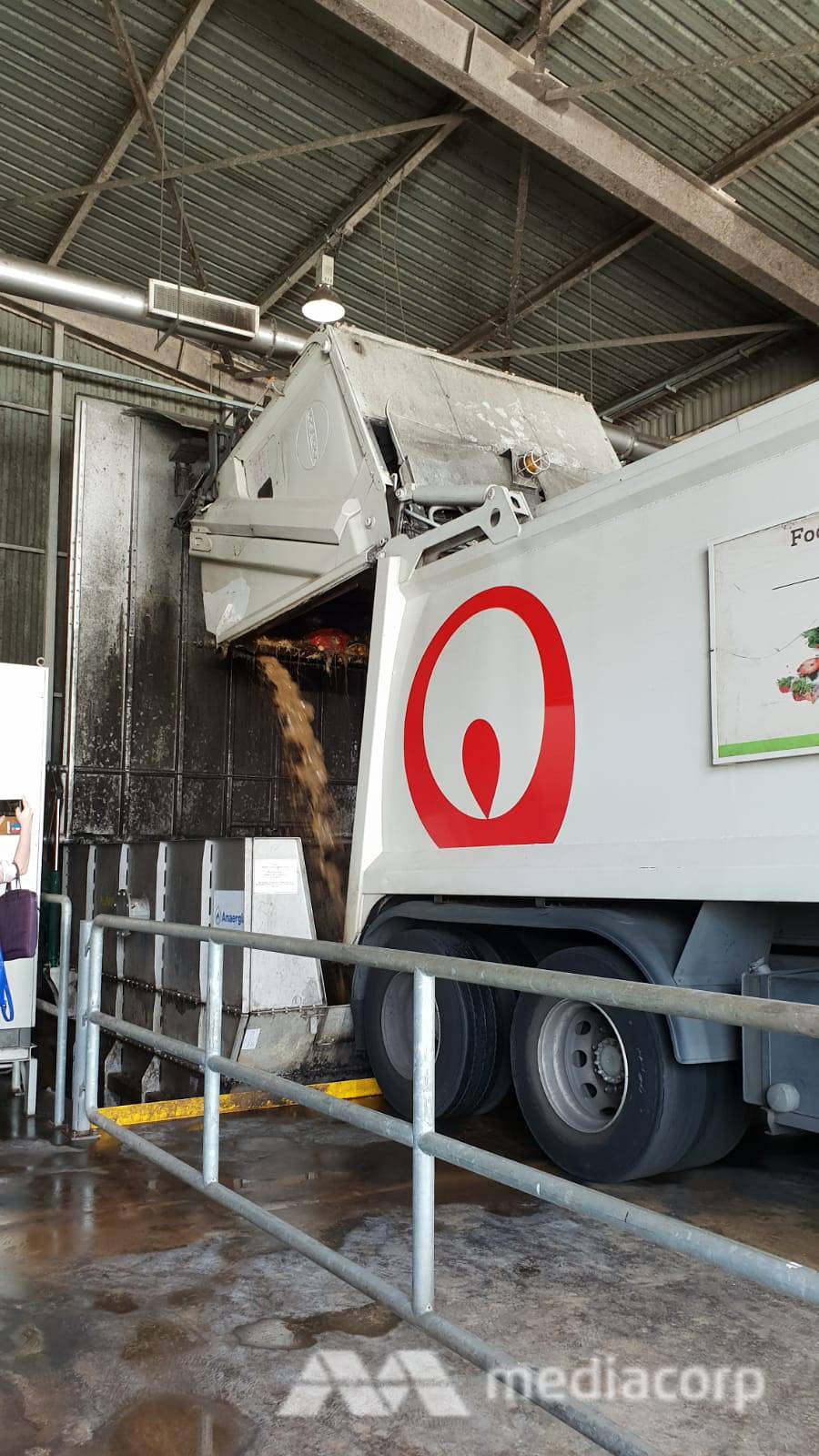
A bunker where food waste is dumped. It then undergoes an extrusion process to extract the liquid waste from the solid, which are not used and are incinerated instead. (Photo: Gwyneth Teo)
As part of the trial, which was done at Ulu Pandan Water Reclamation Plant, up to 40 tonnes of used water sludge and food waste from 23 premises were treated daily at the facility.
The trial generally found that mixing sludge and food waste increased the efficiency of biogas production by 300 per cent compared to processing sludge alone, and by 40 per cent compared to processing both sources separately.
At the Ulu Pandan facility, biogas from sludge currently supplies 25 per cent of the plant’s electricity needs. Mixing food waste and sludge can increase this to 40 per cent, after taking into consideration efficiency losses from converting biogas to electricity.
Waste truck dumping food waste at the start of the extrusion process. (Photo: Gwyneth Teo)
This technology will lead to operational efficiencies at Tuas Nexus, said the agencies.
“We can streamline a lot of processes, including reduction of some of these processes, helping us achieve net energy reduction,” said Dr Kelvin Koh, general manager of Ulu Pandan Water Reclamation.
The food waste used in the trial was collected daily from 23 premises, including army camps, schools, markets and hawker centres, as well as F&B outlets.
Participating organisations were required to segregate food waste from other types of general waste on-site, and place it into dedicated food waste bins.
SINGAPORE: Singapore Post (SingPost) is investigating images circulating online of unopened letters, including some from government agencies, that an Ang Mo Kio resident said she found in a rubbish bin.
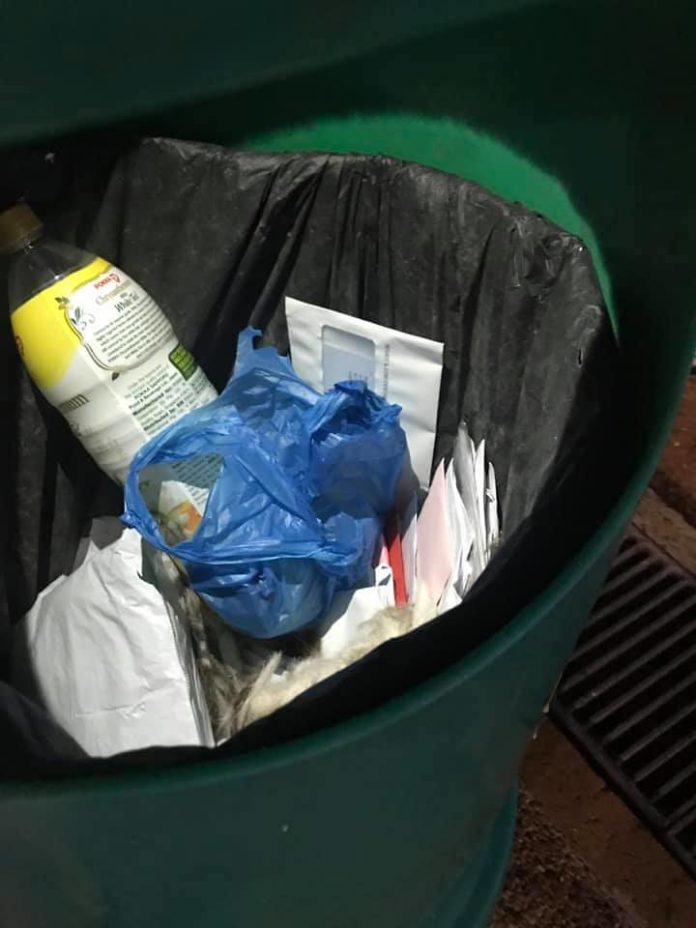
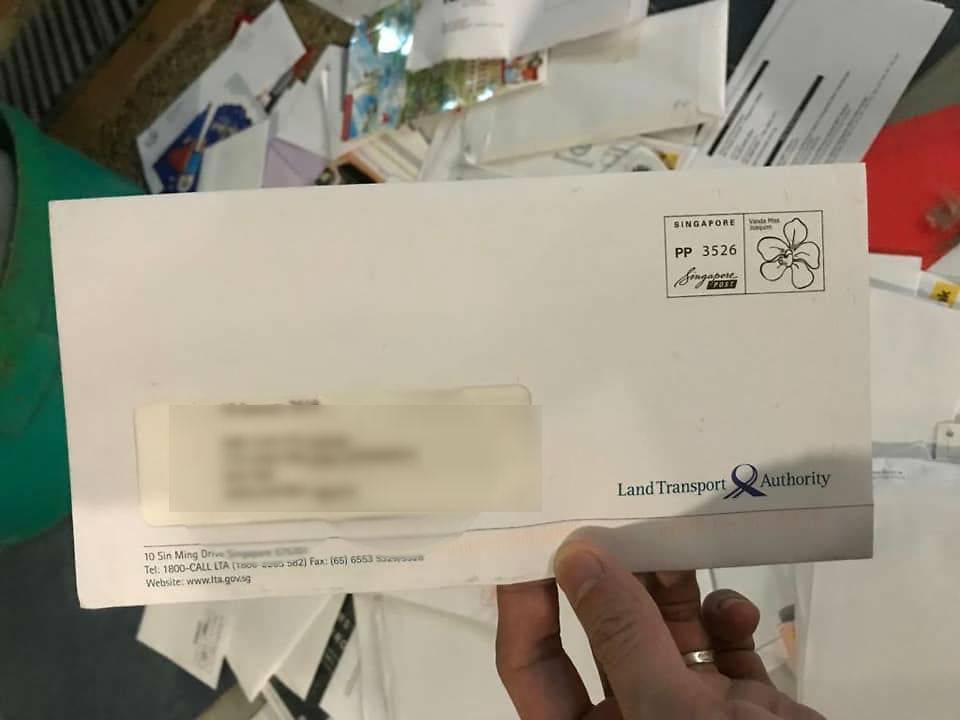
The resident, who only wanted to be known as Mrs Loh, told Channel NewsAsia that she discovered around 30 to 40 unopened letters – some sent by the Land Transport Authority and the Community Health Assist Scheme – in a bin at Block 179 Ang Mo Kio Avenue 5 on Monday night (Jan 28).
She uploaded photos of the letters she found on Facebook the same night. Her post has since been shared more than 6,000 times.
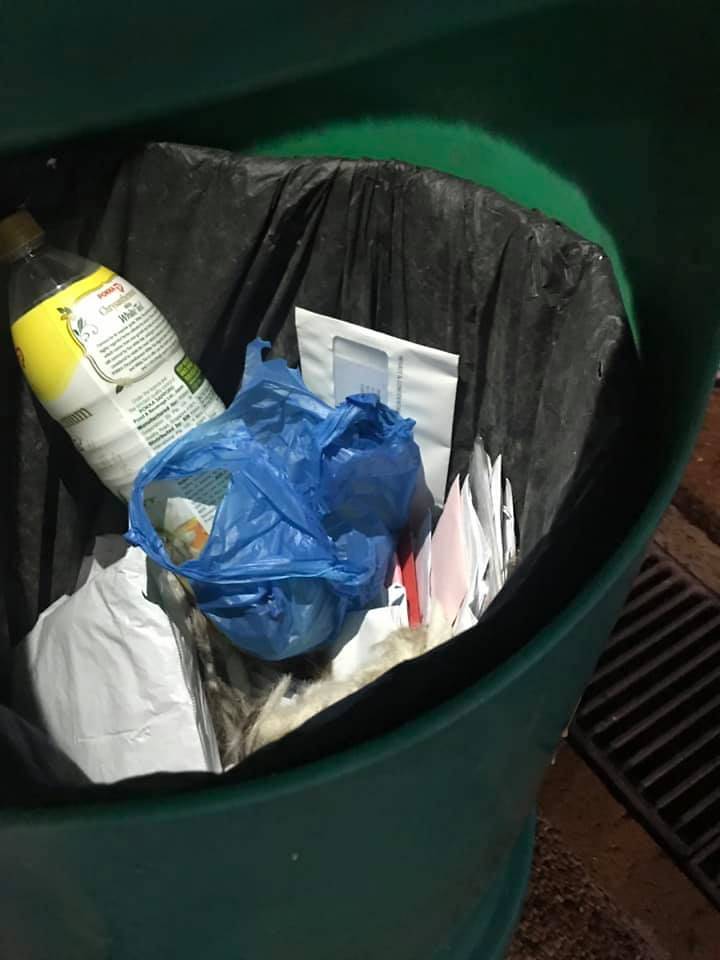
The resident says she found around 30 to 40 letters inside the rubbish bin. (Photo: Facebook/Alyce Kathlyn)
In response to queries from Channel NewsAsia, the national postal agency said it dispatched a team on Monday night to search for the letters.
“SingPost is aware that images of letters allegedly discarded in a bin are circulating online. Based on the addresses on the letters, a team was immediately dispatched to comb the area overnight,” it said in a statement that was also posted on its Facebook page.
The team located the rubbish bin and proceeded to “search every bin within the vicinity”, but did not find the letters, it said.
“Letter boxes were also opened to check if these letters had been delivered to affected recipients,” SingPost added.
Mrs Loh, who is known as Alyce Kathlyn on Facebook, said she removed the letters – which were mostly unopened – from the rubbish bin and placed them at the “nearest letterbox, hoping neighbours could find their lost mail”.
She found the letters in the bin while searching for her “missing parcel”, Mrs Loh added.
Some of the letters that the resident says she found in the rubbish bin. (Photo: Facebook/Alyce Kathlyn)
SingPost said that it was conducting interviews with the postman on duty and is trying to locate the letters so it could have them delivered to the intended recipients.
“Please bear with us as we continue to investigate this and will provide an update as soon as possible,” it added.
SingPost also reached out to Mrs Loh via the comment section of her post and apologised for the “unpleasant experience”. It also assured her that it would “get to the bottom of this”.
Mrs Loh said she has seen letters “dumped twice within six months” at the same block.
Her neighbour, who also lives at Block 179, told Channel NewsAsia that he reported to SingPost last year about mail going missing. The civil servant, who asked to remain anonymous, said he has lived at the same block for nearly 30 years and only experienced issues with mail in the last year.
In February 2018, a SingPost postman was fired after he was found to have thrown away returned letters and direct mail at a condominium.
After a member of the public confronted the postman, he admitted to throwing the mail away and complained that he was tired and had been treated unfairly.
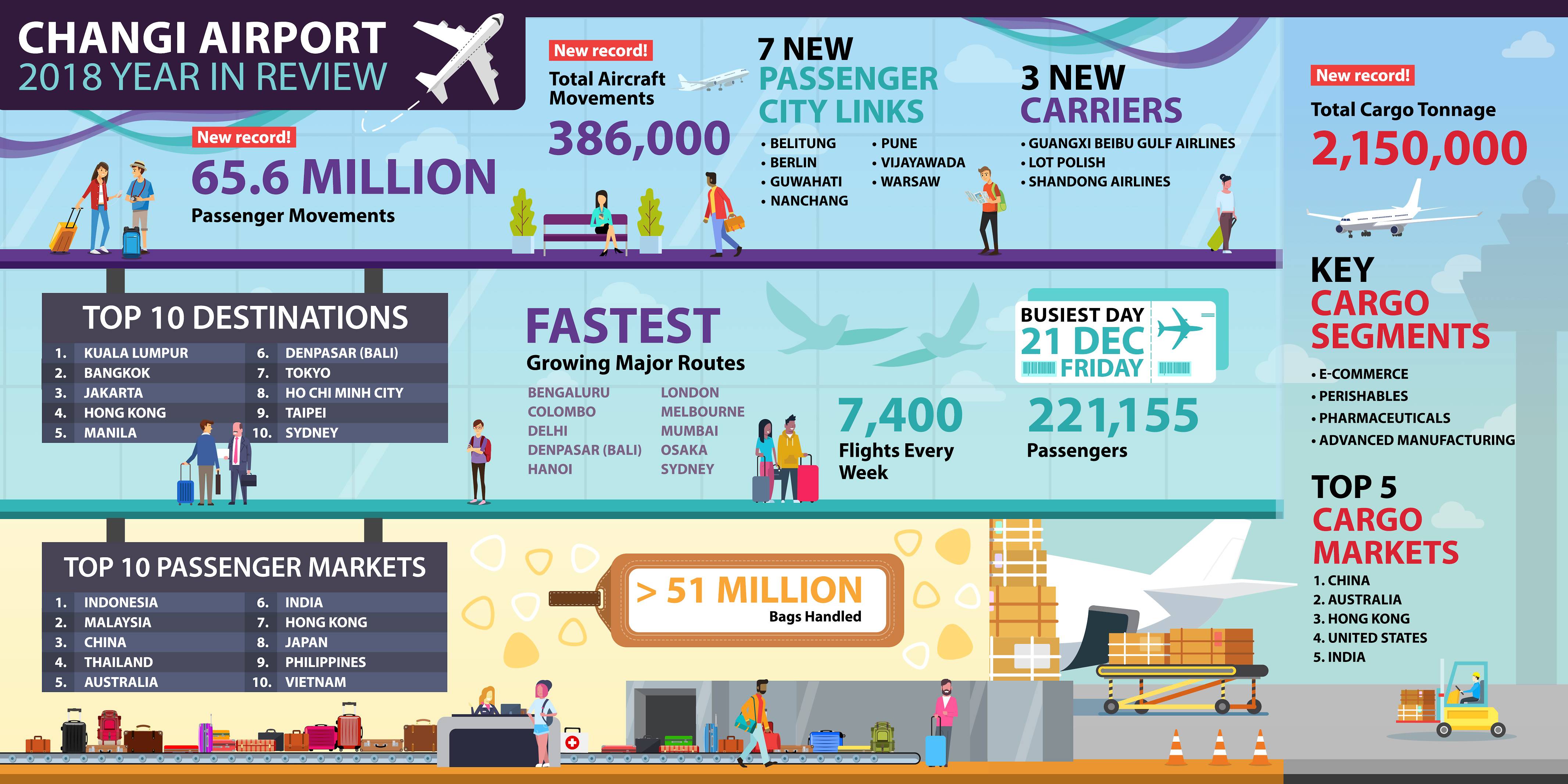
SINGAPORE: Changi Airport saw a record 65.6 million passenger movements in 2018, Changi Airport Group (CAG) said in a news release on Tuesday (Jan 29).
This figure beats 2017’s record of 60 million passengers with a 5.5 per cent increase.
Of the total passenger movements, 6.13 million passengers travelled through Changi Airport in December alone, making it the first month the airport saw passenger numbers exceed 6 million.
The Friday before Christmas, Dec 21, proved to be the busiest day of the year with a record 221,155 passengers movements.
NEW AIRLINES, NEW DESTINATIONS, WORLD’S LONGEST FLIGHT
According to CAG, the airport’s top 10 routes – with Kuala Lumpur, Bangkok and Jakarta being the top three destinations – remained largely unchanged. Hong Kong (4th) and Manila (5th) rounded up Changi Airport’s top five routes.
Bangkok and Bali each moved up one spot to second and sixth position respectively.
CAG also revealed that six of Changi’s top 20 routes grew by at least 5 per cent – Bali, London, Manila, Melbourne, Mumbai and Sydney.
During the course of the year, Changi Airport welcomed three passenger airlines – Guangxi Beibu Gulf Airlines, LOT Polish and Shandong Airlines, and Singapore Airlines launched the world’s longest flight to New York.
Qantas also reinstated its Singapore-London route in 2018, while Lufthansa resumed operations to Munich. Connectivity to Europe further strengthened with non-stop links to Berlin and Warsaw.
Changi Airport is now directly connected to 19 cities in Europe, which is a 10-year high, according to CAG.
Highlights of Changi Airport’s air traffic performance in 2018. (Graphic: CAG)
Traffic between Singapore and India, Changi’s sixth largest market, rose to 4.76 million in 2018, said CAG. Singapore is now linked to Northeast India via Guwahati, operated by Drukair Royal Bhutan Airlines.
CAG also embarked on a new initiative to work with travel agents to offer flight charter services to new destinations in China, such as to Guiyang and Zunyi.
Charter services to other Chinese cities such as Yancheng, Yichang and Zhangjiajie are also being explored, it added. China is Changi’s third biggest market, with 15 airlines operating more than 370 weekly services to 36 city links.
Overall in 2018, the airport saw a total of 386,000 landings and takeoffs, 3.4 per cent higher than the year before. Airfreight throughput increased by 1.4 per cent to reach 2.15 million tonnes for 2018 as well, said CAG.
“2018 was another strong year for Changi Airport,” said CAG’s managing director for air hub development, Mr Lim Ching Kiat.
“We are pleased with the introduction of new city links, as well as the growth of long haul routes from Changi Airport, including the launch of the world’s longest service between Singapore and New York.”
He added: “Our newest terminal T4 completed its first year of operations, and served 8.3 million passengers in 2018.
“Later this year, Jewel Changi Airport will open its doors to the world.”
Jewel Changi Airport is a 10-storey retail and lifestyle complex that is set to open in the first half of 2019. Its tenant mix will include Nike, Pokemon, Shake Shack and Shaw Theatres among others.
“Jewel will augment Changi Airport’s status as an air hub. Terminal 1’s expansion will also be completed, increasing the airport’s handling the capacity to 85 million passengers per annum,” said Mr Lim.
However, he noted that 2019 may pose challenges like rising fuel prices and trade tensions for the industry, but added that demand for air travel in the Asia Pacific region is expected to “grow steadily”.
Retail shops at Jewel ranging from renowned international names to home-grown brands. (Photo: Jewel Changi Airport Devt)
Dining at Canopy Park. (Photo: Jewel Changi Airport Devt)
SINGAPORE: Singaporean composer Julian Wong wasted no time in agreeing to take part in the bicentennial edition of the annual Light to Night Festival which was officially launched on Monday (Jan 28). Themed Traces and Echoes, this year’s edition is meant to rediscover Singapore’s collective memories.
He hopes to jog everyone’s collective memory of the man who composed Singapore’s national anthem, Mr Zubir Said.
Mr Wong is taking part in an artwork which depicts the life and work of Mr Zubir, projected in lights on the wall of National Gallery Singapore’s Padang Atrium. It is titled Sayang di Sayang: The Lesser Known Works of Zubir Said.
He feels a strong connection towards Mr Zubir, because of his teacher, prominent musician Iskandar Ismail. Mr Zubir had taught Mr Iskandar to play the piano and was his first music teacher
“I really hope that it demystifies this legend. Everyone just knows him as the composer of Majulah Singapura and even in his lifetime, he will tell children to stop calling him Mr Mari Kita. I hope the viewers will realise that he is incredibly human and was really a truly gifted composer,” Mr Wong said.
Two projection artists, Brandon Tay and Safuan Johari designed the light projection according to Mr Wong’s arrangement of Mr Zubir’s music.
Accompanying it is a three-song medley – Sayang di Sayang to reflect Mr Zubir’s earlier works in the Bangsawan style and captures his early days, Majulah Singapura for his patriotic works and Suhanna, a song written for his granddaughter.
Mr Wong will also perform a 35-minute concert on Feb 1 and 2 that will feature ten of Mr Zubir’s works from classics such as Selamat Berjumpa Lagi, Orang Singapura and Semoga Bahagia.
TAKING A CLOSER LOOK AT ZUBIR’S LIFE
Mr Wong chanced upon Suhanna when he was reading a biography on the composer published by his daughter Dr Rohana Zubir in 2012. In the book, Dr Rohana had published the score for Suhanna, which had never been seen in public before.
“So I magnified it and played it. It was such a beautiful song and I don’t know if it’s ever been performed in public before. The melody and the lyrics are really beautiful and touching,” Mr Wong said.
“Dr Rohana wrote that he’s always felt especially close to his granddaughter and I think it’s because when she was born, he was also in the hospital. The song ends with, I translate, ‘If I live long enough, I hope we meet again’. Coming from a grandparent, it takes on a different meaning,” he added.
The song also reminds him of his music teacher, Mr Iskandar, who died in 2014.
Mr Zubir’s daughter Dr Rohana Zubir, who is in her 80s, was also present at the first public showing of the light projection told Channel NewsAsia that she felt “emotional” and “tearful” listening to her father’s music again and thinking of him.
“I can’t express it. I’m enthralled. It’s just an amazing feeling that someone is taking so much effort for us to publicly enjoy (Suhanna) like that,” Dr Rohana said.
“I would like her to know of this memorable evening when I get the chance,” she added.
THE STORY BEHIND SEMOGA BAHAGIA
Another favourite of Mr Wong’s, which will also be performed at the concert, is Semoga Bahagia.
He said Semoga Bahagia has a special meaning for him and Mr Iskandar, his music teacher. It was the song Mr Zubir pointed to when Mr Iskandar was deciding if he should pursue his music studies in Boston in 1979 or stay put in Singapore. He made the decision to go to Boston.
“Zubir Said encouraged him in the spirit of Semoga Bahagia,” said Mr Wong. The first line of the song says “we move forward in search of knowledge”.
“Because Zubir Said had left his home (in Indonesia) in 1928 to pursue that dream also. In 2009 when it was my turn, Iskandar encouraged me the same way and he told me this story,” Mr Wong said.
National anthem composer Zubir Said’s daughter Dr Rohana Zubir interacting with local composer Julian Wong and his students at the opening of Singapore Bicentennial. Lesser known works of her father are featured as part of a light projection artwork at the National Gallery. (Photo: Jeremy Long)
To follow in the footsteps of his predecessors, Mr Wong will include four of his students in the performance.
“I thought that was very important because that is always Zubir Said’s spirit. Knowledge is not meant to be taken to the grave so that those I teach today will teach others later on,” he said.
“It’s really a joy to do this, and I think my teacher would have been very happy,” Mr Wong added.
SINGAPORE: Facebook is uncool, my students say. Parents and other relatives are there. So are teachers like me.
Students have Facebook accounts. They use them mostly to post photos of milestones they don’t mind their relatives seeing, like convocation.
Instagram is where they spend their time.
Surely this can’t last. Facebook was cool with students from about 2007 until 2015. Instagram should become uncool any day now. After all, some teachers like me are getting the hang of it.
What will be the next social network? There are no obvious contenders. Back to Facebook?
Facebook owns Instagram, so the two have little incentive to innovate as long as users who tire of one simply go to the other.
Many of my colleagues who teach communication agree that Facebook is uncool, or more precisely, unethical. Its freewheeling sharing of customer data—and slow response to fake news on its platforms—are their reasons.
We’re all stuck, choosing between Facebook’s giant networks.
Social networks could benefit from more competition. Antitrust law —called competition law in many jurisdictions, including Singapore — has potential answers. This is the type of law that the Singapore authorities used in 2018 to fine Grab and Uber for their merger.
The most drastic solution? Antitrust regulators could force Facebook to sell Instagram, and maybe WhatsApp too. It’s worth considering.
Under United States law, the Clayton Act of 1914 enables the government to prohibit or undo mergers and acquisitions of competing firms.
If Facebook and a completely independent Instagram were competing for our attention, the theory is that they would innovate faster to avoid losing users.
Networks might roll out more features. Users of the Chinese social media giants rave about features, including the integration of e-commerce and digital payments, that Facebook’s networks lack.
Maybe Facebook and Instagram would even compete on dimensions like how much they protect our privacy.
Antitrust experts are increasingly advocating a Facebook breakup. Notable is Professor Tim Wu of Columbia Law School, who in 2018 published the book The Curse of Bigness. The Freedom from Facebook campaign also urges antitrust action.
People stand in front of a logo at Facebook’s headquarters in London, Britain, December 4, 2017. (Photo: REUTERS/Toby Melville)
Over a century ago, America lawmakers passed antitrust laws to thwart monopolies that reduced consumers’ choices. Standard Oil controlled 90 per cent of the oil business, and slashed prices to put competitors out of business. Regulators broke it into dozens of independent, competing companies.
In November, President Trump said his administration is looking into antitrust action against Facebook and other tech giants.
Facebook will be well armed for the battle. In November, it hired away a senior US Justice Department antitrust lawyer for its own legal department.
Just days ago, the New York Times reported Facebook’s plans to integrate its messenger platforms — WhatsApp, Instagram’s messaging, and Facebook Messenger — by integrating their infrastructure. The move would further reduce distinct options for consumers, and make splitting up the company more difficult, but not impossible.
Regulators from the United Kingdom and the European Union are also exploring options. In December, the UK Parliament released emails of Facebook executives, obtained for its investigations, that show possibly anticompetitive conduct.
In a 2013 email, Mark Zuckerberg personally decided not to enable users of Twitter’s video-sharing app, Vine, to find their Facebook friends on Vine.
Many nations have law regulating competition in their jurisdictions, though things get complicated when global social networks are involved.
The WhatsApp app logo is seen on a smartphone in this picture illustration, Sep 15, 2017. (Photo: Reuters/Dado Ruvic)
Individual nations may be able to take action against Facebook. But if the goal is a global split of Facebook and Instagram into competing firms, it would probably take the American authorities to force a sale of Instagram.
HOW WE GOT HERE, AND HOW TO DIG OUT
There’s a simpler alternative to breaking up a corporation: Not letting it acquire its competitors in the first place.
United States and European antitrust regulators didn’t flinch when Facebook acquired Instagram in 2012 and WhatsApp in 2014.
In 2012, UK regulators didn’t see Instagram, a camera app, as a direct competitor to Facebook. They said, “Consumers take and upload photos, but do not spend a significant amount of time” in Instagram’s app, so it presents few opportunities for marketing.
American antitrust regulators may have reached similar conclusions, but they don’t publish their reasoning for letting the acquisition proceed.
Facebook no doubt recognised Instagram as a potential competitor, but the regulators lacked foresight. Though Instagram focuses on photos, it is, after all, a social network where many users now spend more time than on Facebook. Advertising is now fully integrated.
(Photo: Unsplash/Katka Pavlickova)
How the American authorities have enforced antitrust law in the last half century presents obstacles to taking aggressive action against social networks.
In recent decades, American regulators and courts have focused antitrust analysis narrowly on whether consumers pay more because of a monopoly, rather than broader questions about consumers’ choices. As a result, antitrust enforcement has waned.
Regulators haven’t broken up a firm since 1982, when they split the AT&T telephone company into regional telephone companies. Twenty years ago, antitrust regulators sought to break up Microsoft, which was bundling its Internet Explorer browser with its operating system, but the case was settled with conditions short of a breakup.
If the question the authorities ask is whether social network users pay more because of Facebook’s acquisition of Instagram, the answer is no, because social networks don’t require users to pay in dollars. We “pay” with the data we disclose, which the networks use to sell advertising targeted to us.
If the question the authorities ask is whether the acquisition has undercut competition — consumer options — the answer is surely yes.
That’s the question regulators should ask. American authorities should revive interpretations of anti-trust law that focus broadly on whether competition is suffering.
A breakup of Facebook is worth considering. It’s too early in the history of social media for winners and losers to have been decided, and for the winners to have the same owner and little incentive to innovate.
Less drastic measures, like fines for reducing competition in a country—such as the fines that Singapore, then the Philippines, imposed for the Grab-Uber merger — help increase the pressure to preserve competition.
A probe found the merger between Uber and Grab had substantially reduced ‘competition in the ride-hailing platform market in Singapore’ (Photo: AFP/ROSLAN RAHMAN)
We can also learn from the past. If Facebook attempts to buy another social network — like Snapchat, which it attempted to acquire in 2013— consumers around the world should howl their disapproval. Regulators should prevent it.
THE CASE FOR MULTIPLE NETWORKS
I don’t believe that deleting one’s Facebook account is the answer for individual users who are dissatisfied with it. What we’ve all built — a network that connects so many of us globally — has value.
Facebook has allowed me to stay in touch with alumni of the school where I teach. It’s good for preserving these low-maintenance relationships with people from different eras of our lives. It was better while everyone was still building their networks and posting regularly.
If large numbers of users quit or go dormant on Facebook — and maybe on Instagram too — and competitors were to proliferate, what would the downside be?
The textbook answer is that a network gains value, to its users, when more people join. It loses value as people leave or become less active.
Bigger is better. A social network impresses us when we meet people from across the street, and across the planet, and can stay in touch with all on the same network.
If users of the big social networks — Facebook’s 2 billion users, and Instagram’s 1 billion — disperse into smaller, disparate networks, Facebook would no longer be fulfilling its stated mission of “connecting the world”. We’d lose something if no big global network took its place.
Even though the textbooks tell us a network’s value increases with more users, my students remind me of another perspective.
There’s value in not spending time on the same network as everyone you know.
We can learn from young people who are happy to maintain accounts on multiple networks. They post occasionally to Facebook and regularly to Instagram. For chat, they occasionally use Facebook’s apps — message services of Facebook and Instagram, and WhatsApp — but chat most with peers on Telegram.
WhatsApp and Facebook messenger icons are seen on an iPhone in Manchester, Britain March 27, 2017. (File photo: REUTERS/Phil Noble)
How willing would you be to join a new social network? It would be a hassle to send out friend invitations again. The law also has a possible antidote. Platforms could be required to let us download our connections and transfer them to other platforms, if our connections consent.
Maybe the rise of a new social network is not such a remote possibility, especially if the network offers innovative features. Many of us might enjoy exploring new social networks, just as we travel in different social circles offline.
To restore competition, I’ll be rooting for the regulators to break up Facebook and Instagram. Meanwhile, if another network starts to gain momentum, sign me up.
And this time, I may even pay attention to the privacy policy.
Mark Cenite teaches media law and is Associate Chair (Academic) at the Wee Kim Wee School of Communication & Information at Nanyang Technological University.
SINGAPORE: As I lowered the VR headset over my eyes, it was as if I had stepped into the common corridor just outside a HDB flat.
The door to the flat was open and waiting for me to step in and have a look around. From the corner of my eye I could see the figure of an elderly woman lying on the floor of the living room. There were people standing around me – a policeman, a relative of the dead woman, and even a curious neighbour – ready to share their accounts of what they had seen with me.
I turned to the policeman, wondering how to initiate a conversation. Behind me, I heard a voice.
“If you want to talk to him, raise your hand and point at him. Then you need to make that pinching motion to interact with him.”
“I’M STEPPING ON THE BODY”
The experience of being in the flat was so immersive it was difficult to bring myself back to reality and listen to the directions of Senior Crime Scene Specialist Wong Jun Yan, my designated trainer.
I was being given a first-hand feel of a new platform developed by the Home Team that uses VR technology to train its crime scene specialists. Located at the Home Team Academy, the platform allows the trainees to apply the skills they learnt in the classroom in a safe and controlled training scenario – in this case, the suicide death of an elderly woman.
Interacting with the virtual people outside the crime scene. (Photo: Home Team)
Jun Yan explained that prior to this, trainees would hone their skills in mock-up crime scenes, which involved a lot of preparation work on the part of the instructors.
“The instructors had to physically create the scene, place a mannequin, and after we finish, they have to wipe everything down and re-create the scene from scratch for the next person to come in,” he said. “There’s limited space and resources, and this limits the kind of scenes they can create as well.”
“VR, however, is limitless.”
He added that the richness of being immersed in the realistic virtual environment – something I also experienced when I first put the headset on – could not be compared to the mock-ups.
But despite the realism of the virtual scene I found myself in, navigating the virtual environment came with some challenges.
For one, while it was easy enough to point and pinch the objects or people I wanted to interact with, stepping into the flat and moving around was a whole different ball game.
A scenario trainees will experience while using the VR platform. (Photo: Home Team)
Rather than walking normally, I was instructed to lean slightly into the harness I was strapped into, shift my centre of gravity forward, before sliding my feet back and forth to move around on the base of the platform. This, I was told, had to be done so the sensors in the base of the platform would be able to sense my movements.
I had put on special foot covers to make it easier to slide back and forth on the platform, but the movements were so counter-intuitive I had to consciously change the posture of my body and remind myself constantly not to take normal steps on the platform. My feet kept slipping off the sensors, which made it difficult to move around the flat.
And before long, a pounding headache began to set in, a sure indication of the motion sickness the trainers had warned me that first-time users tended to get.
As I turned my body, trying to get myself out of the corner of the room I had somehow managed to trap myself in, I looked down and saw the virtual body right below me.
“Uh-oh,” I said. “I think I’m stepping on the body.”
PRACTICE MAKES PERFECT
It may not have been the most successful experience in my books, but Jun Yan assured me that for a first-timer, I had done fine.
“At the beginning, I saw you struggling with the sensors, but I think it was an acclimatisation issue of walking within the system,” he said. “It’s like being in a baby walker, where you have to slide your feet across the centre.”
Channel NewsAsia’s Lianne Chia being guided in the VR technology by senior crime scene specialist Wong Jun Yan. (Photo: Gaya Chandramohan)
The trainees, he added, also need to go through a training session prior to using the platform, where they get used to the movements and controls – something I did not get the chance to experience before being strapped into the harness.
“It took me awhile to get used to sliding across the sensors rather than walking,” he said. “But once you get used to the controls, it’s quite intuitive.”
And as I saw him effortlessly navigate his way around the flat, pointing his finger to interact with objects and completing tasks like dusting for fingerprints and examining the body for ligature marks, I realised that practice really does make perfect.
Jun Yan demonstrating how to select and interact with objects in the VR platform. (Photo: Gaya Chandramohan)
The first VR training session for Home Team investigation officers was held in September 2017. The session, which runs for half a day, is open to all trainees who undergo scene of crime officer training or take a criminal investigation module. However, the system is still being fine-tuned and it will take some time for it to be rolled out to all trainees.
So far, about 240 officers in total have gone through the VR training.
Jun Yan who was among the “pioneer” batch who received the VR training said the “realism” afforded by the VR technology was invaluable and has been put to good use when he attended to a murder case.
“In the murder scene … I had to manoeuvre a body for the pathologist and we were looking to see if there were any defensive wounds on the hands. So (the training) really helped me,” he said.
“It would have been a very big jump to using mannequins to a real body.”
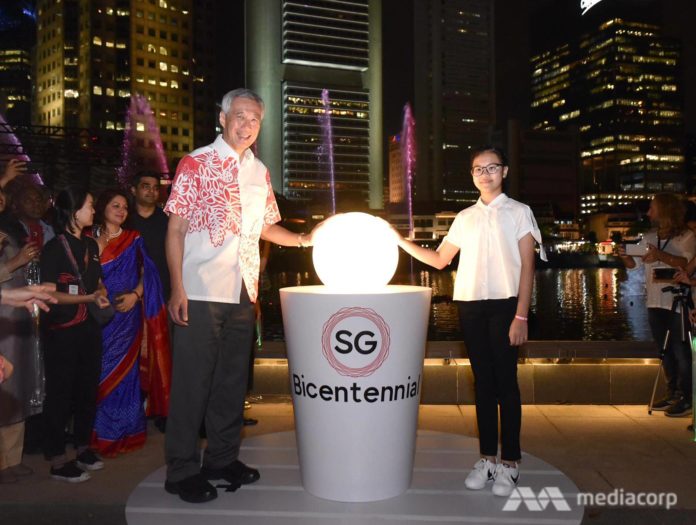
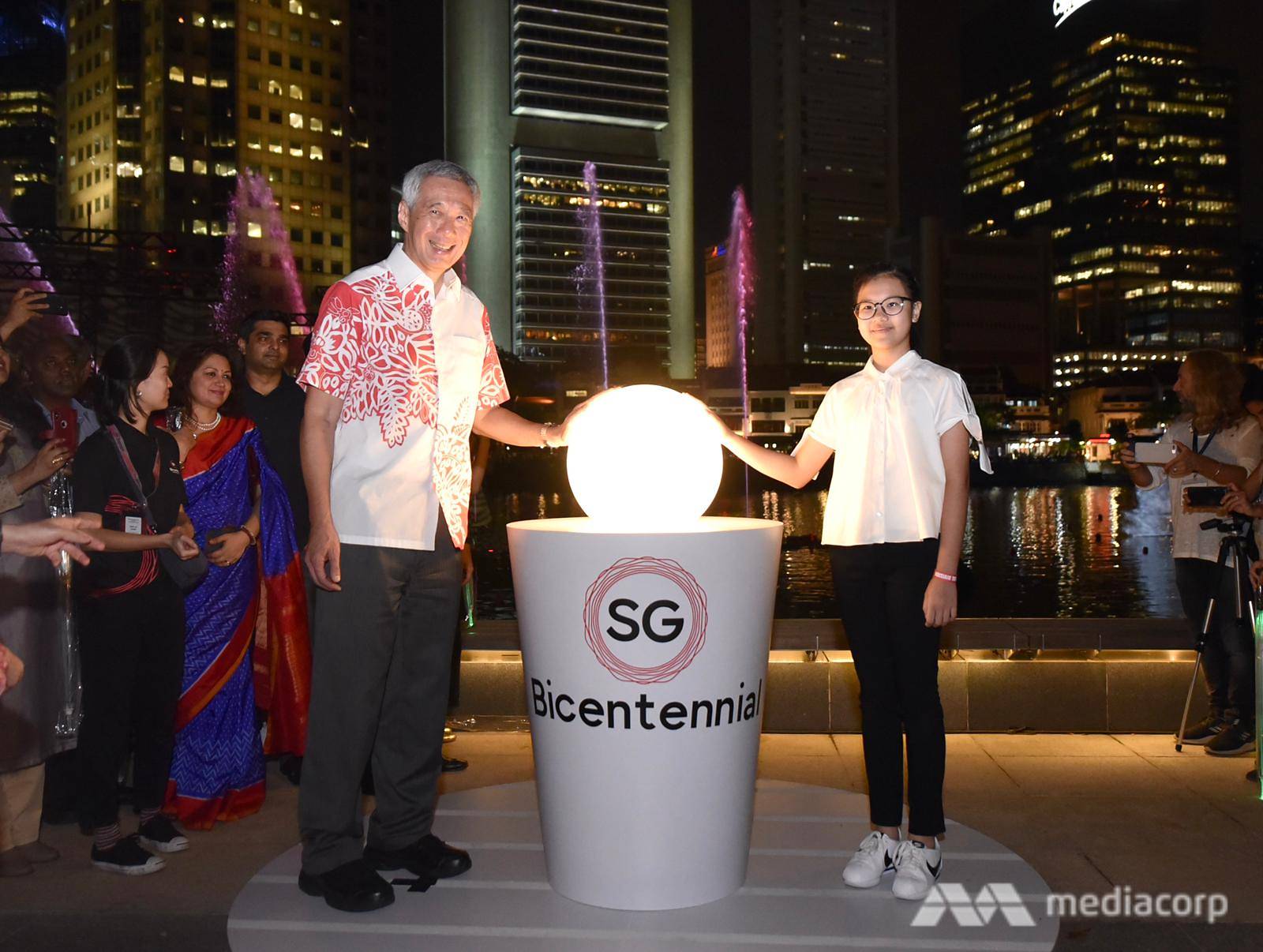
SINGAPORE: As Singapore commemorates 200 years since Sir Stamford Raffles landed on its shores, Singaporeans should also think of how the country can move forward together, Prime Minister Lee Hsien Loong said on Monday (Jan 28).
“For we are never done building Singapore. It is every generation’s duty to keep on building, for our children, and for our future,” Mr Lee said.
“So that in another 50 or 100 years, Singaporeans not yet born will have a richer and greater Singapore Story to tell, and one that we will have helped to write together.”
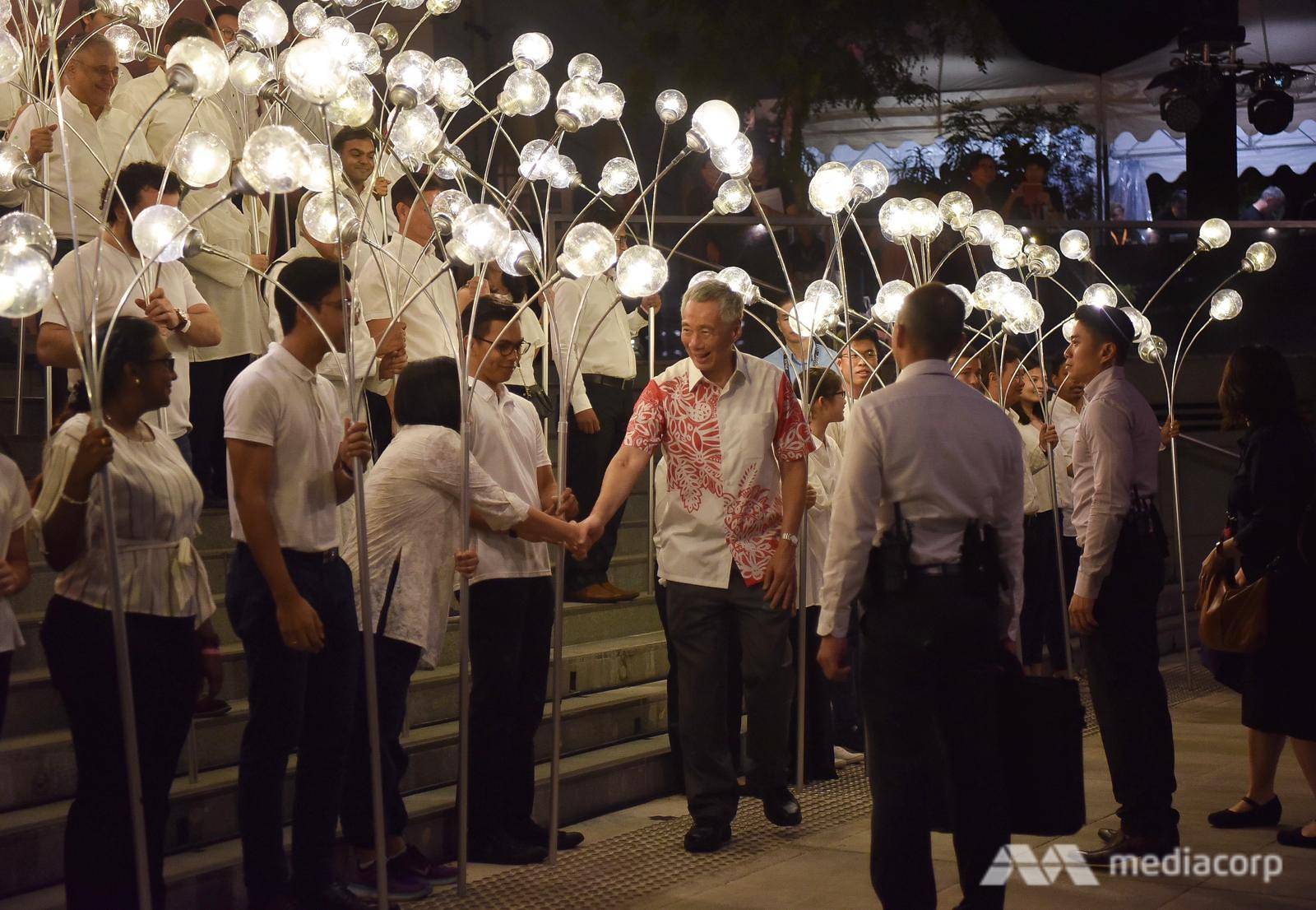
Mr Lee said this at the launch of the Singapore Bicentennial where he will tour the exhibits from i Light Singapore, the Light to Night Festival and test out BALIKSG, an app for an augmented-reality trail that lets users revisit historical events.
Prime Minister Lee Hsien Loong launches the Singapore Bicentennial with the youngest participant 11-year-old Kayla Choy. (Photo: Jeremy Long)
While the bicentennial commemorates 200 years since Raffles came to Singapore, Singapore’s history goes back hundreds of years before his arrival, Mr Lee said.
In the 14th century, the area right at the mouth of the Singapore River was a thriving seaport called Temasek. Around this period, Sang Nila Utama founded Singapura as a kingdom, Mr Lee added.
In the 16th and 17th century, the Europeans came to Southeast Asia and Singapore almost became a Spanish colony, Mr Lee said.
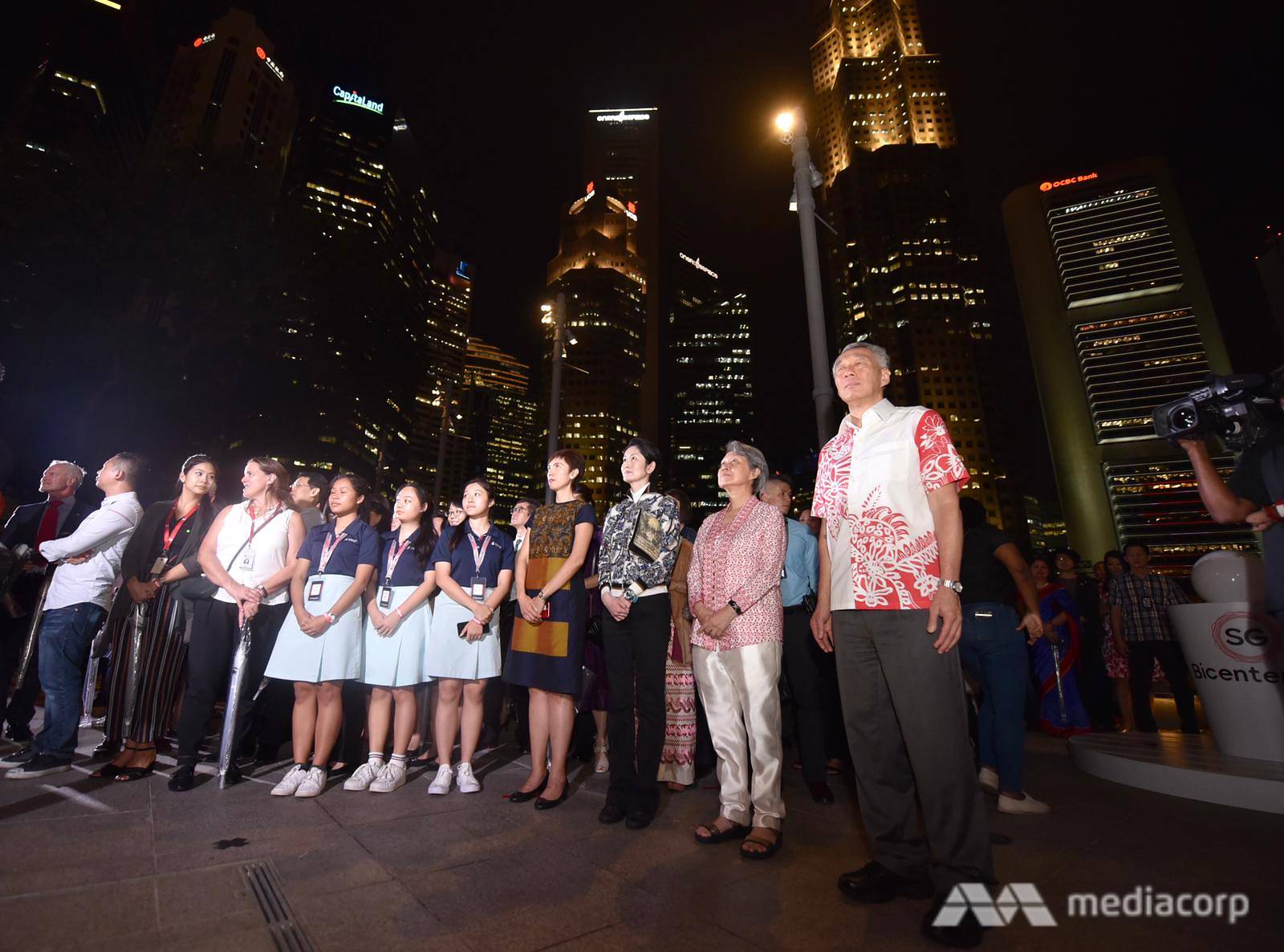
Prime Minister Lee Hsien Loong and his wife Ho Ching attend the launch of the Singapore Bicentennial on Monday (Jan 28). (Photo: Jeremy Long)
“It took another 200 years before Raffles landed at a spot near here, and persuaded the Sultan of Johor to allow the British East India Company to establish a trading post in Singapore,” he said.
This became a “crucial turning point” in Singapore’s history and set Singapore on a trajectory leading to where it is today – a modern, outward-looking and multicultural society, he said.
When Raffles made Singapore a free port, the colony prospered and grew rapidly, attracting immigrants from Southeast Asia, China, India and beyond, Mr Lee said.
“Trade was our life blood. It linked us to the archipelago around us, and to the world beyond.”
Prime Minister Lee Hsien Loong greets participants at the launch of the Singapore Bicentennial. (Photo: Jeremy Long)
Mr Lee added that the impact of important historical events such as the Singapore and Malaysia merger in 1963 and eventual separation in 1965 was also influenced by the British’s arrival in 1819.
“Throughout the colonial period, Singapore was never governed as part of Malaya. … Over the next 150 years, our political values, inter-communal relations, and worldviews had diverged from the society on the other side of the Causeway,” Mr Lee said.
“At the same time, this history since 1819 explains why after separation, Singapore not only survived but thrived,” he added.
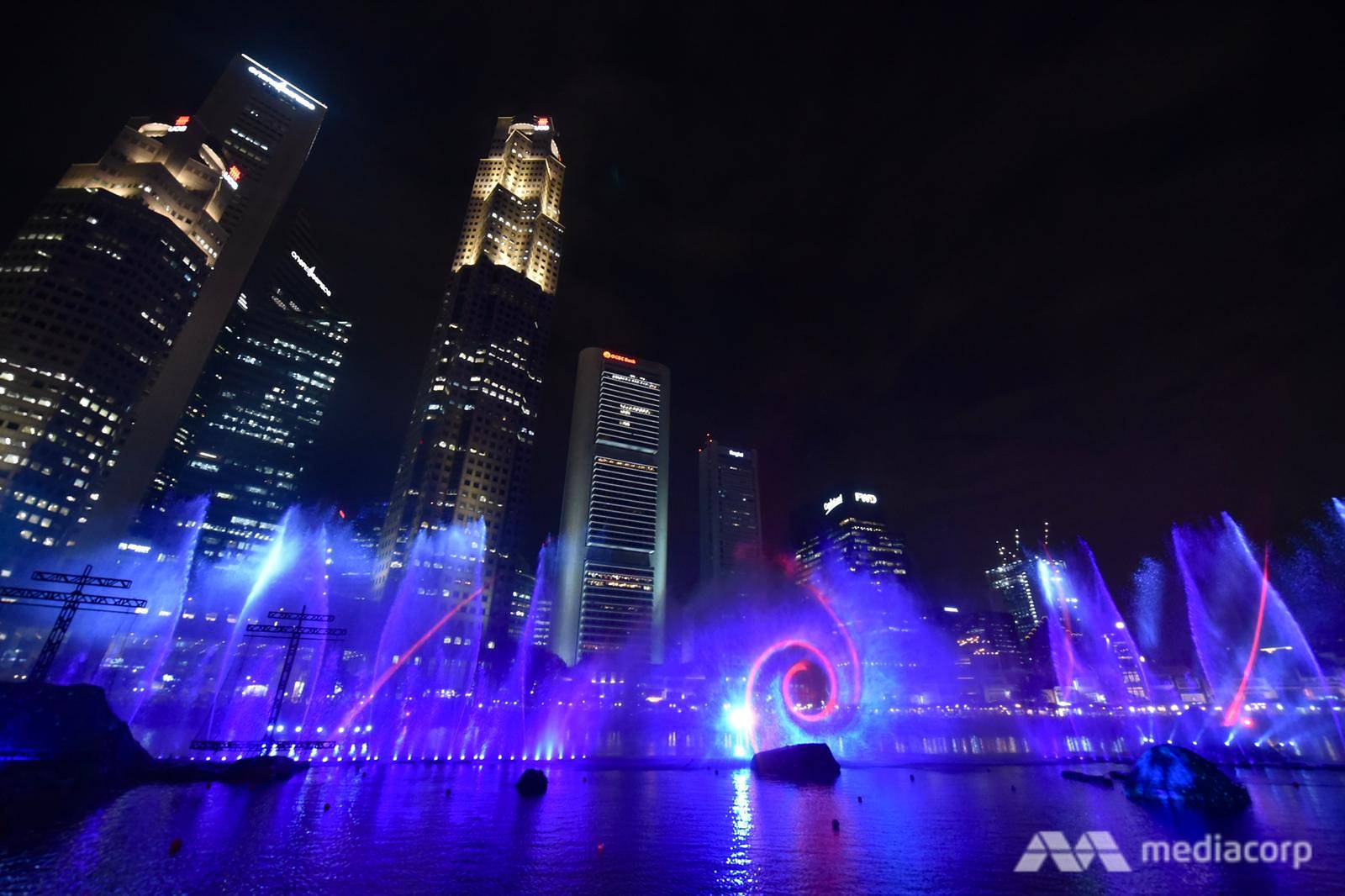
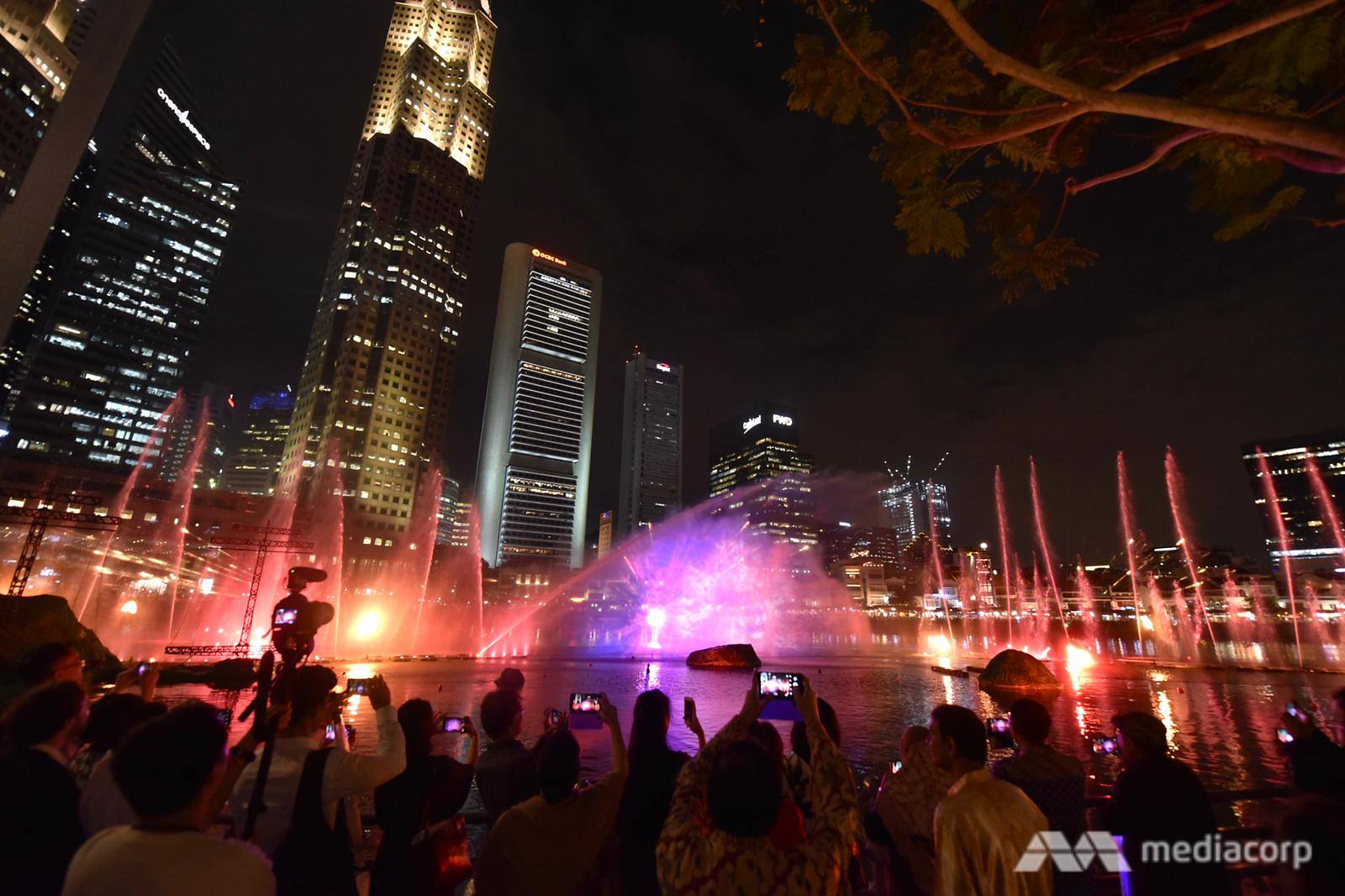
The Bicentennial Edition of i Light Singapore will have five festival hubs. (Photo: Jeremy Long)
Hence, Mr Lee said, the Singapore Bicentennial is “worth commemorating”. It is not just remembering Raffles or Singapore’s first Resident, William Farquhar, but tracing and reflecting upon Singapore’s longer history before 1965, he said.
“Without 1819, we may never have launched on the path to nationhood as we know it today. Without 1819, we would not have 1965, and we would certainly not have celebrated the success of SG50,” Mr Lee said.
There are activities and events planned throughout the year as part of the Bicentennial to explore Singapore’s history before 1965.
View of an i Light display at the launch of the Singapore Bicentennial. (Photo: Jeremy Long)
SINGAPORE: Out of 18 liquor outlets in Little India recently inspected by the authorities, 10 were caught selling alcohol during restricted hours, the police said on Monday (Jan 28).
Three of those outlets were repeat offenders, and some had allowed customers to consume alcohol within their premises during restricted hours.
The enforcement operation took place between Jan 5 and 27, said the police.
Investigations into the errant outlets are ongoing.
The police said advisory stickers were also issued to liquor outlets in Little India to remind owners and members of the public that the sale of liquor is prohibited during restricted hours.
Image of the advisory sticker reminding shop owners and patrons of the restricted hours. (Image: Singapore Police Force)
“Actions will be taken against the operators for flouting the rules and regulations under the Liquor Control Act,” police added.
The Act, which came into force in April 2015, prohibits the sale of liquor at retail outlets and consumption of liquor in public places between 10.30pm and 7am daily.
There are stricter rules for Geylang and Little India, which are designated Liquor Control Zones. Retailers there cannot sell alcohol from 7pm on Saturday to 7am on Monday.
SINGAPORE: Beleaguered water treatment firm Hyflux told Channel NewsAsia that it stays committed to proposing a “fair” restructuring plan next month as its aggrieved mom-and-pop investors grow increasingly worried about how much money they can recover.
Anger and frustration among minority shareholders have been building up since the second round of town hall meetings on Jan 18, where the company provided little meaningful updates except for the mention of possible cash payments and debt-to-equity conversions. Even then, specific figures were not discussed.
This has got retail investors, who are at the bottom of the priority list, losing sleep over the possibility of huge losses – so much so that some have said they would rather see the company liquidated.
It announced a potential lifeline by October when SM Investments – a consortium made up of Indonesian conglomerate Salim Group and energy giant Medco Group – proposed a S$530 million investment in exchange for a 60 per cent stake.
Comprising of a S$400 million equity injection and a S$130 million shareholder’s loan, this new pile of cash will go towards the “full and final” settlement of the company’s debts and working capital needs, said the company in a SGX filing.
However, Hyflux has a staggering debt of almost S$3 billion.
Of which, unsecured bank creditors are owed S$717 million, while unsecured contingent creditors and medium-term noteholders have claims of S$915 million and S$271 million, respectively. Another S$900 million is owed to holders of perpetual securities and preference shares.
A report put out by OCBC last October had noted a “significantly large cash gap”. “While new cash into Hyflux from the SM Investment deal is welcomed, this amount appears heavily conditional and is insufficient to pay out all the amounts owed to various stakeholders.”
Management retention shares may also be allotted to ensure continuity of the business, according to Hyflux’s SGX filing, which means there could be less than 40 per cent equity stake left for various stakeholders in the rescue plan.
Some retail investors have begun doing their own calculations and while these numbers remain speculative, the main concern is that there is simply not enough to go around.
“Less than S$400 million and 40 per cent equity to be split among so many creditor groups, how is that sufficient?” lamented a noteholder who said she has invested S$250,000.
“I’m prepared to forgo my interests. I just want my principal back but looking at this, I fear that we are all going to suffer massive haircuts.”
She, like some others, have been pinning on alternatives such as an extension in the maturity dates of the notes, but her hopes were dashed when that was met with a “no” from the chief executive of SM Investments during the latest town hall session.
“With just a few hundred million, they want to wipe out all of us to make the balance sheet clean and own Hyflux with assets intact. The company is being taken cheap. How is that a white knight?”
Another told Channel NewsAsia that many retail investors left the meetings feeling “disappointed and helpless”.
“It’s not a good deal,” said the investor who requested anonymity. “My own calculation is that I will get back very little (money). If it’s so little then I might as well see Hyflux liquidated.”
In a liquidation scenario, senior unsecured creditors, which include retail note holders, can expect returns of about 3.8 to 8.7 per cent. However, those holding on to perpetual securities and preference share will not be able to recover a single cent, according to presentation slides shown at the town hall session.
In response to Channel NewsAsia’s queries, a Hyflux spokesperson said there was a “careful assessment” of all options before the company decided to proceed with the offer from SM Investments.
The offers it received ranged from a total investment of S$400 million to S$600 million, with equity portions varying from S$250 million to S$530 million in exchange of equity stakes ranging from about 51 per cent to 86.4 per cent.
“When assessing the offers presented, Hyflux considered the conditions associated with each of the offers as well as other factors such as the ability to complete and to do so within a short period of time, given the current liquidity crunch.”
The company also needed a “strategic investor that offered synergies with its existing businesses”.
SM Investments was picked “in the best interests of the Hyflux group and its stakeholders”, added the spokesperson.
On investor worries about steep haircuts, Hyflux said it will not be commenting on any third party speculation for now.
“In relation to returns to the retail investors, the terms of the intended scheme of arrangement are still being finalised and the views expressed from the various stakeholder groups are taken into account in the ongoing negotiations,” it said in the emailed response.
“The company remains committed to proposing a scheme that is fair in all the circumstances and that is feasible so there is a strong platform for long-term growth and stability.”
MORE ANSWERS NEEDED
Hyflux has said that it will put forward the restructuring proposal by mid-February. According to the timetable presented at the recent town hall session, it will also file an application to the court to call for a scheme meeting.
After which, it will meet holders of its notes, perpetual securities, preference shares and ordinary shares again on Mar 13, before having all stakeholders vote on the scheme of arrangement in the last week of March.
To get stakeholders on board, Hyflux will need to be more forthcoming, said investment specialist S. Nallakarappan.
Apart from laying out the basis for the amount of cash and equity each creditor group will be allocated in the rescue deal, Hyflux needs to answer questions, among others, related to the bidding process it had for the divestment of its Tuaspring Integrated Water and Power Plant.
The Tuaspring Integrated Water and Power Plant. (Photo: Hyflux)
Hyflux on Oct 12 said that it was assessing a bid submitted by one of the two interested buyers that have been approved by relevant authorities. Bloomberg, citing unnamed sources, said Sembcorp Industries had put in the bid that was below the plant’s book value of S$1.3 billion.
But since receiving the offer from SM Investments, Hyflux has said it is no longer actively pursuing a voluntary sale of Tuaspring.
On that, Mr Nallakarappan asked: “Why did Hyflux not accept the bid? What was offered then and how far was it from book value? If it wasn’t too low, why are they now willing to sell Hyflux, together with Tuaspring, at S$530 million?”
Questions such as these were also raised during the recent town hall sessions, but were among those unanswered when the meetings were cut off promptly at the two-hour mark.
When asked, Hyflux’s spokesperson said: “Due to time constraint and the large volume of questions, Hyflux regrets that not every single question was addressed during the townhall,”
“We are working to compile the FAQ according to their respective topics to cover the queries our investors have, bearing in mind that there would be some queries that we are unable to provide answers to at this point in time as negotiations and discussions are still ongoing.”
The answers will be uploaded to the company’s website when ready, added the spokesperson without specifying a deadline.
“WILL WE BE HEARD?”
Representation is another gripe for retail investors who fear that their voices have not been heard.
Mr David Gerald, president of the Securities Investors Association (Singapore) (SIAS), said informal steering committees have since been formed for all investor groups.
Speaking to Channel NewsAsia after the town hall meeting for noteholders on Jan 18, he added that legal advisors from Akin Gump and Drew & Napier will also be acting on a pro bono basis for noteholders, as well as perpetual security holders and preference shareholders.
But little is known about who is sitting in the steering committees and what has been done so far, noted investors that Channel NewsAsia spoke to.
Not wanting to be left high and dry, some mom-and-pop investors have turned to messaging app Telegram to form a community, which has grown to more than 700 people and saw active discussions over the past week.
Still, some wonder how much of a say they really have.
“No one (from the steering committee) has spoken to me,” said a noteholder who declined to reveal his name. “Will we be heard? Will we be sacrificed just so the company can go on?”
Until the restructuring plan is announced, it will remain sleepless nights for the retiree who said he had invested a significant amount from his life savings.
“This has been completely unexpected but apart from being very worried and angry at myself for the past few months, I don’t know what else I can do.”