SINGAPORE: Commuters in Singapore are generally prepared to accept slower journeys to allow time for the less mobile to board and alight from public buses and trains.
This was among the feedback given at public discussions on the Land Transport Authority’s (LTA) Land Transport Master Plan (LTMP) 2040.
Releasing the findings on Wednesday (Jan 30), LTA said that since August 2018, it received more than 7,000 responses through its public consultation exercise, which also involved industry stakeholders, transport workers and academics.
Feedback was gathered through electronic polls, online surveys, focus group discussions and listening points set up by government feedback unit REACH.
LTA said 85 per cent of Singapore residents are willing to accept delays of one to five minutes to allow people like the elderly and wheelchair users to board or alight from buses and trains.
There were also many suggestions to improve infrastructure, such as installing more ramps and lifts, said LTA.
Some commuters suggested installing buttons at bus stops to alert drivers of oncoming buses that they need assistance. Others proposed having audio announcements on buses and at bus stops, as well as reducing the height gap between the platform and the bus or train.
TRIAL OF ASSISTIVE TECHNOLOGIES
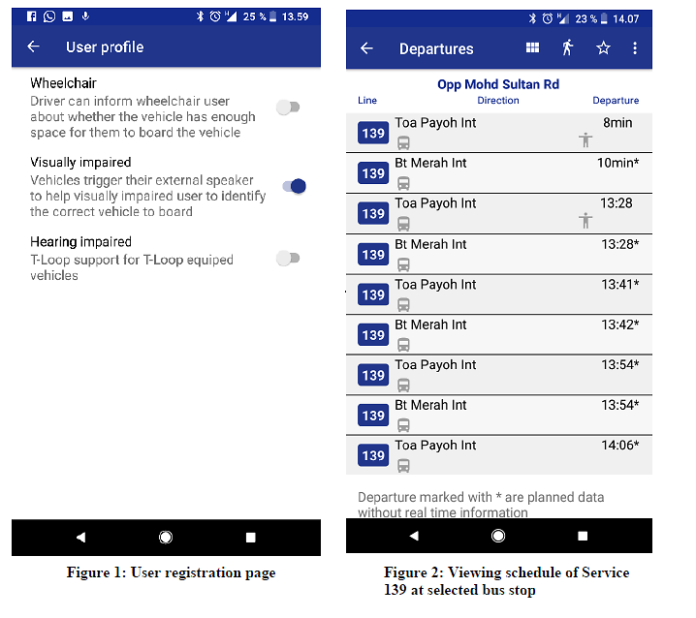
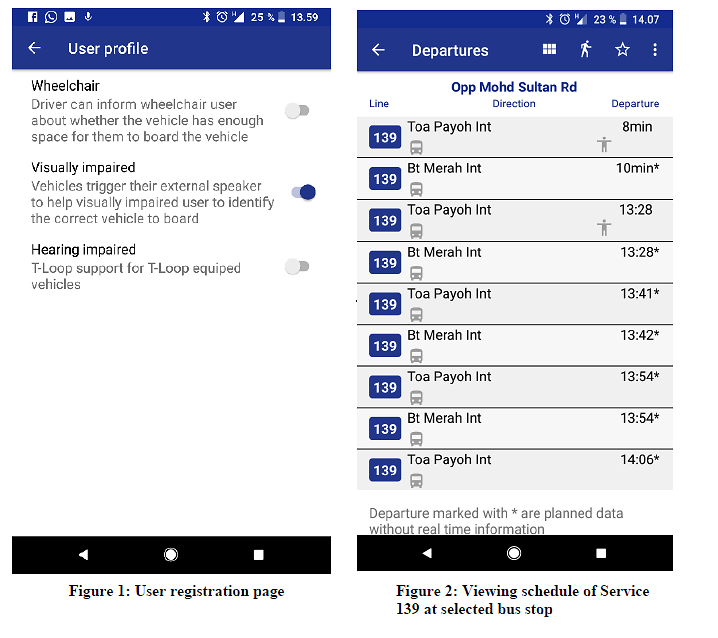
For a start, LTA announced on Wednesday that it will conduct a six-month trial of a new mobile application to help bus commuters who are wheelchair users, visually impaired or hearing impaired.
As part of the trial, audio announcements can be available both inside and outside the bus, announcing the visually impaired to hear the service number and final destination.
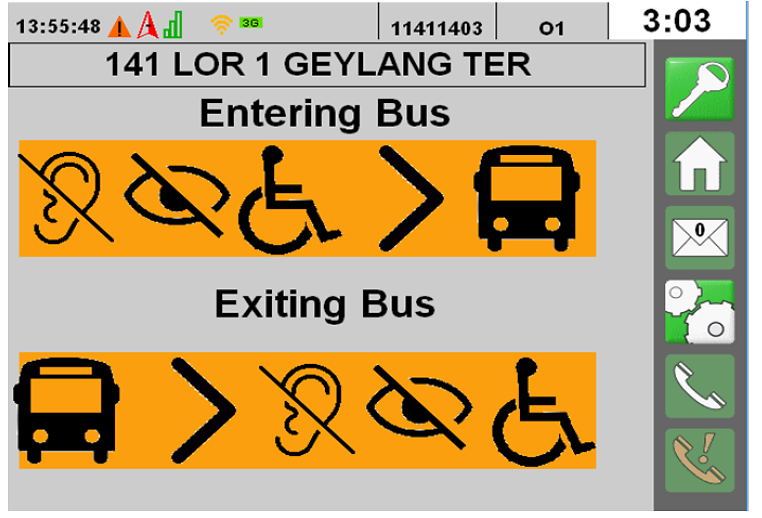
For commuters who are hearing impaired, audio announcements will be transmitted to them via T-coil enabled hearing aids. Bus captains will be given display units which will inform them if commuters with special needs are boarding.
(Image: LTA)
Screenshot of a driver display unit which will send bus drivers notifications when commuters with special needs are boarding or alighting. (Image: LTA)
The trial will start with bus service 139 which serves the Enabling Village at Lengkok Bahru, before being rolled out to service 141 which stops near the Singapore Association of the Visually Handicapped at Toa Payoh.
MORE BUS OPTIONS, BETTER CONNECTIVITY SUGGESTED
LTA said the trial supports one of the themes of its 2040 master plan, which is to build a more inclusive transport system for all.
Its public consultation exercise on the master plan also found that commuters want more bus routes, including more express services and on-demand bus options.
There were also calls to increase the frequency of buses, and to improve the accuracy of arrival times displayed in smartphone applications.
On the MRT system, there were suggestions for express services as well as more train stations.
Commuters called for an expansion of sheltered walkways to cover residential developments further from train stations. Cyclists and active mobility device users, on the other hand, asked for more dedicated cycling paths.
By 2040, about 95 per cent of Singapore residents expect to spend less than 45 minutes to travel between their homes and workplaces, and less than 20 minutes from home to neighbourhood centres, said LTA.
The findings will be handed to the LTMP advisory panel, headed by Senior Minister of State for Transport Janil Puthucheary. The panel will submit its recommendations to the Government by the middle of next month.
SINGAPORE: Sales representatives from four hotels in Singapore shared commercially sensitive information of their corporate customers for a year and more, thereby causing “serious harm to competition” in the industry.
For such practices, the Competition and Consumer Commission of Singapore (CCCS) said on Wednesday (Jan 30) that it had imposed infringement penalties of more than S$1.5 million in total on the hotels. These are Capri by Fraser Changi City Singapore, Village Hotel Changi, Village Hotel Katong and Crowne Plaza Changi Airport Hotel, according to its press release.
CCCS chief executive Toh Han Li told media during a briefing the same day that the investigation into hotels sharing sensitive information was initiated internally, and initially covered more than 30 hotels.
Over time, however, the competition watchdog found that most of the hotel employees’ interactions were just casual chatter, he added.
They did zoom in on the four hotels in question and found that their practices were infringing Section 34 of the Competition Act, and subsequently raided them in June 2015.
Through their investigations, CCCS found that sales representatives of the hotels exchanged information that is “likely to have influenced each other’s future conduct on the market or have placed them in a position of advantage over their customers in contract negotiations”.
The common industry practice was for corporate clients to establish a list pf preferred hotels to get preferential rates and on fixed terms of, say, a year. Hotels on their end would compete to be on the preferred hotels list, then vie for actual room bookings throughout the contract term, the agency explained.
“SERIOUS HARM TO COMPETITION”
However, the sales representatives from the four hotels shared information that placed them in a beneficial position when negotiating with these corporate clients.
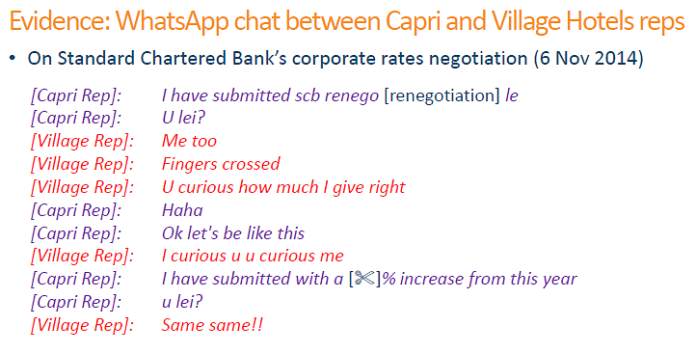
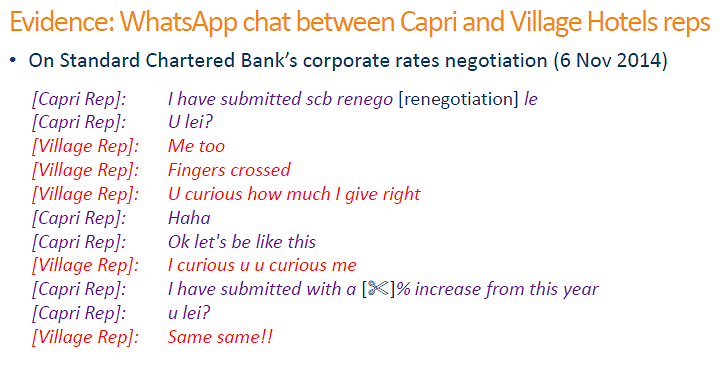
For instance, sales representatives from Capri and Village Hotel had shared the contract renegotiation details between a common corporate customer in Standard Chartered Bank, CCCS revealed.
According to a Nov 3, 2014, WhatsApp chat log the watchdog had obtained, a Village Hotel representative asked the Capri counterpart: “Can check with u how many percent is SCB renegotiating from your offered rate?”
In response, the Capri representative said: “All I can tell u that they are requesting rates lower than this year”
“Same here”
“He ask for (redacted) % reduction”
“u can tell me in percent or not”
“Same la”
(Source: Competition and Consumer Commission Singapore)
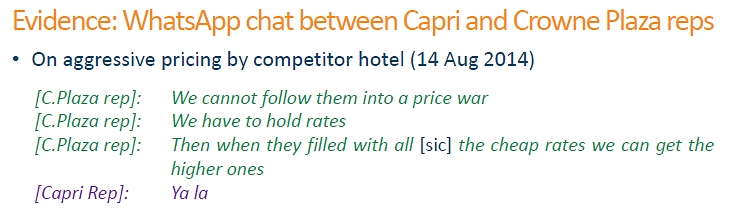
(Source: Competition and Consumer Commission Singapore)
CCCS said the sales representatives tend to interact frequently, especially during periods when customers looked to contract or re-contract with hotels. The two infringements it identified involved Capri and Village Hotels from Jul 3, 2014 to Jun 30, 2015 and Capri and Crowne Plaza from Jan 14, 2014 to Jun 30, 2015.
“Both were, by their nature, injurious to the proper functioning of normal competition and had caused serious harm to competition in Singapore,” the watchdog said.
“Without (the contact), each sales representative would have had to determine their conduct on the market independently. This would have likely resulted in more competitive rates and/or terms offered to corporate customers.”
As a result, CCCS imposed financial penalties on both the owner and operator of the four hotels, with Capri getting the brunt of these. The breakdown of the penalties are:
CAPRI – S$793,925
Ascendas Frasers, owner until Mar 30, 2015
Frasers Hospitality, agent for hotel management and operation
CAPRI – S$216,526
Frasers Hospitality Trustee, owner from Mar 31, 2015
Frasers Hospitality
VILLAGE HOTELS – S$286,610
Far East Organization Centre, owner of Village Hotel Changi
Orchard Mall, owner of Village Hotel Katong
Far East Hospitality Management, agent for management and operation of hotels
CROWNE PLAZA – S$225,293
OUE Airport Hotel, owner
Inter-Continental Hotels (Singapore), agent for hotel management and operation
CCCS noted that in imposing the penalties, it took into account, among other factors, whether companies had applied for its Leniency Programme which incentivises companies participating in secret cartel activities to come forward.
OUE Airport Hotel applied for leniency on Jul 21, 2015, while the owners and agent for Village Hotels did likewise on Apr 18, 2016, it said. Capri did not apply.
Mr Toh said that this is not the first time CCCS took action against companies sharing commercially sensitive information, but this latest decision is the first for the hotel industry.
“We wanted to signal that certain types of (business) practices are not on,” he said of the decision, adding that sales representatives should be more aware that information sharing for certain situations “can be an issue”.
Mikhy K Farrera-Brochez, 34, was arrested at his mother’s house in Clark County, Winchester, Kentucky in December last year, according to court and arrest documents seen by Channel NewsAsia.
Singapore’s Ministry of Health announced on Monday (Jan 28) that Brochez had leaked the personal information of 14,200 HIV sufferers online.
The former lecturer was jailed in 2016 for lying about his HIV status to gain an employment pass in Singapore.
Brochez, who was also convicted of fraud and drug-related offences, was sentenced to 28 months behind bars.
In April last year, he was deported from Singapore, but is now wanted again in connection with the data leak.
“We are seeking the assistance of our foreign counterparts in our investigations. It is inappropriate to comment on the case further as investigations are ongoing,” the Singapore Police Force said in a statement, without specifying any country.
Ms Camille Dawson, the spokesperson for the US Embassy in Singapore, said the embassy could not comment on ongoing investigations.
TRESPASS AND ARREST
Brochez was arrested on Dec 8 last year at his mother Teresa King’s home in Clark County, after she rang the local sheriff’s office to complain that he was banging on her door.
Brochez had been warned on Sep 29 not to return to his mother’s property after he tried to force his way in, or face being arrested for criminal trespass. But he returned on Dec 8 to her home.
“Upon arrival, this deputy observed the above suspect [Brochez] sitting on the porch of the residence,” the arrest citation said.
“After talking with T. King, she advised that she did not want the above suspect on her property and that he had been warned in the past not to be on the property.
“This deputy informed the suspect about the past warning and the suspect was instructed to leave numerous times but the suspect kept wanting to ask about the property that T. King had of his and wanting to talk to the sheriff.”
He was then arrested, placed into custody and brought to the Clark County Detention Centre. A spokesman for the detention centre confirmed with Channel NewsAsia that Brochez had been arrested and is on bail.
Brochez has been ordered to appear before the district court on Feb 18 to face the charge of third-degree criminal trespass.
DATA LEAK
The records leaked online were of 5,400 Singaporeans diagnosed with HIV from 1985 to January 2013 and 8,800 foreigners, including work and visit pass applicants and holders, diagnosed with HIV from 1985 to December 2011.
The leaked information includes names, identification numbers, contact details, HIV test results and other medical information AFP/Kirill KUDRYAVTSEV
It included their names, identification numbers, phone numbers, addresses, HIV test results and medical information.
MOH said the information was leaked by and is still in the possession of Brochez, an HIV-positive American who lived in Singapore from 2008.
He was in a romantic relationship with Ler Teck Siang, a male Singaporean doctor who was the head of the National Public Health Unit at MOH between March 2012 and May 2013.
They started living together in Singapore in 2008, before getting married in New York City on Apr 24, 2014.
Ler had authority to access information from the HIV registry, and he is believed to have mishandled the information and is suspected of not having complied with the policies and guidelines on the handling of such confidential information. He resigned in January 2014.
In May 2016, MOH lodged a police report after receiving information that Brochez still had the confidential information from the registry.
By then, Brochez had been remanded in prison and sentenced to 28 months behind bars. He was deported last year, and MOH received information he still had part of the records.
While the information was not yet public at that time, police were informed and the affected individuals were contacted.
But on Jan 22, MOH was told by the police that Brochez still had part of the information and it had now been leaked online.
WHO IS BROCHEZ?
Brochez had duped the Ministry of Manpower into issuing him an employment pass after arriving from America in 2008.
On two separate occasions, Ler gave a sample of his own blood to be submitted as Brochez’s so the American could hide his HIV status.
File photo of a medical technician conducting a HIV screening test on blood serum samples. (Photo: AFP/Romeo Gacad)
But the ruse was discovered, and when the police raided their properties, they found several fake education certificates purportedly issued to him.
These included a linguistics degree from Vanderbilt University, a Master’s degree in developmental and child psychology as well as a doctorate in psychology and education from the University of Paris. A professional teaching certificate was also seized. Investigations showed they were all forged.
A Bahamian passport, with the name Malatesta da Farrera-Brochez, was also found in a safe.
Brochez had given presentations and talks at several international conferences for academia and research. In a 2010 interview with a local newspaper, he claimed he spoke eight languages and was a “successful laboratory rat” of his mother, a Teresa King, who was supposedly a renowned professor of child and adolescent psychology in the UK.
But there was no psychologist in the UK with such qualifications. When British daily The Independent contacted a UK-registered psychologist who qualified under the name given by Brochez, she said Brochez was not her son and she did not have any specialisation in that particular area.
Mikhy K Farrera-Brochez, 34, was arrested at his mother’s house in Clark County, Winchester, Kentucky in December last year, according to court and arrest documents seen by Channel NewsAsia.
Singapore’s Ministry of Health announced on Monday (Jan 28) that Brochez had leaked the personal information of 14,200 HIV sufferers online.
The former lecturer was jailed in 2016 for lying about his HIV status to gain an employment pass in Singapore.
Brochez, who was also convicted of fraud and drug-related offences, was sentenced to 28 months behind bars.
In April last year, he was deported from Singapore, but is now wanted again in connection with the data leak.
“We are seeking the assistance of our foreign counterparts in our investigations. It is inappropriate to comment on the case further as investigations are ongoing,” the Singapore Police Force said in a statement, without specifying any country.
Ms Camille Dawson, the spokesperson for the US Embassy in Singapore, said the embassy could not comment on ongoing investigations.
TRESPASS AND ARREST
Brochez was arrested on Dec 8 last year at his mother Teresa King’s home in Clark County, after she rang the local sheriff’s office to complain that he was banging on her door.
Brochez had been warned on Sep 29 not to return to his mother’s property after he tried to force his way in, or face being arrested for criminal trespass. But he returned on Dec 8 to her home.
“Upon arrival, this deputy observed the above suspect [Brochez] sitting on the porch of the residence,” the arrest citation said.
“After talking with T. King, she advised that she did not want the above suspect on her property and that he had been warned in the past not to be on the property.
“This deputy informed the suspect about the past warning and the suspect was instructed to leave numerous times but the suspect kept wanting to ask about the property that T. King had of his and wanting to talk to the sheriff.”
He was then arrested, placed into custody and brought to the Clark County Detention Centre. A spokesman for the detention centre confirmed with Channel NewsAsia that Brochez had been arrested and is on bail.
Brochez has been ordered to appear before the district court on Feb 18 to be charged with third-degree criminal trespassing.
DATA LEAK
The records leaked online were of 5,400 Singaporeans diagnosed with HIV from 1985 to January 2013 and 8,800 foreigners, including work and visit pass applicants and holders, diagnosed with HIV from 1985 to December 2011.
The leaked information includes names, identification numbers, contact details, HIV test results and other medical information AFP/Kirill KUDRYAVTSEV
It included their names, identification numbers, phone numbers, addresses, HIV test results and medical information.
MOH said the information was leaked by and is still in the possession of Brochez, an HIV-positive American who lived in Singapore from 2008.
He was in a romantic relationship with Ler Teck Siang, a male Singaporean doctor who was the head of the National Public Health Unit at MOH between March 2012 and May 2013.
They started living together in Singapore in 2008, before getting married in New York City on Apr 24, 2014.
Ler had authority to access information from the HIV registry, and he is believed to have mishandled the information and is suspected of not having complied with the policies and guidelines on the handling of such confidential information. He resigned in January 2014.
In May 2016, MOH lodged a police report after receiving information that Brochez still had the confidential information from the registry.
By then, Brochez had been remanded in prison and sentenced to 28 months behind bars. He was deported last year, and MOH received information he still had part of the records.
While the information was not yet public at that time, police were informed and the affected individuals were contacted.
But on Jan 22, MOH was told by the police that Brochez still had part of the information and it had now been leaked online.
WHO IS BROCHEZ?
Brochez had duped the Ministry of Manpower into issuing him an employment pass after arriving from America in 2008.
On two separate occasions, Ler gave a sample of his own blood to be submitted as Brochez’s so the American could hide his HIV status.
File photo of a medical technician conducting a HIV screening test on blood serum samples. (Photo: AFP/Romeo Gacad)
But the ruse was discovered, and when the police raided their properties, they found several fake education certificates purportedly issued to him.
These included a linguistics degree from Vanderbilt University, a Master’s degree in developmental and child psychology as well as a doctorate in psychology and education from the University of Paris. A professional teaching certificate was also seized. Investigations showed they were all forged.
A Bahamian passport, with the name Malatesta da Farrera-Brochez, was also found in a safe.
Brochez had given presentations and talks at several international conferences for academia and research. In a 2010 interview with a local newspaper, he claimed he spoke eight languages and was a “successful laboratory rat” of his mother, a Teresa King, who was supposedly a renowned professor of child and adolescent psychology in the UK.
But there was no psychologist in the UK with such qualifications. When British daily The Independent contacted a UK-registered psychologist who qualified under the name given by Brochez, she said Brochez was not her son and she did not have any specialisation in that particular area.
SINGAPORE: Mr Avin Tan, 33, took three years to gather enough courage to tell his mother he has the human immunodeficiency virus (HIV).
After being diagnosed in 2009, he started coming out to a few “safe people” in 2012, before leaving his bottles of medication out in the open at home in anticipation of questions from his mother.
“I thought when she would ask me what it was for, I would tell her,” he told Channel NewsAsia at the office of advocacy group Action for AIDS (AfA) on Tuesday (Jan 29). “But the first few times she did, I said it’s for work; it’s someone else’s medication. I chickened out.”
A few weeks later, Mr Tan entered his mother’s room as she was watching television to break the news. She took a while to let it sink in – then she started crying.
“Later, she told me she was crying because she’s just worried. Why did I take so long to tell her? Am I coping well? Is the medication very expensive? How was my health?” Mr Tan said. “She was actually more worried than anything else.”
For something as sensitive as coming out with HIV, Mr Tan was able to choose the right time and the right people. But for some 14,200 other HIV-positive individuals, this was snatched away from them.
On Monday, the Ministry of Health (MOH) revealed that the confidential information of these individuals was illegally leaked online by American Mikhy K Farrera Brochez.
Brochez was the boyfriend of Ler Teck Siang, a general practitioner who was formerly the head of the MOH’s National Public Health Unit. Brochez was deported from Singapore last May after serving a 28-month jail sentence for numerous fraud and drug-related offences, and is now under police investigation for his latest offences.
On Jan 22, the ministry was notified that an unauthorised person – later identified as Brochez – had leaked information from the HIV Registry, dating as far back as 1985 up till January 2013. The information includes names, identification and phone numbers, addresses, HIV test results and medical information.
MOH said it has been “progressively contacting” people who might have been affected by the leak. As of 1pm on Monday, 900 have been approached.
THE CALL
The call for Mr Tan came on Monday evening, right after the MOH press conference announcing the leak ended. But it was not entirely unexpected.
Friends who were HIV-positive told him MOH had contacted them over the weekend. So Mr Tan – a manager for advocacy and partnerships at AfA – was already in the office, busy putting information out on social media and ensuring those affected had the support they needed.
Mr Avin Tan said some of those affected were in tears when they called the AfA hotline. (Photo: Aqil Haziq Mahmud)
Still, when the MOH officer on the line asked for his full name and NRIC, Mr Tan said his “heavy heart sank just a little bit”. “Cognitively, I knew something was happening, but emotionally, it hadn’t quite connected until the call happened,” he added.
Mr Tan immediately felt very anxious, especially for his family, as he was worried that the information would be used against him: Could bad people start calling his family? Disturb them at his home?
“The mind does its own thing despite knowing that the (leaked) information was contained, taken down,” he said. “It’s just that nagging thing at the back of the head. I think that for most people, it’s going to be like that for many months to come.”
THE REACTION
Mr Tan was right. Some affected individuals were in tears as they dialled in to AfA’s hotlines for advice.
“They were so stressed out by the entire situation,” he said. “They don’t know how their families are going to react to it if they found out, they don’t know whether they’re going to lose their jobs if their employers found out.
“Will they lose coverage of their insurance, for example? There’re a lot of those questions hovering, and there are just no clear answers around them until much later, I suppose.”
It took Mr Avin Tan three years to tell his mother he has HIV. (Photo: Aqil Haziq Mahmud)
Another affected individual, who only wanted to be known as Rico, told Channel NewsAsia he was exercising outdoors on Sunday when he got the call. As it was not a working day, he did not believe it was official.
“I thought it was a prank,” Rico, 31, said. Only when he established that it was someone from the hospital he goes to for check-ups did he let his guard down. He was asked to find a quiet place.
“My mind just went blank,” added Rico, who has been living with HIV for almost a decade. His immediate concern was whether a police report had been made, but since then, his worries have grown bigger.
“I have a nagging fear that the information will be leaked again, and that it will be worse this time,” he continued.
Rico has reason to fear the consequences of his identity being revealed. After he was initially diagnosed, he told someone and was shunned.
“I told someone whom I thought would listen,” he said. “But the person outright rejected me. The person broke our friendship based on that.”
Some of the books in the AfA office. (Photo: Aqil Haziq Mahmud)
Fortunately, Mr Tan said he has not received reports of major fallouts from the incident, like people getting fired or losing their insurance coverage.
“I think it’s a mix between being anxious and frustrated,” he said of the current sentiment among the HIV-positive community. “The sense of helplessness is there, because there’s nothing else we can do about this at this point.”
COMMUNITY TRAUMATISED
The bigger picture, however, is that the incident has destroyed the trust the community had built up over the years to seek help in Singapore, Mr Tan said.
“We have spent so much energy and time trying to build up people’s trust to seek care here, and that trust has just eroded now,” he explained. “It’s very traumatic because all the work that has been done over the last 20 years, it’s so easy to lose.”
Mr Avin Tan wants the public to show support for those affected: “Put it up as a Facebook status update, tell them that no matter what, I’m going to support you.” (Photo: Aqil Haziq Mahmud)
Mr Tan said there is a lot of fear about letting the Government know one has HIV, adding that some in the community have now questioned if it is safe to go to advocacy groups like AfA.
“This incident is just going to drive people underground, it’s just going to cause rifts in relationships,” Mr Tan added.
“On a personal level, it’s just the amount things that I’m reading online, it’s so hurtful to read. The misinformation that’s being spread, the bigotry and kind of comments, it’s an onslaught.”
For example, Mr Tan said some netizens had asked how authorities could have allowed so many HIV-positive foreigners into Singapore. Out of the 14,200 affected, 8,800 were foreigners.
“People with HIV are not monsters,” Mr Tan stated. “Whether they are locals or foreigners, it has no implication on how they can work. And instead of showing the kind of concern, we are alienating people.
Likewise, Rico worries that the incident would worsen the stigma surrounding those with HIV. Those who are unsure about seeking help might not come forward now, he added.
“It’s not just 14,200 people, it’s not just figures. It’s the number of lives affected,” he stated. “Everyone is really angry about what happened. I am as angry as anybody else.”
EVERYONE LOSES
Mr Tan is angry too. He was friends with Ler and Brochez, and had looked after their cat at their place a couple of times.
“There’s that very disgusting kind of bitter aftertaste, like I’m actually quite closely linked to this entire thing,” he said. “I know it’s nothing to do with me, but it’s just a bit scary that all that was happening while we were friends.”
Because of what the two men did, Mr Tan said everybody ended up suffering the consequences.
“I think every single person – MOH, everyone whose info had been leaked, including them – are losers in this entire situation,” he added. “So really, it’s not something very nice that he did, but the law will take its own course, and I don’t need to add more to that.”
SINGAPORE: In its push to embrace digitalisation, Singapore Airlines (SIA) is tapping ideas from employees on how the company can adopt innovation solutions.
Its digital innovation lab, called KrisLab, was officially launched on Tuesday (Jan 29), providing employees with a collaborative workspace for employees to develop their ideas further.
They can submit their proposals, and will be informed within five working days if they have made it to the prototyping stage.
“Once an idea is approved, seed funding along with expertise provided by the digital innovation lab team is provided to help further develop it into a prototype, before moving to the implementation stage,” said SIA in a media release.
SIA said it has received 180 submissions so far, with 50 of them approved to advance to the prototyping stage.
The SIA augmented reality colouring mobile application for children. (Photo: Singapore Airlines)
Some of the projects include an augmented reality colouring mobile application for children and an inventory tracking solution.
Another innovation being explored involves the use of virtual reality technology to allow designers to step on board to explore or change future cabin design concepts quickly.
KrisLab will serve as an innovation workspace for employees to develop and collaborate their ideas further. (Photo: Singapore Airlines)
SIA CEO Goh Choon Phong said: “In fact, we encourage all staff, wherever you are, however you think the idea could be touching on, to submit the idea because we think no idea is too small. Every idea is valuable to explore.”
To help develop their ideas, employees can also work with external communities such as start-ups and research institutions.
Mr Goh said he hopes that these ideas will help SIA in “all aspects of the airline operations”, such as customer service, predictive maintenance and human resource.
KrisLab is part of SIA’s digital innovation blueprint, launched a year ago to help the company in its push towards being the world’s leading digital airline.
Since then, Mr Goh said SIA has been working on four areas – nurturing a digital culture within the organisation, revamping its IT infrastructure, increasing IT delivery capabilities, as well as partnering external communities and industry partners.
The lab was designed by students of LASALLE College of the Arts through a design competition, and was officially launched by Trade and Industry Minister Chan Chun Sing.
SINGAPORE: Security firm Certis has formed a K-9 unit, the first of its kind by an auxiliary police force in Singapore, the company said on Tuesday (Jan 29).
Starting with 10 dogs, the unit will begin operations in the first half of 2019, and could grow to 24 dogs. However, that depends on “market demand”.
Security firm Certis has formed a K-9 unit, starting with 10 dogs, including (from left) English springer spaniels, Malinois and Labrador retrievers.
Mr Matthew Ng, commanding officer of Certis CISCO’s Enforcement & Events Division, said that the dogs can be trained to sniff out explosives and narcotics with more than 90 per cent accuracy, far exceeding the accuracy rate of machines which stands at 60 to 70 per cent.
Mr Ng said thorough car checks, for example, can be completed in five to 10 minutes, much faster than the estimated 20 to 30 minutes by two officers.
Labrador retriever Naomi has found a suspicious substance in the car’s fuel door.
The K-9 unit will complement Certis CISCO auxiliary police and aviation security officers, and can be deployed at transport hubs and major events where human traffic is high.
The company, which is wholly owned by Temasek Holdings, said that events such as the Singapore bicentennial commemoration this year, are opportunities for its newly formed unit.
“We take on functions that allow the Singapore Police to concentrate on their policing function and not so much of guarding or escorting,” said Mr Ng. “Similarly the K-9 unit will be able to lighten the load of the Singapore Police Force K-9 (unit) by taking on some of these functions that relieve them of their guarding role.”
Certis said it sources its dogs from the same breeders in the United Kingdom and the Netherlands that the police K-9 unit relies on as well, and it adheres to the same standards.
Security firm Certis has formed a K-9 unit.
Mr Ng said the dogs are well taken care of, with a dedicated vet and quarterly health checks.
Once the dogs reach eight years old, they will be retired and put up for adoption, like those in the K-9 unit of the Singapore Police Force. If they are not adopted, they will be used to train younger dogs through “social learning”, until their dying days.
Certis will launch its own kennel in Toh Tuck, which will include grooming and training facilities, by the third quarter of 2019. Meanwhile, it is currently running its K-9 unit training at The Animal Resort at Seletar Farmway.
Once the dogs reach eight years old, they will be retired and put up for adoption.
Certis’ move to diversify comes on the back of its transformation efforts, announced last October, to become an integrated securities solutions provider from a physical guarding services provider.
The company said it has invested a “significant investment” to set up the K-9 unit, but declined to give a ballpark figure as it was “commercially sensitive”.
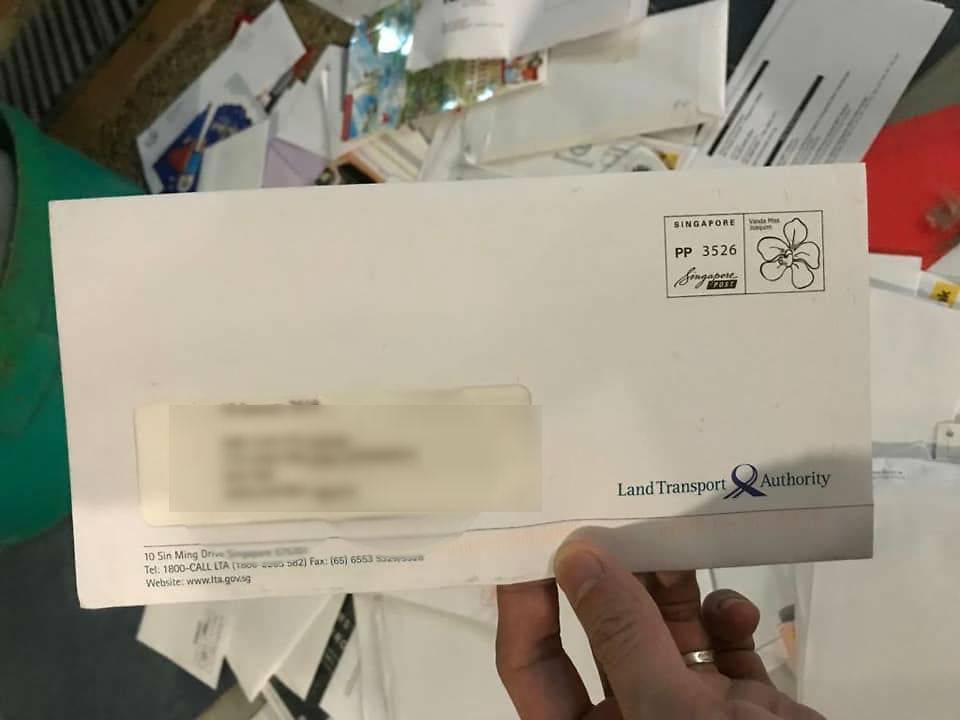
SINGAPORE: A postman serving areas in Ang Mo Kio has been arrested after a resident said she found unopened mail in a rubbish bin.
Singapore Post (SingPost) said on Tuesday (Jan 29) it was investigating images circulating online of unopened letters in a rubbish bin, including some from government agencies.
“Following the findings from internal investigations, we have referred the case to the police,” said the national postal agency in an update. “The postman serving the affected areas was arrested in relation to the case.”
“As police investigations are ongoing, we are unable to comment further, but would like to thank Facebook user Alyce Kathlyn for highlighting this case, and allowing us to look into this.”
Police confirmed that a 29-year-old man has been arrested for theft.
In its statement, SingPost apologised “unreservedly” to residents of the affected blocks. They are: Blocks 175 to 178 Ang Mo Kio Ave 4, Blocks 612 to 619 Ang Mo Kio Ave 4, Block 611 Ang Mo Kio Ave 5 and Blocks 179 to 182 Ang Mo Kio Ave 5.
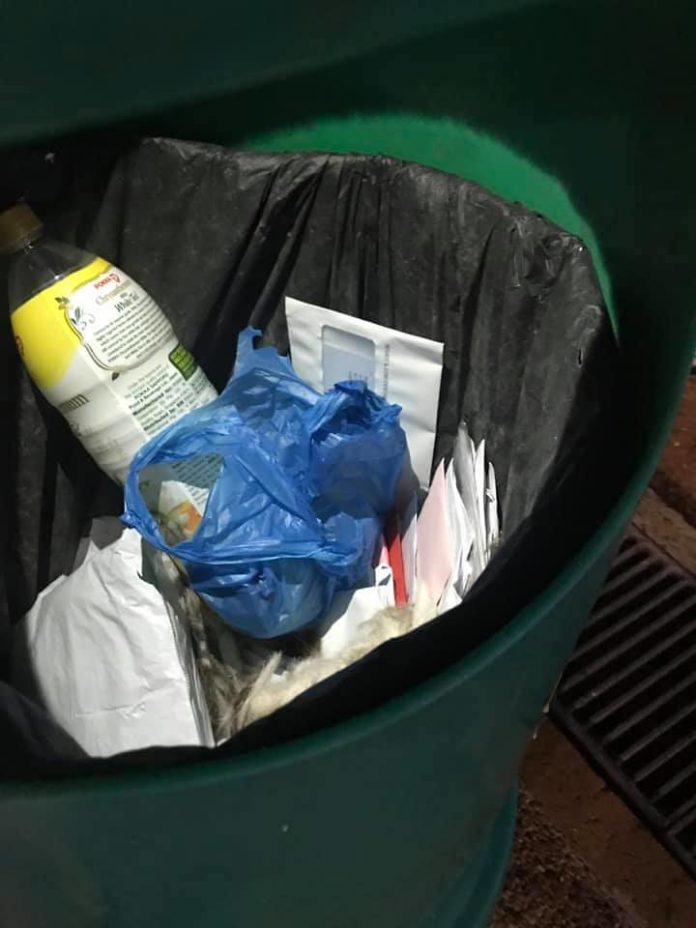
The resident, who only wanted to be known as Mrs Loh, told Channel NewsAsia that she discovered around 30 to 40 unopened letters – some sent by the Land Transport Authority and the Community Health Assist Scheme – in a bin at Block 179 Ang Mo Kio Avenue 5 on Monday night.
She uploaded photos of the letters she found on Facebook the same night. Her post has since been shared more than 6,000 times.
The resident says she found around 30 to 40 letters inside the rubbish bin. (Photo: Facebook/Alyce Kathlyn)
In response to queries from Channel NewsAsia earlier on Tuesday, the national postal agency said it dispatched a team on Monday night to search for the letters.
“SingPost is aware that images of letters allegedly discarded in a bin are circulating online. Based on the addresses on the letters, a team was immediately dispatched to comb the area overnight,” it said in a statement that was also posted on its Facebook page.
The team located the rubbish bin and proceeded to “search every bin within the vicinity”, but did not find the letters, it said.
“Letter boxes were also opened to check if these letters had been delivered to affected recipients,” SingPost added.
Mrs Loh, who is known as Alyce Kathlyn on Facebook, said she removed the letters – which were addressed to residents of different units and blocks – from the rubbish bin. She placed them at the “nearest letterbox, hoping neighbours could find their lost mail”.
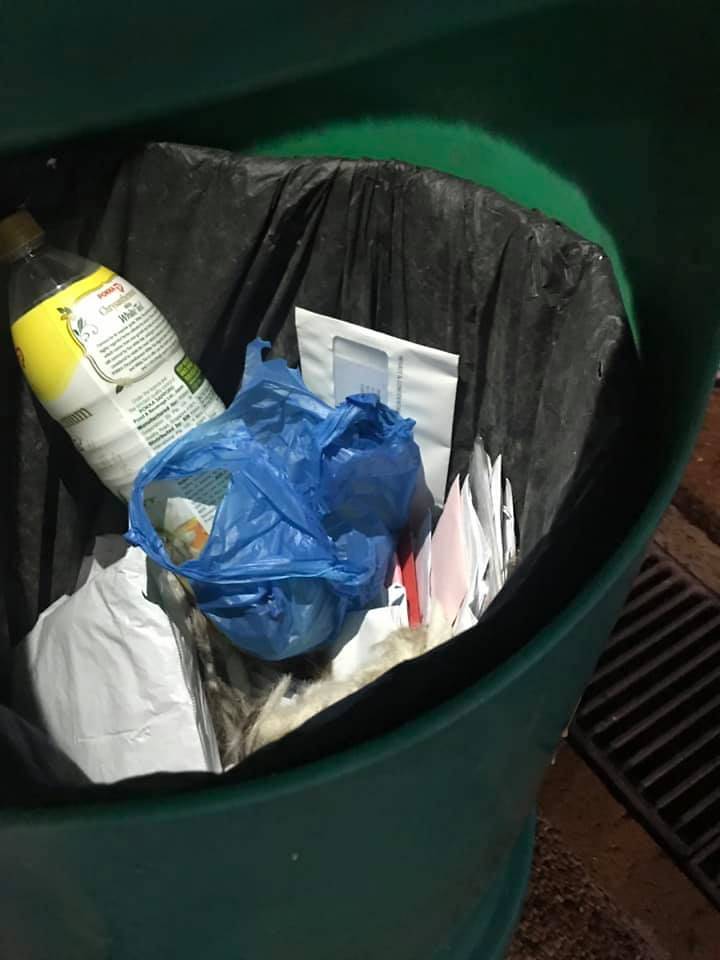
Some of the letters that the resident says she found in the rubbish bin. (Photo: Facebook/Alyce Kathlyn)
SingPost said that it was conducting interviews with the postman on duty and is trying to locate the letters so it could have them delivered to the intended recipients.
“Please bear with us as we continue to investigate this and will provide an update as soon as possible,” it added.
SingPost also reached out to Mrs Loh via the comment section of her post and apologised for the “unpleasant experience”. It also assured her that it would “get to the bottom of this”.
Mrs Loh said she found the letters in the bin while searching for her missing parcel. She added that she has seen letters “dumped twice within six months” at the same block.
Her neighbour, who also lives at Block 179, told Channel NewsAsia that he reported to SingPost last year about mail going missing. The civil servant, who asked to remain anonymous, said he has lived at the same block for nearly 30 years and only experienced issues with mail in the last year.
The Info-communications Media Development Authority (IMDA) said in a statement on Tuesday evening that it had “grave concerns” over the incident, as well as the spate of recent service lapses by SingPost.
“SingPost must comply with its public postal licence requirements and QoS standards. We will take firm action against SingPost for any breaches of these requirements,” said IMDA.
“SingPost must investigate all complaints and feedback raised, and take urgent steps to improve its service standards and restore public confidence in its postal services,” the authority added.
In February 2018, a SingPost postman was fired after he was found to have thrown away returned letters and direct mail at a condominium.
After a member of the public confronted the postman, he admitted to throwing the mail away and complained that he was tired and had been treated unfairly.
SINGAPORE: Five men have been arrested and nearly 1kg of heroin seized after a Central Narcotics Bureau (CNB) operation on Monday (Jan 28).
According to a press release on Tuesday, an observation had been conducted on a group of suspected drug offenders around Bedok North Street 3 and Bedok Town Park early Monday morning.
Several hours into the watch, one of the suspects, a 58-year-old Singaporean man, was seen meeting another suspect, a 30-year-old Malaysian male, in Bedok Town Park.
After their meeting, the Singaporean man returned to his “hideout”, a Housing Board (HDB) unit near Bedok North Street 3, while the Malaysian man left in a taxi.
Black bundle containing heroin, which was recovered in the operation on Monday (Jan 28). (Photo: Central Narcotics Bureau)
At 9.10am, officers spotted another suspect, a 72-year-old Singaporean man, leaving the flat. He was arrested at the void deck of the HDB block and officers then raided hideout.
“From within the unit, a total of about 27g of heroin and 17g of Ice were recovered,” CNB said.
The 58-year-old was also arrested within the unit, along with two other Singaporean men aged 45 and 65.
Suspecting that more drugs had been thrown out via the rubbish chute, CNB officers searched the ground floor and recovered two bundles of heroin wrapped in blue plastic bags. The heroin weighed a total of about 919g.
Cash recovered from the 30-year-old Malaysian male arrested during the operation. (Photo: Central Narcotics Bureau)
Another group of CNB officers arrested the 30-year-old Malaysian at a taxi stand at Kranji MRT station. Cash amounting to S$5,100 was recovered from the suspect.
Investigations into the drug activities of all the suspects are ongoing.
The 946g of heroin seized in the operation would have been enough to feed the addiction of about 450 abusers for a week, said CNB, adding that the total drugs seized were worth an estimated S$68,000.