SINGAPORE: Support for disadvantaged families and healthcare will be the focus of social spending in this year’s Budget, which will be delivered next month.
Second Finance Minister Indranee Rajah revealed this on Wednesday (Jan 30) during a visit to Big Heart Student Care centre at Lianhua primary School, which is run by Singapore’s four self-help groups – CDAC, Mendaki, Eurasian Association and SINDA.
“On the social part obviously we’re looking at the elderly, healthcare and then of course those from disadvantaged backgrounds and how do we make all of these sustainable,” Ms Indranee said.
She added that the government will also consider ways to keep Singapore rejuvenated in terms of maintaining current infrastructure and developing new ones.
While Ms Indranee said that the exact quantum will be unveiled during Budget, she noted that social spending in the last 10 years has more than doubled.
In 2008, the government allocated S$15.9 billion towards the social development sector, while in 2018 this was raised to S$36 billion.
Students during a class at Lianhua Primary School. (Photo: Deborah Wong)
The spotlight on social mobility though, was cast as early as Oct 28 last year, when MOE convened an inter-agency taskforce, Uplift, to strengthen support for students from disadvantaged backgrounds.
Ms Indranee said that the taskforce’s work will be considered under the social aspect of this year’s Budget. The taskforce will release its recommendations in the upcoming Committtee of Supply.
As it is, efforts to support such students are already underway with school-based student care centres set up across the island.
“If you look at the Uplift part of student care centres, we can see a role not just for tuition for children who aren’t doing well. But also in family mentoring and parenting programmes.
“In some cases for parents who don’t prioritise education, we’ll help them to see that this is an important part their children’s progress and development,” she said.
About 3,021 students are enrolled in Big Heart Student Care centres across Singapore, with the one at Lianhua Primary joining the fold this month.
There will be 30 such centres by 2020, catering to about 6,000 students.
A student walking in a classroom at Lianhua Primary School. (Photo: Deborah Wong)
At the centres, students do their homework and revision under supervision. They also get to attend enrichments and outdoor workshops like art and fitness classes.
Ms Low Yen Ling, who chairs the board of Self Help Groups Student Care Limited (SHGSCL), told Channel NewsAsia that she’s observed progress under the programme.
“After joining the centre, one parent shared that when the daughter goes home, she will not switch on the television like she always does, but she will make sure that she has really completed all her homework.
“This positive learning attitude was what the mother observed and we were very heartened by that,” she said.
Households eligible for the Student Care Fee Assistance (SCFA) scheme can receive up to 98 per cent subsidy of the S$290 monthly fee at Big Heart Student Care.
The same percentage applies throughout other student care centres.
As to whether more subsidies will be given to lower-income families in the future, Ms Indranee said this is currently being reviewed.
SINGAPORE: Three legal and diplomatic stalwarts have published a book documenting the case Singapore prepared against Malaysia over the sovereignty of Pedra Branca.
In 2017, Malaysia had filed applications requesting interpretation and revision of the International Court of Justice’s (ICJ) 2008 judgment, which ruled that Singapore had sovereignty over Pedra Branca.
Just two weeks before the scheduled oral hearings, however, Malaysia decided to drop the cases. A new government headed by Prime Minister Mahathir Mohamad had come into power, following the landmark elections last May.
“I felt like a boxer that had trained for 17 months for an important contest, and at the last minute to be given a walkover,” said Ambassador-at-large Professor Tommy Koh, co-author of Pedra Branca: Story of the Unheard Cases.
“So the three of us decided to do the next best thing – write a book about it,” he added at the book launch on Wednesday (Jan 30).
His co-authors are former deputy prime minister S Jayakumar and Deputy Attorney-General Lionel Yee.
They recount how Singapore’s team prepared for the cases, and reveal behind-the-scenes accounts of the “unheard cases”. The book also serves as a sequel to Pedra Branca: The Road to the World Court, which was co-authored by professors Koh and Jayakumar.
Pedra Branca: Story of the Unheard Cases.
Both of them were were part of the legal team that Singapore had assembled for Malaysia’s challenge to the ICJ judgment, along with Attorney-General Lucien Wong and former Chief Justice Chan Sek Keong.
Speaking at the event, Foreign Affairs Minister Vivian Balakrishnan commended the close inter-agency teamwork in preparing for the case. He noted that the team comprised people from the second, third and fourth generations of civil servants across four ministries, as well as the Attorney-General’s Chambers, the Maritime and Port Authority of Singapore and the National Archives of Singapore.
“Whenever our national interests are challenged, it is crucial that Singapore is able to mount a response that is robust and vigorous. And to do so, we need – we will always need – resourceful, experienced and committed officers, and the ability to function as a whole of government across all agencies,” said Dr Balakrishnan.
Foreign Affairs Minister Vivian Balakrishnan speaking at the launch of Pedra Branca: Story of the Unheard Cases on Jan 30, 2019.
References were also made at the launch event to the ongoing maritime and airspace dispute between Singapore and Malaysia. Prof Koh explained why efforts were taken last December to forestall any attempt to open a third-party adjudication process on maritime boundary disputes.
“All we want to do is to be consulted, to agree on the choice of forum, and the precise manner that the issue is to be framed,” said Prof Koh.
He also said it was fortunate that both Malaysia and Singapore believe in the rule of law.
(Left to right) Authors of Pedra Branca: Story of the Unheard Cases Professor Tommy Koh, Professor S Jayakumar and Deputy Attorney-General Lionel Yee.
Prof Jayakumar, who was also law and foreign affairs minister, added that apart from strong legal and diplomatic officers, good political leadership is also key in dealing with such diplomatic issues.
“You need good political leadership to manage the bilateral relations, in such a way that you keep things on an even keel,” he said. “Don’t let the latest issue derail the overall tenor of cooperation and bilateral relations. I think that’s very important.”
“Second, I think it’s important to have a sense of national unity and consensus,” he added. “It’s good that … there was a sense of support for the government and for the team in dealing with Pedra Branca, or the more recent problems we’ve had. And that sense of unity amongst the people really helps.”
A rocky outpost located 44km off Singapore’s east coast, the dispute over the ownership of Pedra Branca, referred to by Malaysia as Batu Puteh, dates back to 1979 when Malaysia published a map indicating that the island was within the country’s territorial waters.
Singapore protested and the matter was brought to the ICJ in 2003.
On May 23, 2008, the ICJ ruled that Singapore had sovereignty over Pedra Branca, while Middle Rocks was awarded to Malaysia and South Ledge belonged to the state in whose territorial waters it is located.
SINGAPORE: Ride-hailing giant Grab will build a new Singapore headquarters in one-north as it expands its operations.
The company announced this on Wednesday (Jan 30) in a joint media release with Ascendas Reit, which will develop and manage the building. It is expected to cost about S$181.2 million.
The new headquarters, which is expected to be ready in the fourth quarter of 2020, will house all of Grab’s employees in Singapore.
“Grab’s largest R&D centre will also be based here, as Grab continues to expand its tech team globally,” said the media release.
Grab’s offices are currently at Midview City in Sin Ming.
The new building will be designed with green features, incorporating mid-level sky terraces and communal spaces.
Artist’s impression of the sky terrace. (Image: Grab/Ascendas Reit)
“The new headquarters is yet another important milestone for us – it represents our long term commitment to Singapore and the region,” said the company’s head of people Ong Chin Yin, noting that Grab hit its three billionth ride in Southeast Asia last week.
She added that Grab has plans to create and hire for “a thousand more exciting roles” globally over the next 12 months.
Grab, which started as a ride-hailing app in 2012, quickly grew to offer food and package deliveries, mobile payments and financial services. It currently operates in Singapore, Indonesia, the Philippines, Malaysia, Thailand, Vietnam, Myanmar and Cambodia.
SINGAPORE: A Scoot flight bound for Singapore was forced to turn back to Bangkok an hour into its journey on Wednesday (Jan 30) due to an unaccompanied cabin bag that was unclaimed.
The airline said Scoot flight TR607 landed safely at Bangkok Suvarnabhumi Airport at around 2.10pm local time (3.10pm Singapore time).
“Preliminary investigations revealed that before departure, our ground handling agent had seen an unattended bag in the gatehold room, and handed it to our cabin crew, in the belief that it belonged to one of the passengers from TR607.
“The crew accepted the bag, which was a breach of security protocols, and was unable to determine its owner,” Scoot said in a statement.
Scoot flight TR607 turned back to Bangkok about an hour into its journey on Jan 30, 2019. (Image: Flight Aware)
“The captain was not informed of this issue until the flight had departed … After the captain was made aware of the situation, he decided to turn back to Bangkok,” Scoot said.
Passengers had to disembark from the aircraft and security personnel conducted the necessary checks, it added. The bag was also removed from the aircraft by the authorities.
“We sincerely apologise for the lapse and we will review our training processes to prevent a recurrence,” Scoot said.
Flight TR607 was rescheduled to depart Bangkok at around 7.30pm local time with a new operating crew.
“BLACK LAPTOP BAG”
A Channel NewsAsia reader who was on the flight said passengers underwent security screening again after they disembarked.
“Airport authorities were swift and provided food and drinks while waiting for further instructions.”
The passenger, who did not want to be identified, said that during the flight, the cabin crew “went from row to row” to ask passengers if the bag belonged to them. The passenger said the bag resembled a black laptop bag.
“All passengers were very cooperative. I just want to highlight the great job by the pilot and crew, especially airport staff who were efficient.”
Video footage taken by the reader showed security personnel, police vehicles as well as an ambulance on the tarmac.
This latest delay is the latest in a string of woes for the airline.
A Scoot flight from Singapore bound for Gold Coast was forced to turn back midway through the flight earlier on Wednesday after the aircraft’s front windshield “sustained some damage”.
In December, Scoot passengers were stranded in Athens for nearly three days after repeated delays.
Another Scoot flight from Bangkok was hit by a 29-hour delay in November after the aircraft encountered technical difficulties.
This story came from a reader tip-off. If you would like to send in photos or videos of something newsworthy, WhatsApp our Mediacorp news hotline at +65 8218 8281 or message us on Facebook.
SINGAPORE: Late actor Aloysius Pang was the first soldier to be injured due to gun lowering while operating the Singapore Self-Propelled Howitzer (SSPH), the Ministry of Defence (MINDEF) said on Wednesday (Jan 30) in a media release clarifying the safety record of the artillery vehicle.
Pang died on Jan 23 in Waikato Hospital in Hamilton, New Zealand, after he was injured while carrying out repair work to a SSPH as part of his reservist duties.
The 28-year-old actor was in New Zealand for Exercise Thunder Warrior, a live firing exercise involving the howitzer.
He suffered crush injuries when the gun barrel was lowered and he underwent a number of operations to treat his injuries, but he died days after the accident.
The SAF said the SSPH has been in operation for the last 15 years and had been used by more than 1,000 servicemen, NSmen and regulars.
“In the last 15 years of SSPH operations, there has not been any reported injury of servicemen due to the gun lowering for maintenance or operating in or firing of the SSPH,” MINDEF said in its statement.
MINDEF confirmed a Committee of Inquiry (COI) was convened on Jan 25 to investigate Pang’s death, with a judge from the State Court as its chairman.
Other members of the COI panel include a consultant medical specialist, a member of the External Review Panel on SAF Safety, a member of the Workplace Safety and Health Council and a senior-ranked national serviceman.
None of the COI members work within MINDEF or are SAF regulars, the ministry said.
Minister for Defence Ng Eng Hen is set to deliver a ministerial statement at the next parliamentary sitting in February to address the deaths.
SAFETY PROCEDURES
Exercise Thunder Warrior in Waiouru Training Area in New Zealand, between Jan 5, 2019 and Feb 2, 2019. Included in the exercise were 500 soldiers from 268th Battalion, Artillery and 24 SA. This was the exercise Aloysius Pang was taking part in when he died.
The SSPH was developed by ST Engineering Land Systems and commissioned in 2003.
Operated by a crew of four, including the gun commander, charge loader, ammo loader and driver, each serviceman is given a safe zone within the turret, MINDEF said.
To lower the gun barrel, the gun commander has to make visual checks that the area surrounding the gun barrel is free from obstacles, and that the crew remain in safe operating positions.
He will then sound off “clear away” to warn the gun crew of the impending barrel movement and shout “standby” when the barrel is lowered, the statement explained.
In an emergency situation that requires the gun barrel or other moving parts to stop immediately, any of the servicemen, except the driver, can activate an emergency stop button.
An example of servicemen’s positions in the Singapore Self Propelled Howitzer (SSPH). (Photo: MINDEF)
“In the event that the gun requires maintenance work during training and operations, a team of Army technicians will be activated onsite and takes charge of the SSPH,” the statement added.
“Given the diagnosis and maintenance works required, the Army technicians may require the assistance of the Gun Commander. Army technicians are also trained and required to abide by the same drills and safety protocols as the SSPH crew.”
Technicians undergoing in-camp training will also have to attend a training course to refresh their skills before being deployed.
“The trainees will be drilled on the theoretical and practical components included in the Maintenance Vocational Training (MVT) until they have been assessed to be competent to ensure that the technicians are proficient in performing the required maintenance tasks,” MINDEF said.
WHAT HAPPENED TO ALOYSIUS
Pang, an armament technician with the 268th Battalion Singapore Artillery, was tasked with repairing a suspected fault in the gun barrel of a SSPH on Jan 19.
As Pang, another technician and a gun commander were inside the cabin, the barrel was lowered to its standby position.
“He was caught between the end of the gun barrel and the interior of the SSPH and he suffered crush injuries as a result.”
Chief of Army MG Goh Si Hou speaking at the press conference on the death of Aloysius Pang on Jan 24, 2019. (Photo: Jeremy Long)
The actor, who held the rank of Corporal First Class (NS), was treated on site before being taken to Waikato Hospital.
After the first two operations, Tan Tock Seng Hospital’s chief of trauma and acute care surgery Dr Teo Li Tserng said that Pang’s condition had stabilised.
But Pang suffered complications, and on Jan 23 had to have another operation in the morning. He died later that night.
“The well-being of servicemen is MINDEF’s and the SAF’s topmost priority. The SAF has reduced the training tempo for commanders and soldiers to assess safety protocols and plans in their units,” MINDEF said on Wednesday.
“The reduced training tempo will remain in place until the SAF is satisfied that training and other activities can be conducted safely. The SAF is committed to strengthening the safety culture on the ground.”
SINGAPORE: New plans for Orchard Road will aim to transform Singapore’s main shopping belt into a “must-visit” lifestyle destination, said the Urban Redevelopment Authority (URA), Singapore Tourism Board (STB) and National Parks Board (NParks) on Wednesday (Jan 30).
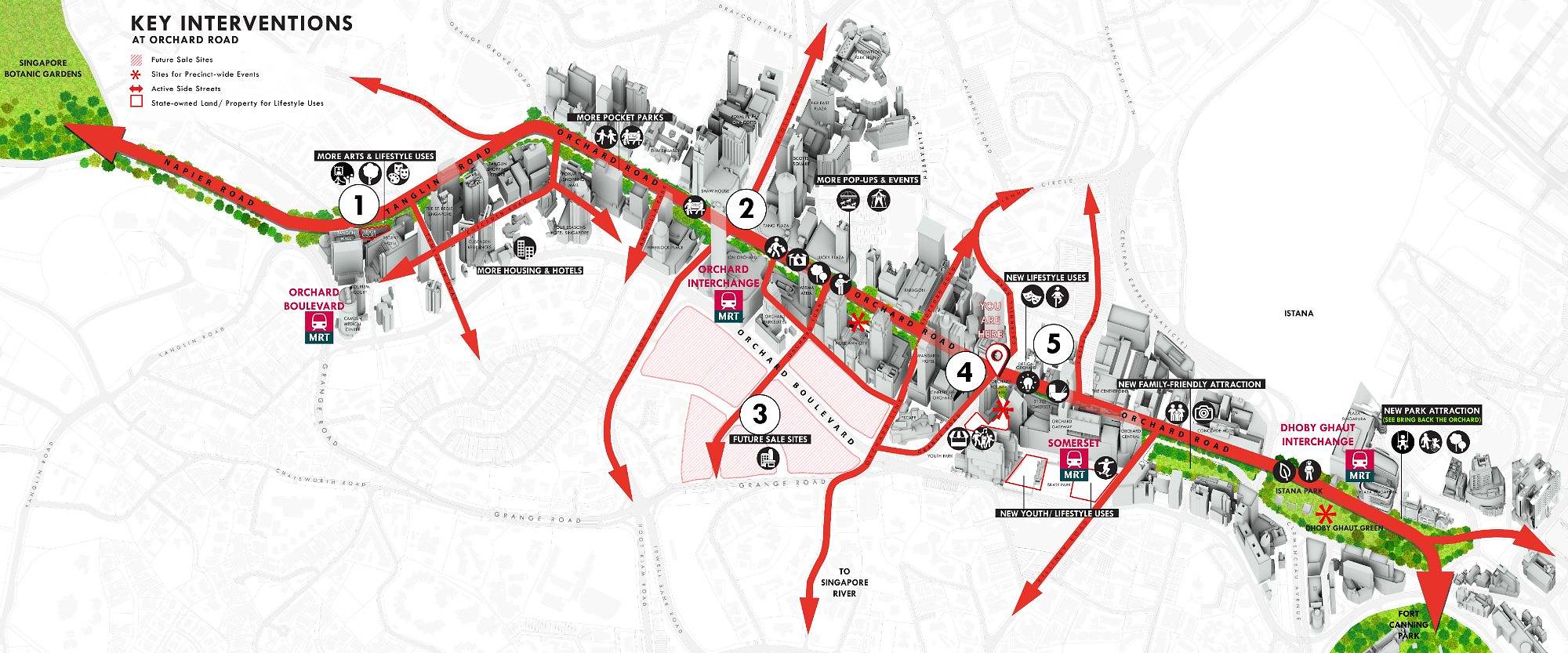
Authorities are also looking into pedestrianising a section of Orchard Road to link up existing green spaces at the Istana Park, Dhoby Ghaut Green and the open space at Plaza Singapura.
An artist’s impression of a new vantage point at the junction of Orchard Road and Paterson Road. (Image: Urban Redevelopment Authority)
This announcement follows a review of the future plans for Orchard Road by STB, URA and NParks, together with the Land Transport Authority.
Speaking at the official opening of Design Orchard, Minister for Trade and Industry Chan Chun Sing said that as the concept of shopping changes, so should Orchard Road.
“Shopping is going to change and continuously evolve as a concept,” said Mr Chan, who is also co-chair of the ministerial steering committee for Orchard Road. “This is the place where we hope that the new shopping experiences, new products, new services, new ideas will be incubated, from here to the rest of the world.
We hope that Orchard Road will continue to be a place where people want to come here to see and be seen with their new products and new ideas.”
Consultations with private sector stakeholders were also held during the exercise, alongside a study led by urban planning consultancy firm Cistri.
“All cities have their own popular shopping streets and neighbourhoods. In Singapore, Orchard Road is our premier shopping district. But it is facing stiff competition from other cities, and has to adapt to rapidly changing retail trends,” said Minister for National Development Lawrence Wong, who is also co-chair of the ministerial steering committee for Orchard Road, in a press statement.
“That’s why government agencies have been working with private sector stakeholders on the rejuvenation plans for Orchard Road. We have put together these ideas to illustrate the possibilities of making Orchard a place for all to experience and enjoy.”
“UNIQUE IDENTITY” OF ORCHARD SUB-PRECINCTS
In order to strengthen Orchard Road’s position as a lifestyle destination, the plans aim to offer experiences to bring out the unique identity of its four sub-precincts – Tanglin, Orchard, Somerset and Dhoby Ghaut.
New lifestyle experiences at Tanglin. (Photo: Urban Redevelopment Authority)
At Tanglin for instance, the conserved Tudor Court could house more arts, cultural and lifestyle offerings in order to highlight its identity as a neighbourhood with a “strong arts and artisanal flavour”.
Orchard, on the other hand, will remain the “retail heart of Singapore”, but the plans will further improve the shopping experience by providing more street activities and better pedestrian connectivity.
For one, the Orchard Road Business Association (ORBA) will start a one-year trial, beginning April this year, to bring in activities to enliven event spaces along the pedestrian malls in Orchard Road. These activities could range from retail and food & beverage pop-ups to arts and entertainment events.
Speaking to reporters, ORBA chairman Mark Shaw said that the initiatives were “pretty good” but pointed out that it would be important for all parties involved to work together in order for these plans to materialise.
“We think the ideas are pretty good but we feel some of that may be hard to implement, but we’ll see how it goes,” he said. “Getting cooperation between the various landlords, mall owners, stakeholders on the street – that’s really going to be the biggest challenge.”
An artist’s impression of a new event space at Somerset. (Image: Urban Redevelopment Authority)
There will also be future mixed-use developments built at the upcoming Thomson-East Coast Line Orchard Interchange MRT station, and these developments will be connected to Orchard Road through side streets.
To improve connectivity, elevated link bridges could make it easier for visitors to cross the junction of Orchard Road and Paterson Road.
Underground tunnels now link the buildings at that junction, including Ion Orchard, Wheelock Place and Shaw House and Centre.
The appeal of “youth hub” Somerset will be enhanced with the newly opened Design Orchard, said the various agencies. The retail space showcases home-grown brands, provides incubation spaces and rooftop amphitheatre.
An map of Orchard Road (Image: Urban Redevelopment Authority)
This will “inject greater retail diversity to Orchard Road, as well as offer promising brands an unparalleled opportunity to present themselves in a world-class location”, said URA, STB and NParks.
In order to set Orchard Road apart from other international shopping streets, there are also plans to “bring back the orchard” and turn it into a green urban corridor connecting Singapore Botanic Gardens and Fort Canning Park.
New initiatives to make this happen could include a “vibrant showcase of trees and shrubs” as well as the rejuvenation of Istana Park with “themed gardens inspired by Singapore’s botanical and horticultural traditions and practices”.
An exhibition on future plans for Orchard Road will be held at Orchard Fountain Corner from Wednesday to Feb 13, for members of the public to visit and share feedback.
“Orchard Road is not a 2.4km IPPT run. We are not aiming for people to pass through Orchard Road in nine minutes or 10 minutes,” said Mr Chan.
“We want people to come here, mingle and make sure they have a different experience at each and every turn,” he added.
SINGAPORE: The construction of a road tunnel between Sin Ming Avenue and Ang Mo Kio Avenue 3 will begin by the second quarter of 2019, the Land Transport Authority (LTA) announced on Wednesday (Jan 30).
The 800m long dual three-lane road tunnel, part of the 21.5km long North-South Corridor (NSC), will be integrated with the future Cross Island Line’s Teck Ghee MRT station, LTA said.
The North South Corridor tunnel between Sin Ming Avenue and Ang Mo Kio Avenue 3. (Map: LTA)
In addition to the tunnel, an MRT station box and commuter facilities such as pedestrian overhead bridges, bus stops, sheltered walkways and cycling paths will also be constructed between Sin Ming Avenue and Ang Mo Kio Avenue 3.
The contract was awarded to Shanghai Tunnel Engineering (Singapore) at a contract sum of S$615.9 million, LTA said.
The contractor has worked on infrastructure projects including the Circle Line and Downtown Line and is currently involved in the construction of tunnels at multiple areas along the Thomson-East Coast Line.
The NSC, Singapore’s first integrated transport corridor, will feature continuous bus lanes and cycling trunk routes, in line with the Government’s car-lite vision. It is expected to be completed by 2026.
Even before allegations that he had leaked information from the registry emerged, Brochez had already made headlines after being convicted for numerous fraud and drug offences.
He was found to have used fake degree certificates to get hired as a lecturer in two local polytechnics.
Brochez, who is HIV-positive, also used blood samples from his partner, Singaporean doctor Ler Teck Siang, to pass blood tests so he could gain and retain his employment pass.
He is believed to have obtained the HIV registry records from Ler, who was head of the Ministry of Health’s (MOH) National Public Health Unit and had access to the registry.
MOH has said that the incident “is believed to have arisen from the mishandling of information by Ler”.
This is a timeline of what we know so far about how the records were leaked.
Jan 2008: Mikhy Farrera Brochez moves to Singapore and uses falsified blood tests to get an employment pass.
Mar 2012 to May 2013: Ler serves as head of the National Public Health Unit, a position that gives him access to the national HIV registry.
Jan 2014: Ler resigns from the National Public Health Unit.
May 2016: MOH lodges a police report against Brochez after receiving information that he had confidential information that appeared to be from the HIV registry.
Ler’s Craig Road apartment and Brochez’s Telok Kurau apartment were searched.
“All relevant material found were seized and secured by the police,” MOH said.
No public announcements were made about the HIV registry records at that time.
Jun 24, 2016: Ler is charged under the Official Secrets Act for “failing to retain possession of a thumb drive” containing data from the HIV registry.
The charge under the OSA has been stood down, and MOH says that it is pending before the courts.
Mar 28, 2017: Brochez is convicted of fraud and drug offences, and sentenced to 28 months’ jail.
Apr 2018: Brochez is released from prison. According to MOH, he was deported from Singapore.
May 2018: MOH receives information that Brochez still has part of the records he had in 2016. The information did not appear to have been made public at the time, MOH said.
MOH lodges a police report and contacts affected individuals to notify them. This appears to be the first time that individuals were informed of the case.
No public announcements were made on the case at this time.
Jan 22, 2019: MOH is informed that Brochez could still have more data from the HIV registry and that he has leaked the information online.
Jan 24, 2019: MOH confirms that the leaked information was the HIV registry records up to Jan 2013.
Jan 24 to 25, 2019: MOH is working with “relevant parties” to disable access to the information, it said, without disclosing who the parties were.
MOH added that Brochez still has the data and could still publicly disclose it in the future.
Jan 26, 2019: MOH begins notifying those affected.
Jan 28, 2019: MOH informs the public that the said HIV registry records of 14,200 people “is in the possession of an unauthorised person”, and that “the information has been illegally disclosed online”.
“I am sorry that one of our former staff who was authorised to have access to confidential information in our HIV registry appears to not have complied with our security guidelines,” Mr Gan told reporters. “We will not hesitate to take stern action against staff who violate security guidelines, abuse their authority or abuse access to information.”
MOH says Brochez is currently under police investigation for various offences and the authorities are seeking assistance from their foreign counterparts.
SINGAPORE: The National University of Singapore (NUS) on Wednesday (Jan 30) unveiled a new building at the School of Design and Environment that has net-zero energy consumption.
This means the building consumes only as much energy as it produces on site, such as by harnessing solar energy. Named SDE4, it is said to be the first net-zero energy building in Singapore that was built from scratch.
The six-storey building features several sustainable designs such as solar roof installations, a hybrid cooling system and a large overhanging roof.
More than 1,200 solar panels have been installed on the roof of the building. (Photo: Alif Amsyar)
The 1,225 solar panels installed on the roof can supply more than 500 megawatt hours of energy per year. This can power up to 1,500 three-room flats for more than a month.
On days when there is insufficient sunlight, the building will draw energy from the university’s power grid, said NUS in a media release.
Summary of the features of SDE4, touted as Singapore’s first net-zero energy building that was built from scratch. (Image: National University of Singapore)
A large overhanging roof shades the building from the sun’s heat, and to manage energy consumption, a hybrid cooling system ensures that rooms will not be over-cooled.
A model of the net-zero energy consumption building at NUS.
“Rooms within the building are supplied with cool air at higher temperatures and humidity levels than a conventional air-conditioning system,” said NUS.
“Ceiling fans circulate the cool air to generate a comfort condition that is significantly better than overcooled spaces.”
Demand for electrical lighting is reduced as these shaded facades allow sunlight to flow into the building. (Photo: Alif Amsyar)
“SDE4 sets an example to the building industry for higher performance standards and the integration of renewable technologies,” said NUS president Tan Eng Chye. “Our students studying in the building will reap the benefits of the human-centric building design.”
Speaking at the opening of SDE4, Finance Minister Heng Swee Keat said such buildings play a part in climate change. The building sector accounts for one-quarter of Singapore’s carbon emissions, he noted.
Finance Minister Heng Swee Keat enjoying the lion dance spectacle at the SDE 4. (Photo: Alif Amsyar)
“We have made green buildings a priority to tackle climate change. Currently, about 36 per cent of our buildings are green. We plan to raise this to 80 per cent by 2030,” said Mr Heng, who is also chairman of the National Research Foundation.
He added that Singapore must continue to harness technologies and drive innovation to improve the living environment.
“Ultimately, our buildings must be more than just bricks and mortar,” Mr Heng said. “They must be human-centric and help to promote interactions among its occupants and connect them and improve wellness.”
SINGAPORE: Some elderly people would still want to work or volunteer after completing formal employment, chairperson of People’s Action Party Seniors Group (PAP.SG) Tan Chuan-Jin said on Wednesday (Jan 30).
Mr Tan, who is also Speaker of Parliament, urged the Government to take the lead in creating more work opportunities for senior citizens, such as providing part-time position for retired civil servants.
He said everyone has a part to play and that the private sector is also well-placed to provide elderly people with jobs.
Presenting PAP.SG’s paper detailing recommendations on “creating the right conditions for seniors to enjoy their golden years by being active and productive”, Mr Tan was accompanied by Members of Parliament (MPs) Joan Pereira and Henry Kwek, former Minister of State Mrs Yu-Foo Yee Shoon and former MP Chiang Hai Ding.
The key is providing the options and creating an environment that enables the elderly to continue working if they would like to, Mr Tan said.
“You are not compelled to work. Should you wish to take the time off, to spend time with grandchildren, that’s fine. But if you say ‘I want to do a little bit (of work) here and there’, that’s also possible,” he said at the PAP headquarters in Bedok.
The recommendations on working opportunities include providing flexible work arrangements and shifting away from employer-sponsored group health and surgical insurance plans, so the higher costs of providing healthcare benefits for senior workers do not stop employers from hiring them.
Another recommendation is making it easier for seniors to sit for tests that they need to go through by using larger font sizes and giving them additional time, especially for tests done on the computer. They should also be allowed to provide oral and written answers in all national languages if they have the relevant working experience.
He acknowledged that while the topic of the elderly working could be a sensitive issue, it is one that needs to be “grappled with”.
“We are very uncomfortable, I think naturally so, when we see the older folks (working) at the hawker centres, coffeeshops. But if we spend time talking to them, we realise that their perspectives are also different,” he added.
ALLOWING SENIORS TO AGE WHERE THEY ARE
PAP.SG also recommended that the authorities promote a housing concept which will allow seniors to live at home with other seniors, with medical care always available nearby.
It recommended the Government revise guidelines surrounding building development so as to promote the setting up of such Group Homes with Assisted Living, and to consider a small-scale trial of this concept for frail seniors within existing public housing estates.
Speaker of Parliament and MP of Marine Parade GRC Tan Chuan-Jin. (File photo: Gaya Chandramohan)
Such homes already do exist in some areas in Singapore, Mr Tan added. There are some one-room flats which are converted and can accommodate two or three people.
“It allows them to sort of look after each other as well. But you also have staff on call to deal with some of the issues,” he said, adding that group homes may be beneficial for those who are more vulnerable on the medical front and need to be within close proximity of medical help.
Such homes could fill the gap between ageing at home and at an institution like a nursing home, he added.
“My own sense is that we were ahead of the game, that eventually there will be that need,” he said.
Mr Tan also spoke about the importance of identifying isolated elderly people and reaching out to them.
“When we are healthy, active and connected, it’s okay. But maybe at some stage, because of mobility issues or other issues, we find that some elderly folks start to retreat and not engage as much,” he added.
“They are always worried ‘When something happens to me, will no one find out?'”
Other recommendations by PAP.SG included actively encouraging seniors to stay active through volunteering and pursuing their passions and adjusting policy restrictions to enable extended family members to help seniors.
Mr Tan said he hopes the Government will respond to the recommendations in a “significant fashion”.
“I hope that some of these things will be taken up, whether at this Budget or as specific initiatives to be worked on,” he said, adding that some of them will be tabled as a motion in Parliament.
“Certainly, we are not going to just wait for the Government,” he said.