Home Blog Page 852

Are Southeast Asia’s education systems preparing workers for the future?

0

WE’VE all heard it before. Most of us will have had it drilled into us by our parents while growing up.

“Go to school, commit to your education, get good grades,” the idea being you’ll have more opportunities in later life and you can fulfil that old promise that you can be whatever you want to be.

But what if that’s not true?

What if your education is nothing more than a postcode lottery? And where you’re born will determine your educational standards and, as a result, your future prospects?

A ‘learning crisis’

There are few regions of the world where this is truer than Southeast Asia – home to some of the starkest contrasts in educational quality on the planet.

According to the latest Programme for International Student Assessment (Pisa) rankings, the region has an incredibly broad range of educational standards, from the very best in the world to some of the worst.

Singapore aced everything, coming number one in reading, maths and science. In comparison, out of the 70 countries surveyed, Indonesia languished in the mid-60s for all categories. Thailand wasn’t much better, ranking in the 50s for all.

SEE ALSO: Is Generation Z ready for employment?

“We have a learning crisis,” said Professor S. Gopinathan, academic adviser at Singapore-based education think-tank HEAD Foundation.

For the last 30 years, the focus has been on expanding access to education across the region; increasing educational opportunities and ensuring gender equality, Gopinathan told Asian Correspondent.

While governments have achieved this with impressive results, reaching almost 100 percent enrolment, the standards aren’t there and many countries in the region just aren’t equipped to take the next step in providing relevant education for today’s economy.
000_Hkg7750307

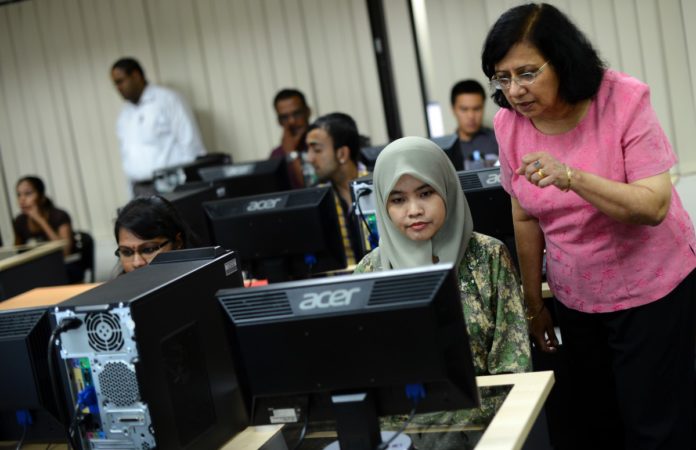
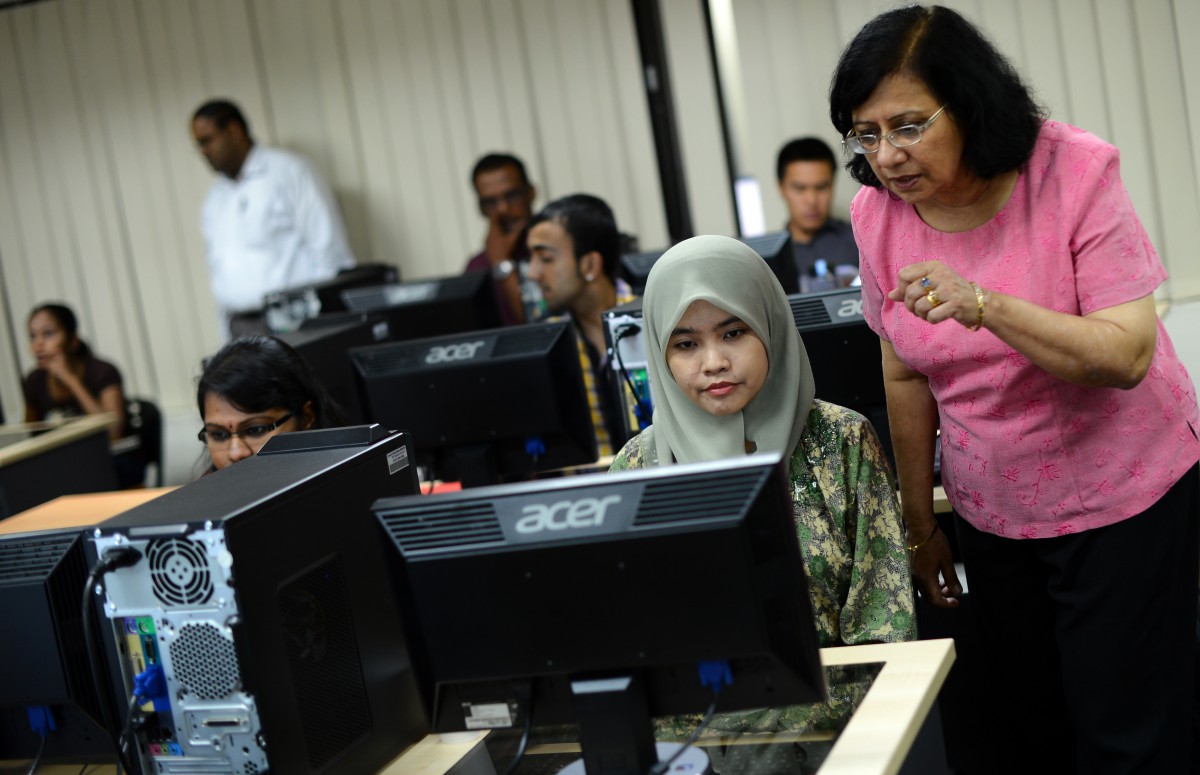
Students prepare for an exam in front of their computers at Kuala Lumpur-based Asia e University (AeU). August 27, 2012. Source: Saeed Khan/AFP

A study by Microsoft and IDC on the digital transformation of the economy suggested that 85 percent of jobs in Asia Pacific will be transformed in the next three years.

“There is a learning crisis even though enrolments have gone up and even though educational expenditure has grown,” he said.

“We talk about ICT like it’s something normal in places like Singapore in a developed context. But in many of these countries, there is just not the bandwidth, there’s not the infrastructure, there’s not the teacher preparation that would be able to exploit that.”

Too little, too late

But it’s not simply an infrastructure or expenditure issue.

As the economy shifts to a more services-based economy and the nature of work changes so rapidly, schools that are already struggling with the basics are struggling to keep pace.

“People are in school but are they learning? What are they learning?” Gopinathan said.

“Even in those areas [of maths, language and science] they are not being mastered adequately. And now we load on to that school the 21st century competencies of critical and creative thinking and all the rest of it.”

This is not a problem restricted to only those countries with poor educational standards. It appears this is almost universal.

Speaking to young professionals in Singapore, they also shared concerns that their public school education in the city-state did not prepare them for the job market that was waiting for them when they graduated.

SEE ALSO: Which Singapore graduates are most employable in the world?

“No, I do not think so,” Isabel Leong (not her real name) said when asked if she thought her Singaporean education had prepared her for work.

“I find the education system focuses too much on theory and not as much on life skills. The streaming and grouping of students on their learning abilities (in theory) also do not encourage students to pursue their other talents which are non-academic.”

This was echoed by Eugene Lim, another Singaporean who feels there is too much emphasis on theoretical knowledge over practical experience, leaving him lacking once he entered the work environment.

“I felt I had no one to guide me in school and had to learn a lot of life skills from my work colleagues and mentors instead,” he said.

To bridge the gap between education and skills, many people choose to go to university. Especially those in countries with lower educational attainment.

The public perception in these poorer countries is that the public system has failed them and the only way parents feel they can prepare their children for is to send them to college, Gopinathan said.

Enrolment in tertiary education has skyrocketed across the region. Universities in East and Southeast Asia have experienced significant expansion in the last few decades with enrolment in higher education in Asia increasing by over 50 percent in the last 10 years.

Graduate unemployment

But even making the decision to attend college or university can come with risks and doesn’t always have the desired outcome.

Professor Gopinathan says a glut of private colleges have opened up in Indonesia and Thailand to capitalise on the influx of prospective students. He warns they provide sub-standard education and offer degrees that are not relevant.

Students are graduating in droves, qualified for jobs that don’t even exist in their home countries.

Even a relevant degree from a reputable university doesn’t guarantee you a place in your chosen field.

While a degree can give you the technical know-how, that’s not necessarily all employers are looking for.

At a time when the job market is changing so quickly – bear in mind, 65 percent of children entering primary school today will be employed in jobs that do not yet exist – technical knowledge ages fast, and graduates need other skills to be able to adapt.

SEE ALSO: Millennials are ‘uneasy’ about the future, have dim view of employers

“Employers today are looking for not just technical expertise and knowledge, but also key 21st century competencies such as communication skills, critical thinking, innovation, adaptability and more to take on the challenges of this fast-changing economy,” Rob Bryson, Managing Director at Robert Walters Singapore, told Asian Correspondent.

“Many young people we speak with today have the right knowledge and qualifications – but they need to be able to prove to employers that they have the 21st century skills to take on whatever the future brings.”

Richer countries are able to bridge this gap. Singapore has launched a SkillsFuture programme in which the government is investing SG$70 million (US$50 million) over three years to train Singaporeans in key evolving sectors such as data analytics and cybersecurity.

This puts Singaporeans at a significant advantage to those people in countries lacking the resources or political will to implement similar plans at home.

2017-09-26T141406Z_1264911663_RC1A364F9760_RTRMADP_3_INDONESIA-VOLCANO

Indonesia President Joko Widodo (C) talks with children as he visits a temporary shelter for people who live near Mount Agung, a volcano on the highest alert level, on the resort island of Bali, in Karangasem, Indonesia, September 26, 2017. Source: Reuters/Agus Suparto

Indonesia’s President Joko Widodo is working to change this as he has made human resources development his number two priority after infrastructure. He has already implemented a vocational school and training programme.

He has also criticised universities, particularly economics faculties, for not pursuing innovation in the face of a changing world.

“Economics faculties only offer limited programmes like accountancy, management and economic development, while the world has already changed,” he said in 2017.

But the training programme is still in its early stages, and for those already falling through the gaps, the options can be limited.

Time to get self-sufficient

To avoid your country’s education system dictating your future prospects, recruiters have some advice.

Robert Walters recruitment heads in both Indonesia and Thailand stressed the importance of learning business English and language skills to give candidates a competitive edge in a global market.

“Language skills will make them attractive to both international companies and Asian companies looking to expand overseas,” said Gerrit Bouckaert, Robert Walters managing director for Thailand and Vietnam.

“Having a strong grasp of both Thai and English will help ease both internal and external communications and allow them to stand out among the competition.

“At the same time, Japanese and Mandarin can also be an asset for such companies as it is used significantly.”

Another suggestion is for graduates to pursue internships to gain valuable industry experience and make sure they’re up to date with the latest tech. Basically, anything they can do to learn how to adapt to different working cultures and environments to ensure they stay relevant in a fast-evolving economy.

And in an increasingly globalised and connected world where knowledge-sharing, collaboration and innovation have become crucial to progress, how to embark on these endeavours should no longer need to be taught.

Source link

Singapore’s driverless vehicle ambitions reach next milestone with new national standards

0

The set of provisional standards, called Technical Reference 68, will promote the safe deployment of fully autonomous vehicles here.

self driving shuttle bus

An EasyMile autonomous shuttle bus that will be on trial in NUS in 2019. (Photo: ComfortDelGro)

SINGAPORE: Singapore’s ambition to be at the vanguard of those deploying autonomous vehicles (AVs) got a shot in the arm on Thursday (Jan 31), after a set of provisional national standards to guide the industry was introduced.

READ: Self-driving vehicles on trial must have safety drivers, black boxes, MOT says

The standards, known as Technical Reference 68 (TR 68), will promote the safe deployment of fully driverless vehicles in Singapore, according to a joint press release by Enterprise Singapore, Land Transport Authority, Standards Development Organisation and Singapore Standards Council (SSC).

TR 68 was developed over the past year and is meant to guide the industry on the development and deployment of vehicles in the Society of Automotive Engineers (SAE) Level 4 and 5 bands. At these levels, the vehicle is fully autonomous in limited and all driving scenarios, respectively.

The SSC’s Manufacturing Standards Committee oversaw the development of the standards, which covers four areas: Vehicle behaviour, vehicle functional safety, cybersecurity and data formats.

Given that it is provisional in nature, TR 68 will continue to be refined as AV technology matures and with feedback from the industry, the press release said.

The introduction of the national standards was lauded by industry partners.

Mr Doug Parker, chief operating officer of Aptiv Autonomous Mobility, said the company is happy to have contributed to the standards as “it will facilitate the commercialisation of autonomous vehicles” in Singapore.

Aptive, the spin-off entity from automotive equipment Delphi, in 2017 bought US autonomous driving start-up nuTonomy, which has an office in Singapore.

Meanwhile, Mr Tan Nai Kwan, chief robotics engineer of Singapore Technologies Engineering Land Systems’ Robotics Business Group, said TR 68 is “much welcomed”  as it provides developers like itself with clear guidelines benchmarked against international standards.

READ: Singapore relooking road rules to allow for self-driving vehicles

The Singapore Government had previously said it will be introduce self-driving buses and shuttles in Punggol, Tengah and the Jurong Innovation District in 2022. The Ministry of Transport had also said it is relooking how road rules can be extended to such self-driving vehicles in the future.

Source link

Doctor at heart of HIV data leak to stand trial in May for drug charges

0

SINGAPORE: The doctor at the heart of the data leak of 14,200 HIV-positive people will be returning to court in May to stand trial for drug charges, the State Courts confirmed on Thursday (Jan 31).

Ler Teck Siang, whose partner Mikhy Farrera Brochez is suspected to have leaked the information online, is facing charges for allegedly trafficking methamphetamine to another man in a hotel, and for possessing drug utensils.

Ler’s previous job as head of the Ministry of Health’s (MOH) National Public Health Unit granted him access to Singapore’s HIV registry, and he mishandled the information of 14,200 HIV-positive people.

On Monday (Jan 28), MOH revealed personal information from the register, including phone numbers and medical records of HIV sufferers, had been leaked online, adding that Brochez is suspected to still possess the data.

Brochez was deported from the country in April 2018, after serving his sentence of 28 months’ jail for lying to the Ministry of Manpower (MOM) about his HIV status, along with other fraud and drug offences.

READ: Unanswered questions and information gaps remain about HIV data leak

Mikhy K Farerra-Brochez mug shot

Mikhy K Farerra-Brochez is suspected to have leaked the data of 14,200 HIV sufferers from Singapore’s HIV registry. (Photo: Clark County Detention Centre/Mugshots.com)

Ler, 37, will return to court on May 29 to face the drug charges, the courts confirmed.

The doctor was charged with eight offences in total. He has been sentenced for the first four, which include two charges of abetting Brochez to cheat MOM about Brochez’s HIV-positive status, and two charges of giving false information to the Ministry of Health (MOH) and the police.

The fifth charge alleged he failed to take reasonable care of confidential information of those who are HIV-positive, an offence under the Official Secrets Act (OSA). It has been stood down, or set aside.

This means the charge is still live and will be dealt with after the other charges have been settled.

DRUG CHARGES

The latest three charges are drug-related. According to charge sheets seen by Channel NewsAsia, Ler was charged for the first drug offence in September last year while his trial for abetting Brochez to cheat MOM was ongoing.

He is accused of failing to provide a urine specimen to a Central Narcotics Bureau (CNB) officer within the required time in March 2018. The charge has also been stood down and the offence is punishable with a maximum 10-year sentence, $20,000 fine or both. 

READ: Mikhy Brochez, American wanted in Singapore for HIV data leak, charged in US for trespassing

Ler was slapped with the other two drug offences on Nov 16, after he was convicted of the first four proceeded charges.

He is accused of trafficking and administering methamphetamine at a hotel room in Swissotel The Stamford on Feb 26, 2018 to another man, Mr Sim Eng Chee. He faces a maximum 20 years’ jail term for this, with 15 strokes of the cane.

He was also allegedly found with drug utensils at the Conrad Centennial hotel lobby on March 2, 2018. The maximum sentence for this is a fine of S$10,000 and three years behind bars, or both.

Source link

Singapore must stay connected to the world or cease to be relevant: ESM Goh Chok Tong

0

SINGAPORE: As Singapore commemorates its bicentennial, it is imperative the country stays connected to the world or cease to be relevant, said Emeritus Senior Minister Goh Chok Tong on Thursday (Jan 31). 

“You can say the world discovered Singapore 200 years ago. Since then Singapore has also discovered the world,” said Mr Goh.

“Singapore being a little country needs to be connected to the world. Otherwise we will cease to be relevant,” he added.

READ: ‘We are never done building Singapore’: PM Lee at launch of Singapore Bicentennial

READ: Light installations, augmented reality trail to kick off Singapore Bicentennial

Tan Chuan-Jin photo exhibition 1

The exhibition featuring photos taken by Speaker of Parliament Tan Chuan-Jin will be opened to the public from Feb 1 to Feb 28. (Photo: Vanessa Lim) 

He also said that despite its size, Singapore is a medium-sized economy in the world because it adds value to others.

Mr Goh was speaking at the launch of a charity photo exhibition by Speaker of Parliament Tan Chuan-Jin, which was held in conjunction with Singapore’s Bicentennial commemoration.

Beyond staying connected with the world, Mr Goh also called for a more concerted effort to build an inclusive society at home. 

Tan Chuan-Jin photo exhibition 2

All proceeds from the event will go towards 13 charities to help low-income families, ex-offenders and others in need. (Phtoo: Vanessa Lim) 

“The Government has done more to support social mobility and integration, but we in the community – businesses, voluntary welfare organisations (VWOs), private individuals – also have a responsibility to contribute,” said Mr Goh.

The exhibition, named Our Place in the World, features 30 photographs taken by Mr Tan during his travels over the last 20 years. 

“I realise just how much we have in common as a human race around the world. We may all have different roots, different journeys, different homes, but we do share a common humanity that ties everyone together,” said Mr Tan. 

Tan Chuan-Jin photo exhibition 3

One of the photos at the exhibition taken by Speaker of Parliament Tan Chuan-Jin. (Photo: Vanessa Lim) 

Located at the second level concourse of Far East Plaza, the exhibition will be opened to the public between Feb 1 and Feb 28. Individuals can make donations to support fundraising efforts. 

All proceeds will go towards 13 charities to help low-income families, ex-offenders and others in need. Participating charities include Mediacorp Enable Fund and The Turning Point. 

Source link

‘No malice or cruelty’: Pest control company Anticimex rejects claims of mishandling snake at Tang Plaza

0

SINGAPORE: There was no malice or cruelty towards the snake outside Tang Plaza during its capture, said pest control firm Anticimex on Thursday (Jan 31) after the Agri-Food and Veterinary Authority of Singapore (AVA) said it was investigating claims that the animal was mishandled.

AVA announced on Tuesday that it was investigating the case after a video on social media showed an Anticimex employee stepping on a 3m-long python while attempting to capture the struggling animal.

READ: AVA investigating alleged mishandling of snake at Tang Plaza

The authority previously said: “Cruelty to animals is an offence under the Animals and Birds Act. AVA has issued a set of guidelines on the proper handling of snakes to all pest control and wildlife management agencies in Singapore.”

In response to this, Anticimex told Channel NewsAsia that the workers involved “used all necessary parts of their bodies to safely relocate a very large snake in a public place”.

“A foot is no different to a hand being used in an attempt to restrain a powerful animal, and in fact the human leg is stronger than the arm for this purpose,” said Mr Tony Hurst, managing director and president Asia, Anticimex.

He added that not restraining the reptile by any means available when it attempted to evade containment “could have had disastrous consequences” in crowded areas like Tang Plaza, which is in Orchard Road.

“The situation called for quick, reactive instinct and action under a highly volatile and unpredictable situation,” he said. “The importance of protecting the human public will always supersede other considerations.”

“Moments of indecision in situations such as these could cause greater harm, so we are thankful the staff acted quickly when the situations called for it,” Mr Hurst added.

Snake Tangs Plaza

Screengrabs of a Facebook video showing the attempt to capture a python at Tang Plaza. 

The video circulating online also showed that the man who stepped on the python was bitten by the snake. 

Anticimex said that the pest control technician involved in the incident was recovering after a minor operation to remove an embedded snake tooth.

“Even after our technician was bitten, there was no malice or cruelty towards the animal, only efforts to contain it and prevent harm,” added Hurst.

Source link

HSA raises alert on Deeja, RDL cosmetic creams containing mercury

0

SINGAPORE: The Health Sciences Authority (HSA) on Thursday (Jan 31) warned the public not to buy or use four cosmetic creams found to contain mercury, a toxic metal.

One of the products, Deeja Cosmetic Wrinkle cream, was found to contain mercury levels exceeding the permissible limits by more than 40,000 times.

The other three products are: Deeja Cosmetic Sun cream, RDL Babyface Whitening Cream Night Cream 5 in 1 and RDL Face Off Fade-Out Cream Day Cream 5 in 1.

Mercury, a toxic heavy metal, is prohibited for use as an ingredient in cosmetic products.

Regular application of creams containing mercury could lead to rash, skin discolouration and blotching. Long-term exposure to high levels of mercury in cosmetic products can cause serious health consequences including damage to the kidneys, digestive and nervous systems.

RDL cosmetic creams collage

RDL Babyface Whitening Cream Night Cream 5 in 1 (left) and RDL Face Off Fade-Out Cream Day Cream 5 in 1. (Photos: Health Sciences Authority)

The authority also raised an alert over another product, Deeja Cosmetic Dream cream, which was found to contain hydroquinone, a skin lightening agent.

Hydroquinone is a potent ingredient used in prescription medicines for the treatment of skin conditions.

Inappropriate use of hydroquinone, especially in high concentrations, can cause changes in skin colour and hypersensitivity reactions such as rashes, skin redness, tingling and burning of skin.

The three Deeja creams are part of a cosmetic box set sold on local online platforms, said HSA.

“The Deeja cosmetic creams carry false claims such as ‘made and specially formulated from 100% natural ingredients’ as they contain prohibited substances,” said the authority.

The RDL cosmetic creams were imported by Arklife Distributors and sold in retail outlets.

HSA has told the distributors to stop selling the creams and to recall the affected products from retail outlets.

The RDL creams were also sold on online platforms. Platform administrators have been directed to remove the web listings of all the affected products, said HSA.

The authority advised consumers to stop using the affected products immediately and to see a doctor if they experience adverse effects.

It also directed all sellers and suppliers to stop selling the products immediately.

Anyone who supplies illegal health products can be jailed for up to three years and/or fined up to S$100,000.

Source link

SCDF paramedics to be equipped with body-worn cameras from Feb 1

0

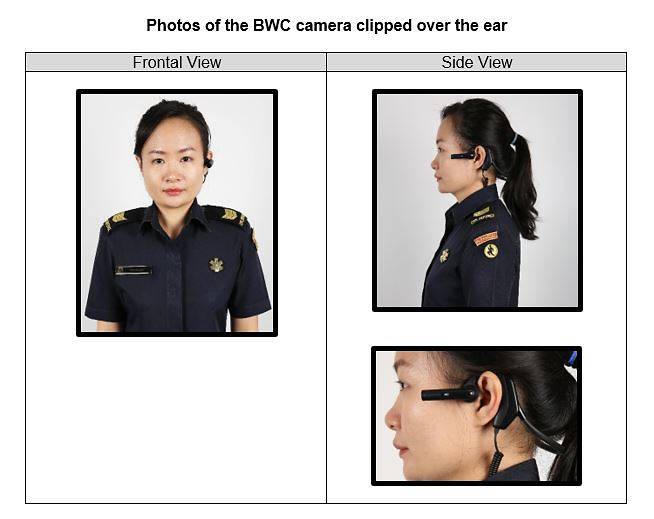
SINGAPORE: Paramedics from the Singapore Civil Defence Force (SCDF) attending to medical cases will be progressively equipped with body-worn cameras (BWC) from Feb 1 (Friday).

By 2020, SCDF expects to roll out the compact device worn over the ear to all its paramedics.

These cameras will “improve the quality and effectiveness” of SCDF’s emergency medical services (EMS), said SCDF.

The recordings will be used for coaching and training purposes, and to fine-tune SCDF’s medical procedures, it added in a Facebook post on Thursday.

In the long-term, SCDF intends to incorporate live-streaming capabilities into the cameras to allow off-site doctors to provide medical advice to paramedics attending to complex cases on the ground if needed.

Photos of SCDF's BWC camera

(Image: SCDF)

It will also “help provide for greater accountability with regard to the interactions between ambulance crew members and EMS patients”, added SCDF. 

However, it assured that paramedics will stop recording in certain situations to respect the privacy of the patients.

“ROBUST CONTROL MEASURES”

“Paramedics will stop recording in certain situations to respect the privacy of patients, such as maternity cases,” SCDF said. 

“This is part of our efforts to use technology to enhance our emergency ambulance operations and improve patient outcomes,” said Assistant Commissioner Yazid Abdullah, director of SCDF’s medical department.

Robust robust control measures to regulate the use of the BWCs and the recorded data, have been put in place, he added.

For example, only authorised personnel will be allowed to handle the collection, storage and use of the data, SCDF said.

“Any access to the data will be logged to enable audit checks. The data will be encrypted for added security.”

​​​​​​​

The data will also be deleted after 90 days from the date of recording, unless there is a need to retain it, such as to assist the police with investigations. 

Any officer who misuses the body-worn cameras or data will be dealt with severely, added SCDF.

Source link

More local employment in Q4, overall improvement in labour market in 2018: MOM

0

SINGAPORE: The labour market improved in 2018, with employment of locals growing in the fourth quarter of last year, said the Ministry of Manpower (MOM) on Thursday (Jan 31). 

The annual average unemployment rates were lower than a year ago, while retrenchments were “significantly fewer”, added MOM.

Total employment, excluding foreign domestic workers, increased by 15,600 in Q4. That was slightly lower than the 16,700 increase in Q3, the report revealed. 

“The increase was due to employment growth in services, primary from seasonal hiring. Manufacturing employment decreased over the quarter, while Construction employment was unchanged,” MOM said.

READ: Singapore’s economy to see ‘slower but still firm’ growth for rest of 2018 and next year: MAS

READ: Retrenchments down, pace of hiring picks up in Q3

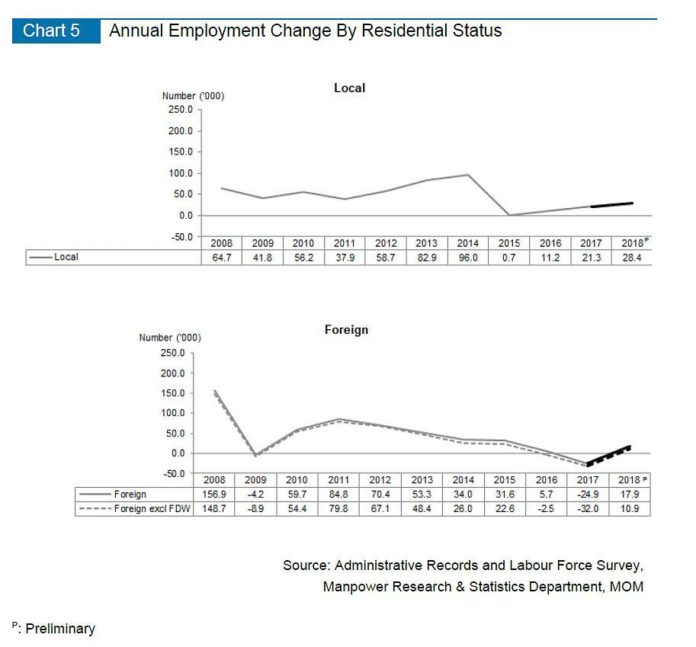
Overall in 2018, total employment, excluding foreign domestic workers, grew by 39,300, with the growth among locals at 28,400 – more than double that of foreigners. Local growth was primarily in the services industries, such as community, social and personal services, and financial and insurance services.

retrenchment figures

Annual employment change by residential status. (Graphs: MOM)

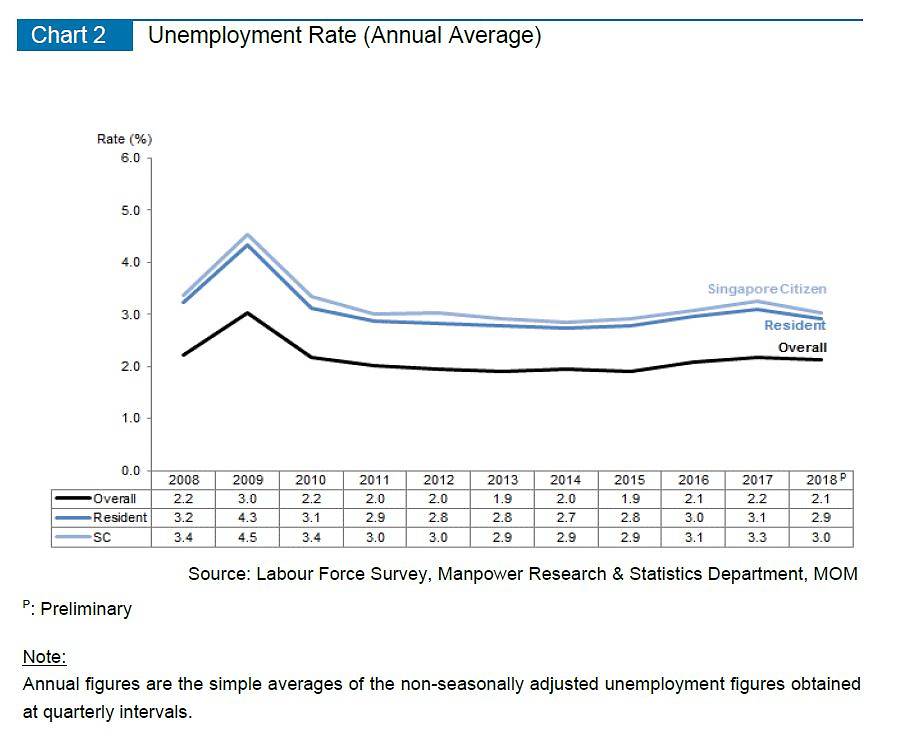
According to the latest report, average unemployment rates were lower in 2018 than the year before, but overall unemployment rate was higher in the last quarter of the year. It rose from 2.1 per cent in September 2018 to 2.2 per cent in December 2018, MOM said.

unemployment rates seasonally adjusted

Annual average unemployment rate. (Graph: MOM)

READ: Total employment grew at faster pace, fewer retrenchments in Q3: MOM

The number of retrenchments were also “significantly lower” in 2018 compared to the year before because of the economy’s continued expansion, the report concluded.

Last year, 11,020 people were laid off while 14,720 were retrenched in 2017.

For the fourth quarter, retrenchment numbers stood at 2,800, similar to the 2,860 retrenchments recorded in Q3 and lower than 3,680 a year ago.

employment change

Annual retrenchment figures. (Graph: MOM)

Singaporean workers continued to earn higher incomes in the last five years as well, said MOM. It added that the real median income, including employer CPF contributions, of full-time employed Singaporeans increased by 3.6 per cent per annum from 2013 to 2018, significantly higher than the 1.7 per cent per annum in the previous five years.

The labour growth outlook for Singapore “will remain modest due to the underlying demographics of an aging population and low birth rates”, noted the ministry.

“As economic growth moderates, workers and businesses need to remain agile and responsive to economic restructuring and the evolving employment landscape,” it concluded.

Source link

Lazada to fold RedMart into its platform, signals entry into online supermarket business

0

The e-commerce company had acquired RedMart in November 2016, but kept it as a standalone entity until now.

Lazada RedMart

File photos of Lazada and RedMart logos. 

SINGAPORE: E-commerce company Lazada on Thursday (Jan 31) announced it will make its foray into the online supermarket in Southeast Asia starting with Singapore, with the integration of RedMart into its platform. 

RedMart, which Lazada acquired for an undisclosed sum in November 2016, will move over to the e-commerce platform from Mar 15 this year. Lazada said this will allow shoppers to buy groceries and fresh produce along with the other products already on its online shopping site in a single location.  

Orders on the new RedMart on Lazada will continue to be fulfilled by the online grocer in customers’ chosen delivery slot between 7am and 10pm, while orders with other Lazada sellers will be fulfilled separately, the press release said. 

Existing RedMart customers can continue shopping on the existing app and website until 11.59pm on Mar 14, before the migration kicks in. They will have to download the Lazada app to continue using the service after that, it added.

RedMart co-founder Rodger Egan

RedMart co-founder Roger Egan appointed to spearhead Lazada’s online supermarket expansion plans. (Photo: Kevin Kwang)

This move is aimed at catering to the rising demand of supermarket shopping as consumers increasingly buy their groceries online, the company said. It said the grocery market in Southeast Asia is expected to be worth US$309 billion by 2021.

It added that it is looking to launch its grocery and supermarket business in at least one other city from the second half of this year.

RedMart co-founder Roger Egan will spearhead Lazada’s push into the supermarket business in Southeast Asia. He will oversee the expansion, launch and operations for its supermarket business and delivery network across the region, the release said. 

Source link

Commentary: Are SingPost’s lapses indicative of a deeper malaise in the company?

0

SINGAPORE: In a digital age where transactions, notifications and records have been digitalised, you would think the postman gets it easier.

But news of SingPost’s investigations this week after fresh images of mail found in a rubbish bin in Ang Mo Kio went viral and its subsequent update that it has referred the case to the Police have touched a raw nerve.

Last year, SingPost fired a postman after he was found to have thrown away returned letters and direct mail at a condominium, and a video of someone confronting the man and claiming he had just thrown a stack of letters into a rubbish bin had gone viral.

SingPost too had issued an apology just two weeks ago after receiving a string of complaints regarding undelivered mail from residents.

BOARD RESPONSIBILITY

These operational lapses have raised questions as to whether the company’s board of directors ought to be held responsible. 

Are these episodes management failures that could have occurred even with the best corporate governance in place, or could they be indicative of the board failing to exercise adequate oversight and discharging their responsibilities?

The answer lies in the extent to which the board has taken necessary and reasonable steps when it became aware of problems. 

Under Singapore’s Companies Act, the board of directors is responsible for managing, directing and supervising the company, and directors are required to act honestly and use reasonable diligence in the discharge of their duties. 

In most companies, the board delegates the day-to-day management role to a management team led by the Chief Executive Officer or equivalent, with the board’s role then focused on advancing the interests of the company and its stakeholders, through overseeing, guiding and holding its management accountable. 

SingPost locker

A woman uses a locker station operated by Singapore Post. (Photo: Kamini Devadass)

​​​​​​​

But as part of its oversight role, the board is expected to ensure the necessary resources are in place for the company to meet its strategic objectives.

The board also has to ensure that there are proper policies, procedures and controls which are implemented in practice. It is responsible for appointing an ethical, competent and committed management team, and putting in place independent audit functions that provide reasonable assurance that the policies, procedures and controls are adequate and effective.

REVIEWING SINGPOST

Let’s now consider the reported service failures at SingPost – including stacks of letters left on top of letter boxes, letters being thrown away, postmen delivering failed delivery notices but not actually ringing people’s doors and leaving parcels on people’s doorstep, as well as allegations of falsifications of proof of delivery. 

SingPost had blamed a seasonal surge in demand over the November to December period, and cites additional 20 doorstep deliveries each day. Yet some readers say these problems seem to be longstanding ones that occur throughout the year so it is difficult to see how the fault can be attributed to seasonal factors. 

Seasonal surges in demand are also recurrent in nature in the business of mail delivery so it is reasonable to expect the management to have forecasted demand and allocated the necessary resources to meet it.

SingPost had also attributed the incidents to the individual actions of a few wayward employees. But many of these service failures are clearly not new. For some years now, there had been complaints of failed delivery notices despite households having someone at home at those times. 

SingPost had then referred the most recent case of mail seen in an Ang Mo Kio rubbish bin to the police, which may go some way to deter future rogue acts by errant postmen but might this distract from the crux of these problems? And will it solve any potentially deeper corporate governance issues? 

singpost letters found in bin at ang mo kio

The resident says she found around 30 to 40 letters inside the rubbish bin. (Photo: Facebook/Alyce Kathlyn)

READ: Postman arrested after Ang Mo Kio resident reports unopened mail found in rubbish bin

PAST TROUBLES RISING BACK TO THE SURFACE?

Between 2015 and 2016, a number of corporate governance concerns over SingPost’s business operations were raised in a series of news reports and commentaries, which later contributed to an overhaul of the company’s board and senior management. Understanding what some of these woes were for SingPost those years ago may illuminate the root of the service lapses in recent months. 

One concern was whether SingPost’s ventures into e-commerce and other areas would affect the quality of its traditional postal services, and how equipped SingPost was to drive this new business model. 

Over a five-year period, the company made more than 20 acquisitions, spending over half a billion dollars to transform SingPost from a mail delivery business to a logistics and e-commerce business. 

With traditional postal services relegated to a sunset industry, there were concerns the company may lose sight of ensuring service standards are maintained, when other areas promise more potential for growth and hold greater lure for investors with deep pockets.  

READ: Are Singapore businesses just not creative enough? A commentary

A second concern was whether some of the long-serving independent directors who had been there for almost two decades had been there for too long. Did they have relevant experience and skills in the context of SingPost’s transformation? Might they have been overstepping their boundaries in making decisions they might not be equipped to? 

Some of these directors formed an unusually active executive committee, blurring the lines between the role of company management and that of the board. The last acquisition made by the then board and executive committee – the US e-commerce company TradeGlobal – cost the company S$236 million but had to be impaired by S$185 million just one-and-a-half years after.

The board had also recruited then 37-year old Dr Wolfgang Baier as CEO (International) in 2011 and promoted him to Group CEO the same year. They also appointed Dr Sascha Hower Group Chief Operating Officer in 2012 when he was 33. Both left in 2016. 

A third concern was whether the management team was equipped to integrate and manage the new businesses. Based on the disclosures of their profiles at the time of the appointment, Dr Baier and Dr Hower were career consultants with little or no experience managing companies. Several other consultants were also appointed to key management positions. 

Then there was the high turnover of management, both in the years preceding the appointment of Dr Baier, and following his departure. Stock exchange rules only require disclosure when directors and certain key officers leave so it is unclear whether this was indicative of a similarly high employee turnover throughout the company which may suggest a deeper malaise. 

Wolfgang Baier former Singpost CEO

Wolfgang Baier, the former Group CEO of SingPost. (Photo: SingPost)

A HEAVY BURDEN FOR THE CURRENT TEAM AT SINGPOST

Today, SingPost’s board and senior management team are unrecognisable from those years.

A new group CEO took over in June 2017, a new group CFO in August 2018 and a new CEO for postal services and Singapore will be taking over in April 2019. Hopefully, a stronger and stable management team is now in place but it will not be easy to turn this ship around, and not when a COO has not been appointed since Dr Hower left in 2016, a role that bears the heavy responsibility of optimising group operations.

READ: Get rid of middle managers? Do so at your own peril, a commentary

The current directors and senior management have the task of sewing up remaining corporate governance issues, reviewing the over 20 acquisitions made, improving operations, all while feeling the pressure from shareholders, an inherited legacy the new team will have to struggle with for some time.

These issues from the past may affect SingPost’s day-to-day operations if business controls have been weakened, including those relating to employee recruitment, induction, training, welfare, supervision and assessment – fueling frustration among its overworked and underappreciated postmen. 

SingPost’s share price has dipped to about 60 per cent of what it was just before Dr Baier’s departure, and dividends have been cut. Public confidence too has been shaken when the recent few cases found huge traction with readers who say they experienced similar issues.

While the current board has taken steps to improve SingPost’s corporate governance and put in place a new management team, it needs to ensure that a thorough review of SingPost’s operations is conducted in light of the numerous lapses. 

It should certainly not dismiss problems by attributing these to seasonal factors or rogue employees without a comprehensive assessment of the complaints. 

This review has taken on even more urgency with the announcement by the Info-communications Media Development Authority (IMDA) that it will take firm action against SingPost for any breaches of its public postal licence requirements, that it “takes a serious view of any incident that impacts the reliability, integrity and security of Singapore’s public postal services”, and its direction that “SingPost must investigate all complaints and feedback raised, and take urgent steps to improve its service standards and restore public confidence in its postal services”.

Mak Yuen Teen is an associate professor of accounting at the NUS Business School where he specialises in corporate governance. The views in this article are his personal views.

Source link