Home Blog Page 851

The Big Read: Battered in the Middle East, IS eyes Southeast Asia as next terrorism hotspot

0

SINGAPORE: The terrorist group Islamic State of Iraq and Syria (IS) is today a shadow of its once-formidable self in the Middle East, with its army in tatters and its territories reduced to a sliver of turf.

But the IS ideology — which includes the setting up of a caliphate — is far from dead and buried.

And its supporters, including those who have returned home after fighting wars in Iraq and Syria, have now set their sights on turning South-east Asia into the next terrorism hotspot.

For IS, the region has all the ingredients needed to become its next cauldron of violence: Porous borders, existence of logistical bases, weak regimes, poor enforcement measures and disenchantment among marginalised Muslims.

“Southeast Asia has been dubbed as the second front for IS,” said Professor Mohd Kamarulnizam Abdullah, who researches on terrorism and religious violence at Universiti Utara Malaysia.

The region already has had a taste of ISIS-style terror in recent years. In 2016, ISIS-linked militants launched a gun and bomb assault in the centre of Jakarta, killing several people.

Last Sunday (Jan 27), a Roman Catholic cathedral on the island of Jolo in southern Philippines was bombed as worshippers gathered for mass. ISIS claimed responsibility for it.

Although Singapore has been fortunate enough not to have experienced any violent attack, it will become increasingly harder to keep the country secure from the threat as the web of terror closes in on the island.

While the Singapore Government has repeatedly stressed that a terror attack here is not a matter of if but when, there remains a sense of complacency among Singaporeans.

A recent report by the Ministry of Home Affairs (MHA) showed that only 20 per cent of Singaporeans felt that the terrorist threat was imminent.

The MHA’s Singapore Terrorism Threat Assessment Report 2019 also said that the Republic’s “most pressing threat” comes from IS.

In 2016, an IS-inspired plot to attack Marina Bay Sands from the Indonesian island of Batam — a 40-minute boat ride from Singapore — was foiled.

Mr Joseph Franco, a research fellow at the S Rajaratnam School of International Studies (RSIS), said

Even if you’re strong security-wise but exist in a bad neighbourhood, you can’t help but always look over your shoulders.

THE REGION: A SECOND WAVE OF TERRORISM

The first wave of terrorism crashed into Southeast Asia in 2002, starting with the devastating bombings in Bali that year. It lasted till 2008, according to last year’s Global Terrorism Index, with terrorist groups the Philippines’ Moro Islamic Liberation Front (MILF) and Indonesia’s Jemaah Islamiyah (JI) — which has ties to Al Qaeda — being responsible for 301 and 274 deaths respectively.

The second wave came in 2016, amid ISIS’ rise. As a result, Southeast Asia saw a 36 per cent increase in deaths due to terrorism from 2016 to 2017.

In 2017, militant and insurgent groups championing separatist causes, which later forged alliances or became affiliated to IS, committed 348 terror acts which resulted in 292 deaths. They came from countries including Bangladesh, Indonesia, Malaysia, Myanmar, the Philippines and Thailand.

Research fellow Muhd Faizal Abdul Rahman from RSIS’ Centre of Excellence for National Security pointed out that “partnerships” between militant groups are not new.

The 10,000-strong Moro Islamic Liberation Front (MILF), which has been fighting for a Muslim

The 10,000-strong Moro Islamic Liberation Front (MILF), which has been fighting for a Muslim homeland in the largely Catholic Philippines for decades, is warning of the growing strength of Islamic State group-affiliated groups in the region. (Photo: AFP/Ferdinand Cabrera)

They existed back in the days when Al Qaeda was at its zenith, forming ties with JI. The latter group sent its members to Afghanistan to train and gain combat skills under Al Qaeda and learn its doctrine.

Similarly, aligning themselves with ISIS “facilitates the exchange of talent, skills and material resources” with local and regional groups, said Mr Faizal.

Smaller militant or terrorist groups would also attain a higher level of legitimacy and support if they associate themselves with IS’ ideology, which seeks to establish a caliphate through a final battle between good (Muslims) and evil (non-believers).

“It is more important to sustain the will to fight even when the means to fight is suppressed by security forces,” said Mr Faizal.

Counterterrorism analysts also pointed out that by working together, the different groups can eliminate their common enemies — Western forces and governments that they claim to have exploited and marginalised Muslim communities — on multiple fronts.

Such collaboration was exemplified during the Marawi siege in southern Philippines in 2017. Pledging allegiance to IS, a number of militant groups banded together to attack and take control parts of the city, before they were defeated by government forces after months of battle.

Although the militants lost, the siege underscored IS’ reach in the region, said analysts.

The Global Terrorism Index report said that the battle of Marawi was a “defining moment” in Islamist terrorism in the Philippines. Following that, IS’ online propaganda has urged foreign fighters to travel to the Philippines and other Southeast Asian outposts.

Mr Franco said that even after the Marawi siege, there continues to be militant groups — whether aligned to IS or not — operating in the Mindanao region.

“With access to illegal firearms, they continue to pose a threat,” he said.

About 18 years after the Sep 11 attacks in the United States — which were carried out by the Al Qaeda — the terrorism threat has evolved and possibly become more potent, said analysts.

Dr Mohamed Ali, an RSIS expert in religious extremism, pointed out that previously, the definition of a terrorist was clear-cut: He or she had to pledge an oath and be a member of a terrorist group.

Now, however, individuals can just carry out attacks in their homelands without having to go through military training.

“They can be anyone and can strike alone and out of the blue,” he added. “That makes them more dangerous.”
The rising exclusivist sentiment in the region, namely in Indonesia and Malaysia, has also added fuel to fire.

Last December, thousands of Muslim Indonesians took to the streets to commemorate the series of rallies held in 2016 that targeted a former Jakarta governor, who is a Christian.

READ: Old rivals face off in Indonesia ahead of elections, a commentary

Basuki Tjahaja Purnama

Jakarta’s Christian governor Basuki Tjahaja Purnama (centre), popularly known as Ahok, was jailed for two years after being found guilty of committing blasphemy. (Photo: AFP/Bay Ismoyo)

Days after, Malaysians rallied in the capital city of Kuala Lumpur to call on the government to preserve Islam as the country’s national religion and protect the rights of the Malays.

Mr Faizal stressed that exclusivism “forms the pathway to terrorism”.

“A person goes through the cognitive process of exclusivism before he is further radicalised into a terrorist. Exclusivism conditions an individual’s mind and values into believing that others are less human, less moral and deserves to be harmed,” he added.

Dr Mohamed Ali warned that the harm caused by exclusivist ideas could be more damaging than the effects of terror attacks. It leads to different racial and religious communities alienating one another and breeding suspicion. The result: A weakening of the country’s unity and social fabric, he added.

INDONESIA: CHANGING FACES OF TERROR

Last May, an Indonesian family of six were involved in back-to-back attacks on three churches in the country’s second-largest city of Surabaya.

The incident drove home the point that the terrorism threat in Indonesia had evolved in two areas: The people conducting the attacks and the weapons used.

READ: Why the use of women and children raises the stakes in the fight against terrorism, a commentary

Relatives and friends of Martha Djumani attend her funeral in Surabaya

Relatives and friends of Martha Djumani attend her funeral in Surabaya AFP/JUNI KRISWANTO

Indonesian counterterrorism expert Dr Noor Huda Ismail noted that terrorist operations have morphed from group operations to lone wolves, and later involving women as well as the entire family unit.

It is part of the IS doctrine to involve the entire family as part of efforts to establish a caliphate, he pointed out. In its propaganda magazines Rumiyah and Dabiq, it has been stated that the role of women is to breed the next generation of terrorists.

Another reason why terror attacks now involve women and the entire family is because Indonesian authorities have successfully destroyed many terrorist networks in the country.

“So, IS supporters have to change their tactics,” added Dr Noor Huda, who founded the Institute for International Peace Building to rehabilitate and reintegrate former terrorists into the society.

Using household items as weapons to inflict damage is also the new norm. No longer is it necessary to make or smuggle in traditional bombs or firearms to carry out an attack, said Dr Najib Azca, the director of the Centre for Security and Peace Studies at Indonesia’s Gadjah Mada University.

IS has indoctrinated its followers to believe that if they cannot join its fight in Syria and Iraq, they can carry out attacks in their homelands as part of the jihad (armed struggle), he said.

To do that, they can use vehicles to ram into crowds, or simply use household items like a kitchen knife to stab as many people as they can, said Dr Najib.

He cited the case of an Indonesian woman Dian Yulia Novi, who planned to use a pressure-cooker bomb to attack the Presidential Palace in 2016, but was arrested before she could do so.

“Those (household items) are also equally effective in killing people,” he added.

READ: Surabaya bombings and the conundrum of family suicide bombers, a commentary

Indonesia bombings

Indonesian K9 police examine a site following attacks outside the Surabaya Centre Pentecostal Church (Surabaya Gereja Pantekosta Pusat) in Surabaya, East Java. (Photo: AFP/JUNI KRISWANTO)

In Indonesia, the authorities also have to deal with another conundrum: Radicalisation taking place behind bars, partly due to the lack of capacity in the prisons.

The country’s 477 prisons are meant to house 125,000 inmates, but have ended up being crammed with more than 254,000 prisoners.

This has resulted in arrested jihadists being placed in the same cells as offenders of other crimes. “That’s where they influence the others,” said Dr Noor Huda.

In some parts of the country such as Solo, he noted that jihadists sit at the top of the moral hierarchy in prisons as they are regarded as “pure and enlightened”.

“So, what happens is that other prisoners will go to them for Islamic teaching, and they too get radicalised. For the jihadists conducting the teachings, they become more hardcore.”

The Indonesian authorities also have to grapple with the return of citizens who had taken part in foreign wars.

A study by the US-based non-profit organisation Soufan Center and the Global Strategy Network released last year tracked 5,600 fighters who had returned to their home countries. Among them were 50 Indonesians.

Dr Noor Huda said that in areas such as the Indonesian city of Medan, the returning fighters would be welcomed as “mujahideen”, a title given to those who had engaged in jihad. They could then pass on their experience and the teaching they had received.

The release of extremists from prisons and back into society poses yet another threat.

Last week, the government of President Joko Widodo faced a backlash after it announced that the JI’s spiritual leader and mastermind of the Bali bombings, Abu Bakar Bashir, would be released early from prison on medical grounds. The Indonesian government later said it will review the issue.

There were concerns over the move as the 80-year-old ailing cleric is still regarded as influential, and could continue to inspire others to wage jihad.

READ: Don’t win the battle against terrorism but lose the war on radicalisation, a commentary

Dr Najib said the announcement of Abu Bakar’s release comes at a politically sensitive time, as the Muslim-majority nation is preparing to elect its next president in April.

“But it could come at a cost, because those individuals could influence others to be radicalised,” he added.
“For Indonesia, the battle against terrorism is still ongoing and there are always new elements that we have to deal with.”

MALAYSIA: POROUS BORDERS A CHALLENGE

According to the Institute for Policy Analysis of Conflict, 70 convicted extremists in Indonesia were released between January 2017 and August 2018. More are expected to be freed by the end of this year.  

Some came from the neighbouring countries of Indonesia and the Philippines. Others from as far as the Middle East.These foreigners entered Malaysia on work permits, and were later employed as labourers or construction workers.

While many were in Malaysia to earn an honest living, some others had nefarious intentions. 

According to Malaysia’s authorities, 445 terror suspects had been arrested since 2013 and more than 120 of them — or over a quarter — were foreigners, some of whom were directly involved in a number of plots planned by extremists groups.

Since 2013, the authorities have thwarted 23 planned attacks, including a plot to launch an assault at the closing ceremony of the Southeast Asian Games held in Kuala Lumpur in 2017.

However, in July 2016, Malaysia experienced its first successful IS attack after a grenade blast wounded eight people at a nightclub in Selangor.

Prof Kamarulnizam of Universiti Utara Malaysia attributes the influx of such extremists to the country to the region’s porous borders as well as Malaysia’s openness in welcoming Muslims from other countries.

“It is easy to slip in and slip out. You can go to the Philippines through Sabah, for example,” he added.

Extremists who come to Malaysia, they either stay here to plot attacks in the country, or they use Malaysia as a launching pad to other South-east Asian countries to carry out attacks.

Ahmad El-Muhammady, a counterterrorism analyst at the International Islamic University Malaysia, said the country has seen fewer arrests since the peak of 2013 to 2016. This, however, does not mean the “end of terrorism”, he cautioned.

“This is just a hibernation period,” said Mr El-Muhammady. “On the surface, it looks safe, but beneath it, extremists are secretly making plans and radicalising others.”

Even though the authorities have managed to crack down on terrorist networks such as JI, Al Qaeda or IS, analysts said they still pose a significant threat: Their ideologies are still floating around — whether online or offline — and are deeply entrenched in the minds of supporters and sympathisers.

“Total eradication of ideology is almost impossible. It can be tamed and ‘domesticated’, but not total eradication,” stressed Mr El-Muhammady.

Prof Kamarulnizam said that another worry is the return of Malaysians who had fought overseas. The study by Soufan Center and the Global Strategy Network estimated there were eight such fighters who had returned to Malaysia.

Ironically, the authorities had received personal requests from Malaysians who had fought in Syria, asking to be brought home, said Prof Kamarulnizam. They had burnt their passports after pledging allegiance to IS.
“Of course we cannot entertain them. The risk is too huge,” he added.

The situation in Malaysia, however, is not as bad as in Indonesia, said analysts. For instance, there has yet to be an entire family unit radicalised and plotting terror attacks, though Prof Kamarulnizam pointed out that there was a case of a family who had sold their land and used the money to travel to Syria.

Another issue of concern for Malaysia is “political radicalisation”, said analysts.

Mr El-Muhammady said it involves spreading exclusivist views where Muslims are told they cannot celebrate the festivals of other faiths and that they should not accept non-believers.

“It is a perfect ingredient for individuals to be led down the path of terrorism, when political radicalisation and terrorist radicalisation are merged together,” he added.

Abu Bakar Bashir is visited by Yusril Ihza Mahendra at Gunung Sindur prison in Bogor

Abu Bakar Bashir is visited by Yusril Ihza Mahendra at Gunung Sindur prison in Bogor. (File photo: Reuters)

SINGAPORE: LINGERING COMPLACENCY

Like many other countries, Singapore faces the risk of home-grown, self-radicalised “lone actors”, the authorities have said.

Since 2015, a total of 22 radicalised Singaporeans have been dealt with under the Internal Security Act — double the number between 2007 and 2014, according to the Singapore Terrorism Threat Assessment Report 2019

Singapore is also not immune to having radicalised foreigners on its home turf. Since 2015, 14 radicalised Indonesian domestic workers have been repatriated after they were found to have been radicalised.

Last year, three Malaysian work-permit holders were arrested for their suspected involvement in terrorism-related activities. Two were allegedly involved in a Johor-based group linked to S which was plotting attacks in Malaysia.

Dr Noor Huda said that domestic helpers working abroad are susceptible to radicalisation. They are alone in a foreign land with no friends and families. Muslim domestic helpers, in some instances, might also find it hard to reconcile working for non-Muslim employers.

One tactic employed by IS militants is to forge “romantic relationships” with the domestic helpers. Using various online platforms, they would target those searching for love.

Once romance is in the air, the radicalisation process begins. “Furthermore in Indonesia, marrying a religious man is seen as a step up,” said Dr Noor Huda, who recently organised a seminar on the issue for Indonesian domestic workers at the Indonesian Embassy.

Analysts said that Singaporeans’ attitudes towards terror-related issues are a source of concern.

“There’s still that thinking that terrorism is a Middle East problem. It will never happen here,” said Associate Professor Bilveer Singh of the National University of Singapore.

According to the MHA threat assessment report, a survey last year showed that 97 per cent of the respondents agreed that all Singaporeans have a role to play in preventing and dealing with a terror attack.

In addition, 60 per cent of the respondents recognised that Singapore is a target for terror attacks.
But there was also this finding: Only around 20 per cent felt that the threat is imminent, that an attack might occur in Singapore within the next five years.

Mr Faizal, the RSIS research fellow, said that “some complacency” still exists as “some Singaporeans may take our long period of peace for granted”.

He added: “But at the same time, it may also reflect that Singaporeans have a high level of confidence in our security agencies.”

READ: The secret group dynamics that fuel horrifying terror attacks, a commentary

MHA’s Senior Parliamentary Secretary Sun Xueling said that such a perception is “not completely unexpected”.

In an email response to queries, she noted: “Our security agencies have worked hard to keep the terror threat at bay, but therein lies the challenge of how to keep complacency at bay.”

As such, the Government is boosting its SGSecure efforts, a nationwide movement launched in 2016 to sensitise, train and mobile the society to prevent and deal with a terror attack, said Ms Sun.

Recently, she announced new initiatives under SGSecure, which include organising roadshows in suburban malls.

Ms Sun said ramping up SGSecure will “sustain the awareness amongst Singaporeans of the terror threat, and give more people the opportunity to pick up emergency preparedness skills”.

Asked whether SGSecure focuses more on preparing Singaporeans, and not so much on informing them of the different types of terrorism threats, she said that “being aware is an important first step, but it is not enough”.
SGSecure aims to prepare the community to collectively and effectively respond to such threats, and to an attack when it takes place, Ms Sun added.

In building an informed citizenry, Assoc Prof Singh noted that the Government could end up seen as being “too paranoid” if it puts out too much information.

Mr Faizal said that the authorities, in any case, should devise new ways to make the information attractive and easily digestible. They could do this based on current patterns of information consumption and themes that are currently popular.

He added: “We need different methods of communication to inform people of different ages, social groups and backgrounds.”
Source link

Advanced Facilitation Skills Training Course

0

Advanced Facilitation Skills Training Course
from Thursday, May 16, 2019 at 9:00 AM to Thursday, May 16, 2019 at 4:30 PM

Singapore Cliftons

108 Robinson Road, Singapore, 068900 Singapore

Source link

Zero Waste Masterplan to focus on electronics, packaging, food waste: Masagos

0

SINGAPORE: Singapore will relook the waste management cycle for three major streams of trash: Food waste, packing waste and e-waste, under its first Zero Waste Masterplan, Minister for Environment and Water Resources Masagos Zulkifli said.

The ministry has designated 2019 as Singapore’s Year Towards Zero Waste, in a campaign that aims to raise awareness of waste issues and the need to conserve resources.

At 21 per cent, Singapore’s household recycling rate is low when compared with other developed countries like Germany and South Korea. 

While Singaporeans are practicing better recycling habits, many of them are still doing it wrong, said Mr Masagos in an interview with 938NOW which was broadcast on Friday (Feb 1).

READ: 7 in 10 people in Singapore do not know what plastics to recycle: SEC report

The blue recycling bins placed at Housing and Development Board flats are “gradually becoming a more welcome sight in many estates”, but some still treat them as general waste bins, said the minister.

According to the National Environment Agency, about 40 per cent of the load collected from these bins is tainted.

“There’s still a level of abuse there,” Mr Masagos said. “Recyclable materials become useless if you throw food and liquids with them.”

READ: S$2 million grant to encourage zero-waste living

But not all is lost when it comes to using the blue bins. Mr Masagos said more residents are becoming better educated about proper recycling habits and are beginning to use the blue bins the right way.

“We used to have a problem putting them there but people actually want them there now. If we can achieve this simple act of not mixing food waste with other recyclables, our domestic recycling rate will improve significantly,” he said.

BYE BYE SINGLE-USED PLASTIC BOTTLES? 

Minister Masagos has also resorted to unusual methods to encourage his Tampines West constituents to adopt a zero-waste attitude. Single-use plastic bottles are now banned from the Community Club (CC).

READ: New service aims to cut out single-use plastic from takeaways, rent out containers for free

“I don’t see why we should be carrying around PET or single-use plastic water bottles. We should invest in reusable plastic bottles and fill them with tap water instead. 

“So that’s one zero-waste aspect that we’re encouraging in my own constituency, where in our CC we’ve banned PET bottles altogether. It’s something for all of us to get used to,” he said. 

masagos speaks to 938NOW on year of zero waste

Minister for the Environment and Water Resources Masagos Zulkifli with 938NOW’s Melanie Oliveiro. (Photo: MEWR)

ELECTRONIC WASTE

Electronic waste or e-waste is one of the waste streams that Mr Masagos is particularly concerned about due to its toxic nature.

“We are producing in excess of 60,000 tonnes (of e-waste) a year. This is equivalent to us all throwing one handphone a week,” he said.

To bring Singapore closer to its zero-waste goals, S$45 million has been invested in harvesting smart technology, as well as research and development. 

Mr Masagos said an example is finding other uses for the country’s incinerated bottom ash (IBA), which is usually dumped into the Pulau Semakau landfill. 

“We’re exploring the possibility of using R&D and technology to extract potentially toxic metals from the IBA. If we can do that effectively, then we can mix the IBA with construction materials and also use them to construct our roads,” he said.

Mr Masagos added that if this comes to fruition, the PUB would not have to worry about toxic metals leaching into Singapore’s water system when the IBA is reused.

READ: The long road to ensuring that Singapore’s waste doesn’t go to waste

“This is all part of an ecological framework. The upcoming Zero Waste Masterplan will therefore take into account the impact and beneficial effects our treated waste can have on our ecology,” he said.

Mr Masagos was speaking to 938NOW in its inaugural Question Time interview series which features weekly interviews with thought leaders and newsmakers.

To listen to the interview visit www.facebook.com/938Now/ or Download the MeRadio app.

Source link

In search of the real Singapore stories, beyond Raffles

0

SINGAPORE: It is an exploration of the dark side of Singapore’s colonial past: Fabric effigies of Stamford Raffles inspired by his statue in front of the Victoria Memorial Hall, but torn by the women who had made them.

The effigies were also tied with ropes and dyed. “You can see the scar marks of the ropes, like rope burns,” said artist Jimmy Ong, who described his artwork, Seamstresses’ Raffleses, as “something about dishonour rather than about heroism”.

“What I’m trying to say here is: Who gets to decide what our monuments are?”

The 53-year-old’s work represents a modern generation grappling with the legacy of colonialism. And 200 years after the British landed on a tropical island named Singapura, Raffles has been recast as both hero and monster.

Open Love Letters by Jimmy Ong featured a Stamford Raffles sculpture, seen here being fabricated.

Open Love Letters, another Jimmy Ong artwork featuring a Sir Stamford Raffles sculpture, seen here being fabricated, involved transforming it into a charcoal grill. (Photo: Jimmy Ong)


School textbooks say Singapore was founded in 1819. For generations, this has been accepted as the nation’s official start date, while many were taught that Raffles transformed the mangrove swamps into a bustling port.

But this understanding of the past, with its emphasis on the colonial era, is changing, as the series Becoming Singapore finds out. (Watch it here.)

More of the complex canvas that is Singapore, shaped over hundreds of years by a blurring of ethnic boundaries, is being uncovered. And in a nation that prides itself on order, narratives are being questioned.

As long-gone figures are commemorated this year, what is being forgotten about Singapore’s other histories and lost to the march of time? Is there a blind side to our understanding of our diasporic past?

Or are Singaporeans often too forward-looking to concern themselves with bygone times?

Are Singaporeans often too forward-looking to concern themselves with bygone times?

A memory of a bygone age.

FLOURISHING FOR OVER 700 YEARS

One man who has spent three decades hunting for clues to Singapore’s secrets has found them hidden on a hillside. Bukit Larangan (Forbidden Hill) – now known as Fort Canning – was once revered as the final resting place of Malay kings.

It is where Professor John N Miksic and his team started excavating in 1984, when “there’d never been an (archaeological) dig anywhere in Singapore”. They discovered 14th-century artefacts and a wealth of evidence of a flourishing society.

READ: Digging up the past: Searching for treasures to unlock more of Singapore’s history

“There were craftsmen living here. They were manufacturing gold items and glass ornaments. So they were very highly skilled people using very sophisticated technology, which was quite rare anywhere in the world at this time,” said the 72-year-old.

“A 14th-century Chinese source said the people of Temasek lived on this hill, on terraces cut into it … implying that there were many people living here, not just the nobles. So it could’ve been already a large multi-ethnic group.”

The 14th-century people of Temasek were said to live on terraces cut into Fort Canning Hill.

The Fort Canning dig.

Although a treasure trove of 14th-century gold was found at Fort Canning as early as 1928, it was not until the excavations began that a true picture of the past emerged.

Archaeologists have unearthed thousands of Indian and Javanese beads, Chinese coins and over half a million pieces of pottery – proof of a large, diverse and affluent community here.

The scale of these finds, however, are small compared with Singapore’s largest archaeological excavation, undertaken in 2015 in Empress Place. Three tonnes of materials like ceramics were recovered, which Mr Lim Chen Sian, who oversaw the dig, said was “mind-boggling”.

From the different types of artefacts, he believes the site might have been a commercial centre, “like a pasar or marketplace”.

Chinese coins found at the Empress Place archaeological excavation site.

Chinese coins found at the Empress Place archaeological excavation site in front of the Victoria Theatre and Concert Hall. (Photo: Goh Chiew Tong)

“The bulk of the materials that we got, at least from the ceramics, were Chinese. And they were manufactured in the … 13th to 14th century,” said the 43-year-old.

“It just shows that this huge amount of trade happened between ancient Singapore and the region.”

The emergence of these objects – clues to a past that archaeologists are now piecing together – could make an impact, he thinks, because it comes at a time, since SG50, when Singaporeans “are facing a midlife crisis”.

“People are searching for their own past,” he said. “What exactly are we, right? So we’re looking for an identity, and I believe archaeology is one of the keys to that.”

To Prof Miksic, it matters that Singapore’s history goes beyond the colonial era because “the deeper that heritage, the stronger the country will be”. He said: “Modern Singaporeans aren’t alone. They do have ancestors to look back to for guidance.”

Becoming Singapore 5

He added that people may be starting to understand that Singapore has a unique heritage “not brought in from … Melaka or elsewhere” and which is “stronger because it’s a hybrid society”.

“Singapore had it before Melaka did. So we can show that Singapore has been very successful in combining people from different origins – different talents – and making something very successful out of that for a very long time.”

LEGACY OF INTEGRATION

Singapore’s centuries-old legacy of integration as the driving force behind its success can be seen in Waterloo Street, which is famous for housing places of worship side by side.

Visitors pay their respects, regardless of their religion. It is a tradition that has continued for over a century.

“These places of worship emerged in the late 19th century. And it seems to have taken place because of the diverse communities who took up residence here,” said Dr Imran Tajudeen from the National University of Singapore’s Department of Architecture.

“So you have, in the 1870s, the Hindu temple, Sri Krishnan Temple, which was contemporaneous with the emergence of the (Maghain Aboth) Synagogue, and then a decade later, the Guan Yin temple (Kwan Im Thong Hood Cho Temple).”

There is also the Church of Saints Peter and Paul, first completed in 1870.

“If you look at it from the perspective of a diverse society, then the city itself is an open textbook, telling us of older inter-ethnic links and how people lived next to each other,” added Dr Imran.

This multiculturalism at work, however, contrasts with what he thinks has been “an emphasis, for tourism purposes, on marketing large blocks of areas in Singapore as though they were mono-ethnic”, when that “isn’t true”.

“Rather than talk about these mono-racial blocs, we could talk about the fine-grain diversity. So, in that sense, using Waterloo Street is just a starting point because this isn’t the only such street in Singapore,” he said.

“There’s a danger that we’ll believe that artificial narrative, and then, by extrapolating from that, we’d assume that people lived in isolated blocs.”

Life on Waterloo Street still represents the ties that bind. And despite the changes time brings, the ability to live together, regardless of differences, has been a constant in Singapore.

That is what Mr Francis Olsen, the father of Becoming Singapore presenter Eunice Olsen, remembers of the kampung days.

“Kampung life back then was integration, helping each other in need. We couldn’t get any help from our relatives because there were no relatives around. So who were the ones who were going to help you out? The neighbours,” he said.

His family were the only Eurasians in his kampung, but “nobody treated us differently – we were all poor”, he recalled. And he learnt to speak Teochew and Hokkien because of that integration.

“We went to my neighbour’s place for tea, and they came over to our place sometimes for dinner. Segregation and prejudice and all that? There was none,” he added.

HISTORY’S ‘FORGOTTEN’ ACTORS

A lot of the old ways, however, even of our parents, are being forgotten. One person who is passionate about preserving the past is Mr Subbiah Lakshmanan, a fourth-generation Chettiar Singaporean.

The Chettiars are a South Indian caste. Skilled at investment and moneylending, they traded along the Singapore River from the 1820s. And Mr Subbiah, 54, thinks that such roots matter.

“After independence, we’ve been focusing so much on hardware because of survival,” he said. “But ultimately, what makes people overcome challenges is the software inside us.

“For our future, if we don’t understand our past and don’t have strong software … (we) wouldn’t have the will to overcome.”

He thinks it is important for families to have conversations about things that happened decades ago, especially as many people “are already in their 70s and 80s”.

“Official documents (and) newspapers only cover people whom I call ‘on the radar’, (and) official events. Nothing will be said about the common man, but they all had very rich and diverse lives,” he added.

“The only way you can capture that is through oral history … We can tell that story better, and that’ll make us richer. And that’ll help us face our future better.”

For Ms Olsen, however, knowing more about her Chinese roots in particular and talking about family history did not strike her as things to do until she began exploring Singapore’s past for this series.

She discovered that her mother’s side of the family sailed here from China in the 1880s, that for two generations, they painted horse carriages and then cars, and that their family home was in Dunlop Street in today’s Little India.

The 41-year-old could finally name her Chinese great-grandfather, Png Song Sai, the first in her family to be born in Singapore, in 1903. And for the first time, she could visit his final resting place, in Pu Ti Buddhist Temple.

It was a journey that made her wonder how much of Singaporeans’ personal histories and roots that “stretch far and wide” are unexplored, left to disappear without a trace.

“This is something that history books cannot write for us … We have to take it upon ourselves to write this story, by ourselves with our families,” said the former Nominated Member of Parliament.

“Our ancestors faced many adversities … and the march was long. And if we commemorate a stranger who landed here two centuries ago, we should surely look back and pay homage to the bravery of our own forgotten ancestors.”

REVISITING MALAY IDENTITY

One group of Singaporeans who have a connection to this island even before Raffles are the Orang Laut, the indigenous sea people who navigated these waters for hundreds of years.

With the dawning of the colonial era, their nomadic days were numbered. But their descendants live on after them. Mr Mohamed Nassir Ismail, for example, grew up along the Kallang River in a village populated by the Orang Laut.

Becoming Singapore 3

It was called Kampong Kuchai, which his grandfather, as a community leader, helped to establish during the Second World War. It originally comprised 64 houses, which his grandfather knew how to build along the river.

“They worked like professional architects,” Mr Nassir said with a laugh. When asked what being a native Singaporean meant, the 63-year-old replied: “It means that we’re the origin of Singapore. We’re from the Singapore River.”

Despite his village’s thriving community, its time was short-lived. With the demolition of kampungs, residents moved into public flats. But his roots are still integral to his identity, and he keeps photos of his village.

“It’s so important to preserve our Orang Laut,” he said. “We belong to this small island. So (it’s) to tell others that we still exist.”

Becoming Singapore 4

The place of Malays in Singapore’s history is something undergraduate Faris Joraimi also thinks is worth revisiting. He wants to change perceptions of local Malay culture.

“What’s interesting is the fact that Singapore played an incredibly important role in what I’d like to think of as a renaissance of Malay literature, which happened in the early 20th century,” said the Yale-NUS College sophomore.

The heart of that renaissance was Kampong Glam, a port of call for Muslims from the region travelling to Mecca for the haj. “Naturally, every year there’d be a heavy influx of Malay-speaking, Malay-writing people,” noted Mr Faris.

Its history as a hub for Malay intellectualism, however, is one that not many may know.

The first commercial presses arrived in the 1860s. Over the decades, there was a surge in companies that produced Islamic and political works. Just along the short stretch of Bussorah Street, there were four or five publishers, including from Java.

One of Singapore’s best-known publishers was Al-Ahmadiah Press, established in 1920 by a group of aristocrats from the Riau islands. It printed religious literature, fiction and lifestyle magazine, in a place that now houses a boutique hotel, The Sultan Hotel.

“The fact that Malays had adopted the printing press and actively appropriated it for their own cultural and intellectual enterprise by the 20th century is incredibly significant,” said Mr Faris.

“Gentrification of course changes the way we think about urban spaces, so there’s definitely a kind of laying over, I think, of this very important legacy.”

READ: Heritage and gentrification: Is there a win-win for neighbourhoods?

He believes that knowing about this forgotten industry is crucial to young Malays’ identity.

“There’s already a vision of what the Malay Singaporean is. When you open a school textbook, you’ll probably see a picture of a fishing village, of a Malay farmer, and that’s probably about it,” he explained.

“You don’t learn so much about the modernity that the Malays in Singapore pioneered … And I think that’s so important. And then you start to re-evaluate what your place is as a Malay person in Singapore in the 21st century.”

VANISHING CULTURAL MARKERS

Language and the arts have been crucial in defining the nation’s heritage. But can cultural remnants be saved from the brink of extinction?

That is the task one group of young people have taken on in reviving Kristang, a Portuguese and Malay creole that originated from 16th-century Melaka. It has no official written form and has survived through the spoken word.

READ: We’re more than an ‘other’: Eurasians in search of their disappearing culture

READ: Kristang crusade: A new festival for a 500-year-old language

There were once thousands of Kristang speakers, but it is estimated that fewer than 100 remain in Singapore. Three years ago, the group Kodrah Kristang (Awaken, Kristang) was established, and it now teaches over 500 students.

The group’s leader Kevin Martens Wong started out as “somebody who just loved languages, who recognised the importance of maintaining linguistic and cultural diversity here”.

“Two thirds of our students are usually Eurasian. We do get a lot of younger people, especially non-Eurasians who are Singaporean. They feel invested in this part of Singapore’s shared heritage, and they want to help in some way,” he said.

To this 26-year-old, it dispels the stereotype that Singaporeans are insular.

“This is completely wrong because Kristang has served as a gateway … People come to class, learn about Kristang, and on top of that, they learn more about various aspects of Singapore’s history that they never thought about,” he explained.

That the group has non-Eurasians teaching in class also tells him that identity in Singapore is “always shifting” and a “dynamic idea”. He added: “We kind of put on and take off different identities in different circles.”

Mr Wong, who mastered Kristang only recently, came to teach his own Eurasian grandparents.

“(They) weren’t sold on it at first. I mean, who speaks Kristang any more, right? Then they came, they had a lot of fun and they’ve never skipped a class since, in the succeeding two years,” he said.

Grandfather Peter Martens described the class as “a great social mixer” and the learning as “another form of disruption”. “We’re always harping on skill sets and new skills, so why not Kristang?” said the retired teacher.

It is not only tongues nor pre-independence markers that have the potential to vanish. Architecture from the 1960s and 70s is also facing a fight for survival.

While there are over 7,000 conserved buildings in Singapore, only some 15 of them were built after independence.

And photographer Darren Soh, 43, who has a passion for documenting early Housing and Development Board blocks, is fearful something so common is vanishing before our eyes.

READ: ‘I’m afraid one day it’s going to go’: Saving Singapore’s old buildings one photograph at a time

“Someday a lot of these buildings aren’t going to be here any more,” he said.

“A lot of them are being demolished because they’re old. It’s a pity because these flats have a lot of heritage in them, and they were really important to both the government as well as the people.”

Becoming Singapore 1

He cited the flats that housed people who were moved after the 1961 Bukit Ho Swee fire.

“To just demolish them without either … documenting them or maybe trying to save one block out of a whole estate there will (leave) this big gap in our history,” he said.

While he is heartened that “a lot of the young feel very strongly for a lot of these old buildings”, he also thinks most Singaporeans “just go along with the ride”.

“Many of them have accepted that this is the way things are. And after a while we come to terms with it. But moving forward, maybe we need to start talking a little bit more about these things,” he added.

“What if it happened to your home and your childhood space that you feel attached to? Because you live in this place, you don’t have any say as to whether it gets demolished or not. How would you feel?”

Darren Soh Singaporean photographer_mod

Singaporean photographer Darren Soh at the launch of his exhibition Before It All Goes at the Objectifs Gallery. (Photo: Darren Soh’s Facebook page) 

To Ms Olsen, “what stays and what goes is often an impossible choice to make”. What she has come to realise is that “each one of us has a diverse, complicated and important story to tell”.

“For me, it’s clear that we must preserve this uniqueness whilst embracing all of our differences. Because what binds us together in this rich tapestry is the one place we call home,” she said.

Watch the series Becoming Singapore here.

Source link

Commentary: We treat the business of death like it’s dirty work

0

SINGAPORE: Shiny skyscrapers shoot skywards in the green city-state of Singapore. Glistening air-conditioned shopping malls filled with top global brands money can buy. Numerous five-star hotels provide countless options for the weary traveller.

Despite all these trappings of modernity and grandeur, a very important aspect and essential service of Singapore society has failed to progress. Located in undignified and unforsaken places in the country are spaces and facilities for death and funerals.

THIRD WORLD FUNERAL FACILITIES & SERVICES

Singapore is a First-World country with Third-World funeral facilities. Singapore society still has a long way to go towards achieving dignity in dying, death and funeral facilities.

As a professional funeral director of over two decades, I have had the unenviable task of walking many families to receive their departed loved one at some hospitals, hospices and nursing homes.

As tears stream down their faces, amid painful sobs, I cannot help but feel the shame of indignity borne by grieving Singaporean families. Families receive their dead through loading bays, car parks and sometimes the same exits used by garbage. This most undignified way that the dead are handed back to their families for that final journey adds to the burden of grief.

OLD IDEAS ABOUT DYING HOLD US BACK

Singapore society inherited centuries-old rituals, superstitions and taboos surrounding death.

These unfounded fears have molded the way we treat our dearly departed on their final journey and where they are laid to rest, including rules governing where funeral facilities can be set.

These regulations have led to most funeral companies operating only in industrial parks like Sin Ming, Toa Payoh and Geylang Bahru. We treat the business of death like it’s dirty work to be located far away from livable spaces so that contamination of the living can be avoided.

Burial sites, columbaria and cemeteries are located in far-flung areas next to nature reserves or virgin jungle, far from the public eye.

Over the years, the dead have given up their resting space for the living. Cemeteries in Bishan, Holland and even Bukit Brown have made way for the living.

These areas are now thriving with up market condominiums and classy shopping centres including Junction 8, Holland V and Tiong Bahru. As the dead have made way for the living, can we not accept having our dead next to us?

bukit brown cemetery

Bukit Brown Cemetery. (Photo: AFP)

Despite death being something all of us and our loved ones will have to confront at some point, we still spare little thought to spaces for the dead. Funeral facilities and places where we house our dead are seen as a dreadful place, a place of death, sadness, susceptible to hauntings.

This recoil away from any mention of death starts young. In Primary One when we all had to stand up and tell the class our father’s occupation, my classmates shunned me after I mentioned that daddy was a funeral director. They felt that bad luck would befall them if they shook my hand or touched me.

During Singapore’s early years, funerals used to take place in people’s homes where the community comes together to support the bereaved family.

Alive, we were a colleague, a friend, a family member, a member of society. When death occurs, it is the end of a physical life, but it is not an end to a relationship. Our living loved ones and families still cling onto the memories of us. 

A funeral is a ceremony that commemorates our lives and its connections with and effects on others. It is also a time when the living honour the dead and commemorate their life experiences and values

Today, despite the fact that funerals are very often held at void decks or multi-purpose halls of HDB flats, many Singaporeans are still against the idea of a columbarium or funeral service hall located near their homes. This is a huge not-in-my-backyard (NIMBY) syndrome that we have to work against now before it is further entrenched, making it harder for land planners to locate these facilities in the community.

CHANGING FOR THE BETTER

This negative mindset on dying, death and funerals in Singapore must change for the better. This starts with public education.

Mount Vernon Columbarium

Mount Vernon Columbarium. (Photo: Facebook/Blaster Shogun)

The Ang Chin Moh Foundation has over the years embarked on several public education campaigns on dying, death and funerals, working with the Lien Foundation and aged-care support groups, hospitals and government agencies.

With the “Die-Die Must Say” campaign, we had a roaming getai to deliver messages of dying, death and funerals through dark humour, to five locations with more than 13,000 coming to watch the shows. It brought home the message, especially among older audiences, that talking about dying, death and funerals is not going to bring on your early demise or bad luck.

People must understand that death is an integral part of life and planning helps alleviate the pain their beloved go through.

This point was brought across by two famous getai hosts, one of whom even went as far to have his picture emblazoned in front of a hearse and flashed on to the screen, to normalise the idea of death.

Dying is a natural part of life, but many of us do not talk about it. 

What are our options if we want to die with dignity? How can we plan for the end, regardless of our age? How can we talk to our loved ones about our values and choices? 

To educate people about what it means to live well, and leave well, we also ran a community engagement project “Both Sides, Now” that used drama, immersive art experiences, video and photography to bring these messages over a three-year period to the heartlands of Singapore, where over 20,000 visited the project.

OPEN UP MORE SITES WITHIN THE COMMUNITY TO CHANGE MINDSETS

There have been no new long-term leases available in Singapore for the last 20 years or more for funeral companies. 

The last were two sites in Old Choa Chu Kang, zoned as columbariums in 1997 and 1999. One of the two has funeral parlours but suffers low occupancy due to its remote location away from populated community areas.

Pusara Abadi

Choa Chu Kang Cemetery. 

READ: The dead need a place too in land-scarce Singapore, a commentary

The NEA and other government agencies face huge challenges in locating funeral facilities anywhere near to the community. They have to balance between unhappy public voices and national needs.

Their recent announcement that four new funeral parlour sites in different areas around the island will be launched for development over the next decade is a baby step in the right direction but is not enough when these are still located in industrial or far-flung areas.

These new sites may help cope with rising demand, but will not completely meet the true needs of a dignified send-off. 

READ: Funeral parlours welcome new sites but say some locations could present challenges

Continuing to locate funeral facilities in industrial sites is going to further entrench the NIMBY Syndrome. It will create an uphill task for authorities to plan the proper use of land in Singapore for future generations. We must bring these back into the community.

BETTER WAYS TO SAY GOODBYE

We need society to prioritise places where people can say goodbye to their dead.

Recognising that death is a part of life helps us to reconcile with loss and live our lives today more meaningfully. It is also a good reminder that time is not infinite in a person’s life.

Funerals and funerary facilities continue our relationship with the departed and are integral to how we can achieve closure. Modernising these spaces with purposeful design and development can be a useful first step in shifting mindsets.

READ: Cemeteries should be more than where the dead reside, a commentary

A recent architectural design contest, “Land for the Living, Space for the Dead” commissioned by Ang Chin Moh Foundation together with the Department of Architecture at the National University of Singapore unearthed fresh ideas of how Singapore can have funeral service halls and columbaria located discreetly in these parks or sitting in harmony within community areas. 

A serene and tranquil environment with lush greenery helps in the grieving process.

Ang Chin Mo winning cemetery architectural design contest

The winning design from the “Land for the Living, Space for the Dead” contest that was commissioned by Ang Chin Moh Foundation and Department of Architecture at the National University of Singapore (Photo: Ang Chin Mo Foundation) 

There is a growing sense that locating the dead nearer to the living can give a sense of normalcy to those grieving for their loved ones. 

In another international Design for Death competition, over 2,000 ideas from 96 countries surfaced include moving cemeteries into the city centre as parks. Instead of tombstones, each burial plot will sprout a tree as a sign of remembrance for each departed individual.

Second, let’s consider locating funeral services in the community. Locating funeral services in North, South, East, West and the city is not just a matter of providing convenience to those who mourn, but also the idea that funeral services fill a community need.

Instead of industrial parks for funeral service halls, we could afford to locate them in the many parks around Singapore. These parks are used during the morning and evening and rarely at night.

Third, let’s rethink how we house our dead. Cremation allows cremated ashes to be efficiently stored in urns and occupy less space, hence, fueling a trend away from burial, which saddles families with trauma when they have to go through a subsequent exhumation.

Funerals are a necessary part of mourning. Scattering the ashes at sea or on designated land areas can be a meaningful ritual that also reduces the space demand crunch.

At the same time, families can keep a portion of the ashes as special mementos, whether as memorial diamonds or other beautifully designed jewelry. These can be kept at home at a family altar or passed down as heirlooms. 

There will be no need to fight and jostle in traffic jams, argue over car parks, go through overgrown undergrowth and be bitten by mosquitoes once a year during festivals such as Ching Ming or All Souls Day.

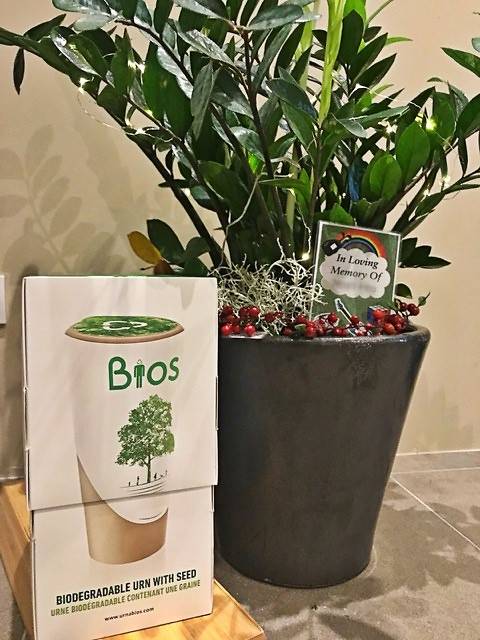
Biodegradable urns alternative burial methods ashes cremation

Indoor potted plants such as this incorporate a biodegradable urn in the pot. (Photo: The Life Celebrant)

Apart from being a beautiful memento to hold on to during our most vulnerable moments, as Singaporeans become increasingly cosmopolitan, family members can hold onto a treasured jewel of their departed ones even if they’re halfway around the world.

It will take a whole community to help a family overcome grief.

Grief, while highly personal, can have a debilitating impact on society. Locating funeral services and homes for the dead in our communities can provide a strong shoulder for the bereaved to lean on.

The only way forward to erase this negativity that shrouds dying, death and funerals is for Singapore to have a national conversation on everything that linked to it. 

Public education can reshape entrenched mindsets towards positive outcomes. This is going to benefit our future generations.

Ang Ziqian is founder of the Ang Chin Moh Foundation.

Source link

‘I want to change … and I need help’: The repeat drug abusers on a mission to stay clean

0

SINGAPORE: For more than two years, Farhan* was clean.

In 2011, he was arrested and sent to the Drug Rehabilitation Centre (DRC) for consuming cannabis. He spent seven months there and another five at home, observing a curfew with an electronic tag strapped around his ankle.

Then it was another 15 months of Central Narcotics Bureau supervision and regular urine tests. Farhan passed it all and finally he was a free man.

It was the start of a new life. Or at least it was supposed to be.

“All of a sudden, I met my party friends whom I used to skateboard with,” Farhan told reporters on Jan 9 in an air-conditioned room within the DRC. “So when we skate, we had some (cannabis) joints and substances like cough syrup.”

Together with a lack of self-discipline, time management and meaningful commitments, Farhan started taking drugs again, and soon found himself getting sucked into his old life.

“I was really hooked because I have this difficulty of controlling myself when it comes to opium-based substances (like cough syrup),” he said. “So when I got the cough syrup, I topped it up myself and drank more and more.”

In 2018, he was arrested and sent to the DRC again for consuming cannabis, this time for 18 months.

“TAKE IT AS A CHALLENGE”

Now 30, Farhan has about six months left of his sentence, which he will spend at the Jamiyah Halfway House in Pasir Panjang. This is part of the DRC regime, which requires inmates to spend the tail end of their sentence in the community to prepare them for reintegration into society.

Drug Rehabilitation Centre sign

Entrance of the Drug Rehabilitation Centre. (Photo: Marcus Ramos)

On Jan 15, Parliament passed changes to the Misuse of Drugs Act that would allow recalcitrant drug abusers – who have been caught three times or more, but do not face other criminal charges – to be sent for rehabilitation instead of being put in jail.

The move hopes to put a greater focus on rehabilitation and reduce the relapse rate for drug abusers. DRC was previously reserved for first or second-time offenders.

READ: More inmates expected at drug rehab centre; more manpower needed for programmes

For repeat offenders like Farhan, the DRC regime will be more intensive, with more classes on coping skills and being assertive around friends to deal with their addiction. The classes have taught Farhan well.

“Whenever we bump into friends with drugs, we can be firmer,” said the former hydraulics specialist. “After you undergo this life (in prison), when you know you’ve been given a lot of chances to surface again, why not use the time and take it as a challenge?”

The room stayed silent as Farhan, sporting closely cropped hair and a baggy, plain white T-shirt, spoke to reporters sat around him in a loose circle. Then it was time to listen to the man next to him.

“I MISS HIM A LOT”

Alan* had the same hairstyle and attire, but his biceps and chest bulged through his T-shirt. His arms were covered with skulls and peonies, shaded on one arm and outlined on the other.

Like Farhan he was also in the DRC for the second time. But unlike Farhan he had on both occasions been sent there for consuming methamphetamine.

Now 27, Alan has been in DRC for 11 months, and will spend the remaining seven months in the community at another halfway house called Breakthrough Missions.

Drug Rehabilitation Centre Alan Farhan

Farhan (left) and Alan speaking to their personal supervisor (casework). (Photo: Marcus Ramos)

But things used to be different for Alan, who ran a chicken rice stall and is married with a one-year-old son. “I miss him a lot,” he said. “But I have to face my problems down here in order for me to have a long stay outside.”

The DRC emphasises the importance of family in the rehabilitation process, and thus tries to involve them along the way. Inmates also attend family programmes to help build stronger ties with their loved ones.

Drug Rehabilitation Centre Alan Farhan 2

Alan (left) and Farhan telling their stories. (Photo: Marcus Ramos)

Through these classes, Alan said he’s beginning to understand his wife’s “love language”, allowing them to connect on a deeper and more intimate level. This also helps with his drug problem, especially as he turned to methamphetamine to deal with family issues.

“When I had too much free time, I started to mix around with my friends,” he said. “I started from cough syrup, then slowly went back to ice again. I also took it to escape reality when I was having problems with my family.”

HOW RELAPSE OCCURS

Ms Lau Kuan Mei, who leads a team of DRC counsellors responsible for developing and implementing the intervention programmes, said the belief that drugs can help deal with certain situations is one factor that leads to relapse.

Drug Rehabilitation Centre counsellor

Ms Lau Kuan Mei speaking to media. (Photo: Marcus Ramos)

“That’s why we teach them emotional management skills,” she said. “The ideal is for them to be aware that such thoughts (of not getting hooked) exist, and for them to maintain more helpful thinking that can help dispute these thoughts.”

To prevent re-offending, Ms Lau said it helps to have positive relationships with friends and family, as well as job stability and a structured, routine lifestyle. “And having that sense of self-belief that they can quit drugs,” she added.

WHAT THE FUTURE HOLDS

For Alan, what keeps him going is a determination to turn over a new leaf.

“To carry on is to want to change,” he said. “I note that I have a drug use problem, so yes I want to change first, I’m very difficult to change and I need help.”

Moving forward, Alan said he’s focused on learning as much as possible from the classes and finishing his sentence. After getting out, he wants to prioritise his career and spending time with his wife and son.

“After that, I can save up some money and start my chicken rice stall again. Maybe in five years’ time, I can run my own restaurant,” he added with a smile.

Drug Rehab Centre teleconferencing

Inmates can speak to family members via teleconferencing. (Photo: Marcus Ramos)

Farhan is also truly beginning to understand the importance of family, as he admitted they weren’t a priority when he was free.

His mother has heart problems, he said, but never fails to see him during the two 20- to 30-minute visits inmates usually get each month, either face-to-face or through a computer screen.

Farhan stated that his mum always puts on a brave face despite her ill health. “She has the strength to come and visit me,” he added, his voice tinged with admiration and regret.

READ: ‘Doing the right thing has never been easy for me’: A serial convict’s journey

When asked if their second DRC stint will help them steer clear of drugs for good, Alan said: “To be honest with you, it depends on ourselves, the individual.”

Farhan cut in mid-sentence, eager to give his input.

“If we undergo this type of rehab, part of us will say it’s enough; part of us will say it’s not,” he said. “What I mean is we will know better when we step out in real world.

“And we know what drugs are. So to really get a proper understanding of what it means to be away from drugs, it will be a challenge.”

*Names have been changed to protect their identities.

Source link

Last Day At Work: The pre-school teacher who’s a child at heart

0

SINGAPORE: Her words tumble over each other as she speaks, her hands moving animatedly in her excitement to express herself.

“I am by nature quite impatient,” she says with a grin. “I also talk very fast, and very loudly … But I’ve calmed down already.”

With her stylish haircut, ready smile and infectious laughter, Ms Doris Choy – or Teacher Doris, as her charges know her – looks decades younger than her 70 years.

Her youthfulness goes beyond appearance: Besides teaching and caring for infants in her day job as a senior infant educarer at a PCF Sparkletots pre-school in Telok Blangah, she also finds the energy to pursue dancing as a hobby, and even volunteers as a storyteller at the library.

“Let’s just say I cannot sit down and do nothing,” she said, with yet another laugh. “Besides, running after children every day keeps me young.”

SHE FELL IN LOVE WITH THE JOB ON HER FIRST DAY

It had never been her intention to join the pre-school sector, but the role seemed an almost natural fit for the former stay-at-home mother, who had quit her administrative job to look after her children.

It was 1992, her children had grown up, and while she was looking to keep herself busy, she recalled being slightly hesitant when a friend recommended her for a role in a small childcare centre.

“My first thought was, it’s so noisy,” she said. “Because I used to walk past and hear the noise.”

“But then, when I started work, I realised that actually, the children were very cute, and they were so obedient …I fell in love with the job on my first day.”

But was she worried, or even a tiny bit apprehensive about the task that lay ahead of her that first day? She smiled, surprised to be asked that question, and shook her head firmly.

“I’m a mother, I’m used to kids,” she said. “I played with them and sang them some songs.

I enjoyed myself, otherwise how else would I have stayed so long?”

She spent 26 years in the early childhood sector, taking up different positions in her desire to pick up new skills and try out new challenges. From the childcare centre, she moved on to a PCF kindergarten, returned to childcare for a few years before rejoining PCF Sparkletots in 2010, where she was placed in charge of infants aged 7 to 18 months.

WHEN A CHILD POOPED IN HER FACE  

An early riser, she is often at the centre when the sky is still dark. It is about 6.40am, and there is much to do even before the parents arrive to drop off their children: She cleans the centre thoroughly, wiping down the surfaces and boiling water for the infants.

The day gets even more hectic when the infants arrive. There is a whole host of things Ms Choy and her colleagues need to pay attention to and record on an observation sheet: including the times the infants eat and drink, when they sleep, when their diapers need to be changed and even whether their stool is loose or hard.

“I always tell the new staff members … when the children come in, you cannot turn your back,” she said. “We need to be on our toes the entire time.”

“But it’s good,” she added. “I can be slim and active.”

Last Day At Work Doris 2

There are many things that Ms Choy and her colleagues need to pay attention to, so much so that they are “always on their toes”. (Photo: Gaya Chandramohan)

The early childhood sector had been in the news recently for the difficulties faced in recruiting and retaining manpower. Ms Choy agrees, pointing out that she had seen new entrants coming in thinking that all they needed to do was teach. They did not last long.

“They expect that they don’t have to do the routine jobs, like bathing the children, changing their diapers or cleaning up poop or vomit,” she said. “But all this is part and parcel of the job.”

“There was this once I was changing a diaper and a child just pooped in my face,” she added, with a grimace. “But I lived through it!”

But she is also quick to stress that the job involves a lot more than simply being a nanny to the children.There are activities aimed at stimulating the children’s interest in learning to plan and carry out, such as singing and role-playing.

“This is one of the biggest misconceptions,” she said. “People think we’re just nannies, but there is actually so much more to it.”

In fact, Ms Choy, said centre principal Choo Sir Mori, has been instrumental in introducing storytelling to the children.

“She did it for her own children, and she saw how important it is to start reading, especially from a young age,” she said.

“I was amazed at how, every time she picks up a book, all the children just cluster around her like magnets,” she added. “There is no doubt that she’s instilled this love for reading in them.”


Last Day At Work Doris 3

She strongly believes in the importance of reading and storytelling from a young age. (Photo: Gaya Chandramohan) 

THEN AND NOW

While at its core the job has essentially remained the same over the years, there have been improvements: better facilities and the introduction of modern-day technology, Ms Choy said.

Before computers, for example, teachers spent much time drawing and using stencils to make signs for the children.

“My drawing’s not very good, so I trace, but there was this one time I managed to draw Santa Claus,” she said, smiling at the memory.

And while centres now are better equipped and certainly more comfortable for the teachers and children, the demands placed on the teachers have also changed.

“In the past, there was a lot of rote learning, where we had to use books and teach, but now, learning through play is more important,” she said. “So things like sand play, water play … it stimulates their mind and fine motor skills, and I’ve found the children learn better this way … but it’s also more challenging for us as teachers, because we have to think of a lot more activities.”

And to that end, she is grateful for the myriad of training opportunities she had access to in recent years – something she says did not exist in the past.

One incident – which she recalls with a wistful smile on her face – was the time she had to take care of a child with Down Syndrome, without having had any training in special education.

“I was actually very scared, but I just did my best,” she said. “I had to use signs to communicate with her, and I had to be very, very patient.”

“But it was so fulfilling when she smiled at me and started responding to me.”

Training, she said gives her greater confidence in her job. She is always on the lookout for such opportunities and is happiest when the workshops relate to dancing, her hobby.

“I have to do concerts, so I must know the dance steps,” she said, “I learnt folk dancing, line dancing and social dance … and whatever I know, I will impart to the children.”

THE LEGACY SHE LEAVES BEHIND

The centre echoed with the cries and gurgles of young children as it gradually filled up with people. Besides the infants under Ms Choy’s care, there were also siblings, former students and their parents, all present this Friday afternoon to honour her on her last day at work.


Last Day At Work Doris 4

Taking a group photo at her farewell party. (Photo: Marcus Ramos) 

After more than 26 years in the sector, she is finally retiring to spend more time with her family and pursue yet another of her hobbies: Travelling.

“I’m going to Hokkaido!” she said, clapping her hands as she spoke about her upcoming trip, her eyes lighting up in excitement.

“I really like travelling, but I’m so busy working here … and I still haven’t seen the whole of Singapore, so maybe I’ll travel Singapore too,” she added.

She is almost childlike in her excitement, a quality that Ms Choo, her good friend, good-naturedly pointed out.  

“She’s very much a child at heart,” she said. “When I see her face, I can immediately tell how she’s feeling.”

“She’s also so full of energy,” she added. “No one is like her … Rain or shine, she’s there for me, professionally as well as personally.”

“She has never taken a day of MC.”

Indeed, despite it being the tail end of a long day at work, Ms Choy’s energy levels never flagged even as she was ushered, smiling bashfully, into the gaily decorated room filled with balloons in all colours of the rainbow. As she embraced Ms Choo, applause rang out, cameras flashed and young children ran towards her, clutching gift-wrapped presents and calling for their Teacher Doris.

She greeted each one by name, bending down to accept the presents and gamely posing for photos, giving each of them a warm hug. From her excitement and enthusiasm at seeing some of her former students again, it was clear that the children hold a special place in her heart.

“She always remembers the children, even though she taught our first child more than eight years ago,” said Mr Lee Jui Boon, a father of four whose children all experienced Ms Choy’s care.

“She taught them to be independent, cared for them when they were sick and inculcated all these good virtues in them,” he said.

“We have to go to work very early and my son is usually the first to reach the centre,” chimed in another parent, Mdm Kuah Hui Yeng. “Doris is always already here, and will always welcome us with a warm smile, play some music and make my son very comfortable to be here.”

“I’m sad to see her go, but I’m happy she can finally have some time for herself to do what she likes.”


Last Day at Work Doris 3

Posing for a selfie at her farewell party. (Photo: Gaya Chandramohan) 

The cake has been cut, the last pictures taken and the party is wrapping up. As Ms Choy carefully closed and latched the safety gate as she left the centre, the infants she left behind may not have grasped the significance of the moment.

But the legacy she leaves behind will remain: Whether it is the children’s books she painstakingly picked out and packed into gift bags for all the children at the party, or the storytelling sessions that Ms Choo says will go on even in her absence.

And most of all, the scores of children who have passed through her care over the years, some of whom are already on the cusp of adulthood, but still recognise her and smile shyly when they bump into her.

“Some of them are already in NS, or in university,” she said. “But the parents still know me, and the kids … they still call me ‘Teacher Doris’.”

Indeed, it is clear that while she may no longer be a teacher, she will continue to live on in their hearts and minds as Teacher Doris. 

Source link

Residents evacuated as fire engulfs furniture shop at Upper East Coast Road

0

SINGAPORE: Fire engulfed a furniture shop at 135 Upper East Coast Road early on Saturday morning (Feb 2), causing the evacuation of nearby residents.

The Singapore Civil Defence Force (SCDF) said in a Facebook post that it had responded to the fire at about 3.30am.

“Upon SCDF’s arrival, the fire was well alight involving the contents of a furniture shop,” said SCDF in its Facebook post at about 5.20am.

It said the fire was under control, and that the police had evacuated nearby residents as a safety precaution.

The fire had “fully engulfed” the furniture shop when SCDF arrived at the scene.

“SCDF quickly deployed its resources around the affected area to contain the fire,” said the agency in a later Facebook update at about 6.40am.

Upper East Coast Road fire 2

Nearby residents were evacuated as a precaution. (Photo: Facebook / SCDF)

A total of 11 emergency vehicles and about 35 firefighters were deployed. 

“At the height of the operations five water jets, including an unmanned firefighting machine, were used to bring the fire under control,” said SCDF.

Upper East Coast Road fire 3

The Singapore Civil Defence Force (SCDF) said in a Facebook post that it had responded to the fire at about 3.30am. (Photo: Facebook / SCDF)

The fire was extinguished in about two hours, and damping down operations are ongoing, it added.

There were no reported injuries, said SCDF.

Residents who were evacuated have been allowed to return to their homes, and the cause of the fire is under investigation.

Source link

Commentary: Public attitudes of HIV have not moved beyond narratives of fear, prejudice from early years of global epidemic

0

SINGAPORE: The first diagnosis of a human immunodeficiency virus or HIV infection in Singapore was made in 1985. The incidence of HIV infections has increased every year since then until 2008.

Today, the rate of new infections has stabilised and had even started to decline over the past few years, with just 434 new infections registered in 2017. A total of 7,982 Singapore residents were registered as being HIV-positive as of end-2017, of whom 6,022 remain alive today.

HIV targets a key cell that orchestrates the body’s immune response to a large number of infections and diseases. Left untreated, all infected individuals eventually succumb after a number of years in which their immune systems progressively weaken as more of these cells are destroyed until their body is unable to fight off opportunistic infections and cancers that rarely affect healthy people.

HIV is primarily spread by unprotected sexual intercourse. Other modes including contaminated needles, mother-to-child transmission and blood transfusions are rare, especially in Singapore, due to improvements in needlestick injury protocols, better antenatal care and effective antiretroviral regimens, as well as better screening of blood donors and products.

NO LONGER A DEATH SENTENCE

Marked scientific progress has been made since the start of the global HIV epidemic all those decades ago.

Although a cure or vaccine for HIV remains elusive, when treated, people living with HIV may achieve viral suppression or an undetectable viral load – meaning they do not have a measurable amount of HIV virus in their blood.

Advances in medical science, coupled with a regime of lifetime medication has reduced HIV infection from a death sentence to a chronic disease, with life expectancies close to that of an individual without the HIV virus.

READ: ‘It’s a death sentence’ – HIV myths debunked

More importantly, from a public health standpoint, individuals who achieve viral suppression are at virtually zero risk of spreading HIV to others.

Evidence from three large international observational cohort studies have shown that no transmission of HIV from a sexual partner with an undetectable viral load in nearly 130,000 acts of condom-less penetrative sex.

THE STIGMA REMAINS, EVEN AMONG NURSING AND MEDICAL STUDENTS

However, progress towards social acceptance and the de-stigmatisation of HIV has lagged behind scientific progress in most parts of the world, including Singapore.

hiv testing

A healthcare worker draws a blood sample from a man getting tested for HIV/AIDS. (Photo: AFP/ Noah SEELAM).

Public perceptions and attitudes towards people living with HIV have not moved beyond the narratives of fear and prejudice that marked the early years of the epidemic.

In a 2007 National Behavioural Surveillance Survey, only 54.1 per cent of 1,768 Singaporean survey respondents said they were willing to care for an HIV-infected relative, while only 22.4 per cent were willing to share a meal with an HIV-positive individual.

The results of a survey on the attitudes of 80 nursing and medical students in Singapore towards HIV were highlighted in an editorial in the Annals of the Academy of Medicine of Singapore in 2009.

37.5 per cent of respondents said they would not share a house with a person living with HIV. 34 per cent believed that it was the patient’s fault that he or she had HIV. 20 per cent would not perform surgery on a HIV-positive patient.

These and other studies suggest the stigma surrounding HIV remains prevalent in Singapore, even among professionals who might be called upon to administer care to the people they so stigmatise.

WE NEED TO MOVE BEYOND THIS NARRATIVE OF FEAR AND PREJUDICE

As a hub for healthcare excellence and innovation, Singapore is well-positioned to contribute to the global fight to eradicate HIV by eliminating new transmissions and ensuring all HIV-positive individuals have access to effective treatment.

However, we must tackle this stigma because it has very real implications for HIV transmission and prevention, and may prevent us from achieving the goal of zero new transmissions of HIV in Singapore.

HIV-related stigma is a key barrier to testing for HIV, while the internalisation or anticipation of such stigma among people living with HIV may lead to a late diagnosis of HIV, poor adherence to medication, and poor mental health outcomes.

stress or depression file photo

(Photo: Unsplash/Volkan Olmez)

READ: We still fail to understand that some people are more prone to mental illness, a commentary

These negatively impact HIV prevention because early diagnosis and treatment ensures earlier viral suppression, thus rendering it non-transmissible.

The Infectious Disease Act mandates that all individuals who test positive for HIV at any healthcare provider must be registered with the Ministry of Health within 72 hours of their diagnosis.

However, many fear the repercussions being on the register may have on their career prospects, and the reactions from their friends, colleagues, and family members if they were to find out about their HIV status.

MOH subsequently introduced the anonymous testing scheme in 1991 to encourage HIV testing, and there are a total of 10 designated anonymous test sites today.

READ: Why does Singapore need an HIV registry

In order to receive care and treatment for HIV in Singapore, however, individuals who previously tested positive anonymously will still have their HIV status registered with MOH by their healthcare providers.

The only option to avoid being on the HIV registry while undergoing treatment is to obtain the treatment overseas, a luxury few can afford.

TESTING REMAINS LOW

In spite of the availability of anonymous and affordable testing, voluntary testing rates remains sub-optimal among individuals at risk of acquiring HIV in Singapore.

Only 23 per cent of new HIV infections were detected via voluntary testing in 2017. Yet, only an estimated 72 per cent of Singaporeans who were living with HIV knew about their status in 2015, according to Senior Minister of State for Health Dr Amy Khor who highlighted this in her opening speech at the Singapore AIDS Conference in 2018.

hiv test 4 (one time use ONLY)

A licensed rapid HIV test used in Singapore, at Dr Jeremy Chan Medical Clinic. (Photo: Jalelah Abu Baker)

We worry that MOH’s announcement of HIV registry data leak this past week may erode the public’s trust in the integrity and confidentiality of the Singapore’s HIV registry, which in turn may further exacerbate the fear of being registered as an HIV-positive person in Singapore.

This potentially further disincentivises non-anonymous HIV testing locally, and may lead to delayed treatment among those living with HIV, with the consequence of increasing opportunities for the onward transmission of the disease.

But we also see this crisis as an opportunity for Singapore to step up efforts to de-stigmatise HIV and tackle old, hurtful narratives head on.

TACKLE OUR FEARS

The fear of being recorded in Singapore’s HIV registry speaks of a deeper anxiety over one’s own alienation from society as someone living with HIV.

It stems from an overwhelming fear of the impact of disclosure of one’s HIV status to employers, family, friends, and other loved ones. Is it any wonder concealment of one’s HIV-positive status makes more sense to those living with HIV who want to avoid the possibility of discrimination or rejection from those they love?

We must recognise that HIV does not discriminate, but people do. Our response to this incident should be one of compassion and empathy, not only for those whose data were leaked, but also for others living with HIV or the possibility that they might be HIV-positive but are too afraid to find out.

We must recognise that HIV infection is today a chronic disease of public health concern, and not a moral failing.

By doing so, we not only indirectly improve the lives of people living with HIV by destigmatising the disease, but also signal our support for the health of our loved ones and for others in our community.

It is a critical step towards the eradication of HIV in Singapore if we want to achieve that goal in our lifetime.

Rayner Tan is a PhD candidate and researcher on HIV at the Saw Swee Hock School of Public Health, National University of Singapore. Associate Professor Hsu Li Yang heads the Infectious Diseases Programme at the same school.

Source link

117 suspected drug offenders, including pregnant mum, arrested in CNB operation

0

SINGAPORE: More than 100 suspected drug offenders, including a pregnant mother, were arrested during an island-wide operation, the Central Narcotics Bureau (CNB) revealed on Friday (Feb 1).

The operation from Jan 21 to Feb 1 was supported by the Singapore Police Force and officers raided areas including Bedok, Buangkok, Bukit Batok, Commonwealth, Jurong, Pasir Ris, Serangoon, Tampines and Yishun.

Some 280g of Ice, 13g of heroin, 27g of cannabis, 2,234 Erimin-5 tablets, 41 Ecstasy tablets, 24g of new psychoactive substances and a small amount of ketamine were seized during the operation, CNB said, with 117 people arrested.

READ :5 arrested, nearly 1kg of heroin seized in CNB operation

In one case, two suspected drug abusers were arrested in the vicinity of Balestier Road on Jan 28.

Preliminary investigations found that the couple, a 31-year-old Singaporean mum and a 36-year-old Singaporean man, moved hotels frequently with their 10-month-old child to avoid arrest. 

During the raid, the toddler was found to be running a high fever.

CNB drug operation Feb 1

One of the 117 suspected drug offenders arrested in CNB’s island-wide operation from Jan 21 to Feb 1. (Photo: Central Narcotics Bureau)

“CNB officers immediately rushed the toddler to hospital for medical examination and treatment,” the bureau said.

A small amount of Ice and various drug paraphernalia were recovered from within the room rented by the couple.

The woman, who was three months pregnant, was found to have continued to use Ice during her pregnancy.

“The Ministry of Social and Family Development’s Child Protective Service has arranged for alternative care for the 10-month old toddler, and will work with the family on the long-term safety and welfare of the child,” CNB said.

Another case during the 11-day operation involved the arrest of a 31-year-old Singaporean man shortly after midnight on Jan 23. The suspected drug trafficker was arrested in the vicinity of Toa Payoh Lorong 1.

“From within the residential unit, officers recovered a total of about 84g of Ice, numerous empty plastic sachets, a digital weighing scale and drug-taking apparatuses,” the statement added.

Investigations into the drug activities of all the arrested persons are ongoing.

Source link