Home Blog Page 846

Promising or harmful? A debate ensues after Thailand legalises medical cannabis

0

BANGKOK: Medical cannabis has been called a wonder drug, one that can treat various conditions, including Parkinson’s, asthma, insomnia, autism and even cancer. But how valid are these claims about reducing pain and curing illnesses?

If they are, should the use of the substance – long considered harmful to heath – be legalised?

Thailand, a country known for growing cannabis, is about to find out the consequences of that following the decision in December to legalise its use for medical purposes – the first Southeast Asian country to do so.

Even as the regulations are being drafted, there are indications that more countries in the region are considering a move in the same direction. Among them are Malaysia and the Philippines.

READ: Malaysia mulls legalising medicinal marijuana: Report

The programme Insight looks at whether the tide of opinion on cannabis is turning, whether Southeast Asia is becoming soft on the war on drugs and what the recent trends mean for Singapore. (Watch the episode here.)

Regulations are being drafted following Thailand's decision to legalise medical cannabis.

CRUX OF THE CONTROVERSY

The crux of the controversy is that cannabis contains two main – and polarising – ingredients: Tetrahydrocannabinol (THC), the main psychoactive constituent, which produces the “high” that drug addicts crave; and cannabidiol (CBD), which shows promise for medicinal purposes.

Medical cannabis research is focused on separating the two elements and harvesting the use of CBD, without the effects of THC.

The United States’ Food and Drug Administration and the European Union have approved a few CBD products – such as for epilepsy and chronic pain management – with “proven effects”, noted Singapore’s Dr Munidasa Winslow, an addictions psychiatrist at Promises Healthcare.

READ: Chronic pain most common reason US patients get medical marijuana

Other conditions for which cannabinoids have been used include multiple sclerosis, “where there are a lot of spastic changes, very tight muscles and a lot of pain”, cited anaesthetist Nicholas Chua, the president of the Pain Association of Singapore.

He also listed research being done in areas like migraines, glaucoma and cancer pain management.

But there is no conclusive evidence yet – beyond anecdotal examples – to support the safety and efficacy of cannabis as a form of medical treatment for major illnesses.

“The literature is divided. Well, there are a lot of good things that we can read about it, but experts aren’t convinced,” said Dr Chua.

“Because of the fact that we don’t have a huge body of evidence that says, ‘wow, the benefits far outweigh its risk’, potentially it can create issues, whether medically in the short term or socially in the long term.”

Thailand and its experts, however, are willing to give medical cannabis a try, convinced that their efforts will bear fruit one day.

“It could cure several illnesses and symptoms, such as bruises (and) pain … It could help a lot,” said Dr Sarita Pinmanee, who leads the research on hemp and cannabis at the Royal Agricultural Station Pang Da in Samoeng district.

“We should support one side (medical use) but control another side (recreational use) … Of course, there are people who want to use it for recreation. In fact, some countries allow it, within limits. I don’t support such (recreational) use.”

Insight producer Genevieve Woo with Dr Sarita Pinmanee at the Royal Agricultural Station Pang Da.

Insight producer Genevieve Woo with Dr Sarita Pinmanee.

Thailand’s Office of Narcotics Control Board is taking a similar position.

“It’s a plant that grows in nature. It, however, has negative effects, and humans can abuse it and be addicted. On the other hand, it can be utilised for medical purposes,” said the board’s secretary-general Niyom Termsrisuk.

“The main point is how to optimise the use of it for the benefit of society (and) nation.”

FACTORS IN THAILAND’S MOVE

To begin with, getting rid of the cannabis habit has been an uphill battle in Thailand, where several major hill tribes still rely on it as a form of folk medicine – a practice ingrained in their culture for generations.

“We’ve had the knowledge for quite a long time – more than 300 years,” said Dr Panthep Phuaphongphan, the Dean of Rangsit University’s Institute of Integrative Medicine and Anti-Ageing.

“We have the records in traditional Thai medicine recipes … (for) how to use cannabis in some diseases, which would be cured.”

As with the rest of 20th-century Asia, cannabis then became illegal in Thailand, and “this knowledge disappeared”, hence the need to “relearn” and “review those recipes”.

He added: “We have to find the facts because the most dangerous point is about the dose.”

Within the medical circle, one of the pioneers in Thailand who had been pushing for medical cannabis to be legalised is Dr Somnuk Siripanthong, a cancer and immunity therapy consultant at the Panacee Medical Centre in Bangkok.

He is aware that the research and evidence is not watertight, but he said he has witnessed too many success stories to dismiss cannabis outright.

Mr Chalor Nuchyangkul, for example, has been following up with the doctor since a brush with late-stage colon cancer gave the retired policeman “no choice” but to use cannabis oil.

“It was the ‘underground medicine’, we called it. It was illegal,” admitted Mr Chalor, who had stopped chemotherapy because of the “terrible” side effects. “Good or not good, I had to try it.”

He said that for 90 days, he relied only on cannabis oil, taken orally, to treat his cancer. The result of his blood test after that? “No cancer cells found,” he declared.

Dr Somnuk remarked: “The medical literature says, ‘Oh you have to go for an operation, radiation or chemotherapy.’ Some people spend millions of baht on these treatments, and they still die.

“Whether or not it’s research-based, we want to put the patient at the centre of our interest … Cannabis is so-called illegal, but the patient is alive.”

Now, government hemp plantations have been approved in several districts, including Samoeng, which is some 50 kilometres from the northern city of Chiang Mai. The plants are cultivated under strict supervision and only for medical research and development.

There are seven greenhouses, each under lock and key, at the Royal Agricultural Station Pang Da.

There are seven greenhouses, each under lock and key, at the Royal Agricultural Station Pang Da.

“If we grow cannabis on a certain plot, the information on land size, the number of trees and the plant strain should be clarified. What disease is this strain cultivated for and at what quantity?” said Mr Niyom.

“And the plantation security system (must) prevent the legal cannabis from leaking out.”

With that legal status, medical cannabis has the potential to be a significant cash crop for the kingdom and to position it as the epicentre of an industry nicknamed the Green Gold Rush.

The global legal market is projected to grow to US$56 billion (S$76 billion) by 2025, according to business consultancy Grand View Research. And advocates claim that Thailand’s legal cannabis market could reach US$5 billion by 2024.

READ: Greece eyes pot of gold as medicinal cannabis licensed

Dr Jet Sirathraanon, chairman of the National Legislative Assembly’s public health committee, can envision a tourism boost too.

“Maybe because Thailand has a lot of tourists – now we have more than 30 million tourists, in the last year – some tourists may come to Thailand for medical purposes,” he said.

“For the economic benefits, maybe we can lessen the import of medicine from Western countries.”

WHITHER THE WAR ON DRUGS?

Thai authorities emphasised, however, that their commitment to the war on drugs has not wavered.

“Cannabis won’t be legalised; it remains an illicit drug. We’ll make the public understand that it’s for medical purposes only, not for recreation,” said Mr Niyom.

“Cannabis is not to be used freely. The user still breaches the law unless he’s diagnosed as a patient and (cannabis is) prescribed by a medical doctor to use for medical treatment.”

Thailand’s narcotics agency also said search-and-destroy operations that include the Thai military are regularly mounted against illegal drug plantations.

The Insight team was invited to join in a multi-agency operation in the hills of Chiang Rai.

The Office of Narcotics Control Board invited the Insight team to join in a multi-agency operation in the hills of Chiang Rai.

For decades, Southeast Asia has battled the drug problem. Drug laws in the region remain some of the toughest in the world, but the war has yet to be won.

To observers, what is especially surprising about Thailand’s move to legalise medical cannabis is that it comes amid a surge in criminal drug activities.

READ: Meth ‘disaster’ for region as seizures surge in Thailand

“What we see taking place here in Southeast Asia is an expansion of the drug business that’s quite profound. That surge has taken place extremely rapidly,” said United Nations Office on Drugs and Crime regional representative Jeremy Douglas.

“This region is now the largest methamphetamine producer in the world. And that took place with very large law enforcement activity in the region against that backdrop. So clearly, the cartels (and) organised crime are a few steps ahead.”

In Thailand, cannabis is also trafficked from countries such as Laos and Cambodia. “There’s still a very large cannabis market within the region. It’s also unique in a sense that it’s produced in most countries,” he added.

“It’s grown wild in rural areas, but it’s also produced commercially and trafficked. So it’s not local production to meet local need; it’s also got commercial production to meet trafficking need and to kind of serve large markets like Bangkok.”

Drug abuse and trafficking remain a scourge on the region, with its proximity to the Golden Triangle

Drug abuse and trafficking remain a scourge on the region, with its proximity to the Golden Triangle.

So is Thailand’s move to legalise medical cannabis a turning point in the region’s war on drugs?

“Authorities are concerned that if you go down the road of softening an approach to one drug, that sends a signal that drugs in general are acceptable and that there are no consequences of using those drugs,” said Mr Douglas.

“Our position is that if a drug is controlled … then states have to put in place measures in one form or another – health, law enforcement, regulatory, or whatever – to make sure that the supply can’t be widely used and abused.”

Dr Winslow thinks that is possible “to a certain extent” when it comes to CBD oils.

“As long as you keep the THC component low, or not allow the part that gets you high to be more than a certain percentage, then it gives you an opportunity to observe what’s happening and … calibrate our responses,” he said.

Dr Chua believes that the war is against recreational drugs, so he “wouldn’t go as far as to say that it’s softening”. But apart from law enforcement challenges, he cited one medical conundrum.

“There’s no way to be able to separate the recreational use of cannabis from cannabinoids used for medical purposes because the drug test is the same. It’s a urine test. It can even be detected in the hair,” he said.

“I don’t think there’s a way to differentiate at the moment.”

CHALLENGES FOR SINGAPORE

Doubts about medical cannabis are guided by two major considerations: A lack of scientific evidence and the high social cost associated with drug addiction.

“We know that for every one person who suffers from an addiction, at least five family members are affected,” said Dr Winslow.

And Singapore continues to have zero tolerance for drugs.

READ: 4kg of cannabis seized, 4 arrested in CNB operation
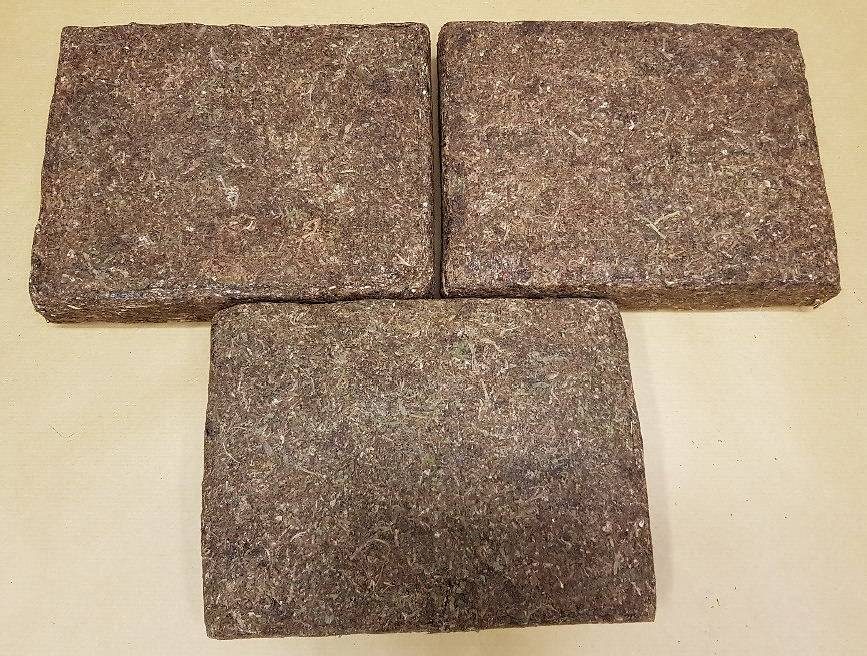
Cannabis seized in a Central Narcotics Bureau operation on Dec 14, 2018.

Cannabis seized in a Central Narcotics Bureau operation on Dec 14, 2018. (Photo: CNB)

Dr Gomathinayagam Kandasami, chief of the Addiction Medicine Department at the Institute of Mental Health, said: “The cost to the children is very huge because of someone as a parent having a substance addiction.

“If you have substance addiction, you can’t supervise your kids very well. Unsupervised means there’s a likelihood that as a child, you’d face a lot of adverse childhood experiences … Your trajectory of your growing up experience would completely change.”

In a joint statement yesterday, the Home Affairs and Health ministries affirmed the harmful effects of using raw or unprocessed cannabis, making a distinction between the illicit drug and pharmaceutical products containing cannabinoids with potential therapeutic uses.

Law and Home Affairs Minister K Shanmugam told Insight that the case for legalisation fails to convince for the same reason.

READ: ‘It’s bunkum’: Shanmugam on pharma claims about cannabis for medical use

Cannabis is not just being legalised for medical use, however. In October, Canada became the second country to make recreational cannabis legal. Uruguay was the first to do so, in 2013.

Countries like Peru, Spain, the Netherlands and South Africa have relaxed legislation on personal use, while at least 10 states in the US have also legalised recreational cannabis.

READ: More precaution than promotion for Canadian cannabis tourism

READ: Michigan vote to legalize pot fires up investor momentum behind cannabis

Within the Association of Southeast Asian Nations (Asean), more member states are thinking along the lines of medical use. So there are “increasing challenges” ahead for Singapore.

“If there’s an official imprimatur for the use … then the stuff is more easily available, people can go out there and get it, and the impetus to bring more of it into Singapore is also there,” said Mr Shanmugam.

“Asean, so far, has taken a very strong stand against drugs. We speak with one voice internationally. We make a point of saying that each country has got to decide for itself how it prescribes drugs, what it does, what kind of penalties there are.

“We’ve had very good cooperation. Of course, if some countries take a different route, then there’s a potential for that cooperation to be slightly different from how it was in the past.”

What if a Singaporean resident were to be prescribed medical cannabis in Thailand and bring it back home?

“If people get prescribed medicine that has some cannabinoid compounds, and there’s a proper prescription for it, and if our doctors agree, then there’d be no issue. But you must get our doctors to look at it,” said Mr Shanmugam.

“But the truth is, under the rubric of medical cannabis, if you’re given basically cannabis to take with no clear medical purpose, we aren’t going to buy that. And my concern is, in some countries, that’s what’s going to happen.”

For patients in Thailand, it has been a risk taking cannabis, but to Mr Chalor at least, it was worth it. “I wanted to fight and survive for my wife and kids. I couldn’t leave them behind,” he said.

Whether or not medical cannabis had given him a cure, it is the what-if question in a topic that can be emotionally charged.

“If they have advanced carcinoma … what if they can find a way to cure themselves?” postulated Dr Jet. “Cannabis may be the last door, maybe the last hope, for them.”

Others point to evidence that it is harmful, yet the trend towards legalisation has renewed debate. Medical cannabis is also a multibillion-dollar industry. And the region’s policymakers will continue to grapple with the cost-benefit analysis – medical, economic and social.

Watch the episode here. The programme Insight is telecast on Thursdays at 8pm.

Source link

Man fined for allowing foreign non-employees to stay in shipping container on farm

0

SINGAPORE: A 58-year-old man was fined S$1,500 on Wednesday (Feb 13) for breaching farm licensing conditions, said the Agri-Food & Veterinary Authority of Singapore (AVA).

Acting on a public tip-off, AVA officers conducted a joint night raid with the Singapore Land Authority and the Ministry of Manpower at Kai Hong Aquatics.

Toh Kay Hong, the licensee of the farm, was found to have breached AVA’s farm licensing conditions by allowing the storage of several skip tanks on the farm’s premises.

READ: AVA to review regulations for pet boarding businesses

Man fined for breaching farm licensing conditions

Several skip tanks were found on the farm premises. (Photo: AVA)

He also allowed the lodging of two foreigners who were not employees of the farm. One of the foreigners was found to be staying with three dogs in a shipping container that had been converted into a makeshift home.

“Due to land constraints in Singapore, agriculture land is meant solely for farming use,” said AVA. 

“Only farming or ancillary farming-related activities approved by relevant authorities are allowed on the farms.”

Those found guilty of breaching AVA’s farm licensing conditions can be jailed for up to a year and face a maximum fine of S$10,000.

Source link

Former Indonesian first lady Ani Yudhoyono treated for blood cancer in Singapore

0

SINGAPORE: The wife of former Indonesian president Susilo Bambang Yudhoyono is being treated for blood cancer at the National University Hospital, Yudhoyono said on Wednesday (Feb 13).

Kristiani Herrawati, 66, better known as Ani Yudhoyono, has been hospitalised since Feb 2, he said.

“I ask for prayers from everyone that God will cure my beloved wife so that she can continue her activities back home,” the Democratic Party chairman said in a press conference in Singapore.

He also thanked President Joko Widodo, the government and all well-wishers for their support.

Democratic Party executive Andi Arief said on Tuesday that Indonesia’s presidential medical team is working with doctors in Singapore.

“Pak Jokowi has instructed the presidential medical team to work together with doctors in Singapore for Ibu Ani Yudhyono’s recovery, as mandated by the law,” he said on Twitter.

Democratic Party spokesperson Imelda Sari said on Tuesday that Ani Yudhoyono is in a “stable condition”, The Jakarta Post reported.

Ani yudhoyono hospitalised

Ani Yudhoyono with her family. (Photo: Twitter/Agus Yudhoyono)

Yudhoyono also spoke of his wife’s support for him, in particular during his 10 years as Indonesia’s leader between October 2004 and October 2014.

“As a husband, of course, I will remain at her side. I know that she is a strong person. She has accompanied me through thick and thin,” the 69-year-old said.

The couple married in 1976 and have two children.

Source link

Visitor arrivals to Singapore rise 6.2% to hit new high in 2018: STB

0

SINGAPORE: The Singapore tourism industry had a record year in 2018, with 18.5 million visitor arrivals – a 6.2 per cent spike from the year before.

Tourists to the island spent a projected S$27.1 billion, also a new high and an increase of 1 per cent from 2017, said the Singapore Tourism Board (STB), which shared preliminary estimates for 2018 in a press release on Wednesday (Feb 13).

Receipts and arrivals from the Business Travel and Meetings, Incentive Travel, Conventions and Exhibitions (BTMICE) sector saw bumper growth.

From January to September last year, BTMICE spending rose by 10 per cent to S$3.44 billion, compared to the same period in 2017, while visitor arrivals rose 14 per cent year-on-year to hit 2 million.

STB highlighted that it took advantage of opportunities in 2018 to promote Singapore as a destination – via events such as the launch of movie Crazy Rich Asians which is set in Singapore, the Trump-Kim Summit and the Bloomberg New Economy Forum.

Singapore also held the ASEAN chairmanship in 2018 and as such, there were more ASEAN-related events and meetings hosted by the country during the year, said STB. 

Singapore relies on tourism for about 4 per cent of its economic output.

MORE SPENT ON SIGHTSEEING, LESS ON SOUVENIRS

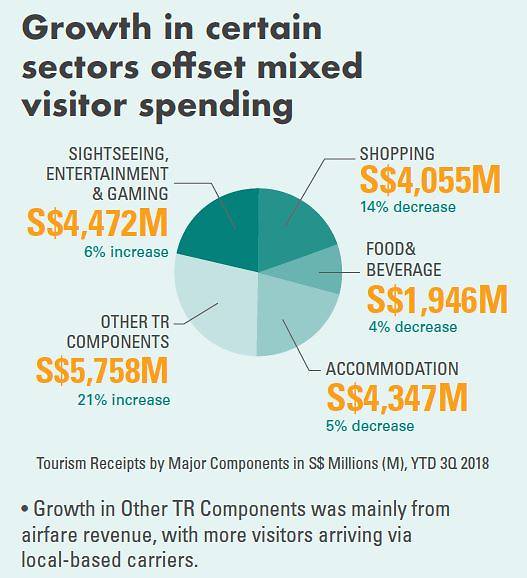
Tourism spending grew mainly on the back of growth in visitor numbers, as there were declines in spending on shopping (-14 per cent), accommodation (-5 per cent) and food and beverage (-4 per cent).

This was because there were more day-trippers to Singapore and more travellers who went to multiple destinations, resulting in shorter stays in the country, STB shared. There was also less spending on souvenirs and gifts.

However, visitors splashed out on other past-times, such as sightseeing, entertainment and gaming, which saw a 6 per cent hike. 

The largest increase (21 per cent) came from “other tourism receipts”, which STB said was mainly due to a rise in airfare revenue as more visitors flew in on Singapore-based carriers.

STB tourism receipts 2018

(Source: Singapore Tourism Board)

GROWTH IN 14 TOP MARKETS

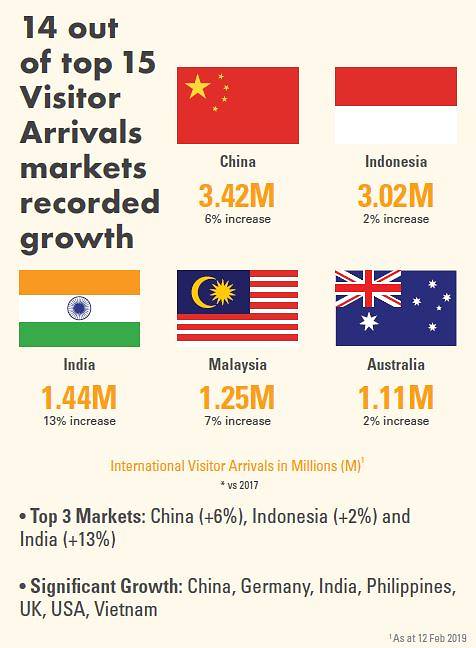
The growth in visitor numbers was driven by record-high visitor arrivals from seven of Singapore’s top 15 markets – China, India, The Philippines, The United Kingdom, United States, Vietnam and Germany, STB said.

Fourteen of these markets registered growth in 2018, said STB.

STB visitor arrivals graphic 2018

(Source: Singapore Tourism Board)

Arrivals from India, in particular, rose 13 per cent with cruise arrivals going up by 27 per cent. The number of visitors from China, Singapore’s largest market, went up by 6 per cent.

STB attributed the rise to greater air connectivity and the agency’s marketing into more cities within the countries.

“For China and India, there was growth from both tier one and tier two cities, due to strong travel demand and increased flight connectivity,” said STB.

For example, there were new and increased flights last year between Singapore and Nanchang, Haikou and Jinan in China, as well as new flights to Guwahati, Pune and Vijaywada in India.

STRONG YEAR FOR HOTELS, CRUISE INDUSTRY

The hotel industry continued to do well in 2018, with higher room revenue (7.4 per cent) that reached S$4 billion.

Hotel occupancy rose by 1.2 percentage points to 86 per cent and the average room rate increased 0.9 per cent year-on-year to S$219.

The number of cruise passengers jumped by 35 per cent to reach 1.87 million.

STB chief executive Keith Tan said that Singapore’s tourism sector performed well in 2018 “despite some economic uncertainties”. 

“We were fortunate to have benefited from a confluence of positive factors such as strong Asia-Pacific travel demand, increased flight connectivity to Singapore, and various high-profile events,” he said.

For 2019, STB forecasts tourism receipts to be in the range of S$27.3 to S$27.9 billion and international visitor arrivals to rise to the range of 18.7 to 19.2 million.

“We are still forecasting growth from China this year. It will probably be a little bit more moderate compared to past years,” said Mr Tan.

Source link

Three drivers forfeit their vehicles for providing illegal chauffeured services from Singapore to Johor: LTA

0

SINGAPORE: Three drivers were fined and forfeited their vehicles for providing illegal chauffeured services from Singapore to Malaysia, LTA said on Wednesday (Feb 13).

A fourth driver was also fined, with the authority applying to have his vehicle forfeited. A decision on that is pending.

The four drivers were investigated separately and were found to have conveyed passengers from Singapore to Johor Bahru for an agreed fare but without a Public Service Vehicle Licence​​​​​​​ (PSVL), the authority added. 

Each driver was charged with using a vehicle as an unlicensed public service vehicle and driving a vehicle without valid insurance. All four pleaded guilty to the charges and were fined a total of S$1,400 each. They were also disqualified from driving all classes of vehicles for 12 months.

All four vehicles found by LTA were foreign-registered, LTA said.

READ: More than 2,500 active mobility offences recorded between May and December 2018

“Under the Road Traffic Act, all vehicles, including foreign-registered ones, are not allowed to provide taxi or chauffeured services in Singapore without a valid PSVL,” said LTA in the release.

“Any person caught using a vehicle that is not issued with a valid PSVL to provide taxi or chauffeured services shall be prosecuted.”

Convicted offenders can be fined up to S$3,000 or jailed for up to six months, or both. The vehicle used may also be forfeited.

LTA enforcement checks (1)

LTA officers conducting enforcement operations at East Coast Park Service Road. (Photo: Land Transport Authority)

LTA STEPPING UP ENFORCEMENT CHECKS

In 2018, 13 drivers were separately caught for using unlicensed foreign-registered vehicles to provide chauffeured services, said LTA.

The authority has increased enforcement activities, covering areas such as Changi Airport, HarbourFront Centre and East Coast Seafood Centre, which are known visitor hot spots. LTA enforcement officers also conduct regular deterrence operations at these locations.

“LTA strongly urges the public against engaging chauffeured services provided by persons using unlicensed vehicles,” it said in the statement. 

“As these vehicles might not be sufficiently insured against third party liabilities, these passengers may not be entitled to insurance recourse if they are involved in a traffic accident while travelling in such vehicles.”

Mr Chandrasekar Palanisamy, Group Director (Traffic and Road Operations) at LTA, said: “Our enforcement officers have cracked down on these unlicensed public service vehicles to protect our commuters and our drivers. We work closely with various agencies to obtain the information and investigate these incidents.

“LTA views these infringements seriously, and we are committed to taking severe action against offenders.”

Source link

Singapore household incomes grew in 2018, income inequality stable

0

Those in the 71st to 90th percentile income groups enjoyed higher real wage growth.

HDB flats

File photo of HDB flats. (Photo: Hester Tan)

SINGAPORE: Households in Singapore saw their earnings from work increase in 2018, while income inequality in Singapore held near the lowest level in a decade, according to official data released on Wednesday (Feb 13).

Among households headed by a Singapore citizen or permanent resident which had at least one working person, the median monthly income last year grew by 3 per cent in nominal terms to S$9,293, up from $9,023 in 2017.

Factoring in inflation, the increase was 2.6 per cent in real terms, showed the Key Household Income Trends report by the Singapore Department of Statistics.

After accounting for household size, the median monthly household income from work per household member grew by 3.4 per cent in nominal terms, or 3 per cent in real terms, to S$2,792 in 2018.

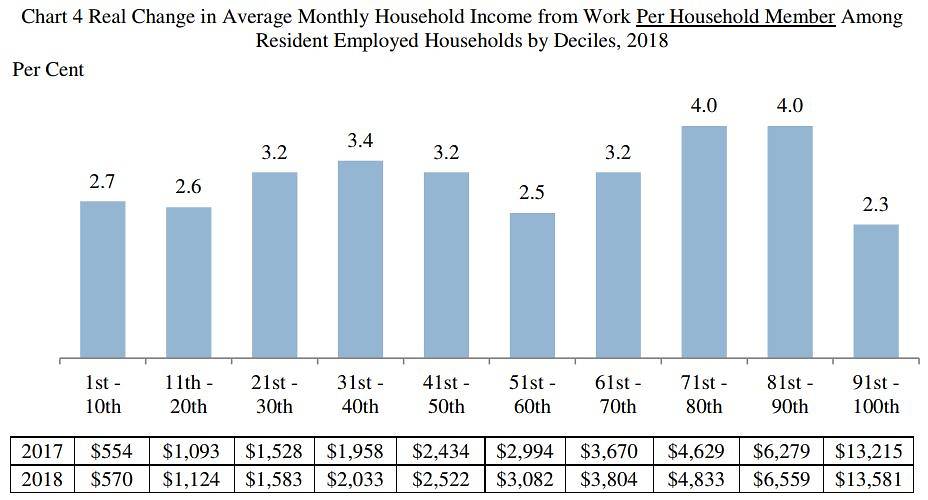
The annual report noted that households across all income groups enjoyed real growth in average work earnings per member in 2018.

household income by decile 2018

Change in average household income from work per household member. (Source: SingStat)

Households in the 1st to 70th percentile income groups saw real growth of 2.5 per cent to 3.4 per cent. Those in the 71st to 90th percentile income groups enjoyed higher real growth of 4 per cent, the report showed.

Households in the top 10 per cent recorded real growth of 2.3 per cent.

INCOME INEQUALITY STABLE

For 2018, Singapore’s Gini coefficient – which measures income inequality as a ratio from 0 to 1, with 0 representing total income equality – was 0.458.

This continues to be among the lowest levels in a decade, with the Gini coefficient standing at 0.459 in 2017 and 0.458 in 2016.

After including Government transfers and taxes, the Gini coefficient for 2018 dropped to 0.404.

Families saying in one-room and two-room HDB flats received S$10,347 per household member on average – more than double the transfers than those in other housing types.

Resident households, including those with no working person, received S$4,494 per household member on average from various Government schemes last year.

Source link

HDB flats above 30 years depreciate less than private non-landed housing: NUS study

0

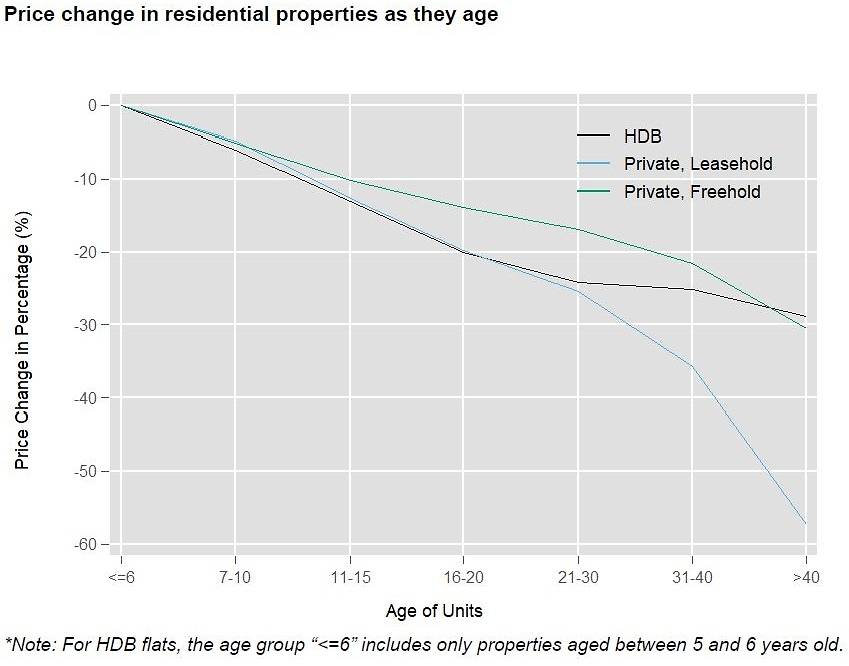
SINGAPORE: Housing Development Board (HDB) flats that are older than 30 years depreciate less than private non-landed housing, according to a study conducted by the National University of Singapore (NUS).

The results of the study, which were announced in a press release on Wednesday (Feb 13), also revealed that differences in depreciation between freehold and leasehold residential properties and HDB flats only appear after 10 years.

Depreciation rates are related to building age, said NUS. Other factors such as land tenure and size have also been adjusted in price changes.

The study was conducted by mapping age-related depreciation rates against transaction prices of resale properties. This was done using data obtained from the Urban Renewal Authority (URA) and HDB. Historical resale transaction prices for both property types were used to study the depreciation rates of resale houses over twenty years, from 1997 to 2017, the news release said.

Distinctive HDBs (18)

Block 259 is the only circular HDB block in Singapore. (Photo: Gaya Chandramohan)

The properties were then divided and categorised into three housing types – HDB flats, 99-year leasehold non-landed residential properties and freehold non-landed residential properties.

Control measures for factors unrelated to age were also accounted for. These factors include housing size, type, number of housing units in the neighbourhood and distances to the nearest MRT station and to the Central Business District.

According to the study, prices for all housing types declined as the house aged. Depreciation rates for all types were similar within the first 10 years, though HDB flats were depreciating one per cent faster than the two other property types.

After the 10-year mark, private freehold properties generally see a slower rate of depreciation, as compared to private leasehold properties and HDB flats, the study found. The latter two types depreciated at similar rates for up to 20 years, it added.

NUS study on residential property depreciation

When the properties reach 21 years and above, the depreciation rate for HDB flats is around 3 per cent, while private properties depreciate by more than 10 per cent. Leasehold private residential property prices depreciated by more than 30 per cent once they reach the same age, the study said.

The study found that prices declined at a much slower rate for HDB flats aged 30 years and above, compared to private properties.

“The increasing aging effects of private properties above 30 years old is probably due to lack of maintenance of the building and its surroundings,” said Associate Professor Sing Tien Foo, who co-authored the study.

“HDB flats enjoy the benefits of upgrading efforts such as the Singapore Government’s Home Improvement Programme that help reduce the aging effects more effectively than private properties.

“The problem seems more serious for leasehold private property owners who face both aging and lease decaying effects as aging can hasten economic obsoleteness of older buildings.”

Distinctive HDBs (3)

The total length of 34 Whampoa West’s corridor is about three football fields. (Photo: Gaya Chandramohan)

In addition to redevelopment schemes that slow down the declining prices of older HDB flats, subsidy grants of up to S$50,000 for first-time buyers of resale flats also help mitigate the price depreciation as the property ages, said Professor Sumit Agarwal.

The study was co-authored by a team at NUS, consisting of Prof Sing, Prof Agarwal, NUS Business School professor Low Tuck Kwong and PhD student Zhang Xiaoyu.

Source link

Commuter satisfaction in public transport highest in more than a decade: PTC survey

0

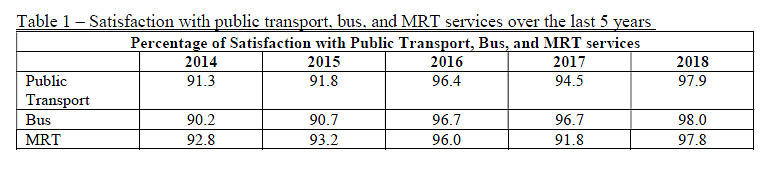
SINGAPORE: Commuter satisfaction levels with public transport improved in 2018, according to the results of a survey released by the Public Transport Council (PTC) on Wednesday (Feb 13). 

The annual Public Transport Customer Satisfaction Survey (PTCSS), which was conducted in October last year, showed the mean satisfaction score rise to 7.9 out of 10 in 2018, the highest in more than a decade and up from 7.7 in 2017.

Transport Minister Khaw Boon Wan said the results of the survey were “inspiring” for transport workers on the ground. 

“They work day and night, to regain public trust. Their efforts are showing results. But they are not complacent,” he wrote in a Facebook post. 

He added that workers are aware that commuters have high expectations and that they would have to “work even harder and smarter to meet the demand”. 

READ: 2018 a much better year for public transport: Khaw Boon Wan

READ: Higher rail reliability target for 2020 set, as improvements seen: Khaw Boon Wan 

Public transport mean satisfaction score

The mean satisfaction score for public transport rose from 7.7 in 2017 to 7.9 in 2018. (Graphic: PTC)

The percentage of respondents who were satisfied with public transport in 2018 also increased compared to the previous year.

Overall, satisfaction levels rose to 97.9 per cent from 94.5 per cent in 2017. 

Commuters satisfaction table

Table showing commuters’ satisfaction with public transport, bus and MRT services over the past five years. (Table: PTC)

Satisfaction with MRT services improved, with the mean satisfaction score rising from 7.5 in 2017 to 7.9 in 2018, said the PTC. 

Service attributes such as waiting time and reliability saw the biggest improvements from 2017 to 2018, up from 7.0 to 7.6 and 6.7 to 7.6 respectively. 

“The uptick in commuter satisfaction is a reflection of overall improvements made in rail reliability,” the PTC said. Commuters’ mean satisfaction score for reliability rose from 6.7 in 2017 to 7.6 last year.   

PTC graph

Table showing public transport satisfaction from 2008 to 2016. (Graphic: PTC)

“This mirrors the significant improvement in the MRT network’s Mean Kilometres Between Failure (MKBF), from 181,000 train-km in 2017 to 690,000 train-km in 2018,” said the PTC. 

MKBF calculates the mean distance travelled before a train fault lasting more than five minutes.

This improvement can be attributed to factors like intensified maintenance efforts and investments put in by the Land Transport Authority (LTA) and public transport operators to improve rail reliability over the past three years, it added. 

The Downtown Line 3, which opened in October 2017, could also have contributed to the higher mean satisfaction scores for MRT across the board, said the council.

SATISFACTION WITH BUS SERVICES REMAIN HIGH

Satisfaction with bus services maintained at a mean score of 7.9, according to the survey.  

While the mean satisfaction scores improved for service attributes such as waiting time, travel time and reliability, scores for stop/station accessibility dipped in the year. 

The PTC said that since the implementation of the Bus Contracting Model in 2016, the overall satisfaction with bus services have continually improved with the mean score rising from 7.2 in 2015 to 7.9 in 2018. 

The PTC Satisfaction Survey has been conducted annually since 2006. For the latest survey, 5,000 bus and MRT commuters, aged 15 years and above, were randomly selected and interviewed during both peak (7am to 9am and 5pm to 7pm) and off-peak periods. 

Source link

Commentary: Why recycling, less single-use plastics are not the answers to our plastic scourge

0

DENVER, Colorado: Plastic is everywhere, even in the most remote places on earth such as the deepest depths of the Pacific Ocean in the Mariana Trench, to the highest peak of Mount Everest. 

But no place has been as negatively impacted by plastic waste as the fastest growing nations of Asia, where the United Nations has hailed the growing situation over plastic waste a “planetary crisis”. 

A WORLD OF PLASTIC

Peak Plastic describes the point in time when the benefit of the next piece of plastic provides is outweighed by its irreversible damage to the environment, a timeline that will happen in the next eleven years. 

Peak Plastic will occur in some places much sooner according to some studies, in the developing communities of China, Indonesia and Philippines where the production of plastic waste are already at a crisis level. 

More than half the plastic waste dumped in the oceans comes from five Asian countries: China,

More than half the plastic waste dumped in the oceans comes from five Asian countries: China, Indonesia, the Philippines, Thailand and Vietnam (Photo: AFP/Romeo GACAD)

Worldwide, plastic production and use is growing at a 10 per cent rate, but in the developing regions of Asia, it is growing much faster than the existing waste management infrastructure can handle, leading to a large majority of the 9 million tonnes a year of plastic that is dumped into our oceans every year. 

READ: The world’s plastic problem is bigger than the ocean, a commentary

By 2050, it is possible that there will be more plastic in our oceans than fish, a scenario that seems almost impossible to believe given 71 per cent of the earth is covered by oceans.

TACKLING THE PLASTIC SCOURGE

What can be done to address this global problem before it is too late? Is the answer for individuals to recycle more or to consume less, producers to develop sustainable materials, or even for innovators to step forward with the latest technologies? 

Two weeks ago, Singapore food delivery service Revolv announced that they aimed to replace single-use plastic in take-aways with reusable cups and containers that customers can rent for free. They join a plethora of big global brands like Starbucks, Coca-Colaand KFC in reducing their plastic footprint.

All these options are a part of the overall solution but are not the crux of the real problem which stems from the 21st century’s super-efficient supply chain system has seamlessly designed, sourced, manufactured and distributed materials and goods to consumers on such a large scale and low cost in virtually every nation of the world. 

Paradoxically, it is both a supply chain system built on waste and convenience, but born out of necessity when it has provided needed infrastructure for some of our most basic needs such as food, water, and healthcare.

Solutions that may appear logical on the surface, such as reducing usage, eliminating single-use plastic, and developing new product alternatives can lead to an even worse impact to the environment if the same supply chain system stays intact.

READ: Our reluctance to part with plastic bag stems from a ‘yeah-but’ mentality, a commentary

Revolv resuable cup

A Revolv cup filled with Bushwick Kombucha tea used at EarthFest on Jan 20. (Photo: Jacqui Hocking)

Take for example the important role of plastic in the developing world as millions are being lifted away from poverty and elevated into the middle class. Middle class consumerism generates waste, but this is also a function of the improved health, sanitation and population control. 

The efforts by large consumer product companies, such as Nestle, Starbucks, Coca Cola, and Pepsi to become more sustainable in their products is almost always well intended, but these campaigns without transformational changes to how their supply chains operate just leads to more publicity than results. 

Grand plans driven by advances in technology, such as The Ocean Clean Up Project, can be lionised as the ultimate solution and raise tens of millions of funding dollars only to fail miserably in trying to achieve too ambitious a purpose. 

Recycling programmes, industry sustainability campaigns and high-technology innovations have failed to accomplish much more than incremental improvements all at the same time the global plastic production is rising at nearly a 9 per cent rate per annum, and most of the 380 million metric tonnes produced is wasted, including 9 million tonnes spilled into the oceans every year.

A NEW MODEL OF PLASTIC PRODUCTION

Fundamentally, the world needs a new model for plastic that serves the purposes of good without the harmful impact to the environment and human health. We need a new supply chain system of plastic that makes it both a material of economic growth and environmental sustainability rather than a choice of one over the other. 

READ: Dear Singapore, a plastic future is not fantastic, a commentary

For this to occur, the first step is for plastic to be designed to be recycled in the first place. Today’s plastic was never designed to be recycled, and as a result, our best efforts can only achieve a 10 to 20 per cent recycling rate rather than materials in nature where an output from one natural process becomes a feedstock to another. 

Low rates of rubbish collection in many parts of Asia is one of the main reasons why so much plastic

Low rates of rubbish collection in many parts of Asia is one of the main reasons why so much plastic waste ends up in the sea (Photo: AFP/Noel CELIS)

Today, there exists technology to recycle plastic for reuse through changes in how its feedstocks are sourced and manufactured in a closed loop system.

The challenge is to create this type of closed loop system as exists in nature to the same complexity and scale as our industrial systems today. This should be the focus in creating a design and polymerisation process for plastic that operates like nature, but at the super-efficiency and scale of today’s industrial systems.

Innovations in chemistry and material science are leading to changes in what we consider to be plastic, how we use and reuse it. Many technical breakthroughs exist today, or are on the cusp of being discovered.  

In January 2019, a non-profit organisation called Alliance to End Plastic Waste was formed through a US$1.5 billion commitment over five years of more than 25 global organisations, including the largest plastic producers like Procter & Gamble, ExxonMobil and Veolia, to innovate through this challenge. This is the most prominent response from the major manufacturers to work together to solve the problems of plastic while enabling its growth to continue. 

SCALE UP ENTREPRENEURIAL EFFORT

Innovation and funding should not fixate on how to collect plastic in the ocean after it has slimed its way thousands of miles to its collection points, but double down on how to create a supply chain system that enables communities to design, source, produce, use and reuse these molecules in a manner as exists today in nature where the waste of one local product becomes the input of another. 

Entrepreneurial waste pickers are moving in this direction, albeit in a low technology manner.

plastic recycling

Workers sort through trashed plastic at a recycling plant in Singapore. (File photo: TODAY/Jason Quah)

READ: What will it take for Singapore to give up plastic? A commentary

For example, the Mother Earth Foundation in the Philippines works with local communities to re-purpose nearly 80 per cent of plastic waste, as do the Jabbaleens in Egypt. My research goal is to connect these innovators from the developing world with best practices in supply chain management, and the cutting-edge technologies that can succeed within one innovative solution.

Our massive, global supply chain systems create products in one location to be mass distributed across the planet, leaving plastic waste as logistically of no value at its end of life. 

In contrast, these community-based, or localised supply chain systems value plastic materials at the source where production and consumption both exist, which drives both economic growth and environmental sustainability. 

What if industrial companies created formalised community-based supply chain systems that includes the proper technologies and investment to replace their existing long distance globalised systems into these informal, highly entrepreneurial waste picking enterprises?

The economics and science for this model can succeed, and we have calculated the business cases to provide it, fostered by a new approach to material design and polymerisation, de-polymerisation, and re-polymerisation is a transformative approach to this plastic problem in both developing and developed markets.

It may seem like a tall order, but this scalable approach can succeed within local communities that aligns their entrepreneurs with supply chain best practices and cutting edge technologies. We just need to move forward in putting them in place.

Man shovels shredded plastic litter to be recycled into roofing tiles in Mogadishu

A man shovels shredded plastic litter to be recycled into roofing tiles at the Envirogreen recycling plant in Mogadishu, Somalia January 13, 2019. (Photo: REUTERS/Feisal Omar)

READ: A made-in-Singapore solution to the world’s plastic waste problem

A 21ST CENTURY SYSTEM

Don’t get me wrong. Recycling programmes, reductions in consumption, industry sustainability campaigns and technology from innovators can be useful options in countries’ toolboxes in incrementally addressing issues, but they will not be able to fix the root causes of our plastic problem. 

The paradox is that plastic is too valuable to eliminate yet too harmful to continue in its current state, so a new model of its supply chain system must become the focus area for any other solutions to be successful. 

This 21st century system must redesign its materials to be synthetic in use but break down as materials do in nature, and the supply chain to value inputs and outputs in a synergistic flow within a localised system. 

The first step is to create these systems in smaller scale innovative business grant funding and incentives across the world until they can be scaled into global networks, the same process that happened in the development of today’s supply chain system. 

Even a few decades ago, nobody would have believed that it would be possible to efficiently manufacture a smartphone device across more than 20 or so nations, but this is today’s reality.  

So why shouldn’t we believe that through changing how our supply chain systems work that industry and nature can enable our societies to grow in wealth and prosperity?

Jack Buffington is a professor at the University of Denver and expert in supply chains and material science.

Source link

80-year-old man caught with duty unpaid cigarettes at Singapore Cruise Centre

0

SINGAPORE: An 80-year-old man has been referred to Singapore Customs after officers caught him with duty unpaid cigarettes at the Singapore Cruise Centre on Sunday (Feb 10).

The incident came to light after officers detected “anomalies” in the scanned images of two of the man’s bags, said the Immigration & Checkpoints Authority (ICA) in a Facebook post on Tuesday.

Man caught with duty unpaid cigarettes at cruise centre 2

Three cartons and 34 packets of duty unpaid cigarettes as well as 21 loose sticks were found concealed in the man’s bags. (Photo: Facebook / Immigration & Checkpoints Authority)

Man caught with duty unpaid cigarettes at cruise centre 1

Cigarettes found concealed in the man’s bags. (Photo: Facebook / Immigration & Checkpoints Authority)

Three cartons and 34 packets of duty unpaid cigarettes as well as 21 loose sticks were found concealed in assorted boxes within the bags.

“The ICA will continue to conduct security checks on passengers and vehicles to prevent smuggling attempts of undesirable persons, drugs, weapons, explosives and other contrabands,” said the authority.

Last week, it was announced that 25 drivers were caught trying to smuggle duty-unpaid cigarettes into Singapore in 2018, lured by online advertisements.

READ: Online ads lure drivers to cigarette smuggling; 25 caught

Vehicles such as cars and vans with modified compartments were used to smuggle the cigarettes. The drivers were sentenced to jail terms ranging between 10 weeks and six months.

Source link