SINGAPORE: A former senior procurement office with Keppel Shipyard pleaded guilty on Friday (Feb 15) to 54 charges of corruption and money laundering after taking more than S$700,000 in bribes.
Neo Kian Siong, who was responsible for procuring supplies for Keppel Shipyard, took the bribes over 14 years before he was found out, TODAY reported.
The 63-year-old pleaded guilty on Friday to 54 of the 395 charges involving corruption and money laundering. The rest of his charges will be taken into consideration during sentencing, which is expected on April 17.
The bribes were used to pay off outstanding loans on houses and cars, buying shares in several firms and funding a number of insurance premiums, it was reported.
He used more than S$54,000 to pay for outstanding loans on a unit in Chantilly Rise condominium in Bukit Batok, and more than S$132,000 in deposits for two cars – a Honda Odyssey and a Volkswagen Passat.
Neo also used that money to buy S$38,000 worth of shares belonging to Keppel Corporation, Tiger Airways, Liongold Corp and Innopac Holdings, and to fund a number of insurance premiums.
During his time at Keppel, suppliers would contact Neo for information on quotations submitted by their competitors so as to undercut bids and win orders. At least eight suppliers had offered Neo kickbacks for his help.
The suppliers who paid Neo bribes included Ong Chim Sum, founding director of piping component supplier Kim Seng Huat. Ong gave Neo S$56,000 on 10 occasions from 2000 to 2009.
He had first approached Neo in 2000 asking for help to expand his firm’s business with Keppel Shipyard. In return, Ong promised Neo a share of the company’s profits from sales to Keppel, TODAY cited Deputy Public Prosecutor (DPP) Eugene Sng as saying.
Neo then came up with the idea to inform Ong of the lowest quote in order to undercut the bid.
Ten years later, Ong introduced his son who continued the arrangement.
Ong’s son, Andy Ong Tong Yang, paid Neo S$97,500 on six occasions from 2011 to 2014, reported TODAY.
Foreign vessels berth alongside the wharf for repairs at the Singapore Keppel Shipyard. (Photo: AFP/Roslan Rahman)
‘ANG POWS’
Founder and managing director of piping component supplier First Hydraulic and Industrial Tony Ong Swee Tek, was also found to have paid Neo S$30,000 on 29 occasions between 2007 and 2014 for the lowest quotes.
An additional S$27,600 was also paid to Neo by Juliana Lee May Ling, founder of copper-nickel fitting supplier Athical Engineering, on 10 occasions between 2008 and 2014, reported TODAY.
With Lee, Neo agreed to reveal the lowest bids after she offered “ang pows”, the court was told.
In 2014, the Corrupt Practices Investigation Bureau (CPIB) probed Neo after large deposits were made into the joint bank account he shared with his wife. The deposits could not be traced back to their salaries.
CPIB then seized two of Neo’s bank accounts, which had a balance of about S$150,500, along with 11 insurance policies with a total cash value of about S$730,200.
Neo was dismissed from Keppel Shipyard in early 2016.
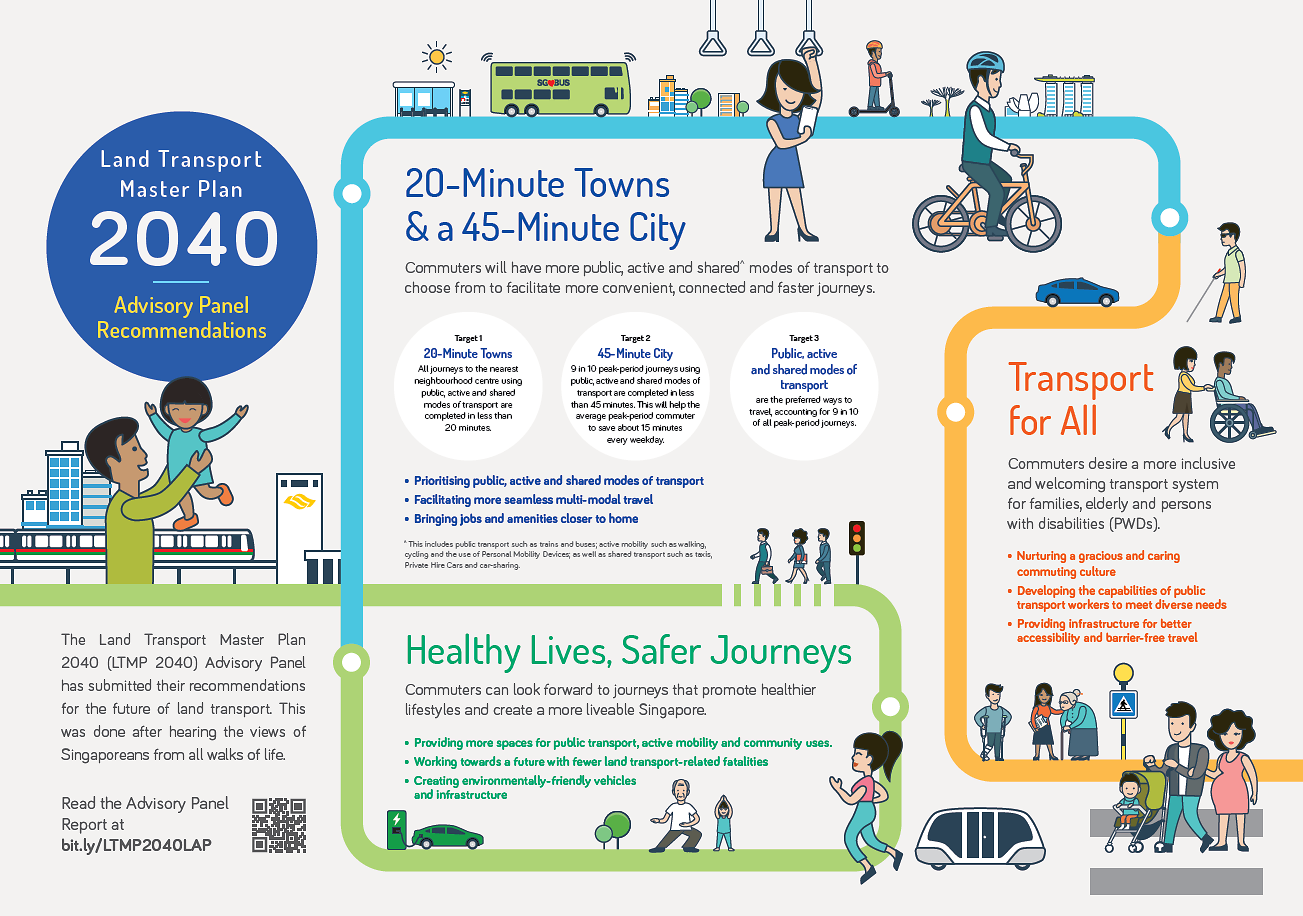
SINGAPORE: An advisory panel tasked to look into Singapore’s transport master plan for 2040 submitted nine recommendations for an inclusive, well-connected and fast transport system to the Government on Friday (Feb 15).
In coming up with the recommendations, the panel led by Senior Minister of State for Transport Dr Janil Puthucheary considered more than 7,400 responses from the public in the last six months.
They fall under three key areas namely 20-minute towns and a 45-minute city, transport for all, as well as healthy lives, safer journeys. Under each key area, three recommendations have been made.
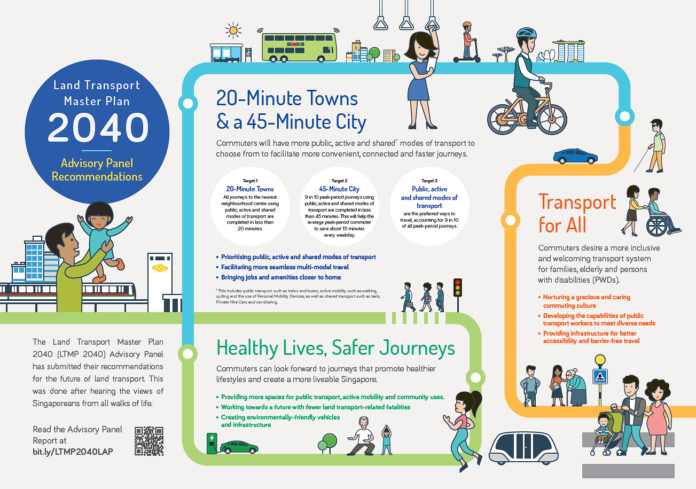
Infographic of recommendations for the Land Transport Master Plan 2040. (Source: Ministry of Transport)
20-MINUTE TOWNS AND A 45-MINUTE CITY
Under the first key area, the panel recommends that the Government work towards reducing all journeys to the nearest neighbourhood centre to under 20 minutes. Peak-period journeys should also be completed under 45 minutes.
This, the panel said, will help the average peak-period commuter save about 15 minutes every weekday.
To do this, the panel has suggested three strategies. The first is to prioritise the public transport system by growing the rail network and improving bus speeds.
First- and last-mile commutes can also be improved with better pedestrian and cycling infrastructure such as by freeing up space from roads to accommodate more Transit Priority Corridors, which has been implemented on Bencoolen Street.
Transit Priority Corridors are dedicated bus lanes and cycling paths for travel in and across towns.
Secondly, the panel suggests working towards more seamless travel by reducing the number of transfers or by better integrating multi-modal journeys by adopting technology.
The third strategy is to explore opportunities to introduce more jobs and amenities outside the city area.
TRANSPORT FOR ALL
To make public transport more inclusive, the panel recommends that the Government work towards fostering a gracious and caring commuting culture, and making more parts of the commuting journey barrier-free.
To do that, the panel recommends the training of public transport workers to identify and help those with different needs.
In addition, better infrastructure such as barrier-free access points for wheelchair and baby pram users can help these commuters enjoy travelling independently, the panel said.
The panel also suggests more platforms, such as Heart Zones, be set up to encourage Singaporeans to help other commuters in need and to recognise gracious or caring behaviour.
HEALTHY LIVES, SAFER JOURNEYS
To make Singapore’s transport system safer for use, the panel recommends that the Government dedicate more space to public transport, community uses and active mobility such as walking and cycling.
By making the walking experience more comfortable and improving how active mobility options connect to public transport, streets can be more pedestrian- and active mobility-friendly.
In spite of low accident rates, the panel urged the Government to continue giving emphasis to road safety and aiming for a “Vision Zero” environment, with fewer land transport-related fatalities. Roads and paths can be designed to enhance safety or encourage safer behaviour, for example, the panel said.
Lastly, for a better quality of life through cleaner air and a quieter environment, the panel suggests that the Government adopt cleaner and more energy-efficient fuel sources for the public bus fleet.
Shared transport operators could also consider setting targets for cleaner vehicles for taxi and private-hire car fleets.
The advisory panel was led by Senior Minister of State for Transport and Communications and Information Dr Janil Puthucheary. (Photo: Fann Sim)
“Our land transport system needs to transform, continue to support Singapore’s growth and meet the evolving needs of our commuters. It will also need to contend with technological disruptions to the industry, demographic changes and land constraints,” Dr Puthucheary said.
“The vision, targets and strategies we recommend were developed with Singaporeans’ feedback, and together, I am confident we will build a better land transport system for the future.”
SINGAPORE: The recent opening of the library@harbourfront marks the continuation of the National Library Board’s (NLB) rethinking of the role, purpose and design of our public libraries encapsulated in the Libraries of the Future Masterplan launched in 2015.
Technology has enhanced library access and usage in various ways today, with amazingly sophisticated artificial intelligence and technological applications engaging users in reading, learning and collaboration.
The NLB’s e-collection has made immediate access to an expansive range of books, magazines and research journals far more convenient and available with just an NLB online account. Multimedia is used to enhance storytelling in an immersive storytelling room.
Located at VivoCity, users at the library can browse recommended books on interactive screen displays and gain immediate access just by scanning the QR code and keying in one’s NLB password.
Across different libraries, the investment in highly intelligent book sorting systems and shelf-reading robots reduces the need for manpower to complete the routine work of sorting and placing the books back on the right shelf.
Smart technology has indeed made the business of reading and learning much more accessible in public libraries but this focus on technology and AI should not dull the centrality of human intelligence.
After all, the purpose of technology and AI is to reduce mechanical work to free up room for creative, intelligent work and not to completely replace work that only humans can do.
CURATION IS A HUMAN’S JOB
Human intelligence remains essential for growing our libraries of the future in three ways.
First, the crucial work of the curation of books requires human intelligence. Even if a library can order every book in the world, it is physically impossible for a person to read even a small fraction of the immense spread of content.
Library@harbourfront will organise workshops on technology-related topics. (Photo: Cheryl Lin)
We also need librarians to make decisions about the acquisition, exhibition and appraisal of reading materials, where some books may be more suitable for one reader or important to another’s context, and some books may be difficult to find but absolutely necessary to provide.
One book selector from NLB I know shared that she reads about 40 books a month and tries to put as many good books as she can on the shelves for teenage readers. Aside from popularity considerations, books with literary merit that might appeal to different readers or stretch the imaginations of our youths are also considered.
School librarians I have spoken to are repositories of book knowledge. The ability to spot a good book, identify the best-fit read for a user and recommend new books that might be of interest is honed through years of experience.
Librarians who see passing on the love of reading as a core part of their vocation are vital to growing the library’s role and importance in our society, in a world of boundless information.
This is the reason why human librarians who can be consulted remain central to a library.
An algorithm may help with book selection but cannot make informed decisions as to why one book might be better than another for a particular context or user profile. Librarians do not just mine for profile preferences but can recommend books that expand an individual’s reading tastes and preferences.
Second, human intelligence is required to design programmes for learning. The talks and workshops organised by the public library are selected by librarians who identify current and important needs and connect with individual experts who are able to share their knowledge with specific communities.
At the National Institute of Education where I teach, our librarians organise programmes that teach us how to use the latest software to organise our bibliographies and access the latest research.
At the neighbouring Art, Design and Media Library at the Nanyang Technological University, librarians work with professors and lecturers to curate art exhibitions that highlights students’ work, creating opportunities to generate dialogue and learning in general.
The 460-seat library will be split into two wings — one for adults and teenagers, and the other for children. (Photo: Cheryl Lin)
Third and most important, we need human intelligence to nurture learning in others. A most neglected part of library work, in my opinion, is that of mentorship. We assume that books on the shelves and the worldwide web avail knowledge to anyone who is interested to search for more information.
However, studies by researchers show that students from different home backgrounds have different access points to reading and technology.
In my research on reading habits of Singapore teenagers and school libraries, students who have many books at home and are socialised into reading from a young age are likely to know how to find a good book for themselves.
On the other hand, students with fewer books, lower language proficiency and less exposure to reading may find something as simple as picking the right book to be an extremely difficult task.
Drawing on data from the 2009 Programme for International Study Assessment (PISA) that analysed early home literacy’s impact in students on informational online reading behaviour from various countries, Natascha Notten and Birgit Becker found that students from homes with more books and reading parents are more likely to be avid online informational readers.
The same students who read more in print are more likely to read more online.
Library@harbourfront will organise workshops on technology-related topics. (Photo: Cheryl Lin)
For children who may not come from reading homes, the library can be the next best place to acquire a love for reading. But in the absence of an adult mentor, the child may find it difficult to find the right books or pick up effective reading habits.
Programmes such as NLB KidsRead where volunteers spend time reading with children from low-income families and book clubs are forms of organised mentorship. In addition to such programmes, having an actual librarian on the ground speak to children and answer their queries is another form of mentorship.
It is hard to measure the effectiveness of a mentorship as a deliverable but that should be a central goal of a human-centric library.
As much as we focus on developing library reach and investing in meaningful use of technology, I hope we continue to invest in the humans required to make our libraries work.
Humans have a wealth of experience gathered working with books and knowledge, and this must be seen as part of the resources we have for growing lifelong readers and learners.
Assistant Professor Loh Chin Ee teaches at the English Language and Literature Academic Group at the National Institute of Education, Singapore. Her current research focuses on reading and school libraries.
SINGAPORE: Local commuters definitely have plenty to say about public transport in Singapore, as well as many suggestions on how to improve it.
This can be seen from the more than 7,000 responses given at the public discussions on the Land Transport Authority’s (LTA) Land Transport Master Plan (LTMP) 2040 that have been conducted since August 2018.
But according to Dr Janil Puthucheary, what stood out for him from the five-month public consultation exercise was people’s recognition of their own roles in ensuring pleasant and enjoyable daily public transport experiences for everyone.
The Senior Minister of State for Transport, Communications and Information, who also heads the LTMP advisory panel, was struck by how the respondents wanted to see more graciousness and considerate commuter behavior.
“It was a significant part of almost every discussion we had,” said Dr Puthucheary recently in an interview with Mediacorp’s 938NOW.
“People kept suggesting, ‘Can we be more gracious? Can we give way more often? Can we help each other?’
“People came to the conclusion that actually, if we’re gracious and give way a little bit, that achieves a lot that infrastructure cannot.”
“It’s definitely the first step,” he said.
“I mean, if people don’t think this is something important, we have no chance of making this happen.”
The fact that people want it indicates that things are improving even though, he noted, “we still have some way to go as well.”
The public consultation exercise revealed another finding – that Singapore commuters want more seamless transport options.
The panel envisions a future where residents will be able to – using these shared transport modes – get to their nearest neighbourhood centre by 20 minutes and travel to town in under 45 minutes.
“Basically they want their journeys to be faster, smoother and more pleasant,” said Dr Puthucheary.
“And they want many choices – the option to go in this way, or by bus today, an MRT tomorrow, and maybe a shared car journey another day.”
Senior Minister of State for Transport, Communications and Information Janil Puthucheary in an interview with Mediacorp’s 938NOW.
To get there, he said, the Government will keep improving and building on its infrastructure network.
For example, new rail lines such as the Thomson-East Coast line that is currently under construction, and the upcoming Cross Island Line, will strengthen the backbone of Singapore’s transport infrastructure.
And even though the recently-completed five-year S$1.1 billion Bus Service Enhancement Programme has expanded bus capacity, and resulted in more frequent and comfortable bus trips and shorter waiting times, Dr Puthucheary said more remains to be done.
“Quite a lot of the information and suggestions we got from our focus group discussions was about how we can optimise the bus experience as well as the bus network,” he told 938NOW.
Singapore also needs to invest in its transport workers and give them the recognition and support they need to deliver a well-functioning transport system.
“Public transport workers are quite well-trained and need to continue to be well-trained, not just in looking after disabled commuters, but everybody” said Dr Puthucheary.
“But we also have a part to play in helping them do that.
“They will need training and reskilling as our land transport system changes, and we should commit to doing so and supporting them.”
The LTMP 2040 panel will submit the compiled feedback and recommendations to the Government this month.
Dr Janil was speaking to 938NOW via the new weekly interview series “Question Time” which airs every Friday. To listen to the interview, go to Facebook.com/938Now/ or download the MeRadio app.
There is a tussle at the top of the headphone market as Sennheiser and Bose battle to become market leader as we kick off 2019. Sennheiser and Bose offer truly excellent headphone products that offer a revolutionary sound experience that other brands of headphone cannot seem to come close to matching, so we thought we would take a look at both brands latest models to see what we like and don’t like about each.
Sennheiser PXC 550 Wireless Headphones
These Sennheiser headphones make use of the latest Bluetooth 4.2 wireless technology for listening to music on the go, without any leads. The headphones themselves are ergonomically designed and lightweight, and even after prolonged usage, the headphones are comfortable to wear.
For portability, the headset can be folded up which makes it perfect for travellers who like to listen to music on the go.
The headphones are fitted with adaptive noise cancellation technology. We tried the headphones out on a flight, and we loved the noise cancellation, thanks to the Impedance:Active 490 Ohm/ Passive 46 Ohm noise cancellation system.
It is possible to control the PXC 550 headphones using voice prompts. Of course, you can also control them using touch as well if you prefer. We found that NFC pairing was simple and straight forward.
For phone calls, the headphones make use of triple microphone array technology which provides excellent clear calls.
The PXC 550 headphones from Sennheiser are able to work with “CapTune”. This is the company’s new premium music player and sound tuning app, so you can adapt the music to exactly how you want it.
The latest Bose headphones to hit the market are the QuietComfort 35 (Series II) line. What makes these headphones unique is that they are able to offer three levels of world-class noise cancellation technology. This makes them perfect if you want no interruptions while listening and this also makes them great for travelling.
We loved the way that these headphones were Alexa-enabled, allowing you to play your favourite music using voice commands. For phone calls, the QuietComfort 35 headphones use a noise-rejecting dual-microphone system, which makes your voice transmit to the receiver without any background noise. You will certainly notice the difference!
In terms of Bluetooth pairing, this is easy to do. When you switch the headphones on, it will set this up automatically, so there is no fiddling around with the headphones themselves to try and pair them with your device.
On balance, no matter what headphones you buy, you will love the quality of the sound. For portability, I would recommend Sennheiser. For noise cancellation, make sure you go with the Bose headphones.
For more information on the latest headphones, check out http://www.portable.technology/.
Credit scores are vitally important for a whole host of reasons. For example, if you have a poor credit score, you will not be eligible for a mortgage or even a credit card. To keep your credit score healthy, make sure you pay any credit card debt off to reduce the chances of these bills harming your score. Of course, we know this is easier said than done.
It is important not to bury your head in the sand. A lot of people will be scared about finding out what their credit score is. It is certainly better to know what it is, so you can take measures to remedy the credit score.
With this in mind, here are four reasons why you should check your credit score, with the help of https://drpiggybank.com/.
1. Know Where You Stand
Your credit score is a measure of your overall financial health. If you have recently had bad debts, it is important to see if these debts have adversely affected your credit score. If it has, you can then work to improve it.
2. Make Improved Financial Decisions in the Future
If you have a poor credit score, you can then curtail your credit card spending to reduce the likelihood that you will damage your credit score still further. Plus, you will see what debt has negatively affected your score, and you can learn from your mistakes to not let it happen again.
3. Start Now To Make Improvements
If you have found out that you have a bad credit score, it can take months or even years for the score to improve. It is not something you can change overnight. The sooner you find out that you have a bad score, the sooner you can make changes to improve it for the future.
4. Reduce Your Chances of Identity Theft
Identity theft has never been more prominent than it is in 2019. If you have recently had documents stolen, or been the victim of hacking, fraudsters can quickly assume your identity. If this has happened to you, it is important that you keep checking your credit score. It is not uncommon for fraudsters to take out mortgages in unsuspecting victim’s names. As you can imagine, such a situation can completely destroy your credit score for many years, so it is better to be safe than sorry.
For more reasons why you should check your credit score, check out https://drpiggybank.com/check-your-credit-score/.
Professional truck drivers up and down the country should be taking enhanced measures to look after their truck tires. This is according to an 18-wheeler accident attorney based in Texas. It is crucial that when a driver is beginning a long journey, or at the start of each day, that they carefully check the tires and carry out a rigorous pre-trip inspection. This may sound like overkill doing it each time you begin to drive, but it could prevent an accident from occurring later and thus save lives.
The key is to ensure that your tires are properly inflated. This has two benefits. The first is of course preventing accidents, but you will also notice that it will increase your fuel efficiency, saving you on gas. You will also notice that keeping your tires pumped up will increase the life of the tires, meaning they will need to be replaced less frequently.
We would recommend that as part of your pre-trip inspection that you make use of a properly calibrated air pressure gauge to measure exactly the pressure of each tire. Tire failure often results if you continually drive on an under-inflated tire. This is generally agreed to be the number one cause of premature tire failure in trucks.
While the pressure of the tire is important, it is also crucial to look at the tread of the tire itself, as well as the sidewall area of the tire for any signs of damage. It can be quite hard to notice wearing such as tapered tread depth or bald spots, so make sure you study each tire carefully.
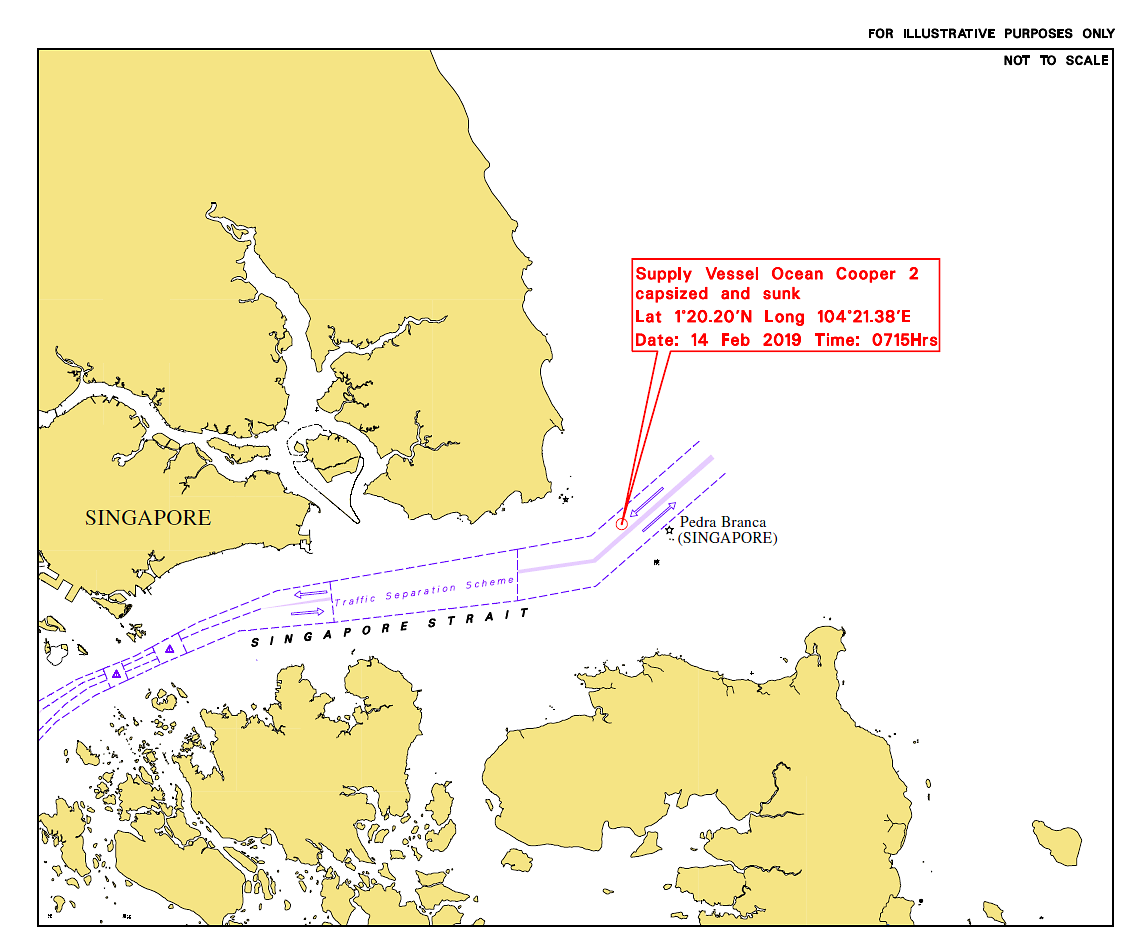
SINGAPORE: A Dominica-flagged supply vessel has capsized and sunk in Singapore territorial waters near Pedra Branca, the Maritime and Port Authority of Singapore (MPA) said in a press release on Thursday (Feb 14).
The authority received a report at about 7.15am on Thursday that the vessel, Ocean Cooper 2, capsized and sank in the westbound lane of the traffic separation scheme about 3 nautical miles from Pedra Branca.
A traffic separation scheme is a ship routing system aimed at separating opposing streams of traffic into different lanes.
The incident happened within Singapore territorial waters in the Singapore Strait.
(Image: Maritime and Port Authority of Singapore)
The vessel’s three Indonesian crew members were rescued by a nearby accompanying supply vessel, Jolly Rachel, and are all safe, said MPA.
No injuries or oil pollution were reported, added the authority.
“MPA has issued navigational broadcasts asking ships to navigate with caution in the vicinity of the incident,” it said.
The authority added it had deployed a craft to conduct a hydrographic survey of the wreck.
Traffic in the Singapore Strait remains unaffected, and MPA is investigating the incident.
In that incident, Greece-registered ship Pireas and Malaysian buoy-laying vessel Polaris collided as the former was making its way from Singapore to Tanjung Pelepas in Malaysia.
Witnesses reported hearing “explosions” from the hotel and smoke emitting from one of its back doors.
The Singapore Civil Defence Force (SCDF) said it responded to a fire at 76 Bras Basah Road, which is the hotel’s address, at 1.15pm.
“The fire, which was contained within a switch room, was extinguished by SCDF using fire extinguishers,” SCDF said.
About 1,000 people were evacuated from the building and there were no reported injuries.
The cause of the fire is being investigated, it said.
Safety workers from SP Group gathered at the back of Carlton Hotel on Feb 14, 2019. (Photo: Jeremy Long)
A spokesman for the Carlton Hotel added that those evacuated from the building included hotel guests and visitors. The hotel also said that a back-up generator would be set up.
Photos on social media show SCDF vehicles around the hotel.
The scene outside Carlton Hotel at Bras Basah on Feb 14, 2019. (Photo: Facebook/何少東)
Facebook user Ricardo Sentosa posted a video on the social media site showing smoke and a blackened door at the hotel.
He said a “small explosion” was heard around 1.20pm, which was shortly followed by a second explosion.
An eyewitness working at Odeon Towers, who wanted to be known only as Jason, said white smoke was seen coming out of a room at the back of the hotel.
“It smelled like burnt rubber and plastic. I didn’t hear the explosion, but we left our office after hearing the alarm go off,” he said.
SP Group officers outside Carlton Hotel. (Photo: Jeremy Long)
Another eyewitness, who gave his name as Mr Lee, was working at a nearby kitchen when he heard an explosion.
“We came out and there was a lot of smoke coming out from a room at the hotel,” he said. “The power was out in our kitchen and it was very hot so we all came out and took a break … we resumed working 30 minutes later. I wasn’t too worried since we are not in the same building.
Social media users also reported blackouts in offices and MRT stations around the Bugis area, but it was not clear if these events were related.
Commuters at Chinatown MRT station during the blackout. (Photo: Channel NewsAsia reader)
Mr Ho Shao Dong, who was at Bras Basah Complex, said it appeared that the whole building was hit by a blackout.
SBS Transit said that seven of its MRT stations were affected by power outages but train services were not disrupted.
SP Group vehicles along Victoria Street. (Photo: Jeremy Long)
Electricity supply to some areas in central Singapore was disrupted, SP Group confirmed.
“Our officers were immediately deployed to the affected areas and our priority is to restore supply as safely and quickly as possible,” it said in a Facebook post. “Supply has been restored to most of these locations.”
SP Group said it is investigating the cause of the incident.
This story came from a reader tip-off. If you would like to send in photos or videos of something newsworthy, WhatsApp our Mediacorp news hotline at +65 8218 8281 or message us on Facebook.
SINGAPORE: Electricity supply to some areas in central Singapore was disrupted on Thursday afternoon (Feb 14).
Blackouts were reported at Bras Basah Complex, Odeon Towers and several MRT stations at around 1.30pm.
Mr Ho Shao Dong, who was at Bras Basah Complex, said it appeared that the whole building experienced a blackout.
Ms Vera Ang, who works at Wilby Central along Queen Street said that the lights in her office blacked out “for a second” and the Wi-Fi stopped working.
“A colleague who was at the coffee shop opposite the road said the same thing happened there. After that, we heard a lot of horns and sirens as fire trucks zoomed past,” she told Channel NewsAsia.
A commuter who wanted to be known only as Ms Ju said that there was a blackout at Boon Keng MRT station when she entered at about 1.25pm. She then took a train and reached Dhoby Ghaut MRT station, which was also experiencing a blackout, but the power gradually came back on.
A blackout at Boon Keng MRT at about 1.25pm on Feb 14, 2019. (Photos: Ms Ju)
“Announcements were made at Dhoby Ghaut MRT station for commuters to use the stopped escalators as stairs as there was a minor power trip,” she said.
“They also apologised for the inconvenience.”
SBS Transit said that seven stations on the North-East Line – HarbourFront, Outram Park, Chinatown, Clarke Quay, Dhoby Ghaut, Boon Keng and Potong Pasir – were affected.
“This was due to a dip in the power grid network. Emergency lights were turned on during this period which lasted less than 25 minutes,” said Ms Tammy Tan, senior vice-president of corporate communications at SBS Transit.
“Train services were not affected by the power outage.”
A blackout at Dhoby Ghaut MRT at about 1.27pm on Feb 14, 2019. (Photo: Ms Cheng)
SP Group said that its officers were immediately deployed to the affected areas.
“Our priority is to restore supply as safely and quickly as possible. Supply has been restored to most of these locations,” it said in an update on Facebook at about 2.30pm.
“We are investigating the cause of the incident.”
The Singapore Civil Defence Force (SCDF) also said it responded to a fire incident at the Carlton Hotel at around the same time as the blackouts.
It is not clear if the incidents are linked.
The hotel said that there was a fire in the switch room which was extinguished by SCDF. Close to 1,000 people, including hotel guests and visitors, were affected.
This story is developing. Refresh for updates.
This story came from a reader tip-off. If you would like to send in photos or videos of something newsworthy, WhatsApp our Mediacorp news hotline at +65 8218 8281 or message us on Facebook.