Home Blog Page 847

New agency to be formed to oversee Singapore’s food safety, security

0

SINGAPORE: A new agency to oversee food-related issues will be formed under new laws passed in Parliament on Tuesday (Feb 12).

The Singapore Food Agency (SFA), which is set to be formed on Apr 1 and come under the Ministry of the Environment and Water Resources, will consolidate the regulatory oversight of food safety and security, which are currently divided among three public agencies.

These are the Agri-Food and Veterinary Authority (AVA), the National Environment Agency (NEA) and the Health Sciences Authority (HSA). All three work together to oversee the food supply chain — from import, local production, manufacturing to retail.

Environment and Water Resources Minister Masagos Zulkifli, in presenting the Bill for a second reading in Parliament, said Singapore will not be the first to adopt such a “farm-to-fork model” and the Government has studied other countries where a single agency is responsible for food safety along the entire food supply chain.

There are merits in doing so, he added, and the reorganisation will be a boost in securing the supply of safe food for Singapore.

Other measures aimed at beefing up Singapore’s food security will also be introduced in the future.

READ: Zero Waste Masterplan to focus on electronics, packaging, food waste

IMPORTANCE AND FUNCTIONS OF NEW AGENCY

While the country has done well in terms of food security – an area that is fundamental to national security – Mr Masagos stressed that Singapore cannot take the current situation for granted.

This is due to rapid changes in the landscape for agriculture and food.

The minister mentioned how the world population is set to grow by another 30 per cent to 9.7 billion by 2050, with global food demand also projected to rise by 60 per cent. Vital resources to meet the increased food demand, such as water and energy, are becoming increasingly scarce.

Climate change will exacerbate these threats, he added, citing an example close to home.

ntuc fairprice 1

File photo of shoppers at an NTUC FairPrice supermarket outlet. (Photo: TODAY)

“Right here in ASEAN, one of my counterparts shared with me that the impact of climate change is already being felt and has caused more frequent and severe droughts and floods in the Mekong River Delta, which is the ‘rice bowl’ of Asia,” he said. “Rice production can fall by more than 50 per cent.”

“These are real-life threats, and can hit us bad since we import more than 90 per cent of our food.”

Growing complexity in global food supply chains has also made the safeguarding of Singapore’s food supply even more challenging because it increases the “potential points of failure where contamination can enter the food chain”.

Given how food undergoes multiple processes involving different countries before reaching consumers here, Mr Masagos noted that this had made it “more difficult to identify the source of the problems when they occur”.

“Was the cause of a food poisoning incident due to poor hygiene in the restaurant or hotel? Could it have been due to high levels of pesticides on the raw ingredients? Contaminants introduced in the manufacturing process of packing and canning? Or deterioration in quality and safety during transportation?”

“Such challenges will intensify. Complex supply chains will evolve as climate change affects production,” Mr Masagos said.

READ: Asia-Pacific countries need to collaborate to deal with climate change

With the consolidation of existing capabilities of NEA, AVA and HSA, the SFA will be able to “holistically respond to food safety incidents wherever these occur along the food supply chain”, the minister added.

He went on to explain that in the event of a food poisoning incident, a single team will oversee the entire food supply chain and manage investigations – starting from the accreditation of overseas farms, to import, to intermediate processing by central kitchens and retailers, and finally to the proper storage and preparation at the retail outlet.

“This will allow SFA to respond more promptly to trace the source of contamination,” he said.

On food security, new measures will require importers of key food items to have plans and preventive strategies to mitigate the impact of food supply disruptions.

Referring to Malaysia’s recent announcements on restricting certain seafood exports, as well as considering limiting or stopping egg exports to Singapore, Mr Masagos said this will not be the last time Singapore faces possible disruption to its food imports.

“We must therefore continue to diversify our food import sources and not be over-reliant on any single source,” the minster said.

READ: Malaysia seafood export limits ‘not likely to have significant impact’ on Singapore supply: AVA

In addition to regulatory oversight, the SFA will also partner businesses to transform the local food industry.

This will be done by leveraging emerging opportunities – including new food production methods and novel food products – to enhance food supply resilience and grow Singapore into an agri-food hub.

“Amidst the uncertainties facing the agri-food landscape, our goal is to seize the opportunity for Singapore to turn our food challenges into strategic advantages … to secure our food supply, transform our agri-food industry, develop our local enterprises, and provide good jobs to Singaporeans. Just like how we have turned our vulnerability in water into opportunity,” Mr Masagos said.

A STEP IN THE RIGHT DIRECTION

Members of the House supported the Bill, with some describing the streamlining of functions into a single agency as a step in the right direction.

MPs, including Mr Melvin Yong (Tanjong Pagar GRC) and Mr Gan Thiam Poh (Ang Mo Kio GRC), cited the recent spate of food poisoning incidents and asked how the SFA could strengthen Singapore’s food safety regime.

In his reply, Mr Masagos mentioned that the forming of a single agency can help deepen food safety expertise here, given how the National Centre for Food Science will soon come under the SFA.
 
The formation of the SFA will also integrate operations related to food safety threats, such as providing a single contact point for the public to provide feedback, combining contact tracing and industry engagement operations.

masagos sg-msia bilat

Environment and Water Resources Minister Masagos Zulkifli speaking to reporters on Friday (Dec 7) on defending Singapore’s sovereignty amid maritime tensions with Malaysia. 

This, according to the minister, will allow the new agency to pinpoint and remedy critical points across the supply chain, and react more quickly to food safety incidents. 

MPs also emphasised the area of food security, with Mr Saktiandi Supaat (Bishan-Toa Payoh GRC) asking how the Government is tapping on business organisations to continually look for new and reliable supply sources.

Mr Ong Teng Koon (Marsiling-Yew Tee GRC) referred to the potential disruptions in the country’s egg and seafood imports, and asked how the SFA can better handle such incidents without causing alarm.

To that, Mr Masagos replied that the SFA will ensure food security by developing and enhancing three national strategies.

These include building on the existing work of the AVA to diversify import sources, intensify efforts to grow an agri-food ecosystem here, as well as continue to support home-grown companies to expand overseas.
Source link

Oil up nearly 2 percent on Saudi and OPEC cuts

0

Oil prices edged up on Tuesday amid OPEC-led supply cuts and U.S. sanctions against Iran and Venezuela, although surging U.S. production and concerns over economic growth kept markets in check.

An oil well pump jack is seen at an oil field supply yard near Denver

FILE PHOTO: An oil well pump jack is seen at an oil field supply yard near Denver, Colorado, U.S., February 2, 2015. REUTERS/Rick Wilking/File Photo

LONDON: Oil prices gained nearly 2 percent on Tuesday, supported by OPEC-led production cuts which Saudi Arabia said it would surpass by over half a million barrels per day (bpd) and by U.S. sanctions against Iran and Venezuela.

Brent crude futures were up US$1.17 or 1.9 percent at US$62.68 a barrel by 1135 GMT. U.S. West Texas Intermediate (WTI) crude oil futures rose 89 cents or 1.7 percent to US$53.30.

Markets are tightening because of voluntary production cuts, effective since Jan. 1, led by the Organization of the Petroleum Exporting Countries and allies including Russia aimed at forestalling a global glut.

Saudi Arabia, the world’s top oil exporter and de facto leader of OPEC, said it would reduce crude production to around 9.8 million bpd in March, over half a million bpd more than it originally pledged.

Energy Minister Khalid al-Falih announced the move in an interview with the Financial Times published on Tuesday, as the kingdom seeks to drive up oil prices to help fund an economic transformation plan.

OPEC’s monthly oil market report for February will be issued at 1225 GMT on Tuesday.

Also on the radar are hopes expressed by U.S. and Chinese officials that a new round of talks, which began in Beijing on Monday, would bring them closer to easing their months-long trade war.

Beijing and Washington are trying to hammer out a deal before a March 1 deadline, without which U.S. tariffs on US$200 billion worth of Chinese imports are scheduled to increase to 25 percent from 10 percent.

However, rising U.S. oil production, fighting near Libya’s main oilfield, sanctions on Venezuela and suspense over whether Washington will grant more waivers to import Iranian oil leave markets unsure about broader supply.

“We believe that oil is not pricing in supply-side risks lately as markets are currently focused on U.S.-China trade talks,” JP Morgan said in a weekly note.

Should U.S.-China talks succeed, the U.S. bank said oil markets would “switch attention from macro concerns impacting future demand growth to physical tightness and geopolitical risks impacting immediate supply”.

Any economic slowdown could cap oil markets.

Bank of America also warned of a “significant slowing” in global growth, adding that it expects Brent and WTI to average US$70 and US$59 a barrel respectively in 2019 and US$65 and US$60 in 2020.

(GRAPHIC: U.S. oil production & drilling levels – https://tmsnrt.rs/2Tm4u4I)

(Reporting by Noah Browning; Additional reporting by Henning Gloystein; Editing by David Goodman and Dale Hudson)

Source link

Update to legal framework needed to tackle foreign interference: Edwin Tong

0

SINGAPORE: To ensure that Singapore does not fall prey to foreign interference and information campaigns, the law must be updated to respond swiftly to such threats, said Senior Minister of State for Law and Health Edwin Tong in Parliament on Tuesday (Feb 12). 

Mr Tong was responding on behalf of Prime Minister Lee Hsien Loong to Member of Parliament (MP) Cheng Li Hui. 

Ms Cheng asked if there is a need to introduce new laws or strengthen existing laws when dealing with foreign interference and Singaporeans who work with foreign actors to influence Singapore’s elections and politics. 

She also asked whether Singapore can learn from countries such as the United States, Australia and France in their encounters with foreign interference in their elections and politics. 

Mr Tong brought up the case of New Zealand where an opposition leader had allegedly circumvented political donation laws by disguising a donation by a businessman linked to a foreign government so that it did not have to be declared. This sparked debate within the country on the need to review policies against foreign interference. 

READ: Foreign efforts to influence 2018 US elections on Twitter ‘limited’

READ: Russia rejects Indonesia election ‘propaganda’ accusations

“Indeed, today, information can easily be weaponised by foreign actors, at low cost, and with anonymity and impunity. No country is immune. This is asymmetric information warfare, fought in a theatre and era with no distinction between war and peace,” said Mr Tong. 

“In this battlefield, Singapore, an open, democratic, digitally-connected and diverse country, is especially vulnerable. We are a young country with sensitive fault lines that foreign actors can exploit to foment distrust and ill-will among our various communities,” Mr Tong added.

SINGAPORE ‘ESPECIALLY VULNERABLE’ TO FOREIGN INFLUENCE

In his supplementary response, Mr Tong said that foreign influence has had a long history in Singapore. In the 1970s, two newspapers were taken to task for taking foreign money and attempting to undermine the Government. 

Mr Tong also gave the example of Huang Jing, a former professor at Lee Kuan Yew School of Public Policy who was expelled after being identified as an agent of influence acting on behalf of a foreign country. 

READ: MHA’s statement on Huang Jing, LKY School professor who tried to influence S’pore foreign policy

READ: ‘Agent of foreign influence’, LKY School Prof Huang Jing had international profile

READ: Professor Huang Jing’s appeal rejected, must leave Singapore: MHA

Huang had knowingly interacted with and cooperated with intelligence organisations and agents of a foreign country to influence Singapore’s foreign policy and public opinion, he said. 

Huang had done so by engaging prominent and influential Singaporeans and gave them what he claimed was “privileged information” about the foreign country so as to influence their opinion.

He also recruited others in aid of his operations, Mr Tong said.

Huang Jing

Professor Huang Jing speaking at an LKYSPP conference. (Screengrab of video on LKYSPP’s YouTube page)

There are also other signs that Singapore has been targeted for information campaigns. Testimony given during the Select Committee on Deliberate Online Falsehoods has highlighted the use of news articles and social media to influence segments of Singapore’s population

READ: Meet the fake news trolls who influenced US and Indonesian polls for money

For instance in December last year when Singapore and Malaysia’s bilateral ties were strained, the Government saw a spike in critical comments made online by avatars, which are anonymous accounts with pictures that do not show the owner’s face. 

“On one such issue, jams at land checkpoints, around 40 per cent of comments on alternative media outlets pages on social media came from avatar accounts. We do not know who these suspicious accounts belong to nor do we know if they are being coordinated by foreign actors,” Mr Tong said. 

“But it is clear that these accounts have sought to give and create and artificial impressions to netizens of the opposition to Singapore’s position at a time of heightened bilateral difficulties,” Mr Tong added.

TAKING ACTION TO EXPOSE, COUNTER FOREIGN INFLUENCE

Hence, the Government must update and enhance existing legal framework to counter hostile information campaign, which is “outmoded against modern and technologically-sophisticated tactics”, Mr Tong said. 

New legislation should have two broad objectives. First to allow the Government to act swiftly and effectively to disrupt and counter false, misleading and inauthentic information and narratives spread by foreign actors. 

Second, the Government must be able to pre-emptively expose clandestine foreign interference campaigns. 

“In the physical world, foreign actors may interfere in our domestic politics through the use of proxies, by funding or donating to politically-involved individuals and organisations, or by taking on key leadership roles in the organisations,” he said. 

“Our laws must minimise the possibility of such entities being thus used and manipulated. We must not allow foreign actors to undermine our political sovereignty, nor our ability to make our own choices on how we want to govern our country, and live our lives,” Mr Tong added. 

Singaporeans also need to be sensitised to the threat of foreign influence. 

“We are our own first line of defence. We must learn to be sceptical of and be able to discern falsehoods or half-truths, and detect foreign actors and their attempts to interfere in our politics,” he said. 

“The threat is real, and we will be moving onto these issues later this year,” he said. 

Source link

Update to law needed to tackle foreign interference: Edwin Tong

0

SINGAPORE: To ensure that Singapore does not fall prey to foreign interference and information campaigns, the law must be updated to respond swiftly to such threats, said Senior Minister of State for Law and Health Edwin Tong in Parliament on Tuesday (Feb 12). 

Mr Tong was responding on behalf of Prime Minister Lee Hsieng Loong to Member of Parliament (MP) Cheng Li Hui. 

Ms Cheng asked if there is a need to introduce new laws or strengthen existing laws when dealing with foreign interference and Singaporeans who work with foreign actors to influence Singapore’s elections and politics. 

She also asked whether Singapore can learn from countries such as the United States, Australia and France in their encounters with foreign interference in their elections and politics. 

Mr Tong brought up the case of New Zealand where an opposition leader had allegedly circumvented political donation laws by disguising a donation by a businessman linked to a foreign government so that it did not have to be declared. This sparked debate within the country on the need to review policies against foreign interference. 

READ: Foreign efforts to influence 2018 US elections on Twitter ‘limited’

READ: Russia rejects Indonesia election ‘propaganda’ accusations

“Indeed, today, information can easily be weaponised by foreign actors, at low cost, and with anonymity and impunity. No country is immune. This is asymmetric information warfare, fought in a theatre and era with no distinction between war and peace,” said Mr Tong. 

“In this battlefield, Singapore, an open, democratic, digitally-connected and diverse country, is especially vulnerable. We are a young country with sensitive fault lines that foreign actors can exploit to foment distrust and ill-will among our various communities,” Mr Tong added.

SINGAPORE ‘ESPECIALLY VULNERABLE’ TO FOREIGN INFLUENCE

In his supplementary response, Mr Tong said that foreign influence has had a long history in Singapore. In the 1970s, two newspapers were taken to task for taking foreign money and attempting to undermine the Government. 

Mr Tong also gave the example of Huang Jing, a former professor at Lee Kuan Yew School of Public Policy who was expelled after being identified as an agent of influence acting on behalf of a foreign country. 

READ: MHA’s statement on Huang Jing, LKY School professor who tried to influence S’pore foreign policy

READ: ‘Agent of foreign influence’, LKY School Prof Huang Jing had international profile

READ: Professor Huang Jing’s appeal rejected, must leave Singapore: MHA

Huang had knowingly interacted with and cooperated with intelligence organisations and agents of a foreign country to influence Singapore’s foreign policy and public opinion, he said. 

Huang had done so by engaging prominent and influential Singaporeans and gave them what he claimed was “privileged information” about the foreign country so as to influence their opinion.

He also recruited others in aid of his operations, Mr Tong said.

Huang Jing

Professor Huang Jing speaking at an LKYSPP conference. (Screengrab of video on LKYSPP’s YouTube page)

There are also other signs that Singapore has been targeted for information campaigns. Testimony given during the Select Committee on Deliberate Online Falsehoods has highlighted the use of news articles and social media to influence segments of Singapore’s population

READ: Meet the fake news trolls who influenced US and Indonesian polls for money

For instance in December last year when Singapore and Malaysia’s bilateral ties were strained, the Government saw a spike in critical comments made online by avatars, which are anonymous accounts with pictures that do not show the owner’s face. 

“On one such issue, jams at land checkpoints, around 40 per cent of comments on alternative media outlets pages on social media came from avatar accounts. We do not know who these suspicious accounts belong to nor do we know if they are being coordinated by foreign actors,” Mr Tong said. 

“But it is clear that these accounts have sought to give and create and artificial impressions to netizens of the opposition to Singapore’s position at a time of heightened bilateral difficulties,” Mr Tong added.

TAKING ACTION TO EXPOSE, COUNTER FOREIGN INFLUENCE

Hence, the Government must update and enhance existing legal framework to counter hostile information campaign, which is “outmoded against modern and technologically-sophisticated tactics”, Mr Tong said. 

New legislation should have two broad objectives. First to allow the Government to act swiftly and effectively to disrupt and counter false, misleading and inauthentic information and narratives spread by foreign actors. 

Second, the Government must be able to pre-emptively expose clandestine foreign interference campaigns. 

“In the physical world, foreign actors may interfere in our domestic politics through the use of proxies, by funding or donating to politically-involved individuals and organisations, or by taking on key leadership roles in the organisations,” he said. 

“Our laws must minimise the possibility of such entities being thus used and manipulated. We must not allow foreign actors to undermine our political sovereignty, nor our ability to make our own choices on how we want to govern our country, and live our lives,” Mr Tong added. 

Singaporeans also need to be sensitised to the threat of foreign influence. 

“We are our own first line of defence. We must learn to be sceptical of and be able to discern falsehoods or half-truths, and detect foreign actors and their attempts to interfere in our politics,” he said. 

“The threat is real, and we will be moving onto these issues later this year,” he said. 

Source link

Singapore retail sales down 6% in December

0

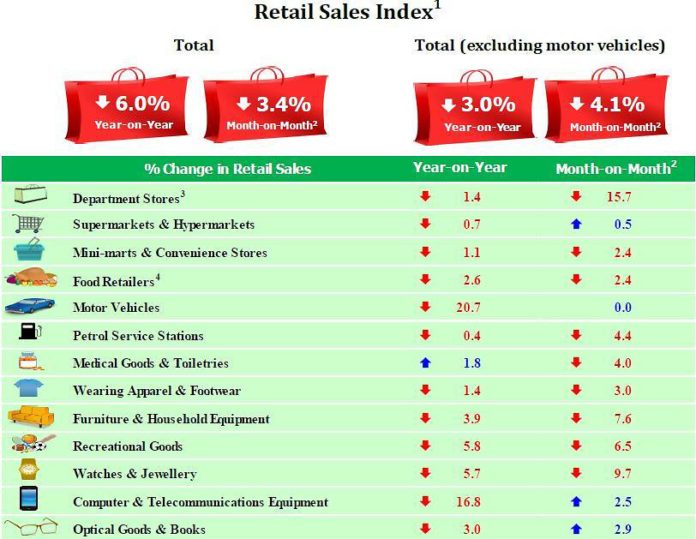
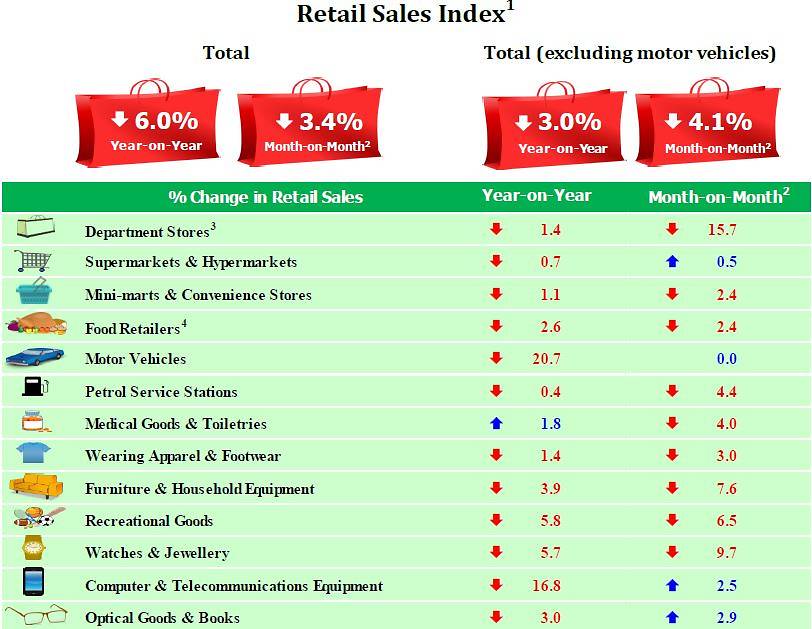
SINGAPORE: Retails sales in Singapore went down 6 per cent in December as compared to the same month in 2017, according to a release from the Department of Statistics (Singstat) on Tuesday (Feb 12).

On a month-on-month basis, retail sales went down 3.4 per cent. Excluding motor vehicles, retail sales decreased 3 per cent year-on-year and 4.1 per cent month-on-month.

Year-on-year sales dropped for all retail sectors with the exception of medical goods and toiletries, which increased by 1.8 per cent.

Sales of motor vehicles saw the biggest decline year-on-year at 20.7 per cent, followed by computer and telecommunications equipment at 16.8 per cent.

Sales of department stores, supermarkets, mini-marts and convenience stores, food retailers, petrol service stations, wearing apparel and footwear, furniture and household equipment, recreational goods, watches and jewellery and optical goods and books all went down between 0.4 and 5.8 per cent.

Retail sales index for Dec 2018

Month-on-month, sales of supermarkets and hypermarkets, computer and telecommunications equipment and optical goods and books experienced an uptick, with increases of 0.5, 2.5 and 2.9 per cent respectively.

The food and beverage (F&B) services sector reported an increase of 4.5 per cent year-on-year and 0.6 per cent month-on-month for December.

All F&B sectors showed sales growth between 2.5 to 6.6 per cent year-on-year, with food caterers reporting the biggest increase. 

On a monthly basis, aside from other eating places such as cafes, which saw a decline of 3.4 per cent, numbers for other sectors also went up between 0.3 and 5 per cent.

Total retail sales value in December 2018 was about S$4.3 billion. Online sales made up an estimated 5.5 per cent of this figure.

Meanwhile, food and beverage services took in an estimated S$925 million, an increase from the S$886 million in December 2017.

The Retail Sales Index and the Food and Beverage Services Index measure the short-term performance of retail and F&B service industries based on their sales records. The sales figures exclude taxes such as GST and COE.

Source link

3,739 BTO and ROF flats released in first HDB launch of 2019

0

SINGAPORE: The Housing and Development Board (HDB) launched 3,739 flats for sale on Tuesday (Feb 12) in the first Build-To-Order (BTO) and Re-Offer of Balance Flats (ROF) exercise of 2019.

Of these, 3,162 are BTO units which will be spread across five projects – three in the non-mature towns of Jurong West and Sengkang, and two in the mature town of Kallang Whampoa.

The five projects are Boon Lay Glade, Jurong West Jewel, Fernvale Vines, Kallang Breeze and Towner Crest.

READ: HDB to launch fewer new flats next year; 2,000 homes in Tengah on offer

The flats are priced from S$95,000 for a 2-room Flexi in the Boon Lay area to about S$523,000 for a 4-room in Kallang Whampoa.

Towner Crest BTO

Artist’s impression of Towner Crest BTO flats. (Photo: HDB)

Eligible first-timer families can get up to S$80,000 of housing grants, the release said. These include up to S$40,000 of Additional CPF Housing Grant (AHG) and up to S$40,000 under the Special CPF Housing Grant (SHG).

“With these grants, flat buyers could pay as little as S$15,000 for a 2-room Flexi flat, S$110,000 for a 3-room flat, S$197,000 for a 4-room flat, and S$333,000 for a 5-room flat,” said HDB.

Flat allocation priority will still be given to first-timer families, the release said. Those who wish to live with or stay close to their parents will also be given the option to do so. 

Couples who wish to live with their parents can apply for a Three-Generation (3Gen) flat in Jurong West or Sengkang. Meanwhile, those who wish to live close to parents or married children in the same BTO project can submit a joint application under the Multi-Generation Priority Scheme.

RE-OFFER OF BALANCE FLATS

In addition to the BTO flats, 577 unselected flats from the Sale of Balance Flats exercise in May last year will also be on offer.

These consist of two to five-room flats, as well as 96 units of 3Gen and three executive flats across various towns and estates.

At least 95 per cent of the flat supply will be reserved for first-timer families and up to 5 per cent for second-timer families, HDB said. Should they meet the prevailing eligibility conditions, elderly may apply to buy a 2-room Flexi flat.

However, families will be given priority for flat selection.

HDB said about 13 per cent of these ROF flats are already completed, while the rest are under construction.

“Eligible families with more urgent housing needs and/or who are less particular about location and attributes may wish to apply,” it added. “Under ROF, home buyers will be able to select their flats quicker, and from a bigger pool of balance flats for different flat types and in different locations.”

Prices for ROF under this exercise start at S$179,000 for a 3-room in a non-mature town. Three-generation flats in mature towns are priced from S$559,000.

Interested buyers may apply for the flats on offer from Tuesday to next Monday. However, they will only be able to take part in either the BTO or ROF exercise, not both.

The next HDB flat launch will be in May. This exercise will offer about 3,400 flats in Kallang Whampoa, Tengah and Woodlands.

Source link

Commentary: Shady tactics in influencer campaigns make social media the new frontier for stubbing out smoking

0

SINGAPORE: The Singapore Government has passed the Tobacco (Control of Advertisements and Sale) Bill, thus ushering in new restrictions on the packaging of cigarettes.

Irrespective of their brands, cigarette packs must come in the same size, shape and appearance, adopting a dark drab brown surface with a matt finish, and have graphic health warnings cover at least 75 per cent of the pack.

Such dull and standardised packaging is intended to make tobacco products less appealing to consumers, while providing more health information about the dangers of smoking.

DISCOURAGING THE YOUNG FROM PICKING UP A HARMFUL HABIT

Such a concerted effort to stem smoking is critical because it exacts a significant toll on our society. According to the Ministry of Health (MOH), more than 2,000 Singaporeans die prematurely from smoking-related diseases every year and the social cost of smoking is “conservatively estimated” to be at least S$600 million a year in direct healthcare costs and lost productivity.

MOH also noted that over the last ten years, Singapore has seen no definitive patterns of sustained decline in smoking prevalence, which has hovered between 12 and 14 per cent.   

READ: The year Singapore attempts to snuff out tobacco, a commentary

According to a study published in Asia and the Pacific Policy Studies, the smoking prevalence in Singapore approximates 15 per cent among adults and 6 per cent among youths aged 13 to 15.

Notably, research by the Singapore Cancer Society found that 80 per cent of adult smokers in Singapore picked up the habit before reaching 21. Indeed, studies in other parts of the world have shown that people who smoke during adolescence are 16 times more likely to become adult smokers.

Given the evidence that early experimentation with smoking is a predictor for smoking dependency in adulthood, governments worldwide must do their utmost to discourage young people from picking up this harmful habit. 

Singapore no smoking

File photo of a consumer looking at tobacco products.

ALIGNED WITH INTERNATIONAL EFFORTS AGAINST SMOKING

Singapore’s move towards plain packaging will align the country with the World Health Organisation’s framework convention on tobacco control, along with countries such as Australia, France, New Zealand, and the UK, which have also mandated standardised packaging for tobacco products.

The Ministry of Health undertook considerable preparatory work in proposing these changes, referencing over 200 studies, and holding three rounds of public consultations.

Indeed, beyond laws on packaging, many countries have established robust laws restricting tobacco advertisements and the promotion of smoking in paid media content.

However, an adverse trend is gaining momentum that will undo the value and hard work of such anti-tobacco legislation and enforcement. This is the circumvention of restrictions on tobacco advertising by multinational tobacco companies through the use of insidious social media campaigns.

READ: Tobacco companies play mind games to make quitting tougher in the UK, a commentary

COMBATING INSIDIOUS CAMPAIGNS AND SHADY TACTICS

These campaigns capitalise on the appeal of social media influencers through photographs featuring young role models smoking in cool venues while wearing trendy clothing, accompanied by catchy hashtags.

Deceptively however, no explicit mention is made of the tobacco companies behind these campaigns. Such visually arresting content seeks to depict smoking as a normal practice among young people, and indeed showcases it as a glamourous and desirable lifestyle choice.

Civil societies are responding to this trend. In the United States, the Campaign for Tobacco-Free Kids has led several organisations including the American Academy of Paediatrics and the American Lung Association to mount a petition requesting action by the United States Federal Trade Commission.

This petition asserts that tobacco companies are actively promoting smoking via hundreds of thousands of images, hashtags and videos shared by young people on social media platforms such as Instagram, Facebook and Twitter.

The reach of such content is sizable. Research by the petitioners found that a mere 123 hashtags linked to these tobacco companies’ social media campaigns were viewed 8.8 billion times in the US and 25 billion times worldwide just on Twitter alone.

High school students look at a mock up of plain cigarette packaging in Ottawa

High school students look at a mock up of plain cigarette packaging before the start of a news conference in Ottawa, Ontario, Canada, May 31, 2016. (Photo: REUTERS/Chris Wattie)

​​​​​​​

These multinational tobacco companies have initiated such media campaigns in numerous countries throughout Asia, Europe, the Middle East, and Central, North and South America, roping in high-profile youth influencers in each country. Closer to home, tobacco companies have funded such social media campaigns in neighbouring countries such as Indonesia, Malaysia, the Philippines and Thailand.

Influencers are given strict instructions on which cigarettes to feature, how to take natural photographs which do not resemble advertisements, when they should post these images for optimal audience engagement, as well as the hashtags they must use.

In one particular country, the influencers were even told to conceal the health warnings on the cigarette packs before posting the images. Such shady tactics are calculated to mislead young people into thinking that these images are organic social media content that simply reflect youth culture.

READ: Flavoured e-cigarettes fuelling a dangerous increase in tobacco use, a commentary

SOCIAL MEDIA’S REACH

While there is fortunately no evidence to show that social media influencers in Singapore have been targeted by tobacco companies in this way, the porous and borderless nature of the internet means that young Singaporeans can nevertheless be exposed to such images.

Many social media influencers also have a global fan base so even campaigns originating from well beyond our shores can appeal to our youths if influencers with a strong following in Singapore are mobilised. After all, Singaporeans are avid social media users, with young Singaporeans being the most active.

Of particular pertinence to Singapore is the fact that most of these social media campaigns promoting smoking almost exclusively use English even when it is not the lingua franca of the country from which these campaigns originate. The highly visual nature of social media platforms such as Instagram, Facebook and Snapchat also means that language is essentially no barrier to the communicative impact of such images.  

To conserve precious capacity, officials filtered out social media, cutting families off from

The rise of social media and Big Tech has generated calls for antitrust action in recent months. (Photo: AFP/ARUN SANKAR)

This is yet another issue, in addition to online falsehoods, that shows how the extensive reach of big technology companies with global influence has significant ramifications on society. 

Because of the lack of transparency surrounding the algorithms that determine what content social media platforms serve us, we cannot discern why we may be seeing more of particular forms of content.

Neither can we exert more active control over our social media feeds should we so choose. Young people who like, share or comment on images portraying negative behaviours as hip and trendy, with particular hashtags, may then be served more of such images on their social media feeds.

LISTEN: That awkward conversation we need to have with Facebook, an episode on The Pulse podcast

STUB OUT SOCIAL MEDIA CAMPAIGNS ON SMOKING

Such transnational social media campaigns that actively promote smoking must therefore be actively tracked by health authorities. 

MOH should also work with its counterparts in ASEAN and countries further afield, as well as the World Health Organisation, to take action against this egregious and damaging practice by multinational tobacco companies.

Health authorities worldwide must also engage with technology companies to remind them of the contributory and supportive role they should play in helping to minimise young people’s exposure to images portraying smoking in a positive light. 

These companies possess the ability to alter their algorithms to stem the spread of such images, in the same way that they have algorithms to weed out obscene and extremist content.

Within Singapore, agencies such as the Advertising Standards Authority of Singapore should consider establishing more concrete guidelines around the responsibilities of social media influencers with regard to full disclosure in cases of sponsored content by tobacco and e-cigarette companies.

This practice of covert social media campaigns promoting smoking as a positive behaviour is highly pernicious and must be stubbed out.

Professor Lim Sun Sun is professor of communication and technology and head of humanities, arts and social sciences at the Singapore University of Technology and Design, and a Nominated Member of Parliament.

Source link

Open Hotels Weekend 2019

0

Open Hotels Weekend 2019
from Friday, March 1, 2019 at 10:00 AM to Friday, March 1, 2019 at 6:00 PM

To be announced

Singapore, Singapore, Singapore

Source link

ERP rates for 3 gantries to be removed during morning peak hour

0

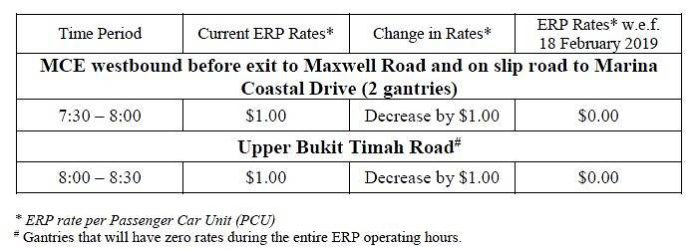
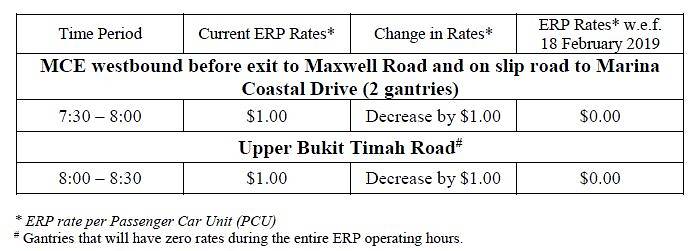
SINGAPORE: Electronic Road Pricing (ERP) charges will be removed at two gantries along the Marina Coastal Expressway (MCE) as well as another gantry at Upper Bukit Timah Road, the Land Transport Authority (LTA) said on Monday (Feb 11).

The revised rates will apply to the 7.30am to 8am period for the gantries along the MCE in the westbound direction: before the exit to Maxwell Road and on the slip road to Marina Coastal Drive.

Motorists will also no longer have to pay ERP charges at the gantry along Upper Bukit Timah Road, located in the southbound direction after Hume Avenue, between 8am and 8.30am, making it free of charge throughout the day.

Motorists were previously charged S$1 at those gantries.

ERP rates remove 3 gantrie morning Feb 18 review

(Image: LTA)

The changes are part of LTA’s quarterly review of traffic conditions, and will take effect on Feb 18.

The next review will take place in May.

Source link

Bill to enforce plain packaging for tobacco products passed in Parliament

0

SINGAPORE: New restrictions on cigarette packaging will be introduced in Singapore, after amendments to the Tobacco (Control of Advertisements and Sale) Bill were passed in Parliament on Monday (Feb 11). 

All tobacco products will be have to be sold in plain packaging – in a standardised colour and with all logos, brand images and promotional information removed. 

Brand names and product names will be allowed, but only in a standard colour and font style.

Graphic health warnings will also have to be at least 25 per cent bigger than existing ones.

Singapore plain cigarette packaging infographic

In moving the Bill for a second reading, Senior Minister of State for Health Edwin Tong said that more needs to be done to reduce tobacco use here.

He noted that one in five men in Singapore smoke daily, and that the male smoking rate is higher than in Australia, New Zealand, the United Kingdom and the United States. 

More than 2,000 Singaporeans die prematurely from smoking-related diseases each year, he said.

READ: Minimum legal age for smoking to be raised to 19 on Jan 1

Even though the smoking rate has been brought down in the past with measures like banning smoking in certain public places, restricting tobacco advertising and imposing taxes, the decline has been harder to sustain in recent years, said Mr Tong. 

“The smoking rates have been fluctuating between 12 per cent and 14 per cent in the last 10 years, with no clear pattern of continuous decline,” he added. 

“Clearly, we need to do more to stem tobacco use among Singaporeans, with a view to denormalising the use of tobacco products and bringing overall smoking rates to a level that is as low as possible.”

The amendments to the Bill come on the back of a ban on point-of-sale tobacco product displays which took effect in August 2017, as well as legislative changes to increase the minimum legal age for the purchase, use, possession, sale and supply of tobacco products.

The Ministry of Health (MOH) will brief industry stakeholders on the proposed specifications for the standardised tobacco packaging and discuss other operational implementation issues with them, Mr Tong said.

As with other changes relating to tobacco products, nine to 12 months’ advance notice is likely to be given, he added.

THE APPEAL OF BRANDED PACKAGING

Explaining the focus on packaging, Mr Tong said that cigarette packs serve as a “five-second commercial”.

“Evidence suggests that the appeal of branded packaging also acts as one of the factors encouraging children and young adults to experiment with tobacco and to establish and continue a habit of smoking,” he said.

A study carried out by the Health Promotion Board (HPB) to assess Singaporeans’ perceptions of current and plainer cigarette packaging appears to support such evidence. 

The study found that attractive pack designs were associated with high quality cigarettes and increased likelihood of attracting youths to try such products, Mr Tong said, adding that among a “significant minority” of non-smokers, perceived pack attractiveness was associated with the intention to try smoking.

HPB’s findings from other local studies also indicated that packets with darker colour and with graphic health warnings that filled at least 75 per cent of surfaces were considered by Singaporeans to be least attractive. They were also perceived to be more harmful to health.

READ: Singapore to introduce plain packaging, larger graphic warnings for all tobacco products

COUNTERFEIT PRODUCTS, “INSIDIOUS” ADVERTISING AMONG CONCERNS RAISED BY MPs

MPs who spoke on the Bill were generally in support of the amendments, but raised some concerns.

Chairman of Government Parliamentary Committee for Health Chia Shi-Lu asked if standardised packaging would lead to an increase in counterfeit tobacco products. He also asked if it would lead to “down-trading”, which describes a phenomenon in which there is a shift from more expensive tobacco products brands to lower priced alternatives in a market.

On the issue of advertising, Nominated MP Lim Sun Sun pointed out the use of what she described as “insidious social media campaigns” by multinational tobacco companies, which circumvent restrictions on tobacco advertising. Such campaigns, she explained, capitalise on the appeal of social media influencers through photographs featuring the influencers smoking in cool venues while wearing trendy clothing, accompanied by catchy hashtags.

Influencers are given strict instructions on which cigarettes to feature, how to take natural photographs which do not resemble advertisements, when they should post these images for optimal audience engagement, as well as the hashtags that they must use, she said. In one particular country, the influencers were even told to conceal the health warnings on the cigarette packs before posting the images.

“Such shady tactics are calculated to mislead young people into thinking that these images are organic social media content that simply reflect youth culture,” she said.

Professor Lim asked if there will be greater effort made to track the use of social media by tobacco and e-cigarette companies. She also asked if the ministry will work with the Advertising Standards Authority of Singapore to establish more concrete guidelines around the responsibilities of social media influencers with regard to full disclosure in cases of sponsored content by tobacco and e-cigarette companies.

Advertising was also a concern brought up by MP Gan Thiam Poh, who asked if MOH would consider requiring broadcast media to carry reminders of the harmful effect of tobacco in all screenings of videos, movies or drama productions, where scenes of smoking cannot be edited and cut.

DECISION TO INTRODUCE CHANGES “NOT TAKEN LIGHTLY”

Responding to the MPs’ concerns in his round-up speech on the Bill, Mr Tong said that MOH’s assessment is that the introduction of standardised packaging is “unlikely to materially contribute towards an increase in illicit trade in tobacco products in Singapore”.

“We arrived at this view after having carefully considered the arguments and evidence submitted by the tobacco industry on illicit trade to the public consultation,” he said. Mr Tong added that the local context is also important, as the prevailing form of illicit tobacco in Singapore is that of genuine but duty-unpaid cigarettes, as opposed to counterfeit cigarettes.

Duty unpaid ciggs at Tuas

6,000 cartons of duty-unpaid cigarettes were uncovered in a prime mover on Friday (May 18) at Tuas Checkpoint. (Photo: ICA)

“Due to the relatively small Singapore market for cigarettes, counterfeit cigarette manufacturers are not incentivised to counterfeit cigarettes for sale in Singapore,” he said.

Mr Tong added that the contribution of standardised packaging to down-trading is likely to only be a modest one. Any impact that down-trading may have on increasing overall demand may also be addressed by policy measures to increase the absolute price of low-price brands, for example, by increasing tobacco taxes.

On advertising concerns, Mr Tong said that Prof Lim had raised valid points about what happens with the proliferation of social media. He noted that as it stands, tobacco-related advertisements in all forms of media are already banned, but agreed that the large number of different influencers and the carefully designed portrayal of images may make detection and enforcement a lot more difficult.

READ: Ban on display of tobacco products to take effect on Aug 1 as grace period ends

He added that the HPB also runs a “very extensive” public education campaign which is also done online and on social media.

“So apart from enforcing it through the rules which we have in place, we also want to amplify public education outreach on the same platform, with the same reach and hopefully to the same target audience as what these tobacco companies are trying to do,” he said.

As for broadcast media, he said there are existing content guidelines for media broadcasters to exercise due diligence in the depiction of smoking on TV, in movies and other media channels.

Nonetheless, he added that his ministry will study the suggestion to display anti-smoking messages or advertisements before films containing tobacco imagery are shown.

Rounding up his speech, Mr Tong said that the decision to introduce standardised packaging and enlarge the size of the graphic health warning was not taken lightly.

“We have given due consideration to the available primary evidence, consulted with experts in different fields, and sought the public’s views multiple times,” he said, adding that his ministry acknowledges the impact of the changes on tobacco and related industries, and has taken steps to mitigate that impact.

Source link