Home Blog Page 842

Commentary: Sleeping more is essential to performing well at work and school

0

SINGAPORE: If there is one topic most Singaporeans often talk about, it’s that a huge number of us feel tired and sleep deprived most of the time, but can’t seem to do anything meaningful to escape our situations.

Undergraduate Ng Chia Wee expressed frustration dealing with the tension between obtaining adequate sleep and the drive to excel in our work and studies in a recent commentary for Channel NewsAsia.

He painted a vivid picture: A community of like-minded students burning the midnight oil with dogged determination, holding resolutely to the belief that “this will all be worth it”. These expressions of hard work and sacrifice in pursuit of excellence are admirable.

However, lest we romanticise the notion of sleep as a worthy sacrifice, the consequences of doing so need to be given due consideration.

LOSING SLEEP IMPACTS YOUR HEALTH

Being youthful and in good health may sometimes lend young Singaporeans a veil of impassivity as the related health consequences seem to be contained in an imperceptible, distant future. The reality of ill health, however, is not distant nor imperceptible.

One in nine Singaporeans have diabetes which can lead to blindness, kidney failure and lost limbs. One in eight Singaporeans suffer from a mental disorder, one in 10 will develop dementia, and cardiovascular diseases continue to be a leading cause of hospitalisation in Singapore.

READ: Unable to look sideways? Unusual signs of diabetes often unnoticed, ignored or denied, a commentary

Countless studies have shown that lack of sleep increases the risk of these conditions that require costly management, which places the burden of care on our family, affecting those around us.

While these conditions do not often affect 20 to 30 year olds, the risk increases between 40 and 70, an age bracket that constitutes a large segment of our workforce.

eyes in dark room

(Photo: Unsplash/Victorien Ameline)

READ: Are we losing the fight against inadequate sleep? A commentary

In addition, the effects of sleep on anxiety and depression can impact individuals at even younger ages, with high prevalence in adolescents and young adults.

BEING IN POORER HEALTH HURTS PRODUCTIVITY

On a population level, a 2016 RAND study reported the staggering economic costs of sleep loss and its harmful effects on companies and national economies.

Lower productivity, more sick days and fewer productive working years can chip off a country’s growth.

Based on the size of a country’s workforce, its GDP, and known prevalence of short sleep using representative population surveys, it is estimated that the lack of sleep costs the America US$411 billion or 2.29 per cent of GDP each year.

In Japan, a society with a work and sleep culture much like Singapore, the estimated economic costs of sleep loss reached up to 2.92 per cent of its GDP in that same RAND study (which did not include Singapore).

Economist Marco Hafner writes: 

If you’re a well-slept person you tend to be more productive on average which subsequently has a positive effect on your long-term earnings.

man sleeping at a cafe

(Photo: Unsplash/Hutomo Abrianto)

READ: Getting more sleep might land you that promotion, a commentary

Sleep loss stifles career progression, not just your present day work productivity. In extreme cases, developing a serious illness may lead to an extended period away from work, impacting your career progression.

HEALTH-SEEKING BEHAVIOURS AND EXCELLENCE ARE INSEPARABLE

We would only bear to sacrifice sleep if we think it is not essential.

Achieving seven to eight hours of sleep may not always be possible on a daily basis, and is not a cure-all, but it is imprudent to dismiss expert guidelines shaped by a wealth of knowledge amassed over decades of research, and declare that regularly getting sufficient sleep is an impossible feat.

We would not take the same fatalistic stance toward other health-seeking behaviours that improves performance in other aspects of our lives, like exercise or nutrition, yet we see getting enough sleep as an extravagance.

Throngs of office workers can be seen jogging around the Marina Barrage area every evening, many of whom plan to head back to the office to continue working post-exercise. This commitment to fit in time for exercise may even withstands busy periods as people recognise the benefits to performance and well-being that make exercise worth the time and effort.

Even high-performing teams in more industries are waking up to the insidious impact of disturbed sleep. Elite soccer clubs like Manchester United, Liverpool and Real Madrid have hired sleep consultants to help their players improve sleep to achieve peak performance on the field.

READ: Sleepless in Singapore? Let’s address our bedroom epidemic, a commentary

Public education and incentive programmes, such as the National Steps Challenge, can help achieve the needed behavioural changes and encourage more to adopt healthy lifestyles through gamification. 

Such programmes are believed to have a net positive impact on the health and productivity of individuals, as well as the population as a whole – and we could afford to think about how to apply these to solve our national problem of not getting enough sleep.

SLEEP MORE AND WORK MORE

Why are we not getting enough sleep? This question is as complex as it is frustrating. A 24-hour day just seems too short for all the professional, family, and community activities that are important to us.

Sleep loss insomnia obstructive sleep apnoea health (1)

(Photo: Unsplash/Kevin Grieve)

Ng Chia Wee aptly describes the conflict between the need to sleep and the desire to get more done, where the anxiety of not reaching our full potential deters us from heading to bed.

Certainly, spending more time asleep would mean less time working, but it comes at a cost when we are less focused, less energetic and less efficient. We also tend to make more mistakes and are more forgetful when we don’t get enough rest.

READ: Sleeping later is bad for your health and well-being, a commentary

Interestingly, just this year, students from Baylor University were invited to take part in a challenge which offered incentives if students managed to sleep an average of 8 hours a night during the week of their final exams.

Using a fitness wearable to track their sleep, researchers found that those who attained 8 hours of sleep did better than those who slept fewer hours.

When their sleep improved during the exam week, their grades did not suffer. So sleeping does not necessarily come at a cost to academic performance, contrary to popular fears.  

Studies from our own lab have also found more hidden productivity benefits of sleep. In one experiment, Singapore students learned a set of biological facts, after which they were given time to take a break, cram the same materials further, or take a nap.

When tested later that day, students who napped, and those who spent the same period of time further cramming the material, had better memory performance than those who took a break but did not sleep. One week later, this memory benefit was still present for the nap group, but not for the group that used the time to cram more facts.

A student takes a nap on a desk during his lunch break in a classroom in Hefei

Representational purpose: A student takes a nap on a desk during his lunch break in a classroom in Hefei, Anhui Province June 2, 2012. (Photo: REUTERS/Stringer/File Photo)

READ: Want to sleep better? Get a good pillow. A commentary

While we often think of sleep as unproductive time, the fact is active sleep processes are at work in the brain, transforming and reorganising the information we encounter during the day, working to strengthen our memory and help us gain new insights after sleep.

Furthermore, sleep offers mental health benefits. The restoration of positive emotions that result from a night of rest is an important resource in your arsenal to fend off annoyances and stress that arise with each task at work or assignment at school.

Shifting mindsets regarding sleep will be a first step towards improvement.

Obtaining seven to eight hours of sleep is surely difficult in a hectic life, but improving the quantity and quality of our sleep ought to be a priority since it is so essential to the excellence we seek.

Ruth Leong is a PhD student and Stijn Massar is a Senior Research Fellow, both at the Cognitive Neuroscience Laboratory, Duke-NUS Medical School.

Source link

Wine Fight – A Battle For the Ages…

0

The Wine Fight is held on the morning of the 29th of June each year in the historical heart of Rioja just outside the town of Haro (pronounced Aro), and is an exuberant, liberating and totally awesome experience.

Unlike the Running of the
Bulls and San Fermin in Pamplona or the La Tomatina Tomato Festival in Bunol
near Valencia, the Wine Fight is a much more authentic Spanish fiesta with many
locals and fewer tourists.

wine fight girl

From 7.00am in the morning
on a craggy hillside at the foot of the Cliffs of Bilibio boozy revellers begin
to gather. Most have had no sleep having partied all night in the town’s main
square to the many bands and DJ’s that have performed the night away. The
streets of Haro are filled the night before with locals of all ages and you’ll
often see kids and the elderly still there at dawn and heading to the Wine
Fight arm in arm.

With historical roots forged
a millennium ago, this wine throwing fiesta, known locally as the La Batalla
Del Vino (battle of the wine), is quite simply put…Crazy! According to
tradition, Haro had to reclaim its control of the area every year by raising
the town’s flag above the tiny chapel at the top of the cliff. Eventually
pilgrims who were to carry out this ritual, started feasting, drinking and
well…the rest is history as they say!

Combatants make their way the 6kms out of town to the location by foot, bike, horse, tractor, car, scooter, motorcycle, donkey or via the council provided free bus transfers which take you most of the way to the Cliffs of Bilibio. For this insane battle the weapon of choice is vino (wine) and there is no quarter asked and no mercy given once in the thick of the action. Armed with water pistols, buckets, crop sprayers, water bombs, jugs, backpacks, bottles and every other imaginable vessel that can hold liquid the crowd gleefully covers each other in red wine from head to toe.

wine fight crowd

The tradition of San Vino
dictates that everyone wears white clothing adorned with red sashes and scarves
and it’s pretty much guaranteed that by the end of the Wine Fight that there
won’t be any part of your clothing that’s not stained irreversibly red. Young
children can be seen attacking adults and grandparents can be seen dumping
buckets of red wine on very young children. There is no mercy.
Tourists are easily identifiable and simple cannon fodder for the locals and
are guaranteed to be soaked. This Wine Fight is bacchanalia at its core
and the wine god Bacchus himself would be proud to witness this ridiculous,
superfluous but totally energising and invigorating event.

Most tourists attending the Wine Fight
stay at the nearby campsite which is in a brilliant position just outside the
towns centre. An added advantage of staying at the campsite is that the local
buses also depart for the Wine Fight from the campsite, so it makes an ideal
base for tourists to locate themselves.

For loads more information on the event including accommodation
options and advice on how to prepare check out https://sites.google.com/view/winefight

Last modified: February 19, 2019

Source link

Biggest supermoon of 2019 lights up Singapore sky

0

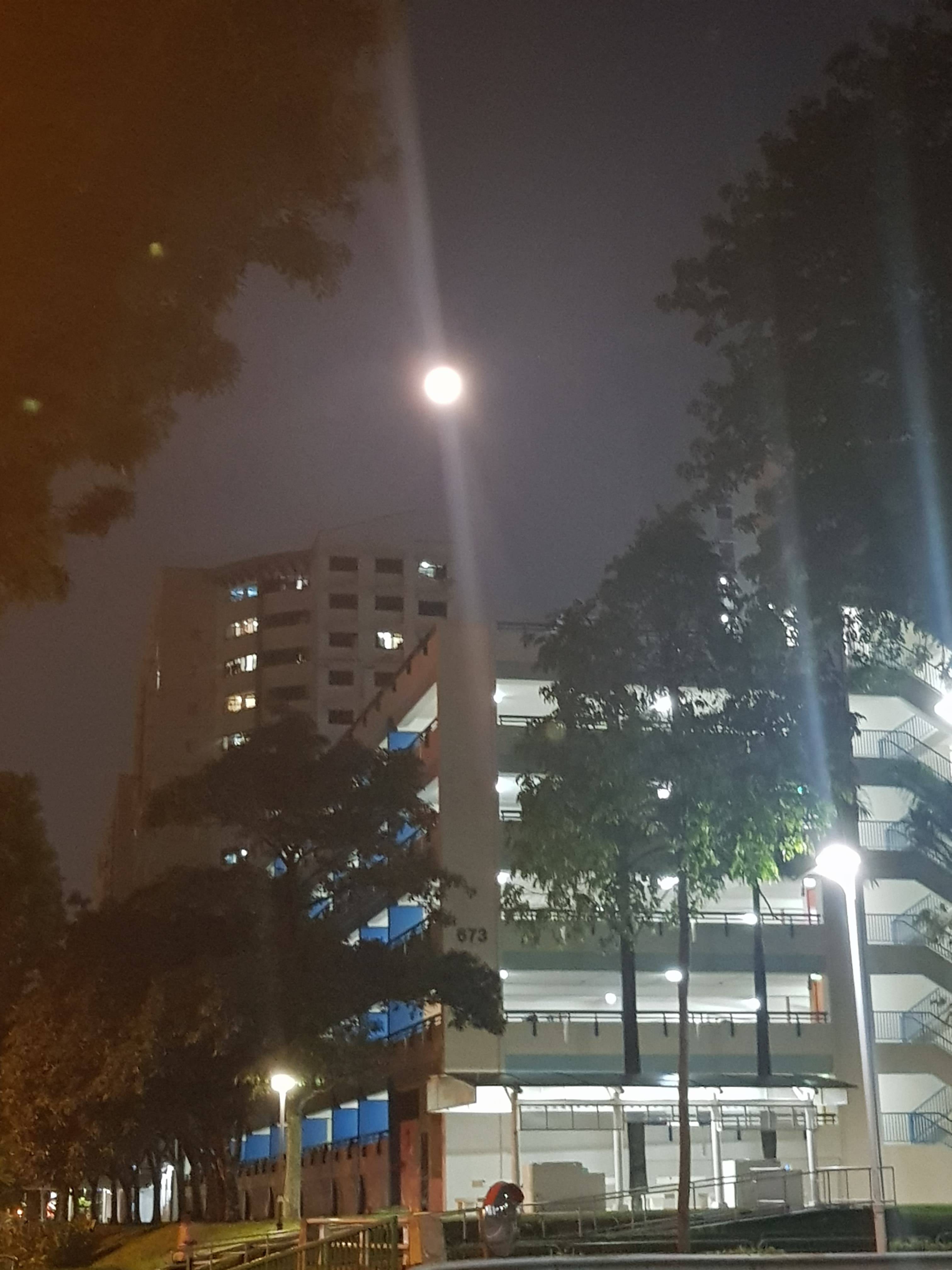
SINGAPORE: Moongazers in Singapore can expect a visual spectacle on Tuesday night (Feb 19) as a supermoon lights up the skies. 

A supermoon is when a full moon is at its closest approach to the earth, causing it to appear larger than the usual full moons that year, according to the Science Centre Singapore.

Said the organisation in a Facebook post: “Best viewed at around 7.30pm, make sure to get a clear view of the skies and cross your fingers for good weather to witness this year’s supermoon!”

It suggested looking to the eastern horizon on Tuesday night to catch a glimpse of the phenomenon.

Supermoon over Malaysia

The moon shines over Karak in Malaysia’s Pahang state on February 18, 2019 a day before full moon. (Photo: AFP/Mohd Rasfan)

Tuesday’s supermoon is said to be the biggest and brightest of the year. 

It coincides with Chap Goh Mei, which marks the end of the 15-day Chinese New Year celebrations.

Supermoon seen at Jurong

The supermoon shining bright in Jurong on Feb 19, 2019. (Photo: Norliana Fairyliasha Love Raymund)

Housewife Norliana Fairyliasha Love Raymund caught a glimpse of the supermoon on Tuesday at around 8.45pm in Jurong.

“It is so beautiful, it’s so, so bright,” the 35-year-old told Channel NewsAsia.

“It’s not (the) first time (seeing a supermoon) but definitely this time, supermoon is so beautiful,” she added.

The next supermoon of 2019 will be on Mar 21, the last of three for this year. 

This story came from a reader tip-off. If you would like to send in photos or videos of something newsworthy, WhatsApp our Mediacorp news hotline at +65 8218 8281 or message us on Facebook.

Source link

Man arrested after trying to pay for ride with fake S$50 note

0

SINGAPORE: A man has been arrested for using a counterfeit S$50 note to pay for a private-hire car ride, said the police in a news release on Tuesday (Feb 19). 

The case came to light on Feb 12, when the driver reported being given the fake note as payment by the passenger. 

“The driver noticed the lack of security features on the note and rejected it,” said the police. 

She then returned the note to the passenger and lodged a police report. 

Man arrested after found with fake notes 2

Authorities also seized a colour printer and mobile phone as case exhibits. (Photo: Singapore Police Force)

Through follow-up investigations, officers arrested the 25-year-old man along Marsiling Rise at about 2pm on Monday.

Police found counterfeit S$100 notes in his possession and seized those, along with a colour printer and mobile phone, as case exhibits. 

The man will be charged on Wednesday.

If found guilty of counterfeiting currency notes, he could be jailed for up to 20 years and fined. Those convicted of using counterfeit currency notes in place of genuine currency notes could face the same punishment. 

Meanwhile, anyone found guilty of possessing such notes could be jailed for 15 years and fined. 

Source link

Mikhy Brochez, accused of Singapore HIV data leak, appears in US court on trespassing charges

0

WINCHESTER, Kentucky: The US citizen accused of leaking details of 14,200 HIV-positive people from Singapore’s HIV registry appeared briefly in a Kentucky courtroom on Monday (Feb 18) on trespassing charges, telling the judge he believes the Singapore Government may be interfering in the case.

Mikhy Farrera Brochez, 34, arrived without an attorney at a Clark County District Court in Winchester, Kentucky, where he had been arrested in December and charged with third-degree criminal trespassing for refusing to leave his mother’s home.

Kentucky court

Mikhy Farrera Brochez arrives at a Clark County District Court in Winchester, Kentucky on Feb 18, 2019. (Photo: Chris Kenning) 

Judge Charles Hardin delayed the case until Mar 4 at the arresting officer’s request, noting that Brochez had pleaded not guilty and the charges carried no possibility of jail time. The judge told Brochez he did not know anything about his allegation of interference.

Outside the courtroom before the hearing, Brochez did not directly address a reporter’s question on whether he leaked information from Singapore’s HIV registry. But he recently told Vice News that he shared the data with government and media sources and that the information had already been exposed.

Brochez repeated claims on Monday that he contracted HIV only after “they had me gang-raped in prison”. Singapore authorities have said his allegations are “blatantly false”.

READ: HIV data leak: Singapore authorities refute ‘baseless allegations’ made by Mikhy Brochez

READ: HIV data leak: Unanswered questions and information gaps remain

Asked about those potentially hurt by the leak, he said: “I was thrown in prison for something I didn’t do. And I was held down and gang-raped by your government. And you want to talk to me about someone’s feelings? Do you have any idea what I’m going through right now?”

Brochez stood during the hearing in a plaid button-down shirt before the judge. He said his mother wanted to drop the case, and that it was causing hardship by interfering with his ability to work. Judge Hardin said his mother did not have the right to dismiss it and continued it for two weeks.

Mikhy Farrera Brochez

Mikhy Farrera Brochez shows up for his court hearing in Winchester, Kentucky, on trespassing charges. (Photo: Chris Kenning) 

His mother, Ms Teresa King, was not present and could not be reached.

It was at Ms King’s house near Winchester where Brochez was arrested in December after he refused to leave, three months after police responded to a similar call and he was warned to stay away.

“This deputy informed the suspect about the past warning and the suspect was instructed to leave numerous times but the suspect kept wanting to ask about the property that T. King had of his and wanting to talk to the sheriff,” according to an arrest report.

After the hearing, Brochez declined to answer questions. He was accompanied by the sheriff’s deputies outside, climbing into a white Mercedes SUV and driven away. Court documents listed his home address in Lexington, Kentucky.

READ: What we know about Mikhy Farrera Brochez

Mikhy Farrera Brochez in court 2

Mikhy Farrera Brochez is seated at the Clark County District Court in Winchester, Kentucky on Feb 18, 2019. (Photo: Chris Kenning)

Brochez, who had worked in Singapore as a psychology lecturer, was sentenced in 2017 to 28 months in jail on drug and fraud charges, including for using a fake blood test to lie about his HIV-positive status and gain an employment pass.

His partner, Singaporean doctor Ler Teck Siang, had access to the HIV registry as part of his work as the former head of the National Public Health Unit. The pair started living together in Singapore in 2008, and were married in New York City in 2014.

Singapore’s Health Ministry announced on Jan 28 that Brochez, who was deported last April, had leaked online information from Singapore’s HIV registry. That included names, phone numbers, addresses, test results and medical information.

He is now wanted in connection with the data leak that includes 5,400 Singaporeans diagnosed with HIV from 1985 to January 2013 and 8,800 foreigners, including work and visit pass applicants and holders, diagnosed with HIV from 1985 to December 2011.

Health Minister Gan Kim Yong said in Parliament recently that the Singapore police will “spare no effort” in bringing Brochez to justice and that they are “engaging their American counterparts and are seeking their assistance in the investigations against Brochez”.

READ: HIV data leak: Police will ‘spare no effort’ to bring Mikhy Farrera Brochez to justice

The US Embassy in Singapore has previously declined comment.

Investigators say Brochez also forged his degrees including a doctorate from the University of Paris to a US teaching certification. In 2010 he had told a local newspaper that his mother was a renowned professor of child and adolescent psychology in the UK.

Source link

Mikhy Brochez appears in US court on trespassing charges

0

KENTUCKY: The US citizen accused of leaking details of 14,200 HIV-positive people from Singapore’s HIV registry appeared briefly in a Kentucky courtroom on Monday (Feb 18) on trespassing charges, telling the judge he believes the Singapore Government may be interfering in the case.

Mikhy Farrera Brochez, 34, arrived without an attorney to a Clark County District Court in Winchester, Kentucky, where he had been arrested in December and charged with third-degree criminal trespassing for refusing to leave his mother’s home.

Kentucky court

Mikhy Brochez arrived without an attorney to a Clark County District Court in Winchester, Kentucky, where he had been arrested in December and charged with third-degree criminal trespassing for refusing to leave his mother’s home. (Photo: Chris Kenning) 

Judge Charles Hardin delayed the case until Mar 4 at the arresting officer’s request, noting that Brochez had pleaded not guilty and the charges carried no possibility of jail time. Hardin told Brochez he didn’t know anything about his allegation of interference.

Outside the courtroom before the hearing, Brochez did not directly address a question of whether or not he leaked registry information. But he recently told Vice News that he shared the list with government and media sources and that the information that had already been exposed.

Brochez did repeat claims on Monday that he contracted HIV only after “they had me gang-raped in prison.” Singapore authorities have said his allegations are “blatantly false.”

READ: HIV data leak: Singapore authorities refute ‘baseless allegations’ made by Mikhy Brochez

READ: HIV data leak: Unanswered questions and information gaps remain

Asked about those potentially hurt by the leak, he said: “I was thrown in prison for something I didn’t do. And I was held down and gang-raped by your government. And you want to talk to me about someone’s feelings? Do you have any idea what I’m going through right now?”

Brochez stood during the hearing in a plaid button-down shirt before the judge. He said his mother wanted to drop the case, and that it was causing hardship by interfering with his ability to work. Hardin said his mother didn’t have the right to dismiss it and continued it for two weeks.

Mikhy Farrera Brochez in court 1

Mikhy Farrera Brochez in a Clark County District Court in Winchester, Kentucky on Feb 18, 2019. (Photo: Chris Kenning) 

His mother, Teresa King, was not present and could not be reached.

It was at King’s house near Winchester where Brochez was arrested in December and refused to leave, three months after police responded to a similar call and he was warned to stay away.

“This deputy informed the suspect about the past warning and the suspect was instructed to leave numerous times but the suspect kept wanting to ask about the property that T. King had of his and wanting to talk to the sheriff,” according to an arrest report.

After the hearing, Brochez declined to answer questions. He was accompanied by sheriff’s deputies outside, climbing into a white Mercedes SUV and driven away. Court documents listed his home address in Lexington, Kentucky.

READ: What we know about Mikhy Farrera Brochez

Mikhy Farrera Brochez in court 2

Mikhy Farrera Brochez in a Clark County District Court in Winchester, Kentucky on Feb 18, 2019. (Photo: Chris Kenning)

Brochez, who had worked in Singapore as a psychology lecturer, was sentenced in 2017 to 28 months in jail on drug and fraud charges, including for using a fake blood test to lie about his HIV-positive status and gain an employment pass.

His partner, Singaporean doctor Ler Teck Siang, had access to the HIV registry as part of his work as the former head of the National Public Health Unit. The pair started living together in Singapore in 2008, and were married in New York City in 2014.

Singapore’s Health Ministry announced on Jan 28 that Brochez, who was deported last April, had leaked online information from Singapore’s HIV Registry. That included names, phone numbers, addresses, test results, and medical information.

Mikhy Brochez

Mikhy Brochez accompanied by sheriff’s deputies after leaving the courtroom. (Photo: Chris Kenning) 

He is now wanted in connection with the data leak that includes 5,400 Singaporeans diagnosed with HIV from 1985 to January 2013 and 8,800 foreigners, including work and visit pass applicants and holders, diagnosed with HIV from 1985 to December 2011.

Health Minister Gan Kim Yong said in Parliament recently that the Singapore police will “spare no effort” in bringing Brochez to justice and that they are “engaging their American counterparts and are seeking their assistance in the investigations against Brochez”.

READ: HIV data leak: Police will ‘spare no effort’ to bring Mikhy Farrera Brochez to justice

The US Embassy in Singapore has also previously declined comment.

Investigators say Brochez also forged his degrees including a doctorate from the University of Paris to a US teaching certification.  In 2010 he had told a local newspaper that his mother was a renowned professor of child and adolescent psychology in the UK.

Source link

7 things you need to know about Budget 2019

0

SINGAPORE: The 2019 Budget remains an “expansionary” one, with Finance Minister Heng Swee Keat announcing a Bicentennial Bonus and measures to help Singaporeans with healthcare costs.

He also set out details for the much-anticipated Merdeka Generation Package, which will cost the Government S$8 billion in all.

What do the measures announced on Monday (Feb 18) mean for Singaporeans and Singapore businesses?

Here’s a quick overview:

1. THANKS, MERDEKA GENERATION

As expected, the Finance Minister fleshed out the previously announced Merdeka Generation Package, which he called a “gesture of our nation’s gratitude” for those who played a critical role in Singapore’s development.

The five key benefits announced were:

  • A S$100 top-up to Merdeka Generation seniors’ PAssion Silver cards
  • Medisave top-ups of S$200 for five years
  • Community Health Assist Scheme (CHAS) subsidies and discounts at polyclinics, public specialist outpatient clinics
  • MediShield Life premium subsidies
  • A S$1,500 incentive to join CareShield Life

2. AN “EXPANSIONARY” BUDGET THIS YEAR

Like the previous financial year, the Government’s budget position for FY2019 remains expansionary, with a basic deficit of S$7.1 billion expected. 

This is excluding government top-ups to funds and Net Investment Returns Contribution from past reserves.

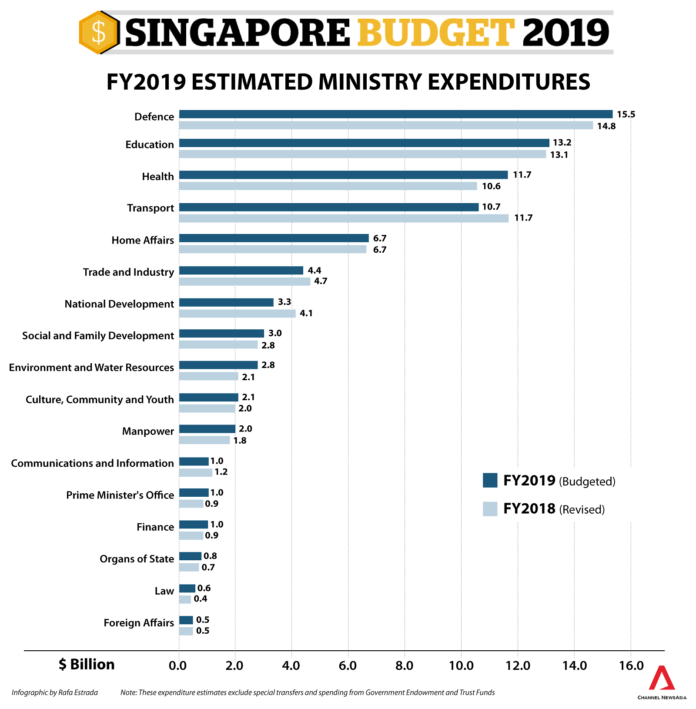
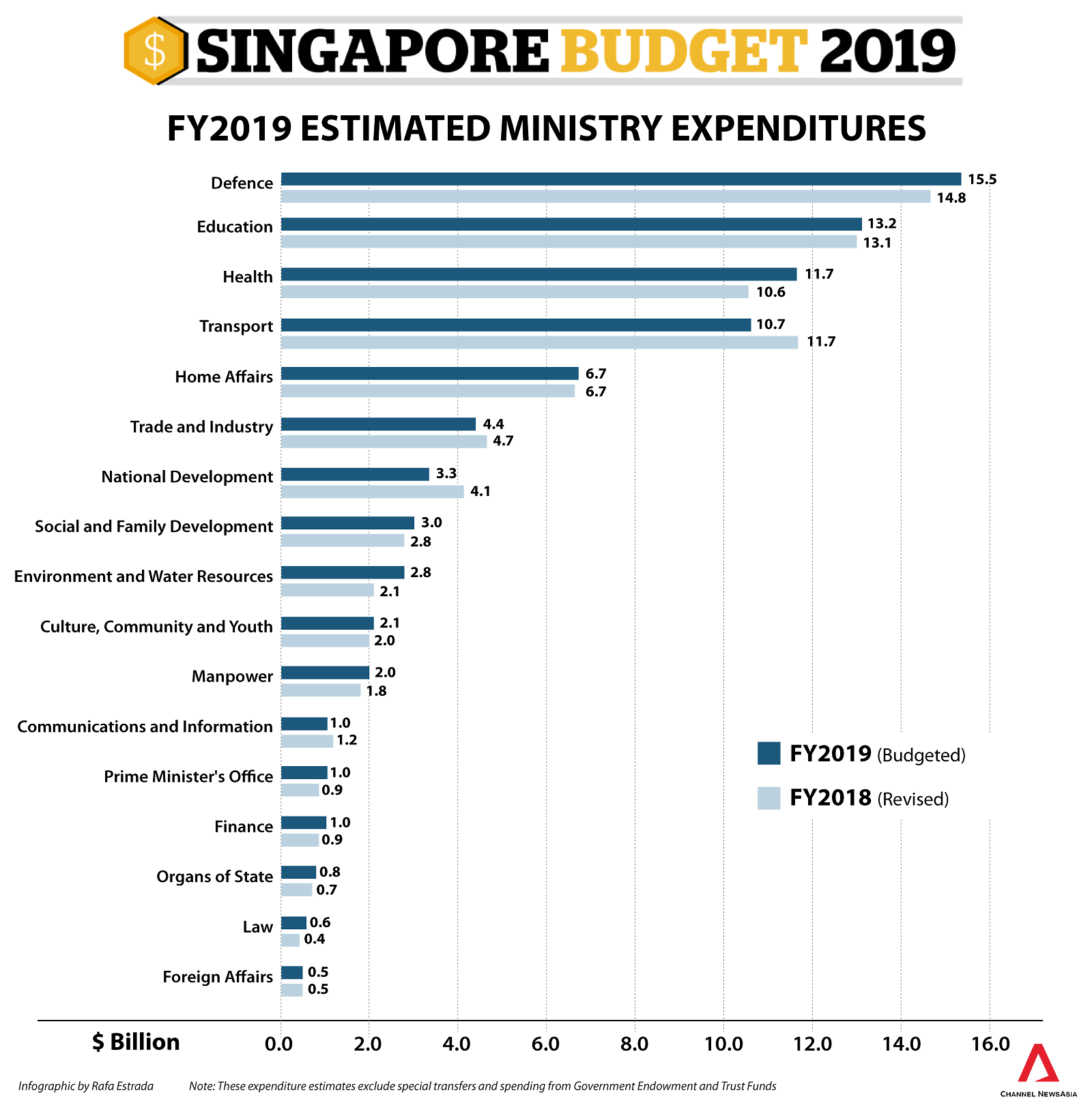
On the whole, a deficit of S$3.5 billion or 0.7 per cent of GDP is predicted, with increased spending expected for defence, education and health.

Budget 2019 estimated expenditure infographic

3. NOT EXACTLY A “HONG BAO”, BUT STILL A BONUS

Last year, the Finance Minister ended his Budget speech on a prosperous note, announcing a one-time “hongbao” for Singaporeans aged 21 and above.

In a similar vein, a S$1.1 billion Bicentennial Bonus was announced to commemorate Singapore’s bicentennial this year.

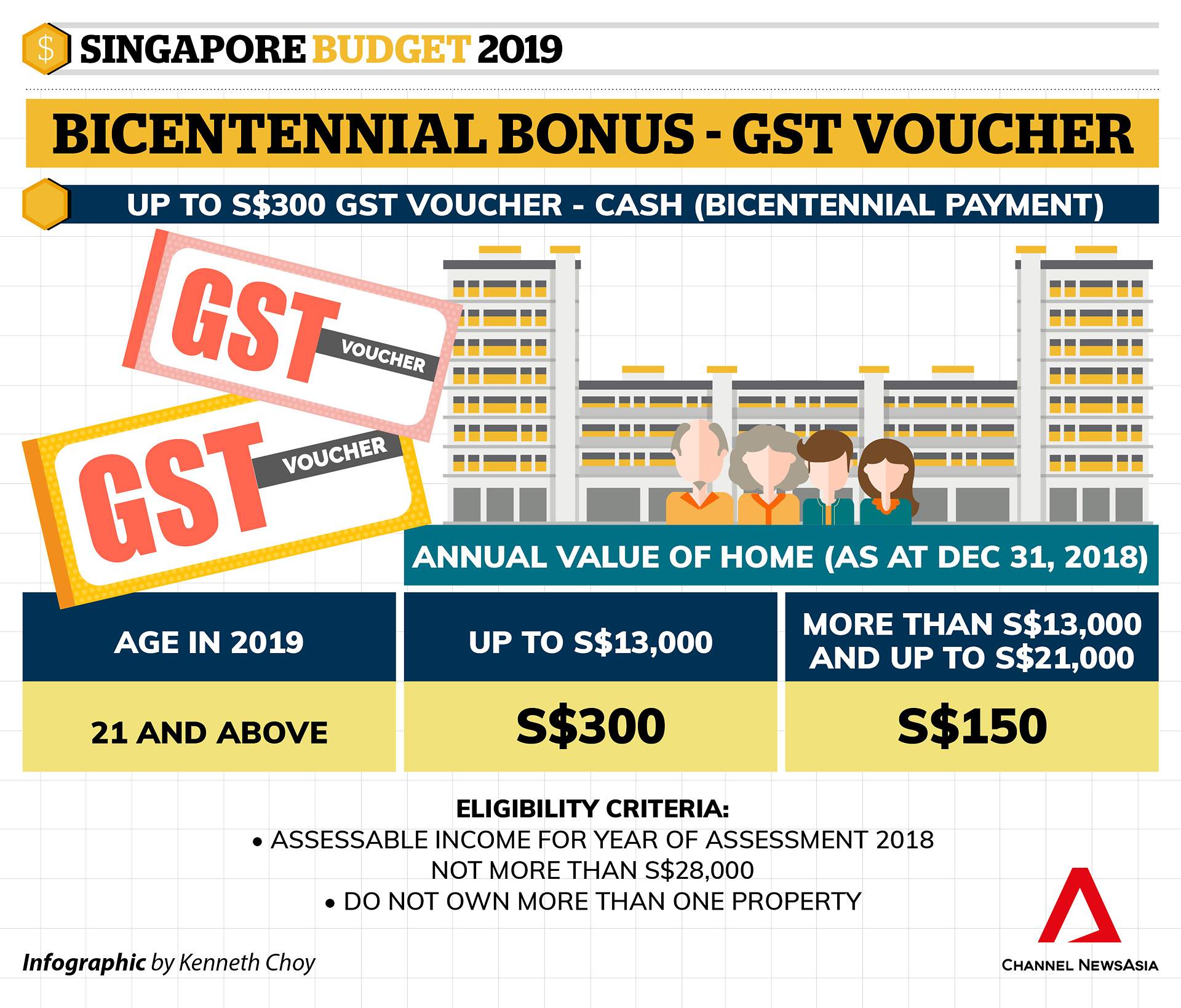
This includes GST vouchers and a personal income tax rebate of 50 per cent (capped at S$200 per taxpayer), for income earned in 2018.

Budget 2019 GST voucher

Younger Singaporeans will get additional top-ups to their Edusave and Post-Secondary Education Accounts, while eligible older Singaporeans can look forward to a one-off CPF top-up.

Lower wage workers will also get more in Workfare Income Supplements.

4. HEALTHCARE IN FOCUS

Healthcare was a key focus, with more money earmarked for premium subsidies and other forms of support. 

With another S$3.1 billion set aside this year, a total of S$5.1 billion will be put into a new Long-Term Care Support Fund, to fund CareShield Life subsidies and ElderFund.

In addition, CHAS subsidies will be enhanced:

  • CHAS coverage will be extended to all Singaporeans for chronic conditions, regardless of income
  • Lower to middle-income Singaporeans who are CHAS Orange cardholders will also see subsidies extended to include common illnesses
  • Subsidies for complex chronic conditions will also be increased

READ: Budget 2019: More support for lower-wage, older workers; enhanced CHAS subsidies at GPs

5. MORE SUPPORT FOR WORKERS, BUSINESSES…

Measures worth S$1 billion were also announced to help local companies build “deep” capabilities. Firms can look forward to “customised” assistance in overcoming business challenges and scaling up.

For workers, there will be new Professional Conversion Programmes relating to blockchain, embedded software and pre-fabrication, while there will be extended wage support for older workers.

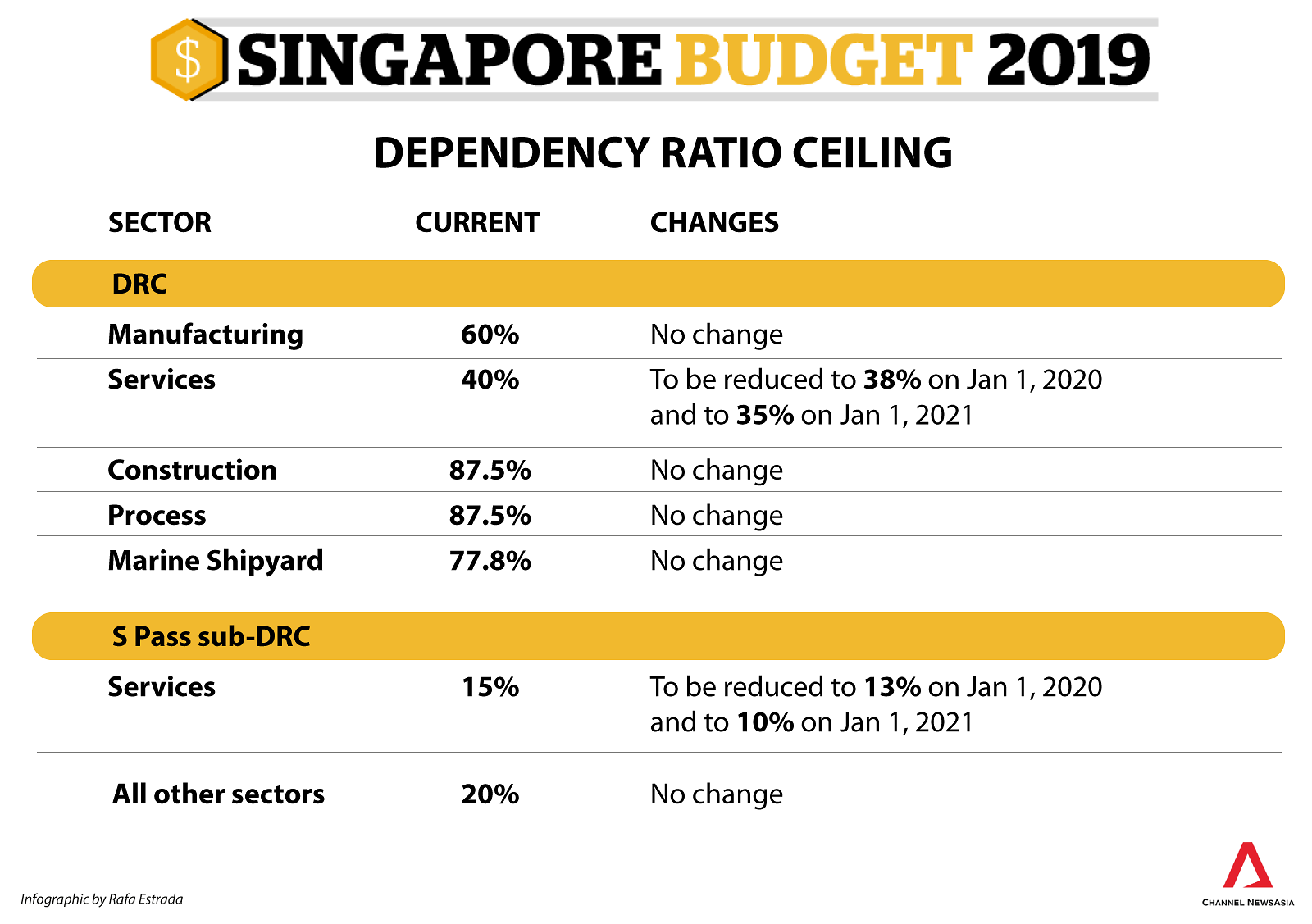
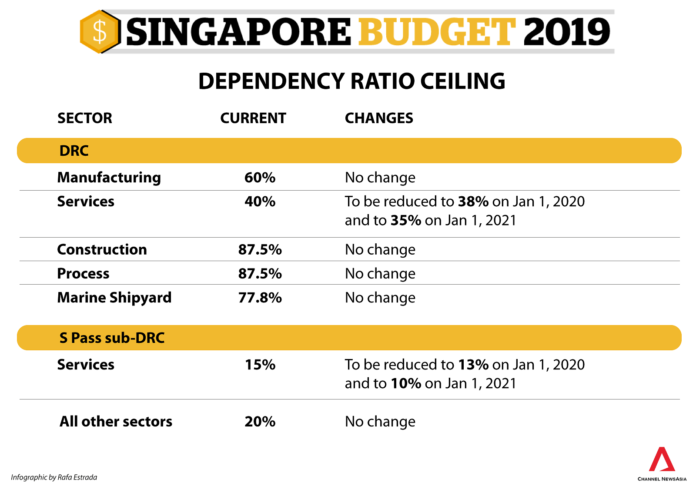
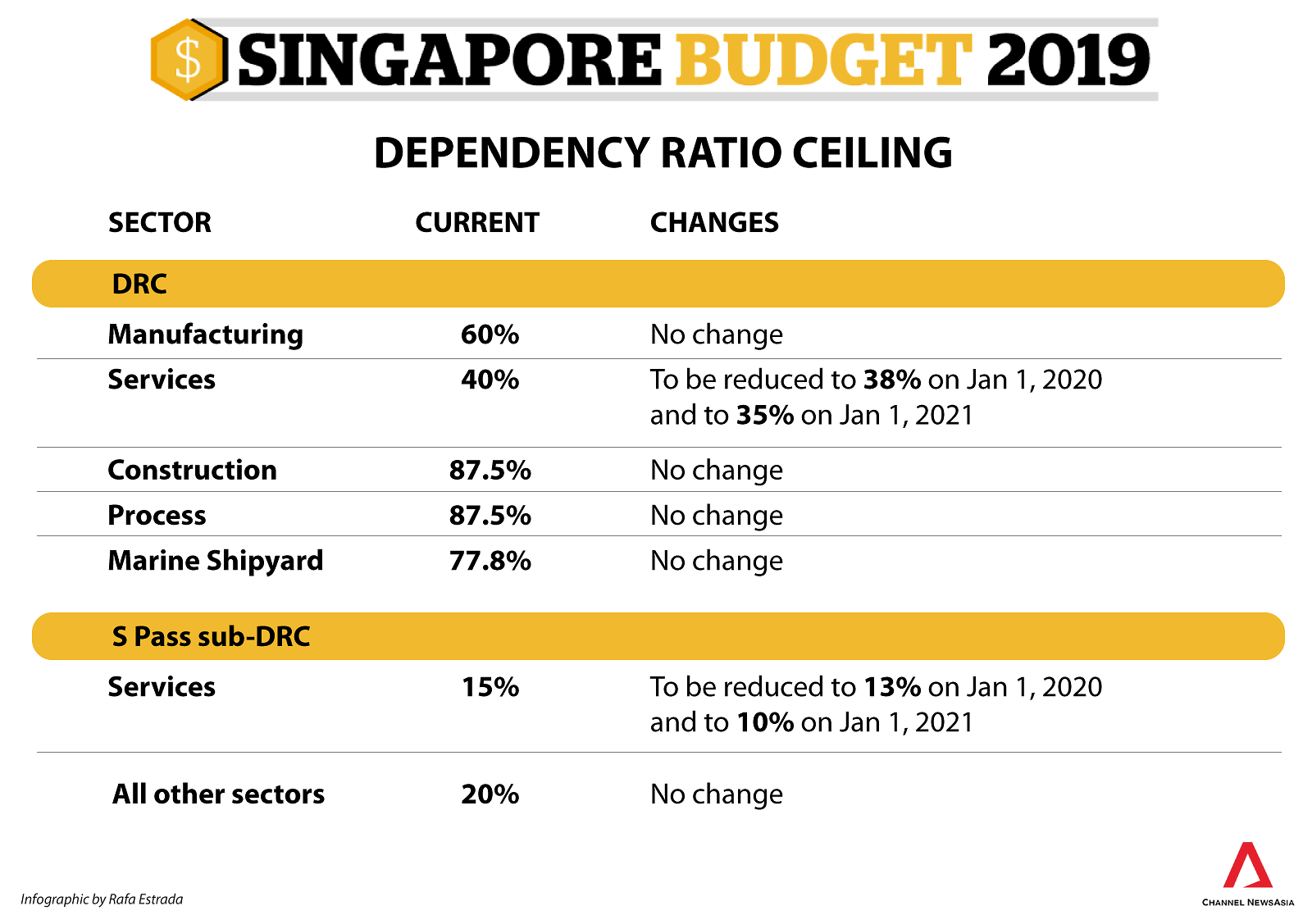
However, there will be a lower foreign worker ratio in the services sector, with Mr Heng saying that “relying on more and more foreign workers is not the long-term solution”.

foreign worker ratio DRC Budget 2019 Graphic

6. … BUT LESS FUN FOR HOLIDAYMAKERS

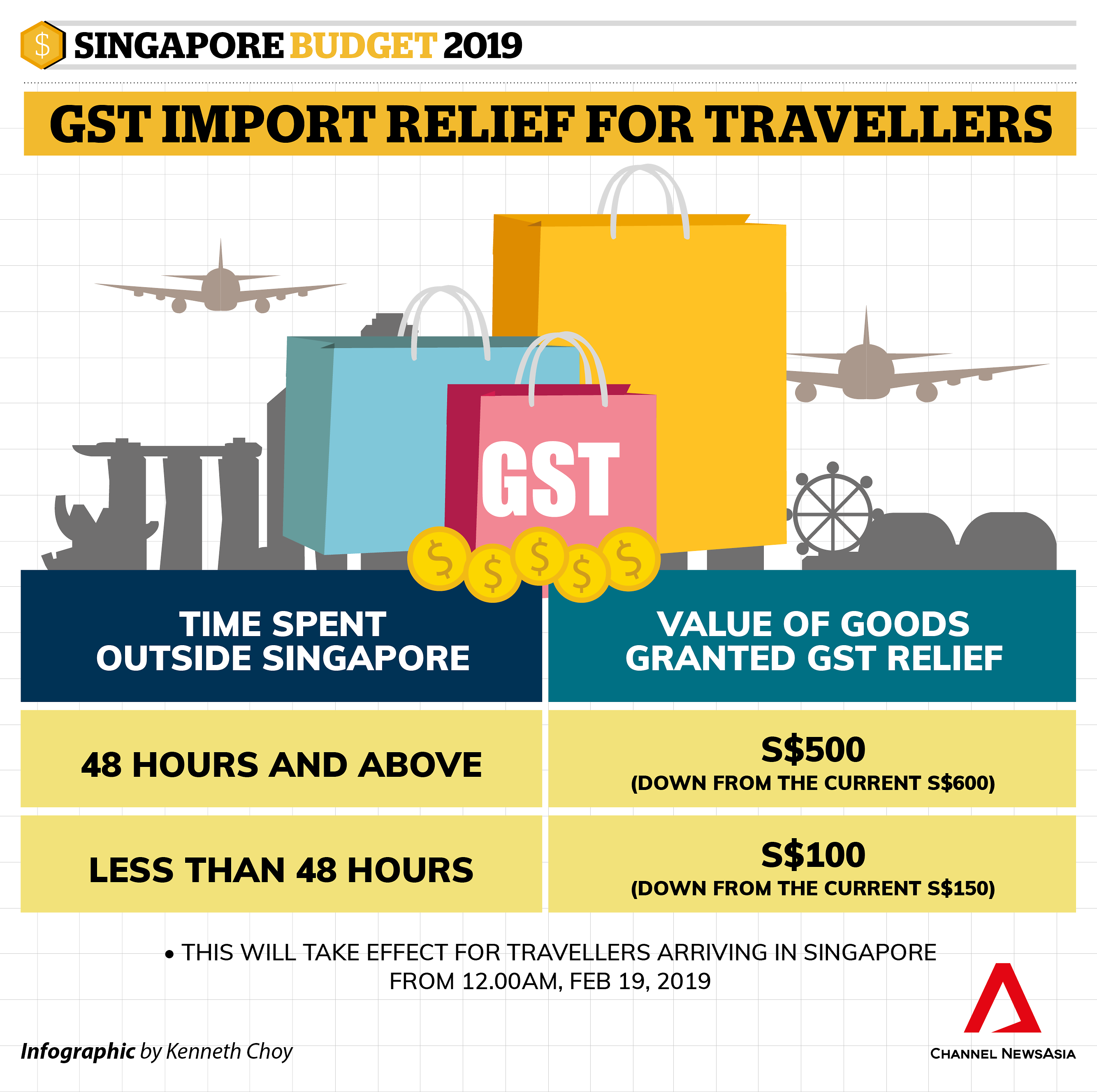
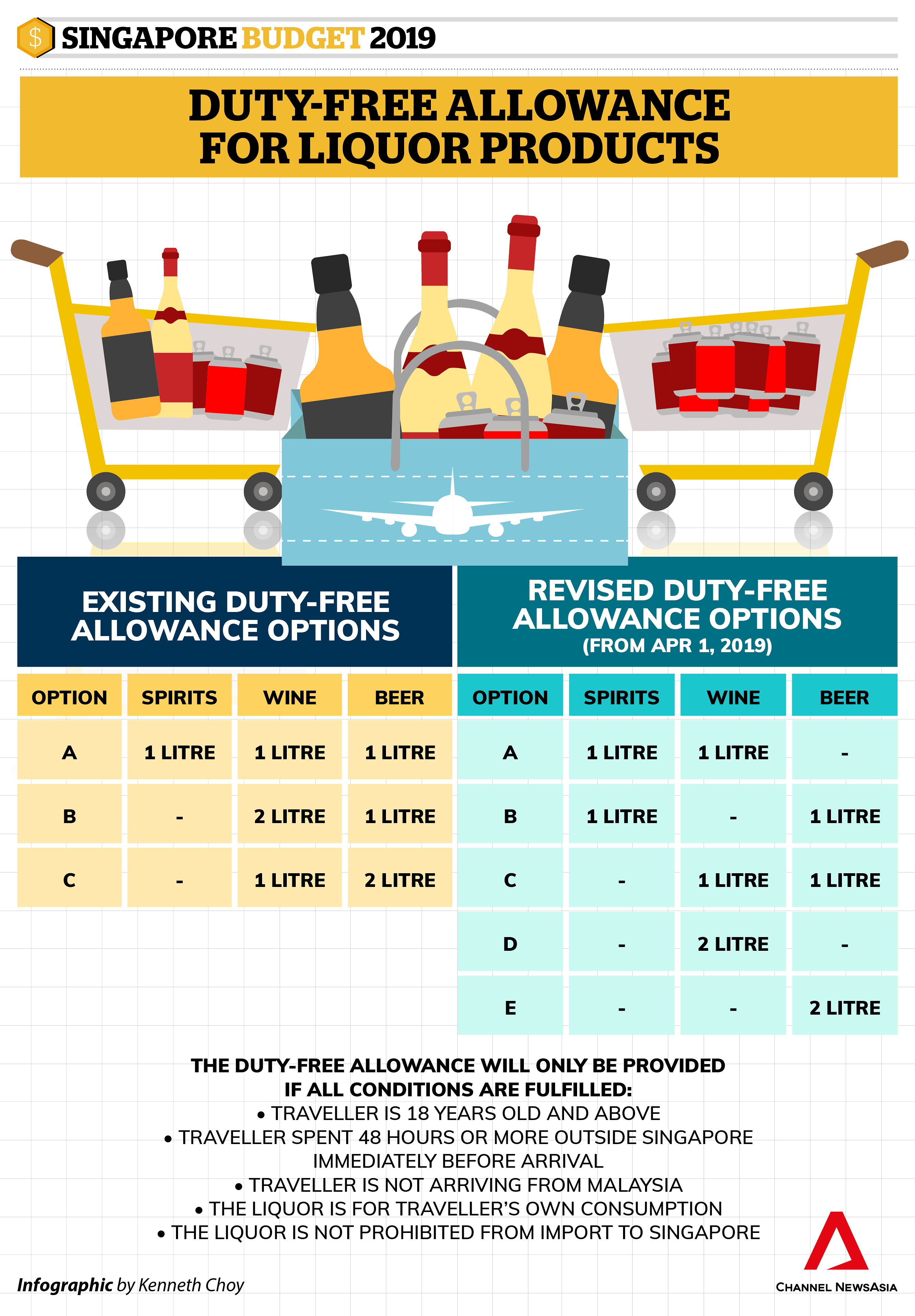
There was bad news for holidaymakers, with the announcement of less GST import relief and a reduced alcohol duty-free concession.

Travellers who spend fewer than 48 hours outside Singapore will have to start paying GST on goods bought overseas worth more than S$100, down from the previous S$150 allowance. This change takes place with effect from midnight, Tuesday.

GST relief duty-free Budget 2019 Graphic

Those who like their booze duty-free should also take note – from Apr 1, travellers will only be able to buy 2 litres of duty-free alcohol, down from the current 3 litres.

Duty-free liquor Budget 2019 Graphic

READ: Budget 2019: Travellers to get lower allowance for GST-free purchases, duty-free alcohol

7. DOUBLED DUTY ON DIESEL

Mr Heng also announced that the excise duty on diesel fuel has been increased from S$0.10 to S$0.20 per litre with immediate effect, as part of measures to restructure diesel taxes.

At the same time, the annual special tax on diesel taxis will be permanently reduced by S$850, while the special tax on diesel cars will be cut by S$100.

However diesel buses ferrying schoolchildren will get additional cash rebates of up to S$3,200 over three years. 

Commercial diesel vehicles will get a 100 per cent road tax rebate for one year, and partial road tax rebate for another two years.

Source link

Made for Singapore: First of four custom-built RSN submarines launched in Germany

0

KIEL, Germany: The first of four customised submarines designed for operations in Singapore’s shallow and busy tropical waters was launched in Germany on Monday (Feb 18).

Speaking to reporters after the launch ceremony in Kiel, Defence Minister Ng Eng Hen said the acquisition of the submarines was “timely”, with the maritime environment around Singapore facing security challenges and other Asian countries increasing their defence spending.

READ: Singapore, Malaysia maritime dispute: A timeline

The 70-metre long vessel, christened the Invincible, is the first of four new submarines custom-built to Singapore’s needs. Among other things, they will possess longer endurance and greater weapons-carrying capacity.

The new submarines will replace the Republic of Singapore Navy’s (RSN) current Archer-class and Challenger-class submarines. 

Besides being able to last underwater one-and-a-half times longer than the navy’s current submarines, the Type 218SGs can locate enemies faster and identify them more accurately with its improved sonar.

This will enhance the navy’s capability to better protect Singapore’s waters, and safeguard Singapore’s access to the sea lines of communication, the Defence Minister said.

Dr Ng added: “The SAF (Singapore Armed Forces) will have to shape itself to deal with a multitude of security challenges, some of which are conventional, some like terrorism or weapons of mass destruction. 

“So the submarines are very much part and parcel of any modern military and I think it’ll add significantly to the RSN’s capability and the SAF’s capabilities in terms of options when the time is needed.”

The minister also said that deterrence is very important to Singapore, and it does not build or operate against any single country.

“When we acquired these vessels, we took into account the other militaries around us modernising their submarines,” Dr Ng said.

“Like Indonesia, Thailand, Vietnam, China, and from further afar. Obviously Australians too. So it’s in keeping with the modernisation of militaries in our region.”

Type218SG submarine

The 70-metre long vessel, christened the Invincible. (Photo: Jeremy Koh)

THREE REMAINING SUBMARINES UNDER CONSTRUCTION

Following its launch, the Invincible will undergo a series of sea trials before delivery to Singapore in 2021.

The submarine crew can look forward to larger living spaces compared to the RSN’s older submarines, meaning hygiene on board will improve and the crew can endure longer underwater, said Colonel Teo Chin Leong, Commanding Officer of the 171 Squadron, which will receive the new submarines.

READ: Confined conditions, stressful scenarios, tough training: The life of a Singapore submariner

He added: “The crew will be undergoing training in phases. First at an individual level before they move on to operate the submarine as a group.”

The three remaining Type 218SG submarines – named Impeccable, Illustrious and Inimitable – are still under construction.

Source link

Budget 2019: Building a ‘strong, united Singapore’; Merdeka Generation Package, healthcare take spotlight

0

SINGAPORE: Finance Minister Heng Swee Keat delivered an expansionary Budget on Monday (Feb 18) that outlined a strategic plan “to build a strong, united Singapore”.

He said “new forces are reshaping the global environment”, and these are interacting in complex ways at the global, regional and national levels and there is a need for Singapore to chart its way forward confidently building on its distinct strengths.

As expected, details for the Merdeka Generation Package were fleshed out by Mr Heng in Parliament after it was first announced by Prime Minister Lee Hsien Loong in his 2018 National Day Rally speech.

READ: NDR 2018: ‘Merdeka Generation’ healthcare package for Singaporeans born in ’50s

Singaporeans who are born in the 1950s fall in this category of people who – as the minister said – “played a critical role” in the nation’s development and came together to forge its multicultural, multiracial society.

Among the key highlights of the package are that they will receive a MediSave top-up of S$200 each year for five years starting from 2019, while getting additional subsidies for outpatient care for life. For the latter, special Community Health Assist Scheme (CHAS) subsidies for common illnesses, chronic conditions and dental conditions will be given to all in this demographic, regardless of income, he explained.

“The Merdeka Generation Package is a gesture of our nation’s gratitude for their contributions and a way to show care for them in their silver years,” Mr Heng said.

“It will provide them better peace of mind over future healthcare costs, while helping them to stay active and healthy.”

The package, which is expected to benefit close to 500,000 Singaporeans, is estimated to cost more than S$8 billion over the beneficiaries’ lifetimes, said Mr Heng.

As such, S$6.1 billion of this Budget has been set aside – with interest accumulated over time, the amount will be able to cover the projected costs, he said.

Eligible Singaporeans will be notified by April and receive their Merdeka Generation cards from June. Health Minister Gan Kim Yong will also provide more details during the Committee of Supply debates.

BICENTENNIAL BONUS

In another nod to the country’s past, the minister also revealed two initiatives to commemorate 200 years since Sir Stamford Raffles landed on Singapore’s shores.

READ: Budget 2019: S$1.1 billion Bicentennial Bonus for Singaporeans

The first is to set aside S$200 million for a Bicentennial Community Fund, which will provide dollar-for-dollar matching for donations made to Institutions of a Public Character (IPCs) in Financial Year 2019.

“With this, we hope to further encourage more Singaporeans, including younger Singaporeans, to embrace the spirit of giving back,” he said. “At the same time, we are encouraging IPCs to reach out to more donors.”

More details will be shared by the Ministry of Culture, Community and Youth (MCCY) at a later date, he said.

The other initiative is a S$1.1 billion Bicentennial Bonus, which includes more financial assistance to lower-income Singaporeans as well as a one-off 50 per cent personal income tax rebate.

Lower-income workers who receive Workfare Income Supplement (WIS) payments, for instance, will get a Workfare Bicentennial Bonus of an additional 10 per cent of their payments for work done in 2018 – with a minimum payment of S$100 – in cash.

Parents with school-going children will also benefit through an S$150 top-up to their primary and secondary school children’s Edusave accounts. This is on top of the annual contributions they receive from the Government, he said. 

Mr Heng said: “From time to time, when our finances allow, we share the surpluses with Singaporeans, and provide more help to those with specific needs. With this bonus, I hope that all Singaporeans, young and old, will join us to commemorate this significant moment in Singapore’s history.”

INDUSTRY IMPETUS

Mr Heng also outlined how the Government intends to meet future challenges, and ensure that Singapore firms and workers remain competitive and stay relevant to the world.

He said Singaporeans are making “good effort” to invest in their learning, with the percentage of residents in the labour force who participated in training growing from 35 per cent in 2015 to 48 per cent in 2018.

More than 76,000 jobseekers found employment through the Adapt and Grow initiative from 2016 to 2018, he added.

Going forward, the Government will launch new Professional Conversion Programmes (PCPs) relating to blockchain, embedded software and prefabrication to prepare Singaporeans to move into new growth areas, the minister said.

Yet, he also highlighted that productivity growth has been uneven across sectors. The manufacturing sector, for example has done well despite strong global competition.

In the services industry, however, while some firms have done well, other segments such as food and beverage (F&B) and retail remain very labour-intensive, he said.

The industry has also seen the number of S Pass and work permit-holders rise by about 3 per cent a year, or 34,000 in the last three years.

If this foreign manpower growth trend continues, it may become “unsustainable”, Mr Heng said.

READ: Budget 2019: Foreign worker quota in services sector to be cut to 35% by 2021

As such, the Government is adjusting the workforce quota for the services sector in two ways: Reducing its Dependency Ratio Ceiling (DRC) and its S Pass sub-DRC over two years from 2020.

“The Government recognises the economic headwinds and cost pressures ahead of us,” he said. “But if we do not take action early, our firms will find it harder to compete in the years ahead and our workers will be left behind.”

There will be steps to support these companies as they adjust, such as extending the 70 per cent funding support level for the Enterprise Development Grant for three more years to March 2023, the minister said.

He said about S$4.6 billion is expected to be spent over the next three years on the new and enhanced economic measures announced in this budget.

DRC changes

Reduction in Dependancy Ratio Ceiling (DRC).

READ: Budget 2019: More support for lower-wage, older workers; enhanced CHAS subsidies at GPs

HEALTHCARE HELP

Another area that the Budget focused on is healthcare.

Mr Heng announced that the CHAS subsidies at general practitioner (GPs) clinics will be enhanced in three ways. The first will see CHAS subsidies extended to cover all Singaporeans for chronic conditions, regardless of income. Lower- to middle-income Singaporeans who hold CHAS Orange cards will see subsidies for chronic illnesses extended to include common illnesses too.

Subsidies for complex chronic conditions will also be increased, he said.

He pointed out that CHAS clinics need to deliver good outcomes too, so the Ministry of Health (MOH) will be looking at how to help these clinics better track their patients’ progress and outcomes. MOH will also review its clinical guidelines for care provided at CHAS dental clinics, he added.

The finance minister also detailed plans to strengthen financial protection for long-term care.

He noted that MOH has previously announced it will introduce the new CareShield Life from 2020, which is an enhancement to the current ElderShield scheme.

There will also be a new ElderFund scheme launched next year to help severely disabled, lower-income Singaporeans who need additional financial support for long-term care, he said.

With these in mind, Mr Heng said he will set aside another S$3.1 billion in this Budget, in addition to the S$2 billion earmarked last year, with the total sum of S$5.1 billion to  be put into a new Long-Term Care Support Fund to help fund the initiatives mentioned above.

“This is a significant commitment to help Singaporeans with their long-term care needs,” he said.

TACKLING CLIMATE CHANGE

Mr Heng also took time to outline how the Government is preparing the country for climate change, including the Climate Action Plan launched in 2016.

“Climate change and rising sea levels threaten our very existence,” he said. “As a low-lying nation, there is nowhere to hide when sea levels rise.”

He said in line with the Climate Action Plan, low-lying roads near coastal areas have been raised, while Changi Airport Terminal 5 will also be built at 5.5 metres above mean sea level.

But to protect Singapore against these threats, Mr Heng said it will have to invest more; together with existing infrastructure needs, the total bill for infrastructure will increase significantly.

Looking forward, the minister said the carbon tax will be applied on this year’s emissions.

READ: Zero Waste Masterplan to focus on electronics, packaging, food waste, says Masagos

Additionally, the Zero Waste Masterplan will be introduced in the second half of this year to look at things such as better management of food waste, electronic waste and packaging waste including plastics, he said.

The minister also mentioned that the Government has seen “positive results” since introducing measures to reduce diesel consumption here in 2017. 

To continue such efforts, he announced that the excise duty for diesel will be raised by S$0.10 per litre to S$0.20 per litre with immediate effect and the annual special tax on diesel cars and taxis to be permanently reduced by S$100 and S$850, respectively. 

FISCAL PLANS

Finally, the minister shed light into how the Government plans to fund the initiatives in this year’s Budget. He said it will pursue new investments using a differentiated fiscal strategy, taking one approach for major infrastructure investments and another for recurrent social and security spending.

On infrastructure investments, which he said are “large and lumpy” and where benefits span many generations of Singaporeans, paying for them through some borrowing is fairer and more efficient, he said.

Citing the Changi East development as example, he said the Changi Airport Group will be taking up loans to fund its share of the infrastructure investments.

To lower financing costs, the Government will provide a guarantee for Changi East borrowings, with the concurrence of President Halimah Yacob, he said.

“This allows us to tap on the strength of the Government’s balance sheet to back this strategic investment,” Mr Heng explained, adding it is further studying the option of using government debt as part of the financing mix for long-term infrastructure projects that it will be taking on directly.

For recurring spending in areas such as healthcare, pre-school education and security, the minister said a fairer and more robust approach is to meet them with recurrent revenues, which is why Singapore’s tax system must continually be reviewed.

In addition to the impending increase of GST from 7 per cent to 9 per cent and introducing GST for imported services, Mr Heng said he will tighten the GST import relief for travellers as well as their alcohol duty-free concession from three litres to two litres.

BUDGET DEFICIT FOR FY19

For FY2018, the Government expects an overall budget surplus of S$2.1 billion, or 0.4 per cent of the overall Gross Domestic Product (GDP). This, he said, is a S$2.7 billion increase from the S$600 million deficit projected a year ago due to the “unexpected two-year suspension of the Kuala Lumpur-Singapore High-Speed Rail project and higher-than-expected stamp duty collections”.

Excluding Government top-ups to funds and Net Investment Returns Contribution from past reserves, Mr Heng said a basic deficit of S$7 billion, or 1.4 per cent of GDP, is expected – making it an expansionary Budget.

For FY2019, he said the Government’s position remains expansionary with a basic deficit of S$7.1 billion and, on the whole, expecting an overall budget deficit of S$3.5 billion, or 0.7 per cent of GDP. The ministries’ total spend is expected to be S$80.3 billion in the coming financial year, 1.6 per cent higher than the previous year.

“We have sufficient fiscal surplus accumulated over this term of Government to fund the overall deficit in FY2019. There is no draw on past reserves,” the minister said.

Source link