Home Blog Page 841

More drink-driving accidents, motorists running red lights: Police

0

SINGAPORE: While there were fewer traffic accidents last year, the number of drink-driving accidents and motorists who ran red lights went up, annual statistics from the police showed.

The number of drink-driving accidents increased by 17.3 per cent to 176 cases last year, from 150 in 2017, the police said.

Motorcyclists who were drink-driving and got involved in accidents increased by 51.3 per cent to 59 cases in 2018, from 39 cases in 2017.

However, the number of people arrested for drink-driving decreased despite an increase in the number of drink-driving enforcement operations conducted in 2018, police said.

The number of red-light running violations spiked by 15.7 per cent to 53,910 cases, police said. This is 7,311 cases more than 2017’s 46,599 violations.

Accidents caused by red-light running increased slightly by 2.6 per cent to 120 accidents, from 117 accidents in 2017.

FEWER MOTORISTS SPEEDING

Speeding violations, however, saw a decrease. The number of speedsters detected fell by 5 per cent to 156,157, from 164,319 in 2017. 

The number of speeding-related accidents also slid to 719 cases from 762 cases in 2017 (-5.6 per cent).

READ: New cameras that capture average speed launched along Tanah Merah Coast Road

The Traffic Police will be leaning more on technology to detect and deter speeding motorists, it said.

Last December, it launched the new Average Speed Camera system along a 4km stretch of Tanah Merah Coast Road, which tracks the average speed of the vehicle over that stretch of road rather than at a single spot. 

The Traffic Police will consider deploying this system at other locations in future, it said.

It also trialled blinker lights to warn motorists before they enter speed enforcement zones. These will be progressively implemented islandwide by 2022.

FEWER ROAD ACCIDENTS, ELDERLY PEDESTRIANS A CONCERN

The number of accidents resulting in injuries fell slightly by 0.5 per cent to 7,690 cases last year, from 7,726 in 2017. This number is the lowest in five years.
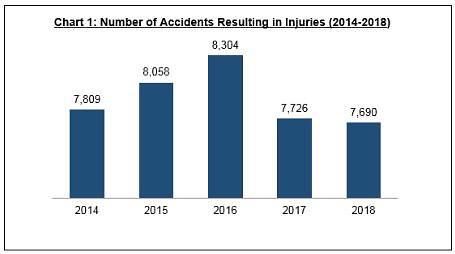
traffic accidents 2014-2018 chart

(Source: Singapore Police Force)

However, the number of fatalities from accidents remained similar to 2017 – at 124, up slightly from 121. The road traffic fatality rate per 100,000 population increased slightly to 2.20 in 2018, from 2.16 in 2017.

READ: Police officer hit by car dies in hospital, driver arrested

READ: NUS professor who drove Maserati against traffic given maximum fine, driving ban

The number of fatal accidents involving motorcyclists increased to 65 cases, from 45 cases in 2017.

Motorcyclist and pillion rider fatalities increased to 61 from 44 in 2017 (38.6 per cent). They accounted for almost half of all road traffic fatalities in 2018.

Accidents involving elderly pedestrians remain a concern, police said. While the number of accidents involving the elderly (259) fell by 6.2 per cent, they made up a quarter of all accidents with pedestrians.

Elderly pedestrians accounted for more than two-thirds of all pedestrian fatalities in 2018. Half of these fatal accidents were due to jaywalking.

The Traffic Police urged motorists to look out for elderly pedestrians and said it will continue to educate seniors on the dangers of jaywalking.

READ: Driver gets jail, driving ban for causing death of 4-year-old in Bukit Batok accident

The annual statistics were released as Senior Parliamentary Secretary for Home Affairs and National Development Sun Xueling launched the Use Your RoadSense 2019 campaign.

The traffic landscape has changed with the increasing prevalence of personal mobility devices and electric bicycles, police said.

“There is a need to promote greater graciousness and responsibility among increasingly diverse groups of road users,” the release said.

The Ministry of Home Affairs will also conduct a review of traffic laws to impose heavier penalties on irresponsible drivers, it said.

Source link

Commentary: The role reversal between parent and child, as ageing takes a toll on families

0

SINGAPORE: Mum’s memory has been failing. 

She had left a pair of huge tailor’s scissors on the table but insisted she had kept it out of the children’s reach. A couple weeks ago, she left her cooking unattended and went out of the house to open the letter box. 

What seemed like the hundredth argument my wife and I had since we moved my 74-year-old father and 65-year-old mum in with us 8 years ago has become a daily affair. 

They were getting on in age. Mobility was an issue due to mum’s severe osteoarthritis and dad was getting weaker as he aged. 

I had moved them in to look after them better. But that decision strained our relationship with my parents and nearly broke my marriage.    
  
A REALITY FOR MANY SINGAPOREAN 
  
Ageing is a huge challenge for many Singapore families. Statistics from the Ministry of Social and Family Development show that the number of households with at least one senior has almost doubled from 2000 to 2014 from 192,800 to 354,700. 

The conundrum of our rapidly ageing population is compounded when you think about how the number of seniors is projected to nearly triple to 900,000 by 2030. Looking after at least one if not two elderly parents will become a reality for many Singapore families.  

While many seniors want to slow down and enjoy their golden years, ageing can be a costly affair for their families, especially if a senior is plagued with serious health issues or debilitating diseases for prolonged period. 

The Government recognises this and has rolled out a slew of policies and various support schemes to relieve the financial burden on families in recent years. These broad-based initiatives provide greater assistance to those in the lower income brackets, and cover a wide variety of costly essential services including healthcare, housing and social services. 

Budget 2018 file - elderly 6

File photo of elderly woman in Singapore. (Photo: Christy Yip)

LISTEN: What life in your 60s should look like, an episode on The Pulse podcast

The Pioneer Generation Package (PGP) and the Merdeka Generation Package, details of the latter which were announced at Budget 2019, benefit families with qualifying elderly parents, with outpatient care subsidies, Medisave top-ups, and Medishield Life subsidies among other aids to help defray healthcare costs. 

Seniors in the bottom 20 per cent also receive assistance of at least S$300 a quarter from the Silver Support Scheme. The auto-inclusion feature of these schemes reduces administration hassle and ensure prompt financial assistance to seniors.
 
My family has benefited from these government schemes. It might seem like small amounts, but these add up and have reduced our cash outlay over the years by no mean sum. 

Last January, mum needed a knee replacement surgery, which came up to S$50 after subsidies. My dad’s cataract removal operation in 2011 cost less than S$100, with the rest paid for with Medisave and Medishield Life. 

HEART WRENCHING

While financing healthcare is a challenge that has been recognised and tackled, what has received less focus and is often overlooked are the human aspects of caring for seniors. 

Looking after the elderly is a familial responsibility that can be physically and emotionally draining for family members, especially when many caregivers are not aware of how extensive their role can be as a nurse, personal assistant and someone who handles the finances, Chief, Senior Support and Career Services, at the Agency for Integrated Care Kelvin Lim once said.

Elderly on wheelchair

An elderly woman in a wheelchair with her caregiver. (File photo: TODAY)

READ: Help with disability costs welcomed but allowing withdrawal of Medisave may not benefit all, a commentary

Families caring for seniors with multiple needs face an especially grueling challenge. 40 to 60 per cent of caregivers looking after loved ones with dementia suffer from “significant stress”, according to a 2016 study conducted by Tan Tock Seng Hospital’s Institute of Geriatrics and Active Ageing. If left unattended, the more serious cases can degenerate into depression. 

This is a challenge I understand, as my mum suffered a bout of mental illness when I was in my early twenties. She also suffered from severe osteoarthritis and has been wheelchair-bound for the past decade. 

READ: Dementia caregivers put on a brave front – while watching loved ones fade away, a commentary

Her physical condition has exerted a mental and emotional toll on our family. She would hurl expletives at us whenever she felt frustrated or when the pain in her knees became unbearable. 
  
WHAT DOES BEING FILIAL MEANS?  

It is in this context that caring requires families to go the extra mile to provide assurance for seniors and confidence to face an uncertain future in old age.

When people ask what drove me to move my parents in with us, I reply that filial piety does it for me. Everybody’s view on filial piety is different but I see it as more than just providing financial support for our parents, but also unconditional love, taking care of all their needs in their old age. 

Isn’t it innate to love our parents? Yes, but in the midst of competition for our limited time and attention, bogged down with making ends meet, and when old age causes physical pain and strains relations, it is very challenging to love them in the way they need to be loved.  

Instead, we tend to get angry and frustrated with our parents over the slightest thing. How many times have we ignored our parents when they asked about our day, dismissing their concerns as nagging? 

How often do we grow impatient and show our annoyance at them when they are forgetful? How frequently do we treat strangers better than our parents?  

And as they age, do we realise that they need us to show them the same love and understanding they showed us while we were helpless children?

stock elderly 03

An old man walks on an overhead bridge in Singapore. (File photo: Francine Lim)

READ: Three lessons learned caring for seniors as Singapore’s population ages, a commentary

Instead, most of us take them for granted and think our relationship with our parents can continue like business as usual during their twilight years. 

Most of us do not understand how to adapt to this inevitable yet painful role reversal between aged parents and middle-aged child. Many of us find it challenging to even identify let alone meet these new commitments to our elderly parents. 

Sandwiched between the old and our young children, we find ourselves unprepared for the financial, physical and psycho-somatic requirements that comes with caring for aged parents. 

What has helped in caring for my parents in their old age and coping with this role reversal was becoming a parent myself and extending my empathy to them. 

Every parent wishes for their children to be independent, look after themselves, and earn an honest living. Every parent hopes for their child to reciprocate their parental love, especially in their later years, as they age and slowly fade away with each passing day.   

So while aid to help tackle rising healthcare costs through the Merdeka Generation Package in this Budget is appreciated, I hope Singaporeans see that caring for their aged parents will require more than just dollars and cents.

READ: Merdeka Generation Package – What you need to know

Sometimes what is needed are not big sweeping gestures but the small things like spending time with them, visiting them with their favourite food if they live elsewhere, or accompanying them for medical appointments to provide assurance.

At the core of these small gestures is a respect for their wishes and an empathetic heart to give back to them in the way they cared for us while we were young.

It does not take a lot actually, it just requires a re-prioritisation of our time and a mindset shift. 
   
Tan Chin Hock is recipient of the filial piety award conferred by the Nanyang Confucian Association.

Source link

Residents evacuated after fire at St Regis Residences in Tanglin Road

0

SINGAPORE: Residents were evacuated from the St Regis Residences in Tanglin Road after a fire broke out late on Wednesday night (Feb 20).

The Singapore Civil Defence Force said they received reports of the fire at 33 Tanglin Road and responded to the blaze at 11.30pm.

“The fire involved the contents of a bedroom in a unit on level 12,” SCDF said.

One water jet and one hosereel was used to extinguish the fire, they added.

Several residents were forced to leave their homes after the blaze caught hold.

A resident who was evacuated from his home told Channel NewsAsia that the situation was “super crowded” and “chaotic” and that it was “very smoky”.

scdf at scene

The Singapore Civil Defence Force was seen at the scene of the fire. (Screengrab: Instagram/bryanchowsg)

“I know 170 plus units were evacuated but I don’t see some of my neighbours. I’m afraid they might still be inside,” he said.

The resident added that the lifts in the building had been grounded.

Photos on social media show flames coming out the windows of a unit, with thick clouds of smoke billowing.

st regis gire

A fire broke out at St Regis Residences late Wednesday (Feb 20) night. (Photo: Instagram/bryanchowsg)

This story came from a reader tip-off. If you would like to send in photos or videos of something newsworthy, WhatsApp our Mediacorp news hotline at +65 8218 8281 or message us on Facebook.

Source link

MINDEF to recruit 300 cybersecurity experts, opens cyber training school

0

SINGAPORE: More cybersecurity experts will be recruited to step up defences in light of increasing threats, MINDEF said on Wednesday (Feb 20).

The Ministry of Defence (MINDEF) aims to recruit about 300 cybersecurity experts through two new schemes – one for military personnel and one for non-uniformed professionals – to take up various roles in the ministry’s cyber entities.

Part of their training will also be carried out at a new cyber defence school, which opened on Wednesday afternoon.

READ: Commentary: Stop playing the blame game in a cybersecurity breach

cybersecurity experts 2

The Cyber Defence School opened on Feb 20, 2019. It trains cyber vocationalists to equip them with cyber skill sets and knowledge in preparation for their deployment to various MINDEF cyber defence entities. (Photo: Ahmad Khan)

SHORTAGE OF CYBERSECURITY PROFESSIONALS

Personnel hired under the two new cyber expert schemes will undergo up to 20 weeks of training at the newly launched Cyber Defence School at Stagmont Camp. 

The school will also train full time national servicemen in cyber defence skills. It will serve as the centre for cyber defence training and education across MINDEF, and will conduct cybersecurity workshops for MINDEF personnel.

Serene Ong, a former cyber analyst, was recruited by MINDEF last year to become a Defence Cyber Expert (DCX). She performs specialised operational roles in areas such as cyber incident response and network monitoring.

“Currently there is a shortage of cybersecurity professionals around the world,” Ms Ong said. “So this DCX scheme can help to widen the pool of candidates by including people from various different backgrounds even if they do not have background in computer science or computer engineering.”

cybersecurity experts 3

Military personnel at the Cyber Defence Test and Evaluation Centre (CyTEC) conduct advanced training scenarios to reflect the latest cyber threat developments and possible cyber attack techniques. (Photo: Ahmad Khan)

Serene will work together with military personnel like ME4 S Subash. 

He has been recruited into the SAF Command, Control, Communications and Computer Expert (C4X) vocation, specialising in military cyber operations.

“I will ensure that we bring in the latest technologies to ensure that we allow our assault monitoring teams to perform monitoring with the latest capabilities and also the cyber incident responders to have the right equipment to actually perform their tasks,” he said.

ENSURING SINGAPORE IS OPERATIONALLY READY

These new initiatives follow the recent launch of Digital Defence as the sixth pillar of Total Defence.

cybersecurity experts 4

Members of Advisory Council on Community Relations in Defence (ACCORD) were briefed on the ministry’s cyber defence set-up during their visit to Stagmont Camp, hosted by Senior Minister of State for Defence Heng Chee How. (Photo: Ahmad Khan)

READ: Digital Defence pillar added to Singapore’s Total Defence framework to strengthen cybersecurity

Senior Minister of State for Defence Mr Heng Chee How said the move will help defend Singapore’s systems, making it “resilient against attacks” and will protect the country’s sovereignty. 

Mr Heng was visiting the Cyber Defence Test and Evaluation Centre (CyTEC) at Stagmont Camp together with Advisory Council on Community Relations in Defence (ACCORD) members. 

They were briefed on MINDEF’s cyber defence set-up and were given a tour of the training facility, where advanced cyber defence training and exercises are conducted.

READ: Singapore can play ‘important role’ in cybersecurity for SEA region, says FireEye CEO

Source link

Online retailer fined for tampering with, selling food products with inaccurate expiry dates

0

SINGAPORE: An e-commerce retailer has been fined S$1,600 for selling pre-packed food products labelled with tampered expiry dates, the Agri-Food and Veterinary Authority (AVA) said in a media release on Wednesday (Feb 20).

GoPurpose Inc – which according to its website sells sustainable lifestyle products and organic agriculture – had tampered with the expiry date labels on several Chaga Health food products, AVA said.

The authority said it had received feedback in June 2018 that GoPurpose had sold a batch of pre-packed Chaga Health food products that were beyond their recommended expiry dates.

“Subsequent investigations revealed that GoPurpose Inc Pte Ltd had replaced the original expiry date-markings on the food products with new expiry date-markings that were beyond the manufacturer’s recommended expiry date,” AVA said.

The products affected include “wild lingonberries”, “pine bud powder” and “spruce tip powder”, according to photos from AVA. 

Food packaging with inaccurate expiry dates (1)

Pre-packed Chaga Health food products with tampered expiry date markings. (Photo: AVA)

“AVA takes a serious view of false and inaccurate labelling of food,” it added in its statement. 

“All pre-packed food products for sale in Singapore must be labelled according to the general labelling requirements of the Singapore Food Regulations. Accurate date-markings of expiry dates for products is important as products after their expiry dates might have deteriorated in quality.”

Those convicted under the Sale of Food Act may be fined up to S$1,000 for their first offence and up to S$2,000 on subsequent convictions.

According to the Singapore Centre for Social Enterprise (raiSE) website, GoPurpose is an e-commerce platform that retails organic items from vendors worldwide. It was first founded in 2013 as a social crowdfunding platform.

Source link

Crime reports up in 2018 due to surge in scam cases: Police

0

SINGAPORE: The total number of reported crimes increased by 1.4 per cent in 2018 to 33,134 cases, compared to 32,668 cases the year before, the police said on Wednesday (Feb 20).

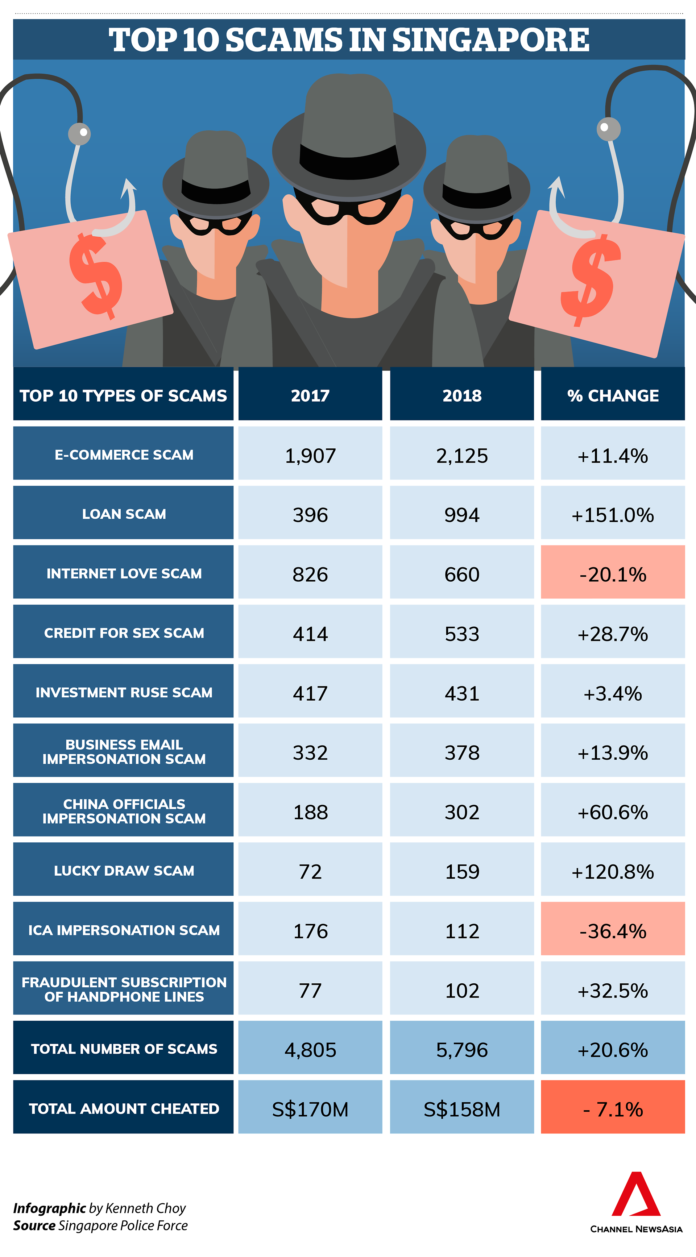
E-commerce, loan, credit-for-sex and China officials impersonation scams, “remain a concern”, with the total number of scam cases increasing by 20.6 per cent in 2018, from 4,805 instances to 5,796 last year.

Loan scams increased by 151 per cent, from 396 cases in 2017 to 994 cases in 2018. The total amount cheated in loan scams increased by 253.4 per cent, from about S$566,000 in 2017 to about S$2 million in 2018. The largest amount cheated in a single case was close to S$90,000.

The total amount cheated in e-commerce scams increased to about S$1.9 million in 2018, up from S$1.4 million the year before. The largest amount cheated in a single case in 2018 was close to S$69,000.

Seventy per cent of the e-commerce scams took place on the online marketplace Carousell, police said, and involved electronic products and tickets to attractions like Universal Studios Singapore.

READ: 11 suspects arrested for illegal transaction of marine gas oil

Credit-for-sex scams increased by 28.7 per cent, rising to 533 cases in 2018 from 414 cases in 2017. The total amount cheated increased by 50 per cent to about S$1.5 million in 2018. The largest amount cheated in a single case last year was close to S$100,000.

China officials impersonation scams increased by 60.6 per cent to 302 cases in 2018, up from 188 cases in 2017. The total amount cheated decreased by 0.8 per cent to about S$12.7 million in 2018. The largest amount cheated in a single case in 2018 was close to S$1.7 million.

top 10 singapore scams

“A significant proportion of online crimes are committed remotely by foreign syndicates that continue to find ways to prey on victims,” the police said.

“The police will continue to work closely with foreign law enforcement counterparts to crack down on such foreign syndicates targeting Singaporeans.”

READ: Man gets jail, caning for trying to enter Singapore on sampan

UNLICENSED MONEYLENDING HARASSMENT

The total number of cases related to unlicensed moneylending (UML) increased by 21.1 per cent to 4,619 cases in 2018, up from 3,814 cases the year before.

Harassment cases by electronic means increased by 33.5 per cent to 3,719 cases last year, compared to 2,785 in 2017. These accounted for the majority of UML-related harassment cases in 2018.

Harassment cases involving damage to property decreased by 12.5 per cent to 900 cases in 2018, down from 1,029 cases in 2017.

“The police’s enforcement efforts to disrupt UML syndicate operations, strong partnership with the community and the introduction of additional police cameras in neighbourhoods forced UML harassers to shift to non-damage and non-confrontational tactics, such as placing harassment notes in letterboxes,” said the police.

handcuffs

File photo of handcuffs. (Photo: TODAY)

More victims are being harassed via SMS and social media platforms due to the increase in new communication platforms and smartphones. This makes it easier for UML harassers to target larger groups of people, police said.

There has also been a rise in cases involving foreign workers borrowing money from unlicensed moneylenders.

“The police have engaged maid employment agencies and businesses to educate foreign workers against borrowing from loansharks and to warn them of the severe consequences of getting involved in UML activities,” police said.

PHISHING

Cases under the Computer Misuse Act include unauthorised access or transaction of an individual’s online accounts, unauthorised purchases using credit or debit cards, and phishing emails that obtained sensitive personal information such as passwords and credit card details.

In 2018, there was a 40.3 per cent increase in such cases, from 858 cases in 2017 to 1,204 cases last year.0

“The police would like to remind members of the public to safeguard their personal particulars and online credentials and to be wary of phishing emails or websites,” the statement read.

“Credit and debit card holders are advised to opt for SMS one-time password (OTP) verification for charges to their cards, as well as a notification for any charges incurred.”

READ: Commentary: Don’t carry your bank cards with your mobile phone

READ: ‘Monster’ who prostituted wife, sexually assaulted 6-year-old daughter gets jail, caning

OVERALL CRIME RATE

The overall crime rate went up in 2018, said the police, with 588 cases per 100,000 population compared to the 582 cases in 2017. 

“The increase in the number of reported crimes was largely due to a rise in scam cases,” police said.

Notably, theft and related crimes decreased by 8.6 per cent to 12,279 cases in 2018 from 13,431 cases in 2017. This includes shop thefts, theft-in-dwelling cases, motor vehicle and related theft cases and bicycle thefts. 

“The decline in theft cases can be largely attributed to the Police’s continued crime prevention efforts, including increased Police presence at malls and other crowded places,” said the police. 

Source link

Motorcyclist tries to smuggle cigarettes hidden in loaf of bread into Singapore

0

SINGAPORE: A Malaysian man was caught on Saturday (Feb 16) with packets of duty-unpaid cigarettes at Woodlands Checkpoint – including five packets in a hollowed-out loaf of bread.

Officers uncovered a total of seven packets of cigarettes on the 38-year-old, the Immigration and Checkpoints Authority (ICA) said in a Facebook post on Wednesday.

In addition to the five packets hidden in the loaf of bread – which was placed in the man’s motorcycle basket – officers also found one packet in the man’s pocket and another in the padding of his helmet.

cigarettes in hemet

A pack was also found inside the padding of the man’s helmet. (Photo: Immigration and Checkpoints Authority)

The case has been referred to Singapore Customs for further investigation.

“The ICA will continue to conduct security checks on passengers and vehicles at the checkpoints to prevent attempts to smuggle in undesirable persons, drugs, weapons, explosives and other contraband,” said the authority.

The incident follows a similar case earlier this month where an 80-year-old man was caught with duty-unpaid cigarettes in his bags at the Singapore Cruise Centre.

Source link

Grab launches on-demand GrabPet transport option

0

SINGAPORE: Pet owners in Singapore will soon find it easier to transport their furry friends with the beta launch of Grab’s new GrabPet ride option on Wednesday (Feb 20).

Under the new service, passengers with pets will be allocated to Grab drivers who have received pet-handling training and welcome animals in their vehicles. Fares start from S$14.

All household pets approved by the Agri-Food and Veterinary Authority in Singapore are allowed on GrabPet with the exception of birds, as air fresheners used in vehicles could pose a risk to them, Grab said in a press release.

All pets must be accompanied by human passengers, it added.

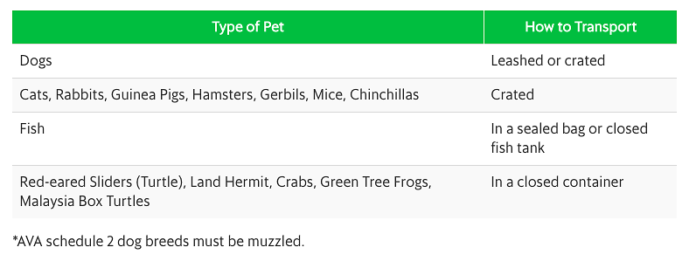
GrabPet table

A maximum of two medium-sized pets (up to 41cm in length) or one large pet (41cm in length or more) is allowed on a GrabPet ride, and pets must be in a crate or leashed at all times.

According to Grab, “hundreds of driver-partners” have already been trained for the new service.

Vehicles will be equipped with an in-car kit including a back-seat cover, microfibre towel and air freshener.

Grab is also providing additional insurance coverage for pets, passengers and driver-partners on GrabPet rides –  a first for a pet transportation service in Singapore, it said.

“While there are existing pet transportation services on the market, most of them typically require bookings or reservations to be made in advance,” said Grab in its press release. “With GrabPet, pet owners can book a ride on-demand, 24 hours a day and seven days a week, as long as there’s an available driver in the vicinity.”

Pet owners had previously been able to transport their animals with Uber’s uberPET ride option, which launched in October 2017. However, that service stopped after the Uber’s Southeast Asia operations were bought over by Grab last year.

Ryde also has a carpool option called RydePet, with rates up to 25 per cent higher than a normal carpool. Animals allowed on RydePet include dogs, cats, rabbits, turtles, hamsters, birds in cages and fish in bowls or plastic bags.

READ: Grab buys Uber’s Southeast Asia operations: Who are the winners and losers?

To mark the beta launch of GrabPet in Singapore, Grab will donate S$3 from every GrabPet ride to the Society for the Prevention of Cruelty to Animals (SPCA) in Singapore for the next month.

GrabPet screengrabs

Source link

No mishandling of snake at Tang Plaza, says AVA after investigation

0

SINGAPORE: There was no mishandling of the snake captured last month outside Tang Plaza by Anticimex employees, said the Agri-Food and Veterinary Authority of Singapore (AVA) following an investigation. 

In an email addressed to the pest company seen by Channel NewsAsia on Wednesday (Feb 20), AVA said it had completed its investigation into the incident. 

READ: ‘No malice or cruelty’: Pest control company Anticimex rejects claims of mishandling snake at Tang Plaza

READ: AVA investigating alleged mishandling of snake at Tang Plaza

“AVA has completed investigation into the case and we have established that there was no mishandling by your staff who were activated to catch the python outside Tangs Plaza on Jan 29, 2019,” read the email, which was dated Feb 11. 

The case came to light after a video on social media showed an Anticimex employee, Mr Mohd Farhan, stepping on a 3m-long python while attempting to capture it. 

The video also showed Mr Farhan being bitten by the snake. He went through a minor operation to remove the embedded snake’s tooth, the pest control company had said.

AVA said in the email that it was “unfortunate” that one of Anticimex’s employees, Mr Farhan, was bitten in the process. “Hence, he had to resort to using necessary force to restrain the python,” it added.  

“Mr Farhan had acted in good faith to prevent further harm and injuries to himself as well as the public who were in close proximity,” said AVA in the email to Anticimex. 

In response to Channel NewsAsia’s queries on the investigation, AVA replied: “The snake was at a location with high human traffic. Our investigations found that the handlers present removed it as promptly and practicably as possible.”

Anticimex said it was pleased that the authority had completed the investigations into its employees’ actions. 

“We thank them for their professional handling of this matter,” said the pest company in a statement.

“Our team at Anticimex will continue to remain focused on our daily business, working with the experts within our field and avoiding distractions of commentary from spectators,” it said. 

The company added that it will continue to “empower our employees to take immediate and correct actions when needed to prevent and protect Singaporeans in their daily lives”. 

python tooth

Pest control technician Farhan is recovering after a minor operation to remove an embedded snake tooth following the incident outside Tang Plaza on Jan 29, 2019. (Photos: Anticimex)

When AVA initially announced that it was investigating the alleged mishandling of the snake, the authority had said: “Cruelty to animals is an offence under the Animals and Birds Act. AVA has issued a set of guidelines on the proper handling of snakes to all pest control and wildlife management agencies in Singapore.

“For example, snakes should not be unduly harmed by the persons handling it and appropriate equipment should be used to catch them.”

In response, Anticimex had said that the workers involved “used all necessary parts of their bodies to safely relocate a very large snake in a public place”.

Not restraining the reptile by any means available when it attempted to avoid capture “could have had disastrous consequences” in crowded areas like Tang Plaza, added the pest company.

Source link

Is Budget 2019 an election budget? ‘I don’t plan on that basis,’ says Heng Swee Keat

0

SINGAPORE: The Budget is a “strategic plan” to ensure Singapore’s long-term success and it is not based on election cycles, said Finance Minister Heng Swee Keat on Tuesday (Feb 19) at a post-Budget television forum.

He was responding to a question from the show’s presenter about the Government’s balance sheet, and if the healthy surplus accumulated since the start of the Government’s term would “drive election strategy” with the next General Election due by early 2021.

Forecasts by some economists have tipped the accumulated surplus over the past three years to be more than S$15 billion, even after taking into account the estimated deficit of S$3.5 billion for this financial year.

READ: 7 things you need to know about Budget 2019

Mr Heng said: “The Budget is a strategic plan to allocate resources for Singapore to remain successful, vibrant in the long run and to be fair across generations.

“It is not about ‘we are near the election so let’s spend this, let’s spend that’ … (and) it doesn’t mean that next year, we are going to spend that S$15 billion.”

Asked about what he would say to those who describe the latest Budget as an election budget, the finance minister replied: “If they mean that they are very happy with the Budget then I’ll say that is good, but I don’t plan on that basis.”

Elaborating, he said he usually starts with a “very long list of requests” as he holds pre-Budget meetings with the heads of various ministries, before cutting it down to a few priorities following more discussions with ministers and the Prime Minister.

“This is the way that we plan our budget and I must say, let us maintain that.”

READ: S$1.1 billion Bicentennial Bonus for Singaporeans

READ: Merdeka Generation Package worth S$8b to include subsidies for outpatient care

Mr Heng said “unexpected developments” have helped to boost the Government’s coffers.

Take FY2018 for instance, the unexpected suspension of the Kuala Lumpur-Singapore High-Speed Rail (HSR) project, as well as better-than-expected collections from stamp duties and statutory boards, contributed to a S$2.1 billion surplus. This is compared to expectations for an overall deficit of S$600 million.

While Singapore has been “fortunate” to have better balance-sheet results for recent financial years, these are “one-off events” and “good luck” cannot form the basis of Budget planning, he added.

All surplus left at the end of the Government’s term will become a part of past reserves, which will be invested to generate higher net investment returns contribution (NIRC) for the future.

This is a more sustainable way of using Budget surpluses, said the finance minister.

“It doesn’t mean that we have this surplus and we splurge it tomorrow. If our founding fathers had taken that approach, we would not even have one cent of this NIRC to talk about and we will not be talking about increasing goods and services tax (GST) from 7 to 9 per cent. It would be much more.”

Speaking to reporters after the forum where he was asked if the Ministry of Finance had been too conservative with its budgeting thus far, he explained that the economy goes through cycles.

Surpluses come along when the economy performs well but when a slowdown occurs, the Government will need to ensure it has sufficient resources to support the economy and its workers.

“So it’s important for us to plan not just from year to year, but plan with our needs in mind and be able to meet unexpected events.”

Heng Swee Keat at Ask the Finance Minister forum 2019

Finance Minister Heng Swee Keat at a post-Budget forum on Feb 19, 2019. (Photo: Jeremy Long)

COST OF LIVING AMONG QUESTIONS RAISED

Mr Heng on Monday delivered the Budget for 2019, which included details of the much-anticipated Merdeka Generation Package, a slew of measures worth S$4.6 billion to help firms and workers keep pace with changes, as well as a S$1.1 billion Bicentennial Bonus to mark Singapore’s bicentennial.

During the hour-long forum, questions were raised, among others, about how the Merdeka Generation Package encourages active living, as well as the ongoing economic restructuring’s impact on firms and workers.

Some in the audience also asked about “glaring omissions”, including policies concerning the local property market and the country’s birth rates. Others wanted more help for certain segments of the population, like the sandwiched generation and the middle class, when it comes to coping with rising living costs.

Mr Heng said it is not possible for a single Budget to “tackle A to Z” – a point that he repeatedly made during the show.

On the perennial issue of cost of living, he said it is important for the Government to keep costs affordable, and it does so through various ways.

This includes operating an open and competitive system where imports come from all over the world, as well as maintaining a strong economy.

READ: Cost of living in Singapore: Slow overall inflation but some pressure points

An audience member asked if the Government has considered absorbing GST for essential items, like food.

Mr Heng replied this was “very carefully studied” before GST was even introduced and he had also revisited the topic recently.

Citing his observations of different countries that have tried to differentiate essential items, he said this usually entails a “big quarrel” about what defines essentials and a “very distortionary” end result.

He went on to explain that Singapore’s “simple system” of having everyone pay the same amount but issue “targeted” help to those from the lower income, is much more effective.

Heng Swee Keat at post-Budget forum

Finance Minister Heng Swee Keat at a post-Budget forum on Feb 19, 2019. (Photo: Jeremy Long)

When asked by Channel NewsAsia if the Government needs to do more about cost-of-living concerns, he responded by highlighting two issues that contribute to the perception of things becoming less affordable.

These include changing aspirations and consumption patterns, as well as how people tend to feel the pinch when items that are purchased “very frequently” see price increases.

Nevertheless, the Government has continued to ensure low unemployment rates of below 3 per cent despite global uncertainties, alongside “quite credible wage growth” over the years.

“A very important element of tackling the cost of living is that (we) keep our workers employed,” said Mr Heng. “We must continue with this.”

Source link