Home Blog Page 840

Commentary: Consumers feel the pinch of rising interest rates

0

SINGAPORE: After four interest rate hikes in 2018, US Federal Reserve announced that interest rate increases would be put on hold, on the back of sluggish inflation and slowing growth in Europe and China.

This must be music to many ears, interest rate increases over the past year have had implications for investors around the world, including Singapore.

Unlike other countries where lending rates are typically dictated by the central bank, interest rates in Singapore are determined by the Singapore Interbank Offered Rate or SIBOR.

Interest rates movements in the US will influence the SIBOR in Singapore, which, in turn, will affect local mortgage lending rates.

LOW INTEREST RATES FOR ALMOST A DECADE

In the past, Singaporeans have enjoyed very low bank lending rates for almost a decade – close to 1 per cent. This is truly remarkable for consumers who are looking for bank financing.

The low rates have meant that many have been able to get a mortgage loan for close to 1.5 per cent, finance a car, and possibly even get a small business loan at very low rates at the same time.

READ: Succeed in your career, settle down, buy a BTO. Is this Singaporean dream outdated? A commentary

However, over the past year, these rates have been moving up and now they are close to 3 per cent. Clearly, this has consequences for consumers who have existing loans or are thinking of taking out new loans.

Consumers who have cash do not need to borrow money. However, those who are liquidity constrained, or do not have enough cash in hand are more likely to borrow from banks for big purchases. For them, it is difficult to service existing debt when rates go up.

singapore dollar currency at a money changer

File picture of Singapore currency. (Photo: AFP/Roslan Rahman)

Consider a family with a combined take-home pay of about S$3,000 a month, makes a S$1,000 mortgage payment, another S$1,000 for kids’ education, transportation and other necessities, and another S$1,000 for discretionary spending like dining out, clothes and travel. 

They are pretty much tapped out at the end of the month and are essentially living from paycheck to paycheck.

READ: A mediocre year ahead as dark clouds gather over global economy, a commentary

When interest rates go up from 1.5 to 3 per cent, the consumer debt service burden has essentially doubled. Consumers, especially those in the lower income group, will find it challenging to make their mortgage payment.

In our example, it is likely their mortgage payment will go up from S$1,000 to as high as S$1,500.

THREE OPTIONS

At this rate, they have three options.  First, they can default on their mortgage. With such increases in interest rates, the reality is that some people will have a hard time making ends meet.

The second option is to cut down on other forms of consumption. The easiest items to cut down on would be durables and discretionary items such as electronics, clothes and restaurant meals. Essentially, these consumers on the edge must tighten their belts.

The third option is to borrow on their credit cards and take on debt to support current consumption at the cost of future consumption.

Consumers who can afford the higher loan payments will nevertheless be concerned as many may have thought that interest rates will not go up beyond three percentage points.  If it were to rise higher to 4 per cent, it may put this group on the edge as well. 

They must start thinking about what to do moving forward in terms of their spending behaviour and savings. 

INTEREST RATE MOVEMENTS SHOULD NOT BE A SURPRISE TO HOMEBUYERS

Unfortunately, interest rates fluctuations are not new. Hence, in Singapore, the Housing and Development Board (HDB) offers a fixed-rate mortgage option to all public housing buyers. However, these mortgages come with some strict restrictions and are priced higher compared to bank loans.

hdb new flats

A man looking at a model of new flats at the HDB Hub. (File photo: TODAY/Ooi Boon Keong)

READ: Mind the varied impact of HDB schemes on different groups of home owners, a commentary

So some HDB home buyers choose to take out a bank loan for their public housing. Meanwhile, all private home buyers need to get a bank loan. 

Since banks can only give a maximum loan of 75 per cent of the house value since been tighter restrictions on the loan-to-value limits were announced last year, homeowners will need more cash on hand for the down payment.

This will stretch their finances and force them to draw down on their savings, savings which would have come in handy when interest rates rise.

It is also often the case that many homebuyers buy bigger homes in anticipation of future housing needs. This increases their current debt service burden when rates rise. 

They should have instead bought a smaller house that requires a smaller mortgage payment every month, giving them more buffer for future rate changes.

BROADER IMPLICATIONS

Rising rates will also have broader implications in the economy. Consumers and businesses are less likely to take out new loans at higher rates and this will hurt economic growth.

Thus, banks need to think about how that transmission of SIBOR, will affect bank lending behaviours to consumers and businesses, and impact to their future business plans.

Commercial banks should consider how a higher SIBOR would affect their current portfolio of services. First, they will get fewer buying houses as the higher interest rate makes purchasing housing more costly.

Second, many may default on their mortgages so the banks will have a higher credit risk on their portfolio. We are already seeing early signs of this in Singapore with the mortgage slowdown due to rising interest rates and the latest round of property curbs.

Furthermore, the impact will also extend to consumers shying away from credit cards and auto loans.  Businesses some also will be less likely to take out commercial loans because of high interest rates.

FILE PHOTO: A Standard Chartered bank branch in Singapore

FILE PHOTO: A Standard Chartered bank branch in Singapore October 11, 2016. REUTERS/Edgar Su/File Photo

From a regulatory point of view, monetary policy in Singapore overseen by the Monetary Authority of Singapore (MAS) takes the form of a nominal exchange rate policy to keep prices stable. This combined with the act that Singapore has a relatively open capital account, means that the MAS is unable to influence interest rates at the same time, without risking capital flows. 

What these collectively mean is that this rise in interest rates will inadvertently have implications for the most vulnerable consumer – those that do not understand financial markets and how banking works. 

There is really few effective solutions apart from greater financial literacy including an understanding of what can influence one’s loan payment amounts for one to make better decisions. 

Sumit Agarwal is the Low Tuck Kwong Distinguished Professor of Finance, Economics and Real Estate at NUS Business School. The opinions expressed are those of the writer’s and do not represent the views and opinions of NUS.
Source link

Hyflux gets court approval to hold scheme meetings for creditors to vote on rescue plan

0

SINGAPORE: Embattled water treatment firm Hyflux and three of its subsidiaries on Thursday (Feb 21) received the go-ahead from the Singapore High Court to hold scheme meetings in early April for creditors to vote on its do-or-die restructuring plan.

Two creditor classes – the senior unsecured creditors and subordinated debt holders – will get to vote first on Apr 5, possibly via two separate meetings on the same day.

Senior unsecured creditors include the banks and medium-term noteholders. The latter refers to the large group of 34,000 perpetual security and preference share investors, who have been put together to vote as a single class.

Trade creditors of the three subsidiaries will have their scheme meeting on Apr 8.

To pass, the scheme needs to be approved by at least 50 per cent in number and 75 per cent in value of each creditor class present at these meetings.

The court on Thursday also granted mom-and-pop investors who hold Hyflux’s securities through nominees or custodians to cast their votes in person at the scheme meetings, and be counted both in number and value.

Under the law and as seen in the debt restructuring case involving Singapore-based offshore services firm Swiber Holdings, those who hold investments through nominees are not allowed to attend creditors’ meetings and have to be represented by these nominees. 

A nominee can only be counted as one vote, regardless of how many investors it represents.

Hyflux will release a notice for the scheme meetings and an explanatory statement of its financial restructuring scheme in the coming days. 

READ: Hyflux lays out restructuring plan to revitalise business, but retail investors lament big losses

READ: Hyflux’s retail investors face losses under proposed restructuring plan

WHY “RUTHLESSLY ELIMINATE” US: RETAIL INVESTOR

The clock is ticking down on Hyflux to sort out its financial woes. While its debt moratorium only finishes at end-April, it needs to get the okay from a majority of creditors and another court approval by Apr 16 before its S$530 million lifeline from Indonesian consortium SM Investments expires.

If the proposed scheme of arrangement fails to get creditors’ backing, Hyflux “will likely go for liquidation” which “can be quite brutal”, its legal advisor from WongPartnership told the court.

In a liquidation scenario, senior unsecured creditors can expect recovery rates of about 3.8 to 8.7 per cent, but those holding on to perpetual securities and preference shares will “probably get nothing”.

However, it remains to be seen whether Hyflux’s restructuring proposal can garner the votes that it needs for a second chance.

Recovery rates of 10.7 per cent and 24.5 per cent for its subordinated debt holders and senior unsecured creditors, respectively, have been cold comfort for many – so much so that some retail investors have said they would rather see Hyflux liquidated or are petitioning for counter proposals.

During the hearing, Justice Aedit Abdullah said he had received a letter and email from Madam Loo Leong Hun, a retail perpetual security and preference shareholder.

Mdm Loo, who was given an opportunity to air her concerns in court, said retail investors like her are willing to “waive or accept low coupons”, as well as consider “staggered capital redemptions or no capital redemptions until Hyflux sees better days”.

She urged the court to accept this proposal, which she described “as a glimmer of hope” for investors like her to recover their hard-earned savings.

“We understand what Hyflux is going through. We have been informed that the potential buyer does not want any debt therefore we have decided to step down,” she said.

“I wish to highlight that in this demand proposal, there are no contractual obligations to redeem capital or to pay interest, therefore it is not a debt and it is placed in the same classification as equity.

“Our ranking is the same as equity, so is there a need to write off the preference shareholders?”

Hyflux Singapore

(Photo: Jeremy Long)

She also referred to the company’s 2017 annual report, which suggested that perpetual securities do not fall under the category of a financial liability given that there is “no contractual obligation to repay its principal or to pay distribution”.

“So why is there a need to ruthlessly eliminate us from the balance sheet? We are a benign equity and not a toxic debt to Hyflux,” she added.

Mdm Loo also said many elderly folk are among those who have invested their retirement funds into Hyflux. She cited an 86-year-old retiree who relied on dividends from her investments for daily expenses. 

“Now (with mobility issues), it is not possible for her to work and recover her principal,” Mdm Loo said.

“There are many others like her out there. Many Singaporeans will be affected by the new scheme proposed by Hyflux.”

READ: SIAS to hold investor-only town hall session on Feb 25 for Hyflux perpetual, preference shareholders

READ: ‘A big shock’: Retail investors in Singapore caught out by Hyflux woes

Justice Aedit said he recognised the circumstances as “something unfortunate” but his role for Thursday’s hearing is “fairly limited” to assessing whether Hyflux’s application to convene scheme meetings meets minimum requirements.

“I am not in the position myself to put a proposal in. It has to come from the creditors as a whole,” the judge added.

He said he has given copies of Mdm Loo’s letter to Hyflux’s legal advisors and other working groups. To that, WongPartnership lawyer Manoj Sandrasegara said he will pass on the letter to Hyflux’s board of directors and SM Investments.

Source link

41 people died in 2018 after suffering injuries in the workplace: MOM

0

SINGAPORE: Forty-one people suffered fatal injuries while at work in 2018, while the overall number of workplace injuries rose last year, according to the Ministry of Manpower’s (MOM) Workplace Safety and Health Report released on Thursday (Feb 21).

A workplace injury is a personal injury or death resulting from a workplace accident, and includes work-related traffic injuries.

Last year, 41 people died after getting injured in the workplace. That is one lower than the previous year, the report said.

The overall number of workplace injuries rose from 12,498 cases in 2017 to 12,810 cases in 2018, an increase of about 2.5 per cent.

Both major and minor workplace injury cases increased last year, with 596 workers sustaining major injuries, compared to 574 cases the previous year. Workplace minor injuries also saw an increase in 2018, from 11,882 the year before to 12,173 cases.

Minister of State for Manpower Mr Zaqy Mohamad said the rise in workplace injuries was a “cause for concern”.

MOST DEATHS IN CONSTRUCTION

The overall workplace injury rate – which takes into account the total number of fatal and non-fatal workplace injuries divided by the total number of employed people – rose from 369 per 100,000 employed persons in 2017 to 373 per 100,000 employed persons in 2018.

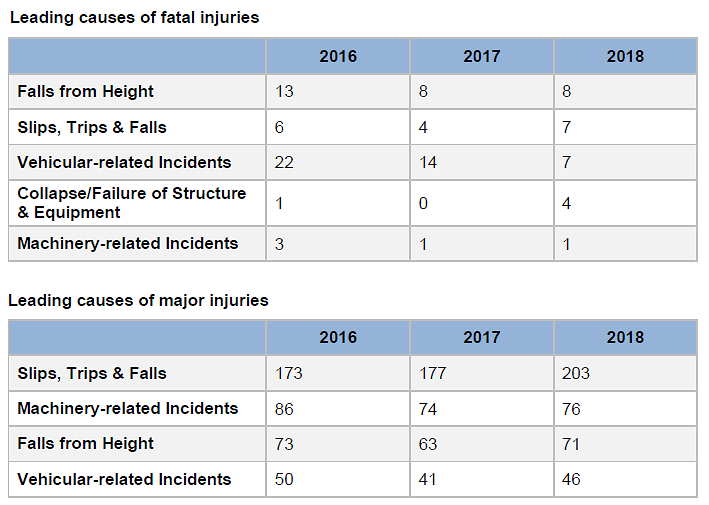
Falls from height, slips, trips and falls, and vehicular-related incidents remained the top causes of fatal injuries in 2018, although the number of vehicular-related fatal incidents halved in 2018 compared to 2017.

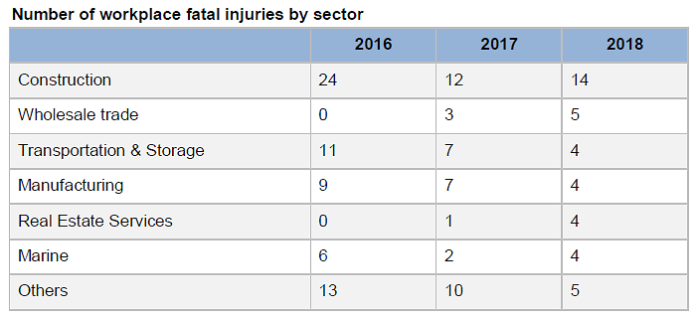
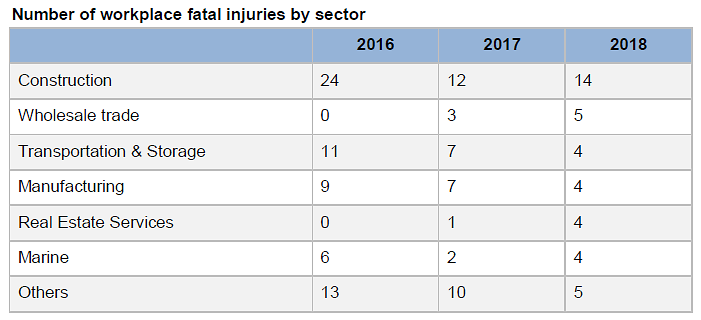
Construction remained the industry with the highest number of fatalities.

Table of workplace fatalities by sector 2018

Falls from height overtook vehicular-related incidents as the leading cause of fatal injuries in 2018, with the latter seeing a halving of cases last year.

Tables showing leading causes of workplace injuries 2018

Authorities in a press release cited the “pronounced increase” in major injuries from slips, trips, and falls – seen across a variety of industries, including traditionally low-risk ones – as an area of concern.

As for occupational diseases, these decreased by 30 per cent last year compared to the year before.

Work-related musculoskeletal disorders, noise-induced deafness and occupational skin diseases have remained the top three occupational diseases since 2016, and MOM said it would continue to focus prevention efforts in these areas.

Last year saw a number of workplace injury cases make the news, including that of a 48-year-old construction worker who died after falling from a raised platform at the Lentor MRT station worksite.

Similarly, a foreign worker died after he fell from a building at a Housing and Development Board worksite along Canberra Street.

READ: Worker injured in Joo Koon accident was conducting tests on maintenance train: SMRT

An SMRT employee was injured while carrying out maintence work near Joo Koon MRT station last December. The employee suffered foot injuries and was taken to hospital.

Source link

6 Myanmar nationals arrested in cemetery for immigration offences

0

SINGAPORE: Six Myanmar nationals have been arrested at a cemetery in Choa Chu Kang for immigration-related offences, including overstaying in Singapore, said the Immigration and Checkpoints Authority (ICA) on Thursday (Feb 21).

The six men, aged between 22 and 42, were arrested during an ICA operation on Tuesday morning. 

One of the men tried to flee when he saw the officers, who managed to subdue him. 

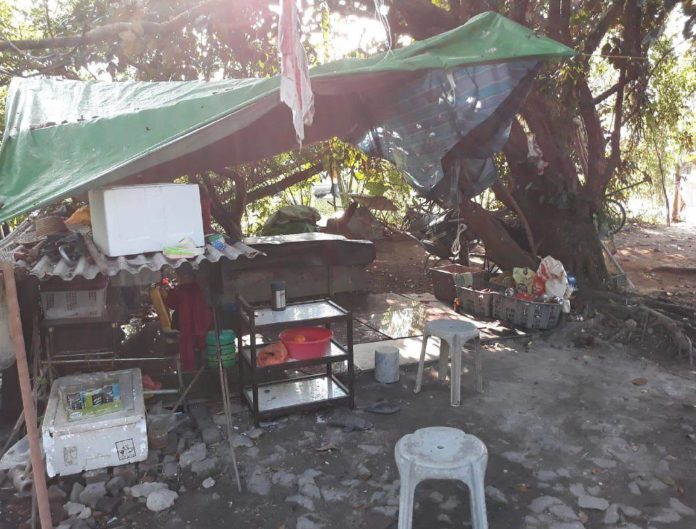
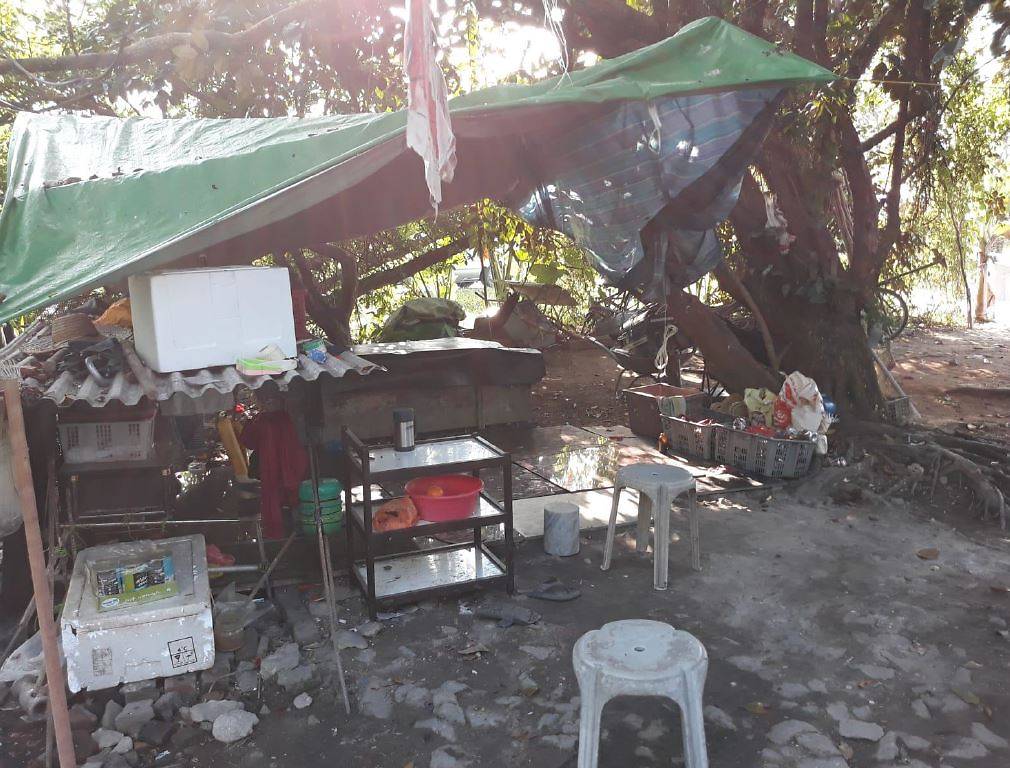
The man then led the officers to their makeshift quarters in the cemetery where the other five men were found.

makeshift quarters in cemetery

Makeshift quarters in the cemetery. (Photo: ICA)

The men claimed that they were working as grave diggers in the cemetery, said ICA in a news release.

Investigations are ongoing.

Those convicted of overstaying or illegal entry face a jail term of up to six months and a minimum of three strokes of the cane. The penalties for illegal departure are a fine of up to S$2,000, a jail term of up to six months, or both, ICA added.

Source link

Telepod, Neuron to be charged for providing PMD-sharing services illegally: LTA

0

SINGAPORE: E-scooter sharing operators Telepod and Neuron Mobility are set to be charged in court for providing services at public places without a licence or exemption, the Land Transport Authority (LTA) said in a news release on Thursday (Feb 21).

The charges will be brought against Telepod on Thursday and Neuron Mobility at a later date.

LTA said it has impounded 68 personal mobility devices (PMDs) from Telepod and 131 from Neuron Mobility as of Feb 14. The devices were impounded as they had been illegally made available for hire at public places, LTA said. 

READ: LTA impounds PMDs from Neuron Mobility, Telepod and Beam

Telepod had been given repeated written warnings before the devices were impounded, LTA said.

Investigations into Neuron Mobility have been completed, and the company will be charged at a later date, the authority said.

Telepod e-scooters impounded at Outram Road on 23 November 2018

Telepod e-scooters impounded at Outram Road on Nov 23, 2018. (Photo: LTA)

Neuron’s e-scooters impounded at Battery Road, outside Raffles Place MRT on 8 November 2018

Neuron’s e-scooters impounded at Battery Road, outside Raffles Place MRT on Nov 8, 2018. (Photo: LTA)

Under the Parking Places Act, unlicensed operators convicted of providing device-sharing services at public places can be fined up to S$10,000 and/or be jailed for up to six months. If they continue providing the service illegally after the conviction, they can be fined a further S$500 per day or part of a day.

Telepod and Neuron Mobility were among the first shared e-scooter players in Singapore when they launched in 2017.

Neuron e-scooters

Neuron’s e-scooters impounded at Bencoolen Street on Oct 10, 2018. (Photo: LTA)

E-scooters at Esplanade Drive

Telepod and Neuron’s e-scooters impounded at Esplanade Drive on Feb 7, 2019. (Photo: LTA)

They are also among 10 operators who confirmed with Channel NewsAsia ahead of the Feb 11 deadline their intention to apply for a licence.

“LTA would like to remind all operators that when evaluating licence applications, LTA will consider their track record, including their compliance with the law and regulatory requirements,” the authority said in its press release on Thursday.

In November, LTA said that it had impounded 42 PMDs from operators including Telepod and Neuron Mobility, after they were found available for hire without a licence at Bencoolen Street and Bayfront Avenue.

Source link

Five suspected drug offenders nabbed in CNB operation, almost 1kg of heroin seized

0

SINGAPORE: Five suspected drug offenders were arrested on Wednesday (Feb 20) in a pre-dawn operation conducted by the Central Narcotics Bureau (CNB), it said in a press release on Thursday.

CNB said its officers were deployed to the vicinity of Jalan Bukit Ho Swee on Wednesday to observe two suspected drug offenders. 

The first suspect, a 61-year-old Singaporean man, was first spotted meeting up with the second suspect, a 28-year-old Malaysian man, around Tiong Bahru Plaza.

The two parted, but were seen meeting up near Block 41 Jalan Bukit Ho Swee a while later, said CNB. The Malaysian suspect later left on his motorcycle, while the Singaporean returned to his hideout nearby.

The Malaysian was later arrested at the Woodlands Checkpoint, as he was leaving Singapore. Cash of S$5,200 was recovered from him.

Cash and drugs seized in drug bust

Cash recovered from the Malaysian suspect (left), and heroin found hidden inside a black haversack outside a unit raided by CNB officers. (Photos: Central Narcotics Bureau)

CNB officers also raided the Singaporean suspect’s hideout at the same time, where 500g of heroin and S$2,900 in cash were recovered. More heroin, 466g, was found hidden inside a black haversack left hanging outside the unit.

Investigations led officers to another suspect, a 57-year-old Singaporean male, believed to be linked to the first.

Officers who raided his hideout near Indus Road found a small amount of heroin and Ice. The man was arrested together with a 53-year-old Singaporean male who was also in the hideout.

A 47-year-old Singaporean male suspected of being a drug abuser was also arrested outside the unit.

CNB said investigations into the drug activities of all suspects are ongoing.

The amount of heroin recovered from the operations is enough to feed the addiction of about 464 abusers for a week, it added.

Source link

Motorists to face harsher penalties for serious offences as MHA reviews traffic laws

0

SINGAPORE: Motorists found guilty of serious traffic offences will face harsher penalties as part of proposed changes to the Road Traffic Act. 

Longer jail terms and heavier fines will be imposed “for serious offences where the motorist exhibits egregious driving behaviour and causes serious harm to the victim”, said the Ministry of Home Affairs (MHA) on Thursday (Feb 21). 

Examples of egregious driving include drink-driving and speeding past pedestrian crossings when the motorist does not have the right of way. 

MHA proposed creating two classes of irresponsible driving offences – Dangerous Driving and Careless Driving – which will be further broken down into four tiers relating to different levels of harm caused. 

The two classes of offences correspond broadly to rash act and negligent act in the Penal Code, said MHA, although each offence will come with a longer maximum jail term and a higher maximum fine than what is laid out in the Penal Code. 

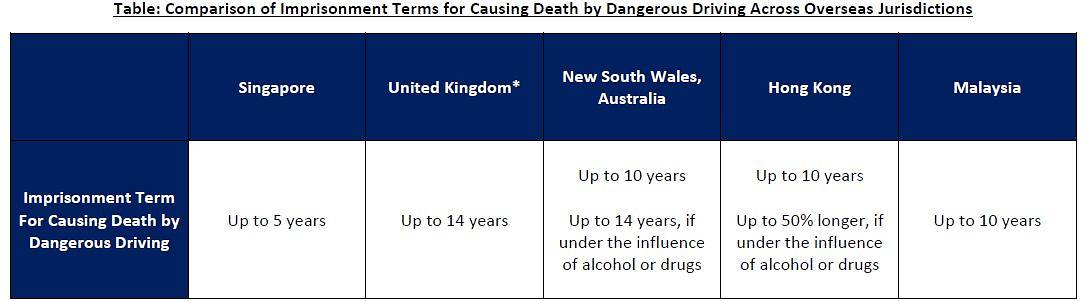
The maximum jail term for dangerous driving, for instance, could be increased from five years to eight years, with a minimum one-year sentence if death or grievous hurt is caused. 

For careless driving, the maximum jail time will be raised from two years to three years, if death was caused. Minimum mandatory punishments will also be imposed.

“Despite our enforcement and education, there are still motorists who drive or ride in a dangerous manner – against the flow of traffic, swerving across lanes suddenly without warning and beating red lights,” said Senior Parliamentary Secretary for Home Affairs Sun Xueling at the launch of a road safety campaign on Thursday. 

“For the … reason of deterrence, we want to impose mandatory minimum jail sentences for the most serious offences. For causing death by dangerous driving, a motorist should serve a minimum sentence of two years in jail,” she added.

“For doing so whilst intoxicated, he should serve an additional minimum sentence of a year.”

READ: Authorities considering stiffer penalties for drink-driving offenders: Sun Xueling

Penalties may be doubled for repeat offenders, according MHA’s press release.

If the convicted motorist was drink-driving or on drugs, he or she could have add-on penalties that include up to two more years of jail time. An additional penalty of at least one more year in jail will be imposed if death or grievous hurt was caused. This is similarly doubled for repeat offenders.

From Apr 1, authorities will also raise the composition sum, or fines, for road traffic offences involving motorists, pedestrians and cyclists.

READ: Higher fines for motorists, pedestrians and cyclists from April: MHA

SUSPENSION FROM DRIVING

MHA’s announcement on the review of traffic laws comes as the police released their annual statistics on traffic accidents in Singapore.

The statistics show that while there were fewer traffic accidents last year, the number of drink-driving accidents and motorists who ran red lights went up.

As part of the proposed changes to the Road Traffic Act, more drivers who run afoul of traffic laws can also be suspended from driving as the ministry plans to expand the range of offences which require a minimum disqualification period.

MHA also intends to increase the types offences for which the offender’s licence can be suspended immediately, to keep them off the roads while their court cases are pending.

A minimum suspension of eight years is proposed for drivers who caused death or grievous hurt through dangerous driving. This can be increased by at least two years if the offence was committed under the influence of alcohol or drugs.

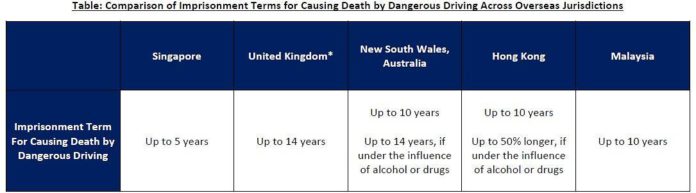
Currently, the penalties for irresponsible driving are less severe in Singapore compared to some other jurisdictions, MHA noted.

Jail terms for causing death by dangerous driving countries comparison MHA

(Source: Ministry of Home Affairs)

Between 2014 and 2018, the number of feedback submitted by members of the public to the Traffic Police on irresponsible driving more than doubled, from 6,900 to 18,500, the ministry said. 

Between 2015 and 2018, the number of summonses issued rose by one-fifth, from 152,700 to 181,000.

Penalties for driving while under suspension will also be heavier. There may also be more offences for which motorists may have to forfeit their vehicles. Currently, the courts may do so for certain offences such as illegal racing. 

The ministry is seeking views from the public on the review from Thursday to Mar 13.

A public engagement document on the proposed changes has been posted on government feedback portal REACH.

The public can give their feedback on the REACH website or email RTA_Feedback@mha.gov.sg.

Source link

Higher fines for motorists, pedestrians and cyclists from April: MHA

0

SINGAPORE: The Ministry of Home Affairs (MHA) will raise fines for road traffic offences starting Apr 1, in a bid to strengthen deterrence against irresponsible driving. 

In a press release on Thursday (Feb 21), MHA said that raising composition sums, or fines, would ensure that they remain effective as a deterrent and curb the uptrend in road traffic offences

“It is important to nip unsafe driving in the bud, before serious accidents happen and people are killed or hurt,” said MHA.

READ: More drink-driving accidents, motorists running red lights – Police

“For road traffic offences that do not involve egregious driving behaviour and do not result in harm caused to others, the offence may be compounded, in lieu of prosecution,” the ministry added. 

Fines for motorist road traffic offences were last reviewed in 2000.

MOTORIST OFFENCES

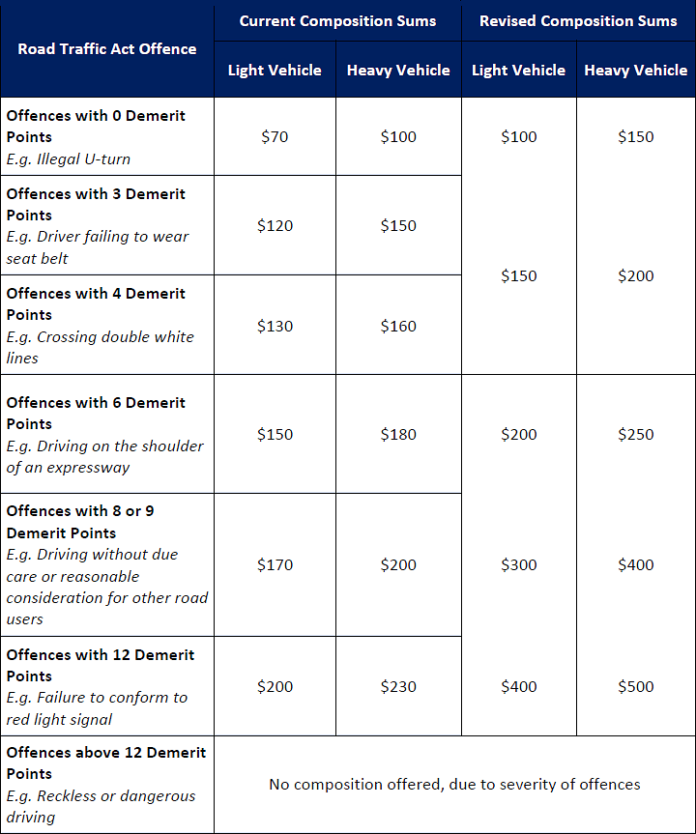
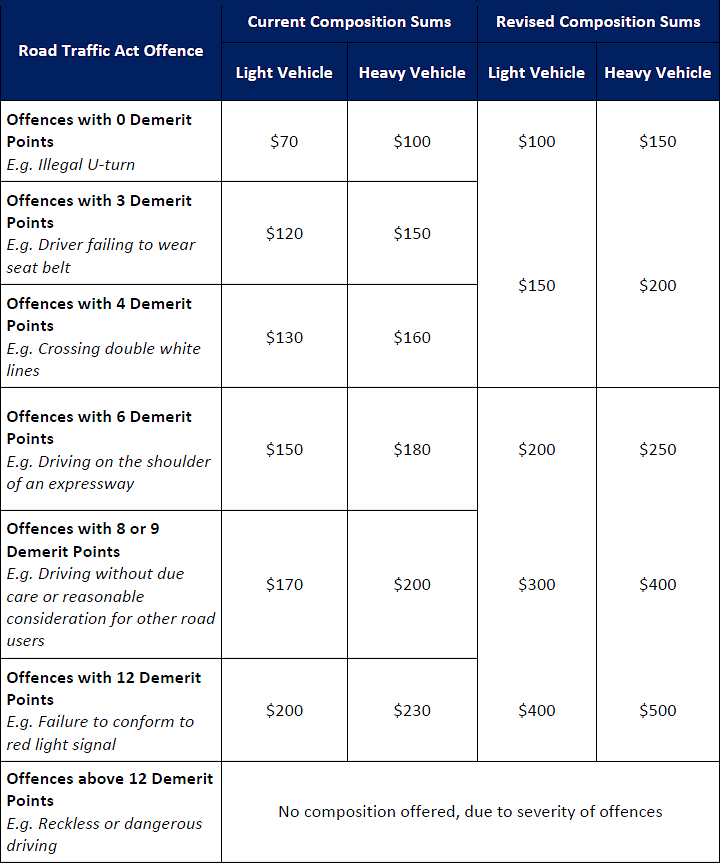
For committing an offence with zero demerit points such as an illegal U-turn, drivers of light vehicles could be fined S$100, up from the current S$70. Drivers of heavy vehicles committing the same offences could face a fine of S$150, up from S$100.

Offences with three demerit points like failure to wear a seat belt while driving will soon carry the same penalties as those with four demerit points such as crossing double white lines, at S$150 for light vehicles and S$200 for heavy vehicles.

Offences with six demerit points such as driving on the shoulder of an expressway may be punishable by a fine of either S$200 or S$250, while those with eight or nine demerit points, which include driving without due care or reasonable consideration for other road users, may be punishable by a fine of either S$300 or S$400. 

Increased fines - motorist offences graph

(Image: MHA)

Not stopping at a red light, which is an offence with 12 demerit points, carries increased fines of S$400 for drivers of light vehicles, up from S$200, and S$500 for drivers of heavy vehicles, up from S$230.

Fines for offences committed by drivers of heavy vehicles increased more than for drivers of light vehicles, as “heavy vehicles are more likely to cause death or serious injury when they are involved in accidents”, said MHA. 

This warrants a stronger deterrent, with a greater increase in fines for more serious offences (those attracting eight or more demerit points) compared to the increase for less serious offences.

PEDESTRIAN AND CYCLIST OFFENCES

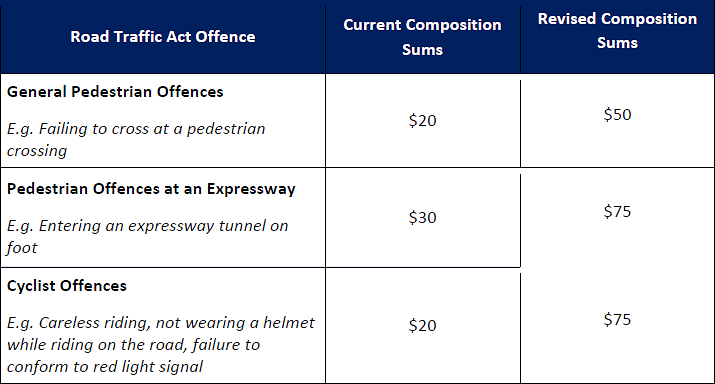
Fines for pedestrian and cyclist offences will also be raised, for the first time in more than 20 years.

Increased fines - pedestrians and cyclists graph

(Image: MHA)

Those who commit general offences, including jaywalking, may be fined S$50, up from the current S$20. Pedestrian offences at an expressway such as entering an expressway tunnel on foot may be punishable by a S$75 fine. The fine was previously set at S$30. 

Cyclist offences like not wearing a helmet while riding on the road or failing to stop at a traffic light may also incur a S$75 fine, up from S$20.

Source link

Mikhy Brochez ran Hong Kong centre for special needs children, could face fraud charges

0

HONG KONG: Mikhy Farrera Brochez, the US citizen believed to have leaked confidential information from Singapore’s HIV registry, ran an education centre for special needs children in Hong Kong, local media found on Thursday (Feb 21). 

For this, he could faces charges of fraud in Hong Kong, the South China Morning Post reported, on top of being wanted in Singapore for the leak that affected 14,200 people. 

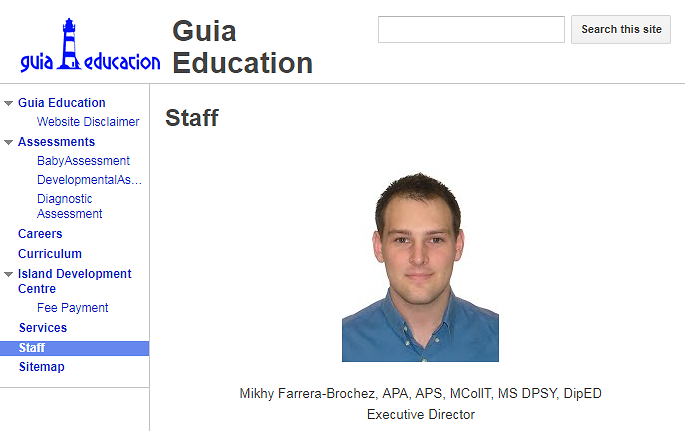
Brochez, 34, is listed on a website as one of the nine members of staff at Guia Education, which charges up to HK$8,000 (S$1,480) for each assessment of a child with special needs. 

“We envision a society where each child, irrespective of background or ability, receives an affordable, easily accessible, world-class education in a compassionate and inclusive environment,” the site says. 

Brochez is described as executive director, with the credentials “APA, APS, MCollT, MS DPSY, DipED”. APA refers to the American Psychological Association and APS to the American Physiological Society. 

But neither Brochez nor any of Guia Education’s staff are on the APA member database, wrote the Post, citing an APA spokesperson. 

Mikhy Farrera-Brochez on Guia Education website

Mikhy Farrera-Brochez is listed as Guia Education’s executive director on its website, with five different credentials from various organisations under his name.

The website was created in December 2009, about two years after Brochez moved to Singapore. It was last updated on Feb 14, 2015. The last post on the school’s Facebook page, which mostly shared media articles, was in March 2016. 

The site also listed the Guia Education office address as the 16th floor of Island Place, King’s Road No 500 in North Point, but according to the Post, there is no Guia Education office to be found in the area. 

There are also no corporate filings for Guia Education in Companies Registry records, the report added. 

Guia Education address Hong Kong

Island Place, King’s Road No. 500 in North Point, Hong Kong. (Photo: Google Maps)

University professor Dr Alex Chan Chi-keung told the Post that it is not uncommon for those with questionable credentials to practise educational psychology in Hong Kong due to the lack of regulation. Still, lawyer Albert Luk Wai-hung said Brochez could face fraud charges and more if he had had any clients. 

READ: HIV data leak – What we know about Mikhy Farrera Brochez

READ: The leaking of Singapore’s HIV registry records and the hunt for Mikhy Farrera Brochez – a timeline 

“A PATHOLOGICAL LIAR”

Brochez made headline news in January when Singapore’s health ministry announced he had leaked the HIV-positive status of 14,200 people, along with confidential information such as their identification numbers and contact details.

Brochez had been deported earlier in April 2018 after serving 28 months in jail for fraud and drug-related offences, one of which was lying about his HIV status to gain an employment pass. 

READ: “It’s very traumatic” – HIV-positive individuals anxious, frustrated after MOH data leak

Investigators had also found that Brochez lied about his educational qualifications to apply for jobs, having forged certificates from the likes of Vanderbilt University and the University of Paris. 

After Singapore’s announcement of the leak, Brochez attempted to clear his name through several posts on Facebook. But authorities refuted his claims and called him “a pathological liar”. 

“Mikhy Brochez lied about the identity of his mother, he lied about his own identity in his passport, he lied about his educational qualifications, he lied about his HIV positive status, and he is now lying about what he did,” Senior Minister of State for Health and Law Edwin Tong had said. 

Brochez is now in the United States. He appeared in a Kentucky court on Monday after being arrested in December and charged with third-degree criminal trespassing for refusing to leave his mother’s home. 

Source link