Home Blog Page 834

‘We’re treated as equals’: Women officers in SPF

0

SINGAPORE: When Traffic Police officer Nur Hafizah Harun stopped a driver for a speeding offence along the Ayer Rajah Expressway (AYE), the first words she heard from the man behind the wheel were: “Wow, a female officer?”

“Why can’t a female officer be on the road?” she asked, to which he replied: “Female officer can ride big bikes?”

She recalls smiling politely in response.

The 28-year-old Staff Sergeant has been with the Traffic Police (TP) for seven years and is all too familiar with such a reaction, though she says no one has tried to flirt their way out of a ticket just yet.

“The biggest stereotype that I always hear is that female officers cannot ride big bikes. That is not true. We can ride big bikes and we are trained to ride these big bikes, the same as the other male officers,” she told Channel NewsAsia.

SAME, SAME BUT DIFFERENT

SSgt Hafizah is one of 1,800 policewomen in the Singapore Police Force (SPF) today. They make up 19 per cent of the force, which has a come a long way since introducing women into its ranks as an experiment in 1949. Back then, just 10 female police officers were enrolled as members of the Special Constabulary (Active Unit). There are now no roles or rank within the force which women cannot attain, the SPF states.

“Even though I work in a male-dominated environment, everything else is the same because we are all treated as equals,” SSgt Hafizah said. Like her male counterparts, she spends up to 10 to 12 hours on the road daily while out on patrol.

She credits a senior female officer for “changing the game” in the TP by advocating to take a Class 2 motorcycle licence many years ago. “When I saw her riding big bikes, I also wanted to operate one. Eventually, I took up my own licence,” said SSGT Hafizah who joined the force after graduating with a diploma in Business Applications from Republic Polytechnic.

She was particularly impressed by a fellow petite officer who handled larger motorbikes with ease in a TP pilot. “I told myself: if she can operate these machines and lift up these bikes, why not me?”

She was also inspired by their decision to further their studies despite the long hours of the job, and is pursuing a part-time degree in Human Resource Management and Security Studies.

WIFE, MOTHER, STUDENT AND OFFICER

The young mother of one travels twice a week from the Traffic Police headquarters in Ubi to Clementi to attend evening classes. Due to the nature of her job though, SSGT Hafizah has had to occasionally skip classes and even exams.

During last year’s Trump-Kim summit in Singapore, SSgt Hafizah had to skip classes as she was deployed to single-handedly effect a road closure and lift it. She reported to the station at 6am and manned it till 8pm, returning for another shift at 2am.

Her husband, also a TP officer, was involved in summit security as well, so their baby was left in the care of other family members.

“We found it hard because our son was only seven months old back then. He required our full attention and it broke my heart to leave the house when I heard him crying at 2am in the morning.”

She added: “As a policewoman, one of the sacrifices I have had to make is to miss my son’s milestones. I missed his first steps and only managed to see him walking through the video that my mother sent me while I was at work.”

It is not just her family that she misses because of irregular work hours. “I also hardly meet up with my friends for a gathering or dinner because they are working an office job while I am working in a shift job,” she said.

“Despite the sacrifices, at the end of the day, my satisfaction is to keep Singapore’s roads safe and to bring errant road users to justice.”

TOUGH AS THEY COME

Another female officer making her mark is *Sgt Fiona(*not her real name) – the youngest of three women from the pioneer batch of female officers in the Police Coast Guards’ Special Task Squadron (STS).

Intercepting maritime threats with a high-speed boat, jumping into deep waters to capture assailants, and pinning down aggressors twice her size is all in a day’s work for the 31-year-old.

police coast guard female officer

Sgt Fiona from the Police Coast Guards’ Special Task Squadron. (Photo: Gaya Chandramohan)

“We had to go through a very intensive hell week. There’s no difference between female and males (in training). Whatever the guys did, we have to do as well. So things like carrying weights, running or even climbing with it, no different, no discount,” said Sgt Fiona on the gruelling selection tests she had to go through.

She told Channel NewsAsia she joined the STS because of a desire to help and protect people. But her mother, while eventually supportive, had expressed concern when she first learnt her daughter wanted to join the elite unit.

“When coming to STS, I told her what the job was like and she said: ‘Can don’t want or not?’,” recounts Sgt Fiona, laughing.

“(But) I told her not to worry and that everything will be okay. My mum supports whatever I want to do. She won’t stop me.”

“I WAS CHALLENGED … AND I PROVED THEM WRONG”

Sgt Fiona, who stands at a petite 160cm, says her six-month training stint helped her build mental and physical resilience.

“I had to go through everything, like carrying weights, putting all the equipment on me and working well with it. At the start, it was so difficult because the weights were about 100kg, including my own weight. We had to run and do whatever we’re told with our equipment almost every day.

“Once, I couldn’t catch my breath and hyperventilated. It was one of the toughest times I had during training.”

Scepticism from some of her male peers made her all the more determined to do well.

“There are some guys who will take you as a challenge, like: ‘They are girls, I cannot lose to them’,” she said.

“But eventually, the culture changed. I was challenged before. No issue, took up the challenge and proved some of them wrong. It actually motivated some of the guys and they joined us and they managed to pull through and they are proud of themselves as well.”

She added: “They have this mindset that ‘She knows what she is doing; she has to do it and she will do it.’ They actually trust us to do the job well, and now there’s no stereotyping at all.”

After being on the job for three years, the rigours of becoming an STS officer have become second nature to her.

“I’m slowly getting better and won’t hyperventilate anymore. I learnt to catch my breath and know how to control basically anything, including my aggression. It’s a very important part of it,” Sgt Fiona said. 

“Challenges come every day. Once you complete a challenge, a new challenge comes.”
Source link

Commentary: Three literacies to level up Singapore’s disruption game

0

SINGAPORE: Minister for Finance Heng Swee Keat has announced a budget that charts strategic paths for the country in the face of formidable headwinds.

In particular, this year’s budget will help Singapore to confront and harness the forces of digital disruption as they interact with demographic shifts, Asia’s growing ascendance in the world economy and subsiding support for globalisation.

Indeed, even as Budget 2019 addresses the critical needs of lower-income households, it also seeks to boost the capabilities of our people and the companies that power our economic transformation. Hence, different schemes for companies such as Innovation Agents, SMEs Go Digital and the Automation Support Package are certainly critical and can give industries a welcome boost.

In his Budget statement, Mr Heng also spoke of the need for our people to have the “skills, knowledge and attitude” to flourish in our fast-changing world that has seen the rapid proliferation of technology.

READ: 2019 – a year for political consolidation or a year for elections? A commentary

READ: The Singapore Budget and Heng Swee Keat’s shift away from Big Government, a commentary

CROSS-CULTURAL LITERACY, TO EMBRACE DIVERSITY AND REGIONAL OPPORTUNITIES

To this end, I would like to highlight three critical literacies we must seek to nurture in our people, to help us all better adapt to our rapidly evolving environment. If the Annual Budget starts with A and B, we need to inculcate three core literacies beginning with C, D and E: Cross-cultural literacy, digital literacy and ethical literacy.

The Finance Minister had in fact raised the need to cultivate cross-cultural literacy among our young so as to broaden our regional and international connections. 

Cross-cultural literacy –  the ability to understand and interact across different cultures in a manner that is sensitive to differences, yet respectful of diversity – is arguably more crucial today than ever before.

HSK Budget 1

Finance Minister Heng Swee Keat delivering the Budget 2019 statement.

To fortify our rich multi-cultural heritage, we must create more spaces and opportunities for meaningful cross-cultural understanding. 

Rather than simply trading in essentialist and simplistic caricatures of different cultures, we need to create forums where people are unafraid to ask tough questions of one another, confront their unconscious biases, and dispel long held misconceptions.

Cross-cultural interactions should be well developed, organised, and supported by facilitators, failing which these encounters may create confusion, trigger misunderstandings, and at worst, reinforce stereotypes and prejudices. Greater cross-cultural literacy can help to forge a more inclusive society where diversity is valued rather than frowned upon.

Efforts to enhance cross-cultural literacy should be introduced not only in schools, but also in community and corporate events so that working adults can benefit as well. 

Ultimately, social ties that are undergirded by greater cross-cultural literacy will be more enduring and resilient, and can serve as a bulwark against threats such as online disinformation campaigns that seek to foment inter-ethnic discord.

Beyond Singapore, our people must also inculcate a deeper understanding of our neighbours. Our region boasts of a rich cultural heritage and tremendous growth potential. And yet, many young Singaporeans view our regional neighbours as nothing more than holiday destinations.

READ: The Big Read: As ASEAN economies take off, young Singaporeans need to shed misperceptions about the region  

Many industry leaders I meet increasingly lament that Singaporeans are averse to job postings in the region as they view them as being less glamourous and rewarding than those further afield. Yet our region is home to fast-growing markets where there are many inroads to make significant impact.

To better develop Singapore into a node both within Asia and globally, and ensure that our citizens are well placed to tap such opportunities, our schools from primary through to tertiary levels should make greater efforts to strengthen and deepen our students’ appreciation of the region.

For example, the Singapore University of Technology and Design has taken the bold step of introducing funded overseas immersion trips to ASEAN countries to enhance the learning experience for first-year students.

pm lee prayut asean chairmanship handover

Singapore Prime Minister Lee Hsien Loong hands over the ASEAN Chairmanship to Thailand’s Prime Minister Prayut Chan-ocha at the closing ceremony of the ASEAN Summit. (Photo: Jeremy Long) 

DIGITAL LITERACY, TO CONFIDENTLY NAVIGATE AN INCREASINGLY DIGITALISED WORLD

Moving on to D for digital literacy. Singapore has done well in terms of providing access to digital devices and services.

Schemes such as the NEU PC Plus and Home Access programmes for low-income households, and Enable IT for persons with disabilities, which provide affordable broadband packages and computers, have helped to make sure that all Singaporeans have basic access to digital technology. Fortunately, we do not face a significant issue of a digital access divide.

However, we must be vigilant about any emerging digital skills divides that may find certain segments of our population less advantaged and less able to benefit from our digitalisation push. 

Notably, the Ministry of Communication and Information’s Digital Readiness Blueprint recommends that all citizens be equipped with a foundational set of digital skills. These pertain to managing information, communicating, transacting and maintaining cyber safety.

Going beyond the Basic Digital Skills Curriculum however, we need to pay particular attention to providing support for specific demographic groups that may require more targeted assistance.

For instance, how do we ensure that emerging adults from across the socio-economic spectrum are prepared for the job market in terms of knowing how to profile their competencies, utilise job portals, seek online career mentoring and access skills upgrading programmes? 

READ: Singapore’s Digital Readiness Blueprint must also address ‘invisible illiteracies’, a commentary

At the same time, we may wish to offer digital roadmaps for critical issues that everyone has to deal with. For example, how can individuals seek reliable health information online, and how can families obtain sound advice on managing household finances?

In my research on parents with school going children, I have also found that some parents were daunted by the online homework their children were given, and felt deeply insecure about their inability to help their children.

Indeed, our digitally-connected world is constantly expanding in complex ways, with an ever-proliferating range of apps, portals, platforms and content. As far as possible, we must offer signposts to help people navigate their way online, equip them with the instincts to adapt to these changes, and make sense of the deluge of information they encounter. 

A student works with a tablet computer at a school

A student using a tablet. (File photo: AFP/Frederick Florin)

ETHICAL LITERACY, TO CONFRONT DILEMMAS IN A FAST TECHNOLOGISING WORLD

Finally, E stands for ethical literacy. Because our society is becoming more digitalised, with a growing embrace of the Internet of Things, Big Data, artificial intelligence, machine learning and automation, we must enhance the ethical literacy of our workforce to ensure that these technologies are deployed in the best interests of our society.

Whether the solutions to our wicked problems are technologically or socially engineered, they must accord with our values and align with the ethical principles we collectively subscribe to. 

In this regard, we must vest our workforce with the competencies to recognise ethical issues where and when they present themselves, understand different ethical perspectives, and to apply these perspectives to help resolve ethical conundrums.

Who should be given access to information about whom and for what purpose? How do we draw the line between customer-orientation and surveillance? When should automated decision-making yield to human judgement?

Controversies in Big Tech have shown how inattention to ethical considerations can lead to issues such as Facebook’s Cambridge Analytica debacle, and Uber using its technology to track users’ locations even when they were not using the app. In this regard, the Proposed Model Artificial Intelligence Governance Framework launched in January by the Personal Data Protection Commission is both far-sighted and commendable.

LISTEN: That awkward conversation we need to have with Facebook, an episode on The Pulse podcast

Facebook

“Workplace by Facebook” is an enterprise-oriented version of the social network that, instead of distracting workers, lets them connect and collaborate. (REUTERS/Dado Ruvic/Illustration)

By effectively disseminating this framework across the relevant industry and education sectors, Singapore can strive to develop itself into an enlightened innovation hub which places equal premium on creativity and ethicality.

Indeed, ethical literacy should also be systematically phased into young Singaporeans’ educational journeys, where we could consider refreshing and updating our civics and moral education curriculum to take into account emerging ethical dilemmas in the era of Industry 4.0. 

Budget 2019 will advance Singapore’s Smart Nation drive, but crucially, we should also augment it by inculcating in our people three core literacies – cross-cultural, digital and ethical literacy.

Dr Lim Sun Sun is Professor of Communication and Technology and Head of Humanities, Arts and Social Sciences at the Singapore University of Technology and Design, and a Nominated Member of Parliament. 

Source link

Domestic helpers are moonlighting illegally as brokers and even moneylenders

0

SINGAPORE: Six months ago, moneylenders showed up at Mr Yazid Sulaiman’s flat. His parents answered the door, as he was away on a trip, and were shocked when the moneylenders demanded payment.

“My parents had never borrowed from moneylenders before. So it was the first time in their lives where someone just knocked on the door and demanded payment,” recounted the former flight steward.

“They had a piece of A4-sized paper with a colour-printed picture, captured on CCTV, (of the) face of my maid.”

Alarmed to hear the news, he told his wife to settle the debt of S$1,814.

Alarmed by moneylenders going to his flat, Yazid Sulaiman and his wife settled their maid's debt.

Mr Yazid Sulaiman.

“I was worried about the safety of my daughter,” he explained. “If you have a helper under stress, she (may) neglect your daughter. I didn’t want that to happen.”

But the day after the debt was settled, his helper ran away.

Mr Yazid is not the only employer who has had to deal with the aftermath of a foreign domestic worker borrowing money indiscriminately. The number of helpers borrowing from licensed moneylenders in Singapore has spiked recently.

GOING UNDERCOVER

In the first half of last year, 28,000 foreign domestic workers had borrowed from licensed moneylenders, which is more than double the 2017 figure and nearly 20 times the 1,500 in 2016.

READ: Maids could turn to loansharks if employers’ consent needed to borrow money from licensed moneylenders: MOM

To find out how easy it is for helpers to borrow money and whether moneylenders actively prey on them, Talking Point enlisted the help of a Filipina actress to pretend to seek a loan from a popular licensed moneylender.

Talking Point enlisted the help of an actress to pretend to seek a loan from a licensed moneylender.

Briefing the actress.

In the shop, she was told by a domestic helper in the queue that she would have to go through a broker – usually another helper – as the moneylenders would typically not entertain walk-in maid applicants.

Mr Billy Lee, the executive director of Blessed Grace Social Services, which helps domestic workers in debt to negotiate payment plans, said these brokers are “very familiar” to the moneylenders.

“If you go through the broker, then things can be worked out quicker … There’s a relationship between them,” he said.

In certain cases, the broker would accompany the domestic helper who doesn’t have the money to repay the loan.

One broker whom the undercover actress spoke to disclosed that for every loan she brings in, her commission is S$20.

It can be a lucrative income; the broker claimed that she can get about 15 customers on a typical Sunday, which works out at about S$1,200 a month – double the pay of most helpers.

If the undercover actress were to refer customers to her, the former would get S$10 per person.

Mr Lee said: “These brokers are very persuasive because they get a commission. So a lot of them (helpers) are swayed into borrowing from moneylenders, despite the fact that they might not be able to repay.”

Mr Billy Lee is the executive director of Blessed Grace Social Services, which helps maids in debt.

Mr Billy Lee.

20 PER CENT INTEREST

It is illegal for foreign domestic workers to moonlight as brokers, however, as they are not allowed to work for anyone except their employer.

To protect foreigners here and their employers from the effects of over-borrowing, a helper who earns less than S$10,000 annually can borrow only up to S$1,500 from all licensed moneylenders combined. Interest rates are also capped at four per cent.

READ: Loan caps for those borrowing from moneylenders to take effect end-November

Most helpers have been able to repay their loans to licensed moneylenders, the Ministry of Manpower told Talking Point.

But Mr Lee said the loan cap, which took effect in November, may give some helpers a false sense of security, so more end up taking out loans.

Over 200 maids who have borrowed money gather on a Sunday at Blessed Grace Social Services.

Over 200 domestic workers who have borrowed money gather on a Sunday at Blessed Grace Social Services.

Some domestic workers are themselves lending money. On average, he counsels about five helpers a week who say their peers have lent them money – with a 20 per cent interest rate plus an upfront fee of 10 per cent.

One helper, who declined to be identified, said she would rather pay the exorbitant interest than visit licensed moneylenders, as she feels uncomfortable providing them with her work permit, passport and contract details as well as employer’s number and address.

She has borrowed hundreds of dollars from a fellow helper since last year, but is not worried that it is illegal or that there is no formal contract.

“This is (based on) trust. I’ve known (the lender) for quite some time,” she said.

I don’t worry about my safety. This is like our Filipino code.

The police, too, have observed that more foreign domestic workers are borrowing from unlicensed moneylenders (such as those helpers who charge interest).

Those who moonlight as brokers or act as unlicensed moneylenders face fines and jail terms, while those who borrow from unlicensed ones will be banned from future employment in Singapore.

LEFT WITH NO OTHER OPTION?

In the case of Mr Yazid’s helper, she had gone to three licensed moneylenders.

And he thinks she was afraid to ask him for money because her employment agency had advised helpers against borrowing from their employer, leaving them with moneylenders as the go-to option.

The reason some agencies do that, said Ms Flora Sha, a branch manager at employment agency United Channel, is that domestic workers already take out a loan in their respective countries before coming to Singapore.

United Channel branch manager Flora Sha has had maids from her agency who turned to moneylenders.

Ms Flora Sha.

Over the past two months, she had about eight cases of moneylenders calling to ask for helpers who had turned to them for financial help. And it does not help that domestic workers’ salaries here are “too low”, she agreed.

In Singapore, they are typically paid a minimum wage of S$450 to S$570 a month, while those in Taiwan and Hong Kong are paid about S$745 to S$780 respectively.

However, the Centre for Domestic Employees (CDE), which looks after the interests of domestic workers here, does not believe that there is a correlation between their salaries and their problems with moneylenders.

CDE executive director Shamsul Kamar cited the example of Hong Kong, which is grappling with the same issue, despite the higher pay there.

Talking Point host Steven Chia with Centre for Domestic Employees executive director Shamsul Kamar.

Talking Point host Steven Chia with Mr Shamsul Kamar.

“The larger issue is about poor financial management and lifestyle choices,” he said. “They have friends and (face) peer pressure, where they go around getting the latest phones and all that. Sometimes they do overspend.”

Whether it is bad choices or easy access to credit, employers are at risk of carrying the can.

Mr Yazid’s alarming episode did not end when his helper left. Last month, he found a letter in his letterbox and realised that she even managed to borrow from a moneylender in Hong Kong.

That was when he quit his aircrew job of seven years. “I worry about my baby and also my family members,” he explained.

Source link

Feeling hot? Here’s why February was one of the hottest in 90 years

0

SINGAPORE: This February was the third hottest Singapore has seen in 90 years, but the next two weeks may get even warmer, said the Meteorological Service Singapore on Friday (Mar 1).

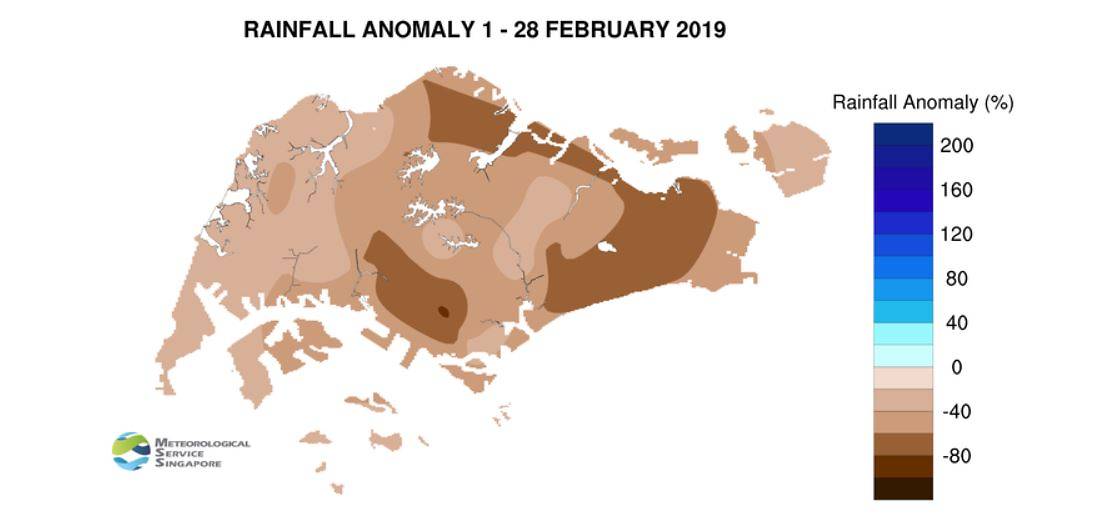
While February has traditionally been the driest month in the year, other factors contributed to the heat last month. 

Singapore is currently in the dry phase of the northeast monsoon, when prevailing winds bring in air that does not generate as much rain compared to December and January, said one expert.

“The relative lack of clouds during this period tends to result in more direct sunlight reaching the surface, so it feels ‘hotter’,” said Assistant Professor Winston Chow from the National University of Singapore’s Geography Department.

He added that this is normal at this time of the year.

hot weather dry plants

Some leaves on plants in a park have turned brown after a dry February 2019. (Photo: Chew Hui Min)

The Met Service said that the mean monthly temperature last month was 28.2 degree Celsius, 1.1 degree Celsius warmer than the long-term average for February. It was also the third warmest February since temperature records began in 1929.

READ: Hotter days expected in first half of March after third warmest February in 90 years

Two other phenomena are contributing to the hot and dry weather recently, weather scientist Koh Tieh-Yong told Channel NewsAsia.

There has been a weak El Nino condition since last October which has reduced the moisture for rainfall in this region.

“This is a climate anomaly that happens every few years … and makes our northeast monsoon drier in the first three months of 2019,” said Associate Professor Koh from the Singapore University of Social Sciences. 

Rainfall chart Singapore February 2019

Over the last two weeks, there has been what the Met Service called a “dry and stable air mass” over the region. According to Friday’s forecast, it is here to stay for two more weeks.

Prof Koh said that this is because an intra-seasonal disturbance, called the Madden-Julian Oscillation, has entered the dry phase in Southeast Asia. As a result, there has been a relative lack of deep clouds in the region.

“(The) descending dry air further discourages cloud and rain formation,” he explained.

“When there are less clouds, the equatorial sun efficiently heats up the land surface. Accompanied by the dearth in rainfall, not much cooling by the evaporation of water can occur, thereby exacerbating the hot weather.”

READ: Second Johor hotspot detected; fires could bring ‘some smell and haze’ to Singapore: NEA

The conditions above have also contributed to hotter weather in Malaysia earlier in the week, when MetMalaysia issued Level 1 alerts to look out for heat waves in the northern states of the peninsula, Prof Koh added. 

The hot and dry weather has also caused fires to break out, such as in southeast Johor on Feb 25 and 26.

The particulate matter from the fires, diffused by the monsoon winds, caused mild hazy conditions in some parts of Singapore.

Source link

Day 2 of Committee of Supply debates: 5 key takeaways

0

SINGAPORE: The Defence, Foreign Affairs and Home Affairs ministries sat down for day two of the Committee of Supply (COS) debates on Friday (Mar 1). 

This time around, discussions ranged from the outward-facing to the domestic, covering topics including the 1962 Water Agreement and safety in the Singapore Armed Forces (SAF). 

READ: Day 1 of Committee of Supply debates – 5 key takeaways

Here are a few of the points of discussion: 

1. SINGAPORE’S BILATERAL RELATIONS WITH MALAYSIA

Foreign Affairs Minister Vivian Balakrishnan told the House that Singapore is committed to resolving the ongoing bilateral issues with Malaysia in an “amicable and constructive manner” and in strict accordance with bilateral agreements and international law. 

Dr Balakrishnan said Malaysian Prime Minister Mahathir Mohamad’s recent comments about the 1962 Water Agreement were “strong, emotive words” intended to rouse public opinion. 

Dr Mahathir had described the water deal as “morally wrong”, asking how Singapore, as a “rich nation”, could pay “such an unreasonable rate” for raw water sold by Malaysia under the agreement.

“I’m supposed to be diplomatic but I think members of this house also know that I call a spade a spade,” said Dr Balakrishnan. 

“The 1962 Water Agreement is not about who is richer or poorer. It is about the fundamental principle of respecting the sanctity of agreements,” he added. 

But Dr Balakrishnan said that Singapore and Malaysia are permanent neighbours and “we want to be good neighbours”.

He also pointed out that Singapore has spent more than S$1 billion on water projects in Johor, such as the Linggiu Dam project. 

As for the ongoing maritime and airspace disputes between Malaysia and Singapore, he said that a working group is due to submit its recommendations for the former in early March, while officials from both sides have also been meeting to discuss airspace issues.

More broadly, the foreign minister also talked about Singapore’s wider foreign policy and stressed that Singapore must stand up for a multilateral, rules-based global trading system.

2. INVESTMENTS IN DEFENCE

Singapore is spending more on defence this financial year (FY), with the figure to hit S$15.5 billion, up from S$14.8 billion in FY2018. 

In his COS speech, Minister for Defence Ng Eng Hen said developing a capable Singapore Armed Forces to protect the nation’s interests and keep Singaporeans safe for another generation will require “significant and steady investments“. 

“Defence, especially for a small island like Singapore, is crucial if we are to safeguard our interests and deter aggression. Singapore is on track to building a modernised tri-service SAF … that can meet security challenges both in the real and virtual worlds in the 21st century,” he said. 

Dr Ng also elaborated on what is in the pipeline for MINDEF:

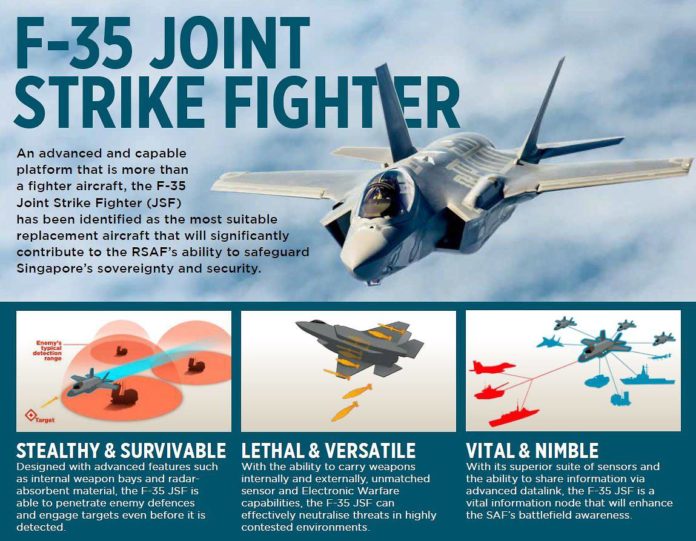
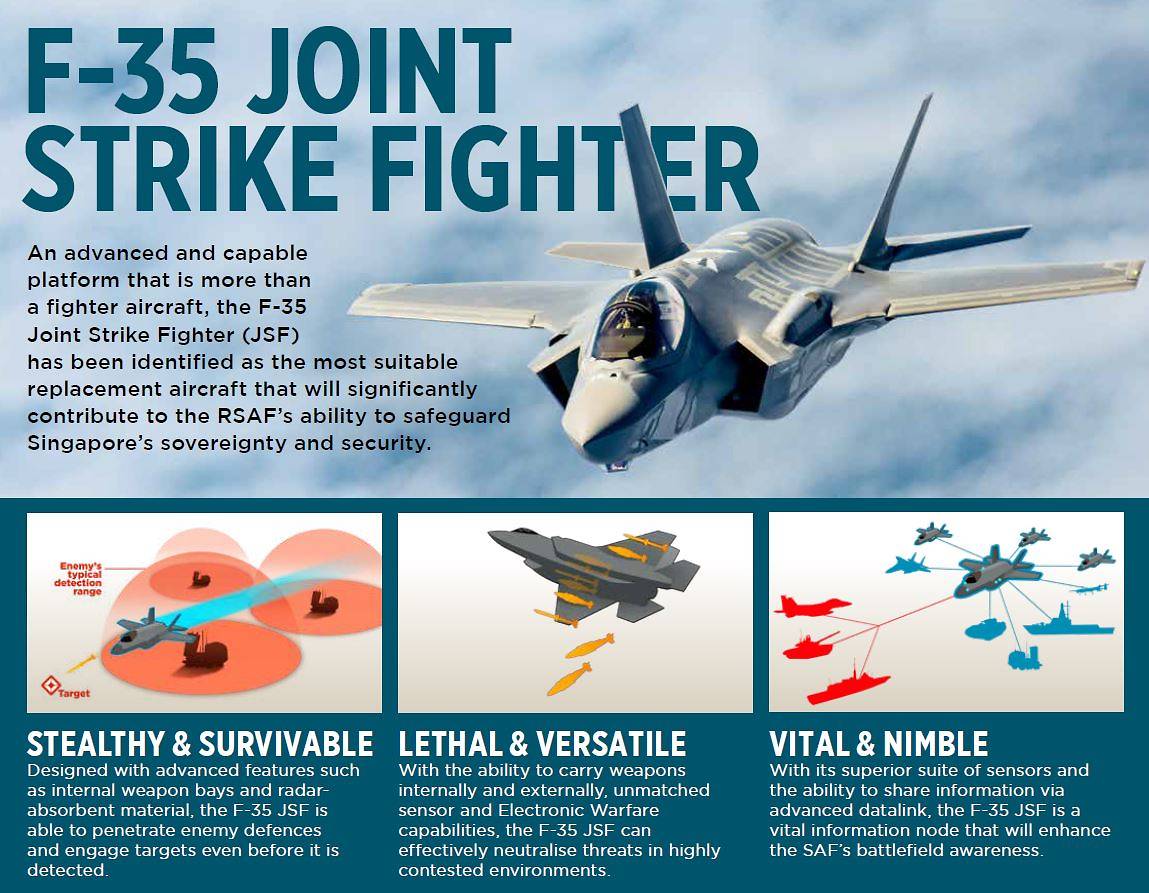
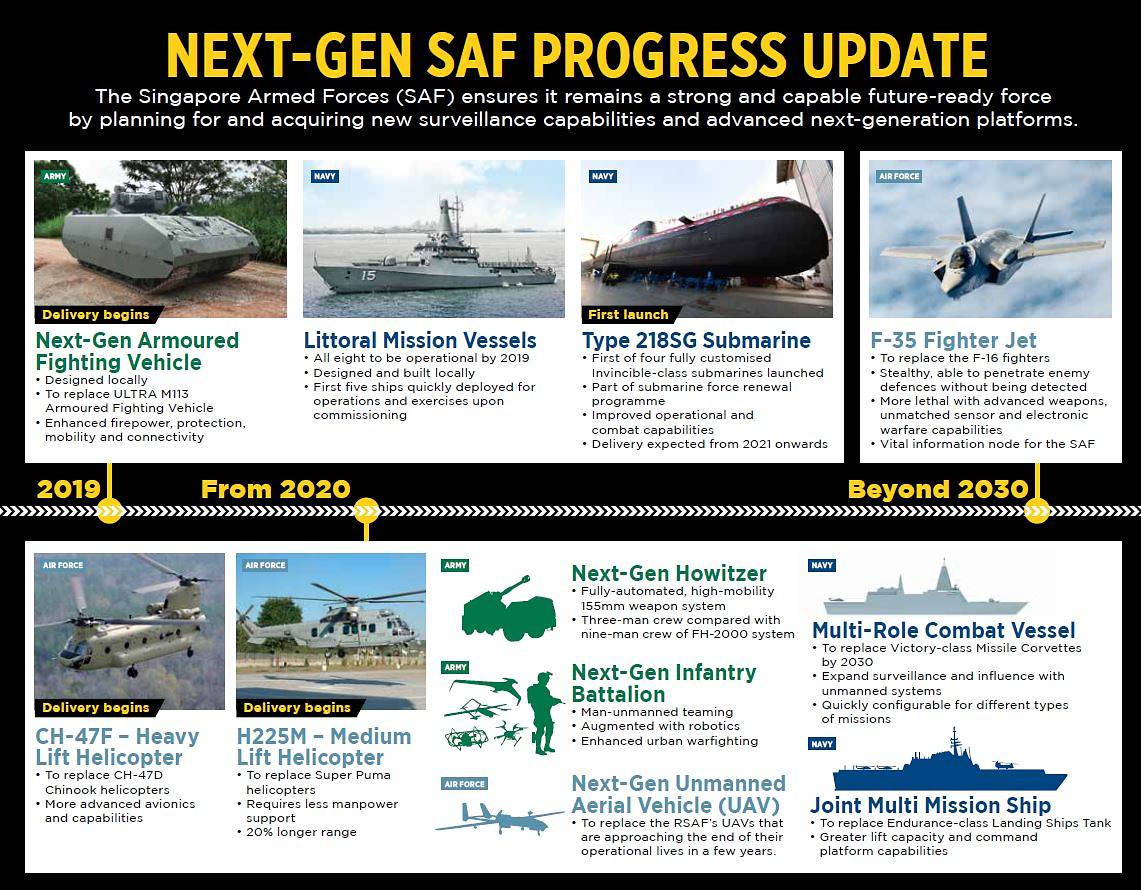
  • In the skies: MINDEF will place an initial order of four F-35s from the US, with the option of a subsequent eight. This is part of plans to replace the F-16 fighter jets, meaning that the future RSAF fighter fleet will consist of F-35s and F-15SGs.
  • In the water: The SAF is adding new submarines and warships to its arsenal, including four new Invincible-class submarines. Its missile corvettes will also be replaced by new multi-role combat vessels, the first of which will be delivered around 2025.
  • On land: New Next-Gen Armoured Fighting Vehicles will replace the M113 vehicles as the “mainstay” of Singapore’s mechanised forces from this year.
Infographic on SAF F-35

(Infographic: MINDEF)

3. ONE-STOP NATIONAL SERVICE HUB

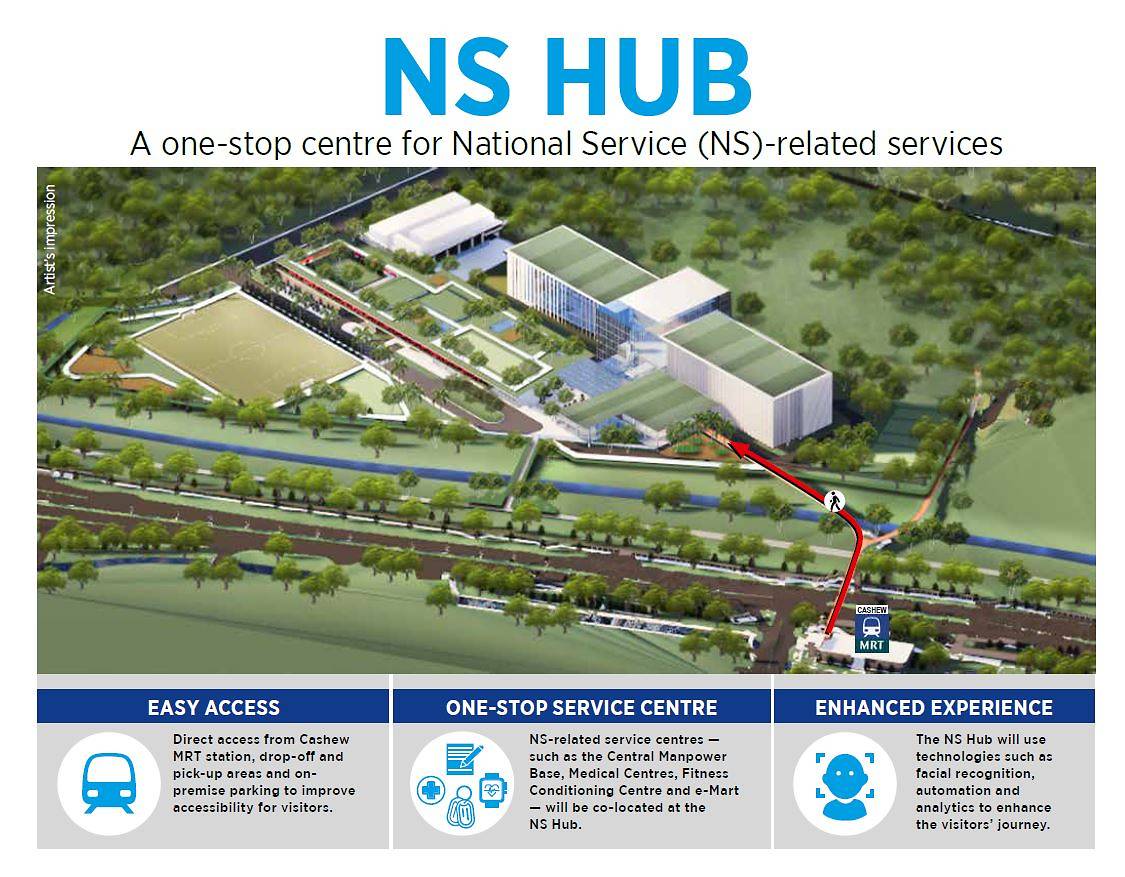
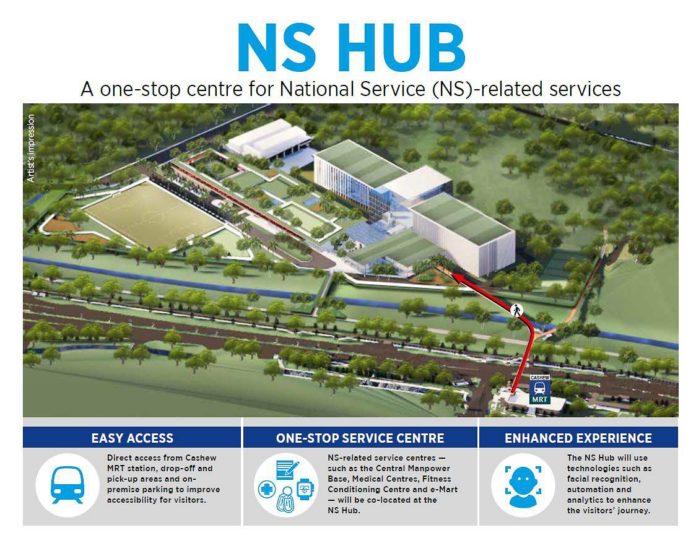
Dr Ng also announced the construction of a one-stop National Service (NS) Hub, where personnel can undergo their pre-enlistment medical, train at the fitness conditioning centre for the Individual Physical Proficiency Test and buy equipment at an e-Mart. 

When the facility is completed, it will be located opposite Cashew MRT station in Bukit Panjang and be the size of nine football fields. 

Senior Minister of State for Defence Heng Chee How also spoke during the debate, announcing several measures aimed at showing support and encouragement for national servicemen. 

“Our national servicemen have to balance their personal and NS commitments, and we must strive to increase convenience for them by reducing administrative burdens wherever possible,” he said. 

Among these measures were the removal of the overseas notification requirement for trips shorter than six months, as well as an initiative called NS Memories that gives NSmen access to non-sensitive, individually tagged photos of themselves and fellow servicemen that document their entire NS journey, from full-time NS to post-ORD.

New NS Hub infographic

Features of the NS Hub. (Infographic: MINDEF)

4. SAFETY FIRST FOR SAF

Mr Heng also promised “100 per cent inspection of all high-risk and field training” at the SAF, in a bid to reassure Singaporeans that training safety is a top priority for MINDEF and the military. 

High-risk training includes overseas exercises and live firing, while field training includes field and tactical manoeuvres. Previously, inspections were done for all high-risk training but only some field training.

In January, Singapore actor Aloysius Pang suffered serious injuries during Exercise Thunder Warrior in New Zealand and died at Waikato Hospital, where he was being treated. Pang’s fatality was the fourth one related to SAF training in 18 months. 

Meanwhile, from March, the Navy will trial a click and share-style mobile app called SafeGuardian at its bases, meant to allow servicemen to take photos of workplace hazards and share them with other servicemen and inform relevant SAF safety officers.

“Your buddies nearby will also be informed via safety alerts to their mobile phones,” said Mr Heng. The app will be progressively implemented to the rest of the SAF “as soon as possible”, he added.

NS 06

File photo of a rifle (Photo: Jeremy Long)

5. FIRE SAFETY FOR HOSPITALS, OTHER “HIGH-RISK” BUILDINGS

Fire safety was another topic on Friday, with authorities set to amend the Fire Safety Act to require owners of selected older buildings to put in place critical fire safety upgrades.

“High-risk” industrial buildings, public buildings and hospitals will be prioritised.

Additionally, around 60,000 rental flats will get home fire alarm devices or smoke detectors in the next two to three years, at no charge. 

Source link

Hotter days expected in first half of March after third warmest February in 90 years

0

SINGAPORE: Expect warmer weather in the first fortnight of March, with the daily maximum temperature forecast to reach as high as 35 degree Celsius on a few days, said the Meteorological Service Singapore on Friday (Mar 1). 

This is due to “dry conditions and strong solar heating of land areas during the day”, said the Met Service in its fortnightly weather outlook. 

It also noted that the prevailing dry and stable air mass over Singapore and the surrounding region since mid-February is likely to persist.

Towards the second week of March, four or five days of short-duration thundery showers can be expected in the afternoon, said the Met Service. 

Overall, rainfall for the first two weeks of March is likely to be below normal, it added. 

hot weather dry grass Singapore

Dry weather has turned grass brown by a road in Singapore. (Photo: Chew Hui Min)

THIRD WARMEST FEBRUARY IN 90 YEARS

Singapore and the region are in the dry phase of the northeast monsoon season. 

The Met Service said last month was the third warmest February in 90 years, based on the mean monthly temperature.

At the climate station in Changi, the mean monthly temperature last month was 28.2 degree Celsius, 1.1 degree Celsius warmer than the long-term average for February. 

“This makes February 2019 the third warmest February since temperature records began in 1929, after February 1998 and 2010 (28.9 degree Celsius) and February 2005 (28.5 degree Celsius).

As for the daily maximum temperature for February, it ranged between 33 degree Celsius and 35.5 degree Celsius.

The highest daily maximum temperature of 35.5 degree Celsius was recorded at Choa Chu Kang on Feb 9. 

Source link

‘Significant and steady investments’ in defence required to keep Singapore’s future secure: Ng Eng Hen

0

SINGAPORE: Developing a capable Singapore Armed Forces (SAF) to protect the nation’s interests and keeping Singaporeans safe for another generation will require “significant and steady investments”, said Minister for Defence Ng Eng Hen in his Committee of Supply speech on Friday (Mar 1).

“Defence, especially for a small island like Singapore is crucial, if we are to safeguard our interests and deter aggression,” said Dr Ng. “Singapore is on track to build a modernised tri-service SAF … that can meet security challenges both in the real and virtual worlds in the 21st century. 

“If we continue our steady investments into defence and our NSmen maintain their commitment and resolve to defend Singapore, then our future will be secure for another generation. We can look forward to celebrate SG75 with the assurance that we have strong defences.”

Defence spending for Financial Year (FY) 2019 is expected to hit S$15.5 billion, up from S$14.8 billion the previous FY, Finance Minister Heng Swee Keat had previously announced in his Budget statement on Feb 18.

Dr Ng said that nominal defence spending over the next decade is expected to grow at 3 to 4 per cent each year, to “at least keep pace with inflation”.

“To develop such a capable SAF … which can protect Singapore’s interests and keep Singaporeans safe for another generation, will require significant and steady investments,” added Dr Ng. “I make no bones about it – it will require resources and our commitment.”

NEW ASSETS

Plans to modernise the Next-Generation SAF to better respond to security threats are “progressing well for all three services”, said Dr Ng.

Infographic on SAF F-35

(Infographic: MINDEF)

In the skies, MINDEF plans to replace their F-16 fighter jets with the F-35s. This will mean that the future RSAF fighter fleet would consist of F-35s and F-15SGs. As such, MINDEF will place an initial order for four F-35s from the US, said Dr Ng.

“As stated previously, MINDEF will issue a Letter of Request (LOR) to the US to acquire F-35s. As required by US law for foreign military sales, the US Congress must approve the sale of F-35s,” he added.

READ: Singapore to buy 4 F-35 fighter jets with option for 8 more; price comparable to F-15SG

“Our LOR will request an initial acquisition of four F-35s, with the option of a subsequent eight if we decide to proceed. Singapore has the endorsement of both the United States Administration and the Department of Defense for our proposed purchase of F-35s, but the Congress must still approve it.

Infographic on SAF Multi-Role Combat Vessels

(Infographic: MINDEF)

The SAF will also be bolstering its sea capabilities, with the addition of new submarines and warships to its arsenal.

This includes the four new Invincible-class submarines – the first of which was recently launched in Germany, with the other three being built. 

“The Invincible-class submarines will have longer endurance, and also the latest locally-developed sensors and automated systems designed for optimal use in our surrounding waters… We aim to have a full fleet of four Invincible-class submarines by 2025,” added Dr Ng.

READ: Made for Singapore: First of four custom-built RSN submarines launched in Germany

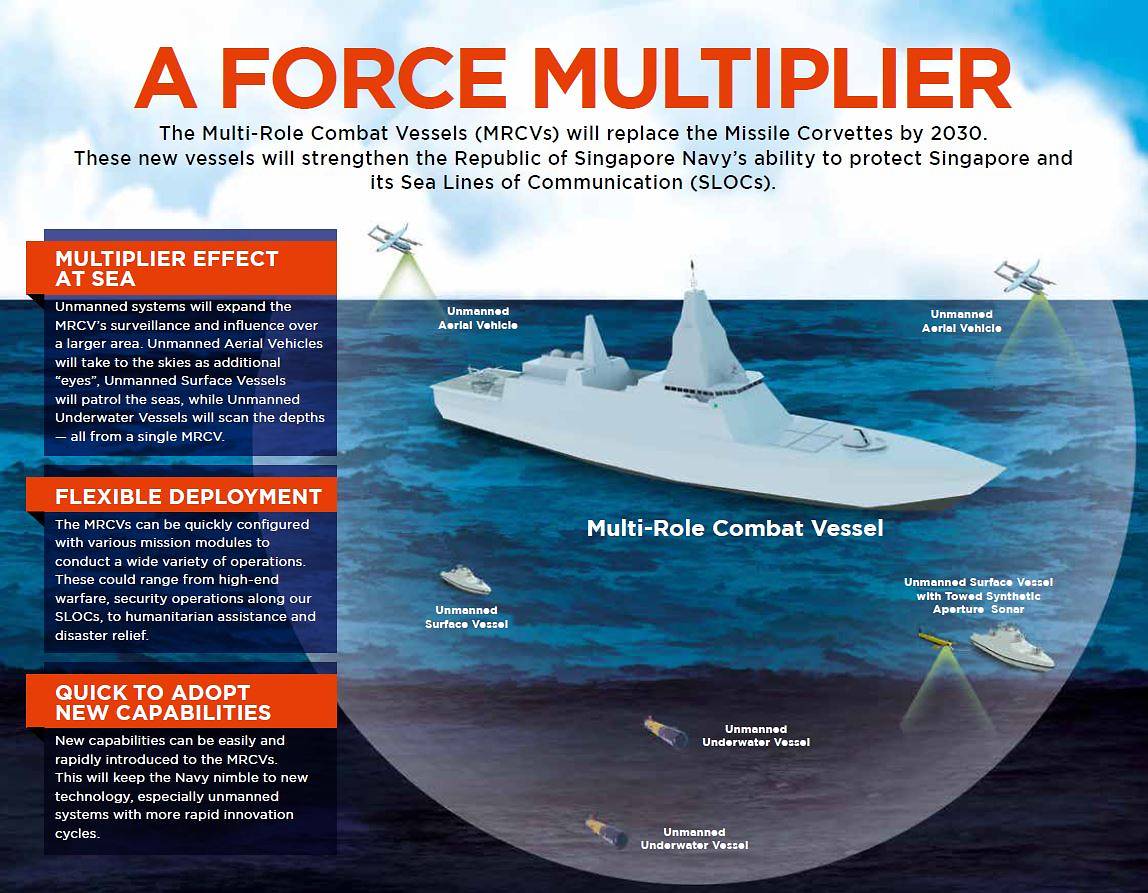
The SAF’s missile corvettes will also be replaced by the new multi-role combat vessels (MRCVs). The first of these vessels will be delivered around 2025, and full delivery is expected by 2030.

MINDEF will also “beef up” security for the entire coastline of Singapore, said Dr Ng.

This means the addition of more optical sensors and coastal radars to deter and detect potential threats as well as more unmanned watch towers for better coverage of the busy traffic across the Singapore Strait. Beginning next year, unmanned surface vessels will also patrol Singapore waters. 

Infographic on SAF acquisitions

(Infographic: MINDEF)

For the army, new Next-Gen Armoured Fighting Vehicles will replace the M113 vehicles as the “mainstay” of Singapore’s mechanised forces from this year onwards, Dr Ng said.

“In all, the Next-Generation SAF of 2030 and beyond, with this full complement of assets in air, land and sea, will be able to defend Singapore for another generation. This is the SAF that will take us into and guard our future. This is the SAF that our investments have bought or will buy,” he added.

When it comes to digital defence, Singapore is vulnerable to the threat of “hybrid attacks”, including the targeting of IT networks to disrupt services and capabilities, said Dr Ng.

“Two years ago, I announced the setup of the Defence Cyber Organisation (DCO). DCO has stood up the Defence Cyber Security Centre… for daily operations against cyber threats targeted at MINDEF and SAF IT systems, especially our command and control computer networks,” he added.

Incident response teams are also in place for deployment to support other national agencies during cyberattacks on critical systems. 

The SAF is also expanding the pool of regulars for the cyber domain under the Military Domain Experts Scheme, as well as the non-uniformed Defence Cyber Expert. More than 300 will be hired in the first phase. 

NSFs also can play an “important” role in digital defence, said Dr Ng. 

The 59-strong pioneer batch of the Cyber NSF Scheme who enlisted in late 2018 are now undergoing an eight-month-long Cyber Specialist Cadet Course and will graduate in August.

The Cyber Defence Test and Evaluation Centre has been built to train soldiers in a “realistic and challenging environment”, added Dr Ng. The Centre includes a “cyber range” that simulates the SAF’s networks and online traffic, using actual malware and attacks against these nodes. 

The SAF will also tap on NSmen with IT expertise as a result of their civilian jobs or training.

INVESTMENT IN TRAINING FACILITIES

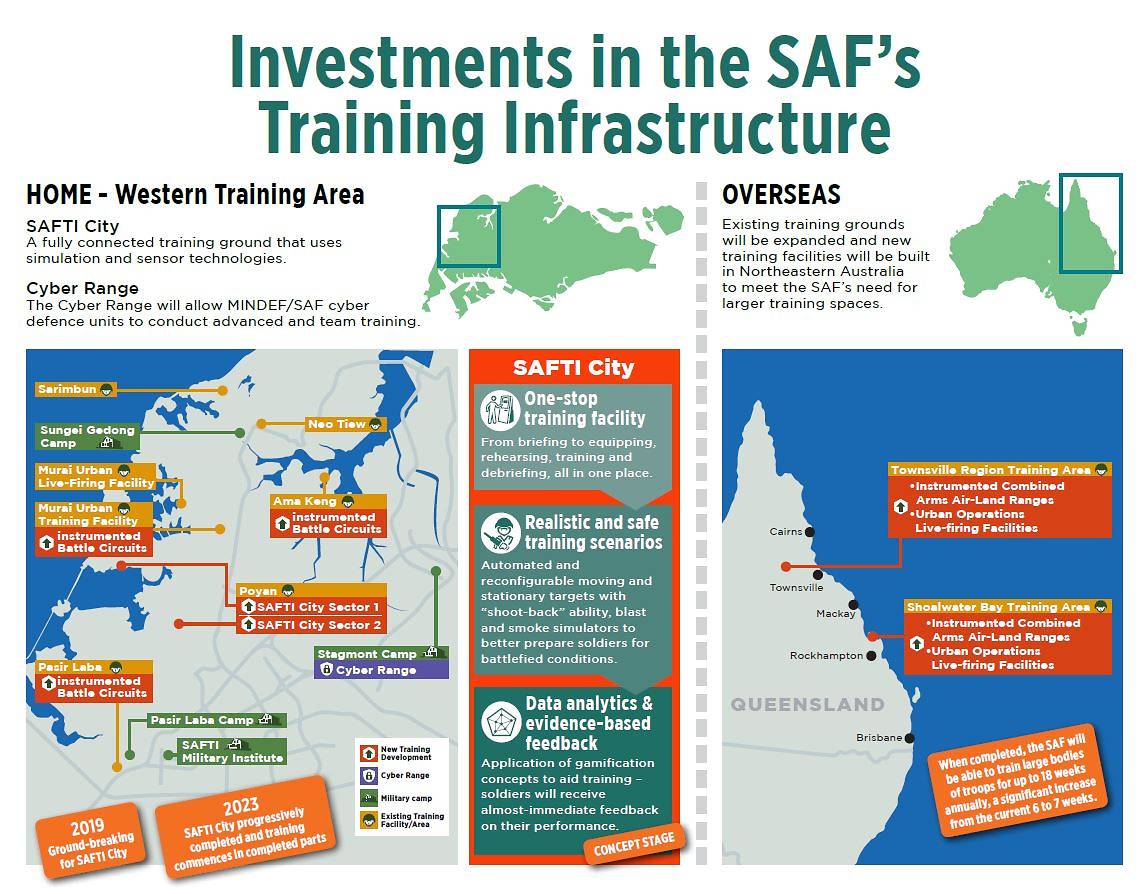
In tandem with its investment in hardware, MINDEF will also invest more into training facilities, said Dr Ng. This includes the construction of SAFTI city, a one-stop training facility which will complement the “traditional terrains” of the old SAFTI with “urban settings”.

Infographic on SAF investments

(Infographic: MINDEF)

He said: “I am glad to report that SAFTI City is taking shape and on schedule. We’ll build more roads and bridges so that motorised and mechanised troops in Army vehicles can start training this year. SAFTI City will be progressively built and when finished will have more than 200 buildings of varying heights and types, when completed.”

READ: SAFTI City ‘the size of Bishan’ to be built for army training

The facility is slated to be progressively completed in 2023.

Overseas, the SAF will expand its training areas in Australia under the Singapore-Australia Comprehensive Strategic Partnership. This includes the extension of training areas at Shoalwater Bay and new developments in Townsville Region in Northeast Australia.

New facilities such as Instrumented Combined Arms Air Land Ranges and Urban Operations Live-Firing Facilities are “on track” to being built, added Dr Ng. When the facilities are completed over the coming years, the SAF will be able to train large groups of troops for up to 18 weeks annually, a significant increase from the current six to seven weeks.

NEW NS HUB

Besides that, Dr Ng said MINDEF will also build a central facility to “better respond to the needs of the NS community”.

The New NS Hub, to be completed in 2023, will bring together the Central Manpower Base for the pre-enlistment process, medical centres for medical reviews, an e-Mart for buying NS equipment and a fitness conditioning centre for IPPT.

It will be located opposite Cashew MRT.

READ: Improving NS experience: New NS Hub brings together pre-enlistment medical, IPPT, e-Mart

“MINDEF will continue its efforts in defence diplomacy … We want to promote regional peace and stability,” said Dr Ng. “We make friends with those who are willing, and partner those countries whose interests are aligned with ours and who share our desire for inclusiveness, peaceful resolution of disputes and respect for the law. 

“But at the same time, we must ensure that the SAF is strong and adequate to defend our rights when diplomacy fails and when others choose to do us harm or ignore our rights … A strong SAF protects Singapore and Singaporeans,” Dr Ng said.

Source link

All high-risk, field training to be inspected, as SAF renews emphasis on safety

0

SINGAPORE: The Singapore Armed Forces (SAF) has renewed its emphasis on safety, Senior Minister of State for Defence Heng Chee How said in his Ministry of Defence (MINDEF) Committee of Supply speech on Friday (Mar 1), announcing that all high-risk and field training will be inspected for safety.

“Commanders have comprehensively reviewed safety management plans and the overall training tempo. They know that they must lead by example in driving safety as a topmost priority,” Mr Heng said.

“The Army will also ensure 100 per cent inspection of all high risk and field training. We want, through concrete action, to reassure Singaporeans that training safety is a top priority for MINDEF and the SAF.”

READ: ‘I am deeply sorry for the loss’: Ng Eng Hen on recent NS training deaths, vows accountability for every soldier

High-risk training includes overseas exercises and live firing, while field training includes field and tactical manoeuvres. Previously, inspections were done for all high-risk training but only some field training.

These inspections will be done by one of three levels of the Army safety audit and training inspection system.

ARMY SAFETY INSPECTORATE

At the highest level is the Army Safety Inspectorate (ASI), which develops safety regulations, conducts safety audits and training inspections, investigates safety incidents, promotes safety education and analyses safety-related trends.

“We are also doing our very best, our utmost to raise the safety consciousness of every soldier,” ASI head Colonel Tong Yi Chuen said during a surprise inspection of a live firing exercise on Thursday.

“We find that safety inspections are one of the mechanisms to ensure that all units are complying with safety regulations. We also use this chance to check the competencies of personnel involved.”

READ: PM Lee says he and SAF leaders ‘take safety with utmost seriousness’

The ASI inspection team conducts about 300 safety audit and training inspections each year.

Safety audits assess the unit’s safety processes and provide feedback on its safety organisation, while training inspections are unannounced spot checks during training to check the unit’s compliance with Training Safety Regulations.

Army Safety Inspectorate checking medical equipment

Inspectors checking pre-range medic processes and medical equipment. (Photo: Jeremy Long)

“For example, inspectors will check the authorised operating materials, such as lesson plans, and verify that the safety protocols are being adhered to during training,” MINDEF said in a media release on Friday.

“Such safety protocols include the enforcement of hydration regime and the conduct of risk assessment checks by the section commanders.”

READ: Greater weight to be given to safety compliance when assessing SAF unit commanders

Each safety audit and inspection team is made up of two ASI inspectors, who are military or ex-military commanders experienced in training. They are also required to attain Workplace Safety and Health basic and advanced certification.

LOWER LEVELS OF SAFETY SYSTEM

The inspections can also be done by the lower levels of the safety system, which comprise the division or formation headquarters and below it the ground units themselves.

Army Safety Inspectorate checking live firing

Inspectors checking pre-range action drills and shooting fundamentals. (Photo: Jeremy Long)

The division and formation headquarters perform a second layer of audits and inspections to enforce implementation of safety and training systems on the ground, while the unit headquarters and safety officers conduct internal inspections on their sub-units’ training activities.

INSPECTOR-GENERAL OFFICE

Beyond these three levels, the newly formed Inspector-General Office (IGO) will also from April conduct independent audits and inspections to ensure that the SAF’s safety policy and objectives are being implemented effectively.

READ: Tan Chee Wee appointed SAF’s first Inspector-General

In addition, MINDEF said the IGO will work with ASI and other service inspectorates to share and incorporate safety ideas and best practices from all services and from outside the SAF.

Inspector General Tan Chee Wee live firing

Inspector General Brigadier-General Tan Chee Wee speaking to media. (Photo: Jeremy Long)

​​​​​​​

“I believe these efforts will really help us better understand how services ensure troops train safely while training realistically as well,” Inspector-General Brigadier-General Tan Chee Wee said on Thursday during the surprise inspection.

“I also believe that these efforts will help us unveil potential weaknesses in our inspection systems.”

NEW APP TO HIGHLIGHT SAFETY HAZARDS

Meanwhile from March, the Navy will also trial in its bases a mobile application that will allow servicemen to take photos of workplace hazards and share them with other servicemen.

The app, called SafeGuardian, can also provide access to safety checklists on-the-go, although these forms are currently only available on the terminals in camp.

One possible scenario where the app could be used is when servicemen in camp notice sharp wire fittings that could cause injury. They can take a photo of it using the app, which will inform relevant SAF safety officers for further action.

“Your buddies nearby will also be informed via safety alerts to their mobile phones,” Mr Heng said.

The app, which has been developed since last year, will be progressively implemented to the rest of the SAF “as soon as possible”.

“Ultimately, safety involves this, everything that I’ve mentioned, but it also involves more than just sound systems and top-down measures,” Mr Heng added. “Safety must be a part of our organisational culture, one that every soldier at every level has a role to own, to build and to foster.”

Source link

Improving NS experience: New NS Hub brings together pre-enlistment medical, IPPT, e-Mart

0

SINGAPORE: Come 2023, National Service (NS) personnel will be able to engage all related services – from the pre-enlistment medical to the Individual Physical Proficiency Test (IPPT) – at a new one-stop hub the size of nine football fields.

“MINDEF (Ministry of Defence) has also decided to build a central facility to better respond to the needs of the NS community,” Defence Minister Ng Eng Hen said in his Committee of Supply debate speech on Friday (Mar 1).

The NS Hub, located opposite Cashew MRT Station at Bukit Panjang, will host medical centres for medical reviews, a fitness conditioning centre for IPPT and an e-Mart for buying NS equipment. The hub will also use technology like facial recognition, automation and analytics to improve visitor experience.

New NS Hub infographic

Features of the NS Hub. (Infographic: MINDEF)

The Central Manpower Base at the Depot Road camp, where the pre-enlistment process is conducted, will move to the hub. The vacated building will be repurposed.

“A new NS Hub will bring together different services which are now scattered across Singapore,” Dr Ng said, noting that for instance, pre-enlistees currently take their IPPT at Toa Payoh Stadium, pre-enlist at Depot Road Central Manpower Base, then attend medical reviews at the Military Medicine Institute in Kent Ridge.

“The new NS Hub will bring greater convenience to the NS community by acting as a one-stop centre for all NS-related services,” the Ministry of Defence (MINDEF) said in a release on Friday.

REMOVAL OF OVERSEAS NOTIFICATION

Beyond that, Senior Minister of State for Defence Heng Chee How announced several other measures to improve the NS experience, aimed at showing support and encouragement for national servicemen.

“Our national servicemen have to balance their personal and NS commitments, and we must strive to increase convenience for them by reducing administrative burdens wherever possible,” he said.

“This will help them to focus on their training. We will also maximise the potential and tap into the abilities of our increasingly educated pool of servicemen so that they can contribute even more meaningfully.”

For starters, MINDEF and the Ministry of Home Affairs will from Mar 1 remove the overseas notification requirement for trips shorter than six months.

Currently, NSmen travelling for more than 14 days but less than six months have to notify the agencies of their overseas travel and contact information.

“Removing this notification requirement will not compromise operational readiness as there are other exit measures in place,” MINDEF said.

For instance, operationally ready national servicemen (NSmen) are still required to apply for an exit permit before travelling for more than six months, while those on operational and mobilisation manning still need to seek permission from their units before travelling.

“Control measures could be tightened if the need arises,” Mr Heng said.

CONTRIBUTE DURING RESERVIST WITH CIVILIAN EXPERTISE

Mr Heng also announced that NSmen can now contribute to defence with their civilian expertise earlier in their Operationally-Ready NS (ORNS) training cycle. This expertise can include “relevant and important” skills like nursing and info-communications.

Previously, NSmen had to complete the full 10-year training cycle before converting to a role that allows them to use their civilian expertise.

“Now, if found suitable, they can be deployed to roles such as nursing officers and network communications officers after completing two High-Key In-Camp Training stints and have served five ORNS years,” Mr Heng said.

MORE SKILLS COURSES FOR NSFs

As for full-time national servicemen (NSF), MINDEF will help with their transition to studies or work by introducing three initiatives by mid-2019.

First, NSFs can use S$350 worth of Electronic Pre-Release Employment Programme (E-PREP) credits on about 3,000 selected courses, including SkillsFuture Series courses that focus on priority skillsets such as data analytics and cybersecurity, and a range of Massive Open Online Courses offered by SkillsFuture-approved training providers such as Udemy.

“These expanded offerings will help NSFs refresh, update or acquire new skills that aid their transition to further studies or to join the workforce,” MINDEF said.

READ: National Service skills to be formally accredited for future career use

Currently, NSFs can use their credits to subscribe to about 200 online courses offered by local universities and polytechnics. These credits are valid up to one year after NSFs complete full-time NS.

Secondly, MINDEF will work with Institutes of Higher Learning to develop modular courses for E-PREP that will grant NSFs credit exemptions for higher education programmes after their Operationally Ready Date (ORD).

For example, NSFs can use their credits to take up a course offered by a polytechnic. Upon admission to that polytechnic, they will be granted partial exemption from one module.

Lastly, MINDEF will provide a career orientation experience for NSFs near their ORD through the conduct of customised SkillsFuture Advice workshops at the Enhanced Career and Education Fair (ECEF).

A pilot with NSFs attending the ECEF will be conducted in March, following trial workshop sessions with the Basic Military Training Centre and the 30th Battalion, Singapore Combat Engineers in January.

NS MEMORIES

MINDEF and the Singapore Armed Forces will also trial an initiative called NS Memories to “strengthen engagement and promote support for NS”.

“Our servicemen have told us that sharing photographs of their NS experiences in camp would help build a strong sense of community,” Mr Heng said.

As part of the initiative, NSmen will be given access to non-sensitive, individually tagged photos of themselves and fellow servicemen that document their entire NS journey, from full-time NS to post-ORD. These might include training, cohesion activities and other “memorable events”.

These photos will be stored on a digital platform, and NSmen will be able to view, download and share them on their social media platforms.

Mr Heng said an active infantry unit will trial the initiative for three months in mid-2019. If proven successful, he said MINDEF will expand the initiative. 

“MINDEF is exploring suitable online platforms for NS memories, and will assess the development of features and functions based on feedback from the trial participants,” it added. 

Source link

Surge in consumer complaints for beauty and transportation industries in 2018: CASE

0

SINGAPORE: The beauty industry and transportation firms received a surge in complaints from disgruntled customers last year, said the Consumers Association of Singapore (CASE) on Friday (Mar 1).

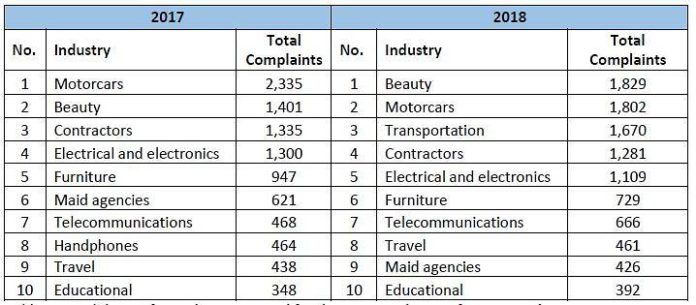
The beauty industry had the highest number of complaints, followed by the motorcars, and transportation industries, CASE said, noting that this was the first time since 2012 that the car industry did not top the list.

CASE received 1,829 complaints against the beauty industry, a 31 per cent increase from 2017. A large number of the complaints resulted from businesses closing abruptly or aggressive sales tactics.

CASE complaints 2017 and 2018 Table 1

Industries with the most complaints received by the Consumers Association of Singapore (CASE) in 2017 and 2018. (Source: CASE)

The sudden closure of Traditional Javanese Massage Hut saw consumers losing nearly S$200,000 in prepayments for massage packages and unused sessions across all outlets. 

Consumers from the company’s River Valley outlet received a pay-out from prepayment insurance because that outlet was under the CaseTrust Spa and Wellness accreditation scheme.

CASE also highlighted instances of aggressive sales. In one case, two salespeople retained an elderly consumer’s debit card after she paid for one item, and made her sit through two hours of promotion.

When her card withdrawal limit was reached, one salesperson followed the consumer to an ATM to withdraw more money.

“Her bill amounted to $5,000. Upon CASE’s intervention, the consumer managed to receive a full refund,” CASE said.

TRANSPORT INDUSTRY

There was a 10-fold increase in complaints relating to the transportation industry – from 165 complaints in 2017 to 1,670 complaints in 2018.

Of these, 1,396 were against oBike after its decision to cease operations in June 2018.

CASE advised consumers to protect themselves by understanding the risks involved when they make advance payments to businesses.

“This is more so as the prevalence of prepayment cuts across many industries,” it said.

The motorcars industry saw a 23 per cent drop in complaints, from 2,335 complaints in 2017 to 1,802 complaints in 2018. Non-conforming or defective goods accounted for 46 per cent of the complaints.

CASE said it also observed an increasing trend of complaints arising out of online transactions.

“While most complaints pertain to consumer transactions with traditional brick-and-mortar stores, there was a 60 per cent increase in the number of complaints involving online purchases handled by CASE from 2017 to 2018,” it said.

In all, CASE received 16,090 complaints last year. About 70 per cent of the complaints negotiated and/or mediated by CASE on consumers’ behalf were resolved, with more than S$2.73 million recovered in cash and kind.

Source link