Historically horseracing, in one form or another, has been around for thousands of years. Records exist from Ancient Egypt, Greece, Babylon, Syria, the Roman Empire and the list goes on. However, it wasn’t until the evolution of actual thoroughbred racing in the 17th century, and it’s highlighted profile through its popularity with British Royalty and British Aristocracy, that it earned the title “The Sport of Kings”.
…And there has been no monarch in history that has ever embraced “The Sport of Kings” quite like The Queen, Her Majesty Queen Elizabeth the Second.
A day at the races in the UK is a fantastic opportunity to experience English history, pageantry, pomp and tradition and since first attending the Epsom Derby as a Princess back in 1946, The Queen has missed the race just twice. By the age of 6 years old Elizabeth was a keen horse rider and that competency grew through her teens and as an adult strengthening her love of the animals and for horseracing. It was her father King George the Sixth, also a horse enthusiast, that first took the young Princess Elizabeth to the Epsom Derby, and so began an eight decade long love affair with the event.
Elizabeth the Second was crowned as Queen of England in 1953 after the death of The King and unbelievably, just four days later, attended her first Epsom Derby as reigning Monarch.
Queen Elizabeth the Second inherited a magnificent collection of thoroughbreds and breeding stock from her late father and has since built her stable into a formidable racing empire. Jockeys wearing the scarlet and purple colours of Her Majesty have passed the winning post over 1600 times on The Queens horses and she has won all the British Classics, many multiple times, with only one race eluding her trophy cabinet, the Epsom Derby. Despite attempting the race with her runners 10 plus times The Queen has yet to become part of The Derby History as a winner of the race, with her best result actually coming in her first year attempted back in 1953 with Aureole which finished second to Pinza.
In a statement made in 2012 Epsom Downs Racecourse chairman, Anthony Cane said this about The Queen:
At the end of the day, her love is to come here. You have to remember, she comes here in a normal year in a private capacity not on an official visit. But she comes because she loves it, and this time it’s her one trip to Surrey in the Diamond Jubilee.
[The Queen] is incredibly knowledgeable. Her knowledge of thoroughbreds and breeding goes way back. She’s absolutely amazing.”
Once again in 2019 The Queen will be attending Britain’s richest flat race and will have her Royal Standard raised in the Jockey Club Enclosure after the royal procession down the straight from Tattenham Corner. If you’d like to be part of that celebratory crowd then perhaps consider a Hospitality Package through an official supplier to the event.
SINGAPORE: In the coming months, the National Population and Talent Division will consult Singaporeans on their needs and concerns over marriage and parenthood, said Minister in the Prime Minister’s Office Josephine Teo on Thursday (Feb 28).
“I would like to invite all stakeholders to join us in co-creating and shaping policies,” said Mrs Teo in her Committee of Supply speech. The consultation will involve how the Government and community can better support people’s aspirations. “We will give more details about this consultation process soon.”
She noted parents’ concerns over financial costs, such as pre-school fees.
On this, Mrs Teo, who oversees population matters, said the Early Childhood Development Agency (ECDA) is reviewing the pre-school subsidy framework to make it more affordable for parents.
“The Ministry of Social and Family Development will provide an update on this during its Committee of Supply debate,” she said.
Currently, working mothers get a basic subsidy of S$600 and S$300 for infant care and childcare full-day programmes, respectively. Non-working mothers get S$150 for either.
Mrs Teo, who is also Manpower Minister, said that since 2014, ECDA has increased the number of full-day pre-school places nationwide by more than 50 per cent. She said there are 170,000 full-day preschool places today, a figure that will increase to about 200,000 by 2023.
She pointed out that parents now get more support for childraising costs.
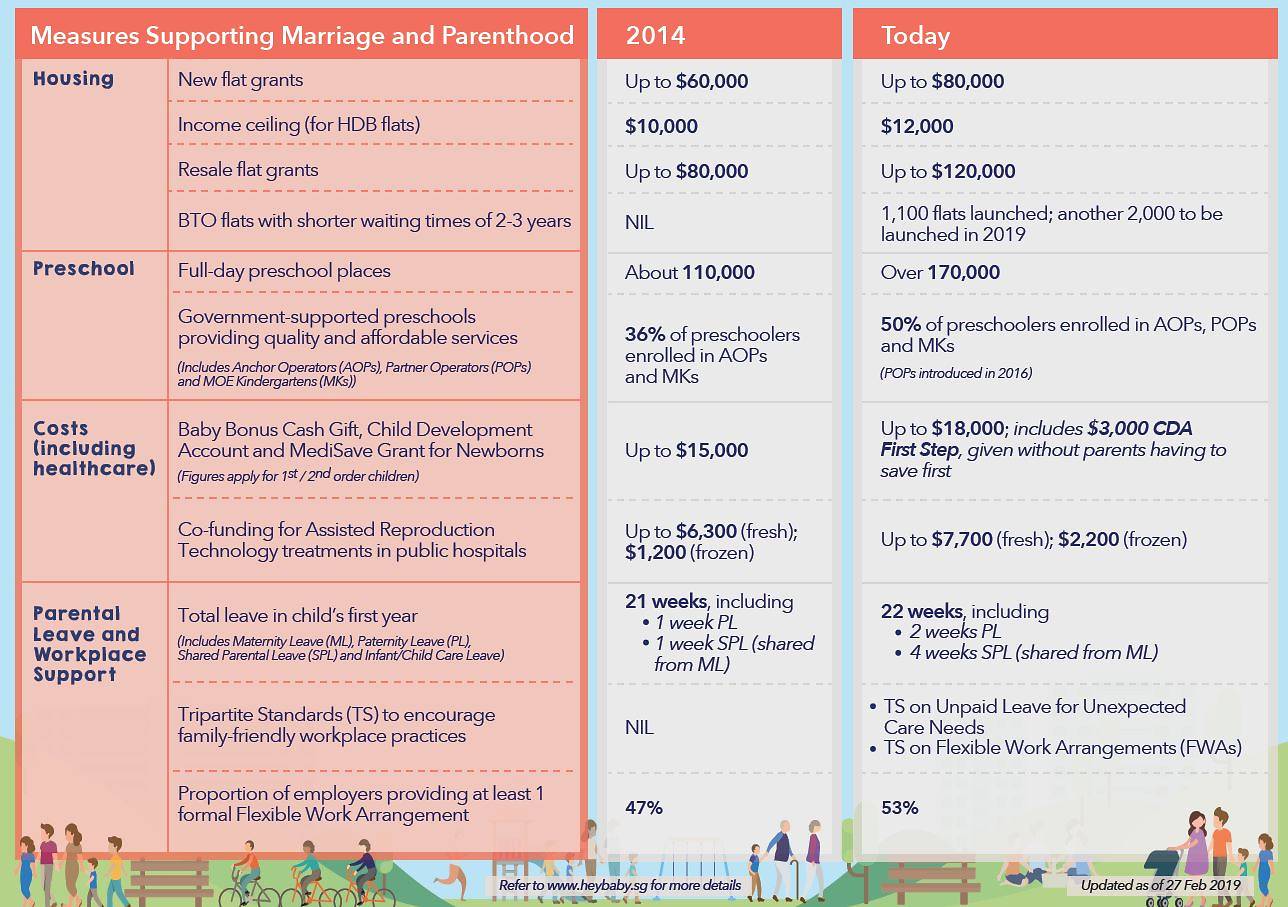
After the first child is born, they can receive up to S$18,000 through the MediSave Grant for Newborns, Baby Bonus Cash Gift and the Child Development Account (CDA), a figure that is S$3,000 more than the maximum a couple would get in 2014.
“They will also receive a CDA First Step of S$3,000 deposited by the Government, without having to save into the CDA first, which helps to lighten their load at the start of their parenthood journey,” Mrs Teo said.
ENCOURAGING MARRIAGE AND PARENTHOOD TRENDS
Mrs Teo said there are “some reasons to be optimistic” when considering how Singapore is doing over the longer term when it comes to marriage and parenthood.
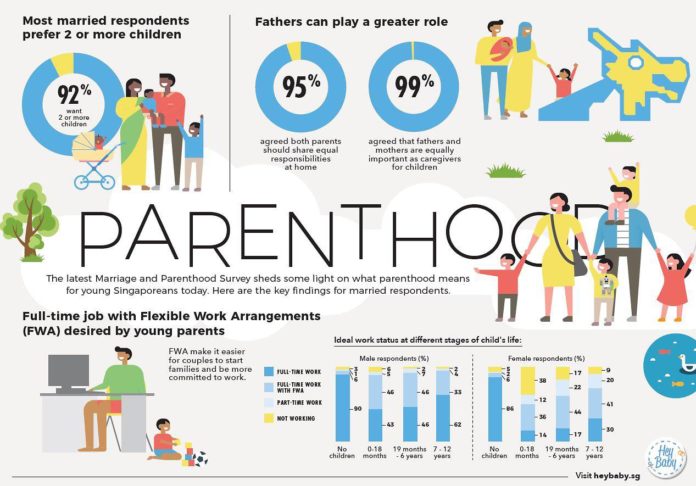
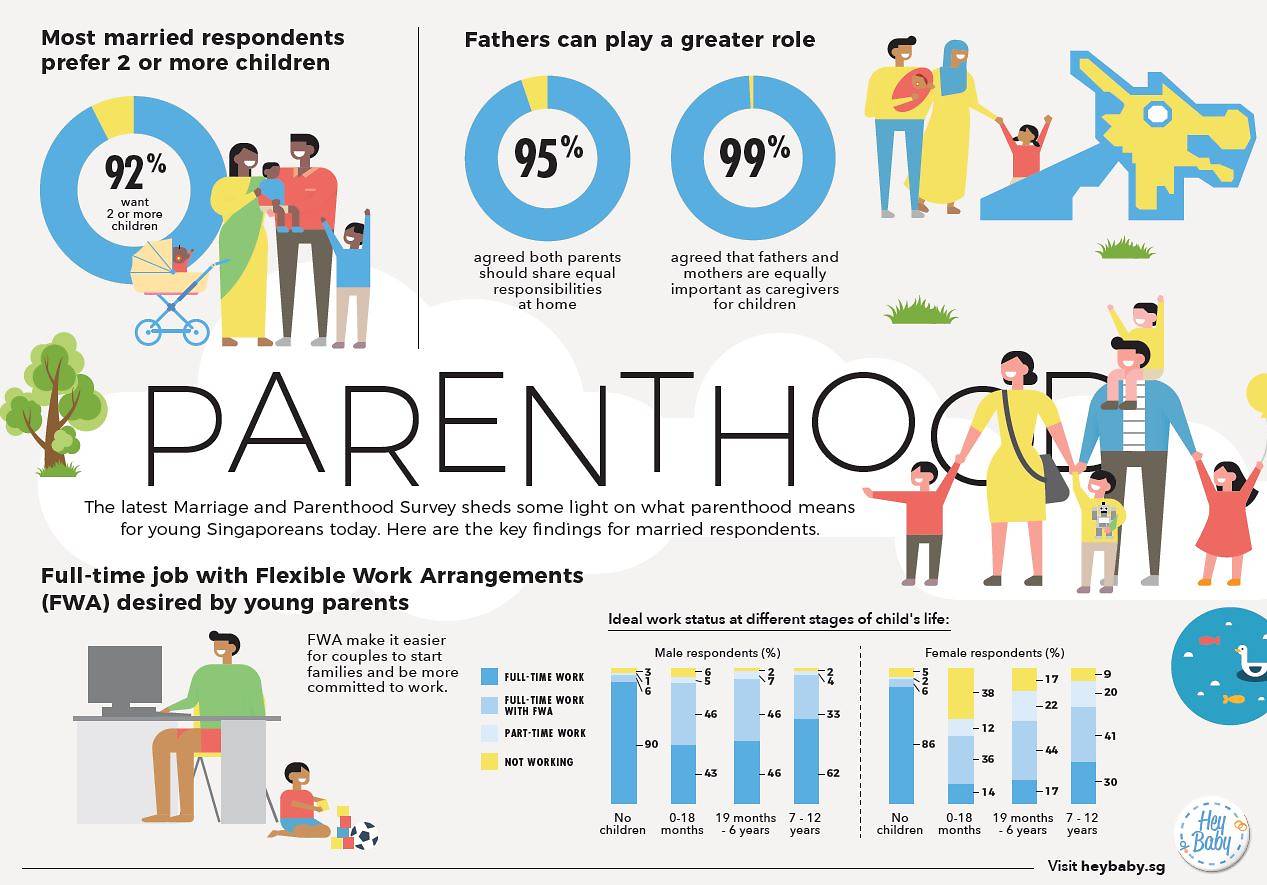
Findings on parenthood from the latest marriage and parenthood survey in 2016. (Infographic: Prime Minister’s Office)
She pointed to statistics which indicate that the average number of citizen births in the last five years is higher than previous five-year periods.
From 2014 to 2018, the average was 33,000 births annually. From 2009 to 2013, and from 2004 to 2008, this figure was lower at 31,400 and 32,000 births, respectively.
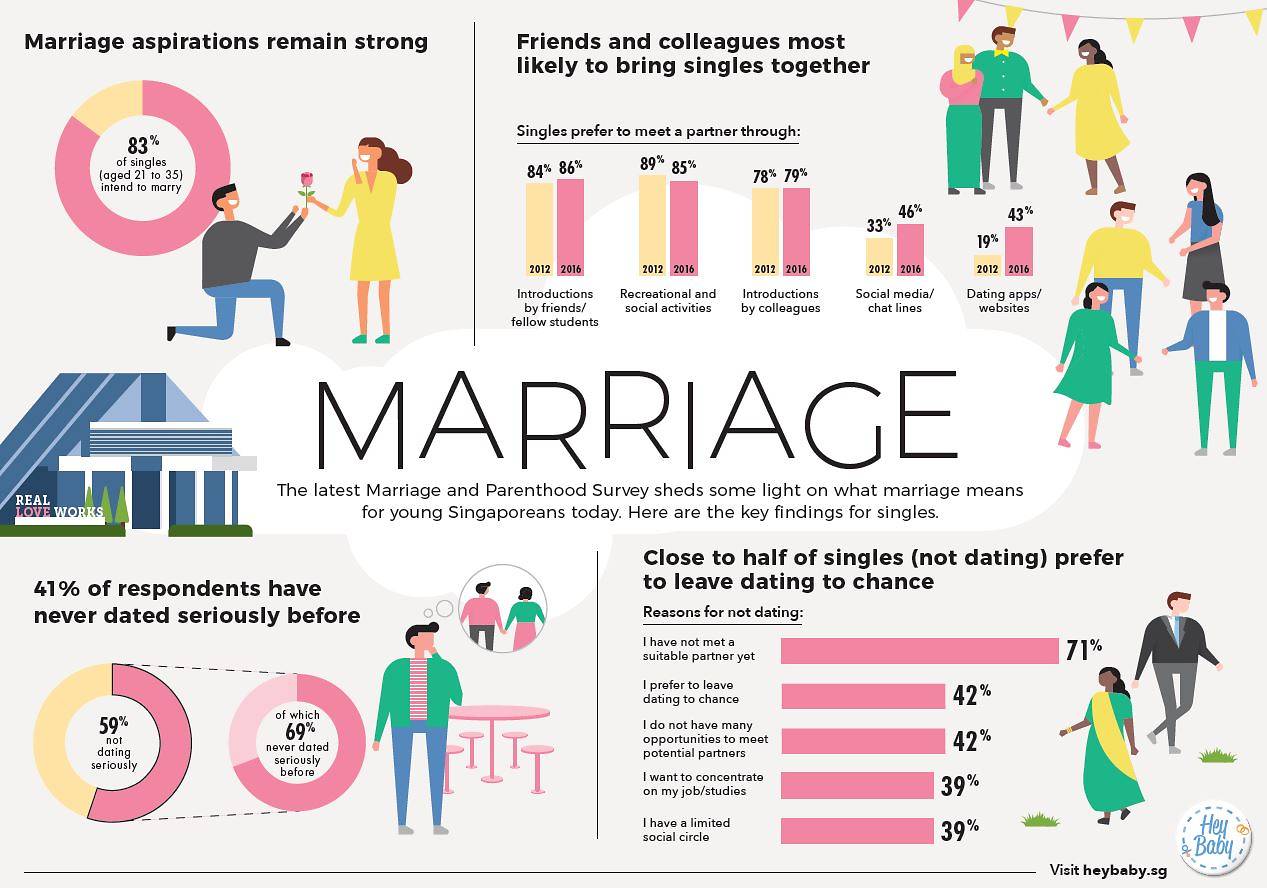
Findings on marriage from the latest marriage and parenthood survey in 2016. (Infographic: Prime Minister’s Office)
In addition, Mrs Teo highlighted that recent marriage numbers have remained high, with the average number of marriages in the past five years “significantly higher” than the past decade.
Still, with the trend of later marriages and births, Mrs Teo said the Government will review its assistance for couples who face difficulties conceiving, and who wish to undergo assisted reproduction technology treatments.
“For family to remain the bedrock of society, we must actively lean against the wind to make marriage and parenthood achievable, enjoyable and celebrated,” she added.
IMPROVED PARENTAL LEAVE
But to allow parents to care for their children better, Member of Parliament for Nee Soon GRC Louis Ng asked if it was possible to further increase the amount of parental leave.
“We will keep reviewing the scope to expand leave provisions, but we should be careful about mandating businesses to do more, as it would impact business viability and put jobs at risk,” Mrs Teo replied. “Given the recent enhancements, I hope members will agree to give companies some time to adjust before further moves.”
A table showing measures to support marriage and parenthood. (Infographic: Prime Minister’s Office)
Fathers can now get up to eight weeks of leave in his child’s first year, compared to four weeks five years ago. “The take-up of paternity leave has been encouraging, increasing from 37 per cent in 2014 to 53 per cent for recent cohorts,” Mrs Teo added.
Furthermore, Mrs Teo said each parent with children below the age of seven has six days of paid childcare leave per year, and two days of annual paid childcare leave when their children are in primary school.
FLEXIBLE WORK ARRANGEMENTS
At the workplace, Mrs Teo said parents are likely to benefit from flexible work arrangements (FWA), after the launch of the Tripartite Standard on Flexible Work Arrangements and the Work-Life Grant.
The grant, launched in July, has received more than 340 applications in five months, Mrs Teo said.
“More workplaces are now supportive of FWAs,” she added, noting that around 53 per cent of employers now offer at least one formal flexible work arrangement, up from 47 per cent in 2014.
“This is, in fact, a significant turning point I have been waiting for. The tide is shifting and I’m hopeful flexible work arrangements will become much more commonplace henceforth.”
CONDUCIVE WORKPLACE CULTURE
But beyond workplace flexibility, Mrs Teo said there are deeper issues of workplace culture.
“Some Singaporeans indeed work very long hours, leaving little time for dating or family life,” she said. “Having fewer hours to rest and recharge not only affects employees’ health and well-being, but also the time that they have with their loved ones.”
With that, Mrs Teo said there is value for organisations to adopt new ways of working, but still achieve good business outcomes while giving staff enough down time to recharge.
For example, she pointed to M.Tech, a cybersecurity company which uses IT tools to enable staff to work remotely and still be effective. One employee was able to telecommute when her children were down with chickenpox.
“M.Tech was initially concerned about the investment needed to enable mobile working, but later found the benefits well worth it,” Mrs Teo stated.
“We hope many more employers will make the effort to promote more sustainable work practices for the sake of their employees and their own business viability in the longer run.”
CHANGE IN MINDSET REQUIRED
Nevertheless, Mrs Teo acknowledged that “deeper changes in mindsets” are needed to reduce the stress associated with parenting.
“Ultimately, marriage and parenthood are personal decisions, shaped by the values that each person holds dear, but influenced in no small part by our families, employers and the wider society,” she said.
SINGAPORE: Two existing Smart Nation initiatives – Moments of Life (MOL) and MyInfo – will be expanded in the coming year to address more citizens’ needs.
Minister-in-charge of Smart Nation Initiative Vivian Balakrishnan revealed these plans during the Committee of Supply debate in Parliament on Thursday (Feb 28).
The Moments of Life (Families) app was first introduced last June, helping parents manage their child’s early years. In an update, the Smart Nation and Digital Government Group (SNDGG) said that as of February this year, more than 2,000 births have been registered through the service.
As part of ongoing improvements to the service, SNDGG said the electronic registration of births at KK Women’s and Children Hospital, Singapore General Hospital and National University Hospital will be expanded to private hospitals starting with Thomson Medical Centre this January.
Going forward, the MOL initiative will cater to citizens’ other key life moments. These include integrating relevant information and services that encourage seniors to lead active and engaged lives, as well as enabling citizens to plan ahead for end-of-life matters.
“MOL is a journey taken with citizens,” SNDGG said. “As citizens’ needs will evolve over time, this iterative process will continue, to further improve user experience and the suite of services offered.”
Minister-in-charge of GovTech Janil Puthucheary added in his speech that the Government is actively engaging of citizens on Smart Nation initiatives through a project called Smart Nation Co-creating with our People Everywhere (SCOPE).
For instance, he said a series of engagements at senior activity centres, grassroots and NTUC events that reached about 3,500 citizens helped GovTech discover that the majority of seniors aged 60 and above have smartphones and are open to the idea of using digital services, according to preliminary findings.
These citizens also gave feedback on how to design the app in an easy-to-use manner and how to provide support to seniors using these service. “All these will help us to deliver a better product, service and experience,” Dr Puthucheary said.
SNDGG said in a factsheet that the platform will include MyInfo Business from the first quarter of this year, and this will enable smoother business-to-business transactions. For example, it will save business owners time and effort when submitting Government-verified data such as one’s corporate profile, financial performance and ownership information.
Singapore-registered business owners can log in through CorpPass, give consent and have their data pre-filled for participating services, it added.
Additionally, the Smart Nation and Digital Government Office and Government Technology Agency, in collaboration with the Monetary Authority of Singapore, are working on a pilot with three local banks to facilitate financial institutions’ credit assessment for small- and medium-size enterprises (SMEs).
SMEs can use MyInfo Business to open a corporate account and apply from loans from the DBS Bank, Oversea-Chinese Banking Corporation (OCBC) and United Overseas Bank (UOB), the factsheet said.
There will be more B2B services added to MyInfo Business in the future, while developer tools will also be made available and more details will be shared at a later date, said SNDGG.
The Parking.SG app. (Photo: MCI)
Meanwhile, Dr Balakrishnan noted that Parking.sg is already used by more than 60 per cent of car owners, but the Government hopes to make it easier for motorists to find parking. As such, GovTech, URA and MSO will be testing smart sensors to provide real-time availability of kerb-side parking lots, he said.
A SNDGG spokesperson told Channel NewsAsia that the trial is part of its Smart On-Street Parking project under the Smart Nation Sensor Platform, and is expected to start in the first half of this year for a period of six months. It will be for on-street parking lots along Telok Ayer Street and Temple Street, the spokesperson added.
Motorists can find out parking availability information via the URA website and the “Find Parking” function in the OneService app. The outcome of the trial will be assessed and on-street parking lot information may be included in Parking.sg at a later phase, the spokesperson said.
The Finance Minister also said the Budget is the country’s strategic financial plan for the future, and not a bag of benefits that serves some in one year or another.
Finance Minister Heng Swee Keat at a post-Budget forum on Feb 19, 2019. (Photo: Jeremy Long)
(Updated: )
Bookmark
SINGAPORE: The Singapore Government takes a long-term approach to planning for the country’s budget and this “strategic financial plan for the future” cannot be seen in isolation, Finance Minister Heng Swee Keat said in his round-up speech for this year’s Budget debate on Thursday (Feb 28).
“Even if there’s nothing new for you this year, you and your family have certainly benefitted from every one of our budgets,” he said, pointing out that some people have said to him that there did not seem to be anything in this Budget for them.
For instance, young people here have benefitted from stronger support in education, housing and parenthood, as well as the opportunities that a vibrant economy brings.
Parents, for one, can receive a maximum of between S$18,000 and S$32,000 in marriage and parenthood benefits for each eligible child, on top of paid maternity and paternity leave, tax benefits and pre-school subsidies, he said.
Middle-income families, especially those sandwiched between supporting retiree parents and school-going children, also benefit from various schemes, the minister added.
These include the just-announced Merdeka Generation Package to ease healthcare costs for their parents, as well as the tax rebate of up to S$200.
“Some middle-income and upper-income families also commented that the tax rebate of S$200 is insignificant, and of not much benefit to them,” Mr Heng said.
“But we must not forget that overall, income taxes are kept low, so that they can keep a large part of what they earn.”
Mr Heng reiterated that the Government’s long-term approach to budget planning means that we cannot see each year’s Budget in isolation.
“Our budget builds on the foundation of earlier budgets,” he said in Parliament. “We have a multi-year plan which tackles the priorities as systematically as we can.”
LEXINGTON, Kentucky: A US judge has ordered the American accused of sharing the personal information of thousands of people from Singapore’s HIV registry to remain in jail while a grand jury considers whether to indict him on federal charges, which now include transmitting threats for purposes of extortion.
Mikhy Farrera-Brochez, 34, appeared at a federal court in Lexington, Kentucky, on Wednesday (Feb 27) in handcuffs and a yellow jail jumpsuit.
He was arrested and jailed late last week on charges of unlawful transfer of stolen identification documents and possession with intent to distribute them.
US Magistrate Matthew Stinnett found probable cause to send the case to a federal grand jury, which could take several weeks or longer to decide whether to indict Brochez on the charges.
Brochez will remain in custody of the US Marshalls at the Fayette County Detention Centre, but his attorney said he may seek a hearing to fight the detention.
Singapore has accused Brochez of leaking a database of 14,200 people who were infected with HIV. He worked as a lecturer before he was jailed for several drug and fraud-related offenses in connection with falsifying an HIV test to get a work permit.
He was deported last year.
Upon hearing the prison time he could face in US federal prison, Brochez told the judge that “the United States government isn’t one to put a value on lives” citing the nation’s wars.
He did not enter a plea but his attorney, Jay Oakley, said his client maintains his innocence.
Mikhy Brochez’s attorney, Jay Oakley, speaking with reporters outside the federal courthouse in Lexington, Kentucky. (Photo: Chris Kenning)
An FBI affidavit filed on Feb 22 said Brochez acknowledged that he had come “into possession of the database in Singapore” and brought it to the US and said he would hand over the database to the FBI if it could “convince the Government of Singapore to release his husband,” Singaporean doctor Ler Teck Siang.
If not, he said he “would release the database to the public”, according to the affidavit, which noted that he told the FBI he would “commit suicide” before he would turn over the database.
A second FBI complaint filed on Feb 27 said Brochez emailed links to what he said was HIV registry data to Singapore government agencies and others “with the intent to extort from them things of value. Namely, Brochez intended to obtain an investigation of crimes allegedly committed against him in Singapore, the end of the HIV registry, and the release of Siang from imprisonment”.
The FBI has alleged from June 2018 through to at least January 2019, Brochez, while living in Kentucky, had also emailed links from the medical database to several media outlets, including Alvinology, Mothership, the Straits Times and CNN.
During Wednesday’s hearing, magistrate Stinnett asked if either side had concerns about Brochez’s mental competency.
Oakley said he did not, while assistant US attorney Dmitry Slavin said the government has “general concerns” but that he was competent to proceed with Wednesday’s hearing.
Brochez’s mother, Teresa King, told the FBI that Brochez was living with after he was released from Singapore prison and that her son was mentally ill.
She said she was “extremely afraid of him”, according to the affidavit.
Brochez told the judge he had post-traumatic stress disorder from what he has endured. He has previously alleged he was raped in prison in Singapore, where he has claimed he contracted HIV, which the Singapore Government has denied.
Brochez is also facing trespassing charges in Clark County District Court in Winchester, Kentucky, after having been arrested in December for refusing to leave his mother’s home. That case could be delayed while he is incarcerated, his attorney said.
Oakley told reporters that Brochez was concerned about loved ones in Singapore. Ler has been charged in Singapore with failing to take reasonable care of confidential information relating to HIV-positive patients.
Oakley said he was not certain yet if Brochez could legally be extradited to Singapore to face charges.
“He’s an American citizen. I would say the odds are likely not,” he said.
SINGAPORE: Doctors in Singapore are living through a tumultuous period in the wake of a series of high-profile complaints and law suits over the last three years.
While there is no reliable data on whether the number of claims and complaints against doctors is rising, there is a palpable atmosphere of fear and defensiveness within the medical profession.
The Court of Appeal has handed down landmark decisions on medical negligence emphasising patient autonomy, and the Singapore Medical Council’s Disciplinary Tribunal has imposed heavy fines and suspensions on doctors, following malpractice complaints.
In the most egregious case, a doctor who caused the death of his patient following a liposuction procedure, was referred by the court to the Public Prosecutor to investigate potential criminal prosecution for causing death by a rash or negligent act.
A DUTY TO INFORM
Of greatest concern to doctors are the changes to the way the duty to inform is viewed. This has consequences for liability under the tort of negligence as well as for professional misconduct under the Medical Registration Act (MRA).
The recent decision of the Singapore Medical Council (SMC) fining Dr Lim Lian Arn the maximum S$100,000 for professional misconduct based on a failure to inform the patient of potential adverse effects of a routine steroid injection sparked such outrage that a petition to the Ministry of Health (MOH) was launched and Senior Minister of State for Health Lam Pin Min had to answer questions in Parliament this month, assuring doctors that the decision did not mean that doctors must disclose any and all information to patients.
MOH has also taken the unusual step of requesting that the SMC apply to the High Court for a review of the decision.
DISCLOSURE DOES NOT MEAN DUMPING INFORMATION
For the purposes of the tort of negligence, a doctor is required to provide information and advice to which a reasonable patient would attach significance, or to which the doctors knows or ought to know that the particular patient would attach significance.
To be guilty of professional misconduct, the negligence must be “sufficiently serious” – a higher standard than for civil liability.
Whether Dr Lim was negligent, let alone seriously negligent, was simply not tested in court because he pleaded guilty. The outrage was provoked by the high sentence imposed, but the ire has been misdirected at the law governing the duty to inform.
The two should be disentangled, and doctors should be reassured that the law does not impose unreasonable standards for disclosure.
The reaction in some quarters advocating defensive medicine is misplaced, and indeed likely to exacerbate the situation.
A ward in a hospital. (Photo: Reuters/Mike Blake)
One may speak of defensive medicine in the context of medical diagnosis and treatment. Doctors, fearing they may miss something, may choose to order extensive, medically unnecessary tests or carry out medically unnecessary procedures.
This is a costly and ineffective way of avoiding potential legal liability. However, defensive medicine in the context of the duty to inform is a non-starter.
The Court of Appeal has recently reaffirmed that while disclosing anything and everything is not required by law, equally an “information dump”, to use the court’s words, will not satisfy the law.
A doctor is obliged to engage in dialogue with the patient and help the patient understand the material risks and their options. Being defensive and “dumping information” on a patient is therefore more likely to result in a breach of the law, inviting a complaint or a lawsuit.
Perhaps, a leaf can be taken out of good medical practice and acknowledge that prevention is better than cure. Rather than focus on the duty to inform and defensive medicine, it may be more productive to reflect on three questions.
First, why do patients complain or sue doctors? Second, how do corporate healthcare practices adversely affect the doctor-patient relationship? Third, what can medical schools do to prepare doctors for the medico-legal realities of today?
Studies show one of the main reasons patients sue doctors or make complaints is because they are not getting answers that they need, especially when things go wrong.
There is empirical evidence that good communication reduces litigation. Good communication involves engaging the patient in dialogue, and that is really what the law requires.
Doctors themselves acknowledge that a well-informed patient is better able to manage their health, and there is general acceptance today of a model of the doctor-patient relationship based on collaborative autonomy. Communication is key. Yet, the duty to inform remains a sore point.
Part of this is due to systemic problems with the overburdened healthcare system, and part of it is due to the hidden cultural values in medical education that shape young doctors.
A doctor anaesthetises a patient before the start of surgery. (Photo: REUTERS/Suhaib)
TECHNOLOGY AND CORPORATE CULTURE GET BETWEEN DOCTORS AND PATIENTS
In a recent commentary in the New Yorker, Atul Gawande, a celebrated doctor and healthcare thought leader, wrote about how computer screens and bureaucratic processes are coming between doctors and patients.
Through interviews with other doctors, he paints a picture of doctors being burdened by administrative record keeping and an overload of information. This burgeoning corporate healthcare bureaucracy, fuelled by the allure of information technology and the addiction to big data, places enormous strain on doctors.
Functions previously performed by support staff are shifted to doctors, now kept busy with these tasks instead of engaging with their patients. The corporatisation of medicine is a far greater threat to the doctor-patient relationship than the legalisation of medicine.
The laptop doctor is slowly killing the bedside doctor.
Going further upstream, what can medical schools do to produce doctors who embrace collaborative autonomy as the defining feature of the doctor-patient relationship and not simply as a tick in the box in their medical ethics course?
One strategy would be to emphasise teaching medical law over medical ethics, or at least to use law rather than ethics as the guiding framework.
Ethics is aspirational – it seeks the morally right answer, which is often contentious and uncertain. Law is certain and provides clear standards. Patients are guided by their legal rights; doctors by their ethical obligations.
(Photo: Pixabay/Semevent)
Teaching medical law shifts the focus from the doctor to the patient. The young doctor starts not from the perspective of what a doctor should do but what a patient desires and is entitled to – it embodies the shift from medical paternalism to patient autonomy.
Medical law in medical schools should also be taught by lawyers, preferably plaintiff lawyers. As they say, keep your friends close, but your “enemies” closer. At least, it will be an authentic learning experience.
When doctors teach, they bring their hidden values into the lesson. In a recent article entitled, The Contemporary Hidden Curriculum in Medical Education, a group of US medical professors identified eight areas of hidden values that adversely affect medical education, including defensive medicine due to “legal phobia” and “patient depersonalisation” due to over-reliance on technology.
Another study showed how teaching empathy does not create genuine empathy, as students simply fake it to pass their examinations.
Medical schools should emphasise ethical values and empathy in the admissions process rather than in the curriculum.
A lawyer teaching a medical ethics course once said, “Few ethical dilemmas faced by physicians require specific ethics training to resolve, but every physician will face some legal dispute where an awareness of the issues and how to approach them would be invaluable.”
Let’s put the lawyers and doctors together in the classroom, rather than in the courtroom.
Kumaralingam Amirthalingam is a professor of law at NUS Law School.
SINGAPORE: The number of contraband cases detected at Singapore’s checkpoints in 2018 was the highest annual figure recorded, the Immigration and Checkpoints Authority (ICA) said on Wednesday (Feb 27).
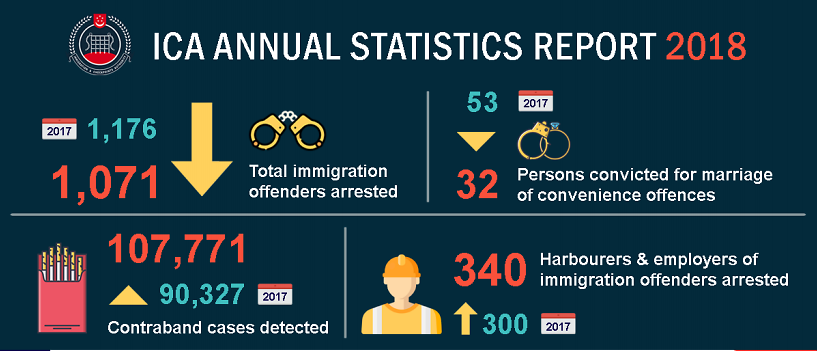
The number of cases spiked by 19 per cent from 90,327 in 2017 to 107,771 in 2018, with an average of about 300 cases per day.
The increase in cases was mainly due to the higher number of contraband cases detected at the land checkpoints, said ICA in its annual report.
Lorry and heavy commercial vehicles such as bowsers and trailers were one of the most common modes of transport for contraband items.
“This is of concern because the sheer size of such vehicles allows large quantities of contraband items or even security-sensitive materials such as toxic industrial chemicals and explosives to be concealed within the consignments or the modified compartments of these vehicles,” said the authority.
ICA said that it has addressed these challenges by using radiographic scanners to scan cargo vehicles.
Bus scanners were also implemented at Tuas Checkpoint last year, it added.
“These scanners are able to screen huge buses and cargo vehicles, allowing us to identify secret compartments and contraband items more effectively and quickly,” said ICA.
The Malaysia-registered prime mover used to smuggle the duty-unpaid cigarettes. (Photo: Immigration and Checkpoints Authority)
The report highlighted a case on May 18 last year when anomalies were detected from scanned images of a Malaysia-registered prime mover.
During further checks of its consignment, ICA officers found 6,000 cartons of duty-unpaid cigarettes which were concealed among printer parts and roller scanners.
MORE HARBOURERS, EMPLOYERS OF IMMIGRATION OFFENDERS ARRESTED
The number of harbourers and employers of immigration offenders (IO) arrested last year also increased by about 13 per cent to 340 compared to 300 in 2017, said ICA.
The harbourers and employers arrested were primarily Singaporeans or Permanent Residents above the age of 50.
“They had mostly failed to conduct the necessary checks on the foreigners’ immigration statuses, in their bid to earn rental income,” said ICA.
“IOs who are undocumented present a security risk and may resort to crimes to sustain their livelihood.”
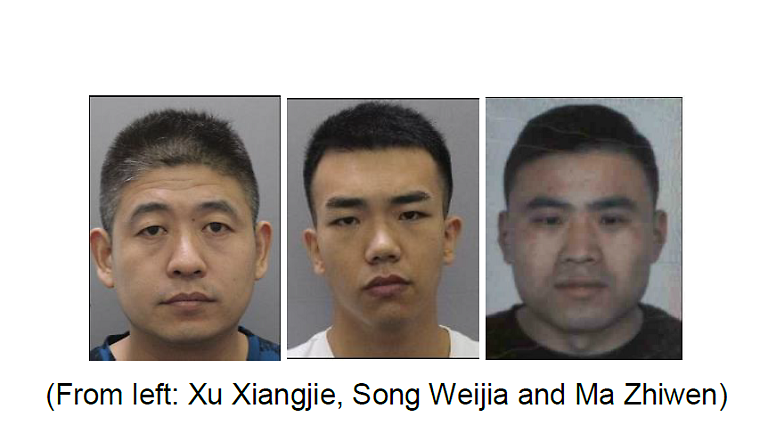
The report noted a case last year where two male Chinese nationals, Xu Xiangjie and Song Weijia, aged 35 and 23 years old, were jailed for six months’ each for harbouring two immigration offenders.
Another male Chinese national, 32-year-old Ma Zhiwen, was also found culpable of providing shelters to the offenders and signing the tenancy agreement for the housing unit. He was also jailed for six months.
Separately, the number of immigration offenders arrested dropped in 2018 by about 8.9 per cent to 1,071 from 1,176 the previous year.
The number of arrests of both illegal immigrants and overstayers fell, the report said.
ICA attributed the dip partly to its biometric identification system that scans travellers’ fingerprints and has been progressively implemented across all checkpoints since 2016.
“This measure has denied and further deterred such persons from entering Singapore,” the authority said.
ICA said it has also maintained its inland enforcement efforts and keep the situation under control. Its officers conducted an average of more than 100 raids per month in 2017 and 2018.
LESS SHAM MARRIAGES
Fewer people were convicted for entering into sham marriages last year, added the report.
In 2018, there was a 40 per cent decrease with 32 people convicted for marriage of convenience-related offences from 53 people in the previous year, said ICA.
HANOI: US President Donald Trump and North Korean leader Kim Jong Un begin their second summit in less than a year in the Vietnamese capital on Wednesday (Feb 27), with the US side seeking tangible steps by North Korea to dismantle its nuclear weapons program.
The White House said Trump would meet Kim at Hanoi’s French-colonial-era Metropole Hotel at 6.30pm (1130 GMT) and have a 20-minute one-on-one conversation before a dinner scheduled to last just over an hour and a half.
Trump flew into Hanoi on Air Force One late on Tuesday.
“Just arrived in Vietnam,” he wrote in a Twitter post. “Thank you to all of the people for the great reception in Hanoi. Tremendous crowds, and so much love!”
Kim arrived by train early in the day after a three-day, 3,000-km (1,850-mile) trip from his capital, Pyongyang, through China. He completed the last stretch from a border station to Hanoi by car.
The two leaders, who seemed to strike up a surprisingly warm relationship at their first summit in Singapore last June, will be accompanied at dinner by two aides and interpreters, the White House said, before they meet again on Thursday.
Their talks come eight months after the historic summit in Singapore, the first between a sitting US president and a North Korean leader.
While much of that first meeting was about breaking the ice after decades of bitter animosity between their two countries, this time there will be pressure to move beyond a vaguely worded commitment by Kim to work toward the complete denuclearisation of the Korean peninsula.
A worker installs the national flags of North Korea, Vietnam, and US for the upcoming North Korea-US summit in front of the Metropole hotel in Hanoi on Feb 25, 2019. (Photo: Reuters/Kim Kyung-Hoon)
Trump’s critics at home have warned him against cutting a deal that would do little to curb North Korea’s nuclear ambitions, urging specific, verifiable North Korean action to abandon the nuclear weapons that threaten the United States.
In return, Kim would expect significant US concessions such as relief from punishing sanctions and a declaration that the 1950-53 Korean War is at last formally over.
Trump, landing in darkness, waved as he disembarked Air Force One and was met by senior Vietnamese and US officials. His motorcade passed crowds waving the flags of Vietnam, the United States and North Korea on its way to the JW Marriott Hotel, his accommodation for the two-day summit.
Earlier, Vietnamese officials greeted Kim at the station in Dong Dang town after he crossed the border from China by train. He got a red-carpet welcome with honour guard, military band and fluttering North Korean and Vietnamese flags.
Kim was accompanied by his sister, Kim Yo Jong, an important aide.
About a dozen bodyguards briefly ran alongside his limousine as he began the two-hour journey to Hanoi. Roads were closed with security forces in armoured personnel carriers guarding the route to the Melia hotel, where Kim is staying.
A worker installs a sign for the upcoming North Korea-U.S. summit in front of the Metropole hotel in Hanoi, Vietnam, February 25, 2019. REUTERS/Kim Kyung-Hoon
North Korean officials engaged in working-level talks for the summit briefed Kim after he arrived, the North’s state news agency, KCNA, said on Wednesday.
At the Melia hotel, Kim “heard concrete details on the pattern of engagement between working-level delegations,” KCNA said, referring to the North by its official name, the Democratic People’s Republic of Korea.
Visiting the North Korean embassy in Vietnam, Kim urged staff there to strengthen two-way ties in line with the needs of the times, KCNA added.
Kim “will reunite with US President Donald J. Trump from Feb 27 to 28 and conduct the historic second DPRK-US summit,” before embarking on a goodwill visit to Vietnam on Mar 1 and 2, the agency said.
US Secretary of State Mike Pompeo also arrived on Tuesday and met Vietnamese Foreign Minister Pham Binh Minh for talks.
‘TREMENDOUS’
Trump said before leaving Washington it would be “a very tremendous summit” and stressed the benefits to North Korea if it gave up its nuclear weapons.
“With complete denuclearisation, North Korea will rapidly become an economic powerhouse,” he said. “Without it, just more of the same. Chairman Kim will make a wise decision!”
In a speech on Sunday, however, Trump appeared to play down the possibility of a major breakthrough, saying he would be happy as long as North Korea maintained its pause on weapons testing.
Vietnamese soldiers use a metal detector around the Metropole hotel ahead of the North Korea-U.S. summit in Hanoi, Vietnam, February 24, 2019. REUTERS/Jorge Silva
“I’m not in a rush,” he said. “I just don’t want testing. As long as there’s no testing, we’re happy.”
North Korea has not held a nuclear or missile test since 2017, but analysts say the two leaders have to move beyond summit symbolism.
“The most basic, yet urgent, task is to come to a shared understanding of what denuclearisation would entail,” said Gi-Wook Shin, director of Stanford’s Asia-Pacific Research Centre.
“The ambiguity and obscurity of the term ‘denuclearisation’ only exacerbates the scepticism about both the US and North Korean commitments to denuclearisation.”
While the United States is demanding North Korea give up all of its nuclear and missile programs, the North wants to see the removal of a US nuclear umbrella for South Korea.
Trump’s departure from Washington comes at a time of increased pressure at home, and he is keen to show progress on a foreign policy issue that has confounded multiple predecessors.
Some analysts fear that may lead him to pull his punches.
“The main concern is whether the president, besieged by domestic distractions, will give away too much, and take a bad deal that leaves the United States less secure,” said Victor Cha, a former White House official who took part in North Korea talks under previous Republican administrations.
While Trump is in Hanoi, his former personal lawyer Michael Cohen is testifying before US congressional committees, with the president’s business practices the main focus.
Anticipation has also been rising about the impending release of Special Counsel Robert Mueller’s report on Russian interference in the 2016 US election, though a senior US Justice Department official said on Friday it would not come this week.
A South Korean presidential spokesman told reporters in Seoul the two sides might be able to agree to a formal end of the Korean War, a move long sought by North Korea, as the war concluded with an armistice, rather than a peace treaty.
SINGAPORE: How can entrepreneurs find funding to build and grow their businesses?
Often, they start companies by bootstrapping – meaning they fund their initial operational cost out of their own pocket – but that often isn’t enough as operations grow more complex and start-up costs balloon before revenue streams in.
External sources can offer a much larger capital base for entrepreneurs anticipating the need for bigger pots of funding, as their businesses scale up.
Apart from seeking out investments from family and friends, entrepreneurs can tap on an array of grants set up to assist companies adopt new technologies, build capabilities and grow, which make up part of the Government’s efforts to increase the productivity and competitiveness of local businesses.
Entrepreneurs may also seek out bank loans as another source of funding. Banks, including DBS and OCBC, offer business loans but the loan tenor can be short, hovering around four to five years, and the interest rates high (one reaching almost 11 per cent per annum) depending on your credit rating.
Many small and medium-sized enterprises fund operations through such loans – almost 9 in 10 in a 2017 survey released by Spring Singapore.
Social enterprises may have more recourse, as banks such as DBS have special programmes that offer them unsecured business loans at a preferential rate.
But there are strong reasons for ambitious entrepreneurs looking to expand their businesses rapidly to consider adopting a different mode of funding: Equity investments.
In the most recent Budget 2019 announcements by Finance Minister Heng Swee Keat, Mr Heng made an interesting announcement of a top-up of S$100 million for investments in SMEs under its SME Co-Investment Fund III, in addition to S$400 million set aside since 2010.
The CIP had been set up to catalyse patient growth capital for Singapore-based enterprises through co-investment with the private sector. The Government, as co-investor, relies on the private sector to assess investments, and seed capital could be matched on a 1:1 basis.
Why is this announcement interesting? Because it further emphasises the growing salience of the use of equity investment as a public policy tool to spur growth in local businesses, beyond a pure grant model.
Finance Minister Heng Swee Keat delivering the Budget 2019 statement.
EQUITY INVESTMENTS ARE EARLY LITMUS TESTS
I often encourage aspiring entrepreneurs and my students at NUS Enterprise to seek additional funding from institutional investors – whether venture capital firms after a company has had proof of value or angel investors at an earlier stage as the company continues to develop its business model – and not to rely solely on grants and business plan competition prizes.
I know a few entrepreneurs who have gone from one business plan competition to another and one grant proposal to another, thinking this strategy to be an easy way in getting “free” money without giving up equity.
However, filling out grant reports and going through business plan competitions are time-consuming. Each grant comes with required administrative reporting that grantees must fulfill, first to quality and then to receive subsequent tranches of funding.
The amount granted is usually small, as the subsidies are tied to the proportion of costs incurred by the company in fulfilling the conditions of the grant, whether to adopt new technologies, carry out research and development, or invest in human capital.
Similarly, each business plan competition also requires startups to fill out long application forms and present their business ideas to judges, who are often under strict guidelines from their respective donors, to conform to a grant mandate.
In contrast, bringing on board equity funding helps businesses enlist a whole host of other resources to scale up. Where the goal of most equity investors is to see returns on their investments, companies they back can look forward to a huge amassing of resources to do just that.
Selecting and partnering with the right equity investors will provide the support that entrepreneurs often lack as they are often first-time entrepreneurs.
The right investors offer a lot more than just money. They bring in connections, networks, and expertise in exchange for some control and voting rights over key business decisions.
They often take a Board of Directors seat, providing supervision and guidance over the management team. Investors also often push start-ups to grow by acquiring other start-ups.
ShopBack, a start-up providing cashback reward for online shopping – has a team of 150, over 5 million monthly users across desktop and mobile across seven markets in the Asia Pacific including Malaysia, Thailand and Australia.
(Photo: ShopBack)
It has raised a total of US$40 million (S$54 million) equity financing from investors like SoftBank Ventures Korea and the Mizuho Financial Group.
That kind of financing has allowed ShopBack to make a strategic acquisition of Seedly, a personal finance and expense tracker, giving it better insights into the millennial demographic. Both companies are barely five years old.
Raising funds from respectable investors with a long track record of success also accords the start-up a better brand positioning for attracting top talent and potentially additional funding.
The venture capital world pays close attention to which start-ups get investments from the who’s who of the investment world – especially Softbank, Sequoia, Monk’s Hill Ventures, Gobi Partners and East Ventures, just to name a few. Other companies would also be more open to partnering start-ups backed by these players.
LOSING CONTROL OF YOUR COMPANY?
Issuing equity does not necessarily mean you lose control of your company, so long as you do your due diligence in knocking out a reasonable term sheet and guard against partnering predatory investors.
Still, grants have their merit. They can be useful to kickstart your venture, bringing your business from an idea to prototype stage.
Big institutional investors, which include mutual funds and investment banks, often refrain from investing during the ideation stage given the risks. This is why some educational institutions, government bodies, or foundations offer small grants for aspiring entrepreneurs – helping them build a prototype, and make it investment ready.
Take Carousell for example – it was founded by three National University of Singapore (NUS) Overseas College alumni. The founders received two grants from NUS Enterprise in their early days to pursue their idea.
The co-founders of mobile classifieds marketplace Carousell. (Photo: Carousell)
But after being incubated further at Block71, Carousell raised its first substantial seed funding of S$1 million from Rakuten in 2013. Subsequently, the start-up raised S$7.8 million in Series A funding from other larger investors including Sequoia, Golden Gate Ventures, and 500 Startups.
I applaud the Government’s initiative of topping up the Co-Investment Programme to encourage private sector investments to share business risks with the Singapore Government, and hope this rallies the private sector and venture capital community to spur more growth in Singapore start-ups.
Ultimately, how much success these schemes will enjoy depend largely on how skillful private investors are in evaluating and assessing investment worthiness of a business venture.
The Government can provide funding to give the needed jolt to a sector, but at the end of the day, it takes effort from both the entrepreneur and private investors to pull off a successful venture. In the long run, once the Government feels comfortable with the uptake from the private sector, it would most likely reallocate its limited resources to other under-served sectors.
That’s the essence of a public-private-partnership that can raise the game of local entrepreneurs, if only they shift towards such funding support to grow their businesses beyond the prototype stage.
Jonathan Chang is the Executive Director at the National University of Singapore (NUS) Enterprise and oversees units including the NUS Entrepreneurship Centre, NUS Overseas College, Lean LaunchPad Singapore and Social Venture Lab.
SINGAPORE: It has been said that cybersecurity is like an arms race, with both sides constantly evolving their weapons and defences.
On one side are the keepers of data and information, and on the other are the cyber criminals who want to steal and profit from that information.
WHAT’S THE COST?
In one of the largest data heists in history, it came to light in November that the data of 500 million customers of the Marriott hotel group had been stolen. Earlier last year, cyber criminals took the records of some 145 million customers of credit-reporting agency Equifax.
In Singapore, the information of 1.5 million healthcare patients, including those of the Prime Minister, were stolen. Separately, the records of 14,200 HIV-positive people in Singapore were also leaked online.
In Bangladesh, rogue hackers in 2016 robbed the country’s central bank of US$100 million, with some of the money later traced to Sri Lanka and the Philippines.
These cases are not isolated. Cyber crimes cost businesses close to US$600 billion per year, or 0.8 per cent of global GDP, according to a study. This is up from an estimate in 2014 that put global losses at about US$445 billion.
While it could be argued that cybercrime affects “only” 0.8 per cent of the world’s wealth, that is 0.8 per cent too many. You’d be mad to think it’s okay to hand over US$600 billion to hackers every year.
On top of suffering from the economic costs, businesses preyed by cybercrime would also have to deal with the impact on their reputation, the loss of productivity, potential fines by regulators, and perhaps the most crucial – the loss of trust from their customers.
Mikhy Farrera Brochez at the Clark County District Court in Winchester, Kentucky on Feb 18, 2019. (Photo: Chris Kenning)
From what we have observed, our digital information can be grouped into different types. First is our identity, or our record of who we are. Second is our transaction histories, which, with artificial intelligence (AI), could predict when we will next watch a movie or buy a car. Third, and more specific to banks, are our assets – our money.
All these are now in the digital realm, which criminals are only too happy to hack.
As online transactions become more popular, we could assume that online fraud would increase as well.
This raises some questions. How can companies regain the trust of customers if their data has been stolen? Can we reverse or at least slow the growth of cybercrime?
HOW WE’RE MISTAKEN
The trouble is, there are some stubborn misconceptions about cybersecurity.
Until today, one of the most popular but mistaken beliefs we’re hearing from ordinary consumers is that “Cybersecurity is not my problem”, or “Cybersecurity is someone else’s responsibility”, passing the blame – sometimes, rightly so – to banks, credit card companies, online stores, or other companies which allow online transactions.
Among corporations, I am still hearing top executives say
Cybersecurity is handled by the IT department.
These misconceptions form just one aspect of this scourge of being vulnerable to cyber breaches, and they are the biggest hurdle.
But even if consumers and corporate leaders get past that mental hurdle – what’s next? Next is having to contend with so-called legacy or ageing platforms. These are the hardware and software which host applications and services.
Upgrading these core platforms can cost money, is time-consuming, and could mean downtime of services and millions in lost revenue while systems are being upgraded. That is why you would hear groans from heads of businesses when their heads of IT departments present their upgrading plans and the costs involved.
A person using a laptop. (File photo: AFP)
Sadly, many companies are jolted into action only because of two things – either a country’s regulators introduce new guidelines and requirements, or a company falls victim to a catastrophic breach and therefore gears up to recovery mode.
It is also unsurprising that during these times of crises and breaches, some organisations or even governments resort to the knee-jerk reaction of disallowing their staff from accessing the public Internet.
Indeed, we should not wait for catastrophes to happen before preparing ourselves.
At the basic level, consumers, company executives, third-party providers and regulators need to agree that cyber security is everyone’s business. We’re all in this together.
Consumers need to keep their accounts secure by following basic rules, including creating difficult passwords, not giving them away, changing passwords often, using two-step verification processes, and logging out of accounts or computers not in use. That sounds easy, but worryingly, a survey has shown that 35 per cent of Americans do not change their passwords.
Companies have far more complex duties – a combination of policies and practices. These include backing up data, setting up firewalls, securing office computers and devices, managing admin passwords, using spam filters to reduce phishing emails, educating employees, and having IT security and risk-management policies in place.
Educating staff about data security is highly important. Studies have shown that around half of data losses arise from actions by a company’s own employees.
But, even more worryingly, a study sponsored by IBM Resilient, showed 77 per cent of companies surveyed globally do not have a consistent cybersecurity response plan.
File photo of a person typing on a keyboard. (Photo: Reuters/Kacper Pempel)
DON’T LET THE BAD GUYS WIN
By any measure, we still have a lot to do and cannot let the hackers win.
To beat cyber criminals, the IT industry has been hiring so-called ethical hackers, whose job is to discover security vulnerabilities in the computer systems of companies and organisations.
Regulators also have the duty to issue directives to compel companies and organisations to protect their systems from cyberattacks, including viruses, worms, denial of service attacks, ransomware and malware.
Early indications show that the European Union’s General Data Protection Regulation (GDPR), sometimes called the “granddaddy” of data regulations and in force since May last year, has some level of success in shifting more power over personal data back to the consumer.
This answers our first question above. Customers would trust companies that adhere to duty of care over data, with the help of best practices in cybersecurity.
Consumers need to know clearly what information is needed from them, and how this will be used. Companies, on the other hand, would have to collect only data relevant to the business.
In case of a data breach, customers want companies to explain what happened and what they are doing to solve the issue. If a company makes a mistake, consumers want to hear an apology and see some action, or even compensation.
Facebook admitted to the data breach in a blog post. (REUTERS/Robert Galbraith/File Photo)
THE ‘OPEN’ APPROACH
Of course, there needs to be some financial investment in removing obsolete IT systems and replacing them with robust ones.
To any doubtful business executive, we ask this: How would you weigh that IT investment against the cost of a security breach? How does it compare with the cost to regain your reputation and the trust of your customers, who are the lifeblood of your company?
For many years, experts have also said that open-source software like Linux is more secure than proprietary software. Why is that? It’s because the open-source community of developers, in which Red Hat is a strong contributor, can discover software vulnerabilities more quickly as codes are shared openly and vetted more thoroughly by the community.
Vulnerabilities in proprietary software, on the other hand, are not discovered as quickly because proprietary software codes are developed in-house with less transparency.
Based on my experience in helping customers, I have seen how the open-source way of development can also be a strategy template in solving cybersecurity problems. This involves openness and sharing between all involved.
There have been calls for companies to be more open about getting support from “white” or ethical hackers, and we have seen cybersecurity firms forming their alliances to deter attackers. But these measures are not enough.
It is also not enough to jail cyber criminals and create software patches every time a new virus is unleashed. Perhaps it is high time to change tack, to be more proactive, and use a far more collaborative, “open” approach, where consumer groups, industry bodies, regulators, think tanks and experts come together, share views and technical knowledge, and draw up longer-term strategies to combat cybercrime.
Fostering this openness could also make us quicker in responding to crises, and could give us access to resources and talent within this unified community
This is something which hackers do not have, for they cannot work in the open. To answer our second question above, this open approach could stem the tide of breaches in cybersecurity.
Dirk-Peter van Leeuwen is the Senior Vice-President & General Manager of Red Hat Asia Pacific.