TradeTrust is a new initiative aimed at allowing for the exchange of digital trade documentation both locally and globally, and maritime trade is the first industry being targeted.
A general view of ships docked at Tanjong Pagar container port in Singapore. (File photo: AFP/Roslan Rahman)
(Updated: )
Bookmark
SINGAPORE: A slew of initiatives are being planned to further drive businesses in Singapore to go digital, including introducing digital documentation in previously paper-driven transactions and increasing the funding for research and development (R&D) in services and digital economy (SDE).
These were revealed by Minister for Communications and Information S Iswaran during his ministry’s Committee of Supply debate in Parliament on Monday (Mar 4).
One of the key projects this year is to develop an interoperability framework known as TradeTrust, to facilitate the exchange of digital trade documentation, according to MCI’s factsheet. This would involve working with various agencies and industry partners, both local and international.
“This framework aims to reduce inefficiencies and complexities of cross-border trade arising from the current usage of paper-based documentation, such as bills of lading,” it explained.
“This lowers operating costs for businesses and the risk of fraud while accelerating the digitalisation of cross-border trade processes, thereby facilitating more efficient trade.”
PAPERLESS MARITIME INDUSTRY
The first to potentially benefit from this is the maritime industry.
The Info-communications Media Development Authority (IMDA) will partner the Maritime Port Authority (MPA) to lead TradeTrust development for electronic Bills of Lading (eBLs). They will be supported by Singapore Customs and Singapore Shipping Association, the ministry said, adding the four parties signed a memorandum of understanding (MOU) to affirm their support.
They will focus on developing the infrastructure for the exchange of such digital documents and conduct technical trials to demonstrate the interoperability of eBLs across different ecosystems, it said.
IMDA will organise industry consultation workgroups with stakeholders from the maritime trade, logistics and finance sectors, before issuing a Request for Proposal to the industry to submit proposals on how to implement the TradeTrust infrastructure.
This is not the first initiative MCI has introduced to try and eliminate paper from business transactions. During the committee of supply debates last year, it announced a plan to develop a common electronic invoicing (e-invoicing) framework and modelled it after the Pan-European Public Procurement On-Line (PEPPOL) standard.
This was activated in January this year and interested companies can get on board via 11 local access point providers.
INCREASE IN SDE FUNDING
Mr Iswaran also pointed out that the budget for SDE will be almost doubled to further Singapore’s innovation and to help it remain competitive globally. A total of S$360 million was originally committed to this segment under the Research, Innovation and Enterprise (RIE) 2020 plan.
Efforts in this domain have contributed to the growth in areas such as artificial intelligence, cybersecurity and data science, the Ministry of Communications and Information said in its factsheet.
As such, the SDE budget will be increased by an additional S$300 million to further boost the country’s Smart Nation and digital economy aspirations in the mid- to long-term. This is part of the next phase of the RIE 2020 plan, which will be announced at a later date, the ministry added.
OTHER INITIATIVES IN THE WORKS:
Expanding industry digital plans to more sectors. As mentioned by Finance Minister Heng Swee Keat in his Budget speech, the industry digital plan will be expanded to three more sectors: Accountancy, sea transport and construction. Smaller companies can also sign up for more cost-effective, pre-approved solutions under the SMEs Go Digital programme and these will be extended to include those in cloud computing, AI and cybersecurity.
Ushering 5G tech to Singapore. The next-generation mobile network is currently being tested by the three incumbent telcos here, and regulator IMDA has waived spectrum fees for such trials until the end of the year. MCI said the next stage is to test out enterprise use cases and launch a public consultation in “early 2019” on issues like spectrum allocation, with the aim of commencing 5G rollout next year.
Similarly, the Electronic Transactions Act is also being looked over to facilitate digitalisation of transactions (see: TradeTrust) and make e-commerce easier for consumers, and a public consultation is slated for the first half of this year.
SINGAPORE: Local map tech provider GPS Lands occupies an office space in a quiet, unassuming industrial nook at Jalan Pemimpin.
Yet its humble home conceals its burgeoning ambitions. It is looking to offer makers of autonomous vehicles high definition maps which are more accurate than those from the industry bigwigs, according to founder Gerry Ong.
“Our technology can serve as a fundamental base to support key Smart Nation projects developing high-definition maps used specifically for autonomous vehicles,” he said during a recent interview with Channel NewsAsia.
“We are also working on maps with centimetre-level accuracy that can refresh at a much shorter interval than any other available sources today, and with the aim of doing so in real time. This will be vital for safety when deploying self-driving cars.”
This level of accuracy is higher than that seen in maps by other map developers like Google and Here Technologies, he added.
GPS Lands hires predominantly Singaporeans as founder Gerry Ong aims to raise the competency levels of those in the high-definition map-making field. (Photo: Gerry Ong)
It became apparent over the course of an hour-long conversation that this was not the idle boast of another aspiring start-up looking to make its mark in the competitive tech sector.
EARLY DAYS’ HURDLES
GPS Lands has its roots in the more traditional industry of land surveying.
Founder Gerry is a registered surveyor with years of experience both at a conventional land surveying and engineering services company as well as a tech provider offering hardware and software to the building, engineering and construction sectors.
In 1999, he decided to strike out on his own, pioneering the use of global positioning system (GPS) in Singapore and developing modern, satellite-based methods of mapping which are less labour-intensive and time-consuming than more traditional methods like land surveying. But convincing both private and public sector organisations to give the technology a try was a hard slog, Gerry recounted.
He cited several reasons: The high costs of the GPS technology (“a pair of the GPS unit costs about S$100,000, about 10 times that of more traditional tools”), mistrust over the “new kid on the block” and the lack of understanding of the benefits that can be reaped from these modern tools and technology among his prospective clients.
“In those days, we were just going around doing lots of education roadshows with government agencies and companies,” Gerry said.
Besides struggling to convince people to get on board the new GPS-based technology, the 49-year-old had other pressures to face: He had borrowed a “six-figure sum” from friends and family to start the business.
“I also just welcomed my second child to the family when the business started, and my first was just two,” Gerry said. “It was a challenging time.”
TURNING POINT
But GPS Lands stuck to its guns, firm in the belief that the technology it has invested in was the way to go.
That validation or “turning point” came in 2002, Gerry recalled.
This had to do with the piecemeal nature of Singapore maps then; these maps were put together using data collected via traditional land surveying methods and were inaccurate. This resulted in maps of adjacent areas not lining up, which could in turn result in poorly planned or built buildings, he said.
Gerry said GPS technology removes this inaccuracy as data for the maps are collected digitally allowing for more precise maps to be drawn.
In 2005, GPS Lands got another break when it won a government tender to build Singapore’s first islandwide positioning infrastructure, known today as the Singapore Satellite Positioning Reference Network (SiReNT), Gerry said.
This global navigation satellite system (GNSS) reference network is “used for the purpose of high precision and accuracy positioning, navigation and monitoring”, and supports various satellite tracking systems like US’ GPS, Europe’s Galileo and China’s Beidou, according to SLA’s website.
One of the nine global navigation satellite system reference stations part of the Singapore Satellite Positioning Reference Network (SiReNT). (Photo: Gerry Ong)
“This project announced to the world that GPS Lands is no longer just a hardware company but a systems integrator (SI) too,” the founder said.
Today, GPS Lands continues to provide the technology and maintenance for SiReNT, said Gerry. This puts the company in a good position to play a greater role in Singapore’s Smart Nation ambitions, especially in developing mapping-related applications and services, given that it has such intimate know-how and expertise of the underlying infrastructure, he explained.
But just as Gerry was getting comfortable with the company’s relative success, a conversation with a friend jolted him out of his complacency.
He recalled being asked: “If someone threw a lot of money and manpower into replicating what you have, will they succeed?”
As much as Gerry hated to admit it, he knew that anyone with the resources could replicate what GPS Lands could do. “This realisation forced me to look at how to better innovate and position my company,” he said.
He decided that front-end applications of its technology, such as high-definition maps for AVs and drone delivery systems, would be the growth engines for the business. Ride-hailing platform operators like Grab and Go-Jek, for example, would need such maps if they hope to turn their ambition of deploying self-driving vehicles on the roads – and safely – into a reality.
This is also why these companies, as well as traditional car-makers, are actively building up internal capabilities or acquiring mapmakers. Audi, BMW and Daimler-Benz, for example, had spent US$2.7 billion to buy Here from Nokia in 2015, before Intel and Bosch made further investments in the company.
Alphabet, too, has been reported to have a two-pronged approach to developing maps: A team inside Google is working on a 3D-mapping project it may license to car-makers, while its AV unit Waymo is separately developing high-definition maps for its own use, a 2018 report by Fortune said.
To position GPS Lands to ride this wave, Gerry shared that the company invested a “seven-digit figure” to acquire light detection and ranging (LiDAR) and imaging systems as well as send four of its employees to Europe to train with the manufacturer.
It is also building up its artificial intelligence and machine learning capabilities internally, he shared.
“We want to do our bit to raise local core competency in this 3D mapping industry,” Gerry explained.
The work it is doing has not gone unnoticed. Last March, then-Minister for Communications and Information Yaacob Ibrahim visited the company to find out how it contributed to the Virtual Singapore project.
Virtual Singapore is envisioned to be a dynamic 3D city model and collaborative platform for use by the public, private, people and research sectors in areas such as urban planning and research and development.
It could be a few more years before we know whether Gerry’s bet will pay off, but for now, it looks like the local mapping company is poised to navigate its way to international prominence.
SINGAPORE: Most scientists will agree that smoking is addictive, causes all sorts of health issues, and can kill. But when it comes to vaping there is no consensus.
Vapes, also known as e-cigarettes, are electronic devices that heat up a vapour solution (“e-liquid”) and send it into the lungs much like a regular cigarette. Some look like regular cigarettes while others look more like fancy pens, flash drives or high-end tech gadgets.
Sales of imitation tobacco products, including e-cigarettes, have been banned in Singapore since 1993. In February 2018, Singapore also made it illegal to buy, use or possess these.
NOT SAFE AND ADDICTIVE
In general, e-liquids contain far less chemicals than tobacco, but the long-term health impact of most these chemicals is unknown.
Some studies suggest vaping is almost as dangerous as smoking, while others suggest it is near harmless. Some studies say vaping among youth is a gateway to smoking, while others say it is not. Some studies suggest e-cigarettes help people quit smoking, while others suggest they actually prevent people from quitting.
The harms of e-cigarettes are difficult to assess, partly because there is so much variation between different e-cigarettes and the e-liquids they contain. As these products are also newly developed, we cannot make fair conclusions about their long-term health impact. This is a challenge because most diseases linked to smoking have a late onset, some 40 over years after the person starts smoking.
But based on the body of research, it seems fair to assume meanwhile that e-cigarettes containing nicotine are addictive, much like regular cigarettes. We can also assume that vaping is not safe, but safer than smoking. But to say something is “safer than smoking” does not say much, since the odds of dying from a smoking-related disease are more than one in two.
Scientists are still unsure about the potential harms of ‘vaping’ as an alternative to traditional cigarettes, though most seem convinced it is at least safer than tobacco (Photo: AFP/JUSTIN SULLIVAN)
Due to the addictiveness and unknown health risk of e-cigarettes, a sensible policy should, at the minimum, prevent youths from using them.
But teen e-cigarette use has proliferated in some places. In the United States, 3.6 million teens are now using e-cigarettes, up from 2.1 million a year ago.
Some e-cigarette companies have been quick to make their products and brands as appealing as possible to the tech-savvy, fun-loving younger generation.
Juul, the most popular e-cigarette brand in the United States, is sold in a sleek, colourful device which resembles a flash drive and comes in flavours such as mint, mango, and creme brulee. Research studies have shown that flavours of vapour solutions are especially appealing to young people.
Juul also use brightly coloured ad campaigns that feature attractive young models and associate the brand with having fun, freedom, relationships, and sex appeal.
NEW PRODUCT, SAME INDUSTRY
Tobacco companies, which own most of the e-cigarette market, have a well-documented history of preying on youth.
For decades before the 21st century, smoking used to be ubiquitous on the big screen. Even after countries started banning cigarette advertising on radio and television, tobacco companies found other ways to glamourise smoking – by putting them in movies.
Ever wonder why James Bond smokes so much? Or why he chose Larks in License to Kill? Larks paid the filmmakers US$350,000 (S$474,000). But tobacco companies also placed their products in movies such as Who Framed Roger Rabbit and The Muppet Movie.
Leaked internal industry documents from the 1970s reveal that tobacco companies intentionally target youths as they are more vulnerable to addiction, and more impressionable. A 1973 tobacco industry report notes:
The fragile, developing self-image of the young person needs all of the support and enhancement it can get … this self-image enhancement effect has traditionally been a strong promotional theme for cigarette brands.
And it is still a strong promotional theme for cigarettes today.
TARGETING YOUTHS
In 2011, Marlboro launched a “Be Marlboro” campaign, which ran across more than 60 countries. It featured images of rebellious, fun-loving youth – one advertisement even feature a young leather-clad couple kissing in a dark street, with the tagline “maybe never fell in love” right next to a pack of Marlboro cigarettes.
More recently, tobacco companies are turning their attention to social media. A recent investigation by the Campaign for Tobacco-Free Kids found that tobacco companies pay influencers to promote cigarettes, with specific instructions on which brands to promote, when to post the content for maximum exposure, and how to avoid making the photos look staged.
The report which investigated more than 100 social media campaigns found big Tobacco companies, such British American Tobacco and Philip Morris International/Altria, to be behind several high-profile influencer marketing campaigns.
The latter rolled out a campaign in Indonesia for their brand Marlboro which has been viewed more than 47 million times online.
Indonesian youth smoke clove cigarettes in Jakarta on April 7, 2012. (Photo: AFP/Oscar Siagian)
But due to the borderless nature of social media, youth all over the world were exposed to this advertising. Singapore NMP Professor Lim Sun Sun, in her recent commentary, warned that in Singapore, too, there is nothing to stop young people from being exposed to these adverts
E-cigarettes are also aggressively promoted on social media. Juul, for its launch in 2015, spent over US$1 million on internet marketing.
Their products were promoted on Twitter, Instagram and YouTube, and social media influencers were recruited to promote it to their followers. This had quite an impact on teen experimentation with Juul.
The number of Juul-related tweets per month shot up from 765 in 2015 to over 30,500 in 2017, and by 2017, Juul had captured most of the e-cigarette market in the US.
STILL DANGEROUS
The advertising platforms are changing, but the industry’s target remains the same. The gadgets are evolving, but the nicotine remains the same.
Whether they vape or smoke, the tobacco industry’s goal is simple: To create loyal customers. And to do that, they must hook the younger generations onto nicotine.
Debates on e-cigarettes often focus on the potential harms or benefits of vaping versus smoking. But perhaps it’s the industry’s preying on youth we should be more worried about.
Dr Yvette van der Eijk is Senior Research Fellow at the Saw Swee Hock School of Public Health, National University of Singapore, and Dr Jeong Kyu Lee is Assistant Professor at the same school.
SINGAPORE: Fred Cheong, 55, has done a lot more than the average person across two starkly different lives.
The Special Forces commando graduated from the excruciating US Navy SEAL course, stormed a hijacked Singapore Airlines plane, and moulded multiple batches of officer cadets into soldiers.
After leaving the Singapore Armed Forces (SAF), Cheong became a Buddhist monk. Since then he has lived simply in a monastery, meditated on snow-capped mountains deep in the Himalayas, and led dharma retreats all over the world.
This is why Cheong prefers to be known as the Venerable Tenzin Drachom, a name given by the Dalai Lama and an acknowledgment of his 32-year military career.
“In Tibetan ‘dra’ means delusion, ‘chom’ means destroyer,” he told Channel NewsAsia at his temple-like maisonette in Pasir Ris. “In the military, I destroyed the enemy outside. Now I destroy the enemy inside.”
But as a young, scrawny boy, Drachom never had ambitions of joining the military. Or any strong ambitions, for that matter. “I was not very strong, I couldn’t even swim,” he said. “Maybe I was thinking I wanted to be an air steward.”
In December 1982, the 18-year-old enlisted for National Service and eventually signed on as an officer cadet, after seeing his bunkmates do the same. “Might as well,” he mused. “I thought (joining) the military could not be wrong.”
HIJACK OF SQ117
Mar 26, 1991 was a day the military could not afford to get wrong.
Singapore Airlines flight SQ117 bound for Singapore was hijacked by four male Pakistani passengers shortly after it took off from Kuala Lumpur.
The plane, carrying 114 passengers and 11 crew, landed at Changi Airport at about 10.30pm. The hijackers, armed with knives, lighters and what looked like explosives, assaulted the pilot, attendants and passengers. Two stewards were pushed off the plane.
The hijackers, who wanted the plane refuelled and flown to Sydney, made their demands: To speak to former Pakistan Prime Minister Benazir Bhutto and have the authorities release a number of people jailed in Pakistan.
After negotiations spilled into the wee hours of the next morning, the hijackers lost patience and threatened to start killing if their demands were not met.
SQ117 sits on the tarmac after the rescue operation.
It was then that authorities gave the signal: Special Operations Force (SOF) commandos were ordered to storm the plane and rescue the hostages. Drachom, by then a seasoned SOF trooper, was part of the team.
“When the time came, it was ‘just do it’,” he said. “There was no mental thought of will I go, will I not go or I’ll call my girlfriend. No bulls***.”
From their training, the commandos knew the interior layout of various aircraft types like the back of their hands. Under the cover of darkness, they approached the Airbus A310.
The adrenaline was pumping, but Drachom treated the operation like “just another drill”.
“You’ve trained your mind to operate under duress,” he said, taking a deep breath. “It was really surgical … so we just have to be very clear, shoot very straight, and let’s do it.”
At about 6.50am the commandos stormed the plane, shouted for passengers to get down and shot all four hijackers dead. The operation lasted just 30 seconds.
The rescue operation naturally made front page news. (Photo: Facebook/National Library Singapore via Singapore Press Holdings)
The years of training prepared the commandos well, but did it also prepare them to take lives?
“We were really quite clear when we went inside there; we knew exactly what to do,” Drachom replied. “You cannot go there and start to think. We go there and do what we train for because there will be that trade-off.”
Drachom stressed that “there wasn’t any ego” from each member of the team. “You were just there to do the job,” he added. “Nothing more.”
When the commandos returned to base, Drachom said nobody there knew how the operation had unfolded.But soon enough, elite forces from around the world wanted to visit, curious about how they had executed the mission so successfully.
The SAF’s Special Operations Task Force, a counter-terrorism command, comprises members from the Special Operations Force and Naval Diving Unit. (Photo: Facebook/Modern Elite Forces)
The operation, Drachom noted, had elevated the young Army’s reputation in the eyes of the world.
“Only after the whole thing, we realised that we had rallied and pulled through together as a team,” he added. “What kept us going was a good training system; our due faith in every level that everyone will do their job.”
The details of the operation are still fresh in Drachom’s mind, although he said the team has declared the chapter “forever closed”. “We closed it because we wish that it will never happen again,” he said.
THE TRANSITION
Fast forward to 2013, and Drachom’s chapter in the military had also come to an end. He retired from the force, but knew immediately what he wanted to do next.
Having grown up in a Buddhist family, Drachom had been practising the religion since his teens. He studied at the Amitabha Buddhist Centre in Geylang and eventually became its vice-president. As a soldier, he would wake up at 4am every morning to pray before leaving for camp.
Buddhism was his “source of strength”, the force that pushed him through his demanding job.
Drachom (right) with his teacher at the Amitabha Buddhist Centre. (Photo: Tenzin Drachom)
So for Drachom, the “natural progression” was to become a monk. “The purpose of being a monk is to realise your potential, and in the process, help as many people as possible,” he said. “Make people around you happy.”
While Drachom said his Army colleagues were not surprised by his decision, they still did not expect him to go that far. “Most people know it’s correct, but they’ll never take the step,” he added.
The Dalai Lama leading ordination ceremonies for a group of Taiwanese monks at his residence in Dharamsala. (Photo: Facebook/Dalai Lama)
There was no time to waste. On Sep 27 that year, Drachom flew to Dharamsala, India to get ordained by the Dalai Lama. He shaved his head and took his vows. Drachom had traded his green fatigues for the monk’s maroon robes.
“It marked a very new beginning for me, the beginning of a spiritual life,” he said.
The rigours of monkhood, when the goal is to rid your mind of worldly distractions through constant prayer and meditation, did not bother Drachom. He had grown used to it through decades of practice.
Drachom has been a monk for about five years now. (Photo: Aqil Haziq Mahmud)
In fact, there were some parallels between being a monk and being in the military.
“Both needed great amounts of discipline,” Drachom explained. “One is awareness of the enemy and situation. The other is awareness of negative emotions that cause an unpleasant state of mind prevalent to all.”
Still, Drachom faced some challenges. In the initial months he became “very self-aware” of his dressing and behaviour.
For instance, wearing the monk’s shemdap – or skirt – came with the risk of wardrobe malfunctions. “It is the first time in your life you are wearing a skirt; it’s really different,” he said, chuckling. “No one told me that when the wind blows, you must push it down.”
Drachom’s home is filled with Buddhist ornaments, like this centuries-old stone relic. (Photo: Aqil Haziq Mahmud)
But the adjustment was quick, Drachom said, noting that monkhood soon became the “new norm”.
“There is a little transition, then you understand that it is a fantastic, very rare chance to practise, so you try,” he added. “It’s just transiting from soldier to spiritual warrior.”
SPECIAL OPERATIONS FORCE
But to understand how Drachom first became such an elite soldier, you have to go back to his career-defining moment in 1984, a few months after he was commissioned as an officer.
He was woken up by his bunkmate who told him the SOF was going to hold a selection for its first ever batch of operators. “You’ll like this,” he remembered his friend saying. “I said, why not?”
The SAF has given Drachom numerous plaques, including one from the Special Operations Force (in red). (Photo: Aqil Haziq Mahmud)
A large number applied but only 60 were invited for the actual selection. And out of that, just 32 got in, Drachom among them. “I felt really good because it was the most elite and difficult course,” he said. “Many people desired it, but not many were able to do it.”
In April 1985, after a year of training, Drachom became an operational SOF trooper. He passed open and classified military courses both locally and abroad, including Airborne, Ranger, Combat Diving and Long-Range Reconnaissance Patrol.
Drachom has amassed various memorabilia throughout his military career, which started when he was an air defence artillery officer. (Photo: Aqil Haziq Mahmud)
But Drachom’s toughest challenge yet came in the winter of 1989, when he went to the US to attempt the Navy SEAL course.
Drachom said the numerous YouTube videos on the brutal Basic Underwater Demolition/SEAL training – carrying boats on heads, lifting logs, rolling in the sand and slogging through mud – are all accurate.
Navy SEAL trainees during Hell Week, which is five-and-a-half days of continuous training on a total of four hours of sleep. (Photo: US Navy/Eric Logsdon)
When he first went diving, the instructors reminded him to breathe underwater. He dismissed the statement as rhetorical, but only understood when he slipped into the 15-degree Celsius sea. “Because it was so cold, you froze and forgot to breathe,” he added.
The sheer fatigue also meant Drachom fell asleep the moment his head hit the pillow. “Recovery become something I understood,” he stated. “You needed to do whatever you could so you could get the maximum time to rest and recover.”
Drachom’s Number 1 uniform bears the coveted US Special Warfare insignia, also known as the SEAL trident. (Photo: Aqil Haziq Mahmud)
Drachom persevered through a year of physical and mental torture with little sleep, eventually passing and receiving the coveted SEAL trident. Of the 168 trainees in his batch, only 28 passed the course.
On graduation day Drachom said he felt the sun was shining for him. He stood proudly, chest puffed out. “I felt that I wanted it very much, more than anyone else,” he said. “It was not about me, it was about the country’s pride.”
MEDITATION AND MONASTERIES
So when Drachom was told how difficult his first dharma retreat would be – monks would isolate themselves, live on minimal food and meditate for hours each time – he laughed it off.
How could sitting in a room, he joked, be more difficult than Singapore’s Ranger course, regarded as one of the toughest courses in the SAF?
The cave in the Himalayas which Drachom meditated in. (Photo: Tenzin Drachom)
Drachom took his meditations a step further, following in the footsteps of religious figures and heading to remote places considered blessed.
Two years ago, Drachom and a friend travelled to a deserted cave on a mountain in Rolwaling, located in the Himalayas. To reach the cave, they had to take a helicopter to the snow line before embarking on a one-day trek.
Drachom surrounded by snow-capped mountains. (Photo: Tenzin Drachom)
Drachom spent about three weeks meditating there. “At night it was just the moonlight, snow, cold air, freshness of mind, me, now,” he said, closing his eyes and snapping his fingers. “It’s a very amazing feeling.”
At least once a year, Drachom also heads to the Sera Jey Monastery in Mysore, South India to practise and attend lectures. This is where monks as young as 12 start on a curriculum which lasts for 25 years.
Outside the Sera Jey Monastery. (Photo: Facebook/Sera Jey Monastery)
Drachom’s routine at the monastery begins at 4am with what he calls “preliminaries”, including washing up and cleaning the premises. The day is then broken down into four sessions of meditation.
The first session is from 4.30am to 7am, followed by breakfast comprising a cup of tea or coffee, and a piece of bread with jam or butter. Then it is rest time, which can involve light reading, lighter meditation or catching up with the news.
Monks inside the Sera Jey Monastery. (Photo: Facebook/Sera Jey Monastery)
The next session runs from 9am to noon, after which is lunch, usually rice and vegetable soup with seasonal fruits like mango or papaya. If Drachom misses the taste of home, he cooks instant noodles. Monks then take a one-hour siesta, before doing some more revision, going for debates and attending lectures.
The third session runs from 3pm to 6pm, then it is another cup of tea, before the final session from 7pm to past 9pm. No dinner is served, but Drachom is used to it. The monks would then do some final revision before sleeping at 10pm. It is another 4am start the next day.
Drachom in the meditation room on the upper floor of his maisonnete. (Photo: Aqil Haziq Mahmud)
“Meditation doesn’t mean not doing anything, but familiarising your mind with a virtuous object, especially wisdom and compassion,” Drachom said, likening it to awakening from a dream where worldly distractions are just mental constructs. “No one can cheese you off anymore.”
It is clear that Drachom is serious about his quest for nirvana. In the past five years, he’s made about 80 trips to countries like the US, China, Switzerland and Australia, where he would learn, teach and meditate on retreats.
Soon he is going to India and then Paris for a couple of retreats. Then in June, he’s off to Mongolia to travel the Silk Road to Tibet. “My health is quite good, so my idea is to do a little bit more travelling to some of the places where your mind can be 100 per cent,” he said.
Drachom usually spends a month abroad before returning to Singapore for a week. Then the cycle repeats. In Singapore, he tries to teach and attend to those who need help with their problems.
Drachom attends to visitors in his living room. (Photo: Aqil Haziq Mahmud)
“You need to have enough knowledge before people come (to you for help),” he said. “You’re almost like a repairman; they have something that’s spoilt, you need to help them repair it.”
OFFICER CADET SCHOOL
Drachom is no stranger to helping people. After leaving the SOF in 2006 as commanding officer of the Special Operations Training Centre, he was posted to the Officer Cadet School (OCS) as commander of the Hotel wing, one of 10 wings for Army cadets.
Drachom speaking to his cadets. (Photo: Tenzin Drachom)
The years from 2006 to 2012 were arguably when he left the greatest impression in the military, as he helped transform 700 young cadets across seven batches into full-fledged officers.
“I was really serious when I did training,” Drachom said. “We can train timekeepers, or we can train people to be watchmakers: Taking everything apart, understanding the pedagogy, the meaning, the why, the how and everything that’s needed.
“Because an officer should not only be able to do it, he must be able to train the men to do what he wants them to do, and he has to do it together with them.”
Drachom leading his cadets in the 1,000 sit-up-challenge. (Photo: Facebook/Asian Records Academy)
For every batch in his wing, Drachom also introduced the 1,000-sit-up challenge, a rite of passage he pioneered in his commando days that’s not so much physical punishment, but a demonstration that the cadets are capable of more than they think.
Drachom would do one sit-up and his cadets would follow, all the way till 1,000. The record stands at 58 minutes and nine seconds.
“It was not so much about doing the thing,” he said. “It was doing what they seemingly were not so sure of doing. Most people after finishing, they still couldn’t believe what they had just done. Because between doing and believing, believing is more difficult.”
Drachom speaking to parents during a Hotel wing engagement session. (Photo: Facebook/Officer Cadet School, Singapore)
Apart from boosting cadets’ confidence, Drachom would also look after their welfare. Before tough training, he implemented what he called the morale hour, where instructors would buy snacks like potato chips and ice cream and share it with the cadets, all within an hour.
“The men will fight for me because I take care of their training, morale and discipline,” he said. “Give them a short period of time, enjoy as much, and there’ll be more of this, boys.”
Drachom was well aware that his job was to help his charges succeed as leaders.
“I said we train to fight, we fight to win,” he added. “I decided that there will be no losers. I can’t tell you how success looks like. But I will in all my ability give you everything that will make you succeed.”
Drachom (right) receiving the SAF Long Service and Good Conduct (30 Years) medal. (Photo: Facebook/Officer Cadet School, Singapore)
Looking back, Drachom said leading cadets was “really different” from being in the SOF, where he had felt “a little burnt out doing it day in, day out”.
“It was a complete pleasure and privilege to take these fine men,” he added of his time at OCS. “I affected everybody who crossed paths with me. As long as I got a chance to speak to a cadet, I will try to rip his heart out and let him remember why we serve.”
FINAL THOUGHTS
In 2012, Drachom became deputy commander of the entire OCS Army wing, before retiring as a Lieutenant-Colonel in September the following year.
Drachom (fourth from left) with some of his fellow officers. (Photo: Tenzin Drachom)
He still tries to meet up with his former cadets, many of whom have become parents and senior commanders in their own right. “You think of the things we have done together, you can only think that it was purposeful and important,” he said.
Sometimes they recognise him – shaved head, robes and all – when he shops for groceries at the supermarket, although he can’t remember all of them simply because he’s taken charge of far too many men.
But rather than go out for meals with his ex-colleagues, Drachom usually tries to host gatherings at his home. “I can’t be watching you eat dinner,” he added with a laugh.
Drachom said he has no regrets about his one and only career as a soldier. (Photo: Aqil Haziq Mahmud)
As a monk, Drachom said he misses some parts of his old job, especially his daily interaction – “talking to them and guiding them” – with cadets. “As much as the young men felt that I gave them meaning, it was as much them giving me meaning,” he said.
Still, he doesn’t really have any regrets.
“My only regret is I only have one life to serve my country,” he added. “I wish I had one more to do it all over again.”
SINGAPORE: Singapore’s services sector must bite the bullet and prepare for a day when there may be a dearth of foreign workers willing to work here for the sort of pay being offered for their jobs.
Minister for Manpower Josephine Teo says this is one of the main reasons why Singapore needs to reduce its dependency on foreign workers in this sector.
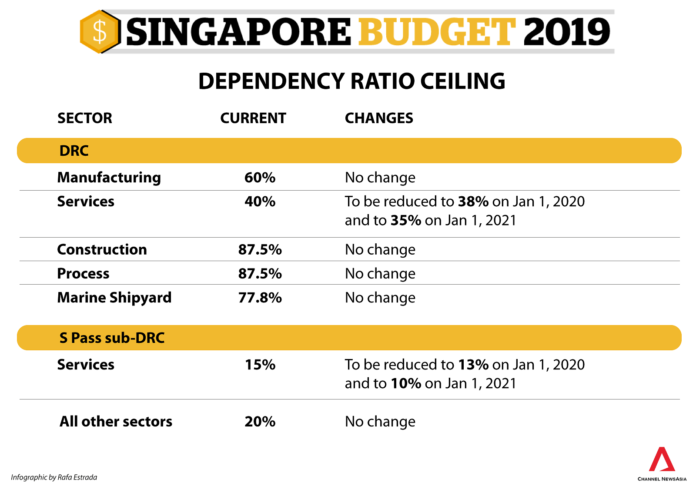
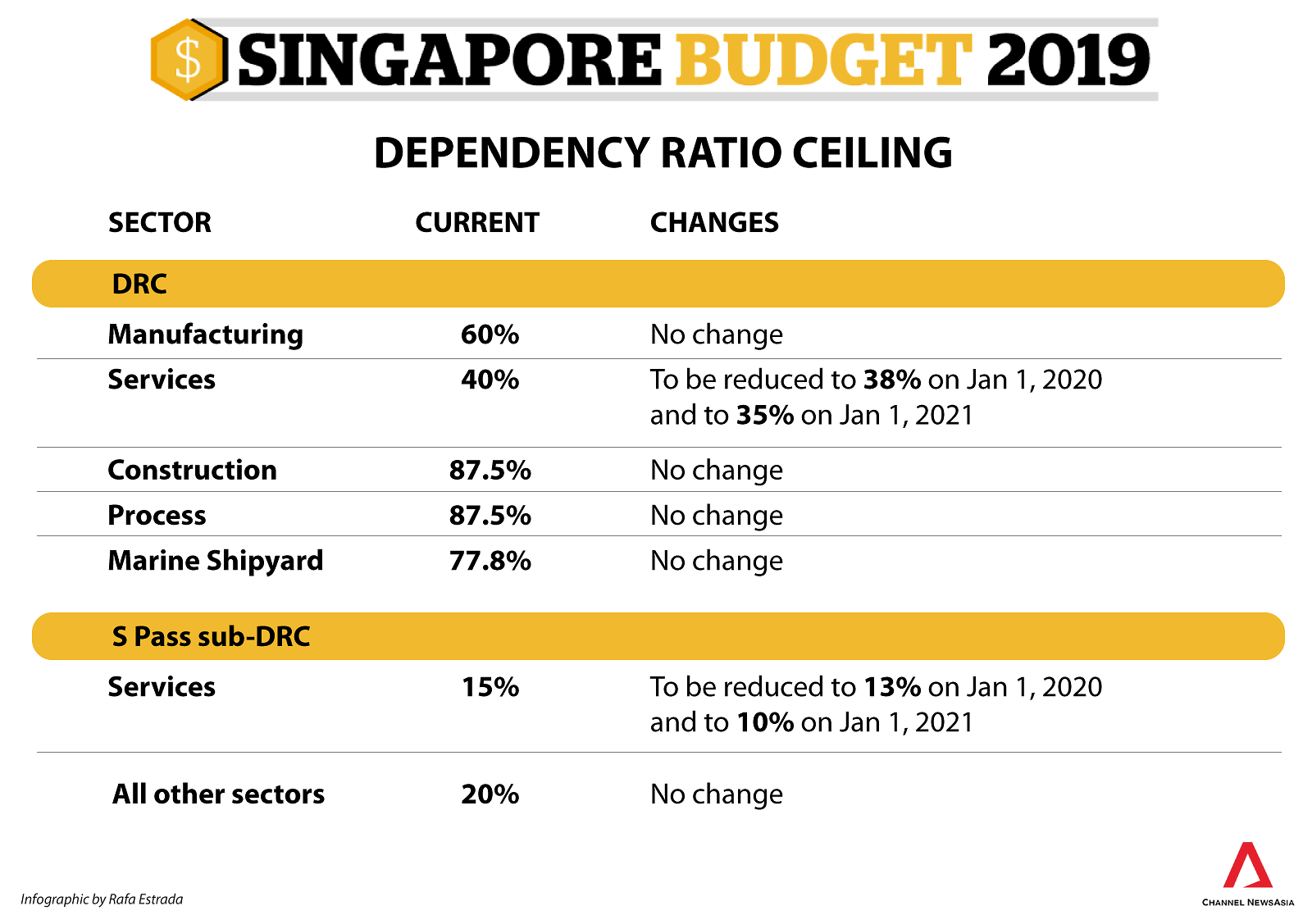
Also known as the Dependency Ratio Ceiling (DRC), the quota tables the maximum permitted ratio of foreign workers to the total workforce that a company can employ.
The DRC for that sector will be further cut – in two stages – from the current 40 per cent to 35 per cent by 2021.
The S Pass sub-DRC will be lowered from 15 per cent to 10 per cent eventually in 2021.
Reduction in Dependancy Ratio Ceiling (DRC).
To further account for these decisions, Minister Teo, who was speaking to 938NOW in a recent interview, pointed to a future scenario of a growing middle class in South-east Asian countries.
If increasing affluence in these countries leads to their citizens start getting a level of pay comparable to what is being offered in Singapore, it may result in many of them declining such services jobs here.
She said: “We have to ask ourselves this question: ‘Do we think that it will always be a case where we can get an indefinite supply of foreign workers?’
“And if the answer to that is ‘No’, then we’d better think twice about that and adjust our policies.”
She added that positive outcomes arising from adjusting the DRC cuts will eventually lead to more sustainable business practices, holistic job redesign and reskilling of local workers to adapt to an increasingly digital future.
But the Government will also be helping firms to achieve this and more, via expanded schemes and new initiatives. For example, Finance Minister Heng announced a slew of measures worth S$1 billion to help local companies transform.
NO CHANGES IN OTHER SECTORS
In a Facebook post following the Budget announcements, Mrs Teo assured companies there will be no change to DRC quotas in other sectors.
She added that the Manpower Ministry will not raise foreign worker levies. Nor will it make changes to the current policy for Employment Pass holders.
When it comes to incentivising companies to hire workers, particularly older ones and those who have been made redundant or are on the brink of retrenchment, Mrs Teo said programmes from the Manpower Ministry’s ‘Adapt & Grow’ initiative, such as the Career Support Programme (CSP), have worked.
Indeed, such Workforce Singapore programmes have, to date, placed more than 76,000 jobseekers into new roles.
It is why Mrs Teo said she is “very happy” with Mr Heng’s announcement that the CSP will be extended for two more years until March 2021.
And contrary to what some people may think, the Minister says many of these workers did not have to suffer a pay cut upon accepting new job offers.
“More often than we dared to expect, these people moved on to better jobs, in terms of pay,” she revealed
“Now we don’t dare to say that that is a promise, but I can share with that many people have been able to do so.”
She added that it takes tenacity and a certain growth mindset to venture into taking up a new job role in a different job environment.
“It does require a certain amount of willingness to adapt to either a different job or a different industry, particularly those who have entered into sectors that are in a growth stage,” she said.
“And that is where the opportunity to grow in your career is still possible.”
Displaced jobseekers who seek help from Workforce Singapore need not worry about forking out money for training costs, said Mrs Teo. This is because these skills-training programmes are heavily subsidised by the Government and prospective employers.
In all, the 2019 Budget will set aside a further S$3.6 billion to help workers ride the wave of technological disruption.
BICENTENNIAL BONUS
Another key Budget announcement was the disbursement of the Bicentennial Bonus worth $1.1 billion for lower-income Singaporeans.
Minister Teo says this should not be considered a handout. Instead, they should be seen as a way of recognising and remunerating these employees for their hard work.
“The Workfare Bicentennial Bonus recognises that they have put in the effort and therefore, provides them with a top-up that says ‘Well done and keep going!” Mrs Teo said.
‘If you think about the older Singaporeans who are about to retire, the Bicentennial Bonus package provides a CPF top-up.
“And that essentially says, ‘We know you’re concerned about retirement adequacy and this is one way in which the government can help.’”
Around 1.4 million lower-income Singaporeans will receive Bicentennial payments of up to S$300 through a GST Voucher cash payout.
Lower-income workers – under the Workfare Income or WIS scheme – will also get a Workfare Bicentennial Bonus.
They will get an extra 10 per cent of their payment for work done in 2018, with a minimum reward of S$100 in cash.
This article was adapted from an interview with Manpower Minister Josephine Teo on 938NOW’s new weekly interview series, “Question Time”, which airs every Friday. To listen to the interview, go to facebook.com/938Now/ or download the MeRadio app.
SINGAPORE: The orang utans at Singapore Zoo hate Francis Cabana, and he knows it.
That is no surprise because he took away all the food they love – chicken rice, Milo, bread and most of the fruit. He estimates that they had been eating these items – which provided a diet high in sugar – for 45 years, but like a doting mother who knows best, it was with their best interests at heart that he enforced the change.
Cabana is a wildlife nutritionist, and his job is all about feeding the most nutritious food to more than 10,000 animals within the four parks under Wildlife Reserves Singapore (WRS): Singapore Zoo, River Safari, Night Safari and Jurong Bird Park.
The primates now get a diet of “vegetables and beans and lovely healthy things”, he said.
“The orang utans hate me, because I took away the food that they love, but the keepers trust me,” he quipped.
Changing their diet, however, was no mean feat. Whereas it usually takes about two weeks to make such a change, it took four months to convince the primates about their new diet.
“They are very smart, so you have to go very, very slow, so the changes are imperceptible. Generally, the smarter the animal, the slower you have to go,” Cabana said.
The secret, he said, is not giving them a choice.
“Even if you give a little bit of fruit, they are always going to eat the fruit, and then look at you very sadly, hoping that you will crumble and give them what they want. They are very smart,” he said.
Cabana, who is from Canada, strategically chose to start with the diet of the orang utans when he joined Wildlife Reserves Singapore three years ago.
Wildlife nutritionist Francis Cabana at the nutrition centre where food is prepared for animals at the Singapore Zoo, Night Safari and River Safari. (Photo: Hanidah Amin)
“I started with the orang utans, because it’s the iconic species of Singapore Zoo and because I was new to the animals, new to the zoo, new to the whole team, and the country, I kind of wanted to start off with a bang, so I started with the orang utans to gain everyone’s trust. It worked, yes,” he said, grinning.
WRS has two nutrition centres: One that services the Singapore Zoo, Night Safari and River Safari, and one at Jurong Bird Park. Cabana works with 14 full-time staff, five interns and four part-time staff to make sure all the animals are fed.
THE IMPORTANCE OF NUTRITION
Cabana, who has a doctorate in animal nutrition, started out working in a pet shop in Canada, before starting work as a zookeeper there.
“I was always trying to figure out how to take better care of my animals, how to make them happier, healthier, look better, act more natural. And I came to the conclusion that nutrition was the way to help the animals be more of all of that because nutrition is everything,” he said.
Preparation of food at a nutrition centre. (Photo: Jalelah Abu Baker)
Bad nutrition shows up in the form of disease or other health issues, Cabana said, adding that different species tend to have different health problems.
However, the first problems that often emerge are related to dental issues, he said.
“They (animals) are just like humans. When we eat a lot of candy, we get cavities and bad teeth. (It’s the) same thing for animals, except the animals can’t tell us, so we figure out when it’s very bad,” he said.
Other issues include abscesses, which are formed when pus collects. There are also weight challenges, with animals that are obese or too thin, diabetes and kidney issues, he said.
On the other hand, good nutrition can delay, prevent or improve an animal’s condition, and even positively impact its behaviour.
Giving an example, Cabana said that glazing the fish that sea lions eat with concentrated carotenoids has shown to delay or prevent cataracts in mammals’ eye.
The way animals are fed can also have an impact on their behaviour in captivity.
Speaking about animals pacing from one end of an enclosure to the other, and standing and swaying from side to side, he said this behaviour has no apparent function.
“The animals do this possibly out of frustration or because of a period of bad welfare in their lives. This is not necessarily because of the food we give them, but how we feed them,” he said.
REMEMBERING THE ANIMALS’ WILD TENDENCIES
To combat such issues, the team gets creative to mimic what happens in the wild.
“For large carnivores like lions or tigers you don’t want to give them small pieces of meat, you want to give them large chunks and you want to hide them … and you can hide all of this in a giant bag so they actually have to tear it up like they would shred up their prey,” he said.
The daily menu across all the parks is highly varied: There are red meats, like kangaroo, beef and mutton, insects, like locusts, cockroaches and grasshoppers, and many vegetables. For those species who might eat such things in the wild, there are mice and rats.
The animals also get fruit like apples and pears, with some, like elephants, chimpanzees and orang utans, treated to durians once a week.
While it is not possible to recreate the same diet as in the wild, recreating the nutrients in their meals can be done, Cabana said. It typically takes two weeks to create the perfect diet for a particular species.
FEEDING DIFFICULT ANIMALS
There is scientific literature and sharing by other zoos that help Cabana in picking the ingredients for the right diet for most animals. However, some problems emerge for which there is no immediately obvious cause or solution.
Take the slow loris.
A slow loris licking its gum diet off a vine at the Night Safari. (Photo: Jalelah Abu Baker)
“They all had dental diseases, they had facial abscesses. You had rescue centres filled with slow lorises that only had half a jaw because they had the other half removed; they were all obese or wasting, so really, a terrible species to feed,” Cabana said.
That was the problem, and Cabana decided to find a solution. As part of his field work for his doctorate, he spent a year in an Indonesian jungle, becoming nocturnal like them as he observed them and what they ate in the wild from sunset to sunrise.
What they loved to consume was tree gum, bamboo leaves and insects, he found out. This was a far cry from what they were being fed in captivity.
He said: “In rescue centres and zoos, they used to feed a lot of fruits and meat. They would give chicks, baby mice, chicken and tons of fruit like bananas. The slow lorises would eat them but they would still get sick. In reality, what they needed was a high-fibre diet, and also medium protein.”
Cabana went into the kitchen to see if he could cook up a gourmet feast. He mixed a bit of gum powder with water, added some vegetables, crickets and mealworms. Combined together, the perfect diet for the slow loris was created.
At Indonesian rescue centres where he tested the new meal, he found that there was less fighting among the animals. It also resolved the weight-related issues seen among some of the animals held in captivity.
“In an enclosure of four individuals, one was fat, and three were very thin. The moment we changed the diet, the fat one lost weight, and the thin ones gained weight, so it helped to kind of equalise,” he said.
At the Night Safari, where the slow lorises lick the concoction off a vine that hangs in their enclosure, the diet has gone down a storm.
“Since we changed the diet three years ago, our slow lorises have been making babies every year, which is definitely proof of how successful the diet is. They don’t have any obesity or thinness. Their body weight is constant, it doesn’t vary. They don’t have any more digestive issues or dental issues either,” he said.
TAKING CARE OF THE OLD
It is not just the mysterious or picky eaters that need special attention. The older animals do too.
An orang utan eating at Singapore Zoo. (Photo: Hanidah Amin)
“One thing that is unique to zoos is old animals. We take very good care of animals, they live a very long time. This generally doesn’t happen in the wild. And this also means that it’s not really known or not really well-studied how to take care of these old animals, specifically how to feed old animals,” he said.
Among the old animals at the Singapore Zoo are two Indian rhinos – Gomati, who is 40, and Mary aged 30. This species typically lives up to 50 years old in the wild.
They are given a special mix of supplements made up of probiotics, Vitamin B Complex, Vitamic C and calcium that is aimed at helping with their joints and skin quality, Cabana said.
“We have noticed a huge improvement in skin quality. It used to be bumpy and pale. But since then the skin has become thicker, it looks the same as a young little rhino. We’ve also seen huge success with their joint movement,” he said, adding that like humans, animals get arthritis as they grow old.
It is such success stories which give Cabana immense satisfaction.
“When I see animals actually thriving because of their new diets it makes me feel like my mission is somewhat accomplished. It’s a lot of work, but it’s really hopeful for me because it makes me feel like I am doing something (good).”
SINGAPORE: The Ministry of Education (MOE) recently published a set of guidelines for school-home partnerships.
These guidelines are supposed to provide greater clarity on how schools and parents can work together as part of a common quest to develop all students holistically.
They focus on giving advice to parents on how best to work with schools. They also include tips on creating a conducive home environment for children to do homework and how to guide children to develop independent study habits.
Parents are also reminded that teachers are not required to share their mobile numbers and may not be able to respond to queries immediately. In addition, parents are urged to contact teachers only during school operating hours.
TEACHERS HAVE A ROLE TOO
Amid these reminders about the need to respect teacher-parent boundaries, little attention has been paid to teachers’ roles and responsibilities.
What are the appropriate ways for teachers to negotiate home-school partnerships and when might teachers be overstepping their boundaries?
A few years ago, MOE formalised the Teachers’ Ethos, which spells out professional expectations of teachers. Among the key elements is the need for teachers to form trusting, supportive and collaborative partnerships with families with the ultimate aim of bringing out the best in each student.
It is all too tempting for teachers, especially those teaching primary school students, to get frustrated when students fail to hand in homework on time. Some teachers assume that parents have failed to supervise their children and ensure that homework is done.
They therefore go beyond merely listing the homework for students in the classroom by WhatsApp-ing parents on a daily basis, providing detailed instructions on what homework has been assigned and how it is to be completed.
Behind such actions, the zeal these teachers feel is understandable and may indeed serve to ensure the responsibility of homework remains with the child and his or her parents.
Students at Swiss Cottage Secondary School discuss meritocracy and social inequality at a Glocal Perspectives class led by teacher Mini Sathiya Sidhan. (Photo: Lianne Chia)
However, it may have the unintended effect of leading parents to rely on such daily reminders. In fact, some parents may come to expect these reminders as a matter of course, and view them as an integral part of a teacher’s responsibilities.
Teachers may also be in danger of crossing an unspoken line between teacher and parental responsibilities, by dictating their expectations of parental responsibilities.
BUT INTERVENING IN HOME MATTERS CAN BE TRICKY
Another tricky situation arises when teachers feel that parents are not doing enough to support important school initiatives.
For instance, amid national drives to reduce sugar intake and tobacco consumption, teachers may unwittingly place themselves at odds with some parents when students share the message about healthier lifestyles with their parents, and urge their parents to change their lifestyles.
The last thing teachers want to do is to introduce strife within the family and undermine their students’ images of their parents as adult role models.
Even more detrimental is the tendency to judge students’ parents based on their children’s behaviour or academic outcomes in school and to assign all the blame to parents, while expecting them to fix the problem.
This happened recently when a teacher made a social media post in which she lambasted parents who she alleged had not taken the effort to spend time reading with their children.
Her unfortunate outburst demonstrates a condescending lack of sensitivity to the different circumstances which various parents find themselves in, and contributes little in promoting trusting, supportive and collaborative partnerships with parents – precisely the goal she seeks.
YET TEACHERS MUST INTERVENE IN SOME OCCASIONS
While as educators, we should all adopt a cautionary posture to avoid overstepping the boundaries needed for a strong, healthy teacher-parent partnership, that does not mean that teachers should apply a blunt approach and shy away from looking over their students’ lives outside of school altogether.
Indeed, because teachers spend an incredible amount of time with students, and are generally seen as trusted figures of authority, they are in a special position when it comes to ensuring the well-being of those entrusted into their care, especially those who are more vulnerable.
Woodgrove Primary School students participating in a mathematics class. (File photo: TODAY)
There are definitely occasions when they will not only be expected to but also called upon to actively intervene in students’ lives at home in the interests of their students’ welfare.
For instance, if teachers have reason to suspect that their students are victims of domestic physical or sexual abuse, they not only are within their rights to alert relevant authorities, but are often expected to look out for such cases.
Back to drawing appropriate boundaries between teachers and parents, it is interesting that MOE’s guidelines advise parents to restrict their communication with teachers to school operating hours. But what about teachers’ communication with parents?
Teachers need to recognise that not all parents can respond to their telephone calls or WhatsApp messages during these hours. In such cases, it will be impossible for both parents and teachers to adhere to these guidelines, and both sides must find a constructive balance that ensures they both play appropriate roles in educating our kids.
In summary, it is timely for teachers to remind themselves to watch the delicate line demarcating teacher and parental responsibilities.
Although teachers face increasing demands of public scrutiny and accountability, they need to ensure that they do not take on more than their work calls for.
In doing so it is worth bearing in mind three things:
First, well-intentioned acts such as sending daily homework reminders to parents may in fact undermine supportive partnerships by engendering an unnecessary reliance on these reminders.
Second, teachers need to be careful that they do not unintentionally undermine students’ respect for their parents.
Third, teachers need to work more closely with parents as allies rather than as adversaries. Blaming parents for perceived shortcomings does little to develop mutual trust between parents and teachers.
The guidelines issued by MOE are a good starting point to begin this conversation about what the best teacher-parent partnership should look like, and may differ depending on familial and school circumstances.
Trusting partnerships cannot be developed overnight. And it is only through a slow, careful process of listening to parents’ concerns instead of merely dispensing advice that teachers too can preserve hard-won trust and respect from parents.
Jason Tan is associate professor at the National Institute of Education.
SINGAPORE: A Singapore-flagged ferry ran aground at the Karang Galang reef, off the coast of Batam, on Saturday afternoon (Mar 2), the Maritime and Port Authority (MPA) said.
The Wavemaster 5 ferry was on its way to Tanah Merah Ferry Terminal from Tanjung Pinang, Indonesia, when the boat ran aground, MPA said.
It received a report at 1.55pm of the incident, which happened off the eastern coast of Batam.
There were 50 passengers on board the ferry, the authority said, including five Singaporeans and seven crew members. All of them were transferred to another ferry, Wavemaster 6, which was activated by operator Majestic Ferry.
Passengers from a Singapore-flagged ferry that ran aground on Mar 2, 2019. (Photo: MPA)
As of 5.50pm, all passengers were safely returned to Tanah Merah Ferry Terminal, according to MPA.
“All the passengers are accounted for and the ferry is in [a] stable condition. There are no reports of injury or oil pollution. MPA is investigating the incident,” the authority said.
SINGAPORE: A worker was taken to hospital after a large concrete beam collapsed at a construction site at 132 Margaret Drive in Queenstown on Saturday (Mar 2).
The Singapore Civil Defence Force (SCDF) said on Facebook that it responded to the incident at about 4.35pm.
It added that a large concrete beam from a building under construction had collapsed from the upper floors onto its lower floor multi-storey carpark.
The large concrete beam that collapsed at a construction site at 132 Margaret Drive on Mar 2, 2019. (Photo: SCDF)
A construction worker suffered a head injury and was taken to the National University Hospital as a result of the incident, SCDF said.
It added: “SCDF has completed its search operations at the construction site and no other injuries were reported.”