Home Blog Page 823

Commentary: How to make water issues matter to world leaders

0

SINGAPORE: In December 1992, the UN General Assembly declared Mar 22 World Water Day, to be celebrated each year. With larger populations and more economic activities, many countries face water scarcity – which in turn limits their economic development.

Sadly, not a single World Water Day over the past 25 years has focused on how water could be put high up on the political agendas of countries on a long-term basis. Until this happens, the probabilities of solving national, and then global, water problems are slim.

An analysis of the last 50 years would indicate that except for Lee Kuan Yew, Singapore’s prime minister from 1959 to 1990, no other leader of any other country have shown sustained interest in water in normal times. 

They are interested in water only when there are severe droughts or heavy floods. Once these extreme events are over, and situations return to normal, their interest in water promptly evaporate.

READ: Singapore’s water story underscores the value of preparedness, a commentary

In contrast to national political leaders, most water professionals from all over the world, from academia, public and private sectors and NGOs, explicitly or implicitly consider water to be one of the most, if not the most, important issue facing their countries.

If this gulf in perception between national policymakers and the water profession is to be bridged, the latter must change their current messaging.

In recent decades, the focus of the water profession has been exclusively on good planning and management. However, this has not got national political leaders interested in water on a long-term and sustained basis.

This is because they are elected or judged primarily on the basis of improvements in the economic and social conditions of their countries. 

Thus, to attract their attention on water issues, the message to them should focus on how good water management can contribute to a country’s social and economic development, poverty alleviation, job creation and improved quality of life for citizens.

EVERYONE’S PROBLEM

Water problems are a global issue and leaders in both developed and developing countries should focus on them.

A Yemeni girl drinks water from a well in an impoverished village on the outskirts of Hodeidah on

A Yemeni girl drinks water from a well in an impoverished village on the outskirts of Hodeidah on July 23, 2017 as the region faces acute water shortages (Photo: AFP/Abdo HYDER)

There’s a misconception among most policymakers in developed countries who feel their water problems were solved over half a century ago. Developed countries still have major water problems to solve. However, these are different from the problems in developing countries.

READ: Think outside of the box to tackle water scarcity, a commentary

In most developed countries, billions of dollars are needed annually to keep their water and wastewater infrastructure functional, safe and in compliance with current and future regulations. 

For example, every four years, the American Society of Civil Engineers grades America’s infrastructure using a simple A to F report card. The latest 2017 report gives America’s dams, inland waterways and drinking water a D, and wastewater a D+.

According to the American Water Works Association, the US needs to invest more than US$1 trillion over the next 25 years to replace its ageing drinking water pipes. This does not include costs of updating sewer and storm-water pipes and water supply and wastewater treatment plants.

In developing countries, a large proportion of the population are engaged in agriculture-related activities, which accounts for nearly 70 per cent of total global water use. In India, agriculture accounts for some 90 per cent of national water use. Corresponding figures for Egypt are 86 per cent and for China 65 per cent.

Agriculture depends on a reliable supply of water. So, nearly all developing countries have a dedicated water ministry because of its economic and social importance. Even then, water in such countries is not being managed efficiently and equitably.

India, for example, has had ten water ministers between 2000 and 2018. But not a single water minister in that time has managed to make any perceptible difference to how water is managed in India.

FILE PHOTO: A girl bathes to cool off herself with water that is leaking from a broken pipe valve o

FILE PHOTO: A girl bathes to cool off herself with water that is leaking from a broken pipe valve on a hot summer day on the outskirts of Ahmedabad, India, May 18, 2015. (Photo: REUTERS/Amit Dave/File Photo)

READ: In parched India, collecting water turns millions into second-class citizens, a commentary

It has been difficult for India to find and retain good and capable persons as water ministers. For a total of five years at least, ministers holding another important portfolio were given the additional responsibility of running the water ministry. This includes the current minister.

CONVINCING POLICYMAKERS

Water professionals have failed to convince senior policymakers of the potential of water to assure their countries’ economic and social development. They have been unable to put water high up on the political agenda by not realising or appreciating what influences the political views and priorities of prime ministers or presidents.

India’s former prime minister, Indira Gandhi, was a mentor to one of us (Asit). In early 1973, she noted that a water professional often thinks the “sun and the moon” revolve around water. As a prime minister, she had not much interest in water. She explained that issues like water or energy are a means to an end. 

She was interested mostly in the ends: 

How could India’s economic growth be increased, how could poverty be alleviated, or how could a significant number of good and well-paid jobs be generated?

To attract the attention of state leaders, water professionals should make it clear that water can act as an engine for economic and social development, generate new employment and improve the standard of living and quality of life of the people.

Water professionals can also point out lessons from Singapore, whose leaders have consistently considered water to be a strategic issue for the country’s social and economic development.

singapore world water day

Water Wally formation at the Singapore World Water Day 2016 Opening Ceremony. (Photo: PUB)

During a series of private discussions with Lee Kuan Yew, we found out that he had three people in his office who examined all policies “through the lens of water” before they were approved. He noted: 

All policies had to bend at the knees for water survival.

With such an enlightened outlook, Singapore’s water management, which in the early 1960s was similar to that of Delhi, became one of the best in the world only 25 years later. Water continues to receive high political priority in Singapore.

Even for advanced industrial economies, water can be an engine for their continuing social and economic development. Properly planned, water should contribute to a better quality of life and standard of living of their citizens. However, this is unlikely to happen without strong and sustained high-level political support.

Cecilia Tortajada is Senior Research Fellow at the Institute of Water Policy, Lee Kuan Yew School of Public Policy, National University of Singapore. Asit K Biswas is Distinguished Visiting Professor at the same school and also a visiting professor at the University of Glasgow. 

This commentary first appeared in The Conversation. Read it here

Source link

Co.Lab.Asians [ M1 CONTACT Contemporary Dance Festival 2019 ]

0

Co.Lab.Asians [ M1 CONTACT Contemporary Dance Festival 2019 ]
from Tuesday, June 18, 2019 at 8:00 PM to Tuesday, June 18, 2019 at 9:30 PM

Esplanade – Theatres on the Bay

1 Esplanade Drive, Singapore, 038981 Singapore

Source link

These young engineers want to make recycling a breeze in Singapore

0

SINGAPORE: “When I have something I want to recycle, what can I do?”

That was one of the main problem statements a group of four young engineers at the Government Technology Agency’s (GovTech) Data Science and Artificial Intelligence department were hoping to tackle when they developed their prototype tool – named Trashy – not too long ago.

READ: Singapore to ‘double down’ on artificial intelligence efforts, says Vivian Balakrishnan

Ms Laura Lee, an associate computational scientist, shared how her experience living in London provided the impetus for creating the prototype.

“It is second nature to recycle in London,” Ms Lee recounted during a recent interview with Channel NewsAsia. But when the 27-year-old returned home to Singapore about two years ago, she found it a challenge to do the same.  

This experience was shared by another team member, Ms Christabel Neo, who was also based in London.

“Every building has a recycling bin, and you have to separate the rubbish before bringing the waste down to dispose,” explained Ms Neo, an associate software engineer.

Comparing the experience here of disposing rubbish through a centralised rubbish chute system, the 24-year-old posited that this convenience “plays against” encouraging Singaporeans to recycle more of their waste.

She added that while there are the blue recycling bins around, the use of these are usually shared among several Housing and Development Board (HDB) blocks and they are not always easily located.

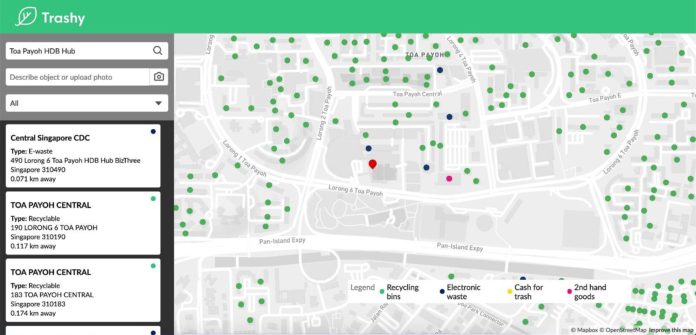
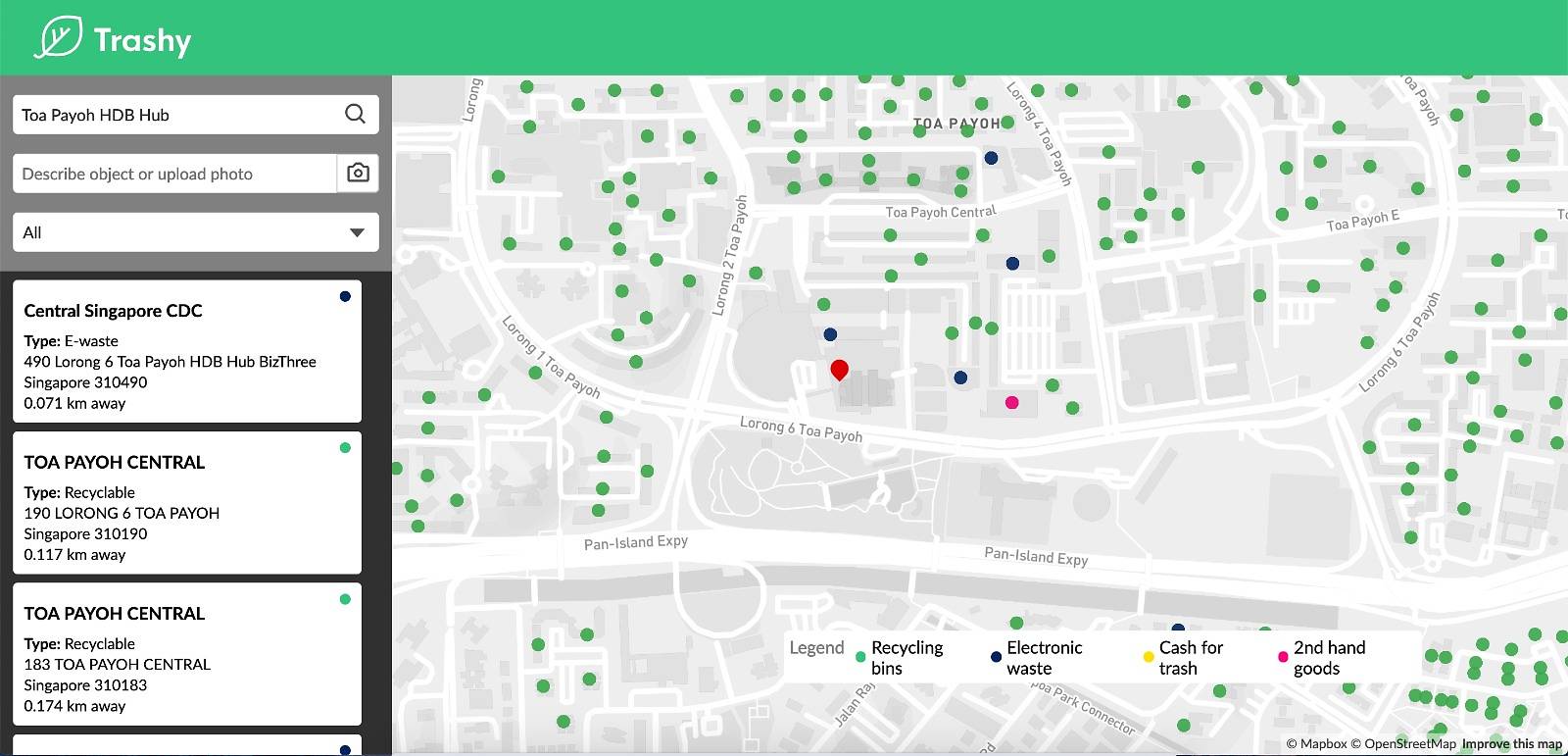
Trashy screenshot

The prototype tool uses geolocation to identify where the user is, and recommends the nearest places where there are recycling or e-waste bins. (Image: GovTech) 

Product manager Lisa Tjide, another team member, went on to point out that waste is very well managed here, and the National Environment Agency (NEA) “is doing a great job”, maybe so much so that consumers here don’t see the need to recycle their waste.

OPEN COLLABORATIONS SPARK IDEAS

These reasons helped spark the development of Trashy, which maps all the recycling bins, electronic waste bins, sites that take in second-hand goods as well as places where you can get “cash for trash”.

The team, which also includes associate software engineer Seah Chin Ying, came up with the idea and prototype during a month-long hackathon organised within the department in January.

The hackathon also led to the introduction of Colourise.sg, an AI-based tool that allows users to bring colour to old black-and-white snaps. It even caught the attention of Prime Minister Lee Hsien Loong, who posted a childhood picture of when he was at Outward Bound Singapore and the results after using the tool.

Trashy could potentially be next in GovTech’s production line of citizen-centric services. 

Minister-in-charge of GovTech Janil Puthucheary had mentioned the project during his Committee of Supply debate speech on Smart Nation earlier this month when speaking of Ms Lee’s decision to leave Candy Crush-maker King.com to move to GovTech.

Dr Puthucheary said then that she is “part of a team that is trying to find ways to use technology, machine learning and our Smart Nation platforms to encourage more recycling”.  

READ: 7 in 10 people in Singapore do not know what plastics to recycle, SEC report shows

The four twenty-somethings who developed the app are now focused on refining the tool and bringing in new features such as photo identification using machine learning and, through recognising the waste for disposal, recommend to users how to deal with it and where, Ms Lee said.

The information on recycling is publicly available on NEA’s website, she added. But this feature allows for relevant information to be served to users according to their needs, rather than people having to hunt for the data.

Ms Neo shared that the intention is also to open source Trashy’s code, so that other developers can contribute ideas to the tool or even improve on the software on their end.

Her teammate, Ms Tjide, also pointed out how it was easier and much faster to gather a group of like-minded engineers to work on passion projects like this, given that there is a ready pool of technical experts on hand within GovTech. 

By comparison, if they had to develop this tool from scratch as a start-up, much time and resources would be spent trying to attract people with the right skillsets to come onboard, she said. 

She added the team has talked about the project with other agencies, but Trashy hasn’t yet been put forward to be developed as a full-fledged product. 

Any effort to encourage Singaporeans to recycle can be considered a boon to the country’s goals of raising the domestic recycling rate to 30 per cent by 2030 as stated in the Sustainable Singapore Blueprint.

It is currently at 21 per cent, according to 2017 figures provided by the Ministry of the Environment and Water Resources.

Source link

Self-driving vehicles for road sweeping to go on trial

0

SINGAPORE: Self-driving vehicles to clean roads in Singapore will go on trial in 2020, said the National Environment Agency (NEA) and the Ministry of Transport (MOT) in a joint media release on Thursday (Mar 21).

Two consortiums have been selected to design, develop and test the vehicles, following a Request for Proposals that was issued in December 2017. 

Trials will be conducted in two stages – first, each consortium will test the vehicles’ safety features within a circuit at the CETRAN AV Test Centre. 

They will only be allowed to start trials on public roads at designated AV (autonomous vehicle) test sites such as one-north, after passing a rigorous safety assessment, said NEA and MOT. 

“The AESVs (Autonomous Environmental Service Vehicles) are required to have on board at all times for the duration of the trials, a safety driver who is trained to take immediate control of the vehicle, in accordance to strict operational protocols,” the authorities added. 

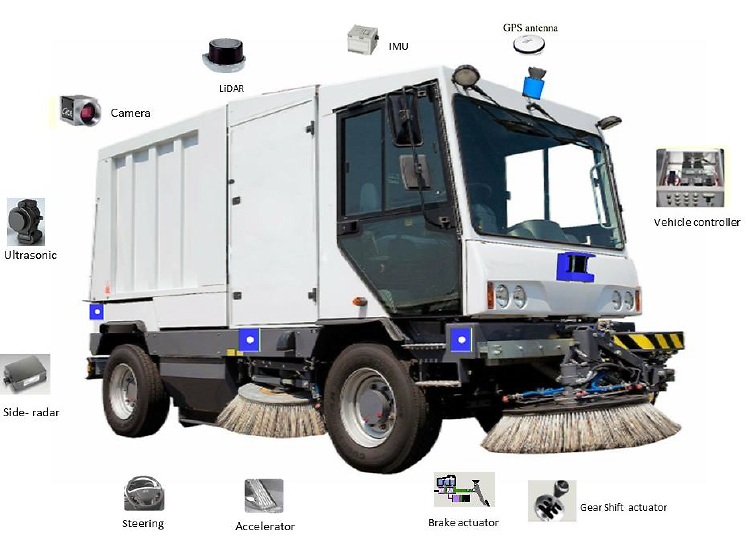
Proposed AESV concept

An illustration of a proposed Autonomous Environment Services Vehicles concept. (Graphic: Dulevo International)

The consortiums selected consist of “experienced and established” players from the autonomous vehicles and environmental services industries, said NEA and MOT. 

The first consortium comprises Nanyang Technological University, Enway, Veolia ES Singapore Industrial and Wong Fong Engineering Works. 

The second consortium is made up of ST Engineering Land Systems and 800 Super Waste Management.

“The successful completion of these trials will pave the way for the pilot deployment of AESVs for road cleaning,” said NEA and MOT, adding that details of the pilot deployment will be announced after 2020.

“Building on existing technologies used on our mechanical sweeper vehicles to monitor the progress and status of road cleaning, these projects seek to further automate road cleaning, by catalysing the local robotics industry to build up expertise and experience in delivering environmental robotic solutions, which can then be commercialised and potentially exported,” said NEA CEO Tan Meng Dui.

Such vehicles also have the potential to improve productivity, said Permanent Secretary for Transport Loh Ngai Seng.

“The deployment of AESVs will enable us to optimise the use of our road network, while improving the productivity of road cleaning operations,”  he said.

“With reduced reliance on manpower, we can potentially shift road cleaning activities to the night and reduce congestion during the day.”

Source link

Irish boyband Westlife announces Singapore concert date

0

SINGAPORE: Westlife will be performing in Singapore on Aug 10, the boyband announced on Thursday (Mar 21).

The concert will be held at the National Stadium as part of their The Twenty Tour, celebrating two decades of hits by the Irish pop group.

Westlife facebook post

Westlife announces a Singapore concert as part of The Twenty Tour. (Image: Facebook/Westlife)

Formed in 1998, Westlife were hugely popular in the late 1990s and early 2000s.   

They are known for hits including My Love, Swear It Again, Queen of My Heart and Flying Without Wings. Their last album, Gravity, was released in 2010.

They disbanded in 2012 and reunited after a six-year hiatus in October last year, with an announcement of new music and a new tour.

The reunion, which marked the 20th anniversary of the band’s formation, does not include former fifth member Brian McFadden, who left the band in 2004.

Their first new single in eight years – Hello My Love – is written by Ed Sheeran and Steve Mac, Hello My Love was released Jan 10 this year.

In January, they came to Singapore to meet fans at an Q&A session organised by Universal Music Singapore.

In an exclusive interview with CNA Lifestyle in February, they said there would also be an Asian tour that will “most definitely include a Singapore concert”.

The Twenty Tour will be their 13th world tour together. Tickets go on sale on Apr 1, starting from S$108.

Source link

3 Ways to Increase Your Number of Instagram Likes

0

In this day and age, to be successful on social media platforms such as Instagram, you need to get as many likes as possible. This is essential if you want to be considered an “influencer”. Building likes and a fan base takes time, persistence and sheer hard work, so we thought we would give you tips on how you can increase the number of Instagram likes on your account.

Tip #1 – Share Your Instagram Posts on Other Platforms

You will be surprised how often this is overlooked. If you take the time to link your Instagram account to other services such as Facebook and Twitter, you will notice more engagement. This will increase traffic to your page, which will in turn increase your likes (and followers too). If you have a blog or a website, make sure you share on these too.

Tip #2 – Use Popular Hashtags

It is vitally important that you carefully select your hashtags. Don’t use random hashtags. Each tag should be chosen with care and research. If you try and use popular hashtags, this is the best way to reach a large number of users in a short period of time. It will maximize the chances of your images being visible to a wider audience. This is a good way to try and increase the number of Instagram likes.

Tip #3 – “Like to Enter” Posts

While it may not give the best quality likes, running a “like to enter” giveaway is a good way to increase the number of likes. It can be rather easy to run up a huge amount of likes in a short period of time. Just make sure you create an attractive, engaging photo of the prize on offer to maximize the effectiveness of the campaign.

We hope you find these tips helpful in increasing the number of Instagram likes for your account. Have you got your own tips? Let us know!

Last modified: March 21, 2019

Source link

Singapore Mint launches Bicentennial-themed medallions, banknote replicas

0

SINGAPORE: The Singapore Mint has launched a range of Bicentennial-themed collectibles, including medallions and banknote replicas, to mark 200 years since Sir Stamford Raffles landed in Singapore. 

One of the highlights is a ½ oz 999.9 Fine Gold Proof Medallion with a Swarovski crystal insert, which retails at S$1,400. A silver 1oz version is available at S$120.

They are part of a series of four medallions under the Sir Stamford Raffles Medallions range, said The Singapore Mint in a media release on Wednesday (Mar 20).

Sir Stamford Raffles Medallions

The Sir Stamford Raffles ½ oz 999.9 Fine Gold Proof Medallion with Swarovski Crystal, and Sir Stamford Raffles 1 oz 999 Fine Silver Proof Medallion with Swarovski Crystal. (Photo: The Singapore Mint)

Sir Stamford Raffles 999 Fine Silver Proof-Like Medallion

The Sir Stamford Raffles ¼ oz 999 Fine Silver Proof-Like Medallion. (Photo: The Singapore Mint)

There is also a Sir Stamford Raffles 1 gram 999.9 Fine Gold Proof-Like Medallion, which retails at S$138, and a series of banknote replicas and currency collectibles which trace Singapore’s history of pre-independence.

A Sir Stamford Raffles 1 gram 999.9 Fine Gold Proof-Like Medallion

A Sir Stamford Raffles 1 gram 999.9 Fine Gold Proof-Like Medallion. (Photo: The Singapore Mint)

The replicas features the $10,000 banknote, minted in 1g 999 Fine Gold and 8gm 999 Fine Silver.

Replicas of banknotes depicting King George VI and Queen Elizabeth II

Replicas of $10,000 banknotes depicting Queen Elizabeth II (left) and King George VI. (Photo: The Singapore Mint)

The collectibles will be available for sale at The Singapore Mint’s booth at the Singapore International Coin Fair 2019, held from Mar 22 to 24 at the Marina Bay Sands Expo and Convention Centre.

They can also be purchased on the Singapore Mint website.

Source link

Sentosa Development Corporation appoints new chairman, board members

0

SINGAPORE: Sentosa Development Corporation (SDC) has appointed Mr Bob Tan Beng Hai as chairman, announced the Ministry of Trade and Industry (MTI) on Wednesday (Mar 20).

The appointment takes effect on Apr 1.

Mr Tan is also board chairman of Jurong Engineering, ASCOTT Resident Trust Management, SINGEX Holdings and the Institute of Technical Education of Singapore.

He succeeds Mr Moses Lee, who is stepping down after completing his term on Mar 31.

In a media release, MTI said that since he became chairman in 2013, Mr Lee played a key role in expanding Sentosa’s range of signature events, as well as making the island more accessible by extending free island admission to the local community.

Major partners such as Madame Tussauds and Kidzania started operations on Sentosa, noted MTI, adding that the island hosted significant events such as the inaugural Trump-Kim summit and the Bloomberg New Economy Forum.

“I would like to thank Moses for his leadership and valuable contributions to Sentosa Development Corporation, which have strengthened Sentosa as a vibrant and accessible destination, with a variety of events and attractions that appeal to both tourists and locals,” said MTI Permanent Secretary Loh Khum Yean.

“I look forward to Bob’s stewardship to oversee the transformation of Sentosa in its next phase of development.”

New board members appointed by Sentosa Development Corporation

Sentosa Development Corporation has appointed new members Ms Ang Shi-Huei and Mr Andrew Lim to its board. (Photo: Ministry of Trade and Industry)

SDC also appointed two new members to the board – Ms Ang Shi-Huei is co-founder and CEO of Klareco Communications, and Mr Andrew Lim Ming-hui is partner and co-head of corporate mergers acquisitions at law firm Allen and Gledhill.

The following board members have been re-appointed:

  • Mrs Diana Ee-Tan, chairman, Mount Faber Leisure Group
  • Mr Eugene Ho, chief strategy officer, Deloitte South East Asia & Deloitte Consulting Asia Pacific; deputy regional managing director, Deloitte Consulting South East Asia; and consumer, travel & transportation industry leader, Deloitte South East Asia
  • Mr Eugene Leong, CEO, Early Childhood Development Agency
  • Ms Rita Soh Siow Lan, managing director, RDC Architects

Source link

Travel vlogger Nas Daily to move to Singapore

0

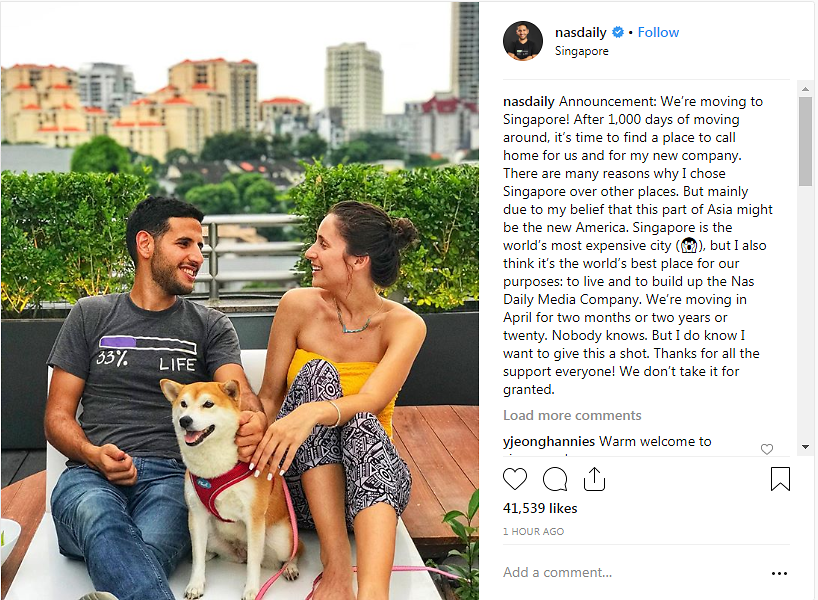
SINGAPORE: Popular travel vlogger Nuseir Yassin, better known as Nas, said on Wednesday (Mar 20) that he will move to Singapore next month.

The Israeli-Palestinian, who is known for his one-minute videos on Facebook page Nas Daily, said he is choosing to move to Singapore with his company and his girlfriend Alyne Tamir because he believes “it is the world’s best place” for them.

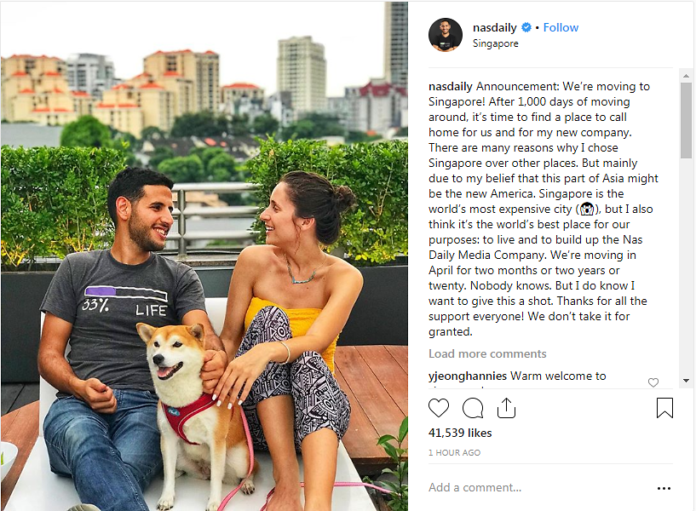
“There are many reasons why I chose Singapore over other places. But mainly due to my belief that this part of Asia might be the new America,” Mr Yassin announced on Instagram.

“Singapore is the world’s most expensive city, but I also think it’s the world’s best place for our purposes: to live and to build up the Nas Daily Media Company,” he added.

He did not commit to a fixed timeframe for his stay in Singapore, saying that it could be “two months or two years or twenty. Nobody knows”.

The Nas Daily Facebook page has 12.4 million followers.

Nas Daily Instagram announcement on move to Singapore

A screengrab of Nas Daily’s Instagram post showing his announcement regarding his move to Singapore. 

Mr Yassin’s announcement came several hours after Ms Tamir, who is also a video content creator, revealed their plans in her Instagram page.

In her post, Ms Tamir – who publishes videos on Facebook under Dear Alyne – described Singapore as the “hub of Asia and arguably a major hub of the world”.

Mr Yassin, who has made several videos on Singapore, has been outspoken about how he is “really fascinated” with Singapore.

Some of his videos have touched on how Singapore’s “passport is a lot of people’s dream”, how “you’re not gonna get any road rage” in the country and how its landfills are so “insanely clean” they “almost feel like resorts”.

LISTEN: The Pulse – Why Singaporeans reacted badly to a vlogger’s praise

The positive nature of the video clips – as well as the appearance of Prime Minister Lee Hsien Loong in his video The Almost Perfect Country in September last year – has attracted some criticism.

“Whenever I promote a country, a product or a company, people assume and ask: ‘how much did you get paid for this? credibility lost!’ he said in a post in September last year.

“97% of the time the answer is $0. In fact, I PAID to do it,” he added.

On Jan 5, Mr Yassin announced “the end” of his one-minute clips. 

In a clip marking 1,000 days of his one-minute video a day series, he said: “It’s been an honour showing up on your feed everyday. This isn’t goodbye. This is see you later. I’ll be back with more videos. But not everyday and not one minute,” he said.

“For now, Chapter one is over. I’ll miss you,” he added.

Source link