SINGAPORE: Fifteen journalists and media outlets were on Wednesday (Mar 20) recognised for their outstanding reporting on environment-related issues at the Asian Environmental Journalism Awards.
Channel NewsAsia’s correspondents Pichayada Promchertchoo and Jack Board, from the digital desk, won best environment story for their series on damming the Mekong River.
Power struggle: Damming the Mekong explores the underlying politics behind three large-scale and controversial dams, as well as their impact on communities in Laos, Thailand and Cambodia.
“It’s an honour to be recognised for the stories we did but what is more rewarding for us is that the series has brought our audience closer to the key environmental issues in the region,” said Pichayada.
Added Board: “People have a love and respect for the river that gives them life. They’re scared about what the future may hold for them. At the same time, progress is inevitable and necessary. That tussle was what we wanted to dig into deeper.”
Mediacorp clinched a merit award in the environmental media organisation category, along with Thomson Reuters.
“Interest has really grown for environmental stories around Asia,” said David Bottomley, deputy chief editor of digital news at Channel NewsAsia. “Certainly in the digital space we see a lot more people clicking on such stories as awareness grows about some of the challenges the region is facing.”
Channel NewsAsia won best environment story for a series on damming the Mekong River.
The other winning entry from Singapore was a merit award for environmental photograph by The Straits Times’ Lim Yaohui.
India bagged the most number of awards with six of its journalists and media outlets recognised on Wednesday.
The annual award is organised by the Singapore Environment Council, a non-government organisation which promotes and supports sustainability and environmental efforts in Singapore.
With growing environmental problems around the world such as climate change, pollution and waste, the media plays an important role in highlighting such issues, said Minister for the Environment and Water Resources Masagos Zulkifli.
“There is an urgent need for us to combat these challenges and build a more resilient and sustainable future for our countries. Our media play an important role in inspiring and galvanising collective action and resolve” said Mr Masagos, who presented the awards.
“I urge you to continue on this important mission and to rally society to make an impact for positive change.
SINGAPORE: Activist Jolovan Wham and Singapore Democratic Party’s John Tan will have to wait to find out their sentences after both men were convicted of contempt of court.
Justice Woo Bih Li on Wednesday (Mar 20) reserved judgment on the High Court sentencing against Wham and Tan. During the two-hour hearing, he grilled both the prosecution and defence on their sentencing submissions.
The prosecution called for Wham to be fined S$10,000 to S$15,000 and in default, jailed for two to three weeks. It also wanted Tan to be sentenced to at least 15 days in jail, saying both men demonstrated an “utter lack of regard” and “disrespect of the finding of this court in particular”.
They have a “high level of culpability”, the prosecution added.
The duo was found guilty of the offence in October last year. In April 2018, Wham published a Facebook post alleging that Malaysia’s judges were more independent than Singapore’s when it comes to cases with political implications.
The Attorney-General’s Chambers (AGC) initiated a contempt of court case against him.
Less than a month later, Tan, a Singapore Democratic Party politician, said on Facebook that the AGC’s actions confirmed the truth of Wham’s comment.
Civil rights activist Jolovan Wham leaves the State Court after a hearing in 2017. (Photo: Reuters/Edgar Su)
These were the first convictions for contempt of court by scandalising the judiciary, under the Administration of Justice (Protection) Act 2016, which came into effect on Oct 1 last year.
In supporting his sentencing submissions, Deputy Public Prosecutor Senthilkumaran Sabapathy said that a relevant aggravating factor was that the offending posts were still online, more than five months after the men were found guilty of contempt of court, and more than 10 months after the posts were posted.
He said: “This shows a striking lack of remorse and defiance of the court’s authority.”
During the hearing in the High Court, Justice Woo questioned the relevance of the timeline and said that the bottom-line was that the two men have refused to take their posts down.
Mr Senthilkumaran, referring to blogger Alex Au’s contempt of court case for which Au was fined S$8,000 in 2015, said that Wham’s case was more serious than Au’s.
Au’s allegations, which were against Chief Justice Sundaresh Menon and Justice Quentin Loh, were more targeted, while Wham’s was an “indiscriminate attack and wholly unnecessary”, he added.
The judge questioned his argument that Wham was more culpable, given that Au took the trouble to target certain members of the judiciary, and his post “went into paragraphs”.
When Mr Senthilkumaran said that Wham’s offence is more serious, Justice Woo said: “I am trying to understand how so.”
Justice Woo also took issue with the submission that Tan should have a custodial sentence, which the prosecution pointed out that his defence lawyers agreed with. The two men were represented by lawyers Eugene Thuraisingam, Remy Choo and Priscilla Chia.
John Tan of the Singapore Democratic Party (SDP) holds a magazine outlining the party’s history as part of a donation drive in Singapore August 8, 2010. REUTERS/Russell Boyce/Files
Justice Woo said: “This court is not bound to sentence a person to imprisonment just because prosecution and defence think it’s appropriate.”
Mr Senthilkumaran also raised Tan’s previous offence in 2008, when he was convicted of contempt of court for turning up at a defamation hearing in a t-shirt with a kangaroo dressed in a judge’s gown.
The prosecution said it pointed to the politician’s higher culpability. Photos of him and others wearing the same t-shirt were also posted online.
While Justice Woo said that the two offences were different, Mr Senthilkumaran argued that the essence of the offences was the same.
“I hear you that he has got an antecedent. I am just wondering whether that necessarily means he needs to be incarcerated for the present offence,” Justice Woo said.
When Mr Thuraisingam responded, asking for Wham to be fined S$4,000 to S$6,000 or jailed a week in default, and for Tan to be jailed for three days, Justice Woo grilled him on the need for Tan to be imprisoned.
The reason behind asking for a jail term was that if a politician was fined more than S$2,000, he or she would not be able to stand for election. The threshold for being able to stand for election when it comes to a jail term is one year.
He also asked if Mr Thuraisingam thought that Tan was more culpable than Wham, given the higher sentence submitted for Tan.
“If I am not persuaded that he is more culpable than Wham, we have a situation that one sentence is a fine, and one is a jail sentence,” Justice Woo said.
The judge said it was up to Tan if he wanted to stand for election, but questioned if the court should take it into account when sentencing.
COURT SHOULD ORDER APOLOGY, POSTS TO BE TAKEN DOWN
The prosecution also asked the court to order the men to apologise and take down the posts, but Justice Woo said that an apology should not be forced.
“How meaningful can it be if the court has to order the contemnor to apologise?” he asked. He reiterated his question several times, asserting that a forced apology was not a genuine apology.
Mr Senthilkumaran said that sincerity was not the point, but efficacy was. He argued that the apology should be made on the same medium where the offence was committed, in this case, on Facebook and that a court order would “ensure effective purging” of the contemptuous content.
The judge asked if not purging the content could lead to a second incident of contempt of court, of which the prosecution said it would.
“We are not focusing on the two of them, but the administration of justice and the reputation of the court,” Mr Senthikumaran said.
Justice Woo said he was more concerned about the principle. If he were to follow the prosecution’s argument, the general approach would be to order an apology, the judge added.
The prosecution also sought S$8,000 in costs from Wham and S$5,000 from Tan.
During the course of the discussion with the judge, Mr Thuraisingam submitted a higher sentence of seven days and said that while Tan will not apologise, as he did not intend to scandalise the court, he will take down the post on Wednesday.
This is not Wham’s first brush with the law. Last month, he was fined S$3,200 over a public assembly he organised two years ago without a permit and refusing to sign a police statement. At the time, he indicated he would not pay the fine and will instead serve jail time of 16 days in default.
For contempt of court, Wham and Tan face a maximum fine of S$100,000 and a jail term of up to three years.
SINGAPORE: Water flowing from the tunnel ceiling in the Marina Coastal Expressway (MCE) was not from a burst pipe or seawater leakage, said the Land Transport Authority (LTA) in response to videos circulating on social media.
“At 7.10am today, the water-based fire-fighting system along a 25m stretch of the Marina Coastal Expressway (MCE) westbound tunnel, after the East Coast Parkway/Fort Road entry, was accidentally triggered due to a technical fault,” said the LTA in a statement on Tuesday (Mar 19).
“The system was switched off at about 7.26am. There is no fire and seawater seepage in the tunnel. There was some slow moving traffic near the affected areas of the tunnel during the incident, with no major impact to traffic.”
A video posted on several Facebook pages showed motorcyclists lining the side of the tunnel to put on their raincoats before going under the sprinklers.
A driver and passenger can be heard speculating on the origin of the water, and if it was a burst pipe or seawater leaking through the ceiling.
A screengrab from a video showing motorcyclists lining the side of the Marina Coastal Expressway tunnel to put on their raincoats on Mar 19, 2019.
Another video showed vehicles passing through a curtain of water after rows of sprinklers were activated.
In January, a section of the Marina Coastal Expressway (MCE) was closed for about two hours because of a burst pipe.
The fire-fighting system along the Marina Coastal Expressway (MCE) tunnel was accidentally activated in May 2017, causing a slowdown in traffic.
SINGAPORE: Residents of Marine Parade have called for more measures to make the pavements around a roundabout safer, after an elderly woman died from injuries sustained in a crash on Monday (Mar 18).
Member of Parliament (MP) for Mountbatten Lim Biow Chuan said on Tuesday he will talk to the Land Transport Authority (LTA) about how they can make the area safer.
An 82-year-old woman died in hospital after she was struck by a car while she was on the pavement by a roundabout between Marine Parade Road and Amber Road.
Mr Lim told Channel NewsAsia that he felt “terribly sorry to hear of the death of the pedestrian” and is obtaining more details on the accident victim.
DANGER “CIRCUS”
The two-lane roundabout, or “circus” as residents call it, has three exits that lead to Marine Parade Road, Amber Road and the Silversea condominium. According to them, the roundabout is heavily used by drivers to get to the city via Mountbatten Road or towards Parkway Parade on Marine Parade Road.
Residents living in the condominiums along Amber Road and Amber Gardens have to walk on foot along the roundabout to get to transport nodes or nearby shopping areas.
Some of them had appealed to Mr Lim during a dialogue in 2017 for safer roads.
“The residents gave feedback and felt that the circus is actually a very dangerous place. They suggested that they (LTA) either put road humps or other measures to slow the traffic, or put up safety barriers like crash barriers,” said a meeting participant, who wanted to remain anonymous.
He added that he could see cars “zooming past” on the roundabout on a daily basis.
“Some even suggested putting up traffic lights like what you have in Newton Circus. The nearest traffic light is outside Parkway Parade and it doesn’t slow the traffic down,” he said.
Another resident Mrs Dawn Seow said that road users often do not drive safely near the roundabout. Her family had a few close brushes after moving to a condominium in the area a year ago.
“People don’t seem to give way so there were two, three times when we had to stop the car suddenly,” said Mrs Seow.
Another resident, Mr Michael, said he uses the roundabout as a driver three to four times a day and is very cautious when he is on it.
“The people don’t stop at the exits and they approach the roundabout at full speed. At this roundabout, I have near-misses at least once a week,” he added.
“Roundabouts are not in the driving test in Singapore so people are not used to them. Whenever you are here or by the stadium, roundabouts are always hazardous. This one over here, it’s the speed that people go around and [the] lack of lane discipline that is the problem.”
Residents living near the roundabout at Marine Parade Road and Amber Road say the pavement is too narrow and sometimes too tight when shared between pedestrians, cyclists and those with prams. (Photo: Darius Boey)
NARROW PAVEMENT SHARED BY PEDESTRIANS, CYCLISTS
During the dialogue session, residents raised concerns about the narrow pavement on the perimeter of the roundabout and requested for a wider footpath.
Acting on their feedback, Mr Lim said that LTA had widened the 70 metre-long footpath from 1.5 metre to 1.8 metre wide sometime in December 2017. Some shrubs along stretches of the footpath were also removed to increase walking space and allow motorists a better view of pedestrians when approaching the roundabout.
While there were also requests for a side barrier, Mr Lim said that LTA’s assessment found the site to be too narrow to install a side barrier as it would need a base mounted onto the path. The footpath is already on a raised road kerb, Mr Lim added.
To advise motorists on the speed limit, LTA has also erected traffic signs in response to concerns from the residents.
On the road, there are “SLOW” signs erected by LTA in response to the concerns of the residents living near the roundabout between Amber Road and Marine Parade Road. (Photo: Lim Biow Chuan)
Despite the improvement works, residents still find the pavement too narrow.
“It’s a bit scary yes. I definitely will try to go a bit closer (away from the road) but it’s very narrow,” said resident Mrs Knudsen.
“I was told by our concierge to be careful when we walk here. Everybody, we walk here because we want to get to the shopping area. It’s very narrow. You have bikers and people walking using this pavement, and in both directions,” she added.
Resident Madam Tan Giak Kee said those who live around the area have to use the footpath when they leave their condominium.
With a lack of pedestrian crossings, pedestrians may it unnerving when crossing on the roundabout exits, such as the one just outside her condominium Silversea, she said.
“The footpath is already so narrow and with the heavy traffic, it makes me nervous to walk on this path,” Mdm Tan said.
She added that due to the construction of the Thomson-East Coast Line nearby, there are signs instructing cyclists to dismount and push their bicycles but people rarely adhere to it. She has told off cyclists who continue to ride on the narrow pavement.
“Once I saw a cyclist and I told him to dismount because there were other people on the pavement like mothers with their strollers but he scolded me back and said everybody does this,” she said.
Residents Mrs Ankita Pareek and Ms Wang Shirley said that there is a need for roads to be safer due to families with young children living in the area and the close proximity to schools nearby. Among them are Canadian International School, Tao Nan School, Tanjong Katong Girls’ School and Tanjong Katong Secondary School and several kindergartens.
Residents say there are many families with young children and schools in the area. (Photo: Darius Boey)
“They should put up some barricades to protect the people walking. We are very careful when we walk here especially because we have small kids. There are many narrow pavements around this area, up to Tanjong Katong Road,” Mrs Pareek said.
“There are always people on scooters, bicycles on this narrow pavement. They don’t wait for people who are walking, they just go ‘ting ting ting’ on their bell even if we have kids with us. They can’t be bothered about safety,” she added.
Resident Ms Janine Jacobs said: “I’m often walking with two small children near the roundabout towards Parkway Parade or the underpass, and even when on the sidewalk, cars are passing by at speed, which can feel so daunting.”
She added that her apartment at The Seaview overlooks the roundabout and she often sees traffic accidents and near-misses from home. Ms Jacobs added that speed bumps, traffic lights, and anything that could slow the traffic down when approaching the roundabout would improve traffic in the area.
Following the accident, Mr Lim said that he will discuss with LTA the technical possibility of installing a road barrier even if it means that the footpath may become narrower.
“I will also ask LTA whether such road barriers can prevent a speeding car from crashing through,” Mr Lim said.
“However, road safety requires every motorist to obey traffic rules as well. If the vehicle driver disregards traffic signs, drive recklessly and mount a raised road kerb, pedestrians will continue to be at risk,” he added.
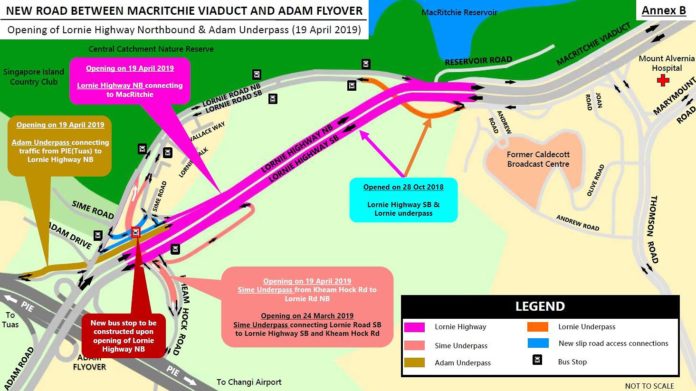
SINGAPORE: Lornie Highway, which connects MacRitchie Viaduct to Adam Flyover, will fully open on Apr 19, said the Land Transport Authority (LTA) in a media release on Tuesday (Mar 19).
The opening of the northbound section will complete the entire stretch of Lornie Highway. The first phase of the highway was opened on Oct 28 last year.
The new Adam underpass will also open on Apr 19. This will allow motorists on the PIE heading towards Changi to have “a seamless connection” onto northbound Lornie Highway, said LTA.
The northbound Lornie Highway towards MacRitchie Viaduct, Adam Underpass and the remaining bound of Sime Underpass will open on Apr 19, 2019. (Graphic: Land Transport Authority)
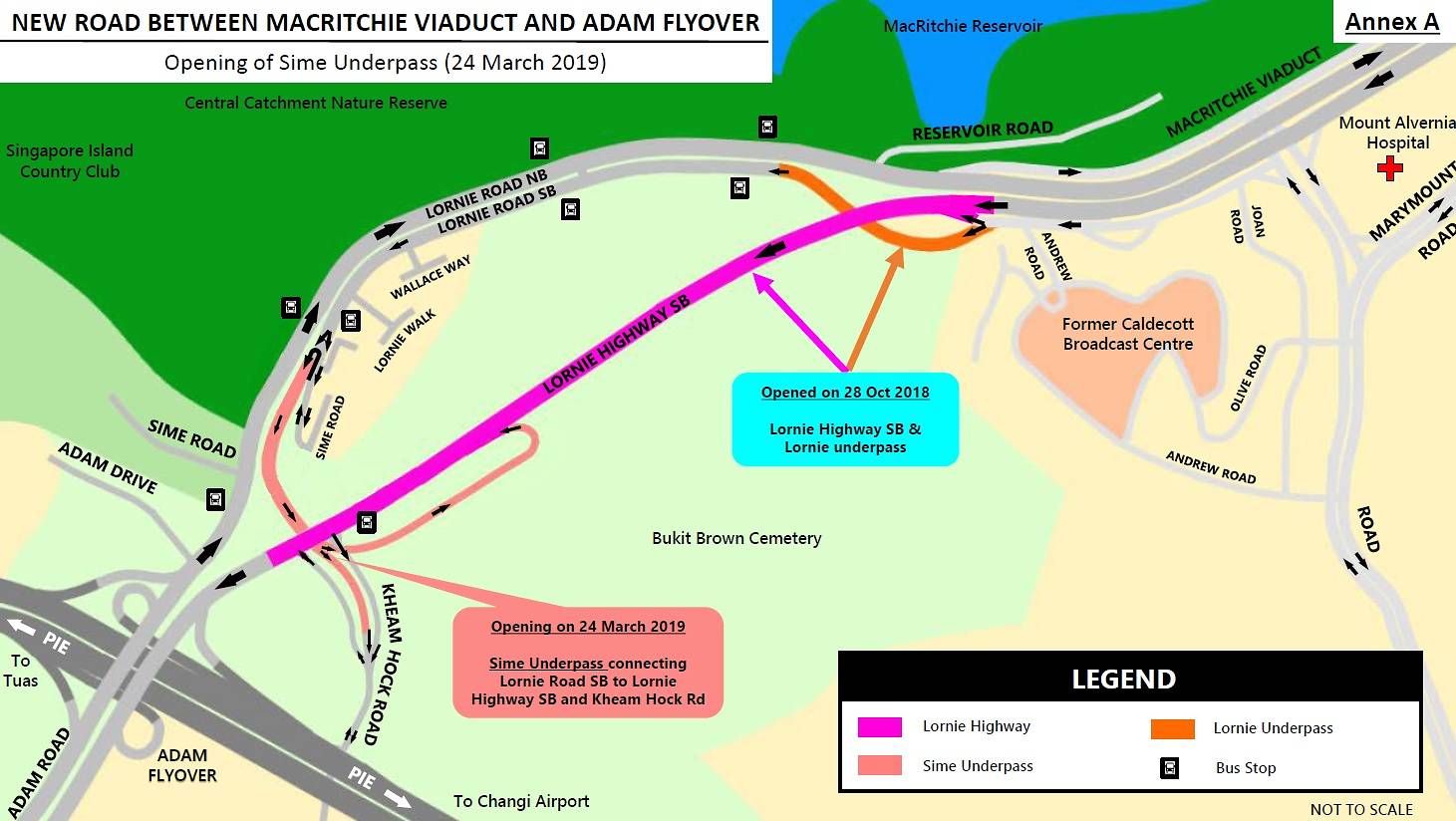
Opening in two phases, one bound of the Sime Underpass will first open at 3am on Mar 24. Motorists will be able to go directly from Lornie Road (southbound) to Lornie Highway (southbound) and Kheam Hock Road.
With this connection, the temporary road connection from Sime Road and the signalised junction along Lornie Highway (southbound) will be removed, said LTA.
The remaining bound of Sime Underpass, which will bring traffic from Kheam Hock Road towards Lornie Road (northbound), will be fully completed by Apr 19 as well.
LTA said the phased approach was adopted due to the expected increase in traffic flow during the Qing Ming Festival, which falls from end March to early April.
Sime Underpass connecting Lornie Road (southbound) to Lornie Highway (southbound) and Kheam Hock Road will open on Mar 24, 2019. (Graphic: Land Transport Authority)
The completion of the entire Lornie Highway and the underpasses will improve traffic flow along Lornie Road and the PIE, said LTA.
It will also “cater to expected growth in future traffic demand”, it added.
A new bus stop will be constructed as well along the new access road to Sime Road estate with the new highway opening, said LTA.
Bus services 52, 74, 93, 852, 855 which are currently operating on Lornie Road would cater to the new northbound highway.
The change in routes is expected to be effective by the third quarter of 2019.
Sime Underpass connecting Lornie Road (southbound) to Lornie Highway (southbound) and Kheam Hock Road will open on Mar 24, 2019. (Graphic: Land Transport Authority)
EXPANSION OF KPE/TPE INTERCHANGE
On Mar 30, a new slip road will open from Tampines Expressway (SLE) Exit 6 at the Kallang–Paya Lebar Expressway/TPE intercharge to Halus Link towards Lorong Halus and Punggol Central.
This will give motorists an alternative route when returning from TPE(SLE) to Punggol town to Punggol Central, in addition to existing routes via Punggol Road and Punggol Way.
The new slip road is expected to alleviate the evening peak traffic along TPE towards SLE and at the Punggol Road/Punggol Way exits, said LTA.
By June, another new slip road will also open from TPE(PIE) Exit 7 to Halus Link towards Lorong Halus and Punggol Central.
This will provide motorists an alternative route to Punggol Central.
LTA added that the current Exit 7, which connect to KPE(ECP), will be renamed Exit 7A.
SINGAPORE: Singapore’s largest private residential estate, Braddell View, will be put up for collective sale for S$2.08 billion next week, marketing agent Colliers International announced on Tuesday (Mar 19).
This comes after more than 80 per cent of the owners in the development signed a collective sale agreement one year after the signing process began in February 2018.
A former Housing and Urban Development Company (HUDC) estate, Braddell View was the last HUDC to be privatised in March 2017 – opening up the way for an en bloc sale. Six months later, the collective sale committee was formed.
The 1.14 million sq ft hilltop site – which is made up of two lots measuring about 618,000 sq ft and 525,000 sq ft – is the largest among the 18 former HUDC estates islandwide.
“Given that this is a sizable development, it is likely to see interest coming from a consortium of developers,” said Colliers International managing director Tang Wei Leng.
“In the coming weeks, we will be engaging the authorities to seek more clarity on traffic impact study, the feasibility of a phased redevelopment of the site, and even explore the possibility of selling the site as two separate plots,” said Ms Tang.
The public tender will open on Mar 27 and close on May 28.
The estate is accessible from Braddell MRT station on the North-South Line, and Caldecott MRT station on the Circle Line and the future Thomson-East Coast Line expected to be completed next year.
Amenities around the site include Mount Alvernia Hospital, Marymount Convent School, Raffles Institution and Raffles Girls’ School (expected to be completed end-2019), as well as MacRitchie Reservoir Park.
The Braddell View site is flanked by schools and is close to MacRitchie Reservoir Park. (Photo: Colliers International)
“These excellent attributes make the Braddell View site stand out from the rest and will present developers with an opportunity to create a signature project that will elevate their profile throughout the region.”
OWNERS HAVE BEEN “OPEN-MINDED” AND “ENGAGED”
The Urban Redevelopment Authority (URA), under its Master Plan 2014, has earmarked the site as residential with a gross plot ratio of 2.1. This translates to a proposed total gross floor area of about 2.4 million sq ft.
Colliers estimates that up to 2,620 new units with an average size of about 915 sq ft could be built on the site, subject to approval by the authorities.
Braddell View currently comprises 918 units of apartments, maisonettes and penthouses, as well as two shops.
“We will do our best to gather as much information as we can to help prospective tenderers assess the merits of the plot, as well as minimise potential risks and lower the level of uncertainty,” said Ms Tang.
In 2017, then chairman of Braddell View management committee Mr Alex Teo said that the estate hoped to increase the plot ratio to either 2.8 or 3.2 before it launched an en bloc sale.
Mr Teo also said that if the plot ratio was raised to at least 2.8, the estate could pocket nearly S$3 billion.
“I am heartened that owners have been open-minded, engaged and committed throughout the entire signing process, cognisant of the fact that the estate is ageing and in need of rejuvenation,” Mr Teo said.
With the reserve price tagged at S$2.08 billion, homeowners can expect to receive between S$2.04 million and S$4.03 million per property, according to Colliers’ estimation. The units range between 1,453 sq ft and 3,369 sq ft.
Owners of commercial units, which span 194 sq ft and 517 sq ft, could receive about S$529,500 and S$1.2 million, respectively.
The reserve price translates to about S$1,200 per square foot per plot ratio (psf ppr), and includes an estimated differential premium of about S$795 million to increase land use and top up the lease to a fresh 99 years. The initial 102-year lease term, which started in 1978, had a balance lease term of about 61 years.
In response to Channel NewsAsia’s queries, Ms Tang said that as in every collective sale, Braddell View owners had “understandably” hoped for higher plot ratio.
“However, land use in Singapore is guided by the government’s Master Plan and Concept Plan,” she said.
Braddell View is the largest private residential estate in Singapore. (Photo: Colliers International)
SIGNING PROCESS NOT ‘AN EASY TASK’
Mr Teo, now chairman of the collective sale committee, said that the en bloc bid was not going to be easy from the onset.
“We started the signing process a year ago and we knew then that it would not be an easy task given the large number of owners in the estate,” he said.
Some residents had reportedly voiced unhappiness over the fine print of the deal, such as the method that would be used to divide the earnings should the en bloc sale proceed.
In spite of the reported resistance, the owners of 741 units signed the deal before the February deadline, according to a notice put up by lawyers in charge of the en bloc sale.
Their combined ownership – 80.2 per cent of the total share value and 80.1 per cent of the total area of all lots – was enough to trigger a collective sale.
To reach the 80 per cent consensus, Ms Tang told Channel NewsAsia, Colliers had “worked tirelessly” with the collective sale committee by “maintaining open communication, being transparent about the process, listening to the views of the stakeholders involved, keeping all owners engaged in the discussion, and providing timely and relevant market insights and assessment”.
She also noted the influence market conditions might have had on the owners’ decision.
“Based on our observation, the market conditions have created a sense of urgency among the owners, providing impetus for them – particularly those who are sitting on the fence – to agree to put the development up for collective sale,” she said.
However, they also considered other more personal matters such as replacement home options as well as their housing needs, she added.
When asked about owners who were against the en bloc, Ms Tang highlighted the avenue minority owners have to voice their concern.
“Under collective sale laws (they can) raise their objection to the Strata Titles Boards after the majority owners file an application, when they manage to secure a buyer for the site.”
SINGAPORE: The total share of job vacancies for professionals, managers, executives and technicians (PMETs) rose from 48.5 per cent in 2017 to 53 per cent in 2018, latest data from the Ministry of Manpower (MOM) showed on Tuesday (Mar 19).
This reflects an increase in vacancies in PMET-dominated industries such as professional services, financial and insurance services, and information and communications (ICT), MOM said in its report, after it surveyed 15,900 establishments.
Forty-two per cent of the 63,300 job vacancies in 2018 were newly created positions arising from business formation and expansion, it added, with the majority of job vacancies in 2018 commonly from the community, social and personal services, manufacturing, as well as ICT industries.
Over the last five years, ICT roles that had significant growth were chief information officers, database designers and administrators, information technology security specialists, and network and communications managers.
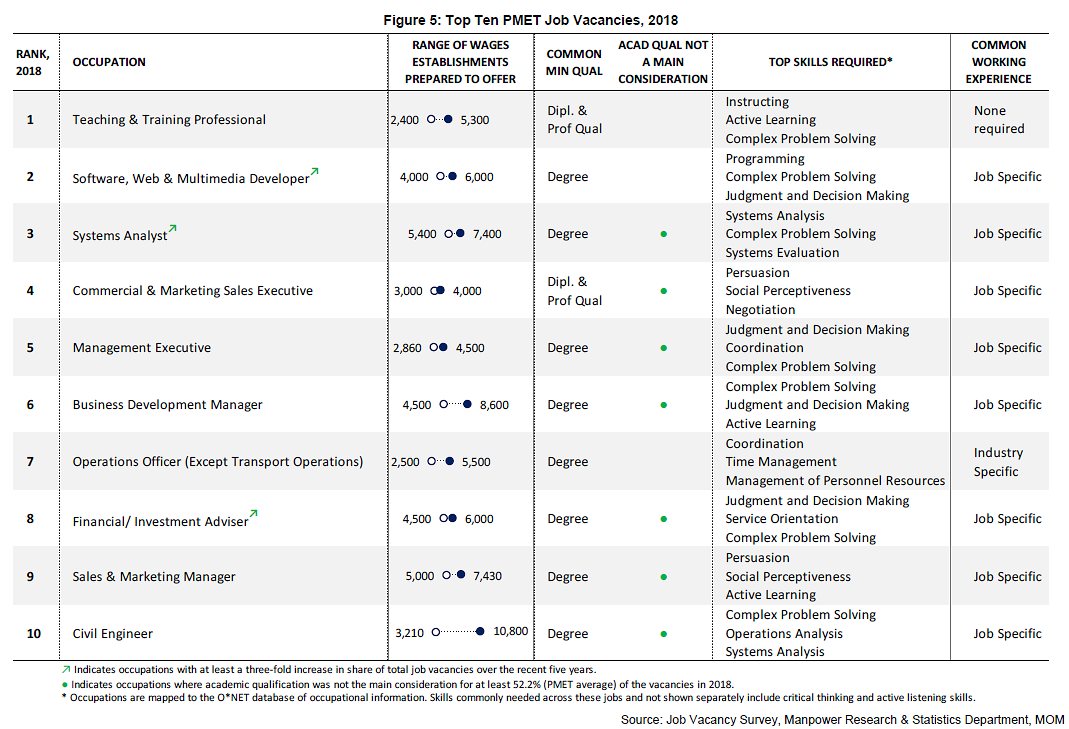
In finance, marketing and business development, the most sought after roles were commercial and marketing sales executives, business development managers, financial or investment advisers and sales and marketing managers.
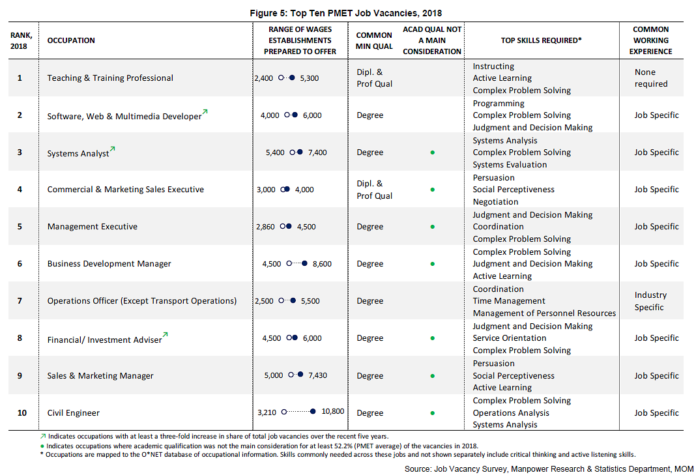
Top ten job vacancies for professionals, managers, executives and technicians. (Table: MOM)
There is also an emerging demand for analytical positions in regulatory and risk assessment as well as market research, MOM’s report said.
More employers also looked beyond academic qualifications when hiring PMETs, the report added. The proportion of PMET vacancies where academic qualification was not a main consideration increased from 42 per cent in 2017 to 52 per cent in 2018.
For instance, employers placed stronger emphasis on skills or relevant work experience for positions including software, web and multimedia developers, system analysts and commercial and marketing sales executives, the report said.
However, 21 per cent of PMET job vacancies remain unfilled for six months or more in 2018, according to MOM’s report, with employers indicating lack of candidates with necessary specialised skills (54.9 per cent) or work experience (31.8 per cent) among top reasons.
Top ten job vacancies with significant growth for professionals, managers, executives and technicians. (Graphic: MOM)
DECLINE IN VACANCIES FOR SOME NON-PMET JOBS
Non-PMET positions remain harder to fill, MOM’s report said, with 49 per cent of non-PMET jobs unfilled for at least six months. Employers indicated reasons such as unattractive pay (47.2 per cent ) and physically strenuous job nature (52.8 per cent).
Vacancies for non-PMET positions such as cleaners, shop sales assistants and security guards have also declined, the report said.
“In particular, the share of vacancies for shop sales assistants was nearly halved from five years ago, as the retail industry continues to evolve in the face of changing consumer preferences and competition,” the report said.
Meanwhile, vacancies for healthcare assistants such as therapy aides increased over the past five years, with employers prepared to pay at least S$1,400 in 2018, more than S$1,200 two years ago.
“As companies reinvent and build digital capabilities, new jobs in demand in technical and analytical fields have emerged,” MOM said in the report.
“When hiring, employers are also looking beyond academic qualifications to consider a wider pool of candidates with relevant skills or working experience.
“For non-PMET job openings which tend to be harder to fill, employers are encouraged to improve job quality through job redesign and salary review to make them more attractive to locals.”
SINGAPORE: Five families roughed it out at Marina Reservoir by surviving on only five litres of water for 12 hours on a cold night on Mar 1. They were participating in a water-rationing camp run by outdoor recreations company Better Trails.
The camp, which was supported by PUB, was one of several initiatives for the agency’s latest water-saving campaign, “Make Every Drop Count”.
Launched on Mar 2 as part of Singapore World Water Day, it will run for an entire year, making it one of its biggest and longest to date. Previous editions in recent years had lasted a month at most.
The last time PUB embarked on a campaign of such a scale as this year’s was likely in the 1990s, which involved household water-rationing exercises across Singapore.
The recent launch event was graced by President Halimah Yacob and included over 2,000 representatives from schools, corporations and grassroots organisation.
The latest campaign will also feature 60 roadshows and events across Singapore for this month alone.
To mark World Water Day, 23 landmarks and buildings around Singapore will be lit in blue on Mar 22.
In a departure from previous campaigns that focused mostly on water conservation, this year’s drive will cast the spotlight on the making of water.
“We know water comes from the skies as rain, but we seldom think about the complex process of where every drop of it goes to be cleaned, filtered and purified before it reaches our taps,” said Mrs Cindy Keng, the director of PUB’s 3P Network Department, in an email interview. The department oversees PUB’s engagements with stakeholders in the public and private sectors.
This year’s high-profile campaign comes on the heels of a survey jointly conducted by the national water agency and REACH feedback unit which found that younger Singaporeans did not view water conservation as important as older residents.
File photo of a cup filling up water from a tap. (Photo: AFP/Anne-Christine Poujoulat)
Singaporeans’ water usage has declined steadily over the last few years. From 2003 to 2009, Singapore’s daily household water consumption per person dropped from 165 litres to 155 litres. Following the rise in water tariffs over the last two years, the figure dropped from 148 litres in 2016 to 143 litres in 2017 — the sharpest drop in a decade.
Given the findings, Mrs Keng added that it was timely for PUB to “refresh” its water-conservation campaign to build “a more pervasive water-saving culture”.
WATER-SAVING CAMPAIGNS OVER THE YEARS
PUB’s water campaigns have become a regular fixture since the first one was held in 1972. At that time, the “Water is Precious” campaign was launched in the wake of a prolonged drought in Singapore.
In the 1980s, the campaign was renamed “Let’s Not Waste Precious Water”. A Water Conservation Unit was formed to visit large industrial water users and suggest how they could reduce water consumption. A water-conservation course was also introduced in secondary schools to help students understand Singapore’s water challenges.
In the 1990s, Singapore’s water consumption growth rate was at 6 per cent a year. This raised concerns that Singapore would run out of water by 2001.
As such, the PUB launched the now annual “Save Water” campaign in 1995 to encourage Singaporeans to reduce their water consumption.
That year saw the PUB conduct a water-rationing exercise with 30,000 households. Water supply to houses was disrupted for up to 14 hours a day as part of its six-day campaign.
Recounting her experience, 48-year-old Anna Gloria Anandhi Pawai said:
I remember we did water rationing a long time ago when I was in secondary school.
“The authorities would inform us that the water supply would be shut off and my mum used to tell me to fill up bottles before then. We literally experienced conserving water in big tanks for a few hours.”
The millennium marked the debut of NEWater, which was wastewater purified into drinkable water by PUB.
At the 2002 National Day Parade, then Prime Minister Goh Chok Tong, ministers and participants toasted with NEWater to show that it was safe to drink.
The water-saving campaign during that period also centred around Singapore’s four “National Taps” to highlight its strategy to achieve self-sufficiency in water.
The taps refer to Singapore’s four sources of water, namely imported water, water from local catchments, NEWater and desalinated water.
(Photo: REUTERS/Carlos Barria)
The four taps marked a turning point in Singapore’s water security strategy as they would allow the island to become completely self-sufficient if necessary after the expiration of the 1962 Water Agreement with Malaysia in 2061.
In 2005, Water Wally, a blue water droplet, made its first appearance as PUB’s mascot and has been a mainstay in campaigns since. Although Water Wally had received some negative publicity, several people highlighted the mascot when recalling past PUB campaigns.
“My memory of water campaigns was of the Water Wally mascot from primary school,” recounted 20-year-old university student Kirstin Yip.
“The teachers would occasionally give out booklets to teach us things like cyber bullying, being kind, and saving water. I remember posters and videos of Water Wally telling students to shower for less than 10 minutes.”
In 2008, the PUB launched its annual Singapore World Water Day celebrations in March to coincide with the United Nations’ World Water Day.
“Since 2008, the annual Singapore World Water Day celebrations in March have been a key platform for us to rally the community and corporate partners to conserve water,” said Mrs Keng.
“The event has garnered good traction over the years, with partners coming on board to run activities such as roadshows and exhibitions, door-to-door engagements and water-saving competitions.”
The following decade saw the PUB target new audiences in its campaigns. It increased its presence online by posting regular updates to engage netizens on water conservation.
Foreign workers were also brought into the fold. Water-conservation roadshows were held at their haunts while brochures printed in Tamil, Chinese, Thai and Burmese were distributed to them.
KEEPING UP WITH TIMES
Each iteration of PUB’s campaign has sought to keep up with the population’s changing attitudes.
Dr Yugal Joshi, a director at the Swachh Bharat (Clean India) Mission in India’s Ministry of Drinking Water and Sanitation, said that in the beginning, campaigns had mostly been controlled and targeted.
“After independence, when water scarcity was stark and Singapore was dependent on foreign water, people were asked to stay away from water sources and reservoirs so as to avoid polluting them,” he noted.
“The water conservation and cleanliness campaigns were then focused on information, public relations and awareness.”
At that time, there were only three reservoirs and a catchment area in Singapore which covered 11 per cent of the land. Today, it has 17 reservoirs.
Generic photo of Lower Seletar Reservoir. (Photo: PUB)
However, with rapid socio-economic development, PUB’s campaign began to incorporate greater public participation, said Dr Joshi, who is also the co-author of The Singapore Water Story, a book which chronicles Singapore’s journey to achieve water sufficiency.
“From the last decade of the previous century, a first-world, confident and self-reliant Singapore successfully experimented with giving partnership to the public in its water-conservation campaigns,” he said.
“Water resources like reservoirs became proud playgrounds. The campaigns became bolder, high-tech and innovative.”
With the emergence of a new generation that had never suffered hardship, campaigns also became more “celebratory” in their approach over the last two decades.
Concepts such as “bonding with water”, “valuing water” and “enjoying water” were introduced to emphasise a personal citizen-water relationship, added Dr Joshi.
The recent campaign, which focuses on the processes involved in making Singapore’s water clean, is yet another effort by PUB to keep up with the changing attitudes of the new generation.
Unlike their older counterparts who insist on saving water and avoiding wastage, the current generation has grown used to water coming out at the turn of the taps.
Given the younger generation’s inability to relate to water scarcity, Dr Joshi said that it made sense for PUB to centre its latest campaign around the water-treatment process.
“We often say, we drink the same water that dinosaurs used to drink …This explains the (difficulty) of natural water treatment and recycle process. Therefore, the residents must be told that any misuse of water would indeed lead to a series of catastrophes.”
He added: “The visualisation, experience and imbibing the complexity, effort and money that go into treating every drop of used water will go a long way to make people value this scarce resource.”
A NEWater plant in Singapore. (File photo: TODAY)
While the approach of campaigns has evolved over the years, Dr Joshi said that successful campaign techniques such as the Meter Reading Contest in 1978 could be brought back, albeit catered to a younger audience. The contest was to encourage consumers to read meters set up at PUB’s exhibition. Those with correct readings were rewarded with vouchers.
However, Dr Cecilia Tortajada, a senior research fellow at the Lee Kuan Yew School of Public Policy’s (LKYSPP) Institute of Water Policy, cautioned that some “scare tactics” such as water rationing are unlikely to work in this day and age.
Switching off the taps as part of a campaign exercise would only affect vulnerable people such as children and the elderly, and would detract from the message that the PUB intends to send, she said.
“You want to deliver a message which is accurate. But if any message makes people feel unsafe, the negativity of the message will become exaggerated. This results in the proper information not getting through to the people.”
She added that the PUB should stick to its “straightforward” messaging without being alarming.
“The PUB has a very clear message in the sense that it tells people how they can participate (in water conservation),” she noted.
“What the PUB has been doing so far is to explain the situation, explain the pluses and minuses of water conservation and invite people to contribute to the campaigns. This will help people understand more about water conservation.”
The changing attitudes towards water by the younger generation were confirmed by a survey conducted by PUB and REACH last October.
The qualitative survey involved 48 Singaporeans and permanent residents who paid their own household utility bills. Participants were segmented into three groups – families with children below 12 years old, families with teenage children and seniors aged 55 and above.
It found that younger participants such as those with young or teenage children, viewed water scarcity as “a distant concept” compared to their older counterparts.
Younger Singaporeans felt little urgency to conserve water as it is readily available in taps, while some participants felt that water scarcity may not be an issue given new technologies like NEWater and desalination which allowed Singapore to diversify its water sources.
People may be ingesting between 3,000 and 4,000 microparticles of plastic from tap water every year, said a study. (AFP PHOTO / FRANCK FIFE)
Mrs Keng said that the decision to step up the campaign this year was prompted by the survey findings.
“Singaporeans are generally aware that water is a precious resource. However, the readily available clean water at the turn of the tap may have inadvertently led to a perception that water shortage is a prospect that is far from reality,” she added.
“Among the younger participants, the water-saving culture seemed to have been watered down and the sense of importance attached to water sustainability appeared to be less salient.”
As such, it was timely for the PUB to refresh its water-saving campaign.
Mrs Keng said that the latest campaign would seek to create greater buzz and awareness on the ground, which will be supplemented with targeted outreach efforts to specific groups.
One such group has been Muslim worshippers, who received a sermon in their mosques on Mar 8 to mark Singapore World Water Day.
Another group has been the local art community, whose artistic expressions of water will be displayed along Orchard Road this month.
Beyond campaigns, Mrs Keng added that PUB would also create channels to engage the public on water-related issues with a strong environmental message, such as the “Friends of Water Programme” and “Watermark Award”.
The former encourages community participation in positive water-related causes, while the latter is awarded to individuals or organisations that achieve water efficiency.
OLD WATER IN NEW BOTTLE?
Despite a “refreshed” campaign with a new focus on water treatment, it retains similar messages from previous ones.
For instance, the latest campaign continues to publicise household water-saving tips featured in previous editions.
However, the tips have been “rebranded” under a memorable mnemonic — W-A-T-E-R — to represent washing clothes on full load, always using half-flush, and turning off the shower when soaping, among other pointers.
Engagement with schools are not a new approach either. The PUB has been conducting water-rationing exercises with schools since 2016.
It remains to be seen if programmes and activities planned for students by PUB in the latter half of the year will depart from the usual campaign activities.
Several people interviewed were also unaware that PUB had launched a water campaign this year. Others who have young children said that there limitations on what they can do to conserve water.
Ms Anandhi whose household has eight members, said that her family consumes water at about 10 per cent above the average Singaporean household each month.
While she tries to conserve water at home, she admits that her four children, aged two to 16, do not share the same attitude.
(Photo: Pixabay/stevepb)
“During my time, we had water-rationing exercises to help us understand the importance of water shortage. Children nowadays don’t have similar experiences,” the home-maker said.
“They are used to the convenience of taps and washing machines. They don’t understand how much water is being consumed.”
Similarly, registered nurse Majidah Mahamood, 32, said that her utilities bills are consistently high, averaging about S$300 each month.
Mdm Majidah said that although she feels the need to save water, her hands are tied since she has three school-going children aged four to six, and an ailing mother.
“Sometimes (the high bills) cannot be helped. My mother who has dementia tends to forget to turn off the tap.”
Although her children had taken part in activities held in conjunction with PUB’s water campaign, Mdm Majidah said that the effect of the campaign activities was temporary.
“My son went for a NEWater excursion recently. He knows he should save water, but after a while he forgets to do so,” she said.
“It’s the same with my other children. Sometimes they have projects on saving water, but if I were to ask them three weeks later if they remember the messages they had learnt, they couldn’t recall.”
Director of public relations firm AsiaPRWerkz, Ms Ginny-Ann Oh, said that even though the latest PUB campaign is not well known among people in some quarters, its effectiveness ultimately has to be judged by the change in people’s behaviour.
“The success of a campaign is based on a change in behaviour. For those who may not know the tagline for PUB’s water campaign, how many of them have actually adopted water-saving behaviour?” she said.
“If they are already using thimbles on their taps, which regulate water flow rate, then that is a change in behaviour. Gone are the days where we judge the success of a campaign based on their knowledge of taglines.”
Ms Oh said that in PUB’s case, the gradual reduction in household water consumption among Singaporeans over the last few years suggested a degree of success in its campaigns.
On whether the PUB is re-using old tactics in its latest campaign, Ms Oh said that good practices to save water hardly change over time, which may explain why PUB continues to incorporate them in its campaigns. These practices also need to be conveyed to the younger generation.
She acknowledged that the effects of any campaign would be temporary, especially on young children. However, constant reinforcement would help a campaign message to be transmitted successfully.
Water Wally formation at the Singapore World Water Day 2016 Opening Ceremony. (Photo: PUB)
“Children need repetition, reinforcement and reminder for something to become a behaviour or habit. For example, after a school water-rationing exercise, are there posters put up in the toilets to remind them to use less water?,” said Ms Oh, whose firm does not work for PUB.
“Do their parents remind them that their shower is running when they get home from school? It’s a concerted effort that needs to be done at a consistent level for a child’s behaviour to change.”
In this regard, Ms Oh said that mounting a year-long campaign would likely be more effective than previous campaigns given that there are more opportunities for students and the public to be reminded on ways to save water.
TIME FOR A STRONGER MESSAGE?
Water experts also suggested that the PUB tweak its message to resonate with the younger generation and to keep up with changing global events.
Given that the younger generation has not experienced water scarcity, Dr Tortajada said that a message has to be crafted to make them think about their individual responsibility towards saving water. To this end, water campaigns should place greater emphasis on the effects of climate change on water sustainability in Singapore.
“People read about climate change all the time. Now if you talk to a taxi driver, or a student or a teacher, they know about the potential implications of climate change.”
For LKYSPP Visiting Professor Asit Biswas, the message put forth by PUB needs to be more stark as Singaporeans’ water consumption is not going down as much as it could.
“We have to tell all Singaporeans that 50 per cent of the water is not coming in from Johor, and climate change is making water availability and extreme drought a very serious problem,” he said.
In October 2016, water in Johor’s Linggiu Reservoir, which supplies water to Singapore, reached a historic low of 20 per cent.
File photo of Linggiu Reservoir. (Photo: Monica Kotwani)
“With the uncertainties of climate change, droughts could last for a longer period, such as in California or Australia. We must make clear to the people that reducing water demand would not affect their quality of life,” said Dr Biswas.
“Other cities have successfully reduced their water demand and they lead a very good life. When the next drought hits, Singaporeans are the ones who will suffer because water will not be available when you want it.”
Echoing their views, Ms Yip, the university student, said that the PUB could also play up the message of climate change.
“The knowledge that our planet is dying faster than we might like it to, and (the fact that) there are a few ways to make an impact at an individual level would spur me to conserve more water.”
Associate Professor Md Saidul Islam, who specialises in environmental sociology at the Nanyang Technological University, said that in societies such as Singapore where people are disconnected from nature, their behaviour is driven by rational economic calculations and gains.
As such, Singaporeans are unlikely to change their behaviour if they do not see any incentives.
Agreeing with Assoc Prof Islam, 28-year-old civil servant Joanne Loh said that the biggest factor for her to cut down her water usage would be a rise in water prices.
To encourage Singaporeans to save water, she suggested that incentives or disincentives be introduced to appeal to Singaporeans’ practical nature.
With the recent change in its campaign message, it remains to be seen if this year’s longer PUB campaign will bear fruit.
“It’s still early days for the latest campaign, so let’s wait and see what else is being done,” said Ms Oh.
SINGAPORE: An 82-year-old woman died in hospital from injuries sustained in an accident on Monday (Mar 18) at the junction of Marine Parade Road and Amber Road.
Police said they were alerted to the accident at 12.30pm.
“The pedestrian, an 82-year-old woman was unconscious when conveyed to Tan Tock Seng Hospital where she subsequently succumbed to her injuries,” police said.
The driver, a 29-year-old man, is assisting in investigations.
An eye-witness said the 82-year-old woman was flung into the air and hit her head on the windshield of the car. (Photo: Sandra Decasper)
According to a witness, the car mounted the kerb and hit the woman, who was on the pavement at the time.
“It was an horrific scene because of the violence of the hit,” said another witness.
Both witnesses, who are residents at the nearby Silversea condominium, said the woman was flung into the air by the impact, and hit her head on the windshield of the car.
She was said to be bleeding profusely from the head.
The witnesses, along with other residents, kept the woman company while waiting for the ambulance and police to arrive.
The witnesses said the residents of Silversea condominium have written to both the Land Transport Authority and the condominium management to appeal for safety measures to be taken.
Residents of Silversea condominium, including the witnesses, say they have written to both the LTA and the condominium management to appeal for safety measures to be installed. (Photo: Sandra Decasper)
This story came from a reader tip-off. If you would like to send in photos or videos of something newsworthy, WhatsApp our Mediacorp news hotline at +65 8218 8281 or message us on Facebook.
SINGAPORE: Private Ethan Maniam’s food allergy meant he was classified as PES C when he enlisted in the Army. However, that did not stop him from getting a military experience.
He is from one of the first batches of recruits to graduate from Basic Military Training Centre (BMTC) School Five, which began operations in October last year.
The school is dedicated to full-time national servicemen who can only take up combat support and service vocations. These personnel, who are given PES C or E status, go through a combined nine-week, stay-in course at the school.
PES C and PES E recruits are put through the Service-Fit Fitness Programme, which lets them train and progress at their own pace while under supervision. (Photo: MINDEF)
Those classified in PES E previously had to go through a two-week military assimilation programme.
“Training is now centralised so that commanders are able focus on people who have issues, who are not combat fit,” said Private Maniam. “So being in PES C, I feel very safe.”
NSFs given either PES C or E status now have to go through a four-week soldiering phase, during which they can self-regulate their training. This allows them to train and progress at their own pace while under supervision.
The enhanced training curriculum allows recruits to participate in more training activities, at their own pace. (Photo: Ahmad Khan)
This is followed by a five-week vocational training stint, during which they learn how to take on roles, such as that of a transport operator.
Afterwards, they have a Weapon Presentation Ceremony and a combined graduation parade to look forward to – an experience that their counterparts from earlier batches did not get to go through.
“We have also brought in experienced and committed instructors from BMTC and also other training institute to BMTC School Five to ensure quality, care and supervision are also given to recruits,” said LTC Sim Kian Hwa, the school’s commanding officer.
“We have also collaborated with SAF counselling centre for training and management of instructors so they are able to take care of the recruits properly during the nine-week stay-in period.”
Senior Minister of State for Defence Heng Chee How speaks to Private Ethan Maniam, a recent course graduate, and his parents during his visit to the Basic Military Training Centre School V. (Photo: Ahmad Khan)
Senior Minister of State for Defence Heng Chee How, who visited the school on Monday (Mar 18) afternoon, said every full-time national servicemen has a role in defending Singapore, regardless of medical status.
“It is very important for us to have effective training that is safe that leaves a very good and impactful sense of experience with our NS men, so that everyone, regardless, has strengths to contribute into the defence of the country,” he said.
Three batches of recruits have already graduated from the school, and about seven more batches are expected to come through by the end of the year.