Home Blog Page 822

Last Day at Work: The aviation worker whose long journey through the ranks saw him eventually make it as airline captain

0

SINGAPORE: Something unusual happened on board Scoot flight TR 181 on Mar 6, before it left Nanjing airport to head towards Singapore. 

The flight captain, Chung Choon Yin, was asked by his crew-in-charge Yong Hui Yi to step out of the cockpit into the passenger cabin. 

When Mr Chung walked out of the flight deck, the flight’s passengers and crew were there to surprise him with a farewell party. It was the veteran pilot’s last flight after more than four decades in aviation. 

Ms Yong meticulously planned the celebration, bringing on board colourful balloons and customised banners. She and the other crew members invited passengers to join in. 

Chung and passengers

Captain Chung with enthusiastic passengers during his last flight for Scoot. (Photo: Scoot) 

Speaking to Channel NewsAsia in an interview recently, Mr Chung said he felt grateful for the jubilant send-off. 

“It was a pleasant surprise! Even the passengers joined the celebration. My cabin crew had good rapport with the passengers … and they were more than happy to celebrate the occasion with me,” he said.

But even then, Mr Chung knew that his last task as captain was not over, and he had to keep focused to ensure the journey went smoothly. 

“The job is never done until the aircraft comes in, and the (wheel) chocks are on and the checks are over,” said Mr Chung.

“So during the flight itself, I had no time to think about retirement. That’s the beauty and requirement of this job. You cannot let your mind wander, so basically I was concentrating until the flight was over,” he added.

BALANCING WORK AND STUDY 

Mr Chung’s journey to captain was not a smooth flight. He spent most of his life in the 1970s burning the midnight oil.

He spent his days as an aircraft maintenance engineer, servicing Singapore Airlines (SIA) planes on the ground. At night, he hit the books, striving to finish his diploma at Singapore Polytechnic.

More than 40 years later, Mr Chung finished his career with the SIA Group on a high, ending his long journey as a captain with budget airline Scoot. Yet it was those moments when he had to struggle at the beginning that Mr Chung recalled most vividly.

“From eight (am) to five (pm), we were on the SIA premises, at the airplane hangar or apron servicing unit. And from 6 (pm) to 10 (pm), we’d have to go to the polytechnic to take our diploma classes. This went on for five years,” he said.

Mr Chung and his batch of apprentice aircraft maintenance engineers were being sponsored by Singapore Airlines to complete their studies and become fully qualified engineers.

CY Chung cockpit

Mr Chung posing in the cockpit as a flight engineer during the 1980s. (Photo: Chung Choon Yin) 

But during the course of his work, he had the opportunity to interact with the SIA flight crew, and this piqued his interest in flying the aircraft he was working on.

“I had the opportunity to speak to pilots … over time I saw familiar faces and I asked them what the job is all about. I got interested in flying and I told myself that I wanted to become part of the flight crew,” said the 64-year-old.

After much persuasion from his colleagues, Mr Chung took the pilot conversion course in 1980 and became a flight engineer – his first role inside the cockpit.

FROM ENGINEER TO CAPTAIN

He continued on the same trajectory and became a first officer in 1990. Subsequently, he excelled in SIA’s command course and was appointed captain in 2001. He joined Scoot when he turned 62, and spent his remaining two years as a pilot with the airline.

His whole journey from apprentice engineer to captain took 30 years, with roadblocks and obstacles along the way.

For instance, when SIA offered him the opportunity to convert from being flight engineer to a first officer in 1984, he turned the company down because he could not afford surviving on a training allowance.

“I was sponsoring my sister who was studying in Canada and my mother was not well, so I could not afford to be subjected to a pay cut during my (conversion) training,” he said.

Last Day At Work Scoot

Captain Chung standing at the cabin doors after his final flight. (Photo: Scoot) 

Mr Chung’s engineering background helped him become a better pilot. He said he better understood any defects in the system, and issues that cropped up when flying.

“I am able to understand the constraints of the (engineering) department better, and this helps the company build better synergy between the flying and engineering department,” he said.

“OLD SCHOOL”

Mr Chung’s former colleague at Scoot, first officer Brennen Kho who flew with him four times when the pair were at SIA, told Channel NewsAsia that Mr Chung’s “old school” background meant he had “very strict standards”.

“As a former engineer, his technical knowledge of the aircraft is way up there,” said Mr Kho.

The 39-year-old added that Captain Chung’s rise through the ranks taught him not to be “too comfortable in one place”.

“He wanted to move from the back seat to the front seat, and it’s admirable that he decided to step out of his comfort zone, and try something new,” said Mr Kho.

“It’s something that we can all learn (from), even for me as a first officer on the right-hand seat. I get comfortable in my place and when it’s time for me to take the left-hand seat as a captain, I might find it a little tough,” he added with a smile.

Besides being a role model on the flight deck, Mr Kho also lauded his former colleague’s personality. He said that Mr Chung was “dead serious” inside the cockpit, but when he was out of uniform, he was the friendliest colleague. 

CY Chung Scoot

Mr Chung thanking passengers after his last flight from Nanjing to Singapore. (Photo: Scoot) 

“The thing is, he’s really, really, really generous. He will invite his co-pilots and cabin crew out for drinks during stopovers and he’ll always pay for everything. It got to the point where some of us told him: ‘If you’re going to continue doing this, we’re not going to come out with you anymore.’”

But Mr Chung insisted that he was merely perpetuating a tradition, as his former captains would treat him to meals that he could not afford during his earlier years. He made a habit of buying a big box of snacks from Old Chang Kee at Changi Airport for his crew before every departure.

“Everything comes to a full circle. During night stops sometimes, I remember wanting to eat at certain places that would be too costly for me at the time. My captains would say ‘Come, don’t worry about the cost of it. Let’s go for a meal’,” he said.

“When I became captain, I thought it was time to pay back (the goodwill). I was treated well, so now it’s my turn. I think it’s a good gesture to buy a meal for the crew at a night stop. This practice has gone down very well with crew members. Everybody’s happy and we are able to work much closer as a team,” Mr Chung added.

AVOIDING CLOUDS FOR THE TEAM 

Fostering teamwork was an important aspect of his job as a captain, Mr Chung said, highlighting that a captain is in command of not only the flight deck – but the whole aircraft. He had to coordinate with cabin crew, ground crew, maintenance engineers and air traffic controllers to ensure the flight goes ahead smoothly.

For instance, a captain is responsible for making the work of the cabin crew easier by minimising turbulence when meals are being served.

“You’ve got to take note of when the cabin services are going on. If you see a patch of clouds, you cannot just fly straight through them or you’re going to give the cabin crew a hard time trying to serve the passengers with their meal,” he said.

“You must learn about the environment before your flight so that you can plan the safest and smoothest course for your route,” Mr Chung added.

AN EMBARRASSING LESSON

While his last flight as a pilot went smoothly, Mr Chung recalled how his first flight was a “little bit of an embarrassment”.

It was his inaugural flight as a trainee pilot, and he was scheduled to fly from Singapore to Zurich. But due to his own mix-up, he was still at home when it was about one hour to departure. 

“I got a call from control asking, ‘Hey CY, where are you?’ I said I was at home,” recalled Mr Chung.

“But luckily the place I was staying at was very near the airport and I was able to get to the aircraft in time – 15-20 minutes before departure,” he added.

His captain for the flight was really understanding, and he was let “off the hook”, but following that incident, Mr Chung resolved to never be late for work again. 

STRICT REPUTATION  

According to Mr Kho, Mr Chung has a reputation for being a strict captain, and would demand a high standard from his trainees and first officers.

“He was known as one for the four heavenly kings in SIA, so trainees and qualified first officers back then were all very fearful of him. As a trainee, when I knew I was going to be rostered with him for a flight, I knew I had to really be on my toes. I was very nervous actually and when he first appeared in the crew room, my heart was just going nuts,” said Mr Kho.

Scoot airplane

File photo of a Scoot airplane. (Photo: AFP) 

But Mr Kho recalled that the flight went fine and Mr Chung even treated him to a massage when they arrived at their destination, Bali.

On the way back to Singapore, Mr Kho said he missed out on some procedures. He was given feedback but maintained that he was not screamed or shouted at.

“Of course he came down hard (on me) … but at the end of the flight he gave me a pat on the back and said ‘Good job, just keep it up’. He’ll bring your confidence down and then back up again. This means something because not every captain is able to do that,” he added.

Mr Chung acknowledged that he was a strict mentor, but explained that it was because Scoot and the SIA Group as a whole has a strong safety record, and for this to be sustained, the pilots “must be disciplined” and “cannot condone complacency, even for a minute”.

“I’ve been known for being strict, but to me there’s no two ways about it. There are 400 lives with you, and some of the passengers could be your relatives or loved ones,” he said.

“It’s a job that you cannot ‘play play’. You must give your 100 per cent at all times,” Mr Chung added.

EYEING MENTORSHIP ROLE

Although he has flown his last commercial plane, Mr Chung maintains that his chapter in aviation has not come to a close. He wants to serve as a flight simulator instructor with Singapore Airlines because he believes that he can mentor future pilots

Mr Chung noted that not many cadets with SIA eventually graduate as pilots. He believes that he can play a part in helping them individually with their technique.

“Sometimes a trainee might not be seated correctly. He or she might be placing (his or her) heels on the floorboard .. that makes it much harder to control the path of the aircraft,” he said.

“During my days at SIA, I had quite a lot of trainees who had difficulty getting through certain phases of their training. But once you sit down with them, you will be surprised by how the trainees’ faults could be corrected, most of the time, by giving them different pointers,” added Mr Chung.

He also had words of encouragement for aspiring pilots, saying that they should consider the job if they could fulfill certain requirements – such as maintaining a healthy diet and staying away from alcoholic drinks at least 12 hours before a flight. 

CY Chung family

Mr Chung and his family. Now that he is retired, Mr Chung hopes to spend more time with his 10-year-old son and help out his wife with domestic chores. (Photo: Marcus Mark Ramos) 

“You have to keep a good and clean lifestyle. If you think you are able to accept this, I would say go for it. Why not? It’s a rewarding job. At the end of the day, when flight is over, you don’t have to bring worries home,” he said.

Mr Chung added that he had no regrets with how his career has turned out.

“I would say I am a (more) complete pilot  – in the sense that I was a maintenance engineer before, and then a pilot,” he said.

“So I started off with the company when I was 18, and now I’m 65. I’ve seen it all. Given another chance I would do it all again.” 

Source link

DPM Tharman renews call for cooperative international order at Beijing forum

0

BEIJING: Deputy Prime Minister Tharman Shanmugaratnam has reiterated a call for the world to develop a new cooperative international order to better tackle future challenges.

For this to be “effective and sustainable”, he said on Saturday (Mar 23) that a new relationship between China, the United States and other leading centres of global power is required.

Speaking at the China Development Forum in Beijing, Mr Tharman said that the important development of the last 30 years has been China’s integration with the global economy, although this story is “far from over”.

“Today’s China is still one-third the level of productivity of the United States. There’s still tremendous potential not just for GDP growth, but for a rise in productivity, incomes and capabilities,” said Mr Tharman.

“We must build a new cooperative world order that involves a sharing of responsibilities and an updating of rules that enables China to take greater responsibility in maintaining an open world order.”

Mr Tharman pointed out there have been pushbacks to this open order, which have much deeper roots than today’s governments.

The pushbacks, he said, are not because of a failure of globalisation, but are a result of an open order which has resulted in many people coming out of poverty.

If a new cooperative international order is not established, the world risks becoming more fragmented, said Mr Tharman.

“It will not happen suddenly. It starts with frictions. The frictions become harder and you get divisions, and you eventually get rifts between the leading global economic powers and rifts between different blocks in the global economy.

“That will weaken all nations. It does not just weaken multilateralism,” he said.

Tharman China Development Forum 2

Deputy Prime Minister Tharman Shanmugaratnam poses for a photo at China Development Forum in Beijing. (Photo: China Development Forum)

Mr Tharman said the world today faces future challenges that it is quite unprepared to deal with.

These include the challenge of development, as 1.1 billion young people below the age of 15 in Africa, South Asia and the Middle East will be in need of jobs.

There is also a crisis of global resources, with the world already falling behind in tackling climate change, for example.

The international monetary system is another issue, as countries cannot grow without risk of financial disruption in today’s system.

Mr Tharman, who chairs the G20 Eminent Persons Group on Financial Governance, said the solution to these challenges is to reform global financial governance, which currently lacks coherence.

“It does not require new institutions, new multilateral institutions, new supranational institutions. It requires that we join up the existing institutions – global, regional and bilateral. Leverage on their strengths together. And critically, work together to reduce the risk of the investment environment in the developing world,” he said.

“We cannot return to the old multilateralism. There is no single conductor and we have several orchestras now. We need a new harmony. But we will only get a new harmony if everyone is playing from the same music score.”

Source link

‘Hard choices’ need to be made to keep healthcare spending sustainable: PM Lee

0

SINGAPORE: Hard choices will have to be made as the Government considers ways to fund future healthcare spending, said Prime Minister Lee Hsien Loong on Saturday (Mar 23). 

Healthcare expenditure currently exceeds S$9 billion and is set to rise even further. Eventually, this will be unsustainable, Mr Lee said.

“In the medium term, we have to find new ways to fund this healthcare spending. But at the same time, we have to think hard about what we must spend on, and which drugs and procedures are cost-effective,” he added.

“Hard choices will need to be made, and I hope we will have the support of Singaporeans in making them.”

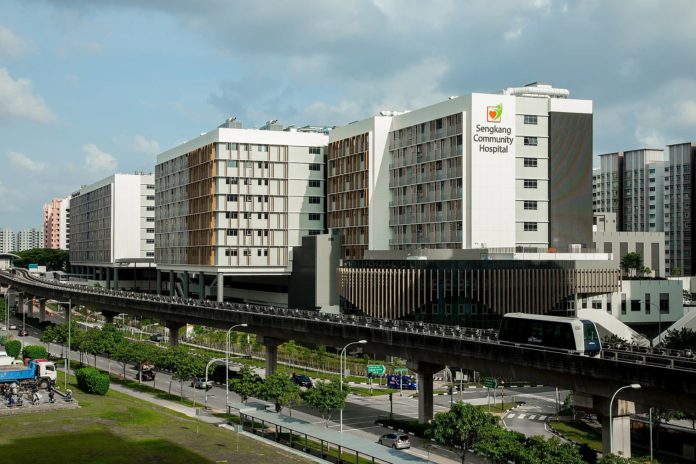
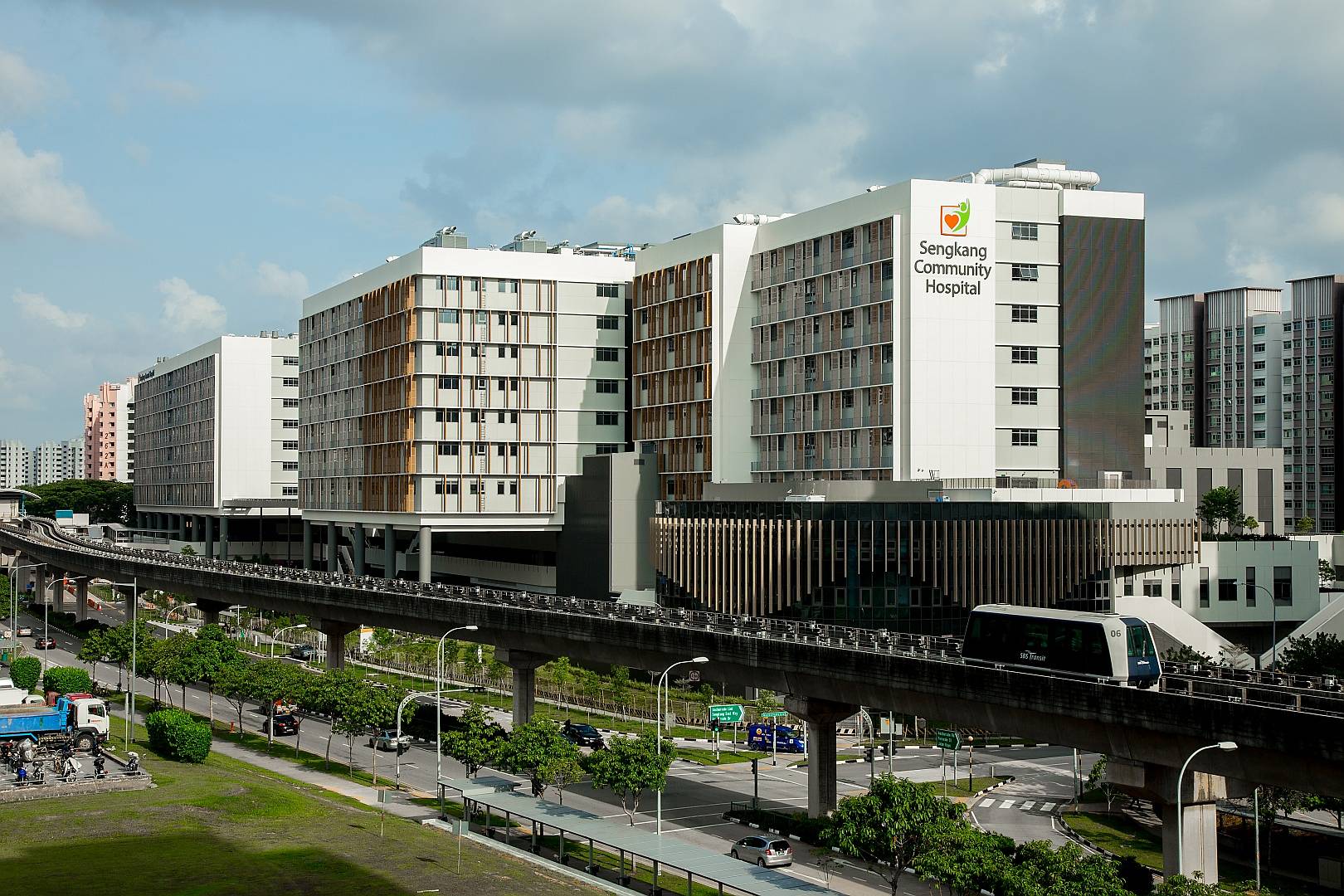
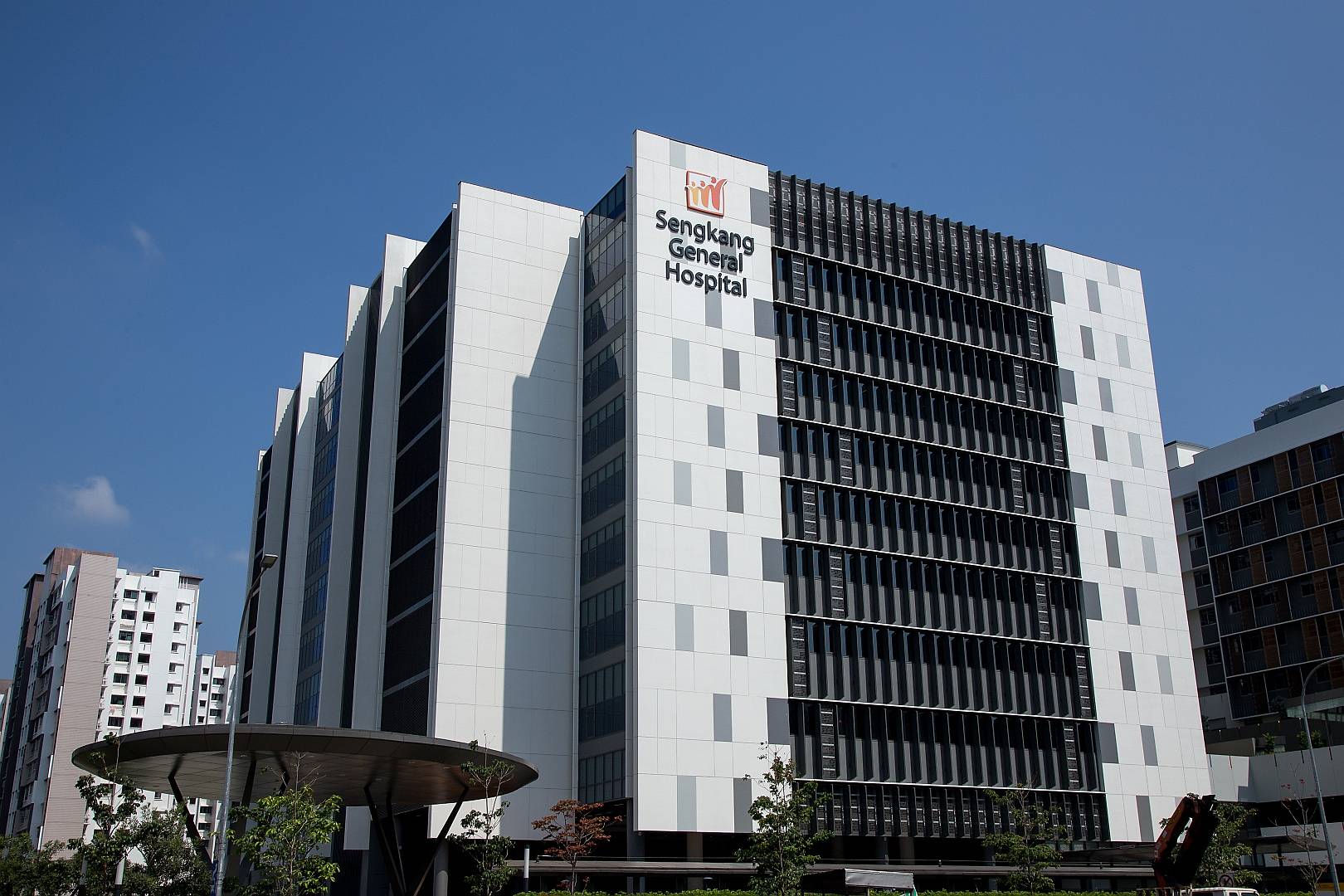
Mr Lee was speaking at the opening ceremony of Sengkang General Hospital and Sengkang Community Hospital.

Sengkang Community Hospital

Sengkang Community Hospital is located near Cheng Lim and Farmway LRT stations. (Photo: Sengkang General Hospital)

He noted that although Singapore spends less on healthcare than most other developed countries, it has better outcomes.

This is mainly because Singapore has structured its system properly, Mr Lee said, and built in the right incentives to guard against overconsumption of healthcare.

“This is not easy to do,” he said.

“It’s very very difficult to tell people that the treatment they want is not really necessary, or not cost effective. Yet we have to watch how heavily the Government subsidises healthcare. This is not just to save taxpayers’ money, but to avoid encouraging over-treatment by doctors and over-consumption of healthcare.”

Singapore has been steadily building and expanding medical facilities across the island as part of the Healthcare 2020 Masterplan. In 2010, Khoo Teck Puat Hospital opened in the north, and in 2015 Ng Teng Fong General Hospital and Jurong Community Hospital opened in the west.

Sengkang General Hospital

Sengkang General Hospital opened on Mar 23, 2019. (Photo: Sengkang General Hospital)

The new hospitals in Sengkang will eventually add about 1,000 acute beds and 400 community beds to the national healthcare capacity.

Mr Lee noted that the co-location of Sengkang General Hospital and Sengkang Community Hospital – with more services integrated at one location – is the latest example of Singapore’s shift towards a more patient-centric, multidisciplinary approach to healthcare.

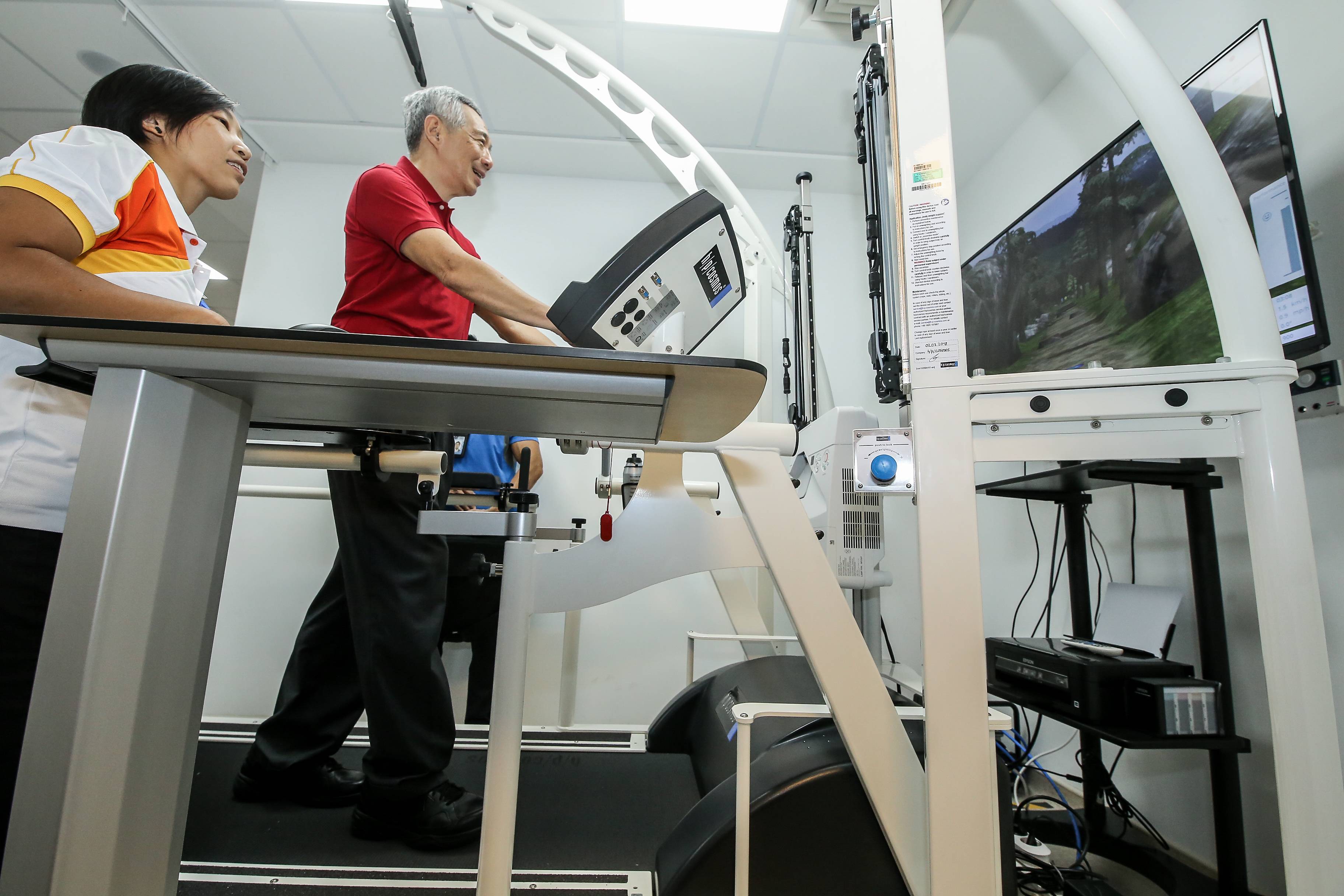
Lee Hsien Loong Sengkang hospital 2

Prime Minister Lee Hsien Loong tries out a virtual reality walking machine. (Photo: Sengkang General Hospital)

“For example, a patient who has been treated at Sengkang General Hospital can be smoothly transferred to the Community Hospital for rehabilitation and continuing care,” he said.

“This is especially helpful for older patients who tend to need longer to recover. The doctors and staff in both hospitals work together as one team to look after the patient comprehensively. Administration is also simplified.”

He added that Singapore’s healthcare system must adapt to meet changing needs like longer life expectancy, rise in chronic diseases and smaller family sizes.

And while the Government is building better facilities, improving the healthcare system is a collective effort, Mr Lee said, as he urged Singaporeans to take responsibility for their own health.

“The best thing that we can do for ourselves is to take care of our own health, stay healthy, and avoid going to the hospital at all,” he said.

“Many diseases are preventable if we watch our diet or lead healthy lifestyles.”

Source link

‘Welcome back Team Singapore!’: Family, friends celebrate Special Olympics homecoming

0

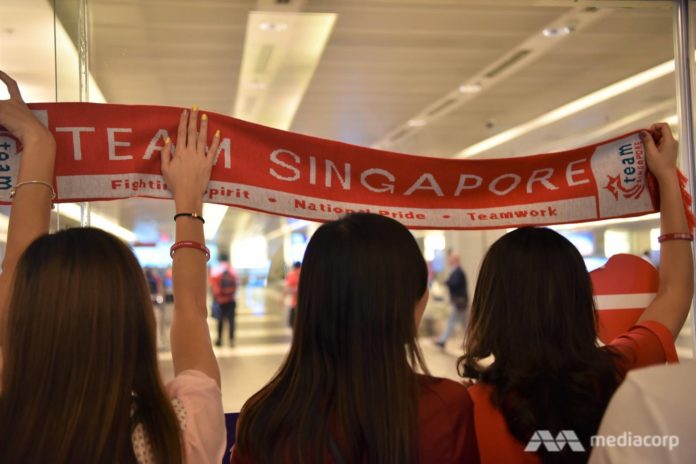
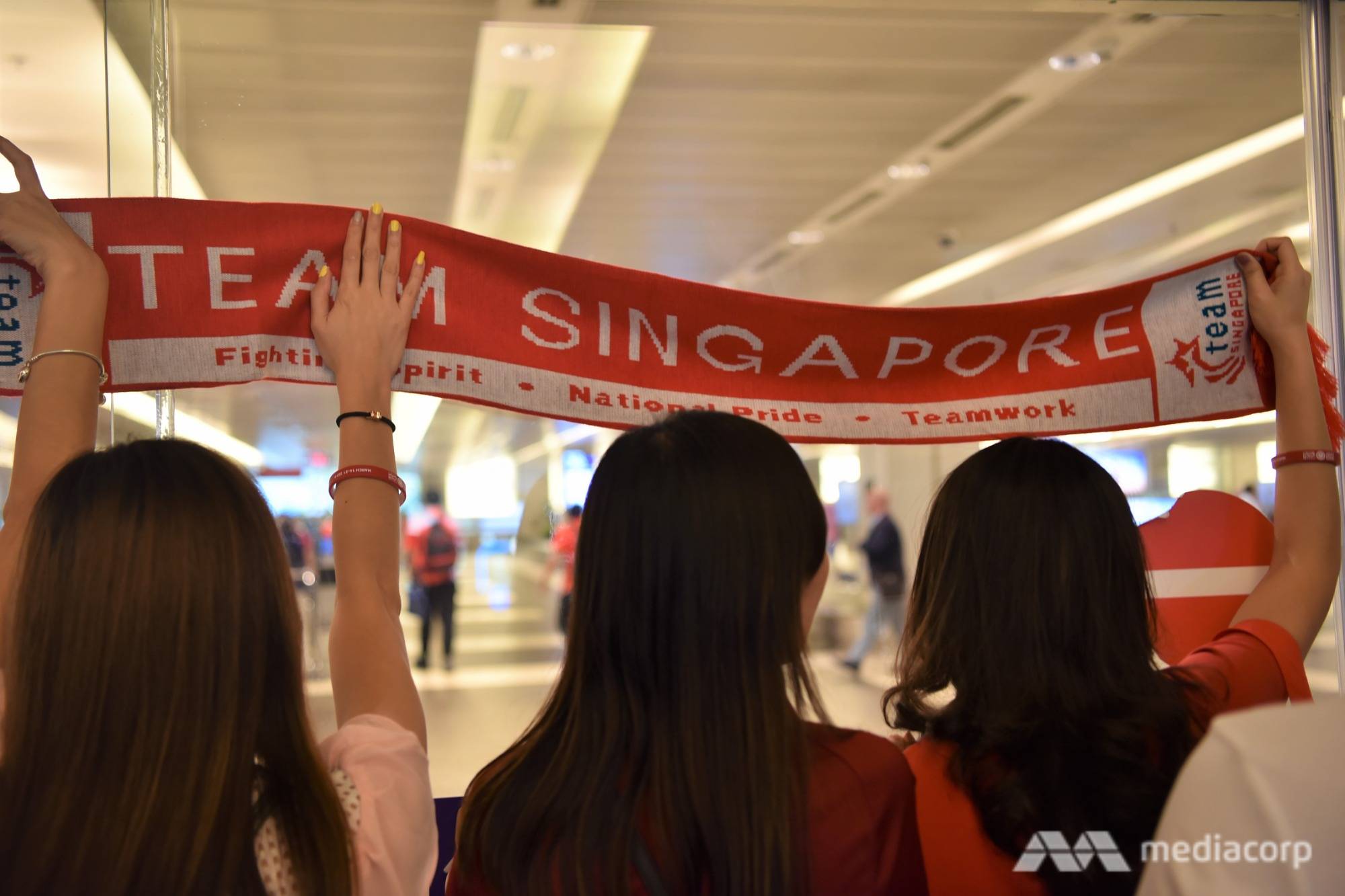
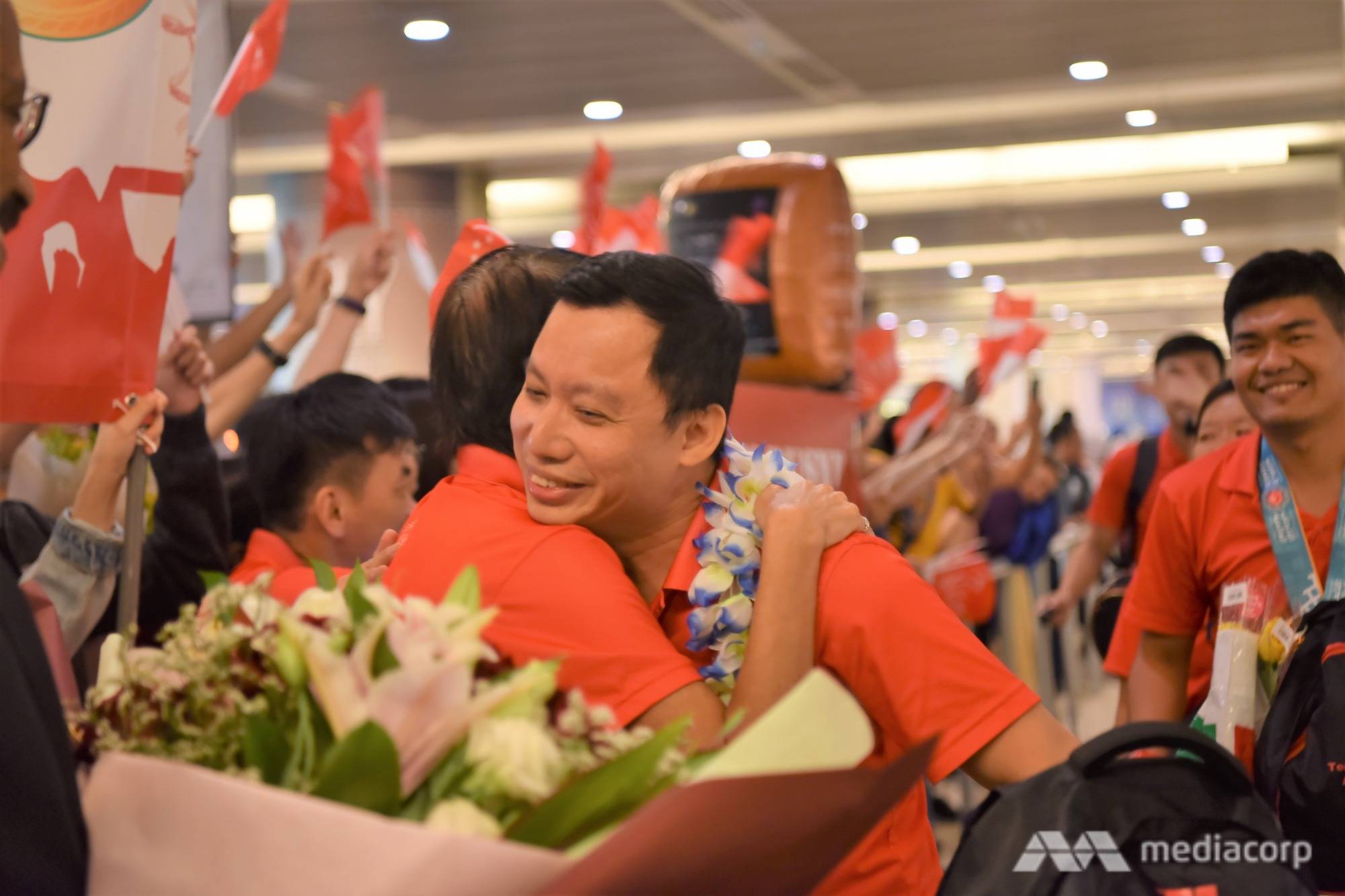
SINGAPORE: The moment Singapore’s Special Olympics athletes entered the arrival hall of Changi Airport on Saturday (Mar 23), a crowd exclaimed in unison: “Welcome back Team Singapore!”

Family and friends had gathered at Terminal 2 – armed with flags, banners, balloons and garlands – eagerly awaiting the return of their loved ones.

Fresh from a week of competition in Abu Dhabi, the athletes walked out proudly with their medals. Someone in the crowd shouted: “Well done!”

READ: Special Olympics: In Singapore’s successful athletics contingent, coaches are learning a thing or two

Special olympics homecoming

Family members of sprinter Maveric Lee plaster themselves against the glass panels upon hearing news of the athletes’ arrival. (Photo: Darius Boey)

Singapore won four gold, four silver and eight bronze medals at the Special Olympics, a competition for athletes with intellectual disabilities.

But it was their stories of grit, guts and never-give-up attitude that have inspired many.

READ: Grit, Guts and Glory – the Special Olympics in pictures

INSPIRING HEROES

Sprinter Jacob Wong, 14, said the competition has been a good experience.

He won gold in the M3 division of the 100m race at the Games, but not before missing his 200m race due to an injury.

“I feel excited because this is my first medal, I am very proud to represent Singapore because they gave me a chance to participate; it is a good experience for me,” said Jacob, the youngest athlete in the contingent.

READ: ‘The heart of a lion’ – Singapore youngster claws back from injury to win Special Olympics gold

He won praise for his stellar performance, with Prime Minister Lee Hsien Loong lauding his efforts.

“We should celebrate such inspiring stories by our athletes who embody the never-give-up attitude, even when things do not go their way. Not forgetting the coaches, support staff, and families, who have cheered the athletes on at every stage of this journey,” said Mr Lee in a Facebook post on Thursday.

Then there was swimmer Siau Ek Jin’s unfaltering determination to represent the nation.

In the 50m breaststroke M6 division, the 26-year-old clinched bronze, clocking a personal best timing of 47.95 seconds.

The swimmer’s mother, Mrs Lucy Siau, said that after he was not selected to take part in the previous edition of the Games, he trained even harder to realise his goals.

Siau Ek Jin

Siau Ek Jin (centre) poses for a photograph. (Photo: Special Olympics Singapore)

“It’s his dream, and he really trained very, very hard, almost seven days a week and two hours a day for the past whole year,” his mother said.

“He was very upset when he wasn’t selected previously but we told him if he continued to train hard he would have the opportunity to go,” she added.

“Now that he has represented Singapore, he has achieved his own target; that’s his proudest moment. The bronze medal is a bonus.

“My son took 10 years to learn swimming and he only made his first stroke when he was 16 years old. For him to make it to the Special Olympics is really a miracle,” she said with a bright smile.

READ: Focus on ability, not sympathy, say Team Singapore’s coaches and officials 

Special Olympics homecoming 2

Family members shower Team Singapore athletes with flowers, banners, hugs and cheers, including Mr Lee Theng Ngee, the Head of Delegation for the 43-man Singapore Team. (Photo: Darius Boey)

The Jeyabalan family had much to celebrate as well after siblings Priyadarshani Jeyabalan and Shaman Pandian Jeyabalan both won medals in Dubai, where the track and field events were held.

Priyadarshani, who had an injury midway through her 400m F3 division race last Tuesday, continued to power through her race to cling on to a third-place finish. Her brother Shaman won a silver in his event.

“I was very happy to get a medal, having teamwork with everyone and helping each other in our group and never giving up on them. When my brother was racing, I screamed: ‘Shaman run faster!’,” Priyadarshani said.

Coach Tamil Selvi added: “Priya is very motherly, she can lead the whole team and the girls can follow her; same for Sharman, he can lead the boys together. There was always team spirit and we could see that they were helping each other.”

Special olympics homecoming 3

The Jeyabalan siblings give a thumbs up with their coaches Nur Hanif Sulaimee (right) and Tamil Selvi (left). (Photo: Darius Boey)

SPIRIT OF THE GAMES

Above all, it was the journey and personal growth of the athletes that mattered most.

“The medals are important but it’s not the only thing, we’re very proud of all our athletes whether they have won a gold medal or whether they’ve come in third or fourth,” said president of Special Olympics Singapore Teo-Koh Sock Miang.

“For us, when you win the medals, that’s just the icing on the cake. Sports is transformative; our athletes transform, grow and learn through sports. They find out who they are and they become so much more confident and independent; that’s what sports is all about,” Dr Teo-Koh said.

READ: For Team Singapore’s Special Olympics contingent, to dare is to do

Thirty athletes took part in this edition of the Special Olympics, the 10th year that Singapore has participated at the quadrennial multi-sport event.

Team Singapore athletes competed in six different sports, including athletics, bocce and bowling, as well as a unified basketball event, where players without intellectual disabilities partnered Special Olympics athletes.

The Abu Dhabi Games brought together 7,500 athletes and unified partners from 192 nations.

Special olympics homecoming

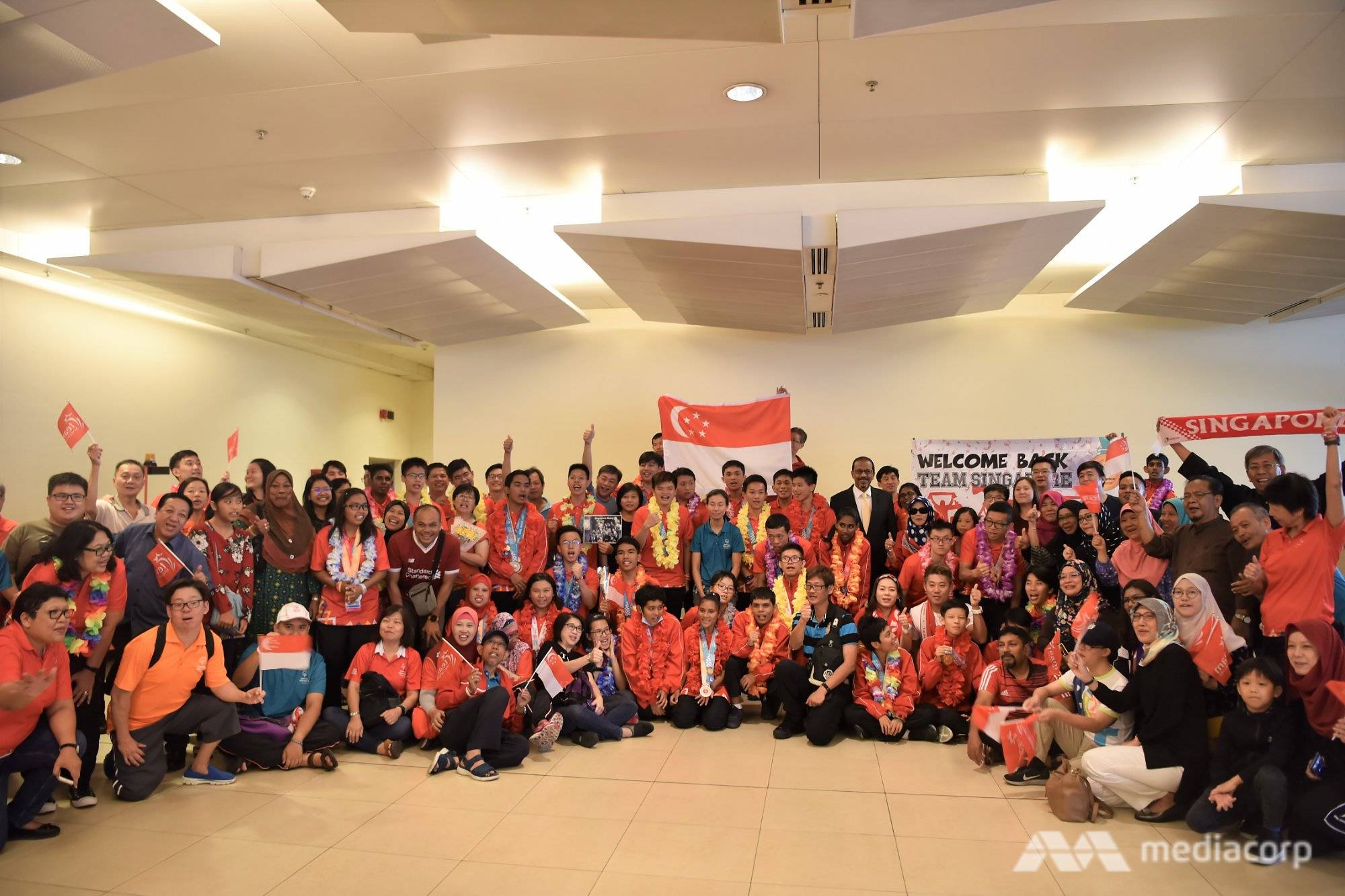
The Team Singapore contingent back in Singapore from the Special Olympics in Abu Dhabi, together with their family members. (Photo: Darius Boey)

Source link

Woman dies after taxi ploughs into pedestrians at junction of Jalan Bukit Merah, Alexandra Road

0

SINGAPORE: An SMRT taxi ploughed into a crowd of pedestrians at the junction of Jalan Bukit Merah and Alexandra Road on Friday (Mar 22) evening, leaving one elderly woman dead and another pedestrian injured.

The police said they were alerted at about 7pm to an accident involving a taxi and two pedestrians at the junction.

The taxi driver, a 72-year-old man, and two female pedestrians, aged 32 and 66, were taken to National University Hospital, where the elderly woman subsequently succumbed to her injuries, the police said.

The Singapore Civil Defence Force (SCDF) said three ambulances were dispatched to the scene.

smrt taxi

An SMRT taxi ploughed into a crowd of pedestrians at the junction of Jalan Bukit Merah and Alexandra Road on Friday (Mar 22) evening, leaving one elderly woman dead and another pedestrian injured. (Screenshot: Facebook/SG Road Vigilante)

A video of the incident circulating on social media showed the taxi – which was on the second lane – slow to an almost complete stop some distance away from the traffic light. There were no vehicles between the taxi and the traffic light. The driver’s window was rolled down.

The taxi then slid into the first lane, just as the rear window was also rolled down. The taxi’s hazard lights were flashing.

As the vehicle approached a stationary car on the first lane, it swerved abruptly onto the second lane, accelerated and turned right into oncoming traffic at the junction.

It ploughed into the crowd of pedestrians crossing the road.

The police said that preliminary investigations indicate the taxi driver had lost consciousness prior to the accident.

The taxi driver is currently assisting in investigations, the police added.

SMRT told Channel NewsAsia that it is trying to get in touch with the victims and their families.

“Our immediate priority is the well being of the injured and our care team is trying to get in touch with them and their families to render assistance and support,” said Ms Margaret Teo, vice-president for SMRT Corporate Communications.

“Meanwhile, we are extending our full cooperation to the police in their investigations into the accident,” Ms Teo added.

Source link

Singapore skyline turns blue to commemorate World Water Day

0

SINGAPORE: Thirty of Singapore’s iconic landmarks and bridges – such as Marina Bay Sands, Gardens by the Bay and St Andrew’s Cathedral – were bathed in blue on Friday (Mar 22) to commemorate World Water Day 2019.

IMG_5113

Among the iconic landmarks which lit up in blue was Esplanade. (Photo: Darius Boey) 

Other landmarks which followed suit include the Singapore Flyer, Millennia Tower and Centennial Tower, as well as Bishan-Ang Mo Kio Park and White Sands shopping mall in the heartlands. 

World Water Day 2019 - Gardens by the Bay (1)

Is this the set of Avatar? No, Gardens by the Bay lit up in blue to commemorate World Water Day and drive home the importance of water conservation. (Photo: Darius Boey) 

IMG_5116

The Singapore Flyer also turned blue on Friday night (Mar 22). (Photo: Darius Boey) 

The City Turns Blue initiative, which kicked off in 2014, expanded beyond Singapore’s shores this year. The Permanent Mission of Singapore to the United Nations in New York City was also due to light up the Singapore Chancery building in blue on Friday. 

IMG_5110

The Marina Bay Sands also turned blue on Friday (Mar 22) as part of World Water Day. (Photo: Darius Boey) 

World Water Day 2019 (1)

Members of the public gathered at Marina Barrage on Friday night (Mar 22) for the first GoBlue4SG night carnival. (Photo: Darius Boey) 

The first-ever GoBlue4SG night carnival, an event aiming to raise awareness on water conservation, also took place on Friday. Organised by national water agency PUB, the blue-themed carnival held at Marina Barrage saw people gather around food trucks, games, as well as performances by local artistes Joanna Dong, Tay Kewei and Alfred Sim. 

World Water Day 2019 - Joanna Dong

Artiste Joanna Dong performing at the GoBlue4SG carnival on Friday night (Mar 22). (Photo: Darius Boey) 

World Water Day 2019 - Alfred Sim and Tay Kewei (1)

Alfred Sim and Tay Kewei entertaining the audience at the GoBlue4SG carnival on Friday night (Mar 22). (Photo: Darius Boey) 

Another highlight of the carnival was a sunset yoga session led by Sandra Riley Tang of local band The Sam Willows. 

World Water Day 2019 - yoga with Sandra Riley Tang

Sandra Riley Tang leading a yoga session at the GoBlue4SG night carnival. (Photo: Darius Boey) 

The carnival is part of the GoBlue4SG movement which encourages Singaporeans and local businesses to support the cause of water conservation by wearing blue or offering products in blue.

More than 60 partners are part of the GoBlue4SG movement. These include Twelve Cupcakes, which is offering blue cupcakes, as well as White Sands shopping mall, which will hand food vouchers to patrons who don blue, PUB said. 

Source link

A picture of hope: Former ACJC rugby captain debuts solo art exhibition after traumatic accident

0

SINGAPORE: Days before the opening of his first solo exhibition as a professional artist, 32-year-old Lee Wei Kong was helping to curate the paintings. 

One of the highlights he drew attention to was a piece that was inspired by his parents.

“That’s me, papa and mummy. Mummy is further away. I love my mum a lot,” said Wei Kong, the artist.

READ: ‘There’s still hope he can live a normal life’

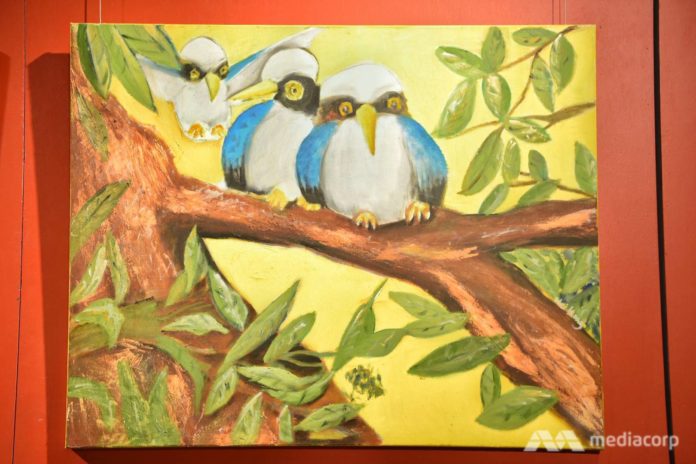
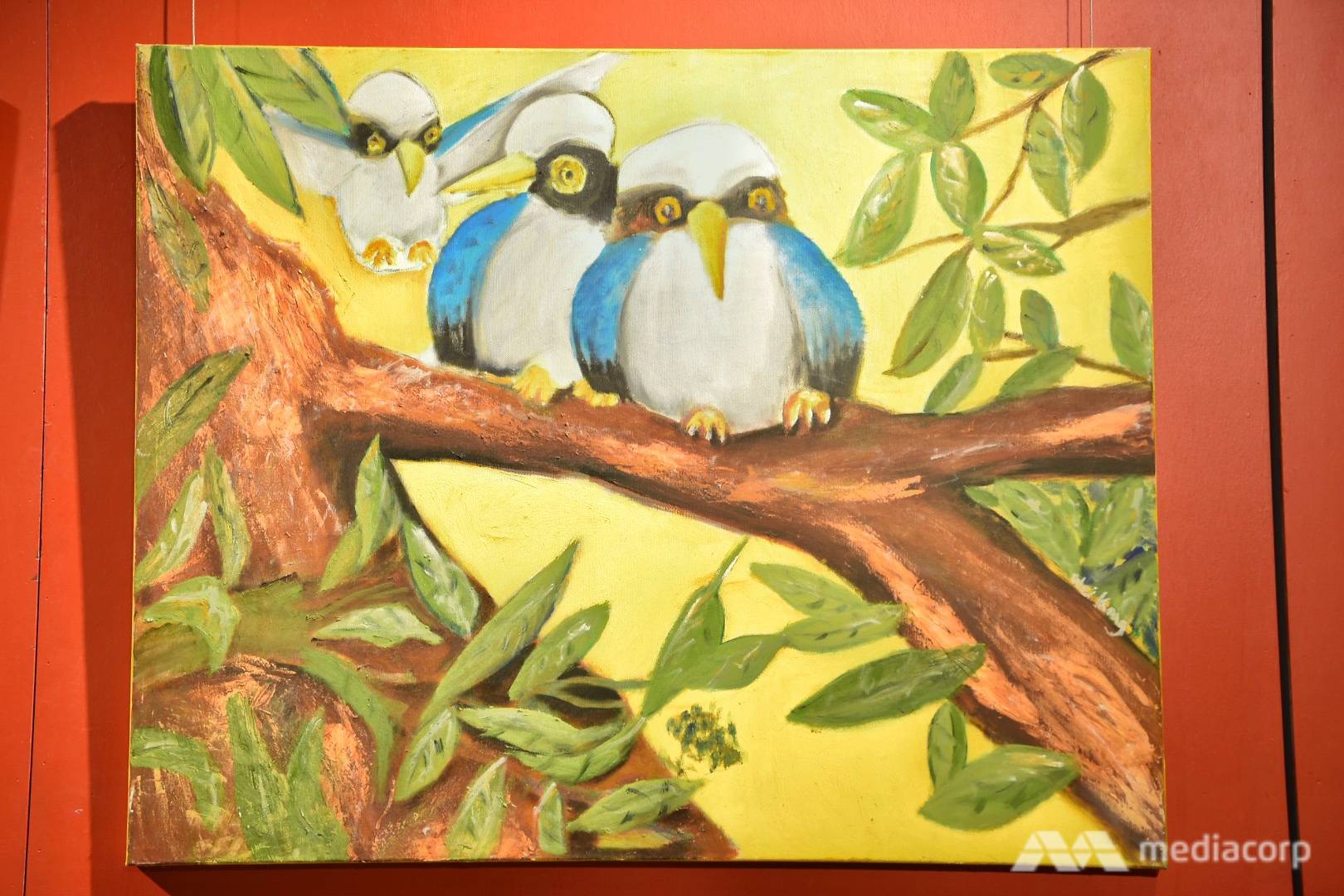
The painting portrays three birds perched on a tree branch, each with a telling expression. At the focal point of the painting is Wei Kong, he explained with the same demeanour as the bird in the picture – proud and dauntless.

Lee Wei Kong Family

The bird with its wings spread is Wei Kong’s mother, followed by his father and him. It’s titled “You gave me wings and taught me to fly…”.(Photo: Darius Boey)

This year marks 14 years since Wei Kong met with a horrific traffic accident that changed him and his family’s life. He was hit by a taxi when he sprinted across a pedestrian crossing, just a day before starting his second year at Anglo-Chinese Junior College (ACJC).

He was the captain of the rugby team, and the injuries left him with severe, traumatic injuries to his brain and spine, cutting his athletic and academic dreams short. He lost the ability to talk and walk, and doctors told his parents that Wei Kong was going to become a vegetable.

“At that time, you were physically at your peak. … You wanted to be an architect,” Wei Kong’s father Lee Swee Chit, 60, said to Wei Kong as the family chatted with Channel NewsAsia.

“Yes, I wanted to be an architect,” Wei Kong said in agreement with his dad. The interchange showed how even though Wei Kong is “very independent” in how he goes about his daily life, he needs his father’s help in expressing himself.

Lee Wei Kong Rearguard

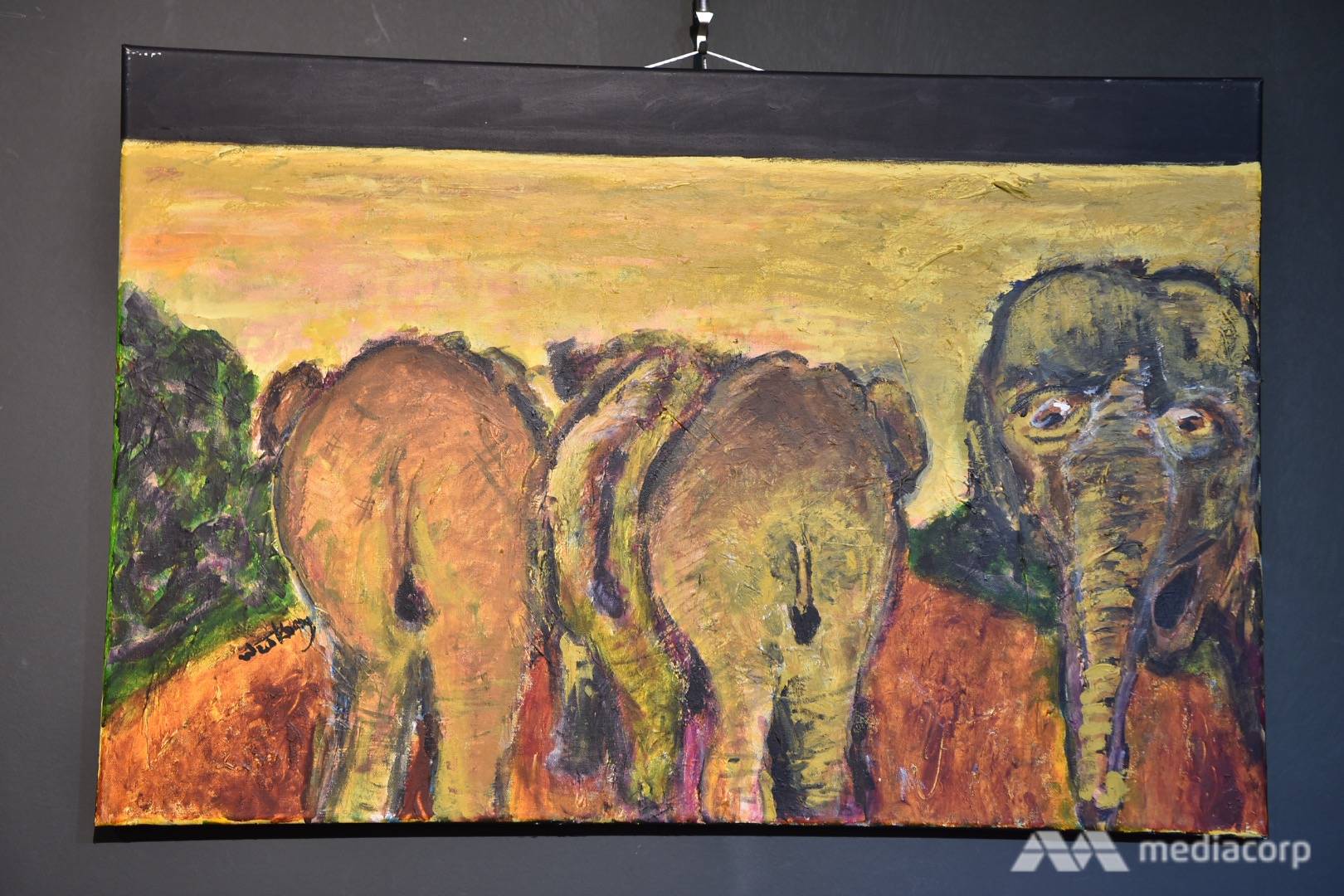
Three is repeated throughout Wei Kong’s paintings, such as in “Rearguard” where there are three elephants. (Photo: Darius Boey)

Every now and then during the sit-down interview, Wei Kong would gently brush his father’s hands and knees.

“Papa helps me a lot. I can’t tell you what I want to say but Papa can tell you a lot. I can’t explain how difficult it is for me to see the world. If only I could say what I say, Papa no need to come,” said Wei Kong.

“He’s trying to say that I can second guess what he wants to say. Of course, as a father, I can roughly know sometimes just by looking at him,” Swee Chit added.

After the accident, Wei Kong’s parents saw that he had retained his talent to paint and draw, so his father decided to push him to pursue this skill. However, this was a challenge – Wei Kong is naturally right-handed, but the accident initially left him unable to use that hand. So, the family hired professional artists to help him learn to draw using his left hand.

At the same time, his parents continued to help him regain the use of his right hand and managed to achieve this two years after the accident. Wei Kong practiced relentlessly and managed to cobble together a portfolio to enrol for a diploma programme in fine arts at LASALLE College of the Arts.

“When he was in LASALLE, his mother was the one who went to school with him every day. She took lecture notes for him and taught him, and we helped him do his homework. But of course, he would do the paintings on his own. The theory part of art was done with our help,” said Swee Chit.

WATCH: Wei Kong’s story is featured in an episode of On The Red Dot

When Wei Kong graduated three years later, Swee Chit said it felt like the three of them had graduated together.

“VERY, VERY MISERABLE. I HAD NO WAY TO FIND WORK”

After graduation, Wei Kong struggled to find suitable work. He said that he was “very, very miserable”.

Within a year of graduating, he tried to work as a cleaner, dishwasher, waiter and baker. He broke tableware, slowed down processes and could not get along with his colleagues.

“He doesn’t stay in a job for a long time because he likes to interact with his colleagues and many of them don’t really understand him. So sometimes they feel that he’s very kaypoh (nosy), like to be a busybody and disturbs others when they are working,” said Swee Chit.

“Sometimes I feel lonely. I just need a companion, somebody to talk to,” Wei Kong retorted cheekily.

The long-term plan was always to become a professional artist, said Swee Chit. With some help from a fellow church member, Wei Kong managed to work as a painter at Westlite, where he painted the walls of workers’ dormitories.

“They created this job just for him. They didn’t need any paintings or murals but the boss employed him,” Swee Chit said. He held onto the job for five years until this year when Swee Chit and his Westlite employer made the decision amicably for Wei Kong to leave the job and work on himself and his craft.

Wei Kong, who is now married with two young daughters, said that being gainfully employed is important to him and his father.

“He has always wanted a family. He likes to talk about money. For example, when he meets people, people who don’t really understand him will think that he’s always thinking about money. But if you go into it deeper, he’s not talking about money. He just wants to have the pride of getting employment and be able to support his family,” said Swee Chit.

FINDING HIMSELF AS AN ARTIST

For Goshen Art Gallery owners Faith Lam and Jack Yu, this was something that attracted them to his story. Faith, in particular, has worked with other artists with disabilities.

Jack Yu, Lee Wei Kong, Faith Lum

Goshen Art Gallery and ArtSE’s founders Jack Yu and Faith Lum with artist Lee Wei Kong. (Photo: Darius Boey)

“When I look at his paintings, I can identify what he is trying to say even though he cannot articulate it. … It’s alive to me. It’s not just a painting or a picture. When I look at his artwork, it gives me a glimpse of his life,” said Faith.

On display at his exhibition titled “Reminisce” are 30 pieces painted by Wei Kong in the last 14 years at different stages of his recovery.

According to Faith, Wei Kong’s style has developed from looking “very structured” because he was guided, to his own style now which shows off his athletic energy and joy.

“Given his condition, he also has a very short attention span. Some of his paintings from a few years ago tend to have very quick strokes maybe because of his back. He gets backache when he sits for too long,” Faith said.

Lee Wei Kong Shofar

Wei Kong’s painting titled Shofar. (Photo: Darius Boey)

“If you look at his recent work like Shofar, it’s layered. He waited for the first layer to dry and then (worked on) the second layer. The strokes are longer and there is more detail to his work. That shows his maturity and his ability to concentrate or to ponder and consider before he attempts his next step,” she added.

Now, Wei Kong is employed as a professional artist under Faith’s social enterprise ArtSE on a part-time basis. The plan is to have Wei Kong visit the studio regularly and paint there. He gets to dictate his own hours based on his most productive time of the day.

At the same time, Wei Kong is preparing to explore art therapy.

“All his rugby friends have grown to be professionals, many of them are doctors and architects. He’s always finding himself left out so he feels a bit sad on that part but I always tell him that there’s always happiness and joy in whatever he is doing,” Swee Chit added.

But instead of using art as an avenue to foster healing and mental well-being as he did, he will be using it to help others.

“I’m just an encourager only. I help them to see, carry things from one point to another point. It’s good that they let me do that,” said Wei Kong.

“He’s happy doing work to help old people,” his father Swee Chit said.

Wei Kong looked at his father and nodded with a hint of joy.

Lee Wei Kong’s works are exhibited at Goshen Art Gallery (DUO Galleria) from Saturday (Mar 23) till April 7. They are open on weekdays and Saturday from 11am to 7pm. On Sundays, they are open from 3pm to 7pm.

Priced between S$1,200 to S$3,900, proceeds from the sale of his artwork will go to Wei Kong and the social enterprise arm of Goshen, ArtSE.

Source link

Commentary: Want to raise a responsible child (or nation)? Create a safe space first

0

SINGAPORE: “My parents told me that finding my passion is important”, the university student I was talking to said. “They made me try fencing, community work, archery and tennis”.

“How’s that going?” I asked. “They’re still looking for it.”, he said with a shrug.

Later on that day at a career event, I moderated a panel where employers from diverse sectors gave unanimous feedback that the biggest difficulty in doing business in Singapore was finding local talent who were pro-active, self-aware and driven.

Is the education system to blame for over-structuring and over-teaching?

‘HOW MANY WORDS?’

When we set projects for our students, the first question we get is invariably: 

How many words should I write?

When we tell them “However many words as it takes to answer the question successfully, you decide”, most students recoil with horror, unused to such a lack of guidance.

Yet this is the ambiguous reality of modern life that awaits them. Your clients aren’t going to tell you how many pages your proposal should be. No model answers await you in the world of work. 

Over-protective parents also have their part to play in fostering a generation unused to taking ownership of their lives.

Employers are desperate for Singaporeans who will accept overseas stints, which can often mean a fast-tracked career. Yet, we often encounter parents who discourage their children from venturing overseas for fear that they may encounter risks and hardship.  

READ: My generation has a fear of missing out – on a disrupted future, a commentary

Attendees carry their resumes at a job fair in Washington

Attendees at a job fair line up for an interview carrying their resumes in leather bags. (Photo: REUTERS/Jason Reed)

Although it is a natural instinct to want to protect our youth, a disruptive future of Artificial Intelligence and automation will demand resilience and resourcefulness from their generation and perhaps test them more than any other generation before.

RADICAL OWNERSHIP

As we look towards the fourth Industrial Revolution where our youth are set to change careers perhaps a dozen times or more over their 100 year lifespan, they must pick up the pen and become the architects of their future and own their own development.

One of the most important mindsets that both our youth and our talent need to cultivate is that of radical ownership – being responsible for doing what needs to be done rather than waiting to be told, and taking responsibility for the results they create.

READ: Career resilience is more than just bouncing back, a commentary

A mindset of radical ownership is the opposite of entitlement and playing the blame game. It is not “nobody told me” or “nobody taught me how to …”, and that’s why I haven’t succeeded.

Radical ownership is making the choice to be the primary force responsible for your growth. It is not “what will you give me if I do it” or “is this part of my Key Performance Indicators”?

FEELING SAFE

Taking charge of your personal growth is not an easy choice. There are many good reasons for wanting to stay passive or blame others for the results you’re getting or not getting from life. 

Perhaps the biggest obstacle to being able to develop this mindset is this question. Do I feel safe enough?

For you to step up and own your challenges, try different things, make yourself vulnerable and open to criticism, you need to feel safe first.

READ:  Here’s what Singapore’s human capital index in a world of disruption should look like, a commentary

There have been numerous research studies demonstrating that in cultures where psychological safety is present, performance is remarkably better. Google’s Project Aristotle is a famous case where researchers analysed 180 teams and found that, surprisingly, the most important factor of successful teams was psychological safety. Much more so than consensus, skills or rewards.

Psychologists from MIT and Harvard, Alex Pentland and Amy Edmondson have found that our brains are hardwired for safety. We are built to require lots of reassurance and safety signals to shift our brains from worrying about danger to unleashing our potential.

people in orchard road

People cross a traffic junction in the Orchard Road shopping district in Singapore on May 27, 2017. (File photo: AFP/Roslan Rahman)

So consider how psychologically safe is Singapore? We are a self-admitted nation of complainers, criticisers and occasionally even outraged online mobs. 

Just recently, a 19-year old student who expressed her honest views about travelling internationally was subjected to a torrent of cruel and personal online comments, criticising her naivete and incapability.

READ: A commentary on travel plans – of course it will go awry. It’s a foreign country

It may be true that our youth are over-reliant and entitled, but if you’re trying to encourage them to develop, the worst thing that you can do is to undermine their sense of safety.

CREATING THE SPACE FOR RADICAL OWNERSHIP

We need to simultaneously balance letting go of our inclination to over-structure and over-teach our youth, while also creating a safe space for them to try out different things and give them honest feedback.

Here are some suggestions developing radical ownership and empowerment.

1. Own your choices. Instead of saying “I have to”, say “I choose to” or “I get to”. Instead of “I have to get up early to attend this class”, re-framing as “I get to attend an interesting course” focuses your mind on the fact that it is your choice and is a more empowering perspective.

2. Perform an audit of your assumptions, beliefs and mindsets. What is standing between you and the success that you would like in your life? Write down all your answers as they come. I’m too old, I’m too shy, I’m not creative enough, or that only people of a certain type succeed.

And for each belief, challenge if it is actually true, or if it is an old, outdated belief that no longer serves you.

3. Keep a “To Learn” list of skills and mindsets that you would like to develop. Grow your curiosity muscle by constantly seeking out opportunities for learning. And regularly evaluate if you are too entrenched in your comfort zone or if you’re pushing your limits sufficiently.

Student writing on paper, getting work organised.

Student writing on paper, getting work organised. (Photo: Unsplash/Marten Bjork)

For parents or leaders:

1. Embody the change that you want to see and watch out for giving mixed messages that signal danger. One common scenario we see in Singapore is senior management who claim they value innovation and risk-taking, but yet send out conflicting messages such as not wanting to have any client complaints about new procedures.

READ: Move by St Margaret’s Primary a test of parents’ ability to deal with change. Will they rise to the challenge? A commentary

2. Clearly spell out your risk-taking policy and create a safe space for experimentation. Another common misconception is that if you reward risk-taking, it is tantamount to encouraging failure and danger. Here, it is important to emphasise that risks and rules fall on a spectrum. 

At one end are rules that are not to be trifled with, such as rules that are vital for safety or ethical rules (e.g. insider trading), but on the other extreme, there are mild risks that such as speaking up during a meeting, suggesting a different idea, disagreeing with a course of action, where the worst outcome if things didn’t work out is that you’ve learned something and perhaps sustained a little bruise to your ego. 

These risks well worth experimenting with in the pursuit of self-improvement.

The quest to upgrade the skills of our entire nation need not just be driven out of grim fear of being replaced by robots. Rather, it’s equally important to inspire our talent, from youth to adult learners, see the joy in unlocking their full potential and living in a more empowered way, while creating a safe space for all of us to push our boundaries and expand our growth.

Crystal Lim-Lange and Dr Greg Lim-Lange are founders of Forest Wolf, a future-readiness consultancy.

Source link

From birdcage maker to spice shops: The tourist experience in the heartlands

0

SINGAPORE: Tucked away in a quaint shophouse in Ang Mo Kio stands a birdcage-making shop – a sight rarely seen in Singapore today.

Cage Making 159 belongs to Teng Leng Foo, who has experience in this craft stretching back five decades. But the proudest moment in his career only happened recently, when he was commissioned by the American delegation to create a one-of-a-kind birdcage for North Korean leader Kim Jong Un during last June’s Trump-Kim summit in Singapore.

Mr Teng said that the birdcage – which sold for S$3,500 – featured specially designed embellishments and shells.

His skill as a craftsman is seen as something that an increasing number of tourists are interested in, as they search for different and immersive local experiences.

Now the 72-year-old’s shop is a stop on a tour of Singapore’s heartlands. 

The tour was developed as part of the Singapore Tourism Board’s (STB) Tour Design Challenge, which took place from May to Oct 2018. Such tours are featured in STB’s marketing activities locally and overseas.

READ: HDB shops in Punggol turn to e-commerce to chase customer awareness, dollars

“We created this tour because we think there are a lot of tourists coming to Singapore now and there is demand from them to come to these heartlands to see the living environment of Singaporeans,” said Stanley Foo, 43, co-founder of Oriental Travel and Tours. His company is leading the tour, which the media was invited to experience on Friday (Mar 22).

“It came about from the movie Crazy Rich Asians. With that movie in mind, they (visitors) are thinking: ‘Are all Singaporeans staying in such big villas, big bungalows?’ They just request for (an) authentic Singapore experience,” he said.

Mr Foo added that his company has been providing such heartland tours for the last six months. The tours are mostly made up of foreign guests in a 9:1 ratio. Most of them come from Europe, Australia and the United States, he said.

Each tour has between two and six guests and costs S$80 for a four-hour experience or S$180 for one lasting seven hours.

READ: HDB in collaboration to develop ‘useful’ apps, services for residents

Another stop on the heartlands tour in Ang Mo Kio sees Jack Leow, 29, offer the best cooking tips for the spices he sells from his business called Little Spice Shop In Singapore.

His spice business, which is located at a wet market, has received some attention from tourists, who sought him out after doing research on the Internet.

He prides himself on sourcing spices from across the world and prepares them in small, takeaway packets that are easy for tourists to bring home. Each spice packet sells for between S$3.00 and S$9.00.

Mr Leow added that some foreign guests would occasionally drop him emails to thank him for the cooking tips. He also said that the tours do not disrupt his business, even though his core business is serving the local community. In fact, he sees additional benefits to being part of the heartlands tour.

“Business has always been good … and there has been a positive impact (from the heartland tours). It helps to build publicity when they (foreign guests) share their experience of my shop on websites like TripAdvisor.”

WATCH: Ideas for community spaces in the heartlands come alive with virtual reality

SPECIALIST TOURIST GUIDES

To further develop new tourist experiences, STB has launched a scheme to encourage people with detailed knowledge of things such as nature or food to become guides for niche tours. Those who think they have what it takes to lead visitors on a different type of tour will be assessed by STB, who will evaluate their guiding skills and subject knowledge. 

STB said additional Area Tourist Guide (ATG) training will last between two to three months, and authorised ATGs will be able to hold a guide license for three years. Since the scheme was soft launched in Oct 2018, 32 individuals have already qualified as ATGs.

“We wanted to think of a way to bring in more Singaporeans who have expertise in different, specific domains. Then they are able to show uniquely Singaporean experiences to our visitors, and this ATG scheme allows us to do that,” said Senior Minister of State for Trade and Industry Chee Hong Tat, who was also present during Friday’s tour.

READ: More greenery, street activities to make Orchard Road a ‘lifestyle destination’: URA, STB and NParks

READ: Visitor arrivals to Singapore rise 6.2% to hit new high in 2018: STB

“I hope that with this greater awareness, we can encourage more to step forward … because we do not just want to show them the more touristy aspects of Singapore. Those are important, but we also have many authentic, local experiences: How Singaporeans live on a day-to-day basis, our food, our heritage, our culture. I think that is also something that tourists increasingly look for.”             

Chee Hong Tat Heartland Tour 3

Senior Minister of State for Trade and Industry Chee Hong Tat interacting with a shop owner during a heartlands tour in Ang Mo Kio. (Photo: Aaron Chong) 

Source link

‘The struggle is temporary’: SG Bike founders predict bright future ahead for bike-sharing

0

SINGAPORE: The three founding members of local start-up SG Bike had different ideas of what their future would be like before they started the firm.

Chief technology officer David Lim, an economics graduate from University College London, wanted to be an investment banker. Marketing director Benjamin Oh eyed a career in public relations, while the company’s founder and chief operating officer Sean Tay wanted to be a nuclear scientist.

In a recent interview with Channel NewsAsia, the trio maintained that they had no regrets about their decision to start the company, even though many observers have noted that the bike-sharing industry in Singapore is at an ebb.

Since bike-sharing was launched in Singapore in 2016, the three companies with the largest fleets – oBike, Ofo and Mobike – have all faced issues staying afloat.

oBike exited the market amid much controversy while Mobike has requested permission to surrender its licence. 

Ofo’s licence has been suspended due to the company’s issues in implementing a QR-code system.  

READ: Ofo gets more time to remove bicycles from public spaces, is in talks for partnership

SG Bike is potentially the industry’s last stand. If Ofo fails to get back its licence and Mobike’s permission to exit the Singapore market is granted, SG Bike will be the only company left with a full operating license. 

And the company’s three founding members, who were former classmates in secondary school, expressed optimism that the tide would turn as the Singapore Government develops the cycling infrastructure.

Mr Lim, whose interest in bike-sharing was sparked by the bicycle docking stations during his university days in London, acknowledged that the firm is in survival mode. But if the company weathers this “transition period”, it will reap the benefits.

He said: “In the future, the park connector network will be expanded, and there will be more push for mobility devices in Singapore. Bicycles will be the main mode of public transport, and we predict that it will eventually be a serious option.

READ: Commentary: With Mobike’s impending exit, is it time to give public bike-sharing a shot?

“We will always look at Europe but we believe that Singapore has a vision to embrace cycling in a similar way. The struggle is temporary, it’s painful, but the key thing here is to have faith,” he added. 

Over the last two years, Ofo, Mobike and oBike have reduced their fleets in Singapore, but SG Bike’s fleet has increased from 200 to 3,000. Mr Oh also confirmed that its number of users has been on a constant upward trend.

Mr Tay pointed to how Ofo managed to clock a million rides a month during its heyday in Singapore, and that signalled an interest in cycling as a genuine transport option.

The firm’s founder, who grew up aspiring to work in academia, learnt the ropes of bicycle maintenance and operating a bicycle business while helping out over the school holidays at his father’s bicycle renting business at East Coast Park.

And his interest in bike-sharing was piqued when he saw how the industry had grown during a trip to Shanghai three years ago. He later contacted Mr Lim and Mr Oh to kickstart SG Bike. 

EDGING RIVALS WITH FINANCIAL PRUDENCE

On how SG Bike managed to survive while the huge China-based firms failed, Mr Lim said the main difference was financial prudence – by only increasing its fleet size if the company could manage it.

“So financial prudence is one of the most essential skills that we as a team have and agree to stick by. In today’s context, a lot of companies take venture funding, gain market share and aim to be the leader as soon as possible,” he said.

“But what they don’t realise is that profit margin in bike-sharing is thin. When you increase the exposure with many bicycles, the operational cost will kill (you). We expand only when we have the capital – not borrow capital to expand.”

SG Bike basket

SG Bikes ensure that their bicycles are hgih quality and some are equippend with seats for infants. (Photo: Amir Yusof) 

Mr Tay added that having a senior management team who are Singapore citizens helped SG Bike anticipate the indiscriminate parking problem that plagued bike-sharing and resulted in the Land Transport Authority (LTA) imposing measures to ensure bicycles are left at designated parking zones.

“It’s culture and behaviour. I knew that the Singapore Government would not accept (indiscriminate parking), we know how Singaporeans work. We want a clean and green city,” said Mr Tay.  

THE FIRST TO FINE USERS 

While the Singapore Government only implemented parking zones in September 2018, SG Bike introduced its own mechanism when it started in 2017.

Its competitors allowed users to park anywhere they wished, but SG Bike installed a geo-station system in its fleet at Bukit Panjang and East Coast Park that would fine customers S$1 if they did not park in designated zones.

SG Bike created an RFID device, which emits a signal, and placed it at parking zones. Each bicycle has a signal receiver. If a bicycle is parked outside the range of the RFID, its user will be fined.

Mr Oh said that reception to this mechanism was understandably negative in the beginning.

“At the start, it wasn’t that good. We were the first and only company that fined users if they parked indiscriminately,” he said.

The company even had to paint yellow boxes to demarcate parking zones, forcing them to negotiate with the land owners of these public spaces, including town councils, NParks and PUB, to obtain permission.

Across their area of operations, SG Bike managed to outline 2,000 parking zones.

A year later, LTA followed up with the idea islandwide as it enforced new legislations requiring users to park at zones and sign off with QR codes after locking their bicycles.

‘SHIFTING BUS STOPS’ 

Mr Tay acknowledged that users found this inconvenient, but the whole system would work if LTA designates enough parking spaces across the country.

“This is a similar concept to bus stops. You don’t want your bus stops to be shifting every single time. If it moves, it can get annoying. But this whole thing is contingent on there being enough yellow boxes,” said Mr Tay.

Like many of bike-sharing companies, SG Bike saw a “good number of users” drop out following the implementation of LTA’s QR-code parking legislation in January 2019

“We suffered a dip, but we have confidence this is a temporary thing. It’s a matter of time before things turn for the better,” said Mr Tay.

QR code parking for shared bikes 1

A QR code installed at a designated parking lot for shared bikes in Singapore.

“To demand such a big behavioural change from the consumer, asking them to scan QR-codes and park at zones, that’s a huge demand. We hope users accept the way bike-sharing has changed and forget about the past.”

Mr Tay predicted that the public will warm to the idea of bike-sharing again within a year, and some users have given feedback that the parking zones are a good initiative to make the city neater.

“If we keep on this trajectory and every single customer is accounted for, SG Bike will grow, definitely. The licensing regime was really a good thing. The Government took a step to modulate the parking,” he said.

Mr Oh noted that the Government has already made efforts to boost cycling infrastructure by developing the Park Connector Network and marking out dedicated cycling paths in certain neighbourhoods like Bedok.

Bedok cycling path

Cycling paths in Bedok are recognisable by the red paint. (Photo: LTA)

“They are already spending a lot of time to put in resources for this. There are tens of thousands of yellow boxes in Singapore. That is some commitment shown by the Government. They are serious about the industry,” he added.

And Mr Tay is convinced that on-demand services like e-scooters and bike-sharing are here to stay as the government is keen to reduce car usage in Singapore.

“The Government wants people to give up their cars, for society to go car-lite, hence the sharing economy for bicycles and e-scooters [is] going to get more and more robust,” he said.

“Then for companies like us who stuck to our guns, we hope that our efforts will pay off.”  

Source link