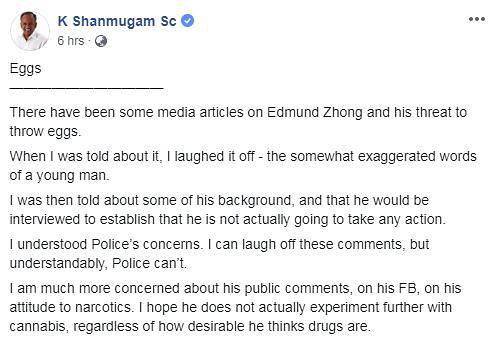
SINGAPORE: Home Affairs and Law Minister K Shanmugam said on Wednesday (Mar 27) that while he laughed off an online threat to throw an egg at him, the police could not and had to interview the man.
A police report was lodged on Mar 19 against 20-year-old netizen Edmund Zhong who had left a comment on a Facebook post “suggesting that he wanted to throw an egg” at the minister, police had said.
A 47-year-old netizen who responded to the comment to provide information on the Minister’s upcoming meet-the-people session was also asked to assist the police with investigations for the offence of communicating an electronic record to incite violence under Section 267C of the Penal Code.
The Australian senator was further thrust into the spotlight after a video showing him being hit on the head with an egg went viral. The clip also showed him punching the teenager – subsequently dubbed Egg Boy – who hit him.
Mr Zhong had commented on a post about the senator: “I wanna do that to K Shanmugam. I swear.”
Channel NewsAsia has reached out to Mr Zhong for his response.
SINGAPORE: Emergency services were seen responding to a fire at the Grand Hyatt hotel at Scotts Road on Wednesday (Mar 27).
Thick smoke could be seen billowing out from the hotel from around 11.30am.
Technical executive Muhammad Syukur B Mohd Haris, 24, told Channel NewsAsia he was walking around Orchard Road when he saw thick smoke in the area.
He saw Singapore Civil Defence Force vehicles rushing to the scene, including a red rhino and a fire engine.
The entrance of the hotel was sealed off when Channel NewsAsia visited the scene at noon. Scores of onlookers were gathered outside the adjacent Far East Plaza.
An SCDF emergency response vehicle at the the Grand Hyatt at Orchard Road on Wednesday Mar 27,2019. (Photo: Hani Amin)
Emergency services parked at the entrance of the Grand Hyatt at Orchard Road on Wednesday Mar 27, 2019. (Photo: Hani Amin)
Rajesh Srivastava, the managing director of Meinhardt India was in the hotel at the time of the incident. “Around 11am in the morning, there was a fire alarm. I checked with the security, and they said they’re trying to fix it,” the 49-year-old told Channel NewsAsia. “There was then an announcement twice on the public announcement system. They said there was a fire.”
“After sometime – I was on the 21st floor – I looked out outside my window and I saw huge, blackish smoke from my room window and saw a lot of fire engines with the sirens.”
Fire seen in the Orchard Road area. (Photo: Muhammad Syukur B Mohd Haris)
He said that the ensuing evacuation was “professionally managed” and that there was no panic.
“People of different ages … some of them were older, it was hard for them to go down the staircase, but the hotel staff were very supportive, there was someone on every floor to guide us down,” he said. “There was no panic. It was (a) very professionally managed evacuation and it was very comforting.”
Another person who was in the hotel at the time said guests were told the fire was from the Mezza9 restaurant.
People wearing masks walk out of the Grand Hyatt hotel at Orchard Road on Wednesday Mar 27, 2019. (Photo: Hani Amin)
“I was staying in my room and first we had two announcements that there was an fire alarm activated. We then had two more announcements saying that the fire was under control. It was in a restaurant kitchen. After a few minutes, we (had) a final announcement calling for an evacuation,” said Jollous Amiel Hernandez, a tourist from Doha.
“The housekeeper assisted me when I was going down and most of the staff were calm,” the 25-year-old added.
A security guard at Grand Hyatt said “smoke was billowing and engulfed the main lobby and the staff assisted people out of the hotel”. The affected restaurant is on the second floor, he added.
Guests were let back into the hotel at about 12.50pm, but there was a lingering smell of smoke, and some people in the hotel were wearing face masks.
SINGAPORE: Places that Singaporeans find familiar such as Orchard Road, mature towns and major recreational corridors will be rejuvenated, said the Urban Redevelopment Authority (URA) on Wednesday (Mar 27).
The areas to be rejuvenated include mature towns such as Farrer Park and Dakota Crescent, and recreational corridors like the Civic District and the Rail Corridor, according to URA’s Draft Master Plan 2019.
It is a blueprint which charts the Government’s development of statutory land over the next 10 to 15 years.
URA said that even as these places undergo rejuvenation, they will retain parts of their unique heritage “sensitively”.
For example, the six former Singapore Improvement Trust blocks built in the 1950s and the iconic Dove Playground in Dakota Crescent will be kept and integrated as a community space.
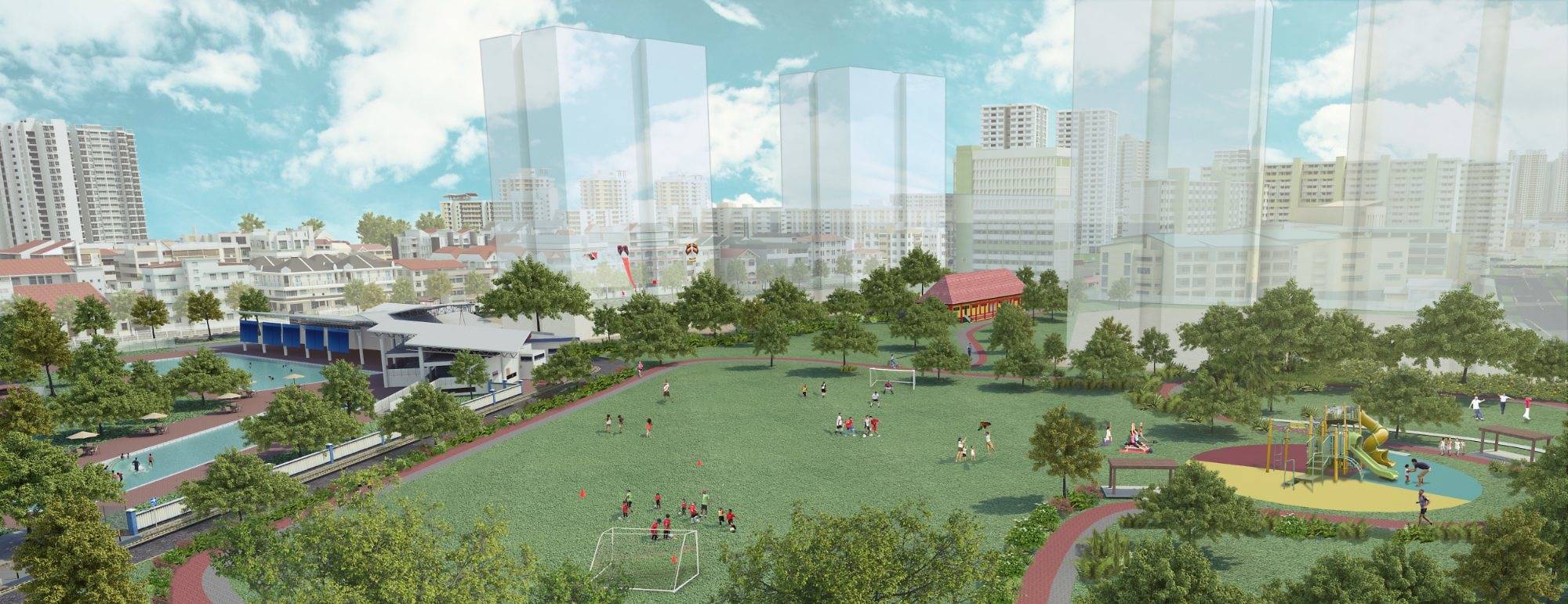
Around Farrer Park, familiar landmarks such as the Farrer Park Swimming Pool and former Boxing Gym will be also be retained to celebrate the sporting heritage of the area. A sports field and park will be integrated with future housing.
Artist impression of the future Farrer Park. (Graphic: Urban Redevelopment Authority)
In the Downtown area, comprising the Central Business District (CBD) and Marina Bay, there will be a continued push towards a car-lite neighbourhood with the upcoming Thomson-East Coast Line MRT stations – Maxwell and Shenton Way – and Circle Line MRT stations – Prince Edward Road and Cantonment.
By 2021, all buildings in Downtown will be within a 10-minute walk to an MRT station.
For those who prefer to cycle, the existing 22km cycling network will be expanded by more than 5km in the Central area.
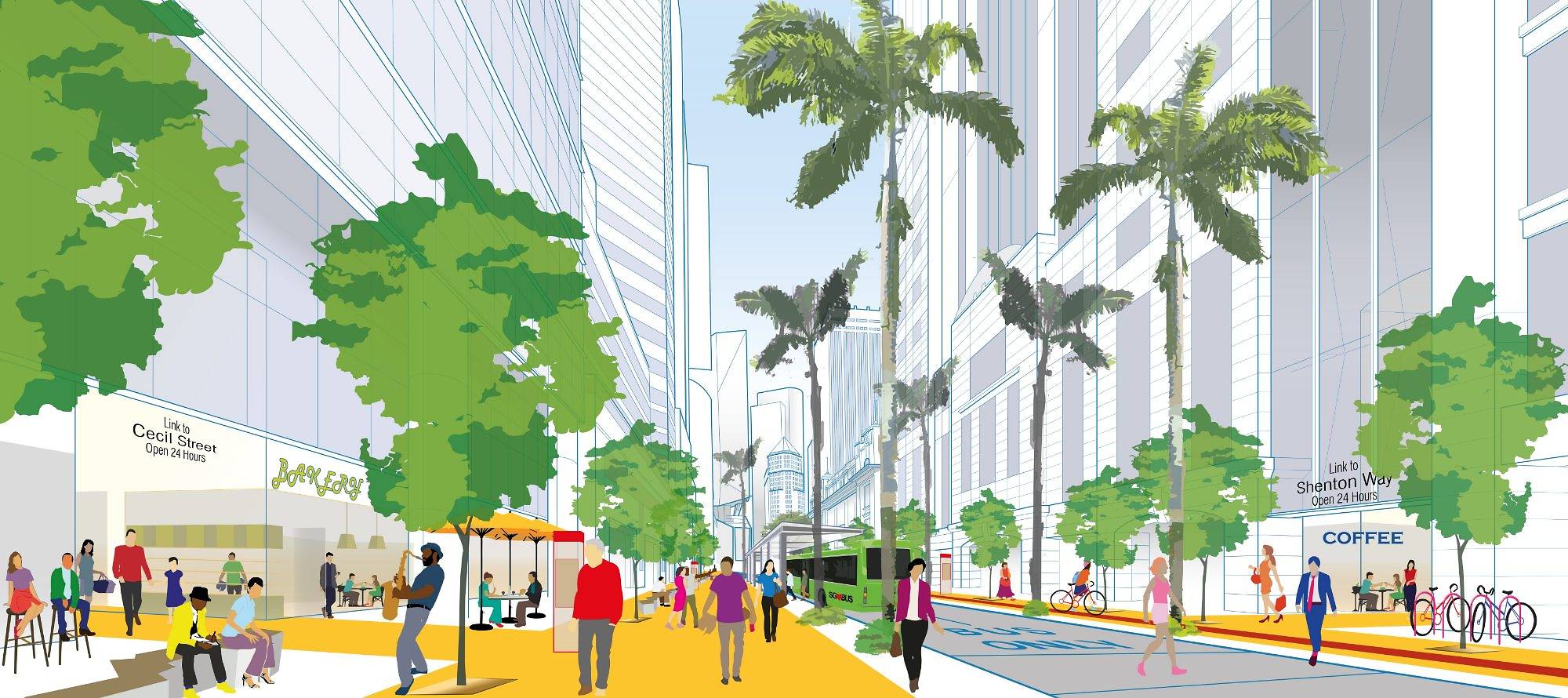
URA said that the agencies are also studying the possibility of transforming Robinson Road into a corridor that prioritises public transport and “active mobility” modes of commuting. Along such a corridor, more space can be allocated for buses, cycling paths and pedestrian walkways.
Artist impression of a transit-priority corridor. (Graphic: Urban Redevelopment Authority)
In addition, URA said that it is planning to introduce more homes in the CBD and Marina Bay to increase the vibrancy of the office-dominated Downtown.
More mixed-used urban neighbourhoods that combine amenities, residential and commercial buildings will be brought in to liven up the neighbourhood, similar to what has been done in Tanjong Pagar.
Another way of injecting life to familiar places could be through letting vacant state properties or land for short-term uses, such as around Marina Bay, said URA. This will create opportunities to try out new lifestyle offerings.
“The adaptive reuse of existing buildings is about creating opportunities for new users to go in to some of these old buildings there are not yet ready for rejuvenation or redevelopment. So some of these adaptive reuse could add new interests to different precincts and bring in new life to the places,” said Ms Hwang Yu-Ning, URA’s chief planner.
Singapore’s main shopping belt Orchard Road will undergo a facelift as well.
“Differentiated experiences” are planned for each sub-precinct, namely Tanglin, Orchard, Somerset and Dhoby Ghaut. They will be linked by a green corridor between two parks, Singapore Botanic Gardens in Tanglin and Fort Canning Park in Dhoby Ghaut, that flank the shopping street.
Some areas around the railway will be conserved for its heritage value such as the Bukit Timah Railway Station and Station Master’s Quarters. Both buildings will be refurbished and re-purposed with suitable amenities.
Nearby, the former Bukit Timah Fire Station and Beauty World will be transformed into gateways for the surrounding nature and heritage attractions such as the Coast-to-Coast trail, Rifle Range Nature Park and the Rail Corridor.
The former fire station building will be conserved and turned into a visitor centre and a central point for the network of attractions in the area.
Likewise, street-level activities and landscaping will be added to improve the walking experience and access from Beauty World to the Rail Corridor.
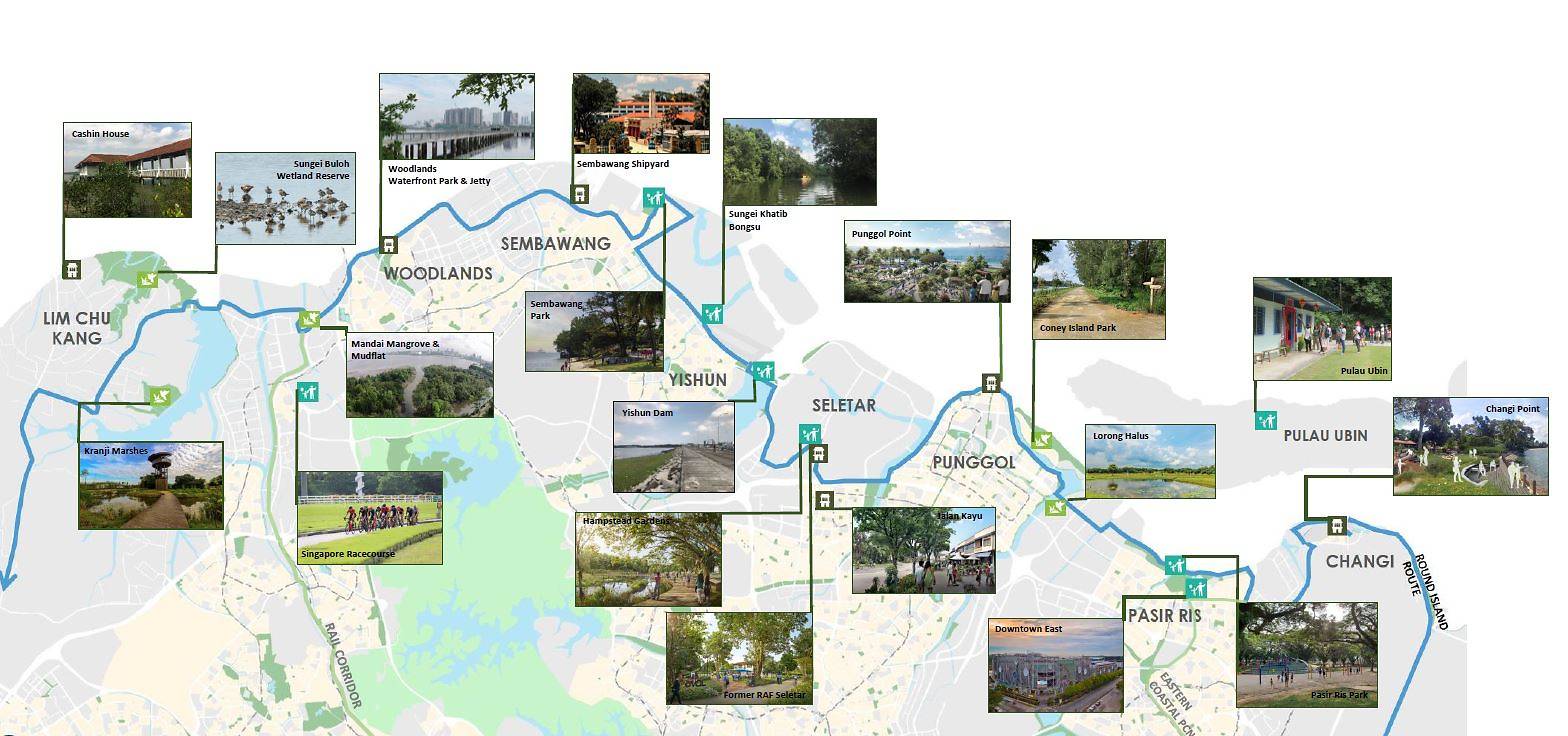
To the north, a 50km belt of parks, beaches and nature attractions will line the northern coast.
The 50-kilometre Greater Rustic Coast stretches from Lim Chu Kang to Changi along the north. (Graphic: Urban Redevelopment Authority)
Called the Rustic Coast, it will run from Changi to Lim Chu Kang. Visitors will get to see places of military and industrial heritage such as the area formerly occupied by the RAF Seletar, and nature reserves teeming with biodiversity like the Kranji Marshes and Mandai Mangrove and Mudflats.
URA is also exploring recreational options in Kranji, specifically at the Singapore Racecourse, and assessing if it can be turned into a family-friendly and communal spot.
INDUSTRIAL HERITAGE SPOTS
The former Pasir Panjang Power District will be rejuvenated as a new lifestyle and heritage spot highlighting its industrial heritage.
URA said that it is exploring different ways to realise this, including the adaptive reuse of the former power station buildings and opening up the grounds for public access.
It added that it will be sensitive to the adjacent Labrador Nature Reserve as it explore new uses of the spot.
As part of the Greater Southern Waterfront, URA and the Singapore Land Authority will be launching a competition in April for members of public to contribute ideas on how the precinct can be transformed.
“The idea competition is targeted at not just the so-called design professionals or the real estate professionals but it’s really for the community to get on board and give us ideas on how they see the different areas and what potential they see in the different buildings and locations,” said Ms Hwang.
Similarly, the URA will be holding an ideas competition later this year to seek the public’s views for the transformation of Paya Lebar Air Base.
URA said that some of the preliminary ideas include repurposing the former airport buildings and part of the runway into community spaces to retain the area’s rich aviation heritage, building a network of parks and open spaces, as well as building a mixed-used neighbourhood for future residents.
The public can look through the Draft Master Plan 2019 at an exhibition at the URA Centre Atrium from Mar 27 to May 24. Members of the public can also provide feedback and proposals to the URA and Ministry of National Development.
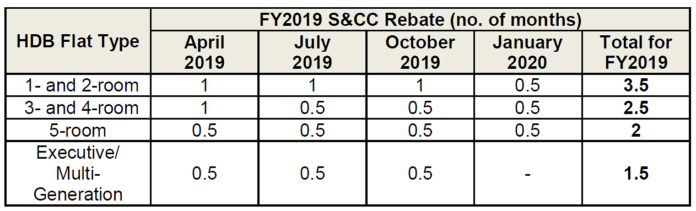
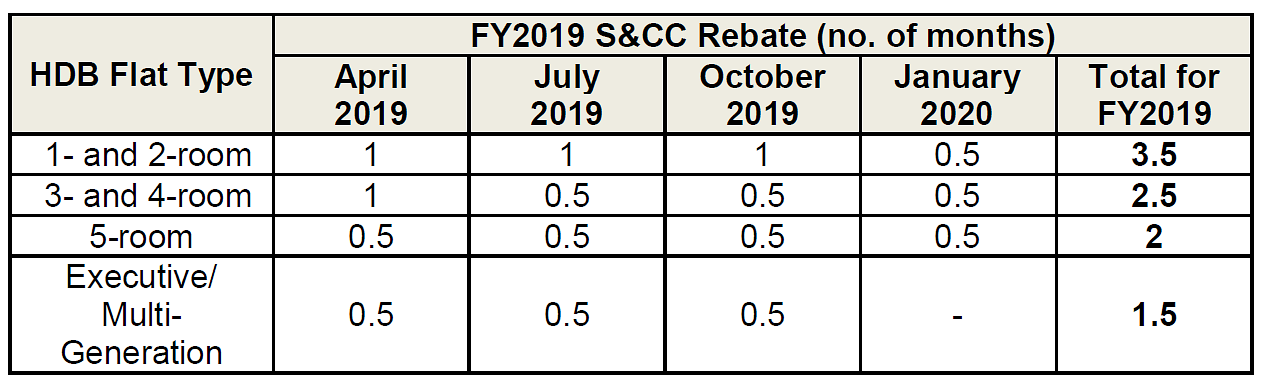
SINGAPORE: Around 930,000 Singaporean Housing and Development Board (HDB) households will receive S$132 million worth of Service and Conservancy Charges (S&CC) rebates in the 2019 financial year (from April 2019 to March 2020).
In a news release on Wednesday (Mar 27), the Ministry of Finance (MOF) said that in total, each eligible household will receive 1.5 to 3.5 months of S&CC rebate, depending on flat type.
The rebate was announced during Budget 2019, and is intended to help households with expenses.
SINGAPORE: The Urban Redevelopment Authority (URA) is using special 3D technology to study the underground as a strategic resource, it said on Wednesday (Mar 27) at the launch of its Draft Master Plan 2019.
The Master Plan is a blueprint that guides Singapore’s development over the next 10 to 15 years and is reviewed every five years.
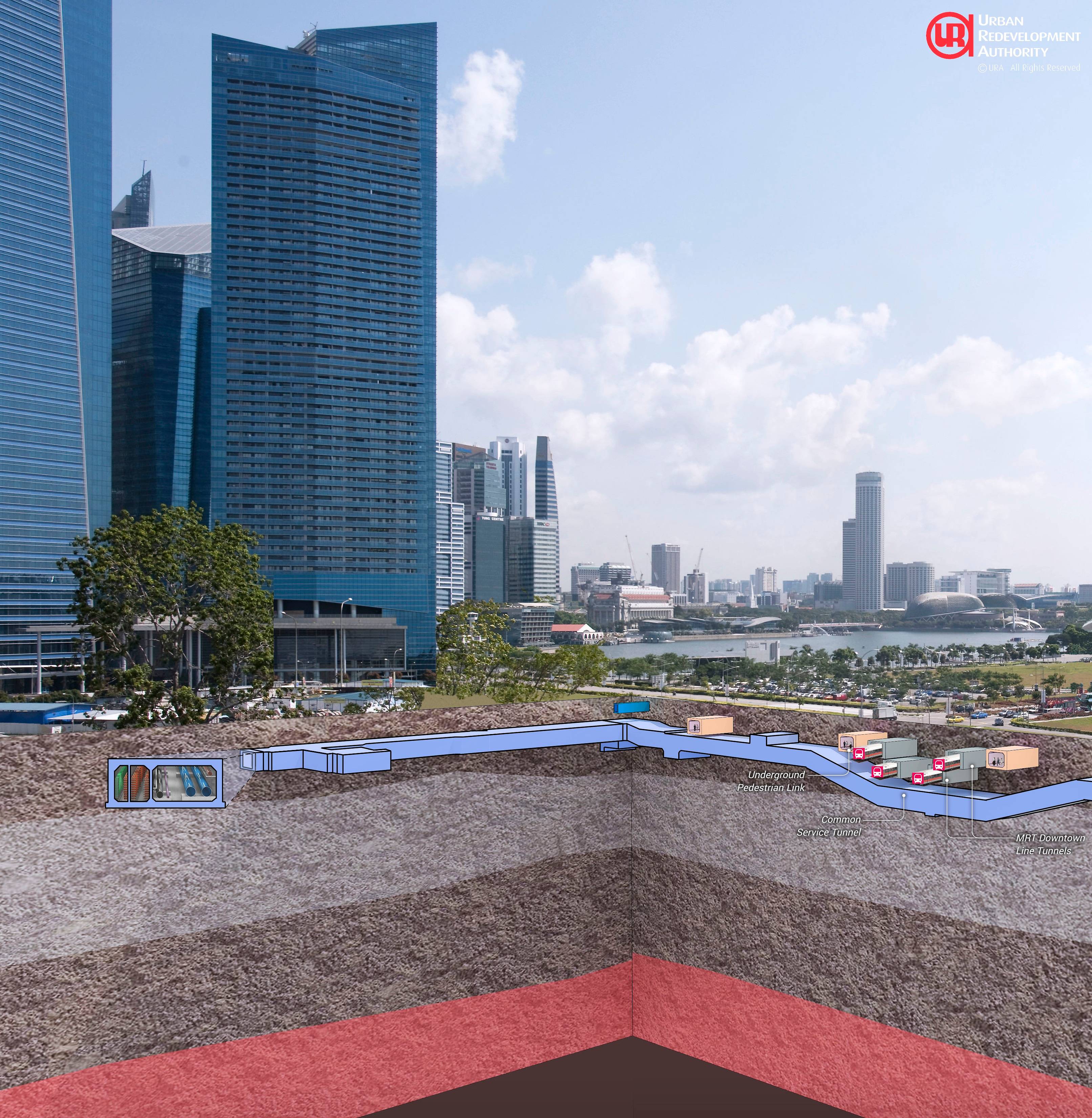
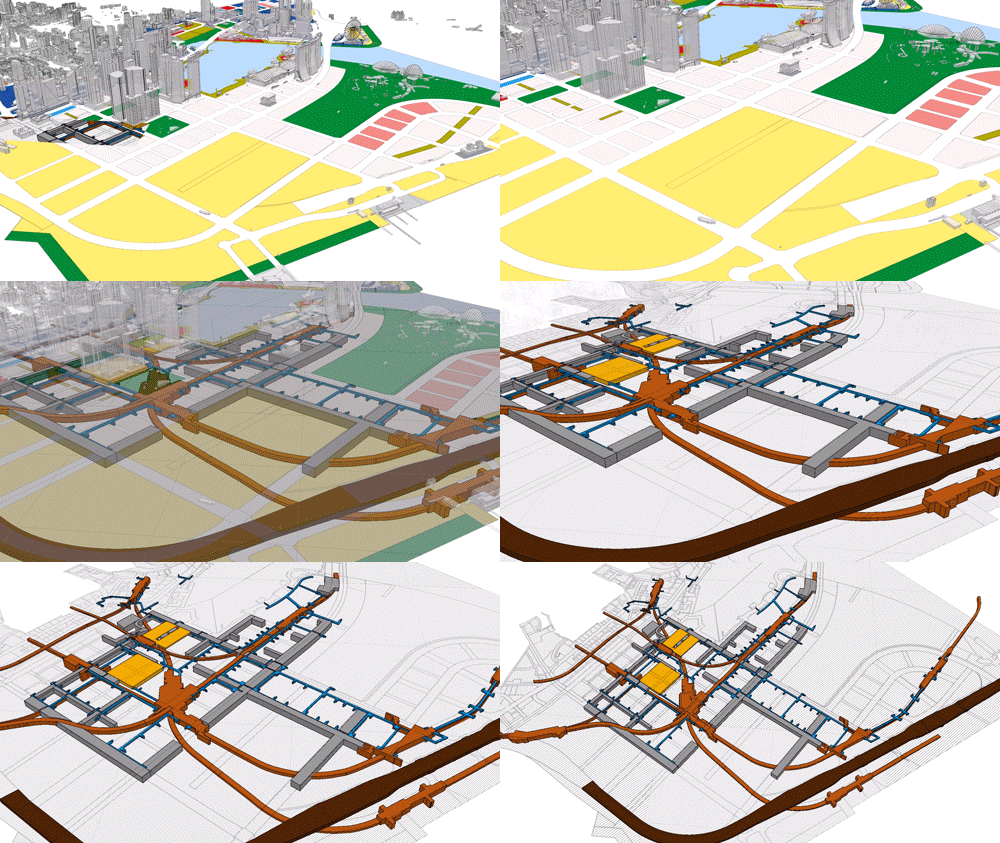
URA said it has rolled out 3D underground maps for Marina Bay, Jurong Innovation District and Punggol Digital District, and plans to expand the pilot to include more areas.
Cross section of the Common Services Tunnel undercrossing MRT tunnels and pedestrian underpasses at Marina Bay. (Graphic: Urban Redevelopment Authority)
Called the Special and Detailed Control Plan (SCDP), the map shows planned underground uses for each district in 3D, which can help protect planning intention.
“The underground plan is part of our strategy to create spaces for the future and create capacity for growth. Providing the plans for the underground provides transparency to the developers. This is more for the shallow underground, but we are also looking at plans for the deeper caverns. That’s for deeper utilities and structures that will go underground,” said Ms Hwang Yu-Ning, chief planner at URA.
The authority is studying the possibility of freeing up surface land for people-centric uses and relocating utilities, transport, storage and industrial facilities to the underground.
Underground uses for Marina Bay. (Image: Urban Redevelopment Authority)
An example of this, she said, is the new substation in the Labrador, Pasir Panjang area, which has the capacity to power more than two public housing towns. Building the substation underground frees up three hectares of land.
“The 230kV substation will go underground and that frees up … about 3ha of land on top for a future office development. It will also free up the space for other people to enjoy rather than look at utilities above ground,” Ms Hwang added.
Depending on the depth, the purposes for underground spaces may vary. In shallower depths, underground connections and MRT stations can be built. Deeper spots such as the Jurong Rock Caverns can store liquid hydrocarbons like gas oil and crude oil.
There are two existing caverns, and JTC and PUB are conducting cavern studies. Cavern areas currently under study are Kent Ridge Hill, Tanjong Kling, Jurong West and Gali Batu.
A 3D Underground Space Plan will come out later this year.
SINGAPORE: More homes will be made available in the central business district (CBD) and Marina Bay area, the Urban Redevelopment Authority (URA) said on Wednesday (Mar 27).
As part of plans in its Draft Master Plan 2019 to rejuvenate the central area, URA said it will increase housing in areas such as Downtown, Marina South and Rochor so that more people can live closer to their workplaces and amenities.
The plans for a larger live-in population in the office-dominated CBD and Marina Bay area is part of moves by URA to bring more life to the area after office hours.
“We are looking to bring in new housing options in the CBD. We want to make our CBD more vibrant, a 24/7 precinct, and housing is one of the ways where we want to bring in more people that will be living within the CBD areas,” said Ms Hwang Yu-Ning, URA’s chief planner.
The Central area also includes retail and entertainment clusters at Orchard and the Singapore River, as well as arts, cultural and heritage areas such as the Civic District, Bras Basah and Bugis.
Further south, the site currently occupied by Keppel Club will also be redeveloped for waterfront housing after the current lease expires in 2021, URA said.
The site – which is close to Telok Blangah and Labrador MRT stations – is part of the expansive 2,000-hectare Greater Southern Waterfront project stretching from Pasir Panjang to Marina East.
Some of the development in for the Greater Southern Waterfront will begin within the next five to 10 years.
MORE HOUSING IN MATURE ESTATES
Besides the Central area, housing and amenities will be also added to the new Bayshore precinct in the Upper East Coast area, and the mature towns of Dakota Crescent and Farrer Park.
A park will be built along the old sea walls, which are characteristic of East Coast Park, as a reminder of its heritage.
When completed, the new Bayshore precinct will have two MRT stations, Bayshore and Bedok South MRT stations. It will also be a car-lite precinct, prioritising walking and cycling with a public transit street lined with shops, food outlets and amenities.
URA said that going forward, future residential precincts will continue to be sustainable, green, community-centric and car-lite, with easy access to a range of public spaces and amenities. Amenities will also be located in one-stop centres similar to Our Tampines Hub to make it easier for residents to shop, dine, and engage in family-bonding activities under one roof.
Artist impression of the future Farrer Park. (Graphic: Urban Redevelopment Authority)
For an existing mature town such as Farrer Park, new housing will open up choices for those seeking to live near the city, URA said. Familiar landmarks such as the Farrer Park Swimming Pool and former Boxing Gym will be retained, while a sports field and park that will be integrated with future housing will allow residents to bond over sports and recreational activities, said URA.
Dakota Crescent can expect to see more public housing, which will be planned to take into consideration the six retained Singapore Improvement Trust blocks nearby, while the iconic Dove Playground will be retained for its heritage value.
BRINGING JOBS CLOSER TO HOMES WITH THREE “GATEWAYS”
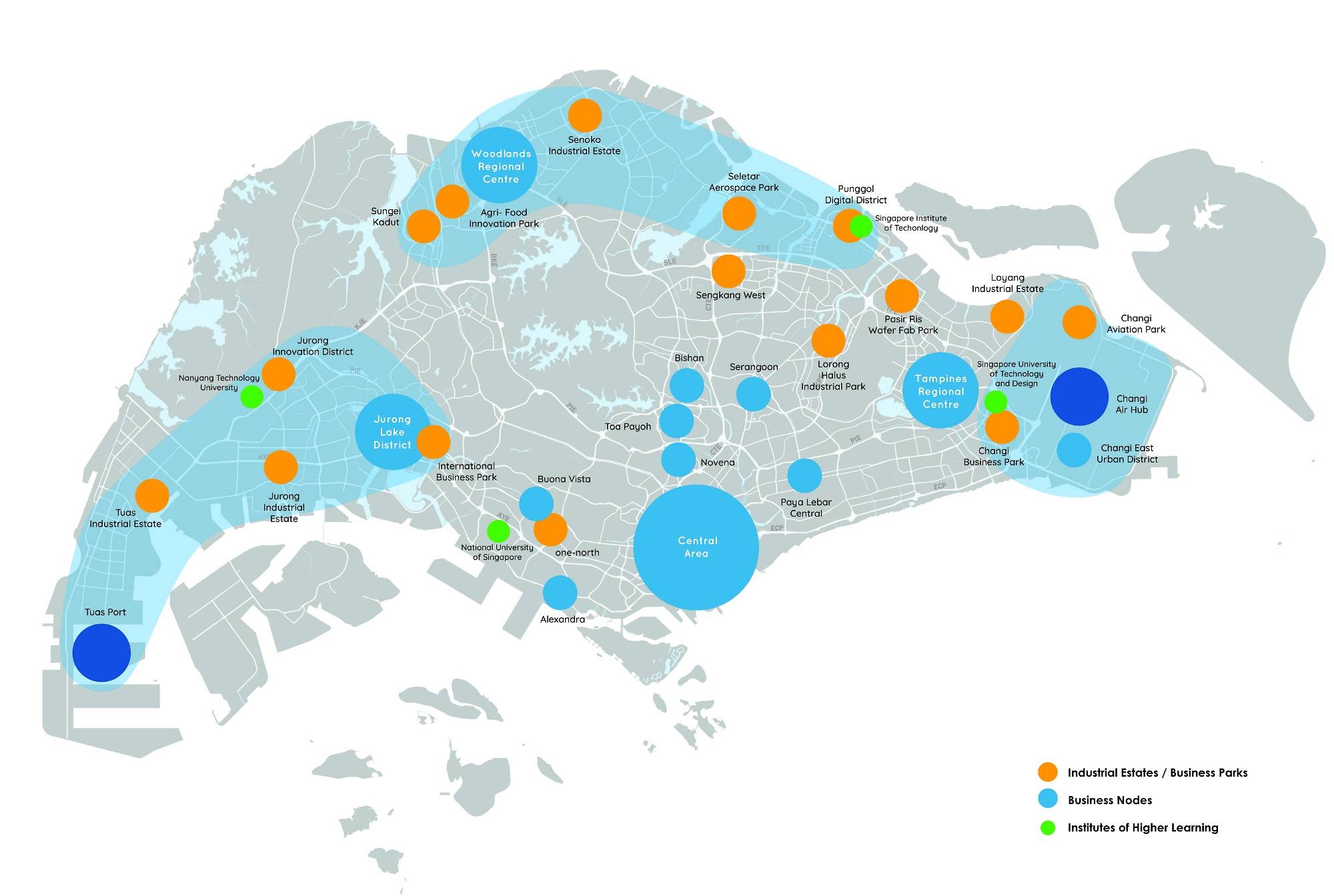
Aside from housing, three major economic gateways in the west, north and east are being planned with each anchored in a few key growth sectors. They will serve as major employment hubs.
The eastern gateway is centered in the Changi Region to tap on the expansion of Changi Airport and its connectivity. The region comprises Changi Aviation Park and the future Changi East Industrial Zone, and will cater to aviation-related businesses.
Also part of the region is Changi City, which is slated to become an innovative lifestyle business cluster including Changi Business Park, Singapore University of Technology and Design, as well as the future Changi East Urban District located at the doorstep at Terminal 5.
In Sungei Kadut, the new Agri-Food Innovation Park will be built as a pilot cluster to catalyse innovation in the agri-tech industry. The Park, which is located near to farms in Lim Chu Kang and businesses in the Senoko Food Zone, forms part of a larger Northern Agri-Tech and Food Corridor.
Plan of employment areas in Singapore with three key economic gateways in the northern, eastern and western regions of Singapore. (Graphic: Urban Redevelopment Authority)
In Woodlands, a new regional centre is on track to become the largest economic hub in the north over the next 15 years with spaces for business, industry, research and development, and learning and innovation.
New community links such as the WoodsVista Gallery and North Coast Vista will link up precincts within Woodlands and bring in more public spaces, and pedestrian and cycling infrastructure to the area.
To the east, the Punggol Digital District – Singapore’s first enterprise district – an integrated business park and the Singapore Institute of Technology university cluster will help foster closer collaboration between industry and academia.
Tapping on Tuas Terminal’s maritime connectivity, the western gateway will be moored alongside the Jurong Lake District (JLD) and Jurong Innovation District (JID).
As part of the Government’s decentralisation strategy, Jurong Lake District will be the biggest business district outside the CBD while Jurong Innovation District will become a next-generation industrial district covering Nanyang Technological University, CleanTech Park, Bulim, Bahar and Tengah.
URA’s Master Plan is reviewed every five years and charts out the Government’s plans for land use over the next 10 to 15 years.
“In this master plan, we hope to have inclusive, sustainable and green neighbourhoods that will make our city more resilient in the longer term. We are also working on plans to help rejuvenate existing familiar places to make sure we bring in new vibrancy and energy to these areas,” said Ms Hwang.