Home Blog Page 818

Commentary: Even criminals deserve justice – and other reasons why lawyers defend them

0

SINGAPORE: In August last year, Audrey Tay, daughter of the founders of a luxury watch retail chain pleaded guilty for taking drugs and causing a car crash.

She was later sentenced to 22 months in jail and fined S$1,000 for three drug charges and one charge of driving without due care or attention, and was also disqualified from driving for 18 months upon her release.

She appealed against that sentence, and her case lawyer, Eugene Thuraisingam, argued for leniency. The high court however, dismissed that appeal on Mar 15.

READ: Behind the public shaming of one wealthy elite, a disturbing but growing divide, a commentary

audrey tay

Socialite Audrey Tay, the daughter of the founders of luxury watch retailer The Hour Glass. (File photo: TODAY)

To many members of the public, the idea of defending a person of such notoriety may seem ridiculous. How could one defend a person like that?

But Mr Thuraisingam is no stranger to controversy. The criminal lawyer have taken plenty of high profile cases – he also defended British drug trafficker Yuen Ye Ming among others.  

Like Mr Thuraisingam, many defence lawyers are often criticised for handling deplorable cases, but there are many like him who undertake such cases without the media glare.

Many readers brought up on a diet of Hong Kong and American legal dramas would have a vague idea of the role of the defence criminal lawyer: They’re the people “defending the accused” – without necessarily fully understanding what that means. 

The role of the lawyer in court is to present the client’s best possible case, but that role is subject to the lawyer’s duties as an officer of the court and to assist in the administration of justice. In other words, lawyers are there to help judges reach a fair decision. 

Defence lawyers are not mouthpieces for the accused. They do not just act for that one client, but uphold a sacred duty to ensure that justice is done and due process is carried out.

They have to make sure all available evidence and arguments are put before the judge, and that all such evidence and arguments are tested through rigorous questioning.

IT’S A BELIEF, NOT A JOB

So why do criminal lawyers still do it? I posed the question to a colleague of mine who was involved in a series of criminal trials involving sex crimes – and rather heinous ones at that.

​​​​​​​

File photo of handcuffs 02

Photo illustration of a man in handcuffs. (Photo: Jeremy Long)

It was not easy to get him to say why he chose to practice at the Criminal Bar. I suspect because nobody wanted to sound like a parrot of the Legal Profession Rules – which outline professional conduct. After much probing, he revealed what I guessed all along: It’s a calling, he said. 

A belief, not a job.

It’s not about getting quoted in the media – only a few can astutely navigate the media the way Mr Thuraisingam or the late Subhas Anandan did. It is the inexplicable combination of ideals that says everyone deserves legal representation, including those accused of the most serious of crimes, that inspire defence lawyers. 

For it is when no one is willing to stand with you, that you most need a lawyer. 

Does the lawyer have to like his client? In the words of my colleague, “No.” 

It was personally trying for him having to defend an elderly who admitted to taking advantage of minors and performing deplorable acts on them. But as challenging as it was, my colleague knew that as the old man’s legal representative, he still had to set out the client’s circumstances in mitigation. The administration of justice required it.

THE DESIRE TO HELP OTHERS

What drives most people to apply to law school may be the inexplicable desire to help others, driven by different reasons – just like how it drove my colleague to the profession.

I look at some of the current students at the Singapore University of Social Science where I work, and am reminded of what they said in their interviews with us. One mentioned how he noticed that lawyers who kept their client updated with all proceedings, and took care in explaining why steps were taken, provided their clients with great comfort.

unisim law school

SUSS law school dean Professor Leslie Chew answering questions from prospective students. (Photo: Faris Mokhtar)

There are also those who remarked on how poorly friends and relatives were treated by lawyers and believe at making things better.

I suppose I should leave my colleague to have the last word why he does it: “As defence counsels, we are in a privileged position to assist the accused. We are both the legal advisor as well as the listening ear to the accused during the course of his  proceedings.”

As we go about our role, there will be times when the accused readily admits to the offence and others who maintain that the incident did not occur or had occurred differently. Either way, we are given the unique opportunity to give voice to the accused’s version of events and to that end, do our level best that justice is administered.

He added: “Crime may not pay, but lending a helping hand to those involved, the accused included, can make a real difference to them and their families. Providing assistance where it is needed, is in itself a reward.”

Associate Professor Darren Koh Ngiap Thiam is Vice Dean and Head at the Taxation & Law Programme in the School of Law at the Singapore University of Social Sciences.

Source link

Marine Parade cat lover ‘in denial’ after body of animal ‘relocated’ by town council was returned to her

0

SINGAPORE: It has been a taxing time for avid cat lover Mdm Tan Hwee Khiang after two of her animals were relocated by Marine Parade Town Council (MPTC) to Harbourfront without her knowledge, with one of them –  Ben Ben – subsequently found dead.

“I fell apart. When I first discovered they were missing, I immediately searched from the first to (the) 16th floor again and again,” Mdm Tan told Channel NewsAsia on Thursday (Mar 28).

Earlier, MPTC apologised after two members of staff carried out the relocation: “We wish to apologise on behalf of our staff who (have) made the misjudgement of relocating the two cats that were found roaming in the block.”

MPTC also said it has received more than 45 reports from residents since 2016 about cats in the area causing a nuisance. 

“The cats, around 15 of them, were left roaming freely within the block, causing disamenities and hygiene issues such as cats defecating/urinating, fur shedding, caterwauling, etc, at the common corridor, staircases and lift lobbies,” said the town council.  

“The cat-related nuisances were reported from most levels of the block and the surrounding blocks too.”

After Ben Ben was found dead, his body was returned to Mdm Tan. 

“When I first received Ben Ben’s corpse, I was in denial and so heartbroken, because he’s been with me for four to five years, and I just wanted to keep him for one more night. It hurt so me much when I had to cremate him,” said an emotional Mdm Tan.

READ: Marine Parade Town Council apologises for ‘relocating’ 2 cats

The 58-year-old has been caring for cats since she moved to the Marine Parade area nearly 15 years ago – and she said that she treats them like her children.

cat lover Tan Hwee Khiang

Mdm Tan Hwee Khiang’s photos of her cats on a wall in her living room. (Photo: Darius Boey)

“All of my cats are rescued. There are some with three legs only, previous skin infections and also those given to me by moving families,” she said. 

“Whether it’s my own, other households’ or cats from the streets, I treat them like my children. The neighbours will usually call me if there are any cat-related problems around. I’ll be the first down to the scene.”

Despite the reports about her cats being a nuisance, Mdm Tan insisted that they mean no harm to other residents: “I’m aware of the complaints. But as for the cleanliness of my cats, I always assure that they are clean. Because there are frequent checks by AVA and HDB, and they are fine with it.”

During the interview, Channel NewsAsia observed that Mdm Tan’s house was clean and tidy, with no cat odour.

As part of her daily routine, Mdm Tan also cares for other people’s cats, and doesn’t mind cleaning up after them.

“I take care (of) my own cats and I do put in the effort. On certain floors, I have placed sandboxes along the stairways and I clean them every day, even though other cats use them too. But I don’t mind cleaning it up,” added Mdm Tan.

cat lover Tan Hwee Khiang (1)

Charlie, one of Mdm Tan Hwee Khiang’s more active cats, roams the lift lobby outside the flat for most of the day. (Photo: Darius Boey)

Mdm Tan still hopes that she will be able to find Leng Leng, the other relocated cat which is still thought to be in the Harbourfront area.

“I miss her very much and I’ll continue to go down to Harbourfront to search for my Leng Leng,” said a hopeful Mdm Tan.

Source link

HSA recalls 3 brands of high blood pressure drugs over potentially harmful impurity

0

SINGAPORE: Three brands of high blood pressure medicine containing the ingredient losartan have been recalled because they contain higher than acceptable levels of a potentially harmful impurity, the Health Sciences Authority (HSA) said on Thursday (Mar 28).

The drugs contain the active ingredient losartan potassium, which was manufactured by Indian pharmaceutical company Hetero Labs.

The affected products are the 50mg and 100mg tablets from the brands Losartas, Losagen and Hyperten and distributed by local suppliers Apotheca Marketing, Medicell Pharmaceutical and Goldplus Universal, respectively.

About 137,000 patients in Singapore are using the three recalled brands of losartan medicine, said the Ministry of Health (MOH).

Losartas is prescribed in public healthcare institutions, while Losartas, Losagen and Hyperten are prescribed at private healthcare institutions.

HSA has advised patients not to stop treatment on their own as there is no immediate health risk and sudden stopping of the drugs can pose greater immediate risk to their health.

READ: 137,000 patients affected by losartan high blood pressure medicine recall: MOH

Losartan Table 1

(Source: Health Sciences Authority)

HIGH EXPOSURE OVER A LONG PERIOD MAY INCREASE CANCER RISK

The recalled products were found to contain trace amounts of a nitrosamine impurity, N-nitro-N-methyl-4-aminobutyric acid (NMBA), which are above internationally accepted levels, HSA said.

Exposure to nitrosamines at high quantities over a long-term period may potentially increase the risk of cancer.

For example, the added cancer risk from an additional six-month exposure is estimated to be less than 0.0002 per cent.

“The risks of trace amounts of NMBA are associated with long term exposure. Sudden stopping of the medicines can pose greater and more immediate risk to patient’s health … We have advised healthcare professionals to review the medicine and treatment plans of their patients,” HSA said.

Losartan Losagen 50mg

The affected products contain the active ingredient losartan potassium. (Photo: Health Sciences Authority)

​​​​​​​

Losartan Losartas 50mg

Affected consumers are advised to consult their medical providers. (Photo: Health Sciences Authority)

HSA said that several losartan medicines have been recalled overseas since end-February due to the presence of NMBA. It tested all locally marketed losartan products for the presence of the NMBA impurity and in March found the three brands contained trace amounts of NMBA above acceptable levels.

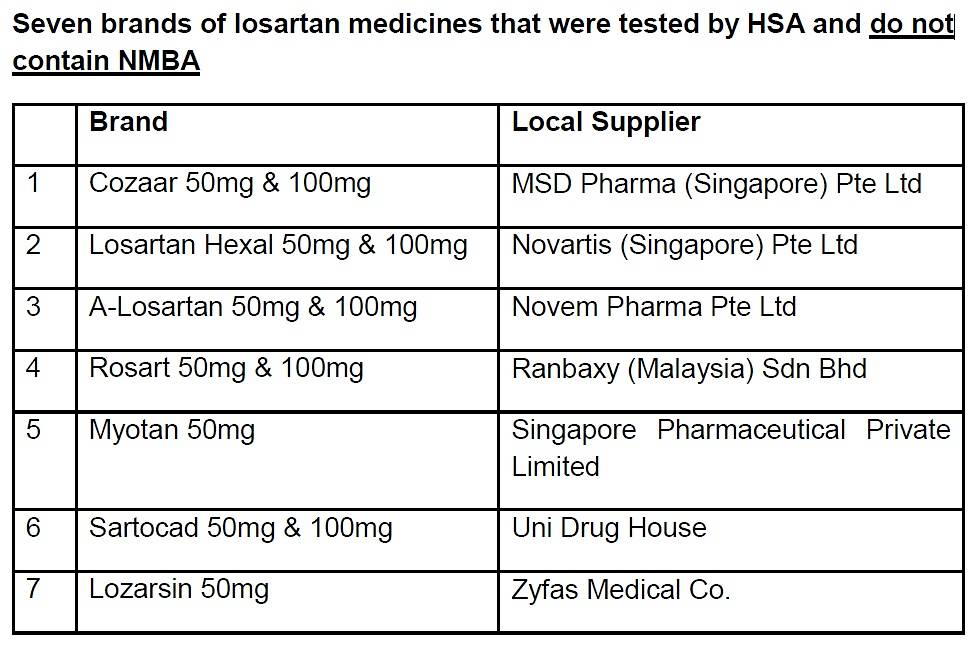
The other seven brands of losartan medicines marketed in Singapore are not affected by this impurity.

Losartan Table 2

(Source: Health Sciences Authority)

NO IMMEDIATE HEALTH RISK

National Heart Centre Singapore Cardiologist Professor Ding Zee Pin said that there is no immediate health risk associated with taking the affected medicines and that patients are advised not to stop or change treatment on their own.

“As losartan is used to treat high blood pressure, stopping the medicine without replacement of other equivalent medication can increase the risk of poor control of blood pressure,” said Professor Ding, who is also on HSA’s Expert Panel on Nitrosamines.

Consumers who are taking the affected medication are advised to discuss their treatment plan with their healthcare provider.

“Do not stop taking the medicines on your own until you have been provided with a replacement brand of losartan or a different medicine by your healthcare provider,” HSA said.

MOH said in its release that public healthcare institutions will be reaching out to their patients.

Those with medical appointments scheduled before Jul 1 should proceed with their appointments, at which point their doctor will advise them on alternative medicines, MOH said.

Patients whose medical appointments are scheduled on or after Jul 1 will be contacted for an earlier consultation.

TESTS CONDUCTED ON OTHER BLOOD PRESSURE MEDICATION

Losartan belongs to a class of medicines called angiotensin II receptor blockers (ARBs), which are used to treat high blood pressure, also known as hypertension.

HSA said that since June 2018, several ARB medicines have been recalled overseas due to the presence of two other nitrosamine impurities, N-Nitrosodimethylamine (NDMA) and N-Nitrosodiethylamine (NDEA).

HSA said it has tested the locally marketed ARB medicines and found that none of them contained unacceptable levels of the two impurities.

“HSA is working with companies and international regulatory agencies to verify the cause of contamination, and to formulate measures to address the issue,” it said.

“HSA will require companies to make the necessary changes to their manufacturing process to ensure that the medicines do not contain these impurities in future,” it added.

Source link

137,000 patients affected by losartan high blood pressure medicine recall: MOH

0

SINGAPORE: About 137,000 patients in Singapore are using the three recalled brands of high blood pressure medicine containing losartan, the Ministry of Health (MOH) said on Thursday (Mar 28).

Earlier, the Health Sciences Authority (HSA) said that the brands Losartas, Losagen and Hyperten were being recalled as the medicines contained higher than acceptable levels of a nitrosamine impurity. 

Exposure to nitrosamines at higher quantities over a long-term period may potentially increase the risk of cancer, said HSA. 

READ: HSA recalls 3 brands of blood pressure drugs over potentially harmful impurity

Seven other brands of losartan medicine approved in Singapore are not affected by the recall. 

“About 137,000 patients in Singapore are using the three recalled brands of losartan medicine. Of these, about 130,000 patients have been prescribed Losartas at the public healthcare institutions,” said MOH. 

There is no immediate risk associated with taking the affected brands of medicine, according to the ministry.  

Losartan Table 1

(Source: Health Sciences Authority)

“Patients are strongly advised to continue taking their medicine until their healthcare providers arrange for them to stop or switch to suitable alternatives.

“Patients who are unsure whether they have been using an affected product should contact their healthcare providers,” said MOH. 

CONSULT DOCTOR FOR ALTERNATIVES: MOH

Public healthcare institutions will be reaching out to their patients, MOH said.

Patients whose medical appointments are scheduled before Jul 1 should proceed with these appointments and their doctor will advise them on suitable alternative medicines. 

Patients whose medical appointments are scheduled on or after Jul 1 will be contacted for an earlier consultation or medication review, or both.

The public healthcare sector has made additional orders of unaffected brands of losartan, said MOH. The additional supplies will arrive progressively from a few weeks’ time. Importers will also be setting aside additional supplies for private healthcare providers.

Losartan Hyperten 50mg

HSA has advised patients to not stop treatment on their own. (Photo: Health Sciences Authority)

“To ensure continued availability of high blood pressure medication for all patients who need them, medical practitioners are advised to initially prescribe the medication on a one-month basis. 

“This ensures that patients in all settings are able to promptly receive the medication they need. This may be the practice for the next six months,” MOH said.

At public healthcare institutions, patients currently on losartan will not have to pay more during the interim period should they switch to replacement medicines, which will be priced the same or lower.

Charges incurred for services such as additional consultations or tests to assess suitability for a switch in medicine will also be waived. Refunds will be provided to patients returning the affected losartan medication at their public healthcare institutions, MOH said.

Alternative high blood pressure medication include the Angiotensin Converting Enzyme Inhibitor (ACE-I) class of medicines as well as other angiotensin receptor blocker (ARB) classes of medicines.

Additional information and updates on impurities in high blood pressure medicines are also available at HSA’s website.

Source link

Marine Parade Town Council apologises for ‘relocating’ 2 cats

0

SINGAPORE: Marine Parade Town Council on Thursday (Mar 28) apologised after two of its staff members “relocated” two cats found roaming at Block 15 Marine Terrace.

“We wish to apologise on behalf of our staff who (have) made the misjudgement of relocating the two cats that were found roaming in the block,” said the town council in response to Channel NewsAsia’s queries.

It also said that it would work with the Cat Welfare Society (CWS) and Agri-Food and Veterinary Authority to educate its staff and pest control operators on proper management of animal-related issues. 

Their remarks come after reports circulating on social media that two cats from the area had gone missing after being caught and “dumped” at Harbourfront by the town council.

The cats, Ben Ben and Leng Leng, were caught at Marine Terrace and subsequently dumped at the Seah Im Food Center earlier this month, Facebook user Snowy Tan said in a post on Wednesday.

One of the cats was later found dead at Harbourfront, the post added. The whereabouts of the other cat is unknown.

“Marine Parade Town Council (MPTC), with their pest control company, trapped cats and cruelly dumped them in an area with no easy access to food and with dangerously high traffic,” said Snowy Tan.

“The cats were dumped miles away from their home and no idea how to get home,” the post added.

In their response on Thursday, the town council said that residents have made more than 45 reports since 2016 about the cats causing nuisance.

“The cats, around 15 of them, were left roaming freely within the block, causing disamenities and hygiene issues such as cats defecating/urinating, fur shedding, caterwauling, etc, at the common corridor, staircases and lift lobbies,” said the town council.  “The cat-related nuisances were reported from most levels of the block and the surrounding blocks too.”

Marine Terrace cats 2

Marine Parade Town Council says residents have expressed frustration about cats roaming freely within the block. (Photo: Marine Parade Town Council)

Marine Terrace cats 3

Marine Parade Town Council says residents have expressed frustration about cats roaming freely within the block. (Photo: Marine Parade Town Council)

The town council added that it has engaged with a Mdm Tan “on many occasions to advise against keeping so many cats in her HDB flat, and not to allow the cats to roam freely at the common areas of the block, affecting many residents”, said the town council.

“However, there was no improvement.”

It also said that the CWS is aware of the situation and assisting to educate Mdm Tan on responsible pet ownership. 

Source link

Backstreet Boys Singapore

0

Backstreet Boys Singapore
Wednesday, October 30, 2019 at 8:00 PM

Singapore Indoor Stadium

2 Stadium Walk, Singapore, Singapore

Source link

King Lear (Screening)

0

King Lear (Screening)
from Sunday, July 28, 2019 at 2:00 PM to Sunday, July 28, 2019 at 6:00 PM

Esplanade – Theatres on the Bay

1 Esplanade Drive, Singapore, 038981 Singapore

Source link

Antony & Cleopatra (Screening)

0

Antony & Cleopatra (Screening)
from Saturday, July 27, 2019 at 2:00 PM to Saturday, July 27, 2019 at 6:00 PM

Esplanade – Theatres on the Bay

1 Esplanade Drive, Singapore, 038981 Singapore

Source link

Tech for urban farming among R&D focus as Singapore looks to beef up food security

0

SINGAPORE: As part of his job, Liew Woei Chang keeps a close eye on hundreds of tilapia fish daily. 

But the 39-year-old does not work in the fish trade. In fact, the tilapia that he monitors possess quite an atypical trait.

A freshwater fish, tilapias tend to grow slower or face high mortality rates when reared in sea water. Together with four other researchers, Dr Liew, a research investigator at the Temasek Life Sciences Laboratory (TLL), has been looking at how to change that.

Eight years since the research programme started, the team has “almost achieved” that.

“Tilapia is one of the most important aquaculture species, being the second most-farmed fish in the world. Traditionally, tilapia have been grown in Singapore and around the region but they do not take to sea water well, so the survivability and growth rates here have not been high,” Dr Liew told Channel NewsAsia during a visit to his lab earlier this week.

Through the use of technology that can accurately identify fish with desired traits and select them for its selective breeding programme, TLL researchers have been able to breed good-quality and salt-tolerant tilapia, now in the fifth generation, without any genetic modification.

“We will do mass cross-breeding for each batch of fish and after about 3 months, do a size selection where we will pick out those that have grown the fastest. We will find out the parents of these superior fish and use them to breed more fish. Their offspring will then be used for the next batch,” said Dr Liew who has been involved in the tilapia selection project since 2014.

“We have been hoping to achieve high-yield, fast-growth tilapia that can survive in sea water. I think we have almost achieved that.”

In another TLL laboratory nearby, Dr Urano Daisuke is hoping to grow vegetables that are climate-proof and have improved agronomical traits and nutritional values.

While an indoor setting allows researchers to come up with optimal conditions, it brings about a different set of challenges.

“Unlike outdoor farms with problems like the weather or pathogens, we don’t have to consider these threats in indoor farms. But plants here need to grow at a high-density setting with low-light intensity.”

The latter stems from cost issues faced by many indoor farms. “Lighting makes up the biggest cost for the business of indoor farming. In Japan, for example, advanced indoor farms spend about 70 to 80 per cent of their costs on LED lights and the remaining on temperature control,” elaborated Dr Urano, who is the principal investigator for TLL’s research on vegetables.

Under low light conditions, plants tend to start growing longer stalks to help them fight for light. This usually results in smaller leaves. 

“But the plants we want is even under low light, they can still make big leaves which is what people eat … If the plants can grow nicely at low-light intensity, then we can reduce cost,” added Dr Urano.

“The plants for indoor farming will have to be different so we need to modify some traits and breed new vegetables that have these unique traits.”

Indoor vegetable farming at Temasek Life Sciences Laboratory

Dr Urano Daisuke, a researcher from the Temasek Life Sciences Laboratory, is hoping to grow vegetables that are climate-proofed and have improved agronomical traits and nutritional values. (Photo: Tang See Kit)

SINGAPORE RAMPS UP AGRI-FOOD R&D BUDGET

Such research and development (R&D) projects are what Singapore is looking to pump in more money as it beefs up its agriculture and food production sector.

In line with the newly announced target to produce 30 per cent of the nation’s nutritional needs by 2030, the Government will invest S$144 million from its Research, Innovation and Enterprise 2020 (RIE2020) plan to ramp up R&D in the agri-food industry.

READ: Digital tech, food security among key areas to get more R&D funding

The National Research Foundation (NRF), in announcing this on Wednesday (Mar 27), said factors like climate change, rising sea levels and temperatures are risks to world food production. Given Singapore’s space and resource constraints, the country is vulnerable to these global trends that impact food supply and safety.

Citing how Singapore has previously tapped on science and technology to tackle its water constraints, it needs to do the same for its food challenges, NRF added in a press release.

The new funds will go to R&D efforts in three areas, namely sustainable urban food production with focus on tropical aquaculture and urban agriculture, development of “future foods” in the form of alternative proteins, as well as building new food safety standards and local capabilities to drive innovation in food production and manufacturing. 

“With the investments we are putting in place, it will help to raise productivity of some of the locally produced food sources,” National Development Minister Lawrence Wong said at a press conference on Wednesday.

“We can also invest in the strengths we have in biotechnology and advanced manufacturing (to) help us look at new food sources emerging now. This will also help us improve our understanding in how these food sources are evolving, strengthen our capabilities in regulating food and ensuring food safety for the future.”

To complement this, two Centres of Innovation focusing on aquaculture and energy will be set up in Temasek Polytechnic and the Nanyang Technological University by June and April, respectively.

Tilapia fish at Temasek Life Sciences Laboratory (2)

The Temasek Life Sciences Laboratory where research on a home-grown breed of tilapia that can grow in sea water is underway. (Photo: Tang See Kit)

USING TECH TO PRODUCE MORE

TLL’s chief executive Peter Chia welcomes the increasing attention on the local agri-tech sector. More than just funds, he said he is excited about the growing awareness that has been created about the industry.

“Rather than just approaching it from a biology point of view, which gives you only one side of the equation, we can now bring together people from multiple backgrounds, agencies to meet the ’30 by 30’ goal in a much more considered way.”

Since founded in 2002, TLL has focused primarily on understanding the cellular mechanisms underpinning the development and physiology of plants, fungi and animals. Its selective breeding programme on fish genetics, for one, has successfully yielded a premium breed of sea bass that is less susceptible to disease and can be bred in 30 per cent less time.

Its ongoing research on salt-tolerant tilapia and the climate-proofing of vegetables are other ways it hopes technology can help to bolster Singapore’s food security.

“As aquaculture becomes more knowledge-intensive, the idea is for us to contribute with technology and knowledge to improve productivity overall,” said Mr Chia. “To produce more with less, and in a lower risk manner so that in general, we will have better-quality food and more affordable food, which is the definition of food security.”

For the tilapia selection project, outdoor trials will be the next step to take and researchers are currently looking to supply fingerlings to farmers in Singapore for a start.

“We have transformed the tilapia to be able to grow in sea water so what’s next is to have farmers to be aware of this and get them to take our fish for trials in the real environment,” said Dr Liew.

Source link

Digital tech, food security among key areas to get more R&D funding

0

SINGAPORE: Following a mid-term review of its five-year science and technology plan, Singapore will pump in more money to boost research and development (R&D) efforts in three key areas, namely digital technologies, cell therapy manufacturing and food security.

These additional investments will build on the “good progress” made under the Research, Innovation and Enterprise 2020 (RIE2020) plan – a S$19 billion initiative launched in early-2016 – said the National Research Foundation (NRF) in a press release on Wednesday (Mar 27).

Speaking at a press conference after a meeting with the Research, Innovation and Enterprise Council (RIEC), Prime Minister Lee Hsien Loong said the elements of research, innovation and enterprise are critical to Singapore’s development.

Since embarking on the RIEC journey in 2006 to deepen the nation’s science and technology capabilities along the whole value chain, progress has been made.

This includes international recognition and significant breakthroughs for local scientists, as well as foreign companies such as Dyson setting up their advanced product development facilities here.

R&D efforts have also resulted in practical and useful products, including autonomous vehicles, he added.

“We must and we will continue to invest in science, technology and innovation in a balanced, sustained and sustainable manner. (This is) in order to keep Singapore competitive and relevant globally, and seed exciting new opportunities for our future economy,” the Prime Minister said.

INVESTING IN FUTURE GROWTH

On the mid-term review of the RIE2020, Mr Lee, who chairs the RIEC, added: “We have affirmed that we are on track, but we are sharpening our focus and making fine-tuning adjustments to our plans.”

Research, Innovation and Enterprise Council press conference

(From left) Minister for National Development Lawrence Wong, Finance Minister Heng Swee Keat, Prime Minister Lee Hsien Loong and Trade and Industry Minister Chan Chun Sing at a press conference after a meeting with the Research, Innovation and Enterprise Council. (Photo: Hanidah Amin)

To ensure that Singapore keeps pace with the digital revolution, the Government will invest an additional S$500 million under the RIE2020 plan to strengthen digital technologies and automation expertise here.

Of that amount, S$200 million will go to boosting the nation’s supercomputing capability and network speed and quality, as announced by Finance Minister Heng Swee Keat earlier this month.

The National Robotics Programme is set to receive about S$41 million to deploy more robotics technology, while the remaining funds will help to expand existing programmes like AI Singapore and foster new capabilities in digital trust, the social science of digital technologies, and computational law.

Another area earmarked for more investments is cell therapy – a form of therapy in which intact living cells are injected into a patient to help fight cancer, or enable the restoration of tissue or organ function. 

The industry has seen accelerated growth in recent years on the back of related product launches, presenting high-value opportunities for the local biopharmaceutical manufacturing sector, according to the Agency for Science, Technology and Research (A*STAR). 

“When you look at the future, it’s beyond what we currently manufacture today. Small molecules, biologics and cell therapy will be part of the future and we want to anchor those investments here in Singapore,” said Dr Benjamin Seet, executive director at A*STAR’s biomedical research council.

By ploughing in S$80 million, Singapore hopes to address existing hurdles in the making of cell therapies. These include developing a commercially scalable platform and improved technology to assess the quality of cells manufactured.

In line with the newly announced target of producing 30 per cent of the nation’s nutritional needs by 2030, some S$144 million will also be allocated from the RIE2020 plan for R&D work in sustainable urban food production, future food, as well as food safety science and innovation. 

READ: Tech for urban farming among R&D focus as Singapore looks to beef up food security

To complement this, two Centres of Innovation focusing on aquaculture and energy will be set up in Temasek Polytechnic and the Nanyang Technological University by June and April, respectively.

“In science and technology, there’s always a lag so it’s important for us to do continuous stock-take,” said National Research Foundation’s (NRF) chief executive Low Teck Seng.

“Because our ambition is not only to build up science and tech knowledge, but to also use it to grow our economy and build solutions to address some of our national challenges.”

While the RIE2020 plan has made good progress thus far, more can be done. For instance, there is still the need to nudge more companies, both big and small, to try to incorporate R&D into their operations, said Mr Low.

“The industry is not spending rapidly enough so we will need to keep pushing our tech consortia idea and others to see to get them more involved. In terms of tech deployment and infusion, can we be more effective? I think we can.”

Additional reporting by Deborah Wong

Source link