Are you on the lookout for your next mountain bike, but you are unsure about what brand to go with? Worry not, because we thought we’d take a look at two of the best mountain bike brands for sale to help you select the right bike for you.
Tommaso
Tommaso is a brand that is known for its quality. We especially like the Gran Sasso 29er, pictured above.
It has rugged 29er wheels which are able to maintain excellent grip when riding over rocky terrain.
We have noticed that having the clearance of a 29er wheel makes such a difference, especially when you are riding on a steep incline. When it comes to braking, the Gran Sasso 29er delivers, thanks to the hydraulic disc brakes which allows you to brake in all weather conditions. We would always recommend that you choose hydraulic brakes over traditional mechanical disc brakes, as they often half the stopping distance.
We have seen in the past that some mountain bike brands offer bikes that are not built to last and break before their time. The Tomasso Gran Sasso 29er is manufactured using the finest quality aluminium. For peace of mind, there is a lifetime warranty on the bike, which arguably makes it one of the most trusted mountain bike brands.
The second brand we would recommend is Schwinn. We love the Schwinn Schwinn Traxion 29” mountain bike from this brand. It is fitted with a rugged and durable aluminium dual suspension frame. This is supported with the unique Schwinn suspension fork, which works to improve the ride quality by soaking up any bumps that you ride over when navigating difficult terrain.
When it comes to making gear changes, this is made easy thanks to the 24-speed Shimano EZ-Fire trigger shifter that is fitted. Gaining speed and moving through the gears is excellent with the Schwinn mountain bike. Durable Schwinn alloy cranks improve the gearing.
When it comes to braking, while it is not hydraulic brakes, the front and rear mechanical disc brakes provide good stopping ability. It would be the perfect bike if it had hydraulic brakes!
This particular bike is fitted with wide double wall alloy rims, which add to the durability of the bike.
Have you tried out these mountain bike brands before? If so, tell us what you think of them and whether they truly are the best mountain bike brands for sale at the moment.
LANGKAWI: Minister for Defence Dr Ng Eng Hen met his counterparts from Malaysia and Indonesia on Monday (Mar 26) as part of his visit to the Langkawi International Maritime and Aerospace Exhibition (LIMA 19).
Other than Malaysia Minister of Defence Mohamad Sabu and Indonesia Minister of Defence General Ryamizard Ryacudu, Dr Ng also interacted with Singapore Armed Forces (SAF) personnel participating in the exhibition.
Singapore Defence Minister Ng Eng Hen (left) and Malaysia’s Minister of Defence Mohamad Sabu on the sidelines of LIMA 19 on Mar 26, 2019. (Photo: MINDEF)
Singapore Defence Minister Ng Eng Hen (left) and Indonesia’s Minister of Defence, General Ryamizard Ryacudu, on the sidelines of LIMA 19 on Mar 26, 2019. (Photo: MINDEF)
The SAF is taking part again in LIMA 19 at the invitation of the Malaysian government, said the Ministry of Defence (MINDEF) in the press release.
The SAF has participated in the exhibition since 2001, said MINDEF, adding that this underscored the long-standing defence relations between Singapore and Malaysia.
This year, RSAF’s exhibit includes a F-15SG fighter aircraft with accompanying displays of munitions such as the AIM-120 Advanced Medium-Range Air-to-Air Missile and the GBU-31 air-to-ground precision-guided munition.
Chief of Air Force Brigadier-General Kelvin Khong (left) hosts Dr Ng Eng Hen (centre) at the F-15SG static display. (Photo: MINDEF)
“In addition, the A330 Multi-Role Tanker Transport (A330-MRTT) also performed a flypast as part of the LIMA 19 aerial display programme,” said MINDEF.
The ministry added that the SAF and the Malaysian Armed Forces interact regularly through bilateral exercises, professional exchanges and cross-attendance of courses as well as multilateral activities under the ambit of the Five Power Defence Arrangements and the ASEAN Defence Ministers’ Meeting (ADMM), and ADMM-Plus.
“These interactions strengthen professional ties and mutual understanding between both armed forces,” it added.
Dr Ng was accompanied by Chief of Navy Rear-Admiral (RADM) Lew Chuen Hong, Chief of Air Force Brigadier-General (BG) Kelvin Khong and MINDEF officials.
The biennial exhibition, which was officiated by Malaysia Prime Minister Mahathir Mohamad, is being held at the Mahsuri International Exhibition Centre and Resort World Langkawi from Mar 25 to Mar 30.
A total of 406 defence and commercial companies from 32 countries are participating in LIMA 19.
If you are looking for volunteering opportunities abroad, and not sure where to turn to, you have come to the right place. We thought we’d take a look at three opportunities that are on offer from Volunteer Abroad, to give you some ideas and to help you choose. Let’s take a look!
Conservation or Environmental Volunteering
In these programs, the volunteer will be able to choose from a range of placements from working in an animal rescue shelter in Escazu or an animal welfare center in India, to helping out in an elephant sanctuary in Jaipur or working with sloths in Costa Rica. We are sure you will find a placement that suits you. Of course, tasks will vary from placement to placement, but you could be expected to help with such things as construction and cleaning, as well as the daily feeding and care of the animals at your placement.
Community Development Building
If you are looking for a challenge, you may wish to try out a Community Development Building volunteer experience. It is important to note that these programs can be hard, but are very rewarding. The programs on offer range from helping with heavy construction, to lending a hand with manual labor tasks.
You could be in charge of mixing sand and digging, as well as aiding the process of making bricks for building schools and orphanages. Whatever you are building in the local area in which your volunteering takes place, you will be helping to lay the foundations for the local community to thrive and improve.
For this placement, you don’t need to have any experience when it comes to building, but you should be quite fit and willing to work hard to make a success of the project you are assigned. Volunteering is available in places such as Nepal and Uganda.
Medical / Nurse / Dental
If you are doctor, nurse, or dentist, your skills could be used for volunteer placements in places as far afield as Tanzania and Zambia. Most health centers where volunteers are placed have been suffering from staffing problems and are chronically under resourced for the amount of work they need to do. You can make a real difference by helping the local community who are in dire need of treatment and the skills that you can offer.
SINGAPORE: A 20-year-old Bangladeshi man and a 46-year-old Malaysian boatman were arrested on Monday (Mar 25) after they were intercepted trying to enter Singapore illegally.
Police said in a news release on Tuesday that the duo’s unnumbered fibreglass boat was discovered at sea off Punggol Barat at around 7.40pm on Monday during a joint operation with the Immigration and Checkpoints Authority (ICA).
After entering Singapore waters, the boat sped towards the shore of Punggol Barat, where a person was seen jumping off and swimming towards the shore. The boat then proceeded to leave the area.
Despite repeated warnings from the Police Coast Guard (PCG) to stop his vessel, the 46-year-old boatman failed to do so and was quickly intercepted and arrested. The 20-year-old Bangladeshi was later arrested at the fencing along the coastline of Punggol Barat.
The Bangladeshi man and a Malaysian boatman were spotted speeding towards the shore of Punggol Barat. (Photo: Singapore Police Force)
The motorised boat and cash of RM3,734 (S$1,252) were seized, police said. According to preliminary investigations, the Malaysian boatman had picked up the Bangladeshi man from the shoreline of Johor Bahru.
Both men will be charged with illegal entry into Singapore. If found guilty, they could be jailed for up to six months and receive at least three strokes of the cane.
The boatman is also being investigated for engaging in the business or trade of conveying illegal immigrant to Singapore, which carries the penalty of at two to five years’ imprisonment in addition to at least three strokes of the cane.
“PCG does not tolerate any illegal activities in the Singapore waters,” said PCG Commander and Senior Assistant Commissioner Cheang Keng Keong.
“PCG will continue to work closely with other agencies to safeguard our waters and sea borders against crime and security threats, including unauthorised entry into and departure from Singapore.”
SINGAPORE: Seven suspected drug offenders were arrested and a “large assortment of drugs” was seized in an operation conducted by the Central Narcotics Bureau (CNB) on Monday night (Mar 25).
The drugs seized included 1.94kg of heroin, 291g of Ice, 34g of ketamine, 5g of cannabis, 838 Erimin-5 tablets and three ecstasy tablets. They are worth about S$179,000, said CNB.
The seven people arrested, all Singaporeans, are aged between 29 and 65.
The first suspect, a 60-year-old suspected drug trafficker, was arrested in the vicinity of Jalan Kukoh near Havelock road. CNB said its officers found 300 Ermin-5 tablets and S$6,800 in cash on him.
They later searched his residential unit in the same area, where they recovered 952g of heroin, 92g of Ice, 34g of ketamine and 87 Erimin-5 tablets.
A 65-year-old suspected drug abuser was arrested when he arrived at the unit while officers were there.
Follow-up investigations led officers to another residential unit at Ang Mo Kio Avenue 10.
Officers had to use force to gain access to the unit, and they arrested a 48-year-old man inside.
Before this, the man was spotted throwing drugs down the rubbish chute, said CNB. Officers searched through the rubbish chute and recovered 986g of heroin, 190g of Ice and 369 Erimin-5 tablets.
Heroin recovered from a unit in Jalan Kukoh, in a CNB operation on Mar 25, 2019. (Photo: Central Narcotics Bureau)
Four more suspects were caught in Ang Mo Kio.
Two of them were arrested inside a car at the junction of Ang Mo Kio Street 41 and 42. Three small packets of Ice were recovered.
The other two suspects were arrested in a car in the vicinity of Ang Mo Kio Avenue 10. A total of 82 Erimin-5 tablets, three ecstasy tablets, 20 unknown tablets, 5g of cannabis, 4g of Ice and S$3,550 in cash were recovered from the vehicle, said CNB.
Investigations into the drug activities of all the suspects are ongoing.
CNB said 1.94kg of heroin is sufficient to feed the addiction of 924 abusers for a week, while 291g of Ice is sufficient to feed the addiction of 166 abusers for a week.
In a letter addressed to PUB chief executive Ng Joo Hee on Tuesday (Mar 26), SIAS president David Gerald posed a series of questions to the national water agency concerning its announcement that it would take over the plant.
PUB said earlier this month that it would terminate a water purchase agreement (WPA) with Hyflux subsidiary Tuaspring Pte Ltd (TPL) and start taking over its desalination plant if the company does not remedy its defaults by Apr 5.
The agency said it was willing to waive the compensation sum it is entitled to under the agreement, and purchase the desalination plant at zero dollars.
In his letter, Mr Gerald asked how the purchase price of zero dollars was determined, and if the purchase price should instead be “the equivalent replacement cost of building or an equivalent plant”.
“In your media release dated Mar 21, 2019, you stated that ‘the purchase price for TSDP will be determined by an independent valuer in accordance with the WPA’. Is there an independent valuation for [the] TSDP?” Mr Gerald asked.
His letter also questioned the timing of PUB’s action and why the agency – given that it was already aware of Tuaspring and Hyflux’s situation since 2017 – chose to issue the notice of default such that it would expire on Apr 5.
That is the same day Hyflux’s restructuring plan will be put to a vote.
“Recent actions by PUB, such as the service of default notice on TPL and its recent announcements have caused serious concerns to investors and stakeholders, quite a number of whom have raised their serious concerns with SIAS,” said Mr Gerald.
File photo of Tuaspring Desalination Plant. (Photo: Darius Boey)
“NEA could have also issued a notice of default for the construction of Tuas One. Taking NEA as an example, why couldn’t PUB also wait till after the Hyflux scheme meeting to issue the default notice?” Mr Gerald added.
“Wouldn’t that be helpful to the plight of the 50,000 Singapore citizens who have ploughed their money into Hyflux to avoid further uncertainty?
“Couldn’t PUB have waited till the outcome of the restructuring, on how the default could be remedied? Could PUB have waited a little longer?”
According to a Mar 1 affidavit, Hyflux chalked up a net loss of S$1.1 billion for the nine months ended Sep 30, 2018, after taking a S$916 million impairment on the carrying value of Tuaspring and other projects.
PUB’s announcement left some retail investors seeking to appeal against the agency’s decision, with a protest against Hyflux’s restructuring plan and recent developments planned for Saturday.
The “ruthless” announcement had been “hard to swallow” for retail investors given that their investments had been used by Hyflux to fund the building of the integrated plant, one investor had told Channel NewsAsia.
SIAS on Monday had also urged Hyflux to provide updates on whether a rescue deal involving Indonesian consortium SM Investments (SMI) was still on the table, in light of recent developments such as the default notice from PUB.
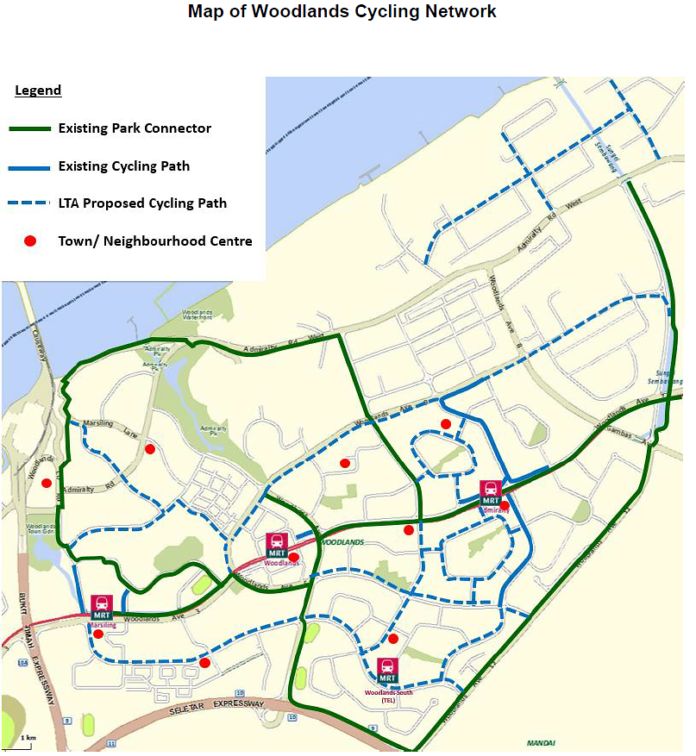
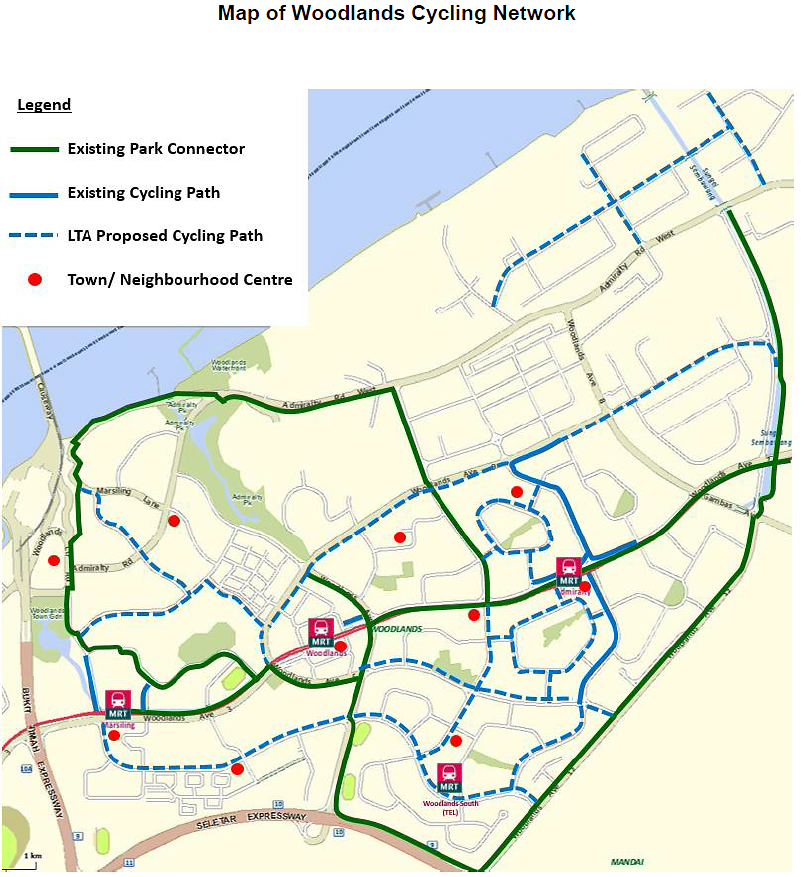
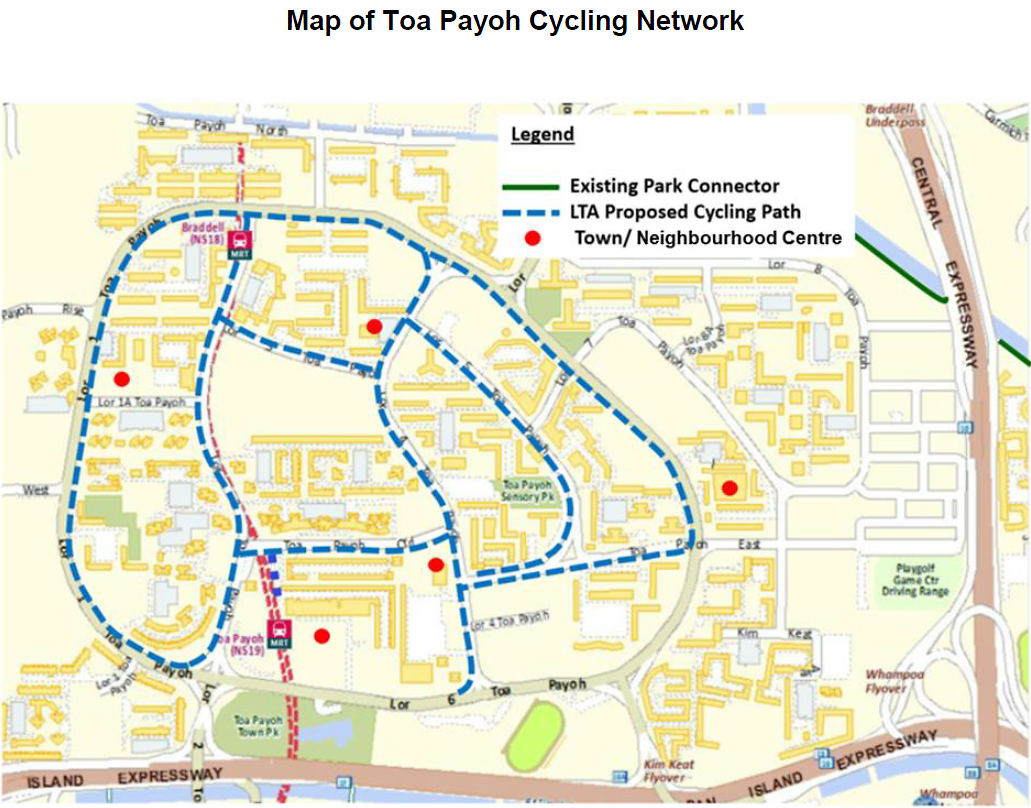
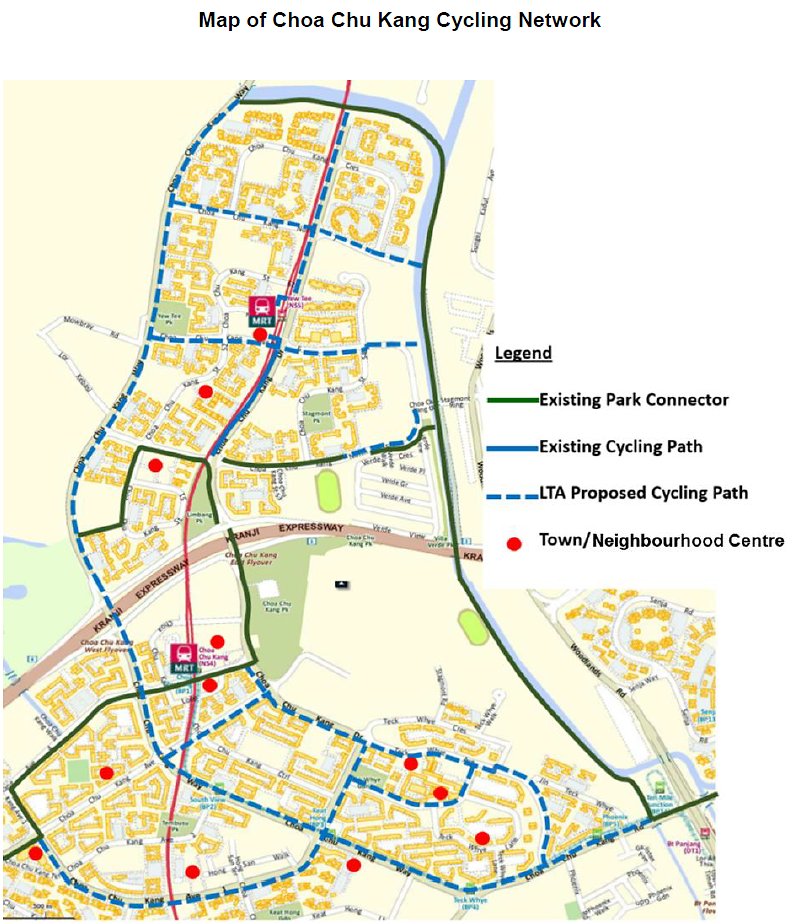
SINGAPORE: Over the next five years, Singapore’s cycling infrastructure will be expanded with new cycling path networks in Woodlands, Toa Payoh, Choa Chu Kang, Geylang and Queenstown, the Land Transport Authority (LTA) announced on Tuesday (Mar 26).
Woodlands will have one of the largest intra-town cycling networks, with about 20km added to its existing paths and the Park Connector Network (PCN), LTA said.
The new paths will connect residents between four MRT stations: Marsiling, Woodlands and Admiralty MRT stations on the North-South Line, and Woodlands South station on the upcoming Thomson-East Coast Line. Accessibility between key amenities and industrial estates will also be enhanced.
The new cycling paths in Woodlands will connect four MRT stations. (Graphic: Land Transport Authority)
A 7km cycling network will be built in Toa Payoh, LTA said. Residents will enjoy “greater connectivity” between their homes and the Toa Payoh town centre, Braddell and Toa Payoh MRT stations.
Bus stops in the area will be retrofitted to better accommodate cyclists and pedestrians.
Residents will enjoy greater connectivity between their homes and key amenities in Toa Payoh. (Graphic: Land Transport Authority)
Choa Chu Kang’s cycling network will be expanded by 12km, LTA said.
The authority is conducting a study on widening the footpath along Choa Chu Kang West Flyover to a 2.5m wide shared path, which will connect the town to Yew Tee, currently separated by the Kranji Expressway.
An additional 12km of cycling paths will be added to Choa Chu Kang’s cycling network. (Graphic: Land Transport Authority)
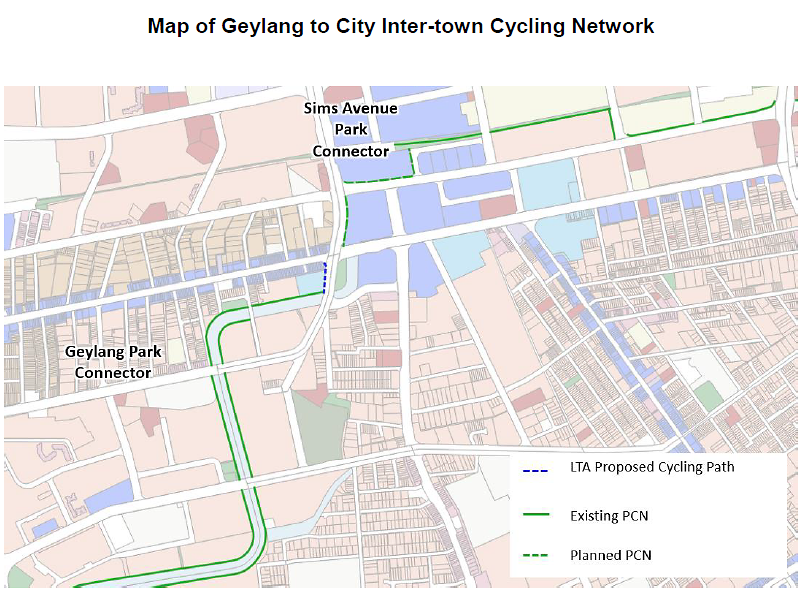
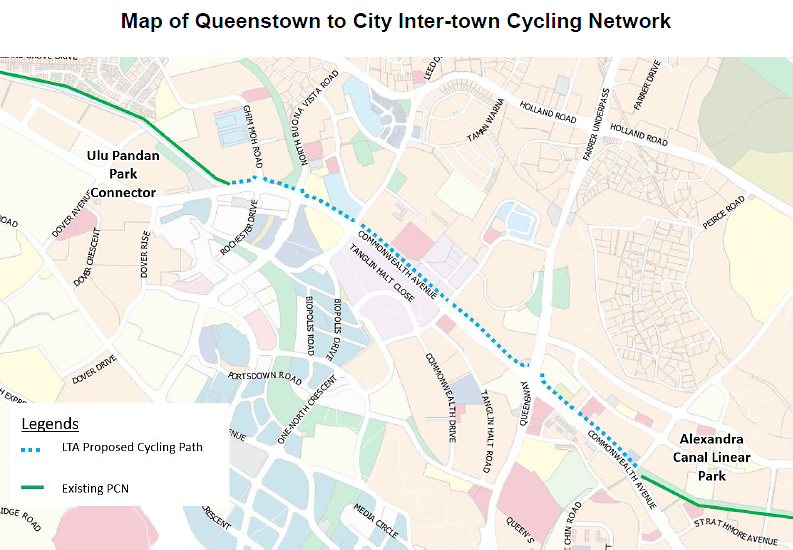
LTA added that new cycling paths in Geylang (150m long) and Queenstown (2.3km long) will be connected to existing PCNs, allowing residents in the areas to ride directly into the city.
New cycling paths in Geylang will allow resident to ride directly to the city centre. (Graphic: Land Transport Authority)
New cycling paths in Queenstown will allow residents to ride directly to the city centre. (Graphic: Land Transport Authority)
All cycling paths currently planned are preliminary and subject to feasibility studies, the authority said. It will continue to work with the relevant agencies to ensure a cycling path network in every HDB town by 2030.
The authority said in a news release it would call for tenders to build the paths later this year.
The LTA will also call for a design consultancy tender to look into improving walking and active mobility connectivity within Jurong Lake District and its neighbouring towns.
SINGAPORE: “We want to solve bigger problems,” the Institute of High Performance Computing’s (IHPC) Dr Michael Sullivan said, matter-of-factly.
The department director of Materials Science and Chemistry at the Agency for Science Technology and Research’s IHPC said that these problems can range from everyday applications like developing hand lotions for Asian skin to designing biodegradable plastic bottles.
Singapore’s only supercomputer – Aspire 1 – can, for example, be used to digitally simulate how a component of hand lotion would interact with different skin samples, reducing the need for costly and time-consuming experiments using physical test subjects, he explained during a recent interview with Channel NewsAsia.
But the wait time to use Aspire 1 can sometimes drag on for days and more compute resources are needed for IHPC to do its work well, he shared.
A proposed US$200 million upgrade will thus boost its capacity significantly – potentially making it one of the top 20 supercomputers in the world.
RISING DEMAND
It is not just the research community that is actively tapping on the Aspire 1’s sought-after compute resources.
Industry players like Keppel are using the supercomputer for a range of activities from digitally testing and improving its rig and ship designs to mapping out the airflow at its data centres for optimum usage.
A company spokesperson said in an email that Keppel, through the Keppel-National University of Singapore Corporate Lab, uses Aspire 1 to run models to visualise gas and liquid flows to improve the safety and fuel efficiency of its products.
Using digital means to design products like container ships and liquefied natural gas (LNG) bunkering vessels also helps to cut down the amount of time and resources needed by “about four to five times”, the spokesperson said.
Meanwhile, at Keppel’s data centres, the company is using the computing prowess of the Aspire 1 to study airflow patterns for hot and cold air at these facilities.
Keppel uses the supercomputer to visualise how hot and cold air flow in its data centre, allowing it to plan its server racks for greater energy efficiency. (Image: A*STAR and Keppel Data Centres)
“This is important in tropical Singapore where the bulk of energy consumption in data centres goes towards cooling equipment,” the spokesperson explained.
These “very high” demands on the supercomputer were highlighted by Professor Tan Tin Wee, chief executive of the National Supercomputing Centre (NSCC), which is in charge of the Aspire 1.
He told Channel NewsAsia the supercomputer has been running at more than 90 per cent capacity for the past two years – which is higher than the average of 50 per cent to 60 per cent usage among other computers of its ilk.
Prof Tan likened the situation to an expressway, where traffic may be held up by a big trailer truck (projects that require heavy computing resources) entering the road.
Similarly, traffic jams can also occur when many small cars (smaller computing workloads) are lined up and produce a backlog, he explained.
As it is, the NSCC has a user base of about 4,000 working on more than 400 projects.
“We expect these numbers to grow as demand for supercomputing and high-performance computing resources increases from both the public and private sectors in Singapore,” he said.
TIMELY UPGRADE
This is why Prof Tan said the recent announcement by Finance Minister Heng Swee Keat to upgrade Singapore’s supercomputing capabilities is “timely”.
Mr Heng said during the recent Supercomputing Asia 2019 conference that the supercomputing facility is currently engaged in work like modelling climate change and designing digital twins of products – from tiny chips to oil rigs and aerospace engines.
“How we transform all our industries, sector by sector, systematically, and search for new engines of growth, will be key to our future economy. In this regard, high-performance computing can play a key role,” he said, adding the National Research Foundation will pump in S$200 million to upgrade existing supercomputing capability.
This, he said, will provide 15 to 20 petaflops of high-end compute performance. With this, the country can work on challenges such as analysing urban mobility conditions and driver behaviour on the road.
“This enables planners to design a more flexible and efficient transport system, to optimise traffic flow and to make travelling more efficient for our people,” Mr Heng said.
Elaborating on how the funds will be used, Prof Tan said it could possibly go towards building a supercomputer with the abovementioned capacity, accompanying storage facilities, “ultra-green” data centres and extensive network connectivity to facilitate advanced research among the industry and academia here.
There are even talks being held to assess the viability of housing the next supercomputer on a floating platform, though the chief executive quickly qualified that the relevant authorities will need to provide a digital simulation of all possible scenarios of doing so before any decision can be made.
The NSCC is no stranger to managing supercomputers in challenging conditions. The Aspire 1, after all, is housed on the 17th floor of a commercial office building, making it one of the world’s highest high-performance computing data centres.
This means having to manage situations oftentimes out of its control just to keep the supercomputer running. For instance, Prof Tan recounted how cold water supply, needed to prevent the servers from overheating, was suddenly cut and employees had to rush back to manually shut the systems off.
Later, they discovered a basement tenant had caused a water leak that resulted in the disruption in water supply, he shared.
Regardless of where it is housed eventually, Singapore’s supercomputing aspirations are not about climbing the ranks of the world’s top supercomputers.
The Aspire 1 currently sits in the 422nd spot of the TOP500 list of supercomputers as of November 2018, and the announced capacity boost will propel the country up to the top 20, but Prof Tan said it will never be able to compete with the likes of the United States and China.
The US, in fact, has announced plans this month to build its fastest computer by 2021 for conducting nuclear weapons and other research – its supercomputers currently take up the top two spots in the TOP500 list.
Instead, it aims to be an enabler for the wider ecosystem to solve challenges and create good jobs, the chief executive explained.
“The enhanced supercomputing platform will help Singapore to solve complex national challenges, more quickly and more effectively than today,” Prof Tan said.
“It will also open up more opportunities for Singapore companies to increase its global competitiveness and create good jobs for Singaporeans.”
SINGAPORE: Stirred by a strongly worded opinion piece about the dearth of spaces for live acts by local musicians, Muhammad Ierfan Lufti wrote a letter addressed to the Singapore Government in 2016, pasted it on online petition hosting site Change.org, and waited.
A day was all it took for the then student and budding musician to gain more than 1,000 signatories from like-minded musicians and music lovers, before three news sites noticed his petition.
Change.org got the rest “covered”, automatically triggering emails to his chosen recipients — which included President Halimah Yacob, who was then chairman of the Parliament’s Public Petitions Committee — once his virtual signature collective drive reached “milestones”, such as the next 100 or 1,000 supporters.
The committee, in fact, does not consider online petitions, but Mr Ierfan, now 27, figured there was no other way for an under-resourced individual like him “to get (his) voice heard” since it is illegal to hold a physical signing drive without a permit.
Mr Ierfan is among a rising number of Singaporeans who are turning to online petitions to champion various causes, from animal rights to banning heavy metal concerts.
In retrospect, he felt that his petition generated an ample groundswell of support “without actually having to do much”, although, admittedly, “nothing really came out of it” and it became a celebration of sorts for those who were passionate about live music.
Last April, following two back-to-back fatal accidents, another netizen, known only as Gen Y, started a petition on Change.org, calling for the removal of discretionary right turns at traffic junctions.
He closed the petition after gaining 16,600 supporters in five days, and the airing of his suggestion on multiple news outlets nudged the Land Transport Authority to announce that it will install red-amber-green arrows at some 1,600 traffic junctions in the coming years.
“A petition is not a confrontation, nor is it a tool to assign blame. It is a formal appeal to the authorities in respect of a particular cause,” Gen Y said as he signed off.
With the proliferation of petition websites such as Change.org – which offer online users a one-stop and anonymous platform to solicit collective action – and Singaporeans’ growing readiness to use them, several questions arise: How should online petitions factor into policymaking, if at all?
How should the Government — which has traditionally not taken these petitions very seriously due to their procedural shortcomings — deal with these public appeals, which make up public feedback yet could be susceptible to abuse and manipulation?
While several Members of Parliament (MPs) and experts interviewed pointed out the dangers of allowing policies to be swayed by online petitions, some noted that it is a legitimate form of public feedback which should not be discounted entirely.
(Photo: TODAY)
GETTING HEARD
Online petitions here have generally gained significant traction in the past few years, with recent petitions on popular sites such as Change.org, GoPetition and iPetitions garnering increasingly large numbers of signatures.
While only some 40 petitions emerged in 2016 when Mr Ierfan posted his, 2017 saw more than 100, followed by more than 150 petitions last year.
In the first three months of this year alone, Singaporeans had already created about 60 petitions – a stark contrast to a decade ago of about only 11 petitions for the whole of 2009.
In terms of the type of petitions, the ones which focus on moral values or social justice tend to generate the most interest among people here.
Petitions this year that made it to the top 10 list – in terms of number of signatures – were two that generated more than 83,000 and 65,000 signatures respectively. The first was a call for stiffer punishments for animal abusers following the Platinium Dogs Club saga in January.
The second was an attempt to seek justice for a Gojek driver, who was investigated by the authorities after a video of his dispute with a female passenger over Electronic Road Pricing charges went viral online.
In all, as many as 23 petitions with more than 10,000 signatures each emerged in the past 12 months alone, in spontaneous shows of indignation, concern and support.
In the United Kingdom for example, these petitions would have triggered replies from its Parliament, which is mandated to respond to every petition with at least 10,000 signatures and debate each one which has at least 100,000 names to it.
In the United States, the Barack Obama administration had adopted a system where the government is required to reply to petitions signed by at least 100,000 people in 30 days on a government-hosted portal called We The People.
Mr Obama, who was US president from 2009 to 2017, made the portal’s source code publicly available in the hope that any government in the world can replicate his administration’s efforts.
Following a temporary suspension, this portal was relaunched last year by the incumbent Donald Trump administration. However, it has been dormant since.
Here in Singapore, there is the perception that the authorities do not want to be seen as being dictated by pressure from petitions in crafting or changing policies, political observers said.
Macron’s plans to create an official status and job for his wife as first lady were shelved in the face of a hostile online petition in 2017. (File photo: AFP/Michel Euler)
GOVERNMENT’S POSITION
In response to queries, the Office of the Clerk of Parliament said parliamentary rules dictate that it only considers petitions with signatures that are dated and handwritten to ensure that they are not duplicated. These have to be accompanied by the signatory’s name and address. Also, the original copy of the petition printed on paper has to be submitted.
Petitions must also be “respectful in language” and “specific as to the nature of the relief sought”, the spokesman said.
“These procedural requirements help to ensure that a petition presented to Parliament is an authentic request from real and distinct individuals and is not abusive in nature,” he added. While it does not consider online petitions, MPs can raise them by filing a parliamentary question or proposing a motion for debate in the House, he noted.
In a 2016 parliamentary debate on the Administration of Justice (Protection) Bill, Law and Home Affairs Minister K Shanmugam had drawn attention to how a petition opposing its contempt of court laws attracted almost 250 signatures. At the same time, there were surveys showing that a “vast majority of the population” supported the Bill.
Mr Shanmugam said then: “We have to make a judgment call on what public interest is. Even if people think something is not correct, we have the duty to go out and persuade and explain.”
Noting that public opinion could be skewed to galvanise support for a particular cause, he added:
If you go and tell people ‘you know your rights are going to be curbed, you know that democracy is under attack, do you know that the law substantially curbs your freedom’. If you say all those things and they do not read the Bill, of course, then they will get concerned.
Then-backbencher Edwin Tong, who is now the Senior Minister of State for Law and Health, also pointed to the “completely unwarranted” fears raised by the same petition. “I would venture to suggest that such statements are alarmist and reveal a fundamental misunderstanding.” Mr Tong had said.
Senior Minister of State for Law Edwin Tong in Parliament on Mar 4.
In 2017, Mr Shanmugam said “public disquiet” was behind the strong support seen for an online petition calling on the Attorney-General’s Chambers to impose a harsher sentence on child sex offender Joshua Robinson. The petition eventually generated more than 79,000 signatures.
Later that year in response to a 40,000-strong petition over the case of waitress Annie Ee who died after daily beatings by her flatmates, Mr Shanmugam said: “As a society, we have to try and avoid putting pressure on judges to impose harsh/ lenient sentences.” Sentences “in any particular case” must not depend on how the public react, he stressed.
Earlier this month, the Ministry of Home Affairs (MHA) raised “security concerns” and cancelled the concert of Swedish black metal band Watain — a day after a 19,000-strong petition calling for its ban emerged.
Nevertheless. Mr Shanmugam made clear that the petition “per se did not influence the decision”. The viewpoints of senior clerics, MPs, and “people in the community” were also taken into consideration, he added.
The Government’s decision later sparked four counter petitions calling on the authorities to reinstate the show, among other things.
Fans of Watain outside the EBX Live Space, where the Swedish metal band was supposed to perform on Thursday (Mar 7) night. (Photo: Matthew Mohan)
It also spawned several spoof petitions, mocking Singaporeans’ obsession with online petitions. They called for bans on American pop rock band Maroon 5, the Manchester United football team, video blogger Nas Daily, and local indie band The Great Spy Experiment, for example.
The people who started these petitions tried to link Maroon 5 and diabetes (the band has a song with the lyrics ‘sugar, yes please”), as well as Manchester United and devil worship (the team is nicknamed the “red devils”). The others were called out for the “subliminal messages” which the petitioners claim they perpetuate.
In response to queries on the Government’s position on online petitions, an MHA spokesperson said that it generally remains “cautious” about treating petition as a reliable feedback mechanism “for obvious reasons”.
Noting that the Government “does not rely solely on one channel” to ascertain public sentiments, she said: “Public sentiments is one of many factors we take into consideration when drafting policies. This can come through public consultation, individual emails, or other feedback channels such as REACH (the Government’s feedback unit).”
NOT ALWAYS A NUMBERS GAME
While some have criticised online petitions as “slackivism”, Dr Carol Soon, a senior research fellow at the Institute of Policy Studies, calls them “a form of political expression and engagement (that) should not be discounted”.
People’s civic engagement is usually “not static” as it evolves with their life stages and social networks, she added.
Dr Soon also said that online petitions are based on what social movement researchers call “the logic of numbers” – as opposed to “the logic of damage”, which involves the destruction of property and sit-ins that disrupt business and traffic.
In other words, the bigger the number, the more likely the cause would attract the attention of those whom the petitioners are targeting, which includes the Government.
“To a certain extent, online petitions are a numbers game,” she said. “We have seen how online petitions which accumulate many signatures within a short period of time attract the policymakers’ attention.”
While MPs spoken to cautioned against being caught up in the numbers game, some also said the authorities should not always dismiss online petitions.
Mr Teo Ser Luck (Pasir Ris-Punggol Group Representation Constituency) said that policymakers should not be immediately “sceptical” and should instead “give a listening ear”. “We may not want it to be, but the numbers do give you an indication of the interest in a segment of the public,” he said.
For him, it is about separating the gems from the junk, or issues that “may not be perceived as substantial”. “The Government needs to decide if it (the petition) is real and substantial enough to represent the larger views and critical enough to review or act on it,” Mr Teo said.
Mr Louis Ng (Nee Soon GRC) agreed, noting that “a lot of the public perception is now very binary, with a lot of yeses and nos” and policymakers should seek to find the middle ground before views in the society get even more polarised.
As for petitions that are backed up with facts, “as a government, I think we should listen (and) at least review what the petition is about. And I think that is what we are doing already,” he said.
Still, Mr Ng said he does not rely solely on petitions as a means of getting a sense of the ground.
“You really don’t know whether they (petitions) are real or fake,” he said. “Just like how there are a lot of trolls behind some of the Facebook comments we see.”
For Mr Ng, public or opinion polls conducted by consultancy firms are more valuable as they come with qualitative feedback too. “I think that is more powerful than a petition that has, say, 100,000 signatures,” he said.
There should not be a “magic number” before a petition could be taken seriously, he said. In September 2017, Mr Ng submitted a petition – signed by seven single parents – in Parliament, calling for a reform of the public housing policy for single parents. The petition was turned down in November.
Nevertheless, in March last year, the Government announced that divorcees could buy or own a subsidised flat immediately upon ending their marriage, rather than wait three years under previous rules. Reacting to the announcement at the time, Mr Ng called it a “good day for activism in Singapore”.
It is rare for petitions such as the one Mr Ng submitted to result in legislative or policy change here. Other instances of petitions submitted, unsuccessfully, include Nominated MP (NMP) Kok Heng Leun’s petition in 2017 to seek an alternative location for the Sungei Road market, and NMP Siew Kum Hong’s petition in 2007 to Parliament for the repeal of Section 377A.
People at Sungei Road Thieves’ Market. (Photo: Natasha Razak)
National University of Singapore sociologist Tan Ern Ser noted: “Numbers do matter, but what is critical is whether it has a compelling argument that has resonance and can gather momentum.”
While both the UK and the US rely on a threshold to get issues on the Parliament agenda, lawyer Gregory Vijayendran warns of the fault lines that lie in adopting a numbers-based approach in a multi-racial and multi-religious society.
“If you take it to its extremes, devotees of a minority religion or a member of a minority race can never get the numbers. Does that mean that the item (proposed by them) should never be placed on the agenda?” said the senior counsel.
GUARDING AGAINST RIGGED PETITIONS
While petitions may raise important issues that warrant a response, some MPs still find it hard to take them seriously, considering the high-profile case of a 2016 online petition for a second Brexit referendum that was found to be rigged with some 77,000 signatures.
There are also concerns that there are no mechanisms to limit signatories of petitions on local issues to Singaporeans only, and to prevent a signatory from impersonating another person.
Tanjong Pagar GRC MP Joan Pereira said: “We must know that online petitions do not represent all Singaporeans. Neither can we verify whether all who signed are legitimate individuals, nor do we know if they are foreigners who signed them hoping to disrupt the harmonious society we have here in Singapore.”
NMP Anthea Ong wondered if the online signatories are “merely keyboard warriors who may make ridiculous demands that get out of hand”, or “citizens who are genuinely passionate about the issue”.
Noting how petitions can be easily rigged with fake signatures created by bots and programming scripts that churn out counterfeit names, she said: “Some experts shared that one way of detecting rigging is when numbers jump sharply over a short period of time.”
“Wasn’t there a sharp jump in 17,000 signatures over merely two days petitioning to ban a band in Singapore?,” she added, referring to the petition to ban Watain.
Fans queuing for a meet-and-greet session with Watain on Thursday (Mar 7). (Photo: Matthew Mohan)
“If policymaking comes down to merely which petition has the larger number of signatures, we are in trouble,” she added.
Asked to respond to criticism that online petition platforms is not doing enough to guard against bots, Change.org spokesman David Barre said it currently relies on users to report suspicious activities. “We can’t monitor all petitions”, with tens of thousands coming through daily, he said.
This due diligence to detect malicious activities on the site is thus done “manually at the moment”, he added. As for double signatures, Mr Barre said only one signature is allowed per user account, and there are mechanisms to block double signatures.
An iPetitions spokesman said that it deploys security mechanisms to restrict fake and double signatures. These include internet protocol (IP) checks to prevent multiple signatures from the same or similar IP address, he noted, adding that its captchas help identify bots.
Commenting on its purpose as a tool for democracy, he said: “Most governments do not give official recognition to online petitions, but this does not mean that they do not have an important purpose to serve.”
Petitions can be an important indication of citizen sentiment, and can help government representatives identify and respond to issues that citizens care about, he said.
This is particularly true of the local government, he added, noting that most successful petitions occur at the grassroots level, where government representatives are closer to the everyday concerns of citizens.
As a means for consumers to get their grouses heard by private companies, in particular, “we find online petitions a highly effective way”, he noted.
MONEY TALKS LOUDER
The advent of the Internet may have facilitated the collection of signatures but it does come at a price. The hosting sites support online petition for “free”, but solicit money from the petitions’ supporters.
Change.org, where most Singaporeans host their petitions on, is one such site. This created some confusion in the “Save Abang Driver GoJek Singapore”, where readers thought they were contributing to the driver, Mr Kamaruzzaman Abdul Latiff.
Screenshot of a viral video showing the Go-Jek driver Kamaruzzaman bin Abdul Latiff and the passenger.
Mr Kamaruzzaman had posted on Facebook: “I was told that someone is collecting a US$4 donation on my behalf … Stop donating as I am not aware of this and never asked for any donation… Someone is trying to cheat you guys.”
But the “donation” notification is what every individual gets each time he or she signs a new petition.
It states: “Can you chip in US$4 to get this petition on the agenda?” A ticker beside the appeal shows that other signers have contributed US$20, US$29 or US$79.
The other options are: “No, I’ll share instead.” Or an inconspicuous one that states: “Sorry, I can’t do anything right now.”
If a user clicks yes, he will be hailed a “hero”, and told that every US$5 he spends will “advertise this petition” to 333 “extra people”, but the money does not go towards the cause. It goes towards the for-profit corporation running the platform – information which is not clearly stated.
If a user indicates no, the platform will prompt him to share the petition instead. Click “no” again, and he will see a screen of 10 petitions “that are building momentum” which might not be related to the cause which he had just signed for.
Then, the user will be faced with what looks like a swiping screen out of dating app Tinder. He can either “skip” or commit to petitions with a “1-Click Sign”, without having to read what cause he is supporting.
Petition starters who do not want their signatories to be faced with this “pay to promote” feature will have to write in to Change.org’s support team.
Mr Barre did not respond directly to concerns about the platform’s methods, but he reiterated that the funds are used to boost the number of people who would see a particular petition.
“The more support a petition has, the more likely it is to reach their decision maker,” he added.
Mr Gilbert Goh, an activist who had created multiple online petitions calling for a minimum wage and for then-Transport Minister Lui Tuck Yew to step down, among others, noted that the growth of what he calls a “petition culture” is a sign of a more active citizenry.
But the 57-year-old, who has staged several protests at the Speakers’ Corner against various government policies, added that Singaporeans are merely turning from being apathetic to “being zealous in a passive and low-risk way”. “Petitioning is the most silent way to protest,” said the founder of Transitioning.org, a support site for unemployed individuals here.
Singapore Management University law professor Eugene Tan noted that most petitioners here do not expect concrete results, as they recognise how the Government operates.
Parliament House, Singapore. (Photo: Hani Amin)
Still, it is “desirable enough” for them to be able to argue and show that there is a certain depth of support for their cause.
“It is a form of self-help by putting into the public domain one’s stand on a matter of public interest. Further, it conveys the narrative that ‘I am not the only one feeling this way; that the view is shared by hundreds or thousands of people’,” he said.
As president of the Law Society of Singapore, Mr Vijayendran has occasionally become the recipient of online petitions — be they calls to investigate lawyer Lee Suet Fern’s alleged “conflict of interest” in the case involving the final will of founding prime minister Lee Kuan Yew, or to investigate into family lawyers’ “unethical, dishonest and abusive tactics”.
These petitions “cut no ice” with him, as “might is not always right”, he pointed out.
“You can have one million all signing on a petition calling for an inquiry into something, but if the comments, complaints or allegations are vague and generalised, then to me, it is a vilification campaign,” he said.
“Do we want to have a virtual lynch mob? Is that the way we determine truth in society? Or do we want to be able to look at the objective facts and come to the conclusion.”
Mr Vijayendran added: “It is easy — the clickety-clack of the keyboard, and out comes an opinion — but if we sit down in a group setting and talk, would you say the same thing? I am not sure.”
The problem with most online petitions, he said, is that it places an over-reliance on rhetoric and emotive language that suspends rational thought. But “even the passionate issues can be analysed dispassionately”, he noted.
His tip for earnest petitioners? Craft something which is “not demagoguery, not manipulative, not propagandist, but is balanced, rational, can connect the dots as a matter of logic, and can also underline the emphasis of why that person needs to sign”.
After all, that was how someone like Mr Ierfan — or just a “university kid” when he put up his petition — got his voice heard.