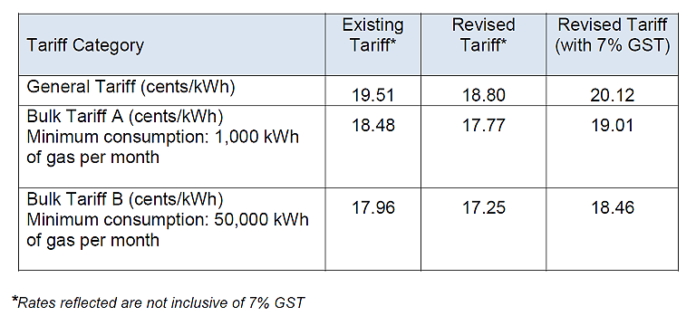
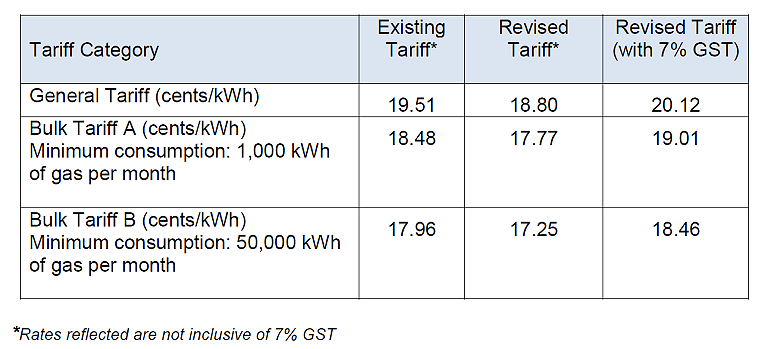
SINGAPORE: Gas tariffs for households will decrease by 3.64 per cent or 0.71 cent per kilowatt hour (kWh) from Apr 1 to Jun 30, City Gas announced on Sunday (Mar 31).
This means that households will need to pay 18.80 cents per kWh, excluding Goods and Services Tax, as compared to 19.51 cents previously.
The decrease is due to lower fuel costs compared with the previous quarter, City Gas said in a media release.
City Gas reviews the gas tariffs based on guidelines set by the Energy Market Authority, which has approved the gas tariffs for the three-month period.
SINGAPORE: Retail prices have risen recently. There is a possibility that Malaysia may limit its egg exports. But the managing director of this local egg farm has not stopped worrying.
For one thing, although eggs are fetching more, the price increase over the years has not kept up with overall inflation, says Mr Koh Yeow Koon, 43.
Seng Choon Farm is the Republic’s largest egg farm, meeting about 12 per cent of the market demand here.
But Mr Koh doubts that his or any local farm can begin to compete with Malaysian farms in terms of cost, which means a limit to sales.
Mr Koh Yeow Koon.
“There’s only a certain proportion of the market that’s willing to pay the higher price for the fresher, higher-quality eggs that Singapore farms produce,” he says.
“I think the amount of people willing to accept Singapore eggs is only about 30 per cent.”
That figure is just a tad higher than their current 27-per-cent share of consumption.
Mr Koh cites Singapore’s higher land, labour, utilities and compliance costs. But what it is that worries him more is the “increasing competition from farms that are doing one to two million eggs a day overseas”.
Seng Choon Farm exterior.
His farm produces 600,000 eggs daily from its 850,000 chickens. And the numbers overseas matter because “we’re increasingly seeing technology being catered for big farms”.
“It’s for sustainability and survival that we need to constantly upgrade our technology,” he explains. “So whether we like it or not, we have to be in the race. We have to adopt all this large-scale automation.”
Technology and automation are the factors in the resurgence of agriculture in Singapore. And that has been no different for Seng Choon since it moved to its 36-acre farmland (27 football fields) in Lim Chu Kang in 2010.
But just how is automation being used to supply Singaporeans with their eggs daily? Here are several ways, big and small, as CNA Insider discovered in an exclusive inside look at Seng Choon Farm.
WATCH: Inside Singapore’s largest egg farm (5:34)
1. HOW THE HENS ARE FED
Close to 100 tonnes of specially formulated feeds are prepared each day in the farm’s feed mill, with about a dozen tanks of various sizes needed to store the raw ingredients, like soya bean, maize and wheat.
Some materials such as maize come in big pieces, so they must first be chopped up in the hammer mill.
At the heart of the whole feed mill is the control room, where a computer weighs what is needed of each ingredient to get the correct proportion for each feed.
The feed mill.
“They’ll get mixed in a mixer … into the proper nutrition that the chickens need,” says Mr Koh.
The feed is sent by conveyor to all the hen houses – a job that used to be done manually and by truck – and is given to the hens five times a day by automatic dispensers.
“This control room seems to be getting smaller and smaller because, over the years, we keep putting in more equipment to reduce the amount of labour that’s involved,” Mr Koh adds.
Feed automation from inside the control room.
2. THE FEED DETERMINES THE TYPE OF EGG
Different chickens are given different feeds to produce a range of products, including carrot eggs and Omega-3 eggs, which are enriched with different vitamins and minerals.
“For example, if we feed the chickens with fish oil or Omega-3 enriched oils, they’d be able to pass these lipids into the egg yolk,” says Mr Koh.
“We can get lower-cholesterol eggs, or higher in vitamin D, and all this is done via our experience in feed varying.”
These specialty eggs are easily machine-sorted because they are packed at separate times.
There are, however, variations in the nutrients available in the eggs because the chicken “isn’t a machine”, and to a degree, this may also depend on the breed.
3. HOW THE HENS ARE HOUSED
The poultry houses are fully enclosed, each having four to six tiers and holding between 30,000 to 50,000 chickens. These are unlike the open and naturally ventilated structures of the past, which had two tiers.
Exterior of the hen houses.
“The temperature is better controlled because it’s enclosed,” says Mr Koh.
“So it may be 33 or 34 degrees outside, but we’re able to keep temperatures in the chicken sheds at 29 to 30°C with the use of evaporating cooling pads and controlled fans.”
With computers maintaining a stable temperature range, “the chickens are cooler and have better welfare”. Even the manure is collected via conveyor and brought to a central treatment area to be converted into compost.
Importantly, as egg farmers in Singapore are not allowed to use antibiotics on their hens, the enclosed houses help to ensure that there is no “interference from outside factors that may spread diseases to the chickens”.
The manure conveyor belt.
Only assigned workers and the veterinarian can enter after disinfecting themselves.
SINGAPORE: The National Parks Board on Saturday (Mar 30) launched a 36km trail linking Coney Island Park in the northeast with Jurong Lake Gardens in the west.
The Coast-to-Coast (C2C) Trail cuts across Singapore and takes visitors through a variety of parks and nature areas, with highlights such as Bukit Batok Nature Park and Bishan-Ang Mo Kio Park.
Bukit Batok Nature Park. (Photo: NParks)
In addition to an online guide, the trail also comes with its very own augmented reality (AR) app, which uses 3D-animated characters to provide information about native flora and fauna and surrounding areas of interest, NParks said in its media release.
Users of the app can also upload photographs taken along the trail to share their experiences with other users. From next year, the app will allow users to develop their own curated trails to share with other users.
The C2C app features interactive AR elements such as 3D-animated characters. (Image: NParks)
The app also has a reward system, with users accumulating reward points by visiting checkpoints and completing “quests” or sharing photos. The points will be converted to rewards such as F&B vouchers, products and services, NParks added.
The C2C mobile app can be downloaded from the Google Play Store (for Android users) or App Store (for iOS users).
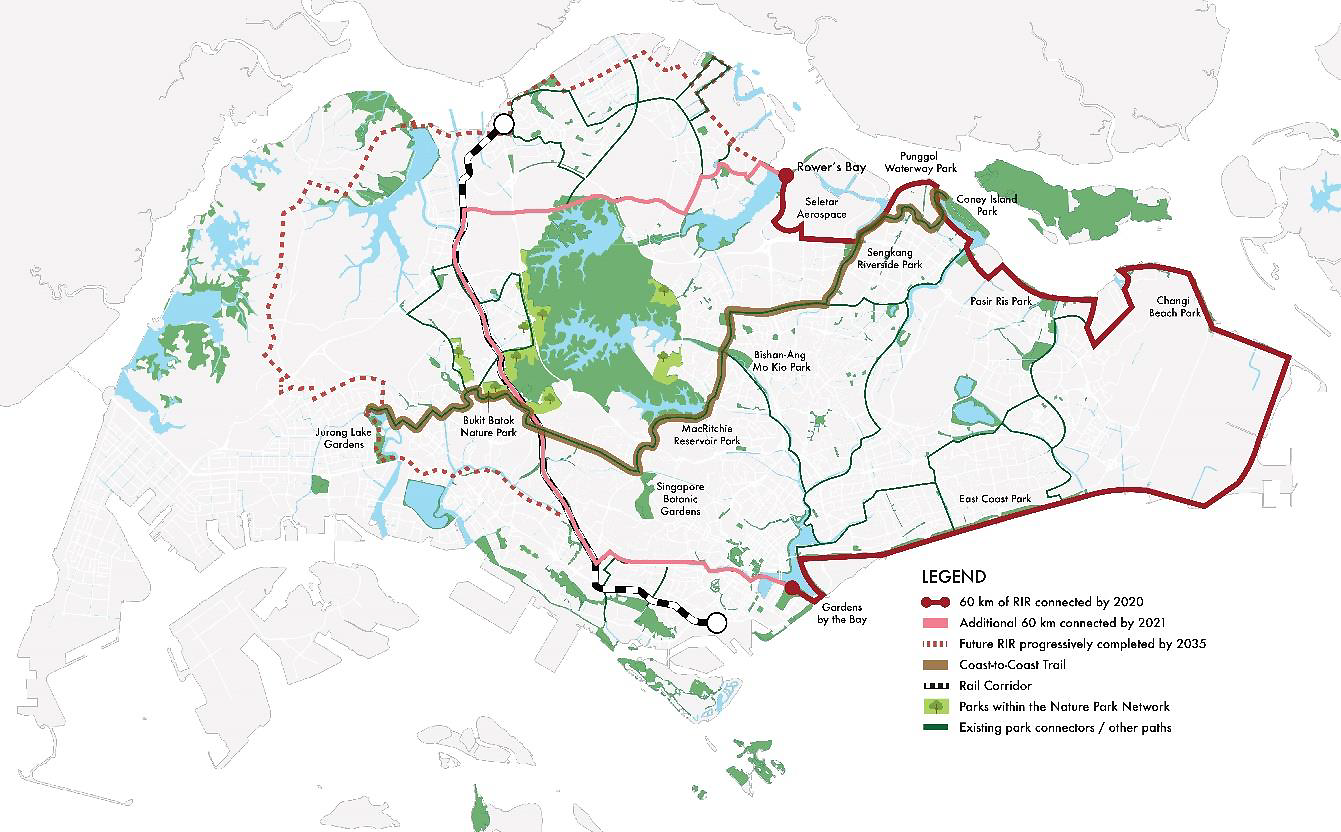
Map of recreational connections. (Map: NParks)
NParks on Saturday also launched Rower’s Bay, part of the first phase of works completed for the 150km Round Island Route (RIR) that goes around Singapore.
Serving as a resting and gathering point for park users along the RIR, Rower’s Bay connects to Seletar Aerospace Park via a 3km path, and features a wetland, lookout pavilion and a boardwalk that brings visitors closer to the water.
A broad-leafed Mahogany Heritage Tree near Seletar Aerospace Park. (Photo: NParks)
It is part of the 60km first phase of the RIR, which when completed by 2020, will connect Rower’s Bay with Gardens by the Bay via Changi Beach Park and East Coast Park.
By 2021, another 60km of paths between Rower’s Bay and Gardens by the Bay, part of which runs along the Rail Corridor, will be connected, making a loop of 120km.
The RIR is expected to be progressively fully completed by 2035.
SINGAPORE It’s been said that there are four kinds of people in the world: Those who have been caregivers, those who are currently caregivers, those who will be caregivers, and those who will need a caregiver.
Indeed, I was recently at a corporate event and met a most unlikely caregiver — Siti, a young professional in her twenties who became emotional when sharing her challenges caring for her three unmarried aunts in their 60s — one suffering from diabetes and depression, another from ovarian cancer and the third from kidney failure.
Caregiving affects all of us yet this role is, ironically, one of the most undervalued in our society.
CHALLENGES OF INFORMAL CAREGIVING
The psychosocial well-being of caregivers must be top of mind for our caregiving policies. We have not done a comprehensive national study on caregiver health (which I highly recommend we do) but segmented studies have revealed that our caregiver population is certainly facing higher mental health risks.
Caregiving is stressful and can cause depression. Among caregivers of stroke survivors, 40.2 per cent have depressive symptoms, according to a 2017 study by the Institute of Mental Health and National University of Singapore.
Caregivers of cancer patients are also at greater risk of developing depression than the general population, a study in the Singapore Medical Journal also found.
Wendy* is a caregiver involved in a study by the Association of Women for Action and Research (AWARE) on the financial costs of caregiving. She is 51, single, and a caregiver to her mother who has dementia.
While she has hired a foreign domestic worker, she remains the “emotional anchor” for her mother. Caregiving has taken a toll on Wendy emotionally, physically and financially — she’s had panic attacks and experiences high levels of anxiety.
Then there’s Ivan*, in his 50s, who’s struggling to cope with the severe care needs of his 85-year-old mother with dementia. Unable to deal with his mother’s mounting behaviour issues last year, he had a series of anxiety attacks and ended up in hospital himself.
With smaller families, there are fewer family caregivers. Over the past few decades, however, Singaporeans have been fortunate to have an army of efficient, dedicated and relatively affordable foreign domestic workers. They form an important part of our informal care workforce.
Yet, the economic impact of caregiving on Singapore is obvious. The Labour Force Survey 2018 shows that 75,800 women and 13,000 men cite caregiving to families and relatives as the main reason for being out of the labour force. This number does not include caregivers who have had to scale back on work commitments in other ways, for example, by moving to part-time or ad-hoc work.
Wendy, whom I mentioned earlier, scaled down on her working hours and now earns less than S$2,000 a month, about one-fifth of what she used to earn. Ivan quit his job to look after his mother, after she repeatedly forgot to turn off the gas at home.
Another caregiver, June*, stopped working completely when her husband was diagnosed with Parkinson’s disease. She is 60 and the sole caregiver to her husband as they have no children. Their only monthly household income of S$1,000 comes from renting out a room in their HDB flat.
CHALLENGES IN FORMAL CARE SERVICES
Did these caregivers lessen their caregiving burden with formal care services?
Wendy tried daycare but her mother reacted violently against it. She’s now considering the nursing home option but the guilt is immense and she’s been putting it off despite her own deteriorating emotional and physical health. Then there’s the cost of the nursing home fee that she will struggle to afford with her drastically reduced income.
June’s husband goes to daycare but is guilt-ridden because he does not like it there yet she needs that time to go to the hospital for physiotherapy. June spends around S$300 to S$400 on daycare (after government subsidies) plus S$100 on transport to her husband’s daycare a month against her S$1,000 rental income.
Most of us would like to be cared for in the comfort of our own homes. However, the increasingly complex care needs of our seniors and shrinking families must be balanced against the needs of the caregiver, meaning formal home-based and community care services are critical and practical necessities.
While the Government has been busy increasing capacity in recent years, more needs to be done to improve the affordability and quality of these services.
The ElderShield Review Committee report estimated that, including transport, consumables and formal home care services, it could cost caregivers as much as S$3,100 per month to look after a severely disabled senior at home, well above the S$2,400 median monthly fee for looking after severely-disabled residents in VWO-run nursing homes.
The Care Where You Are report by Lien Foundation notes that co-payment of care fees remains a key concern for families, although means-tested Government subsidies for long-term care have been increased to cover up to two-thirds of Singaporean households since 2012.
Even for those who are not severely disabled, daycare and home care services can cost S$900 to S$2,200 per month before subsidies, excluding transportation costs. Families eligible for subsidies must co-pay between 20 per cent and 70 per cent. Those with a per capita monthly household income of more than S$2,600 do not qualify for subsidies at all.
Costs may therefore deter even middle-income families from using formal long-term care services, especially since many find it cheaper to hire a foreign domestic worker instead.
However, foreign domestic workers — and even family caregivers themselves — may not be trained to handle complex care needs and, sometimes, could end up compromising the well-being and health of vulnerable seniors, leading to unnecessary hospital stays.
Home care is expensive too and appears underfunded with charity dollars, even after accounting for government subsidies and payouts from CareShield Life insurance — a scheme that may be useful but limited in its impact, given the strict qualifying conditions for payout and seeing that the scheme is optional for older cohorts who need long-term care now.
Elderly people sit outside a food centre at Chinatown in Singapore December 13, 2018. (Photo: REUTERS/Edgar Su/Files)
Even as we work out ways to improve affordability, emphasis must be made on quality and outcomes. In recent years, many sophisticated new care models – such as the Integrated Home and Daycare Programme – have sprung up.
Anecdotal evidence suggest these schemes fulfill some care gaps though programme outcomes need to be tracked and made public to convince skeptical caregivers of their effectiveness.
SHIFT HEALTHCARE SPENDING TOWARDS LONG-TERM AGED CARE
Singapore is ageing from a position of relative strength. We have a largely healthy population and there is a sharper focus in recent years on harnessing the potential benefits of longevity. Yet we must do more.
While the importance of enabling seniors to age at home is widely acknowledged, the Lien report also noted that Government spending on home-based and centre-based care — at S$240 million in 2016 — accounted for only 2.5 per cent of the overall S$9.8 billion healthcare budget for the year.
The Government should consider recalibrating the healthcare budget to enable seniors to age and be cared for at home. More subsidies can be targeted at seniors who are not severely disabled — and therefore do not qualify for ElderShield or CareShield Life — but likely to benefit from professional rehabilitative care before their conditions deteriorate further.
To better support caregivers’ psychosocial well-being needs, the Government could consider giving seniors flexible care packages, whether for daycare, home care, respite care services, transport fees and consumables, or to pay a family member or friend for elder-sitting. Respite care should be enhanced to include counselling and self-care training services as well.
Another way forward is to accord the long overdue recognition and appreciation to family caregivers with an allowance or payment, in both cash and CPF credits. This also ensures some level of financial security for them.
The recent announcement of the S$200 home caregiving grant that replaces the S$120 foreign domestic worker grant is a step in the right direction but it is arguable whether the amount is sufficient.
Perhaps, the payment should vary by the number of Activities of Daily Living the care recipient requires assistance with.
File photo of elderly man in Singapore. (Photo: Gaya Chandramohan)
To enable caregivers to continue working while providing care, the Government should consider converting paid childcare leave into a longer quantum of family care leave of at least 10 days and allow it to be used for the care of any family members, including older relatives. Employers should be partners in this effort to provide flexible work arrangements on request by employees.
Above all, we should collectively embrace caregiving — not as the burden of a few, but a responsibility of all.
There is an urgent need for more informed collective conversations among Singaporeans about what kind of care system we want for our grandparents, parents — and eventually ourselves — and how much we are willing to pay for it, whether through premiums or taxes, for those who can afford it and to support those who cannot.
Because to care for those who once cared for us is one of life’s greatest honours.
Anthea Ongis Nominated Member of Parliament, Hush Teabar founder and author of 50 Shades of Love who advocates for mental health, diversity and inclusion of vulnerable communities, volunteerism and environmental issues.
SINGAPORE: Water conservation has been an ethos drilled into those of my generation.
I remember my primary school conducting at least one water-rationing exercise. Water coolers, taps and toilets were shut off for a few hours.
It was not the most pleasant experience. At 11, when you had to go, you went. And you only had a small pail of water to flush down your business.
But this deliberately painful exercise indeed underscored how precious timely and reliable access to water was.
RECEDING INTO MEMORY
As Singapore continued to develop into a towering metropolis and adopted advanced, innovative methods of water purification, memories of shortages – real or simulated – appear to have receded into the crevices of the public psyche.
The strides made in enhancing Singapore’s water security through the years have instead created a newfound confidence, which is a positive development to be welcomed.
Investments were poured into enlarging water catchment areas, upgrading infrastructure and diversifying sources through NEWater and desalination. The Marina Barrage, the most iconic and visible symbol of the Singapore water story, also turns 11 this year.
Singapore’s water story underscores our founding fathers’ ingenuity, in turning adversity into opportunity and strength, said Prime Minister Lee Hsien Loong at a ministerial forum at the Singapore University of Technology and Design in 2018.
These words perhaps reflect why it’s hard for many to shake off the feeling that water has become less of a national security imperative over the years.
Marina Barrage was officially opened in October 2008. (Photo: PUB)
NEW CHALLENGES
Still, Singapore faces fresh challenges in ensuring we have reliable access to sufficient water. Weather extremes predicted with climate change, in the form of global warming and dry seasons, put the country’s key water sources at risk.
That Linggiu reservoir in Johor, which provides Singapore with a sizable 250 million gallons of its water supply, was at significant risk of running dry in 2017 shocked many.
Flash floods and massive downpours have also made too much water another key issue. A downpour in one evening in November 2018 saw 100mm of rain fall on Bukit Panjang in under two hours – 40 per cent of the average typical monthly rainfall for November.
What a water management system that can withstand both droughts and floods should look like is certainly something authorities can afford to articulate more on.
Another challenge comes from the politically charged exchanges on the water agreements between Singapore and Malaysia, which has come under the media spotlight over the last year.
Even then, when desalination and NEWater meet up to 70 per cent of water demand, is ensuring a full supply of water from Johor still existential for Singapore? Is the narrative of water conservation to deal with scarcity still valid?
DOES WATER FEEL FAR REMOVED FROM OUR DAILY LIVES?
Despite new challenges facing Singapore’s water supply, the danger is if Singaporeans see this as a distant issue, one far removed from our lives.
The initial sharp public reactions to the announcement at Budget 2017 that water prices would be raised were telling, especially because it didn’t seem to reflect a deeper understanding of water’s scarcity, nor the true cost of water production.
Although many Cabinet Ministers and Members of Parliament came out to highlight how Singapore was one of the most water-stressed countries in the world and water is a strategic resource, how many of us complained – but then just moved along and paid our bills as usual?
File photo of Linggiu Reservoir. (Photo: Monica Kotwani)
Quite a few I imagine. A street poll of 100 respondents in March 2017 after the hikes were announced also showed 75 per cent were not even aware of how much they spent on water each month.
“Singaporeans have been taking water for granted just because nothing has happened in the last few years,” Asit Biswas, then visiting professor at the Lee Kuan Yew School of Public Policy told local media outlets.
Still, the fact the poll came after Minister for Foreign Affairs Vivian Balakrishnan highlighted in January 2017 that Singapore might not be able to draw its entitlement of water if Linggiu reservoir dries up suggests we don’t see water security to be a challenge and aren’t concerned about needing to reduce our water usage.
One would think Hyflux’s high-profile fall from grace, a story that has unfolded since 2018, would have jolted national consciousness about the fragility of our water supply.
But a survey conducted by PUB and REACH in October last year showed younger participants viewed water scarcity as “a distant concept” compared to their older counterparts.
That PUB has stepped in to highlight it is ready to take over the desalination plant at zero dollars if Hyflux’s Tuaspring does not resolve defaults certainly suggests that the situation is grave and that authorities are willing to provide a water security safety net.
Still, the online reactions over the unfolding drama have been less about water security and more about whether Hyflux’s proposed restructuring may be jeopardised and how much of their money retail investors will get back.
WE NEED NEW WATER NARRATIVES
It can therefore be argued that Singapore needs a refreshed narrative over water, beyond that of scarcity or even security.
Part of it might be that there isn’t a call to action beyond the tactical message of needing to conserve water. Some out-of-the-box thinking and a new strategic lens from which to view water might be in order.
Children play at a water fountain on a hot day in Singapore. (File photo: Reuters/Edgar Su)
Instead of scarcity or security, why not highlight its centrality to our everyday lives?
Why not emphasise water as an enabler that powers the economy? It is the lifeblood for many strategic sectors including petrochemicals, pharmaceuticals and electronics, which collectively create hundreds of thousands of jobs and billions of economic output.
Why not highlight how it nourishes families and provides a beautiful living environment for Singapore? Scores of joggers and families stroll by the canal I live close to each evening just to enjoy the serene environment and get away from the day’s hustle and bustle.
And instead of water conservation, why not advance a larger national narrative of water guardianship, to inspire Singaporeans towards a moral commitment to preserving water for the next generation and collaborate with others to these ends?
A GROUND-UP APPROACH
A ground-up approach that involves local communities can galvanise support and awareness.
Around the Great Lakes, which straddle parts of Canada and the US, people collaborate to protect this strategic water resource, which might be instructive.
Detroit residents have rallied together to create gardens, parks and picnic areas, while Michigan groups have raised funds to restore wetlands and improve fish habitats.
Businesses, think tanks, school and communities have also become more organised in driving an agenda for change in priority areas and find support from authorities.
In Canada, funding for Great Lakes protection from the government alone has catalysed over 36 wide-ranging initiatives in 2018 – enlisting groups to participate in monitoring and analysis, the rolling out of best practices, and the scaling up of environmental rehabilitation projects.
Great Lakes advocates work with government officials on a range of water causes, promote water conservation as a community ethos in the process, and are empowered to reach across national borders to form constructive partnerships.
Swans paddle near the Mackinac Bridge, spanning the Straits of Mackinac which connect two of the Great Lakes, Lake Michigan and Lake Huron, in Mackinaw, Michigan, US in June 2006. (Photo: Tim Burke/Michigan Department of Transportation/Handout via REUTERS/File Photo)
A Council of the Great Lakes Region has also been formed since 2011, made of regional leaders from governments, business, non-profit, academia and local communities to identify areas for greater collaboration, knowledge-sharing and advocacy.
Back to Singapore. If funding from the Ministry of Environment and Water Resources could be shifted towards catalysing local community projects, younger Singaporeans could be empowered to exercise ownership over their living environment and water resources.
If cross-border Singapore-Malaysia research and community projects could be initiated, both sides could work together towards a shared vision of tackling common water challenges.
CENTRAL TO OUR LIVES
Ultimately, we need to think about what legacy Singapore wants to leave the next generation with and how water fits in that picture.
To be sure, words, narratives and projects can only go so far but it’s worth reviewing our national narrative on water to spur a new generation of Singaporeans to embrace water, not just as a resource to conserve, but one that is central to all facets of our lives.
Lin Suling is executive editor at Channel NewsAsia Digital News where she oversees the Commentary section.
SINGAPORE: Around 300 people – with many Hyflux retail investors among them – gathered at Hong Lim Park on Saturday afternoon (Mar 30) to express concerns regarding recent developments surrounding the embattled water treatment firm.
Many wanted to draw attention to their losses and to rally fellow investors to cast a “no” vote for Hyflux’s restructuring proposal, which asks that perpetual securities and preference shareholders accept a recovery rate of 10.7 per cent – roughly 3 per cent in cash and 7 per cent in equity.
Some were also unhappy with national water agency PUB’s intention to take over Hyflux’s Tuaspring desalination plant at zero dollars and waive the compensation sum it is entitled to, if the company does not remedy its defaults by Apr 5.
At around 3pm on Saturday, the crowd at Hong Lim Park stood around a makeshift podium at Speaker’s Corner, using caps and umbrellas to seek relief from the humidity.
Some investors also placed posters and banners to indicate why they were unhappy and expressed hope for Government intervention.
Former Presidential Election candidate Mr Tan Kin Lian was the first to address the crowd. Although he was not an investor, Mr Tan shared that he was aware how some of them became Hyflux perpetual securities and preference shareholders despite not being financially “savvy”.
“They were just ordinary investors wanting to have a reasonable rate of interest without taking too much risk. If they wanted to take risk, they would have bought shares,” said Mr Tan, who donated funds to organise the protest event.
Former Presidential Election candidate Mr Tan Kin Lian speaking to Hyflux protesters at the Speaker’s Corner. (Photo: Amir Yusof)
Mr S H Lee, a perpetual securities and preference shareholder who was listening to Mr Tan’s speech, told CNA that he was an investor who “did not have financial knowledge” but made the investment because he placed a lot of faith in Hyflux and regulators.
“I invested a significant amount of my retirement funds. I placed a lot faith in Hyflux, and also because water is our strategic resource, I thought this (investment) would give us sufficient funds to cover our expenses, our medical needs, for the rest of our retirement years,” added Mr Lee.
ZERO DOLLARS MOVE “DOESN’T MAKE SENSE”
Mr Lee was also unhappy that PUB intends to take over Hyflux’s Tuaspring Desalination Plant (TSDP) at zero dollars, as he said that his investment helped built the plant.
“I believe a lot of money comes from us investors were used to first build the plant, so you cannot just say okay, now I am going to take over for zero dollars. It doesn’t make sense to me,” he added.
The organizer of the protest event, a perpetual securities and preference shareholder who wished to be known only as Alex, told CNA that PUB should compensate Hyflux investors “out of moral obligation” because the plant was still “functional”.
“It’s not fair and not right to just take back at zero dollars,” said Mr Alex, adding that he hoped for PUB to take back Tuaspring at “fair value” so that the investors would get back some money.
An IT cybersecurity expert who declined to be named said that he invested around S$15,000 in Hyflux in 2016, and maintained that he was hopeful that if investors rejected the company’s restructuring proposal on Apr 5, they could pressure authorities to start investigations into the firm.
A Hyflux protestor rallying the crowd to vote as one for the company’s upcoming restructuting plan. (Photo: Amir Yusof)
“We have not lost faith. If we all vote no, maybe MAS (the Monetary Authority of Singapore) and the SGX (Singapore Exchange) would step in and investigate this. It’s time for them to take over to see if there was any misrepresentation of information,” he said.
Another perpetual securities and preference shareholder, who wanted to be known only as Michael, told CNA that he thought MAS should have stopped Hyflux and the local banks from selling the perpetual securities in 2016.
“MAS should have stepped in to investigate overzealous selling by the banks because the banks were paid a sum to sell these shares and got a substantial amount of commission,” said Michael, who invested around S$10,000.
Following Mr Tan’s speech, three people who said they were investors spoke to the crowd at Hong Lim Park. The group dispersed peacefully at 4pm.
SINGAPORE: The Agri-Food and Veterinary Authority (AVA) issued an alert on Saturday (Mar 30) for a batch of Australia’s Chobani brand Almond Coco Loco yoghurt due to an allergen risk.
In a statement, AVA said the Australian Government Department of Agriculture and Water Resource had issued an alert that the affected batch of yoghurt was recalled due to “the presence of an undeclared allergen” which is almond.
The affected product is the 140g Almond Coco Loco yoghurt, which has a best before date of Apr 23, 2019, AVA said.
AVA added that it had conducted checks and found that the implicated products were imported into Singapore and that all the products had been sold.
“Consumers with an almond allergy or intolerance should not consume the product. Those who have consumed the implicated product and have concerns about their health should seek medical advice,” AVA added.
AVA advised those who have purchased the affected tubs of yoghurt to contact the importer for enquiries or exchange of product.
The food alert from AVA comes as Australia issued a recall for a batch of Chobani Flip Almond Coco Loco yoghurt due to incorrect packaging.
In a statement, Food Standards Australia New Zealand said that the affected yoghurt had been packaged in a Chobani Lemon Meringue Tang tub. The tubs, which contained Almond Coco Loco ingredients, were then sealed with Almond Coco Loco foils.
The authority, which develops food standards for Australia and New Zealand, also said that the recalled product had been available for sale in Coles, Woolworths and other locations in New South Wales, Queensland, Victoria, Tasmania, South Australia and Western Australia.
Chobani’s Australia website also displayed a product recall alert for their Flip Almond Coco Loco yoghurt.
Chobani Australia issued a product recall message on their website.
SINGAPORE: Sporting a bleached blond hairdo, black windbreaker, jeans and sneakers, the lanky Harold Teo breezed into the room where we were scheduled to meet.
Looking at the 29-year-old, you would be hard-pressed to identify him as one of the Sea (formerly known as Garena) employees integral to the success of Free Fire.
Free Fire is the company’s mobile-first rival to other battle royale-themed games like Fortnite and Playerunknown’s Battlegrounds (PUBG) that started off as PC games. Launched in the fourth quarter of 2017, the game was identified by analytics company App Annie as the fourth-most downloaded game for both iOS and Android platforms in 2018.
In the company’s most recent earnings report, Free Fire had more than 350 million registered users and more than 40 million peak daily active users.
Harold, whose job title of Producer for Free Fire somewhat downplays his contributions, was part of the team that developed the game in 2017. Today, he is tasked to bring the game to more people and markets, and create new avenues of user engagement.
Focus groups held before the actual game launch in 2017 allowed the team to realise the need to include visual cues, so players know what to do at the start of the game. “Tutorials don’t really work, as the longer the tutorial the more people will exit the game,” Harold shared. (Screengrab: Sea)
GAMER AT HEART
“I liked RPG (role-playing games) growing up … I was playing Final Fantasy when I was seven,” the game boy shared during a recent interview with CNA.
His love for the game and being in front of the computer for too long even resulted in beatings from his mother, he recounted laughingly.
“When I was in my early secondary school years, my results were not very good,” Harold said. “My brother had better grades … and my parents were very results oriented.”
The Raffles Institution (RI) alum eventually used his parents’ expectations to his advantage though.
“I figured if I did well, I can play more games,” he theorised, and it worked. “It turned out I had a healthy balance.”
It was also at RI that he found kindred spirits that continue to spark this love for gaming.
“I’ve a close group of friends – about 10 from RI – that played social games, and we just bonded over Defense of the Ancients (DOTA),” he shared, adding they still regularly game together.
His passion for computer games is one of the main reasons why he turned down job offers from banking institutions to join the then-Garena under its associate management programme in 2015.
Harold had graduated Nanyang Technological University (NTU) with a finance and accounting degree and, while he does have interest in the field, the allure of gaming – which he describes as his “passion” – proved stronger.
If that wasn’t enough to show how much he loves to game, the 29-year-old also made an audacious request while under the associate management programme.
“I was very inclined to gaming, so I asked if I can be in this area for the four rotation cycles (that programme participants had to go through),” Harold shared, adding that he is “thankful” to his bosses who found a way for him to experience different areas of the gaming business.
“SURPASSED ALL EXPECTATIONS”
His love for gaming was also attributed to the development of Free Fire, though he was quick to downplay it.
“There’s an office rumour that says I keep playing PUBG, so let’s make a mobile game (like that) for him,” Harold shared. “But I don’t think it’s true, la.”
Visually, Free Fire has come a long way from the simple, grainy graphics used during the alpha phase (left) to how it looks like now (right). (Screengrabs: Sea)
True or not, what is clear is that Free Fire has caught the imagination of gamers around the globe, going by figures cited by the company and App Annie.
One of the key value proposition of the game, compared with the likes of Fortnite and PUBG, is its small download size and ability to run on almost all handsets whereas its competitors run only on high-end smartphones.
Harold shared there is a motto held dear among the game’s Shanghai-based developers, which, loosely translated, means: “Keep it small, keep it cool.” In other words, the mobile game should not tax the handset’s components so much that it gets overheated.
The download size for Free Fire is 400MB today, whereas the average of other battle royale-themed games are about 1GB, he explained.
It is why Free Fire is a hit among emerging markets in Latin America like Brazil and similarly in Southeast Asia. The company said in its latest earnings report that Free Fire was the top-ranked game in Brazil last year by average monthly active users, downloads and consumer spend, citing research from App Annie.
“We believe this demonstrates our ability to penetrate fast-growing emerging markets globally, which greatly expands our total addressable market base beyond just our core markets,” Sea said.
The game has “already surpassed all expectations”, Harold said, but added that there is still room to grow.
He is already cooking up different ways of growing the hype and awareness of the game, starting with e-sports competitions that draw both competitive gamers as well as those who just like to watch the games through livestreams.
The Free Fire World Cup competition, which will be featured as part of the wider Garena World e-sports event in April, is expected to bring regional teams from Malaysia, Indonesia, Vietnam and Thailand, as well as Latin America ones from Argentina, Brazil and Colombia, according to the company’s website.
This seems a sound strategy.
A study from research firm Newzoo earlier this February showed that the global e-sports audience will grow to 453.8 million – 201.2 million e-sports enthusiasts and 252.6 million occasional viewers – worldwide this year. Asia-Pacific will account for 57 per cent of the enthusiasts demographic, followed by the European Union at 16 per cent, it added.
“There is still a significant majority (of people in the world) who hasn’t gotten the chance to play a battle royale-themed game before. We want to get as many people to play (Free Fire) as possible,” Harold said.
SINGAPORE: The Urban Redevelopment Authority (URA) has announced plans to add more homes in the CBD area so that more people can live closer to their workplaces.
Its rationale is to increase the live-in population in the business districts to bring more life to the area after office hours.
Imagine living across the river from the iconic Marina Bay Sands or waking up to the sight of the towering Supertrees of Gardens by the Bay?
Will this move fan the property investment ambitions of HDB upgraders eyeing the potential upside?
THE ALLURE OF CITY HOUSING
At first glance, housing options smack in the city centre may seem more suited for jet-setting singles or married couples without kids. Why would families with school-going children even consider making their nest downtown?
An apartment here is likely to be situated a distance away from the kids’ grandparents, making child-rearing support less feasible or convenient. There are also hardly any primary or secondary schools in the CBD.
Further, because of its District 1 location, a city apartment is not going to come cheap. Having said that, many Singaporeans are attuned to a good investment property when they see one, and a District 1 flat’s potential upside is likely to be its key selling point.
Downtown flats have been said to have a “lottery effect” – if you score one, it feels just like you’ve had a windfall.
Consider the lessons learnt from Pinnacle@Duxton, an award winning public housing project and also the first 50-storey HDB development in Singapore. It probably holds the record for highest price ever fetched by a HDB flat when a 5-room unit was sold in late 2016 for S$1.12 million.
According to a Straits Times news report, when the project was launched in 2004, new 5-room flats were priced from S$345,100 to S$439,400. That equates to over half a million in profit.
Google Street View screengrab of the Pinnacle@Duxton.
Is the distance from extended family members and having little to no schooling options worth such a potential windfall?
Is it really conducive for daily life with children?
KEY CONSIDERATIONS WHEN BUYING A HOME
When I got married some ten years ago, I didn’t get to choose where to live. My husband’s late mother had left him a flat in a central location, and we enjoyed being relatively close to our workplaces.
I must say I appreciate the beauty of a short daily commute.
An article published on Inc. cites research revealing that “each extra minute of commuting time reduces both job and leisure time satisfaction – though not overall life satisfaction – and increases strain and worsens mental health for workers”.
A separate article on Forbes asserts that there is a direct link between your commute and life satisfaction.
These findings may make living in the heart of the city more attractive, especially for those who bemoan having to be squashed like sardines on the train at rush hour.
After all, if you work and live in the CBD, your daily commute time might be less than 15 minutes, and you even have the option of cycling or walking to work.
Fast forward ten years and three kids later, our family has shifted slightly further from the CBD, but much closer to our children’s schools. We are also just opposite my in-laws who often help to ferry my daughter after her CCA, and ten minutes away from my ageing godmother.
For us, school and grandparents’ support won out. For some, being close to ageing parents is key, as they have to play the central caregiving role.
Yet others prefer to send their children to their alma mater, and thus choose to live near their choice of school. Others stay put and get used to the long commute.
Every family needs to figure out what is right for them, and which factor takes precedence over others. There is no right answer.
A family walking in Singapore. (Photo: Gaya Chandramohan)
I do admit that the potential of gaining half a million cash to store away in the bank makes inner-city living desirable. The money will surely come in handy for my children’s future education. Aren’t sound investments and planning for the future as important as being close to their primary school?
ANY POTENTIAL PITFALLS?
A wise property investor would keep his eyes wide open to catch any potential pitfalls that may accompany a major financial commitment.
Are there hidden “costs” to making your home in the CBD?
As mentioned before, we may be further away from parents who stay in the heartlands. We may have a smaller basket of schools to opt for; the ones that are more centrally located are reputable schools like Raffles Girls Primary School, Anglo-Chinese School (Junior), St Joseph’s Institution Junior, and Singapore Chinese Girls School, and entry to these are likely to be highly competitive.
We may end up paying more for childcare, dining out at pricier food outlets on the weekends, and groceries. Even a trip to the library may take longer than usual. (The libraries located in the central areas barring the central library may not have been designed with children as their main audience).
For someone like me who’s always been an east-sider growing up, and who has now sunk roots in the central-north, I still appreciate the quiet suburban lifestyle of the heartlands.
There are always children playing at the nearby playground, and a congregation of aunties who all seem to know one another and who share good deals on everything ranging from meat to clothing.
The meat or vegetable sellers may recognise you whenever you pass by; you can get a plate of chicken rice at a decent price; and you can count on some neighbour to inform you whenever your child is up to mischief.
Plus, there are lush parks or open spaces nearby for your kids to exert their endless energy.
Parent and child at a playground in Punggol. (Photo: Gaya Chandramohan)
I’m not denying the perks – any District 1 development will undoubtedly be impressive, designed by some award-winning architect, and fully worth the asking price. But as the adage goes, only fools rush in.
As with any property you purchase, there are risks too.
The regulatory policies surrounding such centrally-located apartments could change. It may no longer be so mind-numbingly simple for us to reap the advantages of a lucky ballot ticket.
Also, with the hefty price tag, it is only available to a select few.
As Singaporeans, we are pragmatic. We know a good deal when we see one, but pay attention to the smaller details as well. In order for a centrally-located project to thrive, it has to cater to the everyday needs of the people living there.
Will there be natural green spaces to break up the horizon of tall, sleek buildings? Will there be a semblance of community spirit that the heartlands seem to encourage? Will enough paths and walkways be provided for to encourage an active and healthy lifestyle? Will there be young friends for our kids to play with?
With our seasoned urban planners and architects looking into making the city greener and more liveable for families, one can only remain hopeful.
For families with young or school-going children, these are the little things that money cannot buy, but that make everyday life more meaningful and joy-filled.
June Yong is a mother of three, an educational therapist and owner of Mama Wear Papa Shirt, a blog that discusses parenting and education in Singapore.
ANXI, CHINA: Chang Keng Township is a quiet and remote area, where 60,000 people live in 26 villages.
Their tea industry is struggling, in a county – Anxi – famed for its terraced mountain fields and tea farming history dating back to the Tang Dynasty (618 to 907).
But scattered across the villages are luxurious cars like Mercedes, Range Rovers and even Porsches, as well as a number of mansions, some as high as seven storeys and occupied by a single family.
“If you just depend on growing tea, it’s almost impossible to build such a big mansion. They may have to work round the clock for many years and would still be unable to afford it,” said Beijing journalist Suki Sun.
“So, to build the mansion, where do you think the money came from?”
Opulence in Anxi.
There are clues to the source of their new wealth, such as a base station in Anxi that was once one of the busiest in Asia, with over a million text messages sent daily.
A sign at one village, however, said it all: “Continue to … fight against phone scamming criminal syndicates”, in Mandarin.
This is where Ms Sun, a crime journalist, has led Talking Point to – China’s infamous “scam town” – as the programme investigates the world of phone scams and its web of criminal syndicates across Asia. (Watch the two-part special here.)
WHERE SCAMMING IS ‘A TYPE OF JOB’
In Singapore, fraud cases involving impersonation of Chinese officials rose by 61 per cent last year compared with 2017, cheating victims out of S$12.7 million.
For the last three years, Police Superintendent Chew Jingwei and his team at the Commercial Affairs Department’s Syndicated Fraud Branch, have been trying to find out where these scammers are really from.
The syndicates behind these impersonation scams are sophisticated, transnational and “very well-organised”, he said. “They use phone-spoofing technologies to mask the calls they make to victims in Singapore.
It makes it hard for the law enforcement agencies and investigators to pinpoint the exact locations (of) the call centres.
As a “sizeable proportion” of the victims were told to remit money to China, his team has shared intelligence on cases regularly with the Chinese police.
And it is in Fujian province’s Anxi County, once one of China’s poorest regions, where “scamming has become an important source of income”, said Ms Sun, who has been tracking the evolution of phone scams for the last two years.
Ms Suki Sun.
“People treat it as a type of job,” she added. “There’s an interesting saying here: Out of 10 persons in Anxi, nine are scammers and one is undergoing training.”
For over a thousand years, the people of Anxi have made a living growing Tie Guan Yin, a premium variety of oolong tea. But when prices crashed owing to overproduction, some people turned to other means of livelihood.
In less than 20 years, earnings in the county grew 40 times.
Talking Point came face to face with one former phone scammer, a Mr Wang, who was able to earn S$3,000 a month in commission – “a big amount of money” or 10 times his previous salary.
Talking Point host Diana Ser with Mr Wang, who was born and bred in Anxi.
The money was easy, but his job landed him in jail for eight years. “I thought I was doing a good job, everything was perfect and it wouldn’t be easy to catch me,” he said.
“But eventually … I was too careless and forgot to switch off my phone. So the police detected my signal and proceeded to track me.”
Anti-scam slogans can now be found everywhere, pointed out Ms Sun, “to scare the scammers that the police are stepping up their efforts”.
There is even a “wall of shame” listing people convicted of scams in Chang Keng Township. On it were 23 people who were all jailed.
Convicted and listed.
CATCHING A MASTERMIND
According to Ms Sun, it has been said that the Taiwanese taught the people in Anxi how to carry out phone scams.
“About two million people in Taiwan can trace their ancestry to Anxi, which means they have very strong ties,” she said.
“When the Taiwanese wanted to expand their scam operations in mainland China, the first place they set their sights on was Anxi.”
Typical village scene in Anxi.
And over in Taiwan, there have been various forms of phone scams. At the peak in 2009, the authorities handled over 18,000 reported cases – which is two people scammed every hour – said Anti-Fraud Command Centre section chief Paggy Chiu.
To tackle this complex issue, the centre was set up in 2016, when one of Taiwan’s most notorious syndicate leaders, Zhu Zhi Wei, was making S$1.6 million a year as a phone scammer.
He had started out as a money mule and went on to run the biggest scam operation in Vietnam, for which he was jailed for four and a half years.
After serving his sentence, he continued his illegal ways, operating his boiler room – a call centre where his syndicate called victims round the world – in a posh condominium in front of the Taichung city government building.
He was getting away with his crimes until a multinational phone scam involving Taiwan and Japan led to his arrest in 2017.
At the Anti-Fraud Command Centre in Taiwan, established by the Ministry of the Interior’s Criminal Investigation Bureau.
Mr Lin Yen-Liang, head prosecutor at the Taiwan Taichung District Prosecutors Office, explained that catching the mastermind is the key to combating such scams successfully.
“The operating cost is all forked out by him (the mastermind), and 60 to 70 per cent of the money earned goes to him,” said Mr Lin.
“Since he isn’t physically in the boiler room, there is often a lack of evidence directly incriminating him.”
Eventually, Taiwanese prosecutors managed to convince a Japanese victim to lodge a police report in Taiwan. With a victim and concrete evidence, the law enforcers raided Zhu’s boiler room. He was subsequently arrested and sentenced to three years in jail.
The raid on Zhu’s own apartment, where he was arrested. (Photo taken from a video by Taiwan’s Criminal Investigation Bureau.)
SCAM SCHOOL
A raid on another boiler room turned up a surprise: A training centre for scammers. Among those arrested were a teacher, a translator and 17 people from Thailand who had travelled to Taiwan to learn how to become phone scammers.
“They learn about the roles they should assume in scamming their targets,” said Mr Chen Hsin-Lang, head prosecutor at the Taiwan Changhua District Prosecutors Office. “After learning, they’d then carry out the scams.”
The discovery of this “scam school” points to one thing: That scammers are venturing into new territory.
Mr Chen Hsin-Lang.
“In the past, scam syndicates used to target the Mandarin-speaking community. But recently, we’re noticing that they have also expanded … to non-Mandarin speaking countries like Thailand and Japan, or English-speaking countries,” added Mr Chen.
Over the last decade, the Taiwanese authorities have managed to reduce the number of phone scam cases by over a third – by tightening cybersecurity to prevent data leaks, cracking down on dubious IP providers and restricting the scammers’ Internet access.
Also, IP addresses help lead the police to boiler rooms, where they nab the callers. And arresting the money mules – the most visible people in the syndicate – prevents the money from reaching the syndicate.
But with Taiwanese authorities closing in, the syndicates have been taking their operations overseas, first to China and then to Southeast Asia, including the Philippines, Vietnam and Malaysia.
Evidence found during a raid. (Photo taken from a video by Taiwan’s Criminal Investigation Bureau.)
HIDDEN SCAMMERS, UNKNOWING RESIDENTS
In the Philippines, scammers from China and Taiwan are regularly intercepted by the Bureau of Immigration. But those who make it through hire locals to identify good locations for boiler rooms.
The thousands of Philippine islands, and villages in remote areas, make it easy for scammers and their bases to go undetected. Take, for example, the town of Dingras in Ilocos Norte province, some 400 kilometres from Manila.
Unbeknownst to residents, a boiler room had been set up in a warehouse in their 38,000-strong community. There, Chinese and Taiwanese scammers were making calls overseas until it was raided in an operation that was two years in the making.
Chief Inspector Artemio Cinco Jr from the Philippine National Police Anti-Cybercrime Group said his unit found several telephone booths and 25 scam callers holed up in the boiler room.
Such scammers typically stay in these boiler rooms for months once they arrive in the Philippines, never stepping out of their compound. They are well provisioned with food, entertainment and adequate sleeping arrangements.
“They had skin as if the sun wasn’t able to touch it for several months,” observed Chief Insp Cinco.
Talking Point host Diana Ser had not imagined that the warehouse, now abandoned, was where frenetic illegal activity had gone on for two years and that some of the calls received in Singapore could have come from that remote area.
“When I first started on this journey to find out where these scam phone calls were coming from, I naturally thought I’d end up in China,” she said.
“But in reality, behind each phone call is an international network spanning China and Taiwan (to) Southeast Asia. While this call centre has been shut down, who knows where the next one will spring up?”
It is a game of cat and mouse, as phone scams are evolving.
Watch this two-part special here. Talking Point airs on Channel 5 every Thursday at 9.30pm.