Home Blog Page 815

FAQ: How will the new law stop deliberate online falsehoods from spreading?

0

SINGAPORE: On Monday (Apr 1), the Government tabled the Online Falsehoods and Manipulation Bill in Parliament as it looks to better equip itself to handle fake news and the ilk when it appears.

The Law Ministry said in its press release that corrections will be the primary response to a harmful online falsehood that is actively spreading – meaning this will require facts to be put up alongside the falsehood “so that the facts can travel together with the falsehood”. 

But what exactly are the levers that authorities can call upon with the proposed law, and how will these affect online news sites and social media platforms? 

READ: ‘Co-regulation approach’ should be taken when tackling hot-button issues, says Facebook VP

CNA takes a closer look. 

CORRECTIONS & TAKE-DOWNS

Corrections will be the primary response to a harmful online falsehood that is actively spreading, said the ministry.

There are two types of corrections: Targeted corrections or general corrections.

For a targeted correction, an order can be issued to the person who made the online falsehood to include a correction with it – so whoever sees the falsehood can also see the facts.

This means the falsehood can remain but people can make an informed decision for themselves with the facts, the Law Ministry explained. 

Then, there are general corrections, which are carried on selected platforms to amplify the spread of the facts. These platforms include prescribed Internet intermediaries such as social media sites Facebook and Twitter, newspapers, broadcasters and telcos.

This is to counter the virality of the online falsehood.

Let us take the example of an online news site report of a girl saying she had been raped and alleging that the police were covering up the crime. This “news” spreads widely on social media. 

The story may have featured interviews, but the report played up false claims and gave no or little coverage of police’s findings that no rape took place.

In such an instance, a correction direction may be issued which states that the online article contains false statements and explain the findings by the police. The online new site can be required to post correction prominently on its report. 

As the news was also circulated on social media platforms, a targeted correction may require these platforms to surface the correction to every member on the platform who may have accessed the news in the past or in the future. 

Those issued with the correction order will have to comply even if the person “does not know or has no reason to believe that the statement is false”, according to the Bill. 

For instances of online falsehoods that could result in “serious harm”, authorities will also have the discretion to issue take-down orders. 

These orders require either the person who spread the deliberate online falsehood or the platform hosting the falsehood to disable online access to it.

It could also require a correction to be put up concurrently, to neutralise the damage caused by the misinformation. 

“Research shows that corrections work, and are an important antidote to falsehoods,” the Law Ministry said in its press release. 
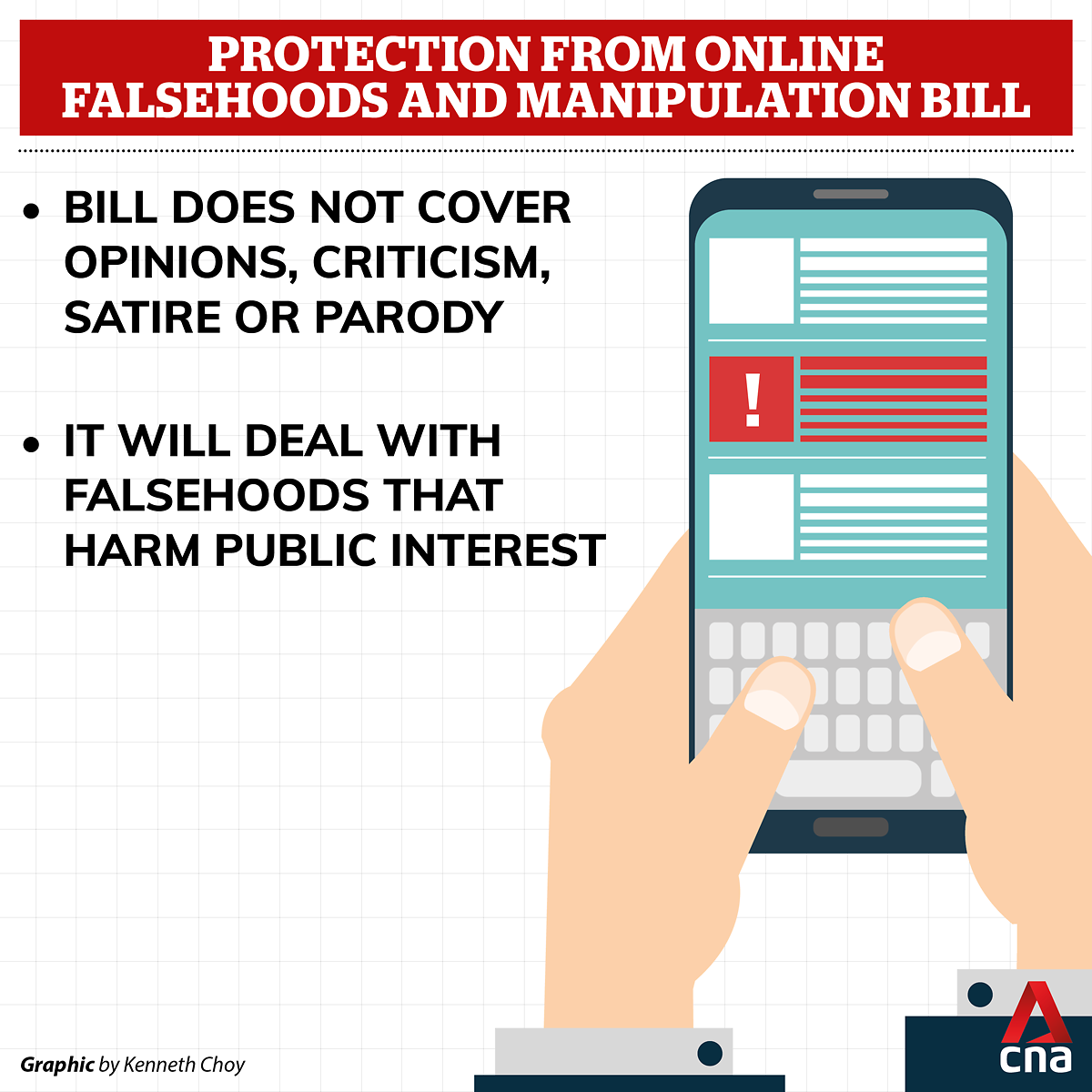
Protection from Online Falsehoods and Manipulation Bill - Graphic 2

ACCOUNT RESTRICTION

This measure deals with bots and fake accounts, when they are used in the spreading of deliberate online falsehoods. 

Fake accounts and bots can be considered “digital foot soldiers of misinformation”, as they amplify falsehoods and create false realities. Locally, these inauthentic accounts were discovered posting critical online comments on public issues of the day such as Malaysia-Singapore relations during 2018 and 2019. 

So, an account restriction order can require social media platforms to disable an inauthentic online account or bot from further communication in Singapore. 

The direction can be issued in two situations:

  • The account has spread a falsehood in Singapore that undermines public interest 
  • The account is engaged in coordinated inauthentic behaviour. For example, coordinated activity with other accounts to mislead people in Singapore  

In the case of the States Times Review article alleging how Singapore had laundered money for Malaysia’s 1MDB in exchange for favourable agreements, it was seen that seven Facebook users had shared the article 45 times collectively over three days to 39 unique Facebook groups. 

This allowed the article to reach an approximate 800,000 potential viewers. 

With the account restriction order, the seven Facebook accounts that shared the article, which were likely inauthentic, could have been shut down to stem the spread. 

BINDING CODES OF PRACTICE

While the measures above are reacting to online falsehoods when they have already been published and circulated, the new Bill introduces binding Codes of Practice for players in the digital ecosystem as a more proactive step to prevent abuse of their platforms.

READ: Facebook chief wants ‘more active’ government role regulating Internet

Specifically, they target three specific areas:

  • Safeguarding against the abuse of inauthentic online accounts and bots 
  • Digital advertising transparency to prevent the abuse of such tools to spread falsehoods 
  • Ensuring that the platforms give less priority to falsehoods that are the subject of a correction or take-down direction 

The approach to this will be targeted and graduated enforcement, and not meant to penalise a platform’s every breach.

This means if a platform is found to not have complied with the codes, the authorities will engage the company on the non-compliance. The factors to consider include: What is the seriousness of the breach? Does it reflect systemic deficiency in processes? Is there a pattern of similar breaches? Is there a need to compel the company to take action? 

A compliance notice can be issued as the next step, and if the company continues to fail to comply, then an offence is said to have taken place.

When that happens, and in the case of an individual, the person is liable to a fine of not more than S$20,000, jail of up to 12 months, or both. For any other case, this means a fine of not more than S$1 million, and if it’s a continuing offence, a fine of not more than S$100,000 for every day the offence continues after conviction. 
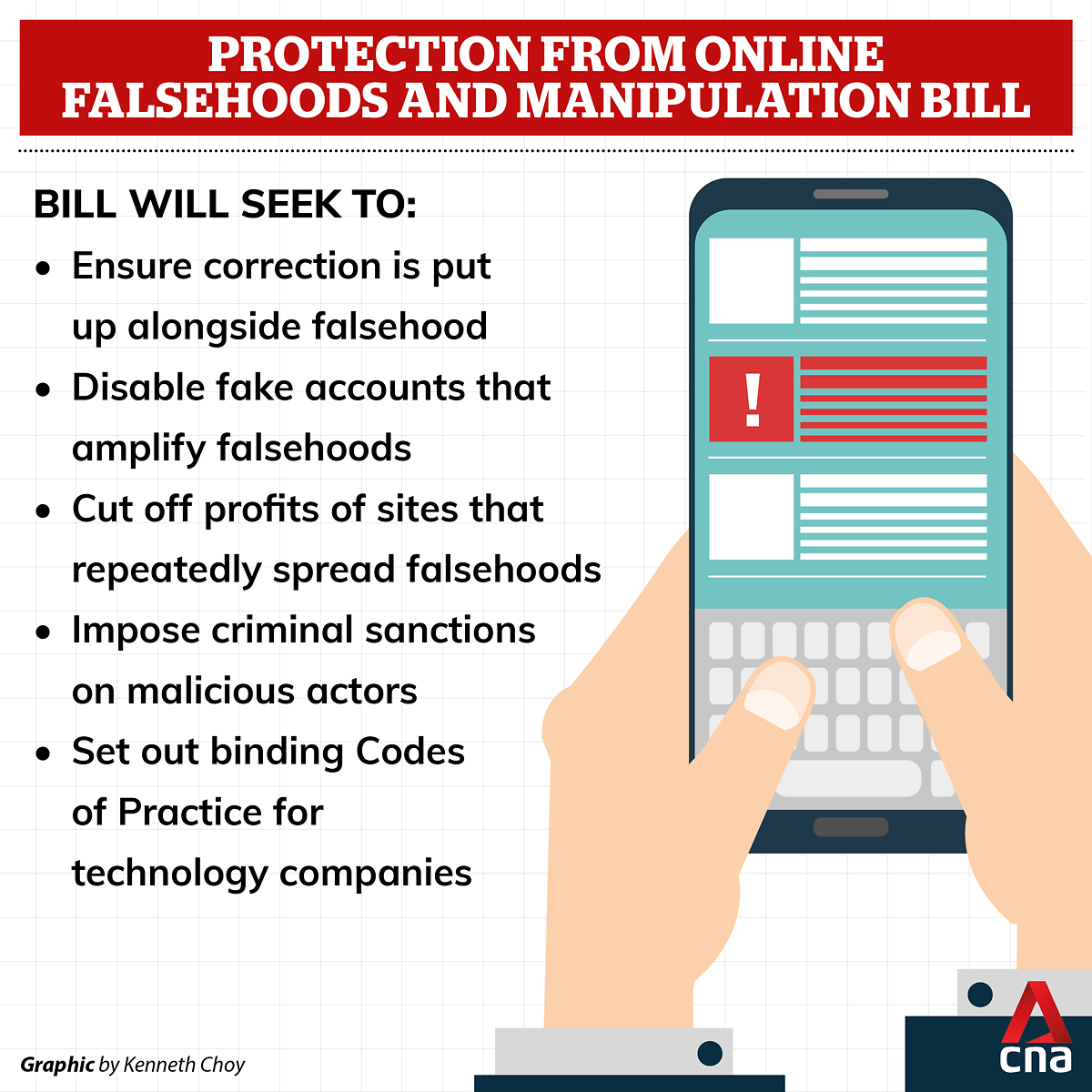
Protection from Online Falsehoods and Manipulation Bill - Graphic 1

“This Bill targets falsehoods, not free speech. It will help ensure online falsehoods do not drown out authentic speech and ideas, and undermine democratic processes and society,” the Law Ministry said.

“The aim is to keep in place the conditions for Singaporeans, as individuals and civic society, to build a healthy and robust public discourse, informed by the facts.

Source link

Regulating online falsehoods is ‘new area’ for Singapore Government, says S Iswaran

0

The new Bill will help the Government take appropriate action against online falsehoods that harms public interest, but everyone plays a part to safeguard the integrity of online discourse, says the Communications and Information Minister.

Social network users

Facebook and Twitter unveiled fresh crackdowns on misinformation campaigns from Russia and Iran. (AFP/Oli SCARFF)

SINGAPORE: The regulation of the online falsehoods domain is a “new area” for the Government, as it is for technology companies to comply, which is why both “will have to learn to work together” to ensure the objectives of the Protection from Online Falsehoods and Manipulation Bill are met.

READ: Time for tech companies to ‘take some responsibility’ for disinformation, says Edwin Tong

“We’re dealing with a domain that is hitherto not been regulated as such,” Communications and Information Minister S Iswaran said. “And therefore, I’m sure this will be a new set of circumstances that they’ll have to deal with.”

He made the comments in a doorstop interview on Monday, when the Bill was first tabled in Parliament.

He added it would be a process going forward, but stressed that the Government has sought to engage with the tech companies throughout this process of looking at deliberate online falsehoods and coming up with the legislation.

“We regard them as partners, not adversaries,” he explained. “We want to work with them, because we have a common interest in ensuring these platforms are trustworthy and reliable.”

With regard to the actual mechanics of when a direction is issued to tech companies, Mr Iswaran said after a falsehood is identified and a direction issued, tech companies will have to respond in terms of how they can meet that direction – and this is when a discussion can take place.

“But I think we are quite clear that the intent is to ensure that a falsehood, and its potential to influence users of the Internet and social media platforms, must be corrected early and effectively,” he added.

WILL NEW LAW STIFLE FREE SPEECH?

Law and Home Affairs Minister K Shanmugam also addressed concerns that some of the definitions in the Bill could be too broad and stifle free speech, saying in a separate interview that this legislation deals with false statements of fact.

READ: Shanmugam warns ‘serious consequences can follow’ when countries are lax about hate speech

“It doesn’t deal with opinions, it doesn’t deal with viewpoints. You can have whatever viewpoints, however reasonable or unreasonable,” he said.

The minister also pointed out that people are putting falsehoods into the marketplace, to confuse others and to change the terms of debate, which, in fact, undermines free speech and democracy.

So, the approach for the website that carried the whole false statement of fact is to carry another statement saying the first statement is inaccurate or untrue, Mr Shanmugam said, adding that this encourages free speech.

“There are more viewpoints for you to have, rather than be restricted in what is said to be just false. So, I don’t see how it affects free speech,” he said.

The minister also pointed out that criminal sanctions will not apply to ordinary citizens who inadvertently share online falsehoods.

He said criminal sanctions only apply when they was deliberateness in the conduct, in that the perpetrator knew it was a falsehood and that it impacts on public interest. “Innocent sharing won’t attract criminal responsibility,” Mr Shanmugam said.

Source link

No correlation between chemical smells and air quality readings: Amy Khor

0

SINGAPORE: There is no correlation between burning or chemical smells and the ambient air quality readings, Senior Minister of State for Environment and Water Resources Dr Amy Khor said in Parliament on Monday (Apr 1).

This was in response to a question by Member of Parliament (MP) for Nee Soon GRC Lee Bee Wah, on whether there was any cause of concern for Yishun residents with regards to burning and pungent smells in the area.

There have been several fires in Johor over the past two months, including fires at two landfills in Bandar Tenggara and Tanjong Langsat and a fire in an oil palm plantation in Punggai.

“Between early-February and mid-March when the hotspots were detected in Johor, the 24-hour PSI readings remained within the good to moderate range, and the 1-hour PM2.5 levels remained in the normal range,” Dr Khor said.

She also highlighted the specific measures taken by the National Environment Agency (NEA) to monitor and keep Singaporeans informed of pollution levels in Singapore’s air quality and water supply.

READ: Burning smell across Singapore could ease in coming weeks: NEA

AIR POLLUTION MONITORING

NEA uses both satellite remoting sensing and a network of real-time ambient air monitoring sensors across Singapore to monitor air pollution levels, according to Dr Khor.

In February, satellite remote sensing allowed NEA to detect fire hotspots with plumes of smoke in Southern Johor. This was later confirmed by the Department of Environment (DOE) Johor to be fires at three hotspots.

Prevailing north-easterly winds blew the smoke plumes towards Singapore, causing “intermittent burning smells over the past few weeks”, Dr Khor said.

Real-time ambient air monitoring sensors measure key air pollutants, which include sulphur dioxide, nitrogen dioxide, carbon monoxide, ozone and particulate matter classed under PM2.5 and PM10. With this data, NEA calculates the Pollutant Standards Index (PSI) over a rolling 24-hour period.

Readings of air pollutants are available publicly on the NEA website and the myEnv app, which has hourly updates from NEA.

“If there are significant variations above normal levels, unhealthy levels, we would notify the public with this information,” said Dr Khor.

WATER POLLUTION MONITORING

Dr Khor also addressed the issue of water quality monitoring by NEA, in response to the illegal dumping of around 20 to 40 tonnes of chemical waste in Pasir Gudang.

Pasir Gudang chemical poisoning Kim Kim River

Fumes from toxic chemicals dumped in Sungai Kim Kim caused students and teachers from nearby schools to experience shortness of breath and vomiting. (Photo: Bernama)

According to Dr Khor, chemical waste was not been detected in NEA’s water samples, and the agency has not detected any anomalies in the water quality at Singapore’s recreational coastal beaches.

“PUB’s online sensors have shown that the water quality of Johor River, our waterways and reservoirs in the north and north-eastern part of Singapore, as well as the water supply is within normal variations,” the minister added.

“On-site inspections and water quality checks have also shown no abnormalities.

“This incident has no impact on our water supply as the chemical dumping location is outside of our Johor River catchment area, where part of our water supply comes from.”

The chemical dumping in Sungai Kim Kai at Pasir Gudang caused thousands of people in the area to be taken ill. A Singaporean and two Malaysians have been charged in connection with the incident.

READ: Pasir Gudang chemical poisoning: 111 schools shut, suspect to be charged on Thursday

READ: Pasir Gudang’s Sungai Kim Kim now clean, safe: Environment minister

CROSS-BORDER COLLABORATION

Dr Khor emphasised the need for greater cross-border collaboration between Malaysia and Singapore to tackle environment pollution.

“These include the provision of early warnings, and environmental monitoring data and guidelines. NEA and SCDF have been in contact with their respective Malaysian counterparts … to obtain regular updates on the situation there,” she said.

“We will continue to monitor the situation and provide updates if there are significant developments.”

Source link

No reason to debar ST Marine from patrol boats tender based on CPIB investigations: Indranee Rajah

0

The Second Minister for Finance says the charges and convictions against six former senior ST Marine executives in 2017 are separate and distinct from the company itself.

Ms Indranee Rajah speaking in Parliament on Monday (Apr 1).

Ms Indranee Rajah speaking in Parliament on Monday (Apr 1).

SINGAPORE: There must be a “nexus” relating to government-related contracts before debarment can be recommended and applied, which is why ST Marine’s winning of the tender to build 12 patrol boats for the Police Coast Guard was allowed, said Second Finance Minister Indranee Rajah on Monday (Apr 1).

Non-constituency Member of Parliament (NCMP) Leon Perera had asked Finance Minister Heng Swee Keat in Parliament why his ministry’s Standing Committee on Debarment (SCOD) did not extend the disbarment of companies from tendering for government contracts to cases where the companies or their senior executives had been convicted of corruption in private sector contracts.

In response, Ms Indranee said corruption is an offence, and companies or individuals who are convicted of the offence will be penalised through the legal system.

Debarment from participation in government contracts, is a “separate and distinct exercise” from court proceedings and serves a different purpose, she said.

“Debarment is an administrative procedure by the Government to protect the Government’s interest as a service buyer against those who have caused direct harm or losses to the Government. It does not duplicate the court’s function of adjudication or punishment,” she said.

In the case of the former ST Marine executives who were convicted of corruption, Ms Indranee said the Corrupt Practices Investigation Bureau (CPIB) investigations “did not reveal any connection to the government agency or contract, hence the circumstances in which debarment can be recommended under the policy parameters did not arise”.

She noted that for the case against the former executives, their offences dated between 2000 and 2011, which meant the most recent case was eight years ago. They had also ceased to be employed by ST Marine between 2004 and 2014.

“ST marine, which is a separate legal entity, did not have any charges or convictions against it,” Ms Indranee added.

A new board of directors for ST Marine was also appointed as of Aug 15, 2018, while the Police Coast Guard tender was awarded in November that year, she added.

Source link

Despite Hyflux situation, Public-Private Partnership model should not be dismissed: Masagos

0

SINGAPORE: The current situation with embattled water treatment firm Hyflux does not mean that Singapore should dismiss the existing Public-Private Partnership model (PPP) altogether, Minister for the Environment and Water Resources Masagos Zulkifli said on Monday (Apr 1).

He was responding in Parliament to a question filed by MP Seah Kian Peng, who had asked about the impact of the recent challenges facing Hyflux on Singapore’s water supply, and whether any review should be done in light of what has happened.

Under the PPP model, Mr Masagos explained that the Government partners the private sector to design, build, own and operate some of Singapore’s desalination and NEWater plants. Currently, he said, Singapore has five NEWater plants and three desalination plants. Out of these, three NEWater plants and two desalination plants are based on the PPP model.

Mr Masagos stressed that Singapore’s other PPP projects are working well, and national water agency PUB has built safeguards into the PPP contracts, to ensure that water security is never compromised. 

READ: PUB issues default notice to Hyflux’s Tuaspring, says will take over plant if defaults not resolved

READ: Hundreds of Hyflux investors gather to express concerns at Hong Lim Park

Mr Masagos added that the PPP model has been useful in allowing Singapore to tap on private sector innovations and cost efficiencies to deliver water services more effectively.

“Even though PUB does not interfere with the business decisions made by the concession companies, PUB monitors the performance of the plants under the PPP model to ensure that the concession companies can meet their contractual obligations to PUB,” he said.

“Where there are issues, PUB will require the concession companies to rectify them, failing which, PUB may exercise its rights to terminate the PPP contracts and take control of the plants.

“We do not exercise these termination rights lightly but will not hesitate to do so when it becomes necessary to safeguard our water security,” the minister added.

Hyflux Singapore (3)

(Photo: Jeremy Long)

PUB’S ACTIONS DO NOT DISADVANTAGE HYFLUX INVESTORS

Mr Masagos noted that safeguards have been built into the Water Purchase Agreement with Tuaspring Pte Ltd (TPL), which owns the Tuaspring Integrated Water and Power Project (TIWPP).

This is one of two PPP projects Hyflux is involved in, as TPL is a wholly-owned subsidiary of Hyflux. The other project – the SingSpring Desalination Plant – is owned by SingSpring Trust, which is majority owned by Keppel Infrastructure Trust, with Hyflux owning a minority stake.

Outlining the background of the Hyflux situation, Mr Masagos said that in 2010, national water agency PUB had called an open tender for a 70 million gallons per day desalination plant, to be completed by 2013. In its tender bid, Hyflux proposed a different business model – one of an integrated desalination and power plant, and made the business decision to build the power plant that has a capacity significantly more than what the desalination plant needed, with the intention of selling excess power to the national power grid.  

Hyflux’s bid met PUB’s requirements for constructing and operating a desalination plant and was the most competitive bid among the submissions. PUB also took into account Hyflux’s expertise and track record. Thus, PUB awarded the tender to Hyflux in 2011.

However, TPL has been experiencing difficulties fulfilling its contractual obligations since 2017, he said, adding that this includes a failure to keep the plant reliably operational as required.

It has also failed to produce financial evidence to demonstrate its ability to keep the plant running for the next six months, the minister explained.

“PUB gave time to TPL to try to sort out its problems but PUB’s concerns have been growing over time,” he said. “To safeguard our water security, PUB issued TPL with a default notice on 5 March 2019 to require TPL to remedy the defaults within the default notice period.”

READ: Beyond scarcity and security, does Singapore need a new water narrative?

READ: The fall of once-great Hyflux, a unicorn in the Singapore story, a commentary

If they failed to do so, PUB will terminate the Water Purchase Agreement and take over the desalination plant, he said.

“This is to ensure that a critical asset remains in safe hands, and avoids uncertainty over the operations of the desalination plant,” he said. “Ultimately, PUB’s actions are based on our overriding objective of ensuring Singapore’s water security and that water continues to be reliably produced at the plant to meet the needs of Singapore and Singaporeans.”

However, Mr Masagos noted that the desalination plant has been and will likely continue to lose money for the next few years. PUB would also have to incur costs to make good the plant and ensure that it operates reliably for its remaining lifespan.

“Given TPL’s current financial position, PUB is unlikely to recover the compensation sum from TPL,” he said. “PUB has therefore indicated that it is willing to waive the compensation sum and purchase the desalination plant at zero dollars.”

Mr Masagos stressed that PUB’s actions do not weaken either TPL or Hyflux, and do not disadvantage those who have invested in Hyflux. Indeed, he said, it is quite favourable to TPL, and TPL has in fact noted in its letter to PUB that if PUB terminates the Water Purchase Agreement, it would alleviate the pressure on the rest of the Hyflux Group.

It positively impacts Hyflux’s value and hence the value of the Hyflux shares being offered.

Mr Masagos said that TPL provides an example of how the safeguards built into the PPP contracts are “robust” and serve their purpose. Nonetheless, he said, the Government is always studying ways to strengthen the safeguards and enhance its operations, and will continue to do so.

He added that water is an existential issue for Singapore.

“Water security is integral to Singapore’s national security,” he said. “PUB’s recent actions reinforce that.”

“We will never allow Singapore’s national or water security to be compromised.”

Source link

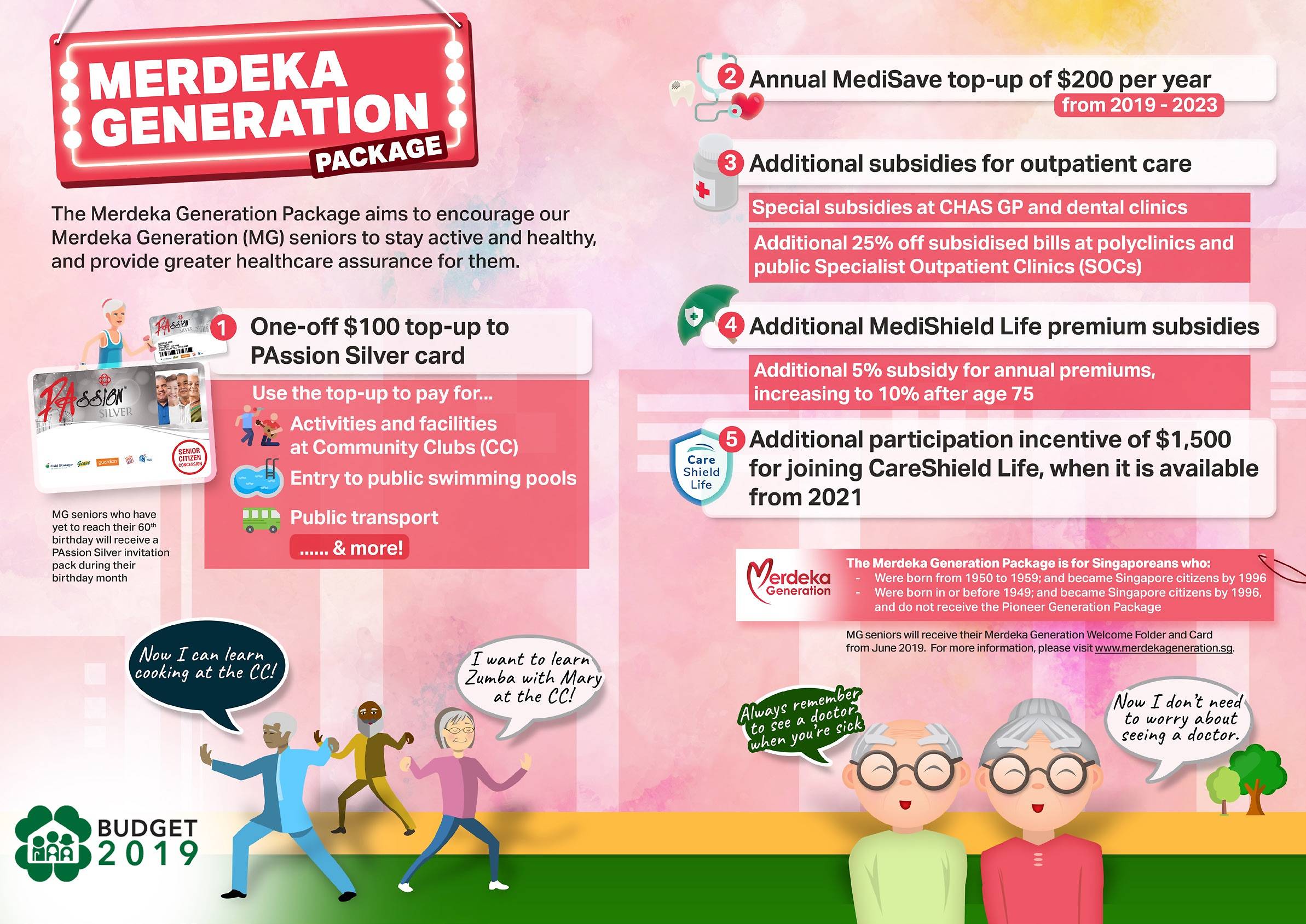
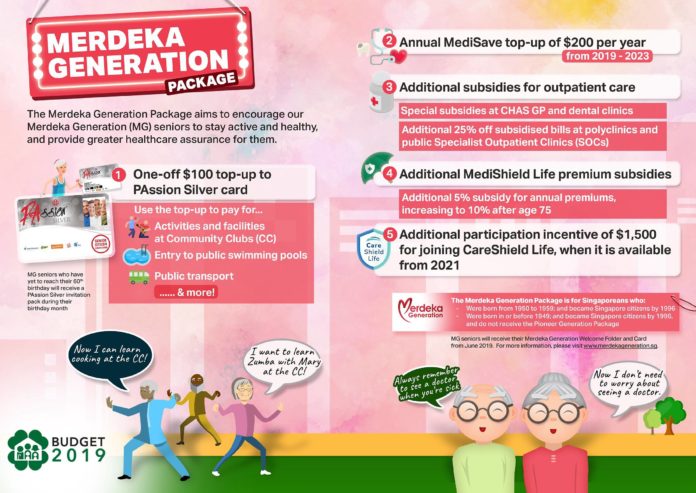
About 500,000 eligible seniors will receive letters on Merdeka Generation Package by end-April

0

SINGAPORE: About 500,000 Singaporean seniors will receive letters informing them of their eligibility for the Merdeka Generation Package by the end of April, said the Ministry of Finance (MOF) on Monday (Apr 1). 

Citizens may also check their eligibility online on the Merdeka Generation website. Merdeka Generation seniors will receive their welcome folder and card from late June, MOF added. 

The package applies to those born from Jan 1, 1950 to Dec 31, 1959 and became Singapore citizens by Dec 31, 1996. It will also be extended to Singapore citizens who were born on Dec 31, 1949 or earlier, became Singapore citizens by Dec 31, 1996 and did not receive the Pioneer Generation Package.

“As announced at Budget 2019, the Merdeka Generation Package aims to encourage our seniors to stay active and healthy, and provide greater assurance with healthcare costs in their silver years,” MOF said.

Merdeka Generation Package MOF

(Source: Ministry of Finance)

READ: Merdeka Generation Package – What you need to know

READ: Merdeka Generation Package can afford to go further to help our poor elderly, a commentary

SENIORS TO RECEIVE BENEFITS FROM JULY

No action is needed at this time for eligible seniors to receive their benefits.

According to MOF’s implementation timeline, seniors can look forward to receiving their benefits from July, starting with a one-off S$100 PAssion Silver card top-up that has to be redeemed by Dec 31, 2020. The credits do not expire. 

From July 2019 until 2023, seniors will enjoy an annual S$200 MediSave top-up, automatically credited to their account. 

Subsidies for MediShield Life premiums will also be effective for policies renewed from Jul 1.

From November, eligible seniors can present their Merdeka Generation cards at Community Health Assist Scheme (CHAS) general practitioner and dental clinics, polyclinics and public specialist outpatient clinics to receive additional outpatient care subsidies.  

Those who join CareShield Life will also get an extra S$1,500 participation incentive when the scheme opens for applications from 2021 to 2023.

Those who join the scheme during this period may receive a total of S$4,000 in participation incentives. This sum will be spread out over 10 years and used to offset their annual CareShield Life premiums.

READ: Six things you should know about CareShield Life, the enhanced ElderShield scheme

READ: Budget 2019: Building a ‘strong, united Singapore’; Merdeka Generation Package, healthcare take spotlight

APPEALS TO BE COUNTED AMONG MERDEKA GENERATION

Singapore citizens born on or earlier than 1959, who missed the citizenship criterion and have good claims to be counted among the Merdeka Generation, can submit an appeal for the package, said MOF. 

Appeals will be considered on a case-by-case basis.

The mandate of the existing Pioneer Generation Appeals Panel will be expanded to consider appeals for the Merdeka Generation Package and will be renamed the Pioneer Generation and Merdeka Generation Appeals Panel. 

The panel will not consider appeals from those who miss out on the age criterion.

Appeals may be sent to contactus@merdeka.gov.sg.

Source link

Private home prices fell 0.6% in Q1: URA

0

SINGAPORE: Private home prices in Singapore fell 0.6 per cent in the first quarter of the year, according to flash estimates released by the Urban Redevelopment Authority (URA) on Monday (Apr 1).

The private residential property index decreased by 0.9 point from 149.6 points in the fourth quarter of 2018 to 148.7 points in the first quarter of 2019.

This represents a decrease of 0.6 per cent, compared to the 0.1 per cent decrease in the previous quarter, said URA.

URA flash estimates Q1 2019

(Source: Urban Redevelopment Authority)

Prices of non-landed private residential properties fell by 2.9 per cent in the Core Central Region (CCR), compared with the 1.0 per cent decrease in the previous quarter.

Prices in the Rest of Central Region (RCR) decreased by 0.2 per cent, after registering an increase of 1.8 per cent in the previous quarter. Prices in the Outside Central Region (OCR) were unchanged, following the 0.7 per cent increase in the previous quarter.

The flash estimates are compiled based on transaction prices given in contracts submitted for stamp duty payment and data on units sold by developers up till mid-March. 

The statistics will be updated on Apr 26 when URA releases its full set of real estate statistics for the first quarter of 2019.

“Past data have shown that the difference between the quarterly price changes indicated by the flash estimate and the actual price changes could be significant when the change is small. The public is advised to interpret the flash estimates with caution,” URA said.

Source link

HDB resale prices down slightly in Q1, continuing declining trend

0

SINGAPORE: Prices of resale flats for the first quarter this year fell 0.3 per cent from the fourth quarter in 2018, continuing a declining trend, according to flash estimates released by the Housing and Development Board (HDB) on Monday (Apr 1). 

The resale price index – which provides information on the general price movements in the resale public housing market – is estimated to have dipped slightly to 131.0.

Resale prices for HDB flats have been on the decline in the last two quarters. Prices fell 0.1 per cent in the third quarter and 0.2 per cent in the fourth quarter of last year.

HDB flash estimates

Source: HDB

HDB also announced that it will offer about 3,400 Build-To-Order (BTO) flats in Kallang Whampoa, Tengah and Woodlands in May. There will also be a concurrent Sale of Balance Flats exercise.

HDB has said it plans to launch 15,000 new flats for sale in 2019.

Source link

New Bukit Gombak Park to be ready in early 2020

0

SINGAPORE: Work on the new Bukit Gombak Park began on Sunday (Mar 31), the National Parks Board (NParks) announced in a media release. 

The 4.8-hectare park, which is located at Bukit Batok West Avenue 5 opposite the Bukit Batok Driving Centre, is scheduled to be opened in early 2020.

Visitors will soon be able to enjoy its greenery and recreational facilities that will include a hill trek and a nature playgarden, NParks said, adding that residents’ feedback on the features were gathered during the planning process.

“Feedback received were varied, and suggestions included having more biodiversity-attracting plants, tranquil areas to enjoy nature, recreational spaces for families and friends, and opportunities for the community to do gardening and be closer to nature,” NParks said.

Bukit Gombak Park 2

Artist’s impression of entrance from Bukit Batok West Ave 5. (Photo: NParks)

READ: NParks launches 36km trail linking Coney Island with Jurong Lake

NParks said the new park will feature a Nature Area and an Active Area “to meet the diverse recreational needs of the community”.

“Located on a hill, the Nature Area will allow park goers to appreciate nature up close. The main feature of this area is an inclined looped 400m hill trek modelled after the trails in Bukit Timah. Besides alleviating visitorship pressure on the nearby Bukit Timah Nature Reserve, the hill trek will help residents to stay healthy in nature,” NParks said.

Nature-lovers will be able to find more than 2,000 trees, comprising 16 species including the endangered Yellow Flame and others like Belinjau and Pink Mempat once the park is ready.

NParks Yellow Flame

The Yellow Flame (Peltophorum Pterocarpum) is a critically endangered native Singapore tree with bright coloured flowers, grows between 15m to 25m. (Photo: Shi Bying, NParks Flora&FaunaWeb)

The Active Area will feature an open lawn for events, an outdoor fitness area, a community garden, a F&B outlet and public toilets. 

The existing basketball court next to Block 394 will also be incorporated as part of the park, NParks said.

“Other features at the Bukit Gombak Park will include a biophilic playgarden which will encourage children to play amid nature. A slide will be integrated into the natural sloped terrain and there will be nature-inspired play equipment, such as balancing beams set amongst trees and shrubs,” it added.

The park will also include a 480 sqm dog run, the first in the Bukit Gombak area. It will be sited on a flat terrain for dogs to run without leash, with benches for dog owners to rest, according to NParks.

The park will complement the existing Bukit Batok Town Park and Bukit Batok Nature Park. These parks are connected via the Choa Chu Kang Park Connector, NParks said.

Health Minister Gan Kim Yong and Mayor of South West District Low Yen Ling, broke ground at the site of the park to signal the start of works.

Mr Gan said: “The new Bukit Gombak Park will be a welcome addition to the network of parks and green spaces in the South West area, together with the picturesque landscape of Little Guilin and the verdant trails of Bukit Batok Nature Park. 

“As our population ages, green spaces such as Bukit Gombak Park will allow for multi-generational recreation, relaxation and enjoying the peace of mind.”

Source link

Electricity tariffs to fall 4.7% from April to end June

0

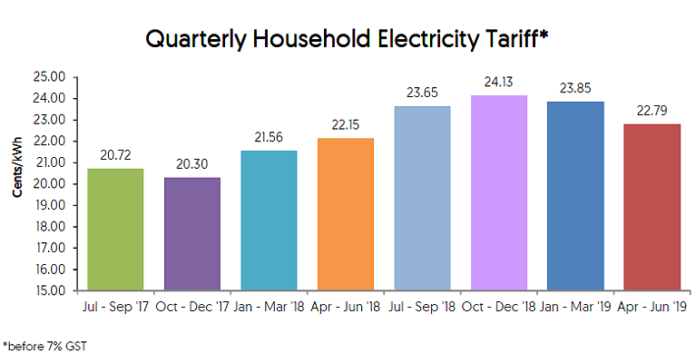
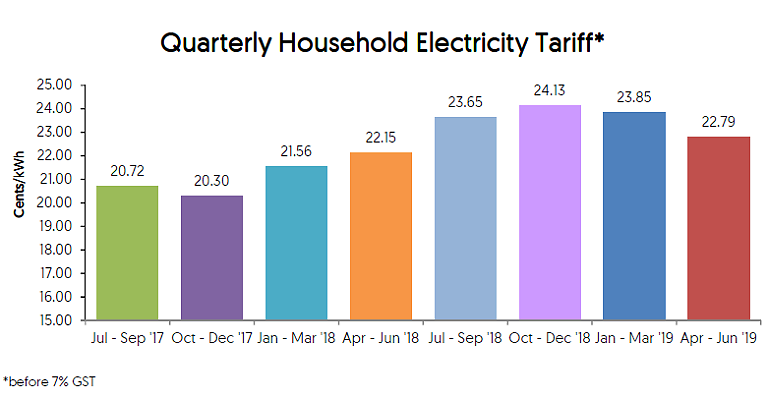
SINGAPORE: Electricity tariffs are set to decrease by an average of 4.7 per cent for the next three months, SP Group said on Sunday (Mar 31). 

The decrease of 4.7 per cent or 1.10 cents per kWh compared to the previous quarter, is mainly due to the lower cost of natural gas for electricity generation. 

Electricity tariffs chart

READ: How do electricity retailers charge lower prices than SP Group? 5 questions answered

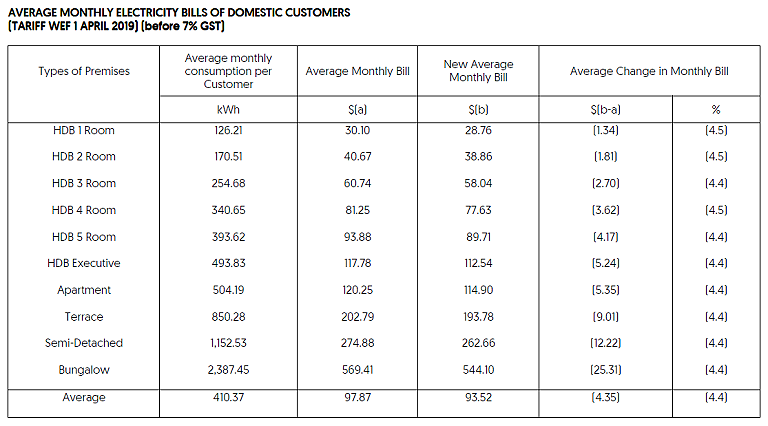
For households, the electricity tariff will fall from 23.85 to 22.79 cents per kWh from Apr 1 to Jun 30. This means that the average monthly electricity bill for families living in four-room Housing Board flats will decrease by S$3.62. 

SP Group reviews the electricity tariffs quarterly based on guidelines set by the Energy Market Authority, the electricity industry regulator.

Average electricity bill

Source link