SINGAPORE: Two men who were washing the facade of Block 451 in Yishun Ring Road were rescued by firefighters on Monday (Apr 15), after the gondola they were on suffered a technical glitch.
Due to the glitch, the men were unable to bring the gondola down from the third floor, and were trapped for about 20 minutes, according to witnesses.
When CNA arrived at the scene at about 12.50pm, the gondola remained stuck in a lopsided position after the men were rescued. A man was seen in an ambulance, about to be taken to hospital.
Both men are in their 30s and are from India. They were washing the facade of the block to prepare it for painting when the incident happened.
A rescue vehicle and fire engine from the Singapore Civil Defence Force (SCDF) were also at the scene.
SCDF fire engine at the scene. (Photo: Alif Amsyar)
“I think there were two men on the gondola, they were washing the building, and there was a motor problem – so the gondola couldn’t come down. The fire service then helped them to come down,” said a 35-year-old construction worker, who wanted to only be known as Mani.
“The SCDF used a ladder to bring the guys down,” added Mani, who was carrying out works at an adjacent block at the time.
The project manager of the site, who wanted only to be known as Mr Kwa, said that the incident happened at around noon.
“The men were brought down within 10 to 15 minutes. (SCDF) also set up a bag in case. But, our men also had their harness and life lines, so everything was secure,” he said.
“The gondola jerked and one of the guys got injured when he hit his head, it’s a small cut but he’s okay.”
The gondola seen hanging from the building. (Photo: Alif Amsyar)
A resident of Block 451, Mrs Lee, 50, a sales director, said that the SCDF had to forcibly gain entry into her flat to conduct rescue operations, as she was not home at the time.
“The gondola was stuck right in front of my unit, and they had to break down my door, the gate and room window. I was at work and arrived at my house around 1.30pm,” said Mrs Lee.
Mrs Lee’s broken front door, which the SCDF had to break down in order to conduct rescue operations. (Photo: Alif Amsyar)
Mrs Lee’s broken front door, which the SCDF had to break down in order to conduct rescue operations. (Photo: Alif Amsyar)
“I was at Tampines for work and the police called my son, who is in the army. When my son called me and said that something is happening at our house, I immediately rushed back. When I reached at 1.30pm, I saw that my gates were already locked and then saw what actually happened,” Mrs Lee added.
When CNA visited Mrs Lee’s unit at about 2.30pm, a broken bedframe resulting from rescue efforts was seen in the room.
A broken bedframe in Mrs Lee’s room, where the SCDF had to forcibly gain entry in order to conduct rescue operations. (Photo: Alif Amsyar)
“The contractors responsible said that they will get both the doors and gates repaired and get the same quality for both, although the design may be different,” said Mrs Lee.
“But they mentioned that they have to go back to a HDB appointed contractor for the door and gate. I told them I wanted both changed because it cannot be repaired anymore – it’s quite bad and even part of my flooring is affected.”
Another resident, Mr Ho, 53, said that he saw the men in the gondola outside his flat.
“I was coming back from work around 12 plus and my curtains were closed, so I didn’t realise anything. Then, I noticed that there were many onlookers from the adjacent school, and I realised that something was wrong.
“When I opened the curtains, I saw the worker and opened the windows. The worker wanted to climb into my window but it was too dangerous.”
When CNA visited Mr Ho’s flat at about 2pm, the gondola could still be seen from his living room. (Photo: Alif Amsyar)
Mr Ho said he felt relieved after SCDF rescued the men. When CNA visited Mr Ho’s flat at about 2pm, the gondola could still be seen from his living room.
CNA has contacted Sembawang Town Council and the SCDF for more information.
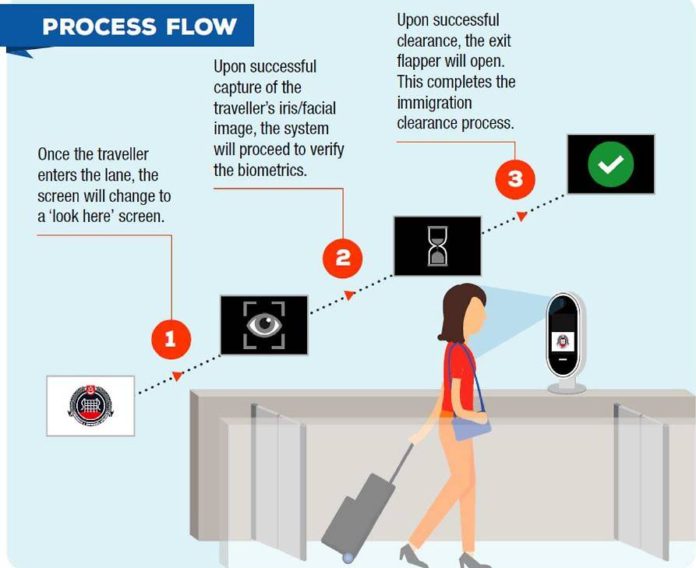
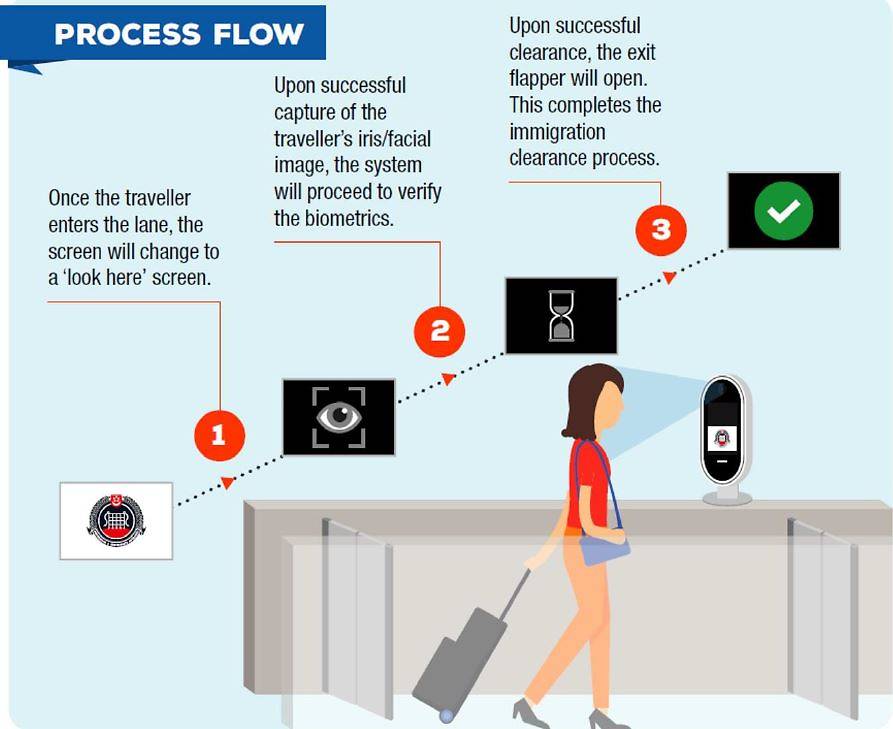
SINGAPORE: A six-month trial for a new contactless, “breeze-through” immigration clearance system at Tuas Checkpoint is currently under way, the Immigration and Checkpoints Authority (ICA) announced on Monday (Apr 15).
The trial, which began on Apr 8, uses one of the automated arrival lanes in the checkpoint’s bus hall.
Travellers are not required to present their passport or thumbprints for clearance in this lane. Their identity is verified using iris and facial images.
A back-end system then verifies if the identified traveller holds a valid passport, ICA said.
(Image: Immigration and Checkpoints Authority)
Participants must not wear sunglasses, cap or other headgear when using the contactless immigration clearance lane.
Singaporean citizens aged six and above, who are holding passports beginning with the letter K and issued after Jan 1, 2018, are eligible for the trial.
Eligible travellers are not required to sign up prior to their trip. They can proceed to clear immigration through the designated lane upon their return at Tuas Checkpoint, said ICA.
It also encouraged those eligible to participate in the trial to help ICA improve the system.
“The contactless immigration system will enhance operational efficiency, yet maintain our high standards of traveller identity verification and security, and is a significant step towards ICA’s vision of an efficient and hassle-free immigration clearance experience using biometric solutions,” it said.
“ICA will study the results of the trial and assess the feasibility to extend this initiative to more automated clearance lanes and other checkpoints.”
SINGAPORE: As the thumping beat of the music reached its crescendo, the 16 dancers froze on stage, some with arms outstretched in a balance, others crouching and supporting the weight of their friends.
There was complete silence as the stage lights went out. Then, thunderous applause and cheers from the parents in the audience as they waved their star-shaped signs, each carefully hand-lettered with encouraging messages: Be strong and courageous. Press on to the goal. I can do all things if I try.
“I’m so proud of them!” One parent was heard as the house lights went up and the dancers ran off the stage.
With their bright eyes and carefully made-up faces, the 16 dancers radiated excitement and joy as they walked back on stage to more cheers and applause.
It was the culmination of months of long practices and burning muscles as they pushed themselves again and again, to execute the required dance moves with the precision and grace required of the art form.
The day also marked a milestone for the dancers. It was the first time that these students from autism-focused school Pathlight School were taking part in the Singapore Youth Festival (SYF) Arts Presentation. It was also the first time that the presentation was opened up to all Special Education schools.
Star-shaped signs with encouraging messages were prepared prior to the performance for Pathlight parents to hold up. (Photo: Alif Amsyar)
GOING HEAD TO HEAD WITH OTHER SCHOOLS
Schools taking part in the SYF Arts Presentation are judged by industry professionals and conferred certificates of distinction, accomplishment or commendation. It is the hallmark of all secondary school performing arts groups in Singapore, according to Tricia Goh, one of the teachers-in-charge of Pathlight’s Dance Talent Development Programme.
“Our students have mostly done performances – things like the Purple Parade, where the stage isn’t as big as this,” she said. “So this is the first time they are performing on such a big stage, and competing with other schools – and mainstream schools, in fact.”
Ms Goh added that all schools taking part – whether special or mainstream – are judged according to the same criteria.
“We are going head to head with all the other schools,” she said. “I think that’s the real hallmark of inclusiveness, where you don’t belittle those with special needs, but you give them the chance to show you that they can do what you can do as well.”
“This is a chance for our students to showcase their talent and to show Singapore and the world that they can do the same things that other people can.”
Pathlight students performing on stage for their SYF Arts Presentation dance item. (Photo: Alif Amsyar)
HARD WORK AND DISCIPLINE
Taking part in SYF might be an opportunity the school was excited about, but Ms Goh admitted that there were some concerns that the students might not be able to cope with the additional demands and long practice sessions.
“In general, people with autism tend to have poorer motor skills, or some coordination challenges,” she said. “So to get them to do dance movements that are technical was already extra from what we expect for most of them.”
“We were worried that they’ll be tired and stressed out, and they won’t be able to cope with the extra practices and the intensity of SYF,” she added. Students first began rehearsing in January, with practices held twice a week. Two weeks prior to the performance on Tuesday (Apr 9), practices became more frequent – four times a week.
Extra hours aside, the students were also held to a high level of discipline during practice, according to Ms Sharon Liew, a professional dance trainer who worked with the students.
“If we’re working with any mainstream group preparing for SYF … I think it would be that kind of hard work,” said Ms Liew, who is also the principal of her own dance school, Dance Spectrum International.
“They need to follow certain rules, and we push their boundaries to a level where most people would feel uncomfortable,” she added. “But they have risen to our standards, and we’re really proud of them and what they’ve achieved over this SYF period.”
“Regardless of the outcome, they are all winners in our eyes.”
And from the parents’ reaction to the performance on stage, it is clear that they felt the same way.
MORE THAN LEARNING TO DO A SPLIT
The jubilant expressions on the students’ faces as they posed for a photo, proudly flourishing their drum sticks, was a far cry from the scene at Pathlight’s dance studio just a few hours earlier.
Their faces were screwed up in concentration, and sweat dripped down their faces as Ms Liew, clearly audible above the thumping music, urged the students to focus as they went through their final practice session.
Pathlight students doing one final practice just a few hours before their performance. (Photo: Gaya Chandramohan)
Among them was 20-year-old Alief Fiqhry Ayob, a Year 9 student with dreams of becoming a dance instructor. He moved around easily among his friends as they did their warm-ups, correcting their posture and supporting them in push-ups.
“I can do a split,” he said, proudly demonstrating his skills. “It’s painful, and at first, I could only do it until my ankle … now I can do this.”
Alief admitted that it was challenging being part of SYF, pointing out that the stage was much larger than any other stage he and his peers had performed on before.
“But the more I practice, the fewer mistakes there are,” he said, smiling confidently.
With just a few short hours to go before the performance, Alief’s confidence and can-do attitude is heartening. But as those around him said, he had not always been like this.
“When he first came in, Alief was very quiet, and found it difficult to make friends,” said Ms Liew, who has worked with Alief for seven years. “But over the years he’s learnt to open up, communicate, and make friends without feeling too awkward.”
Alief was one of the first participants in Pathlight’s Dance Talent Development Programme, one of the school’s signature programmes. As part of the programme, students are trained by professional dance trainers such as Ms Liew, and given opportunities to develop and realise their potential, attaining dance certifications.
Over the years, Alief has achieved far more than learning how to do a split: He has become far more sociable, seen his posture improve and even lost a lot of weight.
Alief has dreams of becoming a dance instructor when he graduates from school. (Photo: Alif Amsyar)
“He’s become vain,” said Alief’s mother, Aini Defahri, as she playfully tugged at his son’s school pants to show how loose they had become. “He keeps weighing himself every night, and he’s afraid to get fat.”
“He enjoys dancing and he will always come back and tell me about what he did … Ibu, I danced in front of the Prime Minister, and I took a picture with him,” she said.
Despite the punishing hours of rehearsals, Mdm Aini said she has never heard him say he is tired.
“From Monday to Sunday, he is packed with activities,” she said, pointing to his part-time job, baking classes and external dance classes he takes as a hobby. “That’s why when he gets home, I will let him rest.”
“But he’s a very good boy, and knows his responsibilities … even after he comes back, he will wash any dishes in the sink, and wipe the kitchen top and gas stove,” she added.
“If he wants to be a dance instructor, I will support him all the way,” she said. “I am so proud of all his achievements.”
SINGAPORE: The neighbourhood was quiet as my ride turned into Chatsworth Road, but it was the proverbial calm before the storm.
Approaching the main gate of the Indonesia embassy in Singapore, it was clear that there were many Indonesians based here who are looking to make their vote count in this year’s presidential elections.
This time, their choice is a familiar one: Current president Joko Widodo, more affectionately known as Jokowi, and former general Prabowo Subianto, who reprise their contest from the 2014 elections.
While the actual elections will be held on Apr 17, overseas Indonesians get the chance to cast their votes earlier with the embassy in Singapore conducting the polling on Sunday (Apr 14) morning.
About 450 Indonesians are helping out with the polling process.
Other embassies who are also holding their polling activities include those in Vietnam, Malaysia and Philippines.
One of those standing at the front of the queue before the doors opened at 8am was Ms Diana Kie.
The 31-year-old, who was second in line, said it was a “big decision for the country”, which motivated her to leave her home early this morning.
Ms Diana Kie was one of the first in line before the embassy gates were opened. “Integrity and responsibility” are characteristics she’s looking out for in the presidential candidates. (Photo: Kevin Kwang)
She also heard from her friend in Melbourne, Australia that the queue was “quite crazy” when she had to vote on Saturday.
On the presidential election, she told CNA: “We all have expectations of how the country and the Government should grow … but there’s a lot of politics involved.” She added that the President Jokowi is “doing well”, considering that it’s “not easy to manage Indonesia”.
Asked what factors would help her decide between the two candidates, she said: “Integrity and responsibility.”
Foreign domestic worker Rasam was another who was up early this morning. She said she reached the Indonesia embassy at 6.20am as the presidential election and the position of president are “very important” for the country.
Foreign domestic workers Rasam (right), 46, and her friend Siti Amirah, 42, started queuing since 6.20am. (Photo: Kevin Kwang)
“(The candidates’) past actions and achievements helped me decide on which candidate to choose from,” the 46-year-old added.
Similarly, businessman Darma was happy to have arrived early and cast his vote.
“Every five years, it is the right of every Indonesian to vote,” the 46-year old said. “And every vote counts.”
To him, this presidential race boils down to whether one wants a fresh voice in power or to continue with the current mandate. “It’s quite a stark contrast actually, between populism and progressiveness,” Darma said.
Student Bing Halim, who has been in Singapore for the past three years, was clear about his choice as he left the polling booth.
The 22-year-old said that he and his family felt that it was “better if Jokowi stays as president”.
Student Bing Halim, 22, says this is not the first time he’s voting, but he’s doing so more out of obligation as he’s “not into politics”. (Photo: Kevin Kwang)
Media coordinator at the Indonesian embassy Ratna Harjana shared that about 60,000 Indonesians are expected to make their choice at the polling booth on Sunday, with doors expected to close at 6pm.
As of 9am, about 2,000 Indonesians had already cast their votes, she added.
They will join about 192 million voters from 34 provinces in electing the eighth president and vice-president of Indonesia come Apr 17.
SINGAPORE: As the thumping beat of the music reached its crescendo, the 16 dancers froze on stage, some with arms outstretched in a balance, others crouching and supporting the weight of their friends.
There was complete silence as the stage lights went out. Then, thunderous applause and cheers from the parents in the audience as they waved their star-shaped signs, each carefully hand-lettered with encouraging messages: Be strong and courageous. Press on to the goal. I can do all things if I try.
“I’m so proud of them!” One parent was heard as the house lights went up and the dancers ran off the stage.
With their bright eyes and carefully made-up faces, the 16 dancers radiated excitement and joy as they walked back on stage to more cheers and applause.
It was the culmination of months of long practices and burning muscles as they pushed themselves again and again, to execute the required dance moves with the precision and grace required of the art form.
The day also marked a milestone for the dancers. It was the first time that these students from autism-focused school Pathlight School were taking part in the Singapore Youth Festival (SYF) Arts Presentation. It was also the first time that the presentation was opened up to all Special Education schools.
Star-shaped signs with encouraging messages were prepared prior to the performance for Pathlight parents to hold up. (Photo: Alif Amsyar)
GOING HEAD TO HEAD WITH OTHER SCHOOLS
Schools taking part in the SYF Arts Presentation are judged by industry professionals and conferred certificates of distinction, accomplishment or commendation. It is the hallmark of all secondary school performing arts groups in Singapore, according to Tricia Goh, one of the teachers-in-charge of Pathlight’s Dance Talent Development Programme.
“Our students have mostly done performances – things like the Purple Parade, where the stage isn’t as big as this,” she said. “So this is the first time they are performing on such a big stage, and competing with other schools – and mainstream schools, in fact.”
Ms Goh added that all schools taking part – whether special or mainstream – are judged according to the same criteria.
“We are going head to head with all the other schools,” she said. “I think that’s the real hallmark of inclusiveness, where you don’t belittle those with special needs, but you give them the chance to show you that they can do what you can do as well.”
“This is a chance for our students to showcase their talent and to show Singapore and the world that they can do the same things that other people can.”
Pathlight students performing on stage for their SYF Arts Presentation dance item. (Photo: Alif Amsyar)
HARD WORK AND DISCIPLINE
Taking part in SYF might be an opportunity the school was excited about, but Ms Goh admitted that there were some concerns that the students might not be able to cope with the additional demands and long practice sessions.
“In general, people with autism tend to have poorer motor skills, or some coordination challenges,” she said. “So to get them to do dance movements that are technical was already extra from what we expect for most of them.”
“We were worried that they’ll be tired and stressed out, and they won’t be able to cope with the extra practices and the intensity of SYF,” she added. Students first began rehearsing in January, with practices held twice a week. Two weeks prior to the performance on Tuesday (Apr 9), practices became more frequent – four times a week.
Extra hours aside, the students were also held to a high level of discipline during practice, according to Ms Sharon Liew, a professional dance trainer who worked with the students.
“If we’re working with any mainstream group preparing for SYF … I think it would be that kind of hard work,” said Ms Liew, who is also the principal of her own dance school, Dance Spectrum International.
“They need to follow certain rules, and we push their boundaries to a level where most people would feel uncomfortable,” she added. “But they have risen to our standards, and we’re really proud of them and what they’ve achieved over this SYF period.”
“Regardless of the outcome, they are all winners in our eyes.”
And from the parents’ reaction to the performance on stage, it is clear that they felt the same way.
MORE THAN LEARNING TO DO A SPLIT
The jubilant expressions on the students’ faces as they posed for a photo, proudly flourishing their drum sticks, was a far cry from the scene at Pathlight’s dance studio just a few hours earlier.
Their faces were screwed up in concentration, and sweat dripped down their faces as Ms Liew, clearly audible above the thumping music, urged the students to focus as they went through their final practice session.
Pathlight students doing one final practice just a few hours before their performance. (Photo: Gaya Chandramohan)
Among them was 20-year-old Alief Fiqhry Ayob, a Year 9 student with dreams of becoming a dance instructor. He moved around easily among his friends as they did their warm-ups, correcting their posture and supporting them in push-ups.
“I can do a split,” he said, proudly demonstrating his skills. “It’s painful, and at first, I could only do it until my ankle … now I can do this.”
Alief admitted that it was challenging being part of SYF, pointing out that the stage was much larger than any other stage he and his peers had performed on before.
“But the more I practice, the fewer mistakes there are,” he said, smiling confidently.
With just a few short hours to go before the performance, Alief’s confidence and can-do attitude is heartening. But as those around him said, he had not always been like this.
“When he first came in, Alief was very quiet, and found it difficult to make friends,” said Ms Liew, who has worked with Alief for seven years. “But over the years he’s learnt to open up, communicate, and make friends without feeling too awkward.”
Alief was one of the first participants in Pathlight’s Dance Talent Development Programme, one of the school’s signature programmes. As part of the programme, students are trained by professional dance trainers such as Ms Liew, and given opportunities to develop and realise their potential, attaining dance certifications.
Over the years, Alief has achieved far more than learning how to do a split: He has become far more sociable, seen his posture improve and even lost a lot of weight.
Alief has dreams of becoming a dance instructor when he graduates from school. (Photo: Alif Amsyar)
“He’s become vain,” said Alief’s mother, Aini Defahri, as she playfully tugged at his son’s school pants to show how loose they had become. “He keeps weighing himself every night, and he’s afraid to get fat.”
“He enjoys dancing and he will always come back and tell me about what he did … Ibu, I danced in front of the Prime Minister, and I took a picture with him,” she said.
Despite the punishing hours of rehearsals, Mdm Aini said she has never heard him say he is tired.
“From Monday to Sunday, he is packed with activities,” she said, pointing to his part-time job, baking classes and external dance classes he takes as a hobby. “That’s why when he gets home, I will let him rest.”
“But he’s a very good boy, and knows his responsibilities … even after he comes back, he will wash any dishes in the sink, and wipe the kitchen top and gas stove,” she added.
“If he wants to be a dance instructor, I will support him all the way,” she said. “I am so proud of all his achievements.”
SINGAPORE: The need for a robust Electric Vehicle (EV) ecosystem in Singapore has become increasingly compelling.
Countries around the world have reached a landmark agreement to combat climate change and intensify actions needed for a sustainable low carbon future at the 2015 World Climate Change Conference (COP21) in Paris.
There is also a ubiquitous acceptance of the United Nations’s 17 Sustainable Development Goals, one of which states the aspiration for affordable and clean energy to become more common in attaining greater sustainability.
MOMENTUM IN SINGAPORE THROUGH THE YEARS
The discussion on the deployment and proliferation of electric vehicles in Singapore dates back to 2009 when the Government set up a task force comprising eight government agencies to study the adoption of EVs.
In 2016, Transport Minister Khaw Boon Wan said in Parliament in 2016 that the proposal for an electric car-sharing programme was underway, giving EVs a much-needed push.
By early 2018, as part of the Nationwide ElV Car-Sharing Programme, LTA reiterated Singapore’s commitment to greater adoption of EVs in its continued move towards a greener and more sustainable urban transport system.
BlueSG, the first large-scale EV car-sharing service in Singapore, has seen high membership and rental figures, with more than 3,300 registered members and 5,000 rentals, and has announced ambitious plans of a 1,000-strong electric vehicle fleet and 2,000 charging points by 2020.
WELL-PLANNED CHARGING INFRASTRUCTURE KEY TO EV SUCCESS
Having a comprehensive and reliable charging infrastructure is a linchpin in driving the adoption of success of more EVs on Singapore roads.
A BlueSG electric car-sharing vehicle is parked at a charging station. (Photo: Reuters/Edgar Su)
Recent encouraging developments include the announcement by SP Group of plans to speed up the installation of EV charging points. It plans to roll out 1,000 charging points by 2020, doubling its original target that was set in June the same year. Thirty eight were installed in January alone.
But in figuring out the next steps, we need to ask: How do we ensure a smart and cost-effective approach?
A scientific approach to distribute charging points across Singapore should map charging infrastructure to travel patterns. The proximity between charging points should ensure accessibility and reduce range anxiety while avoiding unproductive clustering.
Developers must also be enlisted in this effort to work towards planning future-ready buildings and be incentivised to allocate space and supporting infrastructure. The availability and accessibility of carparks outfitted with charging points is one chief case in point.
Singapore’s Building and Construction Authority’s Green Mark scheme that encourage building owners to adopt environmentally sustainable practices can be extended by awarding more points to those who allocate carparks in buildings with such infrastructure.
Building and construction codes should also provide for standards and guidelines for electrical systems to cater to electric vehicles, so as to reduce retrofitting and incremental investments in EV infrastructure costs.
Another area that deserves closer attention is the need to facilitate the interoperability of charging access cards – for instance, using one card across different EV operators. Standard inter-operator stored-valued cards, like those used in the public transportation systems should be considered.
A charging point for electric vehicles. (Photo: Calvin Hui)
Such a solution will also generate benefits like the ability to capture data, understand trends and the impact of transport-related policies while generating inputs for new policies and business models.
In the development of a holistic EV charging infrastructure system, there is also a need to create a harmonised approach for EV drivers to locate EV-friendly carpark lots and the use of standardised, easily recognisable EV plates, to ensure compliance to carpark usage and for first responders in cases of emergencies to identify quickly which emergency response protocol to employ.
CONSIDER INCENTIVES TO PUSH MORE EV USE
As the building sector aims to achieve a lower energy footprint, the proliferation of EVs and the need for charging infrastructure within their premise can be counter-productive to such goals.
But rolling out EVs can help realise multiple benefits across the transport and building sectors in creating a more sustainable Singapore.
This can be done by leveraging technology that monitors the energy consumed and usage status of EV charging points and factor these into the computation of the energy footprint of the building.
The building gross floor area can also be increased as an incentive for charging stations and compensate the increase in energy usage.
To better control the growth of EVs and manage the deployment of infrastructure ahead of the demand curve, it would be pragmatic for policymakers to consider a separate Certificate of Entitlement (COE) category for EVs within the current policy allocation.
This can drive Singapore’s decarbonisation transformation and help the country make a stronger push towards cleaner vehicles while still maintaining the objective of zero-car growth.
A car is parked at a charging point for electric vehicles in London, Britain, March 6, 2018. (Photo: REUTERS/Simon Dawson/File Photo)
The desired outcome would be the reduced deployment of less efficient, high-emission vehicles through a lower COE allocation.
Finally, as we aspire to become a Smart Nation through smart technology, we must also inculcate smart people with smart attitudes. In this instance, EV owners should not occupy lots with charging points when not charging their vehicles as this diminishes their utilisation and compromises the effort around smart planning.
Singapore is still in the early days in terms of thinking and implementing a comprehensive EV charging infrastructure.
There is strong belief within the energy community that taking a smarter approach at the onset will achieve greater efficiencies and productivities in the longer term.
To ensure these benefits are enjoyed, everyone need to start thinking and collaborating in a systematic manner. This needs to start now.
Dr Sanjay C Kuttan is Chairman at the Sustainable Infrastructure Committee at Sustainable Energy Association of Singapore.
You may think it is more cost-effective to assign your employees cleaning duties rather than to hire a professional cleaning service. That is where you would be sorely mistaken. There are numerous reasons to hire a professional cleaning service and cost-effectiveness is just one of them. If you want your Anaheim based business to be perceived as a professional workspace that customers enjoy spending time inside then a professional cleaning service is a must. It not only makes employees happier but it also improves how customers think of your business. If your employees see that their workspace is immaculately clean it will cause them to have a higher morale, and to present themselves in a more professional manner to match that of their workspace.
Having a clean workspace helps slow or stop the spread of viruses and bacteria which means less sick days for your employees which also means more productive days for your company. How often does a flu come through and wipe out multiple people at a time? How much money are you wasting when you are paying employees sick leave? Having a professionally cleaned workspace means that the air will be cleaner and there will be less pollutants in the air which can also cause your employees to experience allergies. When is the last time the air ducts in your business were cleaned? I’m willing to bet you probably can’t remember. A professional cleaning service will make sure that your air ducts are cleaned regularly. On top of hiring professionals to clean your business you may also want to invest in no touch wastebaskets, soap dispensers, and hand drying systems to aid in a bacteria free workspace.
Does your workspace have overflowing trash bins, dirty floors, nasty monitors & keyboards? This all presents a highly unprofessional image that says we don’t care about our cleanliness. This can really affect how customers see your company and if they choose to do business with you or not. Just put yourself in their shoes. If you walked into a business willing to spend some serious money would you not be turned off by an unkempt looking workspace? Just like if you had a front desk employee that didn’t shower or bother to brush their teeth your dirty workspace will be a huge red flag for your potential customers.
Hiring professional cleaners for your Anaheim business will also lead to reduced clutter and more storage space. Imagine how much space you are wasting due to unnecessary clutter. If you do decide to hire professional cleaners (which you should) make absolute sure that you are going through a reputable provider of these goods. When you hire a company to clean for you, you are literally handing them the keys to your business and you want to make sure that your business is in good hands.
SINGAPORE: Two pedestrians were injured outside Jurong Point shopping centre on Saturday (Apr 13) morning after a crash involving a taxi.
Singapore Police Force said it was alerted at 11.36am to the incident involving a taxi and two women at the junction of Jurong West Street 64 and Jurong West Central 3.
“Both pedestrians, aged 26 and 54, were conscious when conveyed to National University Hospital,” the statement added.
“The taxi driver, a 63-year-old man, was arrested for dangerous driving. Police investigations are ongoing.”
In a Facebook post, a witness, who did not want to be named, said that the victims were unable to move or respond much after the accident. Passers-by also assisted the two injured women.
“I asked for tissues and the passers-by willingly helped,” the witness told CNA.
“Two others took umbrellas to shade them, while my colleagues and another passer-by applied pressure on the wounds to stop the bleeding.”
Two pedestrians were injured outside Jurong Point shopping centre on Apr 13, 2019. (Photo: CNA reader)
Other witnesses helped to pick up the groceries that the two pedestrians were carrying, while another diverted traffic from the area.
Photos posted by a witness show the victims lying on the road with head injuries, with passers-by tending to them.
According to the witness, an ambulance arrived about 10 minutes after the crash.
“SCDF was alerted to the incident at about 11.36am (Apr 13). SCDF conveyed 2 persons to NUH,” said the Singapore Civil Defence Force.
In response to CNA’s queries on Sunday, ComfortDelGro’s group chief communications officer Tammy Tan said the taxi driver has been suspended.
“We are deeply sorry to learn about this accident and have suspended the driver with immediate effect,” Ms Tan added.
“The welfare of both pedestrians is currently our top priority. We are already in touch with both pedestrians and will assist them the best we can. We are also assisting the police in their investigations.”
SINGAPORE: A site supervisor for construction company ZAP Piling was sentenced to a total of 16 week’ imprisonment for offences related to a fatal workplace incident on Jun 9, 2016, a press release from the Ministry of Manpower (MOM) said on Saturday (Apr 13).
Tay Tong Chuan was sentenced to eight weeks’ jail under the Penal Code for intentionally obstructing the course of justice by asking a worker to take the blame for the fatal incident. He was also given another eight week’s jail under the Workplace Safety and Health Act for instructing his worker to carry out lifting operations involving a crawler crane without a permit-to-work and a lifting plan.
The victim, Arumugam Elango, was pronounced dead at the scene due to multiple injuries in the incident that took place at a machine storage yard located at 6 Kranji Link.
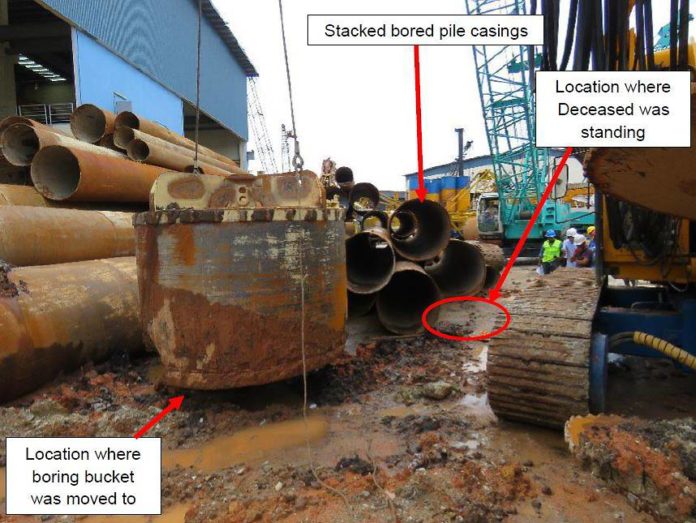
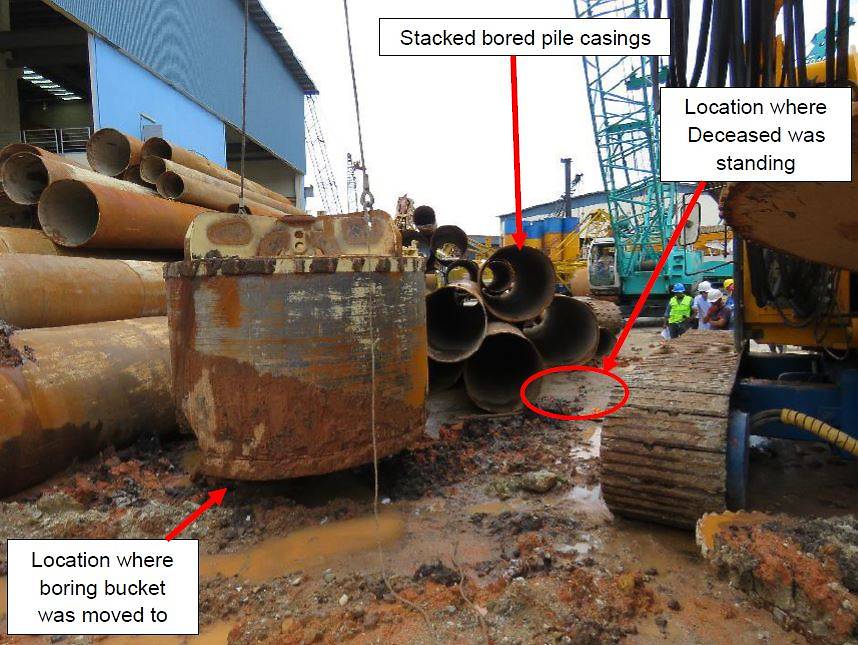
He died after he was pinned against the tracks of a piling machine by piling casings weighing 1.76 tonnes each. The casings had toppled off a stack that was struck by a boring bucket being lifted by a crane.
(Source: Manpower Ministry)
According to MOM, Tay and the company’s plant manager decided to persuade a worker named Mamun to accept the blame for the accident.
Mr Mamun and another worker, Sumon A B M, were called into the store area where Tay coached him to say that the excavator he was in control of had touched the casings, causing the casings to collapse to the ground and hit Arumugam, MOM said.
Mr Mamun refused to take the blame for the accident and covertly recorded the conversation with Tay and the plant manager on his mobile phone, MOM added.
When Mr Mamun was informed that he would be charged for doing a negligent act which endangered the safety of others, he then provided the recording to MOM investigators.
He did not hand over the recording earlier as he was afraid that his recording would be kept and never presented in court. The charge against Mr Mamun was eventually withdrawn.
Providing details of the case in its press release, MOM said: “Tay and the company’s plant manager, knowing that the accident would be investigated by the relevant authorities, intended to obstruct the course of justice by shifting the blame for the accident to Mamun.
“Tay had neither witnessed the accident nor reasonably believed that Mamun was responsible for the accident. By asking Mamun to accept the blame for the accident, Tay had abetted the offence of intentionally obstructing the course of justice. As a result of the company’s plant manager’s instigation, Sumon, who was afraid of losing his job, also made false statements against Mamun.”
(Source: Manpower Ministry)
Mr Sebastian Tan, the ministry’s director of occupational safety and health inspectorate said: “Tay, as the site supervisor, not only failed to ensure a safe working environment for his workers during the lifting operation but took advantage of his supervisory position to attempt to pervert the course of justice.
“MOM takes a very serious view on this and will press for custodial sentences against those who put their workers at risk and attempt to obstruct the course of justice.”
SINGAPORE: There is a “clear oversight mechanism” in place in the Protection from Online Falsehoods and Manipulation Bill to prevent possible abuse of power by the Singapore Government, Law Minister K Shanmugam told CNA in an exclusive interview during which he looked to address concerns over the legislation.
Mr Shanmugam said that checks are in place in the proposed law, as he dealt with arguments that it was too broad and provided for future abuse by future governments. For instance, if there was a declaration that something is false and needed clarification, the courts would have oversight.
In response to questions on whether the legislation provided the Singapore Government with too much power, Mr Shanmugam said that such accusations had also been made on previous pieces of legislation.
“We’ve always said: ‘OK what works for us, we’ve put it in place and we exercise those powers honestly.’ And we allow ourselves to be judged and, periodically, the people judge us at the elections and they look at the results of what we have done. The pluses, minuses, bottomline, how does it work,” the minister said.
“So that’s the way a transparent government has got to work,” he added.
The following is an edited transcript of the interview between Mr Shanmugam and CNA Digital’s chief editor Jaime Ho.
CNA: It’s quite clear that most people understand the need for all governments to address online falsehoods, especially deliberate online falsehoods. The question is obviously how. First off, why have you chosen the ministers to be the first point of decision for various things on what constitutes a falsehood and then deciding on appropriate action?
Minister Shanmugam: When there is a falsehood which affects public interest, it can spread very fast, very quickly.
I can give you actual incidents. In Myanmar, an allegation that two Muslim men raped a Buddhist woman spread within 24 hours. Within that time period, you have people getting killed, lots of rioters on the streets, buildings getting damaged, huge amount of public disorder.
If you turn to the financial markets, an actual example of a falsehood is that the founder of a bitcoin company had died; it’s put out deliberately by somebody, I think, seeking profit. Within a period of four to five hours, billions of dollars were wiped out from the value. Lots of innocent investors lose money.
Likewise in Indonesia, a false allegation that a Chinese woman had criticised and said nasty things about a mosque. Within 24 to 36 hours, buildings were damaged, 12 Buddhist temples were vandalised, lots of public disorder, a real fear for people’s lives. These are real world consequences.
It doesn’t just happen in Asia; Germany too, and in many parts of Europe. Falsehoods spread like wildfire, they spread very quickly. The consequences have to be dealt by governments. So you need to move quickly.
Therefore, ministers are proposed to be given the power. Is it false? And if it’s false, you move in immediately to say: Clarify this. This is not true, it’s false. But we are only talking about facts, not opinion, not satire, not parody, not comments. Direct allegations – did a rape take place? Was this said or was it not said about a mosque by this person. Direct factual allegations which have impact on the public. Ministers call that and you put out a clarification, together with the original article, except that in some cases the original article may have to be taken down.
And if the person who is required to carry a clarification or take-down is not happy, he appeals to court.
CNA: How do you guard against, or at least mitigate, the different ministers having different approaches and thresholds to decide on what needs to be taken action on and, maybe, the different types of action?
Minister: I give you an example from Singapore. I think many people will remember somebody put up a false photo – Punggol HDB roof collapsed.
Do you know how many young families are living there? People will be concerned. (That’s why) SCDF, police and other assets rushed on to the scene. If we have the power to immediately clarify that this is false, and require the person and the (online) platforms to push out a notice to everybody: “Those of you who have read this article, please note that government has clarified that there is no roof collapse.” Would it not be better?
If there is an allegation like: “If you take this vaccine, your child is going to become autistic or is going to get measles”, you’d want the Ministry of Health to be able to put out a clarification and get it carried on the platforms that are carrying the untruth. So that’s what this is about.
The different ministries will have that expertise in different areas, and we’re talking about what facts, clear facts.
That will then have to be put through a Competent Authority which will serve the notification. And we have said quite frequently what will be required, so that tech platforms can carry the clarifications and push it out to the people who have received notice of the (falsehoods).
For most people, there is no impact. They just receive the notifications.
Chief editor for CNA Digital Jaime Ho interviews Minister for Home Affairs and Law K Shanmugam. (Photo: Hanidah Amin)
CNA: You mentioned the Competent Authority. Since you raised the issue of the HDB block (falsehood), is there (an) iterative process between authorities and the minister before a decision is made? It may have to be done fast. It may have to be done quickly, but is there that balance as well that can be found?
Minister: Truth is not malleable – either something is true or it is not true. But the Competent Authority could obviously offer its views to the minister on what needs to be done, follow-up consequences. But the decision, ultimately, will have to be that of the minister’s.
CNA: Another issue that has caught the imagination of the critics is the issue about exemptions. There is a clause in the legislation that says the minister may exempt any person or class of persons from any provision of this Act. Who does the law have in mind here? Obviously when people see exemptions, especially for something as serious as this, they’re saying: “What is going on?”
Minister: It’s because most people, understandably, don’t realise that this is a fairly common provision in many pieces of legislation.
Off-hand, I can tell you, 15, 20 pieces of legislation, there must be more. Let me give you a few examples: Take the Executive Condominium Housing Scheme Act, or the Traditional Chinese Medicine Practitioners Act, Active Mobility Act, Casino Control Act, Telecommunications Act, Postal Services Act, the Remote Gambling Act, Smoking (Prohibition in Certain Places) Act, Dangerous Fireworks Act – a broad variety of legislation has got similar provision.
And the reason is simple. Say there is a request for a tech platform to carry a clarification or push out clarifications and it’s not technically possible to do some part of it. Then the minister will have to consider whether it is true, whether it is not possible. And if so, he could consider giving exemptions. That’s all that this is about.
CNA: The good thing is that you raised those examples used in different legislation as people have come to trust that (the exemption) will not be misused there. The question, then, is there some suspicion it could be misused with this proposed law. If there is some reassurance that it will not be misused, then that’s obviously helpful.
Minister: You know, any government that misuses its powers will face the consequences.
CNA: Another question about this particular portion that deals with the minister’s action is that before someone can appeal, or at least bring his case to the courts, he has to first send it to the minister, and the minister himself has to judge that first appeal to the …
Minister: Yes, that’s again very normal.
CNA: But can you explain that, and is there any rule to mandate at least some degree of speed and efficiency?
Minister: That will be done. It’s just that it’s not normal to set these things out in the primary legislation. I will certainly deal with it during the second reading in Parliament and set it out in subsidiary legislation. The whole approach will be to make it speedy, efficient, quick and as inexpensive as possible.
CNA: During the Select Committee process from last year, there were some who suggested for a separate, independent body, perhaps even accountable to Parliament, to do the fact-checking. Can you explain the thinking behind why this wasn’t taken up in the end?
Minister: We considered it very carefully. A number of reasons as I said earlier.
(One is that) you need to move immediately, sometimes it’s within a matter of minutes, sometimes within a matter of hours. And the people best placed to make those decisions are those who have to deal with the ground situation. That’s usually the government, the executive (branch).
Second, the executive – the ministers, the government – are accountable in Parliament, have to answer questions in Parliament. And also accountable to the courts, where if a person who receives a notice to clarify something, and he is not happy, he doesn’t want to carry the clarification, he may be a great believer in free speech. But he doesn’t want to carry the other side. He can go to court and the courts will then decide whether the minister was right or wrong in saying that something was not true.
We are dealing with a very basic thing: Is something true (or is) something not true. Is the colour of this table white or is it black? It’s factual. We’re not dealing with opinions here. Opinions, people can have. We are dealing with facts.
The third point is, ultimately, the government is accountable to the electorate itself. So it stands or falls by its judgments.
CNA: One of the, I suppose, attractive things about an independent (body), or however independent it can be …
Minister: Who appoints the body.
CNA: It’s one thing to appoint the body. Also, it at least minimises the politicisation of the final decision as well. Frankly speaking, if an appointed minister makes that decision, there’s always some degree of political sensitivity and politicisation of the decision made. The benefit in having the fact-checking body is it will at least be seen as slightly more independent.
Minister: I think the answer lies in coming back to actual concrete examples.
Let’s look at the Punggol example: Roof of a HDB block has collapsed, what is political about it? It’s either the roof has collapsed or it hasn’t collapsed. The Myanmar example: Either the two Muslim men raped a Buddhist woman, or they didn’t. These are facts.
The 2016 hoax photo of the “roof collapse”.
I don’t think we need to go into politicisation. And the consequences will have to be faced by the government acting in the best interest of its people. If there are riots, if there are deep divisions or if there is a serious public inconvenience in that people actually thinking that a fire that has broken out, or their building has collapsed, stuff like that, then it falls on the Government to deal with it.
The Government is best placed. What we are talking about is setting out a clarification, sometimes a take-down. And I don’t see why this needs to be politicised. This is an exercise of Government power, just like the exercise of so many other Government powers. Powers of arrest, powers of detention, powers of investigation, powers to run the economy, spend billions of dollars … (and) put out the truth.
CNA: Since you raised the example of the Punggol incident, honestly, we the media will also feel that that is our role as well. That’s precisely something which the media could have, and some of us probably did, go out to verify that …
Minister: So there is nothing wrong. But is there anything wrong with the Government coming in with a further clarification? It helps. There is no reason why that should …
CNA: We did seek that clarification, and the question then is whether or not in certain cases, we may not need the legislative (tools) …
Minister: I have asked in every session that I attended, including with journalists and others, and there are people who do these things day to day, some day to day for a living. (I asked them) to give me one example of a fact versus falsehood that they think doesn’t need to be corrected in this context, and I said I will amend the legislation.
Not one person has pointed out. Each of the examples I give from around the world and in Singapore, they say: “Oh but that… We agree that power needs to be exercised.”
That is the point, the power needs to be exercised.
CNA: Another issue which I think needs some addressing is the role of the courts. We sort of touched upon that earlier. As you’ve said since Apr 1, the court will be the final arbiter …
Minister: That’s what the Bill provides.
CNA: … and you’ve also said in recent days that you must and will prescribe timelines and even costs to keep the process as efficient as possible. Would you, therefore, admit that there was some understandable concerns from people when they saw that the appeals process to go to the courts will be expensive, will take a long time?
Minister: I can understand people’s concern. But in terms of our thinking, that has always been our thinking.
A lot of people don’t realise, but in addition to this Bill, there is another Bill to amend the Protection from Harassment Act (POHA). That gives individuals broadly similar powers. A lot of people don’t realise (but) people get harassed, people get lies said about them. And they are given powers now to go to court, get an application, get the falsehoods taken down or corrected.
Because why should their individual reputation be tarnished? So individuals are now going to be empowered under the Protection from Harassment Act. And I said some months ago, that it is my intention to make it as inexpensive as possible, streamline the process, make it efficient, make it fast, make it speedy. In fact, set up specialised courts that will deal with it.
CNA: The second reading (of the Bill) will clarify this?
Minister: Wait, so I had said that about POHA. And you don’t set those things out in the legislation. It was precisely my intention, whatever I said a few months ago, for POHA – and POHA and POFMA are being put in (for deliberation) at the same time – that similar sort of process and prescription will be put in place for the Protection from Online Falsehoods and Manipulation Act.
So it’s not something that we haven’t thought about. I can understand people being concerned, but we have already taken care of that in terms of our thinking. And I’ll make it clear during the second reading.
CNA: Another issue that I think needs to be clarified is that within the legislation that you’ve put on the table, the judges’ ability to act on the grounds of which they can decide, can be circumscribed into two areas. One is to decide whether it is true or if it is false, and also whether or not it’s technically feasible. Some have said why shouldn’t the judges be in a position to also decide whether a take-down is disproportionate or maybe a correction is needed …
Minister: They can decide, it follows established law. Whether it’s a true or false, it’s a straightforward question and the judges decide that. Technical feasibility is also a question that they decide.
When it comes to what’s in public interest and what is the right remedy, those are – based on previous case law, based on established precedent – matters for the executive. The courts intervene in certain circumstances and they will set out in law how they will intervene, in what circumstances they will intervene; that’s not being disturbed by this legislation.
There may be different standards in the way of how they will intervene, or the standards that they apply to intervene. As I have said, that’s set out in law. This legislation doesn’t change the law.
CNA: If we can now take a step back and look at it from a big picture perspective. For the ordinary citizen who looks at this legislation, some may understand it more, some may understand it less, and then they will hear international criticisms, they will see criticisms from other people. Obviously the main concern they will have is free speech – how does it affect their own ability to speak, to criticise, to critique, to comment. That’s one.
The second point is then, how does it affect their access to what they see as free speech. Will it constrain their access to contrarian views, different views? There is some groundswell of concern there. Is that something that you can respond to?
Minister: First thing, in all the different meetings that I, my colleagues, my officials have had and in the various soundings that we have taken, reaching out to lots of people, I think, by and large, people understand.
I would say that there are concerns but that’s restricted to a smaller group. But that’s not to minimise their concerns but we get the sense of what people are concerned about. So for the people who are engaging us, those who have concerns, my message has been very simple and I’ve said it publicly: “Ninety-nine per cent of the people don’t have to worry about what they do 99 per cent of the time.”
What do I mean? Most of us receive messages, we share them, we forward them, people like them, none of that is an issue. And if it turns out to be false, the primary approach is to ask the tech platforms to put up a clarification that’s pushed to everyone.
So for most of us, the day after this Bill becomes law, assuming Parliament passes it, life carries on as per normal.
The people who need to be concerned are the people who profit from and peddle in falsehoods. They put out (information) knowing that it’s false and they know that they are going to profit from it. They are doing it deliberately, they are setting it out, there is some element of malice. They need to worry.
But as I said, most people don’t fall into that category. They may be passing on falsehoods, but they are not the creators of it; they don’t know that it is false, they are just passing it on. Nothing changes for them. They will receive, and I’m sure many of them will be happy to receive, a notice saying that actually if you want to know the truth, you can go to such a place.
CNA: If I may close off with another even bigger picture and longer-term question: The way that you set out the legislation, obviously some people criticise it for being way too broad and for providing the Government with too much power.
And some may argue that, while the current government has explained the implementation of the law, there is nothing to prevent a future government from abusing the provisions within the legislation. We’ve seen examples of this everywhere; it’s not just individuals who proffer falsehoods. Certain governments, if I may say so, also quite liberally use falsehoods …
Minister: And those governments will face the consequences at the elections.
CNA: Is that something that you think can be looked at within the legislation? That there are in-built checks to preclude such abuses?
Minister: First of all, there are checks. If there is a declaration that something is false and asking for clarification, the courts have oversight of it. So there is a clear oversight mechanism (and) checks.
Second, you are talking about future governments, whether they will abuse. The Singapore Government, in terms of other legislation, has also been accused of having too much power. We’ve always said: “OK what works for us, we’ve put it in place and we exercise those powers honestly.” And we allow ourselves to be judged and, periodically, the people judge us at the elections and they look at the results of what we have done. The pluses, minuses, bottom line, how does it work. So that’s the way a transparent government has got to work. I cannot vouch for how a future government will act.
But there is a serious problem – falsehoods are the new currency that a lot of people trade in. It has got serious consequences for people, in terms of blood, in terms of money, in terms of lives, and it is wrong for the Singapore Government to keep quiet.
You see legislation in Germany; you see Australia pass its legislation in two days; Britain has proposed very sweeping changes, not yet into legislation. And we had extensive hearings last year, when we heard a lot of evidence. It’s a serious problem, everyone accepts that it’s a problem and we’ve got to do something about it.
CNA: We certainly hope to hear a little bit more about it when the Bill comes for a second reading in Parliament. Thank you so much for giving us your time.
A special telecast of the interview with Minister K Shanmugam will be aired on CNA on Sunday, Apr 14, at 10.30pm.