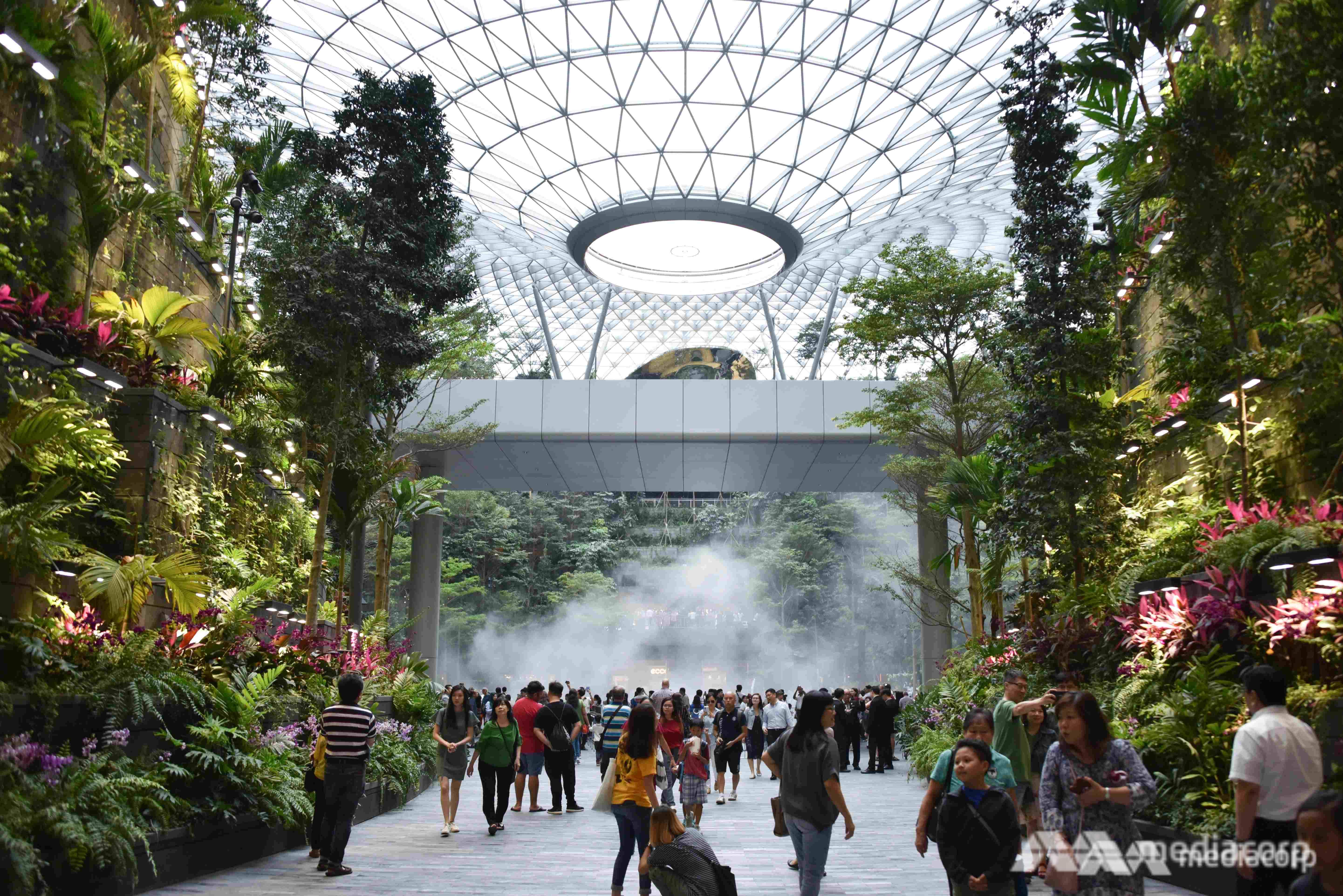
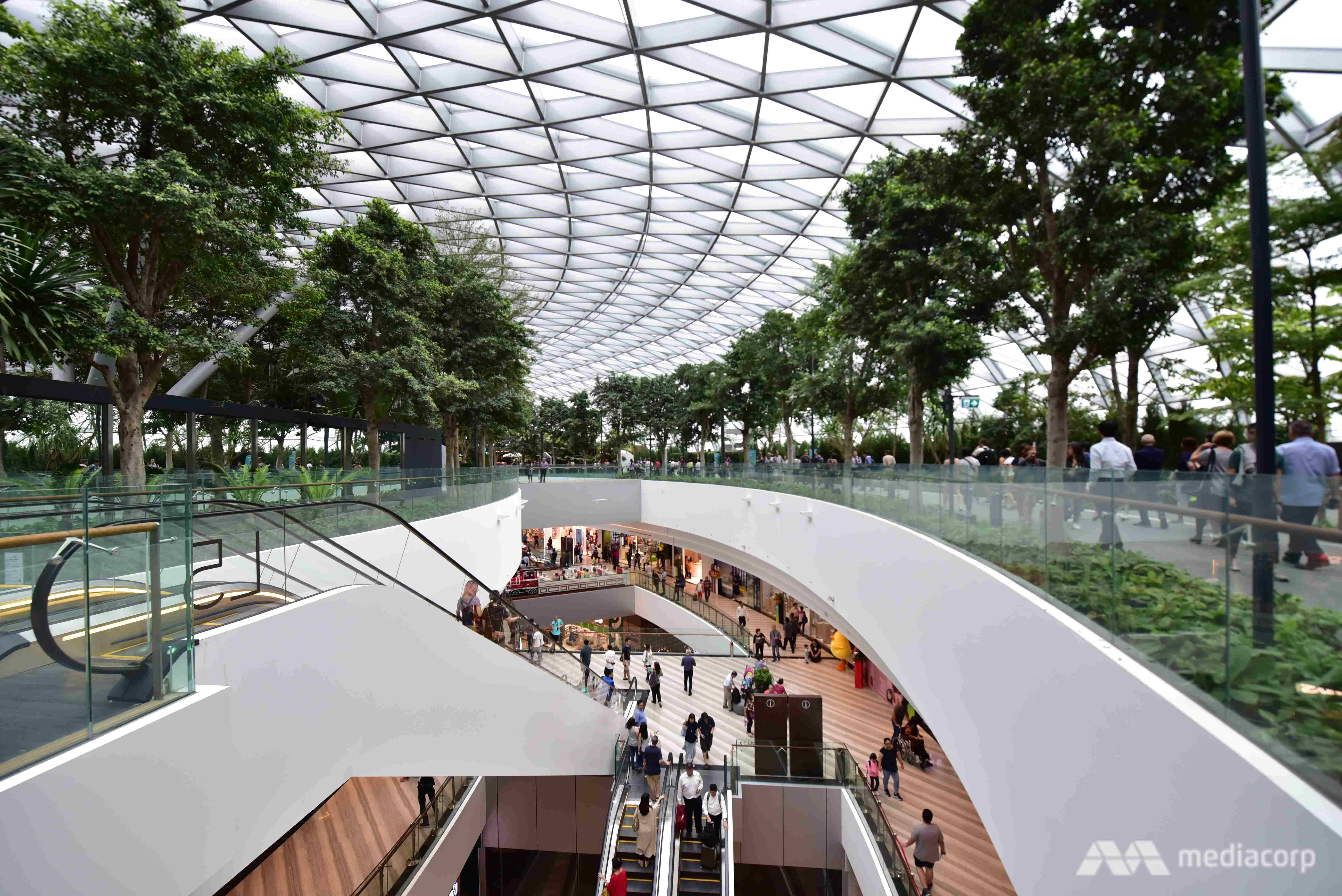
SINGAPORE: Five years in the making, Changi Airport’s latest extension is touted to be the Jewel in its crown – featuring a lush rainforest, 280 shops and a huge internal waterfall, all encased within a glistening glass dome.
Singapore’s airport has always been known as more than just a place to catch a flight, and visitors will be able to catch a movie in an 11-screen cineplex, buy Pokemon merchandise at the brand’s first official store outside of Japan and gawk at an indoor waterfall when Jewel opens its doors on Wednesday (Apr 17).
With its unique dome-shaped facade of glass and steel, the 10-storey complex will house more than 280 shops and eateries.
The S$1.7 billion complex situated on the former open-air carpark in front of Terminal 1 will also connect the airport’s Terminals 1, 2 and 3 on the landside for the first time.
Changi Airport Group (CAG) managing director for airport operations management, Mr Jayson Goh, told CNA last Thursday that Changi is positioning to be “a lifestyle destination in itself”.
“For locals who already visit Changi Airport regularly on the weekends, we hope that Jewel will have more to offer and give them more reason to visit the airport and spend time with their family and friends here,” Mr Goh said.
PIÉCE DE RESISTANCE
It is all part of CAG’s strategy for travellers to spend more time there, and to woo more local footfall – but will it work? Industry experts CNA spoke with had different views on the benefits that Jewel will bring.
Mr Shukor Yusof, the founder of aviation consultancy Endau Analytics, said that the launch of Jewel helps to firm Changi’s grip on the title of “best airport in the world”.
“Jewel is an extension of Changi Airport’s continuous efforts in ensuring the airport not only stays at the top of the global rankings but importantly, attracts more tourists, visitors to Singapore. It marks a new phase for Changi Airport, the piéce de resistance to the world’s best airport,” added Mr Yusof.
“Jewel is pretty much like what the pyramid at the Louvre in Paris stands for – a symbol not only of the success Changi Airport has achieved, but also showcasing the sexiness of Singapore.”
His comments came as Changi Airport was ranked best airport in the world for the seventh year running, and was also named best in the world for its leisure amenities in a global survey by London-based research firm Skytrax.
However, Mr Brendan Sobie, chief analyst at CAPA Centre for Aviation felt that Jewel is not “part of (the) equation” for Changi in its ratings, but acknowledged that it will bring financial benefits to CAG.
“You have to take a local perspective when looking at Jewel. It’s a landside shopping mall, and not catered so much for transit passengers. CAG will eventually have more landside revenue, but we won’t know exactly how much because while they are corporatised, they are not publically traded,” said Mr Sobie.
He added that when it comes to airport ratings, “it’s the airside experience and transit experience that counts”.
“Airport ratings compare the transit experience, the arrival and departure, such as check-ins and baggage claims. Hub airports (such as Changi Airport) essentially compete for transit passengers, from passengers coming up from Australia to Europe, or from India to the USA,” said Mr Sobie.
Mr Yusof, added that while Jewel adds to its status as a premiere airport, the addition of Jewel is about “keeping up with the times”. He believes that the development enhances Changi’s iconic silhouette, which used to be just the standalone control tower behind T1.
MORE INFRASTUCTURE ON THE HORIZON
A view of the site where Changi Airport Terminal 5 will be built.
CAG had started expanding T1 in 2015, in conjunction with the development of Jewel and the expansion works are expected to be completed by mid-2019, said the airport operator.
Travellers can expect new check-in counters, a new automated check-in zone and upgrades to the departure and arrival halls, along with the baggage handling system. The expansion will bump up handling capacity by three million passengers per annum (mppa) to 24 mppa, added CAG.
With the launch of Changi Airport’s Runway 3 and T5 on the horizon, Mr Yusof said that the continuation of infrastructure building is the airport operator’s strategy for growth.
“(CAG) continues to be exacting in delivering a seamless travel experience for travellers and over 100 airlines that fly into the airport. The plan, from the look of it, is to solidify Changi’s (and Singapore’s) position as the preferred place to do business in Southeast Asia, if not Asia-Pacific.”
Jewel Changi Airport boasts a world-class tenant mix with more than 280 shops and food and beverage (F&B) outlets. (Photo: Gaya Chandramohan)
CAG told CNA that T2 will start upgrading works in the fourth quarter of 2019. The project will take up to five years to complete and will increase the terminal’s passenger handling capacity by up to five million to 28 million. As with T1, T2’s upgrades will include new self-service check-in counters and an improved baggage handling system.
Opened in 1990, T2 had its most recent upgrade in 2006.
T5 is expected to be operational around 2030, with a capacity to handle up to 50 mppa in its initial phase. This would bring Changi Airport’s total passenger handling capacity to around 140 mppa.
For 2018, Changi Airport handled 65.6 million passengers, up from 62.2 million the year before, CAG said.
NEED FOR RUNWAY CAPACITY
Both Mr Yusof and Mr Sobie said that there are no fears of overcapacity, with the latter stating that CAG’s “more immediate concern is for runway capacity”.
Changi Airport’s three-runway system is expected to come online in the early 2020s when Runway 3 is opened. CAG had previously said that they will thereafter temporarily close one of the existing runways for maintenance and enhancements.
“There will be short-term concerns for the airlines in (the build up to) Changi’s three-runway system. Airlines have been wanting to add more flights (to Singapore), but they have had difficulty in getting good slots in the last couple of years. Some (slots) have undesirable timings, while others are commercially unviable,” he added.
Mr Sobie elaborated that airlines may have to rely more on apron parking due to a potential lack of gate parking.
The Rain Vortex, a 40m-tall indoor waterfall featuring a light and sound show. (Photo: Gaya Chandramohan)
This means that passengers may have to either transfer to a bus or take a short walk to the terminal building.
“By the time Changi transitions to a three-runway system, the slot constraints will be quite severe,” he said.
Both analysts are however confident that CAG will eventually be able to resolve its operational constraints in the long-term, with Mr Yusof saying that Changi Airport is primed to remain a key player in the aviation sector.
“Changi and Singapore sit in a sweet spot in Asia’s booming travel market,” added Mr Yusof.
A group, including SFA personnel, seen within the premise of Viknesh Dairy Farm. (Photo: Matthew Mohan)
SFA also said that they had asked the management and workers of farms in the area to make a report if they spotted the escaped animal, but that “so far, none of the farms have reported sightings of the bull”.
“SFA and NParks have stopped the search for the bull. Nonetheless, Viknesh Dairy Farm is required to continue with the search,” the agency said.
Members of the public are warned to stay away from the bull and to report sightings to the Animal Response Centre at 1800-476-1600.
On Wednesday, the owner of Viknesh Dairy Farm, who only gave his name as Mr Manikandan, told CNA the two-year-old calf Ganesha was still inside the farm.
The seven-acre farm currently has 36 cows.
“The cow did not escape; escape means go outside (onto the) road, go Jalan Besar, go to other places,” said Mr Manikandan. “It did not go outside, it’s inside our farm.”
SINGAPORE: Taking a leaf out of ancient scriptures and literature, world-renowned architect Moshe Safdie said on Friday (Apr 12) that Changi Airport’s new lifestyle destination, Jewel, was modeled after a “mythical garden”.
“The idea of a garden, well, Singapore has all kinds of gardens (like) Gardens by the Bay (and) Botanical Gardens. How do we do something unique and special? And I was thinking of (the) gardens of ancient scriptures, literature. Every culture has its own gardens of paradise. More recently, the landscape in the Avatar film, in the sense that this was a place we (have) never seen before,” he told CNA.
Mr Safdie, who also designed Marina Bay Sands, said that he had the idea of creating “a great place of nature” in the heart of an airport, with a marketplace that is “intense and busy” on one side, and a nature reserve just adjacent.
The design brains behind Jewel Changi Airport, Moshe Safdie, in front of the Rain Vortex. (Photo: Gaya Chandramohan)
“We recognised from the outset that the bazaar, marketplace, and the garden need to cohabit, but be separate. Each is in its own environment and in its own right,” he added.
He shared that he had the task of designing a facility that unified Changi Airport’s Terminals 1, 2 and 3, and to serve the passengers and the city. This, Mr Safdie added, would mean shopping and airport facilities, as well as an attraction.
“So naturally, everybody thought, ‘Wow (an) attraction! Let’s have dinosaurs, let’s have mummies, some kind of a thematic thing’. And we, as the architects in the room, resisted this notion of an attraction, which would not have brought traffic, (and) which (would) appeal to one age group and not another,” he said.
“I’ve always been fascinated with the capacity of a building to collect rain and bring it into the building and use that water. Here was a great opportunity – a vast dome that covers the entire side, which if we turn it in on itself rather than a conventional dome, it would bring all the water right into the centre,” said Mr Safdie.
“But then we thought, what if we hang it out there instead of supporting it with a column, it would be an amazing waterfall.”
That waterfall forms the centrepiece in Jewel. The 40m HSBC Rain Vortex is also the world’s tallest indoor waterfall, with water falling through the roof at a velocity of 10,000 gallons per minute. During the light and sound shows in the evening, this is reduced to 1,500 to 2,000 gallons per minute.
That water is then circulated through pipes concealed within the building. A water tank with a 500,000L capacity and the control room is stored at basement 3 of Jewel.
The Rain Vortex in Jewel Changi. (Photo: Gaya Chandramohan)
SINGAPORE CLOSE TO MY HEART: SAFDIE
Mr Safdie said that designing Jewel ranked a nine out of 10 in terms of the difficulty of technical issues, but he was not fazed by the challenges and is glad to have completed this job.
“Eight, nine, doesn’t really matter. It’s complex, very complex,” said the 80-year-old Israeli-Canadian architect. “My team must feel terrific.”
Mr Safdie said he has been working on projects in Singapore as far back as 40 years ago, and said some of his “most significant” work is found here.
His other work includes the Sky Habitat condominium in Bishan.
“It’s certainly been a place where there’s been receptivity to my architectural ambitions and interests. I also find that the process of building here, the approval process, the review process, is very rationale and very professional,” said Mr Safdie.
Moshe Safdie, the architect behind Jewel Changi Airport, leading journalists on a tour of the attraction. (Photo: Gaya Chandramohan)
CHALLENGES OF DESIGNING JEWEL
While he had the scope to exercise his creativity, Mr Safdie said there were some challenges he had to contend with when designing Jewel. One of those challenges was the height restrictions of the development.
This was due to the constraints of constructing a building next to iconic control tower. Jewel stands at 37.08m tall from the ground up.
“There is a very specific line of the radar (that) we could not exceed,” he said. “Otherwise, we would have gone taller because of the curvature of the dome.”
Other considerations included the flow of people from the existing terminals, as well as the Skytrain tracks that were already built. The latter resulted in Jewel being built around the tracks, which he said caused “a dilemma” on whether to enclose the train tracks or to leave them out in the open.
Visitors were captivated by the lush greenery and serenity of the cascading waterfall. (Photo: Gaya Chandramohan)
“It took us a year to work out the scheme, (in) which we would get the trains to run in the open by having to devise a method of locks (on each end of the track) that keep the air inside the building and don’t let us lose energy. (Because) this building has to meet the highest environmental standards,” he added.
His biggest challenge was to create a space that was “good for the trees and good for people, where the climate needs to do both”.
“This balancing act, making the plants thrive, making them feel happy, have enough moisture … that took a big team, (an) international team of experts in many fields and this was like orchestrating an opera with a lot, a lot of players,” he explained.
Mr Jeremy Yeo, head of user experience for Jewel Changi Airport Development, previously told CNA that there are 120 species of plants in the Shiseido Forest Valley, five per cent of which are local. They include ferns and orchids.
He highlighted that the temperature in the Forest Valley is a constant 23 degrees Celsius, and that specially curated plants include two olive trees from Spain that are more than 100 years old.
Jewel offers a multi-faceted experience of integrated nature, shopping and dining concepts. (Photo: Gaya Chandramohan)
When asked if there were some concerns that Jewel was another airport mall, Mr Safdie said that his team “did everything (they) could to resist making an airport mall”.
“It is an airport mall, but (we are) juxtaposing it next to the garden (Forest Valley), bringing in a lot of daylight everywhere, from above. When you are walking in the shopping arcades, you are conscious of the trees above,” he said. “We really tried to make this more like a shopping street in a city, than a mall.”
SINGAPORE: The 24-hour PSI levels in Singapore remained in the low-moderate range, the National Environment Agency (NEA) said, after an explosion at the Petronas oil and gas facility in Johor on Friday (Apr 12) left two injured.
The blast at the Pengerang Integrated Complex happened around 1.25am, Petronas confirmed in a statement on Twitter.
It added on Friday afternoon that the fire had occurred at the facility’s Atmospheric Residue Desulphurisation (ARDS) unit, which was currently under the commissioning stage.
“Teams have been set up and are currently working closely with the relevant authorities to investigate the cause of the incident,” Petronas said in their statement.
“We wish to assure members of the public that the situation is under control and there is no health-related risk to this incident.”
The explosion left two Malaysian security guards with minor injuries, emergency services said on Friday morning.
Footage circulating on social media showed a giant ball of fire at the facility, with thick plumes of smoke rising. (Photo: Bernama)
Footage circulating on social media showed a giant ball of fire at the facility, with thick plumes of smoke rising from the blaze.
In response to the incident, NEA said that it was “closely monitoring the situation as well as the air quality in Singapore”.
“The ambient levels of volatile organic compounds (VOCs) along Singapore’s coast remain within safe levels,” it said.
It added that the 24-hour PSI levels in Singapore since 1am on Friday have been in the low-moderate range, while the the 1-hour PM2.5 readings was in the Normal band.
“As of 12pm today, NEA has not received any related local feedback that could be traced to the reported explosion,” the agency said.
“We are in contact with the Department of Environment (Johor) and we will provide updates if there are changes to the situation.”
An ex-staff of mine sent me this video.
I was told that it’s at the Pengerang Integrated Complex PIC) where the PETRONAS Refinery and Petrochemical Integrated Development (RAPID) is.
The explosion resulted in strong blast vibrations in the surrounding areas, witnesses said.
Mohd Azizi Mahmun, 24, who lives near the scene, said he felt as though there was a strong “kick” on the door of his house when the incident occurred.
“I was asleep during the incident, and woke up due to the strong vibration,” he said.
“It also set off the alarms (in) the cars in the area. My neighbours and I then came out (of our houses) and saw smoke and fire in the area. People could see the incident as it (the structure which exploded) was near the road.
“But now I think the situation is under control because there have been no instructions for us (residents) to relocate.”
Another witness, Muslim Mustafa, 30, said he also felt strong vibrations after the explosion.
“I was asleep when I heard a loud explosion. The noise caused my door to shake and all the neighbours came out to see what had happened,” said Muslim, who works as a material controller at the project site.
Corporate communications executive Calvin Fong, who lives in Simei, told CNA that he was jolted awake by the noise from the blast.
“I was half asleep when I jolted up due to a loud boom sound. My windows shook as well,” said the 33-year-old.
“My first thought was that it could be really loud thunder. As I couldn’t go back to sleep, I checked the news outlets on my Facebook to see if there were any reports, but there were none.
“However, a friend living in Pasir Ris posted to ask if anyone else heard a loud sound with a shockwave that shook his windows.”
A preliminary report on the incident was expected from Malaysia’s Department of Occupational Safety and Health (DOSH) on Friday afternoon.
The Johor DOSH had already instructed its team to initiate investigations, Deputy Minister Mahfuz Omar said.
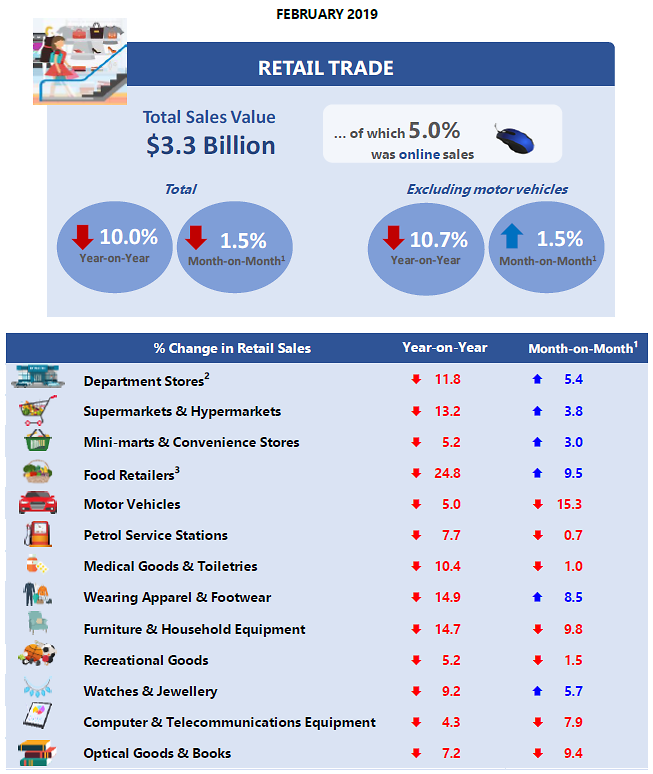
SINGAPORE: Retail sales in Singapore fell 10 per cent in February 2019, compared to the same month in 2018, according to a release from the Department of Statistics (Singstat) on Friday (Apr 12).
On a month-on-month basis, retail sales fell 1.5 per cent. Excluding motor vehicles, retail sales decreased 10.7 per cent year-on-year, and increased 1.5 per cent month-on-month.
Year-on-year sales dropped for all retail sectors, with food retailers seeing the biggest decline, at 24.8 per cent, followed by wearing apparel and footwear at 14.9 per cent.
Sales of department stores, supermarkets, mini-marts and convenience stores, motor vehicles, petrol service stations, medical goods and toiletries, furniture and household equipment, recreational goods, watches and jewellery, computer and telecommunications equipment and optical goods and books all went down between 4.3 and 14.7 per cent year-on-year.
Month-on-month, sales of mini-marts and convenient stores, supermarkets and hypermarkets, department stores, watches and jewellery, wearing apparel and footwear, and food retailers experiences an uptick, with increases of 3.0, 3.8, 5.4, 5.7, 8.5 and 9.5 per cent respectively.
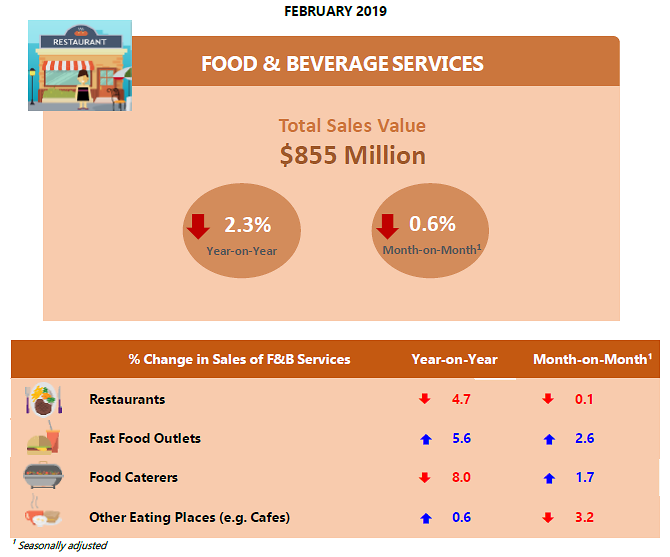
The food and beverage (F&B) services sector reported a drop of 2.3 per cent year-on-year and 0.6 per cent month-on-month for February.
F&B sectors varied in their growth year-on-year, with fast food outlets and other eating places growing 5.6 per cent and 0.6 per cent respectively, and food caterers and restaurants dropping 8 per cent and 4.7 per cent respectively.
On a monthly basis, fast food outlets and food caterers grew 2.6 per cent and 1.7 respectively, with restaurants and other eating page shrinking by 0.1 per cent and 3.2 per cent respectively.
Total retail sales value in February 2019 was about S$3.3 billion. Online sales made up an estimated 5 per cent of this figure.
Meanwhile, food and beverage services took in an estimated S$855 million, an increase from the S$875 million in February 2018.
The Retail Sales Index and the Food and Beverage Services Index measure the short-term performance of retail and F&B service industries based on their sales records. The sales figures exclude taxes such as GST and COE.
SINGAPORE: Jubi Lee, the 10.6m female sperm whale that was found off the coast of Jurong Island in 2015, lived on a diet of squid, a study has shown.
Researchers from the Lee Kong Chian Natural History Museum found more than 1,800 beaks from at least 25 cephalopod species, mainly squids, in the whale’s belly.
Jubi Lee’s belly also contained plastic drinking cups, food wrappers and a plastic bag, the study led by museum researcher Marcus Chua concluded.
Even though the plastic found in its stomach was not “large or copious enough to have resulted in death”, the discovery adds another account of plastic debris found in whales across oceans since the 1970s, the study said.
The drinking cup and food wrapper that were found appeared to be from Indonesia.
“With the amount of marine litter (including plastic debris) generated by Southeast Asian nations equalling or exceeding global averages, this may be of conservation concern to threatened marine species, such as the sperm whale, in the region,” the paper said.
“The ingestion of plastic debris has been known to result in the death of sperm whales due to gastric blockage or rupture,” it added.
Mr Chua told CNA: “This certainly confirms what we have been hearing about in reports that the oceans are polluted with plastic and it is affecting wildlife.
“It is also a sober reminder that we have to manage our use and disposal of plastic.”
The plastic debris found in Jubi Lee’s belly. (Photo: Marcus Chua)
THE WHALE’S ORIGINS
An analysis of its diet, genetics and regional water conditions told the researchers that the sperm whale probably originated from a pod in the Southern Indian Ocean, close to the Cocos (Keeling) Islands or Indonesia.
Using a modelling technique, Mr Chua’s team was also able to approximate that the whale died to the west of Malaysia and free-floated to the southwestern coast of Singapore.
The team also observed that that the whale had spinal injuries and a large gash on its back, suggesting that it was struck by a ship.
This study was born out of a salvage operation that I have so many people to thank for.
Today, the sperm whale is at @LKCNHM and part of the museum’s education programme, inspiring visitors about wildlife, and an ambassador for marine conservation. Have a great afterlife, whale! pic.twitter.com/PM4IKd3h1C
When it was found, researchers immediately went to work salvaging the carcass for further examination by collecting DNA samples and its gut contents.
“For areas outside our expertise, we collaborated with scientists in the National University of Singapore – Dr Ooi and Dr Tay for the coastal modelling to determine how her carcass drifted – and overseas experts like Dr Kubodera, who is a squid researcher from Japan,” said Mr Chua, who described the research process as “humbling and daunting”.
The skeleton of the whale was preserved and is now exhibited at the Lee Kong Chian Natural History Museum.
The animal is the first sperm whale found in Singapore waters. Sperm whales are classified as a vulnerable species by the International Union for Conservation of Nature.
SINGAPORE: Love Pokemon and gotta catch ‘em all? There is now an easy way to, with the opening of the Pokemon Center Singapore at Jewel Changi Airport. The outlet – the first official merchandise store outside of Japan, opened on Thursday (Apr 11) as Jewel flung open its doors to first visitors for a ticketed preview of the new attraction.
Despite snaking queues, hundreds waited in line, eager to have a first look at the store ahead of its Apr 17 official opening.
A long line of people for the Pokemon Centre Singapore at #04-201/201. The store is open from 10am to 10pm, daily. (Photo: Alif Amsyar)
Once they make it in, a huge statue of Pokemon Lapras and Pikachu welcome visitors at the entrance. Many were seen whipping out mobile phones for a snap; some even snuck in a quick hug of the Lapras’ long neck.
In the background, friendly staff at the store chimed in unison: “Welcome to Pokemon Center Singapore!”
Statue of a Pikachu sitting on a Lapras welcomes visitors into the store. (Photo: Alif Amsyar)
“Singapore as you know is surrounded by water. We chose Lapras since it is a water-type Pokemon and by having it here, we wanted people to see and get a feel of what it’s like,” said chief business officer of The Pokemon Company Ito Kenjiro.
“Safe to say that Pikachu and Lapras are extremely popular Pokemon, that’s why we thought it would be a fitting image for Singapore,” Mr Kenjiro added.
Ms Serene Chua, 46, and her son Keith, who have visited the flagship store in Japan, said the Singapore store was worth the wait.
“Previously we had to go to Japan and visited a store in Osaka. Now, we don’t have to since it’s really at our doorstep. We’re here for the experience and we wouldn’t want to miss the chance of coming for the experience since he is such a fan,” Ms Chua said.
She added: “We are even more excited to know that there are items exclusive to Singapore, like the Pikachu plush toys.”
Singapore-exclusive Pikachu plushies clad in a pilot’s uniform. (Photo: Alif Amsyar)
The Pikachu plushies clad in pilot and cabin crew uniforms were a hit among visitor, but each customer can only buy up to five of these limited edition items.
“It’s a unique experience at Jewel since this is the first store outside of Japan, so the novelty is there. It’s good to have the Singapore-exclusive merchandise. Hopefully there will be more of such items in the future,” said civil servant Kenneth Lim.
An array of Pokemon plush toys available at the merchandise store. (Photo: Alif Amsyar)
“There’s a Pokemon store in Tokyo, and we plan to visit that when we go for our holiday in December. I later found out that one was opening in Jewel and I wanted to check it out so we can have a sense of comparison when we go for our trip,” said homemaker Jane Chia, who was seen checking out the various toys.
The visit was a sweet surprise for her son, 8-year-old Kian, who chanced upon the store during their Jewel tour. His mother chose not to tell him about the store beforehand, afraid of creating disappointment should the waiting time have taken too long.
Kian exclaimed: “Actually, I didn’t know there was this shop until I went to the Rain Vortex and received a map of Jewel, flipped through it and saw the word ‘Pokemon’ on it. I was then so eager to come here and it’s my dream come true, because I love Pokemon!”
Every Pokemon from the first generation of the Pokemon franchise is displayed for on these shelves. (Photo: Alif Amsyar)
In total, 143 of the 151 Pokemon mini plush toys are on display for purchase. The other eight are exclusive to stores in Japan.
“I think I have around 50 Pokemon plushies in my collection. I’m just grateful that they came to Singapore so we don’t have to travel far anymore,” said 12-year-old Nathaniel Foo, who has a shelf in his room proudly displaying his collections. Some of these are from stores in Osaka and Tokyo.
Lines of people waiting outside the Pokemon store persisted throughout the day. (Photo: Alif Amsyar)
As for why Singapore was chosen as a major merchandise Pokestop, chief business officer, Mr Kenjiro explained: “When Pokemon GO was initially launched, it gained so much popularity and during that time, we had an event at Changi Airport. It was a huge, huge success and we saw how popular Pokemon became across the region.
“Opening our first store outside of Japan in a place like Jewel, which is really one of the most beautiful malls in the world, we’re extremely happy and excited and grateful for such an opportunity.”
“Before visitors come through our stores, they’ve only really experienced Pokemon through the digital world, but by coming here and actually touching and seeing the characters, we hope they experience this dreamlike environment and keep it as a precious memory,” he added.
SINGAPORE: Travellers using the Woodlands and Tuas Checkpoints during the Good Friday weekend can expect delays and heavy traffic, the Immigration & Checkpoints Authority (ICA) said on Friday (Apr 12).
Traffic flow through both land checkpoints is expected to be particularly heavy between Apr 18 and Apr 19.
“Travellers using the land checkpoints during these periods can expect delays and are advised to adjust their travel plans where necessary,” ICA said.
“Security at our checkpoints remains the ICA’s top priority against any potential threats to Singapore,” it said. “With security checks, traffic build-up is inevitable, especially when large numbers of travellers use the checkpoints at the same time.”
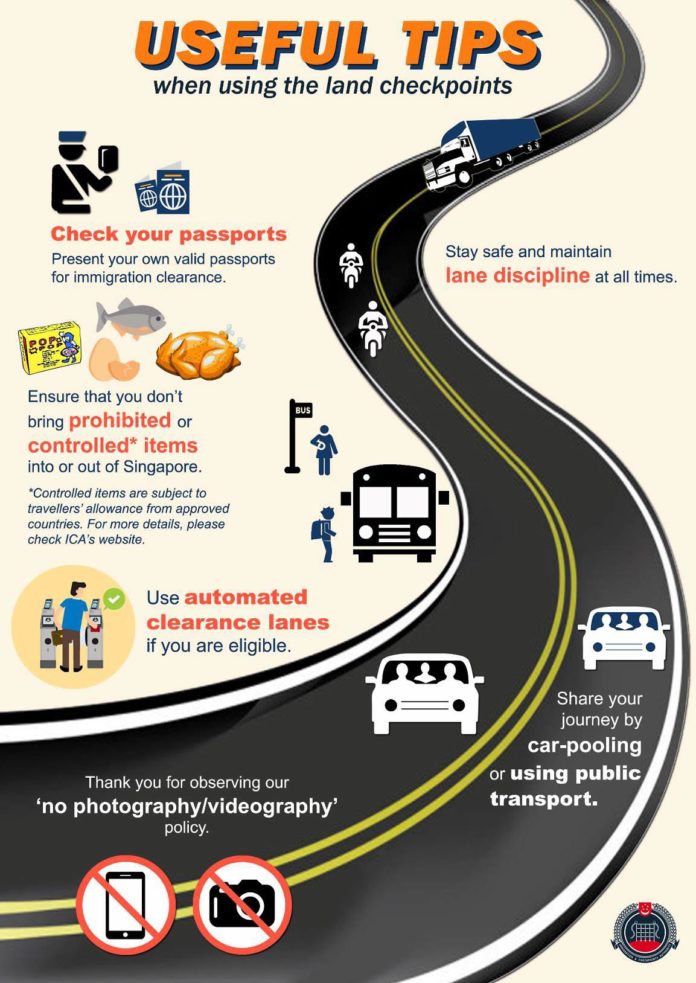
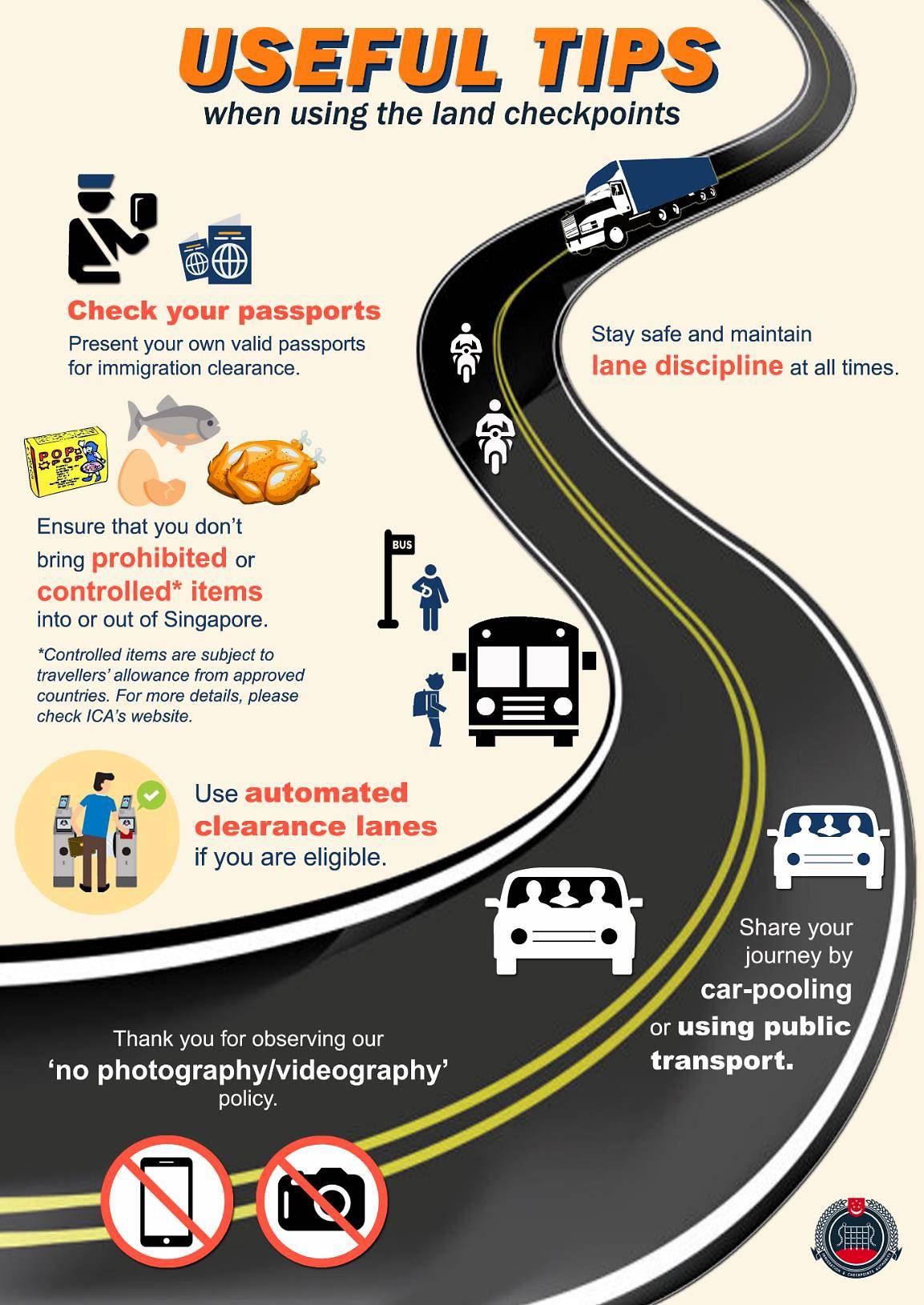
Travellers were also reminded not to carry prohibited items such as firecrackers, pop pops and chewing gum.
Travellers who carry dutiable or controlled items such as eggs, meat products and potted plants should also declare these to ICA officers prior to checks.
ICA also said there have been “many instances of queue-cutting” at both checkpoints during peak periods, which can cause congestion and compromise safety.
It also reminded motorists to observe traffic rules, maintain land discipline and cooperate with checkpoint officers.
Before embarking on their journeys, motorists are advised to check the traffic situation at the Woodlands and Tuas Checkpoints through the One Motoring website or via the Expressway Monitoring & Advisory System installed along the BKE and AYE respectively.
Motorists can also check ICA’s Facebook page for updates on the traffic situation at both checkpoints.
THE thinking of Singapore’s late founding prime minister Lee Kuan Yew has shaped the country’s foreign policy since its independence in 1965.But the world is changing with the shifting geopolitical balance of power, disruptions caused by digital technology, the rise of populism and the backlash against globalisation.
Is Lee’s thinking and strategic vision still applicable in this new world?
On the fourth anniversary of his passing, the question looms large for Singapore. As a small state dependent on the outside world for economic growth, and on larger powers to keep the regional peace, it is particularly vulnerable to how the international order is changing.
There are four elements of his approach to foreign policy that continue to be relevant but will also come under great pressure in the years to come.
First is the idea that a small state like Singapore needs a credible armed forces to deter would-be aggressors. It was a priority when the country suddenly became independent in 1965 and found itself having to build an army from scratch.
Lee’s firsthand experience of Japanese occupation in 1941 as well as the 1965 forced separation from Malaysia had a profound impact on his thinking about security. Singapore has since been unrelenting in building up its armed forces, allocating 30 per cent of government expenditure this year on defence, security and diplomacy.
Developing this military capability has also meant closer ties with the United States from which Singapore buys most of its military equipment, including advanced fighter aircraft. Singapore’s close security ties with the United States are a key part of Lee’s strategic vision but will also come under pressure as the balance of power shifts to a rising China.
Whatever happens, Singapore’s commitment to its own defence that Lee first defined will not change. ‘Without a strong economy, there can be no defence’, Lee asserted, ‘[without] a strong defence, there will be no Singapore. It will become a satellite, cowed and intimidated by its neighbours’.
The second pillar of Lee’s foreign policy stems from his realist view of how a small state can best survive in a world dominated by more powerful actors. Creating space for Singapore has been an unending effort for Singaporean officials, resulting in the many linkages the country has internationally, and its support of multilateral organisations such as ASEAN, the ASEAN Regional Forum and the Comprehensive and Progressive Agreement on Trans-Pacific Partnership.
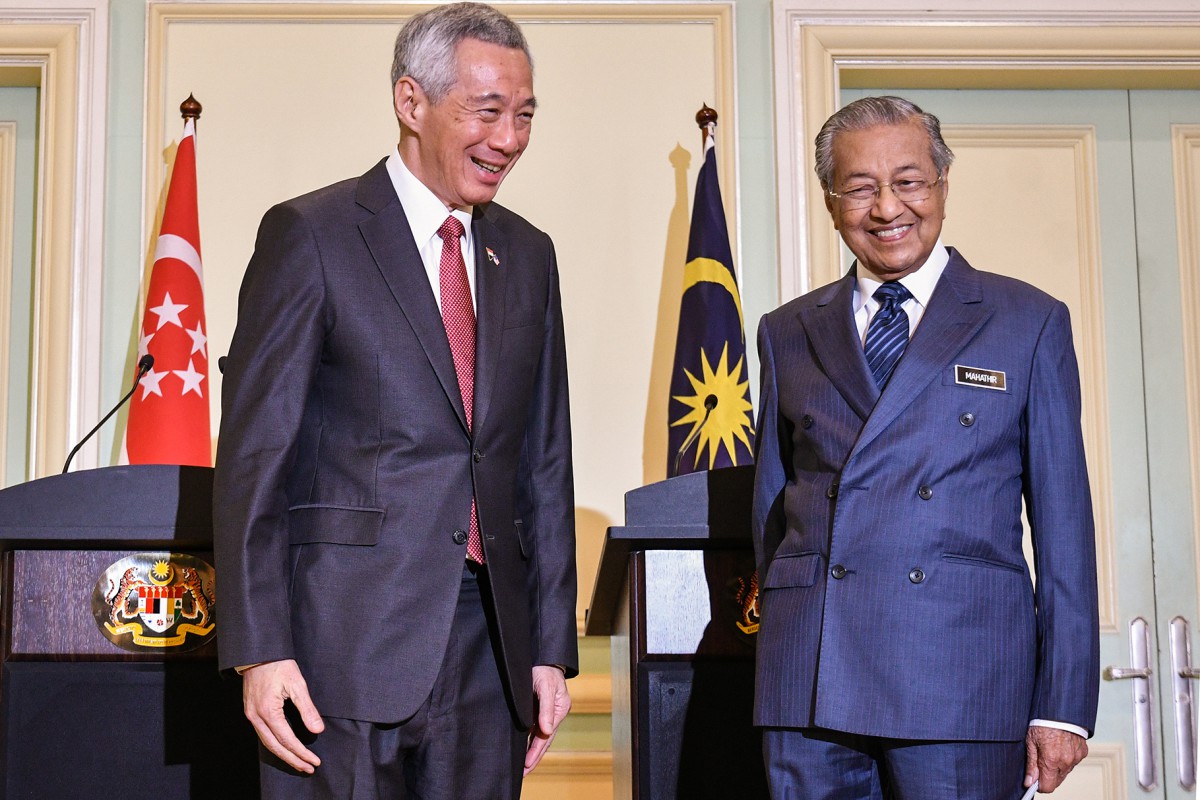
Malaysia’s Prime Minister Mahathir Mohamad (R) and his Singaporean counterpart Lee Hsien Loong smile during a joint press conference in Putrajaya on April 9, 2019. Source: STRINGER / AFP
Lee believed regional peace and stability was best achieved by having the major powers engaged in the region. Not just the United States but also China, Japan, Australia, India and European countries.
Despite the United States being the pre-eminent power in Asia throughout his years in office, he did not anchor Singapore solely in the US camp. Instead he worked hard to expand Singapore’s international space, for example working closely with Chinese leaders to expand economic and political ties.
But China’s rise and its growing assertiveness in pursuing territorial claims in the South China Sea will test how ASEAN, including Singapore, manages the new reality. For Lee the answer lies in continued US engagement in the region. ‘If there is no counterbalance from the US, there will be no room to manoeuvre for smaller Asian countries. When you have two trees instead of one, you can choose which shade to be under’. If Lee were alive today, he would continue looking for more shade.
The third element of Lee’s strategic vision is how to realise Singapore’s strategic goals through developing close relationships with leaders that mattered to Singapore. The best example was Lee’s personal friendship with then Indonesian president Suharto.
They could not have had a worst start after Singapore executed two Indonesian saboteurs in 1968. But the two leaders worked at it, the friendship blossomed and they met regularly over two decades to resolve issues between the two countries.
China–Singapore and US–Singapore ties similarly benefitted from Lee’s personal relationship with many of their leaders who respected his deep insights and forthright views. When the world is more uncertain, it is even more important to be able to reach out to reliable friends.
Finally, Lee’s strategic vision of Singapore’s place in the world cannot be divorced from how he saw the country’s own identity: a vulnerable nation that had to be exceptional in Southeast Asia to survive. ‘I decided we had to differentiate ourselves from [others] or we are finished’, he reflected.
Exceptionalism has profound implications for Singapore’s foreign policy and will invariably create problems with neighbouring countries from time to time. When you are different you have to work harder at your relationships, and Singapore’s leaders will have to manage them deftly.
But the greatest challenge to Lee’s vision of Singapore’s exceptionalism will come internally. Can its people and government maintain the high standards, even as other countries progress to narrow the gap? If they do not, all the other elements of Singapore’s foreign policy fall apart. That is what it means to say that foreign policy begins at home.
Han Fook Kwang is Senior Fellow at the S. Rajaratnam School of International Studies (RSIS), Nanyang Technological University (NTU), Singapore. He was co-author of several books on Lee Kuan Yew including The Man and his Ideas and Hard Truths to Keep Singapore Going. As then Managing Editor of Singapore Press Holdings, he led the editorial team for One Man’s View of the World.
A version of this article originally appeared here on RSIS.
This article has been republished from East Asia Forum under a Creative Commons license.
BEIJING: Singapore Deputy Prime Minister Teo Chee Hean said that Singapore’s relationship with China has progressed “very well” over the past year and hopes this can be taken further in 2019.
DPM Teo made these comments as he met Chinese leaders in Beijing on Thursday (Apr 11), as part of a six-day visit to China.
He was received by China’s top anti-graft official Zhao Leji at the Great Hall of the People in the morning, where both men reaffirmed the “excellent state of bilateral relations”.
They also expressed satisfaction with the cooperation under the Belt and Road Initiative.
“Bilateral relations between China and Singapore have grown from strength to strength in the past year,” said DPM Teo.
He pointed out that Chinese Premier Li Keqiang, Vice Premier Han Zheng and Vice President Wang Qishan made visits to Singapore last year.
Deputy Prime Minister Teo Chee Hean with Mr Guo Shengkun, member of the Political Bureau of the Communist Party of China and Central Political and Legal Affairs Commission Secretary. (Photo: MCI)
Singapore Deputy Prime Minister Tharman Shanmugaratnam was also in Beijing last month, while Prime Minister Lee Hsien Loong will be in the Chinese capital for the Belt and Road Forum later in April.
“These visits provide very important guidance for the work of ministers and officials,” added DPM Teo.
Mr Zhao, who is also a member of the Communist Party’s politburo standing committee, said he was glad to be meeting an “old friend”.
Both have attended three Singapore-China leadership forums together – a platform for leaders from both countries to exchange experiences on challenges in leadership development.
Deputy Prime Minister Teo Chee Hean with Mr Zhao Leji, member of the Political Bureau of the Communist Party of China and Central Commission for Discipline Inspection Secretary. (Photo: MCI)
DPM Teo is set to co-chair the seventh edition of the forum in Yan’an with Chinese minister Chen Xi from Sunday.
Later in the morning, DPM Teo held talks with head of the Central Political and Legal Affairs Commission Guo Shengkun, exchanging views on issues such as transnational crime and counter-terrorism.
He also met the director of the Central Foreign Affairs Commission Office Yang Jiechi.
They reaffirmed the good progress made by the three government-to-government projects, as well as the Sino-Singapore Guangzhou Knowledge City, which is a state-level bilateral cooperation project.
Deputy Prime Minister Teo Chee Hean and State Councilor and Defence Minister Wei Fenghe. (Photo: Olivia Siong)
Also discussed were ways to further cooperation, including in smart cities development and third-country cooperation in Southeast Asia under the Belt and Road Initiative.
In the evening, DPM Teo met State Councilor and Defence Minister Wei Fenghe.
Besides reaffirming the warm and friendly defence ties between the two countries, they also discussed ways to boost defence cooperation.
A group shot with the Singapore delegation in China. (Photo: MCI)
DPM Teo added that he brought several younger leaders along for this trip, to better understand the breadth and depth of the relationship between Singapore and China.
He is accompanied by Minister for Culture, Community and Youth Grace Fu, Minister for Trade and Industry Chan Chun Sing and Minister in the Prime Minister’s Office Indranee Rajah.
On Friday, DPM Teo will travel to Suzhou to mark the 25th anniversary of the Suzhou Industrial Park – the first government-to-government project between Singapore and China.