Flights to and from Lucknow, Kalibo, Quanzhou and Male are to be suspended.
File photo of a Scoot airplane. (Photo: AFP)
(Updated: )
Bookmark
SINGAPORE: Budget carrier Scoot will suspend flights to four cities due to a “combination of weak demand and a shortage of aircraft resources”, it announced on Monday (Apr 29).
The affected destinations are Lucknow in northern India; Kalibo, the main airport to Philippine resort island Boracay; Quanzhou in China’s Fujian province and Male, the capital of Maldives.
Scoot is experiencing aircraft shortage as it will no longer receive SilkAir’s Boeing 737-800NG aircraft following the grounding of SilkAir’s Boeing 737 MAX 8 fleet, it said.
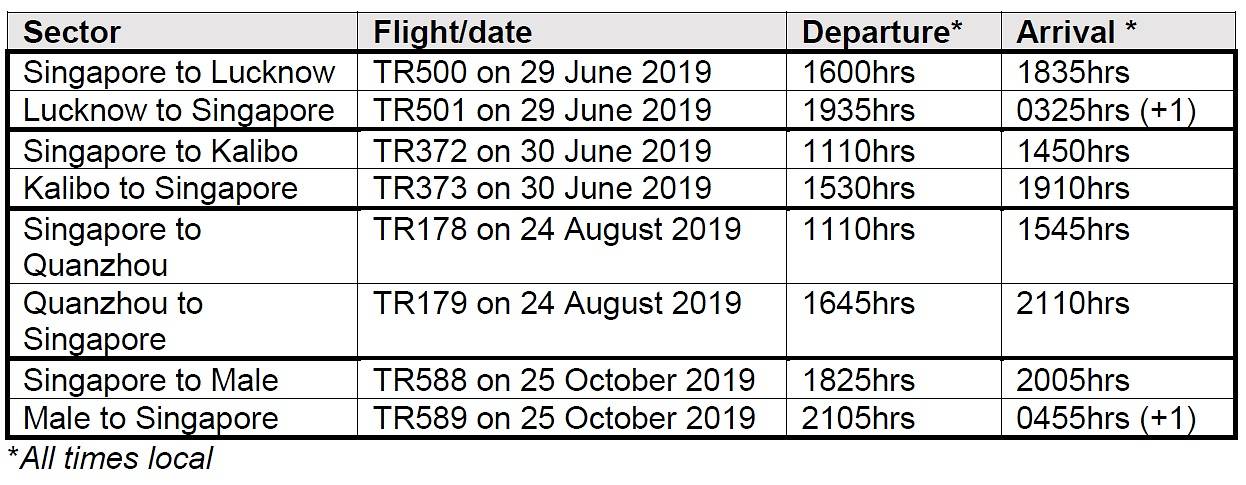
The suspensions are to start from end-June for Lucknow and Kalibo, August for Quanzhou and October for Male.
Scoot currently operates three flights a week to Lucknow, Kalibo and Quanzhou, and flies to Male four times weekly.
The last flights departing Singapore and the four cities are listed, subject to regulatory approvals. (Image: Scoot)
It will operate additional flights to Lucknow in June and to Kalibo for selected periods until the suspension of service, it said.
AFFECTED CUSTOMERS CAN REBOOK
Scoot said it has contacted customers with existing bookings regarding the suspension.
Affected customers can opt to rebook their flight, either to the same destination departing before the suspension or to a different destination within the same country, at no additional charge.
Rebooking to a different destination must be done within seven days of the original departure date.
Alternatively, they can obtain a 100 per cent refund on their booking via their original mode of payment or a 120 per cent refund via a Scoot Travel Voucher.
The airline, however, will continue to undertake the routes SilkAir had earlier committed to transfer over, it added.
These locations are:
• Luang Prabang and Vientiane in Laos, in April 2019
• Coimbatore, Trivandrum and Visakhapatnam in India, between May 2019 and October 2019
• Changsha, Fuzhou, Kunming and Wuhan in China, between May 2019 and June 2019
• Chiang Mai in Thailand, in October 2019
• Kota Kinabalu in Malaysia, in December 2019
• Balikpapan, Lombok, Makassar, Manado, Semarang and Yogyakarta in Indonesia, between May 2020 and July 2020
The previous record holder for a five-day opening was 2011’s Transformers: Dark Of The Moon.
(Screen grab: Avengers: Endgame)
Bookmark
It’s official – Avengers: Endgame has achieved the biggest five-day opening weekend of all time in Singapore.
The final Avengers installment took in a whopping S$7.52 million between 24 and 28 April. This totally eclipses the record held by Avengers: Infinity War last year, which raked in over a million dollars less at S$6.13 million. The previous record holder for a five-day opening was 2011’s Transformers: Dark Of The Moon.
Endgame’s strong showing locally is keeping pace with worldwide opening weekend figures – it’s the number one movie in at least 54 countries and has smashed global box office records with US$1.2 billion worldwide.
The three-hour war against Thanos also saw chart-topping numbers in North America with US$350 million at the tills, obliterating the previous record-holder, Star Wars: The Force Awakens, which made US$248 million in opening-weekend sales.
At the rate it’s going, Endgame has a good chance of zooming past Infinity War – currently Singapore’s biggest film – which had a total run of S$16.2 million.
SINGAPORE: Those suffering from dementia feel rejected, lonely, ashamed and less competent, Singapore’s first national survey on dementia revealed on Monday (Apr 29).
The survey by Singapore Management University (SMU) and the Alzheimer’s Disease Association (ADA) polled more than 5,600 people, including those with dementia as well as their caregivers and the general public.
The results revealed that 72 per cent of people with dementia feel rejection and loneliness while half of them feel that they cannot be open with others regarding their condition.
More than 56 per cent of them say that people treat them as less competent, the study added.
An old man walks on an overhead bridge in Singapore. (File photo: Francine Lim)
For those who care for someone suffering from the disease, nearly 30 per cent said they feel embarrassed while tending to their loved ones in public, while more than 1 in 10 feel that others around them “seem awkward”.
Chief Executive Officer of Alzheimer’s Disease Association Jason Foo said that stigma affects more than just the quality of life for persons with dementia and their families.
“It really emphasises that we should use the right type of language; show more empathy for persons with dementia and their caregivers and aim to integrate persons with dementia into the society by building dementia-friendly communities to support them,” he said.
In measuring stigma levels towards Alzheimer’s disease and other related dementias, findings show that those who hold no connection to dementia have the highest stigmatic attitude.
This is followed closely by the persons with dementia themselves, with about half of them feeling ashamed of their condition, citing stigma as the main reason.
MORE AWARENESS NEEDED
The study also reinforced the need for more dementia education and awareness, with more than 57 per cent of the general public rating themselves as low in dementia knowledge.
The respondents also reported feeling uncomfortable interacting with persons with dementia, with almost 44 per cent feeling frustrated with not knowing how to help.
Despite the low awareness, nearly 8 in 10 of all respondents want to do more to improve the lives of persons with dementia.
About 7 in 10 of the respondents to the survey also agreed that those suffering from dementia should live “with family in their home” and agree that Singapore needs to provide more dementia-friendly amenities.
An elderly man at a void deck in Singapore. (File photo: Gaya Chandramohan)
“We need to strive towards changing the mindset of society and break stereotypes,” said Mr Foo..
All of us should not focus on their (persons with dementia) deficits, but on what they can still do with their remaining abilities. It’s important to recognise that they can still lead purposeful and meaningful lives.”
According to the Institute of Mental Health, 1 in 10 people aged above 60 in Singapore has dementia, with the condition affecting half of those above 85.
This translates to an estimated 82,000 cases locally in 2018, with the number is expected to go beyond 100,000 by 2030.
“ADA believes that proactive steps should be taken to educate people to be aware of dementia, be mindful of any preconceived thoughts of dementia as a debilitating condition,” said Mr Foo.
“In building inclusive dementia friendly communities – anyone and any organisation can be part of this movement.”
To combat this stigma, ADA will be launching a nationwide dementia awareness campaign in June, starting with a set of Dementia-Language guidelines followed by roadshows, events, talks and videos.
The campaign will culminate in a public event on Sep 21 on World Alzheimer’s Day in commemoration of World Alzheimer’s Month.
SINGAPORE: Can plastic toys, clothes and glass pots be recycled? If you say yes, you’re not alone, but these items do not belong in a recycling bin, according to authorities.
Around 60 per cent of Singapore households recycle regularly, but many still find it difficult to identify contaminants and non-recyclables, surveys conducted by the Ministry of the Environment and Water Resources (MEWR) and the National Environment Agency (NEA) have found.
The two surveys, which were conducted between June 2018 and February 2019, covered different aspects of household recycling, said the agencies in a joint media release on Monday (Apr 29).
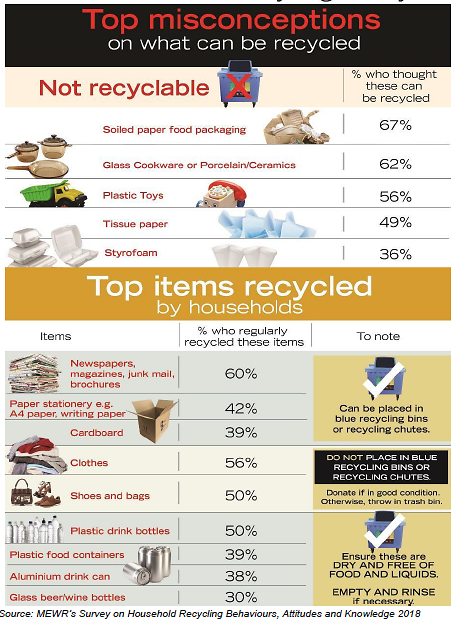
According to the findings, the top items recycled were paper materials like newspapers, magazines, junk mail, brochures and writing paper.
Clothes, shoes and bags were also among the top items recycled. However, these items should be donated – if in good condition – instead of being recycled, said the agencies.
“These wrongly recycled items contribute to the high contamination rate of the recyclables collected from the blue recycling bins,” said MEWR and NEA.
Another category of items which were also regularly recycled were plastic drink bottles, aluminum cans and glass beer/wine bottles.
“While these items can be recycled, they should be emptied and rinsed clean wherever possible,” reminded the agencies.
The most common channel used for recycling was the blue recycling bins, with 56 per cent of regular recyclers using the bins at least once a week, the findings showed.
Convenience was one of the most commonly cited reasons for those who recycled regularly, according to MEWR’s survey.
NEA’s survey also found that this group of households found recycling to be “second nature” and part of their daily routine.
67% THOUGHT SOILED FOOD PACKAGING CAN BE RECYCLED
Even though the findings showed that respondents were generally capable of identifying recyclable items, they had difficulty identifying contaminants and non-recyclables, said MEWR and NEA.
According to MEWR’s survey, 67 per cent of respondents thought that soiled paper food packaging can be recycled, while another 62 per cent thought that glass cookware or porcelain/ceramics can be recycled.
Other items that were wrongly identified as recyclables were plastic toys, tissue paper and Styrofoam.
Top misconceptions of what can be recycled. (Table: MEWR)
Around 60 per cent of respondents also mistakenly thought that recyclables had to be sorted by type before being deposited into recycling bins, said the agencies.
“There is no need to pre-sort items that are deposited into the blue recycling bins, because the contents of the blue recycling bins will be transported to the MRF (Material Recovery Facilities) where the sorting takes place.”
TOO BUSY, INCONVENIENT TO RECYCLE
As for households who did not recycle regularly, the most common reasons were related to convenience.
Some of the reasons included having too few items to recycle, being too busy or tired, as well as not having enough space to accumulate recyclables in their homes.
“Barriers cited by households who did not recycle regularly suggest that recycling was perceived as inconvenient and secondary in their daily routine,” said the agencies.
“Hence, helping Singaporeans to see that recycling is easy and helping with habit formation are important in improving Singapore’s household recycling rate.”
All new Build-To-Order Housing and Development Board flats have installed recycling chutes adjacent to centralised refuse chutes at every level since January 2014.
This requirement has also been extended to buildings taller than four storeys in all new non-landed private residential developments since Apr 1 last year.
For the two surveys, MEWR and NEA surveyed 2,003 and 3,445 randomly-selected households respectively through face-to-face interviews.
SINGAPORE: You’ve probably heard the rule that one year to a human equals seven years for a dog.
These days, career coaches joke that one year in a single role for a millennial is the equivalent of seven years for a Gen X-er.
Frequent career transitions used to be a sign of failure but today, being career mobile and having a diverse array of experiences is not only common, but is rapidly becoming aspirational.
Long gone is the notion of the career ladder, where the ideal CV looks like a narrow, vertical progression. Today’s gold-standard CV looks like a career matrix, with horizontal and vertical moves signifying depth and breadth of experience, skills and exposure to different cultures.
Employers have gone from being cynical about hiring job-hoppers to becoming accustomed to seeing diverse CVs from top talent who are in frequent demand.
I recall being asked “Why didn’t you stay for longer?” in job interviews 10 years ago. Today I hear many employers asking candidates “Why did you stay in one role for so long and not stretch yourself?”. It smacks of complacency.
WHAT CAREER MOBILITY LOOKS LIKE
However, it is important not to confuse career mobility with job-shopping or job-hopping.
A more positive definition of a career-mobile individual is someone who constantly pushes themselves to grow and develop their skills by taking on fresh, professional challenges rather than stagnating in their comfort zone.
Career mobility could mean staying in the same firm while moving to a new role, or taking on an overseas posting or stretch assignment. Or it could mean choosing a different job intentionally to explore broadening one’s skill base.
Career mobility is about playing at your competitive edge, expanding your boundaries of competence. To possess career mobility, one must have self-awareness to understand where one needs to grow, and also strategic awareness of the bigger picture of where opportunities lie.
Woman at work looking at an iPad. (Photo: Pixabay)
When I read about the Government’s plans to improve career mobility for all workers to prepare them for a future of disruption, I was pleasantly surprised by this pragmatic approach.
Companies are constantly in a state of disruption these days. Experts predict that the majority of the jobs in a few decades do not even exist today.
As companies restructure internally so frequently and start-ups come and go, it is only sensible that our workforce learns to identify opportunities, continuously add to their toolbox of skills, and transition well.
The data suggests that career mobility is here to stay. In Singapore we already have one of the most career mobile workforces globally, at least in orientation.
Thirty-four per cent of Singapore professionals have no intention of staying with their current employers for more than a year, well over the global average of 26 per cent, according to a LinkedIn 2017 report.
Yet Singapore workers are also the least confident of gaining access to and pursuing their desired opportunities among the ASEAN countries surveyed by LinkedIn in 2018, with the study suggesting that the lack of strong networks are a major contributing factor.
FOUR WAYS COMPANIES CAN ATTRACT AND RETAIN THE BEST AND BRIGHTEST
To thrive in today’s world, companies must examine how they can work with the career mobility trend by providing their employees more opportunities for growth and development rather than have them leave to pursue options elsewhere.
A man in an office. (Photo: Pixabay/StockSnap)
First, companies can introduce initiatives focused on deliberately developing employees’ breadth of competencies.
For example, people can be encouraged to set one of their Key Performance Indicators to centre on company projects not associated with their usual job scope, or spend a portion of their week in another department to develop new skills.
For example, having salespersons being exposed to data analytics will allow them to learn how to use surveys and statistics to tell stories. Having engineers spend time in marketing helps them develop empathy and design better solutions for consumers.
Second, it is essential for organisations to have learning and development programmes targetting social emotional intelligence skills such as self-awareness, empathic communication and influence because these abilities are timeless, transferable, highly correlated to success in the workplace, and help individuals adapt to disruption.
Harvard University Professor David Deming’s research finds that if you really want to ensure relevance in the future, social skills are a much stronger predictor of future employment and wage growth than cognitive skills. Social emotional skills combined with technical competencies make for an upwardly mobile workforce.
Third, companies should rethink their approach towards hiring for career mobility. Most still prefer to hire candidates not actively looking for jobs, spending vast sums of money on recruiters who identify these “passive” candidates and persuade them to leave.
(Photo: Unsplash/rawpixel)
However, Wharton Professor Peter Cappelli warns that there is no evidence that passive candidates are better employees. In fact, his analysis suggests that the number one factor that encourages “passive” candidates to move is cold, hard money.
In contrast, “active” career mobile job seekers are more motivated by career opportunities, have higher levels of passion about their work, and are more engaged in improving their skills.
Lastly, employers need to make sure that they are constantly “courting” their own employees by repegging their salaries to market rates.
Research suggests that the total direct and indirect costs associated with someone leaving can be up to two years of their salary.
Yet in many companies it is the norm to cap the maximum salary increase for a current employee to low single digits, making it hard for talent to resist outside offers that may be up to a 30 per cent increase in salary.
I’ve encountered this myself when my employees have handed me a resignation letter while expressing disappointment that they have experienced being “penalised” for their loyalty.
Wharton Business School Management Professor Matthew Bidwell estimates that external hires earn 18 per cent more than internal promotes in the same jobs, yet at the same time, it takes new hires three years to catch up in terms of performance to internal hires.
It makes hard economic sense to actively invest in developing your existing talent and to continually let them know that you recognise their worth and contribution.
A woman in the office. (Photo: Unsplash)
One example of this approach in action is the Biopharmaceuticals Manufacturers Advisory Committee, which commissioned a leadership skills development programme, which is unusual in that employees who I teach not only come from 16 different companies, but are also often direct competitors for the same pool of talent.
At the inaugural run of the programme, senior management from the various sites turned up to show their support and participate in a panel discussion on talent development.
“We did consider whether the participants would jump to different companies, but we ultimately realised that they would be more likely to leave if we didn’t invest in them”, Ronan McGarvey, one of the programme leaders said.
“And besides, once they talk to each other, they realise that we’re all dealing with common challenges; there’s no such thing as the perfect company, the grass is not greener on the other side.”
This piece is the first of a two-part series on career mobility by Crystal Lim-Lange. Part two will focus on how individuals can develop career mobility.
Crystal Lim-Lange is the CEO and Co-founder of Forest Wolf, a future-readiness and talent development consultancy.
The two leaders reaffirmed the friendly relations between both countries, said the Prime Minister’s Office.
They also discussed potential cooperation in the areas of urban development, port and maritime development, logistics as well as the digital economy during the morning meeting.
Later in the day, Mr Lee visited the 2019 International Horticultural Exposition in Beijing’s Yanqing district – a mega expo featuring rare plants and more than 100 gardens from different countries.
Mr Lee, accompanied by Mrs Lee, Foreign Minister Vivian Balakrishnan and other Government officials, toured the China Pavilion and the Singapore Garden.
Prime Minister Lee Hsien Loong at the Singapore Garden with Mr Jason Wright, deputy director of design from the National Parks Board, and other Government officials. c
The latter, designed by a 20-member team from the National Parks Board who started work since end-2017, is a 1,000 sq m garden featuring vertical greenery and sculptures to showcase Singapore’s lush tropical landscape.
The biggest draw is the 5,500 orchids from more than 200 species on display.
Among them include the Papilionanda Xi Jinping-Peng Liyuan – the orchid hybrid named after the Chinese President and his wife when they visited Singapore in 2015 – and the Aranda Lee Kuan Yew, which is named after Singapore’s founding prime minister.
After which, Mr Lee participated in a tree planting ceremony and attended the expo’s extravagant opening ceremony.
Prime Minister Lee Hsien Loong and Mrs Lee at the 2019 International Horticultural Exposition in Beijing on Apr 28, 2019. (Photo: Ministry of Communications and Information)
Mr Lee is on a five-day visit to the Chinese capital where he attended the Belt and Road Forum – a summit organised by China to showcase its mega infrastructure plan, which aims to rebuild the old Silk Road to connect China with Asia, Europe and beyond.
On Monday, which is Mr Lee’s final day in Beijing, he will meet Chinese President Xi Jinping.
Mr Lee will also meet and be hosted to lunch by Chinese Premier Li Keqiang, with whom he will witness the signing of several memorandums of understanding between Singapore and China.
SINGAPORE: Prior to the latest cooling measures introduced in July 2018, the last time similar regulations were rolled out to moderate the residential private property market was in 2013 with the introduction of the Total Debt Servicing Ratio (TDSR).
The TDSR sought to encourage financial prudence among borrowers and strengthen credit underwriting practices by financial institutions, by limiting monthly mortgage payments to no more than 60 per cent of one’s income, and consequently curtail the amount one can borrow to purchase a property.
Subsequently, the total sales of residential non-landed properties fell by more than 44 per cent and the private property price index dipped by 3.5 per cent in 2014.
General view of private and HDB properties in Singapore. (File photo: TODAY)
A NEW NORMAL, A BOOM IN 2017 AND 2018
However, the market began picking up again in the second quarter of 2017 – fuelled in part by the relaxation of the seller’s stamp duty (SSD) in March that year, which reduced the amount of time a property owner can sell his place without incurring stamp duties from four to three years, as well as a residential collective sale fever that commenced approximately in May 2017.
In short, it was starting to feel like buyers were beginning to accept those property curbs as “a new normal”.
This was reflected in the residential private property price index that year, which reversed from a contraction of 2.6 per cent in 2016 to a growth of 1.3 per cent in 2017. The volume of transactions jumped by around 48 per cent over the same period.
Residential en bloc sales also surged to S$8.4 billion, up by more than seven times from 2016.
This momentum carried over to 2018 with total sales climbing up by 2.5 per cent year-on-year by the second quarter as well as the price index soaring to a 9.3 per cent year-on-year. In just six months, en bloc sales reached S$10.4 billion before Jul 5, 2018.
Residential non-landed private property total sales volume and property price index. (Graphic and Source: URA, Edmund Tie & Company Research)
A similar trend has been observed after the Government’s introduction of the latest cooling measures in July 2018.
Total sales volume has since almost halved, although prices have remained relatively stable with the price index rising by just 0.5 per cent over the last two quarters of 2018.
The key question remains whether buyers and developers will get used to this newer normal – or whether the cooling measures make it a buyer’s market for those looking for a home if the property market remains in limbo and developers, stuck with huge land bank, now feel pressured to resort to fire sales to sell off units.
HERE’S WHY PRICES WILL REMAIN STABLE
My opinion, however, is that residential private property prices will remain stable despite the introduction of cooling measures for three key reasons.
First, most developers launching upcoming project launches in 2019 had paid high prices for land during the en bloc fever.
Second, developers will likely be more willing to maintain prices and accept a lower sell-down rate rather than resort to discounting, which may devalue the overall project and disappoint earlier buyers who paid higher prices.
A development with more than 300 units is typically launched in stages. Developers tend to offer early bird discounts to attract buyers and gradually increase prices in subsequent stages until they sell all units.
In recent years, Singapore Government introduced cooling measures to tame the demand for property (File photo: TODAY)
If they decide to offer further discounts for remaining units in the later sale stages, earlier buyers and investors would suffer a paper loss and fearing a similar outcome, think twice before buying from the same developer.
Third, although developers may be incentivised to resort to heavy discounting to sell all remaining units within five years of being awarded the land, so as to recoup the remissible portions of developer’s ABSD, which is sizable at 25 per cent (an increase from the previous 15 per cent), Edmund Tie and Company’s analysis of URA’s data suggests that the number of developments reaching the five-year development deadline from now until 2020 is relatively low – totalling less than 200 units.
Instead, developers will aim to position their projects more competitively rather than dish out steep discounts despite the large supply of properties expected this year, with more than 50 projects and 20,000 units likely to be launched.
Apart from early bird discounts, they will likely offer higher sales commissions to agents, and deferred payment arrangements for completed projects to boost sales.
In fact, even within such a busy landscape, projects that are competitively priced, well-located and with good amenities, such as The Tre Ver condominium, may even see price increases for subsequent launches.
Crowd at The Tre Ver showflat. (Photo: UOL)
Taken together, I expect potential downward pressure for the resale market of older, less well-located and well-amenitised estates, due to stiff competition from new project launches.
WHY UNWINDING THE COOLING MEASURES MAY BE A COMPLEX EXERCISE
While the Government’s cooling measures in 2013 and 2018 have been relatively effective in curbing market exuberance and excessive rises in prices, there may be unforeseen implications.
First, unwinding the current cooling measures may be more challenging. Any minor re-calibration or relaxation to policies may unleash pent-up demand that quickly drives up price and transaction volume, as was the case in 2017.
Buyers and investors tend to interpret such moves as an end to further tightening and anticipate that higher demand will drive further price increases.
There is a significant inherent demand for private residential units for buyers who purchase property for owner occupation and long-term investment, whose decisions may be less swayed by property curbs due to their stronger financial positions.
With rising incomes in Singapore, the number of households that fit this group of such owners and investors have been on the uptick. There were more than 178,000 Singapore households earning more than S$20,000 per month as at end 2018 according to Singstat, a figure that has seen an average growth of about 10,000 each year since 2009.
In my view, these cooling measures have not dampened Singaporeans’ longstanding love affair with real estate as a tangible investment and as an inheritance for their children.
Wealthy foreigners have also been watching the Singapore market closely, especially higher-end residences located in the core city region, which are seen as good investments and even trophy assets.
It’s noteworthy that the number of properties sold for S$4 million and above jumped by more than 30 per cent in 2018 compared to 2017.
Foreign buyers may only make up 5 to 6 per cent of the total sales volume but remain a significant source of latent demand, especially when one considers the longer-term plans for more residential spaces in the Central Business District, outlined in the URA draft Master Plan 2019.
Adding to this inherent demand for property are households who have profited during the en bloc sales over the past two years, who may be looking to upgrade to pricier residences or remain in proximity to their previous place of residence.
Third, the Government’s active approach to intervene with property curbs to ensure a stable and sustainable market effectively keeps property capital appreciation in line with economic and wage growth.
Although such interventions reduce speculation and volatility by smoothing out returns on investment in residential properties, they also make private property an attractive long-term investment asset class for buyers with a low-risk profile.
Fourth, the fact remains that developers’ demand for land is cyclical. Many have replenished their land banks with en bloc sites, which has a potential development yield of up to 25,000 new units, equal to circa three years’ supply based on a conservative average sale rate of 8,000 units per annum.
But another round of heightened en bloc activity may occur again over the next one to two years after the current developments diminish, thought prices will likely remain moderated.
In all, what these conditions mean is that Singapore residential private property market prices are expected to remain neutral, although there is a slight advantage to buyers in terms of the wide range of new project launches to choose from.
In fact, the cooling measures may have just made Singapore property a less attractive asset class for investors with a high-risk appetite.
Darren Teo is Head of Research at Edmund Tie & Company.
SINGAPORE: Finance Minister Heng Swee Keat said he will support Prime Minister Lee Hsien Loong in reviewing Singapore’s longer term policy measures to take the country forward in the next decade, as he prepares to take on the role of Deputy Prime Minister from May 1.
Mr Heng said these include ageing population matters, economic restructuring and dealing with social issues that may arise as Singapore experiences a faster pace of change.
Speaking on the sidelines of a community event on Sunday (Apr 28) – his first public event since the cabinet reshuffle was announced on Tuesday – the minister said strengthening relations with major partners was a priority.
“A very important part of it is to support the Prime Minister in strengthening our relations with major partners around the world. As you know I’ve just been back from the United States. I just spent a week in Thailand and Malaysia.
“I’ll be going to China next month, as well as Japan. So there’s a whole range of visits I’m doing to build good relations with our neighbours to strengthen our partnership to take Singapore forward,” said Mr Heng, who will still remain Finance Minister.
The promotion to Deputy Prime Minister cements Mr Heng’s standing as Singapore’s next Prime Minister.
Mr Lee has said he hopes to hand over the reins by the time he turns 70, which would be in 2022. This means his successor would have about three years to prepare for the role.
Asked about the time frame, Mr Heng said having been in public service all his life, the role is not something totally new.
“But of course the learning curve will be steeper, and I will do my best, and we will certainly have the good support of PM Lee, DPM Teo, DPM Tharman as well as cabinet colleagues,” he said.
Mr Heng was also asked about his health, to which he quipped “What do you think? Do I look healthy?” Turning serious, he added: “The one good lesson I learnt is to pace myself better, so I will have sufficient exercise and rest.”
Mr Heng was speaking at a ceremony to mark the completion of the first 1.6 kilometres of additional cycling path in Tampines Town which runs along stretches of Tampines Concourse, Tampines Central 7 and Tampines Avenue 6.
The event was also attended by Grassroots Advisers for Tampines GRC Masagos Zulkifli, BaeyYam Keng, Desmond Choo and Cheng Li Hui. Together with Mr Heng, they also launched the ground-breaking for the next 4km of cycling paths in Tampines, that’s slated for completion in 2020.
SINGAPORE: This February, a milestone moment was achieved in the artificial intelligence (AI) space: A United States-based research organisation called OpenAI demonstrated its machine learning algorithm that’s able to generate its own text.
The algorithm works so well that the researchers behind the project felt it necessary to withhold the full model and the dataset of eight million Web pages they used to train it with.
One Vox writer even started the article detailing OpenAI’s achievements with: “One of the coolest AI systems I’ve ever seen may also be the one that will kick me out of my job.”
These innovations are not happening in just the US.
INSTANT NEWS, JUST ADD AI
Locally, a new media upstart, Observer+, is looking to use AI to pick out the key news of the day, its most salient points and re-package coverage according to what the online crowd wants and is talking about.
Observer+’s Sarah Tang told CNA in an email interview that it has about eight AI bots tasked with “scraping” news from multiple sources. Their primary use is for the detection of certain keywords mentioned in social accounts, forums, news sites, essentially anywhere on the Internet.
It also uses a sentiment tool to extract and analyse Facebook comments “specific to the lingua franca of Singapore and Malaysia”, with an internally developed “Singlish/Manglish dictionary“ for this purpose, she revealed.
Additionally, the AI tool can be used to extract a news article’s content, Web link and author’s name, among others, from the minute these are published, Tang said. The third-party articles are then passed through a “summarisation algorithm similar to Yahoo’s Summly” (a news summarisation app), after which “our ghostwriter will transpose the key points into a proper article”, she added.
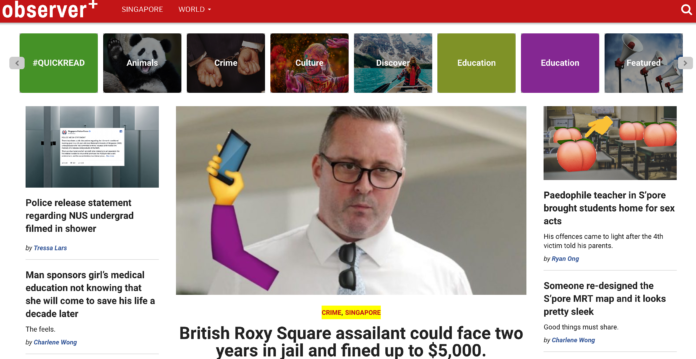
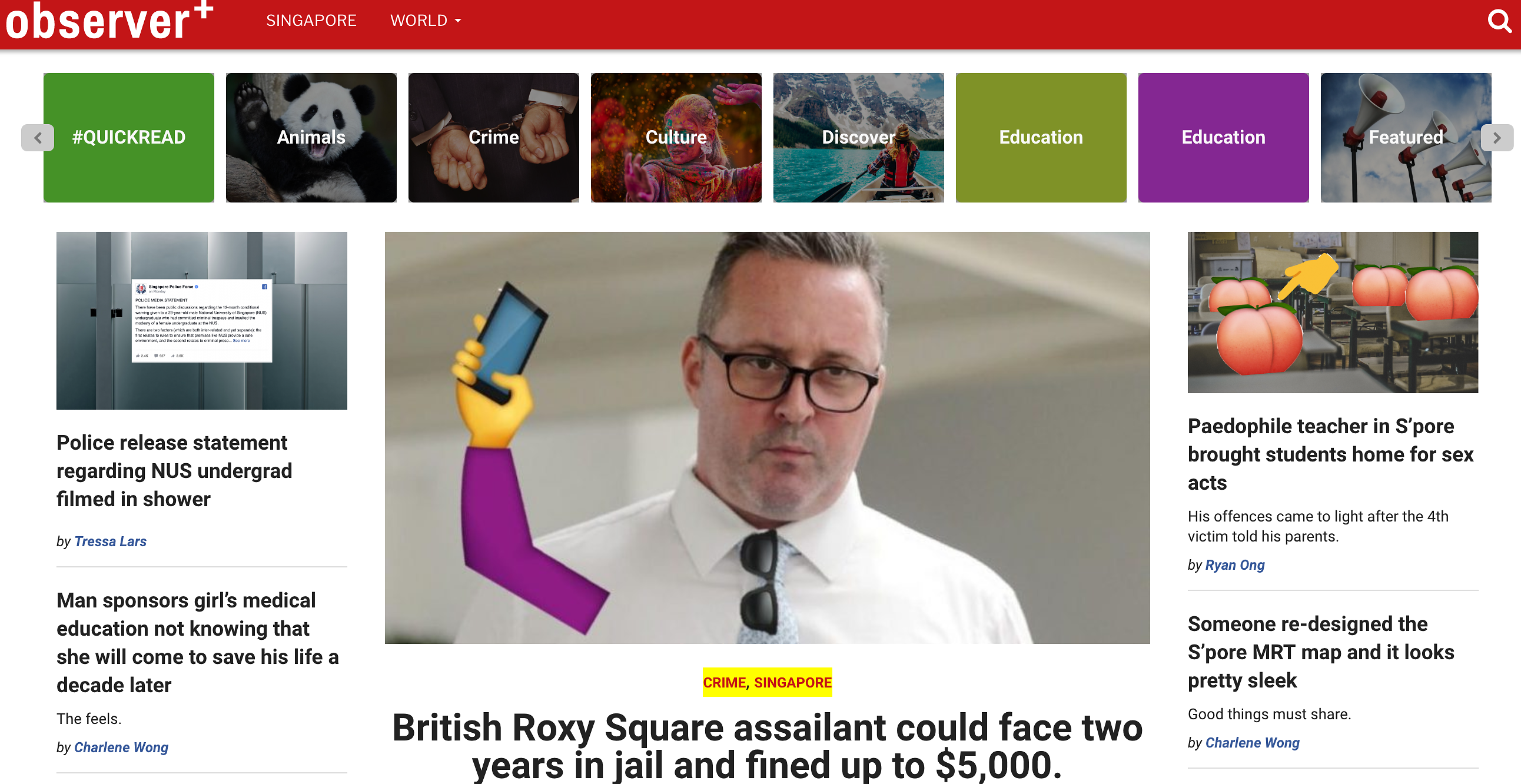
Screengrab of online news site Observer+, which is aided by eight AI bots and just a handful of freelance ghostwriters.
“The extraction and summarisation process takes 30 seconds. This means that within 1 minute of your article published on CNA, we will already know the key points and the gist of your article,” Tang said, adding there are about three freelance ghostwriters working for them.
She pointed out that the AI tool is still a work in progress and it is testing it against human writers. However, the intent is for the tool to help in detecting key news points rather than write an article independently.
LEAN AND MEAN
With the contribution of AI, Tang said this has helped the Singapore-based Observer+ to stay on the path of sustainability and tackle two main problems facing new publishers today: Funding and advertising. These problems, she pointed out, caused competitors like The Middle Ground, Six-Six News and Inconvenient Questions to fold.
Currently, it costs less than S$2,000 to run the site in total every month, and this includes the Web servers and manpower, she said. “Costs are negligible due to AI and we currently have a monthly surplus.”
Azly J. Nor, the person Tang reports to, said in a separate email: “Where sites like The Middle Ground and Six-Six News got it wrong is that they build the platform as a business, despite not getting market validation. Observer+, however, started with a focus on building influence – that’s where the core difference is.”
He said the media start-up does not have manpower difficulties because of AI, and in terms of funding, it does not have to pay for marketing or server costs. The marketing is provided by SMRT Feedback, an online satire and vigilante presence, “as a barter” in exchange for coverage on the latter’s tip-offs.
One example of this barter trade was when Observer+ ran a story on Jun 14, 2017, of pictures SMRT Feedback had dug up of Syaikhah Izzah Zahrah Al Ansari, the first woman detained for radicalism in Singapore, he pointed out.
Tang also said it differentiates itself from others in the market with the ability to provide readers with a fresher angle than the same content already covered by others.
For instance, when the Straits Times reported recently that 15 per cent of Singaporeans polled by the Institute of Policy Studies (IPS) find Muslims threatening and others followed along the same lines, Observer+ went a different route by reporting that 40 per cent from the same poll believed in magical powers, she said.
“(It) is not about reporting B when others are reporting A for the sake of being different,” she added. “You can have many players providing diverse views across a myriad of topics, but that does not mean the readers are all more informed. (We) strive to report from the left, centre and right, and readers decide which positions they want to take.”
This approach appears to be working in its favour.
Tang said in its first month of operations last December, it reached 1.7 million page views and this has grown to 1.9 million in March this year. In terms of reader base, she said it is 70 per cent Singapore-based traffic and 20 per cent from Malaysia.
WHO IS BEHIND OBSERVER+?
Yet, Azly said the news site remains a “pet project”. It’s not modelled as a business and it doesn’t actively seek sponsors, he added.
In fact, while Observer+ is based in Singapore, it has yet to be formalised as a corporate entity and it sees no need to do so now or in the near future, Tang (who declined to provide a picture as she was a formerly an administrator for SMRT Feedback) added.
So who owns the news site? It belongs to an unknown entity called the “Council”, which was also behind the online troll and vigilante site SMRT Feedback that shot into public prominence in 2011, she said.
According to its organisation chart, the Council consists of four sub-branches and members know only each other within their own sub-branch and not the others. So, those in the Advisory Committee would not know who is in the Gatekeepers, and vice versa, Tang said.
The organisation chart of the “Council” and the entities it has ties with. (Chart: Observer+)
Azly, who publicly revealed his identity as co-founder of SMRT Feedback in 2015, is the “Consigliere” linking the Council to its other assets like Observer+, and his is an important role, said Tang, whose designation is Special Projects lead.
His decision to “out” himself was not a personal one but on the request of the Council, she said. “He could have disappeared in 2012 and nobody would have known he was from SMRT Feedback, but we needed at least a public face because it was easier for business.”
For instance, before Observer+ was launched, there was a need for someone to go out and network with existing publishers to understand how they work. According to her, Azly has helped Mothership boost their views with SMRT Feedback when the former first started, and also partnered others like The Smart Local, Vulcan Post and MustShareNews.
This work probably paved the way for the current partnership between SMRT Feedback and Observer+.
“SMRT Feedback needed a media arm for tip-offs to continue their CSI work, without having to run and operate the asset, while the Council needed a media arm to promote their business interests so they can generate revenue and then use the money to fund their research,” she explained.
His appointment is also a “failsafe”, said Tang.
In terms of working within the parameters of the law, Azly’s marketing technology firm Blackwilder is the registered business entity in Singapore. Blackwilder, in turn, is part of a registered entity under Rockefeller Pte Ltd that he owns.
Should Observer+ hit the threshold needed for it to be licensed under the Broadcasting Act one day, similar to what was required of Yahoo or Mothership, this arrangement helps too.
“We have already planned for it. This comes back to the reason why we needed a public face,” Tang said. “When the time comes, Observer+ will go under the ownership of Blackwilder and will be operated within that Singapore entity.
“As Blackwilder already has its own P&L (profit and loss statement), any funds for (the) operation will come from them. We don’t accept foreign funding (nor) will there be a need to seek local funding,” she added.
Additional reporting by Fann Sim.
This profile on Observer+ is part of a wider series looking at Singapore’s alternative online news scene. You can read more about the industry here, or the other profiles on Critical Spectator and Rice Media.
SINGAPORE: It was midweek, and the cafe near Rice Media’s current office at Jalan Besar was quiet, cosy and suitably sheltered from the impending storm threatening outside.
I was early, and nursing a cup of coffee when Mark Tan, founder and CEO of the news media start-up, sauntered in and looked around. We’ve never met, having corresponded primarily through the somewhat archaic SMS platform, so I stood up to get his attention.
Decked out in a clean white shirt, sleeves folded, and light brown slacks, Tan looked like a working professional on his day off. He was, after all, a practising lawyer until about two years ago when he officially started Rice Media.
He has kept a relatively low profile though: This interview is only the second he has agreed to participate in after Rice was founded, he said.
His low-key manner belies the start-up’s ambitious mission statement that reads: “Rice is Asia’s alternative voice. From sex workers to politicians, contemporary art to street food, we bring fresh perspectives and bold commentary on everyday life in Asia.”
Its early blog posts articulated what they hoped to deliver. One of its earliest works, for instance, was an in-depth article on former Singapore Idol contestant Steven Lim, which looked beyond the public persona of the wannabe celebrity to the actual person lurking beneath.
Then there was the March 2018 piece on an American pastor, Lou Engle, who was invited to speak at a Christian conference but crossed the religious fault line with his insensitive comments against the Muslim community.
INTENT ON BROADENING PEOPLE’S UNDERSTANDING
Clearly unafraid to wade into socially sensitive territory, Tan said the decision to do so is always to “broaden understanding”.
Referring to the Lou Engle article, the 35-year-old said to broaden people’s understanding meant it had to be critical and get people “who might not necessarily agree” with the subject matter. “That’s where the provocation might come from, but we don’t start off with the intention of provoking.”
He added that Rice wanted to give the public insight into what happens at many of these religious events and conferences and, more importantly, start a discussion on where the line is when it comes to preaching certain values or ideas.
“In the case of religion, we are often told to be wary of Islamic extremism,” Tan said. “But as our coverage of this story showed, this is not limited to any one religion as any of us can fall into this sort of misunderstanding.
“No religion or ideology is immune to extreme views and we felt that it was important to educate the public on this matter.”
It doesn’t just deal with politically or socially sensitive topics; a similarly critical eye is cast on cultural issues.
One recent piece looked at the spelling, or misspelling, of Malay words among different races in Singapore.
“The point of this piece wasn’t to criticise the spelling mistakes, but to understand why this phenomenon exists,” Tan said, adding that in order to do this, it had to critically analyse how and why the various ethnic groups misspell the work “jelak”.
This is still a strategy being fine-tuned and he admitted to not knowing if it’s going to work but, for now, it is.
He also pointed out how many independent media outlets “lose their way” because they take a provocative approach.
He identified Stomp, a citizen journalism website started by Singapore Press Holdings (SPH), as an example of doing “controversy the wrong way”.
“If I watch some guy getting punched in Geylang right, then I mean, what am I supposed to do with it? You feel angry already, (and) then … ?” Tan elaborated.
“I think the value they’re creating is limited.”
He added: “I’m not saying we’re better, OK, we’re not! But we try to be. I think if your brand’s DNA is built around insight and critical thought, it’s a better foundation.
“Ultimately, it’s like our north star; when we see something that’s controversial, then the question is: ‘What’s the point (of looking at it)?’”
FROM BLOG TO BUSINESS
Yet, this two-year-old upstart entity with lofty ambitions was borne from humble origins, namely Tan’s desire for a creative outlet.
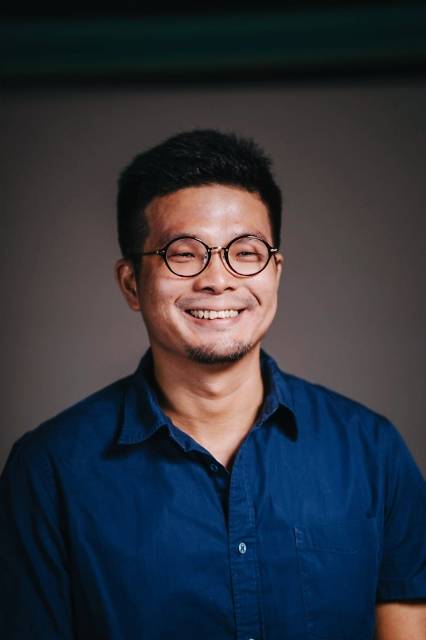
Rice Media founder Mark Tan says while the articles it puts out may sometimes be controversial, it “doesn’t start off with the intention of provoking”. (Photo: Mark Tan)
“I’ll wake up with a shower thought, and if it grinds up my gears that day I’ll write about it,” the founder said with a laugh. This was back in 2015 to 2016, when it was just a pet project for him and one of the current editors at Rice.
He said it was only about mid-2017 when the hobby became a full-time gig.
“One of my partners in Rice runs a creative agency, so they came up with the branding and the website,” he recounted.
It was also around this time that he met an angel investor who was a kindred spirit.
“We happened to meet an angel investor who liked what we were doing. It’s like ‘hey take my money, let’s do something’, and I was like: ’Ya, sure, why not?’”
The unnamed investor poured in S$300,000 in that round, allowing Rice to start recruiting and expanding its operations.
Today, it has about 12 full-time employees including seven in the editorial team, four in production and one account executive. It is racking up an average of about 500,000 unique visitors a month, the CEO said.
“We’ve actually just closed another round of funding … It’s just a private round; my investors, they don’t want to their names to be in the papers. But it’s a private round through some individuals… who I guess are passionate about magazines and content,” Tan said, adding these investors are Singaporeans or Singapore Permanent Residents.
He declined to say how much was raised, except to say that the figure was more than the initial investment.
ON REGULATOR’S RADAR?
Pushing the boundaries in reporting sensitive topics tend to attract attention from not just readers, but local authorities too.
But Tan said he hasn’t been called up for a chat with the Info-communications Media Development Authority (IMDA) yet.
He did point out that Rice’s audience is “far smaller” than Mothership’s, another local media entity that was asked by the then-Media Development Authority to register under the online class licensing scheme in 2015.
The website is “not as political” as others like The Online Citizen or now-defunct The Middle Ground either, he added.
“In fact, politics to us isn’t … it’s only interesting or relevant insofar as when it crosses over to certain social issues. When certain social issues become politicised then we might take an interest,” Tan said.
“Personally, I don’t really have an interest getting into the whole ‘Are we pro-Establishment or anti-Establishment’ (conversation). That isn’t really why I started the brand for.”
KEEPING THE PARTY GOING
In the end, Rice is still a business, and a relatively young one at that, and Tan is intent on creating a sustainable model so it can continue producing what it deems “good content”.
He shared that the operation is entirely funded by native advertising, or in other words, branded content. And it is a challenge to find the balance between the two.
Right now, the majority of published content is still original, he said, but should the ratio swing to, say, 50 per cent of all content is branded, it will be a problem. “Your audience might not like it.”
Similarly, there’s also the challenge of making sure one’s branded content is as good as the original ones – and this, Tan said, is difficult to achieve because there are more stakeholders involved.
“They might be like: ‘Oh you shouldn’t use this word because it’s controversial’,” he said.
The media start-up owner is realistic enough to recognise that this industry is not for those looking to make a lot of money.
“I mean, we’re not rolling in dough la, put it that way,” Tan said. “My reasons for doing this is we want to create good content, and we want to earn enough money so we can continue creating good content. That’s it.
“If you don’t do this, then the party will stop.”
This profile on Rice Media is part of a wider series looking at Singapore’s alternative online news scene. You can read more about the industry here, or the other profiles on Critical Spectator and Observer+.