Home Blog Page 792

New firefighting system, VR training among upcoming initiatives unveiled by SCDF

SINGAPORE: A new firefighting system to help tackle large-scale fires and the use of virtual reality to train emergency responders were some of the initiatives unveiled by the Singapore Civil Defence Force (SCDF) at its annual workplan seminar on Thursday (May 9).

From next year, the organisation plans to roll out a new modular oil tank firefighting system (MOTFS) which could help put out large-scale fires more quickly.

Citing the 2018 fire on Pulau Busing which took six hours to extinguish, Director of Operations of SCDF Assistant Commissioner Daniel Seet said that the MOFTS will enable SCDF to better mitigate fires involving large or multiple oil tanks.

READ: Pulau Busing oil storage tank fire extinguished after ‘massive operation’: SCDF

“Had this system been (introduced at) Pulau Busing, we would have had to deploy a lot lesser (sic) equipment on site. That actually helps tremendously because in any oil refinery system, space is a premium,” said Mr Seet.

“The laying of equipment on site is always the most resource-intensive. So with the collapse of the entire system into largely two guns, we are able to then save time and resources needed to set up this system.”

At full deployment, the two MOFTS’ monitors can pump out 100,000L of water per minute, compared to the current system of four monitors of 60,000L. This will reduce the number of monitors needed to be deployed, overcoming space constraints, said SCDF.

Currently, a fixed number of large monitors and equipment is deployed to each incident, regardless of scale. 

The MOTFS comprises pumps, hoses and monitors in a modular form, which can be quickly deployed in various combinations to match the scale of the incident. 

An automated hose retrieval system will also reduce fatigue for fire-fighters, said SCDF.

Water supply capabilities are also enhanced with a submersible pump unit that allows a large quantity of water to be drawn directly from an open water source, such as the sea, and supplied to a pump placed up to 50m away. 

Currently, a large pump has to be confined on land not more than 3m away from the surface.

“Once all the equipment is in place, we’ll start to train our personnel to orientate them to the new system and then conduct a series of exercises both internally, and also with the industry partners before we operationalise this equipment,” said Mr Seet.

AERIAL FIRE-FIGHTING

Other new technologies were also introduced to increase the range of tactical options for high-rise fire and rescue operations.

For example, the new Combined Platform Ladder 60m is able to extend up to the maximum height of a 20-storey building. It is also equipped with a water monitor capable of discharging water at a rate of 3,800L per minute, and a rescue cage that can hold up to 500kg of weight.

SCDF is also looking to acquire a longer 90m version.

NEW MEDICAL SUPPORT VEHICLE

SCDF also announced enhancements to its medical support vehicle (MSV) which allows the provision of pre-hospital medical care during both peacetime and national emergencies.

SCDF workplan seminar 5

SCDF also announced enhancements to its medical support vehicle. (Photo: Corine Tiah)

A new facility within the MSV provides a clean environment with the inclusion of an air evacuation system and surgical light that allows SCDF paramedics to perform on-site stabilisation and critical invasive treatments.

It also allows a single SCDF responder to transport an individual of up to 380kg with ease.

UNLIMITED AIR SUPPLY FOR UNDERWATER RESCUE

The Disaster Assistance and Rescue Team (DART) unveiled its new surface supplied diving equipment, which provides an unlimited air supply to the diver, allowing for prolonged underwater search-and-rescue operations.

SCDF workplan seminar 4

The Disaster Assistance and Rescue Team unveiled its new surface supplied diving equipment. (Photo: Corine Tiah)

Previously, DART divers were limited to about 40 minutes of underwater operations with an air cylinder, before having to resurface for air.

Once deployed, a DART diver will be fully encapsulated in a dry suit and hard hat, and attached to a surface air supply system for his primary source of air. An accompanying air cylinder will be his backup air supply, said SCDF.

REDEVELOPMENT IN FIELD TRAINING USING VIRTUAL REALITY

SCDF is also rolling out a series of initiatives using science and virtual reality to optimise training of emergency responders such as paramedics.

For example, there will be new training facilities which simulate a realistic training environment for emergency medical services.

Plans are also in the pipeline to use mixed reality, where physical and digital objects co-exist and interact in real time. 

Diverse and complex scenarios can be created quickly and users are guided step-by-step through a self-directed learning platform, with instant feedback provided through colour queues, said SCDF.

SCDF workplan seminar 2

SCDF is also rolling out a series of initiatives using science and virtual reality to optimise training of emergency responders. (Photo: Corine Tiah)

SCDF workplan seminar 1

SCDF is also rolling out a series of initiatives using science and virtual reality to optimise training of emergency responders. (Photo: Corine Tiah)

The organisation is looking to explore the use of VR technology to put firefighter trainees in multiple mission environments, which can include a render of an existing building. This will also provide an objective during- and after action review that shows what can be improved upon.

SIGNING OF MEMORANDUM OF INTENT

The SCDF also signed a memorandum of intent with both Mercy Relief (MR) and Singapore Red Cross (SRC) on Wednesday to provide humanitarian volunteering opportunities for Civil Defence (CD) Lionhearters and their schoolmates.

“By tapping on MR’s and SRC’s expertise and networks, CD Lionhearters will be able to gain more exposure and acquire new experiences,” said Senior Parliamentary Secretary for Ministry of Home Affairs and Ministry of Health Amrin Amin.

“These youth volunteers are crucial to inspire and motivate their peers as well as the next generation towards volunteerism and community first response.”
Source link

NUHS studying how exoskeleton technology can gird Singapore’s rehab landscape

SINGAPORE: Mr Henry Tan, 66, a retired engineer, has congenital muscle dystrophy, which weakens his muscles. It gave him a poor gait and he recalls shuffling around, hunched over a walking stick. Things got worse in October 2018, when he suffered a stroke and lost strength on his right side and became wheelchair-bound.

But treatment with the EksoGT suit – a robotic exoskeleton – is helping him improve his range of motions. He has already gone for six sessions of rehabilitation with the suit.

Said Mr Tan: “Before this, I used to swing my leg too much to one side and walk with my feet open. And I waddled like a penguin because my muscles are weak. But now (this suit) pulls my legs straight.” 

Exoskeleton Patient Mr Henry Tan

Mr Henry Tan wearing the exoskeleton suit and being supported by St Luke’s Hospital physiotherapists. (Photo: Try Sutrisno Foo)

The suit is made by US-headquartered company Ekso Bionics, which specialises in exoskeleton bionic technology to enhance soldiers’ mobility when carrying heavy loads. It evolved the technology beyond military applications, when it found that it could be useful to paraplegics as well.

Right now, the National University Health System (NUHS) – which comprises healthcare institutions such as Alexandra Hospital, Ng Teng Fong General Hospital, Jurong Community Hospital and National University Hospital – has three Ekso suits under its care.

This allows a physiotherapist to increase the intensity of gait training for patients. A patient in an EksoGT suit can take up to 500 steps in a 20-minute session. This is compared to an average of 50 to 100 steps taken without it. 

NUHS on Monday (May 6) launched a programme called Improving Mobility via Exoskeletons Programme, or iMove. The two-year programme, which is supported by Temasek Foundation and Trailblazer Foundation, will study the use of exoskeletons beyond inpatient rehab at hospitals. It aims to also see how robotic exoskeletons can be used for outpatient rehab in community hospitals and nursing homes.

iMove will then evaluate how patient outcomes from using robotic exoskeletons compare with current standard care and assess if scaling up the programme is viable.

The plan is to enroll up to 400 patients in this study. Out of these, 100 will be part of a control group and will not use the exoskeleton suit.

Data from the patient’s performance before, during, and after using the suit will then be collected. So far, 68 patients in Singapore have used the suits. Thirty-six of the patients had data from their sessions on the suit recorded for the iMove study. 

Six have of these patients have already completed the course of the study and two-thirds of them have shown an improvement in at least one category of functional mobility, said Dr Effie Chew, chief of rehabilitation services at Alexandra Hospital.

Mr Gandhi Mailvahanam, a former marathoner, is one such patient who has seen results.

The 65-year-old had suffered a traumatic injury eight years ago which affected his spinal cord. He was left bed-bound after a surgery went wrong two years ago.

“I find (I’m) lighter. I can move my body from left to right, right to left. Before these two years, if I wanted to move myself, I had to find somebody to push my body backward and forward. After 15 sessions I feel my body is lighter,” he said. 

The exoskeleton suit has also helped Mr Mailvahanam regain enough muscular strength to get back on his feet.

“I can even hold my wheelchair and stand up at least 50 times. Before this, I couldn’t even do it five or 10 times.”

​​​​​​​

Exoskeleton Patient Mr Gandhi Mailvahanam

Mr Gandhi Maivahanam and physiotherapists demonstrating their use of the EksoGT suit at Alexandra Hospital. (Photo: Try Sutrisno Foo)

The suits will be deployed to healthcare institutions and sites with physiotherapists trained in their use. These include Alexandra Hospital, NTUC Health, St Luke’s Eldercare, St Luke’s Hospital and Stroke Support Station.  

Dr Chew said it is hoped an encouraging outcome for the study will justify the use of the technology such that it becomes commonplace in the community.

Source link

Help, and a new wheelchair, delivered to GrabFood rider with cerebral palsy

SINGAPORE: Her wheelchair is more than a mobility device to her; it is a lifeline for her family and the vehicle for the 26-year-old’s very first job — the workhorse in her quest for independence.

So when CNA Insider viewers learned that it was breaking down, they rallied round GrabFood delivery rider Roszana Ali, who has cerebral palsy.

They raised the funds needed for a new electric wheelchair — about S$2,100 — in less than a day. And within the next three days, it was delivered to her.

Touched by her story, which was published last Thursday, many people have expressed support for her, with some reaching out to CNA Insider to find out how they could lend her a helping hand.

"I want to be a model,” says GrabFood rider Roszana Ali. “I like dressing up … I just like fashion.”

Before she found hope and fulfilment in earning money as a delivery rider, she had tried and failed to get a job until she had given up.

READ: Jobless for 7 years, woman with cerebral palsy finds hope, faces new hurdles

After her story was filmed, her father told CNA Insider that the wheelchair she usually used on the job was giving way. This made it difficult — and potentially dangerous — for her to make deliveries.

That piece of news, which CNA Insider posted on Facebook, sparked Mr Muhammad Bukhary into action. With a few texts to more than 30 people, he managed to raise the money for a new wheelchair by Friday morning.

GrabFood rider Roszana Ali with her father Ali Osman and donor Muhammad Bukhary.

Ms Roszana with her father Ali Osman and donor Muhammad Bukhary.

“Despite her challenges, she’s able to work and even help her family out with chores, and it struck a chord (with me), as an able-bodied person,” said the 31-year-old.

“She’s on the other end of the spectrum, and she couldn’t get a job, so she needs something to get back on her own two feet.”

This sentiment also resonated with 41-year-old Nadiyah Kamsani. She visited Ms Roszana and presented her with about S$2,300, which she hopes can offset the rider’s loss of income and help her family prepare for the coming Hari Raya festivities.

“Even with her kind of disability, she’s so determined to find an income for her family,” she said. “She’s a very smart girl … It moved me that she didn’t make any excuses despite her disability.”

Ms Nadiyah Kamsani visited GrabFood rider Roszana Ali and presented her with about S$2,300.

Ms Nadiyah Kamsani visiting Ms Roszana.

Referring to a scene in the video where Ms Roszana was helping to vacuum at home, Ms Nadiyah added: “When I saw her doing that, I was like … ‘Oh my god, I wish I had a daughter like that.’”

SHE’S VERY TOUCHED, STAYING POSITIVE

Ms Roszana admitted to being surprised and overwhelmed by the attention she has received. When asked how she felt seeing herself on camera, she said with a bashful smile that she was “shy”.

But it also made her realise that the work she was doing was tough.

GrabFood rider Roszana Ali crossing the road in her electric wheelchair.

Ms Roszana Ali crossing the road in her wheelchair.

“When I deliver, I just do,” she said. “But I think positively. And I want the world to know how hard it is for disabled people to find a job.”

She is grateful for the outpouring of support from readers and viewers. More than 50 people contacted CNA Insider to offer help, while hundreds posted words of encouragement.

“To be honest, I’d probably be annoyed if the food delivery is slow, but when I open the door and see her, I’d feel ashamed of myself,” commented Mr Yazid Sallim.

“I’d be honoured to be served by her — I’d feel blessed that she would’ve made me reflect on my behaviour.”

Disabled GrabFood rider Roszana Ali making another successful delivery.

Another successful delivery.

Ms Roszana took the advice of some of those she had spoken to, and started a crowdfunding page. But it closed within an hour, as Mr Muhammad had by then funded the cost of her new wheelchair in full.

“I do read all the comments one by one, and I’m very touched,” she said, adding that while she has noticed comments questioning the safety of this job for her, she will take them in her stride.

READ: Worries about delivery time, safety for food delivery riders with disabilities

“If everything is dangerous, then you’ll never go out,” she said. “Just be yourself, don’t care about the negative things … Just go out and be positive.”

"Don’t care about the negative things ... Go out and be positive," says GrabFood rider Roszana Ali.

And she is extra grateful for the new wheelchair, as there is “a lot of difference” from her previous one, which she had used for nine years.

“This one is a lot faster, and the new seat is a lot firmer,” she explained.

While she has a spare motorised wheelchair, subsidised by SG Enable, she prefers not to use it for her deliveries because it is smaller and the wheels tend to get stuck in the platform gap at MRT stations.

“We didn’t know he (Mr Muhammad) was going to buy (one),” she added. “The person who came to me said they’re very proud of me, and also told me to take it easy because it’s the fasting month.”

GrabFood rider Roszana Ali's new wheelchair is faster than her previous one, and the seat is firmer.

PAYING IT FORWARD

Ms Roszana is also mindful that many other people with disabilities may need a helping hand. This is something her father, Mr Ali Osman, hopes she will always remember.

“I’m thankful to God and to those who’ve contributed. And I told her that with the help she received, she must remember those who are even more in need than she is,” he said.

In fact, Ms Roszana donated a portion of the money she received to relatives who also needed financial help — but Mr Ali said she did not want to tell anyone.

With the help his daughter Roszana received, Ali Osman hopes she'll always remember others in need.

“That’s how pure her heart is,” he said. “I’ve taught her not to be very kiasu with money since young. And we want to share the blessings with those in need during this blessed month of Ramadan.”

As it turned out, Grab had planned to conduct an internal fundraiser to buy her a wheelchair.

But as she has since received one, the company intends to gift S$1,500 worth of GrabFood vouchers to the Muslim Handicap Society of Singapore, the non-profit organisation she chose.

“We’re heartened that Roszana chose to bless others, and we’re proud to help her pay it forward,” said Grab’s co-chief of staff and head of GrabFood Singapore Lim Kell Jay.

Grab’s co-chief of staff to the CEO and GrabFood Singapore head Lim Kell Jay.

Mr Lim Kell Jay.

The impact of her story will soon be felt in other ways too. Readers and viewers have made suggestions they hoped Grab could implement, ranging from better incentives for riders with disabilities to allowing customers to leave tips for riders.

When asked about these, the company confirmed that change is in the pipeline, including plans to roll out a function for customers to tip GrabFood Singapore riders later this year.

If a rider is in a wheelchair, the company will indicate via GrabChat messages and a customised icon in-app that its rider has a physical disability, so merchants and customers can temper their expectations, or offer help if necessary.

It is also looking at limiting the delivery distance for these riders. And it hopes to partner with electric wheelchair manufacturers so its riders can get wheelchairs or batteries at a cheaper rate if needed.

In the meantime, things are looking up for Ms Roszana’s family. “I know her plight and my own struggles, but … I don’t really bother about the pains any more,” said Mr Ali, who is unable to work because of asthma.

“Things are getting better, and I’m just very thankful.”

Disabled GrabFood rider Roszana Ali and her parents.

Ms Roszana and her parents.

Source link

Several trees across Singapore fall amid widespread thunderstorm

SINGAPORE: Several trees were uprooted amid strong winds and heavy showers in Singapore on Wednesday (May 8). 

Fengshan Member of Parliament Cheryl Chan shared a photo of one of the fallen trees on her Facebook page, which was captured at Block 116 Bedok North Road. 

“Due to heavy rain and strong winds this morning, trees have been reported to have fallen,” said Ms Chan. “Town Council is working to clear the fallen trees. I seek residents’ assistance to stay clear from those areas and please call Town Council for support in you find any in your area.” 

Meanwhile, a fallen tree reportedly caused a traffic jam that lasted more than an hour along the Pan-Island Expressway (PIE) towards Tuas before Eng Neo Avenue on Wednesday morning. 

The Land Transport Authority tweeted an advisory at about 11am, warning motorists of a congestion until the Thomson Road exit.​​​​​​​

Workers were also seen clearing a tree that had fallen along Portsdown Road on Wednesday afternoon. A number of fallen trees and branches were reported in eastern Singapore as well. 

Fallen tree behind Tanglin Trust School

A fallen tree along Portsdown Road, on May 8, 2019. (Photo: Johannes Tjendro)

In a response to CNA’s queries, the Meteorological Service Singapore (MSS) said the heavy downpour was due to the passage of two consecutive Sumatra squalls which had formed along the Strait of Malacca last night “as a result of strong convergence of air streams over the region”. 

“The squalls swept across Singapore between 2am and 5am and again between 9am and 11am. 

“The highest total rainfall of 109.8mm was recorded at Jurong West between 2.05am and 2pm today. The most intense 30- and 60-minute rainfall were 52.8 mm and 71.9 mm recorded at Simei and Jurong West respectively,” said the Met Service. 

MSS also noted the “intense lightning” observed over the southern and western parts of Singapore during the thunderstorm, which it attributed to “intense convection within thunderstorm cells in a squall”. 

Earlier on Wednesday, the National Environment Agency tweeted that Singapore has an average of about 186 lightning days per year, with May being one of the months with the highest incidence of lightning activity. 

Last month, the Met Service said widespread thundery showers with gusty winds were to be expected on three or five days in the second week of May.

It is expected to be hot as well, as May is one of the warmest months of the year.  

Source link

Illegal codeine cough syrup, other medication worth S$53,000 seized in Geylang

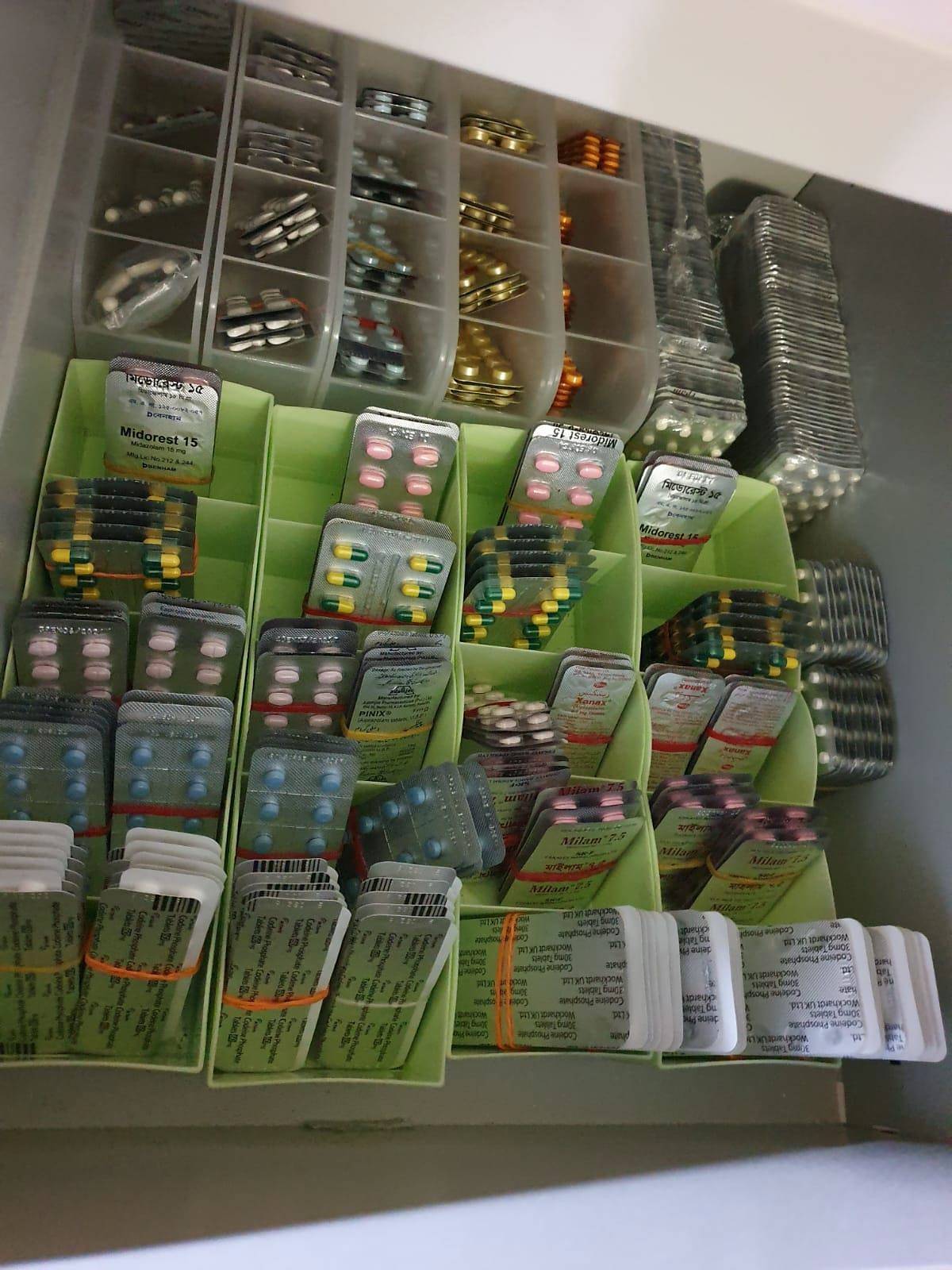
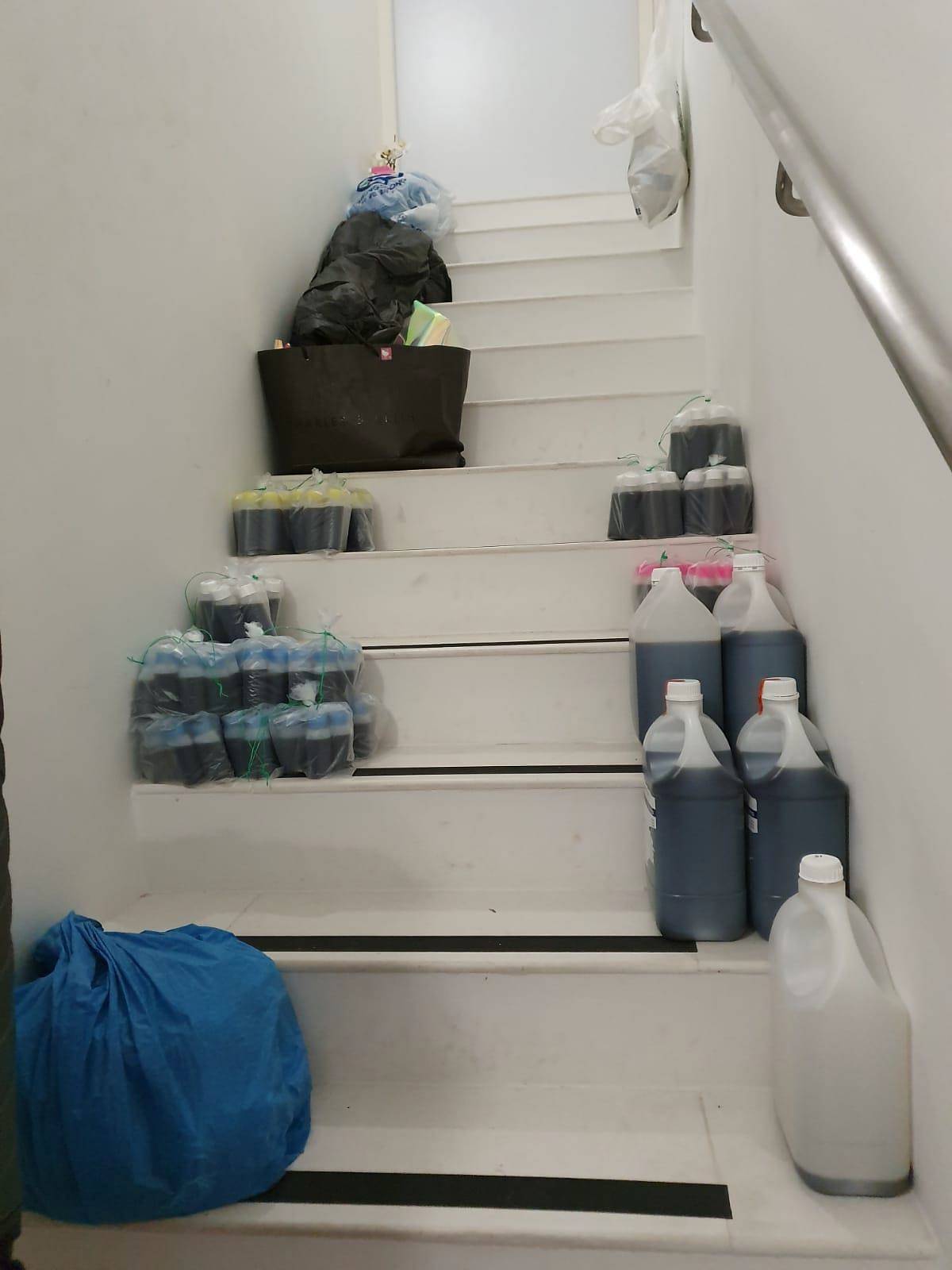
SINGAPORE: More than 80 litres of illegally manufactured codeine cough syrup and 32,000 tablets of assorted medicines were seized from an apartment in Geylang on Wednesday (May 8).

The Health Sciences Authority (HSA) said in a statement that the seized tablets included sleeping pills such as midazolam, nitrazepam and diazepam, as well as other prescription medicines including codeine tablets.

The total street value of all items seized was about S$53,000.

READ: 2.6kg of synthetic cannabis seized in Yishun, 2 men arrested

Illegal codeine cough syrup and medication worth S$53,000

Sleeping pills and other medicines seized during the operation. (Photo: Health Sciences Authority)

HSA said it conducted an enforcement operation in Geylang on Wednesday morning with police officers from the Bedok Police Division following feedback from the public regarding the illegal sale of codeine cough syrup at a coffeeshop near Lorong 20 Geylang. 

Surveillance revealed that the illegal products were stored in a nearby apartment.

“Preliminary investigations revealed that the apartment was used to illegally manufacture and store the cough syrup and medicines. These products were intended for illegal sale in Geylang,” HSA added.

During the operation, two men and a woman were caught inside the apartment. 

The three suspects, aged between 20 and 28, are currently assisting HSA with investigations into the manufacture and supply of illegal medicines.

READ: HSA seizes S$40,000 worth of illegal cough syrup, tablets at Sin Ming HDB flat

codeine cough syrup and medication worth S$53,000 seized in Geylang

Equipment used to make codeine cough syrup was found inside the apartment. (Photo: Health Sciences Authority)

Codeine cough syrups are used medically as a cough suppressant. They are classified as pharmacy-only medicines and can only be supplied by a licensed pharmacist or a licensed medical practitioner, HSA said.

HSA Enforcement Branch Director Annie Tan said cough syrup concoctions made in non-licenced facilities are dangerous and harmful to health as they are produced under poor manufacturing conditions with no proper quality controls.

She advised consumers to purchase such medication from licensed sources such as registered clinics and approved pharmacies.

READ: 91 arrested in multi-agency operation in Geylang

Illegal codeine cough syrup and medication worth S$53,000 (1)

The seized tablets included sleeping pills such as midazolam, nitrazepam and diazepam, as well as other prescription medicines including codeine tablets. (Photo: Health Sciences Authority)

“Through our close collaboration with the police, we were able to successfully uncover and disrupt this illegal supply of codeine cough syrup, and prevent further harm to the public. HSA will continue to step up our efforts and work with the relevant agencies on raid operations in targeted areas to disrupt the illegal supply of such medicines,” she added.

Those found guilty of importing, manufacturing and/or supplying illegal health products face up to two years’ jail and/or a fine of up to S$50,000.

Members of the public are encouraged to report any illegal activity involving illegal cough syrup and medicines to the Enforcement Branch of HSA.

READ: ‘Smart drugs’, weight loss products worth S$9,000 seized

Illegal codeine cough syrup and medication

Canisters and bottles of codeine cough syrup found within the apartment. (Photo: Health Sciences Authority)

Source link

Biggest threat to Johor River’s sustainability is lack of environmental protection: Vivian Balakrishnan

SINGAPORE: Foreign Affairs Minister Vivian Balakrishnan on Wednesday (May 8) warned that the “biggest threat” to the sustainability of the Johor River was a lack of environmental protection, as he urged Malaysia to safeguard water quality for the benefit of both sides.

“The biggest threat to Johor’s own water supply is actually the lack of environmental protection,” Dr Balakrishnan told Parliament. “And the seven episodes since 2017 … are a clear and present amber warning light.”

The minister was referring to the seven pollution incidents that caused PUB’s Johor River Waterworks to be temporarily shut down. The most recent case was on Apr 4, when high levels of ammonia were found in the Johor River.

He noted that the PUB plant and two other water treatment plants belonging to Malaysia were “currently drawing more water from the Johor River (than it) can yield on a sustainable basis”.

Dr Balakrishnan was responding to questions from Members of Parliament regarding the state of bilateral relations between Singapore and Malaysia following a leaders’ retreat last month.

READ: Singapore raises concerns over Johor river, seeks sustainable water supply for both countries

READ: Singapore, Malaysia affirm commitment to cooperative and forward-looking bilateral relationship

Dr Balakrishnan said Prime Minister Lee Hsien Loong had raised “grave concerns” about the pollution and long-term yield of the Johor River during the retreat.

Mr Lee, referencing a March incident when thousands fell ill after chemical waste was illegally dumped into Sungai Kim Kim in Pasir Gudang, had said a similar incident at the Johor River would be “disastrous for both countries”.

Dr Balakrishnan said “these issues, if not addressed, will compromise Singapore’s right to extract our full 250 million gallons per day (mgd) entitlement of water” from the Johor River under the 1962 Water Agreement.

“They will also affect the water supply for Johor’s own growing needs,” he added. “Action needs to be taken expeditiously to avoid a potentially more intractable issue in the future. This is a problem which is clear and present and we can see it looming.”

Under the 1962 agreement, Singapore is entitled to draw 250 mgd per day of water from the Johor River, while Johor is entitled to buy treated water up to 2 per cent of the total quantity of water imported to Singapore on any given day or about 5 mgd when Singapore draws its full entitlement.

In practice, Singapore has been selling 16 mgd of treated water to Johor, at the latter’s request.

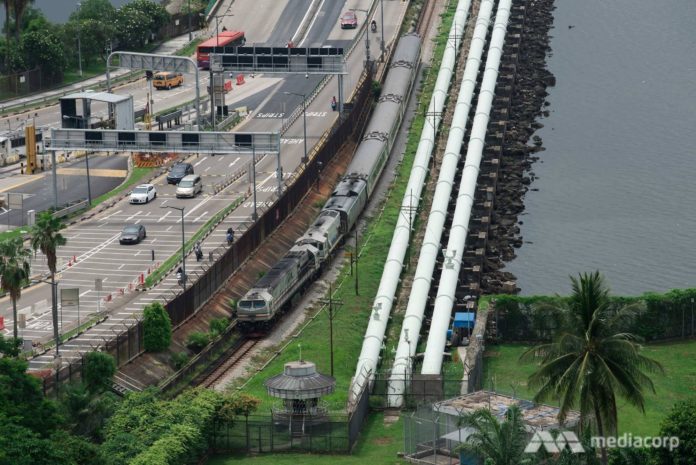
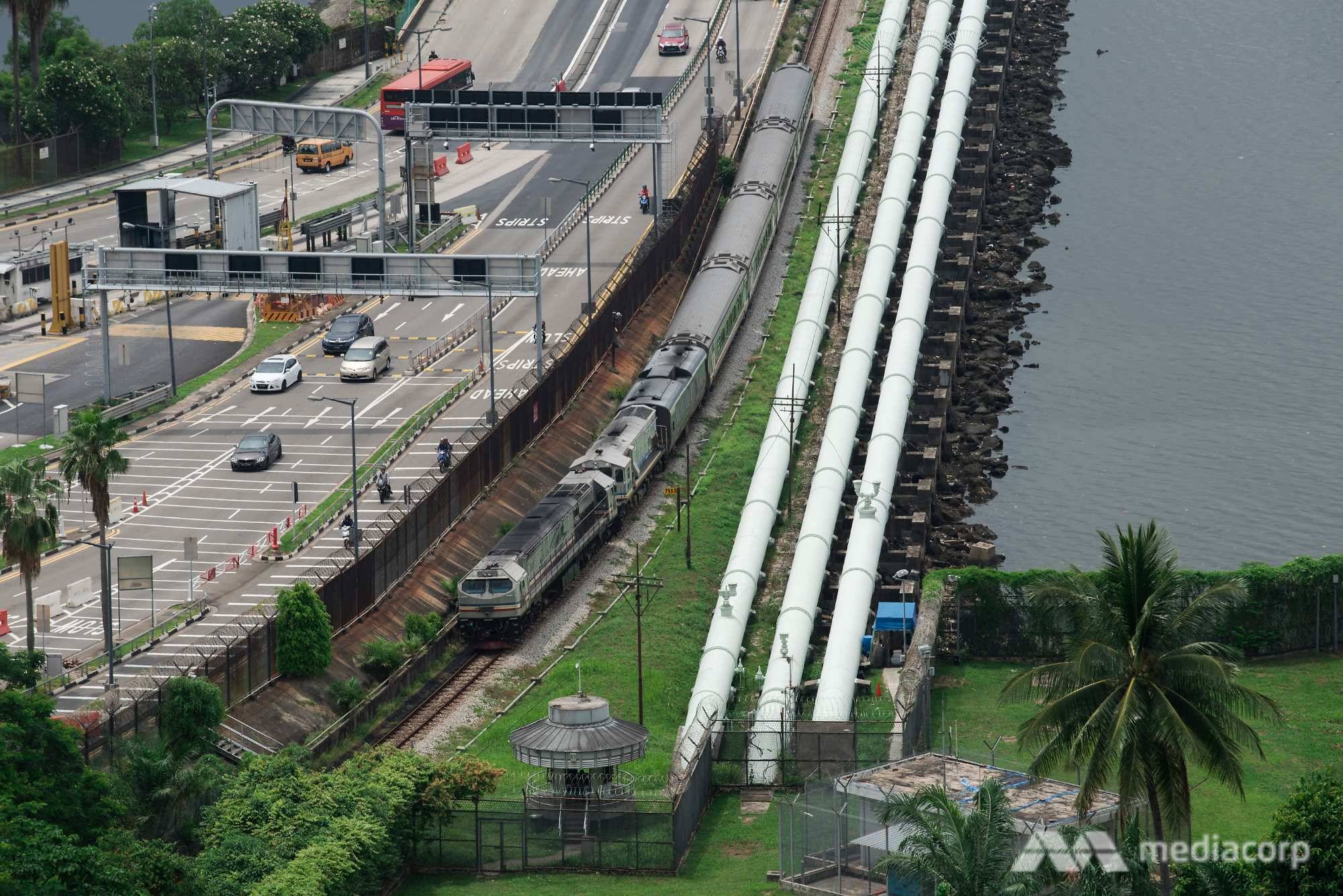
Water Singapore Malaysia 06

Water pipes running along the Causeway between Singapore and Malaysia. (File photo: Jeremy Long)

On Wednesday, Dr Balakrishnan said both governments have noted mutual interest in “identifying appropriate and timely measures”, including schemes to increase the yield of the Johor River and safeguard its environmental conditions and water quality.

“Officials from both countries will follow up on this,” he added.

Dr Balakrishnan, who was once Environment and Water Resources Minister, also encouraged Johor to look at the approach Singapore has taken to safeguard its water quality.

“The challenge for maintaining that quality of assured water supply is not just a technical challenge,” he stated. “It means having strict laws against littering, against pollution, strict and careful long-term planning on zoning, on what type of economic activities are allowed in the water catchment areas.”

However, the minister noted that the Johor authorities were doing what they could. “I think to be fair, the authorities in Johor are aware of this and within their own limits they are trying to address it.”

OUTSTANDING BILATERAL ISSUES

In his reply, Dr Balakrishan also touched on the outstanding bilateral issues including airspace, land and maritime boundaries.

He said that bilateral relations are now on a “more stable footing” but there is still much work to be done.

READ: Airspace talks with Malaysia to factor in safety and efficiency of civil aviation, says PM Lee

On airspace issues, he noted that Malaysia plans to review existing arrangements which delegate the airspace over southern peninsula Malaysia to Singapore, as spelled out in a 1974 Letter of Agreement signed by both countries.

Dr Balakrishnan said the agreement, which operationalises recommendations that were agreed to by both countries and other regional states, was approved by the International Civil Aviation Organization (ICAO) Council.

READ: Singapore, Malaysia working towards new ‘supplemental agreement’ to suspend RTS Link project

“Thus, any review of the existing airspace arrangements should take into account both countries’ needs and interests, as well as the interest of other stakeholders including the airlines and ICAO,” he said.

This means discussions on the review of the 1974 agreement will involve many regional and global stakeholders, Dr Balakrishan added, noting that it would take time and “cannot be rushed”.

Johor Baru-Singapore Rapid Transit System Link (RTS) map (Infographic: Rafa Estrada)

Johor Baru-Singapore Rapid Transit System Link (RTS) map (Infographic: Rafa Estrada)

On land issues, Dr Balakrishnan said both countries were still working out details of a “supplemental agreement” to suspend the Johor Bahru-Singapore Rapid Transit System Link project, similar to the approach taken in the suspension of the High-Speed Rail project.

Dr Balakrishnan said the projects will benefit both countries by easing congestion, facilitating business and improving tourism. “The ball is now in their court,” he added. “We hope that Malaysia will find a way forward in the projects within the period of suspension that they have requested.”

READ: Singapore-Malaysia maritime dispute: Both sides agree to suspend overlapping port limits

Johor straits

An aerial view taken from a helicopter shows Singapore (L) bordering with the southern state of Johor (R) on Feb 2, 2016. (Photo: AFP/Roslan Rahman)

On maritime boundary issues, Dr Balakrishnan said a committee co-chaired by foreign ministry officials from Singapore and Malaysia will meet “soon” to start negotiations on maritime boundary delimitation. Earlier, both sides agreed to mutually suspend the implementation of their overlapping port limits.

Source link

ComfortDelGro to pilot new booking service amid growing passenger demand

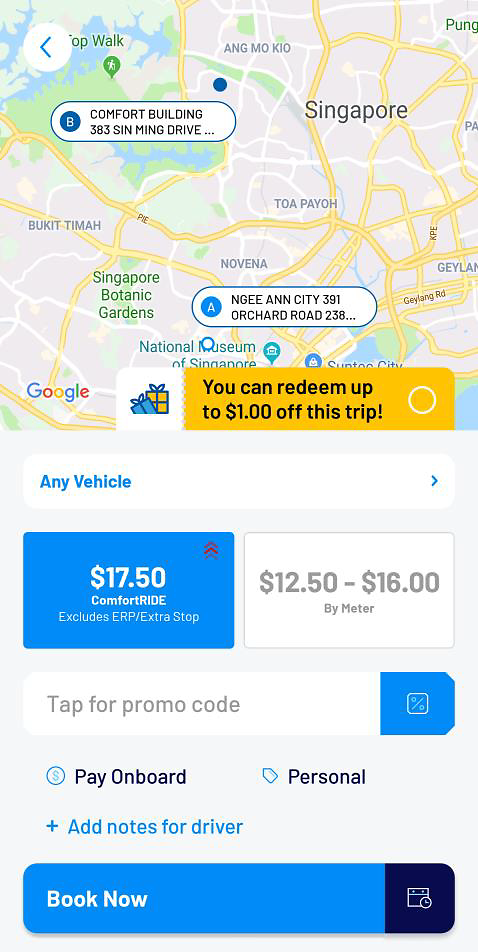
SINGAPORE: ComfortDelGro announced on Tuesday (May 7) it will pilot a new booking service called ComfortRIDE that allows passengers to book rides with fixed fares set based on demand at the time of booking. 

In a statement, the taxi operator said that it will begin pilot testing ComfortRIDE on the existing ComfortDelGro Taxi Booking App on May 15. The service will be available at first to a small group of passengers and may be extended to more passengers on a later date. 

With the pilot, passengers can use the app to choose between a traditional metered taxi option and the new ComfortRIDE option which will despatch either a taxi or possibly in the future, a private-hire vehicle. 

ComfortRIDE, which will only be applicable for current bookings, will see fares adjust according to market demand and supply, said ComfortDelGro. 

“Peak demand fares will, however, be monitored and any surges, will be limited and not exponential. The fares will conversely be lower during off peak,” said the company. 

ComfortDelGro's new service - COMFORTRIDE

What it may look like when pilot testing for ComfortRIDE begins on the ComfortDelGro Taxi Booking App. (Image: ComfortDelGro)

ComfortDelGro said that the service will bring together its 12,000-strong fleet of cabs and possibly private-hire vehicles to help ease the supply crunch, such as that experienced on rainy days. 

“Our volume of booking jobs for 2018 has increased by 7.4 per cent and is still experiencing an uptick in the first four months of 2019,” said ComfortDelGro Taxi CEO Ang Wei Neng.

“The aim of ComfortRIDE is to meet the demand especially during peak hours. With more taxis on the roads during peak hours, commuters will be confirmed a vehicle faster and their waiting time will be reduced.

“This will create demand, so our cabbies can look forward to better earning opportunities and less empty cruising,” he added. 

ComfortDelGro taxi driver Tan Soon Huat called the service a “win-win situation as it means less waiting time for passengers eventually and more jobs for ComfortDelGro cabbies”. 

Source link

Exemption of Government from being sued under POHA amendments a ‘glaring omission’: Pritam Singh

SINGAPORE: The decision to exempt the Government from being sued should it perpetuate a falsehood is a “glaring omission and a lost opportunity at winning the trust of the public”, Workers’ Party MP Pritam Singh said in Parliament on Tuesday (May 7).

Mr Singh was speaking at the second reading of the Protection from Harassment (Amendment) Bill, which seeks to enhance protection for victims of harassment and falsehoods, and to make it easier for victims to obtain remedies.

The amendments to the Protection from Harassment Act (POHA) include criminalising the act of doxxing, which is the publishing of someone’s personal information such as their photos, contact numbers or employment details with the intention to harass. 

The amendments will also include the setting up of a Protection from Harassment court.

Under the Bill, public agencies are excluded.

“What this effectively means is that an individual or company cannot apply to the Harassment Courts in case the Government makes misleading or false statements against them,” he said.

He added that such exemption does not conform to the principle that the rule of law applies equally to all.

READ: As the ‘human flesh search engine’ of online vigilantism grows, measures to deal with doxxing critical, MPs say

GOVERNMENTS CAN COMMUNICATE FALSEHOODS

In supporting his point, he noted the observations of some who spoke at the Select Committee on Deliberate Online Falsehoods that governments can also communicate falsehoods or misleading information.

“Why shouldn’t the public receive protection provided by this Bill – against a prospective government or minister that uses his or her powers not just unwisely but maliciously – with a view to seek a remedy from a neutral body like the courts?” he asked.

Pritam Singh

Pritam Singh in Parliament on May 7, 2019.

To make his point, Mr Singh referred to a video in which former Internal Security Act (ISA) detainee Poh Soo Kai accused the Government of wrongfully alleging that he rendered assistance to an injured Communist Party of Malaya member in Masai, Malaysia.

Mr Poh claimed that he never went across to Malaysia, and that this could be proven through immigration records. Mr Poh then went on to accuse the Government of peddling a false statement of fact as defined by the Bill.

“Now, the limitation period of this example notwithstanding, under the Bill such an individual would have no remedy against a false statement made by the Government,” he said.

“Would the public interest not be better served in allowing a person to apply for the appropriate order from the Harassment Courts and in doing so, make their case?” Mr Singh asked.

“I would argue that the prospects of such recourse and the availability of a neutral forum like the courts, combined with a simple process would in itself act as a deterrent against individuals who seek to retrospectively burnish their reputations or embarrass the Government.” 

READ: ‘Doxxing’ to be criminalised under amendments to Protection from Harassment Act

He said he was not taking a view about the veracity of the facts as presented either by Mr Poh or the Government. However, he said that because all the relevant information is not openly accessible, there is no way members of public can objectively take a view on either side of the story.

“It goes without saying that there exists an asymmetry in information and power between a government and its citizens,” he said.

GOVERNMENT NOT BOUND BY LEGISLATION

He added that allowing a government to open itself to scrutiny on matters where it is accused of peddling falsehoods can “paradoxically operate to strengthen trust in Government”.

He said that political leaders all around the world find their mandate to rule “increasingly questioned by a sceptical public”.

In response to Mr Singh, Senior Minister of State for Law Edwin Tong said that the general position in law is that the Government is not bound by legislation unless it expressly provides for that to be so.

“In the case of POHA, that is the case, and the Government has taken a view that it will not avail itself of remedies under POHA and likewise, it will not be subject to the provisions under POHA,” Mr Tong said.

“As to how officers of the Government can be held accountable, that can always be done in the usual forum, like in Parliament, as is the usual case.”

WHAT IS A MISLEADING STATEMENT?

Mr Singh also had other points to clarify. He wanted to know how a “misleading statement” prescribed under the Bill will be objectively assessed.

Under the Bill, “a statement is false if it is false or misleading whether wholly or in part, and whether on its own or in the context in which it appears”.

READ: Watain concert cancelled based on Christian community’s reaction after initial approval

“While there exists an objective legal test for determining whether a statement of fact is false, can the minister confirm how the Government expects the courts to interpret the boundaries of a statement that is misleading in the context of the new remedies provided for under the Bill,” Mr Singh asked.

He referred to a “hypothetical example” where a person will have made a statement against a black metal band two weeks before it is due to perform, encouraging others not to attend the performance.

This could lead to a loss of revenue and poor ticket sales that could be attributed to the onset of a viral online campaign by that person. The statement is then headlined in bold, reading “People who listen to black metal music may commit violence in the real world” alongside pictures of individuals with heavily tattooed faces.

“From the standpoint of a black metal band, whose music undoubtedly may not be everyone’s cup of tea, the statement is misleading because all sorts of people may commit violence in the real world,” Mr Singh said.

“Therefore a statement can be potentially misleading if it does not cover all the relevant facts or represent the matter fairly – and the choice of which facts are chosen usually turns on where you stand on any given matter, philosophically, politically or morally, for example.”

Responding to Mr Singh’s specific example, Mr Tong said that the statement made by the individual would be an opinion and not a fact.

“It’s a view that has been formed. It’s a culmination of various factors which have led a person to come to the conclusion. That’s not a statement of fact, nor can it be characterised as a misleading statement which is also a statement of fact,” Mr Tong said. 

Misleading statements are made through omission, the minister added.

Mr Singh also noted that there may be a challenge in defining doxxing. For example, there may be a case where an individual’s identity information is already online and another online commentator posts a hyperlink to it with an innocuous comment like “this person is a lawyer and yet he behaves in such a way”.

While the actively revealed information is uncontroversial, the hyperlink reveals other personal information like place of work and contact numbers.

“In such a case, it would be arguable whether the comment and hyperlink together meet the threshold of intent as required under clause 4 of the Bill,” Mr Singh said. In response, Mr Tong said that based on this example, the act is not a question of doxxing.

“Posts which merely state opinion or which are meant to encourage social debate, for example, do not fall within the ambit of offences,” Mr Tong said.

In addition, Mr Singh also said that the courts may have to move faster than the 24-hour window in which the courts will aim to hear the applications.

Mr Singh said that the Workers’ Party supported the Bill, which proposed “very significant” changes to the Act. 

Source link

As the ‘human flesh search engine’ of online vigilantism grows, measures to deal with doxxing critical, MPs say

SINGAPORE: Members of Parliament (MP) on Tuesday (May 7) welcomed the criminalisation of “doxxing” under new amendments to the Protection from Harassment Act (POHA), stressing the need for such laws as online vigilantism becomes more “rampant”.

Doxxing is the act of publishing personal information like photos, contact numbers or employment details with the intention to harass.

Parliament on Tuesday passed amendments to the Act, which means that perpetrators of doxxing could be fined up to S$5,000 or jailed up to six months if the intention was to cause harassment, or 12 months if the intention was to cause fear or provoke violence.

In their debate on the amendments, MPs said online vigilantism impinges on individuals’ personal rights, hurts their physical, mental and financial health, and sometimes targets the wrong people.

MP for Nee Soon GRC Lee Bee Wah said Singapore has seen its fair share of victims who were mistakenly identified.

She pointed to one incident in April 2017, where employees of a local bank were wrongly identified as the perpetrators in a viral video showing a young couple bullying an elderly man at a Toa Payoh hawker centre. 

Netizens circulated their photos online and some even threatened to boycott the bank.

The wrongly identified woman later recounted her ordeal in a Facebook post, calling it “an emotional period and scary moment”.

Speaking about the same case, Nominated MP Lim Sun Sun said the chances of getting it wrong are “high”, especially as netizens often use partial information shared on social media, like grainy videos and blurry photographs.

“Such mistaken identification can lead to incalculable emotional and financial costs for the unfortunate individuals,” she added.

Even if the perpetrators are correctly identified, Dr Lee said harassing them is “never justified”.

“If someone has done something objectionable, we can deal with it through our laws,” Dr Lee added. “But we cannot allow people to harass them in real life. That is like taking justice in your own hands, no different from secret societies or prehistoric villagers.”

READ: “Doxxing” to be criminalised under amendments to Protection from Harassment Act

Tanjong Pagar GRC MP Chia Shi-Lu said the administration of justice is “not an activity which can be done part-time, remotely nor casually”. “Thorough investigations of the facts of the events are necessary, in fairness to all parties involved,” he said.

“I urge all those who truly value justice to consider joining the police force, where you can put your ‘CSI’ skills to good use,” Dr Lee added. “There is no need to take matters into your own hands.”

On the other hand, Professor Lim said the court of public opinion only hands down premature sentences that could be “disproportionately harsh”.

“Indeed, the equivalent Chinese term for doxxing is ‘human flesh search engine’,” she added. “This term graphically captures the rabid zeal with which online vigilantes hunt down and tear apart their targets.”

“AMBIGUITY” IN DEFINITION OF OFFENCE?

Nominated MP Walter Theseira also shared about his experience being harassed online after a comment he made to the media on CPF policy was taken out of context by an online website and posted on Facebook.

As the post went viral, Dr Theseira said netizens insulted his appearance, qualifications and even made outright threats of violence. An individual even turned up at the university where Dr Theseira to look for him.

“It turned out he had come to complain about my dangerous views on CPF to me in person, or perhaps to the university management. So I explained the context to him. It turned out he was not unreasonable, just misinformed,” he added.

“But it did cross my mind that not all unexpected visitors might be reasonable people.”

Nee Soon GRC MP Louis Ng welcomed the criminalisation of doxxing, noting that online vigilantism is becoming more “rampant” in society. But he pointed out that there is “ambiguity” on what constitutes an offence under the Bill.

Mr Ng gave the example of a 2016 incident when a person posted on Facebook the vehicle plate number of a driver who allegedly ran over a dog in a hit-and-run. The person requested anyone who knew the driver’s identity to text or message a private number. 

But angry netizens used the plate number to obtain and publish the driver’s personal particulars online, before harassing her and her employer. It subsequently emerged that the woman had not in fact been driving the vehicle at the time.

Mr Ng asked if the initial action of publishing the woman’s vehicle plate number would be considered doxxing.

“This story highlights my broader concern about the difficulty in determining whether there was intention to cause harm, alarm, or distress by the publication of identity information, or whether the conduct was reasonable,” he added.

Jurong GRC MP Rahayu Mahzam also sought similar clarifications.

“Would an individual who has published the details about the target person, but without making any further statement urging action to be taken against him or her, be able to argue in defence that there was no intention to cause harm, but just to share information?” she asked.

A DEFENCE OF REASONABLENESS

In response, Senior Minister of State for Law Edwin Tong said the law provides for a defence of reasonableness. “If a person can prove that his conduct was reasonable, he would not be guilty of the offences,” he explained.

Posts that merely state opinions or are meant to encourage social debate also do not fall within the ambit of the offences, Mr Tong added.

Edwin Tong

Senior Minister of State for Law Edwin Tong speaking in Parliament on May 7, 2019.

For a person to be prosecuted under the offence of doxxing, Mr Tong said it has to be established beyond any reasonable doubt that the intention of the posting or the publication was to cause the harassment.

For instance, if a person publishes someone’s personal information with words that encourage harassment or violence, or in a forum dedicated to hunting down and harassing “wrongdoers”, the Courts could decide that there was intention.

Personal identity information is defined as information that on its own or with other information identifies, or purports to identify, the victim. This includes photographs, contact details, address and place of employment.

Mr Tong added that the Bill does not distinguish between the original publisher or someone who reposts the publication, noting that the “key factor is intention behind publication”.

“The original publisher might not have had ill-intent but someone who re-posts may then have,” he continued. “Judges will have to look at the specific facts and overall context of each case … and then make an overall assessment.”

Source link

Deliberate online falsehoods Bill: More details revealed on process to challenge decisions

Law Minister K Shanmugam says the relevant minister must make a decision on whether to cancel his or her direction “no later than two days” after an application is received.

supreme court

The Supreme Court of Singapore.

SINGAPORE: A Government minister who issues a correction or take-down direction under the proposed Protection from Online Falsehoods and Manipulation Bill must respond to an application to cancel the direction no later than two days after the application is received, according to Law Minister K Shanmugam.

The minister, speaking in Parliament during the second reading of the Bill on Tuesday (May 7), said that the detailed procedure for challenging a minister’s decision will be spelled out in subsidiary legislation. 

This is expected to be filed later, after the primary legislation is passed.

READ: Proposed law on falsehoods has “clear oversight mechanism” to prevent abuse by Government, says Shanmugam

Mr Shanmugam reiterated that the process would be fast and simplified, and sketched out an overview in his speech.

For instance, a person contesting the decision must apply to the relevant minister to do so. A standard online form will be provided and the person should send it to the email address set out in the minister’s direction, he added.

Once received, the minister must make a decision no later than two working days.

Similarly, the appeal to the court would be fast and simple too.

The appeal must be filed no later than 14 working days after the minister decides on the application, and a simple standard form for the appellant to fill out and file in court will also be provided, Mr Shanmugam said.

The court will be asked to fix the hearing within six days if the appellant attends before the Duty Registrar to request for an expedited hearing in the manner prescribed by the rules of court. 

The documents will need to be served on the minister no later than the next day, and there will be an email address provided to make the process easy, he said.

The minister must then file his or her reply in court no later than three working days after the documents are served and the hearing will be heard no later than six days after the date on which the court received the application. 

In all, Mr Shanmugam said a person disputing the decision will have the opportunity to have the case heard in High Court as early as nine working days after initiating the challenge.

He did say that how long the hearing takes and when the decision will be made are matters for the court.

READ: Online Falsehoods Bill narrows, not widens, Government’s powers, Law ministry says

Costs, too, were factored in. The Law Minister said costs will be kept “very low” for individuals, with no court fees charged for the first three days before the usual rates kick in, but the Court will have the power to waive the fees, he added.

This direction for a fast, simple and relatively inexpensive process was brought up by Mr Shanmugam last month, when he said he would take a similar approach to the measures he introduced in the amendments to the Protection from Harassment Act.

The cost and time taken for the appeal process had been raised as a point of concern.

Source link