Law Minister K Shanmugam says the Broadcasting Act could have been given more powers via subsidiary legislation, but this would leave Government powers broad and with less judicial oversight.
Law Minister K Shanmugam at a press conference on Deliberate Online Falsehoods on Sep 20, 2018. (Photo: AFP/Roslan Rahman)
Bookmark
SINGAPORE: Existing laws could have been amended to give many of the powers that the proposed Protection from Online Falsehoods and Manipulation Bill would have, said Law Minister K Shanmugam, but this would mean giving Government broader powers and less judicial oversight.
Speaking during the second reading of the Bill on Tuesday (May 7), Mr Shanmugam said that current laws already criminalise the transmission of falsehoods, and allow for take-downs and corrections.
So why not rely on existing laws?
Mr Shanmugam said that after the Select Committee process looking into the issue of deliberate online falsehoods was completed, the decision was to have new legislation with a narrower set of powers than under existing legislation.
The intention is to focus on online falsehoods, and the remedies should be calibrated and provide greater judicial oversight over executive action, he added.
“(POFMA is) designed specifically for the Internet rather than rely on existing legislation and to deal specifically with online falsehoods rather than the broader areas that are under the Broadcasting Act,” the minister said.
That the Government already has broad powers was something highlighted by Senior Counsel Siraj Omar and corroborated by Ms Teo Wan Gek, the Press Secretary to the Law Minister, earlier this month.
The alternative would have been to rely on existing laws with “slight tweaks” and add-ons via subsidiary legislation, he said.
For instance, the Broadcasting Act as it is today can be relied on for actions such as correction, take-down and general correction directions, Mr Shanmugam said.
The same law could also impose demonetisation penalties to an extent, such as in Section 16 requiring the licensee to “take action with regard to the contents of programmes or advertisements or to broadcast standards as the authority considers necessary”, he pointed out.
Meanwhile, the current Class Licensing scheme can also be amended via subsidiary legislation to cover provision of content by individual publishers and clarify that Internet intermediaries like Facebook and Google are also covered, he added.
The Broadcasting Act would require a statutory amendment to include Internet intermediaries based outside of Singapore, said the minister.
“If we had taken that approach, the result would have been an instrument with none of the calibration that the Bill proposes or the extent of judicial oversight, which is also going to be made speedier under the current proposals,” Mr Shanmugam said.
“The (deliberate online falsehoods) Bill, on the other hand, was fashioned to deal specifically with falsehoods that can be spread online with incredible speed, in a targeted manner,” he said, adding this was also to address falsehoods “with speed, with proportionality and with the courts given greater powers”.
“That is why the Bill is preferable,” the minister said.
SINGAPORE: Amid a spike in littering offences, Corrective Work Orders (CWOs) are being made more visible with new, brighter vests and signs put up at CWO locations.
Introduced in 1992, CWO involves making recalcitrant litterbugs pick up trash at public areas for between three and 12 hours. The penalty “carries an element of shame” which helps deter littering, according to Singapore authorities.
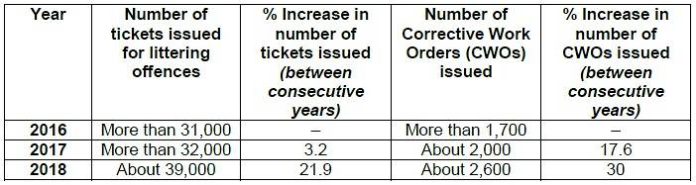
About 2,600 CWOs were issued last year, a 30 per cent rise compared to 2,000 cases in the previous year, the National Environment Agency (NEA) said on Tuesday (May 7).
(Source: National Environment Agency)
A total of 39,000 tickets for littering offences were issued during the year – an increase of nearly 22 per cent compared with 32,000 cases in 2017.
The new CWO vests, which are worn by offenders while picking up litter, are luminous pink and yellow, making them more easily distinguishable, NEA said.
(Photos: National Environment Agency)
“The CWO vest was previously luminous yellow, making it appear similar to other safety vests worn by personnel carrying out work in public areas,” it said.
Starting this month, signs will also be displayed at CWO locations “to highlight an ongoing session so as to raise public awareness”, the agency said.
A sign put up at the site of an ongoing Corrective Work Order session. (Photo: National Environment Agency)
LITTERING HOTSPOTS
NEA said littering commonly occurs in neighbourhood centres, areas around hawker centres, MRT stations and shopping malls. The majority of offenders are men between 18 and 35 years old.
In addition to regular enforcement blitzes by both uniformed and non-uniformed officers, NEA said it has also deployed cameras and video analytics to better monitor littering and smoking hotspots.
Those caught littering face a fine of S$300 for their first offence. Recalcitrant offenders prosecuted in court could be issued a CWO in addition to or in lieu of a fine.
Under the Environmental Public Health Act, the maximum fine for a littering offence is S$2,000 for the first court conviction and S$4,000 for the second conviction. The maximum fine for the third and subsequent convictions is S$10,000.
The number of CWOs issued to offenders rose by 30 per cent in 2018. (Photo: National Environment Agency)
Minister for Communications and Information S Iswaran says the country is “on track” to rolling out 5G mobile networks by 2020.
File photo of a journalist using his mobile phone to take a picture of the 5G logo. (Photo: Reuters/Kai Pfaffenbach)
(Updated: )
Bookmark
SINGAPORE: Singapore is moving another step forward in the process of rolling out 5G mobile networks by 2020 with the launch of its second public consultation on issues like regulatory frameworks and policies for the next-generation network.
The Info-communications Media Development Authority (IMDA) said in a press release on Tuesday (May 7) that the feedback received will assist it in facilitating 5G network rollout by the stated timeframe and identify innovative applications and services riding on the new platform.
It has been said that 5G will shape the future of our technological landscape, and IMDA fleshed this out saying the new networks promise not just faster mobile broadband but also greater reliability, lower latency and the ability to connect more devices.
For consumers, this means cloud gaming – the ability to play compute-intensive games on a low-end mobile device because the compute resources are in the cloud – becomes a possibility. Businesses, too, can tap on the network to introduce services such as autonomous vehicles, the regulator said.
Minister for Communications and Information S Iswaran said separately in Parliament on Tuesday that 5G technology and networks will be a “critical part” of Singapore’s digital economy, and the country is “on track” to achieving the target of rolling out 5G mobile networks by 2020.
Some of the key proposals IMDA made include:
Facilitate sustainable competition with at least two nationwide 5G networks at the outset, while encouraging telcos to partner up to build out the infrastructure. It is mandatory to provide wholesale service though, which means Mobile Virtual Network Operators (MVNOs) like Circles.Life, for example, could lease the network to provide 5G services too.
It intends to free up spectrum in the 3.4GHz – 3.6GHz band – critical for the provision of wide-area coverage – for 5G by 2021, as it is currently used for satellite communications in the Asia-Pacific region by countries such as Malaysia and Indonesia, IMDA said.
Two spectrum packages will be made available: (i) A 100MHz lot of 3.5GHz airwaves (ii) A 50MHz lot of 3.5GHz airwaves. Each package will come with 800MHz of millimetre wave band spectrum, IMDA said, which would provide 5G coverage that is more localised to a specific site or building.
The base price for the 3.5GHz is yet to be decided, but IMDA said it is considering taking reference from international benchmarks of base and final bid prices for similar bands auctioned globally between 2017 and 2019.
Successful spectrum rights holders will be required to provide 5G standalone networks – meaning these are not piggy-backing on existing mobile networks – with more than 50 per cent coverage within 24 months from the commencement of the 3.5GHz spectrum right. They must use the mmWave spectrum within 12 months from given the airwaves.
IMDA is issuing a Call-For-Proposal instead of an auction to assign the 5G spectrum. Besides offer price, it will also evaluate a bidder’s quality of network design and resilience and financial capability, the regulator said. The target is to announce the consultation and award results by the end of this year.
“IMDA’s vision is for Singapore to be a global 5G front-runner for innovation in secure and resilient 5G applications and services,” it said.
Local telco StarHub said it is looking forward to IMDA’s 5G spectrum allocation and is upgrading its network to be ready for 5G.
“We are broadcasting ‘live’ 5G signals at our headquarters to facilitate ongoing trials and industry engagement with partners,” said StarHub chief technology officer Chong Siew Loong. “We will provide IMDA with further comments on the consultation paper in due time.”
SINGAPORE: A recent paper on religion in the Republic by researchers from the Institute of Policy Studies (IPS) threw up a finding that was both surprising and disconcerting: Almost half of young Singaporeans said they were open to religious extremists posting their views online.
The paper, released about a month ago, showed that nearly 46 per cent of the respondents aged 18 to 25 would allow extremist views that deem all other religions as enemies to be published on the Internet or social media.
Even so, almost all of this group (97.2 per cent), in responding to another question, said it was unacceptable for religious leaders to incite violence or hatred against other religions.
Still, the fact that young adults here are more open to religious extremist views online is a cause for concern since it could lead to undesirable consequences and may even have an impact on national security, some experts said.
“Given the rise of self-radicalisation in terrorist incidents, hate speech, and Islamophobia both globally and in Singapore, it is comforting that the majority of Singaporeans would not allow religious extremists to post their views online. But the significant quarter of the population, as well as higher proportions among the young, who would permit such freedoms is worrying,” said the paper’s authors Dr Mathew Mathews, Mr Leonard Lim and Ms Shanthini Selvarajan of the IPS, a Singapore-based think-tank.
Singapore Management University (SMU) law don Eugene Tan, who writes on race, religious and terrorism issues, said that being receptive to such ideology means people are potentially at risk of being on the “conveyor belt” to violent extremism.
Mr Mohamed Imran Mohamed Taib, the director of the Centre for Interfaith Understanding, noted that younger generations — especially in a “deeply plural society” like Singapore — need to know that non-violent extremism can have negative consequences too. Such form of extremism refers to extremist views or behaviour lacking the element of incitement or calling for violence.
“(Non-violent extremism) can seed prejudices, breed distrust, cause segregation and lead to hostility. It will not take much to spark violence when the general population is rife with prejudices, distrust and hostile perceptions and attitudes towards an out-group,” he said.
Something of interest to national security would be how this openness shapes the social and political attitudes of young Singaporeans, said Mr Muhammad Faizal Abdul Rahman, a research fellow at the S Rajaratnam School of International Studies’ (RSIS) Centre of Excellence for National Security. He questioned:
Extremist content promotes the belief that humanity is in a perpetual state of conflict. Would this realisation make young Singaporeans appreciate better the necessity for emergency preparedness and safeguarding religious or racial harmony?
However, IPS researchers Dr Mathews and Ms Shanthini wrote in a recent commentary on the survey findings that “to suppose that the young are not concerned about maintaining religious harmony is simply not true”, as they similarly hold a disdain for religiously motivated hate speech.
Many youths spoken to agreed that they are indeed more open to extremist views online, but said they have faith in the ability of themselves and their peers to draw a line at views that incite hatred or violence.
They attributed their openness to their exposure to ideals of freedom of speech and expression — something that the IPS researchers also cited as an “important societal value”, especially to millennials.
Others felt that youths here have been “desensitised” to such views, precisely of the freedoms they have enjoyed on the Internet and social media.
Youths walking after a class has finished. (Photo: TODAY)
Mr Jiang Haolie, 23, coordinator at student-led group Community for Advocacy and Political Education based in Yale-NUS College, said that just because many youths do not believe in the censoring of religious extremist views online, it “does not necessarily mean that they endorse such views”.
“I think it points to a more mature view of younger Singaporeans — that censoring offensive or uncomfortable views do not actually nip hate speech or extremist views in the bud,” the Yale-NUS College undergraduate added.
Mr Matthew Soo, a law undergraduate at SMU, argued that most people his age would be able to recognise “clear” instances of religious or racial extremism, given the “constant emphasis on racial and religious harmony” here.
On why he and his peers are more open to these views, the 21-year-old pointed to the current social media culture, which has perpetuated a “social justice warrior” generation where pockets of young people use the Internet as a platform for change in social issues. Conversely, there are many who also “really cannot care less”.
“This may be a case of apathy, desensitisation and a slight sense of complacency. Youths today may not feel that there may be serious repercussions arising out of this kind of religious extremism online,” Mr Chun Win Ee, a psychology undergraduate at Nanyang Technological University (NTU), said.
The 27-year-old noted that extremity has almost become a norm in people’s online “double lives”.
As many have seen people posting intolerant comments about numerous issues with no repercussions, this has led to youths possibly thinking that religious extremist views are also the norm. He added:
I also think that such online religious extremist postings are underappreciated as a threat because it seems as innocuous as the typical hate speech that we see online on other issues. And that makes it so much more insidious.
Ms Lo Hoi Ying, a 22-year-old NTU undergraduate in communication studies, spoke about being desensitised to such online views herself. But she said this is because she knows what the religious extremists are saying is “drastically different from what we have experienced while growing up in Singapore”.
I am open to such views, but I also know that if I see these posts on my Facebook, I will just scoff and scroll along because I am not interested in whatever they have to say.
Ultimately, the youths interviewed generally believed that they are ready for open and honest conversations about race and religion. And to them, that is the best way to inoculate themselves against extremist views.
Mr Soo said: “If we cannot have open conversations about (issues of institutional racism), the efforts to promote greater racial and religious understanding run into a (brick wall), where we are simply preaching to the choir instead of addressing the genuine disaffection within or between groups.”
While Ms Lo conceded that people can fall for views meant to incite anger and cause societal tensions despite adequate education and information, Mr Jiang felt that young Singaporeans are mature and educated enough to engage in a discourse about racial and religious issues, rather than “sweeping them under the carpet”.
“Resilience is not nurtured by isolating ourselves from extremism, but by exposing ourselves to it, engaging with it, and repudiating it,” Mr Jiang said.
Students sit at a common area in NUS. (File photo: Darius Boey)
A WORRYING ISSUE WHICH NEEDS EXAMINING
While youths interviewed believe that their generation is well-placed to handle such issues, some experts pointed out that discerning what are religious extremist views may not always be so straightforward.
“Often, a person may overestimate his ability to be clear-headed or discerning about such materials that they come across or consciously seek,” said SMU’s Associate Professor Tan.
Dr Paul Hedges, an associate professor in interreligious studies at RSIS, added:
Extremist views are found online, and in many cases it is not too difficult to find them … As such, what needs to be done is for all people, not just young people, to be given the tools to critically analyse such views and see their deficiencies.
In June 2017, news reports highlighted how unsavoury characters can exploit technology to radicalise anyone, regardless of their backgrounds and where they come from.
These people can also prey on youths’ vulnerabilities such as their emotional needs. Young people are also particularly susceptible as they may be going through an identity crisis at that particular stage in life.
Mr Faizal from RSIS reiterated that it is “crucial” to examine the underlying factors as to why young Singaporeans are more open to online extremist views these days.
He said it could be down to youths feeling that the vastness of the online space renders blocking all extremist content impossible, or they could feel that Singapore’s “social cohesion and education have empowered them with the necessary mental firewalls to recognise and resist extremist content”.
Ms Sun Xueling, Senior Parliamentary Secretary for Home Affairs and National Development, said that the paper’s findings reflect youths’ desires to view all types of information available, whether it is healthy and unbiased, or not.
“The belief is that everyone will be discerning, and will do the right thing regardless of the types of information he or she is exposed to … However, what we see on social media is that there are individuals who can be very biased when it comes to views on race and religion and who use the virality of social media to spread their biased and often hate-filled views,” added Ms Sun, who is also a Member of Parliament (MP) for Pasir-Ris Punggol Group Representative Constituency (GRC).
She pointed to the recent massacre in Christchurch, New Zealand, where a gunman opened fire in mosques and killed 50 Muslims. Australian Brenton Tarrant, a suspected white supremacist, had acknowledged that his extremist views were based on what he read online.
Still, National University of Singapore (NUS) sociologist Tan Ern Ser argued that the majority of young people, if given the opportunity to be exposed to different perspectives and openly debate issues, “could be persuaded to see that perpetuating hatred and killing innocent people is not the way to address legitimate concerns and perceived social injustices”.
Mr Imran, from the Centre for Interfaith Understanding, noted that the IPS paper’s findings show that young Singaporeans in general may not have sufficient understanding on what constitutes religious extremism.
The IRO’s 70th anniversary exhibition traces the organisation’s work over the years to promote interfaith harmony.
He does not think young Singaporeans are more accepting than their older counterparts of violent extremism, but there “might be a gap in perception” of what non-violent extremism is.
“This is worrying, but it also calls for deeper reflection why this is so. One possible reason is that there is some confusion on what constitutes extremism,” he said.
Dr Mathews, senior research fellow from IPS who co-authored the paper, said that social media and the Internet have become powerful tools for people to express their thoughts rather freely.
“Some just don’t want the Government to be increasingly regulating that space. Also, many millennials believe that they are able to counter extremist views and engage in debate with differing views, so why restrict what can actually be a useful platform to bring clarity?” he said.
In his commentary with Ms Shanthini, they urged people to understand the liberties of free speech in relation to the potential ramifications of extremist speech. Such speech “dehumanises and strips groups of dignity and self-respect”, and its publication also “dilutes opportunities for productive discussion”, they wrote.
“While the younger generation certainly appreciates the value of freedom of expression, they should also be cognisant that some discourse should not be accorded a platform, especially in multi-racial and multi-religious Singapore,” they said.
“Nevertheless, millennials should certainly strengthen their ability to navigate social media and counter extremist discourse offline or online.”
TABOO NO MORE BUT FAULT LINES REMAIN
Racial and religious issues have traditionally been taboo subjects in Singapore, especially after the racial riots that erupted here in the 1950s and 1960s.
One notable example was the Maria Hertogh riots in December 1950, triggered by a court’s decision that a young girl who had been raised by Muslim adoptive parents should be returned to her Catholic biological parents.
The May 1969 racial riots, which spilled over to Singapore from Malaysia, leaving four dead, drove the point home further on the explosive nature of race relations.
More people have been openly discussing such issues in recent years, especially as social media becomes more pervasive. However, there is a concern in some quarters that many Singaporeans have become complacent about race and religion being potentially divisive issues.
Some youths acknowledged that while they know of the racial riots through what they were taught in school — such as via Social Studies lessons — they may not have enough appreciation of the fragility of racial and religious harmony in Singapore.
“The events are so far behind us, and given the decent levels of racial harmony that we grew up with, we do not see racial tensions as a huge threat,” said Ms Lo.
Mr Chun said the lack of actual exposure to racial conflict in Singapore has “caused us to take our harmony earned through blood for granted”. “We don’t appreciate how such (extremist) posts can affect our community’s psyche. We are rather oblivious to them and take them lightly,” he added.
Unlike most of her peers, Ms Low Wei Ling, 25, experienced firsthand what it was like to live under the spectre of a potential terrorist attack while studying in the United Kingdom.
In 2015, the research analyst was caught in the middle of a security lockdown in Brussels amid fears that the Belgian city would be the next to be hit in the wake of coordinated attacks by the Islamic State (IS) in Paris.
She then got involved in her university’s chaplaincy team, where staff of different religious groups came together to support students and hold events to bridge gaps between people of different faiths.
Ms Low, who returned to Singapore about a month ago, is now a youth ambassador at inter-faith group Roses of Peace.
The group started as a student-driven initiative by Nominated Member of Parliament (NMP) Abbas Ali Mohamed Irshad in 2012, when he was a student at SMU. Ms Low said:
I wanted to do something to promote this understanding (among religions) and make people more proactive.
Dr Mathews noted that older Singaporeans who had lived through the racial riots would have seen firsthand how extremist speech could cause substantial chaos in society.
“Of course, if more who are young see what happens elsewhere and the effects of unrestrained freedom of expression, I am sure they will understand why some restrictions are beneficial to the overall ability of people to debate freely,” he said.
Mayor of South East District Dr Maliki Osman speaking at an interfaith dialogue. (Photo: Loke Kok Fai)
THE WAY FORWARD: ENGAGE THEM YOUNG
In light of the IPS survey findings, those interviewed suggested that more can be done to educate and engage young Singaporeans — perhaps even starting from primary school.
NUS’ Dr Tan said that education on racial and religious issues should start “the sooner, the better”.
As children are already playing with others across ethnic and religious lines, he proposed that pre-primary and primary curricula reinforce messages of racial and religious harmony not only to children, but their parents too.
“In regard to extremist views, children could be taught to think about various scenarios that could threaten social harmony, and what they could do to unite as Singaporeans, to look out for one another, regardless of race and religion, and not to accept hateful things said about other races or religions in Singapore,” he added.
Ms Joan Pereira, an MP for Tanjong Pagar GRC, said young Singaporeans need to be educated that “as a small nation, we have zero tolerance for individuals or publications which aim to incite hostility or violence among different religious groups”.
Ms Pereira, who sits on the Government Parliamentary Committee for Culture, Community and Youth, added:
I do think we have come a long way in terms of racial and religious harmony … Education should therefore equip our young with the skills to be more discerning and understand the dangers posed by some of these extremist views.
Improving youths’ media literacy is also important, said NMP Lim Sun Sun.
People need to be reminded of the biases that work against them, and resist adding fuel to the fire when they come across alarmist or extremist views, added Professor Lim, who is the head of humanities, arts and social sciences at the Singapore University of Technology and Design.
Assoc Prof Eugene Tan, Dr Tan Ern Ser and Mr Imran suggested organising more forums and events targeted at young people to discuss these issues. These can go beyond existing initiatives such as the Inter-Racial and Religious Confidence Circles, which are local-level inter-faith platforms formed in every constituency to promote racial and religious harmony.
Mr Imran added: “The (IPS paper) should not generate panic, but calls for introspection and should move us to do more to help shape a healthy narrative for social cohesion, while highlighting the dangers of religious extremism. This has to be done both online and offline.”
Meanwhile, Mr Irshad, being the founder of Roses of Peace, has already organised numerous interfaith symposiums and forums over the past few years.
He pointed out that youths do not want to listen to lectures or talks about the theological aspects of religion or race.
Instead, the forums organised by Roses of Peace rely on a curated list of panelists or speakers — from religious leaders to fellow youths — who can discuss how their respective faiths drive them to do social good.
He seems to have found a successful formula, with more than 100 youths turning up for each session. He said that he settled on this format after noticing that forums discussing religious topics were usually attended mainly by older Singaporeans.
Moving forward, he has been invited to join a student advisory committee at a primary school in the western region of Singapore. Roses of Peace also plans to pilot a programme called Peace Education Through Altruism and Leadership, or Petal for short, in schools here.
He said the primary school’s aim is “to have an inclusive environment” which “focuses on race and religious harmony”. “Even at the primary school level, we’re looking to have conversations — even primary school kids are very open these days, they know a lot of things,” he added.
Well aware of Singaporean youths’ desire to have open and honest discussions on race and religion, Ms Sun nevertheless noted the “difficult job” facing security agencies, which have to make judgment calls on issues that could harm racial and religious harmony, and whether they could potentially disturb public order.
Emeritus Senior Minister Goh Chok Tong at the launch of the Inter-Religious Organisation (IRO)’s 70th anniversary exhibition on Mar 18, 2019.
“We need to strike a balance. On the one hand, we cannot have a free-for-all situation so that an individual can say anything he wants, step all over another and expect the other not to react or retaliate,” she said.
“On the other hand, we also do not want a situation where civil and considered discourse on all matters related to religion, race, or a group’s values or orientation be avoided or tiptoed around so as to avoid any possibility of causing offence.”
She added: “While we aspire to greater freedoms, with the stability and prosperity our society affords us, I hope that we also (spare a thought) for those who may be impacted by our decisions, impacted by our words, and also those who toil to safeguard what we have.”
SINGAPORE: NS reservist and actor Aloysius Pang’s death was the direct result of safety breaches by Pang and the other personnel who were with him in a Singapore Self-Propelled Howitzer at the time, a committee of inquiry (COI) has determined.
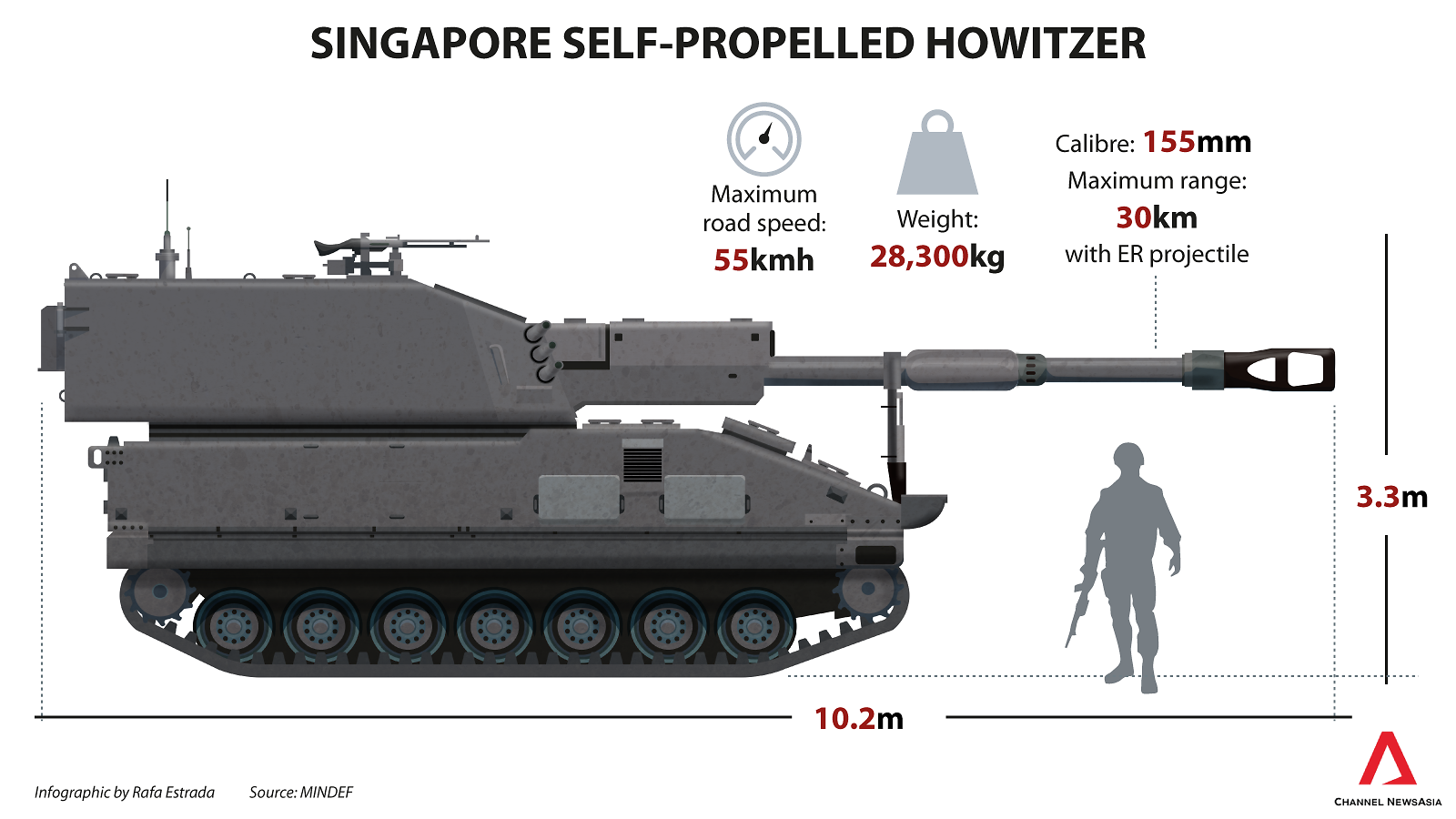
A Singapore Self-Propelled Howitzer participating in a live-firing exercise at Waiouru Training Area, New Zealand. (Photo: MINDEF Singapore)
It was evening on Jan 19 at Waiouru Military Training Area in New Zealand, where Singapore Armed Forces troops were training in Exercise Thunder Warrior.
One of the Singapore Self-Propelled Howitzers (SSPH) needed corrective maintenance on the accuracy of its gun, and it had to be rectified before live firing could resume.
The gun commander asked for assistance from the forward maintenance platoon, and armament technician Aloysius Pang responded to the call.
Pang could not resolve the issue, and a regular technician was sent to help him.
To rectify the fault, they planned to change a CPU card in the motor drive control unit – ammunition handling system (AHS) box in the SSPH.
The regular technician briefed the gun commander to turn off the AHS, lock the gun barrel and turn off the engine and master switch.
Locking the barrel required it to be lowered to the near-horizontal “standby” position.
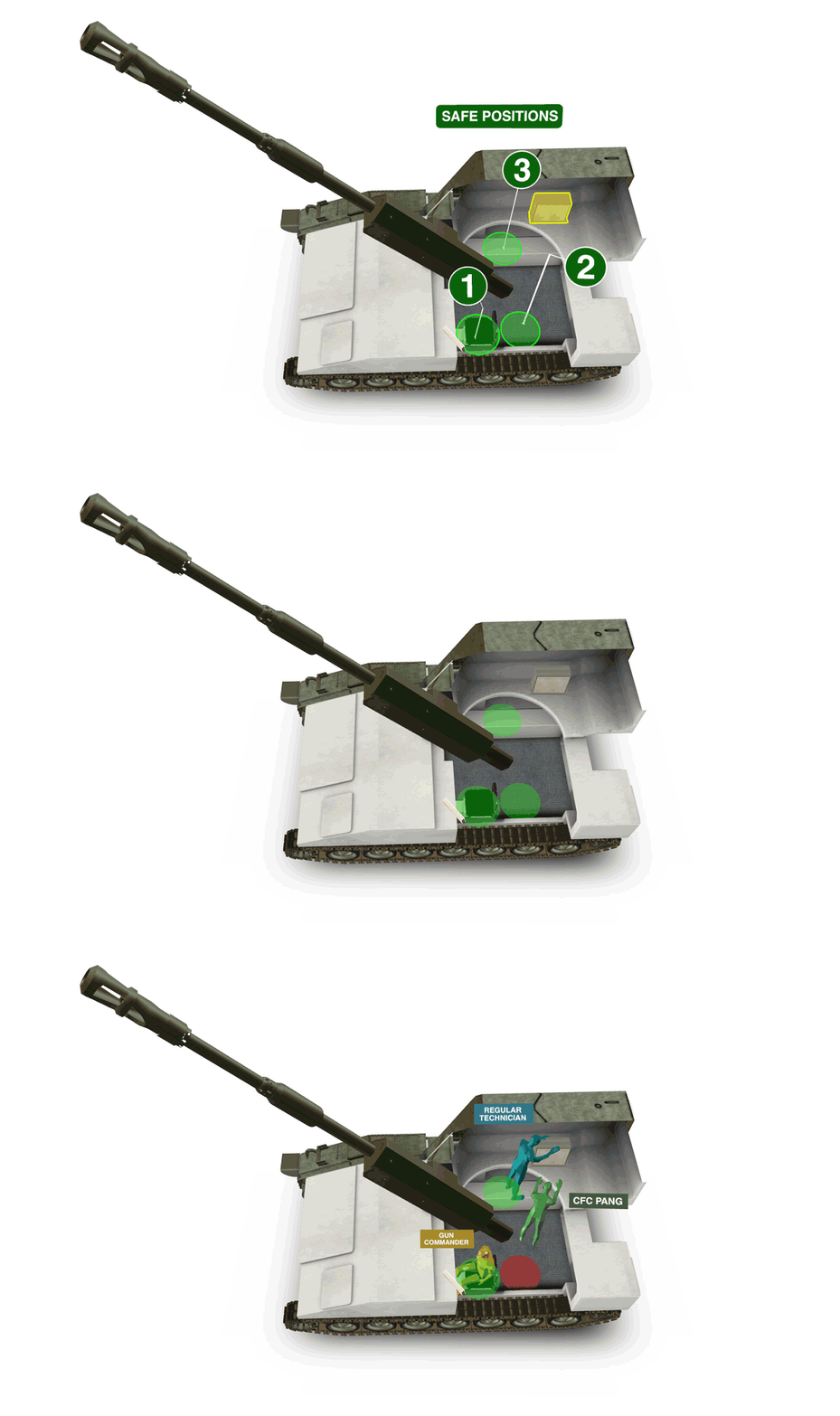
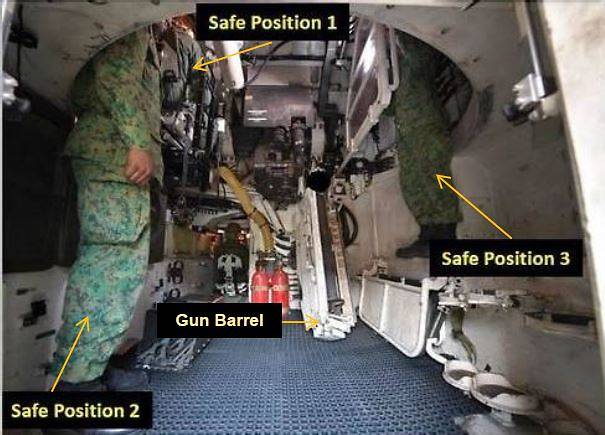
Safe positions in the Singapore Self-Propeller Howitzer and the location of the AHS box (in yellow). (3D modelling: Cleo Terrazola, Jonathan Lijauco Gomez and Alomgir Hossen)
Standing in one of the designated “safe positions”, the regular technician started loosening the screws on the AHS box. He saw that Pang was also removing screws on the right side of the box.
However, Pang was not in any of the safe positions, and was standing with his back facing the barrel.
The regular technician told Pang, in a mix of Mandarin and English, that the barrel was going to be moved to the standby position. He also told Pang to move closer to him or to a safe position.
Replying in Mandarin, Pang said that “it was fine” and that the barrel would not hit him.
Positions of the gun commander, regular technician and Aloysius Pang in relation to the safe positions in the SSPH. (3D modelling: Cleo Terrazola, Jonathan Lijauco Gomez and Alomgir Hossen)
Before moving the barrel, the gun commander said he checked if the path was clear and saw Pang standing near the barrel.
As the gun barrel was in the highest elevated position, the gun commander assumed that Pang would have time to move away, given that it would take some time for the barrel to move into the standby position.
He shouted “Standby, clear away”, before activating the control to move the gun. The regular technician says he heard the instruction, as did personnel who were standing outside the cabin.
As the barrel was lowered and the flick rammer started moving up, Pang continued removing the screws on the box while looking back at the barrel.
Initially, Pang made no attempt to move away. But as the barrel moved closer, he began making some “evasive movements”, the gun commander said.
Shocked to see Pang still in the path of the barrel, the regular technician tried to push against the barrel with his hands.
The gun commander also tried to stop the barrel using the main control screen.
However, neither of them pressed the emergency buttons that could have stopped the gun barrel from moving.
Position of emergency stop buttons in the SSPH. (3D modelling: Cleo Terrazola, Jonathan Lijauco Gomez and Alomgir Hossen)
“As the gun barrel made contact with CFC (NS) Pang, the COI opined that instead of activating the emergency stop buttons, both the technician and the gun commander panicked and acted irrationally,” Dr Ng said.
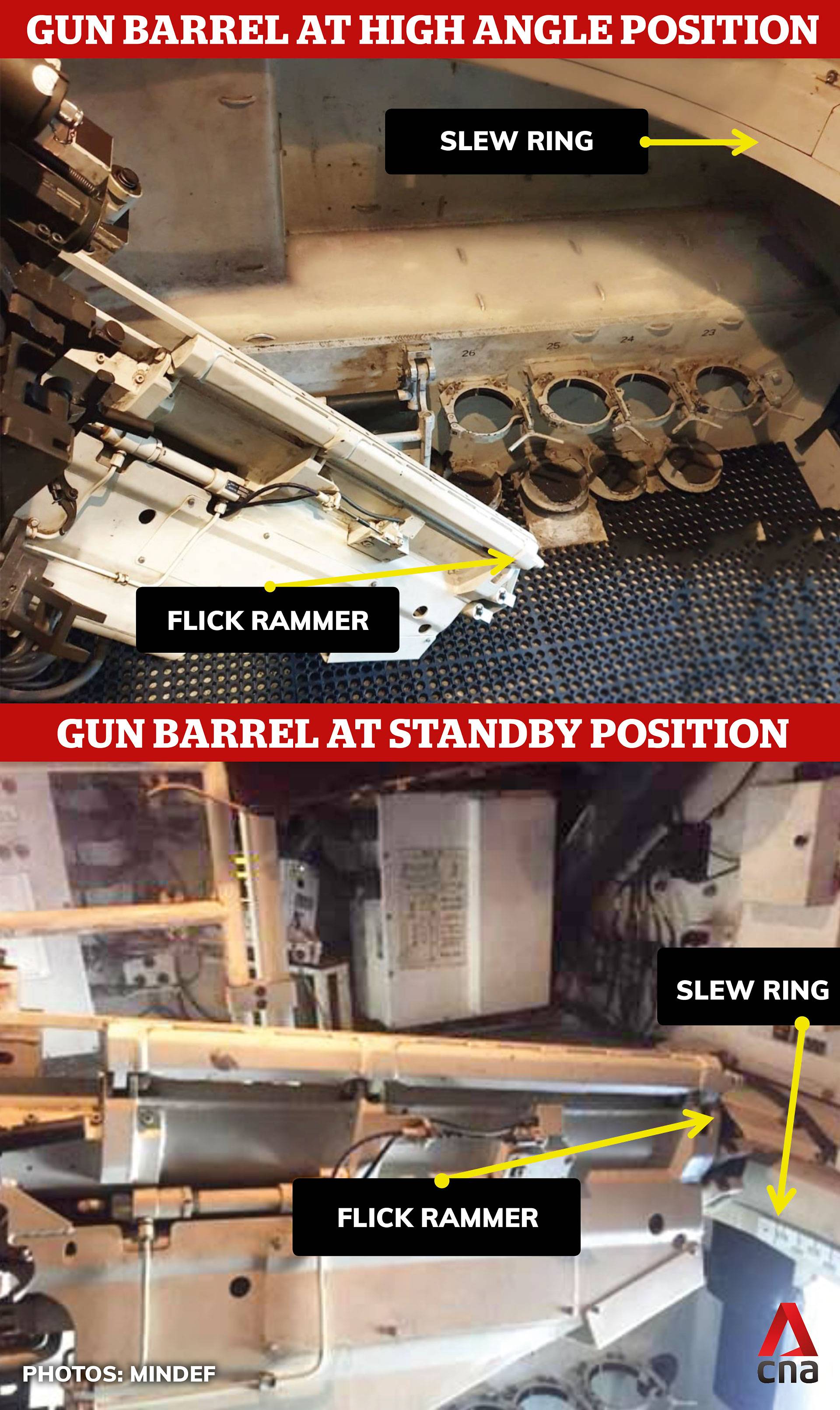
As a result, Pang was crushed between the flick rammer and the slew ring, a cylindrical structure surrounding the cabin.
A battery medic attended to Pang on site. He was taken to the battalion casualty station about 10 minutes later, at 7.10pm. There, he was assessed and stabilised before being taken to the Waiouru Base Medical Centre at 7.50pm.
At 9.50pm, he was evacuated by helicopter to Waikato Hospital, where he was operated on at around 1am the following day, Jan 20.
Pang underwent two more surgeries on Jan 21 and 22 before his condition deteriorated.
On Jan 24, Pang succumbed to his injuries. The committee of inquiry recorded that he died from “severe sepsis arising from his severe chest and abdominal injuries as a result of being trapped between the flick rammer and the slew ring in the SSPH.”
SINGAPORE: An external panel has expressed concerns about “safety lapses and weaknesses in safety culture” in the Singapore Armed Forces (SAF) that have come to light following the death of national serviceman Aloysius Pang.
The External Review Panel on SAF Safety, commenting on Committee of Inquiry (COI) findings on the incident, has recommended that the SAF do more to improve safety awareness among its soldiers, Defence Minister Ng Eng Hen told Parliament in a ministerial statement on Monday (May 6).
The panel also stressed the importance of commanders showing leadership in safety and said it was “vital” that maintenance safety got the same level of emphasis as training safety.
In its report, the COI also recommended improvements to the Army’s safety culture and compliance with operator manuals, and a review of standard operating procedures.
Pang died in January after sustaining serious injuries during a training exercise in New Zealand. He was carrying out maintenance work in a Singapore Self-Propelled Howitzer (SSPH) when the incident happened.
The external panel, whose primary role is to review safety practices in the SAF, said it supported the COI’s proposed recommendations to “prevent a similar incident from occurring”.
Dr Ng said the SAF’s Inspector-General’s Office will ensure the recommendations are followed through, as he laid out six “specific steps” the SAF has taken to improve safety for maintenance-related training or tasks.
SAFETY MARKINGS
As part of safety enhancements, safe and hazardous areas in certain Army platforms, including the SSPH, will be clearly marked out.
This comes as the COI found that the “precipitating cause” of the incident was the lowering of the SSPH gun barrel without ensuring everyone was in a safe position.
Markings showing the safe and hazardous areas inside the SSPH cabin. (Photo: MINDEF)
The safe areas in the SSPH will now be marked with a bold, green line labelled with the word “safe”, while hazardous areas will be marked with industrially recognised yellow and black markings.
Hazardous areas currently marked out on other platforms include high voltage areas.
REFRESHER TRAINING ON HELI-EVACUATION PROCESSES
Medical officers will be required to undergo refresher training on heli-evacuation processes before being deployed for overseas medical support.
This comes after the COI said that the post-incident medical care in Pang’s accident was “adequate but can be improved”.
The COI also recommended formalising arrangements between the SAF and overseas hospitals caring for injured servicemen, so Singaporean doctors caring for them can be updated on clinical developments and contribute more effectively.
In addition, the COI recommended that national servicemen (NSmen) medical officers re-familiarise themselves with acute trauma care by being allowed to observe in emergency or surgery departments.
Dr Ng said the SAF will explore new initiatives to improve medical officers’ exposure to acute trauma care.
SAFETY ADVOCATES
“Safety advocates” will be appointed on the ground to emphasise safety and conduct checks. These advocates can also gather feedback from personnel on safety lapses and relay them to ground commanders.
A regular technician (second from left) looking on as full-time national servicemen go through their pre-maintenance routine. (Photo: Jeremy Long)
This could be useful among smaller groups of servicemen, to help those who might be reluctant to report lapses through existing channels for fear of being unfairly singled out.
NSMEN INVOLVED IN SAFETY REVIEWS
NSmen will be “actively involved” in safety reviews before, during and after in-camp training activities. This is aimed at encouraging them to voice out and identify lapses.
Commanders will ensure safety is discussed and include feedback in reviews of training safety regulations.
SAFETY AWARENESS TEST
All servicemen will be required to take the safety awareness test, currently taken by trainers and commanders, annually. The test will also be tailored to units and their activities.
For instance, servicemen taking the Individual Physical Proficiency Test (IPPT) will answer questions on the amount of rest needed before the test, and more general questions like whether activities can continue in inclement weather.
THINK-CHECK-DO DRILL
A “think-check-do” safety drill will be implemented before maintenance tasks are conducted. This is aimed at helping servicemen internalise safety measures and take more ownership of safety on the ground.
Maintenance personnel are now required to carry a safety drill card. (Photo: Jeremy Long)
As part of the drill, servicemen will plan tasks and review mitigation measures like emergency stop (e-stop) drills, check equipment and the physical state and competency of those around them, and conduct dry-runs of procedures before executing tasks according to sequence and plan.
“The positions of e-stop buttons will be re-emphasised together with e-stop procedures and rehearsed as part of pre-ops drills,” Dr Ng said.
During a demonstration of the safety drill, three full-time national servicemen (NSFs) studied a step-by-step overview of a maintenance task involving the use of a mobile crane to replace a 35kg generator in a Bionix vehicle. The servicemen then discussed their roles and ran through the tasks and emergency procedures involved.
Private Miteshravin Ravindran (right) guiding the Bionix generator. (Photo: Jeremy Long)
Private Miteshravin Ravindran, one of the NSFs involved, said the drill was “very effective in painting the picture of how you’re supposed to work safely”.
“If it wasn’t there, I think there’ll be a lot of complacency,” the 21-year-old added. “Maybe you have some sort of simple knowledge of safety, but it’s not fully realised.”
SINGAPORE: The training accident that led to the death of national serviceman Aloysius Pang in January was due to lapses by Pang and two other serviceman who were in a Singapore Self-Propelled Howitzer (SSPH) at the time, a Committee of Inquiry (COI) has found.
The five-member committee also found no evidence indicating that the accident involved foul play or was caused by deliberate acts, Defence Minister Ng Eng Hen told Parliament in a ministerial statement on Monday (May 6).
Corporal First Class (National Service) Pang died after sustaining serious injuries during a Singapore Armed Forces (SAF) training exercise in New Zealand. Pang was crushed between the gun barrel and cabin while carrying out maintenance work in an SSPH.
Pang was inside the SSPH with a gun detachment commander, a Third Sergeant national serviceman, as well as a technician, a Military Expert 2 who is a regular serviceman.
The COI found the “precipitating cause” of the incident was that the gun barrel was lowered without ensuring that everyone was in their safe positions:
Pang was standing in the path of the moving barrel and not in a safe position prior to the barrel being lowered
Pang did not move to a safe position despite being warned that the barrel was going to be lowered to a standby position
The regular technician did not ensure that Pang moved to a safe position despite knowing that the barrel would be lowered
The gun commander proceeded to move the barrel despite noticing that Pang was not in a safe position, which goes against a requirement stated in the SSPH operator’s manual
Both the gun commander and regular technician failed to press the emergency stop buttons to stop the barrel movement
The COI also said that a combination of factors contributed to the incident:
There was a lack of clarity on who should be in the gun and whether acknowledgement was needed before the barrel was moved, pointing to a lack of coordinated safety control procedure between the gun and maintenance crew
The regular technician had started on a specific maintenance task before the barrel was in a locked position, which goes against a requirement stated in the maintenance manual for SSPH technicians, to “get on with the job quickly”
The regular technician and gun commander had miscalculated the space in the cabin and the time it took for the flick rammer (the rear end of the barrel in the cabin) to hit Pang
In their state of panic, the regular technician and gun commander had “acted irrationally” instead of pressing the emergency stop buttons when the flick rammer hit Pang
The flick rammer at the rear end of the gun barrel. (Photo: Jeremy Long)
As for the judicial process, Dr Ng said the SAF’s Special Investigation Branch has “nearly completed” separate investigations into the incident, and will report directly to the Chief Military Prosecutor to decide if any servicemen will be prosecuted in a military court for related offences.
“Servicemen under investigation are reassigned to administrative duties, and if found to have been culpable, will be charged and punished accordingly,” he added.
Dr Ng gave a “detailed chronology of events”, established by the COI, leading up to Pang’s injury and subsequent death.
On Jan 19, the SSPH gun commander asked Pang – an armament technician – to conduct corrective maintenance related to the accuracy of the gun. This needed to be rectified before live firing could resume.
The motor drive control unit – ammo handling system box. (Photo: Jeremy Long)
But as Pang could not resolve the issue, a regular technician was sent to help him with the task, which involved changing a card on the motor drive control unit – ammunition handling system (AHS) box inside the gun.
The regular technician briefed the gun commander to turn off the AHS, lock the gun barrel, and turn off the engine and master switch. Locking the barrel required it to be lowered to the near-horizontal standby position.
The regular technician then proceeded to stand in one of the safe positions to loosen the screws on the box, and saw that Pang was removing screws on the right side of the box. However, Pang was not in a safe position and had his back facing the barrel.
In a mixture of Mandarin and English, the regular technician told Pang that the barrel was going to be moved to the standby position. He also told Pang to move closer to him or to a safe position. Pang replied in Mandarin that “it was fine”, and that the barrel would not hit him.
Before moving the barrel, the gun commander said he checked if the path was clear and saw that Pang was standing near the barrel. The gun commander assumed that Pang would have time to move away, given that it would take some time for the barrel to move from its highest elevated position to the standby position.
The gun commander then proceeded to shout “standby, clear away” before activating the control to move the gun. This was heard by the regular technician and personnel standing outside the gun.
As the barrel was being lowered and the flick rammer was moving up, Pang was still removing the screws on the box while looking back at the barrel. Initially, he made no attempt to move away.
But as the barrel moved closer to Pang, the gun commander noticed that Pang was making some “evasive movements”. The regular technician, shocked to see Pang still in the path of the barrel, tried to use his hands to push against the barrel. The gun commander also tried to stop the barrel using the main control screen.
The red emergency stop buttons at the gun commander (left) and regular technician positions. (Photo: Jeremy Long)
“As the gun barrel made contact with CFC (NS) Pang, the COI opined that instead of activating the emergency stop buttons, both the technician and the gun commander panicked and acted irrationally,” Dr Ng said.
“As a result, CFC (NS) Pang was wedged between the flick rammer and the slew ring,” he added, referring to a cylindrical structure surrounding the cabin.
POST-INCIDENT RESPONSE
Pang was injured at about 7pm New Zealand time. He was then attended to by the battery medic on site before being evacuated to the battalion casualty station 10 minutes later. There, he was assessed and stabilised before being evacuated to the Waiouru Base Medical Centre at 7.50pm.
At 9.50pm, he was heli-evacuated to Waikato Hospital, where he was operated on at around 1am. Pang underwent two more operations on Jan 21 and 22 before his condition deteriorated.
On Jan 24, Pang died from “severe sepsis arising from his severe chest and abdominal injuries”, as a result of being caught between the flick rammer and slew ring in the SSPH.
INCIDENT WAS PREVENTABLE IF SAFETY RULES WERE FOLLOWED
The COI also commented on factors related to but not contributory to the incident or outcome.
It found that there was no mechanical fault with the SSPH gun that had directly caused the incident, adding that technicians certified the guns fit for firing both in Singapore and New Zealand before the exercise.
The COI also said the post-incident medical care was “adequate but can be improved”, given the extenuating circumstances caused by distance and the availability of the helicopter.
However, the COI is also of the opinion that “this did not cause or contribute to” Pang’s death, Dr Ng said.
Safe positions inside the SSPH (Picture: MINDEF).
Dr Ng stated that it was “sad but undeniable” that the direct cause that resulted in the death was “preventable had there been compliance to safety rules”.
“It was not for lack of knowledge of those rules or inexperience of personnel working on the SSPH gun,” he added. “The COI determined that prior to the incident, all three personnel in the gun had received adequate training to be aware that whenever the gun barrel is moved, they must be in a safe position.”
Dr Ng said Pang had attended several courses and training during his full-time national service, graduating with an overall “A” grade from the armament basic technician training (turret). Last February, he had attended maintenance vocational training during his sixth in-camp training in preparation for the overseas exercise.
Pang also had a positive work attitude and was “very helpful” when it came to work, Dr Ng said, citing accounts by his peers to the COI. “He was also professional when executing his tasks and was seen by his superiors as someone who would not cut safety corners when working.”
SINGAPORE: Gotong-royong – a Malay term popular in the 60s and 70s – refers to the spirit of working together in a community. As the month of Ramadan begins, that spirit is alive and well at the Geylang Serai Ramadan bazaar.
For instance, 37-year-old Idris Ma had his uncle, Mr Mohamad Soleh, fly all the way from Qinghai, China, to assist him in running his Islamic calligraphy stall at the bazaar.
Their stall, called Khaira Chinese Islamic Calligraphy, incorporates traditional Chinese calligraphy with Arabic words on paintings.
Owner of Khaira Chinese Islamic Calligraphy Idris Ma (right) and his uncle Mohamad Soleh. (Photo: Alif Amsyar)
“This is our fourth year at the bazaar in Geylang Serai and every year during Ramadan, when the festive lights are on, it’s like a festival for everyone, no matter what race. Even tourists come to the bazaar and are able to see our works,” Mr Ma said.
“Since my uncle is also very busy in China, I mostly invite him here to stay for two weeks to help out at our stall,” he said with a laugh.
With Hari Raya light installations stretching across Geylang Road, Sims Avenue and Changi Road, many have spent their weekends at the bazaar with family and friends.
For Mr Hossain Saddam, originally from Bangladesh, the bazaar during the fasting month reminds him of home.
Mr Hossain Saddam and his two friends say the Geylang Serai Bazaar reminds them of the festivities in their home country, Bangladesh. (Photo: Alif Amsyar)
“Today is my off day and I’m here with my friends to buy food and clothes. The Geylang bazaar is a very nice place and the lights are beautiful, and there’s delicious food,” the 29-year-old said.
“Now that it’s Ramadan, it’s also very beautiful in Bangladesh, all decorated. The three of us have been in Singapore for nine years. I wish my family all the best during the fasting month,” he added.
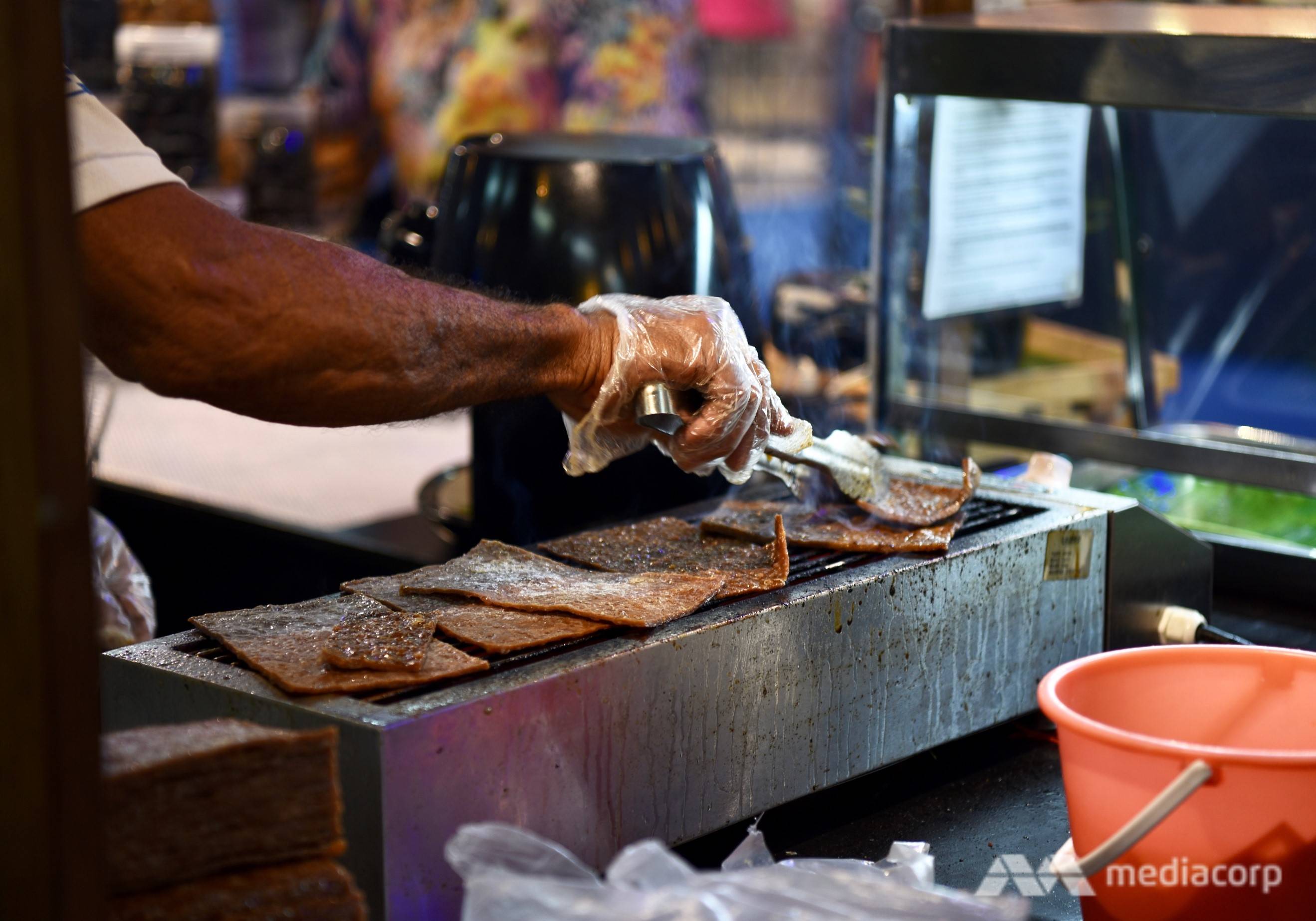
With most of the food stalls being required to sell traditional delicacies this year, stalls selling the likes of dendeng and otah otah saw snaking queues throughout the evening.
Most stalls this year sell traditional goods related to Hari Raya and the Malay culture, including the hot favourite dendeng. (Photo: Alif Amsyar)
The Turkish kebab is now a staple at the Ramadan bazaar. (Photo: Alif Amsyar)
The Geylang Serai Bazaar saw 1.86 million visitors last year, of which 76 per cent were local visitors. Over the years, the bazaar has become a festive event not only for the local Malay-Muslim population in Singapore, but for other Singaporeans and tourists alike.
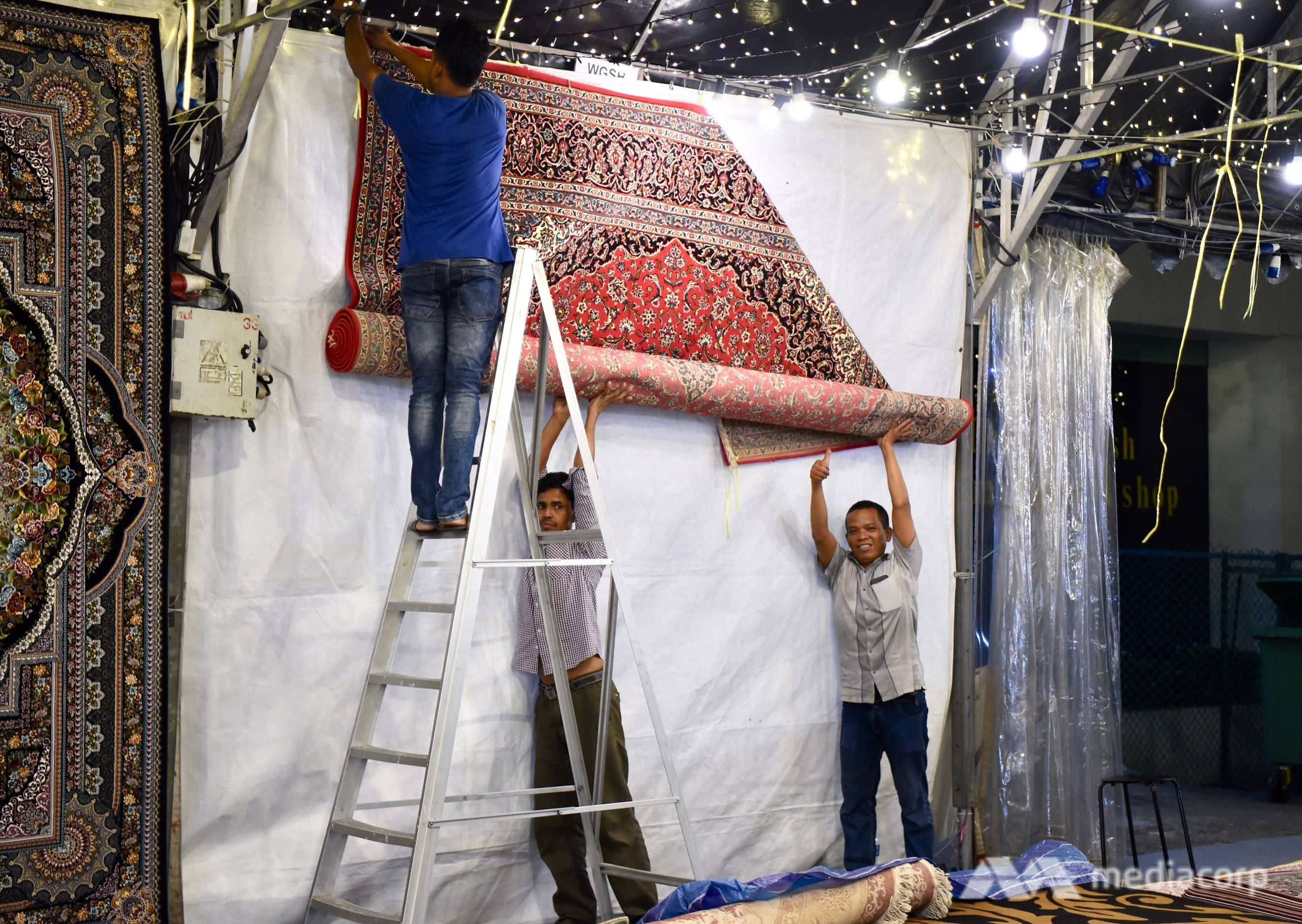
Workers setting up a carpet store at the bazaar, which opened on May 3, 2019. (Photo: Alif Amsyar)
This year’s bazaar is organised thematically – stalls selling traditional Malay delicacies and those selling modern food options are separated and demarcated accordingly. (Photo: Alif Amsyar)
It’s not too early for some to have their henna fix, well before the Hari Raya celebrations next month. (Photo: Alif Amsyar)
Delicacies from other countries have proven popular at the bazaar, such as traditional Lebanese food at a stall run by Tabbouleh Lebanese Gourmet Cafe and Restaurant. (Photo: Alif Amsyar)
While many running the food stalls are no strangers to the bazaar, some, such as those from The Mala Stop, are first-timers.
“It’s exciting but also quite intimidating because everyone looks like they are veterans, like they’ve been here for a long time. You have all those ayam perciks and Ramly burger stalls who’ve been here for so many years,” said The Mala Stop stall manager Reyna, 26.
“But we want to take this chance to give our Muslim friends the chance to taste mala, let them understand the taste and not confine it to being just a dish for the Chinese,” she added.
A section of the bazaar selling non-traditional food draws large crowds, especially younger visitors. (Photo: Alif Amsyar)
This year, the bazaar has about 500 stalls that will run until Jun 5, and for the first time, is fully coordinated by Wisma Geylang Serai, a Malay-Muslim social and cultural heritage hub.
SINGAPORE: More than 20 households who live in five-room and larger flats sold the tail end of their unit’s lease back to the Housing and Development Board (HDB) in the first quarter of this year under the Lease Buyback Scheme (LBS), said the Housing and Development Board (HDB).
In response to queries from CNA, the board said it received more than 200 LBS applications from owners of these bigger flats between Jan 1 and Mar 31 after the scheme was extended to them at the start of the year.
With the extension, about 34,000 households became eligible for the LBS, bringing the total number of households eligible to 130,000, said HDB.
The scheme allows elderly owners to monetise their flats while they continue to live in them by selling at least 20 years of their remaining lease back to HDB.
Ms Ow Binbing, 67, was among those who have taken up the LBS.
The former music teacher sold 53 years of the lease on her Executive Apartment (EA) in Punggol to the HDB in January. Even after doing so, she has enough years left on the lease to allow her to continue living in the flat until she is 97.
Ms Ow bought the nine-year-old unit in 2012 from the resale market for S$630,000 after selling her condominium unit in Farrer Park.
She said her LBS application was handled promptly after she indicated interest at an HDB branch office on Jan 10.
“It was very fast. On the same day at 5pm, the valuer came and took photos and video of everything. A week later, I received my valuation,” said Ms Ow.
Her 1,378 sq ft flat was valued at S$560,000, while the lease period (53 years) she intended to sell back to HDB was valued at S$269,500.
Ms Ow’s apartment has three bedrooms, and one of them is used to house her pet’s things including her 18-year-old cat San Tong’s home. (Photo: Fann Sim)
Ms Ow, the unit’s sole owner, received S$187,000 in cash including a S$5,000 bonus after first using the net proceeds to top up her CPF Retirement Account to the Full Retirement Sum, part of the scheme’s conditions.
This also meant that her retirement payouts received a boost – from S$720 to more than S$1,100 monthly.
“For me, it’s good but for others such as couples, they may not like it because the cash from the proceeds could be little depending on how much they have in their CPF retirement account. I only had to top up my CPF a bit,” she added.
Ms Ow said she had considered downsizingas she found the EA too big.
“I have to clean all of this myself. Every day I’m vacuuming, cleaning. It’s a lot,” she said.
But she struggled to find a buyer, even after having put her unit up for sale for more than a year.
“Nearly every day, I’ll have at least three families who are interested in buying my flat. I priced it between S$568,000 to S$588,000 and it couldn’t sell. There was a buyer but they couldn’t get rid of their own HDB flat,” she said.
She was reluctant to let it go for less.
“If I sold my Punggol flat for S$560,000 and spend around S$400,000 to buy a four-room flat, I think I will get back less than S$100,000 after some renovation,” she said.
She briefly considered renting out rooms in her flat but gave up the idea after hearing horror stories of tenants from her friends.
She said she is happy to age in her Punggol flat and has engaged part-time cleaners to help her with household chores.
“I’m used to this environment. All the neighbours here are very good and very friendly. Many residents here are also pet owners and our pets play together. I go for morning taiji exercise around here too,” she said.
She admitted that she has not thought about what she will do when the lease runs out when she is 97.
“(If I) can (live) until my 80s, it’s fine already,” she said
SINGAPORE: More than 20 households who live in 5-room and larger flats sold the tail end of their unit’s lease back to the Housing and Development Board (HDB) in the first quarter of this year under the Lease Buyback Scheme (LBS), said HDB.
In response to queries from CNA, the board said it received more than 200 LBS applications from owners of these bigger flats between Jan 1 and Mar 31 after the scheme was extended to them at the start of the year.
With the extension, about 34,000 households became eligible for the LBS bringing the total number of households eligible for the scheme to about 130,000, said HDB.
The scheme allows elderly owners to monetise their flats while they continue to live in them by selling at least 20 years of their remaining lease back to HDB.
Ms Ow Binbing, 67, was among those who have taken up the LBS.
The former music teacher sold 53 years of the lease on her Executive Apartment (EA) in Punggol to the HDB in January. Even after doing so, she has enough years left on the lease to allow her to continue living in the flat until she is 97.
Ms Ow bought the 9 year old unit in 2012 from the resale market for S$630,000 after selling her condominium unit in Farrer Park.
She said her LBS application was handled promptly after she indicated interest at a HDB branch office on Jan 10.
“It was very fast. On the same day at 5pm, the valuer came and took photos and video of everything. A week later, I received my valuation,” said Ms Ow.
Her 1,378 sq ft flat was valued at S$560,000, while the lease period (53 years) she intended to sell back to HDB was valued at about S$269,500.
Ms Ow’s apartment has three bedrooms, and one of them is used to house her pet’s things including her 18-year-old cat San Tong’s home. (Photo: Fann Sim)
Ms Ow, the unit’s sole owner, received S$187,000 in cash including a S$5,000 bonus after first using the net proceeds to top up her CPF Retirement Account (RA) to the Full Retirement Sum, part of the scheme’s conditions.
This also meant that her retirement payouts received a boost – from S$720 to more than S$1,100 monthly.
“For me, it’s good but for others such as couples, they may not like it because the cash from the proceeds could be little depending on how much they have in their CPF retirement account. I only had to top up my CPF a bit,” she added.
Ms Ow said she had considered downsizingas she found the EA too big.
“I have to clean all of this myself. Everyday I’m vacuuming, cleaning. It’s a lot,” she said.
But she struggled to find a buyer, even after having put her unit up for sale for more than a year.
“Nearly everyday, I’ll have at least three families who are interested in buying my flat. I priced it between S$568,000 to S$588,000 and it couldn’t sell. There was a buyer but they couldn’t get rid of their own HDB flat,” she said.
She was reluctant to let it go for less.
“If I sold my Punggol flat for S$560,000 and spend around S$400,000 to buy a 4-room flat, I think I will get back less than S$100,000 after some renovation,” she said.
She briefly considered renting out rooms in her flat but gave up the idea after hearing horror stories of tenants from her friends.
She said she is happy to age in her Punggol flat and has engaged part-time cleaners to help her with household chores.
“I’m used to this environment. All the neighbours here are very good and very friendly. Many residents here are also pet owners and our pets play together. I go for morning taiji exercise around here too,” she said.
She admitted that she has not thought about what she will do when the lease runs out when she is 97.
“(If I) can (live) until my 80s, it’s fine already,” she said