SINGAPORE: Five Singapore residents are among the people quarantined after coming into close contact with Singapore’s first monkeypox patient, said the Ministry of Health in an update on Tuesday (May 14).
“Based on MOH’s investigation and contact tracing thus far, 23 persons have been identified as close contacts of the patient, of whom five are Singapore residents,” the ministry said in response to CNA’s queries.
“The rest are from Britain, India, Ireland, Malaysia, Nigeria and Vietnam, most of whom were at the workshop that the patient had attended.”
As of Monday evening, all of them showed no symptoms, it added.
He is currently being treated in an isolation ward at the National Centre for Infectious Diseases.
“He is recovering well, and is in a stable condition,” said the ministry on Tuesday. “He will be ready for discharge once he has recovered and is assessed to be non-infectious.”
Monkeypox can be spread though close contact with the blood, bodily fluids or lesions of infected animals such as rodents and monkeys. The virus can also be contracted by eating meat of such animals that was improperly cooked.
Human-to-human transmission is possible through close contact with an infected person or with objects recently contaminated by their bodily fluids.
Symptoms include lesions, fever, muscle ache, swollen lymph nodes and chills.
The Nigerian patient in Singapore developed symptoms on Apr 30. He was taken to Tan Tock Seng Hospital by ambulance on May 7 and tested positive for the virus the following day.
“The patient was assessed to be a suspect case of monkeypox as he was presenting symptoms that are highly suggestive of monkeypox, had a relevant travel history and reported potential consumption of bush meat,” said MOH.
Outside Africa, monkeypox infections have only been reported in the United States, Britain and Israel, according to the US Centers For Disease Control and Prevention.
SINGAPORE: A security officer who stopped a woman from killing herself was given an award by the Singapore Police Force on Tuesday (May 14).
Mr Foo Kong Soon, a supervisor with Certis Cisco, was working at IMM shopping mall in Jurong East on Mar 16 when he convinced a woman not to take her own life and brought her to safety.
For going the extra distance in dispensing his duties as a security officer, Mr Foo received the Community Partnership Award at Clementi Police Division on Tuesday.
“YOU MUST COME DOWN”
Mr Foo was about to end his day shift at IMM around 6pm when a fellow security officer drew his attention to the top floor of the mall’s car park.
He said: “I could only see her legs dangling, so I went further out and then I saw her legs and arms swinging.”
He could not figure out if the woman sitting on the parapet wall of the car park was “being mischievous” or attempting to take her own life.
Mr Foo Kong Soon recounting how he saved the woman’s life. (Photo: Try Sutrisno Foo)
Mr Foo thought it was dangerous for anyone to be that high up and he knew he had to act fast. He went into the command post to alert fellow security officer, Mr Katiravan Subrayam, and to let other officers on duty know of a possible suicide attempt and to call the police.
Mr Foo rushed to the top floor of the car park ahead of Mr Katiravan, and he spotted a woman in her late 20s.
“I saw her sitting on the ledge. Her hands were twitching,” he said. “I wanted to get near her.”
He knew he would not be able to carry her weight if she jumped, so he stood about 30m away and called out to the woman: “Miss, miss what happened to you? It’s quite dangerous. You must come down.”
Mr Foo got no reply, so he started walking towards her. When he was about 15m away, Mr Foo tried calling out to the woman again.
By that time, Mr Katiravan had reached the top floor. The other security guard stayed a distance away from the scene while keeping Mr Foo and the woman within view.
The woman said to Mr Foo: “Uncle, uncle, you don’t (have to) care about me. If I do something not good, it is not nice for you to see.”
Mr Foo asked the woman if he could come closer. She remained silent, and he inched towards her while continuing to talk to her.
“I want to know what happened to you. Let us be friends first,” Mr Foo recounted as saying to the woman. She finally turned around, telling the security officer to go away.
Community Partnership Award recipient Mr Foo Kong Soon with his colleague, Katiravan Subrayam. (Photo: Try Sutrisno Foo)
After about five minutes, Mr Foo noticed that her mood had stabilised.
“I saw (her looking) like (she was) more stable. (It was) not like when I first approached her, when she was crying and shouting,” he explained.
Mr Foo thought it might be the right time to try and reach out to her, but there was a metal railing between them. He moved slowly from the woman’s right to her left without alarming her.
Once on her left side, with the metal bar no longer blocking him, Mr Foo got within arm’s reach of the woman.
He said to her: “Now you and uncle are friends. Can I hold your hand?”
The woman remained quiet. Mr Foo grabbed her, gripping his hands over her arms. With a firm grasp on her, he continued talking to her to keep her calm.
Mr Foo Kong Soon recounting how he stopped a suicide attempt to AC Jarrod Pereira. (Photo: Try Sutrisno Foo)
“IT WAS LIKE A STONE IN MY HEART WAS GONE”
He saw it as a chance to pull her down, and he managed to get her off the wall without her struggling.
The woman sat down against the wall, and Mr Foo stayed with her, afraid that she might get up again. Mr Katiravan came to Mr Foo’s side and handed a bottle of water to the woman. Police officers arrived a few minutes later.
“It was like a stone in my heart was gone,” he said, describing the relief he felt when the woman was safe.
The Community Partnership Award given to Mr Foo Kong Soon for stopping a suicide attempt at IMM shopping mall. (Photo: Try Sutrisno Foo)
Mr Foo recalled being constantly worried that the woman would be shocked by his presence. But he felt he had to remain focused. He said: “My plan was to keep calm. I must keep calm to make a decision. If I was nervous, I might (have messed) things up.”
He said he was experienced with consoling friends who had been through troubling times and that speaking to the woman was almost like speaking to a friend “who needed a listening ear”.
OTHER AWARDS
Community Partnership Award and Public Spiritedness Award recipients with AC Jarrod Pereira at Clementi Police Division. (Photo: Try Sutrisno Foo)
Three other security officers received Community Partnership awards for their assistance in stopping crimes during the course of their duty.
Two members of the public were also given Public Spiritedness awards for not ignoring a crime unfolding in front of them and for helping the police stop wrongdoers.
Where to get help:
Institute of Mental Health’s Helpline: 6389 2222
Samaritans of Singapore Hotline: 1800 221 4444
Singapore Association of Mental Health Helpline: 1800 283 7019
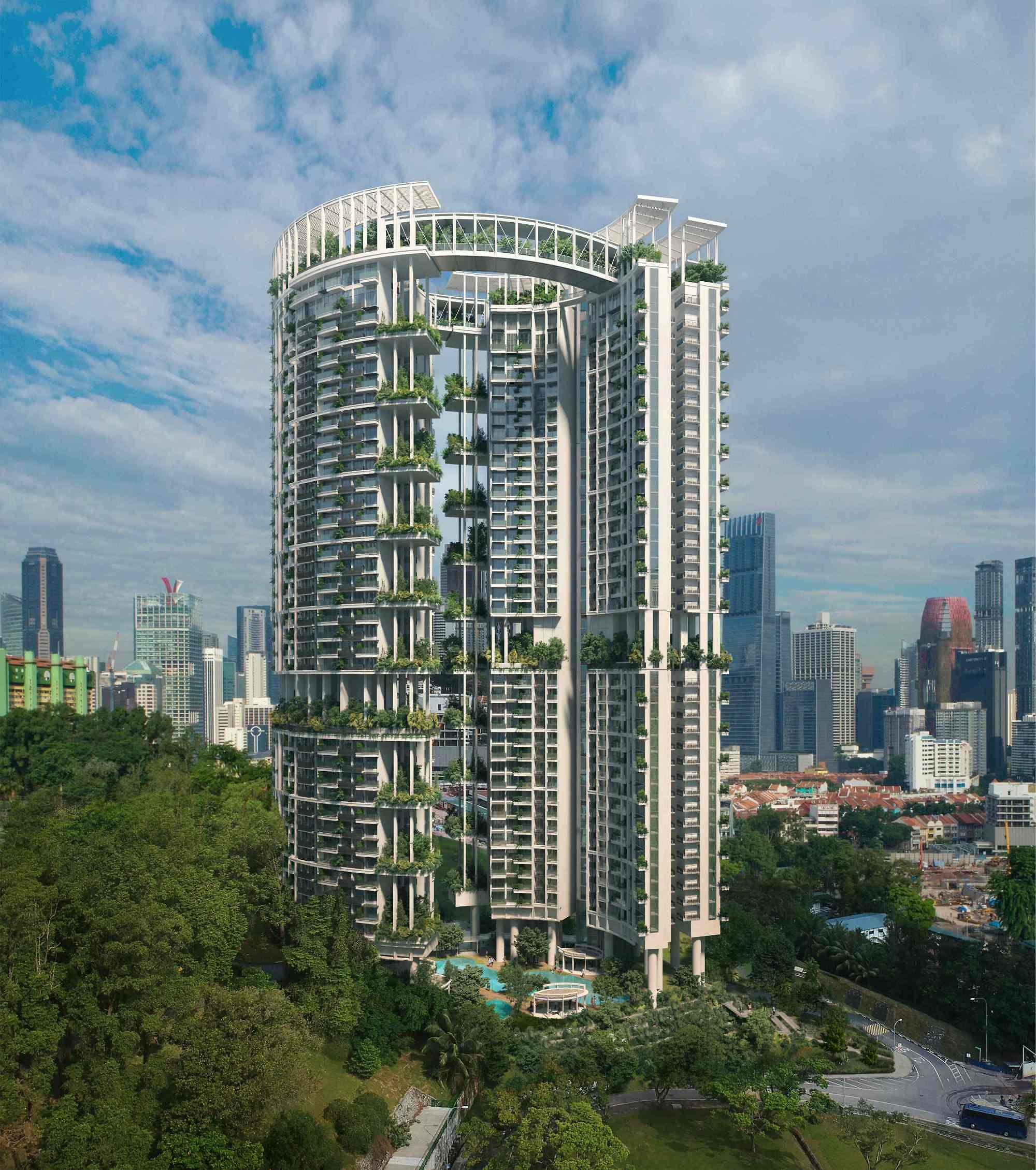
The new development comprises two curved 39-storey towers linked at the roof by sky bridges, CapitaLand said on Tuesday (May 14) in its news release. The building will also feature a vertical sky allotment garden for urban farming.
CapitaLand said: “The slender, curved facades create a light and airy effect, providing ample space for residents and onlookers to look out and through the towers to admire the stunning views atop the hill.”
Situated atop Pearl’s Hill, the 178m tower will be the tallest residential development in the Outram-Chinatown district offering views extending from the Central Business District to Sentosa, the developer said.
Artist’s impression of One Pearl Bank. (Photo: CapitaLand)
Designed by Serie+Multiply, a joint venture between London-based Serie Architects and Singapore-based Multiply Architects, One Pearl Bank will have a total of 774 apartments, including studio apartments and penthouses. The size of each unit will range from about 430 sq ft to 2,800 sq ft.
The two sky terraces and two roof gardens across the towers will have amenities such as an indoor and outdoor gymnasium, a walking track and an alfresco dining area, CapitaLand said.
One Pearl Bank will have a total of 18 sky allotment gardens with close to 200 plots where residents can grow their own herbs, fruits and vegetables, CapitaLand said. Each tower will feature an allotment garden on every four storeys, with 11 plots for each garden.
Artist’s impression of allotment gardens at One Pearl Bank. (Photo: CapitaLand)
This is the first time that a series of sky allotments has been arrayed vertically in a high-rise residential tower, according to CapitaLand, adding that it would support urban farming and promote community bonding.
Additionally, around 500 trees and more than 135,000 shrubs, plants and flowers will be planted throughout One Pearl Bank.
A landscape path linking it to the adjacent and underutilised Pearl’s Hill City Park will also be available, said Mr Ronald Tay, CEO of CapitaLand Singapore, Malaysia and Indonesia.
Artist’s impression of One Pearl Bank. (Photo: CapitaLand)
“Residents can look forward to the rejuvenation of the City Park, which will be transformed into a playground and social space for the community and linked to Fort Canning Park through the scenic Singapore River, as part of the Urban Redevelopment Authority’s Draft Master Plan 2019,” he said.
One Pearl Bank is scheduled for completion in 2023.
SINGAPORE: When the school bell rang, there was one place that then 13-year-old Wang Yiming looked forward to going, and it was not home. It was Queensway Shopping Centre.
Just a short five-minute bus ride away from her old River Valley High School campus at Malan Road, the octagonal mall was the ultimate hangout spot for the lower secondary school student and her friends.
More than a decade later, the 24-year-old freelance creative said she still reminisces about the icon of Queenstown, where she spent her formative years.
“I even got my first floorball stick there,” she recalled wistfully.
Days that were not spent hunting for good deals were instead spent huddled over fries with her friends at McDonald’s, laughing and sharing the latest gossip, among other things.
With so many fond memories from her youth, she was aghast when she recently read reports about an attempt to put up the shopping centre — one of Singapore’s oldest existing malls — for an en-bloc sale.
While Ms Wang acknowledged the Republic’s spatial limitations, she questioned why symbols of the past could not be preserved.
“We’re always tearing down and discarding the old,” she lamented.
On social media, many also expressed disappointment at the news, even though the en bloc attempt is expected to run into strong opposition from commercial tenants as well as some of those living in the adjoining Queensway Tower, which is included in the proposed collective sale.
The dismay felt over the en bloc attempt of Queensway Shopping Centre, which was built in 1976, mirrored the reactions of some Singaporeans when they first learned that Golden Mile Complex was put up for collective sale in late October last year — even though the building would be conserved, many felt that it would lose its distinctively Thai character. So far, there have been no takers for the 46-year-old Brutalist building on Beach Road.
Despite fancier and bigger malls springing up all over the island, some of Singapore’s pioneer shopping centres built in the 1970s and early 1980s such as Queensway Shopping Centre and Golden Mile Complex have retained a special place in Singaporeans’ heart — even among younger generations who are drawn to their unique offerings and distinctive characters.
Their plight, along with en bloc sales of old residential properties, seemed to have renewed interest among people in buildings constructed a few decades ago. Some questioned why these older structures have to make way.
“I’m not sure if looking old is any reason for (these buildings) not to exist,” said Mr Darren Soh, 43, a photographer who has been documenting architecture from Singapore’s early independence years for the last 10 years or so.
His works, which have been published in a book, have also been widely shared on social media. The latest is a photo essay titled Portrait Mode, which documented Pearl Bank Apartments over a period of five years, up to the time when residents had to vacate their units recently.
Chinatown’s landmark horseshoe-shaped building, which was built in 1976, was sold for S$728 million in February last year and is likely headed for demolition despite calls for it to be conserved.
Mr Soh said he was alarmed at the rate at which Singapore’s urban landscape was changing, and wanted to ensure there were visual records of these old places. He said:
The built landscape in Singapore is changing so rapidly that you probably wouldn’t recognise it from your childhood (days).
For a country that is about to celebrate its 54th National Day, he said there should be room “for us to look a bit more at our heritage and history, especially buildings built after independence”.
Furthermore, they are also a legacy of the Republic’s pioneer architects, said Singapore University of Technology and Design’s Associate Professor Yeo Kang Shua.
They represent “a certain phase of our architectural development”, and this was a period when the architects were experimenting with Modernist designs, he said.
As far as shopping complexes are concerned, the architecture and sustainable design professor said that some might be in favour of replacing an old mall with something contemporary offering a one-stop experience for shoppers. However, it would lack the same charm that certain older buildings had acquired, and the reputation they had developed.
Over the years, Queensway Shopping Centre became known for its sporting goods, for example. Others, such as Tanjong Katong Complex, Bras Basah Complex and Peninsula Shopping Centre, have also carved out a niche for themselves while keeping up with the times.
Queensway Shopping Centre (Photo: Darius Boey)
While they may no longer be doing rip-roaring business these days and face an uncertain future, these malls are symbols of resilience — holding their own despite the onslaught of new mega malls and e-commerce.
Many have developed a unique identity and loyal following, while reinventing themselves and drawing younger customers over the decades.
QUEENSWAY SHOPPING CENTRE
It was lunchtime on a weekday and there was barely any space to sit for a meal.
On the ground floor of the 100,000 square feet strata-titled mall, a line had formed along Janggut Laksa eatery as hungry visitors waited to tuck into a steaming bowl of the Katong variant of the local favourite.
Elsewhere, others took advantage of the lull in the workday to either get their badminton racquets restrung, pick up a new pair of leather shoes or get their clothes tailored.
Even though there was a bustling crowd within the retail section of the ageing development, tailor Roy Tik said this was nothing compared to its heyday.
The fashionably dressed 70-year-old, who had bits of thread on his fitting black turtleneck top, said the mall used to be so crowded that it was impossible to put a chair along the walkway.
“People were queuing up to pay (for their purchases),” said Mr Tik, who has been operating within the mall for more than two decades.
Mr Gurbachan Singh, 68, recalled that when he started working at Salam & Sons in 1987, going to the toilet was an ordeal as he had to push past people just to get there.
“I wouldn’t even have time to talk to you like I am (doing) now,” said the sporting goods shop’s manager, who added that he sometimes had to forgo lunch because of the number of customers he had to deal with.
Founded in 1976, the same year the mall opened, Salam & Sons was one of the mall’s pioneers in selling sports equipment and apparel. Back then, Queensway had yet to gain its reputation for being a sports mall. Instead, Mr Singh remembered there were a lot of shops selling jeans.
Mr Ken Lim, 57, also recalled seeing vegetable sellers and aquarium shops during his regular trips to the mall for Japanese classes around the late 1980s to early 1990s.
Mr Ken Lim. (Photo: Low Youjin/TODAY)
It was both eclectic and “very messy”, said Mr Lim.
The loyal customer became a shop owner there: He liked the place so much that in 1986, he set up his own shop there, the Rising Shoe Shop.
Mr Singh said that it was some time in the 80s that his shop’s business started picking up. People became more interested in sports, and competitors started coming in. But he did not mind.
“Honestly, here we don’t compete with each other. No one was trying to undercut the other,” he said.
Mr Lim said this is part of the culture at the mall. “It’s like a neighbourhood; we are like family. Even when customers (first) come in, they become like (our) friends. Any subject you want to talk, can talk.”
Indeed, Ms Wang recalled having many interesting interactions with the shop owners who often acceded to her customisation requests when it came to her clothes. “There was a sense of familiarity. The shop owners were friendly and approachable and we could just connect,” she said.
As tastes and trends change, Mr Mohaiyaden Marecar, who runs the family-owned SS Sports shop with his father, said one needs to specialise in something in order for business to thrive.
For instance, apart from providing a retail space for all things badminton related, the 28-year-old and his father also repair badminton racquets.
Both Mr Lim and Mr Tik agreed that providing extra services is the only way for them to have an edge over the competition from e-commerce.
Product knowledge is key so that you can make the best recommendation for your customers, said Mr Lim. Mr Tik, meanwhile, said that he has been offering tailoring lessons.
Still, Mr Lim believed that Queensway Shopping Centre could perhaps benefit from some new blood.
While it would be hard for newcomers to compete with the well-entrenched sports shops, the relatively low rent would provide the perfect opportunity for them to try out new business concepts, he said.
TANJONG KATONG COMPLEX
Surrounded by tall, sleek glass buildings, Tanjong Katong Complex stands out with its heavy concrete facade.
While it is commonly known as a place that serves the Malay community, particularly during the Hari Raya festive season, there is another aspect of its history that younger Singaporeans may be less aware of.
Located at the intersection of Sims Avenue and Tanjong Katong Road, the 204,514 square feet mall was opened in 1983 with much fanfare as it was the Housing and Development Board’s (HDB) first air-conditioned shopping complex.
At the time, the anchor tenant, Singapore’s first 24-hour Japanese supermarket Yokoso, got so popular that it became synonymous with the strictly-retail mall.
Currently, there are no casual eateries to be found among the 128 retail shops on any of its four floors. The only place where food is served is a Chinese restaurant on the top floor.
“Tell a taxi driver that you want to go to Tanjong Katong Complex, and he will probably drop you off at Katong Shopping Centre instead,” said Mr Thomas Lee, president of the Tanjong Katong Complex Merchant Association.
But tell him ‘Yokoso’, ah, then you will get here.
Tanjong Katong Complex Merchant Association Mr Thomas Lee. (Photo: Najeer Yusof/TODAY)
While Yokoso has since been replaced by the Giant supermarket, the building still retains the “Yokoso” nickname, said the 57-year-old.
Mr Lee has been working at the Dragon Corner optical and watch shop from the day the mall opened. The place used to house many Chinese merchants who had resettled from various kampungs, he said.
It was only when the old Geylang Serai market closed around 2006 for renovation that Mr Lee started noticing the appearance of more shops selling traditional Malay costumes, such as baju kurung and baju Melayu.
Mr Lee, who has since taken over the running of the business from his father, believed that these shops might have been drawn by the relatively lower and affordable takeover fees offered by the Chinese merchants.
The area surrounding Tanjong Katong Complex used to be a kampung for the Malays, said Mr Abdul Wahab Abdullah, who is touted to be Singapore’s sole songkok maker.
The 59-year-old, who has been selling the handmade traditional cap for Malay men after he was taught by his father, moved into the complex in 2004.
The hours may be long, but he takes pride in being able to customise the caps according to his customers’ needs — something they would not be able to do if they bought ready-made ones from the bazaars.
Depending on the complexity of the design, it takes him no more than two hours to put together a songkok. This speed is essential to meet the rise in demand for his craftsmanship in the lead-up to the Hari Raya celebrations.
Shortly after we spoke with Mr Abdul Wahab, a young man approached the craftsman with an infant in tow.
Mr Mohammad Hafiz, 32, said he wanted a songkok for his eight-month-old son. None of the off-the-rack caps were suitable for his toddler and he was told that only Mr Abdul Wahab could make one that fit, said the special needs teacher.
While business is good during Hari Raya period, Mr Abdul Wahab said he worries about making ends meet for the remaining 11 months of the year.
This is a concern shared by Mr Samsul Mabi, the 75-year-old owner of Elmaya House of Fashion.
Mr Samsul said that a majority of his customers are older Malay women, and that it is a challenge to attract younger women to his shop to buy baju kurung.
Another worry for the shopkeepers is the impending expiry of the mall’s lease in 2022.
The mall’s uncertain future has left several shopkeepers in two minds about making any upgrades or other drastic changes, said Mr Lee.
The building is currently managed by the Singapore Land Authority (SLA). In response to queries, an SLA spokesperson said that enhancement works were completed in 2015, including the replacement of lifts and escalators, toilet upgrading, façade painting and new flooring.
The spokesperson added that future plans for the site “are being studied with agencies and will be announced when ready”.
BRAS BASAH COMPLEX
Located within the arts and heritage district in Singapore’s civic centre, the four-storey Bras Basah Complex greets customers with a sign declaring itself as “the centre of books and arts”.
Indeed, since its opening in 1980, Bras Basah Complex has established itself as a go-to place for book and art lovers.
Bras Basah Complex. (Screengrab: Google Maps)
Amid the changing urban landscape and as printed books decline in popularity, several stores there have withstood the test of time, continuing their business ever since the complex’s inception.
One of these “old school” bookstores is Book Point, which sells a wide selection from fiction and non-fiction, to educational, business and reference books.
With a long history of over 50 years, the bookstore had first relocated from Bras Basah Road to set up shop in the complex, said owner Jawahar Ali, who inherited the business from his father.
Mr Ali, 55, noted that the area’s history as a book hub pre-dates the complex’s opening. “Bras Basah Road was well-known for book and art lovers. Shops (catering to these customers) lined the road,” he recalled.
Back then, the presence of many schools in the area — such as the Convent of the Holy Infant Jesus, St Joseph’s Institution, Raffles Institution — helped Bras Basah establish its niche in books.
“In the past, schools did not have in-campus bookstores. Schools would give the students booklists, for them to buy outside,” said Mr Ali.
So if you wanted to buy books, you would come here. In the 1980s and 1990s, commerce here was full of life.
Even as times changed and people’s interests shifted, Bras Basah Complex has managed to retain its niche appeal.
But this has been no easy feat, said 67-year-old Tan Lay Hui, who runs bookstore Music Book Room.
“It’s a different generation, books are dying. We have no way to stop that, but the thing that we can do is to adapt and adjust,” said Mdm Tan in Mandarin.
Music Book Room is also a pioneer at Bras Basah Complex, occupying the same unit for the past three decades. At the beginning, the store used to sell a wide variety of magazines and books.
But “in order to survive and stand out from others”, the store shifted its focus to sell books related to music.
Similarly, Book Point had to adapt to changing customers’ preference, said Mr Ali.
Apart from shrinking its shop size, the store started to specialise in rare books in the 2000s, after schools opened their own bookstores and chains such as Popular established a foothold in the business.
“So for people who couldn’t find the books they wanted at regular bookstores, they had to come to Bras Basah Complex to find them,” said Mr Ali.
The reason why bookstores at the complex continue to thrive is also due to the loyalty of old customers. “They’re the ones that keep us going,” said Mr Ali.
Mr Jawahar Ali. (Photo: Najeer Yusof/TODAY)
One of Book Point’s old-time customers is author Robert Yeo, who first patronised the original bookstore several decades ago at Bras Basah Road. He now visits the store at least once a month.
“I come here all the time because there are some of the best books here. Some of them are old books, first editions, ones you can’t find anywhere else,” said Mr Yeo, 79.
The complex is also a hotspot for younger customers such as architecture student Rahmat Khairudin, who describes it as “a creativity and resource hub for students”.
“Bras Basah Complex is irreplaceable and there’s really no such other place like this,” said the 27-year-old. “It relates to a community interested in the arts, and generations of students and family members come here for the same things.”
Apart from bookstores, Bras Basah Complex also hosts a growing number of art galleries and speciality shops.
At antique store Nanya, Mr Kok Seng Whatt collects and sells old coins and banknotes, while offering artwork mounting and framing services. The store has been there since the complex’s opening.
In the past, there were many Chinese bookstores here. They attracted the Chinese-educated here, and those interested in history were naturally drawn over to our shop,” said Mr Kok, 71, in Mandarin.
Despite the challenges faced by brick-and-mortar shops in Singapore’s cutthroat retail scene, the complex manages to retain a steady pool of customers due to the focus on arts, noted Mr Kok, who is also a committee member of the Bras Basah Complex Merchants’ Association. He said:
People are more open-minded and liberal now, (they) like these artworks and cultural artifacts. It’s their hobby and this helps us retain a loyal stable customer base.
PENINSULA SHOPPING CENTRE
Located near City Hall MRT, Peninsula Shopping Centre — whose facade has been largely untouched since its opening in 1974 — may stick out like a sore thumb amid swanky modern malls in the same area such as Capitol Piazza, Raffles City and the newly-refurbished Funan Mall.
But to some, it is a reflection of its resilience and ability to stay relevant to customers’ ever-changing needs.
One of Singapore’s first fully air-conditioned malls, it has evolved from being home to a mix of local retail shops to housing mainly music-related stores and services.
The shift started in the 2000s, said a spokeswoman from YTC Management which runs the mall.
Currently, the whole basement level is filled with about 10 shops offering music equipment, repair services, and jamming studios.
“A lot of music stores have taken over occupancy of the units, so much so that the influence has also spread over to the neighbouring Excelsior mall,” the spokeswoman added.
The mall’s niche in music was largely anchored by the growth of homegrown brands such as Davis Guitar and Swee Lee, said banker Eric Teh who has been going to the mall for the past 30 years.
“Back in my university years, I used to be in a band, so we’d come here often to get our equipment. Since then it’s quite remarkable how I’ve seen the place changed,” said the 52-year-old music lover.
For Davis Guitar, it first started out with a small unit in the shopping centre in 1989, before expanding in size over the years. Now, Singaporean and overseas artists are part of its clientele.
Davis Guitar. (Photo: Sherlyn Seah/TODAY)
The mall’s steady customer pool has to do with the nature of the music business, said Ms Goh Yiling, 30, who grew up working at Davis Guitar. She added:
Despite the rise in online shopping, the retail experience for music products is very different. You have to come to the store, speak to people and have a relationship, and also try out the guitar first-hand yourself.
With its niche in music, the YTC spokesperson pointed out that the mall continues to see a growing number of related stores, and these in turn attract “more of the same crowd”.
For instance, in 2016, guitar repair store GworX chose to open its store in Peninsula Shopping Centre due to the mall’s established name as a “one-stop solution for guitars”.
“People who come here know what they are here for, so it was natural that we opened here. They buy their guitars downstairs, and when they need fixing they come to us,” said employee Danish Sadaya, 23.
Similarly, Mr Alagiry Alagirisamy set up his vinyl shop For The Record in the mall eight years ago due to its niche in music, and the nearby Adelphi mall that had shops selling hi-fi stereo systems.
“It was a hobby of mine to collect vinyls for over 40 years. Then there was this vinyl revival, so I opened here since it’s near numerous music stores as well,” said the 69-year-old.
With the music stores drawing a good crowd, other retailers in the mall have also adapted their business to capture a slice of the pie.
Initially only dealing in sports goods, Jet Win Sports Company started to sell tee-shirts bearing images of various music bands a few years ago.
“It was a sort of business strategy, because we could see what kind of people were coming in and we needed to stay relevant,” said owner Khoo Chuan, 65.
SINGAPORE: A plan to reduce congestion at crowded choke-points on the rail network during peak periods by offering incentives to choose different transport options could succeed if people see genuine benefits in being flexible, analysts have said.
Their comments follow the Land Transport Authority’s (LTA) announcement on Thursday (May 9) of the new public transport incentive to be launched in the second half of 2019. Named Travel Smart Journeys (TSJ), it will be aimed at distributing peak hour demand more evenly by rewarding commuters along congested areas to consider alternative transport modes or routes.
Dr Walter Theseira, transport economist at the Singapore University of Social Sciences (SUSS) said that this is part of LTA’s “fine-tuning” of its Travel Smart Programme to improve efficiency.
He added that for such a scheme to work, commuters would have to be “flexible in their travel demand”.
“Generally, public transport has a lot of uniform pricing. But this is not efficient, because of the peak capacity problem – most people want to travel at certain times of the day, and the investments required to provide enough capacity for all of them comfortably are incredibly expensive because those extra trains and buses will sit idle the rest of the time.
“So, differentiated pricing (off-peak lower fares, etc) is used to try and spread out demand so that the capacity investment can be more efficient. Of course, this cannot be carried out unless people are actually flexible in their travel demand. They won’t be, if all employers require that all workers show up at the same time, for example,” explained Dr Theseira.
BE PREPARED TO WALK OR CYCLE
Meanwhile, his fellow transport analyst at SUSS, Dr Park Byung Joon, thinks that the LTA may not necessarily be encouraging the use of taxis or buses as alternate modes of transport, but could instead incentivise the public to consider walking, cycling or using Personal Mobility Devices (PMDs).
“The train network will still remain the backbone of (Singapore’s) public transport (network), but the buses are seen as complementary,” added Dr Park. “If I alight one stop earlier, I can still walk or use PMDs.”
File photo of personal mobility devices.
LTA has said that more details on the TSJ will be announced at a later date, but added that it will replace the existing Travel Smart Rewards initiative, and will focus on being “more localised”. The TSJ will be implemented alongside the existing network-wide lower morning pre-peak fares scheme.
The latter allows commuters to get up to 50 cents off their fare when they tap in at any train station islandwide before 7.45am on weekdays, excluding public holidays.
Dr Park said that to the individual commuter, the discount “does not add up to much”.
“From the monetary incentive point of view, it is not that great. Singaporeans spend around S$170 a month just on trains. If I take a train from Tanah Merah to Clementi, I will have to spend more than S$2. I cannot even buy a drink from the hawker centre with the 50 cent discount,” he added.
However, to the train operators, shifting the crowds away during the peak period are of greater value. LTA said that was a 12 per cent increase in commuters travelling during the morning pre-peak period in 2018, significantly larger than overall ridership growth of two per cent.
“If they can reduce the load factor just by a little bit, it really improves the quality of ride experience. Any figure (in increasing pre-peak period travel) that hits two digit is a success,” said Dr Park.
PRACTICAL, BUT CHALLENGING TO TAKE ALTERNATIVE ROUTES AND MODES
Meanwhile, Dr Theseira said that having a system that rewards commuters to take alternative routes and modes of transport to bypass congested points “is more and more practical”, but “challenging” as Singapore’s rail network expands.
“For example, with the building of the Circle Line, passengers have a choice of going through the city centre or through the Circle Line if they are traveling, say, from the North to the West. So the choice they make could reduce congestion, if part of the line is overcrowded.
“Likewise, there may be cases where one service (e.g. bus) is overcrowded compared to a parallel service (MRT). However, targeting these specific choices with incentives could be challenging as the system relies on automatically identifying travel routes from tap-in and tap-out data, so on the MRT network, your route choice for a given trip is not detected automatically,” he said.
However, Dr Theseira noted it will be important for LTA to help commuters understand the trade-offs in the various transport routes and modes. One such solution would be to give accurate information on the expected travel time and type of congestion – though this should be a reward, he highlighted.
File picture of people queuing to board a bus in Singapore. (Photo: Joey Liew)
“I think they generally do a good job of planning, provided that they have the necessary lead time. The challenges we’ve faced in the last decade or so have come largely because the increase in demand from population and economic growth was faster than expected, and of course maintenance also was deferred for too long,” said Dr Theseira.
THE NEED TO IMPROVE QUALITY OF ACCESS
Dr Park added that while assisting the transport operators, such as SMRT, with their passenger needs, the authority should not lose sight of its key focus which is to build up Singapore’s rail infrastructure as the country pushes for a larger population.
He noted that at present, there are no lines being developed are announced for new direct lines that connect the Northern part of Singapore with the East and West areas.
“Commuters today are focused on the quality of access and ‘how quickly I can move from Point A to Point B. Not enough is being done to address this area,” said Dr Park.
SINGAPORE: A plan to reduce congestion at crowded choke-points on the rail network during peak periods by offering incentives to choose different transport options could succeed if people see genuine benefits in being flexible, analysts have said.
Their comments follow the Land Transport Authority’s (LTA) announcement on Thursday (May 9) of the new public transport incentive to be launched in the second half of 2019. Named Travel Smart Journeys (TSJ), it will be aimed at distributing peak hour demand more evenly by rewarding commuters along congested areas to consider alternative transport modes or routes.
Dr Walter Theseira, transport economist at the Singapore University of Social Sciences (SUSS) said that this is part of LTA’s “fine-tuning” of its Travel Smart Programme to improve efficiency.
He added that for such a scheme to work, commuters would have to be “flexible in their travel demand”.
“Generally, public transport has a lot of uniform pricing. But this is not efficient, because of the peak capacity problem – most people want to travel at certain times of the day, and the investments required to provide enough capacity for all of them comfortably are incredibly expensive because those extra trains and buses will sit idle the rest of the time.
“So, differentiated pricing (off-peak lower fares, etc) is used to try and spread out demand so that the capacity investment can be more efficient. Of course, this cannot be carried out unless people are actually flexible in their travel demand. They won’t be, if all employers require that all workers show up at the same time, for example,” explained Dr Theseira.
BE PREPARED TO WALK OR CYCLE
Meanwhile, his fellow transport analyst at SUSS, Dr Park Byung Joon, thinks that the LTA may not necessarily be encouraging the use of taxis or buses as alternate modes of transport, but could instead incentivise the public to consider walking, cycling or using Personal Mobility Devices (PMDs).
“The train network will still remain the backbone of (Singapore’s) public transport (network), but the buses are seen as complementary,” added Dr Park. “If I alight one stop earlier, I can still walk or use PMDs.”
File photo of personal mobility devices.
LTA has said that more details on the TSJ will be announced at a later date, but added that it will replace the existing Travel Smart Rewards initiative, and will focus on being “more localised”. The TSJ will be implemented alongside the existing network-wide lower morning pre-peak fares scheme.
The latter allows commuters to get up to 50 cents off their fare when they tap in at any train station islandwide before 7.45am on weekdays, excluding public holidays.
Dr Park said that to the individual commuter, the discount “does not add up to much”.
“From the monetary incentive point of view, it is not that great. Singaporeans spend around S$170 a month just on trains. If I take a train from Tanah Merah to Clementi, I will have to spend more than S$2. I cannot even buy a drink from the hawker centre with the 50 cent discount,” he added.
However, to the train operators, shifting the crowds away during the peak period are of greater value. LTA said that was a 12 per cent increase in commuters travelling during the morning pre-peak period in 2018, significantly larger than overall ridership growth of two per cent.
“If they can reduce the load factor just by a little bit, it really improves the quality of ride experience. Any figure (in increasing pre-peak period travel) that hits two digit is a success,” said Dr Park.
PRACTICAL, BUT CHALLENGING TO TAKE ALTERNATIVE ROUTES AND MODES
Meanwhile, Dr Theseira said that having a system that rewards commuters to take alternative routes and modes of transport to bypass congested points “is more and more practical”, but “challenging” as Singapore’s rail network expands.
“For example, with the building of the Circle Line, passengers have a choice of going through the city centre or through the Circle Line if they are traveling, say, from the North to the West. So the choice they make could reduce congestion, if part of the line is overcrowded.
“Likewise, there may be cases where one service (e.g. bus) is overcrowded compared to a parallel service (MRT). However, targeting these specific choices with incentives could be challenging as the system relies on automatically identifying travel routes from tap-in and tap-out data, so on the MRT network, your route choice for a given trip is not detected automatically,” he said.
However, Dr Theseira noted it will be important for LTA to help commuters understand the trade-offs in the various transport routes and modes. One such solution would be to give accurate information on the expected travel time and type of congestion – though this should be a reward, he highlighted.
File picture of people queuing to board a bus in Singapore. (Photo: Joey Liew)
“I think they generally do a good job of planning, provided that they have the necessary lead time. The challenges we’ve faced in the last decade or so have come largely because the increase in demand from population and economic growth was faster than expected, and of course maintenance also was deferred for too long,” said Dr Theseira.
THE NEED TO IMPROVE QUALITY OF ACCESS
Dr Park added that while assisting the transport operators, such as SMRT, with their passenger needs, the authority should not lose sight of its key focus which is to build up Singapore’s rail infrastructure as the country pushes for a larger population.
He noted that at present, there are no lines being developed are announced for new direct lines that connect the Northern part of Singapore with the East and West areas.
“Commuters today are focused on the quality of access and ‘how quickly I can move from Point A to Point B. Not enough is being done to address this area,” said Dr Park.
SINGAPORE: Dave*, 28, came to see us as he found himself unable to cope with his work demands.
As a white-collar worker, he habitually spent a lot of time slaving away at his desk, poring over the never-ending items on his to-do list.
He was now a manager after having been promoted twice, yet he was always told to “contribute more”. It reached a point where most of his waking hours were spent on work-related activities, but it never seemed enough – even when he practically lived in the office and was available online 24/7.
He fell sick frequently and noticed that his concentration was no longer the same as before – he was soon dragging his feet to work every day.
Burnout is usually seen as a consequence of a chronic stressful work environment. (Photo: StockSnap/Pixabay)
Confining himself to his desk from 7am to 10pm did little to improve his work performance. Yet, he still felt an immense pressure to do more after coming to the conclusion that his colleagues were all doing well and he was the odd one out.
He became increasingly worried that he would be laid off due to his poor performance. He went from being wide-eyed and eager to weary and worn. Dave was burnt out.
TIRED, DRAINED AND LOST ENTHUSIASM
University of California Berkeley professor emerita and American social psychologist Christina Maslach’s research on burn-out defines it as a prolonged response to chronic emotional and interpersonal stressors. It manifests in a few key aspects, through physical and emotional exhaustion, socially dysfunctional behaviour and psychological impairment, and fuels organisational inefficiency.
Like Dave, those who are burnt-out typically report feeling perpetually tired, drained and lacking in enthusiasm. Mood difficulties are common within this population, with studies reporting that up to nine in 10 of burnt-out workers meet diagnostic criteria for depression.
Many of them gradually withdraw from social activities and become increasingly isolated. Often, burnt-out workers spend more time on work but yet find that their output and morale are worse than their less-stressed colleagues.
Society has upheld the belief that “doing well in school and work equates to doing well in life”. This drive to excel, or extreme meritocracy, appears to be one of the many factors feeding a burnout phenomenon in Singapore, but also apparent worldwide.
In 2013, one in four Singaporeans and permanent residents aged 18 to 69 reported high stress levels, an increase from one in five in 2012 based on results from the Health Behaviour Surveillance of Singapore (HBSS) by the Health Promotion Board.
AN INSIDIOUS PRESSURE TO DO MORE
The survey also highlighted a growing concern – younger members of the workforce were significantly more stressed than older workers.
The Willis Towers Watson’s 2016 Benefits Trends Survey showed 56 per cent of employers in Singapore with 70,000 full-time employees on their payroll cited stress as the top health issue for their employees.
In the same survey done in 2017, this figure grew to approximately two in three employees who reported above average to high levels of stress.
The relentless pursuit of excellence in the hope of securing success has led to the blurring of boundaries between work and personal life, such that work is now seen as the centre of many people’s life. Work-life integration is the new work-life balance.
Employees are encouraged to hustle and work relentlessly to strive for “more”, but this is a tantalising fiction; once reached, one inevitably finds that there is “even more” to work towards.
This insidious pressure to achieve is balanced against an employment market that hangs a looming threat over many workers’ heads: Should you not be able to produce results, someone better could always be found to replace you.
(Photo: Pixabay/caio_triana)
New York Times journalist Erin Griffith recently described the artificially glorified state of ambition in our society as having mutated from being a means to an end into a lifestyle. Mantras such as “Don’t stop when you’re tired, stop when you’re done” also bolster assumptions that employees are only valuable insofar as they are productive.
In summary, burn-out operates on a vicious cycle in our society perpetuated by factors including poor organisational culture, unrealistic expectations of workers’ productivity, role ambiguity and lack of recognition and management. This leads to a feeling of a lack of control over one’s situation that, over the long term, drives workers towards burn-out.
RECOGNISING BURN-OUT
We have to start recognising burn-out earlier so that we can take steps to help those who have found themselves in those doldrums.
Physical signs often include exhaustion or fatigue and somatic problems (e.g. neckaches, backpain). Those who suffer from it also have a lack of motivation, experience more negative emotions (e.g. anger, frustration, irritation) and have cognitive difficulties.
They may also have increased conflict with others and engage in unhealthy habits (e.g. increased smoking, drinking, or binge-eating). These symptoms often cause clinically significant distress or impairment in social, occupational, or other important areas of functioning.
(Photo: Unsplash/Robert Mathews)
Individuals can take action to tackle burnout.
1. First, acknowledge the warning signs and don’t downplay symptoms.
Individuals may take it as a sign of personal failure if they are unable to meet the constant demands of work. These lead to negative thoughts that start to get automatically activated (e.g. “I’m lousy, useless”). It is important to acknowledge the signs that it may be time to slow down before one heads into the danger zone.
2. Second, take a step back to return to basics.
Maslow’s hierarchy of needs posits that basic needs (e.g. food, water, rest, safety) should be fulfilled prior to psychological needs (e.g. relationships, accomplishments) and self-fulfilment (e.g. self-actualisation, fulfilling one’s potential).
Following on from this, we need to ensure that even when the demands of work are high, we maintain good habits in these areas. Sleep, proper nutrition and hydration are pivotal to helping the body and our nervous system recalibrate.
3. Third, take control and prioritise.
The numerous tasks that our jobs necessitate often obscure our vision regarding core values that are important and meaningful to us.
Prioritising involves making decisions regarding time management and tasks. It may seem that everything on our to-do list needs to be done now and with the highest urgency, leading us to push ourselves ever harder in pursuit of clearing our entire list today.
A better approach could be to evaluate tasks and prioritise those more pressing, using colour-coding systems to help with visualising this.
4. Fourth, allocate time for self-care.
We are more resilient and better equipped to handle stressors when we are feeling our best both physically and emotionally. Take short breaks during the day and get involved in activities outside of work that energise you. Recognise the importance of self-care and the need to decompress and unwind.
Rather than isolating yourself, research has highlighted the importance of feeling supported. Sharing what and how you feel with fellow colleagues or friends is an important step in creating a supportive environment for yourself.
Developing strong relationships and having people you can rely on is crucial in preventing burn-out.
WHAT ORGANISATIONS CAN DO TO PREVENT BURN-OUT
Although individuals can make certain habit changes to prevent burn-out, the onus is on organisations to recognise the importance of workplace health and build workplace cultures conducive to their employees’ physical and mental health.
With eight in 10 Singaporeans aged between 25 to 64 forming our workforce, effective workplace health and mental wellness promotion programmes may reduce modifiable risk factors towards this illness.
The Workplace Mental Health Investment Guide from the Health Promotion Board contains resources on how organisations can implement accessible and effective programmes.
In fact, the National Workplace Safety and Health Research Agenda for Singapore (2018-2020) published by the Workplace Safety and Health Institute revealed that organisational politics, workload and lack of support were the top three factors contributing to workplace stress.
Ultimately, organisations should not lose sight of the largest piece in the puzzle – engagement. Indeed, organisations should tread cautiously and strive to achieve a balance between increasing productivity and deleteriously endorsing a hustle culture.
Man in his twenties working on a laptop. (Photo: Unsplash/Matt Wildbore)
Organisations should see their employees as the soul of their company, rather than resources to be expended at their disposal.
For Dave, the good news is he was able to recognise that his behaviours were veering into unhealthy patterns and sought help early. Through his psychotherapy sessions, Dave was able to see how his unhelpful thinking patterns and behaviours perpetuated a vicious cycle.
Dave now sets daily alarms and reminders to leave work at a designated time to begin re-engaging with hobbies he previously enjoyed (e.g. catching a movie, going for a jog) or catching up with his friends outside of work.
He has learnt how to prioritise the tasks that are assigned to him, complete them within the given timeframe and communicate effectively with his superiors if he is unable to do so.
He shared that all these helped him to “feel alive again”.
Sara-Ann Lee is a clinical psychologist at the Institute of Mental Health (IMH).