SINGAPORE: Despite the unassuming black door and the boarded up windows, there was no difficulty in distinguishing Al Capone’s from the other establishments at Far East Shopping Centre.
Even on a Thursday night, the live music in the bar was loud enough to hear from the level below. Inside the bar, people stood shoulder-to-shoulder, gathered in anticipation of a blues jam session by Jason and the Afronauts.
Some of these visitors might even have been old regulars of Blu Jaz Cafe.
“A lot of people who used to go to Blu Jaz come here now,” said Mr Shyam Raj, who runs Al Capone’s along with the main partner of the bar, Mr Anil Goswami.
He was not only referring to the visitors, but also the artists, several of whom were veterans of Blu Jaz Cafe, which until recently was at the heart of Singapore’s network of small performance venues.
(Photo: Facebook/Blu Jaz Cafe)
Since the cancellation of its Public Entertainment Licence, Blu Jaz Cafe has not been allowed to provide any sort of public entertainment on its premises since Feb 1.
The announcement was met with dismay by some in the arts community, and even the wider public, who rallied around the jazz bar with a petition to appeal against the cancellation of its licence.
The cancellation followed breaches in Blu Jaz Cafe’s licencing conditions, said the police, who cited two instances of severe overcrowding at its premises.
Since then, acts which had previously performed there have had to find new venues. While such establishments come and go, moving elsewhere seems to have been straightforward for many of the artists who performed at Blu Jaz.
A thriving ecosystem of smaller entertainment spaces, typically at bars and clubs, allows many locals artists to make their first foray into live performance.
This was how poet Jennifer Anne Champion got her start.
She recalled that she was part of NUS’s drama society around five years ago when she got invited to perform at Blu Jaz Cafe’s poetry open mic.
“I had never seen spoken word before, especially Singaporean spoken word. So when I saw it I just thought that’s amazing, and I think I can do it too.
“It’s been five years, (and it has) pretty much given me my job and my career,” she said.
For musician Jordan Wei, these performance spaces are crucial for musicians to come together and collaborate artistically.
“Without the relevant outlets of expression, the musical hive mind eventually loses its creative focus and withers. And thus some of the potential greatest artistic ideas may never materialise,” he said.
Mr Chris Gomez of the band Jason and the Afronauts agreed, saying: “It’s (about) the camaraderie that is built in the circuit.”
The members of Jason and the Afronauts pose for a picture. (Photo: Fauzi Hasnan)
AN INITIATION FOR PERFORMERS
Performing at bars and clubs is often the best way for musicians and spoken word performers to learn their craft from veterans.
Part-time lecturer at Lasalle College of the Arts and organiser of the Singapore Poetry Slam Chris Mooney-Singh sees these smaller performing spaces as a place where younger artists could train before moving on to larger venues.
“(Smaller performing spaces) is kind of an initiation for young writers to find their feet though public presentation of their works.
“These venues are often small… Having to (perform) for a huge environment (could) be perhaps overwhelming for young writers.
“(These places) serves new people very well I think, socially as well as artistically,” he said.
Head of Lasalle College of the Arts’ School of Contemporary Music Tim O’Dwyer expressed similar sentiments.
“It’s just building capacity. It’s getting in front of people; other musicians are giving them critique. Over and over again they’re going through that whole thing: rehearsing through the material, learning new material, just basically being a professional musician,” he said.
Without venues to play at, musicians would not get the experience of playing in front of a live crowd, passing on this inexperience to musicians after them, said Dr O’Dwyer.
“If you really want a very vibrant, really young people coming through and developing into mature musicians who’ve got something to say and telling Singaporean stories… then they need to have a place to do it,” he added.
A band performs at Al Capone’s, located in Far East Shopping Centre. (Photo: Cindy Co)
THE NEW BLU JAZ?
Ever since the cancellation of Blu Jaz Cafe’s licence, its old performance regulars have moved to new locations.
For now, Destination: Ink has found a home at Miss Chinatown, a bar owned by local musicians Jack and Rai.
The Singapore Poetry Slam has moved to the Southbridge Hotel’s Whisky Bar, while Mr Wei has started performing at various locations like Origin Bar at the Shangri-la hotel, NUDE Grill at Marina One and Al Capone’s at Far East Shopping Centre, among others.
With the exodus of performers from Blu Jaz Cafe, are there any new locations that might come to take on its position at the centre of the live performance scene?
Most artists that CNA spoke to were unsure.
“Honestly, it’s up to event spaces and restaurants themselves – how much effort they want to put in it,” said co-organiser of the Singapore Poetry Slam Ajay Govinda Menon.
To him, “only time will tell” if a new hub for the arts emerges among the current live performance spaces.
This is an aspiration that is perhaps on the cards for the owners of Al Capone’s.
“We want to be a bar that gives the stage for every kind of local musician to boost their craft.
“Hopefully (we can) be one of those people that influences Singaporeans to like original music and receive it with an equal amount of passion as their top 40 covers,” said Mr Raj.
And what about expanding beyond music to include other types of art?
“Yeah, sure. Anything that’s art. Where there is art, where we can offer a venue, we’d love to marry the both. That’s fine,” he said.
SINGAPORE: The new Canberra MRT station on the North-South Line will open on Nov 2, Minister for Transport Khaw Boon Wan announced on Monday (May 20) during a visit to the site.
Located between Sembawang and Yishun stations, Canberra station will be a 10-minute walk away for more than 17,000 households.
“This is expected to save nearby commuters up to 10 minutes in travel time towards the city centre or Jurong East,” said the Land Transport Authority.
Minister for Transport Khaw Boon Wan visits the site of Canberra MRT station on May 20, 2019. (Photo: Facebook/Land Transport Authority)
A 72m crossover track had to be constructed to connect the existing track to and from the station. The track allows trains to cross from one track to another when the need arises, such as if there is a fault on the track.
On Saturday and Sunday, work was carried out to remove the existing tracks and install the new tracks. Testing and commissioning of the signaling software for the newly installed track was done on Monday, the third and final day the closures.
Train services are expected to resume on Tuesday.
Minister for Transport Khaw Boon Wan at the site of Canberra MRT station on May 20, 2019. (Photo: Facebook/Land Transport Authority)
About 75 per cent of the construction for Canberra MRT station has been completed.
“Instead of taking a bus to Sembawang station or Yishun station, we can now just walk over (to Canberra MRT station), and it saves time,” said resident Angeline Tan.
Canberra MRT station will service upcoming residential developments and existing public housing estates. (Photo: Facebook/Land Transport Authority)
Another resident, Gagan Velappakutty, added that he looked forward to shorter travel times. “Definitely we cut down on the travelling time, we don’t need to take a feeder bus (to other stations), we can just walk over,” he said.
Canberra station is the second MRT station to be built on an existing MRT line, after Dover on the East-West Line.
It will have five entrances, and is the first elevated MRT station to provide commuters with direct access to the city-bound train platform via a link bridge across Canberra Link.
The station will also have sheltered walkways to bus stops and more than 500 bicycle parking lots.
SINGAPORE: Several measures will be put in place to reduce vehicular speed and improve pedestrian safety at the roundabout in Marine Parade where a fatal accident took place in March.
Announcing the measures on Monday (May 20), the Land Transport Authority (LTA) said it will implement tighter turning angles that lower motorists’ speeds before entering the roundabout.
“To slow down motorists as they turn into Silversea condominium, the turning radius will also be tightened,” LTA added.
Tighter turning angles will be introduced to lower motorists’ speeds before entering the roundabout. (Photo: Facebook/Lim Biow Chuan)
A series of enhancements will be introduced at the Marine Parade Roundabout to further reduce vehicular speeds and enhance pedestrian safety. (Photo: Facebook/Lim Biow Chuan)
In addition, vehicular impact guardrails will be installed along the footpath at the perimeter of the roundabout.
The crossing point for pedestrians will be moved to allow them to cross further away from the main flow of traffic at the roundabout, said LTA.
The crossing point will be shifted to allow pedestrians to cross further away from the main flow of traffic at the roundabout. (Photo: Facebook/Lim Biow Chuan)
Residents of Marine Parade had called for more safety measures, saying they have seen motorists drive dangerously at the roundabout, and that the pavement on the perimeter of the roundabout is too narrow.
Surrounding the roundabout between Marine Parade Road and Amber Road are many condominium developments. (Photo: Darius Boey)
The two-lane roundabout has three exits that lead to Marine Parade Road, Amber Road and the Silversea condominium. According to residents, the roundabout is heavily used by drivers to get to the city via Mountbatten Road or towards Parkway Parade on Marine Parade Road.
The latest improvements, LTA said, will be carried out in stages and are scheduled to be completed by the end of July.
There will be partial lane closures during the road works; motorists and pedestrians are advised to take note of directional and information signs, and to exercise caution.
LTA said it took into consideration feedback on the matter from residents living in the area and Member of Parliament for Mountbatten, Mr Lim Biow Chuan.
SINGAPORE: Education Minister Ong Ye Kung announced the momentous move to end streaming in secondary schools by 2024 in March.
Schools are now encouraged to do away with the practice of grouping students into form classes by academic ability and instead experiment with innovative ways to group students.
The idea is that this will encourage children from different backgrounds to interact with each other. In the long run, this would lead to better social mixing and greater societal cohesion – or so is thought.
CHALLENGES WITH DOING AWAY WITH ABILITY-BASED CLASS GROUPING
Doing away with ability-based grouping necessarily implies that each form class will comprise a more heterogeneous mix of students than before. A pertinent consideration is whether teachers are well prepared to teach such classes.
At Edgefield Secondary School, for instance, students attend classes in academic subjects such as English and Mathematics, which are grouped by subject-based abilities, but go through about half of their other lessons, including Art and Music, in form classes comprising a mixture of students from all three academic streams.
Teaching a class comprising students from vastly different backgrounds and abilities will naturally be more challenging, since the pace of a given lesson might be too slow for some while too fast for others. Principals must therefore ensure that teachers are trained so that students do not become disengaged.
Form teachers will inevitably need to address thorny questions such as “how should I best pitch my lessons? Should I pitch it so that the content and pace is just right for the average student? Or so I pitch it so that it better challenges the faster learners? Or should I pitch it so as to accommodate the slowest learners?”
Secondary school students in a classroom in Singapore. (File photo: MOE)
In influencing the amount of content taught to students and the pace at which the lesson is delivered, these decisions will have important implications for student learning.
WILL GROUPING BY CCA SOLVE THE PROBLEM OF SOCIAL MIXING WITHIN SCHOOLS?
What should principals consider in deciding how best to organise students into form classes, now that ability-based grouping should be avoided?
In the Committee of Supply debate, a few examples were shared on how some schools had been experimenting with innovative ways of grouping students. Apart from Edgefield Secondary, Minister Ong also cited the example of Boon Lay Secondary School, which had grouped students into form classes based on co-curricular activity (CCA).
While this is an interesting and creative strategy with many merits, principals of other schools who are considering a similar strategy should also be aware of its limitations. Though this strategy might help to reduce the phenomenon of ability-based grouping somewhat, it is unlikely to completely eradicate it.
Why? Because the CCA one participates in involves a choice. It is well known that people from different socioeconomic backgrounds tend to be attracted to different kinds of CCAs. Take golf, sailing, tennis, fencing, or horse-riding for instance.
Who are the kids that tend to take these up as CCAs? Typically the ones from more wealthy families.
These kids have more interest in taking up these activities, perhaps because their parents also engage in them or can send them to such enrichment classes and activities. Because these activities often require access to exclusive clubs or facilities offered by condominium residency, students and parents who engage in them are often those that are more well-to-do.
File photo of secondary school students in Singapore.
Therefore, forming classes by CCAs could continue to result in ability and socioeconomic-based grouping, since students in certain CCAs might be from more advantaged backgrounds than others.
Forming classes based on CCAs may also result in unintentional grouping based on race and gender. Again, this results because students of different races and sex tend to be attracted to different types of activities.
For instance, the majority of those who opt for ballet as a CCA tend to be females. Similarly, Chinese, Malay and Indian dance or music are CCAs that tend to attract students of Chinese, Malay and Indian ethnicities respectively.
As such, grouping students based on CCAs, when CCAs involve self-selection based on socioeconomic, racial and gender lines, may end up inadvertently segregating classes of students along those lines.
A POTENTIAL WAY TO GROUP STUDENTS WITHIN SCHOOLS
If the primary objective is to allow for greater social mixing, schools may want to consider grouping students into form classes based on random assignment instead. This process would much be like rolling a die.
If a die is rolled and the number two is obtained, a student is assigned to class two, and so on. In practice, the assignment can be based on a random number generator. This procedure will ensure that the mix of students in each class will be roughly the same as the composition of students making up the school.
In other words, if the ratio of male to female students in the school is 50:50 and the ratio of Chinese, Malay, and Indian students is 70:20:10, for instance, this procedure will yield a mix of students in each class with roughly these same proportions.
Secondary school students in Singapore. (File photo: MOE)
Importantly, the average ability of students in each class will end up being the same as that of the school. Hence, there will not be a case where some classes will have disproportionately more high ability students or students from certain sociodemographic backgrounds. This results in an equal mix of students across classes within a school.
To ensure that teachers teaching the core subjects will not face the problem of having to deal with a class which is too heterogeneous, schools can explore grouping students by random assignment for non-core subjects like character and citizenship education, but by the new subject-based academic levels when it comes to examinable subjects.
This way, schools can achieve the best of both worlds – with ample opportunities for students of different backgrounds to socialise on a regular basis but yet still ensuring lesson delivery in core subjects continues to be efficient.
SCHOOLS NEED THE BUY-IN OF PARENTS
Of course, for any social mixing scheme to work as intended, schools need the buy-in of parents. Parents, especially of the more-able academic performers, need to be convinced that social mixing will actually be beneficial for their children.
Otherwise, they would simply “migrate” from schools with a policy of social mixing towards those schools where students tend to be higher achieving (such as integrated programme schools) so as to avoid having their children mix with students who are less academically inclined.
Already, there is some evidence that such concerns might be genuine, with reports citing how some parents have responded that they prefer to avoid having their children mix with children who are lower-achieving.
File photo of secondary school students. (Photo: TODAY)
If this is true, we might end up with a situation where the higher-achieving children from more advantaged families would have a greater tendency to cluster in some schools, while lower-achieving children from less advantaged families would have a greater tendency to cluster separately in others.
The end result then, might be more social mixing within schools, but paradoxically greater social inequality across schools.
Kelvin Seah Kah Cheng is a Lecturer in the Department of Economics, National University of Singapore. His research focuses on the economics of education.
You can now get the day’s biggest headlines from CNA on WhatsApp. Every morning, we’ll send you a round-up of the top stories. In addition, we’ll also send you any major breaking news as it happens.
If the button above doesn’t work for you, click here.
You’ll be asked to confirm that you want to receive WhatsApp messages from us. You can also read our privacy policy.
Once you’re done, you will be taken to a WhatsApp chat window with a number originating from Germany (country code +49). This number is supplied to us by MessengerPeople, the company we use for our WhatsApp news service.
Please save this number to your contacts. It’s important that you do this, or we won’t be able to send you any messages.
After you save our number, you should receive the first message from us within 24 hours.
HOW DO I UNSUBSCRIBE?
If you no longer want to receive any messages from CNA on WhatsApp, send a message with the word Stop.
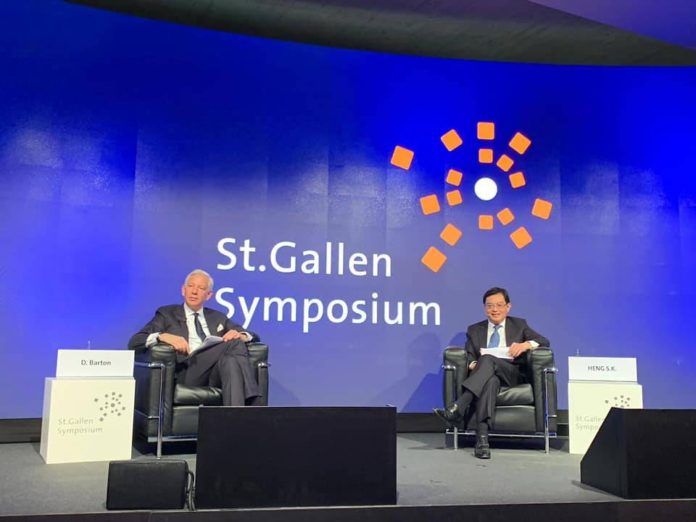
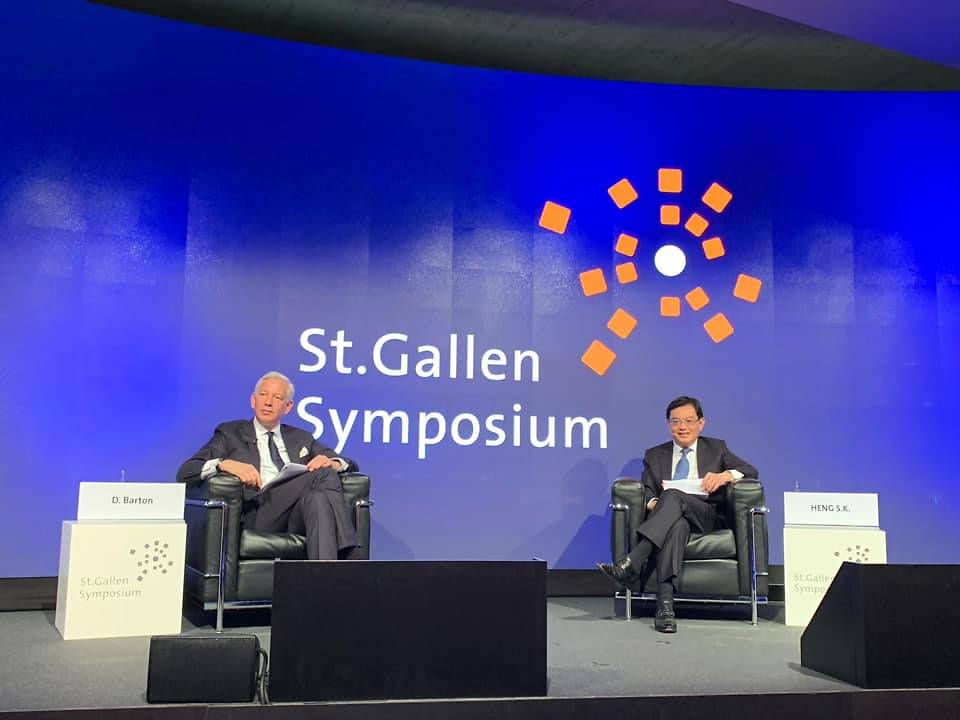
ST GALLEN, Switzerland: Deputy Prime Minister (DPM) and Finance Minister Heng Swee Keat said Singapore must continue to “learn how to evolve and improve our systems” and adopt useful policies from other countries.
Speaking at the sidelines of the recent 49th St Gallen Symposium in Switzerland, Mr Heng was interviewed by Swiss newspaper Neue Zürcher Zeitung on Singapore’s housing policy, the country’s governance and democracy, the role of capital in a modern economy and the Government’s role in managing the economy.
When asked about the biggest challenge that Singapore faces, Mr Heng said: “Well, our biggest challenge that we need to address is to build a sense of unity amidst this tremendous changes that are going on around us.”
This can be done with good governance, keeping politics constructive and making hard decisions for the long run. Together with good governance and a “sense of unity among our people”, Singapore can remain strong, the Deputy Prime Minister said.
Mr Heng was on a visit to Switzerland from May 6 to May 10 – his first overseas trip as Deputy Prime Minister – which included visits to several Swiss businesses. The interview was published by the Swiss newspaper on Friday.
Mr Heng answered questions on the reasons behind the 99-year leases for Housing and Development Board (HDB) flats.
“It is a rational policy if we believe, if we hope that Singapore will last forever. Don’t forget, the whole of Singapore is 700 over sq km,” the Deputy Prime Minister said.
“If we sell land as freehold and that the moment you own it, you own in perpetuity. What it means is that children who are born in the future will never have any home or be able to buy anything.
“We do have some freehold properties but a very small amount. All the new contracts for housing are sold as 99-year leases, and for industrial development, it is even shorter. It is between 20 to 30 years.”
He said the Government wants to encourage young couples to settle down and have children.
“Our own population is coming down and as our young people are better educated, some have chosen to stay single. It is the same phenomenon that we see in the OECD (Organisation for Economic Co-operation and Development) countries,” Mr Heng said.
“Some of those who are successful say I want to enjoy my life, I don’t want to have family, I don’t want to have kids.
“That is a choice that we have to respect but I hope we can encourage more of our young people to find their life partner and have children.”
SINGAPORE’S DEMOCRACY
When asked about Singapore politics, Mr Heng said it was “not the correct understanding” by saying that the Government has “all the answers”.
“Many of us, myself included, have been on record saying that the Government cannot possibly have all the answers to all of the problems and that is why we have to mobilise our society to resolve many of these issues,” said Mr Heng.
“And beyond just resolving the issue, it is also a sense of ownership that as a citizen, I can do what is right and I choose as a citizen to contribute in different ways.”
Mr Heng Swee Keat wrapped up a five-day trip to Switzerland after speaking at the 49th St Gallen Symposium. It was his first overseas trip as Deputy Prime Minister. (Photo: Facebook/Heng Swee Keat)
When questioned about the “Western idea” that competition “helps to breed the best”, Mr Heng said Singapore has “free and fair elections”.
“In the last election, there were so many parties that contested and as I mentioned at the forum earlier on, in 2011, we lost six seats. We lost a number of key ministers,” said Mr Heng.
“The minister was formerly a Minister for Trade and Industry and was our Foreign Minister. Well-respected around the world, but lost the election.
“The Second Minister for Finance lost the election. A very prominent Member of Parliament who had been in politics for many years, who was slated to be the Speaker of Parliament, lost the election because the whole team lost. Five of them in a group constituency.
“Is it a democracy? It is to me. Did we respect that? Yes, we do.”
Added Mr Heng: “The fact that the ruling party has been able to win elections is not because we have been suppressing. The fact is that we have, as I said in my speech earlier on, we have delivered on what we promised, and that we have won the trust and confidence of Singaporeans.
GOVERNMENT’S ROLE IN BUILDING CAPITAL
The Deputy Prime Minister said most Southeast Asian countries came through the global financial crisis better than most people expected because they learnt the lessons of the 1997 to 1998 crisis.
Speaking about the free market approach, Mr Heng said the “market-based approach of allocating capital to its most productive uses remains the best mechanism”.
“But the focus just on the return to capital will not suffice. This is particularly so at a time when technologies are transforming rapidly,” said Mr Heng.
“In that regard, what is important is that even as businesses reinvent themselves and transform, both businesses and governments will have to do more to help our workers to be better prepared for the future.”
Trade unions, such as the National Trade Union Congress (NTUC), have evolved from a “confrontational approach” to a “more collaborative approach”.
“We recognise that more skillful, more productive workers make the company more competitive, and the more competitive, more productive company is able to retain workers better, is able to pay workers better,” said Mr Heng.
“That is a sustainable way of increasing welfare – both the welfare of the workers, as well as the welfare of the owners of capital.”
When asked if the Singapore model of development is a capitalist model, the Deputy Prime Minister said it was “easy to create misunderstanding” by putting a label on models.
“The idea that the private market can do everything and therefore, create growth, and that free, open competition alone will be sufficient to assure a good outcome is not something I believe in,” Mr Heng said.
“I don’t agree with that. I believe governments around the world do have important roles.”
A government should set up rules to provide certainty for all investors, such as not changing “the rules of the game halfway”.
He added that a government has a very important role in providing critical infrastructures – such as roads, airports and seaports – and to invest in education and basic research.
SINGAPORE: The water flowing from Singapore’s taps is perfectly safe to drink, but recent research shows that many people still prefer to quench their thirst with bottled water, with demand continuing to grow.
Data from research firm Euromonitor International show that sales of bottled water have been increasing steadily over the years – from S$161.3 million in 2013 to S$179.4 million in 2018. The figure includes sales of all types of bottled water, including still, carbonated, flavoured and what is known as “functional” water, which is enhanced with ingredients such as vitamins.
And this has an impact on the environment, given that most bottled water is sold in single-used plastic containers, very little of which is recycled, according to the Singapore Environment Council.
A study it released in 2018 showed that about 467 million polyethylene terephthalate (PET) bottles – which are commonly used for drinks, sauces and marinades – are used in Singapore each year. This works out to the volume of 94 Olympic-sized swimming pools.
According to statistics from the National Environment Agency, 6 per cent of plastics were recycled in 2017, and 4 per cent in 2018.
The rising trend in consumption of bottled water in Singapore is not a recent phenomenon.
A 2016 CNA story on the multimillion-dollar bottled-water industry showed consumers in Singapore spending about S$134 million dollars on still bottled water in 2015, a 24 per cent increase from five years before.
The 2016 article focused on how demand for still bottled water was growing. It also highlighted how the dominant brands in Singapore were confirmed by F&N and Coca-Cola – the companies behind the most popular varieties here – to be sourced from water supplies in Malaysia.
According to United Nations trade data, most of Singapore’s bottled water is imported from Malaysia.
When contacted in March this year, Coca-Cola confirmed that there has been no change in where it sources water for its popular Dasani brand. F&N added to its 2016 statement, saying that the process quoted then was “over-simplified”. It said that its water is a blend of “natural mineral water extracted from deep well and reverse osmosis water” that goes through a “stringent 5-tier filtration process that includes various filters.”
F&N said that its popular Ice Mountainbrand of water is sourced and bottled in plants in Peninsular Malaysia.
INCREASED CONSUMPTION BOOSTED BY MOVE AWAY FROM SWEET DRINKS
According to Euromonitor, health conscious consumers are boosting demand for bottled water in Singapore. In its report, the research firm noted that they began to switch to to bottled water from soft drinks, sports drinks and juice, as the drinks were perceived to be sugar-laden.
It added that bottled water is expected to continue its “strong growth”, boosted by this continued switch.
While sales of bottled water have been increasing in Singapore over the years, the sales of other bottled beverages have been on the decline.
But why not just drink water straight from the tap?
The main reason is convenience, said Shane Snyder, Executive Director of Nanyang Environment and Water Research Institute (NEWRI) at Nanyang Technological University.
“I believe the average member of the public trusts that Singapore is producing water that’s healthy and safe,” he said, adding that Singapore is world-renowned for its water technologies and contribution to research in the area. “Let’s say you’re out running and you go by a convenience store … it’s a lot easier to just grab a bottle of water, rather than you having to carry a reusable bottle around and having to wash it when it gets dirty.”
“People also tend to prefer their drinking water cold, and it’s easier for them to get a bottle of chilled water quickly from the stores, rather than getting it from the tap, which isn’t as cold.”
The convenience factor also plays out in places such as food courts, said another analyst.
“How many food courts have water fountains?” pointed out Ravi Krishnaswamy, senior vice president of energy and environment at Frost & Sullivan Asia Pacific. “If you don’t have water points, what do you expect people to do, especially when low-sugar drinks are being promoted? The alternative is just to buy water.”
This consideration may also outweigh the environmental impact of single-use plastics, with Mr Krishnaswamy also noting that there could still be a lack of awareness among consumers about the environmental impact of not just the plastic waste generated by plastic bottles, but also the carbon footprint of transporting them into Singapore, whether it’s from Malaysia or, as in the case of some other popular brands, much further afield.
“While there has been a lot of awareness generated recently over plastic straws, I don’t think people have yet to realise the plastic waste generated from the bottled water is a huge environmental issue,” he said.
WATER FOUNTAINS, MORE EDUCATION CAN HELP ADDRESS THIS
One key solution in addressing this issue, is to make public water fountains more accessible, suggested the two analysts.
This, said Prof Snyder, would help address the “ick factor” of people having to refill their bottles in public toilets.
“One way to really advance the use of tap water would be to have dispensers readily available in public places, preferably if it’s ice cold, and if possible, even warm water,” he said, adding that well-designed water fountains can also play a part.
“We had a water fountain on my university campus in America that was specially designed – it had a very high dispenser and you could put your bottle there. It was very popular, especially if you look at conventional water fountains, where it’s not very easy to put your bottle there to refill it.”
Demand for such sources may be picking up in Singapore, where awareness has accelerated of the environmental damage that can be done by single-use plastics. F&N has launched a water station which it describes as an “environmentally friendly alternative” to disposable bottled water. Apart from dispensing chilled and filtered water to buyers, users also have the option of buying a reusable bottle.
File photo of a cup filling up water from a tap. (Photo: AFP/Anne-Christine Poujoulat)
Educating the public would also be helpful, added Prof Snyder, suggesting that it could be more than just raising awareness about the plastic waste issue.
“Bottled water could be sold as high as S$3 a bottle – if you think about the cost of water in your home, that’s a tremendous mark-up,” he said. “So there could be an education component about the wasted money.”
Mr Krishnaswamy also suggested that education start from young, particularly in the schools.
“Students today tend to be much more aware and conscious about such issues,” he said, adding that schools can also consider not selling bottled water to develop the habit from young.
The rise of ground-up initiatives, he added, is also a positive step.
GROUND-UP INITIATIVES HELPING TO CHANGE MINDSETS ABOUT TAP WATER
One such initiative was put together by a group of Nanyang Technological University (NTU) students as their final year project.
The quartet of final-year communications students decided to start a campaign aimed at encouraging people to eschew bottled water in favour of tap water, spurred by the increasing amount of money that is being spent on bottled water and the rising awareness of environmental issues.
“We saw more people using reusable metal straws, and plastic bags aren’t given out in our school anymore,” said Erny Kartolo, one of the four students. “But we realised that there wasn’t enough attention given to plastic bottle waste, when in actual fact, this accounts for a lot of Singapore’s plastic waste.”
Their “Drink Wise, Drink Tap” campaign ran from January to March, with Senior Minister of State for the Environment and Water Resources Amy Khor praising it as “simple, but brilliant”. Prior to that, the team conducted surveys and focus group discussions to find out how people perceived tap water, and why they chose to buy bottled water.
It appeared, said Ms Kartolo, that it all boiled down to “psychological barriers”, where people are reluctant to drink water from public taps because of how the surroundings appeared.
“This was one of the biggest struggles in our campaign,” she said. “The water from the public toilet tap is completely safe and clean, but if the surroundings are dirty, you don’t want to drink or refill your bottle.”
To prove their point, part of their efforts involved them setting up booths at four events, where they conducted a blind taste test with two identical mason jars: one filled with tap water, and the other with bottled water.
The blind taste test set up by the group at an event. (Photo courtesy of Erny Kartolo)
“Out of the hundreds of people who tried the water, most really couldn’t tell the difference, and some guessed wrongly,” said Ms Kartolo. “So I think it’s true about the psychological barriers … If I tell you this is tap water, you might think it tastes a bit different, but we didn’t tell them, and the majority of them couldn’t tell the difference.”
While the campaign has since ended, Ms Kartolo hopes that their efforts have gone some way in helping to change mindsets among consumers and overcoming this barrier.
Moving forward, the group also hopes that more can be done to help encourage people to make the switch.
For one, they suggested that to encourage more people to drink the tap water from public toilet sinks, NEA and PUB can collaborate on clean toilet campaigns, to assure people about the hygiene of the environment and the cleanliness of the tap water for consumption.
They also suggested that partnerships with eateries be explored, to provide tap water refills.
“Our research found that people trust eateries to provide them with safe drinking water,” said Ms Kartolo. “This would be a great step in getting businesses involved in Singapore’s journey towards sustainability.”
“Tap water is a simple, easy solution for Singaporeans to adopt,” she added. “We want people to realise that there’s really no need for bottled water.”
SINGAPORE: The action starts far away, some 100km from the mothership. The enemy does not see the unmanned aerial vehicle (UAV) loitering high in the sky, let alone the mothership itself.
But the UAV sees the enemy. Its high-definition, high-zoom cameras – powerful enough to see the features on your face – easily identify the enemy: A hostile speedboat carrying armed men.
The images are quickly transmitted to the mothership. Inside its command centre, an operator dispatches yet another robotic weapon: A missile-equipped unmanned surface vessel (USV) slips out from the side of the ship.
The USV charges forward and tracks the enemy. The speedboat doesn’t get close – not within 10km of the mothership – when the USV locks on and destroys it.
Based on a video shown at this year’s International Maritime Defence Exhibition and Conference (IMDEX) Asia held in Singapore, this is how a combat scenario could play out when a mothership works with a team of unmanned boats and drones, making it possible for navies to see earlier and strike faster.
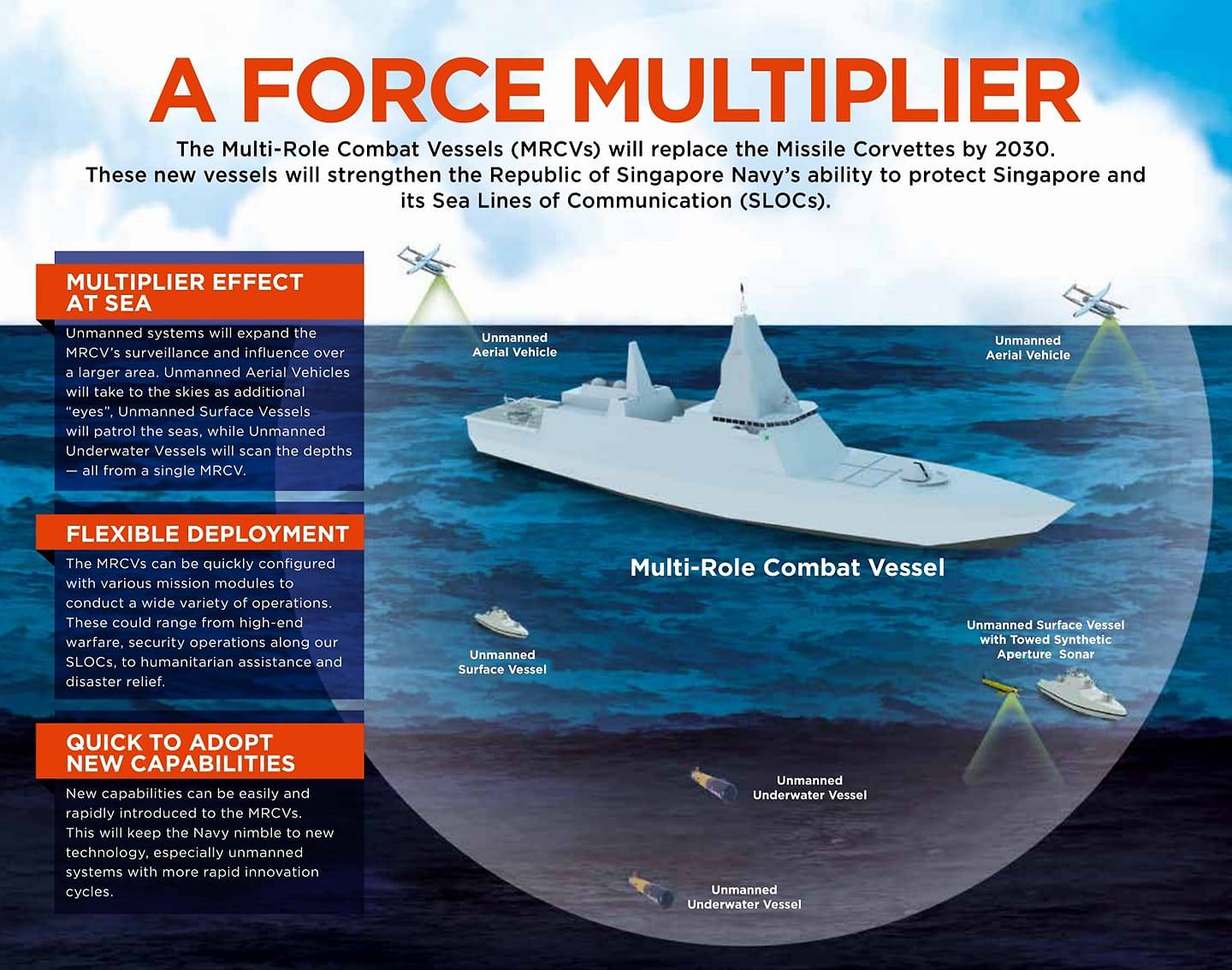
Last June, Defence Minister Ng Eng Hen announced that the Republic of Singapore Navy (RSN) will replace its ageing missile corvettes with the multi-role combat vessel (MRCV), a type of mothership carrying unmanned platforms for the air, surface and sub-surface.
“They will have … a modular package to extend their reach and flexibility against threats,” he reiterated in March during the Ministry of Defence’s (MINDEF) Committee of Supply speech.
The first MRCVs will be delivered around 2025, with full delivery expected by 2030.
The Republic of Singapore Navy’s multi-role combat vessel. (Graphic: MINDEF)
The mothership concept is not new. The US Special Operations Command has deployed a mothership that can carry massive loads of military platforms, supplies and gear, while the UK Royal Navy is developing multi-role ships capable of conducting a variety of operations, including crisis support and warfighting.
And so to find out just what a mothership can do, CNA spoke to defence companies at the biennial IMDEX Asia, featuring more than 230 companies from 29 countries. The May 14 to 16 event included defence giants like America’s Lockheed Martin, Israel’s Rafael and Italy’s Leonardo.
The first stop was a gleaming mega exhibition stand right by the entrance: Singapore’s defence conglomerate ST Engineering.
UNMANNED SURFACE VESSEL
One USV that could be paired with a mothership is ST Engineering’s Venus 16. The RSN has tested the Venus 16 from as early as 2015, when it was used during a maritime exercise to chase suspicious vessels.
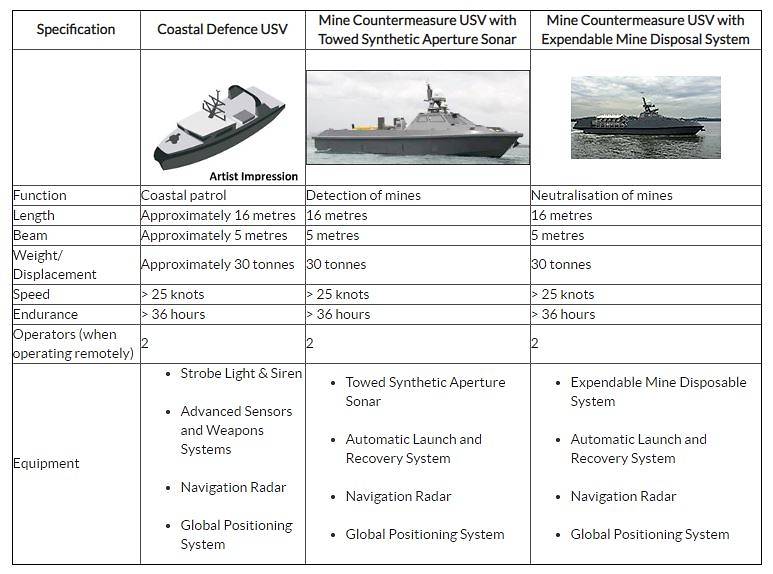
MINDEF also revealed in March that the RSN was developing three types of USVs to counter mines and conduct coastal patrols. In the latter role, the USVs will eventually replace RSN’s littoral mission vessels, allowing the ships to be deployed farther and more strategically for complex missions.
The RSN is developing three unmanned surface vessels that can perform their tasks “at much lower cost and with less manpower” than manned platforms. (Table: MINDEF)
What makes the Venus 16 suitable in a mothership system is its size and ability to play multiple roles, industry players said.
Its 16m length means it is small enough to fit in a mothership, yet big enough to carry a remotely operated gun for force protection and an additional payload depending on the mission. Size also matters when navigating choppy seas and carrying enough fuel to stay out longer.
For mine clearing missions, a Venus 16 can be fitted with a towed sonar to detect mines, while another can carry an expendable robot to dispose mines. For anti-submarine missions, a dipping sonar can be attached to detect submarines ahead of the mothership.
“Our design is so flexible that the same platform can be used to integrate different types of payloads,” ST Engineering vice-president, marine technology and solutions Ng Tee Guan told CNA.
Dr Ng said the Venus 16 unmanned surface vessel helps “reduce risk exposure for soldiers and improve manpower efficiency”. (Photo: Facebook/Ng Eng Hen)
The Venus 16 can also be used for patrols and search and rescue, said Ho Kah Tong, ST Engineering vice-president of unmanned maritime systems, large-scale systems group.
Operators can plot a circuit and go hands off as the boat automatically plies the route and avoids obstacles, all while using day and night cameras to send information back to the mothership.
The various unmanned boats and drones that could potentially fit in a mothership system.
When the Venus 16 is in open sea and there’s not enough communication bandwidth to send huge amounts of imaging data, its sensors can choose to only relay basic identification data, like the shape of a structure or the type of a ship.
Back at the mothership’s command centre, a visualisation engine will use the data to reconstruct 3D video showing what’s around the Venus 16. This lets operators see buildings on shore or a warship passing by, allowing them to maintain situational awareness.
But Mr Ho said the visualisation engine is still under development as it requires a lot of artificial intelligence and machine learning.
AUTONOMOUS UNDERWATER VEHICLE
With the sea surface covered, the attention now turns to the sub-surface.
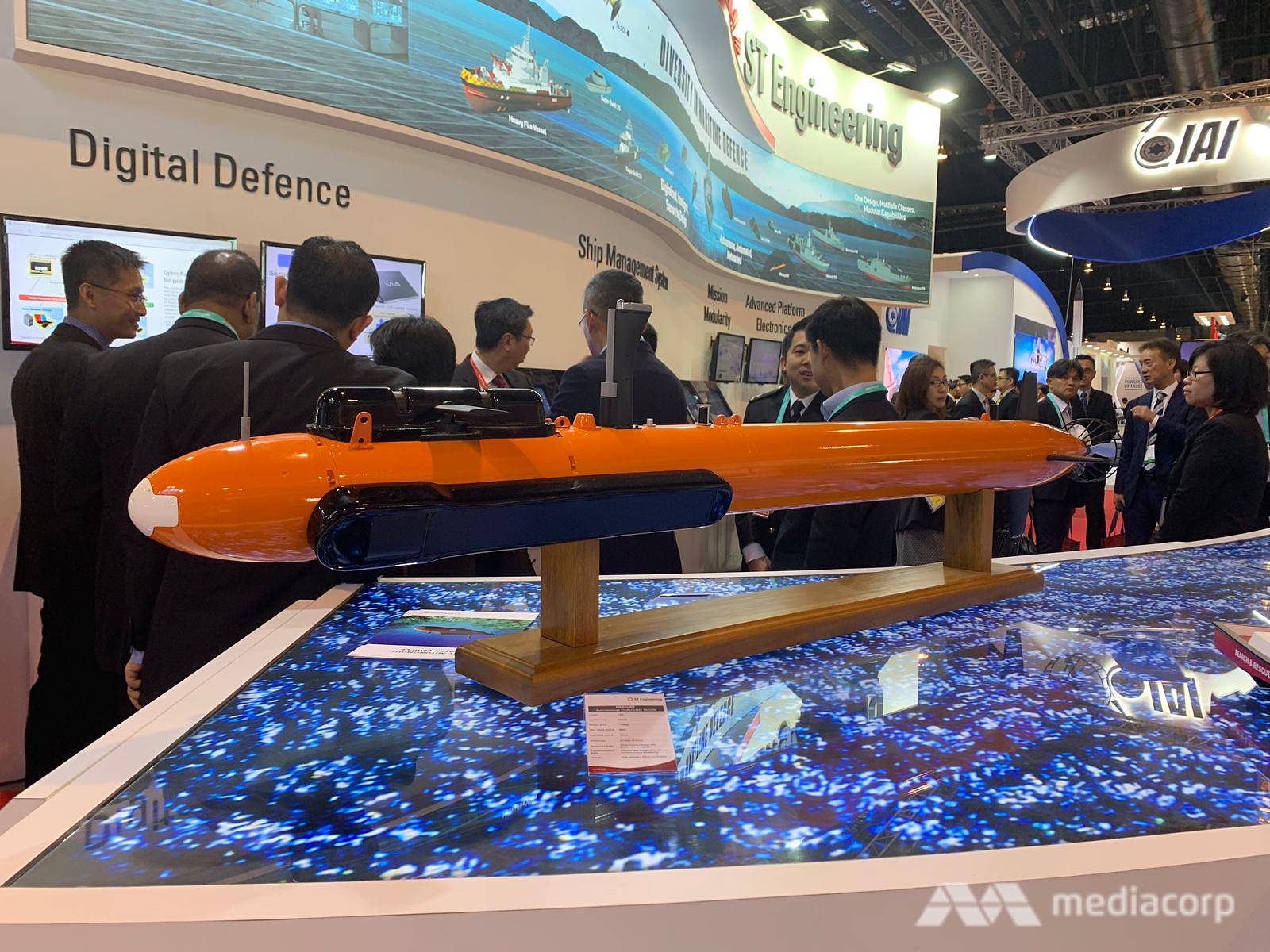
One possible unmanned underwater system for a mothership is ST Engineering’s Mercury autonomous underwater vehicle (AUV), designed to scan the seabed for mines.
The Mercury autonomous underwater vehicle can carry high-frequency and dual-frequency synthetic aperture sonars. (Photo: Aqil Haziq Mahmud)
With its integrated sensors, the Mercury can navigate and detect mines in congested waters better than mine-countering USVs, which move with a sonar in tow. The Mercury is also designed for shallower waters, where currents are stronger and mines are usually deployed.
“When you’re at the 10m-depth region, that’s where you have surface wash and underwater currents, sometimes in different directions,” ST Engineering deputy department manager, maritime comms and systems division Jay Poh told CNA.
“So, these kinds of counter dynamics make stability an issue. But we have perfected this AUV, tested it for more than seven years in Singapore.”
Besides countering mines, the Mercury can be used for harbour security as well as search and salvage operations. Future applications include anti-submarine warfare.
“We are payload agnostic,” Mr Poh added. “Depending on concept of operations, we can then work with payload suppliers to package within our form factor.”
The Mercury’s intentionally small diameter also allows it to fit common ship configurations and be deployed from any ship with a one-tonne crane. Launch and recovery is remotely driven using a portable 10-inch tablet.
UNMANNED AERIAL VEHICLE
When it comes to pairing motherships with UAVs, the RSN has already done so with its missile corvette and ScanEagle, effectively extending the ship’s vision by about 100km.
Three of the RSN’s missile corvettes are equipped with ScanEagles. (Graphic: Republic of Singapore Navy)
But the ScanEagle, by Boeing-owned UAV manufacturer Insitu, is already into its third iteration. According to Insitu’s website, the ScanEagle 3 has double the payload capacity to collect and analyse more data in a single flight.
An Insitu spokesperson was unavailable for comment when CNA visited its booth at IMDEX 2019.
However, another industry player said major navies buying new frigates or corvettes are choosing to pair them with bigger and more robust UAVs that can see even farther.
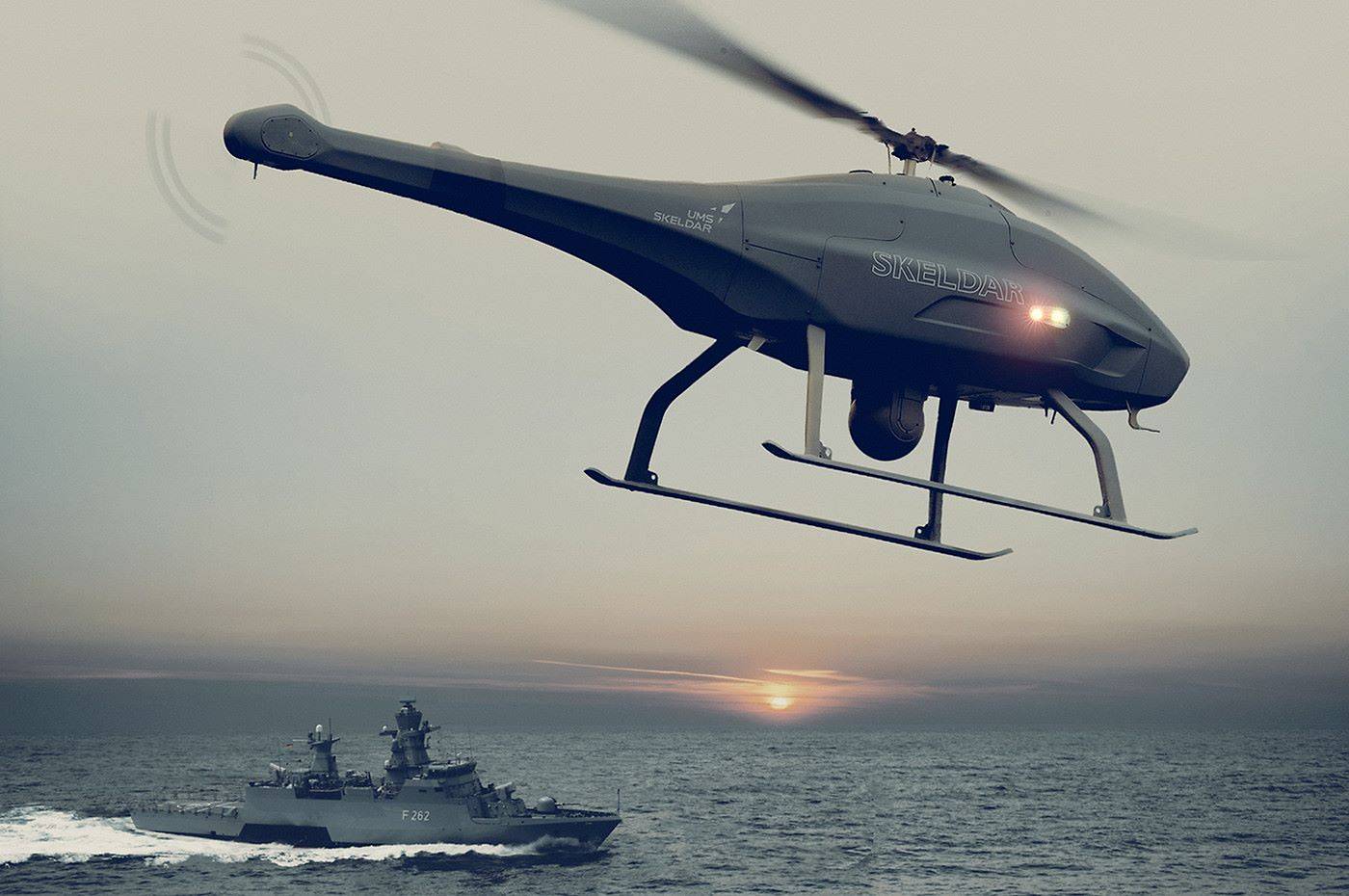
The Skeldar V-200’s payload can include a ground moving target indicator radar, hyper-spectral cameras and ViDAR, a type of radar that covers much more area. (Photo: Facebook/Saab Australia)
One such option is the Skeldar V-200, a helicopter-like UAV that carries more high-performance sensors and transmitters to send information from as far as 200km away.
“If you are meeting a threat who has a system like this, they would have a direct advantage over you,” said Richard Hjelmberg, executive sales director at UMS Skeldar, a joint venture involving Swedish defence company Saab. “They would see you before you see them.”
Beyond its superior surveillance capabilities, the Skeldar-V200 can also take off and land vertically and autonomously, all with the push of a few buttons. No bulky launch and recovery equipment is needed; only a conventional helipad fixed with a rubber pad and auto landing sensors.
“From landing, it takes only 30 seconds until the rotor stops,” Mr Hjelmberg added. “So, it’s easy for the ship’s crew to moor it down or take it into the bay.”
THE MOTHERSHIP
And then there’s the mothership itself.
At IMDEX 2019, ST Engineering unveiled its Vanguard 130, a multi-role warship capable of deploying a wide array of unmanned systems like the USV, AUV and UAV.
In a media release, the company described the ship as a “good fit for ship operators looking for enhanced cost efficiencies and flexible ship deployment”.
Compared to modern frigates, it can also operate with a “quite significant reduction” in manpower, ST Engineering senior vice-president, engineering design centre Mathai Pambrakaran told CNA.
The Vanguard 130 is a multi-role combatant capable of deploying unmanned systems and weapons like surface-to-air missiles, anti-ship missiles and torpedo launchers. (Graphic: ST Engineering)
Mr Pambrakaran said the ship can carry two Venus 16 USVs, two Mercury AUVs and two ScanEagle UAVs. It also has a mission bay capable of holding smaller USVs and manned boats.
USVs and AUVs can be deployed from flushed doors on the side or a ramp at the rear, while UAVs can vertically take-off or be launched from a helipad on the aft deck.
“We have manned and unmanned teaming, and this platform is acting as a hub to coordinate those kind of activities,” he added, noting that the ship can use all-dimensional weapons to deal with threats from the sea, air and underwater.
The Vanguard 130 will also use a phased array radar which doesn’t spin like conventional radars, eliminating moving parts and reducing maintenance costs. “We use a lot of new technology on this platform,” Mr Pambrakaran stated. “Cyber security, data analytics – it’s an intelligent ship.”
A DIFFERENT VIEW
But the mothership concept has its limitations.
One industry player said the launch and recovery of USVs from motherships is “inherently dangerous and difficult”, especially if sea conditions are extremely rough. Furthermore, operators on the mothership would have an extra task of monitoring unmanned systems.
“Here you are looking at the other pictures – doing surveillance, anti-submarine warfare – and you still got to worry about two USVs which you just let go six hours ago,” said James Soon, president of local USV manufacturer Zycraft.
For patrol missions, USVs which use conventional radio communications are also limited by the distance from which they can send information back, he stated, noting that it’s not very strategic for them to be so close to the mothership.
“If you are a mothership and you are sending a USV 12 miles out, 12 miles is still within the radar horizon of the mothership,” he added. “Why do you go so far out just to launch a boat that goes another 12 miles out?”
The Vigilant independent unmanned surface vessel comes with a gyroscopic stabiliser to move steadily through rough seas. (Photo: Aqil Haziq Mahmud)
Instead, Zycraft’s Vigilant USV uses satellite communications, meaning it can conduct surveillance from almost limitless distances. It also uses a smaller engine and propulsion system that burn fuel slower, so it can stay out at sea for 25 days at slower speeds.
But because the Vigilant is about 17m long, Mr Soon said it would not fit in most motherships – not like he sees the need to.
“If I want to send a USV to operate 200 miles from Singapore, why do I have to use a mothership? I can drive the USV there and leave it there for 20 days,” he added.
ST Engineering is also developing the 45m-long, long-endurance USV (LEUSV), which it said can stay out at sea for more than 45 days. (Graphic: ST Engineering)
Mr Soon believes that a USV with the right size – not too small that it can’t hold much, but not too big that it can be spotted from far away – can be an effective warship killer when operated from land.
According to Mr Soon, a 17m-long USV like the Vigilant has enough payload space to hold a substantial amount of fuel and small missiles with a range of about 10 miles (16km).
“We can see a warship at 10 miles, we can take out a warship at 10 miles,” he said, noting that a warship’s guns would not be able to reach that kind of range, while its missiles would likely not be wasted on low-value targets like USVs.
“They won’t know it’s coming, and by the time they realise it’s coming, it’s too late.”
SINGAPORE: The narratives surrounding Singlish has dominated both the public and academic imagination.
Singlish has had her share of supporters and detractors. Supporters of Singlish believe that Singlish is a language that binds Singaporeans together as it is built on a shared common Singaporean identity.
Detractors of Singlish hold the belief that Singlish is “bad English”, and that this corrupted form of English will make Singaporeans come across as less intelligent or competent.
THE MYTHS ABOUT SPEAKING SINGLISH
As a linguist working on languages in Singapore, I have lost count of how often I have been approached to comment on how Singlish is the reason why Singaporeans cannot speak good English.
Of course, some people are better than others at learning languages, but that is an issue of one’s language learning abilities, and has nothing to do with the languages themselves.
To ask if speaking Singlish makes it difficult for people to speak English is akin to asking if speaking Spanish would be detrimental to the learning of Greek. It is, to my mind, curious and ludicrous.
This essentially means that people cannot be bilingual or multilingual, and we in Singapore in particular know this is not true.
It frustrates me greatly that this refusal to delink Singlish and English is present also in academic circles. We have now seen a good five decades of academic research on “Singlish”, “Singaporean English”, “Singapore English”, and numerous other terms that people have come up with.
Two young women talking. (Photo: Unsplash/Trung Thanh)
SINGLISH IS NOT SINGAPORE ENGLISH
Most linguists like to refer to Singlish as the “colloquial” form of Singapore English. Singlish, by this definition, sits on the opposite end of the same continuum as Singapore English.
Singapore English is the “standard” form of English, whose syntax and lexicon are not distinctly different from other “standard” British, American or Australian varieties.
What sets Singapore English apart from other Englishes is primarily in its phonology and how a native Singaporean sounds when speaking English.
To put it simply, Singapore English has most of the syntactic and lexical features that most will consider to be “standard” English, but yet sounds distinctly different to other Englishes.
Not unlike the treatment Singlish has received from the language police, linguistic purists, and the Singapore Government, Singlish has also taken a few beatings in scholarly discourse of earlier days.
Early linguists such as John Platt and Heidi Weber, both of whom were non-Singaporeans based in Singapore in the 1960s and 1970s, referred to Singlish as a product of imperfect learning and spoken only by the uneducated and uncouth. This deprecating perception of Singlish, unfortunately, is exactly the one still held by many.
Luckily, such a position has been shown to be outdated and erroneous within academia. Today, most scholars working on Singapore English and Singlish prefer to think of them as variants of English used by the Singaporean community.
The high life: Singapore is the most expensive city in the world, for the fifth year running, according to an annual cost of living survey published in 2018. (Photo: AFP/Roslan Rahman)
Singapore English has been considered then to be the “high” variety, acquired through formal education, is used in written and formal contexts and is in complementary distribution with Singlish, which is considered to be the everyday “low” variety used only in informal communication. Speakers then use Singapore English and Singlish in appropriate contexts and exploit them for functional purposes.
This view is attractive because it treats the use of Singlish as a matter of personal choice rather than as a function of a speaker’s educational level. It is with this perspective that Singlish is considered to be a colloquial variety of the “standard” Singapore English.
WHY DOES SINGLISH NEED TO CLAIM LINEAGE TO ENGLISH?
There is nothing intrinsically problematic with this view except to say that Singlish is a colloquial variety of Singapore English presupposes that Singlish is some variant or offspring of English.
And for some linguists, to accommodate Singlish on the same cline as Singapore English is a victory as Singlish can now claim to share a genetic relationship to this thing called English.
According to prominent evolutionary linguist Salikoko Mufwene, to deny language varieties like African American Vernacular English, Gullah English, or Old Amish English the status of English is itself a disenfranchising treatment.
Two elderly men walking at a void deck in Singapore. (File photo: Gaya Chandramohan)
To say that Singlish is not English therefore, to follow Mufwene’s line of argument, is tantamount to saying that Singlish is an illegitimate child who has no right to claim lineage from the parent language.
I think it is important for Singlish to claim lineage because it will then allow us to understand the evolution of Singlish, and this is a particularly exciting research exercise.
Understanding the development of Singlish can also give us some insights into the ways in which the languages and cultures in Singapore have come together.
But I do not think it is particularly useful for Singlish to stake a strong genetic relationship to English. All languages evolve and develop on the basis on language contact – some more, some less.
No language is the outcome of a single parent, or as Salikoko Mufwene put it more evocatively, one cannot assume that no intercourse was necessary with other languages prior to the production of offspring.
We certainly do not expect a child to be exactly like one of their parents.
Singlish may or may not have English as one of her parents, but we should not expect Singlish to be English. In fact, to place such a strong genetic relationship between English and Singlish is problematic because it places an unnecessary premium on English.
It is as if English is the superior authority, and that it is only by having a claim of lineage to English can Singlish gain legitimacy as a language. And it is precisely the refusal to delink Singlish from English that the Singaporean government as well as many others has had trouble conceptualising and accepting Singlish as a legitimate language.
Singlish edition of Google Assistant in action. (Photo: Google)
If Singlish is not a variant of Singapore English, then Singlish is not English, good or bad.
My solution to this conundrum is really quite straightforward. We have two very distinctive “Singaporean” linguistic products here, namely Singapore English, and Singlish.
Singapore English is English spoken with a Singaporean accent, and when written, is formal and not unlike other standard varieties of English around the world.
To build on the family tree metaphor, Singapore English is a sibling of other Englishes around the world.
Singlish, on the other hand, is a completely different language whose DNA we can discuss in other forums and avenues.
Singlish is not a type of English, nor Chinese, nor Malay. It is simply Singlish.
Dr Tan Ying Ying is Associate Professor of Linguistics and Multilingual Studies at the School of Humanities in Nanyang Technological University. She is a Singaporean linguist working on languages in Singapore and is a native speaker of Singlish.